EP0221376A2 - N-substituierte Diphenylpiperidine - Google Patents
N-substituierte Diphenylpiperidine Download PDFInfo
- Publication number
- EP0221376A2 EP0221376A2 EP86113837A EP86113837A EP0221376A2 EP 0221376 A2 EP0221376 A2 EP 0221376A2 EP 86113837 A EP86113837 A EP 86113837A EP 86113837 A EP86113837 A EP 86113837A EP 0221376 A2 EP0221376 A2 EP 0221376A2
- Authority
- EP
- European Patent Office
- Prior art keywords
- pyridine
- piperidinyl
- formula
- acid
- diphenylethenyl
- Prior art date
- Legal status (The legal status is an assumption and is not a legal conclusion. Google has not performed a legal analysis and makes no representation as to the accuracy of the status listed.)
- Granted
Links
- QMFJIJFIHIDENY-UHFFFAOYSA-N CC1=CC=CCC1 Chemical compound CC1=CC=CCC1 QMFJIJFIHIDENY-UHFFFAOYSA-N 0.000 description 1
Classifications
-
- C—CHEMISTRY; METALLURGY
- C07—ORGANIC CHEMISTRY
- C07D—HETEROCYCLIC COMPOUNDS
- C07D211/00—Heterocyclic compounds containing hydrogenated pyridine rings, not condensed with other rings
- C07D211/04—Heterocyclic compounds containing hydrogenated pyridine rings, not condensed with other rings with only hydrogen or carbon atoms directly attached to the ring nitrogen atom
- C07D211/06—Heterocyclic compounds containing hydrogenated pyridine rings, not condensed with other rings with only hydrogen or carbon atoms directly attached to the ring nitrogen atom having no double bonds between ring members or between ring members and non-ring members
- C07D211/08—Heterocyclic compounds containing hydrogenated pyridine rings, not condensed with other rings with only hydrogen or carbon atoms directly attached to the ring nitrogen atom having no double bonds between ring members or between ring members and non-ring members with hydrocarbon or substituted hydrocarbon radicals directly attached to ring carbon atoms
- C07D211/18—Heterocyclic compounds containing hydrogenated pyridine rings, not condensed with other rings with only hydrogen or carbon atoms directly attached to the ring nitrogen atom having no double bonds between ring members or between ring members and non-ring members with hydrocarbon or substituted hydrocarbon radicals directly attached to ring carbon atoms with substituted hydrocarbon radicals attached to ring carbon atoms
-
- A—HUMAN NECESSITIES
- A61—MEDICAL OR VETERINARY SCIENCE; HYGIENE
- A61K—PREPARATIONS FOR MEDICAL, DENTAL OR TOILETRY PURPOSES
- A61K31/00—Medicinal preparations containing organic active ingredients
- A61K31/33—Heterocyclic compounds
- A61K31/395—Heterocyclic compounds having nitrogen as a ring hetero atom, e.g. guanethidine or rifamycins
- A61K31/435—Heterocyclic compounds having nitrogen as a ring hetero atom, e.g. guanethidine or rifamycins having six-membered rings with one nitrogen as the only ring hetero atom
- A61K31/44—Non condensed pyridines; Hydrogenated derivatives thereof
- A61K31/445—Non condensed piperidines, e.g. piperocaine
-
- A—HUMAN NECESSITIES
- A61—MEDICAL OR VETERINARY SCIENCE; HYGIENE
- A61K—PREPARATIONS FOR MEDICAL, DENTAL OR TOILETRY PURPOSES
- A61K31/00—Medicinal preparations containing organic active ingredients
- A61K31/33—Heterocyclic compounds
- A61K31/395—Heterocyclic compounds having nitrogen as a ring hetero atom, e.g. guanethidine or rifamycins
- A61K31/435—Heterocyclic compounds having nitrogen as a ring hetero atom, e.g. guanethidine or rifamycins having six-membered rings with one nitrogen as the only ring hetero atom
- A61K31/44—Non condensed pyridines; Hydrogenated derivatives thereof
-
- A—HUMAN NECESSITIES
- A61—MEDICAL OR VETERINARY SCIENCE; HYGIENE
- A61K—PREPARATIONS FOR MEDICAL, DENTAL OR TOILETRY PURPOSES
- A61K31/00—Medicinal preparations containing organic active ingredients
- A61K31/33—Heterocyclic compounds
- A61K31/395—Heterocyclic compounds having nitrogen as a ring hetero atom, e.g. guanethidine or rifamycins
- A61K31/495—Heterocyclic compounds having nitrogen as a ring hetero atom, e.g. guanethidine or rifamycins having six-membered rings with two or more nitrogen atoms as the only ring heteroatoms, e.g. piperazine or tetrazines
- A61K31/505—Pyrimidines; Hydrogenated pyrimidines, e.g. trimethoprim
-
- A—HUMAN NECESSITIES
- A61—MEDICAL OR VETERINARY SCIENCE; HYGIENE
- A61P—SPECIFIC THERAPEUTIC ACTIVITY OF CHEMICAL COMPOUNDS OR MEDICINAL PREPARATIONS
- A61P3/00—Drugs for disorders of the metabolism
- A61P3/06—Antihyperlipidemics
-
- A—HUMAN NECESSITIES
- A61—MEDICAL OR VETERINARY SCIENCE; HYGIENE
- A61P—SPECIFIC THERAPEUTIC ACTIVITY OF CHEMICAL COMPOUNDS OR MEDICINAL PREPARATIONS
- A61P5/00—Drugs for disorders of the endocrine system
- A61P5/38—Drugs for disorders of the endocrine system of the suprarenal hormones
Definitions
- the invention further relates to a process for the preparation of these compounds, new intermediates occurring in this process, and medicaments based on the said compounds.
- lower alkoxy means a straight-chain or branched group having 1-7 C atoms, such as methoxy, ethoxy, propoxy, isopropoxy, n-butoxy, t-butoxy, pentoxy and hexyloxy.
- Alkylene preferably denotes a straight-chain or branched group with 1-12, in particular 4-10 C atoms, such as methylene, ethylene, propylene, butylene, pentylene, hexylene, heptylene, octylene, nonylene, decylene or dodecylene.
- Halogen means chlorine, bromine, iodine and fluorine.
- Het preferably denotes 3-pyridyl, 5, pyrimidinyl or 1-imidazolyl.
- salts of the compounds of formula I are those with pharmaceutically usable inorganic acids, e.g. Hydrohalic acid, such as hydrochloric, hydrobromic or hydroiodic acid, sulfuric acid, phosphoric acid or nitric acid, or with organic acids, white tartaric acid, citric acid, fumaric acid, camphorsulfonic acid, methanesulfonic acid, toluenesulfonic acid, salicylic acid, ascorbic acid, maleic acid or mandelic acid.
- Preferred salts are the hydrohalides, especially the hydrochlorides, and the maleates, fumarates and methanesulfonates.
- the compounds of formula I and their salts can be prepared by using a compound of formula with a halide of the formula Hal-R2-Het, in which R1 to R4 and Het have the above meaning, if desired, a compound of the formula I obtained, in which R2 contains a carbonyl group, to the corresponding compound of formula I, wherein R2 is alkylene, reduced and, if desired, isolating a free base of formula I obtained in the form of a salt with a pharmaceutically acceptable acid.
- a compound of formula with a halide of the formula Hal-R2-Het in which R1 to R4 and Het have the above meaning, if desired, a compound of the formula I obtained, in which R2 contains a carbonyl group, to the corresponding compound of formula I, wherein R2 is alkylene, reduced and, if desired, isolating a free base of formula I obtained in the form of a salt with a pharmaceutically acceptable acid.
- the reaction of a compound of formula II with a halide Hal-R2-Het can be carried out in a manner known per se, e.g. be carried out in a solvent in the presence of a base.
- a base e.g. Tetrahydrofuran (THF), benzene or toluene.
- the base used is e.g. Pyridine or triethylamine, and the reaction temperature is advantageously about 0 ° C to reflux temperature, in particular 0 ° C.
- the solvent used is e.g.
- a base e.g. anhydrous sodium carbonate
- a sodium alkoxide such as sodium methoxide
- an aqueous alkali metal hydroxide such as sodium hydroxide
- the optional reduction of a compound of formula I can be carried out in a manner known per se, e.g. in a solvent such as THF or a hydrocarbon e.g. Toluene or benzene, with a hydride such as lithium aluminum hydride or sodium bis (2-methoxyethoxy) aluminum hydride, at a temperature from about 0 ° C to the reflux temperature, preferably at room temperature.
- a solvent such as THF or a hydrocarbon e.g. Toluene or benzene
- a hydride such as lithium aluminum hydride or sodium bis (2-methoxyethoxy) aluminum hydride
- the salts of the compounds of the formula I are preferably prepared in a solvent, for example ethanol, acetone or acetonitrile, by reacting the free base with the corresponding anhydrous acid.
- a solvent for example ethanol, acetone or acetonitrile
- You can in a conventional manner by hydrogenating a pyridine derivative of the formula where R3 and R4 have the above meaning, to the corresponding piperidine derivative, followed by dehydration of the latter to the corresponding compound of formula II-a, in which R a is C CH, and if desired, hydrogenation to the compound of formula II-a, in which R a is CH-CH2.
- the hydrogenation of a compound of the formula III can be carried out in a manner known per se, for example in a solvent such as glacial acetic acid, in the presence of a hydrogenation catalyst, for example platinum oxide, with hydrogen, for example under a pressure up to about 100 psi, preferably about 50 psi. and at a temperature in the range of about 0 to about 100 ° C, preferably about 25-50 ° C.
- a hydrogenation catalyst for example platinum oxide
- the piperidine derivative obtained can be dehydrated in the presence of trifluoroacetic acid or with an acid such as toluenesulfonic acid in a hydrocarbon, such as toluene or benzene, at a temperature in the range from about 0 ° C to about 50 ° C, preferably at about 25 ° C , accomplish
- the optional hydrogenation of a compound of formula II-a can be carried out in a solvent, e.g. an alkanol, such as ethanol, using a white 10% Pd / C catalyst, in the presence of hydrogen under ordinary pressure and at a temperature of 25 ° C.
- a solvent e.g. an alkanol, such as ethanol
- the compounds of the formulas II in which R1 is CH, III and Hal-R2-Het are known or can be prepared by methods known per se.
- the halides Hal-R2-Het, where R2 is alkylene can be obtained by halogenation of the corresponding alcohols, e.g. with thionyl chloride, in a solvent such as a halogenated hydrocarbon e.g. Produce methylene chloride, or a hydrocarbon such as benzene or toluene, at a temperature in the range from about 0 ° to the reflux temperature, preferably at the reflux temperature.
- a solvent such as a halogenated hydrocarbon e.g. Produce methylene chloride, or a hydrocarbon such as benzene or toluene
- the compounds of formula I and their pharmaceutically usable acid addition salts have insulin-lowering activity and can therefore be used as agents for the treatment of obesity.
- This effectiveness can be demonstrated by methods known per se, for example as described in US Pat. No. 4,500,540, by comparing the insulin secretion before and after perfusion of the isolated rat pancreas with the test compound.
- the results are shown in Table I as an inhibition index, an inhibition index of more than 1 being the complete Hem Insulin secretion means.
- Table I also shows the results of glucose clearance.
- the glucose levels are determined on the one hand immediately before the administration of glucose to Sprague-Dawley rats and on the other hand 30, 60 and 90 minutes after the administration of glucose.
- active compounds increase the glucose level. Since the glucose level peaks 30 minutes after administration of the glucose, the difference between the glucose level in controls and in treated rats 30 minutes after administration is used as an index of activity. The results are given in% of the controls, whereby substances with an index of more than 100% are effective.
- the compounds of the formula I can be administered as medicaments, for example in the form of pharmaceutical preparations which they contain together with a compatible organic or inorganic inert carrier.
- suitable organic or inorganic inert carrier are water, gelatin, lactose, starch, magnesium stearate, talc, vegetable oils, rubber or polyalkylene glycols.
- the pharmaceutical preparations can be suitable for enteral, for example oral or parenteral, administration and can be in solid form, for example as tablets, dragées, suppositories or capsules, or in liquid form, for example as solutions, suspensions or emulsions.
- the pharmaceutical preparations can be sterilized and / or auxiliaries such as preservatives, stabilizers, wetting agents or emulsifiers, salts for generating an osmotic pressure or buffers. They can also contain other therapeutically active substances.
- the pharmaceutical dosage amounts may contain about 250 to 500 mg of a compound of formula I or a pharmaceutically acceptable acid addition salt thereof.
- Oral dosage levels can range from about 5 to about 30 mg / kg / day.
- Example 7 Analogously to Example 7, 5.0 g of the product from Example 2 and 7.2 ml of a 3.5M solution of sodium bis (2-methoxyethoxy) aluminum hydride in toluene, 4.4 g of 3- [4- [4- (2, 2-Diphenylvesthenyl) -1-piperidinyl] butyl] pyridine, mp. 54-46 ° C obtained. These were dissolved in 50 ml of hot ethanol and treated with 1.28 g of fumaric acid. After dilution with 50 ml of ether, 4.1 g (67%) of fumarate were obtained, M.p. 163-165 ° C.
- Example 7 Analogously to Example 7, 7.4 g of the product from Example 4 and 10.0 ml of a 3.5M solution of sodium bis (2-methoxyethoxy) aluminum hydride in toluene gave 7.4 g of free base in the form of an oil. The free base was treated as in Example 9 and 8.4 g (92%) of 3- [5- [4- (2,2-diphenylethenyl) -1-piperidinyl] pentyl] pyridine - (1: 1) - were obtained. (E) -2-butenedioate, mp 160-161 ° C (decomposed).
- Example 7 Analogously to Example 7, from 6.1 g of the product from Example 5 and 9 ml of a 3.5M solution of sodium bis (2-methoxyethoxy) aluminum hydride in toluene, 5.4 g (90%) of the free base 3- [ 4- [4- (2-2-Diphenylethyl) -1-piperidinyl] -butyl] pyridine, mp 62-64 ° C. after crystallization from hexane. A solution of 5.25 g of the free base and 1.53 g of fumaric acid in 30 ml of hot methanol was diluted with 50 ml of ether and cooled. 6.4 g (96%) of the fumarate, mp 146-148 ° C., were obtained.
- Example 7 Analogously to Example 7, from 11.6 g of the product of Example 6 and 30 ml of a 3.4M solution of sodium bis (2-methoxyethoxy) aluminum hydride, 7.4 g (65%) of free base were obtained in the form of an oil . A solution of 7.4 g of the free base and 2.0 g of fumaric acid in 50 ml of methanol was diluted with ethyl acetate and cooled.
- Example 14 Analogously to Example 14, 8.64 g of 4- (2,2-diphenylethenyl) piperidine and 7.4 g of 3- (8-chloroctyl) pyridine, 11.0 g (74%) of 3- [8- [4- (2,2-Diphenylvesthenyl) -1-piperidinyl] octyl] pyridine, mp. 54-55 ° C after recrystallization from hexane. The fumarate was crystallized from ethanol / acetone, mp 128-129 ° C.
- Example 7 Analogously to Example 7, 6.5 g of the product from Example 21 and 7.7 ml of a 3.5M solution of sodium bis (2-methoxyethoxy) aluminum hydride in toluene, 3- [9- [4-2 (2, 2-Diphenylvesthenyl) -1-piperidinyl] -nonyl] pyridine, mp. 51-53 ° C after crystallization from hexane. After evaporation of the hexane filtrates, 5.9 g of a product were obtained which, after being dissolved in 25 ml of hot methanol, was treated with 1.47 g of fumaric acid.
- Tablets and capsules of the following composition were produced in a manner known per se:
Landscapes
- Health & Medical Sciences (AREA)
- Chemical & Material Sciences (AREA)
- Public Health (AREA)
- Animal Behavior & Ethology (AREA)
- Veterinary Medicine (AREA)
- General Health & Medical Sciences (AREA)
- Life Sciences & Earth Sciences (AREA)
- Pharmacology & Pharmacy (AREA)
- Medicinal Chemistry (AREA)
- Epidemiology (AREA)
- Organic Chemistry (AREA)
- Engineering & Computer Science (AREA)
- Chemical Kinetics & Catalysis (AREA)
- Diabetes (AREA)
- Bioinformatics & Cheminformatics (AREA)
- Nuclear Medicine, Radiotherapy & Molecular Imaging (AREA)
- General Chemical & Material Sciences (AREA)
- Endocrinology (AREA)
- Hematology (AREA)
- Obesity (AREA)
- Hydrogenated Pyridines (AREA)
- Plural Heterocyclic Compounds (AREA)
- Pharmaceuticals Containing Other Organic And Inorganic Compounds (AREA)
Abstract
Description
- Die Erfindung betrifft neue N-substituierte Diphenylpiperidine der Formel
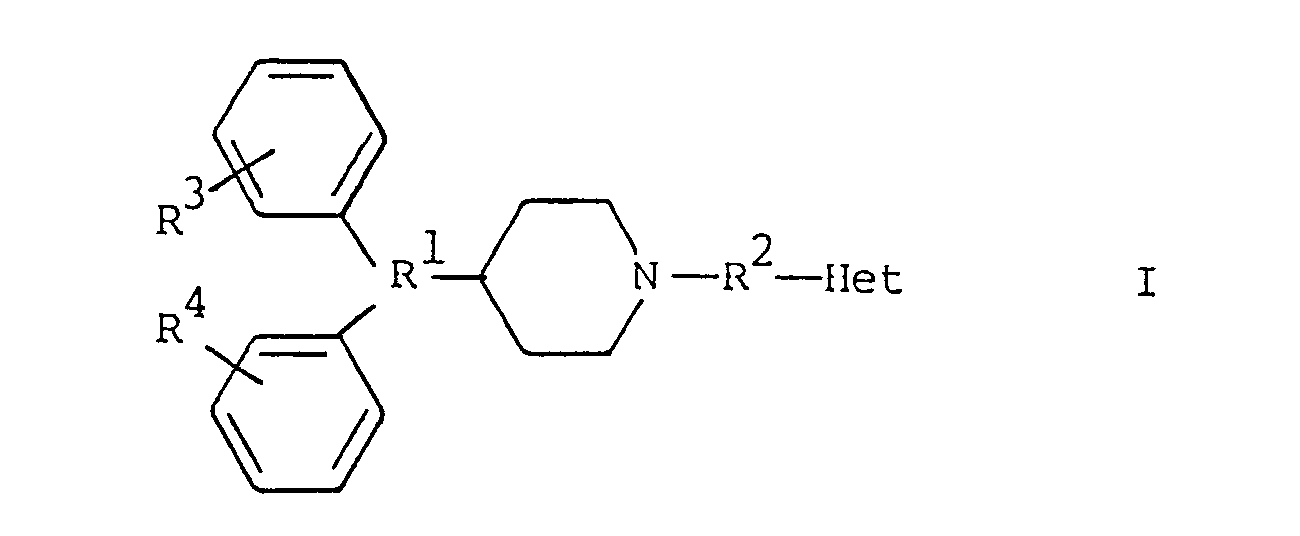
R¹ CH, C=CH oder CH-CH₂
R² Alkylen oder CO-(CH₂)n, n 0 bis 11,
R³ und R⁴ Wasserstoff, Halogen oder nieder-Alkoxy,
Het Pyridyl, Pyrimidinyl order Imidazolyl sind,
und Salze davon mit pharmazeutisch verwendbaren Säuren. - Die Erfindung betrifft ferner ein Verfahren zur Herstellung dieser Verbindungen, neue in diesem Vefahren vorkommende Zwischenprodukte, sowie Medikamente auf der Basis der besagten Verbindungen.
- Im Rahmen der Erfindung bedeutet "nieder-Alkoxy" eine geradkettige oder verzweigte Gruppe mit 1-7 C-Atomen, wie Methoxy, Aethoxy, Propoxy, Isopropoxy, n-Butoxy, t-Butoxy, Pentoxy und Hexyloxy. "Alkylen" bezeichnet vorzugsweise eine geradkettige oder verzweigte Gruppe mit 1-12, insbesondere 4-10 C Atome, wie Methylen, Aethylen, Propylen, Butylen, Pentylen, Hexylen, Heptylen, Octylen, Nonylen, Decylen oder Dodecylen. "Halogen" bezeichnet Chlor, Brom, Jod und Fluor. "Het" bezeichnet vorzugsweise 3-Pyridyl, 5,Pyrimidinyl oder 1-Imidazolyl.
- Beispiele von Salzen der Verbindungen der Formel I sind solche mit pharmazeutisch verwendbaren anorganischen Säuren, z.b. Halogenwasserstoffsäure, wie Chlor-, Brom- oder Jodwasserstoffsäure, Schwefelsäure, Phosphorsäure oder Salpetersäure, oder mit organischen Säuren, wei Weinsäure, Zitronensäure, Fumarsäure, Camphersulfonsäure, Methansulfonsäure, Toluolsulfonsäure, Salicylsäure, Ascorbinsäure, Maleinsäure oder Mandelsäure. Bevorzugte Salze sind die Hydrohalogenide, insbesondere die Hydrochloride, und die Maleate, Fumarate und Methansulfonate.
- Bevorzugte Verbindungen der Formel I sind diejenigen, worin R¹ C=CH und/oder worin R² C1-12-, insbesondere C4-10-Alkylen, und/oder worin R³ und R⁴ Wasserstoff und/oder worin Het Pyridyl sind.
- Beispiele von solchen Verbindungen sind:
- 3-[7-(4-(2,2-Diphenyläthenyl)-1-piperidinyl]heptyl]pyridin (1:1)-(E)-2-butendioat-hemihydrat,
3-[6-[4-(2,2-Diphenyläthenyl)-1-piperidinyl]hexyl] pyridin-(1:1)(E)-2-butendioat,
3-[5-[4-(2,2-Diphenyläthenyl)-1-piperidinyl]pentyl]pyridin (1:1)-(E)-2-butendioat und insbesondere
3-[8-[4-(2,2-Diphenyläthenyl)-1-piperidinyl]-octyl]pyridin und
3-[10-[4-(2,2-Diphenyläthenyl)-1-piperidinyl]decyl]pyridin. - Weitere Beispiele von Verbindungen der Formel I sind:
3-[8-[4-2,2-Bis(3-fluorphenyl)äthenyl]-1-piperidinyl]octyl]pyridin
3-[8-[4-[2,2-Bis(2-fluorphenyl)äthenyl]-1-piperidinyl]octyl]pyridin
1-[6-[4-[2,2-Bis(4-flouorphenyl)äthenyl]-1-piperidinyl]hexyl]-1H-imidazol
3-[8-[4-[2,2-Bis(2-methoxyphenyl)äthenyl]-1-piperidinyl]octyl]pyridin
1-[6-[4-[2,2-Bis(4-methoxyphenyl)äthenyl]-1-piperidinyl]hexyl]-1H-imidazol
5-[6-[4-[2,2-Bis-(3-fluorphenyl)äthenyl]-1-piperidinyl]hexyl]pyrimidin. - Die Verbindungen der Formel I und ihre Salze können dadurch hergestellt werden, dass man eine Verbindung der Formel

- Die Reaktion einer Verbindung der Formel II mit einem Halogenid Hal-R²-Het kann in an sich bekannter Weise, z.B. in einem Lösungsmittel in Gegenwart einer Base durchgeführt werden. Wenn R² eine Carbonylgruppe enthält, verwendet man vorzugsweise ein aprotisches Lösungsmittel, z.B. Tetrahydrofuran (THF), Benzol oder Toluol. Als Base verwendet man in diesem Fall, z.B. Pyridin oder Triäthylamin, und die Reaktionstemperatur beträgt zweckmässig etwa 0°C bis Rückflusstemperatur, insbesondere 0°C. Wenn R² Alkylen ist, verwendet man als Lösungsmittel z.B. Dimethylformamid (DMF), Dimethylsulfoxid oder ein Alkanol, wie Aethanol, und als Base, z.B. wasserfreies Natriumcarbonat, ein Natriumalkoxid, wie Natriummethoxid, oder ein wässriges Alkalimetallhydroxid, wie Natriumhydroxid, und die Reaktionstemperatur beträgt zweckmässig etwa 0°C bis etwa 100°C, insbesondere etwa 50-75°C.
- Die fakultative Reduktion einer Verbindung der Formel I kann man in an sich bekannte Weise durchführen, z.B. in einem Lösungsmittel, wie THF oder einem Kohlenwasserstoff, z.B. Toluol oder Benzol, mit einem Hydrid, wie Lithiumaluminiumhydrid oder Natrium-bis(2-methoxyäthoxy)aluminiumhydrid, bei einer Temperatur von etwa 0°C bis Rückflusstemperatur, vorzugsweise bei Raumtemperatur.
- Die Salze der Verbindungen der Formel I sind vorzugsweise in einem Lösungsmittel, z.B. Aethanol, Aceton oder Acetonitril, hergestellt, indem man die freie Base mit der entsprechenden wasserfreien Säure umsetzt.
- Unter den Verbindungen der Formel II sind diejenigen der Formel

neu und als solche Bestandteil der Erfindung. Sie können in an sich bekannter Weise durch Hydrierung eines Pyridinderivates der Formel
zum entsprechenden Piperidinderivat, gefolgt von Dehydratisierung des letzteren zur entsprechenden Verbindung der Formel II-a, worin Ra C=CH ist, und gewünschtenfalls, Hydrierung zur Verbindung der Formel II-a, worin Ra CH-CH₂ ist. - Die Hydrierung einer Verbindung der Formel III kann man in an sich bekannter Weise durchführen, z.B. in einem Lösungsmittel, wie Eisessig, in Gegenwart eines Hydrierungskatalysators, z.B. Platinoxid, mit Wasserstoff, z.B. unter einem Druck bis zu etwa 100 psi, vorzugsweise etwa 50 psi, und bei einer Temperatur im Bereich von etwa 0 bis etwa 100°C, vorzugsweise etwa 25-50°C.
- Die Dehydratisierung des erhaltenen Piperidinderivates kann man in Gegenwart von Trifluoressigsäure oder mit einer Säure, wie Toluolsulfonsäure, in einem Kohlenwasserstoff, wei Toluol oder Benzol, bei einer Temperatur im Bereich von etwa 0°C bis etwa 50°C, vorzugsweise bei etwa 25°C, bewerkstelligen
- Die fakultative Hydrierung einer Verbindung der Formel II-a kann man in einem Lösungsmittel, z.B. einem Alkanol, wie Aethanol, mittels eines Katalysators wei 10% Pd/C, in Gegenwart von Wasserstoff unter gewöhnlichem Druck und bei einer Temperatur von 25°C durchführen.
- Die Verbindungen der Formeln II, worin R¹ CH ist, III und Hal-R²-Het sind bekannt oder können nach an sich bekannten Methoden hergestellt werden. So kann man die Halogenide Hal-R²-Het, worin R² Alkylen ist, durch Halogenierung der entsprechenden Alkohole, z.B. mit Thionylchlorid, in einem Lösungsmittel, wie einem halogenierten Kohlenwasserstoff, z.B. Methylenchorid, oder einem Kohlenwasserstoff, wie Benzol oder Toluol, bei einer Temperatur im Bereich von etwa 0° bis Rückflusstemperatur, vorzugsweise bei Rückflusstemperatur herstellen.
- Die Verbindungen der Formel I und ihre pharmazeutisch verwendbaren Säureadditionssalze weisen Insulin-erniedrigende Wirksamkeit auf und können daher als Mittel zur Behandlung von Obesitas Verwendung finden. Diese Wirksamkeit kann man nach an sich bekannten Methoden nachweisen, z.B. wie beschrieben in der US-Patentschrift 4 500 540, durch Vergleich der Insulinsekretion vor und nach Perfusion des isolierten Ratten-Pankreas mit der Testverbindung. Die Resultate sind in der Tabelle I als Hemmungsindex wiedergegeben, wobei ein Hemmungsindex von mehr als 1 die vollständige Hem mung der Insulinsekretion bedeutet.
- In der Tabelle I sind auch die Resultate der Glukose-Clearance angegeben. In diesem Test werden die Glukosespiegel einerseits unmittelbar vor der Verabreichung von Glukose an Sprague-Dawley-Ratten und andererseits 30, 60 und 90 Minuten nach Glukoseverabreichung ermittelt. Im Vergleich zu den Kontrollen erhöhen aktive Verbindungen den Glukosespiegel. Da der Glukosespiegel 30 Minuten nach Verabreichung der Glukose einen Maximum erreicht, wird der Unterschied zwischen dem Glukosespiegel bei Kontrollen und bei behandelten Ratten 30 Minuten nach Verabreichung als Index der Aktivität verwendet. Die Resultate sind in % der Kontrollen angegeben, wobei Substanzen mit einem Index von mehr als 100% wirksam sind.

- Die Wirkung der Produkte der Formel I gegen Obesitas wurde an Zuckerratten nach der in der US-Patentschrift 4 500 540 beschriebenen Methode bestimmt. Die Resultate sind in der Tabelle II für die freie Base des Beispiels 16 und in der Tabelle III für die freien Base von weiteren Beispielen angegeben.

- Man kann die Verbindungen der Formel I als Medikamente, z.B. in Form von pharmazeutischen Präparaten, die sie zusammen mit einem verträglichen organischen oder anorganischen inerten Träger enthalten, verabreichen. Beispiele von solchen Trägern sind Wasser, Gelatine, Laktose, Stärke, Magnesiumstearat, Talk, pflanzliche Oele, Gummi oder Polyalkylenglykole. Die pharmazeutischen Präparate können für die enterale, z.B. orale oder parenterale Verabreichung geeignet sein und können in fester Form, z.B. als Tabletten, Dragées, Suppositorien oder Kapseln, oder in flüssiger Form, z.B. als Lösungen, Suspensionen oder Emulsionen, vorliegen. Die pharmazeutischen Präparate können sterilisiert sein und/oder Hilfsstoffe wie Konservierungs-, Stabilisierungs-, Netz- oder Emulgiermittel, Salze zum Erzeugen eines osmotischen Druckes oder Puffer enthalten. Sie können auch weitere therapeutisch wirksame Substanzen enthalten.
- Die pharmazeutischen Dosierungsmengen können etwa 250 bis 500 mg einer Verbindung der Formel I oder eines pharmazeutischen verwendbaren Säureadditionssalzes davon enthalten. Orale Dosierungsmengen können etwa 5 bis etwa 30 mg/kg/Tag betragen.
- Die folgenden Beispiele veranschaulichen die Erfindung.
-
- a) Ein Gemisch von 6,40 l 1,3-Diaminopropan und 15 g Lithiumdraht wurde im Oelbad auf 65°C erhitzt. Zusätzliche 153 g Lithiumdraht wurden portionenweise zugesetzt. Der auf 20°C abgekühlten Lösung wurden 1,56 kg Kalium-t-butoxid zugesetzt. Die Lösung wurde 15 Minuten bei 20°C gerührt. 500 g 3-Octin-1-ol in 100 ml THF wurden zugesetzt. Das Gemisch wurde über Nacht bei 20°C gerührt und dann unter Rühren in 12 l Eiswasser geschüttet. Es wurden 8 l Eis zugesetzt und das Gemisch wurde mit dreimal 8 l Methylenchlorid extrahiert. Die vereinigten Extrakte wurden mit 8 l Wasser, 8 l 1N Salzsäure und 4 l Kochsalzlösung gewaschen und dann getrocknet. Nach Entfernung des Lösungsmittels und Destillation erhielt man 338,2 g (68% Ausbeute) 7-Octin-1-ol in Form einer farblosen Flüssigkeit, Sdp. 104°C/12 mm.
- b) Ein Gemisch von 34,6 g 7-Octin-1-ol, 26,4 ml 3-Brompyridin, 115 ml Triäthylamin und 350 ml Dichlormethan wurde unter Argonstrom gerührt. Dem Gemisch wurden 3,85 g Bis-triphenylphosphin-palladium(II)chlorid und 0,365 g Kupfer(I)jodid zugesetzt und dann wurde das Gemisch über Nacht unter Rückfluss erhitzt. Das abgekühlte Reaktionsgemisch wurde mit Aether verdünnt und die Feststoffe wurden filtriert und mit Aether gewaschen. Die Filtrate wurden mehrmals mit 1N Salzsäure extrahiert und die vereinigten wässrigen Schichten wurden mit Ueberschuss Natriumhydroxid stark basisch gestellt. Das Gemisch wurde mit Dichlormethan extrahiert, getrocknet und eingedampft, wobei man 51 g (91%) rohes 8-(3-Pyridyl)-7-octin-1-ol erhielt. Durch katalytische Hydrierung in 1000 ml Aethanol mittels 5 g 10% Pd/C erhielt man nach Destillation 36 g (72%) 3-Pyridinoctanol, Sdp. 145-152°C/0,3 mm.
Analyse, berechnet für C₁₃H₂₁NO: C, 75,32; H, 10,21; N, 6,76; gefunden: C, 75,13; H, 10,21; N, 6,66. - c) Durch Ersatz von 7-Octin-1-ol durch 3-Butin-1-ol und 5-Hexin-1-ol erhielt man;
- 1) 5-Pyrimidinbutanol, Sdp. 175-180°C/0,3mm.
Analyse, berechnet für C₈H₁₂N₂O: C, 63,13; H, 7,95; N, 18,41; gefunden: C, 62,83; H, 7,98; N, 18,63, bzw. - 2) 5-Pyrimidinhexanol, Sdp. 170-175°C/0,6 mm. Analyse, berechnet für C₁₀H₁₆N₂O: C, 66,63; H, 8,95; N, 15,54; gefunden: C, 66,62; H, 9,15; N, 15,59.
- Einer Lösung von 0,03 Mol des Alkohols von A. in 40 ml Methylenchlorid wurde tropfenweise eine Lösung von 0,04 Mol Thionylchlorid in 10 ml Methylenchlorid zugesetzt. Die entstandene Lösung wurde 1 Stunde unter Rückfluss erhitzt, dann abgekühlt und mit gesättigter Kaliumcarbonatlösung gewaschen. Die organischen Schichten wurden getrocknet und bei 25°C eingedampft. Das entstandene Oel wurde ohne weitere Reinigung in der nächsten Stufe verwendet.
- Auf diese Weise erhielt man aus 145,8 g 3-Pyridinoctanol 191,3 g 3-(8-Chloroctyl)pyridin in Form eines Oels.
- In Eis abgekühltem Thionylchlorid (20 ml) wurden feste Pyridincarbonsäure zugesetzt. Das Gemisch wurde 15 Minuten bei 25°C gerührt und dann aus Toluol mehrmals zur Trockene eingedampft. Das entstandene rohe Säurechlorid-hydrochlorid wurde ohne weitere Reinigung in der nächsten Stufe verwendet.
-
- a) Eine Lösung von 252,5 g 4-Picolin und 2,50 l THF wurde unterhalb von 20°C abgekühlt und bei 15-20°C mit 1,315 l einer Lösung von 1,85M Phenyllithium in 70:30 Cyclohexan:Aether versetzt. Das Gemisch wurde 30 Minuten bei 15-20°C gerührt und dann auf -5-0°C abgekühlt. Bei dieser Temperatur wurde eine Lösung von 494,2g Benzophenon in 1,50 l THF zugesetzt. Das Gemisch wurde dann bei Raumtemperatur 3 Stunden gerührt. Nach Zusatz von 1,0 l deionisiertem Wasser und 2,0 l THF wurde das Gemisch zur Auflösung der Feststoffe erwärmt. Die wässrige Phase wurde abgetrennt und mit 2,0 l THF extrahiert. Die vereinigten organischen Lösungen wurden getrocknet. Das Lösungsmittel wurde abgedampft. Der resultierende Feststoff wurde bei Rückflusstemperatur mit 1,60 l Hexan vermischt. Die Suspension wurde über Nacht bei 4°C aufbewahrt und dann filtriert. Die Feststoffe wurden mit 1,0 l Petroläther gewaschen und getrocknet, wobei man 699,6 g (94% Ausbeute) α,α-Diphenyl-4-pyridinäthanol, Smp. 154-155°C erhielt.
- b) In ähnlicher Weise Wurde α,α-Bis(3-methoxyphenyl)-4-pyridinäthanol, Smp. 134-135°C hergestellt.
-
- a) 40 g α,α-Diphenyl-4-pyridinäthanol wurden unter 50 psi in 500 ml Eisessig mittels 4,0 g Platinoxyd hydriert. Nach Filtrierung und Abdampfen wurde der feste Rückstand in einem heissem Gemisch von Wasser und Toluol gelöst. Ein Ueberschuss an Natriumhydroxidlösung wurde dann zugesetzt und das entstandene Gemisch wurde abgekühlt und filtriert. Das rohe Produkt wurde aus Toluol umkristallisiert, wobei man 32,5 g (80%) α,α-Diphenyl-4-piperidinäthanol, Smp. 153-154°C erhielt. Das Hydrochlorid wurde aus Methanol kristallisiert, Smp. 271°C (Zers.).
- b) Analog erhielt man aus α,α-Bis(4-fluorphenyl)-4-pyridinäthanol α,α-Bis(4-fluorphenyl)-4-piperidinäthanol, Smp. 161-163°C.
- c) In ähnlicher Weise wurde eine Lösung von 63 g α,α-Bis(3-methoxyphenyl)-4-pyridinäthanol in 400 ml Essigsäure mittels 2 g Platinoxid zu 62,5 g α,α-Bis(3-Methoxyphenyl)-4-piperidinäthanol, Smp. 111-113°C hydriert.
- d) In einer Variante des Verfahrens a) wurde 260 g α,α-Diphenyl-4-pyridinäthanol in 3,0 l Aethanol zu 190,65 g (72%) α,α-Diphenyl-4-piperidinäthanol in Gegenwart von 26 g 5% Rh/C als Katalysator hydriert.
-
- a) 20 g α,α-Diphenyl-4-piperidinäthanol wurden in 40 ml wasserfreiem Trifluoressigsäure gelöst und 15 Minuten gerührt. Leicht siedende Stoffe wurden unter Vakuum entfernt und der Rückstand wurde zwischen Toluol und 2N Natriumhydroxidlösung aufgetrennt. Die organischen Schichten wurden getrocknet und eingedampft und der Rückstand wurde aus Hexan zu 17,2 g (92%) 4-(2,2-Diphenyläthenyl)piperidin, Smp. 98-99°C kristallisiert.
- b) Analog wurden aus 25 g α,α-Bis(4-fluorphenyl)-4-piperidinäthanol, 0.25 molarem Methylbenzensolvat und 50 ml Trifluoressigsäure, 19.6 g (83%) des Hexansolvats des 4-[2,2-Bis(4-fluorphenyl)äthenyl]-piperidin, Smp. 84-86°C erhalten.
- c) Analog wurde eine Lösung von 15 g α,α-Bis(3-methoxyphenyl)-4-piperidinäthanol in 30 ml Trifluoressigsäure in 4-[2,2-Bis(3-methoxyphenyl)äthenyl]piperidin, Smp. des Hydrobromid 135,5-137°C umgewandelt.
- d) 15,2 g 4-(2,2-Diphenyläthenyl)piperidin in 500 ml Aethanol wurden mittels 1,5 g 10% Pd/C hydriert. Nach Filtrieren und Eindampfen erstarrte das resultierende Oel in ein tiefsiedendes Wachs. Das 4-(2,2-Diphenyläthyl)-piperidin-hydrochlorid, Smp. 178-179°C wurde aus 2-Propanol/Aether umkristallisiert.
- e) In ähnlicher Weise erhielt man 4-[2,2-Bis(4-fluorphenyl)äthyl]piperidin-hydrochlorid als farbloses Oel.
- Ein Gemisch von 2,0 g 4-Diphenylmethylpiperidin in 5 ml DMF und 4,2 ml Triäthylamin wurde bei 0°C mit einer Lösung von 5 ml DMF und dem aus 2,0 g 3-Pyridinbuttersäure erhaltenem Säurechlorid behandelt. Nach 15 Minuten wurde das Gemisch mit Chlormethan verdünnt, filtriert und zur Trockene eingedampft. Der Rückstand wurde zwischen Toluol und 1N Natriumhydroxid verteilt und die organische Schicht wurde mit Kochsalzlösung gewaschen, getrocknet und eingedampft, wobei man 3,3 g rohes Oel erhielt. Dieses wurde durch Chromatographie auf Silicagel mittels 98:2 Aethylacetat/Triäthylamin gereinigt. Das erhaltene farblose Oel wurde unter Vakuum bei 70°C getrocknet wobei man 2,8 g (86%) 4-Diphenylmethyl-l-[1-oxo-4-(3-pyridyl)butyl]piperidin, 0,1 molares Aethylacetatsolvat erhielt. Analyse, gerechnet für C₂₇H₃₀N₂O,0,1C₄H₈O₂: C, 80,79; H, 7,62; N, 6,88 gefunden: C, 80,91; H, 7,57; N, 6,81.
- Analog Beispiel 1 erhielt man aus 7,9 g 4-(2,2,-Diphenyläthenyl)-piperidin und dem aus 6,6 g 3-Pyridinbuttersäure hergestelltem Säurechlorid, nach Kristallisieren der Toluolextrakte aus Dichlormethan/Aether, 9,1 g (74%) 4-(2,2-Diphenyläthenyl-1-[1-oxo-4-(3-pyridyl)butyl]piperidin, Smp. 91-93°C
- Analog Beispiel 1 erhielt man aus 9,0 g 4-[2,2-Bis(4-fluorphenyl)äthenyl]piperidin, 0,15 molarem Hexansolvat und dem aus 6,6 g 3-Pyridinbuttersäure erhaltenem Säure-chlorid, nach Kristallisieren des Toluolextraktes aus Aether, 8,7 g (65%) 4-[2,2-bis[4-fluorphenyl)äthenyl]1-[1-oxo -4-(3-pyridyl)butyl]piperidin, Smp. 100-102°C.
- Analog Beispiel 1 erhielt man aus 5,27 g 4-(2,2-Diphenyläthenyl)piperidin und dem ausgehend von 6,5 g 3-Pyridinpentansäure erhaltenen Säurechlorid, 8,0 g (94%) rohes 4-(2,2-Diphenyläthenyl)-1-[1-oxo-5-(3-pyridyl)pentyl] piperidin, Smp. 82-84°C nach Kristallisieren aus Aether.
- Analog Beispiel 1 erhielt man aus 5,3 g 4-(2,2-Diphenyläthyl)piperidin und dem aus 5,0 g 3-Pyridinbuttersäure erhaltenen Säurechlorid 6,3 g (76%) 4-(2,2-Diphenyläthyl)-1-[1-oxo-4-(3-pyridyl)butyl]piperidin, Smp. 98-100°C nach Kristallisieren aus Methylenchlorid/Aether.
- Analog Beispiel 1 erhielt man aus 8,3 g 4-[2,2-Bis(4-fluorphenyl)äthyl]piperidin und dem aus 6,1 g 3-Pyridinbuttersäure erhaltenen Säurechlorid 10,5 g (85%) 4-[2,2-Bis(4-fluorphenyl)äthyl]-1-[1-oxo -4-(3-pyridyl)butyl]piperidin, Smp. 108-110°C nach Kristallisieren aus Methylenchlorid/Aether.
- Eine Lösung von 7,8 g des Produktes von Beispiel 1 in 100 ml Toluol wurde unter Rühren tropfenweise mit 12 ml einer 3,5M Lösung von Natrium-bis(2-methoxyäthoxy)aluminiumhydrid in Toluol behandelt. Nach 30 Minuten wurde das Gemisch tropfenweise mit einem Ueberschuss an Natriumhydroxid behandelt und mit Toluol extrahiert. Die organischen Schichten wurden mit Kochsalzlösung gewaschen, getrocknet und eingedampft, wobei man 6,9 g (90%) rohe freie Base in Form eines Oels erhielt. Eine Lösung von 5,9 g dieser Base in 50 ml heissem Aethanol wurde mit 1,8 g Maleinsäure behandelt und die Lösung wurde dann mit 150 ml Aether verdünnt. Der entstandene Feststoff wurde wie oben beschrieben umkristallisiert und man erhielt 6,7 g (87%) 3-[4-[4-(Diphenylmethyl)-1-piperidinyl]butyl]pyridin -(1:1)-(Z)-2-butendioat, Smp. 140-141°C.
- Analog Beispiel 7 wurde aus 5,0 g des Produktes von Beispiel 2 und 7,2 ml einer 3,5M Lösung von Natriumbis(2-methoxyäthoxy)aluminiumhydrid in Toluol, 4,4 g 3-[4-[4-(2,2-Diphenyläthenyl)-1-piperidinyl]butyl]pyridin, Smp. 54-46°C erhalten. Diese wurden in 50 ml heissem Aethanol gelöst und mit 1,28 g Fumarsäure behandelt. Nach Verdünnung mit 50 ml Aether erhielt man 4,1 g (67%) Fumarat, Smp. 163-165°C.
- Analog Beispiel 7 erhielt man aus 13,0 g des Produktes von Beispiel 3 und 34 ml einer 3,4M Lösung von Natrium-bis(2-methoxyäthoxy)aluminiumhydrid in Toluol, 8,9 g freie Base als Oel. Eine Lösung der Base in 50 ml heissem Methanol wurde mit 2,3 g Fumarsäure behandelt und das Methanol wurde abdestilliert unter Zusatz von Aethylacetat. Die entstandenen Feststoffe wurden aus Methanol/Aethylacetat umkristallisiert und man erhielt 8,9 g (56%) reines 3-[4-[4-[2,2-Bis(4-fluorphenyl)äthenyl]-1-piperidinyl]butyl] pyridin-(1:1)-(E)-2-butendioat, Smp. 183-184°C (Zersetzung).
- Analog Beispiel 7 erhielt man aus 7,4 g des Produktes von Beispiel 4 und 10,0 ml einer 3,5M Lösung von Natrium-bis(2-methoxyäthoxy)aluminiumhydrid in Toluol, 7,4 g freie Base in Form eines Oels. Die freie Base wurde wie in Beispiel 9 behandelt und man erhielt 8,4 g (92%) 3-[5-[4-(2,2-Diphenyläthenyl)-1-piperidinyl]pentyl]pyridin -(1:1)-(E)-2-butendioat, Smp. 160-161°C(Zersetzung).
- Analog Beispiel 7 erhielt man aus 6,1 g des Produktes von Beispiel 5 und 9 ml einer 3,5M Lösung von Natrium-bis(2-methoxyäthoxy)aluminiumhydrid in Toluol, 5,4 g (90%) der freien Base 3-[4-[4-(2-2-Diphenyläthyl)-1-piperidinyl]-butyl]pyridin vom Smp. 62-64°C nach Kristallisieren aus Hexan. Eine Lösung von 5,25 g der freien Base und 1,53 g Fumarsäure in 30 ml heissem Methanol wurde mit 50 ml Aether verdünnt und abgekühlt. Man erhielt 6,4 g (96%) des Fumarats, Smp. 146-148°C.
- Analog Beispiel 7 analoger Weise erhielt man aus 11,6 g des Produktes von Beispiel 6 und 30 ml einer 3,4M Lösung von Natrium-bis(2-methoxyäthoxy)aluminiumhydrid, 7,4 g (65%) freie Base in Form eines Oels. Eine Lösung von 7,4 g der freien Base und 2,0 g Fumarsäure in 50 ml Methanol wurde mit Aethylacetat verdünnt und abgekühlt. Nach Filtrierung und Umkristallisation aus THF/Aether erhielt man 7,1 g (76%) 3-[4-[4-[2,2-Bis(4-fluorphenyl)äthylcb -1-piperidinyl]butyl]pyridin-(1:1)-(E)-2-butendioat, Smp. 155-156°C (Zersetzung).
- Ein Gemisch von 4,0 g 4-(2,2-Diphenyläthenyl)piperidinyl, 4,64 g 3-(3-Brompropyl)-pyridin-hydrobromid, 8,25 ml 4N Natriumhydroxid und 50 ml DMF wurde 3 Stunden bei 25°C gerührt. Tiefsiedende Stoffe wurden entfernt und der Rückstand wurde zwischen Aethylacetat und 1N Natriumhydroxid verteilt. Die organischen Schichten wurden getrocknet und eingedampft und der Rückstand (5,8 g) wurde auf Silicagel mittels 96:2:2 Aethylacetat-Methanol-Triäthylamin chromatographiert. Die erhaltenen Fraktionen wurden vereinigt und eingedampft wobei man 4,9 g (85%) freie Base in Form eines Oels erhielt. Eine Lösung von 4,9 g der freien Base in Methanol wurde wie in Beispiel 9 behandelt und man erhielt 4,3 g (66%) 3-[3-[4-(2,2-Diphenyläthenyl) -1-piperidinyl]-propyl]pryidin-(1:1)-(E)-2-butendioat, Smp. 154-156°C (Zersetzung).
- Ein Gemisch von 4,64 g 4-(2,2-Diphenyläthenyl)piperidin, 3,7 g 3-(6-Chlorhexyl)pyridin, 2,64 g Natriumjodid und 50 ml DMF wurde 18 Stunden bei 50°C gerührt. Das Lösungsmittel wurde abgedampft und der Rückstand wurde zwischen 1N Natriumhydroxid und Aethylacetat verteilt. Das entstandene Oel (7,4 g) wurde auf Silicagel mittels 98:2 Aethylacetat-Triäthylamin chromatographiert. Nach Eindampfen der erhaltenen Fraktionen erhielt man 3,9 g (52%) freie Base in Form eines Oels. Eine Lösung von 3,9 g der freien Base in 25 ml heissem Methanol wurde mit 1,07 g Fumarsäure wie in Beispiel 9 behandelt und man erhielt 4,0 g (82%) 3-[6-[4-(2,2-Diphenyläthenyl)-1-piperidinyl]hexyl]pyridin -(1:1)-(E)-2-butendioat, Smp. 170-172°C (Zersetzung).
- Analog Beispiel 14 erhielt man aus 3,9 g 4-(2,2-Diphenyläthenyl)piperidin und 3,1 g 3-(7-Chlorheptyl)pyridin, 4,0 g (62%) freie Base in Form eines Oels. Nach Kristallisation des Fumarats aus Aethanol/Aethylacetat erhielt man reines 3-[7-[4-(2,2-Diphenyläthenyl) -1-piperidinyl]heptyl]pyridin -(1:1)-(E)-2-butendioat-hemihydrat, Smp. 96-99°C (Zersetzung).
- Analog Beispiel 14 erhielt man aus 8,64 g 4-(2,2-Diphenyläthenyl)piperidin und 7,4 g 3-(8-Chloroctyl)pyridin, 11,0 g (74%) 3-[8-[4-(2,2-Diphenyläthenyl) -1-piperidinyl]octyl]pyridin, Smp. 54-55°C nach Umkristallisation aus Hexan. Das Fumarat wurde aus Aethanol/Aceton kristallisiert, Smp 128-129°C.
- Ein Gemisch von 7,4 g 3-(6-Chlorhexyl)pyridin, 10,3 g 4-[2,2-Bis(4-fluorphenyl)äthyl]piperidin, 5,6 g Natriumjodid und 100 ml DMF wurde 18 Stunden bei 50°C und 1 Stunde bei 100°C gerührt. Das Lösungsmittel wurde abgedampft und der Rückstand wurde zwischen Aethylacetat und 1N Natriumhydroxid verteilt. Die organischen Schichten wurden getrocknet und eingedampft und das Produkt (10,5 g) wurde auf Silicagel mittels 50:50:2 Hexan/Aethylacetat/Triäthylamin chromatographiert. Die erhaltenen Fraktionen wurden vereinigt und eingedampft, wobei man 8,5 g (53%) freie Base in Form eines Oels erhielt. Eine Lösung von 8,5 g der freien Base in Methanol wurde wie in Beispiel 9 behandelt und man erhielt 7,5 g (72%) 3-[6-[4-[2,2-Bis(4-fluorphenyl)äthyl] -1-piperidinyl]hexyl]pyridin-(1:1)-(E)-2-butendioat, Smp. 140-141°C.
- 7,3 g 3-[8-[4-(2-2-Diphenyläthenyl)-1-piperidinyl]octyl]pyridin wurde unter normalen Bedingungen mittels 100 ml Aethanol und 1,5 g 10% Pd/C als Katalysator hydriert. Nach Filtrierung und Eindampfen wurde der Rückstand aus Hexan kristallisiert und man erhielt 6,0 g (82%) 3-[8-[4-(2,2-Diphenyläthyl) -1-piperidinyl]octyl]pyridin, Smp. 68-70°C. Das Fumarat wurde aus Aceton kristallisiert, Smp. 110-111°C.
- Analog Beispiel 14 erhielt man aus 4,64 g 4-(2,2-Diphenyläthenyl)piperidin und 3,0 g 5-(4-Chlorbutyl)pyrimidin (hergestellt aus 5-Pyrimidinbutanol) 3,6 g (52%) freie Base in Form eines Oels. Nach Kristallisieren des Fumarats aus Methanol/Aethylacetat erhielt man 3,0 g 5-[4-[4-(2,2-Diphenyläthenyl)-1-piperidinyl]butyl]pyrimidin(1:1)-(E)-2-butendioat, Smp. 181-182°C.
- Analog Beispiel 14 erhielt man aus 7,4 g 4-(2,2-Diphenyläthenyl)piperidin und 5,9 g 5-(6-Chlorhexyl)pyrimidin, 5,9 g (50%) 5-[6-[4-(2,2-Diphenyläthenyl)-1-piperidinyl]hexyl]pyrimidin, Smp. 88-90°C nach Kristallisation aus Hexan.
- Analog Beispiel 1 erhielt man aus 7,9 g 4-(2,2-Diphenyläthenyl)piperidin und dem aus 8,24 g 3-Pyridinnonansäure hergestellten Säurechlorid 12,4 g (73,7%) 4-(2,2-Diphenyläthenyl) -1-[1-oxo-9-(3-pyridyl)nonyl]piperidin, Smp. 82-83°C nach Kristallisation aus Aether.
- Analog Beispiel 7 erhielt man aus 6,5 g des Produktes von Beispiel 21 und 7,7 ml einer 3,5M Lösung von Natrium-bis(2-methoxyäthoxy)aluminiumhydrid in Toluol, 3-[9-[4-2(2,2-Diphenyläthenyl)-1-piperidinyl]-nonyl]pyridin, Smp. 51-53°C nach Kristallisieren aus Hexan. Nach Eindampfen der Hexanfiltrate erhielt man 5,9 g eines Produktes, das nach Auflösung in 25 ml heissem Methanol mit 1,47 g Fumarsäure behandelt wurde. Das Methanol wurde abdestilliert unter Zusatz von Aceton und die entstandenen Feststoffe wurden aus Methanol/Aceton umkristallisiert. Man erhielt 6,7 g (85%) 3-[9-[4-(2,2-Diphenyläthenyl)-1-piperidinyl]nonyl] pyridin-fumarat, Smp. 125-127°C.
- Analog Beispiel 14 erhielt man aus 6,59 g 4-(2,2-Diphenyläthenyl)piperidin und 6,4 g 3-(10-Chlordecyl)pyridin 10,4 g (86%) 3-[10-[4-(2,2-Diphenyläthenyl)-1-piperidinyl]decyl]pyridin, Smp. 63-65°C nach Kristallisation aus Hexan. Das Fumarat wurde aus Aceton kristallisiert, Smp. 134-136°C.
- Analog Beispiel 1 erhielt man aus 3,4 g 4-(2,2-Diphenyläthenyl)piperidin und dem aus 2,73 g 6-(1H-imidazol-1-yl)hexansäure hergestellten Säurechlorid 4,7 g (84%) 4-(2,2-Diphenyläthenyl)-1-[1-oxo-6-(1H-imidazol -1-yl)hexyl]piperidin, Smp. 98-100°C nach Kristallisation aus Aethylacetat/Hexan.
- In zu Beispiel 7 analoger Weise erhielt man aus 2,5 g des 4-(2,2-Diphenyläthenyl) -1-[2-oxo-6-(1H-imidazol-1-yl)hexyl]-piperidin und 3,4 ml einer 3,5M Lösung von Natrium-bis(2-methoxyäthoxy)aluminiumhydrid in Toluol 1,7 g (70%) 1-[6-[4-(2,2-Diphenyläthenyl) -1-piperidinyl]hexyl]-1H-imidazol, Smp. 104-106°C nach Kristallisieren aus Aether/Hexan.
- Ein Gemisch von 1,65 g 4-[2,2-bis(3-Methoxyphenyl)-äthenyl]piperidin, 1,13 g 3-(8-Chloroctyl)pyridin, 0,75 g Natriumjodid und 0,53 g wasserfreiem Natriumcarbonat in 10 ml DMF wurde 16 Stunden bei 75°C unter Argon gerührt. Das Lösungsmsittel wurde im Vakuum entfernt und der Rückstand wurde in einem Gemisch von Aethylacetat und einer 1N Natriumhydroxidlösung aufgenommen. Die abgetrennten wässrigen Schichten wurden mit 3 Portionen Aethylacetat erneut extrahiert. Die organischen Schichten wurden mit Wasser und Kochsalzlösung gewaschen, dann vereinigt, getrocknet, mit Aktivkohle entfärbt und eingedampft, wobei man 2,5 g eines Oels erhielt. Dieses wurde durch HPLC (Hexan:Aethylacetat:Triäthylamin, 34:17:1) gereinigt und man erhielt 1,8 g 3-[8-[4-[2,2-Bis(3-methoxyphenyl)-äthenyl] -1-piperidinyl]octyl]pyridin in Form eines Oels.
- Eine Lösung von 1,7 g der erhaltenen Base in Aethanol wurde mit 418 mg Oxalsäuredihydrat behandelt. Dann wurde zur Auflösung der Feststoffe unter Rückfluss erhitzt, filtriert und mit 30 ml Aether verdünnt. Das Gemisch wurde abgekühlt und der entstandene Feststoff wurde filtriert. Man erhielt 2,0 g 3-[8-[4-[2,2-Bis(3-methoxyphenyl)äthenyl] -1-piperi dinyl]octyl]pyridin-(1:1)-äthandioat, 0,25 molar Hydrat, Smp. 112-115°C.
- In an sich bekannter Weise wurden Tabletten und Kapseln folgender Zusammensetzung hergestellt:

Claims (11)

R¹ CH, C=CH oder CH-CH₂
R² Alkylen oder CO-(CH₂)n, n 0 bis 11,
R³ und R⁴ Wasserstoff, Halogen oder nieder-Alkoxy,
Het Pyridyl, Pyrimidinyl oder Imidazolyl sind,
und von Salzen davon mit pharmazeutisch verwendbaren Säuren, dadurch gekennzeichnet, dass man eine Verbindung der Formel

3-[7-(4-(2,2-Diphenyläthenyl)-1-piperidinyl]heptyl]pyridin-(1:1)-(E)-2-butendioat-hemihydrat,
3-[6-[4-(2,2-Diphenyläthenyl)-1-piperidinyl]hexyl]pyridin-(1:1)-(E)-2-butendioat,
3-[5-[4-(2,2-Diphenyläthenyl)-1-piperidinyl]pentyl]pyridin (1:1)-(E)-2-butendioat und insbesondere
3-[8-[4-(2,2-Diphenyläthenyl)-1-piperidinyl]-octyl]pyridin und
3-[10-[4-(2,2-Diphenyläthenyl)-1-piperidinyl]decyl]pyridin.
Priority Applications (1)
| Application Number | Priority Date | Filing Date | Title |
|---|---|---|---|
| AT86113837T ATE53997T1 (de) | 1985-10-07 | 1986-10-06 | N-substituierte diphenylpiperidine. |
Applications Claiming Priority (2)
| Application Number | Priority Date | Filing Date | Title |
|---|---|---|---|
| US785113 | 1985-10-07 | ||
| US06/785,113 US4632925A (en) | 1985-10-07 | 1985-10-07 | N-substituted diphenylpiperidines and antiobesity use thereof |
Publications (3)
| Publication Number | Publication Date |
|---|---|
| EP0221376A2 true EP0221376A2 (de) | 1987-05-13 |
| EP0221376A3 EP0221376A3 (en) | 1987-09-02 |
| EP0221376B1 EP0221376B1 (de) | 1990-06-20 |
Family
ID=25134481
Family Applications (1)
| Application Number | Title | Priority Date | Filing Date |
|---|---|---|---|
| EP86113837A Expired - Lifetime EP0221376B1 (de) | 1985-10-07 | 1986-10-06 | N-substituierte Diphenylpiperidine |
Country Status (23)
| Country | Link |
|---|---|
| US (1) | US4632925A (de) |
| EP (1) | EP0221376B1 (de) |
| JP (1) | JPH0633254B2 (de) |
| KR (1) | KR870003984A (de) |
| AR (1) | AR241422A1 (de) |
| AT (1) | ATE53997T1 (de) |
| AU (1) | AU593844B2 (de) |
| CA (1) | CA1281326C (de) |
| DE (1) | DE3672134D1 (de) |
| DK (1) | DK168291B1 (de) |
| ES (1) | ES2005074A6 (de) |
| FI (1) | FI85020C (de) |
| GR (1) | GR862513B (de) |
| HU (1) | HU196200B (de) |
| IE (1) | IE59434B1 (de) |
| IL (1) | IL80232A0 (de) |
| MC (1) | MC1769A1 (de) |
| NO (1) | NO166127C (de) |
| NZ (1) | NZ217798A (de) |
| PH (1) | PH24167A (de) |
| PT (1) | PT83495B (de) |
| SG (1) | SG17593G (de) |
| ZA (1) | ZA867375B (de) |
Families Citing this family (18)
| Publication number | Priority date | Publication date | Assignee | Title |
|---|---|---|---|---|
| IL78939A (en) * | 1986-01-17 | 1990-04-29 | Robins Co Inc A H | Pharmaceutical compositions containing n-substituted arylalkyl-and arylalkylene-piperidines and tetrahydropyridines and certain such novel compounds |
| GB9000305D0 (en) * | 1990-01-06 | 1990-03-07 | Pfizer Ltd | Anticholinergic agents |
| KR970005927B1 (ko) * | 1990-10-10 | 1997-04-22 | 쉐링 코포레이션 | 디아릴메틸피페리딘 또는 피페라진의 피리딘 및 피리딘 n-옥사이드 유도체, 이를 함유하는 약제학적 조성물 및 이의 제조방법 |
| WO1993020063A1 (en) * | 1992-03-27 | 1993-10-14 | Schering Corporation | Unbridged bis-aryl carbinol derivatives, compositions and methods of use |
| TW381025B (en) * | 1993-08-05 | 2000-02-01 | Hoffmann La Roche | Pharmaceutical composition containing a glucosidase inhibitor and a lipase inhibitor |
| US6184234B1 (en) * | 1994-03-01 | 2001-02-06 | Fmc Corporation | Insecticidal N-(substituted arylmethyl)-4-[bis(substituted phenyl or pyridyl)methyl]piperidines |
| US6017931A (en) * | 1994-03-01 | 2000-01-25 | Fmc Corporation | Insecticidal compositions containing n-(substituted phenylmethyl)-4-[bis(substituted phenyl)methyl]piperidines |
| WO1996036228A1 (en) * | 1995-05-19 | 1996-11-21 | Fmc Corporation | Insecticidal n-(substituted arylmethyl)-4-[bis(substituted phenyl or pyridyl)methyl]piperidines |
| US6030987A (en) * | 1996-05-17 | 2000-02-29 | Fmc Corporation | Insecticidal N-(substituted arylmethyl)-4-[bis(substituted phenyl or pyridyl)methyl]piperidines |
| US5639763A (en) * | 1994-03-01 | 1997-06-17 | Fmc Corporation | Insecticidal N-(substituted arylmethyl)-4-[bis(substituted phenyl)methyl]piperidines |
| DE69740176D1 (de) * | 1996-03-01 | 2011-05-26 | Novo Nordisk As | Appetithemmendes Peptid, Zusammensetzung und Verwendung |
| EP1026160A4 (de) | 1997-09-16 | 2003-01-22 | Takeda Chemical Industries Ltd | Verbindungen mit stickstoffhaltigen, kondensierten ringen, verfahren zu ihrer herstellung und medikamente |
| RU2241462C2 (ru) * | 2000-07-28 | 2004-12-10 | Ф. Хоффманн-Ля Рош Аг | Новая фармацевтическая композиция |
| US20100064413A1 (en) * | 2008-03-14 | 2010-03-18 | Simply Weights, LLC | Exercise clothing and accessories |
| JP5474047B2 (ja) | 2008-04-29 | 2014-04-16 | エフ.ホフマン−ラ ロシュ アーゲー | 4−ジメチルアミノ酪酸誘導体 |
| WO2009132979A1 (en) * | 2008-04-29 | 2009-11-05 | F. Hoffmann-La Roche Ag | 4-trimethylammonio-butyrates as cpt2 inhibitors |
| WO2019134985A1 (en) | 2018-01-08 | 2019-07-11 | F. Hoffmann-La Roche Ag | Octahydropyrido[1,2-alpha]pyrazines as magl inhibitors |
| CA3190277A1 (en) | 2020-09-03 | 2022-03-10 | Joerg Benz | Heterocyclic compounds |
Family Cites Families (3)
| Publication number | Priority date | Publication date | Assignee | Title |
|---|---|---|---|---|
| US4076717A (en) * | 1971-12-15 | 1978-02-28 | G. D. Searle & Co. | Derivatives of 1-(3-cyano-3,3-diphenylpropyl)-4-phenylpiperidine-4-carboxylic acid |
| US3931197A (en) * | 1974-02-08 | 1976-01-06 | Richardson-Merrell Inc. | Substituted piperidine derivatives |
| US4650874A (en) * | 1984-11-26 | 1987-03-17 | G. D. Searle & Co. | N-(aralkoxybenzyl)-4(benzhydryl) piperidines |
-
1985
- 1985-10-07 US US06/785,113 patent/US4632925A/en not_active Expired - Fee Related
-
1986
- 1986-09-26 ZA ZA867375A patent/ZA867375B/xx unknown
- 1986-10-03 NZ NZ217798A patent/NZ217798A/xx unknown
- 1986-10-03 AU AU63501/86A patent/AU593844B2/en not_active Ceased
- 1986-10-03 DK DK475286A patent/DK168291B1/da active
- 1986-10-03 IL IL80232A patent/IL80232A0/xx not_active IP Right Cessation
- 1986-10-03 CA CA000519718A patent/CA1281326C/en not_active Expired - Lifetime
- 1986-10-03 HU HU864167A patent/HU196200B/hu not_active IP Right Cessation
- 1986-10-06 PT PT83495A patent/PT83495B/pt not_active IP Right Cessation
- 1986-10-06 ES ES8602424A patent/ES2005074A6/es not_active Expired
- 1986-10-06 DE DE8686113837T patent/DE3672134D1/de not_active Expired - Lifetime
- 1986-10-06 IE IE263686A patent/IE59434B1/en not_active IP Right Cessation
- 1986-10-06 JP JP61236364A patent/JPH0633254B2/ja not_active Expired - Lifetime
- 1986-10-06 NO NO863978A patent/NO166127C/no unknown
- 1986-10-06 MC MC861851A patent/MC1769A1/fr unknown
- 1986-10-06 EP EP86113837A patent/EP0221376B1/de not_active Expired - Lifetime
- 1986-10-06 AT AT86113837T patent/ATE53997T1/de not_active IP Right Cessation
- 1986-10-07 PH PH34329A patent/PH24167A/en unknown
- 1986-10-07 KR KR1019860008388A patent/KR870003984A/ko not_active Ceased
- 1986-10-07 GR GR862513A patent/GR862513B/el unknown
- 1986-10-07 FI FI864051A patent/FI85020C/fi not_active IP Right Cessation
- 1986-10-23 AR AR86305473A patent/AR241422A1/es active
-
1993
- 1993-02-17 SG SG175/93A patent/SG17593G/en unknown
Also Published As
Similar Documents
| Publication | Publication Date | Title |
|---|---|---|
| EP0221376B1 (de) | N-substituierte Diphenylpiperidine | |
| DE69615214T2 (de) | Substituierte heteroaromatische derivate | |
| DE2614406C2 (de) | ||
| DE69111029T2 (de) | Kondensierte heterocyclische Verbindungen, ihre Herstellung und Verwendung. | |
| DE69413542T2 (de) | Perhydroisoindolderivate als substanz p antagonisten | |
| DE69420579T2 (de) | 9-HYDROXY-PYRIDO [1,2-a] PYRIMIDIN-4-ON-ETHER-DERIVATE | |
| DE69008012T2 (de) | 4-Fluorbenzolderivate, Herstellungsverfahren und diese enthaltende pharmazeutische Zusammensetzungen. | |
| DE69935600T2 (de) | Dihydrobenzodioxincarbonsäureamid- und ketonderivate als 5-ht4-rezeptorantagonisten | |
| DE69806141T2 (de) | Indazoleamid-verbindungen als serotoninergene mittel | |
| JPS6289679A (ja) | ピペリジン誘導体 | |
| DE60307875T2 (de) | Imidazopyrin-derivate, verfahren zu ihrer herstellung und sie enthaltende pharmazeutische zusamensetzungen | |
| DE1922003A1 (de) | Aminosaeure-Derivate und Verfahren zur Herstellung derselben | |
| DE69214587T2 (de) | Methanoanthracene als Dopaminantagonisten | |
| DE69720021T2 (de) | 1,4-disubstituierte piperazine | |
| DE69010285T2 (de) | Als Spasmolytica geeignete Dibenzothiazepin-Derivate. | |
| DE69703242T2 (de) | Indolin-derivate verwendbar als 5-ht-2c rezeptor-antagonisten | |
| DE69216013T2 (de) | Imidazoindolizinderivate mit Angiotensin-II Hemmwirkung | |
| DE2737630C2 (de) | ||
| EP0254955B1 (de) | Substituierte Pyrido-[2,3-b][1,4]benzodiazepin-6-one, Verfahren zu ihrer Herstellung und diese Verbindungen enthaltende Arzneimittel | |
| DE69228307T2 (de) | Imidazo(1,2-c)chinazolinderivate als antihypertensive und antidysurie | |
| DE69904849T2 (de) | 3-tetrahydropyridin-4-yl-indole zur behandlung von psychotischen störungen | |
| DE2617955A1 (de) | Neue l-substituierte -aroyl-4-hydroxypiperidine, verfahren zu ihrer herstellung und sie enthaltende arzneimittel | |
| CH671579A5 (de) | ||
| EP0389425B1 (de) | Neue Benzothiopyranylamine | |
| DE60209937T2 (de) | Chemokinrezeptor-Antagonisten und Methoden zu ihrer Verwendung |
Legal Events
| Date | Code | Title | Description |
|---|---|---|---|
| PUAI | Public reference made under article 153(3) epc to a published international application that has entered the european phase |
Free format text: ORIGINAL CODE: 0009012 |
|
| 17P | Request for examination filed |
Effective date: 19861006 |
|
| AK | Designated contracting states |
Kind code of ref document: A2 Designated state(s): AT BE CH DE FR GB IT LI LU NL SE |
|
| PUAL | Search report despatched |
Free format text: ORIGINAL CODE: 0009013 |
|
| AK | Designated contracting states |
Kind code of ref document: A3 Designated state(s): AT BE CH DE FR GB IT LI LU NL SE |
|
| 17Q | First examination report despatched |
Effective date: 19890530 |
|
| RAP1 | Party data changed (applicant data changed or rights of an application transferred) |
Owner name: F. HOFFMANN-LA ROCHE AG |
|
| GRAA | (expected) grant |
Free format text: ORIGINAL CODE: 0009210 |
|
| AK | Designated contracting states |
Kind code of ref document: B1 Designated state(s): AT BE CH DE FR GB IT LI LU NL SE |
|
| REF | Corresponds to: |
Ref document number: 53997 Country of ref document: AT Date of ref document: 19900715 Kind code of ref document: T |
|
| ITF | It: translation for a ep patent filed | ||
| REF | Corresponds to: |
Ref document number: 3672134 Country of ref document: DE Date of ref document: 19900726 |
|
| ET | Fr: translation filed | ||
| GBT | Gb: translation of ep patent filed (gb section 77(6)(a)/1977) | ||
| PLBE | No opposition filed within time limit |
Free format text: ORIGINAL CODE: 0009261 |
|
| STAA | Information on the status of an ep patent application or granted ep patent |
Free format text: STATUS: NO OPPOSITION FILED WITHIN TIME LIMIT |
|
| 26N | No opposition filed | ||
| ITTA | It: last paid annual fee | ||
| PGFP | Annual fee paid to national office [announced via postgrant information from national office to epo] |
Ref country code: SE Payment date: 19930915 Year of fee payment: 8 |
|
| PGFP | Annual fee paid to national office [announced via postgrant information from national office to epo] |
Ref country code: GB Payment date: 19930916 Year of fee payment: 8 |
|
| PGFP | Annual fee paid to national office [announced via postgrant information from national office to epo] |
Ref country code: BE Payment date: 19930924 Year of fee payment: 8 |
|
| PGFP | Annual fee paid to national office [announced via postgrant information from national office to epo] |
Ref country code: LU Payment date: 19931001 Year of fee payment: 8 |
|
| PGFP | Annual fee paid to national office [announced via postgrant information from national office to epo] |
Ref country code: CH Payment date: 19931013 Year of fee payment: 8 |
|
| PGFP | Annual fee paid to national office [announced via postgrant information from national office to epo] |
Ref country code: FR Payment date: 19931014 Year of fee payment: 8 |
|
| PGFP | Annual fee paid to national office [announced via postgrant information from national office to epo] |
Ref country code: DE Payment date: 19931018 Year of fee payment: 8 |
|
| PGFP | Annual fee paid to national office [announced via postgrant information from national office to epo] |
Ref country code: NL Payment date: 19931031 Year of fee payment: 8 Ref country code: AT Payment date: 19931031 Year of fee payment: 8 |
|
| EPTA | Lu: last paid annual fee | ||
| PG25 | Lapsed in a contracting state [announced via postgrant information from national office to epo] |
Ref country code: LU Free format text: LAPSE BECAUSE OF NON-PAYMENT OF DUE FEES Effective date: 19941006 Ref country code: GB Effective date: 19941006 Ref country code: AT Effective date: 19941006 |
|
| PG25 | Lapsed in a contracting state [announced via postgrant information from national office to epo] |
Ref country code: SE Effective date: 19941007 |
|
| PG25 | Lapsed in a contracting state [announced via postgrant information from national office to epo] |
Ref country code: LI Effective date: 19941031 Ref country code: CH Effective date: 19941031 Ref country code: BE Effective date: 19941031 |
|
| EAL | Se: european patent in force in sweden |
Ref document number: 86113837.8 |
|
| BERE | Be: lapsed |
Owner name: F. HOFFMANN-LA ROCHE A.G. Effective date: 19941031 |
|
| PG25 | Lapsed in a contracting state [announced via postgrant information from national office to epo] |
Ref country code: NL Effective date: 19950501 |
|
| GBPC | Gb: european patent ceased through non-payment of renewal fee |
Effective date: 19941006 |
|
| NLV4 | Nl: lapsed or anulled due to non-payment of the annual fee | ||
| PG25 | Lapsed in a contracting state [announced via postgrant information from national office to epo] |
Ref country code: FR Effective date: 19950630 |
|
| REG | Reference to a national code |
Ref country code: CH Ref legal event code: PL |
|
| PG25 | Lapsed in a contracting state [announced via postgrant information from national office to epo] |
Ref country code: DE Effective date: 19950701 |
|
| EUG | Se: european patent has lapsed |
Ref document number: 86113837.8 |
|
| REG | Reference to a national code |
Ref country code: FR Ref legal event code: ST |
|
| PG25 | Lapsed in a contracting state [announced via postgrant information from national office to epo] |
Ref country code: IT Free format text: LAPSE BECAUSE OF NON-PAYMENT OF DUE FEES;WARNING: LAPSES OF ITALIAN PATENTS WITH EFFECTIVE DATE BEFORE 2007 MAY HAVE OCCURRED AT ANY TIME BEFORE 2007. THE CORRECT EFFECTIVE DATE MAY BE DIFFERENT FROM THE ONE RECORDED. Effective date: 20051006 |