EP0222948A2 - Méthode de séparation de composants de tubes à rayons cathodiques - Google Patents
Méthode de séparation de composants de tubes à rayons cathodiques Download PDFInfo
- Publication number
- EP0222948A2 EP0222948A2 EP85308749A EP85308749A EP0222948A2 EP 0222948 A2 EP0222948 A2 EP 0222948A2 EP 85308749 A EP85308749 A EP 85308749A EP 85308749 A EP85308749 A EP 85308749A EP 0222948 A2 EP0222948 A2 EP 0222948A2
- Authority
- EP
- European Patent Office
- Prior art keywords
- panel
- bath
- funnel
- nitric acid
- cathode ray
- Prior art date
- Legal status (The legal status is an assumption and is not a legal conclusion. Google has not performed a legal analysis and makes no representation as to the accuracy of the status listed.)
- Granted
Links
Images

Classifications
-
- H—ELECTRICITY
- H01—ELECTRIC ELEMENTS
- H01J—ELECTRIC DISCHARGE TUBES OR DISCHARGE LAMPS
- H01J9/00—Apparatus or processes specially adapted for the manufacture, installation, removal, maintenance of electric discharge tubes, discharge lamps, or parts thereof; Recovery of material from discharge tubes or lamps
- H01J9/50—Repairing or regenerating used or defective discharge tubes or lamps
-
- Y—GENERAL TAGGING OF NEW TECHNOLOGICAL DEVELOPMENTS; GENERAL TAGGING OF CROSS-SECTIONAL TECHNOLOGIES SPANNING OVER SEVERAL SECTIONS OF THE IPC; TECHNICAL SUBJECTS COVERED BY FORMER USPC CROSS-REFERENCE ART COLLECTIONS [XRACs] AND DIGESTS
- Y02—TECHNOLOGIES OR APPLICATIONS FOR MITIGATION OR ADAPTATION AGAINST CLIMATE CHANGE
- Y02W—CLIMATE CHANGE MITIGATION TECHNOLOGIES RELATED TO WASTEWATER TREATMENT OR WASTE MANAGEMENT
- Y02W30/00—Technologies for solid waste management
- Y02W30/50—Reuse, recycling or recovery technologies
- Y02W30/82—Recycling of waste of electrical or electronic equipment [WEEE]
Definitions
- This invention relates to the separation of a glass panel and a glass body of a cathode ray tube, for example a cathode ray tube intended to act as a picture tube of a television receiver.
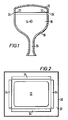
- Cathode ray tubes intended to act as picture tubes of colour television receivers conventionally are constructed by various different manufacturers in a manner that will now be described with reference to Figure 1 of the accompanying drawings.
- the CRT is formed from a funnel- like glass body 10, referred to hereinafter more simply as a “funnel”, and a glass face plate or panel 12.
- a metal electrode member 14, known as an anode button, extends through the wall of a main body portion 18 of the funnel 10 and is sealed in a vacuum-tight manner to the glass making up the wall.
- a carbon (graphite) coating (not shown) is applied to the interior of the funnel 10.
- the composition of the internal graphite coating may vary as between the, main body portion 18 and a neck portion 20 which is designed to accommodate an electron gun (not shown).
- the funnel 10 then is heated in an oven so that the internal carbon coating will cure or set.
- the funnel 10 then is joined to the panel 12, the interior of the panel previously having been coated in respective local areas with one or more phosphors, its own carbon (graphite) coating and, in some instances, aluminium.
- the funnel 10 is joined to the panel 12 by applying an adhesive to an end edge 22 of the funnel and/or to an edge 24 of the panel 12 so that the edges 22 and 24 are joined together by the adhesive.
- the adhesive comprises a frit and a binder liquid and, after it has been applied, the assembly of the funnel 10 and panel 12 is heated so that the adhesive will cure or set to firmly bond together the funnel 10 and panel 12 in such a manner as to provide a vacuum-tight seal between them.
- the binder liquid typically comprises a binding agent (such as nitrocellulose) which is dissolved in a suitable solvent (such as isoamyl acetate).
- a binding agent such as nitrocellulose
- a suitable solvent such as isoamyl acetate
- the binder liquid may be formed by adding nitrocellulose to isoamyl acetate in the proportion of 12.6 g of nitrocellulose per litre of isoamyl acetate
- the adhesive may be formed by mixing the frit (powder form) and binder liquid in the proportions of 900 ml of the binder liquid per kilogram of frit powder.
- the funnel 10 is evacuated and, whilst it is evacuated, the electron gun (not shown) is sealingly fitted into the neck portion 20 of the funnel and the flared end part of the neck portion is removed.
- a carbon (graphite) coating (not shown) is applied to at least part of the exterior of the main body portion 18 of the funnel 10.
- the exterior graphite coating may be of a different composition to that or those on the interior of the funnel 10.
- a CRT manufactured by the method just described will be found to be defective.
- the seal formed by the adhesive joining together the funnel 10 and panel 12 may be defective so that a vacuum cannot be maintained in the CRT.
- many manufacturers will, in this event, try to salvage the funnel 10 and/or the panel 12 by separating them, whereupon the various coatings can be removed from the salvaged component and the component can be reintroduced into the manufacturing process at a suitable stage and used in making another CRT.
- a process employed by several manufacturers to separate the funnel 10 and panel 12 is as follows.
- a batch of defective CRTs are oriented in a separation apparatus as shown in Figure 1 and an aqueous solution of nitric acid (HNO 3 ) is poured on to the centre of the panel 12 of each CRT so that it trickles down past the hardened adhesive joining the panel to the funnel 10.
- the nitric acid solution penetrates the adhesive to some extent and weakens it by attacking the binder that holds the frit together.
- the use of nitric acid solution alone is not sufficient to destroy the bond between the funnel 10 and panel 12, or at least is not sufficient to destroy the bond in a period of time which is not so long as to make the separation process uneconomical.
- the step of applying a nitric acid solution to the adhesive is followed by the application of a thermal shock.
- a thermal shock the flow of nitric acid solution is stopped and replaced by alternating flows of cold water and hot water.
- the alternate supply of hot and cold water provides differential thermal expansion which destroys the bond between the funnel 10 and the panel 12, which bond previously was weakened by the nitric acid solution, so that they can be separated.
- the separation process described above has several disadvantages. Firstly, it is very time-consuming, typically taking about 20 minutes. Secondly, it is not very reliable. Thus, it is sometimes found for a particular CRT that the bond has not been destroyed, that is that the funnel 10 and panel 12 have not become separated, so that the CRT concerned has to be put back in the separation apparatus for at least one further period of around 20 minutes. Thirdly, the thermal shock treatment somtimes stresses the glass funnel 10 and/or the glass panel 12 to such an extent that it will crack and therefore cannot be salvaged. These various disadvantages can have such a cumulative effect that the economic justification for carrying out the salvage operation may become questionable.
- a method of separating a glass panel and a glass body of a cathode ray tube, the panel and body being secured together by an adhesive that comprises a frit and a binder that is susceptible to attack by nitric acid characterised in that the cathode ray tube is at least partially immersed in a bath containing nitric acid such that at least the junction of the panel and body is immersed in the nitric acid, and the nitric acid in the bath is subjected to ultrasonic excitation.
- the ultrasonically-agitated nitric acid effectively destroys the adhesive quite quickly, so much so that if the degree of agitation is optimised the total time taken to destroy the adhesive may be reduced to less than 50% of the time taken by the known method described above. Typically, the separation time may be reduced to about six minutes or even less. Further, the destructive effect of the acid on the binder is so intensified by the ultrasonic agitation that the method should prove reliable in that it is unlikely that even a particularly tenacious bond will not be separated. Also, since no thermal shock has to be imparted to the components of the CRT to separate them, there is no risk of the components becoming cracked by stress induced by thermal shock.
- the ultrasonic excitation is effected by one or more transducers disposed outside of the bath.
- the ultrasonic excitation is effected by means of at least one transducer that is disposed within the nitric acid within the bath or forms part of a wall of the bath. More preferably still, the at least one transducer is so disposed as to provide maximum excitation of the nitric acid in the region of the junction of the body and the panel.
- cathode ray tube (or “CRT") as used herein is to be interpreted broadly as meaning any enclosure or envelope (which may or may not be of tubular shape) which comprises a glass panel and a glass body secured together by an adhesive that comprises a frit and a binder that is susceptible to attack by nitric acid, and which contains or is intended to contain an electron gun or other charged particle source for generating one or more beams of electrons or other charged particles for display purposes.
- the invention is described herein by way of example with particular reference to CRTs intended to act as picture tubes of colour television receivers, the invention is applicable to CRTs of various other types, including (for instance) certain special purpose CRTs which are disassembled (separation of panel and body) as a matter of routine for servicing and/or rebuilding. More specifically, without prejudice to the generality of the foregoing, the invention is applicable for instance to CRTs of the following types.
- a method embodying the invention for separating the funnel 10 and panel 12 of a CRT of the kind described above with reference to Figure 1 will now be described with reference to Figures 2 and 3.
- a batch of several CRTs may be treated simultaneously. For simplicity, however, the treatment of only one CRT will be described.
- the CRT is disposed as shown in a bath 30 containing an aqueous solution of nitric acid 32 so that the junction of the funnel 10 and panel 12 is immersed in the acid.
- the CRT is supported in position by suitable support means (not shown).
- the concentration of the acid may, as in the known process described above, be 5%. However, a lesser concentration, down to as little as 2%, has been found satisfactory.
- the neck portion 20 of the CRT is still sealed and therefore it still contains the electron gun. However, the lower end of the neck may have been cut off and the electron gun removed before the CRT is placed in the bath 30.
- a plurality of piezoelectric transducer heads 34 are immersed in the nitric acid 32 in the bath 30 and are connected via a multiplexer (not shown) to an ultrasonic frequency generator (not shown) so that, when energised, they subject the acid 32 to ultrasonic excitation.
- the transducer heads 34 are disposed to provide maximum excitation of the nitric acid in the region of the junction of the funnel 10 and the panel 12 of the CRT, maximum emanation of ultrasound preferably occurring from the faces of the heads 34 that confront the junction.
- at least one respective transducer head 34 is disposed along and facing each of the four sides of the CRT.
- the destructive effect of the nitric acid on the adhesive holding together the funnel 10 and panel 12 is intensified by the ultrasonic agitation of the acid so that the adhesive bond quickly is destroyed.
- the CRT is lifted out of the bath 30 so that the panel 12 can be lifted from the funnel 10, whereupon the funnel 10 and/or the panel 12 can be cleaned (stripped of their various coatings) and re-used to make another CRT.
- the period of time employed will depend upon a number of . factors, including the size of the tube, the nature of the adhesive bond, the positioning of the transducer heads 34 and the amount of ultrasonic power employed. Laboratory tests have shown a period of six minutes to be adequate. However, these tests used low power transducers which were not arranged optimally with respect to the junction of the funnel 10 and panel 12. In a full scale apparatus, it is expected that the total processing time will be considerably less than six minutes.
- the amount of ultrasonic power generated appears not to be critical. Generally speaking, within reasonable limits, the power is made as high as possible in order to promote quick destruction of the adhesive bond.
- the CRT does not need to be oriented in the bath 30 in the position shown in Figures 2 and 3. It could, for example, be positioned the other way up, so that the panel 12 will drop off when separation occurs. Neither is it necessary for the CRT to be fully immersed: it is sufficient that the junction between the funnel 10 and panel 12 be immersed.
- the transducer heads 34 are, as indicated above, preferably positioned adjacent the junction between the funnel 10 and the panel 12 so as to maximise the ultrasonic agitation of the nitric acid 32 at the junction.
- the method would still function, albeit perhaps less efficiently, using one or more transducer heads positioned elsewhere in the bath, forming part of a wall or walls of the bath, or even positioned outside of the bath.
- the salvaged funnel 10 and/or panel 12 must be cleaned before it can be used. That is to say, the carbon (graphite) coatings must be removed from the interior and exterior of the funnel 10 and/or the carbon, phosphors and aluminium must be removed from the panel 12.
- the carbon coating may be removed by a technique known in the art, according to which the coatings, which are soluble in hydrofluoric acid (HF), are removed by spraying the interior and exterior of the funnel with HF.
- HF hydrofluoric acid
- the funnel 10 and/or panel 12 is cleaned by a method which is described and claimed in our copending UK Patent Application No. 8527489 filed on 7 November 1985 and in our corresponding copending European Patent Application No. which was filed on the same date as the present application.
- the carbon coatings as applied to the inside and outside of the funnel 10 all comprise carbon (graphite) in a liquid binder and can be applied to the respective portions of the funnel by spraying or rolling, after which they are cured or set by heating.
- carbon graphite
- the various different coatings are available in liquid form from specialist suppliers, for instance from Acheson Colloids under the trademark "ELECTRODAG".
- the precise composition of the various carbon coatings will be determined by various factors, including the size of the CRT and its intended quality.
- the coating as applied to the interior of the main body portion 18 of the funnel 10 may be (in parts by weight): 22% graphite, 10% potassium silicate and 68% water; while that applied to the interior of the neck portion 20 may be: 1 kg of graphite and 220 g of silicon carbide to 750 ml of water glass.
- the coatings, when cured or set, are soluble in HF.
- the coatings also all are soluble in alkaline liquids, for example (but not exclusively) sodium hydroxide (NaOH).
- NaOH sodium hydroxide
- the funnel 10 is immersed in a bath of an alkaline liquid and the liquid is excited ultrasonically in a manner similar to that described above with reference to Figures 2 and 3, the corrosive effect of the alkaline liquid can be speeded up greatly, so much so that the funnel can be cleaned of its various graphite coatings in only one to two minutes or so.
- the funnel 10 is immersed fully, as shown, in a bath 40 containing an alkaline liquor 42.
- the liquor 42 may comprise, for example, in parts by volume: 55% NaOH; 5 to 10% sodium carbonate (Na 2 C0 3 ) and the rest water.
- the Na 2 C0 3 acts essentially as a detergent to help free particles of the coatings removed by the corrosive action of the NaOH.
- a plurality of piezoelectric transducer heads 44 are immersed in the liquor 42 in the bath 40 and are connected via a multiplexer (not shown) to an ultrasonic frequency generator (not shown) so that, when energised, they subject the liquor 42 to ultrasonic excitation.
- a multiplexer not shown
- an ultrasonic frequency generator not shown
- the transducer heads 44 are disposed so as to approximately equally insonify the different parts of the funnel 10.
- the destructive (corrosive) effect of the alkaline liquor 42 on the carbon coatings is intensified by the ultrasonic agitation of the liquor so that the coatings are removed quickly, possibly in around one to two minutes.
- the funnel is then removed from the bath 40 and rinsed. Then, after welding on a new lower end part to the neck portion 18, it is ready to be put back on the production line to be used in making another CRT.
- the method of Figure 4 can be varied in similar manner to that of Figures 2 and 3.
- the amount of ultrasonic power employed is preferably as high as possible; the frequency can be 45 kHz, though this is not critical; the funnel 10 can be oriented in the bath 40 in any desired way; and one or more of the transducer heads 44 can be positioned in other positions than these shown, elsewhere in the bath 40, forming part of a wall or walls of the bath, or even outside of the bath.
Landscapes
- Engineering & Computer Science (AREA)
- Manufacturing & Machinery (AREA)
- Manufacture Of Electron Tubes, Discharge Lamp Vessels, Lead-In Wires, And The Like (AREA)
- Vessels, Lead-In Wires, Accessory Apparatuses For Cathode-Ray Tubes (AREA)
Applications Claiming Priority (2)
| Application Number | Priority Date | Filing Date | Title |
|---|---|---|---|
| GB8527488A GB2182653B (en) | 1985-11-07 | 1985-11-07 | Separation of components of cathode ray tubes |
| GB8527488 | 1985-11-07 |
Publications (3)
| Publication Number | Publication Date |
|---|---|
| EP0222948A2 true EP0222948A2 (fr) | 1987-05-27 |
| EP0222948A3 EP0222948A3 (en) | 1988-08-24 |
| EP0222948B1 EP0222948B1 (fr) | 1990-11-22 |
Family
ID=10587880
Family Applications (1)
| Application Number | Title | Priority Date | Filing Date |
|---|---|---|---|
| EP19850308749 Expired - Lifetime EP0222948B1 (fr) | 1985-11-07 | 1985-12-02 | Méthode de séparation de composants de tubes à rayons cathodiques |
Country Status (5)
| Country | Link |
|---|---|
| US (1) | US4952185A (fr) |
| EP (1) | EP0222948B1 (fr) |
| JP (1) | JPS62110232A (fr) |
| DE (1) | DE3580675D1 (fr) |
| GB (1) | GB2182653B (fr) |
Cited By (8)
| Publication number | Priority date | Publication date | Assignee | Title |
|---|---|---|---|---|
| DE3929584A1 (de) * | 1988-09-05 | 1990-03-08 | Meurer Nonfood Product Gmbh | Delaminationsverfahren |
| DE3901842A1 (de) * | 1989-01-23 | 1990-08-09 | Zueblin Ag | Verfahren zur trennung von bildroehrenglas von bildroehren und dessen reinigung sowie eine vorrichtung zur durchfuehrung des verfahrens |
| CH680837A5 (fr) * | 1991-08-06 | 1992-11-30 | Drisa Polytechnik Ag | |
| EP0542676A1 (fr) * | 1991-11-13 | 1993-05-19 | Enviro Ec Ag | Procédé et dispositif de démontage de tubes image (tubes à rayons cathodiques) |
| DE4417877A1 (de) * | 1994-05-18 | 1995-11-23 | Video Computer Recycling | Verfahren zur Trennung von durch Glaslot miteinander verbundenen Teilen |
| EP0692808A1 (fr) | 1994-07-12 | 1996-01-17 | Enviro Ec Ag | Procédé et installation pour le démontage de tubes image |
| WO1997015941A1 (fr) * | 1994-04-22 | 1997-05-01 | Massoud Adib | Procede de preparation d'un tube cathodique |
| DE19756110C1 (de) * | 1997-12-18 | 1998-12-17 | Jenoptik Jena Gmbh | Verfahren und Vorrichtung zum Auftrennen von Glaslot-Verbindungen |
Families Citing this family (10)
| Publication number | Priority date | Publication date | Assignee | Title |
|---|---|---|---|---|
| US5045007A (en) * | 1990-11-19 | 1991-09-03 | Thomson Consumer Electronics, Inc. | Method of salvaging a color selection electrode for a CRT |
| DE4142921A1 (de) * | 1991-12-24 | 1993-07-01 | Preussag Ag | Verfahren zur mechanischen aufbereitung von bildroehrenschrott |
| DE4313157A1 (de) * | 1992-07-21 | 1994-02-03 | Heuser Maschinenbau Gmbh | Verfahren, Vorrichtung und Schaltungsanordnung zum Öffnen von Kathodenstrahlröhren zum Zweck der Aufarbeitung ihrer Materialbestandteile |
| DE19625173A1 (de) * | 1996-06-24 | 1998-01-02 | Schenke Ralf Gerhard Dr | Verfahren und Vorrichtung zum Recyceln von Leuchtstoffe enthaltenden Körpern |
| KR100408492B1 (ko) * | 1997-12-29 | 2004-03-26 | 이기원 | 전자부품의조립에사용하는열경화성유리층의제거방법 |
| US5961359A (en) * | 1998-04-14 | 1999-10-05 | Kostick; Joseph | Method and device for dismantling cathode ray tubes for recycling |
| JP3428931B2 (ja) | 1998-09-09 | 2003-07-22 | キヤノン株式会社 | フラットパネルディスプレイの解体処理方法 |
| DE10059310B4 (de) * | 2000-11-29 | 2011-01-20 | General Electric Co. | Verfahren zum Rückgewinnen von fluoreszierendem Material aus fehlerhaften Glaskörpern von Entladungslampen |
| CN100367442C (zh) * | 2004-05-14 | 2008-02-06 | 清华大学 | 一种crt玻壳分离方法及其专用设备 |
| US8668540B1 (en) * | 2012-09-14 | 2014-03-11 | ECS Refining, LLC | Method and apparatus for separating the glass panel from a cathode ray tube |
Family Cites Families (8)
| Publication number | Priority date | Publication date | Assignee | Title |
|---|---|---|---|---|
| US2884312A (en) * | 1957-09-03 | 1959-04-28 | Sylvania Electric Prod | Electron discharge device manufacture |
| AT225791B (de) * | 1961-09-11 | 1963-02-11 | Watt Gluehlampen Und Elek Zita | Verfahren und Vorrichtung zur flächenmäßigen Begrenzung von Metallspiegelbelägen |
| US3234047A (en) * | 1962-02-05 | 1966-02-08 | Everette C Olson | Method of cleaning carbon and combustion deposits from spark plugs |
| US3823080A (en) * | 1973-01-11 | 1974-07-09 | Gte Sylvania Inc | Process for removing coating from a cathode ray tube mask member |
| US4045243A (en) * | 1975-05-19 | 1977-08-30 | Riverbank Laboratories, Inc. | Carbon paper recycling system |
| SU586206A1 (ru) * | 1976-08-16 | 1977-12-30 | Войсковая часть 75360 | Раствор дл электрохимической очистки металлической поверхности |
| DE2741107A1 (de) * | 1977-09-13 | 1979-03-29 | Heldt Gert Dipl Ing Dr | Verfahren zum loesen von ineinandergefuegten bauteilen |
| DE3027533C2 (de) * | 1980-07-21 | 1986-05-15 | Telsonic Aktiengesellschaft für elektronische Entwicklung und Fabrikation, Bronschhofen | Verfahren zur Erzeugung und Abstrahlung von Ultraschallenergie in Flüssigkeiten sowie Ultraschallresonator zur Ausführung des Verfahrens |
-
1985
- 1985-11-07 GB GB8527488A patent/GB2182653B/en not_active Expired
- 1985-12-02 DE DE8585308749T patent/DE3580675D1/de not_active Expired - Lifetime
- 1985-12-02 EP EP19850308749 patent/EP0222948B1/fr not_active Expired - Lifetime
-
1986
- 1986-01-24 JP JP61013550A patent/JPS62110232A/ja active Pending
- 1986-02-14 US US06/829,161 patent/US4952185A/en not_active Expired - Lifetime
Cited By (9)
| Publication number | Priority date | Publication date | Assignee | Title |
|---|---|---|---|---|
| DE3929584A1 (de) * | 1988-09-05 | 1990-03-08 | Meurer Nonfood Product Gmbh | Delaminationsverfahren |
| DE3901842A1 (de) * | 1989-01-23 | 1990-08-09 | Zueblin Ag | Verfahren zur trennung von bildroehrenglas von bildroehren und dessen reinigung sowie eine vorrichtung zur durchfuehrung des verfahrens |
| CH680837A5 (fr) * | 1991-08-06 | 1992-11-30 | Drisa Polytechnik Ag | |
| WO1993002815A1 (fr) * | 1991-08-06 | 1993-02-18 | Gesellschaft Zur Förderung Der Industrieorientierten Forschung An Den Schweizerischen Hochschulen Und Weiteren Institutionen Eth-Zentrum (Ifw) | Procede d'elimination de tubes a rayons cathodiques, notamment d'ecrans cathodiques ou de leurs elements en verre |
| EP0542676A1 (fr) * | 1991-11-13 | 1993-05-19 | Enviro Ec Ag | Procédé et dispositif de démontage de tubes image (tubes à rayons cathodiques) |
| WO1997015941A1 (fr) * | 1994-04-22 | 1997-05-01 | Massoud Adib | Procede de preparation d'un tube cathodique |
| DE4417877A1 (de) * | 1994-05-18 | 1995-11-23 | Video Computer Recycling | Verfahren zur Trennung von durch Glaslot miteinander verbundenen Teilen |
| EP0692808A1 (fr) | 1994-07-12 | 1996-01-17 | Enviro Ec Ag | Procédé et installation pour le démontage de tubes image |
| DE19756110C1 (de) * | 1997-12-18 | 1998-12-17 | Jenoptik Jena Gmbh | Verfahren und Vorrichtung zum Auftrennen von Glaslot-Verbindungen |
Also Published As
| Publication number | Publication date |
|---|---|
| DE3580675D1 (de) | 1991-01-03 |
| GB8527488D0 (en) | 1985-12-11 |
| GB2182653A (en) | 1987-05-20 |
| JPS62110232A (ja) | 1987-05-21 |
| GB2182653B (en) | 1988-11-23 |
| US4952185A (en) | 1990-08-28 |
| EP0222948A3 (en) | 1988-08-24 |
| EP0222948B1 (fr) | 1990-11-22 |
Similar Documents
| Publication | Publication Date | Title |
|---|---|---|
| EP0222948B1 (fr) | Méthode de séparation de composants de tubes à rayons cathodiques | |
| EP0222949B1 (fr) | Enlèvement de revêtements de tubes à rayons cathodiques ou de parties de ceux-ci | |
| KR100441731B1 (ko) | 화상 표시 장치와 그 해체 처리 방법과 부품의 회수 방법 | |
| WO1996015863A1 (fr) | Procede de nettoyage d'aubes de turbines aux ultrasons | |
| CN100377278C (zh) | 拆解显示器的方法 | |
| US3527628A (en) | Method for reclaiming cathode ray tube screen panels | |
| JP4140225B2 (ja) | プラズマディスプレイ装置の解体方法 | |
| JPS59144132A (ja) | 反応装置 | |
| US4176891A (en) | Salvage method for cathode ray tubes | |
| US4705575A (en) | Process and arrangement for separating ceramic nuclear fuels from metallic casing or support members | |
| JP3564112B2 (ja) | スペーサの回収方法 | |
| US6422744B1 (en) | Method of testing a display device during the manufacture thereof | |
| CN101819911A (zh) | 图像显示装置及其拆解处理方法和元件回收方法 | |
| JPS62252038A (ja) | 陰極線管の光吸収層の再生方法 | |
| JP2002216631A (ja) | 陰極線管の管内清浄方法および管内清浄装置 | |
| US20030036330A1 (en) | Method of manufacturing a display device | |
| Aanstoos et al. | Disassembly process far a cathode ray tube | |
| JPH087766A (ja) | 陰極線管の有害物除去方法 | |
| JPS59119641A (ja) | 陰極線管のバルブ洗浄方法 | |
| US2720493A (en) | Removal of screens from kinescopes | |
| JPS6427141A (en) | Method for separating picture tube | |
| JP2004253397A (ja) | 画像表示装置とその解体装置及び部品の回収方法 | |
| JPH0828195B2 (ja) | 陰極線管 | |
| JPH07155713A (ja) | ブラウン管の蛍光面の洗浄方法 | |
| JP2000149777A (ja) | アルミニウム蒸着装置の内壁遮蔽部品 |
Legal Events
| Date | Code | Title | Description |
|---|---|---|---|
| PUAI | Public reference made under article 153(3) epc to a published international application that has entered the european phase |
Free format text: ORIGINAL CODE: 0009012 |
|
| AK | Designated contracting states |
Kind code of ref document: A2 Designated state(s): DE FR GB |
|
| PUAL | Search report despatched |
Free format text: ORIGINAL CODE: 0009013 |
|
| AK | Designated contracting states |
Kind code of ref document: A3 Designated state(s): DE FR GB |
|
| 17P | Request for examination filed |
Effective date: 19890127 |
|
| 17Q | First examination report despatched |
Effective date: 19900104 |
|
| GRAA | (expected) grant |
Free format text: ORIGINAL CODE: 0009210 |
|
| AK | Designated contracting states |
Kind code of ref document: B1 Designated state(s): DE FR GB |
|
| ET | Fr: translation filed | ||
| REF | Corresponds to: |
Ref document number: 3580675 Country of ref document: DE Date of ref document: 19910103 |
|
| PLBE | No opposition filed within time limit |
Free format text: ORIGINAL CODE: 0009261 |
|
| STAA | Information on the status of an ep patent application or granted ep patent |
Free format text: STATUS: NO OPPOSITION FILED WITHIN TIME LIMIT |
|
| 26N | No opposition filed | ||
| REG | Reference to a national code |
Ref country code: GB Ref legal event code: IF02 |
|
| PGFP | Annual fee paid to national office [announced via postgrant information from national office to epo] |
Ref country code: DE Payment date: 20041125 Year of fee payment: 20 |
|
| PGFP | Annual fee paid to national office [announced via postgrant information from national office to epo] |
Ref country code: GB Payment date: 20041201 Year of fee payment: 20 |
|
| PGFP | Annual fee paid to national office [announced via postgrant information from national office to epo] |
Ref country code: FR Payment date: 20041208 Year of fee payment: 20 |
|
| PG25 | Lapsed in a contracting state [announced via postgrant information from national office to epo] |
Ref country code: GB Free format text: LAPSE BECAUSE OF EXPIRATION OF PROTECTION Effective date: 20051201 |
|
| REG | Reference to a national code |
Ref country code: GB Ref legal event code: PE20 |