EP0224047A2 - Flexibler temperaturempfindlicher Draht widerstandfähig gegen ein trockenreinigendes Lösungsmittel - Google Patents
Flexibler temperaturempfindlicher Draht widerstandfähig gegen ein trockenreinigendes Lösungsmittel Download PDFInfo
- Publication number
- EP0224047A2 EP0224047A2 EP86114813A EP86114813A EP0224047A2 EP 0224047 A2 EP0224047 A2 EP 0224047A2 EP 86114813 A EP86114813 A EP 86114813A EP 86114813 A EP86114813 A EP 86114813A EP 0224047 A2 EP0224047 A2 EP 0224047A2
- Authority
- EP
- European Patent Office
- Prior art keywords
- layer
- thermosensitive
- wire
- wire according
- dry
- Prior art date
- Legal status (The legal status is an assumption and is not a legal conclusion. Google has not performed a legal analysis and makes no representation as to the accuracy of the status listed.)
- Granted
Links
Images

Classifications
-
- H—ELECTRICITY
- H01—ELECTRIC ELEMENTS
- H01B—CABLES; CONDUCTORS; INSULATORS; SELECTION OF MATERIALS FOR THEIR CONDUCTIVE, INSULATING OR DIELECTRIC PROPERTIES
- H01B7/00—Insulated conductors or cables characterised by their form
- H01B7/17—Protection against damage caused by external factors, e.g. sheaths or armouring
- H01B7/28—Protection against damage caused by moisture, corrosion, chemical attack or weather
-
- H—ELECTRICITY
- H05—ELECTRIC TECHNIQUES NOT OTHERWISE PROVIDED FOR
- H05B—ELECTRIC HEATING; ELECTRIC LIGHT SOURCES NOT OTHERWISE PROVIDED FOR; CIRCUIT ARRANGEMENTS FOR ELECTRIC LIGHT SOURCES, IN GENERAL
- H05B3/00—Ohmic-resistance heating
- H05B3/40—Heating elements having the shape of rods or tubes
- H05B3/54—Heating elements having the shape of rods or tubes flexible
- H05B3/56—Heating cables
-
- Y—GENERAL TAGGING OF NEW TECHNOLOGICAL DEVELOPMENTS; GENERAL TAGGING OF CROSS-SECTIONAL TECHNOLOGIES SPANNING OVER SEVERAL SECTIONS OF THE IPC; TECHNICAL SUBJECTS COVERED BY FORMER USPC CROSS-REFERENCE ART COLLECTIONS [XRACs] AND DIGESTS
- Y02—TECHNOLOGIES OR APPLICATIONS FOR MITIGATION OR ADAPTATION AGAINST CLIMATE CHANGE
- Y02A—TECHNOLOGIES FOR ADAPTATION TO CLIMATE CHANGE
- Y02A30/00—Adapting or protecting infrastructure or their operation
- Y02A30/14—Extreme weather resilient electric power supply systems, e.g. strengthening power lines or underground power cables
-
- Y—GENERAL TAGGING OF NEW TECHNOLOGICAL DEVELOPMENTS; GENERAL TAGGING OF CROSS-SECTIONAL TECHNOLOGIES SPANNING OVER SEVERAL SECTIONS OF THE IPC; TECHNICAL SUBJECTS COVERED BY FORMER USPC CROSS-REFERENCE ART COLLECTIONS [XRACs] AND DIGESTS
- Y10—TECHNICAL SUBJECTS COVERED BY FORMER USPC
- Y10T—TECHNICAL SUBJECTS COVERED BY FORMER US CLASSIFICATION
- Y10T428/00—Stock material or miscellaneous articles
- Y10T428/29—Coated or structually defined flake, particle, cell, strand, strand portion, rod, filament, macroscopic fiber or mass thereof
- Y10T428/2913—Rod, strand, filament or fiber
- Y10T428/2933—Coated or with bond, impregnation or core
- Y10T428/2936—Wound or wrapped core or coating [i.e., spiral or helical]
-
- Y—GENERAL TAGGING OF NEW TECHNOLOGICAL DEVELOPMENTS; GENERAL TAGGING OF CROSS-SECTIONAL TECHNOLOGIES SPANNING OVER SEVERAL SECTIONS OF THE IPC; TECHNICAL SUBJECTS COVERED BY FORMER USPC CROSS-REFERENCE ART COLLECTIONS [XRACs] AND DIGESTS
- Y10—TECHNICAL SUBJECTS COVERED BY FORMER USPC
- Y10T—TECHNICAL SUBJECTS COVERED BY FORMER US CLASSIFICATION
- Y10T428/00—Stock material or miscellaneous articles
- Y10T428/29—Coated or structually defined flake, particle, cell, strand, strand portion, rod, filament, macroscopic fiber or mass thereof
- Y10T428/2913—Rod, strand, filament or fiber
- Y10T428/2933—Coated or with bond, impregnation or core
- Y10T428/294—Coated or with bond, impregnation or core including metal or compound thereof [excluding glass, ceramic and asbestos]
-
- Y—GENERAL TAGGING OF NEW TECHNOLOGICAL DEVELOPMENTS; GENERAL TAGGING OF CROSS-SECTIONAL TECHNOLOGIES SPANNING OVER SEVERAL SECTIONS OF THE IPC; TECHNICAL SUBJECTS COVERED BY FORMER USPC CROSS-REFERENCE ART COLLECTIONS [XRACs] AND DIGESTS
- Y10—TECHNICAL SUBJECTS COVERED BY FORMER USPC
- Y10T—TECHNICAL SUBJECTS COVERED BY FORMER US CLASSIFICATION
- Y10T428/00—Stock material or miscellaneous articles
- Y10T428/29—Coated or structually defined flake, particle, cell, strand, strand portion, rod, filament, macroscopic fiber or mass thereof
- Y10T428/2913—Rod, strand, filament or fiber
- Y10T428/2933—Coated or with bond, impregnation or core
- Y10T428/294—Coated or with bond, impregnation or core including metal or compound thereof [excluding glass, ceramic and asbestos]
- Y10T428/2942—Plural coatings
- Y10T428/2947—Synthetic resin or polymer in plural coatings, each of different type
Definitions
- This invention relates to flexible thermosensitive wires which are adapted for use in electrically heated warming devices such as electric blankets, electric sheets or bedcovers and the like.
- thermosensitive wires using thermosensitive polymer materials such as polyamide compositions of low moisture absorption.
- the heater wire In order for one to subject an electric blanket to dry cleaning, the heater wire has to be resistant to solvent.
- United States Patent No. 2,941,176 proposed a heater wire which had an insulative Jacket made of a high molecular weight monomeric eater plasticizer, i.e. pentaerythritol eater. However, this wire has not been found satisfactory with respect to the solvent resistance.
- Japanese Laid-open Patent Application No. 60-89901 has proposed a flexible thermosensitive wire whereby a solvent resistant is imparted.
- thermosensitive polymer layer is covered with a barrier layer for solvent made, for example, of ethylene-vinyl alcohol copolymers or highly crystalline polyolefins or a layer of a non-dissolving polymer material such as an ethylene-vinyl chloride copolymer or a polymer alloy of the copolymer with polyvinyl chloride.
- a barrier layer for solvent made, for example, of ethylene-vinyl alcohol copolymers or highly crystalline polyolefins or a layer of a non-dissolving polymer material such as an ethylene-vinyl chloride copolymer or a polymer alloy of the copolymer with polyvinyl chloride.
- thermosensitive polymer materials of a low moisture absorption are used in these flexible thermosensitive wires, but the polymeric barrier materials or non-dissolving polymer materials are also used to cover the thermosensitive polymer material. Accordingly, release of moisture from the thermosensitive polymer material or a material inside the thermosensitive polymer material is prevented. This involves the problem that the recovery of the thermosensitive characteristic becomes very slow. When such a wire is applied as an electric blanket, the temperature of the blanket cannot be precisely controlled during use within a short period of time.
- thermosensitive wire which is adapted for use in electrically heated warming devices such as an electric blanket.
- thermosensitive wire in which while a thermosensitive polymer material is beat utilized, the wire has a high dry-cleaning resistance when applied to electrically heated worming devices.
- the flexible thermosensitive wire according to the invention is of the type which comprises a core strand, a pair of electrodes in a spaced relation with each other, and a thermosensitive polymer layer formed between the paired electrodes and completely covering the core strand.
- the invention is characterized in that a barrier layer for a dry-cleaning solvent, which is capable of moisture permeation, is formed to cover the thermosensitive polymer layer and one of the paired electrode formed on the thermosensitive polymer layer, and an outermost moisture-permeable layer of a soft polymer material which has a better vapor permeability than the barrier layer and is resistant to a dry-cleaning solvent is formed to cover the barrier layer whereby the wire has a high dry-cleaning resistance.
- a separation layer is provided between the thermosensitive polymer having thereon one of the paired electrode and the barrier layer in order to prevent the thermosensitive polymer layer from deterioration in relation to time.
- thermosensitive wire of the type which comprises a core strand, a first electrode spirally or helically wound around said core strand, a thermosensitive polymer layer covering the cores strand and the first electrode, a second electrode spirally wound around the thermosensitive polymer layer, a barrier layer for a dry-cleaning solvent which is capable of moisture permeation and is formed to cover the thermosensitive polymer layer and the second electrode, and .an outermost moisture-permeable layer of a soft polymer material which has a better moisture permeability than the barrier layer and is resistant to a dry-cleaning solvent whereby the wire has a high dry-cleaning resistance.
- the separation layer as mentioned above is preferably formed in a similar manner.
- the electrodes used in the above embodiments may usually take a ribbon form.
- the flexible thermosensitive wire of the invention has good thermal stability of the thermosensitive polymer layer in relation to time and, when applied to, for example, an electric blanket, can stably maintain the temperature of the blanket, which is thus comfortable during use. Uhen such a blanket becomes dirty, it can be dry-cleaned. This is very advantageous from the practical point of view. More particularly, the wire according to the invention can quickly release moisture. Even when it takes up moisture, the thermosensitive characteristic returns to an original level within a short time. In addition, the wire has a high dry cleaning resistance and only a very small degree in variation of the thermosensitive characteristic is experienced. The wire which is clean dried has hold its flexibility.
- thermosensitive wire When the separation layer is further formed, the thermosensitive wire has a very excellent thermal stability with time with respect to the thermoseneitive characteristic. Moreover, the wire may be readily worked at a terminal thereof for use as a lead wire by elimination of the outer layers because of the presence of the separation layer. This gives a great merit in terminal mold processings.
- the wire W comprises an insulative core strand 1 made, for example, of a polyeeter resin or other materials ordinarily used for these purposes.
- an electrode 2 Around the core strand 1 is spirally or helically wound an electrode 2 which may take a ribbon form as shown.
- the electrode 2 is completely covered with a thermosensitive polymer layer 4, which is in turn helically wound with an electrode 3 ae shown.
- the electrodes 2 and 3 are made, for example, of copper or copper alloys.
- the thermosensitive polymer layer 4 has a substantially uniform thickness of, for example, 0.1 to 0.5 mm along the length thereof and has thus a generally cylindrical croon-sectional configuration.
- This layer 4 is required to have a thermistor characteristic and/or a fusing function and is made, in most cases, of a polyamide composition in order to utilize the thermosensitive characteristic of hydrogen bonds of the amido groups.
- the polyamide composition should preferably be formulated to have thermistor characteristics as desired.
- Such a composition comprises, for example, 50 to 90 wt% of a polyamide resin and 50 to 10 wt% of a thermoplastic phenolic resin.
- these electrodes 2,3 and the thermosensitive polymer layer 4 are not critical with respect to the type of material or composition and one may employ any known materials for these electrodeo 2,3 and the layer 4 in the practice of the invention.
- the thermosensitive polymer layer may be formed of a polymer composition whose electric resistance, electrostatic capacity or impedance is of the negative or positive temperature dependence or may be formed of a crystalline polymer composition having a temperature-fusing function.
- the present invention is characterized in that the electrode 3 and the thermosensitive polymer layer 4 are covered with a barrier layer 5 against a dry-cleaning solvent, which layer 5 has thus a good dry-cleaning resistance, and a moisture-permeable outermost layer 6, both formed such as by extrusion or other techniques.
- the polymer materials used as the barrier layer 5 for a dry-cleaning solvent include, for example, ethylene-vinyl alcohol copolymers, highly crystalline polyolefine, polyvinylidene halides, fluorine-containing polymers, polyamides, metal chelate-containing polymers, acrylonitrile copolymers and the like. These materials have all high crystallinity and exhibit a good barrier property. However, the highly crystalline polymer materials have a greater modulus of elasticity than ordinary soft polymer materials.
- the barrier layer 5 is provided as an outermost layer of the flexible thermosensitive wire, the flexibility of the wire lowers, making it rather unfit for practical applications. Accordingly, the barrier layer 5 is applied over the thermosensitive polymer layer 4 and the electrode 3, over which the moisture-permeable outermost layer is applied.
- hydrophilic group-containing polymer materials such as ethylene-vinyl alcohol copolymers, polyamides and the like are preferred. Of ethylene-vinyl alcohol copolymers, random or alternating copolymers are most preferred because of the better moisture permeability.
- nylon homopolymera such as nylon 6, nylon 11, nylon 12 and the like
- copolymers such as polyether-amides, polyester-amides, N-substituted polyamides and the like.
- nylon homopolymers have generally high crystallinity and, thus, exhibit a good barrier property.
- the modulus of elasticity undesirably increases, resulting in a lowering of flexibility of the resultant flexible thermosensitive wire.
- most preferable polyamides are nylon 11 and nylon 12.
- the barrier layer 5 has generally a thickness of from 0.05 to 0.2 mm in order to ensure the barrier property and allow a suitable degree of moisture permeability.
- the outermost moisture-permeable layer 6 covering the barrier layer 5 should be made of soft polymer materials or compositions which exhibit a moisture permeability equal to or better than the polymer materials of the barrier layer 5 and a good solvent resistance.
- soft polymer materials or compositions are known, of which polyvinyl chloride compositions are preferred. Because of the presence of vinyl chloride units, it ie easy to import a flame resistance to the composition, e.g. when ordinary flame retardants such as antimony oxide are added to a polyvinyl composition, a flame resistance expressed by a lowest oxygen index not leas than 25 is readily imparted. Accordingly, such a polyvinyl chloride composition is suitable for use as a material for the outermost layer or jacket of this type of flexible thermosensitive wire.
- Polyvinyl chloride is easily softened by addition of other polymers or plasticizers.
- Other polymers for blending with the polyvinyl chloride should preferably have a great moisture permeability and are, for examples those polymers which have urethane groups or ester groups having relatively good affinity for water molecules.
- Examples of such polymers include polyurethanes and vinyl chloride copolymers such as vinyl chloride-urethane copolymers, vinyl chloride-acrylic copolymers, vinyl chloride-vinyl acetate copolymers and the like.
- polyurethanes and vinyl chloride-urethane copolymers are preferably sine they are very soft and have very high moisture permeability with good resistances to solvent and cold temperature.
- compositions which comprise blends of polyvinyl chloride and polyurethanes or vinyl chloride-urethane copolymers have a high moisture permeability and a good solvent resistance with good cold temperature and flame resistances.
- solvent resietance' used herein means little or no solubility in dry-cleaning solvents. Only one drawback involved in polyurethanes or vinyl chloride copolymers is a low heat resistance.
- heat-resistant plasticizers include polyesters, trimeilitates, pentaerythritol eaters, epoxy compounds and the like. Since polyester plasticizers have eater groups, they have high affinity for water molecules. In addition, ester compounds are readily polymerized, so that when the compounds are polymerized to have an average molecular weight not lese than 6000, the resultant polyesters exhibit a good solvent resistance. Although the polyester plasticixers may be classified into phthalate plasticizers, adipate plasticizers and sebacate plasticizers, the sebacate plasticizers are preferred.
- sebacic acid is a long-chain dibasic acid with a long distance between the polar groups of the ester bonds and a great degree of freedom of the molecules, so that this type of plasticizer is most compatible with polyvinyl chloride. If polyvinyl chloride and a polyester plasticizer having an average molecular weight not lose than 6000 are mixed, the resulting composition exhibit a high vapor permeability and a good solvent resistant with good heat and flame resistances. However, the plasticizer is so high in molecular weight that the composition has not always a satisfactory cold resistance.
- a preferable polyvinyl chloride composition according to the invention comprises 100 parts by weight of polyvinyl chloride, 30 to 100 parts by weight of a polyester plasticizer having an average molecular weight not less than 6000, and 20 to 80 parts by weight of a polyurethane or a vinyl chloride copolymer.
- the vinyl chloride copolymer includes, for example, a vinyl chloride-urethane copolymer, a vinyl chloride-acrylic copolymer, a vinyl chloride-vinyl acetate copolymer and mixtures thereof.
- This composition has a high moisture permeability, an excellent solvent resistance end good heat, cold and flame resistances and are thus suitable for use as the flexible, moisture-permeable outermost layer.
- polyester plasticizer is less than 30 parts by weight, the moisture permeability and heat resistance become worse. Over 100 parts by weight, the compatibility becomes poor, causing a bleedout phenomenon. On the other hand, when the polyurethane or vinyl chloride copolymer is less than 20 parts by weight, the moisture permeability and flexibility deteriorate. Over 80 parts, the heat resistance becomes poor.
- the polyvinyl chloride used should have an average degree of polymerization of not less than 1800. Since the flexible thtrmosensitive wire of the invention is adapted for use in electric blankets or sheets where clothe or woven fabrics are heated during use, it is desirable that the mechanical strength be high with high heat and flame resistances. These characteristic properties can all be imparted to the wire when using the above composition.
- polyvinyl chloride grains consisting of granules or particles are each covered with a thin skin on the surface thereof. These grains do not separate into particles even when a plasticizer is added to the polyvinyl chloride, tending to cause fishryes.
- skinless grains of polyvinyl chloride are conveniently used.
- the skinless grains have been prepared according to a specific known manner of polymerization. These grains have improved compatibility with plasticizers and good diapersability. Thus, the skinless grains are preferred for use in the polyvinyl chloride composition of the invention.
- the outermost layer has generally a thickness of 0.2 to 0.6 mm in order to fully show its characteristic properties.
- the flexible thermosensitive wire according to the invention may be used, for example, as a temperature sensor when the built-in electrodes are used as signal wirea, or as a thermosensitive heater when at least one electrode is used aleo as a heating conductor.
- thermosenaitive wire of the invention can stand use upon exposure to the solvent within the above time, within which the thermosensitive characteristic does rarely vary while keeping the flexiblity of the wire without dissolution of a plasticizer in the solvent.
- thermosensitive polymer layer 4 is brought into intimate contact with the barrier layer 5, whereupon gradual migration of the resins may take place. This will cause the thermosensitive characteristic of the layer 4 to vary with time.
- the barrier layer 5 is formed of a polyamide composition and the thermosensitive polymer layer is also made of a polyamide composition, the migration is more liable to occur.
- a separation layer is formed, as 10 in Fig. 2 or 11 in Fig. 3, between the thermosensitive polymer layer 4 and the barrier layer 5.
- the separation layer 10 is spirally wound over the thermosensitive polymer layer 4 without leaving a space between any adjacent spiral turns for complete coverage.
- the separation layer 11 of Fig. 3 is to wrap the layer 4 as shown.
- the separation layer 10 or 11 is made, for example, of a polyester or polyolefin film.
- the present invention is more particularly described by way of examples.
- thermosensitive wire of the type as shown in Fig. 1 was fabricated.
- the wire had a polyester core 1, a pair of ribbon electrodes 2,2 of a copper alloy, a 0.15 mm thick thermosensitive polymer layer 4 of a low moisture absorption composed of a polyamide composition comprising a phenolic resin material, a nylon 12 layer as a barrier for a solvent, and an outermost moisture-permeable layer 6.
- the outermost layer 6 was made of a composition comprised of 100 parts by weight of polyvinyl chloride, 30 parts by weight of polyurethane, 50 parts by weight of a polyester plasticizer having an average molecular weight of 8000 (Polycizer P-202, produced by Dainippon Ink Chem. Co., Ltd.), 3 parts by weight of a Ba-Zn thermal atabilizer, and 15 parts by weight of a mixture of antimony oxide and calcium carbonate.
- the layer 6 had a thickness of 0.4 mm, which was larger than that of the layer 5.
- This flexible thermosensitive wire was subjected to a moisture-releasing test.
- the wire was dried at 80°C for 120 hours and subjected to measurement of an impedance (Z O80 ). Thereafter, the wire was subjected to moisture absorption to a saturation under conditions of a temperature of 43°C and a relative humidity of 78% and allowed to stand at a temperature of 80°C for 1 hour, followed by measurement of an impedance (Z W80 ).
- Example 1 The general procedure of Example 1 was repeated using different materials or compositions for the barrier layer 5 and the outermost layer 6.
- the results of the moisture release test are also shown in Table 1, in which Paraplex G-25 used as the plasticizer is a polyester plasticizer having an average molecular weight of 8000, produced by Rohm and Haas Inc.
- Example 1 For comparison, the general procedure of Example 1 was repeated using high density polyethylene for the barrier layer 5 and an ethylene-vinyl chloride copolymer or a mixture of polyvinyl chloride and polyurethane for the outermost layer 6.
- the flexible thermosensitive wires according to the invention can release moisture from the ineide thereof very quickly. This is advantageous in that when the wires are used in electric blankets, the temperature of the blanket returns to a normal state within a very short time and thus, the blanket is invariably comfortable in use.
- Example 1 The wire of Example 1 was subjected to an immersion test using a dry-cleaning solvent. In the test, the wire was immersed in tetrachloroethylene for 30 minutes and dried at 60°C for 30 minutes, this cycle being repeated three times in total.
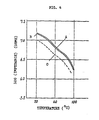
- the impedance-temperature characteristic curve per unit meter of the wire is shown in Fig. 4. In the figure, the curves A and B are, respectively, obtained prior to and after the immersion test.
- the impedance values of the wire of the invention prior to and after the immersion are significantly higher than the comparative wire.
- the wires after the immersion teat were each dried at 80°C for 24 hours, revealing that the outer diameter of the comparative wire reduced by about 12% with the flexibility being substantially lost and that the wire of the invention underwent little change in diameter.
- a wire having such a construction as shown in Fig. 2 were fabricated.
- the wire had a polyester core 1, a pair of ribbon electrodes 2,3 of a copper alloy, a thermosensitive polymer layer 4 of a low moisture absorption made of a nylon 12 composition incorporated with a phenolic resin material, a polyester separation layer 10, a 0.15 mm thick nylon 12 layer 5 as a barrier for solvents, and a 0.4 mm thick outermost layer 6.
- the outermost layer 6 was made of a composition comprised of 100 parts by weight of polyvinyl chloride, 30 parts by weight of polyurethane, 50 part by weight of a polyester plasticizer having an average molecular weight of 8000 (Polycizer P-202, produced by Dainippon Ink Chem.
- Example 7 The general procedure of Example 7 was repeated except that the materials for the barrier layer 5 or the separation layer 10 were changed as indicated in Table 2 and the manner of winding of the separation layer was changed in Example 8. The results are also shown in Table 2.
- the separation layer is advantageous in that when the wire terminal is worked for electric connection, this can be done readily.
Landscapes
- Compositions Of Macromolecular Compounds (AREA)
- Organic Insulating Materials (AREA)
- Resistance Heating (AREA)
- Thermistors And Varistors (AREA)
- Laminated Bodies (AREA)
Applications Claiming Priority (4)
| Application Number | Priority Date | Filing Date | Title |
|---|---|---|---|
| JP239859/85 | 1985-10-25 | ||
| JP60239859A JPS6298504A (ja) | 1985-10-25 | 1985-10-25 | 可撓性感熱電線 |
| JP62254/86 | 1986-03-20 | ||
| JP61062254A JPH0638361B2 (ja) | 1986-03-20 | 1986-03-20 | 可撓性感熱電線 |
Publications (3)
| Publication Number | Publication Date |
|---|---|
| EP0224047A2 true EP0224047A2 (de) | 1987-06-03 |
| EP0224047A3 EP0224047A3 (en) | 1988-07-20 |
| EP0224047B1 EP0224047B1 (de) | 1992-07-29 |
Family
ID=26403318
Family Applications (1)
| Application Number | Title | Priority Date | Filing Date |
|---|---|---|---|
| EP86114813A Expired - Lifetime EP0224047B1 (de) | 1985-10-25 | 1986-10-24 | Flexibler temperaturempfindlicher Draht widerstandfähig gegen ein trockenreinigendes Lösungsmittel |
Country Status (5)
| Country | Link |
|---|---|
| US (1) | US4792663A (de) |
| EP (1) | EP0224047B1 (de) |
| KR (1) | KR900007569B1 (de) |
| CN (1) | CN1006952B (de) |
| DE (1) | DE3686240T2 (de) |
Cited By (2)
| Publication number | Priority date | Publication date | Assignee | Title |
|---|---|---|---|---|
| FR2759841A1 (fr) * | 1997-02-14 | 1998-08-21 | Atlantic Soc Fr Dev Thermique | Dispositif de chauffage a corps de chauffe surmoule |
| WO1999030535A1 (en) * | 1997-12-05 | 1999-06-17 | Winterwarm Ltd. | Improvements relating to heating blankets and the like |
Families Citing this family (13)
| Publication number | Priority date | Publication date | Assignee | Title |
|---|---|---|---|---|
| GB2194719B (en) * | 1986-08-19 | 1990-08-29 | Mohan Singh Boyal | Electrical heating cable |
| US4998006A (en) * | 1990-02-23 | 1991-03-05 | Brandeis University | Electric heating elements free of electromagnetic fields |
| DE4291715T1 (de) * | 1991-05-28 | 1994-02-17 | Abbott Lab | Vorrichtung zur Vermischung eines Pulvers mit einer Flüssigkeit |
| US6300597B1 (en) | 1997-01-21 | 2001-10-09 | Myoung Jun Lee | Electromagnetic field shielding electric heating pad |
| US6226450B1 (en) | 1997-01-21 | 2001-05-01 | Myoung Jun Lee | Electric field shielding apparatus |
| US6153856A (en) * | 1997-01-21 | 2000-11-28 | Lee; Myoung Jun | Low magnetic field emitting electric blanket |
| US5910266A (en) * | 1997-05-28 | 1999-06-08 | The B.F. Goodrich Company | Helical electrical heater |
| US6002117A (en) * | 1998-03-10 | 1999-12-14 | Pak; Il Young | Electric heating cord with non-heating core-conducting element and reduced EMF emissions |
| KR20000028327A (ko) * | 1998-10-31 | 2000-05-25 | 양건호 | 전자파를 제거한 면상 발열체 및 그 제조방법 |
| US6617550B2 (en) * | 2002-01-14 | 2003-09-09 | Yoshiji Sowa | Electrically heated blanket |
| WO2005089019A2 (de) * | 2004-03-08 | 2005-09-22 | W.E.T. Automotive Systems Ag | Flächiges heizelement |
| US7220947B2 (en) * | 2005-09-30 | 2007-05-22 | Global Heating Solutions, Inc. | Pipe heater |
| US8160688B2 (en) * | 2006-04-12 | 2012-04-17 | Vyssotski Alexei L | Integrated self-contained recorder of biological data for small animal research |
Family Cites Families (5)
| Publication number | Priority date | Publication date | Assignee | Title |
|---|---|---|---|---|
| CA581780A (en) * | 1957-05-31 | 1959-08-18 | General Electric Company | Heater wire |
| US2941176A (en) * | 1959-01-27 | 1960-06-14 | Gen Electric | Heater wire |
| CA1235450A (en) * | 1983-05-11 | 1988-04-19 | Kazunori Ishii | Flexible heating cable |
| JPS6089901A (ja) * | 1983-10-24 | 1985-05-20 | 松下電器産業株式会社 | 可撓性感熱電線 |
| US4698488A (en) * | 1985-04-15 | 1987-10-06 | Matsushita Electric Industrial Co., Ltd. | Flexible thermosensitive wire |
-
1986
- 1986-10-20 KR KR1019860008779A patent/KR900007569B1/ko not_active Expired
- 1986-10-24 DE DE8686114813T patent/DE3686240T2/de not_active Expired - Fee Related
- 1986-10-24 EP EP86114813A patent/EP0224047B1/de not_active Expired - Lifetime
- 1986-10-24 US US06/923,082 patent/US4792663A/en not_active Expired - Lifetime
- 1986-10-24 CN CN86107267A patent/CN1006952B/zh not_active Expired
Cited By (3)
| Publication number | Priority date | Publication date | Assignee | Title |
|---|---|---|---|---|
| FR2759841A1 (fr) * | 1997-02-14 | 1998-08-21 | Atlantic Soc Fr Dev Thermique | Dispositif de chauffage a corps de chauffe surmoule |
| EP0859537A3 (de) * | 1997-02-14 | 1998-09-02 | Atlantic - Société Française de Développement Thermique | Heizvorrichtung eines umgegossenen Heizelement |
| WO1999030535A1 (en) * | 1997-12-05 | 1999-06-17 | Winterwarm Ltd. | Improvements relating to heating blankets and the like |
Also Published As
| Publication number | Publication date |
|---|---|
| CN1006952B (zh) | 1990-02-21 |
| CN86107267A (zh) | 1987-09-23 |
| KR900007569B1 (ko) | 1990-10-15 |
| KR870004467A (ko) | 1987-05-09 |
| EP0224047B1 (de) | 1992-07-29 |
| DE3686240D1 (de) | 1992-09-03 |
| DE3686240T2 (de) | 1993-01-07 |
| EP0224047A3 (en) | 1988-07-20 |
| US4792663A (en) | 1988-12-20 |
Similar Documents
| Publication | Publication Date | Title |
|---|---|---|
| US4792663A (en) | Flexible thermosensitive wire having a barrier layer for dry-cleaning solvent and a moisture-permeable layer | |
| NZ196936A (en) | Heating cable: fibre core carbon impregnated | |
| CN107075171A (zh) | 导电聚合物复合材料 | |
| US4698488A (en) | Flexible thermosensitive wire | |
| SE8304042L (sv) | Bandvermare med elektriska anordningar innefattande ledande polymerkompositioner | |
| JPH0374001B2 (de) | ||
| JPH0638361B2 (ja) | 可撓性感熱電線 | |
| JPH0548565B2 (de) | ||
| JPS639362B2 (de) | ||
| CN220511272U (zh) | 负温度系数加热器线和负温度系数传感器线 | |
| KR900007568B1 (ko) | 가요성 감열전선 | |
| JP3430536B2 (ja) | 感熱体及び感熱発熱体 | |
| JP2955029B2 (ja) | 感熱樹脂材料及び感熱発熱体 | |
| GB2033707A (en) | Conductive polymer compositions of an electrical device | |
| JP2955028B2 (ja) | 感熱樹脂材料及び感熱発熱体 | |
| JPS6226706A (ja) | 可撓性感熱線 | |
| JPS60235384A (ja) | 温度検知線 | |
| JPS584065B2 (ja) | クツキヨクヒロウセイノカイリヨウサレタ ポリアミドソセイブツ | |
| JPS6161685B2 (de) | ||
| JPS58210602A (ja) | 温度検知線 | |
| JPS61239585A (ja) | 感熱線 | |
| JP2882717B2 (ja) | 高温耐久性高分子半導体 | |
| JPH07263128A (ja) | 一線式ヒータ線 | |
| JPS639361B2 (de) | ||
| JPS6322041B2 (de) |
Legal Events
| Date | Code | Title | Description |
|---|---|---|---|
| PUAI | Public reference made under article 153(3) epc to a published international application that has entered the european phase |
Free format text: ORIGINAL CODE: 0009012 |
|
| AK | Designated contracting states |
Kind code of ref document: A2 Designated state(s): DE GB |
|
| PUAL | Search report despatched |
Free format text: ORIGINAL CODE: 0009013 |
|
| AK | Designated contracting states |
Kind code of ref document: A3 Designated state(s): DE GB |
|
| 17P | Request for examination filed |
Effective date: 19880902 |
|
| 17Q | First examination report despatched |
Effective date: 19900528 |
|
| GRAA | (expected) grant |
Free format text: ORIGINAL CODE: 0009210 |
|
| AK | Designated contracting states |
Kind code of ref document: B1 Designated state(s): DE GB |
|
| REF | Corresponds to: |
Ref document number: 3686240 Country of ref document: DE Date of ref document: 19920903 |
|
| PLBE | No opposition filed within time limit |
Free format text: ORIGINAL CODE: 0009261 |
|
| STAA | Information on the status of an ep patent application or granted ep patent |
Free format text: STATUS: NO OPPOSITION FILED WITHIN TIME LIMIT |
|
| 26N | No opposition filed | ||
| PGFP | Annual fee paid to national office [announced via postgrant information from national office to epo] |
Ref country code: GB Payment date: 19941014 Year of fee payment: 9 |
|
| PGFP | Annual fee paid to national office [announced via postgrant information from national office to epo] |
Ref country code: DE Payment date: 19941021 Year of fee payment: 9 |
|
| PG25 | Lapsed in a contracting state [announced via postgrant information from national office to epo] |
Ref country code: GB Effective date: 19951024 |
|
| GBPC | Gb: european patent ceased through non-payment of renewal fee |
Effective date: 19951024 |
|
| PG25 | Lapsed in a contracting state [announced via postgrant information from national office to epo] |
Ref country code: DE Effective date: 19960702 |