EP0224207A2 - Complexe à transfert de charges - Google Patents
Complexe à transfert de charges Download PDFInfo
- Publication number
- EP0224207A2 EP0224207A2 EP86116127A EP86116127A EP0224207A2 EP 0224207 A2 EP0224207 A2 EP 0224207A2 EP 86116127 A EP86116127 A EP 86116127A EP 86116127 A EP86116127 A EP 86116127A EP 0224207 A2 EP0224207 A2 EP 0224207A2
- Authority
- EP
- European Patent Office
- Prior art keywords
- charge transfer
- transfer complex
- complex
- radical
- amyl
- Prior art date
- Legal status (The legal status is an assumption and is not a legal conclusion. Google has not performed a legal analysis and makes no representation as to the accuracy of the status listed.)
- Granted
Links
- 238000012546 transfer Methods 0.000 title claims abstract description 36
- 239000003990 capacitor Substances 0.000 claims abstract description 37
- AWJUIBRHMBBTKR-UHFFFAOYSA-N iso-quinoline Natural products C1=NC=CC2=CC=CC=C21 AWJUIBRHMBBTKR-UHFFFAOYSA-N 0.000 claims abstract description 17
- 238000000034 method Methods 0.000 claims abstract description 11
- 239000003960 organic solvent Substances 0.000 claims abstract description 9
- BLXSFCHWMBESKV-UHFFFAOYSA-N 1-iodopentane Chemical compound CCCCCI BLXSFCHWMBESKV-UHFFFAOYSA-N 0.000 claims abstract description 8
- 239000003792 electrolyte Substances 0.000 claims abstract description 7
- 125000002183 isoquinolinyl group Chemical group C1(=NC=CC2=CC=CC=C12)* 0.000 claims abstract description 7
- 238000006243 chemical reaction Methods 0.000 claims abstract description 6
- 239000007787 solid Substances 0.000 claims abstract description 6
- 239000002904 solvent Substances 0.000 claims abstract description 5
- PCCVSPMFGIFTHU-UHFFFAOYSA-N tetracyanoquinodimethane Chemical compound N#CC(C#N)=C1C=CC(=C(C#N)C#N)C=C1 PCCVSPMFGIFTHU-UHFFFAOYSA-N 0.000 claims abstract description 4
- 238000002360 preparation method Methods 0.000 claims abstract description 3
- WEVYAHXRMPXWCK-UHFFFAOYSA-N Acetonitrile Chemical compound CC#N WEVYAHXRMPXWCK-UHFFFAOYSA-N 0.000 claims description 24
- 238000010992 reflux Methods 0.000 claims description 14
- NLZUEZXRPGMBCV-UHFFFAOYSA-N Butylhydroxytoluene Chemical compound CC1=CC(C(C)(C)C)=C(O)C(C(C)(C)C)=C1 NLZUEZXRPGMBCV-UHFFFAOYSA-N 0.000 description 19
- 238000004455 differential thermal analysis Methods 0.000 description 15
- 238000002411 thermogravimetry Methods 0.000 description 15
- 230000000052 comparative effect Effects 0.000 description 11
- NUJOXMJBOLGQSY-UHFFFAOYSA-N manganese dioxide Chemical compound O=[Mn]=O NUJOXMJBOLGQSY-UHFFFAOYSA-N 0.000 description 10
- LFQSCWFLJHTTHZ-UHFFFAOYSA-N Ethanol Chemical compound CCO LFQSCWFLJHTTHZ-UHFFFAOYSA-N 0.000 description 8
- 238000005259 measurement Methods 0.000 description 7
- OKKJLVBELUTLKV-UHFFFAOYSA-N Methanol Chemical compound OC OKKJLVBELUTLKV-UHFFFAOYSA-N 0.000 description 6
- 239000000463 material Substances 0.000 description 6
- 239000007784 solid electrolyte Substances 0.000 description 6
- -1 display devices Substances 0.000 description 5
- RTZKZFJDLAIYFH-UHFFFAOYSA-N Diethyl ether Chemical compound CCOCC RTZKZFJDLAIYFH-UHFFFAOYSA-N 0.000 description 4
- 229910052782 aluminium Inorganic materials 0.000 description 4
- XAGFODPZIPBFFR-UHFFFAOYSA-N aluminium Chemical compound [Al] XAGFODPZIPBFFR-UHFFFAOYSA-N 0.000 description 4
- 238000002474 experimental method Methods 0.000 description 4
- 239000000203 mixture Substances 0.000 description 4
- 239000011541 reaction mixture Substances 0.000 description 4
- 239000010405 anode material Substances 0.000 description 3
- 238000000354 decomposition reaction Methods 0.000 description 3
- 238000002844 melting Methods 0.000 description 3
- 230000008018 melting Effects 0.000 description 3
- 230000004580 weight loss Effects 0.000 description 3
- MWPXDSRCADUQLR-UHFFFAOYSA-N 2-(3-methylbutyl)isoquinolin-2-ium Chemical compound C1=CC=CC2=C[N+](CCC(C)C)=CC=C21 MWPXDSRCADUQLR-UHFFFAOYSA-N 0.000 description 2
- STHANCTVCXBZTJ-UHFFFAOYSA-M 2-(3-methylbutyl)isoquinolin-2-ium;iodide Chemical compound [I-].C1=CC=CC2=C[N+](CCC(C)C)=CC=C21 STHANCTVCXBZTJ-UHFFFAOYSA-M 0.000 description 2
- 239000006183 anode active material Substances 0.000 description 2
- 239000002216 antistatic agent Substances 0.000 description 2
- 239000013078 crystal Substances 0.000 description 2
- 239000010408 film Substances 0.000 description 2
- XMBWDFGMSWQBCA-UHFFFAOYSA-N hydrogen iodide Chemical compound I XMBWDFGMSWQBCA-UHFFFAOYSA-N 0.000 description 2
- 238000002329 infrared spectrum Methods 0.000 description 2
- 125000001972 isopentyl group Chemical group [H]C([H])([H])C([H])(C([H])([H])[H])C([H])([H])C([H])([H])* 0.000 description 2
- 239000011244 liquid electrolyte Substances 0.000 description 2
- 238000004519 manufacturing process Methods 0.000 description 2
- 229910052751 metal Inorganic materials 0.000 description 2
- 239000002184 metal Substances 0.000 description 2
- 125000000740 n-pentyl group Chemical group [H]C([H])([H])C([H])([H])C([H])([H])C([H])([H])C([H])([H])* 0.000 description 2
- 229920000642 polymer Polymers 0.000 description 2
- 239000004065 semiconductor Substances 0.000 description 2
- 239000000126 substance Substances 0.000 description 2
- NASKYXDNBUHVPY-UHFFFAOYSA-N 1-hexyl-2h-quinoline Chemical compound C1=CC=C2N(CCCCCC)CC=CC2=C1 NASKYXDNBUHVPY-UHFFFAOYSA-N 0.000 description 1
- BUZZUHJODKQYTF-UHFFFAOYSA-N 1-iodo-3-methylbutane Chemical compound CC(C)CCI BUZZUHJODKQYTF-UHFFFAOYSA-N 0.000 description 1
- ANOOTOPTCJRUPK-UHFFFAOYSA-N 1-iodohexane Chemical compound CCCCCCI ANOOTOPTCJRUPK-UHFFFAOYSA-N 0.000 description 1
- LCBXYSMUDDKIGK-UHFFFAOYSA-N 2-butan-2-ylisoquinolin-2-ium Chemical compound C1=CC=CC2=C[N+](C(C)CC)=CC=C21 LCBXYSMUDDKIGK-UHFFFAOYSA-N 0.000 description 1
- ZOVSKNKQFDVLMJ-UHFFFAOYSA-N 2-butyl-1h-isoquinoline Chemical compound C1=CC=C2C=CN(CCCC)CC2=C1 ZOVSKNKQFDVLMJ-UHFFFAOYSA-N 0.000 description 1
- LDKOKMMYTFCGMT-UHFFFAOYSA-N 2-ethyl-1h-isoquinoline Chemical compound C1=CC=C2C=CN(CC)CC2=C1 LDKOKMMYTFCGMT-UHFFFAOYSA-N 0.000 description 1
- RQLZZCGLNJCDEK-UHFFFAOYSA-N 2-hexylisoquinolin-2-ium Chemical compound C1=CC=CC2=C[N+](CCCCCC)=CC=C21 RQLZZCGLNJCDEK-UHFFFAOYSA-N 0.000 description 1
- IQRUSQUYPCHEKN-UHFFFAOYSA-N 2-iodobutane Chemical compound CCC(C)I IQRUSQUYPCHEKN-UHFFFAOYSA-N 0.000 description 1
- ACYHWHAJAANUCX-UHFFFAOYSA-N 2-propan-2-yl-1h-isoquinoline Chemical compound C1=CC=C2C=CN(C(C)C)CC2=C1 ACYHWHAJAANUCX-UHFFFAOYSA-N 0.000 description 1
- IHZJPHSLRAKNDC-UHFFFAOYSA-N 2-propyl-1h-isoquinoline Chemical compound C1=CC=C2C=CN(CCC)CC2=C1 IHZJPHSLRAKNDC-UHFFFAOYSA-N 0.000 description 1
- NODRFQNUEKRXRF-UHFFFAOYSA-N 2-propylisoquinolin-2-ium Chemical compound C1=CC=CC2=C[N+](CCC)=CC=C21 NODRFQNUEKRXRF-UHFFFAOYSA-N 0.000 description 1
- OKTJSMMVPCPJKN-UHFFFAOYSA-N Carbon Chemical compound [C] OKTJSMMVPCPJKN-UHFFFAOYSA-N 0.000 description 1
- VYPSYNLAJGMNEJ-UHFFFAOYSA-N Silicium dioxide Chemical compound O=[Si]=O VYPSYNLAJGMNEJ-UHFFFAOYSA-N 0.000 description 1
- BQCADISMDOOEFD-UHFFFAOYSA-N Silver Chemical compound [Ag] BQCADISMDOOEFD-UHFFFAOYSA-N 0.000 description 1
- 230000001476 alcoholic effect Effects 0.000 description 1
- KMGBZBJJOKUPIA-UHFFFAOYSA-N butyl iodide Chemical compound CCCCI KMGBZBJJOKUPIA-UHFFFAOYSA-N 0.000 description 1
- 229910052799 carbon Inorganic materials 0.000 description 1
- 239000010406 cathode material Substances 0.000 description 1
- 239000003985 ceramic capacitor Substances 0.000 description 1
- 150000001875 compounds Chemical class 0.000 description 1
- 238000011161 development Methods 0.000 description 1
- 238000010438 heat treatment Methods 0.000 description 1
- 238000005470 impregnation Methods 0.000 description 1
- 239000012212 insulator Substances 0.000 description 1
- 150000002500 ions Chemical class 0.000 description 1
- AWJUIBRHMBBTKR-UHFFFAOYSA-O isoquinolin-2-ium Chemical compound C1=[NH+]C=CC2=CC=CC=C21 AWJUIBRHMBBTKR-UHFFFAOYSA-O 0.000 description 1
- 239000007788 liquid Substances 0.000 description 1
- MIVBAHRSNUNMPP-UHFFFAOYSA-N manganese(2+);dinitrate Chemical compound [Mn+2].[O-][N+]([O-])=O.[O-][N+]([O-])=O MIVBAHRSNUNMPP-UHFFFAOYSA-N 0.000 description 1
- 150000002739 metals Chemical class 0.000 description 1
- 239000010445 mica Substances 0.000 description 1
- 229910052618 mica group Inorganic materials 0.000 description 1
- 239000004570 mortar (masonry) Substances 0.000 description 1
- PVWOIHVRPOBWPI-UHFFFAOYSA-N n-propyl iodide Chemical compound CCCI PVWOIHVRPOBWPI-UHFFFAOYSA-N 0.000 description 1
- 239000005416 organic matter Substances 0.000 description 1
- 239000008188 pellet Substances 0.000 description 1
- 230000000704 physical effect Effects 0.000 description 1
- 229910052709 silver Inorganic materials 0.000 description 1
- 239000004332 silver Substances 0.000 description 1
- 238000001228 spectrum Methods 0.000 description 1
- 125000001424 substituent group Chemical group 0.000 description 1
- 230000002194 synthesizing effect Effects 0.000 description 1
- 238000005979 thermal decomposition reaction Methods 0.000 description 1
- 239000010409 thin film Substances 0.000 description 1
- 238000004804 winding Methods 0.000 description 1
Images


Classifications
-
- H—ELECTRICITY
- H01—ELECTRIC ELEMENTS
- H01G—CAPACITORS; CAPACITORS, RECTIFIERS, DETECTORS, SWITCHING DEVICES, LIGHT-SENSITIVE OR TEMPERATURE-SENSITIVE DEVICES OF THE ELECTROLYTIC TYPE
- H01G9/00—Electrolytic capacitors, rectifiers, detectors, switching devices, light-sensitive or temperature-sensitive devices; Processes of their manufacture
- H01G9/004—Details
- H01G9/022—Electrolytes; Absorbents
- H01G9/025—Solid electrolytes
- H01G9/028—Organic semiconducting electrolytes, e.g. TCNQ
Definitions
- the present invention relates to a novel organic charge transfer complex which is excellent in both electrical conductivity and thermal stability, and to a process for preparation thereof.
- the present invention also pertains to a solid electrolytic capacitor employing said charge transfer complex.
- Electrically conductive organic charge transfer complexes are increasingly being put to practical use in many fields as, for example, materials capable of imparting electrical conductivity to general-purpose polymers, semiconductor devices, electrolytes for batteries, anode active materials for batteries, antistatic agents, heat sensitive materials, photoconductive materials, display devices, solid electrolytes for capacitors, etc.
- Conventional electrically conductive organic charge transfer complexes have useful properties characteristic to organic matter which are not found in metals, but are inferior in both electrical conductivity and thermal stability and it has therefore been desired that they be improved in respect of these properties.
- capacitors which have excellent high-frequency characteristics include thin-film, mica and ceramic capacitors. These conventional capacitors, however, involve the problem that, when they are designed to obtain an electrostatic capacity of 1 ⁇ F or more, their sizes are increased, and the production costs are also raised considerably.
- Electrolytic capacitors which are known to be large-capacity capacitors, include two types, that is, the liquid electrolyte type in which a liquid electrolyte is impregnated, and the solid electrolyte type in which manganese dioxide is employed as a solid electrolyte.
- the former type of electrolytic capacitor which employs an electrolyte in a liquid state, utilizes ion conduction, and therefore resistance remarkably increases in the high-frequency region, so that the impedance of the capacitor increases disadvantageously.
- the latter type of electrolytic capacitor employs as a solid electrolyte manganese dioxide which is obtained by thermally decomposing manganese nitrate since manganese dioxide is an insoluble solid substance.
- This type of electrolytic capacitor also has relatively high impedance in the high-frequency region partly because manganese dioxide has a relatively high specific resistance, and partly because it is subjected to thermal decomposition to obtain manganese dioxide, and the oxide film thereof is readily damaged.
- one type of electrolytic capacitor which employs as a solid electrolyte a charge transfer complex consisting of a combination of 7,7,8,8-tetracyanoquinodimethane (hereinafter referred to as TCNQ) and a donor has already been proposed.
- TCNQ 7,7,8,8-tetracyanoquinodimethane
- Examples of the donor employed in the proposed TCNQ charge transfer complex include N-n-hexylquinoline, N-ethylisoquinoline, N-n-butylisoquinoline (see Japanese Patent Public Disclosure No. 191414/1983), N-n-propylisoquinoline and N-iso-propylisoquinoline (see Japanese Patent Public Disclosure No. 17609/1983).
- the conventional TCNQ charge transfer complex which may be composed of the above-described compounds suffers from inferior thermal stability and therefor involves a risk of the complex being decomposed during the capacitor manufacturing process such as to become an insulator.
- This prior art is also unsatisfactory in terms of electrical conductivity.
- the present inventors made exhaustive studies with a view to attaining the above objects and have found that the above-described disadvantages of the prior art can be overcome by a charge transfer complex comprising an isoquinoline substituted by an amyl radical at its N-position as a donor and TCNQ as an acceptor, and a capacitor having this complex as an electrolyte has particularly excellent characteristics.
- the present invention has been accomplished on the basis of this finding.
- amyl radical employed in the present invention examples include n-amyl, isoamyl, sec-amyl, active amyl and tert-amyl. Among these amyls, n-amyl and isoamyl are particularly preferable.
- the molar ratio of the acceptor to the donor of generally known charge transfer complexes is 1 or 2
- the molar ratio of TCNQ to an isoquinoline substituted by an amyl radical at its N-position of the complex according to the present invention should be between 0.9 and 3.0, preferably between 0.9 and 2.2.
- Corresponding amyliodide and isoquinoline are reacted with each other at a temperature between room temperature and a reflux temperature in an organic solvent or in no solvent under a pressure of 0.2 to 2 kg/cm 2 to introduce the corresponding amyl radical to the N-position of the isoquinoline, thereby obtaining a donor.
- organic solvents alcoholic solvent is particularly preferable.
- this donor and TCNQ are reacted with each other in an organic solvent, preferably acetonitrile at a temperature between room temperature and a reflux temperature under a pressure of 0.2 to 2 kg/cm 2 to obtain the charge transfer complex according to the present invention.
- the thus obtained charge transfer complex of the present invention is dissolved into an organic solvent to prepare an impregnating solution, and an anode material is dipped in the solution for impregnation. Thereafter, the organic solvent is evaporated to form a complex layer on the surface of the anode material, thereby obtaining a capacitor unit.
- the complex is impregnated into a portion defined between two electrodes of an unit consisting of anode and cathode materials, and is then cooled to obtain a capacitor unit having the complex attached thereto, this capacitor unit being incorporated into a casing member or the like to obtain a solid electrolytic capacitor.
- the charge transfer complex of the present invention which comprises an isoquinoline substituted by an amyl radical at its N-position as a donor and TCNQ as an acceptor, is improved remarkably in both electrical conductivity and thermal stability compared with the conventional electrically conductive organic charge transfer complexes.
- the charge transfer complex of the subject invention can be advantageously put to practical use in may fields as materials capable of imparting electrical conductivity to polymers, semiconductor devices, electrolytes for batteries, anode active materials for batteries, antistatic agents, heat sensitive materials, photoconductive materials, display devices, solid electrolytes for capacitors, etc.
- the capacitors in which the charge transfer complex of the subject invention is incorporated are excellent in both high-frequency characteristics and thermal characteristics.
- TG thermogravimetry
- DTA differential thermal analysis
- the melting point of the charge transfer complex of N-n-amylisoquinolinium TCNQ was 215°C
- the temperature at the start of weight loss was 235 0 C
- the exothermic decomposition temperature was 258°C.
- TG and DTA measured by the same method as that described in Example 1 are shown in Fig. 4.
- the melting point of the charge transfer complex of N-isoamylisoquinolinium TCNQ was 227°C
- the temperature at the start of weight loss was 234°C
- the exothermic decomposition temperature was 262°C.
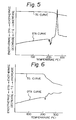
- N-n-propylisoquinolinium TCNQ complex was prepared in accordance with Example 1 except that n-amyliodide was replaced by n-propyliodide.
- the measurements of specific resistance, TG and DTA were carried out by the same methods as those described in Example 1. The results of TG and DTA are shown in Fig. 5, and the others in Table 1.
- N-sec-butylisoquinolinium TCNQ complex was prepared in accordance with Example 1 except that n-amyliodide was replaced by sec-butyliodide.
- the measurements of specific resistance, TG and DTA were carried out by the same methods as those described in Example 1. The results of TG and DTA are shown in Fig. 6, and the others in Table 1.
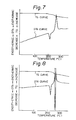
- N -n-hexylisoquinolinium TCNQ complex was prepared in accordance with Example 1 except that n-amyliodide was replaced by n-hexyliodide.
- the measurements of specific resistance, TG and DTA were carried out by the same methods as those described in Example 1. The results of TG and DTA are shown in Fig. 7, and the others in Table 1.
- N-b-butylisoquinolinium TCNQ complex was prepared in accordance with Example 1 except that n-amyliodide was replaced by n-butyliodide.
- the measurements of specific resistance, TG and DTA were carried out by the same methods as those described in Example 1. The results of TG and DTA are shown in Fig. 8, and the others in Table 1.
- Example 2 Into an aluminum case (6.3 mm o ) was charged 60 mg of the complex obtained in Example 1, and this was heated to melt. A winding type aluminum electrolytic capacitor unit was then impregnated with the melted complex and immediately cooled to obtain a capacitor unit. This capacitor unit has its aluminum surface coated with an oxide film by chemical conversion treatment and was then used. The characteristics of the obtained capacitor are shown in Table 2.
- Example 3 The experiment of Example 3 was repeated except that the complex obtained in Example 1 was replaced by the complex obtained in Example 2. The characteristics of the obtained capacitor are shown in Table 2.
- Example 3 The experiment of Example 3 was repeated except that the complex obtained in Example 1 was replaced by the complex obtained in Comparative Example 1. The characteristics of the obtained capacitor are shown in Table 2.
- Example 3 The experiment of Example 3 was repeated except that the complex obtained in Example 1 was replaced by the complex obtained in Comparative Example 2. The characteristics of the obtained capacitor are shown in Table 2.
- Example 3 The experiment of Example 3 was repeated except that the complex obtained in Example 1 was replaced by the complex obtained in Comparative Example 3. The characteristics of the obtained capacitor are shown in Table 2.
- Cap means electrostatic capacity at 120 Hz
- tan 6 means dielectric loss tangent at 120 Hz
- ESR means equivalent series resistance at 100 kHz
- AC/C means percent of capacity change between 85°C and 20°C.
- Example 3 and Example 4 have both low tan ⁇ and low ESR compared to Comparative Examples 5 to 7. Thus, the characteristics of this capacitor are superior. Furthermore, the ⁇ C/C is low, which means that the capacity change ratio caused by temperature change is small. Thus, it is clear that the thermal characteristics of this capacitor are superior.
Landscapes
- Chemical & Material Sciences (AREA)
- Chemical Kinetics & Catalysis (AREA)
- Electrochemistry (AREA)
- Engineering & Computer Science (AREA)
- Power Engineering (AREA)
- Microelectronics & Electronic Packaging (AREA)
- Organic Low-Molecular-Weight Compounds And Preparation Thereof (AREA)
- Pyridine Compounds (AREA)
- Other In-Based Heterocyclic Compounds (AREA)
- Conductive Materials (AREA)
Applications Claiming Priority (2)
| Application Number | Priority Date | Filing Date | Title |
|---|---|---|---|
| JP60256617A JPH0610199B2 (ja) | 1985-11-18 | 1985-11-18 | 電荷移動錯体 |
| JP256617/85 | 1985-11-18 |
Publications (3)
| Publication Number | Publication Date |
|---|---|
| EP0224207A2 true EP0224207A2 (fr) | 1987-06-03 |
| EP0224207A3 EP0224207A3 (en) | 1988-09-14 |
| EP0224207B1 EP0224207B1 (fr) | 1991-06-05 |
Family
ID=17295107
Family Applications (1)
| Application Number | Title | Priority Date | Filing Date |
|---|---|---|---|
| EP86116127A Expired EP0224207B1 (fr) | 1985-11-18 | 1986-11-18 | Complexe à transfert de charges |
Country Status (4)
| Country | Link |
|---|---|
| US (1) | US4688153A (fr) |
| EP (1) | EP0224207B1 (fr) |
| JP (1) | JPH0610199B2 (fr) |
| DE (1) | DE3679637D1 (fr) |
Cited By (2)
| Publication number | Priority date | Publication date | Assignee | Title |
|---|---|---|---|---|
| US4855022A (en) * | 1988-02-05 | 1989-08-08 | Compagnie Europeenne De Composants Electroniques | Method for the impregnation of electrolytic capacitors with tetracyanoquinodimethane salts |
| US5413860A (en) * | 1992-07-15 | 1995-05-09 | Ciba-Geigy Corporation | Coated material, the preparation and use thereof |
Families Citing this family (3)
| Publication number | Priority date | Publication date | Assignee | Title |
|---|---|---|---|---|
| JPS63126212A (ja) * | 1986-11-14 | 1988-05-30 | 松下電器産業株式会社 | 固体電解コンデンサ |
| DE68920408T2 (de) * | 1988-10-31 | 1995-08-31 | Japan Carlit Co Ltd | Ladungsübertragungskomplex und seine Verwendung in Festelektrolytkondensatoren. |
| TWI267507B (en) * | 2000-12-05 | 2006-12-01 | Ind Tech Res Inst | TCNQ composite salt and application on solid capacitor of the same |
Family Cites Families (9)
| Publication number | Priority date | Publication date | Assignee | Title |
|---|---|---|---|---|
| US2677687A (en) * | 1951-07-11 | 1954-05-04 | Sterling Drug Inc | Nu-(4-methoxybenzyl) isoquinolinium chloride |
| US3709820A (en) * | 1970-03-04 | 1973-01-09 | Matsushita Electric Industrial Co Ltd | Solid electrolyte |
| JPS5610777B2 (fr) * | 1972-06-13 | 1981-03-10 | ||
| JPS5817609A (ja) * | 1981-07-24 | 1983-02-01 | 三洋電機株式会社 | 固体電解コンデンサの製造方法 |
| US4580855A (en) * | 1981-04-17 | 1986-04-08 | Sanyo Electric Co., Ltd. | Solid electrolyte capacitor |
| GB2113916B (en) * | 1982-01-18 | 1986-07-09 | Sanyo Electric Co | Solid electrolyte capacitor |
| JPS5963604A (ja) * | 1982-10-01 | 1984-04-11 | 三洋電機株式会社 | 有機半導体物質の処理方法 |
| JPS6065521A (ja) * | 1983-09-20 | 1985-04-15 | 松下電器産業株式会社 | 固体電解コンデンサ |
| JPS6292424A (ja) * | 1985-10-18 | 1987-04-27 | 松下電器産業株式会社 | 固体電解コンデンサ |
-
1985
- 1985-11-18 JP JP60256617A patent/JPH0610199B2/ja not_active Expired - Lifetime
-
1986
- 1986-11-12 US US06/930,317 patent/US4688153A/en not_active Expired - Lifetime
- 1986-11-18 EP EP86116127A patent/EP0224207B1/fr not_active Expired
- 1986-11-18 DE DE8686116127T patent/DE3679637D1/de not_active Expired - Lifetime
Cited By (5)
| Publication number | Priority date | Publication date | Assignee | Title |
|---|---|---|---|---|
| US4855022A (en) * | 1988-02-05 | 1989-08-08 | Compagnie Europeenne De Composants Electroniques | Method for the impregnation of electrolytic capacitors with tetracyanoquinodimethane salts |
| EP0327448A1 (fr) * | 1988-02-05 | 1989-08-09 | Compagnie Europeenne De Composants Electroniques Lcc | Procédé d'imprégnation de condensateurs électrolytiques par des sels de tétracyanoquinodiméthane |
| FR2627008A1 (fr) * | 1988-02-05 | 1989-08-11 | Europ Composants Electron | Procede d'impregnation de condensateurs electrolytiques par des sels de tetracyanoquinodimethane |
| US5413860A (en) * | 1992-07-15 | 1995-05-09 | Ciba-Geigy Corporation | Coated material, the preparation and use thereof |
| US5554446A (en) * | 1992-07-15 | 1996-09-10 | Ciba-Geigy Corporation | Coated material, the preparation of use thereof |
Also Published As
| Publication number | Publication date |
|---|---|
| JPH0610199B2 (ja) | 1994-02-09 |
| JPS62116552A (ja) | 1987-05-28 |
| EP0224207B1 (fr) | 1991-06-05 |
| DE3679637D1 (de) | 1991-07-11 |
| EP0224207A3 (en) | 1988-09-14 |
| US4688153A (en) | 1987-08-18 |
Similar Documents
| Publication | Publication Date | Title |
|---|---|---|
| EP0697705B1 (fr) | Condensateur à électrolyte solide utilisant du polyaniline dopé par un acide disulfonique | |
| EP0654804B1 (fr) | Condensateur à électrolyte solide | |
| JPH01169914A (ja) | 固体電解質組成分として導電性重合体を有する固体コンデンサ及びその製法 | |
| EP0224207B1 (fr) | Complexe à transfert de charges | |
| EP0367147B1 (fr) | Complexe à transfert de charges et son utilisation dans les condensateurs à électrolyte solide | |
| JP3490868B2 (ja) | 固体電解コンデンサの製造方法 | |
| JP2005112733A (ja) | オニウム塩 | |
| US4828738A (en) | Solid electrolytic capacitor | |
| US5672377A (en) | Method of forming a solid electrolytic capacitor | |
| JPH0722073B2 (ja) | 固体電解コンデンサ | |
| JP2993272B2 (ja) | 可逆性電極 | |
| KR101763562B1 (ko) | 메틸 아이오다이드를 이용한 사차 암모늄염의 제조방법 | |
| JP2636793B2 (ja) | 導電性高分子化合物とこれを用いた固体電解コンデンサ | |
| JP2673436B2 (ja) | 耐熱性電荷移動錯体及び耐熱性固体電解コンデンサ | |
| JPH01165575A (ja) | 耐熱性電荷移動錯体 | |
| CA1099090A (fr) | Electrolyte de condensateur, et condensateur qui le renferme | |
| JPH0629249B2 (ja) | コンデンサ用錯体組成物 | |
| JPH0770247B2 (ja) | 耐熱性電荷移動錯体 | |
| JP2586917B2 (ja) | 耐熱性固体電解コンデンサ | |
| JP2640663B2 (ja) | 耐熱性電荷移動錯体 | |
| JP2649239B2 (ja) | 耐熱性電荷移動錯体及び耐熱性固体電解コンデンサ | |
| JPH03237707A (ja) | 固体電解コンデンサ | |
| JP2005126382A (ja) | オニウム塩 | |
| JP2886197B2 (ja) | 固体電解コンデンサの製造方法 | |
| JP2649238B2 (ja) | 耐熱性電荷移動錯体及び耐熱性固体電解コンデンサ |
Legal Events
| Date | Code | Title | Description |
|---|---|---|---|
| PUAI | Public reference made under article 153(3) epc to a published international application that has entered the european phase |
Free format text: ORIGINAL CODE: 0009012 |
|
| AK | Designated contracting states |
Kind code of ref document: A2 Designated state(s): DE FR GB NL |
|
| PUAL | Search report despatched |
Free format text: ORIGINAL CODE: 0009013 |
|
| AK | Designated contracting states |
Kind code of ref document: A3 Designated state(s): DE FR GB NL |
|
| RAP3 | Party data changed (applicant data changed or rights of an application transferred) |
Owner name: THE JAPAN CARLIT CO., LTD. |
|
| 17P | Request for examination filed |
Effective date: 19890221 |
|
| 17Q | First examination report despatched |
Effective date: 19900731 |
|
| GRAA | (expected) grant |
Free format text: ORIGINAL CODE: 0009210 |
|
| AK | Designated contracting states |
Kind code of ref document: B1 Designated state(s): DE FR GB NL |
|
| REF | Corresponds to: |
Ref document number: 3679637 Country of ref document: DE Date of ref document: 19910711 |
|
| ET | Fr: translation filed | ||
| PLBE | No opposition filed within time limit |
Free format text: ORIGINAL CODE: 0009261 |
|
| STAA | Information on the status of an ep patent application or granted ep patent |
Free format text: STATUS: NO OPPOSITION FILED WITHIN TIME LIMIT |
|
| 26N | No opposition filed | ||
| REG | Reference to a national code |
Ref country code: GB Ref legal event code: IF02 |
|
| PGFP | Annual fee paid to national office [announced via postgrant information from national office to epo] |
Ref country code: FR Payment date: 20031124 Year of fee payment: 18 |
|
| PGFP | Annual fee paid to national office [announced via postgrant information from national office to epo] |
Ref country code: GB Payment date: 20031125 Year of fee payment: 18 |
|
| PGFP | Annual fee paid to national office [announced via postgrant information from national office to epo] |
Ref country code: NL Payment date: 20031128 Year of fee payment: 18 |
|
| PGFP | Annual fee paid to national office [announced via postgrant information from national office to epo] |
Ref country code: DE Payment date: 20040120 Year of fee payment: 18 |
|
| PG25 | Lapsed in a contracting state [announced via postgrant information from national office to epo] |
Ref country code: GB Free format text: LAPSE BECAUSE OF NON-PAYMENT OF DUE FEES Effective date: 20041118 |
|
| PG25 | Lapsed in a contracting state [announced via postgrant information from national office to epo] |
Ref country code: NL Free format text: LAPSE BECAUSE OF NON-PAYMENT OF DUE FEES Effective date: 20050601 Ref country code: DE Free format text: LAPSE BECAUSE OF NON-PAYMENT OF DUE FEES Effective date: 20050601 |
|
| GBPC | Gb: european patent ceased through non-payment of renewal fee |
Effective date: 20041118 |
|
| PG25 | Lapsed in a contracting state [announced via postgrant information from national office to epo] |
Ref country code: FR Free format text: LAPSE BECAUSE OF NON-PAYMENT OF DUE FEES Effective date: 20050729 |
|
| NLV4 | Nl: lapsed or anulled due to non-payment of the annual fee |
Effective date: 20050601 |
|
| REG | Reference to a national code |
Ref country code: FR Ref legal event code: ST |