EP0224772A1 - Selektiv-fungizide Verwendung von Thienylharnstoff-Derivaten - Google Patents
Selektiv-fungizide Verwendung von Thienylharnstoff-Derivaten Download PDFInfo
- Publication number
- EP0224772A1 EP0224772A1 EP86115788A EP86115788A EP0224772A1 EP 0224772 A1 EP0224772 A1 EP 0224772A1 EP 86115788 A EP86115788 A EP 86115788A EP 86115788 A EP86115788 A EP 86115788A EP 0224772 A1 EP0224772 A1 EP 0224772A1
- Authority
- EP
- European Patent Office
- Prior art keywords
- butyl
- propyl
- ethyl
- methyl
- butoxy
- Prior art date
- Legal status (The legal status is an assumption and is not a legal conclusion. Google has not performed a legal analysis and makes no representation as to the accuracy of the status listed.)
- Withdrawn
Links
Classifications
-
- A—HUMAN NECESSITIES
- A01—AGRICULTURE; FORESTRY; ANIMAL HUSBANDRY; HUNTING; TRAPPING; FISHING
- A01N—PRESERVATION OF BODIES OF HUMANS OR ANIMALS OR PLANTS OR PARTS THEREOF; BIOCIDES, e.g. AS DISINFECTANTS, AS PESTICIDES OR AS HERBICIDES; PEST REPELLANTS OR ATTRACTANTS; PLANT GROWTH REGULATORS
- A01N47/00—Biocides, pest repellants or attractants, or plant growth regulators containing organic compounds containing a carbon atom not being member of a ring and having no bond to a carbon or hydrogen atom, e.g. derivatives of carbonic acid
- A01N47/08—Biocides, pest repellants or attractants, or plant growth regulators containing organic compounds containing a carbon atom not being member of a ring and having no bond to a carbon or hydrogen atom, e.g. derivatives of carbonic acid the carbon atom having one or more single bonds to nitrogen atoms
- A01N47/28—Ureas or thioureas containing the groups >N—CO—N< or >N—CS—N<
- A01N47/36—Ureas or thioureas containing the groups >N—CO—N< or >N—CS—N< containing the group >N—CO—N< directly attached to at least one heterocyclic ring; Thio analogues thereof
-
- C—CHEMISTRY; METALLURGY
- C07—ORGANIC CHEMISTRY
- C07D—HETEROCYCLIC COMPOUNDS
- C07D333/00—Heterocyclic compounds containing five-membered rings having one sulfur atom as the only ring hetero atom
- C07D333/02—Heterocyclic compounds containing five-membered rings having one sulfur atom as the only ring hetero atom not condensed with other rings
- C07D333/04—Heterocyclic compounds containing five-membered rings having one sulfur atom as the only ring hetero atom not condensed with other rings not substituted on the ring sulphur atom
- C07D333/26—Heterocyclic compounds containing five-membered rings having one sulfur atom as the only ring hetero atom not condensed with other rings not substituted on the ring sulphur atom with hetero atoms or with carbon atoms having three bonds to hetero atoms with at the most one bond to halogen, e.g. ester or nitrile radicals, directly attached to ring carbon atoms
- C07D333/38—Carbon atoms having three bonds to hetero atoms with at the most one bond to halogen, e.g. ester or nitrile radicals
Definitions
- the present invention relates to the use of thienylurea derivatives as a selective fungicide against botrytis fungi.
- the thienylurea derivatives of the formula (I) have a considerably higher selective fungicidal activity against botrytis fungi than the compound 1- (4,5-dimethyl-3-ethoxy) known from the prior art carbonyl-2-thienyl) -3-methylurea (see, e.g., U.S. Patent No. 3,823,161).
- the C 3 -C 4 alkyl radical R 1 denotes straight-chain or branched alkyl having 3 or 4 carbon atoms. Examples include n-propyl, i-propyl, n-butyl, i-butyl, sec-butyl and tert-butyl.
- the C 1 -C 4 alkoxy radical R denotes straight-chain or branched alkoxy having 1 to 4 carbon atoms. Examples include methoxy, ethoxy, n-propoxy, i-propoxy, n-butoxy, i-butoxy, sec-butoxy and tert-butoxy.
- the C 1 -C 4 alkyl radicals R 2 and R 3 mean straight-chain or branched alkyl having 1 to 4 carbon atoms. Examples include methyl, ethyl, n-propyl, i-propyl, n-butyl, i-butyl, sec-butyl or tert-butyl.
- X preferably represents oxygen
- the active ingredients to be used according to the invention have a strong selective fungicidal action and can be used practically to combat unwanted botrytis fungi.
- the active ingredients are suitable for use in crop protection as botrytis agents.
- the active substances to be used according to the invention are particularly effective, e.g. against Botrytis cinerea, the causative agent of gray mold on haricot beans, lettuce, strawberries and vines, preferably they are used on vines, strawberries and lettuce.
- the active compounds can be converted into the usual formulations, such as solutions, emulsions, suspensions, powders, foams, pastes, granules, aerosols, very fine encapsulations in polymeric substances and in coating compositions for seeds, and ULV formulations.
- formulations are prepared in a known manner, for example by mixing the active ingredients with extenders, that is to say liquid solvents, pressurized liquefied gases and / or solid carriers, if appropriate using surface-active agents, i.e. emulsifiers and / or dispersants and / or foam-generating agents. If water is used as an extender, organic solvents can, for example, also be used as auxiliary solvents.
- extenders that is to say liquid solvents, pressurized liquefied gases and / or solid carriers, if appropriate using surface-active agents, i.e. emulsifiers and / or dispersants and / or foam-generating agents.
- surface-active agents i.e. emulsifiers and / or dispersants and / or foam-generating agents.
- organic solvents can, for example, also be used as auxiliary solvents.
- aromatics such as xylene, toluene or alkylnaphthalenes
- chlorinated aromatics or chlorinated aliphatic hydrocarbons such as chlorobenzenes, chlorethylenes or methylene chloride
- aliphatic hydrocarbons such as cyclohexane or paraffins, for example petroleum fractions
- alcohols such as butanol or glycol and their ethers and esters
- ketones such as acetone, methyl ethyl ketone, methyl isobutyl ketone or cyclohexanone
- highly polar solvents such as dimethylformamide and dimethyl sulfoxide, and water.
- Liquefied gaseous extenders or carriers mean liquids which are gaseous at normal temperature and under normal pressure, for example aerosol propellants such as halogenated hydrocarbons and Carrier materials are suitable: for example natural rock powder, such as kaolins, clays, talc, chalk, quartz, attapulgite, montmorillonite or diatomaceous earth and synthetic rock meals, such as highly disperse silica, aluminum oxide and silicates.
- aerosol propellants such as halogenated hydrocarbons and Carrier materials are suitable: for example natural rock powder, such as kaolins, clays, talc, chalk, quartz, attapulgite, montmorillonite or diatomaceous earth and synthetic rock meals, such as highly disperse silica, aluminum oxide and silicates.
- Solid carrier materials for granules are: for example, broken and fractionated natural rocks such as calcite, marble, pumice, sepiolite, dolomite and synthetic granules from inorganic and organic flours as well as granules from organic material such as sawdust, coconut shells, corn cobs and tobacco stalks.
- Possible emulsifiers and / or foam-generating agents are: for example nonionic and anionic emulsifiers, such as polyoxyethylene fatty acid esters, polyoxyethylene fatty alcohol ethers, for example alkylaryl polyglycol ethers, alkyl sulfonates, alkyl sulfates, aryl sulfonates and protein hydrolyzates.
- Possible dispersants are: eg lignin sulfite waste liquor and methyl cellulose.
- Adhesives such as carboxymethyl cellulose, natural and synthetic polymers in the form of powders, granules or latices, such as gum arabic, polyvinyl alcohol, polyvinyl acetate, and also natural phospholipids, such as cephalins and lecithins, and synthetic phospholipids can be used in the formulations.
- Other additives can be mineral and vegetable oils.
- Dyes such as inorganic pigments, for example iron oxide, titanium oxide, ferrocyan blue and organic dyes, such as alizarin, azo and metal phthalo cyanine dyes and trace nutrients such as salts of iron, manganese, boron, copper, cobalt, molybdenum and zinc can be used.
- inorganic pigments for example iron oxide, titanium oxide, ferrocyan blue and organic dyes, such as alizarin, azo and metal phthalo cyanine dyes and trace nutrients such as salts of iron, manganese, boron, copper, cobalt, molybdenum and zinc can be used.
- the formulations generally contain between 0.1 and 95 percent by weight of active compound, preferably between 0.5 and 90%.
- the active compounds according to the invention can be present in the formulations in a mixture with other known active compounds, such as fungicides, insecticides, acaricides and herbicides, and also in mixtures with fertilizers and growth regulators.
- the active compounds can be used as such, in the form of their formulations or the use forms prepared therefrom, such as ready-to-use solutions, emulsifiable concentrates, emulsions, foams, suspensions, wettable powders, pastes, soluble powders, dusts and granules. They are used in the usual way, e.g. by pouring, spraying, spraying, scattering, dusting, foaming, brushing, etc.
- the active compound concentrations in the use forms can be varied within a substantial range. They are generally between 1 and 0.0001% by weight, preferably between 0.5 and 0.001 X.
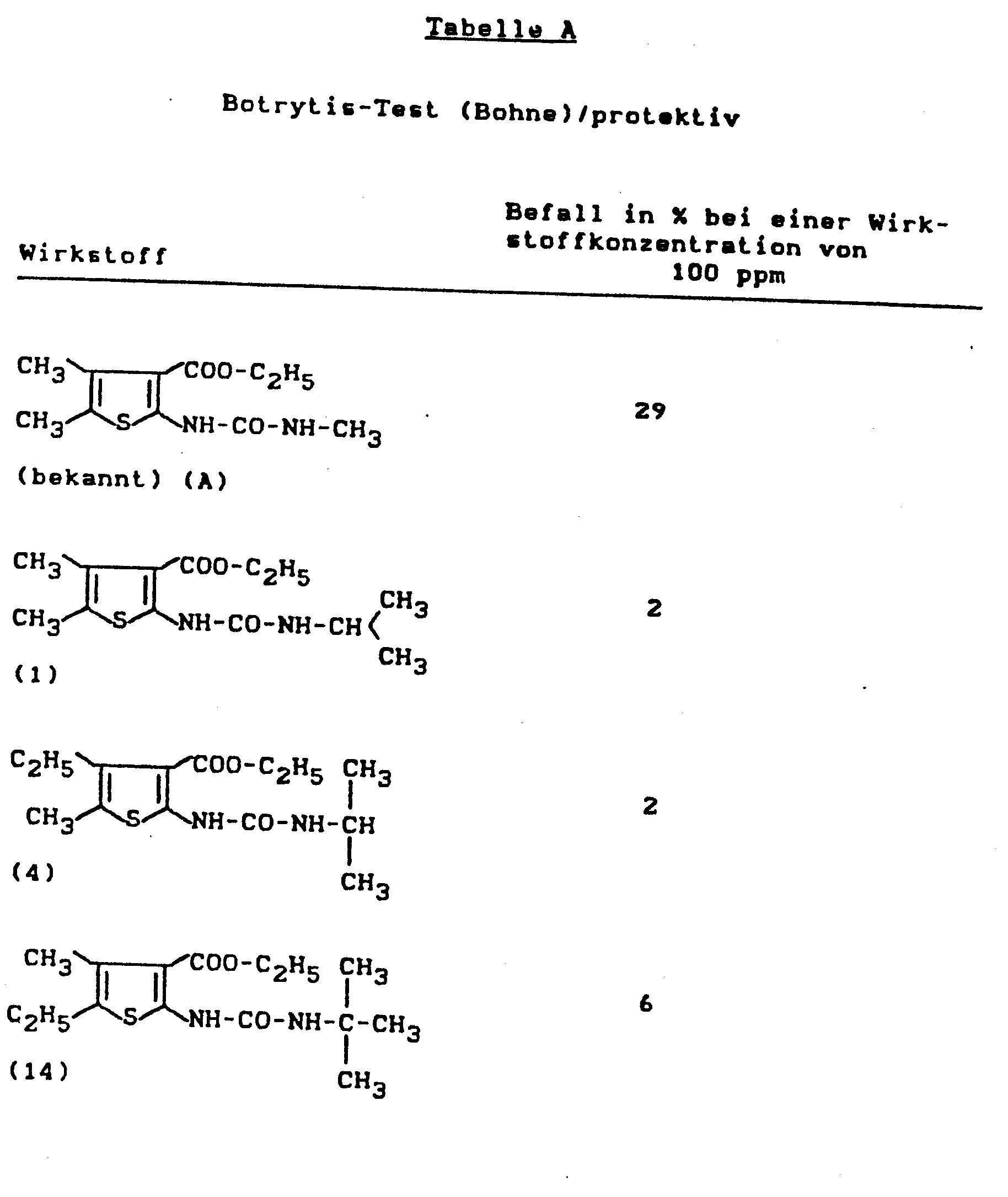
- Botrytis test (bean) / protective
- active compound 1 part by weight of active compound is mixed with the stated amounts of solvent and emulsifier and the concentrate is diluted with water to the desired concentration.
- Botrytis test (vine) / protective
- active compound 1 part by weight of active compound is mixed with the stated amounts of solvent and emulsifier and the concentrate is diluted with water to the desired concentration.
Landscapes
- Chemical & Material Sciences (AREA)
- Organic Chemistry (AREA)
- Life Sciences & Earth Sciences (AREA)
- Agronomy & Crop Science (AREA)
- Pest Control & Pesticides (AREA)
- Plant Pathology (AREA)
- Health & Medical Sciences (AREA)
- Engineering & Computer Science (AREA)
- Dentistry (AREA)
- General Health & Medical Sciences (AREA)
- Wood Science & Technology (AREA)
- Zoology (AREA)
- Environmental Sciences (AREA)
- Agricultural Chemicals And Associated Chemicals (AREA)
- Plural Heterocyclic Compounds (AREA)
Abstract
Selektiv-fungizide Verwendung von Thienylharnstoff-Derivaten der Formel (I) <IMAGE> in welcher X, R bis R³ die in der Beschreibung angegebenen Bedeutungen haben, gegen Botrytispilze.
Description
- Die vorliegende Erfindung betrifft die Verwendung von Thienylharnstoff-Derivaten als selektives Fungizid gegen Botrytispilze.
- Es ist bereits bekannt geworden, daß bestimmte Thienylharnstoffe, wie z. B. 1-(4,5-Dimethyl-3-athoxycarbonyl-2-thienyl)-3-methylharnstoff, eine gute fungizide Wirksamkeit besitzen (vergl. z. B. US-PS 3 823 161). Über die vom wirtschaftlichen Standpunkt aus hoch interessante Wirksamkeit gegen Botrytispilze ist jedoch nichts bekannt.
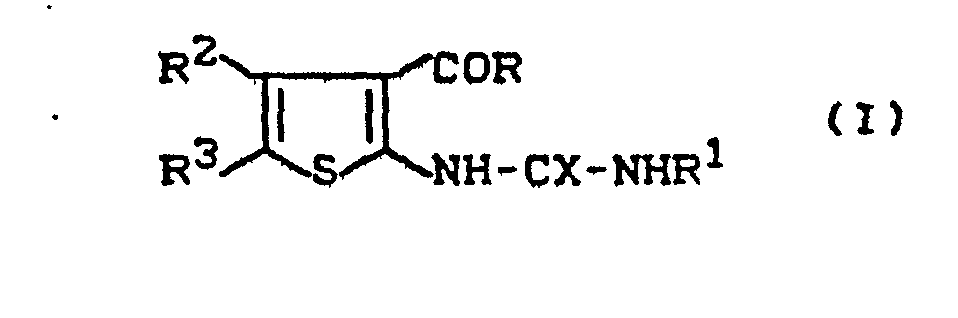
- Es wurde gefunden, daß speziell die Verbindungen der Formel (I)

- X für Sauerstoff oder Schwefel steht,
- R für C1-C4-Alkoxy steht,
- R1 für C3-C4-Alkyl steht,
- R2 für Wasserstoff oder C1-C4-Alkyl steht und
- R3 für Wasserstoff oder Cl-C4-Alkyl steht, mit der Maßgabe, daβ R2 und R3 nicht gleichzeitig für Wasserstoff stehen,
- wegen ihrer besonders guten selektiven fungiziden Wirksamkeit gegen Botrytispilze zur Bekämpfung derselben verwendet werden können.
- Überraschenderweise zeigen die Thienylharnstoff-Derivate der Formel (I) eine erheblich höhere selektive fungizide Wirkung gegen Botrytispilze als die aus dem Stand der Technik bekannte Verbindung 1-(4,5-Dimethyl-3-ethoxycarbonyl-2-thienyl)-3-methylharnstoff (vergl, z. B. US-PS 3 823 161).
- Der C3-C4-lkylrest R1 bedeutet geradkettiges oder verzweigtes Alkyl mit 3 oder 4 Kohlenstoffatomen. Beispielhaft seien n-Propyl, i-Propyl, n-Butyl, i-Butyl, sec.-Butyl und tert.-Butyl genannt.
- Der C1-C4-Alkoxyrest R bedeutet geradkettiges oder verzweigtes Alkoxy mit 1 bis 4 Kohlenstoffatomen. Beispielhaft seien Methoxy, Ethoxy, n-Propoxy, i-Propoxy, n-Butoxy, i-Butoxy, sec.-Butoxy und tert.-Butoxy genannt.
- Die C1-C4-Alkylreste R2 und R3 bedeuten geradkettiges oder verzweigtes Alkyl mit 1 bis 4 Kohlenstoffatomen. Beispielhaft seien Methyl, Ethyl, n-Propyl, i-Propyl, n-Butyl, i-Butyl, sec.-Butyl oder tert.-Butyl genannt.
- X steht vorzugsweise für Sauerstoff.
- Die erfindungsgemäß zu verwendenden Thienylharnstoff-Deriyate sind durch die Formel (1) allgemein definiert. In dieser Formel stehen vorzugsweise
- X für Sauerstoff,
- R für Methoxy, Ethoxy, n-Propoxy, i-Propoxy, n-Butoxy, i-Butoxy, sec.-Butoxy und tert.-Butoxy,
- R l für n-Propyl, i-Propyl, n-Butyl, i-Butyl, sec.-Butyl und tert.-Butyl,
- R2 für Wasserstoff, Methyl, Ethyl, n-Propyl, i-Propyl, n-Butyl, i-Butyl, sec.-Butyl und tert.-Butyl und
- R3 für Methyl, Ethyl, n-Propyl, i-Propyl, n-Butyl, i-Butyl, sec.-Butyl und tert.-Butyl, oder
- X, R und R1 haben die oben angegebenen Bedeutungen und
- R 2 steht für Methyl, Ethyl, n-Propyl, i-Propyl, n-Butyl, i-Butyl, sec:-Butyl und tert.-Butyl und
- R3 steht für Wasserstoff, Methyl, Ethyl, n-Propyl, i-Propyl, n-Butyl, i-Butyl, sec.-Butyl und tert.-Butyl.
- Besonders bevorzugt werden diejenigen Verbindungen der Formel (I) verwendet, in denen
- X für Sauerstoff steht,
- R für Methoxy, Ethoxy oder n-Propoxy steht,
- R1 für i-Propyl, i-Butyl, set.-Butyl, tert.-Butyl oder n-Butyl steht,
- R2 für Wasserstoff, Methyl, Ethyl, n-Propyl oder i-Propyl steht und
- R3 für Methyl, Ethyl, n-Propyl oder i-Propyl steht, oder
- X, R und R1 die oben angegebenen Bedeutungen haben und
- R 2 für Methyl, Ethyl, n-Propyl, oder i-Propyl steht und
- R 3 für Wasserstoff, Methyl, Ethyl, n-Propyl, oder i-Propyl steht.
- Ganz besonders bevorzugt werden diejenigen Verbindungen der Formel (I) verwendet, in denen
- X für Sauerstoff steht,
- R für Ethoxy steht,
- R1 für i-Propyl, sec.-Butyl, tert.-Butyl, i- oder n-Butyl steht,
- R2 für Wasserstoff, Methyl oder Ethyl steht und
- R3 für Methyl, Ethyl oder i-Propyl steht oder
- X, R und Rl die oben angegebenen Bedeutungen haben und
- R2 für Methyl oder Ethyl steht und R3 für Wasserstoff, Methyl, Ethyl oder i-Propyl steht.
- Die erfindungsgemäß zu verwendenden Wirkstoffe der Formel (I) sind bekannt und/oder lassen sich in einfacher Weise nach bekannten Methoden herstellen (vergl. z. B. EP-OS 4 931, DE-AS 20 40 579, DE-AS 21 22 636 (= US-PS 3 823 161), DE-AS 26 27 935 und eine eigene nicht vorveröffentlichte deutsche Anmeldung P 35 29 24 7.4 vom 16.08.1985). So lassen sich z. B. 2-Amino-thiophen-Derivate mit Isocyanaten oder Isothiocyanaten gemäß dem folgenden Formelschema umsetzen:

- Die erfindungsgemäß einzusetzenden Wirkstoffe weisen eine starke selektiv-fungizide Wirkung auf und können zur Bekämpfung von unerwünschten Botrytispilzen praktisch eingesetzt werden. Die Wirkstoffe sind für den Gebrauch im Pflanzenschutz als Botrytismittel geeignet.
- Eine besonders gute Wirksamkeit entfalten die erfindungsgemäß einzusetzenden Wirkstoffe z.B. gegen Botrytis cinerea, den Erreger des Grauschimmels an Gartenbohnen, Salat, Erdbeeren und Reben, vorzugsweise werden sie an Reben, Erdbeeren und Salat eingesetzt.
- Die Wirkstoffe können in die Ublichen Formulierungen übergeführt werden, wie Lösungen, Emulsionen, Suspensionen, Pulver, Schäume, Pasten, Granulate, Aerosole, Feinstverkapselungen in polymeren Stoffen und in Hüllmassen für Saatgut, sowie ULV-Formulierungen.
- Diese Formulierungen werden in bekannter Weise hergestellt, z.B. durch Vermischen der Wirkstoffe mit Streckmitteln, also flüssigen Lösungsmitteln, unter Druck stehenden verflüssigten Gasen undloder festen Trägerstoffen, gegebenenfalls unter Verwendung von oberflächenaktiven Mitteln, also Emulgiermitteln und/oder Dispergiermitteln undloder schaumerzeugenden Mitteln. Im Falle der Benutzung von Wasser als Streckmittel können z.B. auch organische Lösungsmittel als Hilfslösungsmittel verwendet werden. Als flüssige Löaungsmittel kommen im wesentlichen in Frage: Aromaten, wie Xylol, Toluol oder Alkylnaphthaline, chlorierte Aromaten oder chlorierte aliphatische Kohlenwasserstoffe, wie Chlorbenzole, Chlorethylene oder Methylenchlorid, aliphatische Kohlenwasserstoffe, wie Cyclohexan oder Paraffine, z.B. Erdölfraktionen, Alkohole, wie Butanol oder Glycol sowie deren Ether und Ester, Ketone, wie Aceton, Methylethylketon, Methylisobutylketon oder Cyclohexanon, stark polare Löcungsmittel, wie Dimethylformamid und Dimethylsulfoxid, sowie Wasser. Mit verflüssigten gasförmigen Streckmitteln oder Trägerstoffen sind solche Flüssigkeiten gemeint, welche bei normaler Temperatur und unter Normaldruck gasförmig sind, z.B. Aerosol-Treibgase, wie Halogenkohlenwasserstoffe sowie Trägerstoffe kommen in Frage: z.B. natürliche Gesteinsmehle, wie Kaoline, Tonerden, Talkum, Kreide, Quarz, Attapulgit, Montmorillonit oder Diatomeenerde und synthetische Gesteinsmehle, wie hochdisperse Kieselsäure, Aluminiumoxid und Silikate. Als feste Trägertoffe für Granulate kommen in Frage: z.B, gebrochene und fraktionierte natürliche Gesteine wie Calcit, Marmor, Bims, Sepiolith, Dolomit sowie synthetische Granulate aus anorganischen und organischen Mehlen sowie Granulate aus organischem Material wie Sägemehl, Kokosnußschalen, Maiskolben und Tabakstengel. Als Emulgier- und/oder schaumerzeugende Mittel kommen in Frage: z.B. nichtionogene und anionische Emulgatoren, wie Polyoxyethylen-Fettsaureester, Polyoxyethylen-Fettalkoholether, z.B. Alkylarylpolyglycol-elher, Alkylsulfonate, Alkylsulfate, Arylsulfonate sowie Eiweißhydrolysate. Als Dispergiermittel kommen in Frage: z.B. Lignin-Sulfitablaugen und Methylcellulose.
- Es können in den Formulierungen Haftmittel wie Carboxymethylcellulose, natürliche und synthetische pulverige, körnige oder latexförmige Polymere verwendet werden, wie Gummiarabicum, Polyvinylalkohol, Polyvinylacetat, sowie natürliche Phospholipide, wie Kephaline und Lecithine, und synthetische Phospholipide. Weitere Additive können mineralische und vegetabile Öle sein.
- Es können Farbstoffe wie anorganische Pigmente, z.B. Eisenoxid, Titanoxid, Ferrocyanblau und organische Farbstoffe, wie Alizarin-, Azo- und Metallphthalocyaninfarbstoffe und Spurennährstoffe, wie Salze von Eisen, Mangan, Bor, Kupfer, Kobalt, Molybdän und Zink verwendet werden.
- Die Formulierungen enthalten im allgemeinen zwischen 0,1 und 95 Gewichtsprozent Wirkstoff, vorzugsweise zwischen 0,5 und 90 X.
- Die erfindungsgemäßen Wirkstoffe können in den Formulierungen in Mischung mit anderen bekannten Wirkstoffen vorliegen, wie Fungizide, Insektizide, Akarizide und Herbizide, sowie in Mischungen mit Düngemitteln und Wachstumsregulatoren.
- Die Wirkstoffe können als solche, in Form ihrer Formulierungen oder den daraus bereiteten Anwendungsformen, wie gebrauchsfertige Lösungen, emulgierbare Konzentrate, Emulsionen, Schäume, Suspensionen, Spritzpulver, Pasten, lösliche Pulver, Stäubemittel und Granulate, angewendet werden. Die Anwendung geschieht in üblicher Weise, z.B. durch Gießen, Verspritzen, Versprühen, Verstreuen, Verstäuben, Verschäumen, Bestreichen usw..
- Bei der Behandlung von Pflanzenteilen können die Wirkstoffkonzentrationen in den Anwendungsformen in einem größeren Bereich variiert werden. Sie liegen im allgemeinen zwischen 1 und 0,0001 Gew.-X, vorzugsweise zwischen 0,5 und 0,001 X.
-
- Lösungsmittel: 4,7 Gewichtsteile Aceton
- Emulgator: 0,3 Gewichtsteile Alkylarylpolyglykolether
- Zur Herstellung einer zweckmäßigen Wirkstoffzubereitung vermischt man 1 Gewichtsteil Wirkstoff mit den angegebenen Mengen Lösungsmittel und Emulgator und verdünnt das Konzentrat mit Wasser auf die gewünschte Konzentration.
- Zur Prüfung auf protektive Wirksamkeit bespritzt man junge Pflanzen mit der Wirkstoffzubereitung bis zur Tropfnässe. Nach Antrocknen des Spritzbelages werden auf jedes Blatt 2 kleine mit Botrytis cinerea bewachsene Agarstückchen aufgelegt. Die inokulierten Pflanzen werden in einer abgedunkelten, feuchten Kammer bei 20°C aufgestellt. 3 Tage nach der Inokulation wird die Größe der Befallsflecken auf den Blättern ausgewertet.
- Eine deutliche Überlegenheit in Wirksamkeit gegenüber dem Stand der Technik (A) zeigen in diesem Test z. B. die Verbindungen gemäß den Herstellungsbeispielen: (1), (4), (14), (16) und (18).

-
- Lösungsmittel: 4,7 Gewichtsteile Aceton
- Dispergiermittel: 0,3 Gewichtsteile Alkylarylpolyglykolether
- Zur Herstellung einer zweckmäßigen Wirkstoffzubereitung vermischt man 1 Gewichtsteil Wirkstoff mit den angegebenen Mengen Lösungsmittel und Emulgator und verdünnt das Konzentrat mit Wasser auf die gewünschte Konzentration.
- Zur Prüfung auf protektive Wirksamkeit bespritzt man junge Pflanzen mit der Wirkstoffzubereitung bis zur Tropfnässe. Nach Antrocknen des Spritzbelages Werden auf jedes Blatt 2 kleine mit Botrytis cinerea bewachsene Agarstückchen aufgelegt. Die inokulierten Pflanzen werden in einer abgedunkelten, feuchten Kammer bei 20°C aufgestellt. 3 Tage nach der Inokulation wird die Größe der Befallsflecken auf den Blättern ausgewertet.
- Eine deutliche Überlegenheit in Wirksamkeit gegenüber dem Stand der Technik zeigen in diesem Test z.B. die Verbindungen gemäß den Herstellungsbeispielen: 1, 4, 14, 3, 8 und 9.


-

- Man erhält 5,9 g (59,6 % der Theorie) 1-(4,5-Dimelhyl-3- ethoxycarbonyl-2-thienyi)-3-isopropyl-harnstoff vom Schmelzpunkt 135°C.
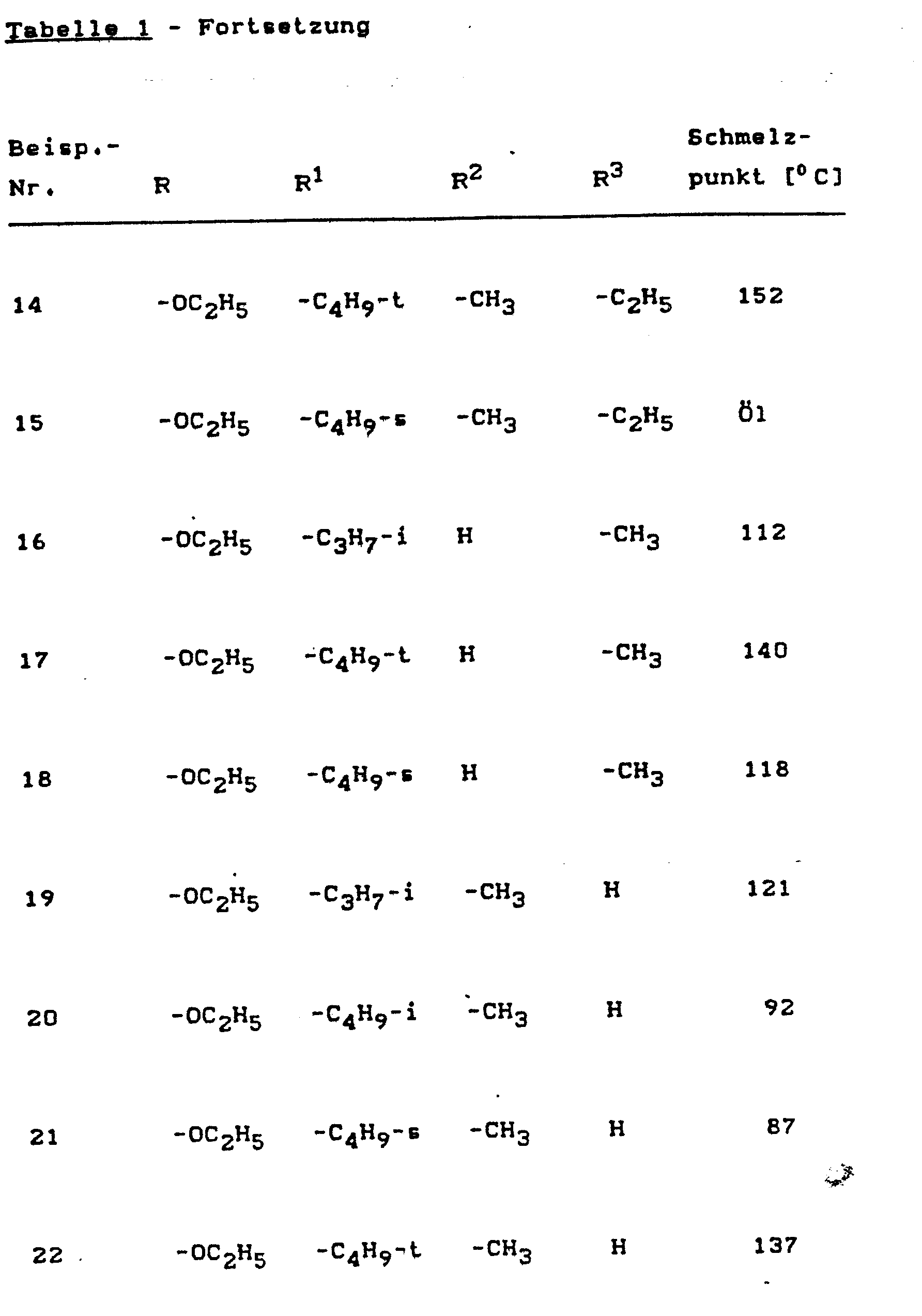
- Analog Beispiel 1 können die folgenden Verbindungen der Formel (I) hergestellt werden:

Claims (8)
1. Selektiv-fungizide Verwendung von Thierrylharnatoff-Derivaten der Formel (I) .

in welcher
X für Sauerstoff oder Schwefel steht,
R für C1-C4-Alkoxy steht,
R1 für C3-C4-Alkyl steht,
R2 für Wasserstoff oder C1-C4-Alllkyl steht und
R3 für Wasserstoff oder C1-C4-Alkyl steht, mit der Maßgabe, daß R2 und R3 nicht gleichzeitig für Wasserstoff stehen,
zur Bekämpfung von Botryticpilzen.2. Selektiv-fungizide Verwendung von Thienylharnstoff-Derivaten der Formel (I) gemäß Anspruch 1,
in welcher
in welcher
X für Sauerstoff,
R für Methoxy, Ethoxy, n-Propoxy, i-Propoxy, n-Butoxy, i-Butoxy, s.-Butoxy oder t.-Butoxy,
R1 für n-Propyl, i-Propyl, n-Butyl, i-Butyl, sec.-Butyl oder tert.-Butyl,
R2 für Wasserstoff, Methyl, Ethyl, n-Propyl, i-Propyl, n-Butyl, i-Butyl, s.-Butyl oder t.-Butyl und
R 3 für Methyl, Ethyl, n-Propyl, i-Propyl, n-Butyl, i-Butyl, s-Butyl oder t.-Butyl stehen.
3. Selektiv-fungizide Verwendung von Thienylharnstoff-Derivaten der Formel (I) gemäß Anspruch 1, in welcher
X für Sauerstoff,
R für Methoxy, Ethoxy, n-Propoxy, i-Propoxy, n-Butoxy, i-·Bαtoxy, s.-Butoxy oder t.-Butoxy,
R1 für n-Propyl, i-Propyl, n-Butyl, i-Butyl, s.-Butyl oder t.-Butyl,
R2 für Methyl, Ethyl, n-Propyl, i-Propyl, n-Butyl, i-Butyl, s.-Butyl oder t.-Butyl und
R 3 für Wasserstoff, Methyl, Ethyl, n-Propyl, i-Propyl, n-Butyl, i-Butyl, s.-Butyl oder t.-Butyl stehen.
4. Selektiv-fungizide Verwendung von Thienylharnstoff-Derivaten der Formel (I) gemäß Anspruch- 1, in welcher
X für Sauerstoff steht,
R für Methoxy, Ethoxy oder n-Propoxy steht,
R1 für i-Propyl, i-Butyl, s.-Butyl, t.-Butyl oder n-Butyl steht,
R2 für Wasserstoff, Methyl, Ethyl, n-Propyl oder i-Propyl steht und
R3 für Methyl, Ethyl, n-Propyl oder i-Propyl steht.
5. Selektiv-fungizide Verwendung von Thienylharnstoff-Derivaten der Formel (I) gemäß Anspruch 1, in welcher
X für Sauerstoff steht,
R für Methoxy, Ethoxy oder n-Propoxy steht,
R1 für i-Propyl, i-Butyl, s.-Butyl, t.-Butyl oder n-Butyl steht,
R2 für Methyl, Ethyl, n-Propyl oder i-Propyl steht und
R3 für Wasserstoff, Methyl, Ethyl, n-Propyl oder i-Propyl steht.
6. Selektiv-fungizide Verwendung von Thienylharnstoff-Derivaten der Formel (I) gemäß Anspruch 1, in welcher
X für Sauerstoff steht,
R für Ethoxy steht,
R1 für i-Propyl, s.-Butyl, t.-Butyl, i- oder n-Butyl steht,
R2 für Wasserstoff, Methyl oder Ethyl steht und
R3 für Methyl, Ethyl oder i-Propyl steht.
7. Selektiv-fungizide Verwendung von Thienylharnstoff-Derivaten der Formel (I) gemäß Anspruch 1, in welcher
X für Sauerstoff steht,
R für Ethoxy steht,
R1 für i-Propyl s.-Butyl, t.-Butyl, i- oder n-Butyl steht,
R2 für Methyl oder Ethyl steht und
R3 für Wasserstoff, Methyl, Ethyl oder i-Propyl steht.
8. Selektiv-fungizide Verwendung von Thienylharnstoff-Derivaten der Formel (I) gemäß den Ansprüchen 1 bis 7, im Anwendungskonzentrationsbereich zwischen 1 und 0,0001 Gew.-%,
Applications Claiming Priority (2)
| Application Number | Priority Date | Filing Date | Title |
|---|---|---|---|
| DE19853541631 DE3541631A1 (de) | 1985-11-26 | 1985-11-26 | Selektiv-fungizide verwendung von thienylharnstoff-derivaten |
| DE3541631 | 1985-11-26 |
Publications (1)
| Publication Number | Publication Date |
|---|---|
| EP0224772A1 true EP0224772A1 (de) | 1987-06-10 |
Family
ID=6286774
Family Applications (1)
| Application Number | Title | Priority Date | Filing Date |
|---|---|---|---|
| EP86115788A Withdrawn EP0224772A1 (de) | 1985-11-26 | 1986-11-13 | Selektiv-fungizide Verwendung von Thienylharnstoff-Derivaten |
Country Status (4)
| Country | Link |
|---|---|
| US (1) | US4740520A (de) |
| EP (1) | EP0224772A1 (de) |
| JP (1) | JPS62129203A (de) |
| DE (1) | DE3541631A1 (de) |
Families Citing this family (34)
| Publication number | Priority date | Publication date | Assignee | Title |
|---|---|---|---|---|
| US6344476B1 (en) * | 1997-05-23 | 2002-02-05 | Bayer Corporation | Inhibition of p38 kinase activity by aryl ureas |
| US6187799B1 (en) * | 1997-05-23 | 2001-02-13 | Onyx Pharmaceuticals | Inhibition of raf kinase activity using aryl ureas |
| US7517880B2 (en) | 1997-12-22 | 2009-04-14 | Bayer Pharmaceuticals Corporation | Inhibition of p38 kinase using symmetrical and unsymmetrical diphenyl ureas |
| US7329670B1 (en) | 1997-12-22 | 2008-02-12 | Bayer Pharmaceuticals Corporation | Inhibition of RAF kinase using aryl and heteroaryl substituted heterocyclic ureas |
| US20080300281A1 (en) * | 1997-12-22 | 2008-12-04 | Jacques Dumas | Inhibition of p38 Kinase Activity Using Aryl and Heteroaryl Substituted Heterocyclic Ureas |
| US20080269265A1 (en) * | 1998-12-22 | 2008-10-30 | Scott Miller | Inhibition Of Raf Kinase Using Symmetrical And Unsymmetrical Substituted Diphenyl Ureas |
| US7928239B2 (en) | 1999-01-13 | 2011-04-19 | Bayer Healthcare Llc | Inhibition of RAF kinase using quinolyl, isoquinolyl or pyridyl ureas |
| EP2298311B1 (de) * | 1999-01-13 | 2012-05-09 | Bayer HealthCare LLC | Omega-carboxyarylsubstituierte-Diphenyl-Harnstoffe als p38-Kinasehemmer |
| EP1140840B1 (de) | 1999-01-13 | 2006-03-22 | Bayer Pharmaceuticals Corp. | -g(v)-carboxyaryl substituierte diphenyl harnstoffe als raf kinase inhibitoren |
| US7351834B1 (en) | 1999-01-13 | 2008-04-01 | Bayer Pharmaceuticals Corporation | ω-Carboxyaryl substituted diphenyl ureas as raf kinase inhibitors |
| US8124630B2 (en) * | 1999-01-13 | 2012-02-28 | Bayer Healthcare Llc | ω-carboxyaryl substituted diphenyl ureas as raf kinase inhibitors |
| HN2000000051A (es) * | 1999-05-19 | 2001-02-02 | Pfizer Prod Inc | Derivados heterociclicos utiles como agentes anticancerosos |
| US6746976B1 (en) | 1999-09-24 | 2004-06-08 | The Procter & Gamble Company | Thin until wet structures for acquiring aqueous fluids |
| US7235576B1 (en) | 2001-01-12 | 2007-06-26 | Bayer Pharmaceuticals Corporation | Omega-carboxyaryl substituted diphenyl ureas as raf kinase inhibitors |
| US7371763B2 (en) * | 2001-04-20 | 2008-05-13 | Bayer Pharmaceuticals Corporation | Inhibition of raf kinase using quinolyl, isoquinolyl or pyridyl ureas |
| US6852905B2 (en) | 2001-11-15 | 2005-02-08 | Paragon Trade Brands, Inc. | Fluid handling layers made from foam and absorbent articles containing same |
| EP2305255B1 (de) * | 2001-12-03 | 2012-08-22 | Bayer HealthCare LLC | Arylharnstoff-Verbindungen in Kombination mit anderen zytostatisch oder zytotoxisch wirksamen Stoffen zur Behandlungen menschlicher Krebserkrankungen |
| US20080108672A1 (en) * | 2002-01-11 | 2008-05-08 | Bernd Riedl | Omega-Carboxyaryl Substituted Diphenyl Ureas As Raf Kinase Inhibitors |
| WO2003068229A1 (en) | 2002-02-11 | 2003-08-21 | Bayer Pharmaceuticals Corporation | Pyridine, quinoline, and isoquinoline n-oxides as kinase inhibitors |
| DK1478358T3 (da) * | 2002-02-11 | 2013-10-07 | Bayer Healthcare Llc | Sorafenibtosylat til behandling af sygdomme kendetegnet ved unormal angiogenese |
| ATE529406T1 (de) | 2002-02-11 | 2011-11-15 | Bayer Healthcare Llc | Aryl-harnstoffe als kinase inhibitoren |
| US20030157000A1 (en) * | 2002-02-15 | 2003-08-21 | Kimberly-Clark Worldwide, Inc. | Fluidized bed activated by excimer plasma and materials produced therefrom |
| UY28213A1 (es) | 2003-02-28 | 2004-09-30 | Bayer Pharmaceuticals Corp | Nuevos derivados de cianopiridina útiles en el tratamiento de cáncer y otros trastornos. |
| EP1636585B2 (de) * | 2003-05-20 | 2012-06-13 | Bayer HealthCare LLC | Diaryl-harnstoffe mit kinasehemmender wirkung |
| PL1663978T3 (pl) * | 2003-07-23 | 2008-04-30 | Bayer Healthcare Llc | Fluoropodstawiony omega-karboksyarylodifenylomocznik do leczenia i profilaktyki chorób i stanów |
| US20070142800A1 (en) * | 2005-12-20 | 2007-06-21 | The Procter & Gamble Company | Disposable absorbent articles having a partially visible graphic |
| BRPI0709011A2 (pt) * | 2006-03-10 | 2011-06-21 | Procter & Gamble | artigos absorventes descartáveis contendo filmes de controle de odor |
| US20080195072A1 (en) * | 2007-02-08 | 2008-08-14 | The Procter & Gamble Company | Disposable absorbent articles having photochromic ink based graphics |
| CA2688474C (en) | 2007-06-05 | 2013-09-03 | The Procter & Gamble Company | Absorbent articles comprising low basis weight films exhibiting low glue burn through |
| US8558051B2 (en) * | 2007-07-18 | 2013-10-15 | The Procter & Gamble Company | Disposable absorbent article having odor control system |
| US8198503B2 (en) * | 2007-11-19 | 2012-06-12 | The Procter & Gamble Company | Disposable absorbent articles comprising odor controlling materials |
| US20100125261A1 (en) * | 2008-11-20 | 2010-05-20 | Randall Alan Watson | Disposable Absorbent Articles Comprising Odor Controlling Materials In A Distribution Profile |
| US8927801B2 (en) * | 2009-04-13 | 2015-01-06 | The Procter & Gamble Company | Absorbent articles comprising wetness indicators |
| US10487199B2 (en) | 2014-06-26 | 2019-11-26 | The Procter & Gamble Company | Activated films having low sound pressure levels |
Citations (3)
| Publication number | Priority date | Publication date | Assignee | Title |
|---|---|---|---|---|
| DE2040579A1 (de) * | 1969-08-14 | 1971-02-25 | May & Baker Ltd | Neue Thiophenderivate |
| DE2122636A1 (de) * | 1970-05-07 | 1971-12-02 | Esso Research and Engineering Co., Linden, N.J. (V. St.A.) | Aminothiophenderivate und deren Verwendung als Pesticide |
| EP0004931A2 (de) * | 1978-04-21 | 1979-10-31 | Bayer Ag | Verwendung von Furan- und Thiophenderivaten zur Regulierung des Pflanzenwachstums |
Family Cites Families (1)
| Publication number | Priority date | Publication date | Assignee | Title |
|---|---|---|---|---|
| DE3331874A1 (de) * | 1982-09-13 | 1984-04-05 | Sandoz-Patent-GmbH, 7850 Lörrach | Neue thiophenderivate |
-
1985
- 1985-11-26 DE DE19853541631 patent/DE3541631A1/de not_active Withdrawn
-
1986
- 1986-11-13 EP EP86115788A patent/EP0224772A1/de not_active Withdrawn
- 1986-11-14 US US06/931,293 patent/US4740520A/en not_active Expired - Fee Related
- 1986-11-20 JP JP61275478A patent/JPS62129203A/ja active Pending
Patent Citations (3)
| Publication number | Priority date | Publication date | Assignee | Title |
|---|---|---|---|---|
| DE2040579A1 (de) * | 1969-08-14 | 1971-02-25 | May & Baker Ltd | Neue Thiophenderivate |
| DE2122636A1 (de) * | 1970-05-07 | 1971-12-02 | Esso Research and Engineering Co., Linden, N.J. (V. St.A.) | Aminothiophenderivate und deren Verwendung als Pesticide |
| EP0004931A2 (de) * | 1978-04-21 | 1979-10-31 | Bayer Ag | Verwendung von Furan- und Thiophenderivaten zur Regulierung des Pflanzenwachstums |
Non-Patent Citations (2)
| Title |
|---|
| CHEMICAL ABSTRACTS, Band 92, Nr. 9, 3. März 1980, Seite 650, Zusammenfassung Nr. 76205r, Columbus, Ohio, US; V.J. RAM: "Tiophenes, pyrazolothiophenes and pyrimidothiophenes as pesticides", & ARCH. PHARM. (Weinheim, Ger.) 1979, 312(9), 726-33 * |
| JOURNAL OF PHARMACEUTICAL SCIENCES, Band 65, Nr. 5, Mai 1976, Seiten 660-664, Washington, D.C., US; M.B. DEVANI et al.: "Synthesis of 3-substituted thieno[2,3-d]pyrimidin-4(3H)-one-2-mercaptoacetic acids and their ethyl esters for pharmacological screening" * |
Also Published As
| Publication number | Publication date |
|---|---|
| US4740520A (en) | 1988-04-26 |
| DE3541631A1 (de) | 1987-05-27 |
| JPS62129203A (ja) | 1987-06-11 |
Similar Documents
| Publication | Publication Date | Title |
|---|---|---|
| DE3541631A1 (de) | Selektiv-fungizide verwendung von thienylharnstoff-derivaten | |
| CH618974A5 (de) | ||
| EP0101902A1 (de) | Oxochinazolin-carbaminsäureester | |
| EP0166462A1 (de) | Fungizide Mittel | |
| EP0226051A1 (de) | Fungizide Verwendung von Tetrahydrobenzothienylharnstoff-Derivaten | |
| DE4338923C2 (de) | Verwendung von Kupfer-(II)-methioninat als Fungizid im Weinbau | |
| EP0093908A1 (de) | Heteroarylthiovinyl-Verbindungen, ein Verfahren zu ihrer Herstellung und ihre Verwendung als Schädlingsbekämpfungsmittel | |
| EP0154273B1 (de) | Fungizide Mittel | |
| EP0055442B1 (de) | N-Sulfenylierte Biurete, Verfahren zu ihrer Herstellung und ihre Verwendung als Fungizide | |
| EP0001395A2 (de) | Substituierte N-Phenyl-bernsteinsäureimide, Verfahren zu ihrer Herstellung sowie ihre Verwendung als Fungizide | |
| EP0012261B1 (de) | Substituierte Spiro-Derivate von 3-(3,5-Dichlorphenyl)-oxazolidin-2,4-dionen, Verfahren zu ihrer Herstellung sowie ihre Verwendung als Fungizide | |
| EP0046557B1 (de) | N-Sulfenylierte Harnstoffe, Verfahren zu ihrer Herstellung, diese enthaltende fungizide Mittel und ihre Verwendung | |
| EP0032706B1 (de) | Indan-4-yl-N-alkyl-carbaminsäureester, Verfahren zu ihrer Herstellung sowie ihre Verwendung als Fungizide | |
| EP0224771A1 (de) | Selektiv-fungizide Verwendung von 1-(3-Ethoxycarbonyl-4-ethyl-5-methyl-2-thienyl)-3-methylharnstoff | |
| EP0127047A2 (de) | N-Sulfenylierte Pyrano-pyrazol-Derivate | |
| EP0110243A1 (de) | Pyrano-pyrazol-Derivate | |
| EP0189800A2 (de) | Thiocyanatomethylthio-Gruppen enthaltende Verbindungen | |
| EP0013322A1 (de) | Neue 3,4-Dioxo-1,2,5-thiadiazolidin-1-oxide (I), ihre Herstellung und Verwendung als Fungizide, die Verbindungen (I) enthaltende fungizide Mittel und deren Herstellung | |
| EP0297346B1 (de) | Verwendung von 1-(4-Chlorphenyl)-4,4-dimethyl-3-(1,2,4-triazol-l-yl-methyl)-pentan-3-ol zur Bekämpfung von Pseudocercosporella herpotrichoides | |
| EP0017110A2 (de) | N-Dichloracetyl-N-phenyl-alenin(thiol)ester, Verfahren zu ihrer Herstellung sowie ihre Verwendung als Fungizide | |
| EP0043488A1 (de) | Tetrachlorphthalamidsäure-Derivate, Verfahren zu ihrer Herstellung und ihre bakterizide Verwendung | |
| DE3314190A1 (de) | Fungizide mittel | |
| DE3608743A1 (de) | Selektiv fungizide verwendung von asymmetrischen 2-pyridylphosphorsaeureestern | |
| EP0002709A1 (de) | Glykolsäure-Derivate, Verfahren zu ihrer Herstellung sowie ihre Verwendung als Fungizide | |
| EP0135186A2 (de) | 3,6-Disubstituierte 1,3,5-Thiadiazin-2-thioxo-4-one |
Legal Events
| Date | Code | Title | Description |
|---|---|---|---|
| PUAI | Public reference made under article 153(3) epc to a published international application that has entered the european phase |
Free format text: ORIGINAL CODE: 0009012 |
|
| 17P | Request for examination filed |
Effective date: 19861113 |
|
| AK | Designated contracting states |
Kind code of ref document: A1 Designated state(s): DE FR IT |
|
| STAA | Information on the status of an ep patent application or granted ep patent |
Free format text: STATUS: THE APPLICATION HAS BEEN WITHDRAWN |
|
| 18W | Application withdrawn |
Withdrawal date: 19880725 |
|
| RIN1 | Information on inventor provided before grant (corrected) |
Inventor name: HALLENBACH, WERNER, DR. Inventor name: BRANDES, WILHELM, DR. Inventor name: LINDEL, HANS, DR. |