EP0224905B1 - Procédé pour le traitement d'eau usée par oxydation humide - Google Patents
Procédé pour le traitement d'eau usée par oxydation humide Download PDFInfo
- Publication number
- EP0224905B1 EP0224905B1 EP86116707A EP86116707A EP0224905B1 EP 0224905 B1 EP0224905 B1 EP 0224905B1 EP 86116707 A EP86116707 A EP 86116707A EP 86116707 A EP86116707 A EP 86116707A EP 0224905 B1 EP0224905 B1 EP 0224905B1
- Authority
- EP
- European Patent Office
- Prior art keywords
- liquid phase
- phase oxidation
- process according
- ruthenium
- water
- Prior art date
- Legal status (The legal status is an assumption and is not a legal conclusion. Google has not performed a legal analysis and makes no representation as to the accuracy of the status listed.)
- Expired - Lifetime
Links
- 238000000034 method Methods 0.000 title claims description 191
- 239000002351 wastewater Substances 0.000 title claims description 111
- 238000009279 wet oxidation reaction Methods 0.000 title claims description 12
- 238000007254 oxidation reaction Methods 0.000 claims description 172
- 239000007791 liquid phase Substances 0.000 claims description 171
- 230000003647 oxidation Effects 0.000 claims description 169
- XLYOFNOQVPJJNP-UHFFFAOYSA-N water Substances O XLYOFNOQVPJJNP-UHFFFAOYSA-N 0.000 claims description 152
- 229910001868 water Inorganic materials 0.000 claims description 152
- 239000003054 catalyst Substances 0.000 claims description 139
- QVGXLLKOCUKJST-UHFFFAOYSA-N atomic oxygen Chemical compound [O] QVGXLLKOCUKJST-UHFFFAOYSA-N 0.000 claims description 134
- 239000001301 oxygen Substances 0.000 claims description 134
- 229910052760 oxygen Inorganic materials 0.000 claims description 134
- 239000007789 gas Substances 0.000 claims description 102
- QGZKDVFQNNGYKY-UHFFFAOYSA-N Ammonia Chemical compound N QGZKDVFQNNGYKY-UHFFFAOYSA-N 0.000 claims description 94
- 238000006243 chemical reaction Methods 0.000 claims description 94
- KDLHZDBZIXYQEI-UHFFFAOYSA-N Palladium Chemical compound [Pd] KDLHZDBZIXYQEI-UHFFFAOYSA-N 0.000 claims description 88
- PXHVJJICTQNCMI-UHFFFAOYSA-N Nickel Chemical compound [Ni] PXHVJJICTQNCMI-UHFFFAOYSA-N 0.000 claims description 84
- XEEYBQQBJWHFJM-UHFFFAOYSA-N Iron Chemical compound [Fe] XEEYBQQBJWHFJM-UHFFFAOYSA-N 0.000 claims description 82
- BASFCYQUMIYNBI-UHFFFAOYSA-N platinum Chemical compound [Pt] BASFCYQUMIYNBI-UHFFFAOYSA-N 0.000 claims description 82
- 239000007787 solid Substances 0.000 claims description 72
- KJTLSVCANCCWHF-UHFFFAOYSA-N Ruthenium Chemical compound [Ru] KJTLSVCANCCWHF-UHFFFAOYSA-N 0.000 claims description 49
- 229910052707 ruthenium Inorganic materials 0.000 claims description 49
- 229910052763 palladium Inorganic materials 0.000 claims description 44
- 229910052759 nickel Inorganic materials 0.000 claims description 42
- RYGMFSIKBFXOCR-UHFFFAOYSA-N Copper Chemical compound [Cu] RYGMFSIKBFXOCR-UHFFFAOYSA-N 0.000 claims description 41
- 229910017052 cobalt Inorganic materials 0.000 claims description 41
- 239000010941 cobalt Substances 0.000 claims description 41
- GUTLYIVDDKVIGB-UHFFFAOYSA-N cobalt atom Chemical compound [Co] GUTLYIVDDKVIGB-UHFFFAOYSA-N 0.000 claims description 41
- 229910052802 copper Inorganic materials 0.000 claims description 41
- 239000010949 copper Substances 0.000 claims description 41
- PCHJSUWPFVWCPO-UHFFFAOYSA-N gold Chemical compound [Au] PCHJSUWPFVWCPO-UHFFFAOYSA-N 0.000 claims description 41
- 229910052737 gold Inorganic materials 0.000 claims description 41
- 239000010931 gold Substances 0.000 claims description 41
- 229910052741 iridium Inorganic materials 0.000 claims description 41
- GKOZUEZYRPOHIO-UHFFFAOYSA-N iridium atom Chemical compound [Ir] GKOZUEZYRPOHIO-UHFFFAOYSA-N 0.000 claims description 41
- 229910052742 iron Inorganic materials 0.000 claims description 41
- 229910052697 platinum Inorganic materials 0.000 claims description 41
- 229910052703 rhodium Inorganic materials 0.000 claims description 41
- 239000010948 rhodium Substances 0.000 claims description 41
- MHOVAHRLVXNVSD-UHFFFAOYSA-N rhodium atom Chemical compound [Rh] MHOVAHRLVXNVSD-UHFFFAOYSA-N 0.000 claims description 41
- WFKWXMTUELFFGS-UHFFFAOYSA-N tungsten Chemical compound [W] WFKWXMTUELFFGS-UHFFFAOYSA-N 0.000 claims description 41
- 229910052721 tungsten Inorganic materials 0.000 claims description 41
- 239000010937 tungsten Substances 0.000 claims description 41
- 229910021529 ammonia Inorganic materials 0.000 claims description 29
- 238000010276 construction Methods 0.000 claims description 28
- 150000001875 compounds Chemical class 0.000 claims description 26
- 239000012476 oxidizable substance Substances 0.000 claims description 23
- IJGRMHOSHXDMSA-UHFFFAOYSA-N Atomic nitrogen Chemical compound N#N IJGRMHOSHXDMSA-UHFFFAOYSA-N 0.000 claims description 12
- DUDJJJCZFBPZKW-UHFFFAOYSA-N [Ru]=S Chemical compound [Ru]=S DUDJJJCZFBPZKW-UHFFFAOYSA-N 0.000 claims description 8
- DHCWLIOIJZJFJE-UHFFFAOYSA-L dichlororuthenium Chemical compound Cl[Ru]Cl DHCWLIOIJZJFJE-UHFFFAOYSA-L 0.000 claims description 8
- CLSUSRZJUQMOHH-UHFFFAOYSA-L platinum dichloride Chemical compound Cl[Pt]Cl CLSUSRZJUQMOHH-UHFFFAOYSA-L 0.000 claims description 8
- BVJAAVMKGRODCT-UHFFFAOYSA-N sulfanylidenerhodium Chemical compound [Rh]=S BVJAAVMKGRODCT-UHFFFAOYSA-N 0.000 claims description 8
- 229910052757 nitrogen Inorganic materials 0.000 claims description 6
- 229910002092 carbon dioxide Inorganic materials 0.000 claims description 4
- 239000007788 liquid Substances 0.000 description 71
- HEMHJVSKTPXQMS-UHFFFAOYSA-M Sodium hydroxide Chemical compound [OH-].[Na+] HEMHJVSKTPXQMS-UHFFFAOYSA-M 0.000 description 39
- 239000002699 waste material Substances 0.000 description 32
- 239000010800 human waste Substances 0.000 description 30
- GWEVSGVZZGPLCZ-UHFFFAOYSA-N Titan oxide Chemical compound O=[Ti]=O GWEVSGVZZGPLCZ-UHFFFAOYSA-N 0.000 description 22
- 229910052815 sulfur oxide Inorganic materials 0.000 description 19
- 229910000069 nitrogen hydride Inorganic materials 0.000 description 18
- 238000001223 reverse osmosis Methods 0.000 description 18
- 229910002089 NOx Inorganic materials 0.000 description 14
- MCMNRKCIXSYSNV-UHFFFAOYSA-N Zirconium dioxide Chemical compound O=[Zr]=O MCMNRKCIXSYSNV-UHFFFAOYSA-N 0.000 description 14
- 239000007864 aqueous solution Substances 0.000 description 13
- 238000000354 decomposition reaction Methods 0.000 description 13
- OAICVXFJPJFONN-UHFFFAOYSA-N Phosphorus Chemical compound [P] OAICVXFJPJFONN-UHFFFAOYSA-N 0.000 description 9
- 229910052698 phosphorus Inorganic materials 0.000 description 9
- 239000011574 phosphorus Substances 0.000 description 9
- 239000000126 substance Substances 0.000 description 9
- 239000003513 alkali Substances 0.000 description 7
- 239000000203 mixture Substances 0.000 description 7
- 239000010865 sewage Substances 0.000 description 7
- 239000010802 sludge Substances 0.000 description 7
- 230000008021 deposition Effects 0.000 description 5
- 239000008399 tap water Substances 0.000 description 5
- 235000020679 tap water Nutrition 0.000 description 5
- CURLTUGMZLYLDI-UHFFFAOYSA-N Carbon dioxide Chemical compound O=C=O CURLTUGMZLYLDI-UHFFFAOYSA-N 0.000 description 4
- PMZURENOXWZQFD-UHFFFAOYSA-L Sodium Sulfate Chemical compound [Na+].[Na+].[O-]S([O-])(=O)=O PMZURENOXWZQFD-UHFFFAOYSA-L 0.000 description 4
- 239000000969 carrier Substances 0.000 description 4
- 239000000463 material Substances 0.000 description 4
- 238000001556 precipitation Methods 0.000 description 4
- 229910052938 sodium sulfate Inorganic materials 0.000 description 4
- 235000011152 sodium sulphate Nutrition 0.000 description 4
- 239000002912 waste gas Substances 0.000 description 4
- YMWUJEATGCHHMB-UHFFFAOYSA-N Dichloromethane Chemical compound ClCCl YMWUJEATGCHHMB-UHFFFAOYSA-N 0.000 description 3
- -1 ammonium ions Chemical class 0.000 description 3
- MWUXSHHQAYIFBG-UHFFFAOYSA-N nitrogen oxide Inorganic materials O=[N] MWUXSHHQAYIFBG-UHFFFAOYSA-N 0.000 description 3
- 239000002245 particle Substances 0.000 description 3
- 238000011160 research Methods 0.000 description 3
- OKTJSMMVPCPJKN-UHFFFAOYSA-N Carbon Chemical compound [C] OKTJSMMVPCPJKN-UHFFFAOYSA-N 0.000 description 2
- VYPSYNLAJGMNEJ-UHFFFAOYSA-N Silicium dioxide Chemical compound O=[Si]=O VYPSYNLAJGMNEJ-UHFFFAOYSA-N 0.000 description 2
- CDBYLPFSWZWCQE-UHFFFAOYSA-L Sodium Carbonate Chemical compound [Na+].[Na+].[O-]C([O-])=O CDBYLPFSWZWCQE-UHFFFAOYSA-L 0.000 description 2
- QCWXUUIWCKQGHC-UHFFFAOYSA-N Zirconium Chemical compound [Zr] QCWXUUIWCKQGHC-UHFFFAOYSA-N 0.000 description 2
- PNEYBMLMFCGWSK-UHFFFAOYSA-N aluminium oxide Inorganic materials [O-2].[O-2].[O-2].[Al+3].[Al+3] PNEYBMLMFCGWSK-UHFFFAOYSA-N 0.000 description 2
- 235000011089 carbon dioxide Nutrition 0.000 description 2
- JYYOBHFYCIDXHH-UHFFFAOYSA-N carbonic acid;hydrate Chemical compound O.OC(O)=O JYYOBHFYCIDXHH-UHFFFAOYSA-N 0.000 description 2
- 238000002309 gasification Methods 0.000 description 2
- 238000010438 heat treatment Methods 0.000 description 2
- LELOWRISYMNNSU-UHFFFAOYSA-N hydrogen cyanide Chemical compound N#C LELOWRISYMNNSU-UHFFFAOYSA-N 0.000 description 2
- 239000011148 porous material Substances 0.000 description 2
- 238000004062 sedimentation Methods 0.000 description 2
- 238000000926 separation method Methods 0.000 description 2
- 239000010801 sewage sludge Substances 0.000 description 2
- 150000004763 sulfides Chemical class 0.000 description 2
- 238000012546 transfer Methods 0.000 description 2
- 229910052726 zirconium Inorganic materials 0.000 description 2
- VHUUQVKOLVNVRT-UHFFFAOYSA-N Ammonium hydroxide Chemical compound [NH4+].[OH-] VHUUQVKOLVNVRT-UHFFFAOYSA-N 0.000 description 1
- XFXPMWWXUTWYJX-UHFFFAOYSA-N Cyanide Chemical compound N#[C-] XFXPMWWXUTWYJX-UHFFFAOYSA-N 0.000 description 1
- RWSOTUBLDIXVET-UHFFFAOYSA-N Dihydrogen sulfide Chemical compound S RWSOTUBLDIXVET-UHFFFAOYSA-N 0.000 description 1
- LFQSCWFLJHTTHZ-UHFFFAOYSA-N Ethanol Chemical compound CCO LFQSCWFLJHTTHZ-UHFFFAOYSA-N 0.000 description 1
- IOVCWXUNBOPUCH-UHFFFAOYSA-N Nitrous acid Chemical compound ON=O IOVCWXUNBOPUCH-UHFFFAOYSA-N 0.000 description 1
- 229910018487 Ni—Cr Inorganic materials 0.000 description 1
- NINIDFKCEFEMDL-UHFFFAOYSA-N Sulfur Chemical compound [S] NINIDFKCEFEMDL-UHFFFAOYSA-N 0.000 description 1
- LSNNMFCWUKXFEE-UHFFFAOYSA-N Sulfurous acid Chemical compound OS(O)=O LSNNMFCWUKXFEE-UHFFFAOYSA-N 0.000 description 1
- 239000002253 acid Substances 0.000 description 1
- XKMRRTOUMJRJIA-UHFFFAOYSA-N ammonia nh3 Chemical compound N.N XKMRRTOUMJRJIA-UHFFFAOYSA-N 0.000 description 1
- 150000003868 ammonium compounds Chemical class 0.000 description 1
- AXCZMVOFGPJBDE-UHFFFAOYSA-L calcium dihydroxide Chemical compound [OH-].[OH-].[Ca+2] AXCZMVOFGPJBDE-UHFFFAOYSA-L 0.000 description 1
- 239000000920 calcium hydroxide Substances 0.000 description 1
- 229910001861 calcium hydroxide Inorganic materials 0.000 description 1
- 239000001569 carbon dioxide Substances 0.000 description 1
- 239000012876 carrier material Substances 0.000 description 1
- 230000015556 catabolic process Effects 0.000 description 1
- 150000001805 chlorine compounds Chemical class 0.000 description 1
- BIJOYKCOMBZXAE-UHFFFAOYSA-N chromium iron nickel Chemical compound [Cr].[Fe].[Ni] BIJOYKCOMBZXAE-UHFFFAOYSA-N 0.000 description 1
- VNNRSPGTAMTISX-UHFFFAOYSA-N chromium nickel Chemical compound [Cr].[Ni] VNNRSPGTAMTISX-UHFFFAOYSA-N 0.000 description 1
- 239000003245 coal Substances 0.000 description 1
- 238000007796 conventional method Methods 0.000 description 1
- 238000004042 decolorization Methods 0.000 description 1
- 230000003247 decreasing effect Effects 0.000 description 1
- 238000006731 degradation reaction Methods 0.000 description 1
- 238000004332 deodorization Methods 0.000 description 1
- 238000006477 desulfuration reaction Methods 0.000 description 1
- 230000023556 desulfurization Effects 0.000 description 1
- 238000001035 drying Methods 0.000 description 1
- 230000000694 effects Effects 0.000 description 1
- 238000002474 experimental method Methods 0.000 description 1
- 239000003337 fertilizer Substances 0.000 description 1
- 239000012634 fragment Substances 0.000 description 1
- 239000000295 fuel oil Substances 0.000 description 1
- 230000004927 fusion Effects 0.000 description 1
- 229930195733 hydrocarbon Natural products 0.000 description 1
- 150000002430 hydrocarbons Chemical class 0.000 description 1
- 229910000037 hydrogen sulfide Inorganic materials 0.000 description 1
- 239000008235 industrial water Substances 0.000 description 1
- 238000004519 manufacturing process Methods 0.000 description 1
- VUZPPFZMUPKLLV-UHFFFAOYSA-N methane;hydrate Chemical compound C.O VUZPPFZMUPKLLV-UHFFFAOYSA-N 0.000 description 1
- 238000002156 mixing Methods 0.000 description 1
- 150000002825 nitriles Chemical class 0.000 description 1
- 239000003921 oil Substances 0.000 description 1
- 150000004045 organic chlorine compounds Chemical class 0.000 description 1
- 150000002898 organic sulfur compounds Chemical class 0.000 description 1
- 238000010979 pH adjustment Methods 0.000 description 1
- 239000008188 pellet Substances 0.000 description 1
- 150000002989 phenols Chemical class 0.000 description 1
- 239000004033 plastic Substances 0.000 description 1
- 229920003023 plastic Polymers 0.000 description 1
- 238000012545 processing Methods 0.000 description 1
- 238000011084 recovery Methods 0.000 description 1
- 238000007493 shaping process Methods 0.000 description 1
- 239000000377 silicon dioxide Substances 0.000 description 1
- 229910000029 sodium carbonate Inorganic materials 0.000 description 1
- 230000001954 sterilising effect Effects 0.000 description 1
- 238000004659 sterilization and disinfection Methods 0.000 description 1
- 229910052717 sulfur Inorganic materials 0.000 description 1
- 239000011593 sulfur Substances 0.000 description 1
- XTQHKBHJIVJGKJ-UHFFFAOYSA-N sulfur monoxide Chemical class S=O XTQHKBHJIVJGKJ-UHFFFAOYSA-N 0.000 description 1
- DHCDFWKWKRSZHF-UHFFFAOYSA-N sulfurothioic S-acid Chemical compound OS(O)(=O)=S DHCDFWKWKRSZHF-UHFFFAOYSA-N 0.000 description 1
- 238000010998 test method Methods 0.000 description 1
Images


Classifications
-
- C—CHEMISTRY; METALLURGY
- C02—TREATMENT OF WATER, WASTE WATER, SEWAGE, OR SLUDGE
- C02F—TREATMENT OF WATER, WASTE WATER, SEWAGE, OR SLUDGE
- C02F11/00—Treatment of sludge; Devices therefor
- C02F11/06—Treatment of sludge; Devices therefor by oxidation
- C02F11/08—Wet air oxidation
-
- Y—GENERAL TAGGING OF NEW TECHNOLOGICAL DEVELOPMENTS; GENERAL TAGGING OF CROSS-SECTIONAL TECHNOLOGIES SPANNING OVER SEVERAL SECTIONS OF THE IPC; TECHNICAL SUBJECTS COVERED BY FORMER USPC CROSS-REFERENCE ART COLLECTIONS [XRACs] AND DIGESTS
- Y10—TECHNICAL SUBJECTS COVERED BY FORMER USPC
- Y10S—TECHNICAL SUBJECTS COVERED BY FORMER USPC CROSS-REFERENCE ART COLLECTIONS [XRACs] AND DIGESTS
- Y10S210/00—Liquid purification or separation
- Y10S210/902—Materials removed
- Y10S210/903—Nitrogenous
Definitions
- This invention relates to a process by which waste water containing suspended solids and at least one of ammonia and chemically oxidizable substances (hereinafter referred to as "COD components") is subjected to a combination of wet oxidations.
- COD components chemically oxidizable substances
- waste water to be treated contains suspended solids in a concentration of as high as about 500 ppm to tens of thousands ppm
- the unreacted suspended solids tend to adhere to the components of treating apparatus, resulting in, for example, decreased heat transfer coefficient on the surface of the heat exchanger, and increased pressure loss and reduced activity of catalyst due to the deposition of solids on the surface of catalyst particles packed in the reactor. Accordingly it is necessary to remove suspended solids partly or wholly from the waste water prior to the treatment depending on the concentration and composition of the solids.
- the treatment is carried out after removing the major portion of suspended solids, or the solids are withdrawn after treatment as excess sludge from the treating apparatus and disposed by incineration, fusion, dumping into sea, landfill or the like or utilized as a fertilizer.
- the overall amount of sewage industrially and municipally produced from the treatment of waste water and the waste from sewage treatment plants is increasing year after year. To overcome this problem, it is desired to find out a measure for minimizing the amount of sludge produced or to be treated and to develop an effective method for treating with economical feasibility the sludge being continuously accumulated.
- This invention provides:
- the ammonia contained in the waste water to be treated by the processes of the present invention includes ammonium compounds capable of forming ammonium ions when dissociated in water.
- the COD components present in the waste water to be treated in the present invention include phenols, cyanides, thiocyanides, oils, thiosulfuric acid, sulfurous acid, sulfides, nitrous acid, organic chlorine compounds (trichloroethylene, tetrachloroethylene, trichloroethane, methylene chloride, etc.) and the like.
- the term "suspended solids" used throughout the specification and the appended claims refers to the substances specified in JIS K 0102, suspended solids prescribed for the sewage test method by Japan Municipal Water Association and other combustible solids (e.g. sulfur).
- the processes of the invention are suitable for treating waste water containing suspended solids and one or two kinds of ammonia and COD components.
- waste water examples include sewage sludge, concentrated liquid of sewage sludge, human waste, waste water resulting from desulfurization and from removal of cyanide, gas liquor from coal gasification and liquefaction processes, waste water from heavy oil gasification process, waste water produced in food processing plants, waste water produced in alcohol manufacturing plants, waste water discharged from chemical plants, etc. to which, however, the waste water to be treated by the processes of the invention is in no way limited.
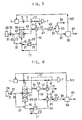
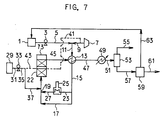
- FIG. 1 to 7 are flow charts each showing the processes I and VII, respectively.
- Raw human waste is subjected to liquid phase oxidation by the process I according to the mode shown in Fig. 1.
- Table 1 shows the components and properties of the raw human waste used.
- the human waste was passed through a swing disk screen (mesh size: 3 mm) to remove the large-size plastics pieces and paper sheets from the waste.
- the mixture was fed to a lower portion of the first reactor 21 at a space velocity of 1.0 l/hr (based on an empty column) and a mass velocity of 2.39 t/m2 hr. Air was introduced into the lower portion of the first reactor 21 at a space velocity of 89.8 l/hr (based on an empty column, under standard conditions).
- the waste was subjected in the reactor to liquid phase oxidation without a catalyst at a temperature of 280°C and pressure of 9117 KPa (90 kg/cm2 ⁇ G).
- Table 2 shows the components and properties of the waste thus treated.
- the waste treated in the step I-(i) was supplied to the second reactor 39 containing a catalyst supported by a titania carrier of honeycomb construction with square cell apertures (3.5 mm in length of one side) having a cell pitch of 4.5 mm and an aperture ratio of 59.3% and composed of 2% by weight of ruthenium based on the weight of the carrier.
- the reactor 39 had the same empty column volume as the first reactor 21.
- To the reactor 39 was fed a 20% aqueous solution of sodium hydroxide. Then the waste was subjected to liquid phase oxidation.
- the reaction temperature and pressure were the same as those in the step I-(i).
- Table 3 shows the components and properties of the waste thus treated.
- pH 7.2 COD components (mg/l) 17 NH3-N (mg/l) 15 Total-N (mg/l) 20
- BOD components* (mg/l) 15 Suspended solids (mg/l) 20
- Total oxygen demand (mg/l) 35
- Total-C (mg/l) 10
- the treated water obtained in the step I-(ii) was cooled at the heat exchanger 13 and at the cooler 49, and fed to the gas-liquid separator 53.
- the liquid from the separator was introduced into the reverse osmosis device 59 under a pressure adjusted to 6584.5 KPa (65 kg/cm2).
- 6584.5 KPa 65 kg/cm2
- Table 4 shows the quality of clarified water.
- pH 6.9 COD components (mg/l) Less than 1.0 NH3-N (mg/l) Trace Total-N (mg/l) Less than 1.0
- the concentrated liquid was returned by way of the line 63 to the waste water tank 1.
- the gas run off from the gas-liquid separator 53 was found to contain less than 0.01 ppm of NH3 and less than 0.01 ppm of SO x , but no amount of NO x was detected.
- the water containing suspended solids in a high concentration was treated for 5,000 hours but involved no precipitation nor deposition of solids on the catalyst or no reduction in decomposition efficiency of components. Thus subsequent treatment proceeded without trouble.
- Raw human waste was subjected to liquid phase oxidation by the process II according to the mode shown in Fig. 2.
- the raw human waste used had substantially the same components and properties as those of the waste used in Example 1.
- the combined amount of catalysts used in the steps II-(ii) and II-(iii) was the same as the amount of catalyst in the step I-(ii) of Example 1.
- the catalyst composed of 2% by weight of ruthenium supported by a zirconium honeycomb carrier and the catalyst composed of 2% by weight of ruthenium supported by a zirconium granular carrier (5 mm in diameter) were used in the steps II-(ii) and II-(iii) in a ratio of 1 : 1.
- the other conditions in the steps II-(ii) and II-(iii) were the same as those in the step I-(i) of Example 1.
- a 20% aqueous solution of sodium hydroxide was added at the inlet of the step II-(ii) to adjust the pH of the water to 7.6 at the outlet of the step II-(iii).
- Table 5 below shows the quality of water at each outlet of the steps.
- Example 2 The same raw human waste as used in Example 1 was subjected to liquid phase oxidation by the process II according to the mode shown in Fig. 2.
- the reactions in the steps II-(i), II-(ii) and II-(iii) were carried out all at a temperature of 250°C and pressure of 7091 KPa (70 kg/cm2 ⁇ G).
- the liquid space velocity was 1.0 l/hr (based on an empty column) in the step II-(i) and 0.67 l/hr (based on an empty column) in the steps II-(ii) and II-(iii) as combined.
- the catalysts were used in the steps II-(ii) and II-(iii) in a ratio of 1 : 1.
- Table 6 below shows the catalysts used in the steps II-(ii) and II-(iii).
- Example 2 The same raw human waste as used in Example 1 was subjected to liquid phase oxidation by the process II according to the mode shown in Fig. 2.
- the reactions of the steps II-(i), II-(ii) and II-(iii) were carried out all at a temperature of 280°C and pressure of 9117 KPa (90 kg/cm2 ⁇ G).
- the liquid space velocity was 2.0 l/hr (based on an empty column) in the steps II-(i) and II-(iii) and 1.01 l/hr (based on an empty column) in the step II-(ii).
- the mass velocity was 2.8 t/m2 hr in the step II-(i).
- the amount of honeycomb catalyst (supported on a zirconia carrier of the same type as used in Example 1) used in the step II-(ii) was twice the amount of granular catalyst (supported on a zirconia carrier of the same type as used in Example 2) in the step II-(iii).
- Air was fed to the inlet in the step II-(i) in an amount corresponding to 0.7 time the theoretical oxygen amount and to the inlet in the step II-(ii) in an amount corresponding to 0.5 time the theoretical oxygen amount.
- a 20% aqueous solution of sodium hydroxide was continuously supplied to the inlets in the steps II-(ii) and II-(iii) to adjust the pH of the water to 7.6 at the outlet of the step II-(iii).
- Raw human waste was subjected to liquid phase oxidation in the same manner as in Examples 9 to 12 with the exception of using the catalysts listed below in Tables 9 and 10 in the steps II-(i) and II-(ii).
- Tables 9 and 10 also show the quality of water treated in the steps.
- Table 12 below shows the quality of water treated in the steps.
- the suspended solids in the water being run off from the outlet of the step II-(iii) were analyzed and found to contain 98% nonflammable components. Accordingly the water being treated was fed to a high pressure sedimentation tank (unillustrated) disposed on an intermediate location on the line 85 in Fig. 2 where the suspended solids were separated. After separation, the water was admitted to the reverse osmosis device 59.
- Raw human waste was subjected to liquid phase oxidation by the process III according to the mode shown in Fig. 3.
- the components and properties of the human waste used were the same as those used in Example 1.
- the mixture was fed to a lower portion of the first reaction zone 21 at a space velocity of 2.0 l/hr (based on an empty column) and a mass velocity of 2.39 t/m2 hr. Air was introduced into the lower portion of the first reaction zone 21 at a space velocity of 89.8 l/hr (based on an empty column, under standard conditions).
- the waste was subjected in this state to liquid phase oxidation without a catalyst at a temperature of 280°C and pressure of 9117 KPa (90 kg/cm2 ⁇ G).
- Table 13 shows the components and properties of the waste treated in this step.
- the waste treated in the step III-(i) was supplied to the second reaction zone 22 containing a titania honeycomb structure with square cell apertures (3.5 mm in length of one side) having a cell pitch of 4.5 mm and an aperture ratio of 59.3% such that the empty column volume was equivalent to that in the step III-(i).
- the waste was subjected to liquid phase oxidation.
- the reaction temperature and pressure were the same as those in the step III-(i).
- Table 14 shows the components and properties of the waste thus treated.
- the waste treated in the step III-(ii) was fed to the third reaction zone 39 containing a catalyst supported by the same titania honeycomb structure as used in the step III-(ii) and composed of 2% by weight of palladium based on the weight of the honeycomb structure such that the empty column volume was equivalent to that in the steps III-(i) and III-(ii).
- the waste treated in the step III-(ii) was further subjected in the reaction zone 39 to liquid phase oxidation at a temperature of 280°C and pressure of 9117 KPa (90 kg/ ⁇ cm3 G).
- Table 15 shows the quality of water resulting from this step. The water obtained was so decolorized and deodorized as to resemble tap water in appearance.
- the water obtained in the step III-(iii) was cooled at the heat exchanger 13 and at the cooler 49, and fed to the gas-liquid separator 53.
- the liquid from the separator was introduced into the reverse osmosis device 59 under a pressure adjusted to 6584.5 KPa (65 kg/cm2).
- 6584.5 KPa 65 kg/cm2
- Table 16 shows the quality of clarified water.
- the concentrated liquid was returned by way of the line 63 to the waste water tank 1.
- the gas run off from the gas-liquid separator 53 was found to contain less than 0.01 ppm of NH3 and less than 0.01 ppm of SO x , but no amount of NO x was detected.
- the waste water containing suspended solids in a high concentration was treated for 5,000 hours but involved no precipitation nor deposition of solids on the catalyst or no reduction in decomposition efficiency of components. Thus subsequent treatment proceeded without trouble.
- Raw human waste was subjected to liquid phase oxidation by the process IV according to the mode shown in Fig. 4.
- the raw human waste used had the same components and properties as those of the waste used in Example 1.
- the amounts of carriers or catalysts used in the steps IV-(ii), IV-(iii) and IV-(iv) were such that the empty column volume was equivalent to that in the step III-(ii) of Example 24.
- the steps IV-(iii) and IV-(iv) each employed a catalyst composed of 2% by weight of ruthenium supported by a titania honeycomb carrier having the same characteristics as the honeycomb structure used in Example 24 or zirconia granular carrier 5 mm in diameter.
- a 20% aqueous solution of sodium hydroxide was supplied to the inlets of the steps IV-(ii) and IV-(iii) to adjust the pH of the water to 7.5 at the outlet of the step IV-(iv).
- Table 17 below shows the quality of water at each outlet of the steps.
- the reactions in the steps IV-(i), IV-(ii), IV-(iii) and and IV-(iv) were carried out all at a temperature of 250°C and pressure of 7091 KPa (70 kg/cm2 ⁇ G).
- the liquid space velocity was 1.0 l/hr (based on an empty column) in the steps IV-(i) and IV-(ii), and 0.67. l/hr (based on an empty column) in the steps IV-(iii) and IV-(iv) as combined.
- the catalysts were used in the steps IV-(iii) and IV-(iv) in a ratio of 1 : 1.
- the step IV-(ii) employed a zirconia honeycomb structure having the same characteristics as that used in Example 24 such that the empty colum volume was equivalent to that in the step IV-(i).
- the catalysts used in the steps IV-(iii) and IV-(iv) are shown below in Table 18.
- the step IV-(iii) employed a catalyst supported by a honeycomb structure of the same type as used in Example 24 and the step IV-(iv) used a catalyst supported by a spherical carrier of zirconia 5 mm in diameter and composed of 2% by weight of palladium or ruthenium based on the weight of the carrier.
- Raw human waste was subjected to liquid phase oxidation in the same manner as in Example 27 except that the catalysts listed below in Table 19 were used in the step IV-(iv).
- Table 19 also shows the quality of water treated in the steps.
- Table 21 below shows the quality of water treated in the steps.
- the suspended solids in the water being run off from the outlet of the step IV-(iii) were separated and the water was found to show the same appearance as that of tap water and to have been completely deodorized.
- the suspended solids at the outlet of the step IV-(iv) were analyzed and found to contain 98% nonflammable components.
- Raw human waste was subjected to liquid phase oxidation in the same manner as in Example 25 with the exception that the catalysts shown below in Tables 22 and 23 were used in the steps IV-(iii) and IV-(iv).
- Tables 22 and 23 also indicate the quality of water treated in each step.
- Raw human waste is subjected to liquid phase oxidation by the process V according to the mode shown in Fig. 5.
- the components and properties of the raw human waste used were substantially the same as those used in Example 1.
- the mixture was fed to a lower portion of the first reaction zone 21 at a space velocity of 1.0 l/hr (based on an empty column) and a mass velocity of 2.39 t/m2 hr. Air was introduced into the lower portion of the first reaction zone 21 at a space velocity of 89.8 l/hr (based on an empty column, under standard conditions).
- the reaction zone 21 was provided with a honeycomb structure made of titania with square cell apertures (3.5 mm in length of one side) having a cell pitch of 4.5 mm and an aperture ratio of 59.3% so that the liquid space velocity therein was 1.0 l/hr.
- the waste was subjected to liquid phase oxidation in this state at a temperature of 280°C and pressure of 9117 KPa (90 kg/cm2 ⁇ G).
- Table 24 shows the components and properties of the waste thus treated.
- the waste treated in the step V-(i) was supplied to the second reaction zone 39 containing a catalyst supported by the same titania carrier of honeycomb construction as used in the step V-(i) and composed of 2% by weight of ruthenium based on the weight of the carrier so that the empty column volume was equivalent to that in the step V-(i).
- a catalyst supported by the same titania carrier of honeycomb construction as used in the step V-(i) and composed of 2% by weight of ruthenium based on the weight of the carrier so that the empty column volume was equivalent to that in the step V-(i).
- To the reaction zone 39 was fed a 20% aqueous solution of sodium hydroxide. Then the waste was subjected to liquid phase oxidation.
- the reaction temperature and pressure were the same as those in the step V-(i).
- Table 25 below shows the components and properties of the waste thus treated at this step.
- the water treated in this step had the same appearance as tap water and was completely deodorized.
- Table 25 pH 7.2 COD components (mg/l) 19 NH3-N (mg/l) Trace Total-N (mg/l) 12 BOD components* (mg/l) 20 Suspended solids (mg/l) 15 Total oxygen demand (mg/l) 30 Total-C (mg/l) 10 Phosphorus (mg/l) 9 * BOD components biochemically oxidizable substances
- the waste treated in the step V-(ii) was cooled at the heat exchanger 13 and at the cooler 49, and fed to the gas-liquid separator 53.
- the liquid from the separator was introduced into the reverse osmosis device 59 under a pressure adjusted to 6584.5 KPa (65 kg/cm2).
- 6584.5 KPa 65 kg/cm2
- Table 26 shows the quality of clarified water.
- the concentrated liquid was returned by way of the line 63 to the waste water tank 1.
- the gas run off from the gas-liquid separator 53 was found to contain less than 0.01 ppm of NH3 and less than 0.01 ppm of SO x , but no amount of NO x was detected
- the raw human waste containing suspended solids in a high concentration was treated for 5,000 hours but involved no precipitation nor deposition of solids on the catalyst or no reduction in decomposition efficiency of components. Thus subsequent treatment proceeded without trouble.
- Raw human waste was subjected to liquid phase oxidation by the process VI according to the mode shown in Fig. 6.
- the raw human waste used had the same components and properties as those of the waste used in Example 1.
- the combined amount of catalysts used in the steps VI-(ii) and VI-(iii) was the same as the amount of catalyst in the step V-(ii) of Example 47.
- the catalyst composed of 2% by weight of palladium supported by a honeycomb carrier was used in the step VI-(ii) and a catalyst composed of 2% by weight of ruthenium supported by a titania granular carrier 5 mm in diameter in the step VI-(iii).
- the reaction temperature was 250°C and the reaction pressure was 7091 KPa (70 kg/cm3 ⁇ G) in the steps VI-(ii) and VI-(iii).
- a 20% aqueous solution of sodium hydroxide was supplied to the inlets of the steps VI-(ii) and VI-(iii) to adjust the pH of the water to 7.5 at the outlet of the step VI-(iii).
- Table 27 below shows the quality of water at each outlet of the steps.
- Example 2 The same raw human waste as treated in Example 1 was subjected to liquid phase oxidation by the process VI according to the mode shown in Fig. 6.
- Table 28 also shows the quality of water treated in the steps VI-(ii) and VI-(iii).
- Example 2 The same raw human waste as used in Example 1 was subjected to liquid phase oxidation by the process VI according to the mode shown in Fig. 6.
- Table 32 below shows the quality of water treated in the steps.
- the suspended solids in the water being run off from the outlet of the step V-(ii) were analyzed and found to contain 98% nonflammable components. Accordingly the water being run off was fed to a high pressure sedimentation tank (unillustrated) disposed on an intermediate location on the line 57 in Fig. 5 where the suspended solids were separated. After separation, the water was admitted to the reverse osmosis device 59.
- Raw human waste is subjected to liquid phase oxidation by the process VII according to the mode shown in Fig. 7.
- the components and properties of the human waste used were the same as those used in Example 1.
- the mixture was fed to a lower portion of the first reaction zone 21 at a space velocity of 1.0 l/hr (based on an empty column) and a mass velocity of 2.39 t/m2 hr. Air was introduced into the lower portion of the first reaction zone 21 at a space velocity of 89.8 l/hr (based on an empty column, under standard conditions).
- the first reaction zone 21 was charged with a catalyst supported by a titania honeycomb structure with square cell apertures (3.5 mm in length of one side) having a cell pitch of 4.5 mm and an aperture ratio of 59.3% and composed of 2% by weight of ruthenium based on the weight of the honeycomb structure.
- the waste was subjected in this state to liquid phase oxidation at a temperature of 250°C and pressure of 7091 KPa (70 kg/cm2 ⁇ G).
- the waste treated in the step VII-(i) was supplied to the second reaction zone 39 packed with a granular catalyst supported by a titania carrier 6 mm in particle size and composed of 2% by weight of ruthenium based on the weight of the carrier such that the empty column volumn was equivalent to that in the step VII-(i).
- a 20% aqueous solution of sodium hydroxide After feed of a 20% aqueous solution of sodium hydroxide, the waste was subjected to liquid phase oxidation.
- the reaction temperature and pressure were the same as those in the step VII-(i).
- Table 33 below shows the components and properties of the waste thus treated.
- the water obtained in the step VII-(ii) had the same appearance as that of tap water and was completely deodorized.
- the waste treated in the step VII-(ii) was cooled at the heat exchanger 13 and at the cooler 49, and fed to the gas-liquid separator 53.
- the liquid from the separator was introduced into the reverse osmosis device 59 under a pressure adjusted to 6584.5 KPa (65 kg/cm2).
- 6584.5 KPa 65 kg/cm2
- Table 34 shows the quality of clarified water.
- the concentrated liquid was returned by way of the line 63 to the waste water tank 1.
- the gas run off from the gas-liquid separator 53 was found to contain less than 0.01 ppm of NH3 and less than 0.01 ppm of SO x , but no amount of NO x was detected.
- the water containing suspended solids in a high concentration was treated for 5,000 hours but involved no precipitation nor deposition of solids on the catalyst or no reduction in decomposition efficiency of components. Thus subsequent treatment proceeded without trouble.
- Raw human waste was subjected to liquid phase oxidation in the same manner as in Example 70 except that the catalysts listed below in Tables 35 and 36 were used in the steps VII-(i) and VII-(ii).
- Tables 35 and 36 also show the quality of water treated in the steps.
- Table 38 shows the quality of water treated in the steps.
- the suspended solids in the water being run off from the outlet of the step VII-(ii) were analyzed and found to show the same appearance as tap water and to have been completely deodorized.
Landscapes
- Life Sciences & Earth Sciences (AREA)
- Hydrology & Water Resources (AREA)
- Engineering & Computer Science (AREA)
- Environmental & Geological Engineering (AREA)
- Water Supply & Treatment (AREA)
- Chemical & Material Sciences (AREA)
- Organic Chemistry (AREA)
- Treatment Of Water By Oxidation Or Reduction (AREA)
- Catalysts (AREA)
Claims (78)
- Procédé pour le traitement d'une eau usée par des oxydations humides, laquelle eau contient des solides en suspension et au moins une sorte de composants parmi l'ammoniac et des substances pouvant être oxydées chimiquement (composants COD), le procédé comprenant les étapes de :(i) soumission de l'eau usée à une oxydation on phase liquide en l'absence d'un catalyseur et en présence d'un gaz contenant de l'oxygène, et(ii) soumission de l'eau provenant de l'étape (i) à une oxydation en phase liquide en présence d'un gaz contenant de l'oxygène et d'un catalyseur supporté par un support ayant une construction en nid d'abeilles et comprenant au moins un élément parmi le fer, le cobalt, le nickel, le ruthénium, le rhodium, le palladium, l'iridium, le platine, le cuivre, l'or, le tungstène et leurs composés insolubles ou à peine solubles dans l'eau.
- Procédé suivant la revendication 1, dans lequel le gaz contenant de l'oxygène est utilisé en une quantité correspondant à 1 à 1,5 fois la quantité théorique d'oxygène requise pour l'oxydation des solides en suspension, de l'ammoniac et des composants COD en azote, CO₂ et eau.
- Procédé suivant la revendication 2, dans lequel le gaz contenant de l'oxygène est utilisé en une quantité correspondant à 1,05 à 1,2 fois la quantité théorique d'oxygène.
- Procédé suivant la revendication 2, dans lequel le gaz contenant de l'oxygène est introduit dans l'étape (i) en une quantité correspondant à 0,4 à 0,7 fois la quantité théorique d'oxygène.
- Procédé suivant la revendication 1, dans lequel la température de réaction dans l'étape (i) pour l'oxydation en phase liquide est comprise dans la gamme de 100 à 370°C.
- Procédé suivant la revendication 5, dans lequel la température de réaction dans l'étape (i) pour l'oxydation en phase liquide est comprise dans la gemme de 200 à 300°C.
- Procédé suivant la revendication 1, dans lequel le support ayant une construction en nid d'abeilles utilisé dans l'étape (ii) pour l'oxydation en phase liquide présente une surface par unité de volume de 200 à 800 m²/m³ et un rapport d'ouverture de 40 à 80%.
- Procédé suivant la revendication 1, dans lequel le composant actif du catalyseur dans l'étape (ii) pour l'oxydation en phase liquide comprend au moins un élément parmi le fer, le cobalt, le nickel, le ruthénium, le rhodium, le palladium, l'iridium, le platine, le cuivre, l'or et le tungstène.
- Procédé suivant la revendication 1, dans lequel le composant actif du catalyseur dans l'étape (ii) pour l'oxydation en phase liquide comprend au moins l'un des composés insolubles ou à peine solubles dans l'eau, du fer, du cobalt, du nickel, du ruthénium, du rhodium, du palladium, de l'iridium, du platine, du cuivre, de l'or et du tungstène.
- Procédé suivant la revendication 9, dans lequel le composant actif du catalyseur dans l'étape (ii) pour l'oxydation en phase liquide comprend au moins l'un des oxydes de fer, de cobalt, de nickel, de ruthénium, de rhodium, de palladium, d'iridium, de platine, de cuivre, d'or et de tungstène.
- Procédé suivant la revendication 9, dans lequel le composant actif du catalyseur dans l'étape (ii) pour l'oxydation en phase liquide comprend au moins l'un des composés parmi le dichlorure de ruthénium, le dichlorure de platine, le sulfure de ruthénium et le sulfure de rhodium.
- Procédé suivant la revendication 1, dans lequel la température de réaction dans l'étape (ii) pour l'oxydation en phase liquide est comprise dans la gamme de 100 à 370°C.
- Procédé suivant la revendication 12, dans lequel la température de réaction dans l'étape (ii) pour l'oxydation en phase liquide est comprise dans la gamme de 200 à 300°C.
- Procédé suivant l'une quelconque des revendications 1 à 3 et 5 à 11, comprenant de plus l'étape de :(iii) soumission de l'eau provenant de l'étape (ii) à une oxydation en phase liquide en présence d'un gaz contenant de l'oxygène et d'un catalyseur supporté par un support granulaire et comprenant au moins un élément parmi le fer, le cobalt, le nickel, le ruthénium, le rhodium, le palladium, l'iridium, le platine, le cuivre, l'or, le tungstène et des composés de ceux-ci insolubles ou à peine solubles dans l'eau.
- Procédé suivant la revendication 14, dans lequel la température de réaction dans l'étape (ii) pour l'oxydation en phase liquide est comprise dans la gamme de 100 à 300°C.
- Procédé suivant la revendication 15, dans lequel la température de réaction dans l'étape (ii) pour l'oxydation en phase liquide est comprise dans la gamme de 200 à 290°C.
- Procédé suivant la revendication 14, dans lequel la température de réaction dans l'étape (iii) pour l'oxydation en phase liquide est comprise dans la gamme de 100 à 300°C.
- Procédé suivant la revendication 17, dans lequel la température de réaction dans l'étape (iii) pour l'oxydation en phase liquide est comprise dans la gamme de 200 à 290°C.
- Procédé suivant la revendication 14, dans lequel le composant actif du catalyseur dans l'étape (iii) pour l'oxydation en phase liquide comprend au moins un élément parmi le fer, le cobalt, le nickel, le ruthénium, le rhodium, le palladium, l'iridium, le platine, le cuivre, l'or et le tungstène.
- Procédé suivant la revendication 14, dans lequel le composant actif du catalyseur dans l'étape (iii) pour l'oxydation en phase liquide comprend au moins l'un des composés insolubles ou à peine solubles dans l'eau du fer, du cobalt, du nickel, du ruthénium, du rhodium, du palladium, de l'iridium, du platine, du cuivre, de l'or et du tungstène.
- Procédé suivant la revendication 20, dans lequel le composant actif du catalyseur dans l'étape (iii) pour l'oxydation en phase liquide comprend au moins l'un des oxydes de fer, de cobalt, de nickel, de ruthénium, de rhodium, de palladium, d'iridium, de platine, de cuivre, d'or et de tungstène.
- Procédé suivant la revendication 20, dans lequel le composant actif du catalyseur dans l'étape (iii) pour l'oxydation en phase liquide comprend au moins l'un des composés parmi le dichlorure de ruthénium, le dichlorure de platine, le sulfure de ruthénium et le sulfure de rhodium.
- Procédé suivant l'une quelconque des revendications 1 à 3 et 5 à 11, comprenant de plus l'étape de :(ii) soumission de l'eau provenant de l'étape (i) à une oxydation en phase liquide en présence d'une structure en nid d'abcilles et d'un gaz contenant de l'oxygène entre les étapes (i) et (ii) de la revendication 1, cette étape (ii) de la revendication 1 devenant l'étape (iii).
- Procédé suivant la revendication 23, dans lequel la structure en nid d'abeilles utilisée dans l'étape (ii) pour l'oxydation en phase liquide présente une surface par unité de volume de 200 à 800 m²/m³ et un rapport d'ouverture de 40 à 80%.
- Procédé suivant la revendication 23, dans lequel la température de réaction dans l'étape (ii) pour l'oxydation en phase liquide est comprise dans la gamme de 100 à 370°C.
- Procédé suivant lu revendication 25, dans lequel la température de réaction dans l'étape (ii) pour l'oxydation en phase liquide est comprise dans la gamme de 200 à 300°C.
- Procédé suivant la revendication 23, dans lequel la température de réaction dans l'étape (iii) pour l'oxydation en phase liquide est comprise dans la gamme de 100 à 300°C.
- Procédé suivant la revendication 27, dans lequel la température de réaction dans l'étape (iii) pour l'oxydation en phase liquide est comprise dans la gamme de 200 à 290°C.
- Procédé suivant l'une quelconque des revendications 1 à 3 et 5 à 11, comprenant de plus les étapes de :(ii) soumission de l'eau provenant de l'étape (i) à une oxydation en phase liquide en présence d'une structure en nid d'abeilles et d'un gaz contenant de l'oxygène entre les étapes (i) et (ii) de la revendication 1, cette étape (ii) de la revendication 1 devenant l'étape (iii), et(iv) soumission de l'eau provenant de l'étape (iii) à une oxydation en phase liquide en présence d'un gaz contenant de l'oxygène et d'un catalyseur supporté par un support granulaire et comprenant au moins un élément parmi le fer, le cobalt, le nickel, le ruthénium, le rhodium, le palladium, l'iridium, le platine, le cuivre, l'or, le tungstène et des composés de ceux-ci insolubles ou à peine solubles dans l'eau.
- Procédé suivant la revendication 29, dans lequel la structure en nid d'abeilles utilisée dans l'étape (ii) pour l'oxydation en phase liquide présente une surface par unité de volume de 200 à 800 m²/m³ et un rapport d'ouverture de 40 à 80%.
- Procédé suivant la revendication 29, dans lequel la température de réaction dans l'étape (ii) pour l'oxydation en phase liquide est comprise dans la gamme de 100 à 300°C.
- Procédé suivant la revendication 31, dans lequel la température de réaction dans l'étape (ii) pour l'oxydation en phase liquide est comprise dans la gamme de 200 à 290°C.
- Procédé suivant la revendication 29, dans lequel la température de réaction dans l'étape (iii) pour l'oxydation en phase liquide est comprise dans la gamme de 100 à 300°C.
- Procédé suivant la revendication 33, dans lequel la température de réaction dans l'étape (iii) pour l'oxydation en phase liquide est comprise dans la gamme de 200 à 290°C.
- Procédé suivant la revendication 29, dans lequel la température de réaction dans l'étape (iv) pour l'oxydation en phase liquide est comprise dans la gamme de 100 à 300°C.
- Procédé suivant la revendication 35, dans lequel la température de réaction dans l'étape (iv) pour l'oxydation en phase liquide est comprise dans la gamme de 200 à 290°C.
- Procédé suivant la revendication 29, dans lequel le composant actif du catalyseur dans l'étape (iv) pour l'oxydation en phase liquide comprend au moins un élément parmi le fer, le cobalt, le nickel, le ruthénium, le rhodium, le palladium, l'iridium, le platine, le cuivre, l'or et le tungstène.
- Procédé suivant la revendication 29, dans lequel le composant actif du catalyseur dans l'étape (iv) pour l'oxydation en phase liquide comprend au moins l'un des composés insolubles ou à peine solubles dans l'eau du fer, du cobalt, du nickel, du ruthénium, du rhodium, du palladium, de l'iridium, du platine, du cuivre, de l'or et du tungstène.
- Procédé suivant la revendication 29, dans lequel le composant actif du catalyseur dans l'étape (iv) pour l'oxydation en phase liquide comprend au moins l'un des oxydes de fer, de cobalt, de nickel, de ruthénium, de rhodium, de palladium, d'iridium, de platine, de cuivre, d'or et de tungstène.
- Procédé suivant la revendication 38, dans lequel le composant actif du catalyseur dans l'étape (iv) pour l'oxydation en phase liquide comprend au moins l'un des composés parmi le dichlorure de ruthénium, le dichlorure de platine, le sulfure de ruthénium et le sulfure de rhodium.
- Procédé pour le traitement d'une eau usée par des oxydations humides, laquelle eau contient des solides en suspension et au moins une sorte de composants parmi l'ammoniac et des substances pouvant être oxydées chimiquement (composants COD), le procédé comprenant les étapes de :(i) soumission de l'eau usée à une oxydation en phase liquide en présence d'une structure en nid d'abeilles et d'un gaz contenant de l'oxygène, et(ii) soumission de l'eau provenant de l'étape (i) à une oxydation en phase liquide en présence d'un gaz contenant de l'oxygène et d'un catalyseur supporté par un support avant une construction en nid d'abeilles et comprenant ait moins un élément parmi le fer, le cobalt, le nickel, le ruthénium, le rhodium, le palladium, l'iridium, le platine, le cuivre, l'or, le tungstène et leurs composés insolubles ou à peine solubles dans l'eau.
- Procédé suivant la revendication 41, dans lequel le gaz contenant de l'oxygène est utilisé en une quantité correspondant à 1 à 1,5 fois la quantité théorique d'oxygène requise pour l'oxydation des solides en suspension, de l'ammoniac et des composants COD en azote, CO₂ et eau.
- Procédé suivant la revendication 42, dans lequel le gaz contenant de l'oxygène est utilisé en une quantité correspondant, à 1,05 à 1,2 fois la quantité théorique d'oxygène.
- Procédé suivant la revendication 41, dans lequel la température de réaction dans l'étape (i) pour l'oxydation en phase liquide est comprise dans la gamme de 100 à 370°C.
- Procédé suivant la revendication 44, dans lequel la température de réaction dans l'étape (i) pour l'oxydation en phase liquide est comprise dans la gamme de 200 à 300°C.
- Procédé suivant la revendication 41, dans lequel la structure en nid d'abeilles utilisée dans l'étape (i) pour l'oxydation en phase liquide présente une surface par unité de volume de 200 à 800 m²/m³ et un rapport d'ouverture de 40 à 80%.
- Procédé suivant la revendication 41, dans lequel le support de la construction en nid d'abeilles utilisé dans l'étape (ii) pour l'oxydation en phase liquide présente une surface par unité de volume de 200 à 800 m²/m³ et un rapport d'ouverture de 40 à 80%.
- Procédé suivant la revendication 41, dans lequel le composant actif du catalyseur dans l'étape (ii) pour l'oxydation en phase liquide comprend au moins un élément parmi le fer, le cobalt, le nickel, le ruthénium, le rhodium, le palladium, l'iridium, le platine, le cuivre, l'or et le tungstène.
- Procédé suivant la revendication 41, dans lequel le composant actif du catalyseur dans l'étape (ii) pour l'oxydation en phase liquide comprend au moins l'un des composés insolubles ou à peine solubles dans l'eau du fer, du cobalt, du nickel, du ruthénium, du rhodium, du palladium, de l'iridium, du platine, du cuivre, de l'or et du tungstène.
- Procédé suivant la revendication 49, dans lequel le composant actif du catalyseur dans l'étape (ii) pour l'oxydation en phase liquide comprend au moins l'un des oxydes de fer, de cobalt, de nickel, de ruthénium, de rhodium, de palladium, d'iridium, de platine, de cuivre, d'or et de tungstène.
- Procédé suivant la revendication 49, dans lequel le composant actif du catalyseur dans l'étape (ii) pour l'oxydation en phase liquide comprend au moins l'un des composés parmi le dichlorure de ruthénium, le dichlorure de platine, le sulfure de ruthénium et le sulfure de rhodium.
- Procédé suivant la revendication 41, dans lequel la température de réaction dans l'étape (ii) pour l'oxydation en phase liquide est comprise dans la gamme de 100 à 370°C.
- Procédé suivant la revendication 52, dans lequel la température de réaction dans l'étape (ii) pour l'oxydation en phase liquide est comprise dans la gamme de 200 à 300°C.
- Procédé suivant l'une quelconque des revendications 41 à 51, comprenant de plus l'étape de :(iii) soumission de l'eau provenant de l'étape (ii) à une oxydation en phase liquide en présence d'un gaz contenant de l'oxygène et d'un catalyseur supporté par un support granulaire et comprenant au moins un élément parmi le fer, la cobalt, le nickel, le ruthénium, le rhodium, le palladium, l'iridium, le platine, le cuivre, l'or, le tungstène et des composés de ceux-ci insolubles ou à peine solubles dans l'eau.
- Procédé suivant la revendication 54, dans lequel la température de réaction dans l'étape (ii) pour l'oxydation en phase liquide est comprise dans la gamme de 100 à 300°C.
- Procédé suivant la revendication 55, dans lequel la température de réaction dans l'étape (ii) pour l'oxydation en phase liquide est comprise dans la gamme de 200 à 290°C.
- Procédé suivant la revendication 54, dans lequel le composant actif du catalyseur dans l'étape (iii) pour l'oxydation en phase liquide comprend au moins un élément parmi le fer, le cobalt, le nickel, le ruthénium, le rhodium, le palladium, l'iridium, le platine, le cuivre, l'or et le tungstène.
- Procédé suivant la revendication 54, dans lequel le composant actif du catalyseur dans l'étape (iii) pour l'oxydation en phase liquide comprend au moins l'un des composés insolubles ou à peine solubles dans l'eau du fer, du cobalt, du nickel, du ruthénium, du rhodium, du palladium, de l'iridium, du platine, du cuivre, de l'or et du tungstène.
- Procédé suivant la revendication 58, dans lequel le composant actif du catalyseur dans l'étape (iii) pour l'oxydation en phase liquide comprend au moins l'un des oxydes de fer, de cobalt, de nickel, de ruthénium, de rhodium, de palladium, d'iridium, de platine, de cuivre, d'or et de tungstène.
- Procédé suivant la revendication 58, dans lequel le composant actif du catalyseur dans l'étape (iii) pour l'oxydation en phase liquide comprend au moins l'un des composés parmi le dichlorure de ruthénium, le dichlorure de platine, le sulfure de ruthénium et le sulfure de rhodium.
- Procédé suivant la revendication 54, dans lequel la température de réaction dans l'étape (iii) pour l'oxydation en phase liquide est comprise dans la gamme de 100 à 300°C.
- Procédé suivant la revendication 61, dans lequel la température de réaction dans l'étape (iii) pour l'oxydation en phase liquide est comprise dans la gamme de 200 à 290°C.
- Procédé pour le traitement d'une eau usée par des oxydations humides, laquelle eau contient des solides en suspension et au moins une sorte de composants parmi l'ammoniac et des substances pouvant être oxydées chimiquement (composants COD), le procédé comprenant les étapes de :(i) soumission de l'eau usée à une oxydation en phase liquide en présence d'un gaz contenant de l'oxygène et d'un catalyseur supporté sur un support ayant une construction en nid d'abeilles et comprenant au moins un élément parmi le fer, le cobalt, le nickel, le ruthénium, le rhodium, le palladium, l'iridium, le platine, le cuivre, l'or le tungstène et leurs composés insolubles ou à peine solubles dans l'eau, et(ii) soumission de l'eau provenant de l'étape (i) à une oxydation en phase liquide en présence d'un gaz contenant de l'oxygène et d'un catalyseur supporté par un support granulaire et comprenant au moins un élément parmi le fer, le cobalt, le nickel, le ruthénium, le rhodium, le palladium, l'iridium, le platine, le cuivre, l'or, le tungstène et leurs composés insolubles ou à peine solubles dans l'eau.
- Procédé suivant la revendication 63, dans lequel le gaz contenant de l'oxygène est utilisé en une quantité correspondant à 1 à 1,5 fois la quantité théorique d'oxygène requise pour l'oxydation des solides en suspension, de l'ammoniac et des composants COD en azote, CO₂ et eau.
- Procédé suivant la revendication 64, dans lequel le gaz contenant de l'oxygène est utilisé en une quantité correspondant à 1,05 à 1,2 fois la quantité théorique d'oxygène.
- Procédé suivant la revendication 63, dans lequel la température de réaction dans l'étape (i) pour l'oxydation en phase liquide est comprise dans la gamme de 100 à 370°C.
- Procédé suivant la revendication 66, dans lequel la température de réaction dans l'étape (i) pour l'oxydation en phase liquide est comprise dans la gamme de 200 à 300°C.
- Procédé suivant la revendication 63, dans lequel le support ayant une construction en nid d'abeilles utilisé dans l'étape (i) pour l'oxydation en phase liquide présente une surface par unité de volume de 200 à 800 m²/m³ et un rapport d'ouverture de 40 à 80%.
- Procédé suivant la revendication 63, dans lequel le composant actif du catalyseur dans l'étape (i) pour l'oxydation en phase liquide comprend au moins un élément parmi le fer, le cobalt, le nickel, le ruthénium, le rhodium, le palladium, l'iridium, le platine, le cuivre, l'or et le tungstène.
- Procédé suivant la revendication 63, dans lequel le composant actif du catalyseur dans l'étape (i) pour l'oxydation en phase liquide comprend au moins l'un des composés insolubles ou à peine solubles dans l'eau du fer, du cobalt, du nickel, du ruthénium, du rhodium, du palladium, de l'iridium, du platine, du cuivre, de l'or et du tungstène.
- Procédé suivant la revendication 70, dans lequel le composant actif du catalyseur dans l'étape (i) pour l'oxydation en phase liquide comprend au moins l'un des oxydes de fer, de cobalt, de nickel, de ruthénium, de rhodium, de palladium, d'iridium, de platine, de cuivre, d'or et de tungstène.
- Procédé suivant la revendication 70, dans lequel le composant actif du catalyseur dans l'étape (i) pour l'oxydation en phase liquide comprend au moins l'un des composés parmi le dichlorure de ruthénium, le dichlorure de platine, le sulfure de ruthénium et le sulfure de rhodium.
- Procédé suivant la revendication 63, dans lequel le composent actif du catalyseur dans l'étape (ii) pour l'oxydation en phase liquide comprend au moins un élément parmi le fer, le cobalt, le nickel, le ruthénium, le rhodium, le palladium, l'iridium, le platine, le cuivre, l'or et le tungstène.
- Procédé suivant, la revendication 63, dans lequel le composant actif du catalyseur dans l'étape (ii) pour l'oxydation en phase liquide comprend au moins l'un des composés insolubles ou à peine solubles dans l'eau du fer, du cobalt, du nickel, du ruthénium, du rhodium, du palladium, de l'iridium, du platine, du cuivre, de l'or et du tungstène.
- Procédé suivant la revendication 74, dans lequel le composant actif du catalyseur dans l'étape (ii) pour l'oxydation en phase liquide comprend au moins l'un des oxydes de fer, de cobalt, de nickel, de ruthénium, de rhodium, de palladium, d'iridium, de platine, de cuivre, d'or et de tungstène.
- Procédé suivant la revendication 74, dans lequel le composant actif du catalyseur dans l'étape (ii) pour l'oxydation en phase liquide comprend au moins l'un des composés parmi le dichlorure de ruthénium, le dichlorure de platine, le sulfure de ruthénium et le sulfure de rhodium.
- Procédé suivant la revendication 63, dans lequel la température de réaction dans l'étape (ii) pour l'oxydation en phase liquide est comprise dans la gamme de 100 à 300°C.
- Procédé suivant la revendication 77, dans lequel la température de réaction dans l'étape (ii) pour l'oxydation en phase liquide est comprise dans la gamme de 200 à 290°C.
Applications Claiming Priority (8)
| Application Number | Priority Date | Filing Date | Title |
|---|---|---|---|
| JP27208285A JPS62132589A (ja) | 1985-12-03 | 1985-12-03 | 廃水の湿式酸化処理方法 |
| JP272082/85 | 1985-12-03 | ||
| JP274192/85 | 1985-12-04 | ||
| JP274193/85 | 1985-12-04 | ||
| JP27419285A JPS62132590A (ja) | 1985-12-04 | 1985-12-04 | 廃水の湿式酸化処理方法 |
| JP27419485A JPS62132592A (ja) | 1985-12-04 | 1985-12-04 | 廃水の湿式酸化処理方法 |
| JP27419385A JPS62132591A (ja) | 1985-12-04 | 1985-12-04 | 廃水の湿式酸化処理方法 |
| JP274194/85 | 1985-12-04 |
Publications (3)
| Publication Number | Publication Date |
|---|---|
| EP0224905A2 EP0224905A2 (fr) | 1987-06-10 |
| EP0224905A3 EP0224905A3 (en) | 1988-08-03 |
| EP0224905B1 true EP0224905B1 (fr) | 1993-09-29 |
Family
ID=27478942
Family Applications (1)
| Application Number | Title | Priority Date | Filing Date |
|---|---|---|---|
| EP86116707A Expired - Lifetime EP0224905B1 (fr) | 1985-12-03 | 1986-12-02 | Procédé pour le traitement d'eau usée par oxydation humide |
Country Status (5)
| Country | Link |
|---|---|
| US (1) | US4699720A (fr) |
| EP (1) | EP0224905B1 (fr) |
| CN (1) | CN1017522B (fr) |
| CA (1) | CA1295754C (fr) |
| DE (1) | DE3689105T2 (fr) |
Families Citing this family (42)
| Publication number | Priority date | Publication date | Assignee | Title |
|---|---|---|---|---|
| CA1301964C (fr) * | 1986-08-22 | 1992-05-26 | Kiichiro Mitsui | Methode de traitement des eaux usees |
| US5205906A (en) * | 1988-08-08 | 1993-04-27 | Chemical Waste Management, Inc. | Process for the catalytic treatment of wastewater |
| JP2628089B2 (ja) * | 1989-08-18 | 1997-07-09 | 大阪瓦斯株式会社 | 廃水の処理方法 |
| US5194161A (en) * | 1989-09-25 | 1993-03-16 | Board Of Regents, The University Of Texas System | Materials and methods for enhanced photocatalyzation of organic compounds with palladium |
| US5234584A (en) * | 1991-02-04 | 1993-08-10 | United Technologies Corporation | Catalytic oxidation of aqueous organic contaminants |
| US5620610A (en) * | 1991-05-14 | 1997-04-15 | Nippon Shokubai Co., Ltd. | Catalyst for treating wastewater, process for producing it, and process for treating wastewater with the catalyst |
| US5183577A (en) * | 1992-01-06 | 1993-02-02 | Zimpro Passavant Environmental Systems, Inc. | Process for treatment of wastewater containing inorganic ammonium salts |
| US5160636A (en) * | 1992-01-17 | 1992-11-03 | Chemical Waste Management, Inc. | Process for the treatment of mixed wastes |
| US5266174A (en) * | 1992-05-12 | 1993-11-30 | Martin Marietta Energy Systems, Inc. | Process for reducing aqueous nitrate to ammonia |
| CN1045076C (zh) * | 1992-09-22 | 1999-09-15 | 中国科学院大连化学物理研究所 | 含高浓度有机物及氨工业污水湿式氧化净化催化剂及制备方法 |
| US5360552A (en) * | 1993-05-12 | 1994-11-01 | Mobil Oil Corporation | Removal of cyanide, sulfides and thiosulfate from ammonia-containing wastewater by catalytic oxidation |
| US5338463A (en) * | 1993-05-12 | 1994-08-16 | Mobil Oil Corporation | Wastewater treatment by catalytic oxidation |
| FR2717460B1 (fr) * | 1994-03-21 | 1996-05-15 | Omnium Traitement Valorisa | Procédé et installation de traitement d'effluents chargés en matière organique, notamment par oxydation en milieu humide, avec recyclage interne des résidus solides. |
| FR2717461B1 (fr) * | 1994-03-21 | 1996-05-15 | Omnium Traitement Valorisa | Procédé intégré de traitement d'effluents industriels et/ou urbains contenant des composés azotés et une proportion importante de matière organique en suspension. |
| US5470486A (en) * | 1994-06-20 | 1995-11-28 | Uop | Conversion of water-soluble inorganic sulfide compounds in an aqueous stream |
| JP3500188B2 (ja) * | 1994-06-27 | 2004-02-23 | 富士写真フイルム株式会社 | 写真処理廃液の処理方法 |
| FR2726262B1 (fr) * | 1994-10-27 | 1998-06-26 | Omnium Traitement Valorisa | Procede et installation de traitement d'effluents par oxydation en presence d'un catalyseur heterogene |
| FR2726261B1 (fr) * | 1994-10-27 | 1997-01-17 | Omnium Traitement Valorisa | Procede et installation de traitement d'effluents par oxydation en presence d'un catalyseur heterogene |
| US5785868A (en) * | 1995-09-11 | 1998-07-28 | Board Of Regents, Univ. Of Texas System | Method for selective separation of products at hydrothermal conditions |
| US6419837B1 (en) | 1998-08-06 | 2002-07-16 | Umpqua Research Company | Process for destroying contaminants in contaminant-containing aqueous streams and catalysts used therefor |
| US6238574B1 (en) * | 1998-10-30 | 2001-05-29 | The Standard Oil Company | Oxidation and ammoxidation of acrylonitrile process waste water organics |
| KR100403412B1 (ko) * | 1999-01-07 | 2003-10-30 | 니폰 쇼쿠바이 컴파니 리미티드 | 배수 처리법 |
| KR100451646B1 (ko) * | 2000-01-05 | 2004-10-08 | 니폰 쇼쿠바이 컴파니 리미티드 | 배수처리용 촉매, 그의 제조방법 및 배수의 처리방법 |
| TWI228105B (en) * | 2002-03-11 | 2005-02-21 | Nippon Catalytic Chem Ind | Method for treating waste water |
| US6716360B2 (en) * | 2002-04-16 | 2004-04-06 | Eau-Viron Incorporated | Method and apparatus for treating waste streams |
| TW200425940A (en) * | 2003-05-16 | 2004-12-01 | Chung Shan Inst Of Science | An air cleaning florescent lamp coated with photocatalysis materials |
| US7371323B1 (en) | 2004-08-11 | 2008-05-13 | Spielman Rick B | System and method for reducing wastewater contaminants |
| US7578939B2 (en) * | 2004-12-09 | 2009-08-25 | Board Of Trustees Of Michigan State University | Ceramic membrane water filtration |
| US7537702B2 (en) * | 2005-04-12 | 2009-05-26 | Honeywell International Inc. | Water purification system and modes of operation |
| CN100402146C (zh) * | 2006-09-13 | 2008-07-16 | 北京交通大学 | 活性炭载氧化铁催化剂及其制备方法 |
| BRPI0806724A2 (pt) * | 2007-01-22 | 2011-09-06 | Siemens Water Tech Corp | processo de oxidação com ar úmido que usa catalisador reciclado |
| CN101798136B (zh) * | 2010-04-26 | 2012-05-30 | 哈尔滨工业大学 | 去除水中有机污染物的方法 |
| CN102284294A (zh) * | 2010-06-18 | 2011-12-21 | 上海牛翼新能源科技有限公司 | 低温吸收和催化分解去除氨 |
| CN102372357A (zh) * | 2010-08-20 | 2012-03-14 | 中国科学院成都有机化学有限公司 | 一种催化湿式氧化预处理焦化废水的方法 |
| CN105692866B (zh) * | 2014-11-27 | 2018-07-13 | 中国海洋石油集团有限公司 | 一种处理高酸重质原油加工废水的催化剂的装填方法 |
| CN105080933A (zh) * | 2015-08-07 | 2015-11-25 | 浙江奇彩环境科技有限公司 | 一种有机固废的处理方法 |
| CN105693011A (zh) * | 2016-01-22 | 2016-06-22 | 济钢集团国际工程技术有限公司 | 一种焦化酚氰废水深度处理装置 |
| CN106362751A (zh) * | 2016-08-29 | 2017-02-01 | 江苏海普功能材料有限公司 | 一种非均相催化剂及其制备、应用方法 |
| CN107352679B (zh) * | 2017-07-11 | 2022-01-07 | 河南中鸿集团煤化有限公司 | 一种脱硫液提盐工艺及其装置 |
| WO2022010725A1 (fr) * | 2020-07-09 | 2022-01-13 | Siemens Energy, Inc. | Traitement des composés azotés dans une solution épuisée de soude caustique |
| IT202200021435A1 (it) | 2022-10-18 | 2024-04-18 | Eurosider Sas Di Milli Ottavio & C | Lampada ad ultravioletti fotocatalitica e metodo per la sua realizzazione |
| CN116730472A (zh) * | 2023-06-30 | 2023-09-12 | 成都瑞耘环境科技有限公司 | 一种分段式催化湿式氧化污水处理装置和方法 |
Family Cites Families (20)
| Publication number | Priority date | Publication date | Assignee | Title |
|---|---|---|---|---|
| US2690425A (en) * | 1950-03-23 | 1954-09-28 | Du Pont | Waste disposal process |
| DE2534892B2 (de) * | 1975-08-05 | 1979-07-05 | Bayer Ag, 5090 Leverkusen | Verfahren zur oxydativen Behandlung sulfid-, sulfit- und thiosulfathaltiger Abwasser |
| US4018568A (en) * | 1976-02-09 | 1977-04-19 | Uop Inc. | Fume absorbing-treating system |
| US4203838A (en) * | 1976-03-13 | 1980-05-20 | Kubota Tekko Kabushiki Kaisha | Process for the treatment of sludge |
| JPS531957A (en) * | 1976-06-25 | 1978-01-10 | Nippon Petrochemicals Co Ltd | Method and apparatus for wet oxidative treating method of waste liquor |
| JPS5919757B2 (ja) * | 1976-08-10 | 1984-05-08 | 大阪瓦斯株式会社 | 廃水の処理方法 |
| JPS53106711A (en) | 1977-02-28 | 1978-09-18 | Sakai Chemical Industry Co | Continuous extrusion molding of ceramic honeycomb structures and dies for continuous extrusion |
| JPS53133592A (en) | 1977-04-26 | 1978-11-21 | Sakai Chem Ind Co Ltd | Dies, production using the same, and catalyst or carrier |
| JPS5442851A (en) | 1977-09-12 | 1979-04-05 | Osaka Gas Co Ltd | Method of simultaneously treating waste water and exhaust gas |
| JPS5457505A (en) | 1977-10-15 | 1979-05-09 | Sakai Chemical Industry Co | Honeycomb structure |
| JPS5472788A (en) | 1977-11-22 | 1979-06-11 | Sakai Chem Ind Co Ltd | Honeycomb structure and catalytic reactor |
| JPS54132469A (en) | 1978-04-05 | 1979-10-15 | Sakai Chem Ind Co Ltd | Packing method for catalyst |
| JPS55160091A (en) | 1979-05-30 | 1980-12-12 | Osaka Gas Co Ltd | Purification of gas and treatment of waste water |
| JPS5929317B2 (ja) | 1979-05-16 | 1984-07-19 | 大阪瓦斯株式会社 | 廃水処理方法 |
| JPS5581786A (en) | 1978-12-15 | 1980-06-20 | Osaka Gas Co Ltd | Treatment method for waste water |
| JPS5827999B2 (ja) | 1978-12-22 | 1983-06-13 | 大阪瓦斯株式会社 | 廃水の湿式酸化処理方法 |
| JPS55140546A (en) | 1979-03-09 | 1980-11-04 | Sakai Chemical Industry Co | Honeycomb structure |
| JPS5949073B2 (ja) | 1981-10-15 | 1984-11-30 | 大阪瓦斯株式会社 | 廃水の処理方法 |
| CA1224891A (fr) * | 1984-03-28 | 1987-07-28 | Kenox Corporation | Systeme d'oxydation a l'etat humide |
| EP0196597B1 (fr) * | 1985-03-28 | 1992-06-17 | Osaka Gas Co., Ltd | Procédé pour le traitement d'eau usée contenant du nitrate d'ammonium |
-
1986
- 1986-12-01 US US06/936,230 patent/US4699720A/en not_active Expired - Lifetime
- 1986-12-02 EP EP86116707A patent/EP0224905B1/fr not_active Expired - Lifetime
- 1986-12-02 DE DE86116707T patent/DE3689105T2/de not_active Expired - Fee Related
- 1986-12-02 CA CA000524359A patent/CA1295754C/fr not_active Expired - Fee Related
- 1986-12-03 CN CN86108846A patent/CN1017522B/zh not_active Expired
Also Published As
| Publication number | Publication date |
|---|---|
| EP0224905A2 (fr) | 1987-06-10 |
| CA1295754C (fr) | 1992-02-11 |
| US4699720A (en) | 1987-10-13 |
| DE3689105D1 (de) | 1993-11-04 |
| EP0224905A3 (en) | 1988-08-03 |
| CN1017522B (zh) | 1992-07-22 |
| CN86108846A (zh) | 1987-07-29 |
| DE3689105T2 (de) | 1994-02-03 |
Similar Documents
| Publication | Publication Date | Title |
|---|---|---|
| US4699720A (en) | Process for treating waste water by wet oxidations | |
| EP0413356B1 (fr) | Procédé pour le traitement d'eau usée | |
| US4294706A (en) | Process for treating waste water | |
| US4141828A (en) | Process for treating waste water | |
| US4626354A (en) | Method for anaerobic treatment of high strength liquors | |
| EP0196597B1 (fr) | Procédé pour le traitement d'eau usée contenant du nitrate d'ammonium | |
| US5534148A (en) | Process for treating photographic waste solution | |
| EP2927197A1 (fr) | Système pour traiter l'eau résiduelle de la gazéification du charbon, et procédé pour traiter l'eau résiduelle de la gazéification du charbon | |
| US5068036A (en) | Activated sludge process with in situ recovery of powdered adsorbent | |
| GB2043045A (en) | Process for treating ammonia- containing waste water | |
| JP2002273494A (ja) | 無機塩を含む有機性固形物、特に下水汚泥の処理方法 | |
| JP2000117273A (ja) | 廃水の処理方法 | |
| JP2000117272A (ja) | 廃水の処理方法 | |
| EP0378521B1 (fr) | Procédé pour l'épuration des eaux | |
| JPH0454512B2 (fr) | ||
| JP2627953B2 (ja) | 廃水の処理方法 | |
| JPH0454515B2 (fr) | ||
| JP2002355695A (ja) | 水処理方法及び装置 | |
| JPH0454514B2 (fr) | ||
| JPH0691281A (ja) | リンを含む有機性廃水の処理方法 | |
| JPH0454513B2 (fr) | ||
| JPS5864188A (ja) | 廃水処理方法 | |
| JPH05261394A (ja) | 高濃度有機廃液の処理方法 | |
| JPS6351730B2 (fr) | ||
| JPH0326399A (ja) | 高濃度有機廃液の処理方法 |
Legal Events
| Date | Code | Title | Description |
|---|---|---|---|
| PUAI | Public reference made under article 153(3) epc to a published international application that has entered the european phase |
Free format text: ORIGINAL CODE: 0009012 |
|
| AK | Designated contracting states |
Kind code of ref document: A2 Designated state(s): DE FR GB NL |
|
| PUAL | Search report despatched |
Free format text: ORIGINAL CODE: 0009013 |
|
| AK | Designated contracting states |
Kind code of ref document: A3 Designated state(s): DE FR GB NL |
|
| 17P | Request for examination filed |
Effective date: 19881013 |
|
| 17Q | First examination report despatched |
Effective date: 19910314 |
|
| GRAA | (expected) grant |
Free format text: ORIGINAL CODE: 0009210 |
|
| AK | Designated contracting states |
Kind code of ref document: B1 Designated state(s): DE FR GB NL |
|
| REF | Corresponds to: |
Ref document number: 3689105 Country of ref document: DE Date of ref document: 19931104 |
|
| ET | Fr: translation filed | ||
| PLBE | No opposition filed within time limit |
Free format text: ORIGINAL CODE: 0009261 |
|
| STAA | Information on the status of an ep patent application or granted ep patent |
Free format text: STATUS: NO OPPOSITION FILED WITHIN TIME LIMIT |
|
| 26N | No opposition filed | ||
| PGFP | Annual fee paid to national office [announced via postgrant information from national office to epo] |
Ref country code: GB Payment date: 19961125 Year of fee payment: 11 |
|
| PGFP | Annual fee paid to national office [announced via postgrant information from national office to epo] |
Ref country code: FR Payment date: 19961127 Year of fee payment: 11 |
|
| PGFP | Annual fee paid to national office [announced via postgrant information from national office to epo] |
Ref country code: NL Payment date: 19961231 Year of fee payment: 11 |
|
| PG25 | Lapsed in a contracting state [announced via postgrant information from national office to epo] |
Ref country code: GB Free format text: LAPSE BECAUSE OF NON-PAYMENT OF DUE FEES Effective date: 19971202 |
|
| PG25 | Lapsed in a contracting state [announced via postgrant information from national office to epo] |
Ref country code: FR Free format text: THE PATENT HAS BEEN ANNULLED BY A DECISION OF A NATIONAL AUTHORITY Effective date: 19971231 |
|
| PGFP | Annual fee paid to national office [announced via postgrant information from national office to epo] |
Ref country code: DE Payment date: 19980227 Year of fee payment: 12 |
|
| PG25 | Lapsed in a contracting state [announced via postgrant information from national office to epo] |
Ref country code: NL Free format text: LAPSE BECAUSE OF NON-PAYMENT OF DUE FEES Effective date: 19980701 |
|
| GBPC | Gb: european patent ceased through non-payment of renewal fee |
Effective date: 19971202 |
|
| NLV4 | Nl: lapsed or anulled due to non-payment of the annual fee |
Effective date: 19980701 |
|
| REG | Reference to a national code |
Ref country code: FR Ref legal event code: ST |
|
| PG25 | Lapsed in a contracting state [announced via postgrant information from national office to epo] |
Ref country code: DE Free format text: LAPSE BECAUSE OF NON-PAYMENT OF DUE FEES Effective date: 19991001 |