EP0227252B1 - Medizinische Einrichtung zur pulsatilen transdermalen Verabreichung von biologisch aktiven Wirkstoffen - Google Patents
Medizinische Einrichtung zur pulsatilen transdermalen Verabreichung von biologisch aktiven Wirkstoffen Download PDFInfo
- Publication number
- EP0227252B1 EP0227252B1 EP86308248A EP86308248A EP0227252B1 EP 0227252 B1 EP0227252 B1 EP 0227252B1 EP 86308248 A EP86308248 A EP 86308248A EP 86308248 A EP86308248 A EP 86308248A EP 0227252 B1 EP0227252 B1 EP 0227252B1
- Authority
- EP
- European Patent Office
- Prior art keywords
- drug
- reservoir
- skin
- delivery
- permeation enhancer
- Prior art date
- Legal status (The legal status is an assumption and is not a legal conclusion. Google has not performed a legal analysis and makes no representation as to the accuracy of the status listed.)
- Expired - Lifetime
Links
- 230000000541 pulsatile effect Effects 0.000 title claims abstract description 14
- 230000037317 transdermal delivery Effects 0.000 title description 10
- 239000013543 active substance Substances 0.000 title description 2
- 239000003814 drug Substances 0.000 claims abstract description 149
- 229940079593 drug Drugs 0.000 claims abstract description 148
- 230000004907 flux Effects 0.000 claims abstract description 54
- 239000003961 penetration enhancing agent Substances 0.000 claims abstract description 44
- LFQSCWFLJHTTHZ-UHFFFAOYSA-N Ethanol Chemical group CCO LFQSCWFLJHTTHZ-UHFFFAOYSA-N 0.000 claims description 144
- 239000003623 enhancer Substances 0.000 claims description 50
- SNIOPGDIGTZGOP-UHFFFAOYSA-N Nitroglycerin Chemical compound [O-][N+](=O)OCC(O[N+]([O-])=O)CO[N+]([O-])=O SNIOPGDIGTZGOP-UHFFFAOYSA-N 0.000 claims description 17
- 239000000006 Nitroglycerin Substances 0.000 claims description 16
- 229960003711 glyceryl trinitrate Drugs 0.000 claims description 16
- 230000000694 effects Effects 0.000 claims description 15
- 239000004821 Contact adhesive Substances 0.000 claims description 13
- XTXRWKRVRITETP-UHFFFAOYSA-N Vinyl acetate Chemical compound CC(=O)OC=C XTXRWKRVRITETP-UHFFFAOYSA-N 0.000 claims description 9
- 239000000853 adhesive Substances 0.000 claims description 9
- 230000001070 adhesive effect Effects 0.000 claims description 9
- 230000001225 therapeutic effect Effects 0.000 claims description 9
- 239000005038 ethylene vinyl acetate Substances 0.000 claims description 8
- 229920001200 poly(ethylene-vinyl acetate) Polymers 0.000 claims description 7
- 229940035676 analgesics Drugs 0.000 claims description 2
- 239000000730 antalgic agent Substances 0.000 claims description 2
- 230000003257 anti-anginal effect Effects 0.000 claims description 2
- 230000003474 anti-emetic effect Effects 0.000 claims description 2
- 239000002260 anti-inflammatory agent Substances 0.000 claims description 2
- 229940121363 anti-inflammatory agent Drugs 0.000 claims description 2
- 230000003110 anti-inflammatory effect Effects 0.000 claims description 2
- 230000002921 anti-spasmodic effect Effects 0.000 claims description 2
- 229940124345 antianginal agent Drugs 0.000 claims description 2
- 239000002111 antiemetic agent Substances 0.000 claims description 2
- 229940125683 antiemetic agent Drugs 0.000 claims description 2
- 229940124575 antispasmodic agent Drugs 0.000 claims description 2
- 239000010410 layer Substances 0.000 description 81
- 210000003491 skin Anatomy 0.000 description 62
- 239000012528 membrane Substances 0.000 description 27
- 238000011068 loading method Methods 0.000 description 21
- 230000035699 permeability Effects 0.000 description 13
- 239000000203 mixture Substances 0.000 description 12
- 230000036765 blood level Effects 0.000 description 11
- 239000003094 microcapsule Substances 0.000 description 9
- VYPSYNLAJGMNEJ-UHFFFAOYSA-N Silicium dioxide Chemical compound O=[Si]=O VYPSYNLAJGMNEJ-UHFFFAOYSA-N 0.000 description 8
- 238000013271 transdermal drug delivery Methods 0.000 description 8
- 238000010521 absorption reaction Methods 0.000 description 6
- DQXBYHZEEUGOBF-UHFFFAOYSA-N but-3-enoic acid;ethene Chemical compound C=C.OC(=O)CC=C DQXBYHZEEUGOBF-UHFFFAOYSA-N 0.000 description 6
- 239000003795 chemical substances by application Substances 0.000 description 6
- 238000000338 in vitro Methods 0.000 description 6
- 239000000463 material Substances 0.000 description 6
- -1 dimethyl lauramide Chemical compound 0.000 description 5
- 238000012377 drug delivery Methods 0.000 description 5
- 239000012530 fluid Substances 0.000 description 5
- 238000001727 in vivo Methods 0.000 description 5
- 239000011159 matrix material Substances 0.000 description 5
- 238000000034 method Methods 0.000 description 5
- 229920001296 polysiloxane Polymers 0.000 description 5
- 230000001052 transient effect Effects 0.000 description 5
- 239000004743 Polypropylene Substances 0.000 description 4
- 239000008280 blood Substances 0.000 description 4
- 210000004369 blood Anatomy 0.000 description 4
- 238000009792 diffusion process Methods 0.000 description 4
- 229920001155 polypropylene Polymers 0.000 description 4
- 230000001839 systemic circulation Effects 0.000 description 4
- 239000012790 adhesive layer Substances 0.000 description 3
- 229940075614 colloidal silicon dioxide Drugs 0.000 description 3
- 238000012423 maintenance Methods 0.000 description 3
- 238000002156 mixing Methods 0.000 description 3
- 230000002093 peripheral effect Effects 0.000 description 3
- 239000012466 permeate Substances 0.000 description 3
- 238000002560 therapeutic procedure Methods 0.000 description 3
- NZJXADCEESMBPW-UHFFFAOYSA-N 1-methylsulfinyldecane Chemical compound CCCCCCCCCCS(C)=O NZJXADCEESMBPW-UHFFFAOYSA-N 0.000 description 2
- IAZDPXIOMUYVGZ-UHFFFAOYSA-N Dimethylsulphoxide Chemical compound CS(C)=O IAZDPXIOMUYVGZ-UHFFFAOYSA-N 0.000 description 2
- GUBGYTABKSRVRQ-QKKXKWKRSA-N Lactose Natural products OC[C@H]1O[C@@H](O[C@H]2[C@H](O)[C@@H](O)C(O)O[C@@H]2CO)[C@H](O)[C@@H](O)[C@H]1O GUBGYTABKSRVRQ-QKKXKWKRSA-N 0.000 description 2
- 230000001154 acute effect Effects 0.000 description 2
- 230000004888 barrier function Effects 0.000 description 2
- 230000007423 decrease Effects 0.000 description 2
- 230000003247 decreasing effect Effects 0.000 description 2
- 239000006185 dispersion Substances 0.000 description 2
- 238000001647 drug administration Methods 0.000 description 2
- 239000000499 gel Substances 0.000 description 2
- 230000002427 irreversible effect Effects 0.000 description 2
- 239000008101 lactose Substances 0.000 description 2
- 238000004519 manufacturing process Methods 0.000 description 2
- 230000037311 normal skin Effects 0.000 description 2
- 229920006254 polymer film Polymers 0.000 description 2
- 230000001681 protective effect Effects 0.000 description 2
- 230000002441 reversible effect Effects 0.000 description 2
- 229920006395 saturated elastomer Polymers 0.000 description 2
- 239000000377 silicon dioxide Substances 0.000 description 2
- 208000024891 symptom Diseases 0.000 description 2
- 230000000699 topical effect Effects 0.000 description 2
- DMBSFYPSHNCYAR-RJMJUYIDSA-N 1,3-dinitrooxypropan-2-yl nitrate (2R,3R,4S,5R,6S)-2-(hydroxymethyl)-6-[(2R,3S,4R,5R)-4,5,6-trihydroxy-2-(hydroxymethyl)oxan-3-yl]oxyoxane-3,4,5-triol Chemical compound [O-][N+](=O)OCC(O[N+]([O-])=O)CO[N+]([O-])=O.O[C@@H]1[C@@H](O)[C@@H](O)[C@@H](CO)O[C@H]1O[C@@H]1[C@@H](CO)OC(O)[C@H](O)[C@H]1O DMBSFYPSHNCYAR-RJMJUYIDSA-N 0.000 description 1
- 108010010803 Gelatin Proteins 0.000 description 1
- 239000002202 Polyethylene glycol Substances 0.000 description 1
- 230000037374 absorbed through the skin Effects 0.000 description 1
- 230000002745 absorbent Effects 0.000 description 1
- 239000002250 absorbent Substances 0.000 description 1
- 244000309464 bull Species 0.000 description 1
- 239000008119 colloidal silica Substances 0.000 description 1
- 238000010276 construction Methods 0.000 description 1
- 230000001419 dependent effect Effects 0.000 description 1
- 239000007933 dermal patch Substances 0.000 description 1
- 238000013461 design Methods 0.000 description 1
- 238000011161 development Methods 0.000 description 1
- 239000002270 dispersing agent Substances 0.000 description 1
- 238000002651 drug therapy Methods 0.000 description 1
- 239000004744 fabric Substances 0.000 description 1
- 230000009969 flowable effect Effects 0.000 description 1
- 238000009472 formulation Methods 0.000 description 1
- 230000004927 fusion Effects 0.000 description 1
- 239000008273 gelatin Substances 0.000 description 1
- 229920000159 gelatin Polymers 0.000 description 1
- 235000019322 gelatine Nutrition 0.000 description 1
- 235000011852 gelatine desserts Nutrition 0.000 description 1
- 230000007794 irritation Effects 0.000 description 1
- 229940116335 lauramide Drugs 0.000 description 1
- ILRSCQWREDREME-UHFFFAOYSA-N lauric acid amide propyl betaine Natural products CCCCCCCCCCCC(N)=O ILRSCQWREDREME-UHFFFAOYSA-N 0.000 description 1
- 229920001179 medium density polyethylene Polymers 0.000 description 1
- 239000004701 medium-density polyethylene Substances 0.000 description 1
- 230000002503 metabolic effect Effects 0.000 description 1
- 230000005012 migration Effects 0.000 description 1
- 238000013508 migration Methods 0.000 description 1
- 238000005065 mining Methods 0.000 description 1
- 238000012986 modification Methods 0.000 description 1
- 230000004048 modification Effects 0.000 description 1
- 230000036470 plasma concentration Effects 0.000 description 1
- 229920000728 polyester Polymers 0.000 description 1
- 229920006267 polyester film Polymers 0.000 description 1
- 229920001223 polyethylene glycol Polymers 0.000 description 1
- 239000000843 powder Substances 0.000 description 1
- 230000008569 process Effects 0.000 description 1
- 230000002829 reductive effect Effects 0.000 description 1
- 239000012047 saturated solution Substances 0.000 description 1
- 238000007789 sealing Methods 0.000 description 1
- 238000000926 separation method Methods 0.000 description 1
- 238000005475 siliconizing Methods 0.000 description 1
- 231100000245 skin permeability Toxicity 0.000 description 1
- 239000007787 solid Substances 0.000 description 1
- 239000000243 solution Substances 0.000 description 1
- 238000010561 standard procedure Methods 0.000 description 1
- 238000003756 stirring Methods 0.000 description 1
- 238000003860 storage Methods 0.000 description 1
- 210000000434 stratum corneum Anatomy 0.000 description 1
- 238000006467 substitution reaction Methods 0.000 description 1
- 239000002344 surface layer Substances 0.000 description 1
- 238000009121 systemic therapy Methods 0.000 description 1
- 229940124597 therapeutic agent Drugs 0.000 description 1
- 238000011287 therapeutic dose Methods 0.000 description 1
- 210000001519 tissue Anatomy 0.000 description 1
- 238000012546 transfer Methods 0.000 description 1
- 230000000007 visual effect Effects 0.000 description 1
- 230000037303 wrinkles Effects 0.000 description 1
Images

Classifications
-
- A—HUMAN NECESSITIES
- A61—MEDICAL OR VETERINARY SCIENCE; HYGIENE
- A61K—PREPARATIONS FOR MEDICAL, DENTAL OR TOILETRY PURPOSES
- A61K9/00—Medicinal preparations characterised by special physical form
- A61K9/70—Web, sheet or filament bases ; Films; Fibres of the matrix type containing drug
- A61K9/7023—Transdermal patches and similar drug-containing composite devices, e.g. cataplasms
- A61K9/703—Transdermal patches and similar drug-containing composite devices, e.g. cataplasms characterised by shape or structure; Details concerning release liner or backing; Refillable patches; User-activated patches
- A61K9/7084—Transdermal patches having a drug layer or reservoir, and one or more separate drug-free skin-adhesive layers, e.g. between drug reservoir and skin, or surrounding the drug reservoir; Liquid-filled reservoir patches
-
- A—HUMAN NECESSITIES
- A61—MEDICAL OR VETERINARY SCIENCE; HYGIENE
- A61M—DEVICES FOR INTRODUCING MEDIA INTO, OR ONTO, THE BODY; DEVICES FOR TRANSDUCING BODY MEDIA OR FOR TAKING MEDIA FROM THE BODY; DEVICES FOR PRODUCING OR ENDING SLEEP OR STUPOR
- A61M35/00—Devices for applying media, e.g. remedies, on the human body
Definitions
- This invention relates to medical devices for delivering biologically active agents (hereinafter referred to generally as "drugs”) to the body through intact skin and more particularly for the pulsatile delivery of drugs at at least two different predetermined rates during predetermined portions of a predetermined administration period according to the preamble of claim 1.
- drug biologically active agents
- U.S. Patent No. 3,249,109 describes a two-layer topical dressing that consists of an adhesive base made of drug-containing hydrated gelatin with a fabric backing layer. This type of device delivers a varying amount of drug to the skin and the rate of absorption is determined by the release rate of drug from the device, which decreases as a function of time of application, and the permeability of the skin at the administration site.
- system-controlled delivery devices which deliver drugs transdermally at rates which are controlled primarily by the delivery device, were developed to reduce or eliminate the variations in delivery rate associated the uncontrolled devices described above.
- U.S. Patent No. 3,598,122 describes a multilayer adhesive bandage for delivering drugs into the systemic circulation formed of a backing layer, a drug reservoir layer, a contact adhesive layer, and includes means for metering the rate at which the drug is released to the skin.
- Other representative system controlled transdermal delivery devices are described in U.S.
- Patents 3,797,494 and 4,379,454 the latter of which teaches controlling the rate at which a drug is absorbed through the skin by controlling the rate at which a permeation enhancer for the drug is delivered to the skin.
- Black, "Transdermal Drug Delivery systems", U.S. Pharmacist, November, 1982, pp. 49-78 provides additional background information regarding commercially available transdermal drug delivery systems and a reasonably representative summary of the factors involved in percutaneous absorption of drugs may be found in Aritz, et al., "Studies on Percutaneous Absorption of Drugs", Chem. Phar. Bull. , Vol. 18, 1970, pp.
- transdermal delivery route is rapidly becoming a preferred delivery route for a wide variety of drugs
- transdermal delivery is not without its problems.
- transdermal systems generally have a relatively long lag time between the time the device is applied to the skin and the time that therapeutic levels are achieved in the blood. This is because the transfer of the therapeutic agent from the device into the bloodstream is a diffusional process and requires the necessary concentration gradient to be established between the device and the internal surfaces of the skin.
- the initial high blood levels may be more effective when followed by a lower maintenance level than if the blood levels were maintained either at the the higher or the lower level throughout the entire administration the higher or the lower level throughout the entire administration period.
- Nitroglycerin for example, could be delivered in such a regime.
- a transdermal drug delivery device adapted to administer a drug throughout a predetermined administration period in which the drug is delivered at a first, higher, substantially constant rate for a significant portion of the delivery period followed by a second, and lower, substantially constant delivery rate for the remainder of the administration period.
- Such a device is particularly suitable for delivering drugs which are capable of permeating through normal skin at rates which produce therapeutic doses from reasonably sized devices without the use of permeation enhancers.
- the device could be employed to deliver drugs which are less permeable if the skin at the delivery site is pretreated to increase its permeability by perforating, stripping, abrading or chemically treating the stratum corneum.
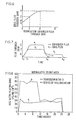
- Figure 1 compares the idealized release pattern obtained from various devices of the prior art to that obtained according to our invention. It will be noted that with respect to most systems there is an initial, transient, release period running from t0 to t1 in which there is a rapid increase of the rate of release into an infinite sink through human cadaver skin from the device which results from the initial loading of the drug at the surface in contact with the skin. After this initial transient period has expired, the uncontrolled devices such as disclosed in U.S.
- Patent 3,249,109 will exhibit, depending on the initial drug loading, either a generally decreasing, steady-state release rate with time from which is typically a function of t ⁇ 1/2 (Curve a), or a pattern (Curve b) characterized by a substantially constant steady-state rate period from t-t2 in which the concentration of the agent is sufficient to permit the delivery rate to be limited by the skin until the concentration of the drug in the device drops at t2 to the level at which a second, decreasing steady-state rate is established which decays as a function of t ⁇ 1/2 similar to that of Curve a.
- the time between t1 and t2 is determined by the initial drug loading and the permeability of the system itself.
- a rate controlled device When a rate controlled device is used a pattern such as shown in Curve c is obtained.
- a rate controlled device is typically designed to release agent at a rate lower than that obtainable through skin of average permeability and to contain sufficient drug such that unit activity (saturation concentration) is maintained throughout the steady-state portion of the delivery period running from t1 - t3 If less drug were contained within the device so that unit activity ceased at t2, the period between t2 and t3 would exhibit a pattern substantially similar to that of Curve b.
- a release rate pattern such as shown by Curve d is intended to be achieved.
- Such a pattern would be extremely useful in connection with drugs such as analgesics, anti-emetics, anti-inflammatories, anti-anginals, and anti-spasmodics in which it is desirable to bring about a rapid onset of the treatment or where an initial higher blood level is required to treat acute symptoms and a continued lower dose rate is desired to prevent recurrence or to sustain therapy after the initial acute phase has been resolved.
- the initial higher blood level may be required to overcome the pre-existing tolerance and a lower blood level is required to be maintained to prevent recurrence of symptoms or to prevent the development of other undesirable side effects which may occur if drug administration is terminated completely.
- the total administration time t0 - t3 would normally be at least 16 hours and usually 24 hours to 7 days.
- the maximum practical time period of transdermal delivery is usually limited by the time during which a system can be maintained in contact with the skin without producing undesirable effects from occlusion or irritation.
- adhesive systems it is normally not practical to transdermally deliver a drug beyond the 7 day period in which the human skin surface layer is replaced from the underlying tissue.
- the steady-state portion of the administration period is that portion of the administration period beginning at the end of the initial transient period (t0-t1) and running to the end of the predetermined administration period, as represented by t1-t3 even though the delivery rate itself may not, as noted above, be constant throughout the steady-state period.
- a steady-state delivery rate is considered to be substantially constant if it does not vary more than about ⁇ 20% during the involved time period.
- the time periods during which the higher and lower steady-state delivery rates are to be maintained will, of course, be dependent on the drug being delivered. Typically the time periods would each be at least about 2-3 hours and preferably at least about 5 hours.
- the blood level achieved from a release rate pattern does not necessarily parallel the release rate curve. This is because of factors such as skin binding, and also because of the competing rates of drug delivery into the blood and drug clearance from the blood as a result of metabolic action on the drug in the skin or body.
- Figures 2-5 disclose embodiments of medical devices according to this invention which in their general construction are similar to those disclosed in the aforementioned U.S. Patent 4,379,454 although differing in certain critical characteristics as will be more specifically described below.
- Figure 2 illustrates a self-adhering skin patch 11 designed to be placed on unbroken skin 12.
- Device 11 is a laminate that consists of four layers, an impermeable top backing layer 13, a drug/permeation enhancer reservoir layer 14, a rate controlling membrane layer 15, and a contact adhesive layer 16.
- Backing layer 13 is made from a material or combination of materials that is substantially impermeable to the components of lamina 14.
- the outer edge of the backing layer will overlay the edge of the reservoir layer and be sealed by adhesion or fusion to the rate controlling membrane.
- the reservoir layer is contained wholly between the backing layer and the membrane layer and does not have any exposed surfaces.
- the backing and rate controlling membrane may be inherently sealable to each other or may include sealing means, such as an additional layer or adhesive, in such embodiments.
- Reservoir layer 14 is immediately below backing 13. It contains supplies of both the permeation enhancer and the drug.
- Rate controlling membrane layer 15 the next layer of the device may be made of a dense or microporous polymer film that has the requisite permeability to the drug and permeation enhancer. It is the element of patch 11 that controls the rate at which the permeation enhancer and drug are delivered to the skin.
- the respective fluxes of the drug and enhancer through layer 15 will depend upon the thickness of the layer, its diffusion coefficients relative to the drug and the enhancer, and the concentration and loading of permeation enhancer in the reservoir.
- the diffusion coefficients of the layer 15 for a particular drug and enhancer may be determined by standard techniques. Examples of the types of polymer films that may be used to make layer 15 are disclosed in U. S. Patents 3,797,494 and 4,031,894 which are incorporated herein by reference.
- Contact adhesive lamina 16 is directly below diffusion membrane layer 15. It is one means by which device 11 may be affixed to the area of skin to be treated. Its composition and thickness are normally such that it does not constitute a significant permeation barrier to either the drug or the enhancer, and normally it will be substantially more permeable to the drug enhancer than layer 15. During the time interval between the manufacture and the use of device 11, layer 16 may absorb enhancer and drug in amounts that will depend upon the composition, solubility of the components in layer 16, and the length of the time interval. If the interval is quite long, layer 16 will absorb enhancer and the drug until it is saturated with both. Contact adhesive compositions that may be used to make layer 16 are disclosed in the aforementioned U. S. Patent Numbers 3,797,494 and 4,031,894.
- device 11 Prior to use, device 11 also includes a protective undercoating layer made from materials that are substantially impermeable to the drug, the enhancer, and any other components of layer 16.
- the same materials that are used to make backing layer 13 may be used to make the undercoating layer, provided they are made strippable such as by siliconizing (not shown).
- the undercoating is pulled away from adhesive 16 and discarded.
- Device 11 is then applied to a relatively nonhairy area of skin 12 that is substantially free of wrinkles, creases, or folds.
- Various locations on the torso such as the flank, chest, or shoulder, provide suitable sites for the bandage. As indicated above, once it is placed on the skin the bandage will begin co-administering drug and permeation enhancer to the wearer.
- a representative pulsatile drug delivery device therefore would be designed to deliver, during the high, steady state delivery rate regime, drug at a rate greater than X, and at any level up to Y, which for example is shown at Z in Figures 6 and 7.
- rate controlling membrane 15 may either control the delivery rate of the drug or the permeation enhancer.
- membrane 15 were to control the enhancer delivery rate its characteristics would be selected such that the enhancer flux through skin would be at level C as shown in Figures 6 and 7. If, on the other hand, membrane 15 were selected to control the drug flux; the enhancer would be delivered in substantial excess such that the enhancer flux through skin during the initial steady state period is in excess of C but less than B.
- the enhancer flux drops rapidly below level C, causing the the drug flux through skin to drop to level X, the rate at which the drug permeates through substantially untreated skin or the level X' a slightly higher level equivalent to the rate at which drug permeates through skin which has been previously treated with a permeation enhancer but in the absence of continuous permeation enhancer delivery.
- Level X' may be slightly higher than X due to some small, transient and non-damaging changes in the properties of the skin.
- the loadings of the drug and the permeation enhancer are critical.
- the loading of the drug must be at least equal to the total dose at the selected delivery rates for at least the predetermined administration period, t0-t3, and sufficient to maintain the drug at or above unit activity throughout substantially all of the time period t0-t3
- the loading of permeation enhancer can be no greater than that required to deliver enhancer within the selected flux range only until the expiration of the high steady state delivery rate regime at t2.
- the activity of the permeation enhancer in the reservoir should be depleted so that the enhancer flux rapidly drops below level C.
- This invention is applicable to a wide variety of drugs and permeation enhancers, within certain constraints imposed by the nature of the invention.
- a drug to be usable according to this invention without pretreatment of the skin would have to have sufficient permeability through normal skin to produce a therapeutic effect when administered at flux level X or X'.
- the permeation enhancer would have to be of the type that does not produce substantial changes in the properties of the skin that are not rapidly reversible when the permeation enhancer is removed.
- Suitable permeation enhancers will vary from drug to drug but include ethanol, n-decylmethyl sulfoxide (nDMS), dimethyl lauramide, and polyethylene glycol monolaurate (PEGML), for example.
- Unsuitable permeation enhancers are of the type that appear to produce non-transient changes in the skin which include dimethylsulfoxide, for example.
- Device 17 is composed of four layers, a backing layer 18, a permeation enhancer reservoir layer 19, a rate controlling membrane layer 22 and a drug reservoir-contact adhesive layer 23.
- Layer 18 is identical in structure and function to layer 13 of embodiment 11.
- Layer 19 contains the supply of percutaneous absorption enhancer. As in Figure 1 the loading of enhancer in layer 19 will depend on the rate and duration of enhancer administration required to achieve the desired pulsatile drug delivery.
- Layer 22 is the component of device 17 that controls the release rate of enhancer to the skin. In this regard it is structurally, compositionally and functionally similar to membrane 15 of embodiment 11.
- layer 22 need not be permeable to the drug. Indeed it is preferred that it be substantially impermeable to the drug to minimize upward migration of the drug from the drug reservoir layer 23.
- Layer 23 contains the supply of drug admixed with a contact adhesive composition, with the loading of drug depending on the rates at which the drug is delivered and the duration of the total therapeutic administration period. Layer 23 may be a uniform dispersion of drug in adhesive or layer 23 may be separated into a distinct drug reservoir layer composed of the drug supply within a suitable matrix material and a distinct contact adhesive layer underlying the drug reservoir layer. In any case, the drug loading is preferably sufficient to maintain the the concentration of the drug in layer 23 at or above saturation from t0 - t3.
- Embodiments such as device 17 in which the drug and enhancer supplies are separate may be advantageous or necessary in instances where formulation or storage of the drug and enhancer in contact with each other is impractical or undesirable or where separation of the drug and enhancer make selection of the rate controlling membrane easier.
- Figure 4 illustrates another embodiment, generally designated 25, in which the supplies of drug and enhancer are separate Device 25 is a laminate composed of two layers, a backing layer 26 and a heterogeneous, microcapsule-containing basal layer 27.
- Backing layer 26 is structurally, compositionally, and functionally identical to layer 13 of embodiment 11.
- Heterogeneous basal layer 27 is composed of a continuous matrix phase 28 in which enhancer-containing microcapsules 29 and drug 32 (represented by stippling in Figure 4) are dispersed.
- Continuous matrix phase 28 is a solid, semisolid or gel composition that is permeable to the enhancer and the drug. It preferably adheres to skin. If it does not, an adhesive overlay will have to be used to keep embodiment 25 in contact with the skin.
- Microcapsules 29 each consist of an inner core of permeation enhancer encapsulated by a rate controlling membrane.
- the membrane functions as membranes 15 and 22 and may be made of the same materials and be selected based on the same criteria as membranes 15 and 22. Accordingly, the membrane on each microcapsule controls the rate at which the enhancer is released therefrom.
- the combined release of enhancer from all the microcapsules in turn defines the rate of release of enhancer from embodiment 25.
- the loading of enhancer contained in layer 27 in microcapsule form will depend upon the required enhancer release rate and duration of the high delivery rate phase.
- Microcapsules 29 may be made using conventional microcapsule forming techniques.
- Drug 32 is preferably present dissolved and dispersed in continuous phase 28, the loading of drug present in layer 27 being at least that required to provide a unit activity drug source throughout the period of therapy. The particular amount present in a given instance will depend upon the rate at which the drug is absorbed by the skin from layer 27 and the duration of therapy.
- the thickness and composition of continuous phase 28 should be such that it does not constitute a principal permeation barrier to either the enhancer or the drug.
- the drug could be encapsulated in the microcapsules and the permeation enhancer dispersed in layer 27 with the same constraints as described with respect to Figures 2 and 3.
- Figure 5 shows another embodiment of the invention, generally designated 33.
- the components of device 33 are backing layer 34, a reservoir layer 35 that contains supplies of permeation enhancer and drug, a diffusion membrane layer 36, and a peripheral ring 37 of contact adhesive.
- Device 33 is structurally, functionally, and compositionally identical to device 11 except in the following respects.
- the contact adhesive component of device 33 is in the form of a peripheral ring rather than a continuous basal layer. Neither drug nor enhancer passes through ring 37 and it, therefore, need not be permeable to these compositions.
- the basal surface from which drug and enhancer is transferred to the skin is defined by rate controlling membrane layer 36.
- the backing layer is not flat but instead forms a pocket or cavity in which the reservoir layer is held.
- the outer edge of the backing layer is sealed to the peripheral ring of contact adhesive.
- inventions of Figures 2-5 may be designed to administer drug and enhancer at the rates required to achieve the desired pulsatile drug therapy.
- a high rate of approximately 80 ⁇ g/cm2/hr for the initial steady state period of approximately 6 hours and at a rate of approximately 35 ⁇ g/cm2/hr for the remainder of a 24 hour administration period were selected as targets and normal having the average permeabilities to nitroglycerin and ethanol of normal human skin were used as design criteria.
- J device is the in vitro steady state flux of agent from the device directly into an infinite sink
- J skin is the in vivo or in vitro steady state inherent flux of agent directly through skin from a unit activity source into an infinite sink, all units being expressed in ⁇ g/cm2/hr.
- the permeability of normal human skin to NG is in the range of about 10-50 ⁇ g/cm2 the average being about 40 ⁇ g/cm2hr.
- the lower NG delivery flux of 35 ⁇ g/cm2/hr will be used to establish the J device (NG) in the absence of a permeation enhancer and the upper NG delivery rate of 80 ⁇ g/cm2/hr will determine the additional characteristics required for the initial phase.
- the J device (NG) In order to permit the skin to primarily control the lower steady state rate, the J device (NG) must be substantially higher than J skin (NG).
- application of Formula 1 shows that J device (NG) should be at least about 280 ⁇ g/cm2/hr.
- a permeation enhancer must be delivered in the initial phase at a flux sufficient to increase the J net (NG) to about 80 ⁇ g/cm2/hr.
- Ethanol within certain flux ranges produces a non-damaging, reversible effect on skin permeability, and is suitable for use as a NG permeation enhancer according to this invention.
- the delivery device of this example therefore should be designed to deliver ethanol at a flux sufficient to increase the NG permeability of the skin to a value no less than the J net of NG in the high initial phase and preferably substantially higher.
- ethanol can reversibly increase the J skin (NG) for average skin to levels greater than 80 ⁇ g/cm2/hr if the J net of ethanol delivered through the skin is at least about 250 ⁇ g/cm2/hr and preferably higher but no greater than about 500 ⁇ g/cm2/hr, the level at which unacceptable and temporarily irreversible skin changes are observed.
- the permeability of average human skin to ethanol is in the range of about 1200 to 1500 ⁇ g/cm2/hr. Therefore the ethanol J device according to this invention is preferably in the range of about 300 to 750 ⁇ g/cm2/hr to obtain the average target ethanol J net of about 250-500 ⁇ g/cm2/hr.
- VVA vinyl acetate
- the minimum initial NG loading per cm2 of the system is determined by the solubility of the NG in the matrix and the in vivo delivery rates, sufficient NG being initially present to maintain a unit thermodynamic activity of NG in the reservoir (saturated solution) substantially throughout the 24 hour delivery period.
- the initial NG loading would normally be in excess of the minimum loading.
- the maximum ethanol loading per cm2 is determined by the ethanol flux required in the initial high delivery rate phase, the duration of the phase and the solubility of ethanol in its carrier. Because of the high permeability of skin to ethanol the desired fluxes can be obtained from sub-saturated sources having an activity less than 1.
- Ethanol fluxes within the selected ranges can be obtained if the initial loading of ethanol is sufficient to maintain the thermodynamic activity of ethanol above about 0.2 during the initial phase and thereafter drop below about 0.2 at t2, the time of commencement of the low NG administration rate phase.
- a typical NG-ethanol reservoir composition according to this invention comprises a dispersant having a low solubility, below about 5 mg/gm, for NG and ethanol and having the NG and the ethanol dispersed therethrough.
- a suitable carrier such as lactose for NG and porous polypropylene or colloidal silicon dioxide for the ethanol, for example, as disclosed in copending U.S. patent application of Gale et al., Serial Number 06/730,714 filed May 3, 1985 for Transdermal Delivery System for Delivering Nitroglycerin at High Transdermal Fluxes.
- a preferred NG delivery device employs silicone medical fluid gelled with silica as the reservoir, colloidal silica or porous polypropylene as the ethanol absorbent and an EVA membrane having a minimum of 11% VA and preferably about 12-18% VA as the rate controlling membrane at a typical thickness of about 1-3 mils.
- the ethanol may be included as absolute alcohol although it is preferred, particularly from a cost standpoint to utilize the substantially less expensive aqueous USP 95% ethanol. More dilute ethanol solutions can be employed provided the ethanol activity is maintained above about 0.2 throughout the initial high delivery rate period and below 0.2 for the remainder of the useful life of the system.
- a NG/ethanol reservoir composition comprising a silicone medical fluid carrier gelled with silica, having NG on lactose uniformly dispersed therethrough and ethanol absorbed in a particulate carrier is fabricated by placing 5 kg of silicone medical fluid having a viscosity of about 100 centistokes and 175 grams of colloidal silicon dioxide in a high energy mixing vessel and blending to produce a gelled silicone fluid. 200 grams of Accurel® porous polypropylene available from ARMAK Company is placed in a separate vessel and approximately 1100 grams of USP ethanol (95% ethanol) is added with stirring to produce an essentially dry, flowable powder which on visual observation appears to have absorbed substantially all of the ethanol.
- nitroglycerin-lactose 10%wt nitroglycerin
- the ethanol loaded porous polypropylene are placed in the original high energy mixing vessel and mixed until a homogeneous blend is obtained.
- a pouching machine is used to pouch the NG-ethanol gel so formed between an impermeable backing member comprising a medium density polyethylene/aluminized polyester/ethylene vinyl acetate multilaminate (Medpar® 1006 available from Minnesota Mining Manufacturing Company) peripherally thermosealed to the rate controlling membrane layer of a trilaminate film consisting of a release liner layer formed from polyester film coated with a film release agent, an adhesive layer formed of silicone medical adhesive and a release rate controlling membrane layer formed from a 1.5 mil thick EVA (12% VA) membrane to produce NG and ethanol loadings of 2.6 mg/cm2 and 4.8 mg/cm2 respectively.
- a medium density polyethylene/aluminized polyester/ethylene vinyl acetate multilaminate Medpar® 1006 available from Minnesota Mining Manufacturing Company
- a transdermal therapeutic device was fabricated according to procedure of Example 1 except that the ethanol is absorbed on 200 grams of colloidal silicon dioxide. The performance will be substantially the same as for the device of Example 1.
- Example 1 A device similar to that of Example 1 was fabricated using EVA (18% VA) film instead of the EVA (12% VA) film and with loadings of 5 mg NG/cm2 and 20 mg ethanol/cm2. The device will perform in a manner similar to that of Example 1 except the initial high steady state delivery rate will be about 80% thereafter.
Landscapes
- Health & Medical Sciences (AREA)
- Engineering & Computer Science (AREA)
- Bioinformatics & Cheminformatics (AREA)
- Animal Behavior & Ethology (AREA)
- Dermatology (AREA)
- Veterinary Medicine (AREA)
- Public Health (AREA)
- General Health & Medical Sciences (AREA)
- Life Sciences & Earth Sciences (AREA)
- Medicinal Chemistry (AREA)
- Epidemiology (AREA)
- Pharmacology & Pharmacy (AREA)
- Chemical & Material Sciences (AREA)
- Anesthesiology (AREA)
- Biomedical Technology (AREA)
- Heart & Thoracic Surgery (AREA)
- Hematology (AREA)
- Pharmaceuticals Containing Other Organic And Inorganic Compounds (AREA)
- Acyclic And Carbocyclic Compounds In Medicinal Compositions (AREA)
- Medicinal Preparation (AREA)
- Media Introduction/Drainage Providing Device (AREA)
- Materials For Medical Uses (AREA)
Claims (19)
- Medizinische Vorrichtung (11) zum schubweisen Verabreichen eines Arzneimittels durch die unversehrte Haut (12) bei einem ersten stationären Fluß während eines ersten Abgabezeitraums und einem zweiten Fluß während eines zweiten Abgabezeitraums, wobei der erste Fluß wesentlich höher als der zweite Fluß ist; bei der der erste und der zweite Abgabezeitraum einen wesentlichen Abschnitt eines vorgegebenen Verabreichungszeitraums umfassen, und bei der die Vorrichtung umfaßt:a) ein Arzneimittelreservoir (14), das eine Arzneimittelmenge enthält, die ausreicht, um das Arzneimittel beim ersten und zweiten Fluß während des Verabreichungszeitraums zu verabreichen;b) ein Reservoir (14) für einen Hautdurchdringungsverstärker für das Arzneimittel; undc) Mittel (16), um die Vorrichtung auf der Haut in einer Arzneimittel- und DurchdringungsverstärkerÜbertragungsbeziehung zu halten, dadurch gekennzeichnet, daß der zweite Fluß während des zweiten Abgabezeitraums ein stationärer Fluß ist, und daß das Reservoir (14) des Hautdurchdringungsverstärkers für das Arzneimittel eine Menge des Durchdringungsverstärkers enthält, die ausreicht, um die Verabreichung des Arzneimittels beim ersten Fluß nur während des ersten Abgabezeitraums zu gestatten.
- Vorrichtung (11) nach Anspruch 1, dadurch gekennzeichnet, daß das Arzneimittelreservoir und das Durchdringungsverstärkerreservoir ein gemeinsames Reservoir (14) ist, das das Arzneimittel und den Durchdringungsverstärker in einem Träger dispergiert enthält.
- Vorrichtung (11) nach Anspruch 1 oder Anspruch 2, dadurch gekennzeichnet, daß ein Abgaberatesteuerungsmittel (15) für das Arzneimittel oder den Durchdringungsverstärker zwischen dem jeweiligen Reservoir (14) und der Haut (12) angeordnet ist.
- Vorrichtung (17) nach Anspruch 1, dadurch gekennzeichnet, daß das Arzneimittelreservoir und das Durchdringungsverstärkungsmittelreservoir zwei getrennte Reservoirs (23, 19) sind, daß ein Abgaberatesteuerungsmittel (22) die Abgaberate des Durchdringungsverstärkers steuert und zwischen dem Durchdringungsverstärkerreservoir (19) und dem Arzneimittelreservoir (23) im Strömungspfad des Durchdringungsverstärkers vom Verstärkerreservoir (19) zur Haut angeordnet ist.
- Vorrichtung (17) nach jedem vorangehenden Anspruch, dadurch gekennzeichnet, daß das Arzneimittelreservoir (23) die Hautkontaktfläche der Vorrichtung umfaßt.
- Vorrichtung (17) nach Anspruch 5, dadurch gekennzeichnet, daß das Arzneimittelreservoir (23) das in einem Klebemittel dispergierte Arzneimittel umfaßt, und daß das Arzneimittelreservoir (23) das Mittel zum Halten der Vorrichtung auf der Haut umfaßt.
- Vorrichtung (11) nach jedem vorhergehenden Anspruch, dadurch gekennzeichnet, daß das Mittel zum Halten der Vorrichtung auf der Haut ein Kontaktklebemittel (16) auf der Hautkontaktfläche der Vorrichtung umfaßt.
- Vorrichtung nach Anspruch 1, dadurch gekennzeichnet, daß das Arzneimittelreservoir und das Durchdringungsverstärkerreservoir voneinander getrennt sind, daß ein Abgaberatesteuerungsmittel die Abgaberate des Arzneimittels während des ersten Abgabezeitraums steuert und zwischen dem Arzneimittelreservoir und dem Durchdringungsverstärkerreservoir im Arzneimittelstrompfad vom Arzneimittelreservoir zur Haut angeordnet ist.
- Vorrichtung nach jedem der Ansprüche 3 bis 7, dadurch gekennzeichnet, daß das Abgaberatesteuerungsmittel die Abgaberate des Durchdringungsverstärkers steuert.
- Vorrichtung nach jedem der vorhergehenden Ansprüche 3 und 8, dadurch gekennzeichnet, daß das Abgaberatesteuerungsmittel die Abgaberate des Arzneimittels während des ersten Abgabezeitraums steuert.
- Vorrichtung nach jedem der vorhergehenden Ansprüche, dadurch gekennzeichnet, daß das Arzneimittel normale menschliche Haut bei therapeutischen Flüssen durchdringen kann.
- Vorrichtung nach jedem vorhergehenden Anspruch, dadurch gekennzeichnet, daß das Arzneimittel aus der Gruppe bestehend aus Analgetika, Antiemetika, enzündungshemmenden Mitteln, Antianginamitteln und Antispasmodika ausgewählt wird.
- Vorrichtung nach jedem vorhergehenden Anspruch, dadurch gekennzeichnet, daß das Arzneimittel Nitroglyzerin und der Durchdringungsverstärker Äthanol ist.
- Vorrichtung nach Anspruch 13, dadurch gekennzeichnet, daß das Abgaberatesteuerungsmittel die Abgaberate von Äthanol steuert; daß die Vorrichtung dadurch gekennzeichnet ist, daß ein J Vorrichtung für Nitroglyzerin mit mindestens etwa 28 µg/cm²/h, und ein J Vorrichtung für Äthanol im Bereich 300-750 µg/cm²/h vorgesehen sind, daß das Äthanolreservoir diejenige Äthanolmenge enthält, die erforderlich ist, um die Aktivität des Äthanols im Reservoir unter etwa 0,2 am Ende des ersten Abgabezeitraums abfallen zu lassen, und daß das Nitroglyzerinreservoir ausreichend Nitroglyzerin enthält, um Nitroglyzerin beim ersten und zweiten stationären Fluß mindestens bis zum Ablauf des vorbestimmten Verabreichungszeitraums abzugeben.
- Vorrichtung nach jedem vorhergehenden Anspruch, dadurch gekennzeichnet, daß der erste Abgabezeitraum mindestens zwei Stunden, der zweite Abgabezeitraum mindestens zwei Stunden, und der vorbestimmte Verabreichungszeitraum mindestens etwa 16 Stunden beträgt.
- Abgabevorrichtung nach jedem vorhergehenden Anspruch, dadurch gekennzeichnet, daß der erste und der zweite Abgabezeitraum jeweils mindestens 6 Stunden beträgt.
- Abgabevorrichtung nach jedem vorhergehenden Anspruch, dadurch gekennzeichnet, daß der Verabreichungszeitraum mindestens etwa 24 Stunden beträgt.
- Vorrichtung nach jedem der Ansprüche 13 bis 17, dadurch gekennzeichnet, daß das Nitroglyzerinreservoir und das Äthanolreservoir ein gemeinsames Reservoir aus Nitroglyzerin und Äthanol in einem Träger umfassen, der eine Löslichkeit für Nitroglyzerin und Äthanol von nicht mehr als 5 µg/gm hat.
- Vorrichtung nach jedem der Ansprüche 3 bis 18, dadurch gekennzeichnet, daß das Ratensteuerungsmittel aus Äthylen-Vinyl-Acetat-Copolymer gebildet ist, welches einen Vinyl-Acetat-Gehalt von etwa 11-18% hat.
Priority Applications (1)
| Application Number | Priority Date | Filing Date | Title |
|---|---|---|---|
| AT86308248T ATE67417T1 (de) | 1985-10-30 | 1986-10-23 | Medizinische einrichtung zur pulsatilen transdermalen verabreichung von biologisch aktiven wirkstoffen. |
Applications Claiming Priority (2)
| Application Number | Priority Date | Filing Date | Title |
|---|---|---|---|
| US06/792,941 US4698062A (en) | 1985-10-30 | 1985-10-30 | Medical device for pulsatile transdermal delivery of biologically active agents |
| US792941 | 1985-10-30 |
Publications (3)
| Publication Number | Publication Date |
|---|---|
| EP0227252A2 EP0227252A2 (de) | 1987-07-01 |
| EP0227252A3 EP0227252A3 (en) | 1989-04-05 |
| EP0227252B1 true EP0227252B1 (de) | 1991-09-18 |
Family
ID=25158559
Family Applications (1)
| Application Number | Title | Priority Date | Filing Date |
|---|---|---|---|
| EP86308248A Expired - Lifetime EP0227252B1 (de) | 1985-10-30 | 1986-10-23 | Medizinische Einrichtung zur pulsatilen transdermalen Verabreichung von biologisch aktiven Wirkstoffen |
Country Status (11)
| Country | Link |
|---|---|
| US (1) | US4698062A (de) |
| EP (1) | EP0227252B1 (de) |
| JP (1) | JPS62129058A (de) |
| KR (1) | KR870003798A (de) |
| AT (1) | ATE67417T1 (de) |
| AU (1) | AU582075B2 (de) |
| CA (1) | CA1275216C (de) |
| DE (1) | DE3681570D1 (de) |
| ES (1) | ES2024423B3 (de) |
| GR (1) | GR3002747T3 (de) |
| ZA (1) | ZA868070B (de) |
Families Citing this family (73)
| Publication number | Priority date | Publication date | Assignee | Title |
|---|---|---|---|---|
| US5135477A (en) * | 1984-10-29 | 1992-08-04 | Medtronic, Inc. | Iontophoretic drug delivery |
| JPS63135179A (ja) * | 1986-11-26 | 1988-06-07 | 立花 俊郎 | 薬物の経皮投与具 |
| US4788062A (en) * | 1987-02-26 | 1988-11-29 | Alza Corporation | Transdermal administration of progesterone, estradiol esters, and mixtures thereof |
| JPS6425717A (en) * | 1987-05-08 | 1989-01-27 | Eastman Kodak Co | Method and apparatus for preventing organic nitric acid ester resistance |
| US5312325A (en) * | 1987-05-28 | 1994-05-17 | Drug Delivery Systems Inc | Pulsating transdermal drug delivery system |
| US5013293A (en) * | 1987-05-28 | 1991-05-07 | Drug Delivery Systems Inc. | Pulsating transdermal drug delivery system |
| JPH0429618Y2 (de) * | 1987-09-11 | 1992-07-17 | ||
| IE64726B1 (en) | 1987-11-20 | 1995-08-23 | Elan Corp Plc | Pharmaceutical formulations for preventing drug tolerance |
| US4906475A (en) | 1988-02-16 | 1990-03-06 | Paco Pharmaceutical Services | Estradiol transdermal delivery system |
| DE3809978A1 (de) * | 1988-03-24 | 1989-10-05 | Lohmann Gmbh & Co Kg | Reservoir fuer gesteuerte wirkstoffabgabe, dieses enthaltende vorrichtung, sowie verfahren zu deren herstellung und verwendung der vorrichtung |
| US4927408A (en) * | 1988-10-03 | 1990-05-22 | Alza Corporation | Electrotransport transdermal system |
| US5496266A (en) * | 1990-04-30 | 1996-03-05 | Alza Corporation | Device and method of iontophoretic drug delivery |
| DE3908432A1 (de) * | 1989-03-14 | 1990-09-27 | Lohmann Therapie Syst Lts | Pflaster als therapeutisches system zur verabreichung von wirkstoffen an die haut mit einer abgestuften wirkstoffabgabe, verfahren zu seiner herstellung sowie verwendung |
| DE3908431A1 (de) * | 1989-03-15 | 1990-09-27 | Lohmann Therapie Syst Lts | Transdermales system mit gestufter wirkstoffabgabe und verwendung fuer die lokale oder systemische wirkstoffverabreichung |
| US5028435A (en) * | 1989-05-22 | 1991-07-02 | Advanced Polymer Systems, Inc. | System and method for transdermal drug delivery |
| US5091186A (en) * | 1989-08-15 | 1992-02-25 | Cygnus Therapeutic Systems | Biphasic transdermal drug delivery device |
| US5207752A (en) * | 1990-03-30 | 1993-05-04 | Alza Corporation | Iontophoretic drug delivery system with two-stage delivery profile |
| EP0522043B1 (de) * | 1990-03-30 | 2003-10-15 | Alza Corporation | Vorrichtung zur iontophoretischen verabreichung |
| US5202125A (en) * | 1990-12-10 | 1993-04-13 | Theratech, Inc. | Method and systems for administering nitroglycerin transdermally at enhanced transdermal fluxes |
| US5352456A (en) * | 1991-10-10 | 1994-10-04 | Cygnus Therapeutic Systems | Device for administering drug transdermally which provides an initial pulse of drug |
| KR960006859B1 (ko) * | 1992-03-06 | 1996-05-23 | 주식회사 태평양 | 티로시나제 저해 활성을 갖는 약물의 안정성을 개선하는 방법 |
| GB2273044B (en) * | 1992-12-02 | 1997-04-09 | Pacific Chem Co Ltd | Medicinal patches for percutaneous administration |
| US5613958A (en) * | 1993-05-12 | 1997-03-25 | Pp Holdings Inc. | Transdermal delivery systems for the modulated administration of drugs |
| KR960011044B1 (ko) * | 1993-09-27 | 1996-08-16 | 재단법인 한국화학연구소 | 알칸올 투과가 우수한 고분자막 |
| DE4423850A1 (de) * | 1994-07-07 | 1996-01-11 | Labtec Gmbh | Transdermales therapeutisches System zur Applikation von Naloxon |
| US5891461A (en) * | 1995-09-14 | 1999-04-06 | Cygnus, Inc. | Transdermal administration of olanzapine |
| US5902603A (en) * | 1995-09-14 | 1999-05-11 | Cygnus, Inc. | Polyurethane hydrogel drug reservoirs for use in transdermal drug delivery systems, and associated methods of manufacture and use |
| US5968547A (en) | 1997-02-24 | 1999-10-19 | Euro-Celtique, S.A. | Method of providing sustained analgesia with buprenorphine |
| US6660295B2 (en) | 1997-09-30 | 2003-12-09 | Alza Corporation | Transdermal drug delivery device package with improved drug stability |
| US6918901B1 (en) | 1997-12-10 | 2005-07-19 | Felix Theeuwes | Device and method for enhancing transdermal agent flux |
| WO1999029364A1 (en) * | 1997-12-11 | 1999-06-17 | Alza Corporation | Device for enhancing transdermal agent flux |
| PT1037686E (pt) * | 1997-12-11 | 2005-10-31 | Alza Corp | Aparelho para potenciar o fluxo de agente transdermico |
| CN1206004C (zh) | 1997-12-11 | 2005-06-15 | 阿尔扎有限公司 | 增强透皮物剂流量的装置 |
| EP1911488A3 (de) | 1997-12-11 | 2008-12-03 | Alza Corporation | Vorrichtung zur Verstärkung des Flusses transdermaler Mittel |
| DK1041975T3 (da) | 1997-12-22 | 2002-11-04 | Alza Corp | Hastighedskontrollerende membraner til anordninger til kontrolleret indførsel af medikament |
| US6699497B1 (en) | 1998-07-24 | 2004-03-02 | Alza Corporation | Formulations for the transdermal administration of fenoldopam |
| US6348210B1 (en) | 1998-11-13 | 2002-02-19 | Alza Corporation | Methods for transdermal drug administration |
| HUP0104728A3 (en) * | 1998-12-18 | 2006-07-28 | Alza Corp Mountain View | Transparent transdermal nicotine delivery device |
| US20070196490A1 (en) * | 1999-01-22 | 2007-08-23 | Powderject Research Limited | Method of enhancing needleless transdermal powered drug delivery |
| AU3932600A (en) * | 1999-04-01 | 2000-10-23 | Alza Corporation | Transdermal drug delivery devices comprising a polyurethane drug reservoir |
| ATE310561T1 (de) | 1999-12-10 | 2005-12-15 | Alza Corp | Vorrichtung und verfahren zur verbesserung des mikronadel-haut-piercing |
| US20020119187A1 (en) * | 2000-09-29 | 2002-08-29 | Cantor Adam S. | Composition for the transdermal delivery of fentanyl |
| US20040029959A1 (en) * | 2002-08-08 | 2004-02-12 | John Devane | Isosorbide mononitrate compositions and methods of their use |
| US20040258742A1 (en) * | 2003-04-11 | 2004-12-23 | Van Osdol William Woodson | Transdermal administration of N-(2,5-disubstituted phenyl)-N'-(3-substituted phenyl)-N'-methyl guanidines |
| DE102004062614B4 (de) * | 2004-12-24 | 2011-12-29 | Lts Lohmann Therapie-Systeme Ag | Transdermales therapeutisches System mit aktivierbarer Übersättigung und kontrollierter Permeationförderung sowie Verfahren zu dessen Herstellung |
| WO2007031973A2 (en) * | 2005-09-15 | 2007-03-22 | Visible Assets, Inc. | Active low frequency radio tag and patch drug delivery system |
| US8518926B2 (en) | 2006-04-10 | 2013-08-27 | Knopp Neurosciences, Inc. | Compositions and methods of using (R)-pramipexole |
| US20070259930A1 (en) * | 2006-04-10 | 2007-11-08 | Knopp Neurosciences, Inc. | Compositions and methods of using r(+) pramipexole |
| KR20090021169A (ko) * | 2006-05-16 | 2009-02-27 | 크놉 뉴로사이언시스 인코포레이티드 | R(+) 및 s(-) 프라미펙솔을 포함하는 조성물 및 이의 사용 방법 |
| US8524695B2 (en) | 2006-12-14 | 2013-09-03 | Knopp Neurosciences, Inc. | Modified release formulations of (6R)-4,5,6,7-tetrahydro-N6-propyl-2,6-benzothiazole-diamine and methods of using the same |
| CN101715443A (zh) | 2007-03-14 | 2010-05-26 | 诺普神经科学股份有限公司 | 手性纯化的取代的苯并噻唑二胺的合成 |
| KR20140143461A (ko) * | 2007-08-06 | 2014-12-16 | 알레간 인코포레이티드 | 데스모프레신 약물 전달을 위한 방법 및 장치 |
| US20110190356A1 (en) | 2008-08-19 | 2011-08-04 | Knopp Neurosciences Inc. | Compositions and Methods of Using (R)- Pramipexole |
| DK2328636T3 (da) * | 2008-08-28 | 2013-09-02 | Medingo Ltd | Anordning til forbedret subkutan insulinabsorption |
| GB0817486D0 (en) * | 2008-09-24 | 2008-10-29 | Smith & Nephew | Delivery system |
| CN102802418A (zh) * | 2009-06-19 | 2012-11-28 | 诺普神经科学股份有限公司 | 用于治疗肌萎缩性侧索硬化的组合物和方法 |
| EP2563455A4 (de) | 2010-04-28 | 2014-02-19 | Kimberly Clark Co | Verfahren zur erhöhung der durchlässigkeit einer epithelialbarriere |
| WO2011135531A2 (en) | 2010-04-28 | 2011-11-03 | Kimberly-Clark Worldwide, Inc. | MEDICAL DEVICES FOR DELIVERY OF siRNA |
| MX345837B (es) | 2010-04-28 | 2017-02-16 | Kimberly-Clark Worldwide Incorporated | Dispositivo para la entrega de un medicamento para la artritis reumatoide. |
| KR20130058012A (ko) | 2010-04-28 | 2013-06-03 | 킴벌리-클라크 월드와이드, 인크. | 사출 성형된 마이크로니들 어레이 및 마이크로니들 어레이의 형성 방법 |
| JP6527305B2 (ja) | 2011-01-10 | 2019-06-05 | インヴィオン, インコーポレイテッド | 禁煙のためのβ−アドレナリン作動性インバースアゴニストの使用 |
| US8696637B2 (en) | 2011-02-28 | 2014-04-15 | Kimberly-Clark Worldwide | Transdermal patch containing microneedles |
| JP6535464B2 (ja) | 2011-10-27 | 2019-06-26 | ソレント・セラピューティクス・インコーポレイテッド | 生理活性薬剤の送達のための移植可能な装置 |
| MX343262B (es) | 2011-10-27 | 2016-10-28 | Kimberly Clark Co | Administración transdérmica de agentes bioactivos de alta viscosidad. |
| US20170246439A9 (en) | 2011-10-27 | 2017-08-31 | Kimberly-Clark Worldwide, Inc. | Increased Bioavailability of Transdermally Delivered Agents |
| WO2013096816A1 (en) | 2011-12-22 | 2013-06-27 | Biogen Idec Ma Inc. | Improved synthesis of amine substituted 4,5,6,7-tetrahydrobenzothiazole compounds |
| US9675754B2 (en) | 2012-10-24 | 2017-06-13 | Nuance Designs, LLC | Autoinjector |
| US9662313B2 (en) | 2013-02-28 | 2017-05-30 | Knopp Biosciences Llc | Compositions and methods for treating amyotrophic lateral sclerosis in responders |
| WO2014188329A2 (en) | 2013-05-20 | 2014-11-27 | Mylan, Inc. | Transdermal therapeutic system for extended dosing of pramipexole in treating neurological disorders |
| US9468630B2 (en) | 2013-07-12 | 2016-10-18 | Knopp Biosciences Llc | Compositions and methods for treating conditions related to increased eosinophils |
| ES3043076T3 (en) | 2013-07-12 | 2025-11-24 | Areteia Therapeutics Inc | Treating elevated levels of eosinophils and/or basophils |
| WO2015023786A1 (en) | 2013-08-13 | 2015-02-19 | Knopp Biosciences Llc | Compositions and methods for treating plasma cell disorders and b-cell prolymphocytic disorders |
| ES2871556T3 (es) | 2013-08-13 | 2021-10-29 | Knopp Biosciences Llc | Composiciones y métodos para el tratamiento de la urticaria crónica |
Family Cites Families (10)
| Publication number | Priority date | Publication date | Assignee | Title |
|---|---|---|---|---|
| US3797494A (en) * | 1969-04-01 | 1974-03-19 | Alza Corp | Bandage for the administration of drug by controlled metering through microporous materials |
| US3625214A (en) * | 1970-05-18 | 1971-12-07 | Alza Corp | Drug-delivery device |
| US4031894A (en) * | 1975-12-08 | 1977-06-28 | Alza Corporation | Bandage for transdermally administering scopolamine to prevent nausea |
| US4291015A (en) * | 1979-08-14 | 1981-09-22 | Key Pharmaceuticals, Inc. | Polymeric diffusion matrix containing a vasodilator |
| US4336243A (en) * | 1980-08-11 | 1982-06-22 | G. D. Searle & Co. | Transdermal nitroglycerin pad |
| US4379454A (en) * | 1981-02-17 | 1983-04-12 | Alza Corporation | Dosage for coadministering drug and percutaneous absorption enhancer |
| US4486193A (en) * | 1981-07-22 | 1984-12-04 | Alza Corporation | Method for treating ischemic conditions by administering drug by two routes |
| US4576604A (en) * | 1983-03-04 | 1986-03-18 | Alza Corporation | Osmotic system with instant drug availability |
| US4559054A (en) * | 1984-08-09 | 1985-12-17 | Research Corporation | Rate-controlled drug release system |
| US4615699A (en) * | 1985-05-03 | 1986-10-07 | Alza Corporation | Transdermal delivery system for delivering nitroglycerin at high transdermal fluxes |
-
1985
- 1985-10-30 US US06/792,941 patent/US4698062A/en not_active Expired - Fee Related
-
1986
- 1986-10-22 KR KR1019860008841A patent/KR870003798A/ko not_active Ceased
- 1986-10-23 ES ES86308248T patent/ES2024423B3/es not_active Expired - Lifetime
- 1986-10-23 ZA ZA868070A patent/ZA868070B/xx unknown
- 1986-10-23 AT AT86308248T patent/ATE67417T1/de not_active IP Right Cessation
- 1986-10-23 DE DE8686308248T patent/DE3681570D1/de not_active Expired - Fee Related
- 1986-10-23 AU AU64320/86A patent/AU582075B2/en not_active Ceased
- 1986-10-23 EP EP86308248A patent/EP0227252B1/de not_active Expired - Lifetime
- 1986-10-29 CA CA000521681A patent/CA1275216C/en not_active Expired - Fee Related
- 1986-10-30 JP JP61259583A patent/JPS62129058A/ja active Pending
-
1991
- 1991-09-19 GR GR91401266T patent/GR3002747T3/el unknown
Also Published As
| Publication number | Publication date |
|---|---|
| US4698062A (en) | 1987-10-06 |
| ATE67417T1 (de) | 1991-10-15 |
| GR3002747T3 (en) | 1993-01-25 |
| AU6432086A (en) | 1987-05-07 |
| DE3681570D1 (de) | 1991-10-24 |
| KR870003798A (ko) | 1987-05-04 |
| ZA868070B (en) | 1987-06-24 |
| EP0227252A2 (de) | 1987-07-01 |
| CA1275216C (en) | 1990-10-16 |
| EP0227252A3 (en) | 1989-04-05 |
| AU582075B2 (en) | 1989-03-09 |
| JPS62129058A (ja) | 1987-06-11 |
| ES2024423B3 (es) | 1992-03-01 |
Similar Documents
| Publication | Publication Date | Title |
|---|---|---|
| US4698062A (en) | Medical device for pulsatile transdermal delivery of biologically active agents | |
| US4379454A (en) | Dosage for coadministering drug and percutaneous absorption enhancer | |
| US4460372A (en) | Percutaneous absorption enhancer dispenser for use in coadministering drug and percutaneous absorption enhancer | |
| US4286592A (en) | Therapeutic system for administering drugs to the skin | |
| US4031894A (en) | Bandage for transdermally administering scopolamine to prevent nausea | |
| US4938759A (en) | Transdermal delivery device having a rate controlling adhesive | |
| US4908027A (en) | Subsaturated transdermal therapeutic system having improved release characteristics | |
| US4262003A (en) | Method and therapeutic system for administering scopolamine transdermally | |
| US4060084A (en) | Method and therapeutic system for providing chemotherapy transdermally | |
| EP0608357B1 (de) | Vorrichtung zur transdermalen verabreichung von arzneimitteln mit einer kontrollierten, zeitlichen strömungsänderung | |
| US4615699A (en) | Transdermal delivery system for delivering nitroglycerin at high transdermal fluxes | |
| US4201211A (en) | Therapeutic system for administering clonidine transdermally | |
| US5314694A (en) | Transdermal formulations, methods and devices | |
| US4588580A (en) | Transdermal administration of fentanyl and device therefor | |
| US5122383A (en) | Sorbitan esters as skin permeation enhancers | |
| US4681584A (en) | Transdermal delivery system for delivering nitroglycerin at high transdermal fluxes | |
| JPS6125569A (ja) | 改良投与特性を有する経皮性治療システム | |
| NZ240361A (en) | Transdermal contraceptive formulation, method and device comprising as active agents an estrogen and st-1435 (a 19-nor-progesterone) together with a skin permeation enhancer | |
| JPH0575727B2 (de) | ||
| JPH01170476A (ja) | 高度にイオン化した脂肪に不溶な薬物を経皮的に投与する医学用デバイス | |
| NZ240358A (en) | Transdermal contraceptive device comprising (as active agents) an estrogen and a gestodene together with a skin permeation enhancer | |
| US4436741A (en) | Method for administering scopolamine transdermally | |
| JP2933337B2 (ja) | 亜飽和経皮投与デバイス | |
| JPH08337521A (ja) | 経皮薬剤放出デバイス | |
| CN112807291A (zh) | 一种硝酸甘油的高通量透皮给药系统 |
Legal Events
| Date | Code | Title | Description |
|---|---|---|---|
| PUAI | Public reference made under article 153(3) epc to a published international application that has entered the european phase |
Free format text: ORIGINAL CODE: 0009012 |
|
| AK | Designated contracting states |
Kind code of ref document: A2 Designated state(s): AT BE CH DE ES FR GB GR IT LI LU NL SE |
|
| PUAL | Search report despatched |
Free format text: ORIGINAL CODE: 0009013 |
|
| AK | Designated contracting states |
Kind code of ref document: A3 Designated state(s): AT BE CH DE ES FR GB GR IT LI LU NL SE |
|
| 17P | Request for examination filed |
Effective date: 19890906 |
|
| RAP3 | Party data changed (applicant data changed or rights of an application transferred) |
Owner name: ALZA CORPORATION |
|
| 17Q | First examination report despatched |
Effective date: 19901213 |
|
| GRAA | (expected) grant |
Free format text: ORIGINAL CODE: 0009210 |
|
| AK | Designated contracting states |
Kind code of ref document: B1 Designated state(s): AT BE CH DE ES FR GB GR IT LI LU NL SE |
|
| REF | Corresponds to: |
Ref document number: 67417 Country of ref document: AT Date of ref document: 19911015 Kind code of ref document: T |
|
| ITF | It: translation for a ep patent filed | ||
| ET | Fr: translation filed | ||
| REF | Corresponds to: |
Ref document number: 3681570 Country of ref document: DE Date of ref document: 19911024 |
|
| REG | Reference to a national code |
Ref country code: ES Ref legal event code: FG2A Ref document number: 2024423 Country of ref document: ES Kind code of ref document: B3 |
|
| PLBE | No opposition filed within time limit |
Free format text: ORIGINAL CODE: 0009261 |
|
| STAA | Information on the status of an ep patent application or granted ep patent |
Free format text: STATUS: NO OPPOSITION FILED WITHIN TIME LIMIT |
|
| 26N | No opposition filed | ||
| REG | Reference to a national code |
Ref country code: GR Ref legal event code: FG4A Free format text: 3002747 |
|
| PGFP | Annual fee paid to national office [announced via postgrant information from national office to epo] |
Ref country code: AT Payment date: 19930917 Year of fee payment: 8 Ref country code: GB Payment date: 19930917 Year of fee payment: 8 |
|
| PGFP | Annual fee paid to national office [announced via postgrant information from national office to epo] |
Ref country code: SE Payment date: 19930920 Year of fee payment: 8 |
|
| PGFP | Annual fee paid to national office [announced via postgrant information from national office to epo] |
Ref country code: GR Payment date: 19930929 Year of fee payment: 8 |
|
| PGFP | Annual fee paid to national office [announced via postgrant information from national office to epo] |
Ref country code: LU Payment date: 19931001 Year of fee payment: 8 |
|
| PGFP | Annual fee paid to national office [announced via postgrant information from national office to epo] |
Ref country code: BE Payment date: 19931012 Year of fee payment: 8 |
|
| PGFP | Annual fee paid to national office [announced via postgrant information from national office to epo] |
Ref country code: FR Payment date: 19931013 Year of fee payment: 8 |
|
| PGFP | Annual fee paid to national office [announced via postgrant information from national office to epo] |
Ref country code: ES Payment date: 19931014 Year of fee payment: 8 |
|
| PGFP | Annual fee paid to national office [announced via postgrant information from national office to epo] |
Ref country code: DE Payment date: 19931026 Year of fee payment: 8 |
|
| PGFP | Annual fee paid to national office [announced via postgrant information from national office to epo] |
Ref country code: NL Payment date: 19931031 Year of fee payment: 8 |
|
| EPTA | Lu: last paid annual fee | ||
| PGFP | Annual fee paid to national office [announced via postgrant information from national office to epo] |
Ref country code: CH Payment date: 19931217 Year of fee payment: 8 |
|
| PG25 | Lapsed in a contracting state [announced via postgrant information from national office to epo] |
Ref country code: GB Effective date: 19941023 Ref country code: LU Free format text: LAPSE BECAUSE OF NON-PAYMENT OF DUE FEES Effective date: 19941023 Ref country code: AT Effective date: 19941023 |
|
| PG25 | Lapsed in a contracting state [announced via postgrant information from national office to epo] |
Ref country code: ES Free format text: LAPSE BECAUSE OF EXPIRATION OF PROTECTION Effective date: 19941024 Ref country code: SE Effective date: 19941024 |
|
| PG25 | Lapsed in a contracting state [announced via postgrant information from national office to epo] |
Ref country code: LI Effective date: 19941031 Ref country code: CH Effective date: 19941031 Ref country code: BE Effective date: 19941031 |
|
| EAL | Se: european patent in force in sweden |
Ref document number: 86308248.3 |
|
| BERE | Be: lapsed |
Owner name: ALZA CORP. Effective date: 19941031 |
|
| PG25 | Lapsed in a contracting state [announced via postgrant information from national office to epo] |
Ref country code: GR Free format text: THE PATENT HAS BEEN ANNULLED BY A DECISION OF A NATIONAL AUTHORITY Effective date: 19950430 |
|
| PG25 | Lapsed in a contracting state [announced via postgrant information from national office to epo] |
Ref country code: NL Effective date: 19950501 |
|
| NLV4 | Nl: lapsed or anulled due to non-payment of the annual fee | ||
| GBPC | Gb: european patent ceased through non-payment of renewal fee |
Effective date: 19941023 |
|
| PG25 | Lapsed in a contracting state [announced via postgrant information from national office to epo] |
Ref country code: FR Effective date: 19950630 |
|
| REG | Reference to a national code |
Ref country code: GR Ref legal event code: MM2A Free format text: 3002747 Ref country code: CH Ref legal event code: PL |
|
| PG25 | Lapsed in a contracting state [announced via postgrant information from national office to epo] |
Ref country code: DE Effective date: 19950701 |
|
| EUG | Se: european patent has lapsed |
Ref document number: 86308248.3 |
|
| REG | Reference to a national code |
Ref country code: FR Ref legal event code: ST |
|
| REG | Reference to a national code |
Ref country code: ES Ref legal event code: FD2A Effective date: 19990601 |
|
| PG25 | Lapsed in a contracting state [announced via postgrant information from national office to epo] |
Ref country code: IT Free format text: LAPSE BECAUSE OF NON-PAYMENT OF DUE FEES;WARNING: LAPSES OF ITALIAN PATENTS WITH EFFECTIVE DATE BEFORE 2007 MAY HAVE OCCURRED AT ANY TIME BEFORE 2007. THE CORRECT EFFECTIVE DATE MAY BE DIFFERENT FROM THE ONE RECORDED. Effective date: 20051023 |