EP0227421A1 - Procédé de fabrication de feuilles composites - Google Patents
Procédé de fabrication de feuilles composites Download PDFInfo
- Publication number
- EP0227421A1 EP0227421A1 EP86309833A EP86309833A EP0227421A1 EP 0227421 A1 EP0227421 A1 EP 0227421A1 EP 86309833 A EP86309833 A EP 86309833A EP 86309833 A EP86309833 A EP 86309833A EP 0227421 A1 EP0227421 A1 EP 0227421A1
- Authority
- EP
- European Patent Office
- Prior art keywords
- polymer
- plastic
- die
- elastomer
- process according
- Prior art date
- Legal status (The legal status is an assumption and is not a legal conclusion. Google has not performed a legal analysis and makes no representation as to the accuracy of the status listed.)
- Ceased
Links
- 239000002131 composite material Substances 0.000 title claims abstract description 11
- 238000000034 method Methods 0.000 title claims description 35
- 229920000642 polymer Polymers 0.000 claims abstract description 83
- 229920003023 plastic Polymers 0.000 claims abstract description 78
- 239000004033 plastic Substances 0.000 claims abstract description 78
- 239000000203 mixture Substances 0.000 claims abstract description 42
- 238000002844 melting Methods 0.000 claims abstract description 22
- 230000008018 melting Effects 0.000 claims abstract description 22
- 238000001816 cooling Methods 0.000 claims abstract description 15
- 238000002156 mixing Methods 0.000 claims abstract description 6
- 239000000758 substrate Substances 0.000 claims abstract description 3
- 229920001971 elastomer Polymers 0.000 claims description 58
- 239000000806 elastomer Substances 0.000 claims description 46
- 239000005060 rubber Substances 0.000 claims description 12
- -1 polypropylene Polymers 0.000 claims description 9
- 229920001577 copolymer Polymers 0.000 claims description 8
- 229920001903 high density polyethylene Polymers 0.000 claims description 6
- 239000004700 high-density polyethylene Substances 0.000 claims description 6
- VGGSQFUCUMXWEO-UHFFFAOYSA-N Ethene Chemical compound C=C VGGSQFUCUMXWEO-UHFFFAOYSA-N 0.000 claims description 5
- 239000005977 Ethylene Substances 0.000 claims description 5
- 239000004743 Polypropylene Substances 0.000 claims description 5
- 229920001155 polypropylene Polymers 0.000 claims description 5
- 229920000181 Ethylene propylene rubber Polymers 0.000 claims description 4
- 238000004519 manufacturing process Methods 0.000 claims description 4
- 239000011347 resin Substances 0.000 claims description 4
- 229920005989 resin Polymers 0.000 claims description 4
- 229920002943 EPDM rubber Polymers 0.000 claims description 3
- 229920001684 low density polyethylene Polymers 0.000 claims description 3
- 238000009459 flexible packaging Methods 0.000 claims description 2
- 229920005555 halobutyl Polymers 0.000 claims description 2
- 229920000092 linear low density polyethylene Polymers 0.000 claims description 2
- 239000004707 linear low-density polyethylene Substances 0.000 claims description 2
- 239000008155 medical solution Substances 0.000 claims description 2
- 229920001748 polybutylene Polymers 0.000 claims description 2
- 229920000307 polymer substrate Polymers 0.000 claims description 2
- QQONPFPTGQHPMA-UHFFFAOYSA-N propylene Natural products CC=C QQONPFPTGQHPMA-UHFFFAOYSA-N 0.000 claims description 2
- 125000004805 propylene group Chemical group [H]C([H])([H])C([H])([*:1])C([H])([H])[*:2] 0.000 claims description 2
- 239000004711 α-olefin Substances 0.000 claims description 2
- 229920002959 polymer blend Polymers 0.000 claims 2
- 239000004820 Pressure-sensitive adhesive Substances 0.000 claims 1
- 125000004968 halobutyl group Chemical group 0.000 claims 1
- 229920000554 ionomer Polymers 0.000 claims 1
- 239000008188 pellet Substances 0.000 description 40
- 238000000576 coating method Methods 0.000 description 16
- 239000011248 coating agent Substances 0.000 description 14
- 239000000463 material Substances 0.000 description 13
- 239000000155 melt Substances 0.000 description 10
- IJGRMHOSHXDMSA-UHFFFAOYSA-N Atomic nitrogen Chemical compound N#N IJGRMHOSHXDMSA-UHFFFAOYSA-N 0.000 description 8
- XLYOFNOQVPJJNP-UHFFFAOYSA-N water Substances O XLYOFNOQVPJJNP-UHFFFAOYSA-N 0.000 description 8
- VLKZOEOYAKHREP-UHFFFAOYSA-N n-Hexane Chemical compound CCCCCC VLKZOEOYAKHREP-UHFFFAOYSA-N 0.000 description 6
- 238000013517 stratification Methods 0.000 description 6
- 239000000839 emulsion Substances 0.000 description 5
- 239000007788 liquid Substances 0.000 description 5
- 238000001125 extrusion Methods 0.000 description 4
- 229910052757 nitrogen Inorganic materials 0.000 description 4
- 238000009472 formulation Methods 0.000 description 3
- 239000007787 solid Substances 0.000 description 3
- 239000002904 solvent Substances 0.000 description 3
- 229920000459 Nitrile rubber Polymers 0.000 description 2
- 239000004698 Polyethylene Substances 0.000 description 2
- PPBRXRYQALVLMV-UHFFFAOYSA-N Styrene Chemical compound C=CC1=CC=CC=C1 PPBRXRYQALVLMV-UHFFFAOYSA-N 0.000 description 2
- 239000000853 adhesive Substances 0.000 description 2
- 230000001070 adhesive effect Effects 0.000 description 2
- 239000000498 cooling water Substances 0.000 description 2
- 229920006037 cross link polymer Polymers 0.000 description 2
- 238000010410 dusting Methods 0.000 description 2
- 230000000694 effects Effects 0.000 description 2
- 239000004702 low-density polyethylene Substances 0.000 description 2
- 238000001000 micrograph Methods 0.000 description 2
- 229920000573 polyethylene Polymers 0.000 description 2
- 239000002861 polymer material Substances 0.000 description 2
- 239000000843 powder Substances 0.000 description 2
- 238000001878 scanning electron micrograph Methods 0.000 description 2
- 230000003068 static effect Effects 0.000 description 2
- 229920001169 thermoplastic Polymers 0.000 description 2
- 239000004416 thermosoftening plastic Substances 0.000 description 2
- 241000212384 Bifora Species 0.000 description 1
- 239000004215 Carbon black (E152) Substances 0.000 description 1
- 244000043261 Hevea brasiliensis Species 0.000 description 1
- 101000653542 Homo sapiens Transcription factor-like 5 protein Proteins 0.000 description 1
- 239000005062 Polybutadiene Substances 0.000 description 1
- 229920002367 Polyisobutene Polymers 0.000 description 1
- 102100030647 Transcription factor-like 5 protein Human genes 0.000 description 1
- 238000013459 approach Methods 0.000 description 1
- 230000000903 blocking effect Effects 0.000 description 1
- 229920005549 butyl rubber Polymers 0.000 description 1
- 150000001732 carboxylic acid derivatives Chemical class 0.000 description 1
- 239000002666 chemical blowing agent Substances 0.000 description 1
- 239000004927 clay Substances 0.000 description 1
- 238000007596 consolidation process Methods 0.000 description 1
- 238000007796 conventional method Methods 0.000 description 1
- 229920001887 crystalline plastic Polymers 0.000 description 1
- 230000003247 decreasing effect Effects 0.000 description 1
- 150000001993 dienes Chemical class 0.000 description 1
- 238000007598 dipping method Methods 0.000 description 1
- 238000001035 drying Methods 0.000 description 1
- 239000000428 dust Substances 0.000 description 1
- 230000004907 flux Effects 0.000 description 1
- 238000010438 heat treatment Methods 0.000 description 1
- 229930195733 hydrocarbon Natural products 0.000 description 1
- 150000002430 hydrocarbons Chemical class 0.000 description 1
- 229910010272 inorganic material Inorganic materials 0.000 description 1
- 239000011147 inorganic material Substances 0.000 description 1
- 229920003052 natural elastomer Polymers 0.000 description 1
- 229920001194 natural rubber Polymers 0.000 description 1
- 239000011368 organic material Substances 0.000 description 1
- 229920002857 polybutadiene Polymers 0.000 description 1
- 229920000728 polyester Polymers 0.000 description 1
- 229920006254 polymer film Polymers 0.000 description 1
- 238000002360 preparation method Methods 0.000 description 1
- 238000012545 processing Methods 0.000 description 1
- 238000011084 recovery Methods 0.000 description 1
- 230000006128 skin development Effects 0.000 description 1
- 238000007711 solidification Methods 0.000 description 1
- 230000008023 solidification Effects 0.000 description 1
- 238000005507 spraying Methods 0.000 description 1
- 238000003860 storage Methods 0.000 description 1
- 229920003048 styrene butadiene rubber Polymers 0.000 description 1
- 229920005608 sulfonated EPDM Polymers 0.000 description 1
- 239000000454 talc Substances 0.000 description 1
- 229910052623 talc Inorganic materials 0.000 description 1
- 150000003505 terpenes Chemical class 0.000 description 1
- 235000007586 terpenes Nutrition 0.000 description 1
- 229920001897 terpolymer Polymers 0.000 description 1
- 239000001993 wax Substances 0.000 description 1
Images

Classifications
-
- B—PERFORMING OPERATIONS; TRANSPORTING
- B32—LAYERED PRODUCTS
- B32B—LAYERED PRODUCTS, i.e. PRODUCTS BUILT-UP OF STRATA OF FLAT OR NON-FLAT, e.g. CELLULAR OR HONEYCOMB, FORM
- B32B27/00—Layered products comprising a layer of synthetic resin
- B32B27/06—Layered products comprising a layer of synthetic resin as the main or only constituent of a layer, which is next to another layer of the same or of a different material
- B32B27/08—Layered products comprising a layer of synthetic resin as the main or only constituent of a layer, which is next to another layer of the same or of a different material of synthetic resin
-
- B—PERFORMING OPERATIONS; TRANSPORTING
- B29—WORKING OF PLASTICS; WORKING OF SUBSTANCES IN A PLASTIC STATE IN GENERAL
- B29C—SHAPING OR JOINING OF PLASTICS; SHAPING OF MATERIAL IN A PLASTIC STATE, NOT OTHERWISE PROVIDED FOR; AFTER-TREATMENT OF THE SHAPED PRODUCTS, e.g. REPAIRING
- B29C48/00—Extrusion moulding, i.e. expressing the moulding material through a die or nozzle which imparts the desired form; Apparatus therefor
- B29C48/022—Extrusion moulding, i.e. expressing the moulding material through a die or nozzle which imparts the desired form; Apparatus therefor characterised by the choice of material
-
- B—PERFORMING OPERATIONS; TRANSPORTING
- B29—WORKING OF PLASTICS; WORKING OF SUBSTANCES IN A PLASTIC STATE IN GENERAL
- B29C—SHAPING OR JOINING OF PLASTICS; SHAPING OF MATERIAL IN A PLASTIC STATE, NOT OTHERWISE PROVIDED FOR; AFTER-TREATMENT OF THE SHAPED PRODUCTS, e.g. REPAIRING
- B29C48/00—Extrusion moulding, i.e. expressing the moulding material through a die or nozzle which imparts the desired form; Apparatus therefor
- B29C48/03—Extrusion moulding, i.e. expressing the moulding material through a die or nozzle which imparts the desired form; Apparatus therefor characterised by the shape of the extruded material at extrusion
- B29C48/04—Particle-shaped
-
- B—PERFORMING OPERATIONS; TRANSPORTING
- B29—WORKING OF PLASTICS; WORKING OF SUBSTANCES IN A PLASTIC STATE IN GENERAL
- B29C—SHAPING OR JOINING OF PLASTICS; SHAPING OF MATERIAL IN A PLASTIC STATE, NOT OTHERWISE PROVIDED FOR; AFTER-TREATMENT OF THE SHAPED PRODUCTS, e.g. REPAIRING
- B29C48/00—Extrusion moulding, i.e. expressing the moulding material through a die or nozzle which imparts the desired form; Apparatus therefor
- B29C48/03—Extrusion moulding, i.e. expressing the moulding material through a die or nozzle which imparts the desired form; Apparatus therefor characterised by the shape of the extruded material at extrusion
- B29C48/07—Flat, e.g. panels
- B29C48/08—Flat, e.g. panels flexible, e.g. films
-
- B—PERFORMING OPERATIONS; TRANSPORTING
- B29—WORKING OF PLASTICS; WORKING OF SUBSTANCES IN A PLASTIC STATE IN GENERAL
- B29C—SHAPING OR JOINING OF PLASTICS; SHAPING OF MATERIAL IN A PLASTIC STATE, NOT OTHERWISE PROVIDED FOR; AFTER-TREATMENT OF THE SHAPED PRODUCTS, e.g. REPAIRING
- B29C48/00—Extrusion moulding, i.e. expressing the moulding material through a die or nozzle which imparts the desired form; Apparatus therefor
- B29C48/25—Component parts, details or accessories; Auxiliary operations
- B29C48/78—Thermal treatment of the extrusion moulding material or of preformed parts or layers, e.g. by heating or cooling
- B29C48/86—Thermal treatment of the extrusion moulding material or of preformed parts or layers, e.g. by heating or cooling at the nozzle zone
-
- B—PERFORMING OPERATIONS; TRANSPORTING
- B29—WORKING OF PLASTICS; WORKING OF SUBSTANCES IN A PLASTIC STATE IN GENERAL
- B29C—SHAPING OR JOINING OF PLASTICS; SHAPING OF MATERIAL IN A PLASTIC STATE, NOT OTHERWISE PROVIDED FOR; AFTER-TREATMENT OF THE SHAPED PRODUCTS, e.g. REPAIRING
- B29C48/00—Extrusion moulding, i.e. expressing the moulding material through a die or nozzle which imparts the desired form; Apparatus therefor
- B29C48/25—Component parts, details or accessories; Auxiliary operations
- B29C48/78—Thermal treatment of the extrusion moulding material or of preformed parts or layers, e.g. by heating or cooling
- B29C48/86—Thermal treatment of the extrusion moulding material or of preformed parts or layers, e.g. by heating or cooling at the nozzle zone
- B29C48/87—Cooling
-
- B—PERFORMING OPERATIONS; TRANSPORTING
- B29—WORKING OF PLASTICS; WORKING OF SUBSTANCES IN A PLASTIC STATE IN GENERAL
- B29C—SHAPING OR JOINING OF PLASTICS; SHAPING OF MATERIAL IN A PLASTIC STATE, NOT OTHERWISE PROVIDED FOR; AFTER-TREATMENT OF THE SHAPED PRODUCTS, e.g. REPAIRING
- B29C48/00—Extrusion moulding, i.e. expressing the moulding material through a die or nozzle which imparts the desired form; Apparatus therefor
- B29C48/25—Component parts, details or accessories; Auxiliary operations
- B29C48/88—Thermal treatment of the stream of extruded material, e.g. cooling
- B29C48/919—Thermal treatment of the stream of extruded material, e.g. cooling using a bath, e.g. extruding into an open bath to coagulate or cool the material
-
- B—PERFORMING OPERATIONS; TRANSPORTING
- B32—LAYERED PRODUCTS
- B32B—LAYERED PRODUCTS, i.e. PRODUCTS BUILT-UP OF STRATA OF FLAT OR NON-FLAT, e.g. CELLULAR OR HONEYCOMB, FORM
- B32B27/00—Layered products comprising a layer of synthetic resin
- B32B27/32—Layered products comprising a layer of synthetic resin comprising polyolefins
-
- B—PERFORMING OPERATIONS; TRANSPORTING
- B32—LAYERED PRODUCTS
- B32B—LAYERED PRODUCTS, i.e. PRODUCTS BUILT-UP OF STRATA OF FLAT OR NON-FLAT, e.g. CELLULAR OR HONEYCOMB, FORM
- B32B7/00—Layered products characterised by the relation between layers; Layered products characterised by the relative orientation of features between layers, or by the relative values of a measurable parameter between layers, i.e. products comprising layers having different physical, chemical or physicochemical properties; Layered products characterised by the interconnection of layers
- B32B7/04—Interconnection of layers
- B32B7/12—Interconnection of layers using interposed adhesives or interposed materials with bonding properties
-
- C—CHEMISTRY; METALLURGY
- C08—ORGANIC MACROMOLECULAR COMPOUNDS; THEIR PREPARATION OR CHEMICAL WORKING-UP; COMPOSITIONS BASED THEREON
- C08J—WORKING-UP; GENERAL PROCESSES OF COMPOUNDING; AFTER-TREATMENT NOT COVERED BY SUBCLASSES C08B, C08C, C08F, C08G or C08H
- C08J5/00—Manufacture of articles or shaped materials containing macromolecular substances
- C08J5/18—Manufacture of films or sheets
-
- C—CHEMISTRY; METALLURGY
- C08—ORGANIC MACROMOLECULAR COMPOUNDS; THEIR PREPARATION OR CHEMICAL WORKING-UP; COMPOSITIONS BASED THEREON
- C08L—COMPOSITIONS OF MACROMOLECULAR COMPOUNDS
- C08L23/00—Compositions of homopolymers or copolymers of unsaturated aliphatic hydrocarbons having only one carbon-to-carbon double bond; Compositions of derivatives of such polymers
- C08L23/02—Compositions of homopolymers or copolymers of unsaturated aliphatic hydrocarbons having only one carbon-to-carbon double bond; Compositions of derivatives of such polymers not modified by chemical after-treatment
-
- B—PERFORMING OPERATIONS; TRANSPORTING
- B32—LAYERED PRODUCTS
- B32B—LAYERED PRODUCTS, i.e. PRODUCTS BUILT-UP OF STRATA OF FLAT OR NON-FLAT, e.g. CELLULAR OR HONEYCOMB, FORM
- B32B2270/00—Resin or rubber layer containing a blend of at least two different polymers
-
- B—PERFORMING OPERATIONS; TRANSPORTING
- B32—LAYERED PRODUCTS
- B32B—LAYERED PRODUCTS, i.e. PRODUCTS BUILT-UP OF STRATA OF FLAT OR NON-FLAT, e.g. CELLULAR OR HONEYCOMB, FORM
- B32B2439/00—Containers; Receptacles
- B32B2439/80—Medical packaging
Definitions
- This invention relates to a method for making composite films.
- elastomers are tacky or exhibit cold flow in their green or uncured state. As a consequence, these materials cannot be transported in bulk as free flowing pellets but must be shipped in bales. This practice requires that the ultimate elastomer processor must be equipped to cut up or mill the bales. The necessary equipment is generally large scale, expensive equipment. Additionally, the bales cannot be readily preblended with other materials. The necessity for baling results in high handling and shipping costs. In order to facilitate handling and processing of elastomers, it has been considered desirable to produce elastomer pellets. Generally, however, elastomer pellets exhibit "blocking" or cold flow characteristics which result in solidification into a solid mass after a short storage time, especially at warm temperatures.
- the elastomer By blending the elastomer with a crystalline type polymer such as polyethylene, polypropylene or copolymers of ethylene and propylene, it has been possible to produce free flowing elastomer containing pellets. However, the elastomer content of the pellet must be less than about 65%. The product is, of course, not suitable for use in all elastomer applications.
- a crystalline type polymer such as polyethylene, polypropylene or copolymers of ethylene and propylene
- Another coating approach to the problem has been the coating of elastomer pellets with emulsions containing a tack free coating material. Coating is accomplished either by dipping pellets into the emulsion or spraying the emulsion onto the pellets. In either case the emulsion coating must be dried, and where the emulsion contains a solvent the solvent must be recovered. Drying and solvent recovery requirements result in increased costs.
- melt-coating methods for producing free-flowing elastomer pellets have also been suggested. According to U.S. 3,669,772 to Bishop, coating can be accomplished by using a die., similar to wire coating die, into which a strand of rubber to be coated is fed simultaneous with melt coating material. A continuous melt coated strand of rubber issues from the coextrusion die outlet, is cooled in a liquid cooling bath, and is subsequently pelletized. This melt-coating method not only adds significantly to rubber manufacturing costs, but has limitations from the standpoint of efficiently producing large quantities of coated pellets.
- Pellets of rubber have been coated with various coating materials by heating the rubber pellet to a temperature which is higher than the melting point of the coating material, and then contacting the heated pellet with the coating material which is preferably in the form of a fine powder.
- the heated pellet fluxes the coating material on the surface of the pellet to form a substantially continuous coating.
- the hot coated pellet is then cooled.
- a composite film comprising at least one layer of a first plastic polymer and a substrate of a second polymer/first plastic polymer composition can be prepared by intimately mixing about 15 to about 90 wt.2 of first plastic polymer and about 10 to about 85 wt.X of the second polymer, extruding the mixture through a film die while cooling at least one surface of the die outlet at least about 10°C below the melting point of the plastic polymer and cooling the film.
- the first plastic polymer has a semicrystalline or crystalline melting point which is at least 10 0 C above the softening or melting point of the second polymer.
- a sandwich type laminate comprising two outer skins of first plastic polymer enclosing a core comprising a blend of first plastic polymer and second polymer can be prepared by cooling both die outlet surfaces. Where a blown film die is utilized the inner and outer die layers must be cooled to accomplish this end. In a sheet die both the upper and lower die layers are cooled.
- This invention relates to a method for preparing composite films. More particularly, it relates to a method for preparing composite films of a first plastic polymer and a subscrate of a second polymer/ first plastic polymer substrate in a single step extrusion process.
- the process of this invention may advantageously be utilized to produce sandwich type composite film laminates comprising a core which comprises a blend of the first plastic polymer and second polymer having outer skins comprising the first plastic polymer.
- an elastomer is blended with a semi crystalline or crystalline plastic material which has a melting point of at. least 10°C higher than the softening point of the elastomer, preferably at least about 15°C than the softening point of the elastomer, preferably at least 30°C, more preferably at least 40°C.
- the elastomer/plastic blend is then extruded through a die in which the die outlet is maintained at least 10°C below the melting point of the plastic in order to develop a temperature gradient across the die from die inlet to die outlet, preferably at least 20°C, more preferably at least about 30 0 C below the melting point of the plastic.
- melt temperature is reduced across the die, the difference in viscosity between the elastomer and the plastic is increased thereby causing stratification in a manner so as to cause the plastic to be concentrated along the surface of the die orifice while the central core becomes elastomer rich.
- Shear plays an important part in the stratification process as does the wall effect because of their effect on the velocity profile of the two components of the melt, and hence, the composition differences throughout the melt exiting the die.
- the melting point of the polymer is a function of shear and pressure, and is higher in the dynamic system of an extruder die than the static melting point of the polymer. As used in the specification and claims, "melting point" will mean the normal static melting point or softening point of the polymer.
- the elastomer/plastic polymer composition is extruded through a multi-orificed strand die in the aforedescribed manner and pelletized either by use of a strand pelletizer or by using a die face pelletizer.
- a conventional strand die is modified by having the die outlet plate cored so that it can be water cooled.
- the die cooling is accomplished by using an underwater pelletizer.
- Typical of these underwater pelletizers is the mini underwater pelletizer (MUP) manufactured by Gala Industries, Inc., Eagle Rock, VA.
- the L/D ratio of the die outlet holes is an important criterion in carrying out the process of this invention.
- the L/D ratio can be about 2 to about 20, preferably about 2.5 to about 12, more preferably about 3 to about 10, e.g., about 3.5 to. about 8;
- the die outlets through which strands of elastomer/plastic:blends are extruded can be converging tubular outlets which have a larger diameter. inlet than outlet. In that event, the L/D ratio is based on an average outlet diameter over the length of the channel.
- the length of the outlet channel can be about 1 . inch to about.4 inches, preferably about 1.5 to about 3.5 inches, more preferably about 2.0 to about 3.0 inches, e.g., about 2.5 inches.
- the diameter of the die outlet orifice can be about 0.05 to about 0.200 inches, preferably about 0.075 to about 0.150 inches, e.g., about 0.125 inches.
- a critical parameter in carrying out the process of this invention is the temperature gradient across the die from the inlet to the outlet. While no particular temperature gradient is required, at some point within. the die the melt temperature must be reduced to a temperature which is preferably at about the melting point of the plastic in order to insure that there is a significant difference between the viscosity of the plastic melt and the viscosity of the elastomer melt. It is not essential that the melt temperature of the composition be below that of the plastic melt point. In a preferred embodiment, however, the melt temperature of the composition is reduced to a temperature which is below the melting point of the plastic component. In the preferred method of carrying out the process of this invention, an underwater pelletizer is used and the temperature gradient across the die is created by cooling the face of the die.
- the maximum temperature differential across the die is achieved by operating at or about the plugging temperature of the system.
- the "plugging temperature” is that temperature at which some of the die outlet orifices begin to be plugged by solidified polymer. Some plugging of a multi-orifice die can be tolerated up to the point where flow rate is decreased below economical rates.
- the outer outlet holes in the die will plug first.
- a multi-orifice die will have twenty or more outlet holes, e.g., 50-100. It is possible to operate the die at the plugging temperature with as much as about 20-30% of the holes plugged.
- the plugging temperature is determined by gradually cooling the die or die face to the point where outlet hole plugging begins to occur. Operation at the plugging temperature achieves the maximum stratification and plastic skin development in the elastomer pellet.
- the cooling water temperature will be about 20°C to about 50°C.
- the "extruder melt temperature” (the die inlet melt temperature) will be about 160°C to about 250°C and will depend on the elastomer and plastic selected.
- the appropriate extruder melt temperature for various plastic/elastomer compositions is known to those skilled in-the extrusion art.
- the process of this invention is particularly suited to those elastomers which are tacky in their solid state or exhibit cold flow.
- Illustrative, non-limiting examples of the elastomers to which this invention may be applied are high molecular weight elastomers having a Tg of less than 0°C, e.g. ethylene-propylene rubber (EPR), terpolymers of ethylene, propylene and a non-conjugated diene (EPDM), natural rubber, polyisobutylene, butyl rubber, halogenated butyl rubber, acrylonitrile-butadiene rubber (NBR) and styrene butadiene rubber (SBR).
- EPR ethylene-propylene rubber
- EPDM non-conjugated diene
- natural rubber polyisobutylene
- butyl rubber e.g. halogenated butyl rubber
- NBR acrylonitrile-butadiene rubber
- SBR styren
- the plastics which may be utilized in the practice of this invention have a crystalline melting point of at least 70°C.
- Illustrative of those plastic polymers are high density polyethylene (HDPE), low density polyethylene (LDPE), polypropylene (PP), LLDPE, syndiotactic polybutadiene resin (SBD), polybutene-1 and crystalline copolymers of ethylene and other alphaolefins.
- the plastic and elastomer must be insoluble in one another in the melt state.
- the elastomer-plastic polymer composition of this invention can comprise about 15 to about 90 weight percent plastic polymer, e.g. about 20 to about 80 weight percent. where the product desired is an elastomeric product the plastic polymer comprises about 15 to about 35 weight percent of the composition; preferably about 15 to about 30 weight percent, most preferably about 20 to about 28 weight percent, e.g., about 25 wt.%.
- the plastic and polymer may be blended in any conventional manner and fed to an extruder.
- an elastomer bale can be. shredded and blended with plastic polymer powder in a ribbon blender and subsequently fed to an extruder.
- a mixing extruder e.g., twin screw extruder is used for the extrusion to insure complete mixing of the elastomer and plastic.
- the mixture is extruded out of a conventional multi-orificed die in which the die face is maintained at a temperature of at least about 10°C below the melting point of the plastic polymer.
- the die face is maintained at a temperature at least about 10°C below the melting point of the plastic polymer; more preferably at least about 20°C; most preferably at least about 30°C below the melting point of the plastic.
- the entire die plate cannot be maintained at a single temperature, and there will be a temperature gradient across the die from its internal inlet surface to its outer face at the outlet of the die.
- an elastomer-plastic polymer composition having the formulation shown in Table I was extruded through a conventional multi-orificed strand die and cooled by passing the polymer strands through a water bath. Subsequently, the strands were pelletized. Additionally the same formulation was pelletized using an underwater pelletizer.
- the underwater cut pellets had a plastic skin, a lower coefficient of friction and were more free flowing than the conventional strand pelletized material.
- Table II compares the coefficient of friction of the two products, and Table III shows the pressure/strength ratio for the compositions.
- the pressure/strength .ratio is the ratio of the consolidation pressure to yield strength under the shear required to create pellet flow. A higher ratio is indicative of a more free flowing pellet.
- the MUP was operated with an extruder melt temperature of 408 0 F, an extruder pressure of 1600 psi and cooling water temperature of 105°F.
- the extruder output rate was 125 lbs/hr.
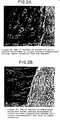
- Figure 1A and B are SEM micrograph comparisons of the strand formed pellets (Fig.lA) and the underwater cut pellets (Fig.lB).
- the rubber phase of the composition was extracted with hexane.
- the product produced according to the process of this invention has a skin which is substantially all plastic polymer while the pelletized strands are essentially of uniform composition throughout.
- a first polymer must be insoluble in a second polymer in the melt state, and that the polymers have. softening or melt points which are separated from one another by at least 10°C; preferably at least about 30°C; more preferably at least about.40 0 C.
- the polymer which is intended to produce the "skin".of the composite, must have the higher melting point.
- the core of the pellet is generally an elastomer.
- the second polymer of the film composition need not be an elastomer so long as the foregoing criter'ia are met.
- the film may be produced using conventional film forming techniques, e.g., blown, cast or tubular. water bath methods.
- film forming techniques e.g., blown, cast or tubular. water bath methods.
- a die surface in order to form the "skin" on at least one surface of the composite, a die surface must be cooled in the aforedescribed manner.
- a conventional method of preparing blown film utilizing an "A" frame and nip roll provides for cooling of the extruded, blown_film using an annular water bath which surrounds the film bubble and cools it.
- This technique can be modified by cooling the inner die outlet l ip either by water cooling the face or by using a water cooled mandrel in extruding the blown film and cooling the mandrel.
- a slit die may be used to prepare coated film. If only the upper or lower die outlet lip is cooled a film comprising two layers, the plastic layer and an elastomer or second plastic layer is formed. Where both die lips are cooled, a sandwich is prepared'with outer skins of plastic polymer and an inner core of elastomer or second plastic polymer.
- a second plastic polymer may be compounded with chemical blowing agents.
- a pneumatogen e.g., Freon
- Freon may be injected into the extruder melt.
- the resulting product has a foamed core between two plastic polymer skins.
- an elastomer is blended with tackifier resins, e.g., terpene resins to form a pressure sensitive or melt adhesive. Only one die outlet lip is cooled. 'The resulting product is an adhesive coated film of plastic polymer useful as wall or shelf coverings.
- tackifier resins e.g., terpene resins
- a sandwich can be prepared having a heat sealable plastic skin and a flexible elastomer core.
- the product is useful for flexible packaging operations, e.g., medical solution bags.
- thermoplastic polyesters e.g., thermoplastic polyesters, ionically crosslinked polymers, PVC, etc.
- ionically crosslinked polymers included sulfonated EPDM and carboxylic acid polymers of ethylene or carboxylic acid copolymers of styrene.
Landscapes
- Engineering & Computer Science (AREA)
- Mechanical Engineering (AREA)
- Chemical & Material Sciences (AREA)
- Physics & Mathematics (AREA)
- Thermal Sciences (AREA)
- Chemical Kinetics & Catalysis (AREA)
- Health & Medical Sciences (AREA)
- Medicinal Chemistry (AREA)
- Polymers & Plastics (AREA)
- Organic Chemistry (AREA)
- Manufacturing & Machinery (AREA)
- Materials Engineering (AREA)
- Processing And Handling Of Plastics And Other Materials For Molding In General (AREA)
- Extrusion Moulding Of Plastics Or The Like (AREA)
Applications Claiming Priority (2)
| Application Number | Priority Date | Filing Date | Title |
|---|---|---|---|
| US809511 | 1985-12-16 | ||
| US06/809,511 US4803035A (en) | 1985-12-16 | 1985-12-16 | Method for making composite films |
Publications (1)
| Publication Number | Publication Date |
|---|---|
| EP0227421A1 true EP0227421A1 (fr) | 1987-07-01 |
Family
ID=25201506
Family Applications (1)
| Application Number | Title | Priority Date | Filing Date |
|---|---|---|---|
| EP86309833A Ceased EP0227421A1 (fr) | 1985-12-16 | 1986-12-16 | Procédé de fabrication de feuilles composites |
Country Status (3)
| Country | Link |
|---|---|
| US (1) | US4803035A (fr) |
| EP (1) | EP0227421A1 (fr) |
| WO (1) | WO1987003533A1 (fr) |
Cited By (3)
| Publication number | Priority date | Publication date | Assignee | Title |
|---|---|---|---|---|
| EP0530977A3 (en) * | 1991-09-06 | 1993-08-11 | Tri- Seal International Inc. | Cap liner for hot filled container, and method for its manufacture |
| WO1994007954A1 (fr) * | 1992-10-02 | 1994-04-14 | E.I. Du Pont De Nemours And Company | Pellicule retractable amelioree et procedes connexes |
| US6514583B1 (en) | 1992-11-13 | 2003-02-04 | Cryovac, Inc. | High impact strength film containing single site catalyzed copolymer |
Families Citing this family (16)
| Publication number | Priority date | Publication date | Assignee | Title |
|---|---|---|---|---|
| US4933124A (en) * | 1986-08-18 | 1990-06-12 | Mobil Oil Corporation | Process of applying a silicone release coating to an oriented polymer film |
| JPH0717756B2 (ja) * | 1988-06-30 | 1995-03-01 | 日本石油株式会社 | 熱可塑性樹脂改質用マスターバッチ組成物の製造方法 |
| DK0420488T3 (da) * | 1989-09-25 | 1993-08-30 | Schneider Usa Inc | Flerlags-ekstrusion som fremgangsmåde til fremstilling af angioplastik-balloner |
| US5195969A (en) * | 1991-04-26 | 1993-03-23 | Boston Scientific Corporation | Co-extruded medical balloons and catheter using such balloons |
| JP3624315B2 (ja) * | 1992-07-29 | 2005-03-02 | バクスター、インターナショナル、インコーポレイテッド | 親水性表面を有する生物材料 |
| JP3577082B2 (ja) | 1993-10-01 | 2004-10-13 | ボストン・サイエンティフィック・コーポレーション | 熱可塑性エラストマーから成る医療装置用バルーン |
| US6896842B1 (en) * | 1993-10-01 | 2005-05-24 | Boston Scientific Corporation | Medical device balloons containing thermoplastic elastomers |
| US5700412A (en) * | 1993-11-01 | 1997-12-23 | E. I. Du Pont De Nemours And Company | Process for making laminar articles |
| US6909028B1 (en) | 1997-09-15 | 2005-06-21 | Kimberly-Clark Worldwide, Inc. | Stable breathable elastic garments |
| US6143818A (en) * | 1999-08-04 | 2000-11-07 | Ato Findley, Inc. | Hot melt adhesive based on ethylene-propylene rubber (EPR) and semicrystalline olefinic polymers |
| US6329468B1 (en) | 2000-01-21 | 2001-12-11 | Bostik Findley, Inc. | Hot melt adhesive based on semicrystalline flexible polyolefins |
| US6846532B1 (en) | 2001-02-15 | 2005-01-25 | Sonoco Development, Inc. | Laminate packaging material |
| WO2003040231A1 (fr) * | 2001-11-05 | 2003-05-15 | Bridgestone Corporation | Procede de production de melanges de 1,2-polybutadiene syndiotactique et d'elastomeres caoutchouteux |
| US20060147685A1 (en) * | 2004-12-30 | 2006-07-06 | Kimberly-Clark Worldwide, Inc. | Multilayer film structure with higher processability |
| CN101460123A (zh) * | 2006-06-07 | 2009-06-17 | 宝洁公司 | 用于吸收制品的可双轴向拉伸的外覆盖件 |
| JP6174571B2 (ja) * | 2011-05-17 | 2017-08-02 | トーレイ プラスティクス(アメリカ),インコーポレイティド | 架橋ポリプロピレン発泡体およびそれから製造する積層体 |
Citations (4)
| Publication number | Priority date | Publication date | Assignee | Title |
|---|---|---|---|---|
| DE1504331A1 (de) * | 1964-08-14 | 1969-10-02 | Grace W R & Co | Verfahren zur Behandlung von miteinander unvertraeglichen Polymeren |
| DE1704561A1 (de) * | 1967-02-17 | 1972-03-30 | Cellophane Sa | Verfahren zum Herstellen eines orientierten opalisierenden Kunststoffilms mit perlmuttartigem Effekt |
| DE1923852B2 (de) * | 1969-05-09 | 1972-12-28 | Alkor-Werk, Karl Lissmann KG, 8000 München | Verfahren und vorrichtung zur herstellung eines teilweise gereckten kunststoff-folienmaterials |
| EP0090554A2 (fr) * | 1982-03-18 | 1983-10-05 | E.I. Du Pont De Nemours And Company | Etirage à froid d'articles lamellaires |
Family Cites Families (30)
| Publication number | Priority date | Publication date | Assignee | Title |
|---|---|---|---|---|
| US2795821A (en) * | 1954-03-16 | 1957-06-18 | Okonite Co | Production of extruded shapes having textured surfaces without recourse to external mechanical devices, such as embossing rolls and the like |
| DE1966466C3 (de) * | 1969-05-09 | 1974-10-10 | Alkor-Werk, Karl Lissmann Kg, 8000 Muenchen | Verfahren und Vorrichtung zum Herstellen einer Verbundfolienbahn. Ausscheidung aus: 1923852 |
| US4053548A (en) * | 1971-11-17 | 1977-10-11 | Exxon Research & Engineering Co. | Fabrication process for multiphased plastics |
| US3949039A (en) * | 1972-04-03 | 1976-04-06 | Japan Steel Works, Ltd. | Method for pelletizing synthetic resins having a high melting point |
| DE2535286C3 (de) * | 1975-08-07 | 1979-01-25 | Dynamit Nobel Ag, 5210 Troisdorf | Verfahren zum Kalibrieren einer coextrudierten Profilleiste aus thermoplastischen Kunststoffen |
| US4196754A (en) * | 1976-05-10 | 1980-04-08 | The Gates Rubber Company | Molded rubber article |
| NL184903C (nl) * | 1976-06-11 | 1989-12-01 | Monsanto Co | Werkwijze voor de bereiding van een elastoplastisch materiaal, dat een thermoplastische, lineaire, kristallijne polyester en een verknoopte rubber bevat. |
| JPS5334859A (en) * | 1976-09-10 | 1978-03-31 | Mitsubishi Heavy Ind Ltd | Extruder for molding multilayer composite film |
| FR2369070A1 (fr) * | 1976-10-29 | 1978-05-26 | Ato Chimie | Procede de f |
| US4183887A (en) * | 1977-04-28 | 1980-01-15 | Copolymer Rubber & Chemical Corporation | Method for producing free flowing particles of elastomeric material |
| JPS5493043A (en) * | 1977-12-29 | 1979-07-23 | Unitika Ltd | Resin composition and its production |
| US4221882A (en) * | 1979-01-31 | 1980-09-09 | Exxon Research & Engineering Co. | High impact melt-flowable dual continuum melt mixed polymer blends of polypropylene, polyethylene, and ethylene-propylene rubber |
| US4410482A (en) * | 1979-03-06 | 1983-10-18 | E. I. Du Pont De Nemours & Co. | Process for making laminar articles of polyolefin and a condensation polymer |
| JPS5667209A (en) * | 1979-11-05 | 1981-06-06 | Du Pont Mitsui Polychem Co Ltd | Tack-free resin pellet and method of manufacturing thereof |
| US4323534A (en) * | 1979-12-17 | 1982-04-06 | The Procter & Gamble Company | Extrusion process for thermoplastic resin composition for fabric fibers with exceptional strength and good elasticity |
| US4289727A (en) * | 1979-12-19 | 1981-09-15 | Mobil Oil Corporation | Method for extrusion of tubular films |
| US4247661A (en) * | 1979-12-26 | 1981-01-27 | The B. F. Goodrich Company | Thermoplastic polymer blends comprising EP or EPDM polymers and highly crystalline polyallomers |
| JPS57165436A (en) * | 1981-04-07 | 1982-10-12 | Toa Nenryo Kogyo Kk | Polyethylene composition |
| US4367113A (en) * | 1981-06-29 | 1983-01-04 | Gulf Oil Corporation | Multicomponent polymer compositions |
| US4370432A (en) * | 1981-09-04 | 1983-01-25 | Exxon Research And Engineering Co. | Hot melt adhesive compositions of neutralized sulfonated EPDM and tackifier mixture |
| US4664866A (en) * | 1981-11-25 | 1987-05-12 | The Dow Chemical Company | Method for preparing a film having preferential one-sided cling |
| JPS5896666A (ja) * | 1981-12-05 | 1983-06-08 | Okura Ind Co Ltd | 二液型接着剤 |
| JPS58208021A (ja) * | 1982-05-31 | 1983-12-03 | Kyoraku Co Ltd | 中空成形品およびその製造方法 |
| US4558096A (en) * | 1983-03-14 | 1985-12-10 | The Goodyear Tire & Rubber Company | High performance rubber-polyester blends |
| JPS59167253A (ja) * | 1983-03-15 | 1984-09-20 | 三菱化学株式会社 | 三層共押出インフレ−シヨンフイルム |
| US4532100A (en) * | 1983-05-06 | 1985-07-30 | The Dow Chemical Company | Blown nylon film and process for the preparation thereof |
| JPS606431A (ja) * | 1983-06-27 | 1985-01-14 | Idemitsu Petrochem Co Ltd | 筒状積層フイルムの製造方法 |
| US4543385A (en) * | 1983-12-28 | 1985-09-24 | Exxon Research And Engineering Co. | Blend compositions of sulfo EPDM's having improved compression set properties |
| JPS60238332A (ja) * | 1984-05-11 | 1985-11-27 | Toppan Printing Co Ltd | 絵柄を有するプラスチツク成形品 |
| US4622193A (en) * | 1984-06-15 | 1986-11-11 | Exxon Research & Engineering Co. | Method for making free flowing coated rubber pellets |
-
1985
- 1985-12-16 US US06/809,511 patent/US4803035A/en not_active Expired - Fee Related
-
1986
- 1986-12-15 WO PCT/US1986/002697 patent/WO1987003533A1/fr not_active Ceased
- 1986-12-16 EP EP86309833A patent/EP0227421A1/fr not_active Ceased
Patent Citations (4)
| Publication number | Priority date | Publication date | Assignee | Title |
|---|---|---|---|---|
| DE1504331A1 (de) * | 1964-08-14 | 1969-10-02 | Grace W R & Co | Verfahren zur Behandlung von miteinander unvertraeglichen Polymeren |
| DE1704561A1 (de) * | 1967-02-17 | 1972-03-30 | Cellophane Sa | Verfahren zum Herstellen eines orientierten opalisierenden Kunststoffilms mit perlmuttartigem Effekt |
| DE1923852B2 (de) * | 1969-05-09 | 1972-12-28 | Alkor-Werk, Karl Lissmann KG, 8000 München | Verfahren und vorrichtung zur herstellung eines teilweise gereckten kunststoff-folienmaterials |
| EP0090554A2 (fr) * | 1982-03-18 | 1983-10-05 | E.I. Du Pont De Nemours And Company | Etirage à froid d'articles lamellaires |
Cited By (7)
| Publication number | Priority date | Publication date | Assignee | Title |
|---|---|---|---|---|
| EP0530977A3 (en) * | 1991-09-06 | 1993-08-11 | Tri- Seal International Inc. | Cap liner for hot filled container, and method for its manufacture |
| US5601200A (en) * | 1991-09-06 | 1997-02-11 | Tri-Seal International, Inc. | Cap liner for hot filled container and method |
| WO1994007954A1 (fr) * | 1992-10-02 | 1994-04-14 | E.I. Du Pont De Nemours And Company | Pellicule retractable amelioree et procedes connexes |
| US6514583B1 (en) | 1992-11-13 | 2003-02-04 | Cryovac, Inc. | High impact strength film containing single site catalyzed copolymer |
| US7588830B2 (en) | 1992-11-13 | 2009-09-15 | Cryovac, Inc. | Heat shrinkable films containing single site catalyzed copolymers |
| US8017231B1 (en) | 1992-11-13 | 2011-09-13 | Cryovac, Inc. | Heat shrinkable films containing single site catalyzed copolymers having long chain branching |
| US8021759B1 (en) | 1992-11-13 | 2011-09-20 | Cryovac Inc. | Heat shrinkable films containing single site catalyzed copolymers |
Also Published As
| Publication number | Publication date |
|---|---|
| US4803035A (en) | 1989-02-07 |
| WO1987003533A1 (fr) | 1987-06-18 |
Similar Documents
| Publication | Publication Date | Title |
|---|---|---|
| US4803035A (en) | Method for making composite films | |
| US4622193A (en) | Method for making free flowing coated rubber pellets | |
| EP0095898B1 (fr) | Procédé de préparation de pastilles s'écoulant librement, enduites en fusion, à base de caoutchouc | |
| EP0169654A2 (fr) | Compositions de granulés enrobés et de pellicule | |
| KR960003278B1 (ko) | 폴리프로필렌 폼 시이트 | |
| US4668571A (en) | Coextrustion tie layer and process for producing such tie layer | |
| US4390573A (en) | Laminar thermoplastic film constructions | |
| JPS5828379A (ja) | ポリエチレン袋フイルム | |
| US4357191A (en) | Laminar thermoplastic film constructions | |
| AU778030B2 (en) | Multilayer heat-shrinkable sealable films | |
| WO1997022656B1 (fr) | Mousse thermoplastique et procede de production de cette mousse a l'aide de dioxyde de carbone | |
| JP2021509372A (ja) | 重ねヒートシール可能な収縮性フィルム、その製造方法、及びそれを用いて製造される包装袋 | |
| HU199271B (en) | Shoe-industrial stiffener | |
| KR100367820B1 (ko) | 필름/기재복합물 | |
| US4822545A (en) | Method for making free-flowing coated rubber pellets | |
| US4970118A (en) | Method for making free-flowing coated rubber pellets | |
| CA1188447A (fr) | Composition de pastilles de polyethylene de faible masse specifique formant une pellicule | |
| CA2171150A1 (fr) | Methodes pour proteger les surfaces hydrofugees et structure pour la mise en oeuvre de ladite methode | |
| CN113442536B (zh) | 一种流延或挤复工艺的易剥离膜及其制备方法 | |
| EP0758946A1 (fr) | Procede de recyclage de materiau polymere et article en feuille obtenu | |
| JP2001115791A (ja) | トンネル用防水シート | |
| US4022858A (en) | Method for the production of foamed thermoplastic film having improved resiliency and flexibility characteristics | |
| EP0228818B1 (fr) | Mélanges de polyéthylène, pellicules et articles d'emballage fabriqués à partir de ces mélanges | |
| JPH01501540A (ja) | 複合フィルムの製造方法 | |
| DE2126812A1 (de) | Verfahren zur Herstellung von Schaumstoffen aus hochmolekularen Olefinpolymerisaten |
Legal Events
| Date | Code | Title | Description |
|---|---|---|---|
| PUAI | Public reference made under article 153(3) epc to a published international application that has entered the european phase |
Free format text: ORIGINAL CODE: 0009012 |
|
| 17P | Request for examination filed |
Effective date: 19870109 |
|
| AK | Designated contracting states |
Kind code of ref document: A1 Designated state(s): AT BE CH DE ES FR GB IT LI LU NL SE |
|
| 17Q | First examination report despatched |
Effective date: 19890505 |
|
| STAA | Information on the status of an ep patent application or granted ep patent |
Free format text: STATUS: THE APPLICATION HAS BEEN REFUSED |
|
| 18R | Application refused |
Effective date: 19920202 |
|
| RIN1 | Information on inventor provided before grant (corrected) |
Inventor name: HAZELTON, DONALD ROSS Inventor name: KRESGE, EDWARD NATHAN |