EP0228148A2 - Polyorgano(hydro)silazane et leur procédé de préparation - Google Patents
Polyorgano(hydro)silazane et leur procédé de préparation Download PDFInfo
- Publication number
- EP0228148A2 EP0228148A2 EP86302618A EP86302618A EP0228148A2 EP 0228148 A2 EP0228148 A2 EP 0228148A2 EP 86302618 A EP86302618 A EP 86302618A EP 86302618 A EP86302618 A EP 86302618A EP 0228148 A2 EP0228148 A2 EP 0228148A2
- Authority
- EP
- European Patent Office
- Prior art keywords
- group
- hydro
- silazane
- polyorgano
- carbon atoms
- Prior art date
- Legal status (The legal status is an assumption and is not a legal conclusion. Google has not performed a legal analysis and makes no representation as to the accuracy of the status listed.)
- Withdrawn
Links
Images


Classifications
-
- C—CHEMISTRY; METALLURGY
- C08—ORGANIC MACROMOLECULAR COMPOUNDS; THEIR PREPARATION OR CHEMICAL WORKING-UP; COMPOSITIONS BASED THEREON
- C08G—MACROMOLECULAR COMPOUNDS OBTAINED OTHERWISE THAN BY REACTIONS ONLY INVOLVING UNSATURATED CARBON-TO-CARBON BONDS
- C08G77/00—Macromolecular compounds obtained by reactions forming a linkage containing silicon with or without sulfur, nitrogen, oxygen or carbon in the main chain of the macromolecule
- C08G77/60—Macromolecular compounds obtained by reactions forming a linkage containing silicon with or without sulfur, nitrogen, oxygen or carbon in the main chain of the macromolecule in which all the silicon atoms are connected by linkages other than oxygen atoms
- C08G77/62—Nitrogen atoms
-
- C—CHEMISTRY; METALLURGY
- C04—CEMENTS; CONCRETE; ARTIFICIAL STONE; CERAMICS; REFRACTORIES
- C04B—LIME, MAGNESIA; SLAG; CEMENTS; COMPOSITIONS THEREOF, e.g. MORTARS, CONCRETE OR LIKE BUILDING MATERIALS; ARTIFICIAL STONE; CERAMICS; REFRACTORIES; TREATMENT OF NATURAL STONE
- C04B35/00—Shaped ceramic products characterised by their composition; Ceramics compositions; Processing powders of inorganic compounds preparatory to the manufacturing of ceramic products
- C04B35/515—Shaped ceramic products characterised by their composition; Ceramics compositions; Processing powders of inorganic compounds preparatory to the manufacturing of ceramic products based on non-oxide ceramics
- C04B35/56—Shaped ceramic products characterised by their composition; Ceramics compositions; Processing powders of inorganic compounds preparatory to the manufacturing of ceramic products based on non-oxide ceramics based on carbides or oxycarbides
- C04B35/565—Shaped ceramic products characterised by their composition; Ceramics compositions; Processing powders of inorganic compounds preparatory to the manufacturing of ceramic products based on non-oxide ceramics based on carbides or oxycarbides based on silicon carbide
- C04B35/571—Shaped ceramic products characterised by their composition; Ceramics compositions; Processing powders of inorganic compounds preparatory to the manufacturing of ceramic products based on non-oxide ceramics based on carbides or oxycarbides based on silicon carbide obtained from Si-containing polymer precursors or organosilicon monomers
-
- C—CHEMISTRY; METALLURGY
- C04—CEMENTS; CONCRETE; ARTIFICIAL STONE; CERAMICS; REFRACTORIES
- C04B—LIME, MAGNESIA; SLAG; CEMENTS; COMPOSITIONS THEREOF, e.g. MORTARS, CONCRETE OR LIKE BUILDING MATERIALS; ARTIFICIAL STONE; CERAMICS; REFRACTORIES; TREATMENT OF NATURAL STONE
- C04B35/00—Shaped ceramic products characterised by their composition; Ceramics compositions; Processing powders of inorganic compounds preparatory to the manufacturing of ceramic products
- C04B35/515—Shaped ceramic products characterised by their composition; Ceramics compositions; Processing powders of inorganic compounds preparatory to the manufacturing of ceramic products based on non-oxide ceramics
- C04B35/58—Shaped ceramic products characterised by their composition; Ceramics compositions; Processing powders of inorganic compounds preparatory to the manufacturing of ceramic products based on non-oxide ceramics based on borides, nitrides, i.e. nitrides, oxynitrides, carbonitrides or oxycarbonitrides or silicides
- C04B35/584—Shaped ceramic products characterised by their composition; Ceramics compositions; Processing powders of inorganic compounds preparatory to the manufacturing of ceramic products based on non-oxide ceramics based on borides, nitrides, i.e. nitrides, oxynitrides, carbonitrides or oxycarbonitrides or silicides based on silicon nitride
- C04B35/589—Shaped ceramic products characterised by their composition; Ceramics compositions; Processing powders of inorganic compounds preparatory to the manufacturing of ceramic products based on non-oxide ceramics based on borides, nitrides, i.e. nitrides, oxynitrides, carbonitrides or oxycarbonitrides or silicides based on silicon nitride obtained from Si-containing polymer precursors or organosilicon monomers
-
- C—CHEMISTRY; METALLURGY
- C07—ORGANIC CHEMISTRY
- C07F—ACYCLIC, CARBOCYCLIC OR HETEROCYCLIC COMPOUNDS CONTAINING ELEMENTS OTHER THAN CARBON, HYDROGEN, HALOGEN, OXYGEN, NITROGEN, SULFUR, SELENIUM OR TELLURIUM
- C07F7/00—Compounds containing elements of Groups 4 or 14 of the Periodic Table
- C07F7/02—Silicon compounds
- C07F7/08—Compounds having one or more C—Si linkages
- C07F7/10—Compounds having one or more C—Si linkages containing nitrogen having a Si-N linkage
-
- C—CHEMISTRY; METALLURGY
- C07—ORGANIC CHEMISTRY
- C07F—ACYCLIC, CARBOCYCLIC OR HETEROCYCLIC COMPOUNDS CONTAINING ELEMENTS OTHER THAN CARBON, HYDROGEN, HALOGEN, OXYGEN, NITROGEN, SULFUR, SELENIUM OR TELLURIUM
- C07F7/00—Compounds containing elements of Groups 4 or 14 of the Periodic Table
- C07F7/02—Silicon compounds
- C07F7/21—Cyclic compounds having at least one ring containing silicon, but no carbon in the ring
Definitions
- This invention relates to a novel polyorgano(hydro)silazane, which is useful for example, as a ceramic starting material, a polymer hardening agent, a densifying agent or a surface coating agent.
- the polymer can be produced by a process having a lower cost and has a stability superior to that of polyorgano(hydro)silazanes of the prior art.
- the present invention also relates to a process for producing said novel polyorgano(hydro)silazane.
- polyorgano(hydro)silazanes which are produced by allowing organodichlorosilanes such as methyldichlorosilane to react with dry ammonia in a non-reactive solvent.
- a ladder-like polysilazane which is prepared by allowing an organo- dichlorosilane to react with dry ammonia, and then removing ammonium chloride to obtain a cyclic silazane with a low degree of polymerization followed by a further reaction with the use of a catalyst such as KH, NaH, etc., (D. Seyferth et al., Communication of the American Ceramic Society, C-132 (6) , 1984).
- the above cyclic polysilazane with a low molecular weight is not desirable as a ceramic starting material because it is susceptible to hydrolysis with water, etc., in the air, and the vaporization loss during firing at a high temperature is great. Further, the polysilazane is produced at a disadvantageously low yield.
- the high molecular weight polysilazane polymerized by ring opening the low molecular weight cyclic polysilazane is a solid polymer insoluble in organic solvents and, therefore, it is not desirable for utilization as a ceramic starting material, a densifying agent, a polymer hardening agent, or a surface treating agent.
- the ladder-like polysilazane with a high molecular weight as mentioned above although it is of interest as a ceramic starting material, requires a large number of steps and expensive catalysts or reaction terminators such as potassium hydride or methyl iodide (which cannot also be reused) in its preparation. Besides, since it is necessary to dry to a high degree the tetrahydrofuran used as the solvent, the production cost per unit weight of ceramics is disadvantageously high. Also, while it is necessary to use a catalyst such as potassium hydride and a solvent such as dry tetrahydrofuran in its production, potassium hydride will react vigorously with water and will ignite if an organic solvent is also present. On the other hand, dry tetrahydrofuran will be readily oxidized to form a highly explosive peroxide. Thus, these compounds are disadvantageous in that they can be handled only with extreme difficulty and with a low safety factor.
- the object of the present invention is to obviate the above mentioned problems.
- the present invention attains the above object by providing a polyorgano(hydro)silazane having the following compositional formula: wherein both substituents R may be the same or different and are selected from the group consisting of an alkyl group, an alkenyl group, a cycloalkyl group, an aryl group, a group other than these groups in which the atom directly bound to Si is carbon, an alkylsilyl group, an alkylamino group, and an alkoxy group, and 0.4 ⁇ x ⁇ 1.
- This polyorgano(hydro)silazane is a mixture of polymers having various structures, but it is considered that it consists basically of a linear portion as represented by the following formula (II) and a cyclic portion represented by the following formula (III), both ends of the linear portion being bound to the cyclic portions.
- the degree of polymerization calculated with (RSiHNH) as the recurring unit, of the polyorgano(hydro)silazane according to the present invention can be about 4 to 1700 or higher.
- the organo group contained in the polyorgano-(hydro)silazane according to the present invention may include, as mentioned above, an alkyl group, an alkenyl group, a cycloalkyl group, an aryl group, an alkylsilyl group, an alkylamino group, and an alkoxy group.
- General examples thereof may include alkyl groups having 1 to 7 carbon atoms, alkenyl groups having 2 to 7 carbon atoms, cycloalkyl groups having 5 to 7 carbon atoms, aryl groups such as phenyl, tolyl, xylyl, mesityl, cumenyl, benzyl, phenethyl, a-methylbenzyl, benzhydryl, trityl, styryl, cinnamyl, biphenylyl, naphthyl and the like, alkylsilyl groups having 1 to 7 carbon atoms, alkylamino groups having 1 to 7 carbon atoms, and alkoxy groups having 1 to 7 carbon atoms.
- the polyorgano(hydro)silazane according to the present invention is novel in that it has a moiety represented by (RSiH) 1.5 N in the above compositional formula, and its amount is in a range as represented by 0.4 ⁇ x ⁇ 1 in the above compositional formula.
- the present invention also relates to a process for producing such a polyorgano(hydro)silazane, the process comprising the steps of: reacting organo(hydro) silane with a base to form a complex thereof, followed by reacting the complex with dry ammonia to form a polyorgano(hydro)silazane having the following compositional formula (I): wherein both substituents R may be the same or different and are selected from the group consisting of an alkyl group, an alkenyl group, a cycloalkyl group, an aryl group, a group other than these groups in which the atom directly bound to-Si is carbon, an alkylsylyl group, an alkylamino group, and an alkoxy group, and 0.4 ⁇ x ⁇ 1.
- R may be generally an alkyl group having 1 to 7, preferably 1 to 5, more preferably 1 to 2 carbon atoms, an alkenyl group having 2 to 7 carbon atoms, a cycloalkyl group having 5 to 7 carbon atoms, or an aryl group
- X may be generally fluorine, chlorine, bromine, or iodine, preferably chlorine.
- aryl group there may be employed phenyl, tolyl, xylyl, mesithyl, cumenyl, benzyl, phenethyl, a-methylbenzyl, benzhydryl, trityl, styryl, cinnamyl, biphenylyl, naphthyl and the like.
- alkylsilyl group mono.di or tri-substituted derivative
- alkylamino group mono or di-substituted derivative
- alkoxy group those having 1 to 7 carbon atoms may be generally used.
- the usable base can be selected widely from among the bases capable of forming an adduct with a halosilane, particularly preferably, a Lewis base is used which will not undergo reactions other than the reaction of forming an adduct with a halosilane.
- Such bases may include, for example, tertiary amines (trialkylamines such as trimethylamine, dimethylethylamine, diethylmethylamine, triethylamine and the like, pyridine, picoline, dimethylaniline and derivatives of these), secondary amines having groups with steric hindrance, phosphine, stibine and arsine, and derivatives of these (e.g., trimethylphosphine, dimethylethylphosphine, methyldiethylphosphine, triethylphosphine, trimethylstibine, tri- methylarsine, triethylarsine, etc.).
- tertiary amines such as trimethylamine, dimethylethylamine, diethylmethylamine, triethylamine and the like, pyridine, picoline, dimethylaniline and derivatives of these
- secondary amines having groups with steric hindrance phosphine,
- a base having a low boiling point and less basic than ammonia e.g., pyridine, picoline, trimethylphosphine, dimethylethylphosphine, methyldiethylphosphine, triethylphosphine
- pyridine and picoline are preferred from the viewpoints of handling and economy.
- the base to be used in the present invention is less expensive than the potassium hydride or methyliodide of the prior art, and can be reused, whereby the production cost becomes advantageously lower.
- the amount of the Lewis base relative to the organo (hydro) dihalosilane may be 0.5 or higher in terms of molar ratio, preferably 1.0 or higher, more preferably 1.5 or higher.
- a complex is formed by adding a Lewis base to the above organo(hydro)dihalosilane.
- a Lewis base it is preferable to use a Lewis base alone or a mixture of a non-reactive solvent with a Lewis base.
- the non-reactive solvent it is possible to use hydrocarbon solvents such as aliphatic hydrocarbons, alicyclic hydrocarbons, and aromatic hydrocarbons, halogenated hydrocarbons such as halogenated methane, halogenated ethane, halogenated benzene, and the like, and ethers such as aliphatic ethers, alicyclic ethers, etc.
- the preferable solvents are halogenated hydrocarbons such as methylene chloride, chloroform, carbon tetrachloride, bromoform, ethylenechloride, ethylidenechlo- ride, trichloroethane, tetrachloroethane, and the like; ethers such as ethyl ether, isopropyl ether, ethyl butyl ether, butyl ether, dioxane, dimethyldioxane, tetrahydrofuran, tetrahydropyrane, and the like; and hydrocarbons such as pentane, hexane, isohexane, methylpentane, heptane, isoheptane, octane, isooctane, cyclopentane, methylcyclopentane, cyclohexane, methylcyclohexane, benzene, to
- the concentration of the organo(hydro)dihalosilane in the solvent may be any desired concentration but is preferably within the range of from 1 to 15% by weight (hereinafter abbreviated as %).
- the temperature may be within the range at which the reaction system can be a liquid, but is preferably a normal temperature, and the pressure may be preferably a normal pressure. Since the reaction is very rapid, the reaction time can be determined as desired.
- the ammonia to be used in this reaction may be either gaseous or liquid. Drying of ammonia may be preferably carried out by, for example, passing it through solid sodium hydroxide, followed by passing it through metallic sodium.
- the amount of ammonia added may be 3.0 to 20-fold in terms of molar ratio relative to the organo(hydro)dihalosilane, preferably 4 to 15-fold, more preferably 5 to 10-fold.
- the reaction solvent, the reaction temperature, the reaction pressure, and the reaction time may be under the same conditions as used in the formation of the complex. However, in a closed system, the reaction is conducted under ammonia pressurization. Also, the water content in the reaction system may be desirably, for example, 500 ppm or less.
- the degree of polymerization of the polyorgano(hydro)silazane can be increased by heating, and those polymers having degrees of polymerization .-with (RSiHNH) as the recurring unit, of about 4 to 1700 are generally obtainable and further, those with a higher degree of polymerization also may be obtainable.
- RSiHNH degrees of polymerization .-with
- the poly- organo(hydro)silazane is separated by conventional means such as centrifugation.
- the novel polyorgano(hydro)silazane provided by the present invention is a ceramic starting material having high strength at high temperature with little reduction in weight by heating. Further, when it is used as a hardening agent for polyester resin or epoxy resin, tensile strength and thermal stability can be improved, while when it is used as the coating agent, abrasion resistance, water-proof workability and acid resistance can be improved.
- the polyorgano(hydro)silazane according to the present invention can be extremely widely used as the starting material for silicon carbide nitrides, etc., hardening agents for various synthetic resins, coating agents, water repellents, stabilizers of silicone rubbers, and films, etc.
- novel polyorgano(hydro)silazane has advantages such that it is soluble in solvents and is easy to handle, that it has a high in yield of the product, and that the production cost per unit weight of ceramics is low.
- the process for producing the polyorgano(hydro)-silazane according to the present invention has an advantage of enhanced safety during the process, in addition to the above-mentioned advantages of the product obtained by the process.
- a device equipped with a gas blowing pipe, a mechanical stirrer, a Dewar condenser and a dropping funnel on a four-necked flask having a 200 ml inner volume was used and the reaction system was replaced with nitrogen gas.
- the device was cooled in an ice-bath, and 6.00 g of methyldichlorosilane (CH3SiHC12) (52.2 mmol) and 70 ml of dry dichloromethane were charged thereinto. Next, 16.6 g (210 mmol) of dry pyridine was added dropwise through the dropping funnel to form a complex, and a colorless solution was obtained.
- CH3SiHC12 methyldichlorosilane
- the average molecular weight of the viscous oil was measured by the cryoscopic method (solvent: benzene) and was found to be 1090.
- the IR (infrared absorption) spectrum (solvent CHC1 3 ) exhibits absorptions based on NH at the wave numbers (cm -1 ) 3380 and 1170; absorption based on CH 3 at 2960; absorption based on SiH at 2130; absorption based on SiCH 3 at 1260; and absorptions based on SiH and SiNSi at 1020-880, as shown in Fig. 1.
- the 1 H NMR data is different from that of the product according to the prior art method shown in Examples 2 and 4 (comparatives) and, therefore, the polymethyl(hydro)silazane according to the present invention was confirmed to be a novel compound.
- the product was fired by a thermogravimetric analyzer in a nitrogen stream under the conditions of a temperature elevation speed of 5°C/min and a maximum temperature of 1000°C.
- the weight of the black solid residue after firing was 44% of that before firing.
- the reaction was carried out in the same manner as Example 1 by using 24.3 g (0.211 mol) of methyldichlorosilane and 300 ml of dry dichloromethane and 18.1 g (1.06 mol) of dry ammonia without using dry pyridine, and 8.81 g of the reaction product was obtained as a colorless liquid.
- the yield was 70.7% based on Si, but the average molecular weight of this product was as low as 314, with the average degree of polymerization being 5.3.
- the polymethyl(hydro)silazane obtained here was fired by a thermogravimetric analyzer under the same conditions as in Example 1.
- the weight of the black solid residue after firing was 14% of that before firing.
- Example 2 The same device as used in Example 1 was employed. The four-necked flask was charged with 100 ml of dry pyridine, and this was ice-cooled. Next, 5.94 g (51.6 mmol) of methyldichlorosilane was added dropwise into the dry pyridine to obtain a colorless solution. The reaction mixture was ice-cooled, and ammonolysis was carried out by blowing 4.10 g (240 mmol) of dry ammonia together with nitrogen gas, under vigorous stirring, therein. The reaction mixture in the form of a white slurry was heated under reflux. The reaction mixture obtained was treated in the same manner as in Example 1 to obtain 2.65 g of polymethyl(hydro)silazane as a colorless viscous oil. The yield was 86.8% based on Si, and the average molecular weight was 1800. The product was confirmed by 1 H NMR spectrum to have a composition of (CH 3 SiHNH) 0.80 [(CH 3 SiH) 1.5 N] 0.20 .
- Example 4 conversion of the product of Example 2 to a high molecular weight compound in the presence of potassium hydride catalyst: comparative
- a four-necked flask having a 100 ml inner volume was equipped with a gas introducing pipe, a thermometer, a condenser and a dropping funnel, and a reaction system was replaced internally with argon gas.
- the four-necked flask was charged with 12 ml of dry tetrahydrofuran and 0.189 g (4.71 mmol) of potassium hydride, and magnetic stirring was initiated.
- 5.06 g (85.6 mmol, based on (CH 3 SiHNH) unit) of the synthetic product of Example 2 and 50 ml of dry tetrahydrofuran were charged, and they were added dropwise into potassium hydride. Hydrogen gas was generated gently.
- the IR spectrum exhibits absorptions based on NH at wave numbers (cm ) 3400 and 1170; absorptions based on phenyl group at 3060, 3010, 1590 and 1430; absorption based on SiH at 2130; absorptions based on SiH and SiNSi at 980-800, as shown Fig. 3.
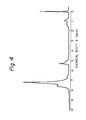
- the 1 H NMR spectrum (60 MHz, DCD1 3 /TMS) shows all broad absorptions, as shown in Fig. 4. That is, 6 0.5-1.9(br, 0.9H, NH); 4.7-5.5(br, 1H, SiH); 6.4-8.0(br, 5H, C 6 H 5 ).
- This spectrum is slightly different from the spectrum of the product in Example 6, in the integral ratio of the absorption based on NH.
- the results of elemental analysis of the polyphenyl(hydro)-silazane of the present invention were (by wt%) Si: 22.5; C: 60.74; H: 5.88; K: 10.88.
- Example 5 The same reaction as in Example 5 was carried out by using 4.12 g (23.3 mmol) of phenyldichlorosilane, 100 ml of dry dichloromethane, and 3.30 g (194 mmol) of dry ammonia, without using dry pyridine, to obtain 2.71 g of a product as a colorless viscous oil.
- the yield was 96.0% based on Si and the average molecular weight 424.
Landscapes
- Chemical & Material Sciences (AREA)
- Organic Chemistry (AREA)
- Engineering & Computer Science (AREA)
- Ceramic Engineering (AREA)
- Structural Engineering (AREA)
- Materials Engineering (AREA)
- Manufacturing & Machinery (AREA)
- Health & Medical Sciences (AREA)
- Chemical Kinetics & Catalysis (AREA)
- Medicinal Chemistry (AREA)
- Polymers & Plastics (AREA)
- Silicon Polymers (AREA)
- Ceramic Products (AREA)
Applications Claiming Priority (2)
| Application Number | Priority Date | Filing Date | Title |
|---|---|---|---|
| JP60293472A JPS62156135A (ja) | 1985-12-28 | 1985-12-28 | ポリオルガノ(ヒドロ)シラザン |
| JP293472/85 | 1985-12-28 |
Publications (2)
| Publication Number | Publication Date |
|---|---|
| EP0228148A2 true EP0228148A2 (fr) | 1987-07-08 |
| EP0228148A3 EP0228148A3 (fr) | 1988-06-01 |
Family
ID=17795188
Family Applications (1)
| Application Number | Title | Priority Date | Filing Date |
|---|---|---|---|
| EP86302618A Withdrawn EP0228148A3 (fr) | 1985-12-28 | 1986-04-09 | Polyorgano(hydro)silazane et leur procédé de préparation |
Country Status (4)
| Country | Link |
|---|---|
| US (1) | US4659850A (fr) |
| EP (1) | EP0228148A3 (fr) |
| JP (1) | JPS62156135A (fr) |
| CA (1) | CA1247285A (fr) |
Cited By (7)
| Publication number | Priority date | Publication date | Assignee | Title |
|---|---|---|---|---|
| EP0375972A3 (fr) * | 1988-12-03 | 1991-01-16 | Hoechst Aktiengesellschaft | Polymères d'hydridochlorosilazanes, leur procédé de préparation et leur utilisation à préparer des matières céramiques contenant du nitrure de silicium |
| EP0375973A3 (fr) * | 1988-12-03 | 1991-01-23 | Hoechst Aktiengesellschaft | Polymères de chlorosilazane, procédé pour leur préparation et procédé de préparation de matières céramiques contenant du nitrure de silicium |
| US5189132A (en) * | 1988-12-03 | 1993-02-23 | Hoechst Aktiengesellschaft | Polymeric hydridochlorosilazanes, process for their preparation, ceramic materials containing silicon nitride which can be manufactured therefrom, and their manufacture |
| WO1994011453A1 (fr) * | 1992-11-19 | 1994-05-26 | Sri International | Revetements resistant a la temperature et/ou non mouillants de polymeres durcis et contenant du silicium |
| FR2698366A1 (fr) * | 1992-11-24 | 1994-05-27 | Atochem Elf Sa | Précurseurs cycliques de nitrure de silicium. |
| EP0304239B1 (fr) * | 1987-08-13 | 1995-04-19 | Toa Nenryo Kogyo Kabushiki Kaisha | Polysilazane modifié et procédé pour sa production |
| CN106232687A (zh) * | 2014-04-24 | 2016-12-14 | Az电子材料(卢森堡)有限公司 | 共聚聚硅氮烷、其制造方法以及包含其的组合物以及使用了其的二氧化硅质膜的形成方法 |
Families Citing this family (34)
| Publication number | Priority date | Publication date | Assignee | Title |
|---|---|---|---|---|
| US4952715A (en) * | 1985-04-26 | 1990-08-28 | Sri International | Polysilazanes and related compositions, processes and uses |
| US5246738A (en) * | 1985-04-26 | 1993-09-21 | Sri International | Hydridosiloxanes as precursors to ceramic products |
| US5055431A (en) * | 1985-04-26 | 1991-10-08 | Sri International | Polysilazanes and related compositions, processes and uses |
| JPH0618885B2 (ja) * | 1986-02-12 | 1994-03-16 | 東燃株式会社 | ポリシロキサザンおよびその製法 |
| US5166104A (en) * | 1986-02-12 | 1992-11-24 | Toa Nenryo Kogyo Kabushiki Kaisha | Polysiloxazanes, silicon oxynitride fibers and processes for producing same |
| US4869854A (en) * | 1986-10-31 | 1989-09-26 | Shin-Etsu Chemical Co., Ltd. | Process for manufacturing organic silazane polymers and ceramics therefrom |
| JP2544928B2 (ja) * | 1987-06-12 | 1996-10-16 | チッソ株式会社 | 新規ポリシラザン及びその製造方法 |
| US4835207A (en) * | 1987-11-13 | 1989-05-30 | Ethyl Corporation | Preceramic compositions and ceramic products |
| US4921925A (en) * | 1988-06-30 | 1990-05-01 | Ethyl Corporation | Organoborosilazane polymers |
| US5045399A (en) * | 1988-01-22 | 1991-09-03 | Ethyl Corporation | Organoborosilazane polymers |
| US5198488A (en) * | 1988-02-01 | 1993-03-30 | Ethyl Corporation | Preceramic compositions and ceramic products with silicon boride |
| EP0331424B1 (fr) * | 1988-02-29 | 1996-04-17 | Toa Nenryo Kogyo Kabushiki Kaisha | Articles façonnés en céramique à base de nitrure de silicium et procédé de leur fabrication |
| US5194338A (en) * | 1988-03-04 | 1993-03-16 | Ethyl Corporation | Preceramic composition containing silicon based powder |
| US5166001A (en) * | 1988-03-04 | 1992-11-24 | Ethyl Corporation | Ceramic coatings |
| US4845058A (en) * | 1988-03-04 | 1989-07-04 | Ethyl Corporation | Process for improving strength of SiC ceramics |
| US4886860A (en) * | 1988-03-23 | 1989-12-12 | Toa Nenryo Kogyo Kabushiki Kaisha | Polymetalosilazane and process for preparing same |
| US4895889A (en) * | 1988-05-12 | 1990-01-23 | Ethyl Corporation | Preceramic compositions |
| US5006492A (en) * | 1988-05-12 | 1991-04-09 | Ethyl Corporation | Preceramic compositions and ceramic products |
| US5179048A (en) * | 1988-10-24 | 1993-01-12 | Ethyl Corporation | Preceramic compositions and ceramic products |
| DE3840779A1 (de) * | 1988-12-03 | 1990-06-07 | Hoechst Ag | Polysubstituierte chlorhaltige silazanpolymere, verfahren zu ihrer herstellung, aus ihnen herstellbare, siliziumnitrid enthaltende keramische materialien, sowie deren herstellung |
| US5009961A (en) * | 1989-06-30 | 1991-04-23 | Ethyl Corporation | Preceramic compositions and ceramic products |
| US5354506A (en) * | 1989-09-28 | 1994-10-11 | Albemarle Corporation | Preceramic compositions and ceramic products |
| JP2704332B2 (ja) * | 1991-10-11 | 1998-01-26 | 株式会社ノリタケカンパニーリミテド | 炭素繊維強化窒化珪素質ナノ複合材及びその製造方法 |
| DE4303106C2 (de) * | 1993-02-04 | 1997-01-16 | Fraunhofer Ges Forschung | Verfahren zur Herstellung von feinteiligen chloridfreien Siliciumcarbonitridpulvern |
| US5413813A (en) * | 1993-11-23 | 1995-05-09 | Enichem S.P.A. | CVD of silicon-based ceramic materials on internal surface of a reactor |
| US5563212A (en) | 1994-05-24 | 1996-10-08 | Exxon Research And Engineering Company | Synthesis of microporous ceramics |
| US5420322A (en) * | 1994-08-31 | 1995-05-30 | Mine Safety Appliances Company | Preparation of alkali-metal hexamethydisilazanes |
| US5747623A (en) * | 1994-10-14 | 1998-05-05 | Tonen Corporation | Method and composition for forming ceramics and article coated with the ceramics |
| US6544657B1 (en) * | 1999-10-12 | 2003-04-08 | The Federal State Of Bavaria, Germany As Represented By The University Of Bayreuth | Synthesis of oligosilazane-containing compounds for the production of a ceramic-like material |
| ATE354818T1 (de) | 2000-08-31 | 2007-03-15 | Az Electronic Materials Usa | Strahlungsempfindliche polysilazan- zusammensetzung, daraus erzeugte muster sowie ein verfahren zur veraschung eines entsprechenden beschichtungsfilms |
| JP4513912B2 (ja) | 2008-03-21 | 2010-07-28 | 富士ゼロックス株式会社 | 画像形成装置用ベルト、ベルト張架装置及び画像形成装置 |
| KR100909215B1 (ko) * | 2009-02-16 | 2009-07-24 | (주)스타네크 | 실리콘-수소 결합의 암모니아 치환을 감소시킨 폴리실라잔 및 폴리실라잔 용액의 제조방법 |
| WO2011079020A1 (fr) | 2009-12-22 | 2011-06-30 | 3M Innovative Properties Company | Procédé de préparation de polysilazanes durcissables stables à la conservation, et polysilazanes ainsi préparés |
| JP7135851B2 (ja) * | 2018-04-11 | 2022-09-13 | 信越化学工業株式会社 | 撥水性被膜形成用組成物及び撥水性被膜 |
Family Cites Families (10)
| Publication number | Priority date | Publication date | Assignee | Title |
|---|---|---|---|---|
| US3318823A (en) * | 1961-01-19 | 1967-05-09 | Aylett Bernard John | Polymeric compounds containing silicon-nitrogen bonds |
| US3498949A (en) * | 1965-12-01 | 1970-03-03 | Monsanto Co | High-temperature resistant polymers which contain silicon and nitrogen and method of making |
| DE2218960A1 (de) * | 1972-04-19 | 1973-11-08 | Bayer Ag | Formkoerper aus mogenen mischungen von siliciumcarbid und siliciumnitrid und verfahren zu ihrer erstellung |
| US4340619A (en) * | 1981-01-15 | 1982-07-20 | Dow Corning Corporation | Process for the preparation of poly(disilyl)silazane polymers and the polymers therefrom |
| US4540803A (en) * | 1983-11-28 | 1985-09-10 | Dow Corning Corporation | Hydrosilazane polymers from [R3 Si]2 NH and HSiCl3 |
| US4482669A (en) * | 1984-01-19 | 1984-11-13 | Massachusetts Institute Of Technology | Preceramic organosilazane polymers |
| US4482689A (en) * | 1984-03-12 | 1984-11-13 | Dow Corning Corporation | Process for the preparation of polymetallo(disily)silazane polymers and the polymers therefrom |
| US4595775A (en) * | 1984-04-06 | 1986-06-17 | Petrarch Systems, Inc. | N-methylhydridosilazanes, polymers thereof, methods of making same and silicon nitrides produced therefrom |
| JPS6189230A (ja) * | 1984-10-09 | 1986-05-07 | Toa Nenryo Kogyo Kk | ポリオルガノヒドロシラザンの製造方法 |
| JPS61287930A (ja) * | 1985-06-17 | 1986-12-18 | Chisso Corp | ポリシラザンの製造方法 |
-
1985
- 1985-12-28 JP JP60293472A patent/JPS62156135A/ja active Granted
-
1986
- 1986-04-07 CA CA000505999A patent/CA1247285A/fr not_active Expired
- 1986-04-09 EP EP86302618A patent/EP0228148A3/fr not_active Withdrawn
- 1986-04-09 US US06/849,755 patent/US4659850A/en not_active Expired - Lifetime
Cited By (10)
| Publication number | Priority date | Publication date | Assignee | Title |
|---|---|---|---|---|
| EP0304239B1 (fr) * | 1987-08-13 | 1995-04-19 | Toa Nenryo Kogyo Kabushiki Kaisha | Polysilazane modifié et procédé pour sa production |
| EP0375972A3 (fr) * | 1988-12-03 | 1991-01-16 | Hoechst Aktiengesellschaft | Polymères d'hydridochlorosilazanes, leur procédé de préparation et leur utilisation à préparer des matières céramiques contenant du nitrure de silicium |
| EP0375973A3 (fr) * | 1988-12-03 | 1991-01-23 | Hoechst Aktiengesellschaft | Polymères de chlorosilazane, procédé pour leur préparation et procédé de préparation de matières céramiques contenant du nitrure de silicium |
| US5189132A (en) * | 1988-12-03 | 1993-02-23 | Hoechst Aktiengesellschaft | Polymeric hydridochlorosilazanes, process for their preparation, ceramic materials containing silicon nitride which can be manufactured therefrom, and their manufacture |
| WO1994011453A1 (fr) * | 1992-11-19 | 1994-05-26 | Sri International | Revetements resistant a la temperature et/ou non mouillants de polymeres durcis et contenant du silicium |
| US5405655A (en) * | 1992-11-19 | 1995-04-11 | Sri International | Temperature-resistant and/or nonwetting coatings of cured, silicon-containing polymers |
| US5919572A (en) * | 1992-11-19 | 1999-07-06 | Sri International | Temperature-resistant and/or nonwetting coating of cured, silicon-containing polymers |
| FR2698366A1 (fr) * | 1992-11-24 | 1994-05-27 | Atochem Elf Sa | Précurseurs cycliques de nitrure de silicium. |
| CN106232687A (zh) * | 2014-04-24 | 2016-12-14 | Az电子材料(卢森堡)有限公司 | 共聚聚硅氮烷、其制造方法以及包含其的组合物以及使用了其的二氧化硅质膜的形成方法 |
| CN106232687B (zh) * | 2014-04-24 | 2020-07-07 | Az电子材料(卢森堡)有限公司 | 共聚聚硅氮烷、其制造方法以及包含其的组合物以及使用了其的二氧化硅质膜的形成方法 |
Also Published As
| Publication number | Publication date |
|---|---|
| EP0228148A3 (fr) | 1988-06-01 |
| CA1247285A (fr) | 1988-12-20 |
| US4659850A (en) | 1987-04-21 |
| JPS62156135A (ja) | 1987-07-11 |
| JPH0446974B2 (fr) | 1992-07-31 |
Similar Documents
| Publication | Publication Date | Title |
|---|---|---|
| US4659850A (en) | Polyorgano(hydro)silazane and process for producing same | |
| KR840001536B1 (ko) | 폴리실란의 제조방법 | |
| US4595775A (en) | N-methylhydridosilazanes, polymers thereof, methods of making same and silicon nitrides produced therefrom | |
| EP0552852B1 (fr) | Polysilazane polycondensé et son procédé de préparation | |
| JP2760555B2 (ja) | ポリボロシラザン及びその製造方法 | |
| EP0123934B1 (fr) | Précurseurs polysilane contenant des groupes oléfiniques, pour carbure de silicium | |
| US5010158A (en) | Process for preparing polysiloxazane compositions and the products formed thereby | |
| US5087685A (en) | Process for preparing polycarbosilanes and new polycarbosilanes | |
| US4550151A (en) | Organoborosilicon polymer and a method for the preparation thereof | |
| US4841083A (en) | Ladder polysilanes | |
| EP0596680B1 (fr) | Dérivés borazine de polymères d'hydridopolysilazane | |
| JPH049169B2 (fr) | ||
| JPH06293833A (ja) | 低酸素ポリメタロシラザン及びその製造方法 | |
| US5138080A (en) | Polysilamethylenosilanes and process for their preparation | |
| EP0139257B1 (fr) | Procédé pour manufacture de carbure de silicium | |
| EP0641820A1 (fr) | Procédé de préparation d'un polymère silicium-organique | |
| US3232958A (en) | Metalloid azides and process for preparing the same | |
| US5100975A (en) | Chlorine-containing silazane polymers, process for their preparation, ceramic material containing silicon nitride which can be prepared from them, and their preparation | |
| US5182411A (en) | Polymeric chlorosilazanes, process for their preparation, ceramic materials containing silicon nitride which can be manufactured therefrom, and their manufacture | |
| JP3114989B2 (ja) | ポリホスホシラザンとその製造方法及びリン原子含有セラミックス | |
| US3352799A (en) | Organosiliconcarbodiimide polymers and process for their preparation | |
| Wettermark et al. | Transsilylation reactions of phosphazene precursors | |
| US3641089A (en) | Siloxazanes compositions and processes thereof | |
| JPH03170533A (ja) | ポリシラザン及びその製法 | |
| Corriu et al. | Chemical transformations of functional polycarbosilanes |
Legal Events
| Date | Code | Title | Description |
|---|---|---|---|
| PUAI | Public reference made under article 153(3) epc to a published international application that has entered the european phase |
Free format text: ORIGINAL CODE: 0009012 |
|
| AK | Designated contracting states |
Kind code of ref document: A2 Designated state(s): DE FR GB NL |
|
| PUAL | Search report despatched |
Free format text: ORIGINAL CODE: 0009013 |
|
| AK | Designated contracting states |
Kind code of ref document: A3 Designated state(s): DE FR GB NL |
|
| 17P | Request for examination filed |
Effective date: 19880606 |
|
| 17Q | First examination report despatched |
Effective date: 19900409 |
|
| STAA | Information on the status of an ep patent application or granted ep patent |
Free format text: STATUS: THE APPLICATION IS DEEMED TO BE WITHDRAWN |
|
| 18D | Application deemed to be withdrawn |
Effective date: 19920625 |
|
| RIN1 | Information on inventor provided before grant (corrected) |
Inventor name: ARAI, MIKIRO Inventor name: FUNAYAMA, OSAMU Inventor name: ISODA, TAKESHI |