EP0228558B1 - Circuit pour la surveillance sélective de flammes d'installations à brûleurs multiples - Google Patents
Circuit pour la surveillance sélective de flammes d'installations à brûleurs multiples Download PDFInfo
- Publication number
- EP0228558B1 EP0228558B1 EP86116128A EP86116128A EP0228558B1 EP 0228558 B1 EP0228558 B1 EP 0228558B1 EP 86116128 A EP86116128 A EP 86116128A EP 86116128 A EP86116128 A EP 86116128A EP 0228558 B1 EP0228558 B1 EP 0228558B1
- Authority
- EP
- European Patent Office
- Prior art keywords
- circuit
- monostable circuit
- flame
- output
- retriggerable
- Prior art date
- Legal status (The legal status is an assumption and is not a legal conclusion. Google has not performed a legal analysis and makes no representation as to the accuracy of the status listed.)
- Expired - Lifetime
Links
- 238000012544 monitoring process Methods 0.000 title claims abstract description 9
- 238000009434 installation Methods 0.000 title claims abstract 3
- 238000011156 evaluation Methods 0.000 claims abstract description 16
- 230000005693 optoelectronics Effects 0.000 claims abstract description 13
- 239000003990 capacitor Substances 0.000 claims abstract description 4
- 230000005540 biological transmission Effects 0.000 claims description 15
- 230000005855 radiation Effects 0.000 description 11
- 238000002485 combustion reaction Methods 0.000 description 5
- 238000010586 diagram Methods 0.000 description 5
- 239000000446 fuel Substances 0.000 description 4
- 238000003384 imaging method Methods 0.000 description 4
- 239000007788 liquid Substances 0.000 description 2
- 238000001208 nuclear magnetic resonance pulse sequence Methods 0.000 description 2
- 238000004886 process control Methods 0.000 description 2
- 239000007787 solid Substances 0.000 description 2
- 230000002123 temporal effect Effects 0.000 description 2
- 238000006243 chemical reaction Methods 0.000 description 1
- 230000001419 dependent effect Effects 0.000 description 1
- 238000005516 engineering process Methods 0.000 description 1
- 230000010354 integration Effects 0.000 description 1
- 238000000034 method Methods 0.000 description 1
- 230000000737 periodic effect Effects 0.000 description 1
- 238000001454 recorded image Methods 0.000 description 1
- 238000004088 simulation Methods 0.000 description 1
Images



Classifications
-
- G—PHYSICS
- G01—MEASURING; TESTING
- G01R—MEASURING ELECTRIC VARIABLES; MEASURING MAGNETIC VARIABLES
- G01R23/00—Arrangements for measuring frequencies; Arrangements for analysing frequency spectra
- G01R23/02—Arrangements for measuring frequency, e.g. pulse repetition rate; Arrangements for measuring period of current or voltage
- G01R23/15—Indicating that frequency of pulses is either above or below a predetermined value or within or outside a predetermined range of values, by making use of non-linear or digital elements (indicating that pulse width is above or below a certain limit)
-
- F—MECHANICAL ENGINEERING; LIGHTING; HEATING; WEAPONS; BLASTING
- F23—COMBUSTION APPARATUS; COMBUSTION PROCESSES
- F23N—REGULATING OR CONTROLLING COMBUSTION
- F23N5/00—Systems for controlling combustion
- F23N5/02—Systems for controlling combustion using devices responsive to thermal changes or to thermal expansion of a medium
- F23N5/08—Systems for controlling combustion using devices responsive to thermal changes or to thermal expansion of a medium using light-sensitive elements
- F23N5/082—Systems for controlling combustion using devices responsive to thermal changes or to thermal expansion of a medium using light-sensitive elements using electronic means
-
- H—ELECTRICITY
- H03—ELECTRONIC CIRCUITRY
- H03K—PULSE TECHNIQUE
- H03K5/00—Manipulating of pulses not covered by one of the other main groups of this subclass
- H03K5/125—Discriminating pulses
- H03K5/1252—Suppression or limitation of noise or interference
-
- F—MECHANICAL ENGINEERING; LIGHTING; HEATING; WEAPONS; BLASTING
- F23—COMBUSTION APPARATUS; COMBUSTION PROCESSES
- F23N—REGULATING OR CONTROLLING COMBUSTION
- F23N2237/00—Controlling
- F23N2237/02—Controlling two or more burners
Definitions
- the invention relates to a circuit arrangement for selective flame monitoring in multi-burner systems for solid, liquid or gaseous fuels, which consists of an optoelectronic sensor unit in which the optoelectronic sensor element is connected via a capacitor to a pulse shaper which generates a pulse sequence corresponding to the flickering frequency of the flame, one electronic evaluation and switching unit.
- Multi-burner systems are operated via a number of individual burners that radiate into a common combustion chamber.
- the particular task of selective flame monitoring in these plants is that the individual burner flames are separated, i.e. regardless of the "flame on” or “flame off” state of the other burners, must be detected in order to immediately stop the fuel supply for the burner in question in the event of a flame failure to avoid dangerous fuel concentrations.
- a problem arises that the sensor elements used to monitor the flame also pick up external signals that arise after the flame has been extinguished by streaking on the afterglowing parts in the combustion chamber (background radiation) or by temporarily irradiated flame tips from neighboring burner flames.
- Selective monitoring is generally carried out in such a way that the sensor element is aligned with a specific flame section of the burner flame to be monitored and thus only receives a limited flicker frequency range which is characteristic of the presence of the flame.
- the difficulty lies in distinguishing between the external signals in the low-frequency range with relatively large amplitude values in the "flame off” state and the overlying frequency range of the useful signals with relatively small amplitude values in the "flame present" state and with a short response time.
- a flame signal is generated with the aid of digital signal processing.
- the signals recorded by the sensor element are first converted to a digital level and the output pulses are continuously counted.
- Statements about the presence of the flame are derived from the number of impulses that occur in a continuously moving time window.
- a major disadvantage of this solution is the high level of circuitry and functionality required for the evaluation of the signals and for the additional measures required for self-monitoring of the overall system to ensure fault safety.
- the invention seeks to remedy this.
- the invention solves the problem of creating a circuit arrangement for selective flame monitoring in multi-burner systems for solid, liquid or gaseous fuels, which realizes maximum selectivity with short response times with simple circuitry means and low component expenditure, the occurrence of unjustified Reduced lockouts and thus guarantees high availability and security against fake flames, in that the output of the pulse shaper is connected to a retriggerable monoflop and its output is connected to an inverter and also to the first input of an AND gate, and in series with the inverter a further monoflop is connected, which is connected to the second input of the AND gate with its rise, and that the output of the AND gate is connected to a further retriggerable monoflop which drives the switching unit.
- the hold time of the first retriggerable monoflop t M10 is preferably to the upper frequency limit of the desired pass band f oo according to the relationship
- the hold time of the retriggerable monoflop that controls the switching unit must be set greater than the sum of the hold times of the first two monoflops and less than the permissible switch-off delay time.
- the simultaneous transmission of n frequency ranges combined with one another is achieved by using n evaluation units (first retriggerable monoflop, inverter, further monoflop and AND gate) in such a way that the inputs of the evaluation units connected in parallel are located at the output of the pulse shaper and whose n outputs are connected via an additional OR gate to the retriggerable monoflop, which controls the switching unit.
- the optoelectronic sensor element also receives signals from neighboring burner flames for a short time within the set transmission range. This is achieved by arranging an integrating element between the second retriggerable monoflop and the switching unit. In this case, the hold time of the second retriggerable monoflop must be set shorter than the sum of the hold times of the first two monoflops and greater than the hold time of the first retriggerable monoflop.
- the switching unit is designed as a threshold switch.
- the circuit arrangement following the pulse shaper i.e. Execute the n evaluation units, the OR gate, the second retriggerable monoflop, the integrating element and the switching unit twice and link the outputs conjunctively.
- the circuit arrangement according to the invention will then be described in function.
- the analog image signals converted from the pulsating portion of the flame radiation by the optoelectronic sensor element or the external signals still radiated onto the optoelectronic sensor element are shaped in the pulse shaper into digital signals whose pulse repetition frequency corresponds to the frequency of the recorded image signals.
- the evaluation unit following the pulse shaper consisting of the retriggerable monoflop, the inverter, the further monoflop and the AND gate, represents a "pulse frequency window" which causes an output pulse to occur at the output of the AND gate only if the time interval between the LH edges of two immediately consecutive input pulses is greater than the hold time of the retriggerable monoflop and less than the sum of the hold times of the two monoflops.
- This is achieved in that the LH edge of the first pulse starts the retriggerable monoflop, which starts the second monoflop after the hold time has elapsed, and which keeps the AND gate open during its hold time, so that only one LH falling within this period Edge of the next following pulse appears at the output of the AND gate.
- the pulse train reaching the "pulse frequency window" from pulse shaper only generates a pulse train of the same frequency at the output of the AND gate if the imaging signals are within the set frequency limits.
- the parallel connection of several evaluation units enables the transmission of a large frequency range, from which the characteristic interference frequency ranges are completely masked out.
- the output pulse train is converted with the help of the second retriggerable monoflop into the flame presence signal, which reaches the input of the switching unit, which takes over the process control.
- triggering of the switching unit when the flame is extinguished is avoided by short pulse scattering of isolated external signals from adjacent burner flames.
- Frequencies of the recorded flame signal from the associated burner flame, the period of which is shorter than the holding time t M30 cause the second retriggerable monoflop to be retriggered continuously.
- Flame signals with lower frequencies (but within the transmission range) appear unchanged at the output of the second retriggerable monoflop and are converted into a pulsating DC voltage by means of the following integrating element, which constantly remains above the switching threshold of the switching unit.
- the invention thus provides a circuit arrangement for selective flame monitoring in multi-burner facilities, which works according to the alternating radiation principle and which transmits a useful signal evaluation area required for the selection of flames with a predetermined frequency limit and absolutely blocks the external signals occurring outside these limits, regardless of their amplitude size.
- Simple means of digital technology are used, which enable a single pulse evaluation and counter circuits as well as the application of Avoid microprocessors.
- the required pass bands are transmitted individually or in combination with any upper and lower frequency limit (e.g. 60 Hz ... 90 Hz, 130 Hz ... 150 Hz, 200 Hz ... 300 Hz etc.).
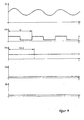
- the imaging signal voltage ie the input signal voltage U E , and its frequency f E are periodic in a short period of time.
- the retriggerable monoflop 4 is set with the LH edge of the square-wave signal voltage U TE , ie the output voltage UM 1 is set to H level.
- f DU 60 Hz
- f DO 90 Hz
- the holding time t M10 of the retriggerable monoflop 4 is on and the hold time of the monoflop 6
- the output voltage U M1 tilts back to the L level at the time t M10 and is set to the H level again at the time t E (following LH edge) , etc.
- the output voltage U M1 thus has a temporal level curve of: and etc., where t M1H is the period of the H level and t M1L is the period of the L level of U M1 .
- the output voltage U M1 is fed via the inverter 5 to the input of the monoflop 6 and also to the first input of the AND gate 7. With the HL flank of the output voltage U M1 ' which occurs at the time t M10 , the monoflop 6 is set so that its output voltage U M2 assumes H potential. The output voltage U M2 then tilts back to the L level after the holding time t M20 has elapsed and is set to the H level again after a further period of time from t E - t M20 (subsequent HL edge of U M1 ), etc.
- the output voltage U M2 thus has a temporal level curve of: and etc., where t M2H is the period of the H level and t M2L is the period of the L level of U M2 .
- the output voltages U M1 and U M2 lie from the time t E to t M10 + t M20 simultaneously at the H level, which is then also present at the output of the AND gate 7.
- the output voltage U A1 of the AND gate 7 falls back to the L level at the time t M10 + t M20 and is set to the H level again after a further time lapse from t E - ( t M10 + t M20 ).
- the output voltage U A1 therefore has a time-related level curve of and etc., where t A1H is the duration of the H level and t A1L is the duration of the L level of the output voltage U A1 .
- the following retriggerable monoflop 9 is set with the LH edge of the output voltage U A1 , ie its output voltage U A2 is set to H level.
- the holding time t M30 of the retriggerable monoflop 9 is dependent on the burner arrangement, the orientation of the sensor view opening and other system-specific conditions on the lower frequency limit of the pass band f DU
- the LH edges of the output voltage U A1 of the AND gate 7 result in a constant retriggering of the monoflop 9, so that the H level of the output voltage U A2 (flame presence signal) is maintained at its output and the control unit “flame” is present by the switching unit 10 "is issued. If the burner flame fails, the optoelectronic sensor element 1 picks up external signals from the background radiation or from the radiation from neighboring flame peaks, the frequency f E of which lies outside the transmission range of the retriggerable monoflop 4, the inverter 5, the monoflop 6 and the AND gate 7 existing evaluation unit, so that a case distinction must be made for external signals below and above the transmission range.
- the hold time t M10 of the retriggerable monoflop 4 is greater than the period t E of the input signal voltage, so that the retriggering of the monoflop 4 prior to expiration its hold time takes place and the monoflop 6 cannot be started via the inverter 5. Since different signal levels are thus present at the AND gate 7, the monoflop 9 is no longer retriggered, so that after the holding time t M20 and the output voltage of the integrating element 11 drop below the threshold voltage of the threshold switch 10, the control command "flame off" is output.
- the period t E of the input signal voltage is greater than the sum of the hold times of the monoflops 4 and 6, so that the retriggerable monoflop 4 starts periodically only occurs when the holding time t M20 of the monoflop 6 has already expired.
- the two inputs of the AND gate 7 are consequently never at H potential simultaneously, as a result of which the switching unit 10 no longer receives a flame presence signal.
- the optoelectronic sensor element 1 in addition to the radiation already mentioned, which is outside the transmission range of the arrangement, may also briefly record signals from neighboring burner flames, the frequency of which may lie within the transmission range, depending on the specific conditions of the system. These disturbances reach the input of the integrating element 11 via the signal path and are converted by the latter into a pulsating direct voltage, which constantly remains below the threshold value of the threshold value switch 10.
- the transmission of several characteristic frequency ranges by connecting several evaluation units A 1 ... A n in parallel according to FIG. 2 has the advantage that the circuit arrangement recognizes an existing burner flame as such with high certainty even if it exhibits fluctuations in the flame quality, for example as a result of control processes. Furthermore, the consistent digital signal processing achieves a high selectivity with a short response time, since known burner and combustion chamber-typical interference frequency ranges, which could lead to a pretense of flame, can be eliminated from the frequency band to be transmitted without delay and absolutely by individual pulse evaluation.
- the circuit arrangement according to the invention also has the advantage of being inexpensive and thereby realizing a high degree of intrinsic safety.
Landscapes
- Engineering & Computer Science (AREA)
- Physics & Mathematics (AREA)
- Nonlinear Science (AREA)
- Chemical & Material Sciences (AREA)
- Combustion & Propulsion (AREA)
- Mechanical Engineering (AREA)
- General Engineering & Computer Science (AREA)
- General Physics & Mathematics (AREA)
- Control Of Combustion (AREA)
- Photometry And Measurement Of Optical Pulse Characteristics (AREA)
- Combustion Of Fluid Fuel (AREA)
- Gas Burners (AREA)
Claims (6)
Priority Applications (1)
| Application Number | Priority Date | Filing Date | Title |
|---|---|---|---|
| AT86116128T ATE54025T1 (de) | 1985-12-23 | 1986-11-21 | Schaltungsanordnung zur selektiven flammenueberwachung in mehrbrenneranlagen. |
Applications Claiming Priority (2)
| Application Number | Priority Date | Filing Date | Title |
|---|---|---|---|
| DD285177 | 1985-12-23 | ||
| DD85285177A DD245030A1 (de) | 1985-12-23 | 1985-12-23 | Schaltungsanordnung zur selektiven flammenueberwachung in mehrbrenneranlagen |
Publications (2)
| Publication Number | Publication Date |
|---|---|
| EP0228558A1 EP0228558A1 (fr) | 1987-07-15 |
| EP0228558B1 true EP0228558B1 (fr) | 1990-06-20 |
Family
ID=5575006
Family Applications (1)
| Application Number | Title | Priority Date | Filing Date |
|---|---|---|---|
| EP86116128A Expired - Lifetime EP0228558B1 (fr) | 1985-12-23 | 1986-11-21 | Circuit pour la surveillance sélective de flammes d'installations à brûleurs multiples |
Country Status (5)
| Country | Link |
|---|---|
| EP (1) | EP0228558B1 (fr) |
| AT (1) | ATE54025T1 (fr) |
| DD (1) | DD245030A1 (fr) |
| DE (1) | DE3672161D1 (fr) |
| HU (1) | HU201993B (fr) |
Families Citing this family (1)
| Publication number | Priority date | Publication date | Assignee | Title |
|---|---|---|---|---|
| DE19650972C2 (de) * | 1996-12-09 | 2001-02-01 | Elbau Elektronik Bauelemente G | Verfahren und Anordnung zur Überwachung und Regelung von Verbrennungsprozessen |
Family Cites Families (2)
| Publication number | Priority date | Publication date | Assignee | Title |
|---|---|---|---|---|
| IT1011594B (it) * | 1973-03-20 | 1977-02-10 | Electricite De France | Dispositivo per il controllo della fiamma di bruciatori |
| JPS57109421A (en) * | 1980-12-26 | 1982-07-07 | Hitachi Ltd | Drop-out detecting circuit |
-
1985
- 1985-12-23 DD DD85285177A patent/DD245030A1/de not_active IP Right Cessation
-
1986
- 1986-11-21 HU HU864839A patent/HU201993B/hu not_active IP Right Cessation
- 1986-11-21 DE DE8686116128T patent/DE3672161D1/de not_active Expired - Fee Related
- 1986-11-21 EP EP86116128A patent/EP0228558B1/fr not_active Expired - Lifetime
- 1986-11-21 AT AT86116128T patent/ATE54025T1/de not_active IP Right Cessation
Also Published As
| Publication number | Publication date |
|---|---|
| DD245030A1 (de) | 1987-04-22 |
| EP0228558A1 (fr) | 1987-07-15 |
| HU201993B (en) | 1991-01-28 |
| HUT45600A (en) | 1988-07-28 |
| DE3672161D1 (de) | 1990-07-26 |
| ATE54025T1 (de) | 1990-07-15 |
Similar Documents
| Publication | Publication Date | Title |
|---|---|---|
| DE2614607C3 (de) | Steuereinrichtung für ein Thyristor-Stromrichterventil | |
| DE3023784C2 (de) | Fotoelektrischer Detektor | |
| EP0228558B1 (fr) | Circuit pour la surveillance sélective de flammes d'installations à brûleurs multiples | |
| EP0229265B1 (fr) | Monteur de flamme à rayonnement variable muni de moyens suppresseurs de signaux parasites | |
| EP0519090B1 (fr) | Commutateur de proximité ultrasonore avec équipement de synchronisation | |
| DE19642149A1 (de) | System zur Datenübertragung | |
| DE2809993C3 (de) | Flammenwächterschaltung zur Überwachung einer Brennerflamme | |
| DE3100747A1 (de) | Last-steuerung | |
| DE10215583B4 (de) | Spannungsgeneratorvorrichtung und Steuerverfahren | |
| DE3311896C2 (fr) | ||
| DE3814877A1 (de) | Signaldetektorgeraet | |
| DE2065765B2 (de) | Anordnung zur Steuerung der Drehzahl und der Drehrichtung eines Gleichstrommotors | |
| DE3026787A1 (de) | Eigensicherer flammenwaechter | |
| DE2142222B2 (de) | Flammenuberwachungseinnchtung | |
| CH689146A5 (de) | Vorrichtung zur Ansteuerung eines Verbrauchers insbesondere eines Magnetventiles einer brennstoffbeheizten Waermequelle. | |
| DE2748075A1 (de) | Schaltungsanordnung zur verkuerzung der einphaszeit eines phasenregelkreises auf die phasenlage von eingangssignalen | |
| DE1942887C3 (de) | Vorrichtung zur automatischen Syn chromsation eines lmpulsfbrmigen Aus gangssignals einer Triggerschaltung mit einem an dieser anliegenden zeitabhan gigen Eingangssignal | |
| DE3240704A1 (de) | Schaltungsanordnung zur ueberwachung von elektronischen rechenbausteinen | |
| EP0333274A2 (fr) | Configuration de circuit pour l'évaluation d'un signal de synchronisation vidéo | |
| DE837251C (de) | Stromkreisanordnung zur Erzeugung oder Trennung elektrischer Impulse | |
| DE2536413C3 (de) | Anordnung zur Erfassung des Freiwerde- oder Sperrvorganges eines Hochspannungs-Stromrichterventils | |
| EP0315054A2 (fr) | Procédé de surveillance d'un circuit de surveillance de temps de microprocesseur et dispositif pour la réalisation du procédé | |
| EP0149097A2 (fr) | Procédé et dispositif pour l'évaluation sûre d'une alarme d'une ligne de signalisation d'un dispositif de signalisation de danger | |
| DE3126747C2 (de) | Schaltungsanordnung zur Anpassung der Länge eintreffender Impulse | |
| DE2402233C3 (de) | Fernsehwiedergabeanordnung mit einer Einrichtung zum Feststellen von Synchronimpulsen |
Legal Events
| Date | Code | Title | Description |
|---|---|---|---|
| PUAI | Public reference made under article 153(3) epc to a published international application that has entered the european phase |
Free format text: ORIGINAL CODE: 0009012 |
|
| 17P | Request for examination filed |
Effective date: 19861127 |
|
| AK | Designated contracting states |
Kind code of ref document: A1 Designated state(s): AT CH DE FR LI |
|
| 17Q | First examination report despatched |
Effective date: 19891003 |
|
| GRAA | (expected) grant |
Free format text: ORIGINAL CODE: 0009210 |
|
| AK | Designated contracting states |
Kind code of ref document: B1 Designated state(s): AT CH DE FR LI |
|
| REF | Corresponds to: |
Ref document number: 54025 Country of ref document: AT Date of ref document: 19900715 Kind code of ref document: T |
|
| REF | Corresponds to: |
Ref document number: 3672161 Country of ref document: DE Date of ref document: 19900726 |
|
| ET | Fr: translation filed | ||
| REG | Reference to a national code |
Ref country code: CH Ref legal event code: PFA Free format text: GERAETE- UND REGLER-WERK LEIPZIG GMBH |
|
| RAP2 | Party data changed (patent owner data changed or rights of a patent transferred) |
Owner name: GERAETE- UND REGLER-WERK LEIPZIG GMBH |
|
| PLBE | No opposition filed within time limit |
Free format text: ORIGINAL CODE: 0009261 |
|
| STAA | Information on the status of an ep patent application or granted ep patent |
Free format text: STATUS: NO OPPOSITION FILED WITHIN TIME LIMIT |
|
| 26N | No opposition filed | ||
| REG | Reference to a national code |
Ref country code: FR Ref legal event code: TP |
|
| PGFP | Annual fee paid to national office [announced via postgrant information from national office to epo] |
Ref country code: AT Payment date: 19931019 Year of fee payment: 8 |
|
| PGFP | Annual fee paid to national office [announced via postgrant information from national office to epo] |
Ref country code: FR Payment date: 19941012 Year of fee payment: 9 |
|
| PG25 | Lapsed in a contracting state [announced via postgrant information from national office to epo] |
Ref country code: AT Effective date: 19941121 |
|
| PGFP | Annual fee paid to national office [announced via postgrant information from national office to epo] |
Ref country code: CH Payment date: 19951103 Year of fee payment: 10 |
|
| PGFP | Annual fee paid to national office [announced via postgrant information from national office to epo] |
Ref country code: DE Payment date: 19951221 Year of fee payment: 10 |
|
| PG25 | Lapsed in a contracting state [announced via postgrant information from national office to epo] |
Ref country code: FR Effective date: 19960731 |
|
| REG | Reference to a national code |
Ref country code: FR Ref legal event code: ST |
|
| PG25 | Lapsed in a contracting state [announced via postgrant information from national office to epo] |
Ref country code: LI Effective date: 19961130 Ref country code: CH Effective date: 19961130 |
|
| REG | Reference to a national code |
Ref country code: CH Ref legal event code: PL |
|
| PG25 | Lapsed in a contracting state [announced via postgrant information from national office to epo] |
Ref country code: DE Effective date: 19970801 |