EP0228864B1 - Process for sintering extruded powder shapes - Google Patents
Process for sintering extruded powder shapes Download PDFInfo
- Publication number
- EP0228864B1 EP0228864B1 EP86309823A EP86309823A EP0228864B1 EP 0228864 B1 EP0228864 B1 EP 0228864B1 EP 86309823 A EP86309823 A EP 86309823A EP 86309823 A EP86309823 A EP 86309823A EP 0228864 B1 EP0228864 B1 EP 0228864B1
- Authority
- EP
- European Patent Office
- Prior art keywords
- process according
- extruded
- tubes
- graphite
- furnace
- Prior art date
- Legal status (The legal status is an assumption and is not a legal conclusion. Google has not performed a legal analysis and makes no representation as to the accuracy of the status listed.)
- Expired - Lifetime
Links
Images
Classifications
-
- F—MECHANICAL ENGINEERING; LIGHTING; HEATING; WEAPONS; BLASTING
- F27—FURNACES; KILNS; OVENS; RETORTS
- F27B—FURNACES, KILNS, OVENS OR RETORTS IN GENERAL; OPEN SINTERING OR LIKE APPARATUS
- F27B5/00—Muffle furnaces; Retort furnaces; Other furnaces in which the charge is held completely isolated
- F27B5/06—Details, accessories or equipment specially adapted for furnaces of these types
- F27B5/10—Muffles
-
- C—CHEMISTRY; METALLURGY
- C04—CEMENTS; CONCRETE; ARTIFICIAL STONE; CERAMICS; REFRACTORIES
- C04B—LIME, MAGNESIA; SLAG; CEMENTS; COMPOSITIONS THEREOF, e.g. MORTARS, CONCRETE OR LIKE BUILDING MATERIALS; ARTIFICIAL STONE; CERAMICS; REFRACTORIES; TREATMENT OF NATURAL STONE
- C04B35/00—Shaped ceramic products characterised by their composition; Ceramics compositions; Processing powders of inorganic compounds preparatory to the manufacturing of ceramic products
- C04B35/515—Shaped ceramic products characterised by their composition; Ceramics compositions; Processing powders of inorganic compounds preparatory to the manufacturing of ceramic products based on non-oxide ceramics
- C04B35/56—Shaped ceramic products characterised by their composition; Ceramics compositions; Processing powders of inorganic compounds preparatory to the manufacturing of ceramic products based on non-oxide ceramics based on carbides or oxycarbides
- C04B35/565—Shaped ceramic products characterised by their composition; Ceramics compositions; Processing powders of inorganic compounds preparatory to the manufacturing of ceramic products based on non-oxide ceramics based on carbides or oxycarbides based on silicon carbide
-
- C—CHEMISTRY; METALLURGY
- C04—CEMENTS; CONCRETE; ARTIFICIAL STONE; CERAMICS; REFRACTORIES
- C04B—LIME, MAGNESIA; SLAG; CEMENTS; COMPOSITIONS THEREOF, e.g. MORTARS, CONCRETE OR LIKE BUILDING MATERIALS; ARTIFICIAL STONE; CERAMICS; REFRACTORIES; TREATMENT OF NATURAL STONE
- C04B35/00—Shaped ceramic products characterised by their composition; Ceramics compositions; Processing powders of inorganic compounds preparatory to the manufacturing of ceramic products
- C04B35/622—Forming processes; Processing powders of inorganic compounds preparatory to the manufacturing of ceramic products
- C04B35/64—Burning or sintering processes
-
- F—MECHANICAL ENGINEERING; LIGHTING; HEATING; WEAPONS; BLASTING
- F27—FURNACES; KILNS; OVENS; RETORTS
- F27B—FURNACES, KILNS, OVENS OR RETORTS IN GENERAL; OPEN SINTERING OR LIKE APPARATUS
- F27B17/00—Furnaces of a kind not covered by any of groups F27B1/00 - F27B15/00
- F27B17/0016—Chamber type furnaces
-
- F—MECHANICAL ENGINEERING; LIGHTING; HEATING; WEAPONS; BLASTING
- F27—FURNACES; KILNS; OVENS; RETORTS
- F27B—FURNACES, KILNS, OVENS OR RETORTS IN GENERAL; OPEN SINTERING OR LIKE APPARATUS
- F27B21/00—Open or uncovered sintering apparatus; Other heat-treatment apparatus of like construction
-
- F—MECHANICAL ENGINEERING; LIGHTING; HEATING; WEAPONS; BLASTING
- F27—FURNACES; KILNS; OVENS; RETORTS
- F27D—DETAILS OR ACCESSORIES OF FURNACES, KILNS, OVENS OR RETORTS, IN SO FAR AS THEY ARE OF KINDS OCCURRING IN MORE THAN ONE KIND OF FURNACE
- F27D5/00—Supports, screens or the like for the charge within the furnace
- F27D5/0068—Containers
-
- F—MECHANICAL ENGINEERING; LIGHTING; HEATING; WEAPONS; BLASTING
- F27—FURNACES; KILNS; OVENS; RETORTS
- F27D—DETAILS OR ACCESSORIES OF FURNACES, KILNS, OVENS OR RETORTS, IN SO FAR AS THEY ARE OF KINDS OCCURRING IN MORE THAN ONE KIND OF FURNACE
- F27D99/00—Subject matter not provided for in other groups of this subclass
- F27D99/0001—Heating elements or systems
-
- H—ELECTRICITY
- H05—ELECTRIC TECHNIQUES NOT OTHERWISE PROVIDED FOR
- H05B—ELECTRIC HEATING; ELECTRIC LIGHT SOURCES NOT OTHERWISE PROVIDED FOR; CIRCUIT ARRANGEMENTS FOR ELECTRIC LIGHT SOURCES, IN GENERAL
- H05B7/00—Heating by electric discharge
-
- Y—GENERAL TAGGING OF NEW TECHNOLOGICAL DEVELOPMENTS; GENERAL TAGGING OF CROSS-SECTIONAL TECHNOLOGIES SPANNING OVER SEVERAL SECTIONS OF THE IPC; TECHNICAL SUBJECTS COVERED BY FORMER USPC CROSS-REFERENCE ART COLLECTIONS [XRACs] AND DIGESTS
- Y10—TECHNICAL SUBJECTS COVERED BY FORMER USPC
- Y10T—TECHNICAL SUBJECTS COVERED BY FORMER US CLASSIFICATION
- Y10T428/00—Stock material or miscellaneous articles
- Y10T428/29—Coated or structually defined flake, particle, cell, strand, strand portion, rod, filament, macroscopic fiber or mass thereof
- Y10T428/2913—Rod, strand, filament or fiber
- Y10T428/2973—Particular cross section
- Y10T428/2975—Tubular or cellular
Definitions
- This invention relates to an improved process for drying, calcining, and sintering extruded powder materials.
- the process yields high strength sintered materials and substantially reduces process times and costs.
- extruded powder shapes are generally dried or calcined by heating the extruded shapes in furnaces or kilns at low temperatures. The shapes are then sintered at higher temperatures in fossil-fuelled furnaces or electric kilns. Materials such as carbides, which cannot be exposed to air and/or the products of fossil fuel combustion, are generally sintered in electric furnaces. Drying and sintering silicon carbide extruded shapes using prior art methods often requires lengthy process times of between 10-100 hours, and high energy costs and requirements.
- Extruded tubes are normally sintered in the prior art in tube furnaces.
- the push speed of the tubes through such furnaces is normally about 3/16 inches (0.48 cm)/minute.
- holes are typically bored in a solid rod material such as graphite and the tubes are loaded into these holes in the rod.
- the loaded rod assembly is then pushed through the tube furnace. This method results in low green/furnace load ratios and slow pushing speeds because of heat transfer limitations.
- the process of the invention comprises drying or calcining an extruded powder material shape and rapid sintering the extruded shape in a plasma fired furnace.
- Use of the process of the invention yields high strength products and reduces process time and costs.
- extruded metallic or nonmetallic powder shapes are dried or calcined.
- the preferred method of drying or calcining is the use of microwave radiation.
- the exhaust from the plasma fired furnace may be used to calcine or dry the extruded shapes. Calcining occurs at higher temperatures than drying, so the extruded shape must be subjected to higher amounts of microwave radiation when calcining is desired. Use of microwave radiation decreases the drying and calcining times and energy requirements.
- the dried or calcined extruded shape is sintered in a plasma fired furnace, in accordance with the invention.
- the preferred sintering furnace is a tube furnace, such as a graphite resistance tube furnace.
- the sintering method may be continuous or intermittent. Use of plasma gases for sintering increases the strength of the final product over that of prior art sintered products.
- EP 0201178A describes a plasma-heated sintering furnace and EP 0197702A describes a process for sintering silicon carbide refractory or ceramic articles using plasma arc gases.
- the preferred powder material used in the process of the invention is silicon carbide.
- Silicon carbide is preferably sintered in an oxygen-free atmosphere, such as in argon, nitrogen, or helium.
- the sintering temperature of silicon carbide is above 1900°C, and preferably 2325°C, when utilizing a nitrogen atmosphere.
- the preferred minimum sintering time for sintering silicon carbide at 2325°C is 15 minutes.
- the heating rate of a tube furnace for silicon carbide is preferably greater than 2000°C/hour, and the push rate is preferably greater than 3 inches (7.62 cm)/ minute.
- the extruded shape in the preferred embodiment is composed of silicon carbide, other ceramic materials, such as Si3N4 or SiC _TiB2, may also be utilized as is, of course, obvious to those skilled in the art.
- the preferred extruded shape in the process of the invention is a tube.
- Typical tube wall thicknesses are 0.1-0.5 inches (0.25-1.25 cm).
- Each green tube of silicon carbide is enclosed in a thin walled graphite tube and then pushed through the furnace. Silicon gas produced upon decomposition of the silicon carbide green body during sintering is therefore maintained within the graphite tube. This supersaturation of the silicon vapour phase retards or prevents further decomposition of silicon carbide.
- the bundle consists of individual green tubes enclosed in their corresponding thin walled graphite tubes.
- Multiple tubes may be sintered simultaneously in a tube furnace in accordance with the invention, by fastening one end of each of several tubes to holding means, and fastening the other end of the tubes to a second holding means to form an assembly.
- the tubes are preferably positioned parallel to each other with a space around each tube.
- the tube assembly is pushed through the tube furnace to achieve sintering.
- Other extruded shapes, in addition to tubes, may be affixed to holding means for sintering in a tube furnace.
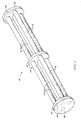
- the sole figure of the drawing is a perspective view of extruded tubes affixed to disc-shaped holding means.
- This invention relates to an improved process for drying or calcining and sintering extruded powder shapes comprising drying or calcining the extruded shape in a microwave furnace and rapid sintering the shape in a plasma fired furnace.
- Use of the process substantially reduces process times and costs and yields a high strength product.
- an extruded powder shape is dried or calcined.
- the preferred powder material is silicon carbide.
- the preferred method of drying and calcining is utilizing microwave radiation.
- the dried or calcined shape is enclosed within a graphite shroud and then rapid sintered in a plasma fired furnace.
- the preferred furnace is a tube furnace.
- the tube furnace must be long enough and/or the heating rates of the furnace high enough so that the sintering temperature is reached.
- the optimum sintering temperature for silicon carbide treated in a nitrogen atmosphere is approximately 2325°C with a minimum sintering time of approximately 5 minutes.
- the heating rate of the furnace is preferably greater than 2000°C/hour, and the push rate preferably greater than 3 inches (7.62 cm)/minute.
- ends of the tubes are held by several holding means to form an assembly.
- the assembly is then pushed through the tube furnace to achieve sintering.
- the final sintered product has a high tensile strength and density.
- the process of the invention is preferably used for silicon carbide extruded powder shapes, although the process can be used for any metallic or nonmetallic extruded powder shapes which require sintering.
- the shapes may be extruded by any means, common to the art, with or without binders.
- the process of the invention is especially useful for elongated shapes such as tubes which can be sintered in a tube furnace.
- the green extruded shape is dried or calcined in accordance with the process of the invention. This step serves to drive off moisture and other volatiles and eliminates excessive shrinkage during the sintering step to yield a higher quality product. Drying requires lower temperatures than calcining. Drying drives off moisture present in the green extruded shape whereas calcining additionally drives off volatile chemically combined constituents.
- the preferred method of drying or calcining is the use of a microwave furnace which utilizes high frequency radiation. By this process, electric field energy is converted into heat within the material being dried. Drying or calcining extruded materials using prior art infrared radiation heating methods requires a long time because of the dependence on thermal conduction from the outside of the material layers and because of generally poor conductive outer layers.
- microwave radiation shortens the drying and calcining times because the microwaves penetrate to the interior of the material. Additionally, microwave drying and calcining drives off water and volatile constituents without shrinkage of the green extruded shape.
- the shapes should be passed or conveyed through the region having the maximum electric field. Several passes through the field are generally necessary in order to dry slowly a green extruded shape with calcining obviously requiring additional passes.
- the extruded shape is placed within a graphite shroud and then sintered in a plasma fired furnace, in accordance with the invention.
- the high heat transfer rates associated with plasma heated gases significantly reduces the sintering time of the extruded shape as compared to conventional methods.
- Plasma arc fired gases differ greatly from ordinary furnace heated gases in that they contain electrically charged particles capable of transferring electricity and heat. The gases become ionized or dissociated and highly reactive. The ionization or dissociation of the plasma gas greatly increases the sintering rate.
- a plasma gas can be "superheated" to temperatures well above the sintering temperature to effect ionization or dissociation; the extruded shape is directly heated by the plasma gas to a much lower temperature.
- Sintering of carbides should be performed in the absence of oxygen or oxygen-bearing gases, such as water and carbon dioxide, to prevent the formation of oxides which may have inferior physical and chemical properties.
- oxygen or oxygen-bearing gases such as water and carbon dioxide
- a plasma gas is useful for sintering carbides since an inert or nonreactive gas may be easily utilized.
- Useful plasma gases for sintering silicon carbide are argon, nitrogen or helium, or a combination thereof. Nitrogen gas dissociates into a highly reactive mixture of N2-molecules, N-atoms, N+-ions and electrons when subjected to a plasma arc.
- Argon and helium gases ionize rather than dissociate when subjected to a plasma arc.
- the sintering temperature of silicon carbide is above 1900°C, and preferably 2325°C when sintered in a nitrogen atmosphere.
- the minimum sintering time for silicon carbide at 2325°C is approximately 15 minutes.
- the preferred plasma fired furnace useful in the process of the invention is a tube furnace, such as a graphite resistance tube furnace.
- a tube furnace the extruded shape is pushed through the length of the furnace where it is subjected to a plasma gas reaction zone.
- the length of the furnace, the heating rate and the push rate depend on the minimum sintering temperature and time requirements of the particular extruded material. For example, to sinter a 6 feet (183 cm) silicon carbide tube of 0.1 inch (0.25 cm) wall thickness at 2325°C in 15 minutes (preferred heat-up and holding time), the heating rate must be 9300°C/hour and the push rate approximately 5 inches (12.7 cm) per minute.
- the length of the tube furnace is slightly longer than the length of the tube in order to introduce cooling gases at the end of the furnace.
- a heating rate of 2000°C/hour and a push rate of 5 inches (12.7 cm) per minute the extruded shape has to be sintered for approximately 45 minutes, and the furnace hot zone has to have a minimum length of approximately 19 feet (5.8 metres).
- the heating rate, push rate and furnace length can all be varied to a great extent depending on the extruded powder material and shape and desired process conditions.
- the process of the invention allows a great deal of flexibility in determining these process conditions.
- the heating rate for silicon carbide is preferably greater than 2000°C/hour, and the push rate is preferably grater than 3 inches (7.62 cm)/minute.
- the pushing method through a tube furnace may be continuous, intermittent, or a combination thereof, in accordance with the invention.
- the extruded shape may be pushed continuously through the furnace until the sintering temperature is reached, and then held at this position for a sufficient time to achieve sintering.
- the graphite tubes enclosing the silicon carbide tubes should be separated from one another.
- the ends of the graphite tube are affixed to holding means 12 made of a material such as graphite, to form an assembly which is pushed through the tube furnace during sintering.
- the holding means "hold" the graphite tubes in place, keep the graphite tubes from contacting the furnace walls, and allow exposure of the graphite tubes to the plasma gases during sintering.
- the preferred holding means shape in the process of the invention is a flat disc 14.
- holding means such as hemispheres, struts, square shapes and hexagon shapes.
- the shape utilized must be able to pass easily through a tube furnace. It is preferable, but not essential, to position the faces of axes formed by the holding means parallel to each other in the assembly.
- the preferred extruded shape for the process of the invention is a tube 16.
- Typical wall thicknesses for tubes 16 are approximately 0.075 inches (1.9 mm).
- An assembly for simultaneously sintering multiple tubes is illustrated in the drawing.
- the disc-shaped holding means 14 in the drawing are perforated 18 to allow insertion of the ends of the tubes.
- Other means of fastening the graphite tubes 16 to the holding means may be utilized, such as providing a slot or protrusion for the shape to fit into.
- the tubes are positioned parallel to each other and perpendicular to the holding means 12. And preferably, a space is left between the tubes to provide for exposure to the plasma gases during sintering.
- the drawing also illustrates an assembly comprising tubes affixed to three disc-shaped holding means.
- the number of tubes which can be positioned between holding means is dependent upon the diameter of the tubes and the tube furnace.
- Other extruded shapes besides tubes can be processed in accordance with the invention.
- the invention is especially useful for extruded shapes in which the length to width ratio is high. Thy invention is also useful for any shapes in which continuous sintering is desired.
- the shapes are affixed to various holding means to form an assembly which can be pushed through a tube furnace; one end of the extruded shape is fastened to one holding means and the other end is fastened to a second holding means. Use of such holding means results in a high green/furnace load ratio, and thus lower process times and costs.
Landscapes
- Engineering & Computer Science (AREA)
- Chemical & Material Sciences (AREA)
- Mechanical Engineering (AREA)
- General Engineering & Computer Science (AREA)
- Ceramic Engineering (AREA)
- Manufacturing & Machinery (AREA)
- Organic Chemistry (AREA)
- Materials Engineering (AREA)
- Structural Engineering (AREA)
- Plasma & Fusion (AREA)
- Physics & Mathematics (AREA)
- Inorganic Chemistry (AREA)
- Ceramic Products (AREA)
- Seal Device For Vehicle (AREA)
- Solid-Sorbent Or Filter-Aiding Compositions (AREA)
- Tunnel Furnaces (AREA)
- Carbon And Carbon Compounds (AREA)
- Saccharide Compounds (AREA)
- Organic Low-Molecular-Weight Compounds And Preparation Thereof (AREA)
- Press-Shaping Or Shaping Using Conveyers (AREA)
- Powder Metallurgy (AREA)
Priority Applications (1)
| Application Number | Priority Date | Filing Date | Title |
|---|---|---|---|
| AT86309823T ATE61557T1 (de) | 1986-01-03 | 1986-12-16 | Verfahren zum sintern von aus pulver extrudierten formkoerpern. |
Applications Claiming Priority (2)
| Application Number | Priority Date | Filing Date | Title |
|---|---|---|---|
| US06/815,981 US4666775A (en) | 1985-04-01 | 1986-01-03 | Process for sintering extruded powder shapes |
| US815981 | 1992-01-02 |
Publications (3)
| Publication Number | Publication Date |
|---|---|
| EP0228864A2 EP0228864A2 (en) | 1987-07-15 |
| EP0228864A3 EP0228864A3 (en) | 1988-02-24 |
| EP0228864B1 true EP0228864B1 (en) | 1991-03-13 |
Family
ID=25219356
Family Applications (1)
| Application Number | Title | Priority Date | Filing Date |
|---|---|---|---|
| EP86309823A Expired - Lifetime EP0228864B1 (en) | 1986-01-03 | 1986-12-16 | Process for sintering extruded powder shapes |
Country Status (10)
| Country | Link |
|---|---|
| US (1) | US4666775A (da) |
| EP (1) | EP0228864B1 (da) |
| JP (1) | JPS62191473A (da) |
| AT (1) | ATE61557T1 (da) |
| AU (1) | AU598781B2 (da) |
| BR (1) | BR8606487A (da) |
| DE (1) | DE3678130D1 (da) |
| DK (1) | DK787A (da) |
| ES (1) | ES2021281B3 (da) |
| NO (1) | NO870013L (da) |
Cited By (10)
| Publication number | Priority date | Publication date | Assignee | Title |
|---|---|---|---|---|
| US6870124B2 (en) | 2002-05-08 | 2005-03-22 | Dana Corporation | Plasma-assisted joining |
| US7189940B2 (en) | 2002-12-04 | 2007-03-13 | Btu International Inc. | Plasma-assisted melting |
| US7432470B2 (en) | 2002-05-08 | 2008-10-07 | Btu International, Inc. | Surface cleaning and sterilization |
| US7445817B2 (en) | 2002-05-08 | 2008-11-04 | Btu International Inc. | Plasma-assisted formation of carbon structures |
| US7465362B2 (en) | 2002-05-08 | 2008-12-16 | Btu International, Inc. | Plasma-assisted nitrogen surface-treatment |
| US7494904B2 (en) | 2002-05-08 | 2009-02-24 | Btu International, Inc. | Plasma-assisted doping |
| US7497922B2 (en) | 2002-05-08 | 2009-03-03 | Btu International, Inc. | Plasma-assisted gas production |
| US7498066B2 (en) | 2002-05-08 | 2009-03-03 | Btu International Inc. | Plasma-assisted enhanced coating |
| US7560657B2 (en) | 2002-05-08 | 2009-07-14 | Btu International Inc. | Plasma-assisted processing in a manufacturing line |
| US7638727B2 (en) | 2002-05-08 | 2009-12-29 | Btu International Inc. | Plasma-assisted heat treatment |
Families Citing this family (23)
| Publication number | Priority date | Publication date | Assignee | Title |
|---|---|---|---|---|
| US4698481A (en) * | 1985-04-01 | 1987-10-06 | Kennecott Corporation | Method for preventing decomposition of silicon carbide articles during high temperature plasma furnace sintering |
| US5580834A (en) * | 1993-02-10 | 1996-12-03 | The Morgan Crucible Company Plc | Self-sintered silicon carbide/carbon graphite composite material having interconnected pores which may be impregnated and raw batch and process for producing same |
| US5422322A (en) * | 1993-02-10 | 1995-06-06 | The Stackpole Corporation | Dense, self-sintered silicon carbide/carbon-graphite composite and process for producing same |
| US5397530A (en) * | 1993-04-26 | 1995-03-14 | Hoeganaes Corporation | Methods and apparatus for heating metal powders |
| CA2124093C (en) * | 1994-03-31 | 2001-04-17 | Prasad S. Apte | Microwave sintering process |
| US5968653A (en) * | 1996-01-11 | 1999-10-19 | The Morgan Crucible Company, Plc | Carbon-graphite/silicon carbide composite article |
| IL122962A (en) * | 1996-05-17 | 2000-10-31 | Implico Bv | Process for making an extruded dried ceramic product |
| BR9901512A (pt) * | 1999-05-27 | 2001-01-09 | Lupatech S A | Processo de extração por plasma de ligantes |
| US7108746B2 (en) * | 2001-05-18 | 2006-09-19 | Integrated Materials, Inc. | Silicon fixture with roughened surface supporting wafers in chemical vapor deposition |
| US20020170487A1 (en) * | 2001-05-18 | 2002-11-21 | Raanan Zehavi | Pre-coated silicon fixtures used in a high temperature process |
| EP1361437A1 (en) * | 2002-05-07 | 2003-11-12 | Centre National De La Recherche Scientifique (Cnrs) | A novel biological cancer marker and methods for determining the cancerous or non-cancerous phenotype of cells |
| US20060228497A1 (en) * | 2002-05-08 | 2006-10-12 | Satyendra Kumar | Plasma-assisted coating |
| US20060233682A1 (en) * | 2002-05-08 | 2006-10-19 | Cherian Kuruvilla A | Plasma-assisted engine exhaust treatment |
| US20060057016A1 (en) * | 2002-05-08 | 2006-03-16 | Devendra Kumar | Plasma-assisted sintering |
| US7504061B2 (en) * | 2002-05-08 | 2009-03-17 | Leonhard Kurz Gmbh & Co., Kg | Method of decorating large plastic 3D objects |
| US20060062930A1 (en) * | 2002-05-08 | 2006-03-23 | Devendra Kumar | Plasma-assisted carburizing |
| US20050233091A1 (en) * | 2002-05-08 | 2005-10-20 | Devendra Kumar | Plasma-assisted coating |
| US20060237398A1 (en) * | 2002-05-08 | 2006-10-26 | Dougherty Mike L Sr | Plasma-assisted processing in a manufacturing line |
| WO2006127037A2 (en) * | 2004-11-05 | 2006-11-30 | Dana Corporation | Atmospheric pressure processing using microwave-generated plasmas |
| JP2015517969A (ja) * | 2012-03-22 | 2015-06-25 | サン−ゴバン セラミックス アンド プラスティクス,インコーポレイティド | 長尺チューブ構造体 |
| US9290311B2 (en) | 2012-03-22 | 2016-03-22 | Saint-Gobain Ceramics & Plastics, Inc. | Sealed containment tube |
| CN106007727A (zh) * | 2016-05-11 | 2016-10-12 | 合肥工业大学 | 一种快速烧结制备LaB6/ZrB2共晶复合材料的方法 |
| CN115175429A (zh) * | 2022-07-18 | 2022-10-11 | 福建省万旗科技陶瓷有限公司 | 一种用于工件烧结的等离子发生器及使用方法 |
Family Cites Families (22)
| Publication number | Priority date | Publication date | Assignee | Title |
|---|---|---|---|---|
| US30286A (en) * | 1860-10-09 | Bedstead-fastening | ||
| AU432371B2 (en) * | 1967-07-13 | 1973-02-06 | Commonwealth Scientific And Industrial Research Organization | Plasma sintering |
| US3935371A (en) * | 1973-02-16 | 1976-01-27 | Camacho Salvador L | Plasma heated batch-type annealing furnace |
| SE371455B (da) * | 1973-03-26 | 1974-11-18 | Norrbottens Jaernverk Ab | |
| US4004934A (en) * | 1973-10-24 | 1977-01-25 | General Electric Company | Sintered dense silicon carbide |
| US4190439A (en) * | 1973-12-28 | 1980-02-26 | Union Carbide Corporation | Process for the preparation of fine grain metal carbide powders and sintered articles therefrom |
| US4041117A (en) * | 1975-06-30 | 1977-08-09 | General Electric Company | Silicon carbide sintered body |
| US4056589A (en) * | 1976-02-18 | 1977-11-01 | Ford Motor Company | Method for sintering ceramics |
| USRE30286E (en) | 1976-11-22 | 1980-05-27 | The Carborundum Company | Method of producing high density silicon carbide product |
| US4469002A (en) * | 1977-01-31 | 1984-09-04 | Thayer Orla E | Axial flow valve |
| US4346049A (en) * | 1978-05-01 | 1982-08-24 | Kennecott Corporation | Sintered alpha silicon carbide ceramic body having equiaxed microstructure |
| US4179299A (en) * | 1978-05-01 | 1979-12-18 | The Carborundum Company | Sintered alpha silicon carbide ceramic body having equiaxed microstructure |
| US4353885A (en) * | 1979-02-12 | 1982-10-12 | Ppg Industries, Inc. | Titanium diboride article and method for preparing same |
| DD147870A1 (de) * | 1979-12-14 | 1981-04-22 | Fred Esser | Metallurgischer plasmaschmelzofen |
| FR2473248A1 (fr) * | 1980-01-07 | 1981-07-10 | Commissariat Energie Atomique | Generateur de gaz ionise a tres haute pression et tres haute temperature |
| DE3040771A1 (de) * | 1980-10-29 | 1982-05-27 | Elektroschmelzwerk Kempten GmbH, 8000 München | Verfahren zur herstellung von praktisch porenfreien, polykristallinen formkoerpern duch isostatisches heisspressen in glashuellen |
| GB2106142B (en) * | 1981-08-10 | 1985-05-22 | Kennecott Corp | Sintering refractory articles using direct-heated gases |
| FR2512536B1 (fr) * | 1981-09-07 | 1989-09-01 | Siderurgie Fse Inst Rech | Procede pour alimenter en energie un four de rechauffage de produits metallurgiques |
| US4559312A (en) * | 1983-09-19 | 1985-12-17 | Kennecott Corporation | Sintering or reaction sintering process for ceramic or refractory materials using plasma arc gases |
| US4707583A (en) * | 1983-09-19 | 1987-11-17 | Kennecott Corporation | Plasma heated sintering furnace |
| US4490319A (en) * | 1983-10-26 | 1984-12-25 | General Electric Company | Rapid rate sintering of ceramics |
| US4676940A (en) * | 1985-04-01 | 1987-06-30 | Kennecott Corporation | Plasma arc sintering of silicon carbide |
-
1986
- 1986-01-03 US US06/815,981 patent/US4666775A/en not_active Expired - Fee Related
- 1986-12-16 EP EP86309823A patent/EP0228864B1/en not_active Expired - Lifetime
- 1986-12-16 DE DE8686309823T patent/DE3678130D1/de not_active Expired - Lifetime
- 1986-12-16 AT AT86309823T patent/ATE61557T1/de not_active IP Right Cessation
- 1986-12-16 ES ES86309823T patent/ES2021281B3/es not_active Expired - Lifetime
- 1986-12-25 JP JP61308065A patent/JPS62191473A/ja active Pending
- 1986-12-30 BR BR8606487A patent/BR8606487A/pt unknown
- 1986-12-31 AU AU67095/86A patent/AU598781B2/en not_active Ceased
-
1987
- 1987-01-02 NO NO870013A patent/NO870013L/no unknown
- 1987-01-02 DK DK000787A patent/DK787A/da not_active Application Discontinuation
Cited By (16)
| Publication number | Priority date | Publication date | Assignee | Title |
|---|---|---|---|---|
| US7465362B2 (en) | 2002-05-08 | 2008-12-16 | Btu International, Inc. | Plasma-assisted nitrogen surface-treatment |
| US7494904B2 (en) | 2002-05-08 | 2009-02-24 | Btu International, Inc. | Plasma-assisted doping |
| US7638727B2 (en) | 2002-05-08 | 2009-12-29 | Btu International Inc. | Plasma-assisted heat treatment |
| US7214280B2 (en) | 2002-05-08 | 2007-05-08 | Btu International Inc. | Plasma-assisted decrystallization |
| US7227097B2 (en) | 2002-05-08 | 2007-06-05 | Btu International, Inc. | Plasma generation and processing with multiple radiation sources |
| US7309843B2 (en) | 2002-05-08 | 2007-12-18 | Btu International, Inc. | Plasma-assisted joining |
| US7132621B2 (en) | 2002-05-08 | 2006-11-07 | Dana Corporation | Plasma catalyst |
| US7432470B2 (en) | 2002-05-08 | 2008-10-07 | Btu International, Inc. | Surface cleaning and sterilization |
| US6870124B2 (en) | 2002-05-08 | 2005-03-22 | Dana Corporation | Plasma-assisted joining |
| US7445817B2 (en) | 2002-05-08 | 2008-11-04 | Btu International Inc. | Plasma-assisted formation of carbon structures |
| US7497922B2 (en) | 2002-05-08 | 2009-03-03 | Btu International, Inc. | Plasma-assisted gas production |
| US7498066B2 (en) | 2002-05-08 | 2009-03-03 | Btu International Inc. | Plasma-assisted enhanced coating |
| US7560657B2 (en) | 2002-05-08 | 2009-07-14 | Btu International Inc. | Plasma-assisted processing in a manufacturing line |
| US7592564B2 (en) | 2002-05-08 | 2009-09-22 | Btu International Inc. | Plasma generation and processing with multiple radiation sources |
| US7608798B2 (en) | 2002-05-08 | 2009-10-27 | Btu International Inc. | Plasma catalyst |
| US7189940B2 (en) | 2002-12-04 | 2007-03-13 | Btu International Inc. | Plasma-assisted melting |
Also Published As
| Publication number | Publication date |
|---|---|
| JPS62191473A (ja) | 1987-08-21 |
| NO870013L (no) | 1987-07-06 |
| EP0228864A2 (en) | 1987-07-15 |
| NO870013D0 (no) | 1987-01-02 |
| AU6709586A (en) | 1987-07-09 |
| US4666775A (en) | 1987-05-19 |
| ATE61557T1 (de) | 1991-03-15 |
| AU598781B2 (en) | 1990-07-05 |
| ES2021281B3 (es) | 1991-11-01 |
| DK787D0 (da) | 1987-01-02 |
| DE3678130D1 (de) | 1991-04-18 |
| EP0228864A3 (en) | 1988-02-24 |
| BR8606487A (pt) | 1987-10-20 |
| DK787A (da) | 1987-07-04 |
Similar Documents
| Publication | Publication Date | Title |
|---|---|---|
| US4666775A (en) | Process for sintering extruded powder shapes | |
| US7196297B2 (en) | Process and system for thermally uniform materials processing | |
| NO893946D0 (no) | Apparat og fremgangsmaate for fremstilling av ensartete, fine, borinneholdende, keramiske pulvere. | |
| CA1195096A (en) | Sintering process for refractory articles using direct-heated gases | |
| US4649002A (en) | System for preventing decomposition of silicon carbide articles during sintering | |
| US4676940A (en) | Plasma arc sintering of silicon carbide | |
| AU5678800A (en) | Method of producing dental ceramics and furnace for heat-treating dental ceramics | |
| WO2002066374A1 (en) | A method for performing thermal reactions between reactants and a furnace for same | |
| JP2002130955A (ja) | 連続焼成炉、焼成体の製造方法及び焼成体 | |
| US6069101A (en) | Boron carbide/silicon carbide ceramics | |
| JP4394345B2 (ja) | 非酸化物セラミックス焼結用焼成炉と非酸化物セラミックス焼結体の製造方法 | |
| JPH0569767B2 (da) | ||
| US4698481A (en) | Method for preventing decomposition of silicon carbide articles during high temperature plasma furnace sintering | |
| Blackman et al. | An induction furnace to attain temperatures above 3000° C in controlled atmospheres | |
| Dé et al. | Effect of green microstructure and processing variables on the microwave sintering of alumina | |
| Taylor et al. | Sintering Time and Temperature for Ba2YCu3O7− x Superconductors | |
| US5124092A (en) | Method of baking shaped carbonaceous products | |
| Shan et al. | Microwave curing of silicon carbide ceramics from a polycarbosilane precursor | |
| WO1994002430A1 (en) | METHOD FOR STABILIZING POLYCARBOSILANE DERIVED Si-C-O CONTAINING FIBERS | |
| JPH02176389A (ja) | 無機物の焼結方法および焼結用坩堝 | |
| JPH0536522B2 (da) | ||
| SU755874A1 (ru) | Тепловая изоляция вакуумных электропечей | |
| JPS62133003A (ja) | 加圧焼結法 | |
| Wroe | MICROWAVE-ASSISTED FIRING OF REFRACTORIES AND OTHER CERAMICS | |
| JPS5923072B2 (ja) | 炭化珪素発熱体 |
Legal Events
| Date | Code | Title | Description |
|---|---|---|---|
| PUAI | Public reference made under article 153(3) epc to a published international application that has entered the european phase |
Free format text: ORIGINAL CODE: 0009012 |
|
| AK | Designated contracting states |
Kind code of ref document: A2 Designated state(s): AT BE CH DE ES FR GB IT LI LU NL SE |
|
| PUAL | Search report despatched |
Free format text: ORIGINAL CODE: 0009013 |
|
| AK | Designated contracting states |
Kind code of ref document: A3 Designated state(s): AT BE CH DE ES FR GB IT LI LU NL SE |
|
| 17P | Request for examination filed |
Effective date: 19880805 |
|
| RAP1 | Party data changed (applicant data changed or rights of an application transferred) |
Owner name: STEMCOR CORPORATION |
|
| 17Q | First examination report despatched |
Effective date: 19891211 |
|
| RAP1 | Party data changed (applicant data changed or rights of an application transferred) |
Owner name: THE CARBORUNDUM COMPANY |
|
| GRAA | (expected) grant |
Free format text: ORIGINAL CODE: 0009210 |
|
| AK | Designated contracting states |
Kind code of ref document: B1 Designated state(s): AT BE CH DE ES FR GB IT LI LU NL SE |
|
| REF | Corresponds to: |
Ref document number: 61557 Country of ref document: AT Date of ref document: 19910315 Kind code of ref document: T |
|
| REF | Corresponds to: |
Ref document number: 3678130 Country of ref document: DE Date of ref document: 19910418 |
|
| ET | Fr: translation filed | ||
| ITF | It: translation for a ep patent filed | ||
| PG25 | Lapsed in a contracting state [announced via postgrant information from national office to epo] |
Ref country code: GB Effective date: 19911216 |
|
| PG25 | Lapsed in a contracting state [announced via postgrant information from national office to epo] |
Ref country code: SE Effective date: 19911217 Ref country code: ES Free format text: LAPSE BECAUSE OF EXPIRATION OF PROTECTION Effective date: 19911217 |
|
| PG25 | Lapsed in a contracting state [announced via postgrant information from national office to epo] |
Ref country code: LU Free format text: LAPSE BECAUSE OF NON-PAYMENT OF DUE FEES Effective date: 19911231 Ref country code: LI Effective date: 19911231 Ref country code: CH Effective date: 19911231 Ref country code: BE Effective date: 19911231 Ref country code: AT Effective date: 19911231 |
|
| PLBE | No opposition filed within time limit |
Free format text: ORIGINAL CODE: 0009261 |
|
| STAA | Information on the status of an ep patent application or granted ep patent |
Free format text: STATUS: NO OPPOSITION FILED WITHIN TIME LIMIT |
|
| 26N | No opposition filed | ||
| BERE | Be: lapsed |
Owner name: THE CARBORUNDUM CY Effective date: 19911231 |
|
| PG25 | Lapsed in a contracting state [announced via postgrant information from national office to epo] |
Ref country code: NL Effective date: 19920701 |
|
| GBPC | Gb: european patent ceased through non-payment of renewal fee | ||
| NLV4 | Nl: lapsed or anulled due to non-payment of the annual fee | ||
| PG25 | Lapsed in a contracting state [announced via postgrant information from national office to epo] |
Ref country code: FR Effective date: 19920831 |
|
| REG | Reference to a national code |
Ref country code: CH Ref legal event code: PL |
|
| PG25 | Lapsed in a contracting state [announced via postgrant information from national office to epo] |
Ref country code: DE Effective date: 19920901 |
|
| REG | Reference to a national code |
Ref country code: FR Ref legal event code: ST |
|
| EUG | Se: european patent has lapsed |
Ref document number: 86309823.2 Effective date: 19920704 |
|
| REG | Reference to a national code |
Ref country code: ES Ref legal event code: FD2A Effective date: 20010301 |
|
| PG25 | Lapsed in a contracting state [announced via postgrant information from national office to epo] |
Ref country code: IT Free format text: LAPSE BECAUSE OF NON-PAYMENT OF DUE FEES;WARNING: LAPSES OF ITALIAN PATENTS WITH EFFECTIVE DATE BEFORE 2007 MAY HAVE OCCURRED AT ANY TIME BEFORE 2007. THE CORRECT EFFECTIVE DATE MAY BE DIFFERENT FROM THE ONE RECORDED. Effective date: 20051216 |