EP0229558A1 - Herbizide Mittel auf der Basis von Estern des Bromoxynils und/oder Ioxynils - Google Patents
Herbizide Mittel auf der Basis von Estern des Bromoxynils und/oder Ioxynils Download PDFInfo
- Publication number
- EP0229558A1 EP0229558A1 EP86402719A EP86402719A EP0229558A1 EP 0229558 A1 EP0229558 A1 EP 0229558A1 EP 86402719 A EP86402719 A EP 86402719A EP 86402719 A EP86402719 A EP 86402719A EP 0229558 A1 EP0229558 A1 EP 0229558A1
- Authority
- EP
- European Patent Office
- Prior art keywords
- esters
- bromoxynil
- acid
- ioxynil
- acids
- Prior art date
- Legal status (The legal status is an assumption and is not a legal conclusion. Google has not performed a legal analysis and makes no representation as to the accuracy of the status listed.)
- Granted
Links
- UPMXNNIRAGDFEH-UHFFFAOYSA-N 3,5-dibromo-4-hydroxybenzonitrile Chemical compound OC1=C(Br)C=C(C#N)C=C1Br UPMXNNIRAGDFEH-UHFFFAOYSA-N 0.000 title claims abstract description 102
- 239000005489 Bromoxynil Substances 0.000 title claims abstract description 98
- NRXQIUSYPAHGNM-UHFFFAOYSA-N ioxynil Chemical class OC1=C(I)C=C(C#N)C=C1I NRXQIUSYPAHGNM-UHFFFAOYSA-N 0.000 title claims abstract description 64
- 230000002363 herbicidal effect Effects 0.000 title claims abstract description 53
- 239000000203 mixture Substances 0.000 claims abstract description 143
- 150000002148 esters Chemical class 0.000 claims abstract description 102
- 239000002253 acid Substances 0.000 claims abstract description 60
- 230000000295 complement effect Effects 0.000 claims abstract description 3
- 241000196324 Embryophyta Species 0.000 claims description 61
- 239000004009 herbicide Substances 0.000 claims description 54
- 150000007513 acids Chemical class 0.000 claims description 33
- XLYOFNOQVPJJNP-UHFFFAOYSA-N water Substances O XLYOFNOQVPJJNP-UHFFFAOYSA-N 0.000 claims description 18
- 239000002904 solvent Substances 0.000 claims description 17
- -1 calcium alkylbenzene sulfonates Chemical class 0.000 claims description 15
- FERIUCNNQQJTOY-UHFFFAOYSA-N Butyric acid Chemical compound CCCC(O)=O FERIUCNNQQJTOY-UHFFFAOYSA-N 0.000 claims description 11
- 125000003118 aryl group Chemical group 0.000 claims description 8
- 238000005507 spraying Methods 0.000 claims description 8
- 239000004094 surface-active agent Substances 0.000 claims description 8
- 125000004432 carbon atom Chemical group C* 0.000 claims description 7
- 150000002430 hydrocarbons Chemical group 0.000 claims description 7
- 239000007788 liquid Substances 0.000 claims description 7
- WWZKQHOCKIZLMA-UHFFFAOYSA-N octanoic acid Chemical compound CCCCCCCC(O)=O WWZKQHOCKIZLMA-UHFFFAOYSA-N 0.000 claims description 7
- MNWFXJYAOYHMED-UHFFFAOYSA-N heptanoic acid Chemical compound CCCCCCC(O)=O MNWFXJYAOYHMED-UHFFFAOYSA-N 0.000 claims description 6
- 239000000839 emulsion Substances 0.000 claims description 5
- 239000012530 fluid Substances 0.000 claims description 5
- 238000000034 method Methods 0.000 claims description 5
- 150000001298 alcohols Chemical class 0.000 claims description 4
- 125000001931 aliphatic group Chemical group 0.000 claims description 4
- MZZBPDKVEFVLFF-UHFFFAOYSA-N cyanazine Chemical compound CCNC1=NC(Cl)=NC(NC(C)(C)C#N)=N1 MZZBPDKVEFVLFF-UHFFFAOYSA-N 0.000 claims description 4
- 239000002480 mineral oil Substances 0.000 claims description 4
- POAOYUHQDCAZBD-UHFFFAOYSA-N 2-butoxyethanol Chemical compound CCCCOCCO POAOYUHQDCAZBD-UHFFFAOYSA-N 0.000 claims description 3
- IAYPIBMASNFSPL-UHFFFAOYSA-N Ethylene oxide Chemical compound C1CO1 IAYPIBMASNFSPL-UHFFFAOYSA-N 0.000 claims description 3
- 150000008064 anhydrides Chemical class 0.000 claims description 3
- 239000003795 chemical substances by application Substances 0.000 claims description 3
- 150000001805 chlorine compounds Chemical class 0.000 claims description 3
- BWDBEAQIHAEVLV-UHFFFAOYSA-N 6-methylheptan-1-ol Chemical compound CC(C)CCCCCO BWDBEAQIHAEVLV-UHFFFAOYSA-N 0.000 claims description 2
- QGZKDVFQNNGYKY-UHFFFAOYSA-O Ammonium Chemical compound [NH4+] QGZKDVFQNNGYKY-UHFFFAOYSA-O 0.000 claims description 2
- 239000005484 Bifenox Substances 0.000 claims description 2
- 239000005504 Dicamba Substances 0.000 claims description 2
- DGAQECJNVWCQMB-PUAWFVPOSA-M Ilexoside XXIX Chemical compound C[C@@H]1CC[C@@]2(CC[C@@]3(C(=CC[C@H]4[C@]3(CC[C@@H]5[C@@]4(CC[C@@H](C5(C)C)OS(=O)(=O)[O-])C)C)[C@@H]2[C@]1(C)O)C)C(=O)O[C@H]6[C@@H]([C@H]([C@@H]([C@H](O6)CO)O)O)O.[Na+] DGAQECJNVWCQMB-PUAWFVPOSA-M 0.000 claims description 2
- SUSRORUBZHMPCO-UHFFFAOYSA-N MC-4379 Chemical compound C1=C([N+]([O-])=O)C(C(=O)OC)=CC(OC=2C(=CC(Cl)=CC=2)Cl)=C1 SUSRORUBZHMPCO-UHFFFAOYSA-N 0.000 claims description 2
- GOOHAUXETOMSMM-UHFFFAOYSA-N Propylene oxide Chemical compound CC1CO1 GOOHAUXETOMSMM-UHFFFAOYSA-N 0.000 claims description 2
- 150000001558 benzoic acid derivatives Chemical class 0.000 claims description 2
- 239000004305 biphenyl Substances 0.000 claims description 2
- 235000010290 biphenyl Nutrition 0.000 claims description 2
- 150000001733 carboxylic acid esters Chemical class 0.000 claims description 2
- IWEDIXLBFLAXBO-UHFFFAOYSA-N dicamba Chemical compound COC1=C(Cl)C=CC(Cl)=C1C(O)=O IWEDIXLBFLAXBO-UHFFFAOYSA-N 0.000 claims description 2
- 238000010790 dilution Methods 0.000 claims description 2
- 239000012895 dilution Substances 0.000 claims description 2
- LQZZUXJYWNFBMV-UHFFFAOYSA-N dodecan-1-ol Chemical compound CCCCCCCCCCCCO LQZZUXJYWNFBMV-UHFFFAOYSA-N 0.000 claims description 2
- 239000002563 ionic surfactant Substances 0.000 claims description 2
- 239000002736 nonionic surfactant Substances 0.000 claims description 2
- 125000001400 nonyl group Chemical group [H]C([*])([H])C([H])([H])C([H])([H])C([H])([H])C([H])([H])C([H])([H])C([H])([H])C([H])([H])C([H])([H])[H] 0.000 claims description 2
- 125000002347 octyl group Chemical group [H]C([*])([H])C([H])([H])C([H])([H])C([H])([H])C([H])([H])C([H])([H])C([H])([H])C([H])([H])[H] 0.000 claims description 2
- ZUOUZKKEUPVFJK-UHFFFAOYSA-N phenylbenzene Natural products C1=CC=CC=C1C1=CC=CC=C1 ZUOUZKKEUPVFJK-UHFFFAOYSA-N 0.000 claims description 2
- SIOXPEMLGUPBBT-UHFFFAOYSA-N picolinic acid Chemical class OC(=O)C1=CC=CC=N1 SIOXPEMLGUPBBT-UHFFFAOYSA-N 0.000 claims description 2
- 239000011734 sodium Substances 0.000 claims description 2
- 229910052708 sodium Inorganic materials 0.000 claims description 2
- 150000003918 triazines Chemical class 0.000 claims description 2
- 235000015112 vegetable and seed oil Nutrition 0.000 claims description 2
- 239000008158 vegetable oil Substances 0.000 claims description 2
- OVSKIKFHRZPJSS-UHFFFAOYSA-N 2,4-D Chemical compound OC(=O)COC1=CC=C(Cl)C=C1Cl OVSKIKFHRZPJSS-UHFFFAOYSA-N 0.000 claims 1
- 239000005631 2,4-Dichlorophenoxyacetic acid Substances 0.000 claims 1
- DBRDEBUVFZJFQV-UHFFFAOYSA-N 2-chloro-2-(4-methylphenoxy)acetic acid Chemical compound CC1=CC=C(OC(Cl)C(O)=O)C=C1 DBRDEBUVFZJFQV-UHFFFAOYSA-N 0.000 claims 1
- XBDQKXXYIPTUBI-UHFFFAOYSA-N Propionic acid Substances CCC(O)=O XBDQKXXYIPTUBI-UHFFFAOYSA-N 0.000 claims 1
- 239000011575 calcium Substances 0.000 claims 1
- 229910052791 calcium Inorganic materials 0.000 claims 1
- 159000000011 group IA salts Chemical class 0.000 claims 1
- 239000000047 product Substances 0.000 description 76
- 239000004495 emulsifiable concentrate Substances 0.000 description 26
- FERIUCNNQQJTOY-UHFFFAOYSA-M Butyrate Chemical compound CCCC([O-])=O FERIUCNNQQJTOY-UHFFFAOYSA-M 0.000 description 25
- 239000000243 solution Substances 0.000 description 23
- 238000002844 melting Methods 0.000 description 20
- 230000008018 melting Effects 0.000 description 20
- WWZKQHOCKIZLMA-UHFFFAOYSA-M octanoate Chemical compound CCCCCCCC([O-])=O WWZKQHOCKIZLMA-UHFFFAOYSA-M 0.000 description 18
- MNWFXJYAOYHMED-UHFFFAOYSA-M heptanoate Chemical compound CCCCCCC([O-])=O MNWFXJYAOYHMED-UHFFFAOYSA-M 0.000 description 17
- 238000009472 formulation Methods 0.000 description 16
- 235000013339 cereals Nutrition 0.000 description 12
- 238000002474 experimental method Methods 0.000 description 12
- 239000003995 emulsifying agent Substances 0.000 description 8
- 238000011282 treatment Methods 0.000 description 8
- 240000008042 Zea mays Species 0.000 description 7
- 238000002425 crystallisation Methods 0.000 description 7
- 230000008025 crystallization Effects 0.000 description 7
- 235000002017 Zea mays subsp mays Nutrition 0.000 description 6
- 238000006243 chemical reaction Methods 0.000 description 6
- 239000012141 concentrate Substances 0.000 description 6
- 239000000470 constituent Substances 0.000 description 6
- 230000006378 damage Effects 0.000 description 6
- PUIYMUZLKQOUOZ-UHFFFAOYSA-N isoproturon Chemical compound CC(C)C1=CC=C(NC(=O)N(C)C)C=C1 PUIYMUZLKQOUOZ-UHFFFAOYSA-N 0.000 description 6
- 241000209140 Triticum Species 0.000 description 5
- 125000000129 anionic group Chemical group 0.000 description 5
- 230000008901 benefit Effects 0.000 description 5
- 230000000052 comparative effect Effects 0.000 description 5
- 230000000694 effects Effects 0.000 description 5
- DQKWXTIYGWPGOO-UHFFFAOYSA-N (2,6-dibromo-4-cyanophenyl) octanoate Chemical compound CCCCCCCC(=O)OC1=C(Br)C=C(C#N)C=C1Br DQKWXTIYGWPGOO-UHFFFAOYSA-N 0.000 description 4
- OAOABCKPVCUNKO-UHFFFAOYSA-N 8-methyl Nonanoic acid Chemical compound CC(C)CCCCCCC(O)=O OAOABCKPVCUNKO-UHFFFAOYSA-N 0.000 description 4
- 235000021307 Triticum Nutrition 0.000 description 4
- 235000005824 Zea mays ssp. parviglumis Nutrition 0.000 description 4
- 239000007900 aqueous suspension Substances 0.000 description 4
- 235000005822 corn Nutrition 0.000 description 4
- 238000002156 mixing Methods 0.000 description 4
- 239000007787 solid Substances 0.000 description 4
- 238000003860 storage Methods 0.000 description 4
- LYCAIKOWRPUZTN-UHFFFAOYSA-N Ethylene glycol Chemical compound OCCO LYCAIKOWRPUZTN-UHFFFAOYSA-N 0.000 description 3
- OKKJLVBELUTLKV-UHFFFAOYSA-N Methanol Chemical compound OC OKKJLVBELUTLKV-UHFFFAOYSA-N 0.000 description 3
- 239000004480 active ingredient Substances 0.000 description 3
- 229930195733 hydrocarbon Natural products 0.000 description 3
- 238000004806 packaging method and process Methods 0.000 description 3
- 230000010076 replication Effects 0.000 description 3
- 230000000717 retained effect Effects 0.000 description 3
- 244000291564 Allium cepa Species 0.000 description 2
- 235000011331 Brassica Nutrition 0.000 description 2
- 241000219198 Brassica Species 0.000 description 2
- 244000000626 Daucus carota Species 0.000 description 2
- 235000002767 Daucus carota Nutrition 0.000 description 2
- KFZMGEQAYNKOFK-UHFFFAOYSA-N Isopropanol Chemical compound CC(C)O KFZMGEQAYNKOFK-UHFFFAOYSA-N 0.000 description 2
- 240000004674 Papaver rhoeas Species 0.000 description 2
- 235000007846 Papaver rhoeas Nutrition 0.000 description 2
- 235000019057 Raphanus caudatus Nutrition 0.000 description 2
- 244000088415 Raphanus sativus Species 0.000 description 2
- 235000011380 Raphanus sativus Nutrition 0.000 description 2
- 240000001949 Taraxacum officinale Species 0.000 description 2
- 235000005187 Taraxacum officinale ssp. officinale Nutrition 0.000 description 2
- 241000407417 Veronica agrestis Species 0.000 description 2
- 235000016383 Zea mays subsp huehuetenangensis Nutrition 0.000 description 2
- 239000011149 active material Substances 0.000 description 2
- JFDZBHWFFUWGJE-UHFFFAOYSA-N benzonitrile Substances N#CC1=CC=CC=C1 JFDZBHWFFUWGJE-UHFFFAOYSA-N 0.000 description 2
- 239000004359 castor oil Substances 0.000 description 2
- 235000019438 castor oil Nutrition 0.000 description 2
- 239000006071 cream Substances 0.000 description 2
- 238000010586 diagram Methods 0.000 description 2
- ZEMPKEQAKRGZGQ-XOQCFJPHSA-N glycerol triricinoleate Natural products CCCCCC[C@@H](O)CC=CCCCCCCCC(=O)OC[C@@H](COC(=O)CCCCCCCC=CC[C@@H](O)CCCCCC)OC(=O)CCCCCCCC=CC[C@H](O)CCCCCC ZEMPKEQAKRGZGQ-XOQCFJPHSA-N 0.000 description 2
- FUZZWVXGSFPDMH-UHFFFAOYSA-N hexanoic acid Chemical compound CCCCCC(O)=O FUZZWVXGSFPDMH-UHFFFAOYSA-N 0.000 description 2
- ZXEKIIBDNHEJCQ-UHFFFAOYSA-N isobutanol Chemical compound CC(C)CO ZXEKIIBDNHEJCQ-UHFFFAOYSA-N 0.000 description 2
- 238000002955 isolation Methods 0.000 description 2
- 235000009973 maize Nutrition 0.000 description 2
- 238000004519 manufacturing process Methods 0.000 description 2
- 235000010446 mineral oil Nutrition 0.000 description 2
- 239000003208 petroleum Substances 0.000 description 2
- ISWSIDIOOBJBQZ-UHFFFAOYSA-N phenol group Chemical group C1(=CC=CC=C1)O ISWSIDIOOBJBQZ-UHFFFAOYSA-N 0.000 description 2
- 239000002994 raw material Substances 0.000 description 2
- 238000009331 sowing Methods 0.000 description 2
- 238000001228 spectrum Methods 0.000 description 2
- 239000007921 spray Substances 0.000 description 2
- BHZWBQPHPLFZSV-UHFFFAOYSA-N (2,6-dibromo-4-cyanophenyl) heptanoate Chemical compound CCCCCCC(=O)OC1=C(Br)C=C(C#N)C=C1Br BHZWBQPHPLFZSV-UHFFFAOYSA-N 0.000 description 1
- MTQKMPGBALVEDL-ZPCKWCKBSA-N (z,12r)-12-hydroxy-2-sulfooctadec-9-enoic acid Chemical class CCCCCC[C@@H](O)C\C=C/CCCCCCC(C(O)=O)S(O)(=O)=O MTQKMPGBALVEDL-ZPCKWCKBSA-N 0.000 description 1
- CHZCERSEMVWNHL-UHFFFAOYSA-N 2-hydroxybenzonitrile Chemical compound OC1=CC=CC=C1C#N CHZCERSEMVWNHL-UHFFFAOYSA-N 0.000 description 1
- OEOIWYCWCDBOPA-UHFFFAOYSA-N 6-methyl-heptanoic acid Chemical compound CC(C)CCCCC(O)=O OEOIWYCWCDBOPA-UHFFFAOYSA-N 0.000 description 1
- XZOYHFBNQHPJRQ-UHFFFAOYSA-N 7-methyloctanoic acid Chemical compound CC(C)CCCCCC(O)=O XZOYHFBNQHPJRQ-UHFFFAOYSA-N 0.000 description 1
- 235000010167 Allium cepa var aggregatum Nutrition 0.000 description 1
- 235000002732 Allium cepa var. cepa Nutrition 0.000 description 1
- 240000002234 Allium sativum Species 0.000 description 1
- 235000007319 Avena orientalis Nutrition 0.000 description 1
- 244000075850 Avena orientalis Species 0.000 description 1
- 235000021533 Beta vulgaris Nutrition 0.000 description 1
- 241000335053 Beta vulgaris Species 0.000 description 1
- 240000006122 Chenopodium album Species 0.000 description 1
- 235000009344 Chenopodium album Nutrition 0.000 description 1
- 240000005702 Galium aparine Species 0.000 description 1
- 235000014820 Galium aparine Nutrition 0.000 description 1
- 240000005979 Hordeum vulgare Species 0.000 description 1
- 235000007340 Hordeum vulgare Nutrition 0.000 description 1
- OWYWGLHRNBIFJP-UHFFFAOYSA-N Ipazine Chemical compound CCN(CC)C1=NC(Cl)=NC(NC(C)C)=N1 OWYWGLHRNBIFJP-UHFFFAOYSA-N 0.000 description 1
- 231100000674 Phytotoxicity Toxicity 0.000 description 1
- 240000000111 Saccharum officinarum Species 0.000 description 1
- 235000007201 Saccharum officinarum Nutrition 0.000 description 1
- 244000061457 Solanum nigrum Species 0.000 description 1
- 235000002594 Solanum nigrum Nutrition 0.000 description 1
- 240000003829 Sorghum propinquum Species 0.000 description 1
- 235000011684 Sorghum saccharatum Nutrition 0.000 description 1
- 240000006694 Stellaria media Species 0.000 description 1
- 241000404538 Tripleurospermum maritimum subsp. inodorum Species 0.000 description 1
- 239000013543 active substance Substances 0.000 description 1
- 238000013019 agitation Methods 0.000 description 1
- 239000003513 alkali Substances 0.000 description 1
- OBETXYAYXDNJHR-UHFFFAOYSA-N alpha-ethylcaproic acid Natural products CCCCC(CC)C(O)=O OBETXYAYXDNJHR-UHFFFAOYSA-N 0.000 description 1
- 150000003863 ammonium salts Chemical class 0.000 description 1
- 244000052616 bacterial pathogen Species 0.000 description 1
- 239000002585 base Substances 0.000 description 1
- 230000015572 biosynthetic process Effects 0.000 description 1
- GPPUEZVQNPTXQZ-UHFFFAOYSA-N butanoic acid;octanoic acid Chemical compound CCCC(O)=O.CCCCCCCC(O)=O GPPUEZVQNPTXQZ-UHFFFAOYSA-N 0.000 description 1
- 229920005551 calcium lignosulfonate Polymers 0.000 description 1
- 150000001735 carboxylic acids Chemical class 0.000 description 1
- 239000013065 commercial product Substances 0.000 description 1
- 238000001816 cooling Methods 0.000 description 1
- 239000013078 crystal Substances 0.000 description 1
- 125000000753 cycloalkyl group Chemical group 0.000 description 1
- 238000007865 diluting Methods 0.000 description 1
- 125000000118 dimethyl group Chemical group [H]C([H])([H])* 0.000 description 1
- 238000009826 distribution Methods 0.000 description 1
- 230000032050 esterification Effects 0.000 description 1
- 238000005886 esterification reaction Methods 0.000 description 1
- 241001233957 eudicotyledons Species 0.000 description 1
- 230000001747 exhibiting effect Effects 0.000 description 1
- 230000008014 freezing Effects 0.000 description 1
- 238000007710 freezing Methods 0.000 description 1
- 235000004611 garlic Nutrition 0.000 description 1
- 238000010438 heat treatment Methods 0.000 description 1
- 229940060367 inert ingredients Drugs 0.000 description 1
- 238000011081 inoculation Methods 0.000 description 1
- 239000012263 liquid product Substances 0.000 description 1
- 239000000155 melt Substances 0.000 description 1
- 230000005499 meniscus Effects 0.000 description 1
- SYSQUGFVNFXIIT-UHFFFAOYSA-N n-[4-(1,3-benzoxazol-2-yl)phenyl]-4-nitrobenzenesulfonamide Chemical class C1=CC([N+](=O)[O-])=CC=C1S(=O)(=O)NC1=CC=C(C=2OC3=CC=CC=C3N=2)C=C1 SYSQUGFVNFXIIT-UHFFFAOYSA-N 0.000 description 1
- 125000005474 octanoate group Chemical group 0.000 description 1
- 239000003921 oil Substances 0.000 description 1
- 235000019198 oils Nutrition 0.000 description 1
- 229940081066 picolinic acid Drugs 0.000 description 1
- 229920005862 polyol Polymers 0.000 description 1
- 125000001453 quaternary ammonium group Chemical group 0.000 description 1
- 229920005552 sodium lignosulfonate Polymers 0.000 description 1
- 239000002689 soil Substances 0.000 description 1
- 239000008247 solid mixture Substances 0.000 description 1
- 238000007711 solidification Methods 0.000 description 1
- 230000008023 solidification Effects 0.000 description 1
- 239000000725 suspension Substances 0.000 description 1
- 238000003786 synthesis reaction Methods 0.000 description 1
- 235000013311 vegetables Nutrition 0.000 description 1
Images
Classifications
-
- A—HUMAN NECESSITIES
- A01—AGRICULTURE; FORESTRY; ANIMAL HUSBANDRY; HUNTING; TRAPPING; FISHING
- A01N—PRESERVATION OF BODIES OF HUMANS OR ANIMALS OR PLANTS OR PARTS THEREOF; BIOCIDES, e.g. AS DISINFECTANTS, AS PESTICIDES OR AS HERBICIDES; PEST REPELLANTS OR ATTRACTANTS; PLANT GROWTH REGULATORS
- A01N37/00—Biocides, pest repellants or attractants, or plant growth regulators containing organic compounds containing a carbon atom having three bonds to hetero atoms with at the most two bonds to halogen, e.g. carboxylic acids
- A01N37/36—Biocides, pest repellants or attractants, or plant growth regulators containing organic compounds containing a carbon atom having three bonds to hetero atoms with at the most two bonds to halogen, e.g. carboxylic acids containing at least one carboxylic group or a thio analogue, or a derivative thereof, and a singly bound oxygen or sulfur atom attached to the same carbon skeleton, this oxygen or sulfur atom not being a member of a carboxylic group or of a thio analogue, or of a derivative thereof, e.g. hydroxy-carboxylic acids
- A01N37/38—Biocides, pest repellants or attractants, or plant growth regulators containing organic compounds containing a carbon atom having three bonds to hetero atoms with at the most two bonds to halogen, e.g. carboxylic acids containing at least one carboxylic group or a thio analogue, or a derivative thereof, and a singly bound oxygen or sulfur atom attached to the same carbon skeleton, this oxygen or sulfur atom not being a member of a carboxylic group or of a thio analogue, or of a derivative thereof, e.g. hydroxy-carboxylic acids having at least one oxygen or sulfur atom attached to an aromatic ring system
- A01N37/40—Biocides, pest repellants or attractants, or plant growth regulators containing organic compounds containing a carbon atom having three bonds to hetero atoms with at the most two bonds to halogen, e.g. carboxylic acids containing at least one carboxylic group or a thio analogue, or a derivative thereof, and a singly bound oxygen or sulfur atom attached to the same carbon skeleton, this oxygen or sulfur atom not being a member of a carboxylic group or of a thio analogue, or of a derivative thereof, e.g. hydroxy-carboxylic acids having at least one oxygen or sulfur atom attached to an aromatic ring system having at least one carboxylic group or a thio analogue, or a derivative thereof, and one oxygen or sulfur atom attached to the same aromatic ring system
-
- A—HUMAN NECESSITIES
- A01—AGRICULTURE; FORESTRY; ANIMAL HUSBANDRY; HUNTING; TRAPPING; FISHING
- A01N—PRESERVATION OF BODIES OF HUMANS OR ANIMALS OR PLANTS OR PARTS THEREOF; BIOCIDES, e.g. AS DISINFECTANTS, AS PESTICIDES OR AS HERBICIDES; PEST REPELLANTS OR ATTRACTANTS; PLANT GROWTH REGULATORS
- A01N47/00—Biocides, pest repellants or attractants, or plant growth regulators containing organic compounds containing a carbon atom not being member of a ring and having no bond to a carbon or hydrogen atom, e.g. derivatives of carbonic acid
- A01N47/08—Biocides, pest repellants or attractants, or plant growth regulators containing organic compounds containing a carbon atom not being member of a ring and having no bond to a carbon or hydrogen atom, e.g. derivatives of carbonic acid the carbon atom having one or more single bonds to nitrogen atoms
- A01N47/28—Ureas or thioureas containing the groups >N—CO—N< or >N—CS—N<
- A01N47/30—Derivatives containing the group >N—CO—N aryl or >N—CS—N—aryl
Definitions
- the subject of the invention is herbicide products based on bromoxynil and / or ioxynil esters.
- the herbicidal products of the genus in question comprise, as active ingredient, mixtures of bromoxynil and / or ioxynil esters and are in the form of solutions of these esters in solvents, advantageously in the presence of surfactants. active ingredients capable of making them dispersible in water with a view to their application by spraying.
- the crystallization temperature of the emulsifiable solutions or concentrates of bromoxynil ester or of ioxynil is a limiting factor for the concentration of these products because, on the one hand, these products are often produced and stored in winter and, d 'On the other hand, a crystallized product is very difficult to reliquefy and it remains in any case heterogeneous and therefore unfit for any subsequent use.
- the Applicant Company has set itself the goal, above all, of doing even better and of supplying herbicide products of the genus in question which, for concentrations in bromoxynil and / or ioxynil equivalent higher than those of the prior art, have a point freezing lower and at most equal to that of known products.
- herbicide products of the genus in question comprising in solution, in solvents and preferably in the presence of surfactants, mixtures of esters of linear acids and of branched acids of bromoxynil and / or antioxynil.
- the herbicidal products in accordance with the invention comprise, in solution in solvents and preferably in the presence of surfactants, a mixture of one or more esters of linear acids and one or more esters of branched bromoxynil acids and / or a mixture of one or more esters of linear acids and one or more esters of branched acids of ioxynil, the proportion of esters of linear acids of bromoxynil in the mixture of these with the branched acid esters of bromoxynil being from 20 to 90%, preferably from 30 to 80 mol% and the proportion of linear acid esters of ioxynil in the mixture of these with the esters of branched acids of ioxynil being from 30 to 95% and preferably from 40 to 85 mol%, the proportion of acid esters branched representing each time the complement to 100%.
- the invention is of course aimed, in addition to the above herbicide products, mixtures of esters of linear acids and branched acids of bromoxynil and ioxynil proper and which constitute the active material and which have notably melting points. lower than those of n-octanoate, equimolecular mixtures n-octanoate / n-butyrate and n-octanoate / n-heptanoate and components of the various esters constituting the mixtures.
- linear acids aliphatic acids comprising a linear hydrocarbon chain composed of 3 to 9 carbon atoms, namely n-propionic, n-butyric, n-valeric, n-caproic, n-heptanoic, n-octanoic acids, n-nonanoic, - by branched acids, aliphatic acids comprising a main hydrocarbon chain composed of 3 to 8 carbon atoms and one to three side chains comprising in total between 1 and 3 carbon atoms, namely in particular methyl-2-propanoic acids, dimethyl -2,2-propanoic, methyl-2-butyric, methyl-3-butyric, ethyl-2-butyric, dimethyl-2,2-butyric, ethyl-2-methyl-2-butyric, methyl-2-pentanoic, n -propyl-2-pentanoic, methyl-2-hex
- cekanoic acid is marketed by the Company CDF Chimie under the name of cekanoic acid CK 7; it is obtained by synthesis and its composition is as follows: C7 acid content 98.5% minimum N-heptanoic acid content 10 ⁇ 2% Content of branched C7 acids 89 ⁇ 2% Distribution of isomers: - methyl-2-pentanoic acid 15 to 20% - methyl-2-hexanoic acid 60 to 70% - other isomers in methyl hexanoic 5 to 10%.
- cekanoates The esters of cekanoic acid CK 7 are hereinafter called cekanoates.
- ester mixtures it is possible either to mix the various esters previously synthesized in a liquid and hot state, or to esterify the ioxynil and / or bromoxynil successively or simultaneously using the various esterifying agents, namely the chlorides or anhydrides of the acids under consideration.
- the herbicide products in accordance with the invention are distinguished by higher concentrations of ioxynil and bromoxynil equivalents than could be achieved to date, while exhibiting remarkable resistance to cold resulting in the absence crystallization after one week of storage at 0 ° C; these concentrations are from 100 to 900 g of bromoxynil equivalent and from 100 to 1100 g of ioxynil equivalent per liter.
- the bromoxynil and / or ioxynil equivalent concentration is greater than approximately 600 g / l and does not exceed approximately 900 g / l.
- Another benefit of compliant herbicide products the invention resides in the reduction in the cost of production of the formulations of bromoxynil esters and / or of oxyynil by, on the one hand, lower costs of heating the esters, during the manufacture of the formulation, due to the fact the low melting point of the mixture of esters and, on the other hand, a lower cost of raw material insofar as some of the branched acids which are inexpensive are used.
- Another advantage lies in the fact that the formulations which can be more concentrated in active material consequently use less inert ingredients, responsible for costs, require less packaging to treat a given surface and therefore reduce packaging costs, transport and storage, as well as the disposal of used packaging.
- the herbicide products according to the invention may also contain other herbicides having good solubility in hydrocarbons such as, for example, derivatives of the family of biphenyl ethers including Bifenox (methyl- (2,4-dichloro-2,4-phenoxy-nitro-2- benzoate), benzoic acid derivatives including Dicamba (dichloro-3,6-methoxy-2-benzoic acid), picolinic acid derivatives including dichloro-3,6-picolinic acid, derivatives of triazines including cyanazine (chloro-4-ethylamino-6-triazin-1,3,5-yl-2-amino) -2-methyl-2-propionitrile), isooctanol or butylglycol esters of acid ( dichloro-2-, 4-phenoxy) -acetic, acid (chloro-4-methyl-2-phenoxy) -acetic, acid ( ⁇ ) (chloro-4-methyl-2-phenoxy) -2 -propionic or acid (
- the amount of these other herbicides in these liquid herbicide products depends on their herbicidal efficacy.
- the herbicidal products according to the invention are liquid products which can be diluted with water to give spraying fluids suitable for application to plants; they comprise, in addition to the mixtures of bromoxynil and / or oxyynil esters defined above, one or more solvents and ionic or nonionic surfactants.
- petroleum hydrocarbons can be used, in particular the aromatic and paraffinic fractions; solvents other than petroleum solvents, such as animal, vegetable and synthetic oils are also likely to be retained.
- mineral oils with a high content of aromatic products and more particularly those having a weight content of aromatic products of at least 70% and a flash point greater than 50 ° C. will be used.
- a preferred solvent is that sold by EXXON under the brand SOLVESSO 200 and which contains 99% of aromatic products. It is also possible to use alcohols having a linear, branched or cyclic hydrocarbon chain, composed of at least 6 carbon atoms, polyol compounds such as, for example, ethylene glycol, butyl glycol or those sold under the trademark Dowanol by the company Dow.
- sulforicinoleates As surfactants, sulforicinoleates, quaternary ammonium derivatives, products based on ethylene oxide condensates with propylene oxide or with alkylphenols, for example nonyl or octyl, or polyarylphenols, or with saponified or non-saponified vegetable oils or with straight or branched alcohols, for example lauric alcohol. It is also possible to use carboxylic esters of optionally polyethoxylated anhydrosorbitols, alkali, alkaline earth or ammonium salts of sulfuric esters, sulfonic derivatives of high molecular weight, such as sodium and calcium lignosulfonates or alkylbenzene sulfonates . Finally, it is also possible to use alkaline, alkaline-earth, ammonium or amine salts of carboxylic acids.
- surfactants will preferably be used in an amount of 0.1 to 20% w / w, either in hydrocarbons such as for example a mineral oil having a flash point above 50 ° C. and a content by weight of aromatic products d '' at least 70%, either in short alcohols such as methanol, isopropanol or isobutanol.
- the spraying fluids obtained by diluting the herbicidal products according to the invention with water contain from 0.05 to 5% w / v of a mixture of linear and branched esters of bromoxynil and / or of oxynynil and are used in the weed destruction process, according to the invention, at herbicide application doses of 50 g to 1 kg per hectare of bromoxynil and / or ioxynil equivalent.
- the bromoxynil esters and mixtures of esters identified in Table A under numbers 1 to 15 are prepared by mixing, if necessary, appropriate amounts of the various esters. Each ester or mixture of esters is then melted and the melt is stirred to make it homogeneous. It is then rapidly cooled to -10 ° C by external cooling. A sample of crystals of the frozen solid mass thus obtained is placed in a capillary tube which is then placed in a Thiele tube forming a water bath (ref. Prolabo, capillary: 09 224 914; Thiele tube: 09 058 156). The Thiele tube allows agitation by thermo-siphon. The temperature of the water bath is slowly raised and the temperature at which a meniscus appears for the first time is recorded, as the melting point of the considered mixture.
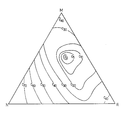
- FIG. I the diagram shown in FIG. I is constructed, which allows the area of the mixtures "bromoxynil n-heptanoate / bromoxynil n-butyrate / ethyl-2-mixture to be determined. -bromoxynil hexanoate "which have the lowest melting point.
- the diagram in this figure is in the form of an equilateral triangle - the vertices M, N, R respectively represent each of the constituents of the mixture, namely bromoxynil n-heptanoate (melting point 45 ° C), bromoxynil n-butyrate (melting point 82 ° C) and l 'bromoxynil ethyl-2-hexanoate (melting point 43 ° C), - whose sides MN, NR and RM respectively represent all the binary mixtures obtained from the products represented by the vertices "M and N", “N and R" and "R and M", and each of the interior points P of the surface of the triangle represents a ternary mixture whose molar composition in each of the three constituents is obtained by passing through P a parallel to each of the sides of the triangle until it intersects the two other sides, which provides the molar proportion by constituting represented by the vertex opposite to the side with respect to which the parallel has been drawn.
- esters and mixtures of ioxynil esters identified in Table B under numbers 16 to 24 are prepared in the same manner as in Experiment I, if necessary, by mixing.
- the melting points are also measured, according to the same principle as in experiment I, and the molar composition ensuring the lowest melting point for the constituents considered is retained for each mixture.
- the mixtures 22, 23 and 24 which all have a certain proportion, adjusted in an optimum manner for each, of branched acid esters of ioxynil, have a lower melting point than the esters or mixtures 16 to 21 which include in particular their constituents taken in isolation.
- Example 2 In the same manner as in Example 1, five solutions f to k are prepared containing 750 g / l of ioxynil equivalent produced by mixing different esters of ioxynil in the solvent SOLVESSO 200. With these solutions stirred and made homogeneous and of clear appearance, GALORYL EM 458 is added as surfactant in the same proportion as in Example 1.
- a solution is prepared containing 900 g / l of bromoxynil equivalent produced by mixing n-heptanoate, n-butyrate and ethyl-2-hexomate of bromoxynil in the percentages respective molars 50/25/25 and in the solvent SOLVESSO 200.
- GALORYL EM 458 is added as surfactant in the proportion of 7% (weight / weight) relative to the final solution.
- This formulation has a density at 20 ° C of 1.443. Its temperature is brought to 0 ° C., then it is sown with a minute quantity of the mixture of esters the component, this having been previously cooled until solidification. In these conditions, it is necessary to wait about a month of storage to note a significant start of crystallization around the germs introduced at the start.
- Example 3 can be used for temperate climates, the temperature of which does not drop for long periods below 0 ° C.
- three concentrates 1, m and p2 emulsifiable are prepared containing respectively 600 g / l of bromoxynil equivalent in the form, for the first, of a mixture n-heptanoate, n-butyrate and bromoxynil ethyl-2-hexanoate, for the second, from a mixture of n-heptanoate, n-butyrate and bromoxynil cekanoate and, for the third, from a mixture of n-octanoate, n-butyrate and ethyl-2- bromoxynil hexanoate.
- Two emulsifiable concentrates n and p1 are also prepared containing 600 g / l of ioxynil equivalent in the form, for the first, of a mixture of n-heptanoate, n-butyrate and ethyl-2-hexanoate of antioxynil and, for the second , a mixture of n-heptanoate, n-butyrate and cekanoate of ioxynil.
- the five emulsifiable concentrates include, apart from the ester mixtures, a solvent, namely SOLVESSO 200 and adjusted mixtures of anionic and nonionic emulsifiers, including GALORYL EM 4039 which is a mixture of anionic emulsifiers and nonionic products marketed by the Applicant.
- the molar proportions of the esters making up the abovementioned products are indicated in Table E in for molar percentages and the proportions of the emulsifiers allowing a dilute aqueous emulsion stable for at least 2 hours are indicated in percentages by weight relative to the emulsifiable concentrate.
- the five emulsifiable concentrates thus prepared are homogeneous and liquid indefinitely when stored at a temperature of -18 ° C.
- two concentrates P3 and P4 emulsifiable are prepared containing 720 g / l of bromoxynil equivalent in the form, for the first, of a mixture n-octanoate, n-butyrate and ethyl- Bromoxynil 2-hexanoate and, for the second, a mixture bromoxynil n-heptanoate, n-butyrate and ethyl-2-hexanoate.
- the two emulsifiable concentrates include, apart from the ester mixtures, a solvent, namely Solvesso 200 and adjusted mixtures of anionic and nonionic emulsifiers, including Galoryl EM 4036 and Galoryl EM 4039 which are mixtures anionic and nonionic emulsifiers sold by the Applicant.
- the molar proportions of the esters making up the abovementioned products are indicated in Table E ⁇ in molar percentages and the proportions of the emulsifiers allowing a stable dilute aqueous emulsion at least 2 hours are indicated in percentages by weight relative to the emulsifiable concentrate.
- the two emulsifiable concentrates thus prepared are homogeneous and liquid indefinitely when they are stored at a temperature of -3 ° C for the formula p3 and -8 ° C for the formula p4.
- the phytoactivity of the herbicide products in accordance with the invention is illustrated by comparative tests conducted first in the greenhouse, then in the fields.
- octanoic esters of ioxynil and / or bromoxynil which are selective weedkillers, were used as comparison products, mainly in spring cereal crops (wheat, barley, oats ...) and corn, sorghum, sugar cane and other crops such as onion, garlic and shallots for the destruction of broadleaf plants, mainly dicots.
- Table E concentrates emulsifiable in water were produced from various esters of bromoxynil or of oxioxynil; the identification of these products results from table F.
- Plants were sown in pots containing garden soil and grown normally for balanced vegetation. These plants were selected taking into account the respective activity spectra of ioxynil and bromoxynil.
- aqueous emulsions of herbicides were applied by spraying when the plants reached the 2 to 4 leaf stage, the volume of the sprayings being 1000 liters per hectare and the doses of each active ingredient those indicated in Tables G and J relating respectively to products based on bromoxynil and ioxynil, these tables also giving the composition of the emulsifiable concentrates used.
- the plants on which the experiments were carried out are - in the case of bromoxynil products: Amarantus retroflexus Brassica oleifera Daucus carota Matricaria inodora Papaver rhoeas Raphanus sativus Solanum nigrum Taraxacum dens leonis Veronica agrestis - in the case of products based on ioxynil: Amarantus retroflexus Beta vulgaris Brassica oleifera Chenopodium album Daucus carota Galium aparine Papaver rhoeas Raphanus sativus Stellaria media Taraxacum dens leonis Veronica agrestis.
- This example relates to the experiments carried out with products based on bromoxynil esters.
- bromoxynil contents of the concentrated products are given in g / l and the necessary volume percentages of the concentrated products relative to water to be able to treat the seedlings at 1000 l / ha at the studied doses of 125 to 500 g of bromoxynil / ha are given in Table G below, in which are also identified, with reference to Tables E and F, the esters or mixtures of esters used.
- This example relates to the experiments carried out with products based on oxyynil esters.
- the field trials were carried out on 10 fields located differently to obtain very different growing conditions from each other so as to be able to assess the reactions of the plants under various climatic circumstances.
- a first type of comparative test (Example 7) in which two mixtures of ioxynil esters in accordance with the invention are used, a conventional mixture of esters of ioxynil and a single ester of ioxynil, - a second type of comparative test (Example 8) in which a mixture of herbicide products according to the invention based on ioxynil and herbicide products according to the invention based on bromoxynil and a mixture are used conventional herbicides based on ioxynil and conventional herbicides based on bromoxynil and - a third type of test (Example 9) in which, with mixtures of the second type of test, isoproturon is associated.
- the oxynils are esterified either with acids provided for in accordance with the invention, or with acids previously used, namely octanoic acid or a mixture of octanoic and butyric acids.
- This example relates to experiments carried out with products based on oxyynil esters.
- the mixtures P1 and m according to the invention behave, from the point of view of herbicide efficacy on winter cereal weeds, in the fields, in an intermediate manner between the two known herbicides u and y. They can therefore be considered effectively herbicides at the doses used in the prior art.
- the herbicides based on ioxynil and bromoxynil in the form of esters were sprayed on fields.
- the contents of products concentrated in ioxynil and bromoxynil are given in g / l and the necessary volume percentages of the products concentrated in relation to water to be able to treat the fields at 500 l / ha at the studied doses of 180 g of antioxynil plus 180 g of bromoxynil and 240 g of ioxynil plus 240 g of bromoxynil / ha are given in said table R.
- the mixture according to the invention behaves, from the point of view of herbicide efficacy on winter cereal weeds, in the fields, in a manner comparable to the known mixture (z, table F) , the differences noted being even to the advantage of the first.
- the mixture according to the invention can be considered as effectively herbicide at the doses used in the prior art.
- Oxyynil and bromoxynil herbicides in the form of esters mixed with an aqueous suspension of isoproturon were sprayed on fields.
- the contents of products concentrated in ioxynil and bromoxynil are given in g / l and the necessary volume percentages of the products concentrated in relation to water to be able to treat the fields at 500 l / ha at the studied doses of 180 g of antioxynil plus 180 g of bromoxynil and 240 g of ioxynil plus 240 g of bromoxynil / ha are given in said table V.
- the isoproturon used was in the form of an aqueous suspension marketed by Ciba Geigy under the name Ofal 440 autosuspensible. It weighs 440 g / l. The dose introduced remained constant at 1320 g / ha. This concentrated suspension is also listed in Table V.
- the mixture in accordance with the invention behaves, from the point of view of herbicide efficacy on winter cereal weeds, in the fields, in a manner comparable to the known mixture (z, table F + isoproturon ), the differences noted being even to the advantage of the mixture in accordance with the invention, which can be considered as effectively herbicide at the doses used in the prior art.
- Untreated control plots were included in the experimental device every two treated plots.
- Different herbicide compositions were applied to each field, formulated as an emulsifiable concentrate, emulsified in water at a dose of 500 l of spray mixture per hectare (intermediate dose in the set of appropriate doses).
- a commercial product was also applied under the same conditions, sold for this application. It is a concentrated aqueous suspension containing 250 g of bromoxynil in phenol form.
- An emulsifiable mixture of esters was used in accordance with the invention containing octanoate, butyrate and bromoxynil ethyl-2-hexanoate (mixture p2 from Table E), an emulsifiable concentrate containing only bromoxynil octanoate at a rate of 240 g / l and for comparison an aqueous suspension of unesterified bromoxynil.
- the bromoxynil phenol product designated below by "Product ⁇ " has the following composition: Bromoxynil: 250 g / l
- the mixture according to the invention behaves, from the point of view of herbicidal efficacy on corn weeds, in the field, in a manner comparable to non-esterified bromoxynil and very slightly worse than bromoxynil octanoate.
- the latter product does not provide sufficient safety for corn compared to the bromoxynil formulation taken as a reference.
- the mixture according to the invention has the same quality as the reference product.
- the advantage of the mixture according to the invention compared to the reference mixture is its dose of use which can reasonably be situated at 360 g of bromoxynil per hectare against 600 g per hectare of non-esterified bomoxynil.
- the interest lies in the plan of a substantial reduction in the cost of treatment.
- compositions were applied, formulated as an emulsifiable concentrate, emulsified in water at a dose of 500 l of spray mixture per hectare (intermediate dose in the set of appropriate doses).
- An emulsifiable mixture of esters was used in accordance with the invention containing bromoxynil n-heptanoate, butyrate and cekanoate (mixture n, table E), n-heptanoate, butyrate and ioxynil cekanoate (mixture p1, table E), an emulsifiable concentrate containing 240 g / l of bromoxynil in the form of n-octanoate and butyrate and 240 g / l of ioxynil in the form of n-octanoate and butyrate (mixture z, table F ), an emulsifiable concentrate containing 240 g / l of bromoxynil and 240 g / l of ioxynil, but this time in the form of n-heptanoate and butyrate.
- composition of this latter concentrate is given below.
- Galoryl EM 4039 5% 20 mole EO condensate on 5% castor oil Solvent qs 100% (w / w) Solvesso 200 (density of emulsifiable concentrate at 20 ° C 1.265)
- the mixture in accordance with the invention behaves, from the point of view of herbicidal activity on wheat weeds, in the field, in a manner comparable to the mixture n-octanoate and n-butyrate of bromoxynil and ioxynil, on the one hand , and to the mixture n-heptanoate and n-butyrate of bromoxynil and ioxynil, on the other hand.
Landscapes
- Life Sciences & Earth Sciences (AREA)
- Agronomy & Crop Science (AREA)
- Pest Control & Pesticides (AREA)
- Plant Pathology (AREA)
- Health & Medical Sciences (AREA)
- Engineering & Computer Science (AREA)
- Dentistry (AREA)
- General Health & Medical Sciences (AREA)
- Wood Science & Technology (AREA)
- Zoology (AREA)
- Environmental Sciences (AREA)
- Agricultural Chemicals And Associated Chemicals (AREA)
- Organic Low-Molecular-Weight Compounds And Preparation Thereof (AREA)
Priority Applications (1)
| Application Number | Priority Date | Filing Date | Title |
|---|---|---|---|
| AT86402719T ATE55214T1 (de) | 1985-12-09 | 1986-12-09 | Herbizide mittel auf der basis von estern des bromoxynils und/oder ioxynils. |
Applications Claiming Priority (2)
| Application Number | Priority Date | Filing Date | Title |
|---|---|---|---|
| FR8518225 | 1985-12-09 | ||
| FR8518225A FR2591069B1 (fr) | 1985-12-09 | 1985-12-09 | Produits herbicides a base d'esters de bromoxynil et/ou d'ioxynil |
Publications (2)
| Publication Number | Publication Date |
|---|---|
| EP0229558A1 true EP0229558A1 (de) | 1987-07-22 |
| EP0229558B1 EP0229558B1 (de) | 1990-08-08 |
Family
ID=9325596
Family Applications (1)
| Application Number | Title | Priority Date | Filing Date |
|---|---|---|---|
| EP86402719A Expired - Lifetime EP0229558B1 (de) | 1985-12-09 | 1986-12-09 | Herbizide Mittel auf der Basis von Estern des Bromoxynils und/oder Ioxynils |
Country Status (8)
| Country | Link |
|---|---|
| US (1) | US4813999A (de) |
| EP (1) | EP0229558B1 (de) |
| AT (1) | ATE55214T1 (de) |
| CA (1) | CA1286122C (de) |
| DE (1) | DE3673376D1 (de) |
| ES (1) | ES2016567B3 (de) |
| FR (1) | FR2591069B1 (de) |
| GR (1) | GR3000830T3 (de) |
Cited By (1)
| Publication number | Priority date | Publication date | Assignee | Title |
|---|---|---|---|---|
| FR2685996A1 (fr) * | 1992-01-13 | 1993-07-16 | Francais Prod Ind Cfpi | Compositions phytosanitaires comprenant en combinaison un oxynil et au moins une substance liquide a temperature ambiante et procede pour leur mise en óoeuvre. |
Families Citing this family (7)
| Publication number | Priority date | Publication date | Assignee | Title |
|---|---|---|---|---|
| FR2677849B1 (fr) * | 1991-06-20 | 1995-06-16 | Francais Prod Ind Cfpi | Poudres mouillables phytopharmaceutiques et leur procede de preparation. |
| FR2751347B1 (fr) * | 1996-07-16 | 2001-12-07 | Rhone Poulenc Agrochimie | Gene chimere a plusieurs genes de tolerance herbicide, cellule vegetale et plante tolerantes a plusieurs herbicides |
| US6759371B2 (en) | 2000-01-07 | 2004-07-06 | Cognis Deutschland Gmbh & Co. Kg | Bromoxynil component-containing herbicidal preparations with enhanced penetration and methods of using same |
| DE10000320A1 (de) * | 2000-01-07 | 2001-07-12 | Cognis Deutschland Gmbh | Wäßriges herbizides Mittel |
| EP1372391B1 (de) * | 2001-03-20 | 2005-11-02 | Bayer CropScience S.A. | Phytopharmazeutische zusammensetzungen in form von legierungen |
| DE10307078A1 (de) * | 2003-02-19 | 2004-09-09 | Bayer Cropscience Gmbh | Verfahren zur Herstellung von wasserdispergierbaren Granulaten |
| CN102740697B (zh) * | 2009-12-29 | 2016-04-13 | 先正达参股股份有限公司 | 农药组合物 |
Citations (3)
| Publication number | Priority date | Publication date | Assignee | Title |
|---|---|---|---|---|
| CH432120A (fr) * | 1962-09-24 | 1967-03-15 | May & Baker Ltd | Composition herbicide à base de dérivés du benzonitrile |
| EP0031684A2 (de) * | 1979-12-26 | 1981-07-08 | Union Carbide Corporation | Lösungen von Bromoxynil- und Ioxynil-Estern |
| FR2556933A1 (fr) * | 1983-12-21 | 1985-06-28 | May & Baker Ltd | Melange d'esters herbicides du dibromo-3,5-hydroxy-4 benzonitrilee |
Family Cites Families (2)
| Publication number | Priority date | Publication date | Assignee | Title |
|---|---|---|---|---|
| US3592626A (en) * | 1970-04-22 | 1971-07-13 | May & Baker Ltd | Method of desiccating foliage of a crop |
| US4349488A (en) * | 1981-11-03 | 1982-09-14 | Great Lakes Chemical Corporation | Process for producing esters of 3,5-dibromo-4-hydroxybenzonitrile |
-
1985
- 1985-12-09 FR FR8518225A patent/FR2591069B1/fr not_active Expired
-
1986
- 1986-12-08 CA CA000524800A patent/CA1286122C/en not_active Expired - Fee Related
- 1986-12-09 US US06/939,802 patent/US4813999A/en not_active Expired - Fee Related
- 1986-12-09 EP EP86402719A patent/EP0229558B1/de not_active Expired - Lifetime
- 1986-12-09 DE DE8686402719T patent/DE3673376D1/de not_active Expired - Lifetime
- 1986-12-09 AT AT86402719T patent/ATE55214T1/de not_active IP Right Cessation
- 1986-12-09 ES ES86402719T patent/ES2016567B3/es not_active Expired - Lifetime
-
1990
- 1990-08-09 GR GR90400261T patent/GR3000830T3/el unknown
Patent Citations (3)
| Publication number | Priority date | Publication date | Assignee | Title |
|---|---|---|---|---|
| CH432120A (fr) * | 1962-09-24 | 1967-03-15 | May & Baker Ltd | Composition herbicide à base de dérivés du benzonitrile |
| EP0031684A2 (de) * | 1979-12-26 | 1981-07-08 | Union Carbide Corporation | Lösungen von Bromoxynil- und Ioxynil-Estern |
| FR2556933A1 (fr) * | 1983-12-21 | 1985-06-28 | May & Baker Ltd | Melange d'esters herbicides du dibromo-3,5-hydroxy-4 benzonitrilee |
Cited By (3)
| Publication number | Priority date | Publication date | Assignee | Title |
|---|---|---|---|---|
| FR2685996A1 (fr) * | 1992-01-13 | 1993-07-16 | Francais Prod Ind Cfpi | Compositions phytosanitaires comprenant en combinaison un oxynil et au moins une substance liquide a temperature ambiante et procede pour leur mise en óoeuvre. |
| EP0552084A1 (de) * | 1992-01-13 | 1993-07-21 | C F P I | Pflanzenschutzmittel enthaltend ein Oxynil und mindestens eine Verbindung, die flüssig bei Umgebungstemperatur ist und Verfahren zu ihrer Verwendung |
| US5695773A (en) * | 1992-01-13 | 1997-12-09 | Cfpi Agro | Phytosanitary composition containing a combination of an oxynil and at least one substance liquid at ambient temperature and a process for applying these compositions |
Also Published As
| Publication number | Publication date |
|---|---|
| DE3673376D1 (de) | 1990-09-13 |
| ES2016567B3 (es) | 1990-11-16 |
| EP0229558B1 (de) | 1990-08-08 |
| FR2591069B1 (fr) | 1988-03-18 |
| FR2591069A1 (fr) | 1987-06-12 |
| GR3000830T3 (en) | 1991-11-15 |
| CA1286122C (en) | 1991-07-16 |
| ATE55214T1 (de) | 1990-08-15 |
| US4813999A (en) | 1989-03-21 |
Similar Documents
| Publication | Publication Date | Title |
|---|---|---|
| CN100579371C (zh) | 除草组合物 | |
| FR2675340A1 (fr) | Compositions herbicides nouvelles et leur procede d'utilisation pour lutter contre des mauvaises herbes. | |
| US20040068008A1 (en) | Peroxy acid treatment to control pathogenic organisms on growing plants | |
| EP2554049B1 (de) | Herbizidzusammensetzung mit verbesserter Wirksamkeit, Herstellungs- und Anwendungsmethode | |
| EA019410B1 (ru) | Дисперсии, содержащие ингибиторы гидроксифенилпируват диоксигеназы | |
| EP0229558B1 (de) | Herbizide Mittel auf der Basis von Estern des Bromoxynils und/oder Ioxynils | |
| FR2701195A1 (fr) | Composition herbicide ayant une phytotoxicité réduite contenant un dérivé de phénylpyrazole 3 substitue. | |
| FR2778820A1 (fr) | Melanges herbicides a base d'aclonifen et de clomazone | |
| CH427400A (fr) | Composition fongicide | |
| EP0228943B1 (de) | Herbizide Mittel auf der Basis von Oxynilester | |
| EP0552084B1 (de) | Pflanzenschutzmittel enthaltend ein Oxynil und mindestens eine Verbindung, die flüssig bei Umgebungstemperatur ist und Verfahren zu ihrer Verwendung | |
| EP0034556B1 (de) | Das Pflanzenwachstum regulierende Zusammensetzungen, die als aktive Substanz Derivate von 2-Methylen-succinamidsäure enthalten, und Derivate dieser Säure, die in diesen Zusammensetzungen verwendbar sind | |
| CH660729A5 (fr) | Melanges d'esters du bromoxynil. | |
| CA3174809A1 (en) | Adjuvant for agrochemicals | |
| BE1029718B1 (fr) | Agent améliorateur d’herbicides d’origine biologique et procédé pour l’utiliser | |
| FR2491295A1 (fr) | Composition herbicide a base d'une phenyluree et de cyanazine | |
| LU86116A1 (fr) | Compositions herbicides selectives ayant une action prolongee et contenant,a titre d'ingredient actif,des derives d'alpha-chloracetamide | |
| EP0033265B1 (de) | Herbizide Zusammensetzungen auf der Basis von 2,4-Diamino-6-chlor-5-methylthio-pyrimidin und Diclofop-methyl und Verfahren zur Behandlung von Kulturen mit den genannten Zusammensetzungen | |
| BE1022655B1 (fr) | Composition herbicide améliorée, procédé et utilisation | |
| FR2513993A1 (fr) | Nouveaux fongicides homologues des n-phenyl alaninates et leur procede de preparation et leur application | |
| FR2582307A1 (fr) | Compose thiazolique, son procede de production, composition microbicide le contenant et ses applications | |
| FR2700242A1 (fr) | Mélange régulateur de croissance des plantes. | |
| CH680826A5 (de) | ||
| FR2533804A1 (fr) | Herbicides a base de sel de trimethyl- ou de triethylamine de bromoxynil | |
| FR2700243A1 (fr) | Composition inhibitrice de croissance des plantes contenant un composé hétérocyclique et un chlorure d'ammonium quaternaire et son procédé d'utilisation. |
Legal Events
| Date | Code | Title | Description |
|---|---|---|---|
| PUAI | Public reference made under article 153(3) epc to a published international application that has entered the european phase |
Free format text: ORIGINAL CODE: 0009012 |
|
| AK | Designated contracting states |
Kind code of ref document: A1 Designated state(s): AT BE DE ES GB GR IT NL SE |
|
| 17P | Request for examination filed |
Effective date: 19870808 |
|
| 17Q | First examination report despatched |
Effective date: 19881125 |
|
| GRAA | (expected) grant |
Free format text: ORIGINAL CODE: 0009210 |
|
| AK | Designated contracting states |
Kind code of ref document: B1 Designated state(s): AT BE DE ES GB GR IT NL SE |
|
| REF | Corresponds to: |
Ref document number: 55214 Country of ref document: AT Date of ref document: 19900815 Kind code of ref document: T |
|
| REF | Corresponds to: |
Ref document number: 3673376 Country of ref document: DE Date of ref document: 19900913 |
|
| ITF | It: translation for a ep patent filed | ||
| GBT | Gb: translation of ep patent filed (gb section 77(6)(a)/1977) | ||
| REG | Reference to a national code |
Ref country code: GR Ref legal event code: FG4A Free format text: 3000830 |
|
| PLBE | No opposition filed within time limit |
Free format text: ORIGINAL CODE: 0009261 |
|
| STAA | Information on the status of an ep patent application or granted ep patent |
Free format text: STATUS: NO OPPOSITION FILED WITHIN TIME LIMIT |
|
| 26N | No opposition filed | ||
| PGFP | Annual fee paid to national office [announced via postgrant information from national office to epo] |
Ref country code: GB Payment date: 19911203 Year of fee payment: 6 |
|
| PGFP | Annual fee paid to national office [announced via postgrant information from national office to epo] |
Ref country code: AT Payment date: 19911210 Year of fee payment: 6 |
|
| PGFP | Annual fee paid to national office [announced via postgrant information from national office to epo] |
Ref country code: SE Payment date: 19911230 Year of fee payment: 6 Ref country code: GR Payment date: 19911230 Year of fee payment: 6 |
|
| ITTA | It: last paid annual fee | ||
| PGFP | Annual fee paid to national office [announced via postgrant information from national office to epo] |
Ref country code: NL Payment date: 19911231 Year of fee payment: 6 |
|
| PGFP | Annual fee paid to national office [announced via postgrant information from national office to epo] |
Ref country code: BE Payment date: 19920114 Year of fee payment: 6 |
|
| PG25 | Lapsed in a contracting state [announced via postgrant information from national office to epo] |
Ref country code: GB Effective date: 19921209 Ref country code: AT Effective date: 19921209 |
|
| PG25 | Lapsed in a contracting state [announced via postgrant information from national office to epo] |
Ref country code: SE Effective date: 19921210 |
|
| PG25 | Lapsed in a contracting state [announced via postgrant information from national office to epo] |
Ref country code: BE Effective date: 19921231 |
|
| BERE | Be: lapsed |
Owner name: CIE FRANCAISE DE PRODUITS INDUSTRIELS Effective date: 19921231 |
|
| PG25 | Lapsed in a contracting state [announced via postgrant information from national office to epo] |
Ref country code: GR Free format text: THE PATENT HAS BEEN ANNULLED BY A DECISION OF A NATIONAL AUTHORITY Effective date: 19930630 |
|
| PG25 | Lapsed in a contracting state [announced via postgrant information from national office to epo] |
Ref country code: NL Effective date: 19930701 |
|
| GBPC | Gb: european patent ceased through non-payment of renewal fee |
Effective date: 19921209 |
|
| NLV4 | Nl: lapsed or anulled due to non-payment of the annual fee | ||
| REG | Reference to a national code |
Ref country code: GR Ref legal event code: MM2A Free format text: 3000830 |
|
| EUG | Se: european patent has lapsed |
Ref document number: 86402719.8 Effective date: 19930709 |
|
| REG | Reference to a national code |
Ref country code: ES Ref legal event code: PC2A |
|
| REG | Reference to a national code |
Ref country code: ES Ref legal event code: PC2A |
|
| PGFP | Annual fee paid to national office [announced via postgrant information from national office to epo] |
Ref country code: DE Payment date: 20051207 Year of fee payment: 20 |
|
| PG25 | Lapsed in a contracting state [announced via postgrant information from national office to epo] |
Ref country code: IT Free format text: LAPSE BECAUSE OF NON-PAYMENT OF DUE FEES;WARNING: LAPSES OF ITALIAN PATENTS WITH EFFECTIVE DATE BEFORE 2007 MAY HAVE OCCURRED AT ANY TIME BEFORE 2007. THE CORRECT EFFECTIVE DATE MAY BE DIFFERENT FROM THE ONE RECORDED. Effective date: 20051209 |
|
| PGFP | Annual fee paid to national office [announced via postgrant information from national office to epo] |
Ref country code: ES Payment date: 20051219 Year of fee payment: 20 |
|
| PG25 | Lapsed in a contracting state [announced via postgrant information from national office to epo] |
Ref country code: ES Free format text: LAPSE BECAUSE OF EXPIRATION OF PROTECTION Effective date: 20061211 |
|
| REG | Reference to a national code |
Ref country code: ES Ref legal event code: FD2A Effective date: 20061211 |