EP0229637A2 - Elektronisches Tafelgerät - Google Patents
Elektronisches Tafelgerät Download PDFInfo
- Publication number
- EP0229637A2 EP0229637A2 EP87100139A EP87100139A EP0229637A2 EP 0229637 A2 EP0229637 A2 EP 0229637A2 EP 87100139 A EP87100139 A EP 87100139A EP 87100139 A EP87100139 A EP 87100139A EP 0229637 A2 EP0229637 A2 EP 0229637A2
- Authority
- EP
- European Patent Office
- Prior art keywords
- writing
- transmission medium
- eraser
- medium elements
- detecting
- Prior art date
- Legal status (The legal status is an assumption and is not a legal conclusion. Google has not performed a legal analysis and makes no representation as to the accuracy of the status listed.)
- Ceased
Links
Images



Classifications
-
- G—PHYSICS
- G06—COMPUTING OR CALCULATING; COUNTING
- G06F—ELECTRIC DIGITAL DATA PROCESSING
- G06F3/00—Input arrangements for transferring data to be processed into a form capable of being handled by the computer; Output arrangements for transferring data from processing unit to output unit, e.g. interface arrangements
- G06F3/01—Input arrangements or combined input and output arrangements for interaction between user and computer
- G06F3/03—Arrangements for converting the position or the displacement of a member into a coded form
- G06F3/041—Digitisers, e.g. for touch screens or touch pads, characterised by the transducing means
-
- G—PHYSICS
- G06—COMPUTING OR CALCULATING; COUNTING
- G06F—ELECTRIC DIGITAL DATA PROCESSING
- G06F3/00—Input arrangements for transferring data to be processed into a form capable of being handled by the computer; Output arrangements for transferring data from processing unit to output unit, e.g. interface arrangements
- G06F3/01—Input arrangements or combined input and output arrangements for interaction between user and computer
- G06F3/03—Arrangements for converting the position or the displacement of a member into a coded form
- G06F3/033—Pointing devices displaced or positioned by the user, e.g. mice, trackballs, pens or joysticks; Accessories therefor
-
- G—PHYSICS
- G06—COMPUTING OR CALCULATING; COUNTING
- G06F—ELECTRIC DIGITAL DATA PROCESSING
- G06F3/00—Input arrangements for transferring data to be processed into a form capable of being handled by the computer; Output arrangements for transferring data from processing unit to output unit, e.g. interface arrangements
- G06F3/01—Input arrangements or combined input and output arrangements for interaction between user and computer
- G06F3/03—Arrangements for converting the position or the displacement of a member into a coded form
- G06F3/033—Pointing devices displaced or positioned by the user, e.g. mice, trackballs, pens or joysticks; Accessories therefor
- G06F3/0354—Pointing devices displaced or positioned by the user, e.g. mice, trackballs, pens or joysticks; Accessories therefor with detection of two-dimensional [2D] relative movements between the device, or an operating part thereof, and a plane or surface, e.g. 2D mice, trackballs, pens or pucks
- G06F3/03545—Pens or stylus
-
- G—PHYSICS
- G06—COMPUTING OR CALCULATING; COUNTING
- G06F—ELECTRIC DIGITAL DATA PROCESSING
- G06F3/00—Input arrangements for transferring data to be processed into a form capable of being handled by the computer; Output arrangements for transferring data from processing unit to output unit, e.g. interface arrangements
- G06F3/01—Input arrangements or combined input and output arrangements for interaction between user and computer
- G06F3/048—Interaction techniques based on graphical user interfaces [GUI]
- G06F3/0487—Interaction techniques based on graphical user interfaces [GUI] using specific features provided by the input device, e.g. functions controlled by the rotation of a mouse with dual sensing arrangements, or of the nature of the input device, e.g. tap gestures based on pressure sensed by a digitiser
- G06F3/0488—Interaction techniques based on graphical user interfaces [GUI] using specific features provided by the input device, e.g. functions controlled by the rotation of a mouse with dual sensing arrangements, or of the nature of the input device, e.g. tap gestures based on pressure sensed by a digitiser using a touch-screen or digitiser, e.g. input of commands through traced gestures
Definitions
- the present invention relates to an electronic blackboard apparatus in which video information is depicted on a writing surface by means of a writing instrument and is simultaneously converted into electric signals by an electromagnetic converting means, the blackboard apparatus being capable of outputting an image similar to the video information on the basis of the electric signals.
- Conventional apparatus of this type include one sort in which light is applied to a writing surface consisting of a windable sheet on which video information is written while the sheet is being wound up, the reflected light being detected by an image sensor or the like, and another sort in which a position-detecting section using matrix-like pressure-sensitive rubber is provided on the rear side of a writing surface which is made flexible so as to detect the writing pressure by means of detection voltage.
- a primary object of the present invention is to provide an electronic blackboard apparatus which is lightweight and outstanding in durability.
- an electronic blackboard apparatus comprising: an electronic blackboard unit having a surface plate made of a non-magnetic material, the surface of which is formed as a writing surface capable of being used repeatedly and a position-detecting tablet for detecting position coordinates of a local magnetic bias applied via the surface plate; a writing instrument having a core member for displaying video information including characters and figures on the writing surface and a magnetism generator for applying a magnetic bias to the position-detecting tablet when the core member is in contact with the writing surface; an eraser having an erasing member for erasing the video information including the characters and figures on the writing surface and a magnetism generator for applying a magnetic bias to the position-detecting tablet when the erasing member is in contact with the writing surface; a position-detecting control unit for driving the position-detecting tablet and for computing the position coordinates of the writing instrument and the eraser; and an output section for outputting the video information of the writing surface.
- the writing instrument is operated on the writing surface of the electronic blackboard unit, video information such as characters and figures is displayed on the writing surface by means of the core member of the writing instrument.
- a magnetic bias with a locus corresponding to the video information is applied to the position-detecting tablet. Position coordinates thereof are calculated by the position-detecting control unit and converted into electric signals.
- the eraser is similarly operated, the video information on the writing surface is erased by the erasing member of the eraser. Simultaneously, a magnetic bias with a locus corresponding to the erased video information is applied to the position-detecting tablet. Position coordinates thereof are calculated by the position-detecting control unit and converted into electric signals.
- Position coordinates identical with those of the video information on the writing surface are obtained on the basis of these electric signals. Furthermore, the video information is output from the output section as a hard copy, or as a display image on a display, or to another device through a communication line, as necessary.
- Another object of the present invention is to provide an eraser for use with an electronic blackboard apparatus which is capable of compiling data for automatically processing a portion to be erased on the electronic blackboard.
- the present invention provides, in accordance with another aspect of the invention, an eraser for use with an electronic blackboard in which each position in a writing region is defined by X coordinates and Y coordinates using each one end of the writing region in the X- and Y-directions as reference positions and reaching each other end thereof, a writing position is indicated with the use of a writing instrument, and a written image is processed electronically
- the eraser comprising: position-indicating means provided in the vicinity of opposite end portions of the surfaces of an erasing member contacting a writing surface and adapted to indicate first and second positions; and inclination-discriminating means for discriminating to which side a straight line connecting the first and second positions is inclined using an X-axis or a Y-axis on the writing surface as a reference line.
- the inclination of a straight line based on coordinates at two points by means of the position-indicating means is determined in cases where the configuration of the surface of the eraser contacting the writing surface is other than a circular shape for instance, rectangular. Therefore, by establishing a given range around a straight line connecting the two points on the basis of the size of the eraser, it is possible to detect the range actually being erased.
- a further object of the present invention is to provide an eraser for use with an electronic blackboard which, when an eraser is used partially, is capable of detecting a range of erasure corresponding to a small range thereof.
- the present invention provides, in accordance with a further aspect of the invention, an eraser for use with an electronic blackboard in which each position in a writing region is defined by X coordinates and Y coordinates using each one end of the writing region in the X- and Y-directions as reference positions and reaching each other end thereof, a writing position is indicated with the use of a writing instrument, and a written image is processed electronically
- the eraser comprising: position-indicating means provided in the vicinity of opposite end portions of the surfaces of an erasing member contacting a writing surface and adapted to indicate first and second positions; inclination-discriminating means for discriminating to which side a straight line connecting the first and second positions is inclined using an X-axis or a Y-axis on the writing surface as a reference line; and at least two switches actuated when the erasing member comes into contact with the writing surface and adapted to indicate an erasing position by a combination with an indication of the position-indicating means.
- an electronic blackboard 1 has a base material 3 constituted by a flat plate made of asbestos, calcium silicate, urethane foams, or the like, and a surface plate 4 is provided thereon.
- the surface plate 4 is constituted by non-magnetic material such as aluminum or austenitic stainless steel, its surface being an enamel-finished flat surface which is used repeatedly by writing thereon with a marker or the like and by erasing with an eraser.
- An assembly 6 of first magnetostrictive transmission medium elements as shown in Fig. 3 and an assembly 7 of second magnetostrictive transmission medium elements as shown in Fig. 4 are installed between the surface plate 4 and a rear plate 5.
- One of a plurality of rows of position-detecting members 8, shown in Fig. 3, is illustrated in Fig. 5 and is constituted by the first magnetostrictive transmission medium element 9, a reinforcing member 10 for reinforcing the same, a coil 11 for fetching an induced voltage based on magnetostrictive vibration waves of the first magnetostrictive transmitting medium element 9, and so forth.
- the first magnetostrictive transmission medium element 9 is constituted by an iron-based amorphous alloy, and one having a width of 2 mm and a thickness of 0.02 mm is used in this embodiment.
- Metal fittings 12A, 12B are for fixing the position-detecting members 8 to respective fitting plates 13A, 13B.
- the fitting plates 13A, 13B are secured to a supporting plate 14.
- the first magnetostrictive transmission medium elements 9 are parallel to each other, and their assembly constitutes a first planar array layer.
- An exciting coil 15 is wound around each end of the first magnetostrictive transmission medium elements 9 so as to commonly excite each of the magnetostrictive transmission medium elements 9.
- Biasing magnets 16 impart biasing magnetic fields to portions of the magnetostrictive transmission medium elements 9 in the vicinity of the coil 15 so that the electromechanical coupling factor in the magnetostrictive transmitting medium elements 9 will become large, thereby allowing large magnetostrictive vibration waves to be produced with a small electric current.
- the assembly 7 of the second magnetostrictive transmission medium elements has an arrangement equivalent to that of the assembly 6 of the first magnetostrictive transmission medium elements, and is superposed on the assembly 6 using a spacer 17 as shown in Fig. 2. Since respective members 19 - 26, including position-detecting members 18, are equivalent to the aforementioned members 9 - 16, description thereof will be omitted. Incidentally, the sections constituted by these members 9 - 16 or 19 - 26 will be referred to as positioh-detecting tablets.
- Fig. 6 shows a state in which the respective assemblies 6, 7 of the first and second magnetostrictive transmission medium elements are assembled in layers, as shown in Fig. 2.
- the position-detecting members 8 are arranged in rows in such a manner that the linear direction thereof coincides with the X-direction of the writing surface 4, and that the direction of the position-detecting members 18 coincides with the Y-direction thereof.
- These position-detecting members 8, 18 are arranged to cover substantially the entire area of the writing surface 4.
- a writing instrument 27, shown in Fig. 7, constitutes a part of an operation unit 2 and is arranged such that a commercially available marker 29 is accommodated in a case 28 made of a non-magnetic metal, and a hollow truncated cone-shaped position-detecting magnet 30 with a core member 31 of the marker 29 inserted therethrough is also fitted in the case 28.
- a magnetic flux thereof is directed to the tip of the core member 31 so as to reach the magnetostrictive transmission medium elements 9, 19.
- An emitted light-controlling portion 32 has a battery and a light-emitting element (neither are shown).
- the light-controlling portion 32 applies modulated infrared rays peculiar to the writing instrument in all directions from a light-emitting window 34 during this time.
- An eraser 35 constitutes the operation unit 2 together with the writing instrument 27, and has a battery and an emitted light-controlling portion (neither are shown) in a synthetic resin-made case 36.
- position-detecting magnets having the same function as that of the magnet 30 shown in Fig. 7 as well as corresponding switches (not shown) which respectively form pairs with said magnets are provided at both end portions 38A, 38B in the lower portion of an erasing member 37, made of a material such as sponge.
- a main control unit 40 controls this apparatus in a comprehensive manner.
- Infrared ray-receiving portions 41A, 41B, shown in Fig. 6, are provided in the upper portion of the surface plate 4 of the electronic blackboard unit 1 so as to receive infrared rays applied from the writing instrument 27 or the eraser 35. Signals from these light-receiving portions 41A, 41B are supplied to the main control unit 40.
- a counter 42 receives an induced voltage alternately from the coil 11 or 12 of the electronic blackboard unit 1 via a multiplexor amplifier unit 43 and counts pulses generated by a clock pulse generator 44 from the time when an X-axis exciting coil 15 or a Y-axis exciting coil 25 is excited until an induced voltage is generated by the position-detecting magnet 30 or the like.
- a blackboard control unit 45 When the writing instrument 27 or the eraser 35 is being operated (i.e., during reception of light), a blackboard control unit 45 alternately excites the X-axis exciting coil 15 and the Y-axis exciting coil 25 at predetermined intervals on the basis of an instruction from the main control unit 40. At the same time, the blackboard control unit 45 changes over the output of the multiplexor amplifier unit 43 to the coil 11 or 12 corresponding to the excitation and, on each such occasion, supplies the count of the counter 42 to the main control unit 40.
- the main control unit 40 computes the position of the position-detecting magnet 30 and the like on the basis of data on the coil 11 with respect to the X-axis and on the basis of data on the coil 21 with respect to the Y-axis from enumerated data thereof, a peculiar frequency (e.g., 100 MHz) of the clock pulse generator 44, and the propagation speed (approx. 5,000 m/sec) of magnetostrictive vibration waves in the magnetostrictive transmission medium elements 9 and 19.
- a peculiar frequency e.g., 100 MHz
- the clock pulse generator 44 e.g., 100 MHz
- the propagation speed approximately 5,000 m/sec
- the infrared ray-receiving portions 41A, 41B receive infrared rays which indicate that writing is being effected.
- the position-detecting magnet 30 is moved as writing is continued, the position coordinates thereof are consecutively computed and accumulated.
- the eraser 35 in this case is provided with two position-detecting magnets.
- the main control unit 40 computes the position of a straight line connecting the respective positions from coordinates concerning these two positions in a manner similar to that described above, establishes the range to be eliminated on the basis of the straight line, computes portions to be eliminated with the movement of the straight line, and elminates the relevant coordinates in the accumulated cordinates.
- the main control unit 40, the counter 42, the multiplexor amplifier unit 43, the oscillator 44, and the blackboard control unit 45 constitute a position-detecting section, while the display 46 and the printer 47 constitute an output section.
- An electronic blackboard 101 is arranged such that magnetostrictive transmission medium elements 103 are installed in layers on the rear surface of a writing surface 102 shown in Fig. 11 in an imaginative manner such as to form layers constituted by an assembly in the X-direction and an assembly in the Y-direction.
- An exciting coil 104 is commonly wound around each one end of the assemblies, and a detection coil 105 for fetching an induced voltage based on magnetostrictive vibration waves is wound around each magnetostrictive transmitting medium element.
- a detection coil 105 for fetching an induced voltage based on magnetostrictive vibration waves is wound around each magnetostrictive transmitting medium element.
- one assembly is shown in the form of a single member, and control of one assembly is shown.
- magnetostrictive vibration waves occur in portions of the magnetostrictive transmission medium elements 103 in the vicinity of the exciting coil 104, and the vibration waves are directed to the other ends and reach the same at high speed (approximately 5,000 m/sec).
- a position-indicating magnet 106 provided in the vicinity of the core member thereof imparts a magnetic flux toward the indicated positions at each of the magnetostrictive transmission medium elements 103 in the X-and Y- directions.
- a comparator CPl compares the detected signal of the detection coil 105 with a reference level ER, and outputs a "H" level signal when the former exceeds the latter.
- the aforementioned pulse signal is also supplied to flip-flops FF1, FF2 and resetting termsinals R of counters CT1, CT2. Simultaneously with the excitation by the excitation control unit Ex, the pulse signal sets the negation-side outputs of the flip-flops FF1, FF2 to the "H" level, opens AND gates G1, G2, and starts to count the clock pulses of a clock generator CL by means of the counters CT1, CT2.
- the compartor CP1 assumes the "H” level.
- the flip-flop FF1 is in the "H” level since its terminal J has received a potential Vcc, the flip-flop FF1 is set when its terminal K receives the "H” level signal, and the counter CT1 stops its counting operation.
- control unit CONT computes coordinates at the position of the magnet 106 from its enumerated data, the frequency of the clock generator CL, and the magnetostrictive propagating speed.
- the counter CT2 also counts, its enumerated data is not adopted when the writing instrument is used.
- Figs. 9(A) and 9(B) are schematic diagrams of a rectangular eraser which illustrates a second embodiment of the present invention.
- an erasing member 109 provided at the lower portion of a synthetic resin-made case 108 if the aforementioned core member of the writing instrument is a marker, one in which felt is wound around sponge or the like is used.
- Magnets m1, m2 are provided at the respective end portions of the eraser 107 in the longitudinal direction thereof at a predetermined interval therebetween, and when the erasing member 109 comes into contact with the writing surface 102, the magnets m1, m2 indicate the repective positions to the magnetostrictive transmission medium elements 103 in the same manner as that of the magnet 106 in Fig. 10.
- the respective positions indicated by the magnets m1, m2 will be hereafter called the first position and the second position, respectively.
- Inclination sensors 110, 110′ respectively move by means of gravity in the direction parallel with a straight line connecting the magnets m1, m2 and in the direction perpendicular to the same so as to actuate one of sensor switches 112A, 112B and one of 112A′, 112B′, or, when gravity does not act on the inclination sensors 110, 110′, these inclination sensors are balanced by means of springs or the like in such a manner that the sensor switches will be inoperative.
- the sensor switches 112A, 112B are inoperative when the straight line connecting the magnets m1, m2 is parallel with the X-axis of the writing surface 102, while the sensor switches 112A′, 112B′ are inoperative when the straight line is parallel with the X-axis.
- the data on the fact that they are inoperative is not used.
- Switches SW1 - SW4 for indicating end portions are installed at the respective corners of the eraser 107, and the arrangement is such that when a cut portion 113A or 113B at the respective ends of an erasing member 109 is pressed against the writing surface 2, a relevant set of switches are actuated, or, when only one corner is pressed, a relevant independent switch is actuated.
- An infrared ray-transmitting portion 114 transmits infrared ray signals from four infrared ray-transmitting windows 115 on the basis of various combinations of the operating conditions of the end portion-indicating switches SW1 - SW-4 and the inclination sensors 110, 110′.
- Fig. 13 shows a circuit diagram of the transmitting portion 114.
- Each multiplexor MP1, MP2 receives operating signals of the switches SW1 - SW4 and the sensors 110, 110′ through its respective input terminals A, B, and C.
- Each common terminal COM thereof is connected to respective control terminals ⁇ A, ⁇ B of a driver DV, while each output terminal X1 - X6 for decoding the signals and outputting decoded signals are connected in parallel to input terminals I1 - I6 of the driver DV.
- infrared rays peculiar to these combinations are generated from an infrared ray-emitting element LED and are transmitted through the infrared ray-transmitting windows 115.
- the magnets m1, m2 are opposed to the magnetostrictive transmission medium elements 103, and, in a manner similar to the case where the aforementioned writing instrument is used, if a pulse is generated from the control unit CONT, the flip-flops FF1, FF2 are reset, and the counters CT1, CT2, on receiving clocks from the clock generator CL via the AND gates G1, G2, starts counting the clock pulses.
- a time t1 has lapsed and magneto-strivtive vibration waves generated by the pulses have reached the position of the magnet m1, a peak voltage is induced in the detection coils 105.
- the comparator CP1 assumes the "H” level.
- the flip-flop FF1 is then set, and the counter CT1 stops its counting.
- the terminal J of the flip-flop FF2 on receiving the affirmation-side output Q of the flip-flop FF1, assumes the "H” level.
- the control unit computes two coordinates in the X-axis direction from the enumerated data thus obtained in the same manner as described above, and, at the same time, computes two coordinates in the Y-axis direction as well.
- Light-receiving portions for receiving infrared ray signals transmitted from the aforementioned infrared ray-transmitting windows 115 are provided separately in the vicinity of the writing surface 102, and the control unit CONT receives said signals.
- Fig. 14 is a diagram explaining how discrimination is carried out as to by which combination of the values of the two X cordinates (they will be referred to as “x1” and “x2”) and the two Y coordinates (they will be referred to as “y1” and “y2”) obtained by the aforementioned computation the positions of the magnets m1, m2 have been indicated.
- the sensor switches 112A and 112A′ are turned on, while, when the eraser 107 is used with the line inclined rising to the right, as shown in Fig. 14(B), the sensor switches 112A and 112B′ (or 112A′ and 112B) are turned on.
- the control unit CONT On receiving infrared ray signals based on the operating conditions of the inclination sensors 110, 110′, the control unit CONT discriminates in which state of Fig. 14(A) or 14(B) the magnets m1, m2 are placed. Meanwhile, the control unit CONT further computes the directions of the two kinds of reference lines obtained from the combinations of the aforementioned two X cordinates and two Y coordinates, and decides that the combinations in which these directions coincide with each other are correct.
- erasing is effected by operating and moving the eraser 107.
- the positions of the moving magnets m1, m2 are also detected in a manner similar to that described above.
- the control unit CONT establishes as a first erasure region a region surrounded by the positions of the magnets m1, m2 during starting of movement and by the subsequently obtained positions of the magnets m1, m2 as well as a region determined by the area of the erasing member 109. Subsequently, the control unit CONT consecutively establishes as second, third, ... erasure regions a region surrounded by the positions of the magnets m1, m2 obtained consecutively in correspondence with the movement of the eraser 107 and by the positions of the magnets m1, m2 obtained immediately before then.
- a region which is determined by the position of the magnet m1 (or m2) in accordance with infrared ray signals based on the on-off operations of the switches SW1 - SW4 as well as the size of the erasing member 109 is established as an erasure region.
- each one of the X or Y coordinates at the positions of the magnets m1, m2 is mutually common, so that coordinates each marked with a cross in Figs. 14(A) and 14(B) do not exist, and, hence, the aforementioned discrimination is not necessary.
- the use of the eraser is facilitated by making it rectangular or in a similar shape, so that it is possible to detect a range of erasure corresponding to the shape of the eraser.
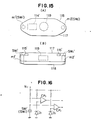
- FIG. 15 illustrates a schematic diagram of an eraser in accordance with a third embodiment of the present invention.
- An eraser 116 has the shape of a ship, and magnets m1′, m2′ and switches SW1′, SW2′ for indicating respective end portions are provided in the vicinity of the opposite end portions of a case 117, respectively.
- the switches SW1′, SW2′ are pressure-sensitive switches using conductive rubber sheets, as their basic principle is shown in Fig. 16. If either of the switches SW1′, SW2′ is pressed against the writing surface, an energizing electric current increases in accordance with an amount of pressing.
- Comparators CP2, CP3 receive mutually different reference levels by means of Zener diodes D1, D2, respectively, and fetch two data on sensed pressure corresponding to compression by the erasing member 118.
- An infrared ray-transmitting portion 114′ transmits infrared ray signals from infrared ray-transmitting windows on the basis of these data in a manner similar to that for the eraser 107.
- An inclination sensor 119 in Fig. 15 is arranged such that, as shown in Fig. 17, two cylindrical magnets 121, 122 roll by means of gravity along the periphery of quadrisected segments of cylindrical pressure-sensitive rubber provided with a planar electrode on both external and internal surfaces thereof, while clamping said periphery.
- the central axis of the cylinder is perpendicular to the underside of the erasing member 118, and a straight line 123 which passes through the divided portions of the pressure senstive rubber 120 and intersects the central axis at right angles is made to correspond with the longitudinal axis of the eraser 116.
- cylindrical members (not shown) for guiding the magnets 121 and 122 are respectively provided on the outer and inner sides of the pressure-sensitive rubber 120.
- Figs. 18(A) and 18(B) are diagrams explaining a method of discriminating the inclination from the state of movement of the magnets m1, m2 without using the inclination sensors.
- the eraser when used partially, it is possible to detect a range of erasure by the turning on and off of the switches, so that it is possible to provide an eraser outstanding in the operational feature.
Landscapes
- Engineering & Computer Science (AREA)
- General Engineering & Computer Science (AREA)
- Theoretical Computer Science (AREA)
- Human Computer Interaction (AREA)
- Physics & Mathematics (AREA)
- General Physics & Mathematics (AREA)
- Position Input By Displaying (AREA)
- Drawing Aids And Blackboards (AREA)
Applications Claiming Priority (4)
| Application Number | Priority Date | Filing Date | Title |
|---|---|---|---|
| JP61002736A JPS62160299A (ja) | 1986-01-09 | 1986-01-09 | 電子黒板装置 |
| JP2736/86 | 1986-01-09 | ||
| JP61013515A JPH069023B2 (ja) | 1986-01-24 | 1986-01-24 | 電子黒板用イレ−サ |
| JP13515/86 | 1986-01-24 |
Publications (2)
| Publication Number | Publication Date |
|---|---|
| EP0229637A2 true EP0229637A2 (de) | 1987-07-22 |
| EP0229637A3 EP0229637A3 (de) | 1988-10-05 |
Family
ID=26336199
Family Applications (1)
| Application Number | Title | Priority Date | Filing Date |
|---|---|---|---|
| EP87100139A Ceased EP0229637A3 (de) | 1986-01-09 | 1987-01-08 | Elektronisches Tafelgerät |
Country Status (2)
| Country | Link |
|---|---|
| US (2) | US4711977A (de) |
| EP (1) | EP0229637A3 (de) |
Cited By (10)
| Publication number | Priority date | Publication date | Assignee | Title |
|---|---|---|---|---|
| EP0307893A3 (en) * | 1987-09-14 | 1990-03-28 | Wacom Co., Ltd. | Electronic blackboard system, marke and eraser therefor |
| EP0347725A3 (en) * | 1988-06-22 | 1990-09-05 | Wacom Company, Ltd. | Electronic blackboard and accessories such as writing tools |
| EP0511406A4 (en) * | 1990-11-16 | 1993-02-10 | Seiko Instruments Inc. | Device for reading out coordinate |
| EP0741353A1 (de) * | 1995-05-03 | 1996-11-06 | Hewlett-Packard Company | Computersystem mit Griffeleingabe und Löschung |
| WO1998037508A1 (en) * | 1997-02-21 | 1998-08-27 | Electronics For Imaging, Inc. | Retrofittable apparatus for converting a substantially planar surface into an electronic data capture device |
| WO1998039729A3 (en) * | 1997-03-05 | 1999-01-28 | Electronics For Imaging Inc | Digitizer system for electronic blackboard |
| US6151014A (en) * | 1998-02-26 | 2000-11-21 | Pagasus Technologies Ltd. | Systems and processing algorithms for ultrasound time-of-flight digitizer systems |
| US6326565B1 (en) | 1997-02-28 | 2001-12-04 | Electronics For Imaging, Inc. | Marking device for electronic presentation board |
| AU755920B2 (en) * | 1997-03-05 | 2003-01-02 | Electronics For Imaging, Inc. | Marking device for electronic presentation board |
| US7050509B2 (en) | 1997-04-22 | 2006-05-23 | Silicon Laboratories Inc. | Digital isolation system with hybrid circuit in ADC calibration loop |
Families Citing this family (71)
| Publication number | Priority date | Publication date | Assignee | Title |
|---|---|---|---|---|
| JPS6370326A (ja) * | 1986-09-12 | 1988-03-30 | Wacom Co Ltd | 位置検出装置 |
| US4853495A (en) * | 1987-06-24 | 1989-08-01 | Shimizu Construction Co., Ltd. | Electronic blackboard and electronic blackboard system |
| US4777329A (en) * | 1987-08-24 | 1988-10-11 | Microfield Graphics, Inc. | Graphic input system |
| US4864411A (en) * | 1988-06-06 | 1989-09-05 | Ncr Corporation | Electronic copy board system |
| US5218174A (en) * | 1991-10-01 | 1993-06-08 | Kurta Corporation | Low power cordless magnetic field digitizer with differential grid sensing and synchronous position demodulation |
| US5225637A (en) * | 1991-10-01 | 1993-07-06 | Kurta Corporation | Position resolving system |
| JPH0619615A (ja) * | 1992-06-29 | 1994-01-28 | Matsushita Electric Ind Co Ltd | 手書き文字入力装置 |
| US5248856A (en) * | 1992-10-07 | 1993-09-28 | Microfield Graphics, Inc. | Code-based, electromagnetic-field-responsive graphic data-acquisition system |
| EP0670070B1 (de) * | 1992-11-17 | 1997-01-15 | Lectra Systemes | Verfahren und vorrichtung zur erfassung und behandlung grafischer information |
| US5465015A (en) * | 1993-09-24 | 1995-11-07 | Satcon Technology Corporation | Transverse field activated magnetostrictive motor |
| US5583323A (en) * | 1993-11-05 | 1996-12-10 | Microfield Graphics, Inc. | Calibration of graphic data-acquisition tracking system |
| US5585605A (en) * | 1993-11-05 | 1996-12-17 | Microfield Graphics, Inc. | Optical-scanning system employing laser and laser safety control |
| US5434370A (en) * | 1993-11-05 | 1995-07-18 | Microfield Graphics, Inc. | Marking system with pen-up/pen-down tracking |
| US20030062889A1 (en) * | 1996-12-12 | 2003-04-03 | Synaptics (Uk) Limited | Position detector |
| US6249234B1 (en) | 1994-05-14 | 2001-06-19 | Absolute Sensors Limited | Position detector |
| US5714720A (en) * | 1994-09-15 | 1998-02-03 | Calcomp Inc. | High efficiency passive pointer digitizer system |
| US6730862B1 (en) * | 1995-12-27 | 2004-05-04 | Lsi Logic Corporation | Erase feature in pen-based computing |
| US6788221B1 (en) | 1996-06-28 | 2004-09-07 | Synaptics (Uk) Limited | Signal processing apparatus and method |
| US6353193B1 (en) * | 1996-10-01 | 2002-03-05 | Greensteel, Inc. | Electronic whiteboard system and method |
| US5866856A (en) * | 1997-02-28 | 1999-02-02 | Electronics For Imaging, Inc. | Marking device for electronic presentation board |
| IL120417A (en) * | 1997-03-10 | 2000-09-28 | Electronics For Imaging Inc | Presentation board digitizer systems |
| US6104387A (en) | 1997-05-14 | 2000-08-15 | Virtual Ink Corporation | Transcription system |
| WO1998054545A2 (en) | 1997-05-28 | 1998-12-03 | Absolute Sensors Limited | Position transducer and method of manufacture |
| GB9720954D0 (en) | 1997-10-02 | 1997-12-03 | Scient Generics Ltd | Commutators for motors |
| GB9721891D0 (en) | 1997-10-15 | 1997-12-17 | Scient Generics Ltd | Symmetrically connected spiral transducer |
| CA2268208C (en) * | 1998-04-06 | 2011-06-14 | Smart Technologies, Inc. | Method for erasing on an electronic writeboard |
| US6100877A (en) | 1998-05-14 | 2000-08-08 | Virtual Ink, Corp. | Method for calibrating a transcription system |
| US6124847A (en) | 1998-05-14 | 2000-09-26 | Virtual Ink, Corp. | Collapsible detector assembly |
| US6177927B1 (en) | 1998-05-14 | 2001-01-23 | Virtual Ink Corp. | Transcription system kit |
| US6232962B1 (en) | 1998-05-14 | 2001-05-15 | Virtual Ink Corporation | Detector assembly for use in a transcription system |
| US6147681A (en) | 1998-05-14 | 2000-11-14 | Virtual Ink, Corp. | Detector for use in a transcription system |
| US6211863B1 (en) | 1998-05-14 | 2001-04-03 | Virtual Ink. Corp. | Method and software for enabling use of transcription system as a mouse |
| US6111565A (en) | 1998-05-14 | 2000-08-29 | Virtual Ink Corp. | Stylus for use with transcription system |
| US6191778B1 (en) | 1998-05-14 | 2001-02-20 | Virtual Ink Corp. | Transcription system kit for forming composite images |
| GB9811151D0 (en) | 1998-05-22 | 1998-07-22 | Scient Generics Ltd | Rotary encoder |
| US6396005B2 (en) | 1998-06-15 | 2002-05-28 | Rodgers Technology Center, Inc. | Method and apparatus for diminishing grid complexity in a tablet |
| JP2002531902A (ja) | 1998-11-27 | 2002-09-24 | シナプティックス (ユーケー)リミテッド | 位置センサ |
| US7019672B2 (en) * | 1998-12-24 | 2006-03-28 | Synaptics (Uk) Limited | Position sensor |
| US8113950B2 (en) | 1999-05-25 | 2012-02-14 | Silverbrook Research Pty Ltd | Competition entry with limited return messaging |
| US7760969B2 (en) * | 1999-05-25 | 2010-07-20 | Silverbrook Research Pty Ltd | Method of providing information via context searching from a printed substrate |
| US7971784B2 (en) | 1999-05-25 | 2011-07-05 | Silverbrook Research Pty Ltd | Sensing device with mode changes via nib switch |
| US7762453B2 (en) * | 1999-05-25 | 2010-07-27 | Silverbrook Research Pty Ltd | Method of providing information via a printed substrate with every interaction |
| US20070233513A1 (en) * | 1999-05-25 | 2007-10-04 | Silverbrook Research Pty Ltd | Method of providing merchant resource or merchant hyperlink to a user |
| US7721948B1 (en) * | 1999-05-25 | 2010-05-25 | Silverbrook Research Pty Ltd | Method and system for online payments |
| US7832626B2 (en) * | 1999-05-25 | 2010-11-16 | Silverbrook Research Pty Ltd | Anonymous competition entry |
| US7793824B2 (en) | 1999-05-25 | 2010-09-14 | Silverbrook Research Pty Ltd | System for enabling access to information |
| US7857201B2 (en) * | 1999-05-25 | 2010-12-28 | Silverbrook Research Pty Ltd | Method and system for selection |
| US7821507B2 (en) * | 1999-05-25 | 2010-10-26 | Silverbrook Research Pty Ltd | Method of providing information via a printed substrate and two-mode sensing device |
| US7593899B1 (en) * | 1999-05-25 | 2009-09-22 | Silverbrook Research Pty Ltd | Method and system for online payments |
| US6326945B1 (en) | 1999-12-13 | 2001-12-04 | Williams, Iii Carl K. | Magnetic writing board |
| US20020054026A1 (en) * | 2000-04-17 | 2002-05-09 | Bradley Stevenson | Synchronized transmission of recorded writing data with audio |
| BE1013822A3 (nl) * | 2000-11-03 | 2002-09-03 | Polyvision Nv | Werkwijze voor het vervaardigen van een geemailleerd schrijfbord. |
| CA2429612A1 (en) * | 2000-11-22 | 2002-05-30 | Cirque Corporation | Stylus input device utilizing a permanent magnet |
| EP1412912B1 (de) | 2001-05-21 | 2008-06-18 | Synaptics (UK) Limited | Positionssensor |
| US20030095115A1 (en) * | 2001-11-22 | 2003-05-22 | Taylor Brian | Stylus input device utilizing a permanent magnet |
| GB2403017A (en) | 2002-03-05 | 2004-12-22 | Synaptics | Position sensor |
| US6875933B2 (en) | 2002-05-10 | 2005-04-05 | Luidia Inc. | Methods and apparatus for configuring a writing surface |
| AU2003232360A1 (en) | 2002-06-05 | 2003-12-22 | Synaptics (Uk) Limited | Signal transfer method and apparatus |
| GB0317370D0 (en) | 2003-07-24 | 2003-08-27 | Synaptics Uk Ltd | Magnetic calibration array |
| GB0319945D0 (en) | 2003-08-26 | 2003-09-24 | Synaptics Uk Ltd | Inductive sensing system |
| GB2461448B (en) | 2007-05-10 | 2011-08-31 | Cambridge Integrated Circuits Ltd | Transducer |
| US7632102B2 (en) * | 2007-07-23 | 2009-12-15 | Antonio Macli | Classroom instructional tool |
| US8890842B2 (en) | 2008-06-13 | 2014-11-18 | Steelcase Inc. | Eraser for use with optical interactive surface |
| US8686975B2 (en) | 2010-07-29 | 2014-04-01 | Dell Products, Lp | Interactive projector device |
| GB2488389C (en) | 2010-12-24 | 2018-08-22 | Cambridge Integrated Circuits Ltd | Position sensing transducer |
| TWI444723B (zh) * | 2011-11-18 | 2014-07-11 | Au Optronics Corp | 電子手寫系統之影像清除裝置及電子手寫系統之操作方法 |
| GB2503006B (en) | 2012-06-13 | 2017-08-09 | Cambridge Integrated Circuits Ltd | Position sensing transducer |
| US9218090B2 (en) | 2013-04-03 | 2015-12-22 | Dell Products, Lp | System and method for controlling a projector via a passive control strip |
| JP2020004103A (ja) * | 2018-06-28 | 2020-01-09 | シャープ株式会社 | 電子ボード |
| US11295410B2 (en) * | 2019-04-12 | 2022-04-05 | Rocket Innovations, Inc. | Writing surface boundary markers for computer vision |
| US12345989B2 (en) | 2021-11-30 | 2025-07-01 | Beijing Boe Optoelectronics Technology Co., Ltd. | Array substrate, handwriting tablet, tablet eraser, handwriting tablet system and method for erasing pattern |
Family Cites Families (13)
| Publication number | Priority date | Publication date | Assignee | Title |
|---|---|---|---|---|
| US3761620A (en) * | 1971-02-01 | 1973-09-25 | R Graven | Pen light, a graphical input device for a computer |
| JPS59107297U (ja) * | 1983-01-08 | 1984-07-19 | 富士通株式会社 | 電子黒板用消去器 |
| US4634973A (en) * | 1983-06-29 | 1987-01-06 | Wacom Co., Ltd. | Position detecting apparatus |
| JPS60221820A (ja) * | 1983-08-05 | 1985-11-06 | Wacom Co Ltd | 位置検出装置 |
| JPS60134325A (ja) * | 1983-12-22 | 1985-07-17 | Wacom Co Ltd | デイスプレイ付座標入力装置 |
| JPS60150121A (ja) * | 1984-01-13 | 1985-08-07 | Wacom Co Ltd | デイスプレイ付座標入力装置 |
| JPS60153537A (ja) * | 1984-01-20 | 1985-08-13 | Wacom Co Ltd | デイスプレイ付座標入力装置 |
| EP0152961B1 (de) * | 1984-02-22 | 1988-12-21 | Wacom Co., Ltd. | Gerät zum Feststellen der Lage |
| JPS60186924A (ja) * | 1984-03-06 | 1985-09-24 | Wacom Co Ltd | デイスプレイ付座標入力装置 |
| EP0184835B1 (de) * | 1984-12-13 | 1991-07-24 | Wacom Company, Ltd. | Gerät zur Positionsbestimmung |
| EP0187372B1 (de) * | 1984-12-28 | 1990-08-08 | Wacom Company, Ltd. | Vorrichtung zur Ermittlung der Position |
| JPS61260321A (ja) * | 1985-05-14 | 1986-11-18 | Wacom Co Ltd | 位置検出装置 |
| FR2584836B1 (fr) * | 1985-07-09 | 1992-06-19 | Farel Alain | Procede de saisie informatique de donnees graphiques concomitante a leur creation |
-
1987
- 1987-01-08 EP EP87100139A patent/EP0229637A3/de not_active Ceased
- 1987-01-09 US US07/001,740 patent/US4711977A/en not_active Ceased
-
1989
- 1989-12-08 US US07/448,041 patent/USRE33936E/en not_active Expired - Lifetime
Cited By (15)
| Publication number | Priority date | Publication date | Assignee | Title |
|---|---|---|---|---|
| EP0307893A3 (en) * | 1987-09-14 | 1990-03-28 | Wacom Co., Ltd. | Electronic blackboard system, marke and eraser therefor |
| EP0347725A3 (en) * | 1988-06-22 | 1990-09-05 | Wacom Company, Ltd. | Electronic blackboard and accessories such as writing tools |
| EP0511406A4 (en) * | 1990-11-16 | 1993-02-10 | Seiko Instruments Inc. | Device for reading out coordinate |
| EP0741353A1 (de) * | 1995-05-03 | 1996-11-06 | Hewlett-Packard Company | Computersystem mit Griffeleingabe und Löschung |
| US5654529A (en) * | 1995-05-03 | 1997-08-05 | Hewlett-Packard Company | Stylus-input computing system with erasure |
| US6266051B1 (en) | 1997-02-21 | 2001-07-24 | Electronics For Imaging, Inc. | Retrofittable apparatus for converting a substantially planar surface into an electronic data capture device |
| WO1998037508A1 (en) * | 1997-02-21 | 1998-08-27 | Electronics For Imaging, Inc. | Retrofittable apparatus for converting a substantially planar surface into an electronic data capture device |
| US6067080A (en) * | 1997-02-21 | 2000-05-23 | Electronics For Imaging | Retrofittable apparatus for converting a substantially planar surface into an electronic data capture device |
| US6326565B1 (en) | 1997-02-28 | 2001-12-04 | Electronics For Imaging, Inc. | Marking device for electronic presentation board |
| WO1998039729A3 (en) * | 1997-03-05 | 1999-01-28 | Electronics For Imaging Inc | Digitizer system for electronic blackboard |
| US6292177B1 (en) | 1997-03-05 | 2001-09-18 | Tidenet, Inc. | Marking device for electronic presentation board |
| AU726304B2 (en) * | 1997-03-05 | 2000-11-02 | Electronics For Imaging, Inc. | Marking device for electronic presentation board |
| AU755920B2 (en) * | 1997-03-05 | 2003-01-02 | Electronics For Imaging, Inc. | Marking device for electronic presentation board |
| US7050509B2 (en) | 1997-04-22 | 2006-05-23 | Silicon Laboratories Inc. | Digital isolation system with hybrid circuit in ADC calibration loop |
| US6151014A (en) * | 1998-02-26 | 2000-11-21 | Pagasus Technologies Ltd. | Systems and processing algorithms for ultrasound time-of-flight digitizer systems |
Also Published As
| Publication number | Publication date |
|---|---|
| USRE33936E (en) | 1992-05-26 |
| EP0229637A3 (de) | 1988-10-05 |
| US4711977A (en) | 1987-12-08 |
Similar Documents
| Publication | Publication Date | Title |
|---|---|---|
| US4711977A (en) | Electronic blackboard apparatus | |
| EP0347725B1 (de) | Elektronische Tafel und Hilfsmittel, zum Beispiel Schreibinstrumente | |
| EP0152740B1 (de) | Koordinateneingabegerät mit Anzeigevorrichtung | |
| US4697244A (en) | Coordinate input device with display and printer | |
| KR0135985B1 (ko) | 좌표 입력장치 | |
| EP0187372B1 (de) | Vorrichtung zur Ermittlung der Position | |
| EP0181560A2 (de) | Koordinateneingabevorrichtung mit Anzeige | |
| US4581761A (en) | Manual image scanning system | |
| EP0159498B1 (de) | Koordinateneingabevorrichtung mit Anzeige | |
| EP0307893A2 (de) | Elektronische Tafeleinrichtung mit einem Markierer und einem Löscher dafür | |
| CN114041106B (zh) | 电子笔及手写输入装置 | |
| EP0184835B1 (de) | Gerät zur Positionsbestimmung | |
| US4845478A (en) | Coordinate input device with display | |
| JPH07146102A (ja) | 位置検出装置 | |
| JP4796539B2 (ja) | スタイラスペン | |
| JPH05313808A (ja) | コードレスデジタイザ | |
| JPS6191716A (ja) | 座標読取装置 | |
| JPS62219121A (ja) | 電子黒板装置 | |
| JP2008283614A (ja) | 画像表示システム、画像送信システム | |
| JPH05341902A (ja) | コードレスデジタイザ | |
| JPS62172422A (ja) | 電子黒板用イレ−サ | |
| JPS62160299A (ja) | 電子黒板装置 | |
| JPH05250084A (ja) | コードレスデジタイザ | |
| JPS60176134A (ja) | 位置検出装置 | |
| JPH0255806B2 (de) |
Legal Events
| Date | Code | Title | Description |
|---|---|---|---|
| PUAI | Public reference made under article 153(3) epc to a published international application that has entered the european phase |
Free format text: ORIGINAL CODE: 0009012 |
|
| AK | Designated contracting states |
Kind code of ref document: A2 Designated state(s): DE FR GB IT |
|
| PUAL | Search report despatched |
Free format text: ORIGINAL CODE: 0009013 |
|
| AK | Designated contracting states |
Kind code of ref document: A3 Designated state(s): DE FR GB IT |
|
| 17P | Request for examination filed |
Effective date: 19890330 |
|
| 17Q | First examination report despatched |
Effective date: 19901109 |
|
| STAA | Information on the status of an ep patent application or granted ep patent |
Free format text: STATUS: THE APPLICATION HAS BEEN REFUSED |
|
| 18R | Application refused |
Effective date: 19921129 |
|
| RIN1 | Information on inventor provided before grant (corrected) |
Inventor name: IZAWA, KIYOSATO Inventor name: TOMOFUJI, YOSHIAKI Inventor name: TSUCHIDA, YOUICHI Inventor name: MIYAMORI, NOBUYUKI |