EP0230546A2 - Vollaromatische mesomorphe Polyesteramide, deren Herstellung und Verwendung - Google Patents
Vollaromatische mesomorphe Polyesteramide, deren Herstellung und Verwendung Download PDFInfo
- Publication number
- EP0230546A2 EP0230546A2 EP86116269A EP86116269A EP0230546A2 EP 0230546 A2 EP0230546 A2 EP 0230546A2 EP 86116269 A EP86116269 A EP 86116269A EP 86116269 A EP86116269 A EP 86116269A EP 0230546 A2 EP0230546 A2 EP 0230546A2
- Authority
- EP
- European Patent Office
- Prior art keywords
- mol
- formula
- repeating units
- polyester amides
- units
- Prior art date
- Legal status (The legal status is an assumption and is not a legal conclusion. Google has not performed a legal analysis and makes no representation as to the accuracy of the status listed.)
- Granted
Links
- LQQKHWUVRBYGOY-UHFFFAOYSA-N C[NH+](c(cc1)ccc1OC)[O-] Chemical compound C[NH+](c(cc1)ccc1OC)[O-] LQQKHWUVRBYGOY-UHFFFAOYSA-N 0.000 description 2
- OOAKNLYPGXZJEN-UHFFFAOYSA-N CC(C)(C)CC(C(C=C1)OC)C=C1OC Chemical compound CC(C)(C)CC(C(C=C1)OC)C=C1OC OOAKNLYPGXZJEN-UHFFFAOYSA-N 0.000 description 1
- CPMFVCKQDTZAHP-UHFFFAOYSA-N CC(C1C=CC(C(C)=O)=CC1)=O Chemical compound CC(C1C=CC(C(C)=O)=CC1)=O CPMFVCKQDTZAHP-UHFFFAOYSA-N 0.000 description 1
- OHBQPCCCRFSCAX-UHFFFAOYSA-O COc(cc1)ccc1[OH+]C Chemical compound COc(cc1)ccc1[OH+]C OHBQPCCCRFSCAX-UHFFFAOYSA-O 0.000 description 1
- DPZNOMCNRMUKPS-UHFFFAOYSA-N COc1cc(OC)ccc1 Chemical compound COc1cc(OC)ccc1 DPZNOMCNRMUKPS-UHFFFAOYSA-N 0.000 description 1
- PLRMEWQDUWAIMO-UHFFFAOYSA-N C[NH+](C(C=C1)C#CC=C1OC)[O-] Chemical compound C[NH+](C(C=C1)C#CC=C1OC)[O-] PLRMEWQDUWAIMO-UHFFFAOYSA-N 0.000 description 1
Classifications
-
- C—CHEMISTRY; METALLURGY
- C08—ORGANIC MACROMOLECULAR COMPOUNDS; THEIR PREPARATION OR CHEMICAL WORKING-UP; COMPOSITIONS BASED THEREON
- C08G—MACROMOLECULAR COMPOUNDS OBTAINED OTHERWISE THAN BY REACTIONS ONLY INVOLVING UNSATURATED CARBON-TO-CARBON BONDS
- C08G69/00—Macromolecular compounds obtained by reactions forming a carboxylic amide link in the main chain of the macromolecule
- C08G69/44—Polyester-amides
-
- C—CHEMISTRY; METALLURGY
- C09—DYES; PAINTS; POLISHES; NATURAL RESINS; ADHESIVES; COMPOSITIONS NOT OTHERWISE PROVIDED FOR; APPLICATIONS OF MATERIALS NOT OTHERWISE PROVIDED FOR
- C09K—MATERIALS FOR MISCELLANEOUS APPLICATIONS, NOT PROVIDED FOR ELSEWHERE
- C09K19/00—Liquid crystal materials
- C09K19/04—Liquid crystal materials characterised by the chemical structure of the liquid crystal components, e.g. by a specific unit
- C09K19/38—Polymers
- C09K19/3804—Polymers with mesogenic groups in the main chain
- C09K19/3809—Polyesters; Polyester derivatives, e.g. polyamides
Definitions
- Preferred polyester amides contain 5 to 20 mol% of repeating units of the formula I 5 to 20 mol% of repeating units of the formula II and 5 to 20 mol% of the formula IV.
- the polyersteramides according to the invention are obtained in a one-step process in which the non-derivatized starting compounds are reacted using anhydrides of lower fatty acids, for example fatty acids with 2 to 4 carbon atoms, in particular acetic anhydride. It is possible to use catalysts, as are known from EP application 131 846, in customary amounts.
- the non-derivatized hydroxy amino and carboxy compounds together with fatty acid anhydride advantageously heated in an at least 5% molar excess, based on the hydroxyl and amino groups present, under an inert gas atmosphere and stirring to a temperature at which reflux can be observed.
- Suitable UV stabilizers are, for example, substituted resorcinols, salicylates, benzotriazoles, benzophenones and the like, and also mixtures thereof. Such UV stabilizers are generally applied to the polymer in amounts of up to 2% by weight.
- Suitable auxiliaries are also dyes which are generally used in amounts of up to 5% by weight, such as nigrosine, pigments such as titanium dioxide, cadmium sulfide, cadmium sulfide selenide, phthalocyanines, ultramirine blue or carbon black.
- Suitable nucleating agents are, for example, talc, calcium fluoride, sodium phenylphosphinate, aluminum oxide or finely divided polytetrafluoroethylene.
- suitable additives are plasticizers in amounts e.g. up to 20% by weight, such as dioctyl phthalate, dibenzyl phthalate, butyl benzyl phthalate, hydrocarbon oils, N-n-butylbenzenesulfonamide, o- and p-toluenesulfonamide.
- the fully aromatic liquid-crystalline polyesteramides according to the invention are suitable for the production of threads, fibers, foils, foams and technical moldings by injection molding, pressing or extrusion.
- the molded parts produced from the polyester amides according to the invention are notable for excellent mechanical properties, such as rigidity, strength and toughness. They are extremely resistant to chemicals and flame retardant. They also have high heat resistance and a smooth, abrasion-resistant surface.
- the polyester amides according to the invention are therefore outstandingly suitable for the production of molded parts for electrical engineering and data technology, vehicle construction and other technical fields. However, they can also be used as coating and coating agents, dispersed in powder form, or as a film.
Landscapes
- Chemical & Material Sciences (AREA)
- Organic Chemistry (AREA)
- Crystallography & Structural Chemistry (AREA)
- Medicinal Chemistry (AREA)
- Polymers & Plastics (AREA)
- Chemical Kinetics & Catalysis (AREA)
- Health & Medical Sciences (AREA)
- Engineering & Computer Science (AREA)
- Materials Engineering (AREA)
- Polyamides (AREA)
- Organic Low-Molecular-Weight Compounds And Preparation Thereof (AREA)
- Compositions Of Macromolecular Compounds (AREA)
- Polyesters Or Polycarbonates (AREA)
Abstract
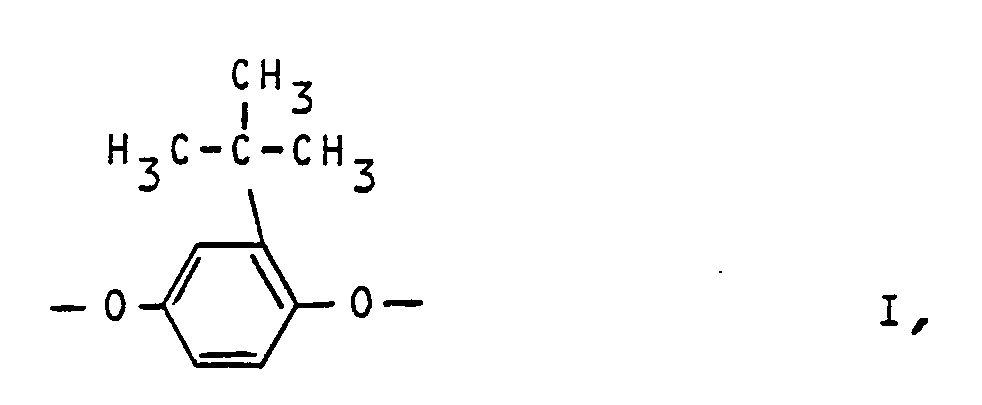
- a) 3 bis 3O Mol.% wiederkehrenden Einheiten der Formel I

- b) 3 bis 3O Mol.% der wiederkehrenden Einheiten der Formel II und/oder III

- c) 2 bis 25 Mol.% , mindestens eine der wiederkehrenden Einheiten IV, V und VI

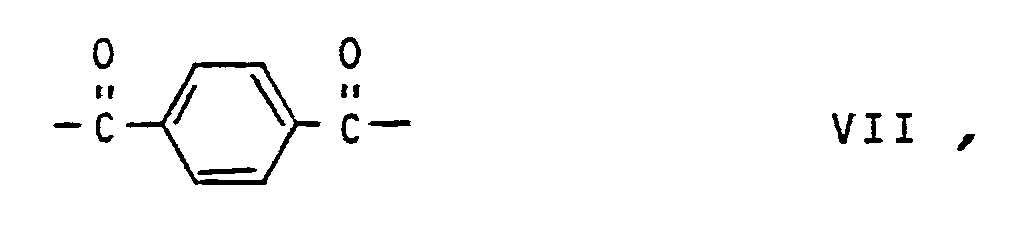
- d) einer Summe aus den Komponenten a), b) und c), ausschließlich der wiederkehrenden Einheit der Formel III entsprechenden molaren Menge wiederkehrenden Einheiten der Formel VII
- e) gegebenenfalls 5 bis 25 Mol.% wiederkehrenden Einheiten der Formel IX

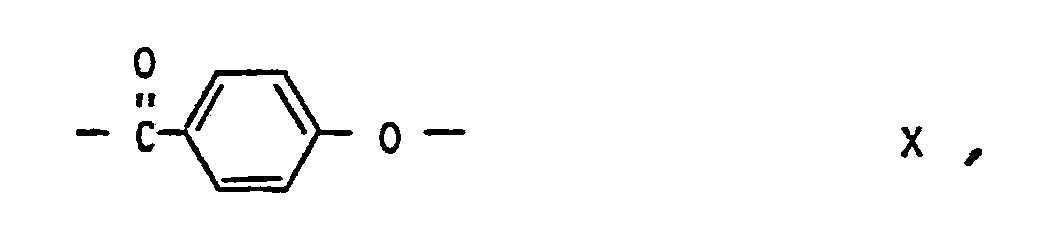
- f) wiederkehrende Einheiten der Formel X
deren Herstellung und Verwendung.
Description
- Gegenstand der Erfindung sind vollaromatische mesomorphe Polyesteramide, die unterhalb 32O°C eine flüssigkristalline fadenbildende Schmelze bilden.
- Es sind schon eine Reihe von flüssigkristallinen Polyesteramiden bekannt. Solche Polymere sind jedoch hinsichtlich ihrer Wärmeformbeständigkeit, ihrer Verarbeitbarkeit und insbesondere ihrer geringen Abriebfestigkeit verbesserungsbedürftig. In der US-PS 4 33O 457 werden Polyesteramide aufgebaut aus Hydroxynaphthalincarbonsäure, Terephthalsäure, Hydrochinon und p-Aminophenol beschrieben. Solche Polyesteramide haben jedoch eine Glasübergangstemperatur von etwa 1O5°C und somit keine ausreichende Wärmeformbeständigkeit. Das gleiche gilt für die aus der US-PS 4 351 917 bekannten Polyesteramide, die aus p-Aminophenol, p-Hydroxybenzoesäure und Hydroxynaphthalincarbonsäure aufgebaut sind. In der EP-PS 7715 werden Polyesteramide, die aus mindestens 5O % Resten von p-Aminophenol sowie Alkoxyterephthalsäure aufgebaut sind, beschrieben. Schließlich sind aus der EP-Anmeldung 81 9OO Polyesteramide bekannt, die mindestens zu 4O% aus coaxialen Einheiten wie aromatischen Dicarbonsäuren, hydroxyaromatischen Carbonsäuren Bisphenolen und Aminophenolen bestehen und eine ausreichende Menge an nichtlinearen Resten enthalten, die sie von aromatischen m-Amino-Verbindungen oder zwei-kernigen aromatischen Sulfonen ableiten. Es wird jedoch kein Hinweis gegeben, welche Zusammensetzung erforderlich ist, um die gewünschte Eigenschaftskombination zu erzielen.
- Es war deshalb die technische Aufgabe gestellt, vollaromatische mesomorphe Polyesteramide zur Verfügung zu stellen, die unterhalb 32O°C eine flüssigkristalline, fadenbildende Schmelze bilden und sich somit leicht verarbeiten lassen und darüber hinaus eine hohe Wärmeformbeständigkeit, eine gute Abriebfestigkeit sowie eine gute Zähigkeit aufweisen.
- Diese Aufgabe wird gelöst durch vollaromatische, mesomorphe Polyesteramide, die unterhalb 32O°C eine flüssigkristalline fadenbildende Schmelze bilden, aufgebaut aus
- a) 3 bis 3O Mol-% wiederkehrenden Einheiten der Formel I

- b) 3 bis 3O Mol-% wiederkehrenden Einheiten der Formel II und/oder III

- c) 2 bis 25 Mol-% mindestens einer der wiederkehrenden Einheiten der Formeln IV, V oder VI
- d) einer Summe aus den Komponenten a, b und c, ausgenommen der wiederkehrenden Einheiten der Formel III entsprechenden molaren Mengen der wiederkehrenden Einheiten der Formel VII


- e) gegebenenfalls 5 bis 5 Mol.% wiederkehrenden Einheiten der Formel IX

- f) wiederkehrenden Einheiten der Formel X

- Die neuen vollaromatischen Polyesteramide haben den Vorteil, eine hohe Wärmeformbeständigkeit mit einer glatten abriebfesten Oberfläche zu verbinden. Weiterhin zeichnen sich die neuen Polyesteramide durch hohe Steifigkeit, Festigkeit und Zähigkeit aus. Zudem sind die neuen Polyesteramide weitgehend chemikalienbeständig und schwer brennbar. Darüber hinaus sind die neuen Polyesteramide bei einer Temperatur unter 32O°C aus der Schmelze verarbeitbar.
- Der flüssigkristalline Zustand der Polyesteramide kann mit dem Polarisationsmikroskop nach einer in der DE-AS 2 52O 819 beschriebenen Methode nachgewiesen werden. Zwischen gekreuzten Polarisatoren weisen die Polymerschmelzen, die in einer Schichtdicke von 1O µm zwischen Glasplatten aufgetragen sind, Texturen auf, die einer mesomorphen Phase zugeordnet werden können.
- Die erfindungsgemäßen Polyesteramide sind aufgebaut aus
- a) 3 bis 3O Mol.%, insbesondere 5 bis 25 Mol.% wiederkehrenden Einheiten der Formel I
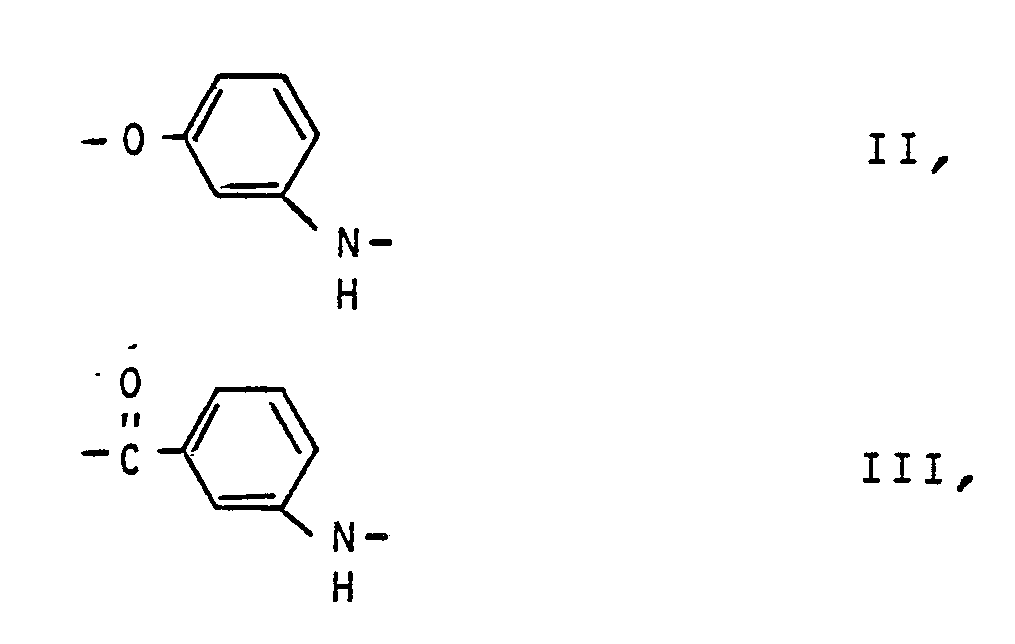
- b) 3 bis 3O Mol.%, vorzugsweise 5 bis 25 Mol.% wiederkehrenden Einheiten der Formel II und/oder III

- c) 2 bis 25 Mol.% vorzugsweise 5 bis 2O Mol.%, mindestens einer der wiederkehrenden Einheiten der Formel IV, V oder VI
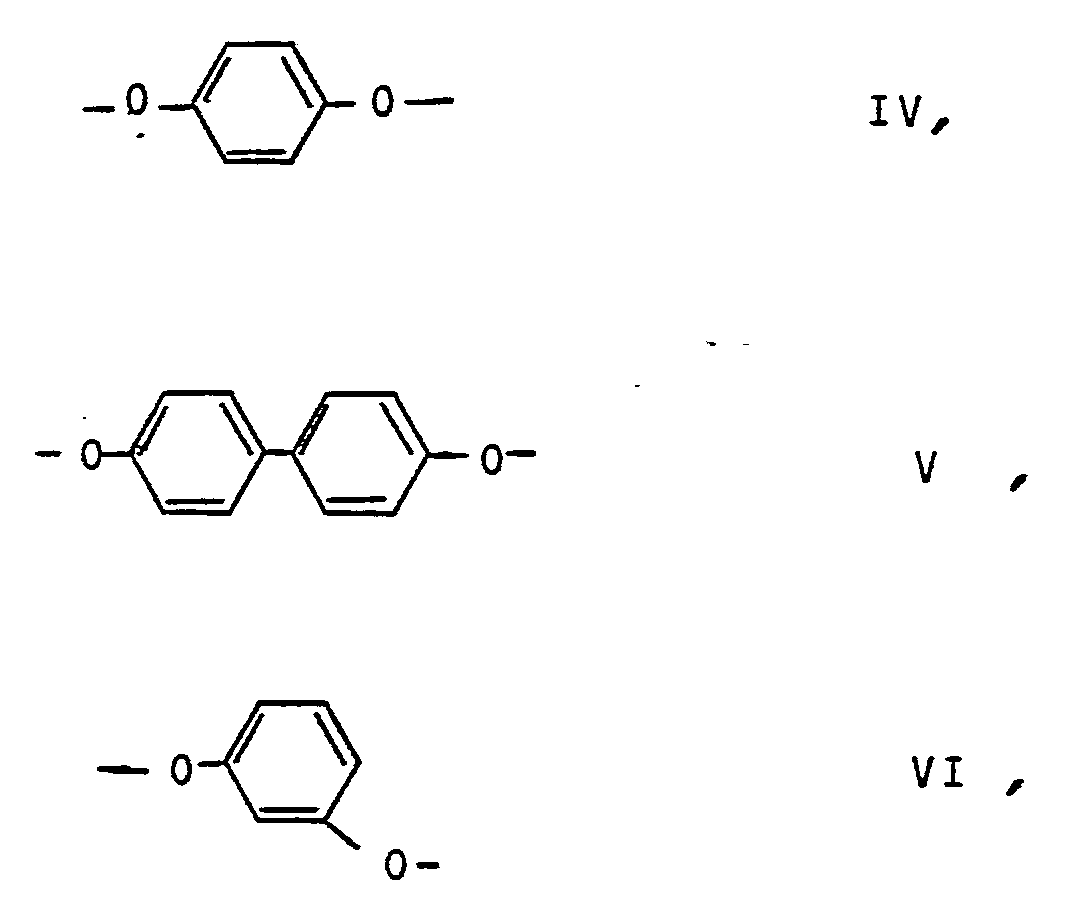
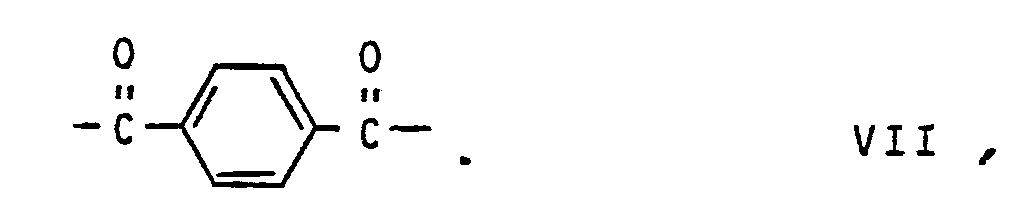
- d) einer Summe aus den Komponenten a), b) und c), ausgenommen der Einheit der Formel III entsprechenden molaren Menge an wiederkehrenden Einheiten der Formel VII.

- e) gegebenenfalls 5 bis 5 Mol.% wiederkehrenden Einheiten der Formel IX

- f) wiederkehrenden Einheiten der Formel X, vorteilhaft in einer Menge von mindestens 1O Mol.%

- Bevorzugte Ausgangsstoffe sind:
für Einheiten der Formel I t-Butylhydrochinon,
für Einheiten der Formel II m-Aminophenol,
für Einheiten der Formel III m-Aminobenzoesäure,
für Einheiten der Formel IV Hydrochinon,
für Einheiten der Formel V 4,4′-Dihydroxidiphenyl,
für Einheiten der Formel VI Resorcin,
für Einheiten der Formel VII Terephthalsäure,
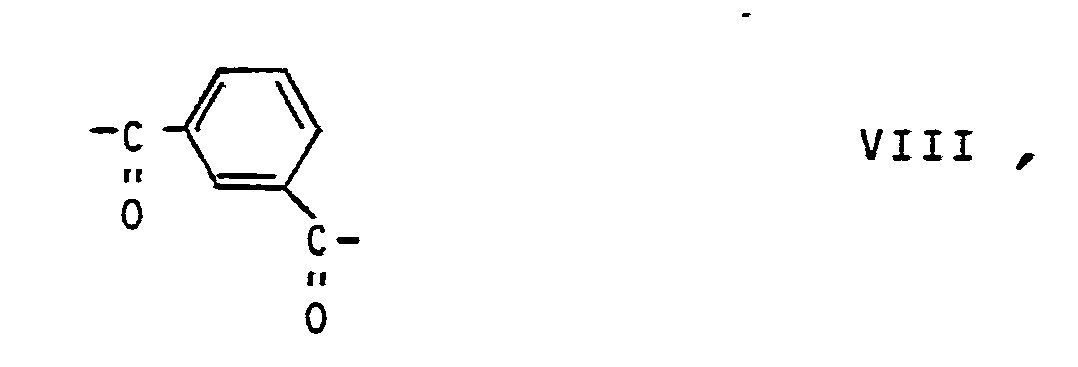
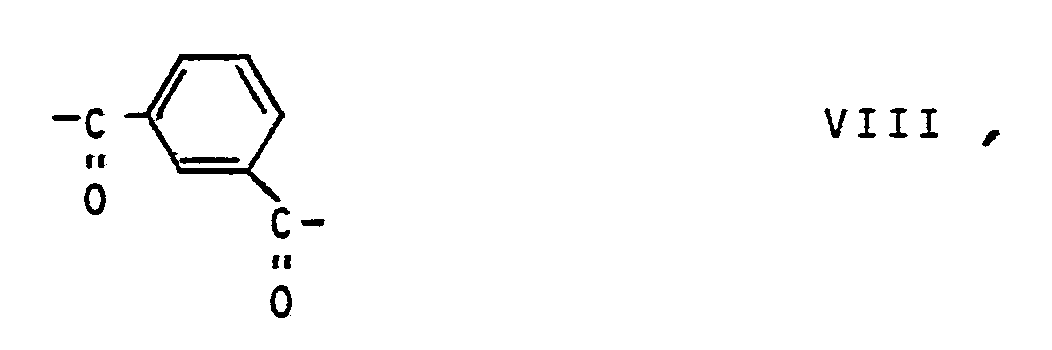
für Einheiten der Formel VIII Isophthalsäure
für Einheiten der Formel IX m-Hydroxybenzoesäure und
für Einheiten der Formel X p-Hydroxybenzoesäure. - Bevorzugte Polyesteramide enthalten 5 bis 2O Mol.% wiederkehrende Einheiten der Formel I 5 bis 2O Mol.% wiederkehrende Einheiten der Formel II und 5 bis 2O Mol.% der Formel IV.
- Andere bevorzugte Polyesteramide enthalten 5 bis 2O Mol.% Einheiten der Formel I, 5 bis 2O Mol.% Einheiten der Formel III sowie 5 bis 2O Mol.% wiederkehrende Einheiten der Formeln IV und V.
- Weitere bevorzugte Polyesteramide enthalten 5 bis 2O Mol.% Einheiten der Formel I, 5 bis 2O Mol.% Einheiten der Formel III für die 5 bis 2O Mol.% Einheiten der Formel IV.
- Bevorzugte vollaromatische Polyesteramide nach der Erfindung haben eine Glasübergangstemperatur Tg von 14O°C, insbesondere 15O°C. Die Glastemperatur wird gemessen mit der DSC-Methode, wie sie beschrieben ist in Makromol. Chem., 127 (1969), Seiten 1 ff. Die vollaromatischen flüssigkristallinen Polyesteramide gemäß der Erfindung bilden bei einer Temperatur 32O°C eine flüssigkristalline fadenbildende Schmelze. Bevorzugt sind auch flüssigkristalline aromatische Polyesteramide, die bei einer Temperatur 2OO°C und 3OO°C Teilkristallinität aufweisen.
- Die erfindungsgemäßen flüssigkristallinen Polyesteramide lassen sich erhalten analog nach Techniken, wie sie beispielsweise in der US-PS 4 375 53O und US-PS 4 118 372 beschrieben werden.
- Nach einer vorteilhaften Arbeitsweise erhält man die erfindungsgemäßen Polyersteramide in einem Einstufenverfahren, bei dem man die nicht derivatisierten Ausgangsverbindungen unter Verwendung von Anhydriden niederer Fettsäuren, z.B. Fettsäuren mit 2 bis 4 Kohlenstoffatomen, insbesondere Essigsäureanhydrid umsetzt. Es ist möglich, hierbei Katalysatoren, wie sie aus der EP-Anmeldung 131 846 bekannt sind, in üblichen Mengen mitzuverwenden. Bei der Umsetzung werden die nicht derivatisierten Hydroxy-Amino- und Carboxyverbindungen zusammen mit Fettsäureanhydrid, vorteilhaft in einem mindestens 5%igen molaren Überschuß, bezogen auf die vorhandenen Hydroxy- und Aminogruppen, unter Inertgasatmosphäre und Rühren auf eine Temperatur erhitzt, bei der Rückfluß zu beobachten ist. Vorteilhaft wird die Temperatur stufenweise gesteigert, z.B. höchstens 5 Stunden, vorzugsweise bis zu 2 Stunden auf 13O bis 2OO°C. Anschließend wird die Temperatur, z.B. innerhalb von 2 bis 2 1/2 Stunden auf 25O bis 35O°C gesteigert. Hierbei werden überschüssige Fettsäureanhydride und Fettsäuren abdestilliert. Um die Reaktion zu vervollständigen, hat es sich als vorteilhaft erwiesen, gegen Ende der Umsetzung verminderten Druck, z.B. von 2OO bis O,1 mbar anzuwenden.
- Bemerkenswert und nicht vorherzusehen bei der Anwendung dieses Einstufenverfahrens ist zunächst die problemlose und vollständige Reaktion ohne Katalysatorzusatz zu den gewünschten Polymeren in einer relativ kurzen Zeit. Dies ist umso bemerkenswerter als durch die Vielzahl chemisch unterschiedlicher Hydroxy- und Aminogruppen eine Abstufung der Reaktivitäten und damit ein mangelhafter polymerer Aufbau zu erwarten wäre.
- Die so erhaltenen vollaromatischen flüssig-kristallinen Polyesteramide werden vorteilhaft in festem Zustand, z.B. bei Temperaturen von 15O bis 25O°C bis zur gewünschten Viskosität weiter kondensiert. Diese Nachkondensation in fester Phase kann sowohl vor als auch nach einer thermoplastischen Verarbeitung erfolgen. Die Festphasenkondensation führt man vorteilhaft in Inertgasatmosphäre, z.B. unter Stickstoff durch.
- Den Polyesteramiden können übliche Zusatz- und Hilfsstoffe in wirksamen Mengen zugesetzt werden. Übliche Zusatz- und Hilfsstoffe sind Stabilisatoren, Oxidationsverzögerer und Mittel gegen Wärmezersetzung und Zersetzung durch ultraviolettes Licht, Gleit- und Entformungsmittel, Färbemittel, wie Farbstoffe oder Pigmente, faser- oder pulverförmige Füll- und Verstärkungsmittel, Keimbildungsmittel oder Weichmacher.
- Stabilisatoren können den Polymeren in jedem Stadium der Herstellung oder den fertigen Polymeren zugesetzt werden. Vorzugsweise werden die Stabilisatoren zu einem frühen Zeitpunkt zugesetzt, um zu verhindern, daß die Zersetzung bereits beginnt, bevor die Polymeren geschützt werden können.
- Geeignete Oxidationsverzögerer und Wärmestabilisatoren sind beispielsweise Halogenide von Metallen der Gruppe I des Periodischen Systems, z.B. von Natrium, Kalium oder Lithium mit Kupfer-(I)-halogeniden, wie Chloriden, Bromiden, Jodiden, sterisch gehinderte Phenole, Hydrochinone, verschiedene substituierte Vertreter dieser Gruppen in Kombinationen derselben in Konzentrationen bis zu 1 Gew.%, bezogen auf das Polymere.
- Geeignete UV-Stabilisatoren sind beispielsweise substituierte Resorcine, Salicylate, Benzotriazole, Benzophenone und dergleichen sowie Mischungen derselben. Solche UV-Stabilisatoren werden in der Regel in Mengen bis zu 2 Gew.% auf das Polymere angewandt.
- Geeignete Hilfsstoffe sind auch Farbstoffe, die im allgemeinen in Mengen bis zu 5 Gew.% angewandt werden, wie Nigrosin, Pigmente, wie Titandioxid, Cadmiumsulfid, Cadmiumsulfid-selenid, Phthalocyanine, Ultramirinblau oder Ruß.
- Geeignete faser- oder pulverförmige Füllstoffe und Verstärkungsmittel, die in Mengen z.B. bis zu 7O Gew.% auf das Polymere angewandt werden, sind beispielsweise Kohlenstoffasern, Glasfasern, amorphe Kieselsäure, Asbest, Calciumsilicat, Aluminiumsilicat, Magnesiumcarbonat, Kaolin, Kreide, gepulverter Quarz, Glimmer oder Feldspat.
- Geeignete Keimbildungsmittel sind beispielsweise Talkum, Calciumfluorid, Natriumphenylphosphinat, Aluminiumoxid oder feinteiliges Polytetrafluorethylen.
- Schließlich sind geeignete Zusatzstoffe Weichmacher in Mengen z.B. bis zu 2O Gew.%, wie Phthalsäuredioctylester, Phthalsäuredibenzylester, Phthalsäurebutylbenzylester, Kohlenwasserstofföle, N-n-Butylbenzolsulfonamid, o- und p-Toluolethylsulfonamid.
- Die erfindungsgemäßen vollaromatischen flüssigkristallinen Polyesteramide eigenen sich zur Herstellung von Fäden, Fasern, Folien, Schäumen und technischen Formteilen durch Spritzguß, Pressen oder Extrusion. Die aus den erfindungsgemäßen Polyesteramiden hergestellten Formteile zeichnen sich aus durch hervorragende mechanische Eigenschaften, wie Steifigkeit, Festigkeit und Zähigkeit. Sie sind außerordentlich chemikalienresistent und flammwidrig. Zudem besitzen sie eine hohe Wärmeformbeständigkeit und eine glatte, abriebfeste Oberfläche. Die erfindungsgemäßen Polyesteramide eignen sich daher hervorragend zur Herstellung von Formteilen für die Elektro- und Datentechnik, den Fahrzeugbau und andere technische Bereiche. Sie können aber auch als Überzugs- und Beschichtungsmittel, pulverförmig dispergiert, oder als Film verwendet werden.
- Die Erfindung sei an folgenden Beispielen veranschaulicht.
- O, 24 mol Terephthalsäure, O,312 mol 4-Hydroxibenzoesäure, O,12 mol t-Butylhydrochinon, O,12 mol m-Aminophenol und 1O1 ml Acetanhydrid werden unter Stickstoffatmosphäre und Rühren innerhalb von 2h5Omin von 15O°C auf 3OO°C erhitzt. Dabei wird überschüssiges Acetanhydrid und Essigsäure abdestilliert. Anschließend wird innerhalb 1h2Omin der Druck auf 3O mbar reduziert. Man erhält eine viskose fadenbildende Schmelze. Die Polymerschmelze und das erkaltete Polymer zeigen einen perlmuttartigen Glanz. Das Polymer besitzt eine glatte, harte und abriebfeste Oberfläche. Aus DSC-Messungen ergibt sich eine Glastemperatur von 165°C und eine Schmelztemp. von 3OO°C. Die inhärente Viskosität beträgt O,78 dl/g, gemessen in O,1%iger (Gew/Vol) Lösung in Pentafluorphenol bei 6O°C.
- O,22 mol Terephthalsäure, O,143 mol 4-Hydroxibenzoesäure, O,O77 mol Hydrochinon, O,O99 mol t-Butylhydrochinon, O,O44 mol 4,4′-Dihydroxybiphenyl, O,143 mol 3-Aminobenzoesäure und 93 ml Acetanhydrid werden unter Stickstoffatmosphäre und Rühren innerhalb von 2h5Omin von 15O°C auf 3OO°C erhitzt. Dabei wird überschüssiges Acetanhydrid und Essigsäure abdestilliert. Anschließend wird innerhalb 5O min der Druck auf 65 bar reduziert. Man erhält eine viskose fadenbildende Schmelze. Die Polymerschmelze und das erkaltete Polymer zeigen einen perlmuttartigen Glanz. Das Polymer besitzt eine glatte, harte und abriebfeste Oberfläche. Aus DSC-Messungen ergibt sich eine Glastemperatur von 172°C.
- Die inhärente Viskosität betragt O,58 dl/g, gemessen in O,5%iger (Gew/Vol) Lösung in 4 Chlorphenol bei 6O°C.
Claims (10)





Priority Applications (1)
| Application Number | Priority Date | Filing Date | Title |
|---|---|---|---|
| AT86116269T ATE75235T1 (de) | 1985-12-04 | 1986-11-24 | Vollaromatische mesomorphe polyesteramide, deren herstellung und verwendung. |
Applications Claiming Priority (2)
| Application Number | Priority Date | Filing Date | Title |
|---|---|---|---|
| DE3542855 | 1985-12-04 | ||
| DE3542855A DE3542855A1 (de) | 1985-12-04 | 1985-12-04 | Vollaromatische mesomorphe polyesteramide, deren herstellung und verwendung |
Publications (3)
| Publication Number | Publication Date |
|---|---|
| EP0230546A2 true EP0230546A2 (de) | 1987-08-05 |
| EP0230546A3 EP0230546A3 (en) | 1989-04-26 |
| EP0230546B1 EP0230546B1 (de) | 1992-04-22 |
Family
ID=6287601
Family Applications (1)
| Application Number | Title | Priority Date | Filing Date |
|---|---|---|---|
| EP86116269A Expired - Lifetime EP0230546B1 (de) | 1985-12-04 | 1986-11-24 | Vollaromatische mesomorphe Polyesteramide, deren Herstellung und Verwendung |
Country Status (6)
| Country | Link |
|---|---|
| US (1) | US4816555A (de) |
| EP (1) | EP0230546B1 (de) |
| JP (1) | JPS62132927A (de) |
| AT (1) | ATE75235T1 (de) |
| CA (1) | CA1268584A (de) |
| DE (2) | DE3542855A1 (de) |
Cited By (1)
| Publication number | Priority date | Publication date | Assignee | Title |
|---|---|---|---|---|
| EP0257598A3 (en) * | 1986-08-28 | 1989-10-18 | Basf Aktiengesellschaft | Wholly aromatic thermotropic polyesters |
Families Citing this family (19)
| Publication number | Priority date | Publication date | Assignee | Title |
|---|---|---|---|---|
| US5096995A (en) * | 1987-08-13 | 1992-03-17 | Toray Industries, Inc. | Polyether-ester amide and permanently antistatic resin composition |
| JP2823873B2 (ja) * | 1988-12-27 | 1998-11-11 | ポリプラスチックス株式会社 | 流動性改良液晶性ポリエステル樹脂組成物 |
| US5266677A (en) * | 1992-05-27 | 1993-11-30 | University Of North Carolina At Chapel Hill | Thiophene-based polymers |
| JP3384888B2 (ja) * | 1994-09-14 | 2003-03-10 | 新日本石油株式会社 | 液晶表示素子用補償板 |
| CA2263603A1 (en) | 1996-09-11 | 1998-03-19 | Kenneth Earl Stevens | Polymeric multilayer heat exchangers containing a barrier layer |
| JP3373528B2 (ja) | 1996-09-11 | 2003-02-04 | デュポン カナダ インコーポレイテッド | 液晶ポリマー層を含有する熱交換器 |
| US6379795B1 (en) | 1999-01-19 | 2002-04-30 | E. I. Du Pont De Nemours And Company | Injection moldable conductive aromatic thermoplastic liquid crystalline polymeric compositions |
| US6364008B1 (en) | 1999-01-22 | 2002-04-02 | E. I. Du Pont De Nemours And Company | Heat exchanger with tube plates |
| WO2002029347A2 (en) | 2000-10-06 | 2002-04-11 | E.I. Du Pont De Nemours And Company | Heat exchanger made from bendable plastic tubing |
| CA2476187A1 (en) * | 2002-02-13 | 2003-08-21 | Dupont Canada Inc. | Method for manufacturing fuel cell separator plates under low shear strain |
| US20040113129A1 (en) * | 2002-07-25 | 2004-06-17 | Waggoner Marion G. | Static dissipative thermoplastic polymer composition |
| CA2538761A1 (en) * | 2005-03-08 | 2006-09-08 | Anthony Joseph Cesaroni | Method for sealing heat exchanger tubes |
| US7547849B2 (en) * | 2005-06-15 | 2009-06-16 | E.I. Du Pont De Nemours And Company | Compositions useful in electronic circuitry type applications, patternable using amplified light, and methods and compositions relating thereto |
| US8475924B2 (en) * | 2007-07-09 | 2013-07-02 | E.I. Du Pont De Nemours And Company | Compositions and methods for creating electronic circuitry |
| JP5292398B2 (ja) | 2007-07-09 | 2013-09-18 | イー・アイ・デュポン・ドウ・ヌムール・アンド・カンパニー | 電子回路構造を製造するための組成物および方法 |
| US20090017309A1 (en) * | 2007-07-09 | 2009-01-15 | E. I. Du Pont De Nemours And Company | Compositions and methods for creating electronic circuitry |
| US20100193950A1 (en) * | 2009-01-30 | 2010-08-05 | E.I.Du Pont De Nemours And Company | Wafer level, chip scale semiconductor device packaging compositions, and methods relating thereto |
| TWI824136B (zh) | 2019-07-02 | 2023-12-01 | 財團法人工業技術研究院 | 液晶聚合物、積層材料、液晶聚合物溶液、與液晶聚合物薄膜的形成方法 |
| CN112175174B (zh) | 2019-07-02 | 2023-03-28 | 财团法人工业技术研究院 | 液晶聚合物、积层材料、液晶聚合物溶液与液晶聚合物薄膜的形成方法 |
Family Cites Families (12)
| Publication number | Priority date | Publication date | Assignee | Title |
|---|---|---|---|---|
| PH15509A (en) * | 1974-05-10 | 1983-02-03 | Du Pont | Improvements in an relating to synthetic polyesters |
| DE2966721D1 (en) * | 1978-07-24 | 1984-04-05 | Ici Plc | Thermotropic polyesteramides |
| US4436894A (en) * | 1980-07-31 | 1984-03-13 | Teijin Limited | Novel wholly aromatic copolyester, process for production thereof, and film melt-shaped therefrom |
| US4330457A (en) * | 1980-12-09 | 1982-05-18 | Celanese Corporation | Poly(ester-amide) capable of forming an anisotropic melt phase derived from 6-hydroxy-2-naphthoic acid, dicarboxylic acid, and aromatic monomer capable of forming an amide linkage |
| US4351917A (en) * | 1981-04-06 | 1982-09-28 | Celanese Corporation | Poly(ester-amide) capable of forming an anisotropic melt phase derived from 6-hydroxy-2-naphthoic acid, aromatic monomer capable of forming an amide linkage, and other aromatic hydroxyacid |
| US4355132A (en) * | 1981-04-07 | 1982-10-19 | Celanese Corporation | Anisotropic melt phase forming poly(ester-amide) derived from p-hydroxybenzoic acid, 2,6-naphthalenedicarboxylic acid, aromatic monomer capable of forming an amide linkage, and, optionally, hydroquinone and additional carbocyclic dicarboxylic acid |
| DE3276323D1 (en) * | 1981-11-16 | 1987-06-19 | Ici Plc | Anisotropic polymers having improved retention of physical properties at elevated temperatures and methods of manufacture thereof |
| US4375530A (en) * | 1982-07-06 | 1983-03-01 | Celanese Corporation | Polyester of 2,6-naphthalene dicarboxylic acid, 2,6-dihydroxy naphthalene, terephthalic acid, and hydroquinone capable of forming an anisotropic melt |
| DE3325787A1 (de) * | 1983-07-16 | 1985-01-24 | Bayer Ag, 5090 Leverkusen | Mesomorphe aromatische polyester mit hoher steifigkeit und zaehigkeit, verfahren zu ihrer herstellung und ihre verwendung zur herstellung von formkoerpern, filamenten, fasern und folien |
| DE3325705A1 (de) * | 1983-07-16 | 1985-01-24 | Bayer Ag, 5090 Leverkusen | Mesomorphe aromatische polyester mit hoher zaehigkeitund verbesserter schmelzviskositaet, verfahren zu ihrer herstellung und ihre verwendung zur herstellung von formkoerpern, filamenten, fasern und folien |
| US4562244A (en) * | 1984-03-29 | 1985-12-31 | Celanese Corporation | Process for forming thermally stable thermotropic liquid crystalline polyesters of predetermined chain length utilizing aliphatic dicarboxylic acid |
| DE3415530A1 (de) * | 1984-04-26 | 1985-10-31 | Bayer Ag, 5090 Leverkusen | Thermotrope aromatische polyester hoher steifigkeit und zaehigkeit, verfahren zu ihrer herstellung und ihre verwendung zur herstellung von formkoerpern, filamenten, fasern und folien |
-
1985
- 1985-12-04 DE DE3542855A patent/DE3542855A1/de not_active Withdrawn
-
1986
- 1986-11-07 JP JP61264158A patent/JPS62132927A/ja active Pending
- 1986-11-19 CA CA000523351A patent/CA1268584A/en not_active Expired - Lifetime
- 1986-11-24 AT AT86116269T patent/ATE75235T1/de not_active IP Right Cessation
- 1986-11-24 DE DE8686116269T patent/DE3685016D1/de not_active Expired - Lifetime
- 1986-11-24 EP EP86116269A patent/EP0230546B1/de not_active Expired - Lifetime
- 1986-12-04 US US06/937,874 patent/US4816555A/en not_active Expired - Fee Related
Cited By (1)
| Publication number | Priority date | Publication date | Assignee | Title |
|---|---|---|---|---|
| EP0257598A3 (en) * | 1986-08-28 | 1989-10-18 | Basf Aktiengesellschaft | Wholly aromatic thermotropic polyesters |
Also Published As
| Publication number | Publication date |
|---|---|
| ATE75235T1 (de) | 1992-05-15 |
| JPS62132927A (ja) | 1987-06-16 |
| EP0230546A3 (en) | 1989-04-26 |
| EP0230546B1 (de) | 1992-04-22 |
| CA1268584A (en) | 1990-05-01 |
| DE3542855A1 (de) | 1987-06-11 |
| US4816555A (en) | 1989-03-28 |
| DE3685016D1 (de) | 1992-05-27 |
Similar Documents
| Publication | Publication Date | Title |
|---|---|---|
| EP0225537B1 (de) | Vollaromatische mesomorphe Polyesterimide, deren Herstellung sowie Verwendung | |
| EP0230545B1 (de) | Vollaromatische Polyesteramide, deren Herstellung und Verwendung. | |
| EP0230546B1 (de) | Vollaromatische mesomorphe Polyesteramide, deren Herstellung und Verwendung | |
| EP0225529A2 (de) | Vollaromatische mesomorphe Polyesteramidimide, deren Herstellung und Verwendung | |
| EP0226847B1 (de) | Vollaromatische mesmorphe Polyetherester, deren Herstellung und Verwendung | |
| EP0251113B1 (de) | Vollaromatische mesomorphe Polyester, deren Herstellung sowie Verwendung | |
| EP0226080B1 (de) | Vollaromatische mesomorphe Polyesteramide, deren Herstellung und Verwendung | |
| EP0257558B1 (de) | Vollaromatische thermotrope Polyester | |
| EP0259670B1 (de) | Vollaromatische thermotrope Polyester und Polyesteramide | |
| EP0230551B1 (de) | Vollaromatische Polyestercarbamide, deren Herstellung und Verwendung | |
| EP0258767B1 (de) | Vollaromatische thermotrope Polyester | |
| EP0226078A1 (de) | Vollaromatische mesomorphe Polyester, deren Herstellung sowie Verwendung | |
| EP0227947A2 (de) | Vollaromatische mesomorphe Polyesterimide, deren Herstellung und Verwendung | |
| EP0230547A2 (de) | Vollaromatische mesomorphe Polyesteramidimide, deren Herstellung und Verwendung | |
| EP0257598B1 (de) | Vollaromatische thermotrope Polyester und Polyesteramide | |
| EP0231462B1 (de) | Vollaromatische mesomorphe Polyetheresterimide, deren Herstellung und Verwendung | |
| EP0231468B1 (de) | Flüssig-kristalline Carbamidgruppen enthaltende Polykondensate, deren Herstellung und Verwendung | |
| EP0230550B1 (de) | Vollaromatische flüssigkristalline Polykondensate, deren Herstellung und Verwendung | |
| DE3700821A1 (de) | Vollaromatische thermotrope polyester |
Legal Events
| Date | Code | Title | Description |
|---|---|---|---|
| PUAI | Public reference made under article 153(3) epc to a published international application that has entered the european phase |
Free format text: ORIGINAL CODE: 0009012 |
|
| AK | Designated contracting states |
Kind code of ref document: A2 Designated state(s): AT BE CH DE FR GB IT LI LU NL SE |
|
| PUAL | Search report despatched |
Free format text: ORIGINAL CODE: 0009013 |
|
| AK | Designated contracting states |
Kind code of ref document: A3 Designated state(s): AT BE CH DE FR GB IT LI LU NL SE |
|
| 17P | Request for examination filed |
Effective date: 19890318 |
|
| 17Q | First examination report despatched |
Effective date: 19901205 |
|
| GRAA | (expected) grant |
Free format text: ORIGINAL CODE: 0009210 |
|
| AK | Designated contracting states |
Kind code of ref document: B1 Designated state(s): AT BE CH DE FR GB IT LI LU NL SE |
|
| REF | Corresponds to: |
Ref document number: 75235 Country of ref document: AT Date of ref document: 19920515 Kind code of ref document: T |
|
| ITF | It: translation for a ep patent filed | ||
| REF | Corresponds to: |
Ref document number: 3685016 Country of ref document: DE Date of ref document: 19920527 |
|
| GBT | Gb: translation of ep patent filed (gb section 77(6)(a)/1977) | ||
| ET | Fr: translation filed | ||
| PGFP | Annual fee paid to national office [announced via postgrant information from national office to epo] |
Ref country code: SE Payment date: 19921012 Year of fee payment: 7 |
|
| PGFP | Annual fee paid to national office [announced via postgrant information from national office to epo] |
Ref country code: FR Payment date: 19921019 Year of fee payment: 7 |
|
| PGFP | Annual fee paid to national office [announced via postgrant information from national office to epo] |
Ref country code: CH Payment date: 19921020 Year of fee payment: 7 |
|
| PGFP | Annual fee paid to national office [announced via postgrant information from national office to epo] |
Ref country code: AT Payment date: 19921022 Year of fee payment: 7 |
|
| PGFP | Annual fee paid to national office [announced via postgrant information from national office to epo] |
Ref country code: BE Payment date: 19921110 Year of fee payment: 7 |
|
| PGFP | Annual fee paid to national office [announced via postgrant information from national office to epo] |
Ref country code: GB Payment date: 19921116 Year of fee payment: 7 |
|
| PGFP | Annual fee paid to national office [announced via postgrant information from national office to epo] |
Ref country code: DE Payment date: 19921119 Year of fee payment: 7 |
|
| PGFP | Annual fee paid to national office [announced via postgrant information from national office to epo] |
Ref country code: NL Payment date: 19921130 Year of fee payment: 7 |
|
| PLBE | No opposition filed within time limit |
Free format text: ORIGINAL CODE: 0009261 |
|
| STAA | Information on the status of an ep patent application or granted ep patent |
Free format text: STATUS: NO OPPOSITION FILED WITHIN TIME LIMIT |
|
| 26N | No opposition filed | ||
| PGFP | Annual fee paid to national office [announced via postgrant information from national office to epo] |
Ref country code: LU Payment date: 19931101 Year of fee payment: 8 |
|
| PG25 | Lapsed in a contracting state [announced via postgrant information from national office to epo] |
Ref country code: DE Effective date: 19931118 |
|
| PG25 | Lapsed in a contracting state [announced via postgrant information from national office to epo] |
Ref country code: GB Effective date: 19931124 Ref country code: AT Effective date: 19931124 |
|
| PG25 | Lapsed in a contracting state [announced via postgrant information from national office to epo] |
Ref country code: SE Effective date: 19931125 |
|
| PG25 | Lapsed in a contracting state [announced via postgrant information from national office to epo] |
Ref country code: LI Effective date: 19931130 Ref country code: CH Effective date: 19931130 Ref country code: BE Effective date: 19931130 |
|
| EPTA | Lu: last paid annual fee | ||
| BERE | Be: lapsed |
Owner name: BASF A.G. Effective date: 19931130 |
|
| PG25 | Lapsed in a contracting state [announced via postgrant information from national office to epo] |
Ref country code: NL Effective date: 19940601 |
|
| NLV4 | Nl: lapsed or anulled due to non-payment of the annual fee | ||
| GBPC | Gb: european patent ceased through non-payment of renewal fee |
Effective date: 19931124 |
|
| PG25 | Lapsed in a contracting state [announced via postgrant information from national office to epo] |
Ref country code: FR Effective date: 19940729 |
|
| REG | Reference to a national code |
Ref country code: CH Ref legal event code: PL |
|
| REG | Reference to a national code |
Ref country code: FR Ref legal event code: ST |
|
| PG25 | Lapsed in a contracting state [announced via postgrant information from national office to epo] |
Ref country code: LU Free format text: LAPSE BECAUSE OF NON-PAYMENT OF DUE FEES Effective date: 19941124 |
|
| EUG | Se: european patent has lapsed |
Ref document number: 86116269.1 Effective date: 19940610 |
|
| PG25 | Lapsed in a contracting state [announced via postgrant information from national office to epo] |
Ref country code: IT Free format text: LAPSE BECAUSE OF NON-PAYMENT OF DUE FEES;WARNING: LAPSES OF ITALIAN PATENTS WITH EFFECTIVE DATE BEFORE 2007 MAY HAVE OCCURRED AT ANY TIME BEFORE 2007. THE CORRECT EFFECTIVE DATE MAY BE DIFFERENT FROM THE ONE RECORDED. Effective date: 20051124 |