EP0230889A2 - Verfahren zum Kleben von polymerisierbaren flexographischen Druckelementen oder -platten - Google Patents
Verfahren zum Kleben von polymerisierbaren flexographischen Druckelementen oder -platten Download PDFInfo
- Publication number
- EP0230889A2 EP0230889A2 EP87100254A EP87100254A EP0230889A2 EP 0230889 A2 EP0230889 A2 EP 0230889A2 EP 87100254 A EP87100254 A EP 87100254A EP 87100254 A EP87100254 A EP 87100254A EP 0230889 A2 EP0230889 A2 EP 0230889A2
- Authority
- EP
- European Patent Office
- Prior art keywords
- printing
- polystyrene
- process according
- edges
- photopolymerizable
- Prior art date
- Legal status (The legal status is an assumption and is not a legal conclusion. Google has not performed a legal analysis and makes no representation as to the accuracy of the status listed.)
- Granted
Links
Images
Classifications
-
- C—CHEMISTRY; METALLURGY
- C09—DYES; PAINTS; POLISHES; NATURAL RESINS; ADHESIVES; COMPOSITIONS NOT OTHERWISE PROVIDED FOR; APPLICATIONS OF MATERIALS NOT OTHERWISE PROVIDED FOR
- C09J—ADHESIVES; NON-MECHANICAL ASPECTS OF ADHESIVE PROCESSES IN GENERAL; ADHESIVE PROCESSES NOT PROVIDED FOR ELSEWHERE; USE OF MATERIALS AS ADHESIVES
- C09J5/00—Adhesive processes in general; Adhesive processes not provided for elsewhere, e.g. relating to primers
-
- B—PERFORMING OPERATIONS; TRANSPORTING
- B41—PRINTING; LINING MACHINES; TYPEWRITERS; STAMPS
- B41N—PRINTING PLATES OR FOILS; MATERIALS FOR SURFACES USED IN PRINTING MACHINES FOR PRINTING, INKING, DAMPING, OR THE LIKE; PREPARING SUCH SURFACES FOR USE AND CONSERVING THEM
- B41N6/00—Mounting boards; Sleeves Make-ready devices, e.g. underlays, overlays; Attaching by chemical means, e.g. vulcanising
- B41N6/02—Chemical means for fastening printing formes on mounting boards
-
- C—CHEMISTRY; METALLURGY
- C09—DYES; PAINTS; POLISHES; NATURAL RESINS; ADHESIVES; COMPOSITIONS NOT OTHERWISE PROVIDED FOR; APPLICATIONS OF MATERIALS NOT OTHERWISE PROVIDED FOR
- C09J—ADHESIVES; NON-MECHANICAL ASPECTS OF ADHESIVE PROCESSES IN GENERAL; ADHESIVE PROCESSES NOT PROVIDED FOR ELSEWHERE; USE OF MATERIALS AS ADHESIVES
- C09J4/00—Adhesives based on organic non-macromolecular compounds having at least one polymerisable carbon-to-carbon unsaturated bond ; adhesives, based on monomers of macromolecular compounds of groups C09J183/00 - C09J183/16
- C09J4/06—Organic non-macromolecular compounds having at least one polymerisable carbon-to-carbon unsaturated bond in combination with a macromolecular compound other than an unsaturated polymer of groups C09J159/00 - C09J187/00
-
- Y—GENERAL TAGGING OF NEW TECHNOLOGICAL DEVELOPMENTS; GENERAL TAGGING OF CROSS-SECTIONAL TECHNOLOGIES SPANNING OVER SEVERAL SECTIONS OF THE IPC; TECHNICAL SUBJECTS COVERED BY FORMER USPC CROSS-REFERENCE ART COLLECTIONS [XRACs] AND DIGESTS
- Y10—TECHNICAL SUBJECTS COVERED BY FORMER USPC
- Y10S—TECHNICAL SUBJECTS COVERED BY FORMER USPC CROSS-REFERENCE ART COLLECTIONS [XRACs] AND DIGESTS
- Y10S428/00—Stock material or miscellaneous articles
- Y10S428/909—Resilient layer, e.g. printer's blanket
-
- Y—GENERAL TAGGING OF NEW TECHNOLOGICAL DEVELOPMENTS; GENERAL TAGGING OF CROSS-SECTIONAL TECHNOLOGIES SPANNING OVER SEVERAL SECTIONS OF THE IPC; TECHNICAL SUBJECTS COVERED BY FORMER USPC CROSS-REFERENCE ART COLLECTIONS [XRACs] AND DIGESTS
- Y10—TECHNICAL SUBJECTS COVERED BY FORMER USPC
- Y10T—TECHNICAL SUBJECTS COVERED BY FORMER US CLASSIFICATION
- Y10T156/00—Adhesive bonding and miscellaneous chemical manufacture
- Y10T156/10—Methods of surface bonding and/or assembly therefor
- Y10T156/1002—Methods of surface bonding and/or assembly therefor with permanent bending or reshaping or surface deformation of self sustaining lamina
- Y10T156/1028—Methods of surface bonding and/or assembly therefor with permanent bending or reshaping or surface deformation of self sustaining lamina by bending, drawing or stretch forming sheet to assume shape of configured lamina while in contact therewith
- Y10T156/1033—Flexible sheet to cylinder lamina
-
- Y—GENERAL TAGGING OF NEW TECHNOLOGICAL DEVELOPMENTS; GENERAL TAGGING OF CROSS-SECTIONAL TECHNOLOGIES SPANNING OVER SEVERAL SECTIONS OF THE IPC; TECHNICAL SUBJECTS COVERED BY FORMER USPC CROSS-REFERENCE ART COLLECTIONS [XRACs] AND DIGESTS
- Y10—TECHNICAL SUBJECTS COVERED BY FORMER USPC
- Y10T—TECHNICAL SUBJECTS COVERED BY FORMER US CLASSIFICATION
- Y10T156/00—Adhesive bonding and miscellaneous chemical manufacture
- Y10T156/10—Methods of surface bonding and/or assembly therefor
- Y10T156/1052—Methods of surface bonding and/or assembly therefor with cutting, punching, tearing or severing
- Y10T156/1062—Prior to assembly
- Y10T156/1066—Cutting to shape joining edge surfaces only
-
- Y—GENERAL TAGGING OF NEW TECHNOLOGICAL DEVELOPMENTS; GENERAL TAGGING OF CROSS-SECTIONAL TECHNOLOGIES SPANNING OVER SEVERAL SECTIONS OF THE IPC; TECHNICAL SUBJECTS COVERED BY FORMER USPC CROSS-REFERENCE ART COLLECTIONS [XRACs] AND DIGESTS
- Y10—TECHNICAL SUBJECTS COVERED BY FORMER USPC
- Y10T—TECHNICAL SUBJECTS COVERED BY FORMER US CLASSIFICATION
- Y10T428/00—Stock material or miscellaneous articles
- Y10T428/19—Sheets or webs edge spliced or joined
- Y10T428/192—Sheets or webs coplanar
- Y10T428/195—Beveled, stepped, or skived in thickness
Definitions
- Photopolymer printing plates for flexographic printing consist of a light-sensitive layer usually applied onto a layer support. Essential constituents of the photosensitive layer are a light-hardenable compound, an elastomeric binder, and a photoinitiator or initiator system.
- the arrangement, composition, and proportions of the individual polymer blocks can vary within wide limits.
- homopolymer blocks of styrene and homopolymer blocks of isoprene and/or butadiene can be present.
- the block copolymer can also be made up, however, of copolymer blocks of styrene and isoprene and/or butadiene and homopolymer blocks of butadiene and/or isoprene.
- Typical examples of such elastomeric binders are described, e.g., in German Patent 2 215 090 (U.S. 4,323,636), German AS 2 815 678 (U.S. 4,197,130) and European Patent 00 75 236 (U.S. 4,430,417).
- the photopolymerizable element is exposed through an original and the unexposed areas are washed off with a suitable solvent.
- the plate is then chemically after-treated and subsequently post-exposed overall to actinic radiation.
- These treatment steps can optionally also be carried out with the plate mounted on the printing cylinder.
- the flexographic printing plate or, if the printing plate is produced on the printing cylinder, the photopolymerizable printing element, is mounted on the printing cylinder or on an endless belt.
- printing plates are frequently composed of individual parts. The necessity of placing them together may be, e.g., due to the motif to be printed itself, or for reasons of cost or to achieve larger plate formats.
- printing plates are not available in all desired sizes, since the format size is limited above all by the size of the processing and exposing apparatus available. Especially when packaging material for large objects must be printed, there is a need for formats that are not easily obtainable.
- the printing cylinder With the photopolymerizable printing element or printing plate endlessly. For this, the printing plate or the photopolymerizable element is laid around the printing roll and the ends are pushed together. They are then fixed by taping them together, using double-sided adhesive tapes. If printing plates consisting of individual parts are used, here too the edges of the individual parts abut at the repsecfive connection points and are fixed on the printing cylinder with double-sided adhesive tapes.
- the flexographic printing plates tend to become detached from the printing cylinder during the printing process, especially at the neighboring ends of the abutting edges, which then stand up. Because of this, printing ink can get between the printing plate and the adhesive tape and the solvents contained in the printing inks impair the adhesive power of the double-sided adhesive tape, which can finally lead to the printing plate becoming detached completely.
- a process to connect the edges of photopolymerizable printing elements seamlessly by means of a combined pressure-and heat-treatment is known from German Patent 2 722 896. This process requires a great deal of apparatus, however, usually requires a subsequent smoothing process, as well as further posttreatment steps, and is therefore only used in special cases that require a seamless joining of the abutting edges. The edges of printing plates cannot be joined by this process.
- flexographic printing plates must fulfill a large number of requirements, caused especially by the materials to be printed. On the one hand they must be soft enough to fit the irregular surface of the materials to be printed, but on the other hand they must be resistant to abrasion, i.e., must have a certain strength. A high tensile strength is 'also required, combined with rapid ability to recover, as well as resistance to the solvents of the printing ink.
- connection point has essentially the same elastic properties, especially tensile strength and restoring force, the same strength, and the same solvent behavior, as the printing plate itself.
- the object of the present invention to give a process suitable for joining the edges of photopolymerizable printing elements and of printing plates, especially of printing areas of the printing plates, that contain as elastomeric binder a thermoplastic, elastomeric block copolymer having polymer blocks of polystyrene and polyisoprene and/or polybutadiene or their copolymers, and that leads to a printing edge joint whose connection point corresponds to the printing plate in its elastic properties, its strength, and its solvent behavior.
- This object was achieved by a process for cementing together the edges of photopolymerizable printing elements or printing plates for flexographic printing that contain as elastomeric binder a thermoplastic elastomeric block copolymer having polymer blocks of polystyrene and polyisoprene and/or polybutadiene or their copolymers, and whereby the printing plate is produced by imagewise exposure of the photopolymerizable printing element, removal of the unexposed areas, optionally a chemical after-treatment, and a subsequent non-imagewise post-exposure, wherein the improvement comprises,
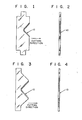
- the cutting area in each figure is designated by numeral 10.
- the cutting direction is indicated by the other arrows in Figures I and 3.
- the process of the invention it is possible to produce printing edge joints by cementing that withstand all stresses of the printing process, so that removal or detachment of the printing plate is reliably prevented, even for very long printing runs.
- the edge joint obtained is also resistant to the mechanical forces that occur during the repeated mounting and unmounting of the printing plate on and off the printing cylinder.
- the desired result can be achieved utilizing either the photopolymerizable printing element or the finished printing plate.
- the cut is made as a drawn-out diagonal cut of about 20-50°, and preferably about 30°.
- a cut may be advantageously made with an electrically heated cutting knife which has a narrow place, or notch, in its cutting area that corresponds to about half the width of the blade.
- Two embodiments of such a blade are depicted in Figures I, 2, 3, and 4.
- the cut is made through an inclined cutting section below the narrowest place in the blade.
- Preferred cutting points are designed by numeral 10.
- the cutting direction is indicated by the other arrows in Figures I and 3.
- the temperature at the cutting point of the blade should be between 400 and 350°C.
- Preferred flexographic printing plates within the invention contain elastomeric block copolymer binders ' as described in U.S. Patents 4,197,130, 4,323,636, 4,430,417, 4,266,005, and 4,394,435, which are incorporated herein by reference.
- elastomeric block copolymer binders include: styrene/butadiene/styrene; styrene/isoprene/styrene; styrene/butadiene or isoprene/homopolymer or copolymer of at least one aliphatic diene hydrocarbon with 4 to 5 carbon atoms; as well as three-block copolymers wherein the two terminal blocks are random copolymer blocks of styrene and butadiene and/or isoprene and where the central block is a homopolymer of butadiene or isoprene.
- the adhesive composition of the invention contains as an essential constituent a linear block copolymer of the general formula A-B-A, in which A stands for a polystyrene block and B stands for a polyisoprene-or polybutadiene block.
- the weight average molecular weight (M w) should be at least 80,000, and preferably, between 100,000 and 250,000.
- the adhesive composition contains at least one photopolymerizable ethylenically unsaturated monomer.
- Suitable ethylenically unsaturated monomers are known in large numbers from the literature. Individual examples are: ethylene glycol-diacrylate, diethylene glycol-diacrylate, glycerin-diacrylate, glycerin-triacrylate, ethylene glycol-dimethacrylate, 1,3-propanediol-dimethacrylate, 1,2,4-butanetriol- trimethacrylate, 1,4-cyclohexanediol-diacrylate, 1,4-hydroquinone-dimethacrylate, pentaerythritol tetramelhacrylate, trimethylol-propanetricrylate, 1,3-propanediol-diacrylate and -dimethacrylate, I,4-butanediol-diacrylate and -dimethacrylate
- the adhesive composition also contains at least one photoinitiator or an initiator system.
- photoinitiator or an initiator system. Examples are: benzophenone/Michler's ketone, hexaaryl-bisimidazoles/mercaptobenzoxazole, substituted thioxanthones/tertiary amines and benzyldimethylketal.
- the individual constituents of the adhesive composition are dissolved in an aromatic solvent.
- Suitable solvents are toluene, o,m, or p-xylene, benzene, alkylbenzene having an alkyl group of 1-4 C-atoms, and styrene, whereby xylene has proven particularly good.
- the adhesive composition generally contains 65-94.5 wt.-% of block copolymer, 5-30 wt.-% of monomer, and 0.5-5 wt.-% of initiator.
- the solids content in the aromatic solvent is 10-40 wt.-%.
- the aromatic solvent or solvent mixture be used as the sole solvent. In the presence of a polar solvent, no cementing occurs.
- the cut surfaces to be cemented are brushed thinly with the adhesive composition and are then held together overlapping with the application of pressure for 5-12 hrs at room temperature.
- the use of pressure during the holding time is required to achieve good adhesion, whereby the pressure must be 10-60 g/cm 2.
- the printing plate is then diffusely post-exposed with actinic illumination in a per se known manner.
- the post-exposure is preferably carried out for 5 to 30 min with a fluorescent tube exposure device or using ultraviolet tubes (10-40 W -3 /cm 2 ; range 300-400 nm).
- adhesive compositions as well as the traditional solvent systems, and also hot melt adhesives, contain adhesive materials based on block copolymers and, indeed, primarily on polystyrene-polybutadiene-polystyrene-and polystyrene-polyisoprene-polystyrene block copolymers, optionally also in combination with ethylenically unsaturated monomers.
- these adhesive compositions must additionally contain a tackifying' resin, preferably a hydrocarbon resin.
- Adhesives of this type are described, e.g., in U.S. Patent 4,269,747 and European Patent 000 4 102 - (U.S. 4,133,731).
- cements are unusable in the framework of the present invention, however; i.e., they do not cause adequate cementing. It was therefore surprising that such excellent cementing can be achieved with an adhesive composition of this type in the absence of the tackifying constituents and in combination with the other process steps.
- cemented point does not differ substantially from its surroundings in its mechanical and photographic properties.
- the tensile stress at 300% elongation given to characterize the elastic properties was measured in all examples according to DIN 53504 (without layer support).
- the cemented printing plates were swollen for 5 hrs in a solution of 30 vol-% of ethyl acetate and 70 vol-% of isopropanol, and then the tensile stress at 200% elongation was likewise measured according to DIN 53504.
- the Shore A hardness was determined according to DIN 53505. All measurements were carried out at 20°C.
- Two photopolymerizable flexographic printing elements produced according to the data of German Patent 2,215,090 (U.S. 4,323,636) are exposed through a line original for 40 min with actinic illumination at a distance of 7.6 cm with a series of 4 parallel 15 W ultraviolet lamps and then are washed off in a per se known manner with a suitable solvent and are dried.
- the edges of the two printing plates to be cemented then receive corresponding smooth diagonal cuts.
- the printing plates are fixed on a conventional cutting table in such a way that the relief side is uppermost.
- an electrically heatable cutting knife that has a narrow point, or notch, in its cutting area, is used to make a drawn-out diagonal cut of about 35°.
- An adhesive composition of the following composition is applied onto the cut surfaces of each of two printing plates produced according to the data of German OS 2 939 989 (U.S. 4,266,005) (Sample A), German OS 3 137 416 (U.S. 4,430,417) (Sample B), and European OS 76 588 (U.S. 4,394,435) (Sample C) and provided with a precision diagonal cut:
- the flexographic printing element is then fixed on the printing cylinder using double-sided adhesive tapes.
- An adhesive of the following composition is applied onto the cut surfaces:
- Adhesives of the following compositions are applied onto the cut surfaces of each two printing plates produced according to the data of Example 1 and provided with corresponding precision diagonal cuts:
- Adhesives of the following compositions are applied onto the cut surfaces of each two printing plates produced according to the data of Example I and provided with corresponding precision diagonal cuts:
- Adhesives of the following compositions are applied onto the cut surfaces of each two printing plates produced according to the data of Example 1 and provided with corresponding precision diagonal cuts:
Landscapes
- Chemical & Material Sciences (AREA)
- Organic Chemistry (AREA)
- Chemical Kinetics & Catalysis (AREA)
- General Chemical & Material Sciences (AREA)
- Photosensitive Polymer And Photoresist Processing (AREA)
- Polymerisation Methods In General (AREA)
Applications Claiming Priority (2)
| Application Number | Priority Date | Filing Date | Title |
|---|---|---|---|
| DE3600774A DE3600774C1 (de) | 1986-01-14 | 1986-01-14 | Verfahren zum Verkleben von photopolymerisierbaren Druckplatten oder Druckformen fuer den Flexodruck |
| DE3600774 | 1986-01-14 |
Publications (3)
| Publication Number | Publication Date |
|---|---|
| EP0230889A2 true EP0230889A2 (de) | 1987-08-05 |
| EP0230889A3 EP0230889A3 (en) | 1989-08-02 |
| EP0230889B1 EP0230889B1 (de) | 1993-06-16 |
Family
ID=6291765
Family Applications (1)
| Application Number | Title | Priority Date | Filing Date |
|---|---|---|---|
| EP87100254A Expired - Lifetime EP0230889B1 (de) | 1986-01-14 | 1987-01-10 | Verfahren zum Kleben von polymerisierbaren flexographischen Druckelementen oder -platten |
Country Status (6)
| Country | Link |
|---|---|
| US (1) | US4758500A (de) |
| EP (1) | EP0230889B1 (de) |
| JP (1) | JPS62165663A (de) |
| AU (1) | AU591222B2 (de) |
| CA (1) | CA1310852C (de) |
| DE (1) | DE3600774C1 (de) |
Cited By (1)
| Publication number | Priority date | Publication date | Assignee | Title |
|---|---|---|---|---|
| WO2004092841A3 (de) * | 2003-04-17 | 2005-03-17 | Basf Drucksysteme Gmbh | Verfahren zur herstellung von fotopolymerisierbaren, zylindrischen, endlos-nahtlosen flexodruckelementen und deren verwendung zur herstellung zylindrischer flexodruckformen |
Families Citing this family (18)
| Publication number | Priority date | Publication date | Assignee | Title |
|---|---|---|---|---|
| DE3704693A1 (de) * | 1987-02-14 | 1988-08-25 | Basf Ag | Verfahren zum nahtlosen und haftfesten verbinden der end- und/oder seitenbereiche von lichtempfindlichen schichten sowie verwendung der so verbundenen lichtempfindlichen schichten fuer die herstellung von druckformen |
| DE3712070A1 (de) * | 1987-04-09 | 1988-10-20 | Basf Ag | Verfahren zum verbinden der zugeschnittenen kanten photopolymerisierter flexodruckformen |
| IT1231223B (it) * | 1987-09-11 | 1991-11-26 | Cerutti Spa Off Mec | Metodo per giuntare le estremita' di una lastra per la stampa rotativa e giunzione cosi' ottenuta |
| DE3736180A1 (de) * | 1987-10-26 | 1989-05-03 | Basf Ag | Verfahren zum verschliessen und/oder abdichten von oeffnungen, hohl- oder zwischenraeumen bei auf formzylindern aufgebrachten druckplatten |
| DE3744243C2 (de) * | 1987-12-24 | 1995-12-07 | Du Pont Deutschland | Verbesserte photopolymerisierbare Aufzeichnungsmaterialien |
| JP3044689B2 (ja) * | 1994-10-14 | 2000-05-22 | 日本ゼオン株式会社 | 感光性エラストマー組成物及び感光性ゴム版 |
| US5798019A (en) * | 1995-09-29 | 1998-08-25 | E. I. Du Pont De Nemours And Company | Methods and apparatus for forming cylindrical photosensitive elements |
| DE19654103A1 (de) * | 1996-12-23 | 1998-06-25 | Du Pont Deutschland | Verfahren zum Kantenverkleben von photopolymerisierbaren Druckplatten oder Photopolymerdruckformen für den Flexodruck |
| DE19709037A1 (de) * | 1997-03-06 | 1998-09-10 | Du Pont Deutschland | Material und Verfahren zum Kantenabdecken von photopolymerisierbaren Druckplatten für den Flexodruck |
| US6007666A (en) * | 1997-08-20 | 1999-12-28 | General Packaging Products Inc. | Process for manufacturing laminated wrapping paper |
| US6989220B2 (en) | 2002-03-25 | 2006-01-24 | Macdermid Printing Solutions, Llc | Processless digitally imaged photopolymer elements using microspheres |
| US20050170287A1 (en) * | 2004-01-30 | 2005-08-04 | Kanga Rustom S. | Photosensitive printing sleeves and method of forming the same |
| DE102004050277A1 (de) | 2004-10-14 | 2006-04-27 | Basf Drucksysteme Gmbh | Verfahren und Vorrichtung zur Herstellung von fotopolymerisierbaren, zylindrischen, endlos-nahtlosen Flexodruckelementen |
| US7081331B2 (en) * | 2004-11-12 | 2006-07-25 | Ryan Vest | Method for thermally processing photosensitive printing sleeves |
| US7060417B2 (en) * | 2004-11-18 | 2006-06-13 | Chris Carlsen | Edge cure prevention process |
| US8359975B2 (en) | 2008-05-23 | 2013-01-29 | E.I. Du Pont De Nemours And Company | Process and apparatus having an adjustable heater |
| US8468940B2 (en) | 2009-06-19 | 2013-06-25 | E. I. Du Pont De Nemours And Company | Apparatus and process for exposing a printing form having a cylindrical support |
| EP3064353B1 (de) * | 2013-10-29 | 2019-11-27 | Toyobo Co., Ltd. | Verfahren zur herstellung eines zylindrischen reliefdruckplattenvorläufers |
Family Cites Families (14)
| Publication number | Priority date | Publication date | Assignee | Title |
|---|---|---|---|---|
| BE408744A (de) * | 1935-04-01 | |||
| US4323636A (en) * | 1971-04-01 | 1982-04-06 | E. I. Du Pont De Nemours And Company | Photosensitive block copolymer composition and elements |
| DE2350841C3 (de) * | 1972-11-20 | 1978-12-14 | Deutsche Semperit Gmbh, 8000 Muenchen | Verfahren zum Stoßverbinden von Lagen aus plastisch verformbarem Material, insbesondere von kautschukierten Stahldrahtlagen |
| JPS5329804A (en) * | 1976-08-30 | 1978-03-20 | Toray Industries | Method of connecting lines for relief printing plate |
| JPS53127004A (en) * | 1977-04-11 | 1978-11-06 | Asahi Chemical Ind | Photosensitive elastomer composition |
| DE2722896C3 (de) * | 1977-05-20 | 1986-01-02 | Du Pont de Nemours (Deutschland) GmbH, 4000 Düsseldorf | Verfahren zur Kantenverbindung lichthärtbarer thermoplastischer elastomerer Druckplatten |
| US4133731A (en) * | 1978-03-03 | 1979-01-09 | Shell Oil Company | Radiation cured, high temperature adhesive composition |
| JPS54130205A (en) * | 1978-03-29 | 1979-10-09 | Nippon Paint Co Ltd | Method and device for making photosensitive resin cylinder |
| JPS607261B2 (ja) * | 1978-10-02 | 1985-02-23 | 旭化成株式会社 | 感光性エラストマ−組成物 |
| JPS55142069A (en) * | 1979-04-23 | 1980-11-06 | Nippon Zeon Co Ltd | Crosslinking reactive tack adhesive composition |
| DE3125564C2 (de) * | 1981-06-29 | 1984-08-30 | Du Pont de Nemours (Deutschland) GmbH, 4000 Düsseldorf | Verfahren zur Verbesserung der Druckqualität von Hochdruckformen |
| DE3137416A1 (de) * | 1981-09-19 | 1983-03-31 | Basf Ag, 6700 Ludwigshafen | Fotopolymerisierbare gemische und elemente daraus |
| US4394435A (en) * | 1981-10-01 | 1983-07-19 | Uniroyal, Inc. | Syndiotactic polybutadiene composition for a photosensitive printing plate |
| GB8416571D0 (en) * | 1984-06-29 | 1984-08-01 | Asahi Chemical Industry Uk Ltd | Flexographic printing |
-
1986
- 1986-01-14 DE DE3600774A patent/DE3600774C1/de not_active Expired
- 1986-12-19 US US06/943,765 patent/US4758500A/en not_active Expired - Lifetime
-
1987
- 1987-01-10 EP EP87100254A patent/EP0230889B1/de not_active Expired - Lifetime
- 1987-01-12 AU AU67474/87A patent/AU591222B2/en not_active Ceased
- 1987-01-13 CA CA000527203A patent/CA1310852C/en not_active Expired - Lifetime
- 1987-01-13 JP JP62004220A patent/JPS62165663A/ja active Granted
Cited By (1)
| Publication number | Priority date | Publication date | Assignee | Title |
|---|---|---|---|---|
| WO2004092841A3 (de) * | 2003-04-17 | 2005-03-17 | Basf Drucksysteme Gmbh | Verfahren zur herstellung von fotopolymerisierbaren, zylindrischen, endlos-nahtlosen flexodruckelementen und deren verwendung zur herstellung zylindrischer flexodruckformen |
Also Published As
| Publication number | Publication date |
|---|---|
| US4758500A (en) | 1988-07-19 |
| DE3600774C1 (de) | 1987-05-07 |
| AU591222B2 (en) | 1989-11-30 |
| EP0230889B1 (de) | 1993-06-16 |
| CA1310852C (en) | 1992-12-01 |
| JPS62165663A (ja) | 1987-07-22 |
| JPH0529102B2 (de) | 1993-04-28 |
| EP0230889A3 (en) | 1989-08-02 |
| AU6747487A (en) | 1987-07-16 |
Similar Documents
| Publication | Publication Date | Title |
|---|---|---|
| US4758500A (en) | Process for the cementing of photopolymerizable flexographic printing elements or printing plates | |
| US4430417A (en) | Photopolymerizable mixtures containing elastomeric block polymers and photocurable elements produced therefrom | |
| US4320188A (en) | Photopolymerizable compositions containing elastomers and photo-curable elements made therefrom | |
| CA1166884A (en) | Multi-layer elements suitable for the production of printing plates and relief copies including an adhesive layer containing isocyanate hardened resin and oh-free polycarbonate | |
| US5035981A (en) | Multilayer, sheet-like, photosensitive recording material | |
| US6037101A (en) | Photosensitive mixture and recording material produced therefrom | |
| US4925775A (en) | Process for improving the ozone resistance of relief printing plates | |
| EP0096572B1 (de) | Photoempfindliches Material für Trockentransfer | |
| EP0209544A1 (de) | Grafisches design-material. | |
| GB2046285A (en) | Photosensitive compositions containing thermoplastic ionomeric elastomers useful in flexographic printing plates | |
| US5472824A (en) | Flexographic printing reliefs having increased flexibility | |
| JPH05273752A (ja) | 凸版印刷版製造用の感光性混合物 | |
| US5972565A (en) | Flexographic printing forms having resistance to UV-hardenable printing inks | |
| WO1992015046A1 (en) | Photosensitive elastomer composition | |
| EP0474178A1 (de) | Lichtempfindliches elastomeres Element mit verbesserter Lösungsmittelbeständigkeit | |
| EP0696761B1 (de) | Flexodruckplatten aus fotohärtbarem Elastomerzusammensetzungen | |
| JPS6348047B2 (de) | ||
| US4239609A (en) | Photopolymerizable coating and recording materials containing a photoinitiator and an organic halogen compound | |
| AU663339B2 (en) | Photosensitive elastomer polymer composition for flexographic printing plates processible in aqueous solutions | |
| JP4230552B2 (ja) | フレキソ印刷の光重合可能な印刷版または光重合体の印刷組版のエッジの被覆方法および/または開きまたはギャップの充填方法 | |
| CA2228530C (en) | Photopolymerizable composition for the production of flexographic printing forms for corrugated board printing | |
| CA2047302A1 (en) | Photopolymerizable printing plate for flexographic printing | |
| JP2735481B2 (ja) | フレクソグラフ印刷板用の光重合性印刷層 | |
| EP0679949A2 (de) | Photoempfindliches Übertragungsblatt | |
| MXPA00012690A (en) | Photo-curable polymer composition and flexographic printing plates containing the same |
Legal Events
| Date | Code | Title | Description |
|---|---|---|---|
| PUAI | Public reference made under article 153(3) epc to a published international application that has entered the european phase |
Free format text: ORIGINAL CODE: 0009012 |
|
| AK | Designated contracting states |
Kind code of ref document: A2 Designated state(s): BE FR GB IT NL SE |
|
| PUAL | Search report despatched |
Free format text: ORIGINAL CODE: 0009013 |
|
| AK | Designated contracting states |
Kind code of ref document: A3 Designated state(s): BE FR GB IT NL SE |
|
| 17P | Request for examination filed |
Effective date: 19900118 |
|
| 17Q | First examination report despatched |
Effective date: 19910426 |
|
| GRAA | (expected) grant |
Free format text: ORIGINAL CODE: 0009210 |
|
| AK | Designated contracting states |
Kind code of ref document: B1 Designated state(s): BE FR GB IT NL SE |
|
| ITF | It: translation for a ep patent filed | ||
| ET | Fr: translation filed | ||
| PLBE | No opposition filed within time limit |
Free format text: ORIGINAL CODE: 0009261 |
|
| STAA | Information on the status of an ep patent application or granted ep patent |
Free format text: STATUS: NO OPPOSITION FILED WITHIN TIME LIMIT |
|
| 26N | No opposition filed | ||
| EAL | Se: european patent in force in sweden |
Ref document number: 87100254.9 |
|
| PGFP | Annual fee paid to national office [announced via postgrant information from national office to epo] |
Ref country code: FR Payment date: 19951202 Year of fee payment: 10 |
|
| PGFP | Annual fee paid to national office [announced via postgrant information from national office to epo] |
Ref country code: NL Payment date: 19951207 Year of fee payment: 10 |
|
| PGFP | Annual fee paid to national office [announced via postgrant information from national office to epo] |
Ref country code: SE Payment date: 19951218 Year of fee payment: 10 |
|
| PGFP | Annual fee paid to national office [announced via postgrant information from national office to epo] |
Ref country code: BE Payment date: 19951219 Year of fee payment: 10 |
|
| PGFP | Annual fee paid to national office [announced via postgrant information from national office to epo] |
Ref country code: GB Payment date: 19951227 Year of fee payment: 10 |
|
| PG25 | Lapsed in a contracting state [announced via postgrant information from national office to epo] |
Ref country code: GB Effective date: 19970110 |
|
| PG25 | Lapsed in a contracting state [announced via postgrant information from national office to epo] |
Ref country code: SE Effective date: 19970111 |
|
| PG25 | Lapsed in a contracting state [announced via postgrant information from national office to epo] |
Ref country code: BE Effective date: 19970131 |
|
| BERE | Be: lapsed |
Owner name: E.I. DU PONT DE NEMOURS AND CY Effective date: 19970131 |
|
| PG25 | Lapsed in a contracting state [announced via postgrant information from national office to epo] |
Ref country code: NL Effective date: 19970801 |
|
| GBPC | Gb: european patent ceased through non-payment of renewal fee |
Effective date: 19970110 |
|
| PG25 | Lapsed in a contracting state [announced via postgrant information from national office to epo] |
Ref country code: FR Effective date: 19970930 |
|
| NLV4 | Nl: lapsed or anulled due to non-payment of the annual fee |
Effective date: 19970801 |
|
| EUG | Se: european patent has lapsed |
Ref document number: 87100254.9 |
|
| REG | Reference to a national code |
Ref country code: FR Ref legal event code: ST |
|
| PG25 | Lapsed in a contracting state [announced via postgrant information from national office to epo] |
Ref country code: IT Free format text: LAPSE BECAUSE OF NON-PAYMENT OF DUE FEES;WARNING: LAPSES OF ITALIAN PATENTS WITH EFFECTIVE DATE BEFORE 2007 MAY HAVE OCCURRED AT ANY TIME BEFORE 2007. THE CORRECT EFFECTIVE DATE MAY BE DIFFERENT FROM THE ONE RECORDED. Effective date: 20050110 |