EP0233105A1 - Compositions thérapeutiques à base de dérivés de 3-alkoxyflavones et nouveaux dérivés de 3-alkoxyflavones - Google Patents
Compositions thérapeutiques à base de dérivés de 3-alkoxyflavones et nouveaux dérivés de 3-alkoxyflavones Download PDFInfo
- Publication number
- EP0233105A1 EP0233105A1 EP87400107A EP87400107A EP0233105A1 EP 0233105 A1 EP0233105 A1 EP 0233105A1 EP 87400107 A EP87400107 A EP 87400107A EP 87400107 A EP87400107 A EP 87400107A EP 0233105 A1 EP0233105 A1 EP 0233105A1
- Authority
- EP
- European Patent Office
- Prior art keywords
- group
- hydroxy
- alkoxy
- hydrogen atom
- chosen
- Prior art date
- Legal status (The legal status is an assumption and is not a legal conclusion. Google has not performed a legal analysis and makes no representation as to the accuracy of the status listed.)
- Granted
Links
- 239000000203 mixture Substances 0.000 title claims abstract description 19
- 230000001225 therapeutic effect Effects 0.000 title claims description 11
- 125000002887 hydroxy group Chemical group [H]O* 0.000 claims description 85
- 125000004435 hydrogen atom Chemical group [H]* 0.000 claims description 59
- 125000003051 glycosyloxy group Chemical group 0.000 claims description 36
- 125000003545 alkoxy group Chemical group 0.000 claims description 30
- 150000001875 compounds Chemical class 0.000 claims description 25
- -1 benzyloxy, methylenedioxy Chemical group 0.000 claims description 23
- 238000000034 method Methods 0.000 claims description 19
- 150000003839 salts Chemical class 0.000 claims description 15
- 125000002861 (C1-C4) alkanoyl group Chemical group 0.000 claims description 13
- 125000002924 primary amino group Chemical group [H]N([H])* 0.000 claims description 12
- 125000005843 halogen group Chemical group 0.000 claims description 11
- 125000004178 (C1-C4) alkyl group Chemical group 0.000 claims description 10
- HVQAJTFOCKOKIN-UHFFFAOYSA-N flavonol Chemical compound O1C2=CC=CC=C2C(=O)C(O)=C1C1=CC=CC=C1 HVQAJTFOCKOKIN-UHFFFAOYSA-N 0.000 claims description 10
- 238000002360 preparation method Methods 0.000 claims description 10
- 238000005804 alkylation reaction Methods 0.000 claims description 9
- 125000001820 oxy group Chemical group [*:1]O[*:2] 0.000 claims description 8
- 125000000051 benzyloxy group Chemical group [H]C1=C([H])C([H])=C(C([H])=C1[H])C([H])([H])O* 0.000 claims description 7
- 229910052739 hydrogen Inorganic materials 0.000 claims description 7
- 239000001257 hydrogen Substances 0.000 claims description 7
- 230000029936 alkylation Effects 0.000 claims description 6
- 125000003178 carboxy group Chemical group [H]OC(*)=O 0.000 claims description 6
- 125000004093 cyano group Chemical group *C#N 0.000 claims description 6
- 125000004356 hydroxy functional group Chemical group O* 0.000 claims description 6
- 125000000449 nitro group Chemical group [O-][N+](*)=O 0.000 claims description 6
- DQFBYFPFKXHELB-UHFFFAOYSA-N Chalcone Natural products C=1C=CC=CC=1C(=O)C=CC1=CC=CC=C1 DQFBYFPFKXHELB-UHFFFAOYSA-N 0.000 claims description 5
- 125000002915 carbonyl group Chemical group [*:2]C([*:1])=O 0.000 claims description 5
- 235000005513 chalcones Nutrition 0.000 claims description 5
- 230000003647 oxidation Effects 0.000 claims description 5
- 238000007254 oxidation reaction Methods 0.000 claims description 5
- 125000002023 trifluoromethyl group Chemical group FC(F)(F)* 0.000 claims description 5
- 125000001589 carboacyl group Chemical group 0.000 claims description 4
- DQFBYFPFKXHELB-VAWYXSNFSA-N trans-chalcone Chemical compound C=1C=CC=CC=1C(=O)\C=C\C1=CC=CC=C1 DQFBYFPFKXHELB-VAWYXSNFSA-N 0.000 claims description 3
- 125000004429 atom Chemical group 0.000 claims description 2
- DGPHAUBUAGDZCS-UHFFFAOYSA-N 2-(2,3-dimethoxyphenyl)-3,5,6,7,8-pentamethoxychromen-4-one Chemical compound COC1=CC=CC(C2=C(C(=O)C3=C(OC)C(OC)=C(OC)C(OC)=C3O2)OC)=C1OC DGPHAUBUAGDZCS-UHFFFAOYSA-N 0.000 claims 2
- 239000003153 chemical reaction reagent Substances 0.000 claims 2
- 125000001424 substituent group Chemical group 0.000 claims 2
- LMBFAGIMSUYTBN-MPZNNTNKSA-N teixobactin Chemical compound C([C@H](C(=O)N[C@@H]([C@@H](C)CC)C(=O)N[C@@H](CO)C(=O)N[C@H](CCC(N)=O)C(=O)N[C@H]([C@@H](C)CC)C(=O)N[C@@H]([C@@H](C)CC)C(=O)N[C@@H](CO)C(=O)N[C@H]1C(N[C@@H](C)C(=O)N[C@@H](C[C@@H]2NC(=N)NC2)C(=O)N[C@H](C(=O)O[C@H]1C)[C@@H](C)CC)=O)NC)C1=CC=CC=C1 LMBFAGIMSUYTBN-MPZNNTNKSA-N 0.000 claims 2
- 229910052736 halogen Inorganic materials 0.000 claims 1
- 150000002367 halogens Chemical class 0.000 claims 1
- 101150114322 ro gene Proteins 0.000 claims 1
- 230000000840 anti-viral effect Effects 0.000 abstract description 11
- LFQSCWFLJHTTHZ-UHFFFAOYSA-N Ethanol Chemical compound CCO LFQSCWFLJHTTHZ-UHFFFAOYSA-N 0.000 description 18
- OKKJLVBELUTLKV-UHFFFAOYSA-N Methanol Chemical compound OC OKKJLVBELUTLKV-UHFFFAOYSA-N 0.000 description 9
- 239000000243 solution Substances 0.000 description 9
- 241000700605 Viruses Species 0.000 description 8
- XLYOFNOQVPJJNP-UHFFFAOYSA-N water Substances O XLYOFNOQVPJJNP-UHFFFAOYSA-N 0.000 description 8
- VEXZGXHMUGYJMC-UHFFFAOYSA-N Hydrochloric acid Chemical compound Cl VEXZGXHMUGYJMC-UHFFFAOYSA-N 0.000 description 7
- KWYUFKZDYYNOTN-UHFFFAOYSA-M Potassium hydroxide Chemical compound [OH-].[K+] KWYUFKZDYYNOTN-UHFFFAOYSA-M 0.000 description 7
- QTBSBXVTEAMEQO-UHFFFAOYSA-N Acetic acid Chemical compound CC(O)=O QTBSBXVTEAMEQO-UHFFFAOYSA-N 0.000 description 6
- XEKOWRVHYACXOJ-UHFFFAOYSA-N Ethyl acetate Chemical compound CCOC(C)=O XEKOWRVHYACXOJ-UHFFFAOYSA-N 0.000 description 6
- 239000002253 acid Substances 0.000 description 6
- 238000010790 dilution Methods 0.000 description 6
- 239000012895 dilution Substances 0.000 description 6
- VLKZOEOYAKHREP-UHFFFAOYSA-N n-Hexane Chemical compound CCCCCC VLKZOEOYAKHREP-UHFFFAOYSA-N 0.000 description 6
- SSXJHQZOHUYEGD-UHFFFAOYSA-N 3-Methoxynobiletin Chemical compound C1=C(OC)C(OC)=CC=C1C1=C(OC)C(=O)C2=C(OC)C(OC)=C(OC)C(OC)=C2O1 SSXJHQZOHUYEGD-UHFFFAOYSA-N 0.000 description 5
- 238000001914 filtration Methods 0.000 description 5
- 239000002244 precipitate Substances 0.000 description 5
- MHAJPDPJQMAIIY-UHFFFAOYSA-N Hydrogen peroxide Chemical compound OO MHAJPDPJQMAIIY-UHFFFAOYSA-N 0.000 description 4
- 150000007513 acids Chemical class 0.000 description 4
- 125000000217 alkyl group Chemical group 0.000 description 4
- 230000000120 cytopathologic effect Effects 0.000 description 4
- 231100000636 lethal dose Toxicity 0.000 description 4
- CSCPPACGZOOCGX-UHFFFAOYSA-N Acetone Chemical compound CC(C)=O CSCPPACGZOOCGX-UHFFFAOYSA-N 0.000 description 3
- WMFOQBRAJBCJND-UHFFFAOYSA-M Lithium hydroxide Chemical compound [Li+].[OH-] WMFOQBRAJBCJND-UHFFFAOYSA-M 0.000 description 3
- SJRJJKPEHAURKC-UHFFFAOYSA-N N-Methylmorpholine Chemical compound CN1CCOCC1 SJRJJKPEHAURKC-UHFFFAOYSA-N 0.000 description 3
- MUBZPKHOEPUJKR-UHFFFAOYSA-N Oxalic acid Chemical compound OC(=O)C(O)=O MUBZPKHOEPUJKR-UHFFFAOYSA-N 0.000 description 3
- HEMHJVSKTPXQMS-UHFFFAOYSA-M Sodium hydroxide Chemical compound [OH-].[Na+] HEMHJVSKTPXQMS-UHFFFAOYSA-M 0.000 description 3
- 238000006243 chemical reaction Methods 0.000 description 3
- 238000004587 chromatography analysis Methods 0.000 description 3
- 239000002904 solvent Substances 0.000 description 3
- 230000003612 virological effect Effects 0.000 description 3
- CDQGCHBSQIWYES-UHFFFAOYSA-N 2-(4-hydroxyphenyl)-3-methoxychromen-4-one Chemical compound O1C2=CC=CC=C2C(=O)C(OC)=C1C1=CC=C(O)C=C1 CDQGCHBSQIWYES-UHFFFAOYSA-N 0.000 description 2
- HZAXFHJVJLSVMW-UHFFFAOYSA-N 2-Aminoethan-1-ol Chemical compound NCCO HZAXFHJVJLSVMW-UHFFFAOYSA-N 0.000 description 2
- GKWVFAJEXKBCSA-UHFFFAOYSA-N 3-methoxy-2-(4-phenylmethoxyphenyl)chromen-4-one Chemical compound O1C2=CC=CC=C2C(=O)C(OC)=C1C(C=C1)=CC=C1OCC1=CC=CC=C1 GKWVFAJEXKBCSA-UHFFFAOYSA-N 0.000 description 2
- HEDRZPFGACZZDS-UHFFFAOYSA-N Chloroform Chemical compound ClC(Cl)Cl HEDRZPFGACZZDS-UHFFFAOYSA-N 0.000 description 2
- RTZKZFJDLAIYFH-UHFFFAOYSA-N Diethyl ether Chemical compound CCOCC RTZKZFJDLAIYFH-UHFFFAOYSA-N 0.000 description 2
- IAZDPXIOMUYVGZ-UHFFFAOYSA-N Dimethylsulphoxide Chemical compound CS(C)=O IAZDPXIOMUYVGZ-UHFFFAOYSA-N 0.000 description 2
- 241000196324 Embryophyta Species 0.000 description 2
- 241000709661 Enterovirus Species 0.000 description 2
- VZCYOOQTPOCHFL-OWOJBTEDSA-N Fumaric acid Chemical compound OC(=O)\C=C\C(O)=O VZCYOOQTPOCHFL-OWOJBTEDSA-N 0.000 description 2
- UFHFLCQGNIYNRP-UHFFFAOYSA-N Hydrogen Chemical compound [H][H] UFHFLCQGNIYNRP-UHFFFAOYSA-N 0.000 description 2
- YNAVUWVOSKDBBP-UHFFFAOYSA-N Morpholine Chemical compound C1COCCN1 YNAVUWVOSKDBBP-UHFFFAOYSA-N 0.000 description 2
- NBIIXXVUZAFLBC-UHFFFAOYSA-N Phosphoric acid Chemical compound OP(O)(O)=O NBIIXXVUZAFLBC-UHFFFAOYSA-N 0.000 description 2
- 241000709664 Picornaviridae Species 0.000 description 2
- QAOWNCQODCNURD-UHFFFAOYSA-N Sulfuric acid Chemical compound OS(O)(=O)=O QAOWNCQODCNURD-UHFFFAOYSA-N 0.000 description 2
- 235000011054 acetic acid Nutrition 0.000 description 2
- 239000004480 active ingredient Substances 0.000 description 2
- 230000004071 biological effect Effects 0.000 description 2
- GDTBXPJZTBHREO-UHFFFAOYSA-N bromine Chemical compound BrBr GDTBXPJZTBHREO-UHFFFAOYSA-N 0.000 description 2
- 150000001789 chalcones Chemical class 0.000 description 2
- 231100000433 cytotoxic Toxicity 0.000 description 2
- 230000001472 cytotoxic effect Effects 0.000 description 2
- XBDQKXXYIPTUBI-UHFFFAOYSA-N dimethylselenoniopropionate Natural products CCC(O)=O XBDQKXXYIPTUBI-UHFFFAOYSA-N 0.000 description 2
- 201000010099 disease Diseases 0.000 description 2
- 208000037265 diseases, disorders, signs and symptoms Diseases 0.000 description 2
- 239000006196 drop Substances 0.000 description 2
- 230000000694 effects Effects 0.000 description 2
- 239000003480 eluent Substances 0.000 description 2
- 238000000605 extraction Methods 0.000 description 2
- 229910052500 inorganic mineral Inorganic materials 0.000 description 2
- JVTAAEKCZFNVCJ-UHFFFAOYSA-N lactic acid Chemical compound CC(O)C(O)=O JVTAAEKCZFNVCJ-UHFFFAOYSA-N 0.000 description 2
- 239000007788 liquid Substances 0.000 description 2
- 238000012423 maintenance Methods 0.000 description 2
- BDAGIHXWWSANSR-UHFFFAOYSA-N methanoic acid Natural products OC=O BDAGIHXWWSANSR-UHFFFAOYSA-N 0.000 description 2
- 239000011707 mineral Substances 0.000 description 2
- BWHMMNNQKKPAPP-UHFFFAOYSA-L potassium carbonate Chemical compound [K+].[K+].[O-]C([O-])=O BWHMMNNQKKPAPP-UHFFFAOYSA-L 0.000 description 2
- 239000000047 product Substances 0.000 description 2
- 239000007787 solid Substances 0.000 description 2
- 239000000725 suspension Substances 0.000 description 2
- 231100001274 therapeutic index Toxicity 0.000 description 2
- 238000004448 titration Methods 0.000 description 2
- 210000003501 vero cell Anatomy 0.000 description 2
- CUGDYSSBTWBKII-LXGUWJNJSA-N (2r,3r,4r,5s)-6-(dimethylamino)hexane-1,2,3,4,5-pentol Chemical compound CN(C)C[C@H](O)[C@@H](O)[C@H](O)[C@H](O)CO CUGDYSSBTWBKII-LXGUWJNJSA-N 0.000 description 1
- 0 *C(C(C(N)=C1*)N)C(OC(c(c(N)c2*)*(*)c(*)c2N)=C2*)=C1C2=O Chemical compound *C(C(C(N)=C1*)N)C(OC(c(c(N)c2*)*(*)c(*)c2N)=C2*)=C1C2=O 0.000 description 1
- PQZKTWBQDPHGOU-UHFFFAOYSA-N 1-(2-hydroxyphenyl)-3-(4-phenylmethoxyphenyl)prop-2-en-1-one Chemical compound OC1=CC=CC=C1C(=O)C=CC(C=C1)=CC=C1OCC1=CC=CC=C1 PQZKTWBQDPHGOU-UHFFFAOYSA-N 0.000 description 1
- ZWVHTXAYIKBMEE-UHFFFAOYSA-N 2-hydroxyacetophenone Chemical compound OCC(=O)C1=CC=CC=C1 ZWVHTXAYIKBMEE-UHFFFAOYSA-N 0.000 description 1
- PBEJTRAJWCNHRS-UHFFFAOYSA-N 2-phenylmethoxybenzaldehyde Chemical compound O=CC1=CC=CC=C1OCC1=CC=CC=C1 PBEJTRAJWCNHRS-UHFFFAOYSA-N 0.000 description 1
- BMYNFMYTOJXKLE-UHFFFAOYSA-N 3-azaniumyl-2-hydroxypropanoate Chemical compound NCC(O)C(O)=O BMYNFMYTOJXKLE-UHFFFAOYSA-N 0.000 description 1
- HYCPSIKUWOEHAR-UHFFFAOYSA-N 3-hydroxy-2-(4-phenylmethoxyphenyl)chromen-4-one Chemical compound O1C2=CC=CC=C2C(=O)C(O)=C1C(C=C1)=CC=C1OCC1=CC=CC=C1 HYCPSIKUWOEHAR-UHFFFAOYSA-N 0.000 description 1
- ZAIANDVQAMEDFL-UHFFFAOYSA-N 3-methoxy-2-phenylchromen-4-one Chemical class O1C2=CC=CC=C2C(=O)C(OC)=C1C1=CC=CC=C1 ZAIANDVQAMEDFL-UHFFFAOYSA-N 0.000 description 1
- OSWFIVFLDKOXQC-UHFFFAOYSA-N 4-(3-methoxyphenyl)aniline Chemical compound COC1=CC=CC(C=2C=CC(N)=CC=2)=C1 OSWFIVFLDKOXQC-UHFFFAOYSA-N 0.000 description 1
- 208000031295 Animal disease Diseases 0.000 description 1
- KZBUYRJDOAKODT-UHFFFAOYSA-N Chlorine Chemical compound ClCl KZBUYRJDOAKODT-UHFFFAOYSA-N 0.000 description 1
- 241000709687 Coxsackievirus Species 0.000 description 1
- FEWJPZIEWOKRBE-JCYAYHJZSA-N Dextrotartaric acid Chemical compound OC(=O)[C@H](O)[C@@H](O)C(O)=O FEWJPZIEWOKRBE-JCYAYHJZSA-N 0.000 description 1
- YXHKONLOYHBTNS-UHFFFAOYSA-N Diazomethane Chemical compound C=[N+]=[N-] YXHKONLOYHBTNS-UHFFFAOYSA-N 0.000 description 1
- 241000991587 Enterovirus C Species 0.000 description 1
- CEAZRRDELHUEMR-URQXQFDESA-N Gentamicin Chemical compound O1[C@H](C(C)NC)CC[C@@H](N)[C@H]1O[C@H]1[C@H](O)[C@@H](O[C@@H]2[C@@H]([C@@H](NC)[C@@](C)(O)CO2)O)[C@H](N)C[C@@H]1N CEAZRRDELHUEMR-URQXQFDESA-N 0.000 description 1
- 229930182566 Gentamicin Natural products 0.000 description 1
- 241000709721 Hepatovirus A Species 0.000 description 1
- 231100000111 LD50 Toxicity 0.000 description 1
- 241000605411 Lloydia Species 0.000 description 1
- 241001465754 Metazoa Species 0.000 description 1
- MBBZMMPHUWSWHV-BDVNFPICSA-N N-methylglucamine Chemical compound CNC[C@H](O)[C@@H](O)[C@H](O)[C@H](O)CO MBBZMMPHUWSWHV-BDVNFPICSA-N 0.000 description 1
- GRYLNZFGIOXLOG-UHFFFAOYSA-N Nitric acid Chemical compound O[N+]([O-])=O GRYLNZFGIOXLOG-UHFFFAOYSA-N 0.000 description 1
- 208000000474 Poliomyelitis Diseases 0.000 description 1
- VYPSYNLAJGMNEJ-UHFFFAOYSA-N Silicium dioxide Chemical compound O=[Si]=O VYPSYNLAJGMNEJ-UHFFFAOYSA-N 0.000 description 1
- KDYFGRWQOYBRFD-UHFFFAOYSA-N Succinic acid Natural products OC(=O)CCC(O)=O KDYFGRWQOYBRFD-UHFFFAOYSA-N 0.000 description 1
- FEWJPZIEWOKRBE-UHFFFAOYSA-N Tartaric acid Natural products [H+].[H+].[O-]C(=O)C(O)C(O)C([O-])=O FEWJPZIEWOKRBE-UHFFFAOYSA-N 0.000 description 1
- UGAPHEBNTGUMBB-UHFFFAOYSA-N acetic acid;ethyl acetate Chemical compound CC(O)=O.CCOC(C)=O UGAPHEBNTGUMBB-UHFFFAOYSA-N 0.000 description 1
- 230000002378 acidificating effect Effects 0.000 description 1
- 229910000147 aluminium phosphate Inorganic materials 0.000 description 1
- 150000008064 anhydrides Chemical class 0.000 description 1
- 230000002744 anti-aggregatory effect Effects 0.000 description 1
- 159000000032 aromatic acids Chemical class 0.000 description 1
- 230000015572 biosynthetic process Effects 0.000 description 1
- 238000009835 boiling Methods 0.000 description 1
- 229910052794 bromium Inorganic materials 0.000 description 1
- KDYFGRWQOYBRFD-NUQCWPJISA-N butanedioic acid Chemical compound O[14C](=O)CC[14C](O)=O KDYFGRWQOYBRFD-NUQCWPJISA-N 0.000 description 1
- AXCZMVOFGPJBDE-UHFFFAOYSA-L calcium dihydroxide Chemical compound [OH-].[OH-].[Ca+2] AXCZMVOFGPJBDE-UHFFFAOYSA-L 0.000 description 1
- 239000000920 calcium hydroxide Substances 0.000 description 1
- 229910001861 calcium hydroxide Inorganic materials 0.000 description 1
- 244000309466 calf Species 0.000 description 1
- 239000002775 capsule Substances 0.000 description 1
- 210000004027 cell Anatomy 0.000 description 1
- 230000010261 cell growth Effects 0.000 description 1
- 239000013553 cell monolayer Substances 0.000 description 1
- 239000000460 chlorine Substances 0.000 description 1
- 229910052801 chlorine Inorganic materials 0.000 description 1
- 238000009833 condensation Methods 0.000 description 1
- 230000005494 condensation Effects 0.000 description 1
- 238000010586 diagram Methods 0.000 description 1
- ZBCBWPMODOFKDW-UHFFFAOYSA-N diethanolamine Chemical compound OCCNCCO ZBCBWPMODOFKDW-UHFFFAOYSA-N 0.000 description 1
- VAYGXNSJCAHWJZ-UHFFFAOYSA-N dimethyl sulfate Chemical compound COS(=O)(=O)OC VAYGXNSJCAHWJZ-UHFFFAOYSA-N 0.000 description 1
- BNIILDVGGAEEIG-UHFFFAOYSA-L disodium hydrogen phosphate Chemical compound [Na+].[Na+].OP([O-])([O-])=O BNIILDVGGAEEIG-UHFFFAOYSA-L 0.000 description 1
- 150000002148 esters Chemical class 0.000 description 1
- XTLNYNMNUCLWEZ-UHFFFAOYSA-N ethanol;propan-2-one Chemical compound CCO.CC(C)=O XTLNYNMNUCLWEZ-UHFFFAOYSA-N 0.000 description 1
- 238000001704 evaporation Methods 0.000 description 1
- 230000008020 evaporation Effects 0.000 description 1
- 230000007717 exclusion Effects 0.000 description 1
- 239000003889 eye drop Substances 0.000 description 1
- 229940012356 eye drops Drugs 0.000 description 1
- 239000000706 filtrate Substances 0.000 description 1
- 229910052731 fluorine Inorganic materials 0.000 description 1
- 125000001153 fluoro group Chemical group F* 0.000 description 1
- 235000019253 formic acid Nutrition 0.000 description 1
- 239000001530 fumaric acid Substances 0.000 description 1
- 235000011087 fumaric acid Nutrition 0.000 description 1
- 238000004128 high performance liquid chromatography Methods 0.000 description 1
- 238000000338 in vitro Methods 0.000 description 1
- 230000002401 inhibitory effect Effects 0.000 description 1
- 229910052740 iodine Inorganic materials 0.000 description 1
- 239000011630 iodine Substances 0.000 description 1
- PNDPGZBMCMUPRI-UHFFFAOYSA-N iodine Chemical compound II PNDPGZBMCMUPRI-UHFFFAOYSA-N 0.000 description 1
- INQOMBQAUSQDDS-UHFFFAOYSA-N iodomethane Chemical compound IC INQOMBQAUSQDDS-UHFFFAOYSA-N 0.000 description 1
- 239000004310 lactic acid Substances 0.000 description 1
- 235000014655 lactic acid Nutrition 0.000 description 1
- 238000002803 maceration Methods 0.000 description 1
- VTHJTEIRLNZDEV-UHFFFAOYSA-L magnesium dihydroxide Chemical compound [OH-].[OH-].[Mg+2] VTHJTEIRLNZDEV-UHFFFAOYSA-L 0.000 description 1
- 239000000347 magnesium hydroxide Substances 0.000 description 1
- 229910001862 magnesium hydroxide Inorganic materials 0.000 description 1
- 238000004519 manufacturing process Methods 0.000 description 1
- 229910052751 metal Inorganic materials 0.000 description 1
- 239000002184 metal Substances 0.000 description 1
- XELZGAJCZANUQH-UHFFFAOYSA-N methyl 1-acetylthieno[3,2-c]pyrazole-5-carboxylate Chemical compound CC(=O)N1N=CC2=C1C=C(C(=O)OC)S2 XELZGAJCZANUQH-UHFFFAOYSA-N 0.000 description 1
- JZMJDSHXVKJFKW-UHFFFAOYSA-M methyl sulfate(1-) Chemical compound COS([O-])(=O)=O JZMJDSHXVKJFKW-UHFFFAOYSA-M 0.000 description 1
- 239000012022 methylating agents Substances 0.000 description 1
- 239000002324 mouth wash Substances 0.000 description 1
- 229910017604 nitric acid Inorganic materials 0.000 description 1
- 239000002674 ointment Substances 0.000 description 1
- 150000007524 organic acids Chemical class 0.000 description 1
- 235000005985 organic acids Nutrition 0.000 description 1
- 150000007530 organic bases Chemical class 0.000 description 1
- 235000006408 oxalic acid Nutrition 0.000 description 1
- WLJNZVDCPSBLRP-UHFFFAOYSA-N pamoic acid Chemical compound C1=CC=C2C(CC=3C4=CC=CC=C4C=C(C=3O)C(=O)O)=C(O)C(C(O)=O)=CC2=C1 WLJNZVDCPSBLRP-UHFFFAOYSA-N 0.000 description 1
- 238000007911 parenteral administration Methods 0.000 description 1
- 238000005192 partition Methods 0.000 description 1
- 238000005325 percolation Methods 0.000 description 1
- JRKICGRDRMAZLK-UHFFFAOYSA-L peroxydisulfate Chemical compound [O-]S(=O)(=O)OOS([O-])(=O)=O JRKICGRDRMAZLK-UHFFFAOYSA-L 0.000 description 1
- 239000003208 petroleum Substances 0.000 description 1
- 239000008194 pharmaceutical composition Substances 0.000 description 1
- 239000000546 pharmaceutical excipient Substances 0.000 description 1
- CHKVPAROMQMJNQ-UHFFFAOYSA-M potassium bisulfate Chemical compound [K+].OS([O-])(=O)=O CHKVPAROMQMJNQ-UHFFFAOYSA-M 0.000 description 1
- 229910000027 potassium carbonate Inorganic materials 0.000 description 1
- 230000003449 preventive effect Effects 0.000 description 1
- 235000019260 propionic acid Nutrition 0.000 description 1
- IUVKMZGDUIUOCP-BTNSXGMBSA-N quinbolone Chemical compound O([C@H]1CC[C@H]2[C@H]3[C@@H]([C@]4(C=CC(=O)C=C4CC3)C)CC[C@@]21C)C1=CCCC1 IUVKMZGDUIUOCP-BTNSXGMBSA-N 0.000 description 1
- 238000010992 reflux Methods 0.000 description 1
- 210000002966 serum Anatomy 0.000 description 1
- 239000000741 silica gel Substances 0.000 description 1
- 229910002027 silica gel Inorganic materials 0.000 description 1
- 238000003756 stirring Methods 0.000 description 1
- 239000000829 suppository Substances 0.000 description 1
- 238000003786 synthesis reaction Methods 0.000 description 1
- 239000003826 tablet Substances 0.000 description 1
- 239000011975 tartaric acid Substances 0.000 description 1
- 235000002906 tartaric acid Nutrition 0.000 description 1
- 238000004809 thin layer chromatography Methods 0.000 description 1
- 125000005147 toluenesulfonyl group Chemical group C=1(C(=CC=CC1)S(=O)(=O)*)C 0.000 description 1
- 238000011200 topical administration Methods 0.000 description 1
- 230000000699 topical effect Effects 0.000 description 1
- VZCYOOQTPOCHFL-UHFFFAOYSA-N trans-butenedioic acid Natural products OC(=O)C=CC(O)=O VZCYOOQTPOCHFL-UHFFFAOYSA-N 0.000 description 1
- LENZDBCJOHFCAS-UHFFFAOYSA-N tris Chemical compound OCC(N)(CO)CO LENZDBCJOHFCAS-UHFFFAOYSA-N 0.000 description 1
- 108700026220 vif Genes Proteins 0.000 description 1
Classifications
-
- A—HUMAN NECESSITIES
- A61—MEDICAL OR VETERINARY SCIENCE; HYGIENE
- A61K—PREPARATIONS FOR MEDICAL, DENTAL OR TOILETRY PURPOSES
- A61K31/00—Medicinal preparations containing organic active ingredients
- A61K31/33—Heterocyclic compounds
- A61K31/335—Heterocyclic compounds having oxygen as the only ring hetero atom, e.g. fungichromin
- A61K31/35—Heterocyclic compounds having oxygen as the only ring hetero atom, e.g. fungichromin having six-membered rings with one oxygen as the only ring hetero atom
-
- A—HUMAN NECESSITIES
- A61—MEDICAL OR VETERINARY SCIENCE; HYGIENE
- A61P—SPECIFIC THERAPEUTIC ACTIVITY OF CHEMICAL COMPOUNDS OR MEDICINAL PREPARATIONS
- A61P31/00—Antiinfectives, i.e. antibiotics, antiseptics, chemotherapeutics
- A61P31/12—Antivirals
-
- C—CHEMISTRY; METALLURGY
- C07—ORGANIC CHEMISTRY
- C07D—HETEROCYCLIC COMPOUNDS
- C07D311/00—Heterocyclic compounds containing six-membered rings having one oxygen atom as the only hetero atom, condensed with other rings
- C07D311/02—Heterocyclic compounds containing six-membered rings having one oxygen atom as the only hetero atom, condensed with other rings ortho- or peri-condensed with carbocyclic rings or ring systems
- C07D311/04—Benzo[b]pyrans, not hydrogenated in the carbocyclic ring
- C07D311/22—Benzo[b]pyrans, not hydrogenated in the carbocyclic ring with oxygen or sulfur atoms directly attached in position 4
- C07D311/26—Benzo[b]pyrans, not hydrogenated in the carbocyclic ring with oxygen or sulfur atoms directly attached in position 4 with aromatic rings attached in position 2 or 3
- C07D311/28—Benzo[b]pyrans, not hydrogenated in the carbocyclic ring with oxygen or sulfur atoms directly attached in position 4 with aromatic rings attached in position 2 or 3 with aromatic rings attached in position 2 only
- C07D311/30—Benzo[b]pyrans, not hydrogenated in the carbocyclic ring with oxygen or sulfur atoms directly attached in position 4 with aromatic rings attached in position 2 or 3 with aromatic rings attached in position 2 only not hydrogenated in the hetero ring, e.g. flavones
-
- C—CHEMISTRY; METALLURGY
- C07—ORGANIC CHEMISTRY
- C07H—SUGARS; DERIVATIVES THEREOF; NUCLEOSIDES; NUCLEOTIDES; NUCLEIC ACIDS
- C07H15/00—Compounds containing hydrocarbon or substituted hydrocarbon radicals directly attached to hetero atoms of saccharide radicals
- C07H15/26—Acyclic or carbocyclic radicals, substituted by hetero rings
-
- C—CHEMISTRY; METALLURGY
- C07—ORGANIC CHEMISTRY
- C07H—SUGARS; DERIVATIVES THEREOF; NUCLEOSIDES; NUCLEOTIDES; NUCLEIC ACIDS
- C07H17/00—Compounds containing heterocyclic radicals directly attached to hetero atoms of saccharide radicals
- C07H17/04—Heterocyclic radicals containing only oxygen as ring hetero atoms
-
- C—CHEMISTRY; METALLURGY
- C07—ORGANIC CHEMISTRY
- C07H—SUGARS; DERIVATIVES THEREOF; NUCLEOSIDES; NUCLEOTIDES; NUCLEIC ACIDS
- C07H17/00—Compounds containing heterocyclic radicals directly attached to hetero atoms of saccharide radicals
- C07H17/04—Heterocyclic radicals containing only oxygen as ring hetero atoms
- C07H17/06—Benzopyran radicals
- C07H17/065—Benzo[b]pyrans
- C07H17/07—Benzo[b]pyran-4-ones
-
- Y—GENERAL TAGGING OF NEW TECHNOLOGICAL DEVELOPMENTS; GENERAL TAGGING OF CROSS-SECTIONAL TECHNOLOGIES SPANNING OVER SEVERAL SECTIONS OF THE IPC; TECHNICAL SUBJECTS COVERED BY FORMER USPC CROSS-REFERENCE ART COLLECTIONS [XRACs] AND DIGESTS
- Y02—TECHNOLOGIES OR APPLICATIONS FOR MITIGATION OR ADAPTATION AGAINST CLIMATE CHANGE
- Y02A—TECHNOLOGIES FOR ADAPTATION TO CLIMATE CHANGE
- Y02A50/00—TECHNOLOGIES FOR ADAPTATION TO CLIMATE CHANGE in human health protection, e.g. against extreme weather
- Y02A50/30—Against vector-borne diseases, e.g. mosquito-borne, fly-borne, tick-borne or waterborne diseases whose impact is exacerbated by climate change
Definitions
- the present invention relates to therapeutic compositions based on derivatives of 3-e lavones alkoxy having in particular antiviral activity.
- 3-alkoxyflavone derivatives are compounds with the following basic structure wherein Ro is an alkyl group.
- derivatives of 3-alkoxyflavones have been described which exhibit antiviral activity.
- the derivatives have in position 5 a hydroxy group or a derivative group and in position 7 a hydroxy or alkoxy group, positions 6 and 8 being unsubstituted. These compounds are described as inhibiting the reproduction of rhinovirus, enterovirus, coxsackie-virus and polio-virus.
- a halogen atom denotes a chlorine, bromine, iodine or fluorine atom.
- the pharmaceutically acceptable salts are the addition salts which form the compounds with pharmaceutically acceptable acids, as well as the salts which form the compounds with an acid group (COOH) with pharmaceutically acceptable bases.
- addition salts with pharmaceutically acceptable acids designate the salts which give the biological properties of the free bases, without having an undesirable effect.
- These salts can be in particular those formed with mineral acids, such as hydrochloric acid, hydrobromic acid, sulfuric acid, nitric acid, phosphoric acid; acidic metal salts, such as disodium orthophosphate and monopotassium sulfate, and organic acids, such as formic acid, acetic acid, propionic acid, glyco acid lique, oxalic acid, fumaric acid, lactic acid, succinic acid, tartaric acid and pamoic acid.
- mineral acids such as hydrochloric acid, hydrobromic acid, sulfuric acid, nitric acid, phosphoric acid
- acidic metal salts such as disodium orthophosphate and monopotassium sulfate
- organic acids such as formic acid, acetic acid, propionic acid, glyco acid lique, oxalic acid, fumaric acid, lactic acid, succinic acid
- the salts with pharmaceutically acceptable bases designate the salts which do not modify the biological properties of the free acids.
- These salts can in particular be those formed with mineral bases, such as sodium hydroxide, potassium hydroxide, lithium hydroxide, calcium hydroxide, magnesium hydroxide, or organic bases such as glucamine, N-methyl-glucamine, N, N-dimethylglucamine, ethanolamine, diethanolamine, morpholine, N-methylmorpholine and tris- (hydroxymethyl) -methylamine.
- the compounds belonging to the classes defined under 2) to 7) are products of natural origin or derived from products of natural origin.
- the Applicant has also found that 3,3 ', 4', 5,6,7,8 heptamethoxyflavone has antiviral activity.
- the compound has been described in US-A-3,867,541 as having anti-aggregating activity, without any viral activity being suggested.
- the invention also relates to the use of this compound for the manufacture of a pharmaceutical composition for the treatment of viral diseases.
- 3-alkoxyflavones used in the present invention can be obtained by one of the following methods:
- a methylating agent mention may, for example, be made of methyl sulphate, methyl iodide or diazomethane.
- a 3-hydroxyflavone can be prepared and then an alkylation is carried out as described in 1.
- any hydroxy groups can be protected and unprotected at the end.
- Y being for example a p.toluenesulfonyl residue.
- a number of 3-alkoxyflavones useful in the present invention are present in plants and can be obtained by extraction.
- the extraction method is as follows: The leaves of the plants are macerated with 80% ethanol with stirring at room temperature for 2 hours. The sheets are separated after maceration by filtration and the filtration residue is percolated with the same solvent. The filtrate and the percolation liquid are combined and concentrated under vacuum (at a temperature below 40 ° C) to obtain a thick extract. The extract is partitioned between 90% methanol and hexane (or a 40-60 * petroleum ether). The methanolic phase is separated and brought to dryness. The residue obtained is subjected to partition between water (pH5) and ethyl acetate. We separates the ethyl acetate phase and it is brought to dryness.
- the residue obtained is subjected to back-flow chromatography, drop by drop, using a chloroform / water / methanol mixture (7: 8:13) as the eluent in descending mode.
- the effluent is checked at 355 nm and by thin layer chromatography or by high pressure liquid chromatography and the antiviral activity of the fractions is tested.
- the fractions with antiviral activity are subjected after evaporation to chromatography on Sephadex LH 20 using methanol as eluent, and the eluate is checked as above.
- the active fractions are subjected to chromatography on a column of silica gel impregnated with 5% water and the mixture is developed using a hexane / ethyl acetate acetate (5: 3: 1) mixture as a solvent according to the technique. of the "dry column”. Pure active 3-alkoxyflavones are thus obtained.
- the compounds which are used in the present invention inhibit the reproduction of picorna viruses, including hepatitis A virus, rhabdoviruses and other viruses causing human or animal diseases.
- the antiviral activity was expressed by the factor of reduction of the viral titer by the method called EPTT (end point titration technique) (cf. Vanden Berghe et al. Lloydia, 1978, 41, 463).
- EPTT end point titration technique
- the 50% lethal dose (LD50), the 90% and 99% effective dose (DE90 and DE99) and the therapeutic index 90 and 99 (IT90 and IT99) were also determined using the following methods:
- the compounds were prepared at a dose of 1 mg / ml in a maximum volume of 0.1 ml of dimethyl sulfoxide and addition of up to 12 ml of a maintenance medium M-2. Dilutions were made with M-2 maintenance medium.
- VERO cell monolayers in microplates were infected with 10-fold dilutions of the virus (Polio type I). After fixing the virus to the cells (60 minutes, 37 ° C.), the compounds are added in medium M-2 to the infected cultures. The plates were incubated at 37 ° C. for a time allowing the appearance of the cytopathogenic effect (CPE). Antiviral activity was determined from this effect. The virus titer reduction factor is calculated for each dilution by the ratio of the dilution of the virus without cytopathogenic effect / dilution of the virus + compound without cytopathogenic effect.
- the effective dose DE90 is the dose at which 90% of the viruses are inhibited.
- the effective dose DE99 is the dose at which 99Z of viruses are inhibited.
- the LD50 is the concentration at which 50% of normal cell growth is inhibited.
- 5.10 5 VERO cells were used in suspension in 10 ml of E199 medium supplemented with 6% calf serum (CS) and gentamycin (20 micrograms / ml). The compounds were added to obtain final concentrations of 200; 100; -75; 50; 25; 10; 5; 3; 2; 1; 0.1 and 0.01 micrograms / ml.
- IT90 and IT99 are the LD50 value divided by DE90 and DE99 respectively.
- compositions according to the invention can therefore be used both for curative and preventive purposes.
- compositions according to the invention can be administered to humans or to animals by topical, oral or parenteral route.
- They can be in the form of solid, semi-solid or liquid preparations.
- compositions the active principle is generally mixed with one or more usual pharmaceutically acceptable excipients well known to those skilled in the art.
- compositions which can be administered topically may in particular contain from 0.1 to 5% by weight of the active principle.
- compositions which can be administered orally or parenterally can contain in particular from 1Z to 60Z by weight of active principle.
- the amount of active ingredient administered obviously depends on the patient being treated, the route of administration and the severity of the disease. However, for oral or parenteral administration, about 100 to 1000 mg can be administered 3 to 6 times / day. For topical administration, 0.1 to 100 micrograms / cm2 can be administered 3 to 6 times a day.
Landscapes
- Chemical & Material Sciences (AREA)
- Organic Chemistry (AREA)
- Health & Medical Sciences (AREA)
- Life Sciences & Earth Sciences (AREA)
- General Health & Medical Sciences (AREA)
- Molecular Biology (AREA)
- Genetics & Genomics (AREA)
- Biotechnology (AREA)
- Biochemistry (AREA)
- Engineering & Computer Science (AREA)
- Animal Behavior & Ethology (AREA)
- Veterinary Medicine (AREA)
- Pharmacology & Pharmacy (AREA)
- Medicinal Chemistry (AREA)
- Public Health (AREA)
- Chemical Kinetics & Catalysis (AREA)
- General Chemical & Material Sciences (AREA)
- Nuclear Medicine, Radiotherapy & Molecular Imaging (AREA)
- Oncology (AREA)
- Communicable Diseases (AREA)
- Virology (AREA)
- Epidemiology (AREA)
- Pharmaceuticals Containing Other Organic And Inorganic Compounds (AREA)
- Pyrane Compounds (AREA)
Abstract
Description
- La présente invention concerne des compositions thérapeutiques à base de dérivés de 3-alkoxy- elavones, ayant notamment une activité antivirale.
- Les dérivés de 3-alkoxyflavones sont des composés présentant la structure de base suivante

- Dans EP 0 019 081 on a décrit des dérivés de 3-alkoxyflavones présentant une activité antivirale. Les dérivés possèdent en position 5 un groupe hydroxy ou un groupe dérivé et en position 7 un groupe hydroxy ou alkoxy, les positions 6 et 8 étant non substituées. Ces composés sont décrits comme inhibant la reproduction de rhinovirus, d'entérovirus, de coxsackie-virus et de polio-virus.
- Cependant certaines de ces 3-alkoxyflavones présentent des rapports dose cytotoxique/dose active relativement faibles interdisant en pratique toute application thérapeutique. D'autres se sont mêmes avérées inactives.
- On a maintenant trouvé que certaines classes particulières de 3-alkoxyflavones présentent une activité antivirale importante et avec des rapports dose cytotoxique/dose active permettant une application thérapeutique.
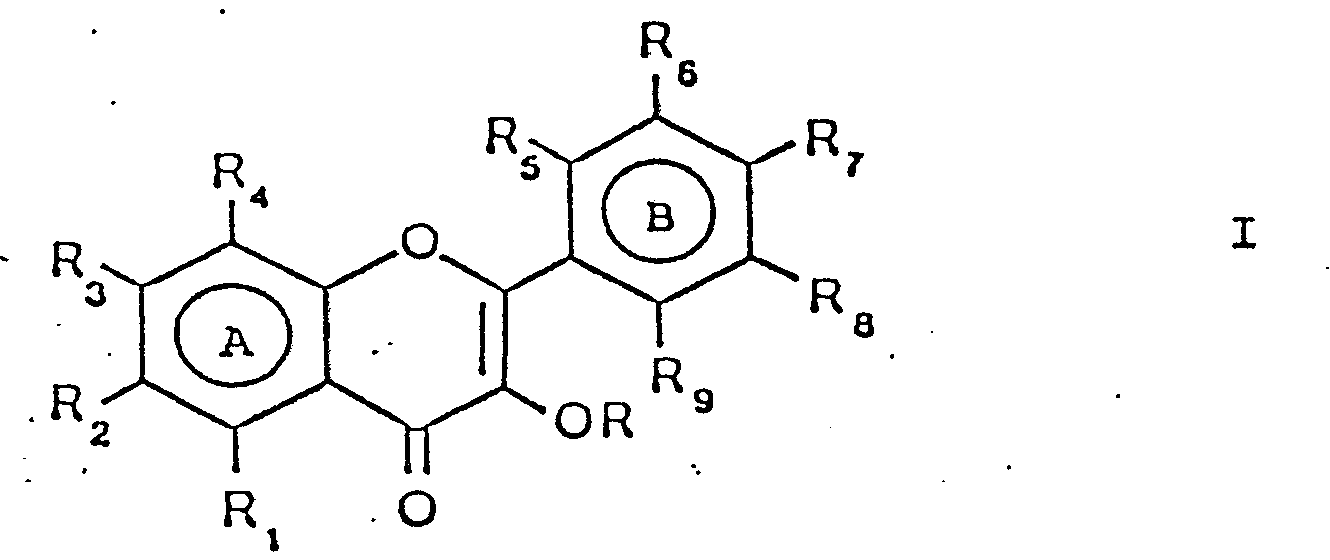
- La présente invention a. ainsi pour objet une composition thérapeutique comprenant à titre de principe actif un composé de formule

R est un groupe alkyle en C1-C4 et - 1) R1,R2,R3,R4 sont choisis parmi un atome d'hydrogène, un atome d'halogène, un groupe nitro, cyano, trifluorométhyle, alkyle en C1-C4, alkoxy en C1-C4, benzyloxy, méthylènedioxy, alcanoyle en C1-C4, (alkoxy C1-C4) carbonyloxy, amino, (alkyl C1-C4) amino, di(alkyl C1-C4) amino, (alkanoyl C1-C4) amino, hydroxy, (alkanoyl C1-C4)oxy, glycosyloxy, carboxy, (alkoxy C1-C4)carbonyle,
- R5,R6,R8,R9 sont choisis parmi un atome d'hydrogène, un atome d'halogène, un groupe hydroxy, alkoxy, en C1-C4, benzyloxy, alkyle en C1-C4
- au moins l'un des groupes R1,R2,R3,R4,R5,R6,R8 et R9 étant autre qu'un atome d'hydrogène, un groupe hydroxy ou un groupe alcoxy en C1-C4, par exemple un atome d'halogène ou un groupe alkyle en C1-C4, et
- R7 est un groupe hydroxy ou glycosyloxy; ou bien
- 2) R1,R2,R3 et R4 sont choisis parmi un groupe hydroxy et un groupe alkoxy en C1-C4,
- R5,R6,R8 et R9 sont choisis parmi un atome d'hydr- gène, un groupe alkoxy en C1-C4, et
- R7 est un groupe hydroxy, alkoxy en C1-C4 ou glycosyloxy, à l'exclusion de la 3,3',4',5,6,7,8 heptaméthoxy flavone;
ou bien
- 3) R1,R2,R3,R4 sont choisis parmi un atome d'hydrogène, un groupe hydroxy et un groupe alkoxy en C1-C4, trois de ces groupes étant autres que l'hydrogène,
- R et R9 sont choisis parmi un atome d'hydrogène, un groupe hydroxy et un groupe alkoxy en C1-C4,
- R6 et R8 sont des atomes d'hydrogène, et
- R7 est un groupe hydroxy, alcoxy en C1-C4 ou glycosyloxy;
- 4) R3 et R4 sont des atomes d'hydrogène,
- R1 et R2 sont choisis parmi un groupe hydroxy et un groupe alkoxy en C1-C4
- R5,R6,R8 et R9 sont choisis parmi un atome d'hydrogène, un groupe hydroxy et un groupe alkoxy en C1-C4 et
- R7 est un groupe hydroxy, alkoxy en C1-C4 ou un groupe glycosyloxy;
- 5) R1 et R4 sont des atomes d'hydrogène,
- R2 et R3 sont choisis parmi un groupe hydroxy ou alkoxy en C1-C4,
- R5, R6, R8 et R9 sont choisis parmi un atome d'hydrogène, un groupe hydroxy ou alkoxy en C1-C4 et
- R7 est un groupe hydroxy, alkoxy en C1-C4 ou glycosyloxy;
ou bien - 6) R3 est un atome d'hydrogène
- R1, R2 et R4 sont choisis parmi un atome d'hydrogène, un groupe hydroxy et un groupe alkoxy en C1-C4, deux de ces groupes étant autres que l'hydrogène,
- R5, R6, R8 et R9 sont choisis parmi un atome d'hydrogène, un groupe hydroxy et un groupe alkoxy en C1-C4 R7 est un groupe hydroxy, alkoxy en C1-C4 ou glycosyloxy;
- 7) R1, R2, R3, R4 sont choisis parmi un atome d'hydrogène, un groupe hydroxy et un groupe alkoxy en C1-C4, au moins trois de ces groupes étant un atome d'hydrogène,
- R5, R6, R8 et R9 sont choisis parmi un atome d'hydrogène, un groupe hydroxy et un groupe alkoxy en C1-C4, R7 est un groupe hydroxy, alkoxy en C1-C4 ou glycosyloxy,
et un de leurs sels pharmaceutiquement acceptables. - Dans la définition ci-dessus l'expression "un atome d'halogène" désigne un atome de chlore, de brome, d'iode ou de fluor.
- Les sels pharmaceutiquement acceptables sont les sels d'addition que forment les composés avec des acides pharmaceutiquement acceptables, ainsi que les sels que forment les composés à groupe acide (COOH) avec des bases pharmaceutiquement acceptables.
- Les "sels d'addition avec des acides pharmaceutiquement acceptables" désignent les sels qui donnent les propriétés biologiques des bases libres, sans avoir d'effet indésirable. Ces sels peuvent être notamment ceux formés avec des acides minéraux, tels que l'acide chlorhydrique, l'acide bromhydrique, l'acide sulfurique, l'acide nitrique, l'acide phosphorique; des sels métalliques acides, tels que l'ortho- phosphate disodique et le sulfate monopotassique, et des acides organiques, tels que l'acide formique, l'acide acétique, l'acide propionique, l'acide glycolique, l'acide oxalique, l'acide fumarique, l'acide lactique, l'acide succinique, l'acide tartrique et l'acide pamoique.
- De même, "les sels avec des bases pharmaceutiquement acceptables" désignent les sels qui ne modifient pas les propriétés biologiques des acides libres. Ces sels peuvent être notamment ceux formés avec des bases minérales, telles que l'hydroxyde de sodium, l'hydroxyde de potassium, l'hydroxyde de lithium, l'hydroxyde de calcium, l'hydroxyde de magnésium, ou des bases organiques telles que la glucamine, la N-méthyl-glucamine, la N,N-diméthylgluca- mine, l'éthanolamine, la diéthanolamine, la morpho- line, la N-méthylmorpholine et la tris-(hydroxymé- thyl)-méthylamine.
- A la connaissance de la Demanderesse les composés de formule I appartenant à la classe définie sous 1) sont des composés nouveaux.
- Les composés appartenant aux classes définies sous 2) à 7) sont des produits d'origine naturelle ou dérivant de produits d'origine naturelle.
- La Demanderesse a également trouvé que la 3,3',4',5,6,7,8 heptaméthoxyflavone a une activité antivirale. Le composé a été décrit dans US-A-3 867 541 comme ayant une activité antiagrégante, sans qu'une activité virale soit suggérée. L'invention a également pour objet l'utilisation de ce composé pour la fabrication d'une composition pharmaceutique pour le traitement de maladies virales.
- D'une manière générale les 3-alkoxyflavones utilisées dans la présente invention peuvent être obtenues par l'un des procédés suivants :
- 1) Alkylation de 3-hydroxyflavones selon le schéma suivant :

- Comme exemple d'agent de méthylation on peut citer par exemple le sulfate de méthyle, l'iodure de méthyle ou le diazométhane.
- 2) Synthèse par la méthode de Allan Robinson (J. Chem. Soc. 125, 2192, 1924) par condensation de o-hydroxya- rylcétones avec des anhydrides d'acides aromatiques selon le schéma suivant :

- Dans cette méthode les groupes hydroxy éventuels peuvent être protégés si nécessaire et déprotéges après réaction.
- En variante selon le même type de réaction on peut préparer une 3-hydroxyflavone et effectuer ensuite une alkylation comme décrit en 1.
- 3) Méthode d'oxydation de Algar-Flynn-Oyamada (J. Algar. J.P. Flynn. Proc. Roy Irish Acad. 423, 1, 1934, B. Oyamada J. Chem. Soc. Japan 55, 1256, 1934) consistant en l'oxydation de chalcones par du peroxyde d'hydrogène en milieu alcalin, suivie d'une réaction d'alkylation comme décrit en 1 selon le schéma suivant

- Dans cette méthode les groupes hydroxy éventuels peuvent être protégés et déprotégés à la fin.
- 4) Réduction nucléaire d'un ester, par exemple selon le schéma réactionnel suivant :

- Y étant par exemple un reste p.toluénesulfonyle.
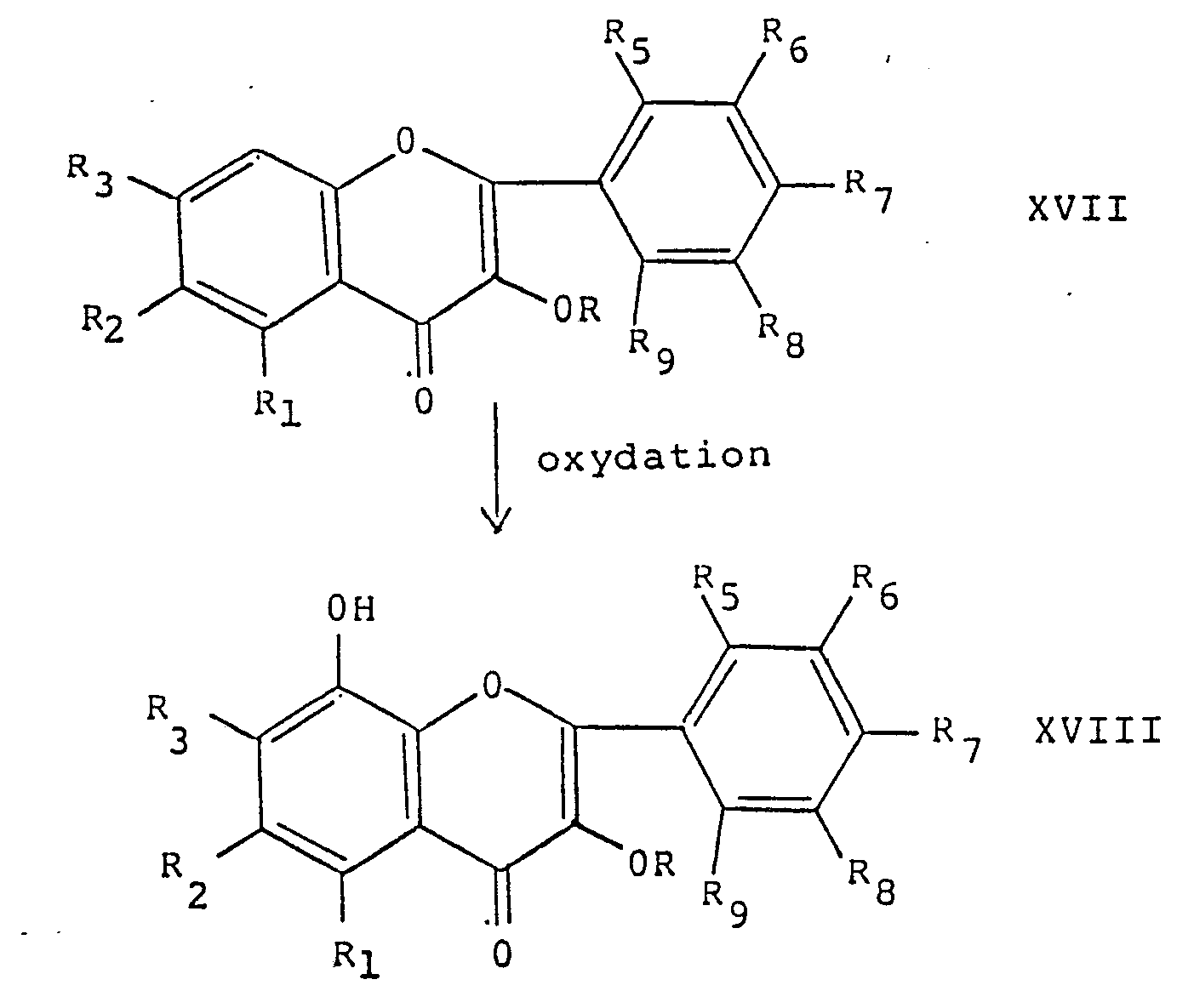
- 5) Oxydation nucléaire, par exemple par du persulfate selon le schéma suivant :
- Un certain nombre de 3-alkoxyflavones utilisables dans la présente invention sont présentes dans des plantes et peuvent être obtenues par extraction.
- La méthode d'extraction est la suivante : On fait macérer les feuilles des plantes avec de l'éthanol à 80% sous agitation à température ambiante pendant 2 heures. On sépare les feuilles après macération par filtration et on percole le résidu de filtration avec le même solvant. On réunit le filtrat et le liquide de percolation et on concentre sous vide (à une température inférieure à 40°C) pour obtenir un extrait épais. L'extrait est soumis à un partage entre du méthanol à 90% et de l'hexane (ou un éther de pétrole 40-60*). On sépare la phase méthanolique et on l'amène à siccité. Le résidu obtenu est soumis à un partage entre l'eau (pH5) et l'acétate d'éthyle. On sépare la phase acétate d'éthyle et on l'amène à siccité. Le résidu obtenu est soumis à une chromatogra- phie à contre courant, goutte à goutte, en utilisant comme éluant un mélange chloroforme/eau/méthanol (7: 8:13) en mode descendant. On contrôle l'éffluent à 355 nm et par chromatographie en couche mince ou par chromatographie liquide haute pression et on teste l'activité antivirale des fractions. Les fractions à activité antivirale sont soumises après évaporation à une chromatographie sur Sephadex LH 20 en utilisant le méthanol comme éluant, et l'on contrôle l'éluat comme précédemment. On soumet les fractions actives à une chromatographie sur une colonne de gel de silice imprégné avec 5% d'eau et l'on développe en utilisant comme solvant un mélange hexane/acétate d'éthylelacide acetique (5:3:1) selon la technique de la "colonne sèche". On obtient ainsi les 3-alkoxyflavones actives pures.
- Les exemples suivants illustrent la préparation des composés de formule I.
- Une solution de 2-hydroxyacétophénone (25 mmole) et le benzyloxybenzaldéhyde (25 mmole) dans 25 ml d'éthanol est refroidie à la glace. On ajoute lentement une solution d'hydroxyde de potassium à 50% (25 ml) et on maintient le mélange sous agitation pendant 4 jours à température ambiante. On refroidit à nouveau à la glace la solution, et acidifie avec de l'acide chlorhydrique dilué. On sépare le précipité par filtration, lave à l'eau et recristallise dans l'éthanol (rendement 59/), F = 112-113°C.
- On prépare de même d'autres chalcones :


- On ajoute une solution à 10% d'hydroxyde de potassium dans de l'eau (15 ml) et une solution de péroxyde d'hydrogène (100 vol. 2 ml) à une solution à l'ébullition de la chalcone décrite en a (3 mmole) dans de l'éthanol (15 ml). Au bout de 15 minutes on verse la solution dans un mélange de glace et d'acide chlorhydrique et on sépare le précipité formé par filtration. On le lave à l'eau et le recristallise dans un mélange éthanol-acétone (rendement 421 ) F = 176°C.
- On prépare de même d'autres 3-hydroxyflavones.
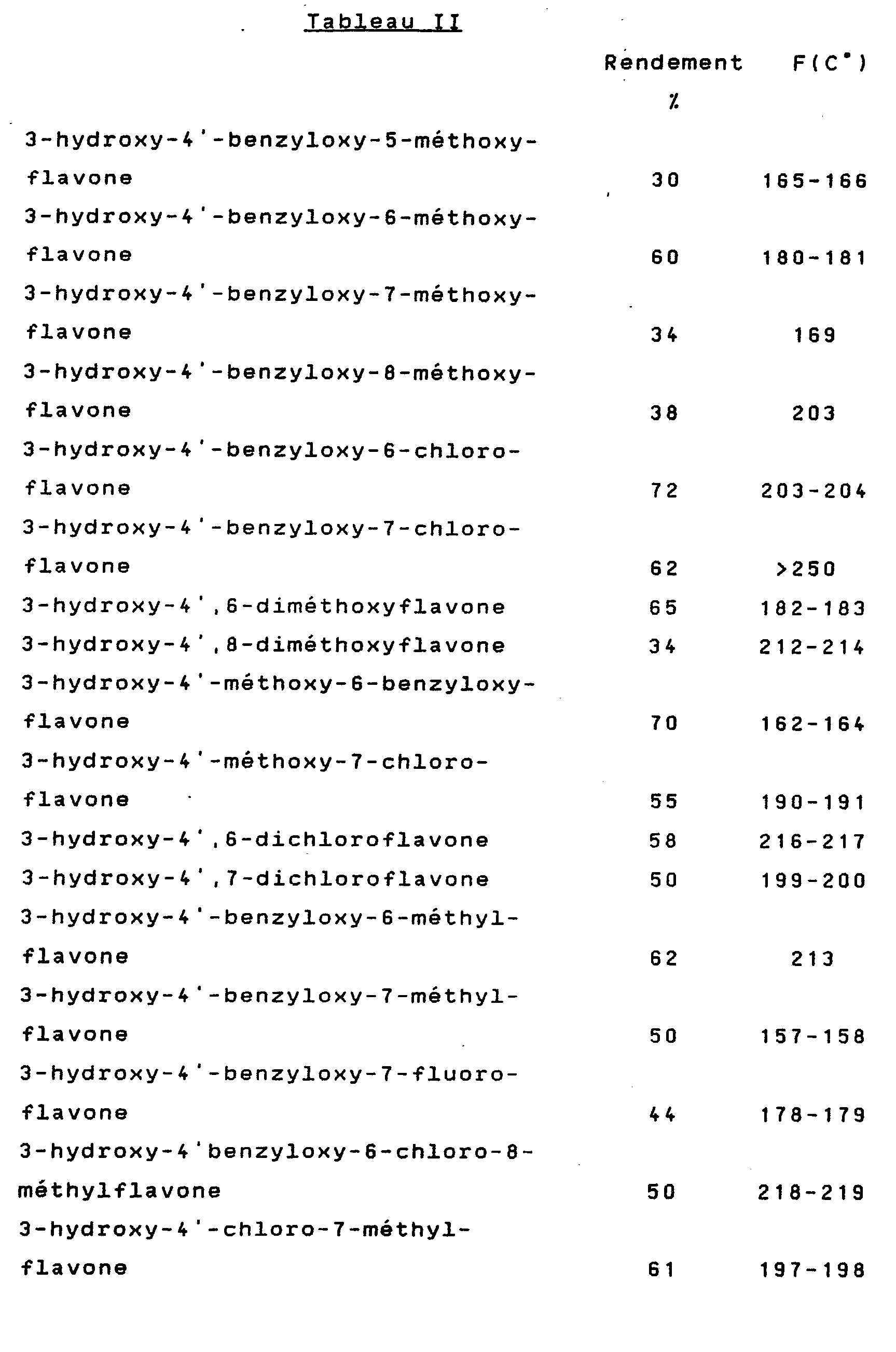
- On ajoute du carbonate de potassium (3 mmoles) et du sulfate de diméthyle (2 mmoles) à une solution de la 3-hydroxyflavone obtenue en b (1 mmole) dans de l'acétone. On chauffe le mélange au reflux pendant 12 heures. On évapore le solvant. On ajoute de l'eau jusqu'à dissolution du précipité. On filtre le précipité et on recristallise dans l'éthanol (rendement 63%).
- On prépare de même d'autres 3-méthoxy-4'-benzyloxyflavones :


- On chauffe au reflux la 3-méthoxy-4-benzylo- xyflavone (1 mmole) dans un mélange d'acide chlorhydrique concentré (2 ml) et d'acide acétique concentré (2 ml) pendant 3 heures. Après dilution avec de l'eau on sépare le précipité formé par filtration et on recristallise dans l'éthanol (rendement 72%) F°C = 232-233°C.
- On prépare de même d'autres 3-méthoxyfla- vones :

- Les composés qui sont utilisés dans la présente invention inhibent la reproduction des picorna virus, y compris le virus de l'hépatite A, les rhabdo- virus et d'autres virus provoquant des maladies humaines ou animales.
- On donnera ci-après dans le tableau V des résultats de l'étude in vitro de l'activité antivirale des composés utilisés dans la présente invention vis- à-vis de certains picorna virus.
- L'activité antivirale a été exprimée par le facteur de réduction du titre viral par la méthode dite EPTT (end point titration technique) (cf. Vanden Berghe et coll. Lloydia, 1978, 41, 463).

- On a par ailleurs déterminé la dose léthale 50% (DL50) la dose efficace 90% et 99% (DE90 et DE99) et l'indice thérapeutique 90 et 99 (IT90 et IT99) en utilisant les méthodes suivantes :
- Les composés ont été préparés à la dose 1 mg/ml dans unvolume maximal de 0,1 ml de diméthyl- sulfoxyde et addition jusqu'à 12 ml d'un milieu de maintenance M-2. Les dilutions ont été effectuées avec le milieu de maintenance M-2.
- Des monocouches de cellules VERO dans des microplaques ont été infectées avec des dilutions par 10 du virus (Polio type I). Après fixation du virus aux cellules (60 minutes, 37°C) on ajoute les composés dans le milieu M-2 aux cultures infectées. Les plaques ont été incubées à 37°C pendant un temps permettant l'apparition de l'effet cytopathogène (CPE). On a déterminé l'activité antivirale à partir de cet effet. Le facteur de réduction du titre du virus est calculé pour chaque dilution par le rapport de la dilution du virus sans effet cytopathogène/dilution du virus + composé sans effet cytopathogène.
- La dose efficace DE90 est la dose à laquelle 90% des virus sont inhibés.
- La dose efficace DE99 est la dose à laquelle 99Z des virus sont inhibés.
- La DL50 est la concentration à laquelle 50% de la croissance des cellules normales est inhibée. Pour cette détermination on a utilisé 5.105 cellules VERO en suspension dans 10 ml de milieu E199 additionné de 6% de sérum de veau (CS) et de gentamycine(20 microgrammes/ml). Les composés ont été ajoutés pour obtenir des concentrations finales de 200;100;-75;50;25;10;5;3;2;1;0,1 et 0,01 microgrammes/ml.
- IT90 et IT99 sont respectivement la valeur de la DL50 divisée par DE90 et DE99.
- Les résultats sont donnés dans le tableau VI.

- Les compositions thérapeutiques selon l'invention peuvent donc être utilisées à la fois à titre curatif et à titre préventif.
- Les compositions thérapeutiques selon l'invention peuvent être administrées à l'homme ou aux animaux par voie topique, orale ou parentérale.
- Elles peuvent être sous la forme de préparations solides, semi-solides ou liquides. Comme exemples, on peut citer les comprimés, les gélules, les suppositoires, les solutions ou suspensions injectables, les pommades, les çollyres huileux ou aqueux, les collutoires, les solutions nasales et otologiques, ainsi que les formes retard.
- Dans ces compositions le principe actif est généralement mélangé avec un ou plusieurs excipients pharmaceutiquement acceptables habituels bien connus de l'homme de l'art.
- Les compositions thérapeutiques administra - bles par voie topique peuvent contenir notamment de 0,1 à 5% en poids du principe actif.
- Les compositions thérapeutiques administra- bles par voie orale ou parentérale peuvent contenir notamment de 1Z à 60Z en poids de principe actif.
- La quantité de principe actif administré dépend évidemment du patient qui est traité, de la voie d'administration et de la sévérité de la maladie. Cependant, pour l'administration par la voie orale ou parentérale, on peut administrer environ de 100 à 1000 mg 3 à 6 fois/jour. Pour l'administration par la voie topique, on peut administrer de 0,1 à 100 micro- grammes/cm2 3 à 6 fois par jour.
ou bien
ou bien
ou bien
Claims (10)
R est un groupe alkyle en C1-C4 et
ou bien
ou bien
ou bien
ou bien
ou un de ses sels pharmaceutiquement acceptables.

et de leurs sels pharmaceutiquement acceptables, caractérisé en ce que l'on effectue une alkylation d'une 3-hydroxyflavone de formule


R est un groupe alkyle en C1-C4 et
ou bien
ou bien
ou bien
ou bien
ou bien
ou un de ses sels pharmaceutiquement acceptables.

dans laquelle


Priority Applications (1)
| Application Number | Priority Date | Filing Date | Title |
|---|---|---|---|
| AT87400107T ATE59777T1 (de) | 1986-01-17 | 1987-01-16 | Therapeutische zusammenstellungen auf basis von 3-alkoxyflavonen und derivate von 3-alkoxyflavonen. |
Applications Claiming Priority (2)
| Application Number | Priority Date | Filing Date | Title |
|---|---|---|---|
| FR8600644 | 1986-01-17 | ||
| FR8600644A FR2593066B1 (fr) | 1986-01-17 | 1986-01-17 | Compositions therapeutiques a base de derives de 3-alkoxyflavones et nouveaux derives de 3-alkoxyflavones. |
Publications (2)
| Publication Number | Publication Date |
|---|---|
| EP0233105A1 true EP0233105A1 (fr) | 1987-08-19 |
| EP0233105B1 EP0233105B1 (fr) | 1991-01-09 |
Family
ID=9331224
Family Applications (1)
| Application Number | Title | Priority Date | Filing Date |
|---|---|---|---|
| EP87400107A Expired - Lifetime EP0233105B1 (fr) | 1986-01-17 | 1987-01-16 | Compositions thérapeutiques à base de dérivés de 3-alkoxyflavones et nouveaux dérivés de 3-alkoxyflavones |
Country Status (8)
| Country | Link |
|---|---|
| EP (1) | EP0233105B1 (fr) |
| JP (1) | JPS62223179A (fr) |
| AT (1) | ATE59777T1 (fr) |
| CA (1) | CA1284640C (fr) |
| DE (1) | DE3767175D1 (fr) |
| DK (1) | DK24687A (fr) |
| FR (1) | FR2593066B1 (fr) |
| PT (1) | PT84130B (fr) |
Cited By (3)
| Publication number | Priority date | Publication date | Assignee | Title |
|---|---|---|---|---|
| US5539112A (en) * | 1992-02-14 | 1996-07-23 | Kyowa Hakko Kogyo Co., Ltd. | 5-aminoflavone derivatives |
| WO1998027080A1 (fr) * | 1996-12-19 | 1998-06-25 | Agrevo Uk Limited | Chromones utiles en tant que fongicides |
| CN1837202B (zh) * | 2006-04-25 | 2010-08-18 | 中国人民解放军第二军医大学 | 具有降血脂作用的黄酮醇类化合物 |
Families Citing this family (3)
| Publication number | Priority date | Publication date | Assignee | Title |
|---|---|---|---|---|
| IL118657A0 (en) * | 1996-06-14 | 1996-10-16 | Arad Dorit | Inhibitors for picornavirus proteases |
| IL122591A0 (en) | 1997-12-14 | 1998-06-15 | Arad Dorit | Pharmaceutical compositions comprising cystein protease inhibitors |
| EP3604291A4 (fr) * | 2017-04-21 | 2020-02-26 | Tsuchida, Yuuzo | Composé ou sel de celui-ci, agent antiviral et composition pharmaceutique |
Citations (6)
| Publication number | Priority date | Publication date | Assignee | Title |
|---|---|---|---|---|
| FR3541M (fr) * | 1964-05-12 | 1965-09-13 | Laroche Navarron Lab | Médicament a propriétés natriurétiques a base d'une nouvelle flavone. |
| US3632477A (en) * | 1966-05-25 | 1972-01-04 | Beecham Group Ltd | Antibiotic production using a strain of aspergillus candidus |
| US3661890A (en) * | 1970-03-10 | 1972-05-09 | Us Agriculture | Preparation of quercetin derivatives |
| FR2187320A1 (en) * | 1972-06-09 | 1974-01-18 | Cortial | Flavoured extracts of birch - with cytolytic activity |
| US3867541A (en) * | 1972-05-03 | 1975-02-18 | Ralph C Robbins | Compositions and methods for disaggregating blood cells |
| EP0019081A1 (fr) * | 1979-04-10 | 1980-11-26 | F. HOFFMANN-LA ROCHE & CO. Aktiengesellschaft | Dérivés de flavone, leur préparation, ces flavones et flavones connues en soi en tant qu'agents antiviraux et compositions pharmaceutiques les contenant |
Family Cites Families (2)
| Publication number | Priority date | Publication date | Assignee | Title |
|---|---|---|---|---|
| GB1461777A (en) * | 1973-06-08 | 1977-01-19 | Fisons Ltd | 2-phenyl-4-oxo-4h-1-benzopyran derivatives |
| JPS5899414A (ja) * | 1981-12-10 | 1983-06-13 | Jun Okuda | アルド−スレダクタ−ゼの阻害剤 |
-
1986
- 1986-01-17 FR FR8600644A patent/FR2593066B1/fr not_active Expired
-
1987
- 1987-01-15 CA CA000527372A patent/CA1284640C/fr not_active Expired - Lifetime
- 1987-01-16 JP JP62007955A patent/JPS62223179A/ja active Pending
- 1987-01-16 DE DE8787400107T patent/DE3767175D1/de not_active Expired - Lifetime
- 1987-01-16 EP EP87400107A patent/EP0233105B1/fr not_active Expired - Lifetime
- 1987-01-16 DK DK024687A patent/DK24687A/da not_active Application Discontinuation
- 1987-01-16 PT PT84130A patent/PT84130B/pt not_active IP Right Cessation
- 1987-01-16 AT AT87400107T patent/ATE59777T1/de not_active IP Right Cessation
Patent Citations (6)
| Publication number | Priority date | Publication date | Assignee | Title |
|---|---|---|---|---|
| FR3541M (fr) * | 1964-05-12 | 1965-09-13 | Laroche Navarron Lab | Médicament a propriétés natriurétiques a base d'une nouvelle flavone. |
| US3632477A (en) * | 1966-05-25 | 1972-01-04 | Beecham Group Ltd | Antibiotic production using a strain of aspergillus candidus |
| US3661890A (en) * | 1970-03-10 | 1972-05-09 | Us Agriculture | Preparation of quercetin derivatives |
| US3867541A (en) * | 1972-05-03 | 1975-02-18 | Ralph C Robbins | Compositions and methods for disaggregating blood cells |
| FR2187320A1 (en) * | 1972-06-09 | 1974-01-18 | Cortial | Flavoured extracts of birch - with cytolytic activity |
| EP0019081A1 (fr) * | 1979-04-10 | 1980-11-26 | F. HOFFMANN-LA ROCHE & CO. Aktiengesellschaft | Dérivés de flavone, leur préparation, ces flavones et flavones connues en soi en tant qu'agents antiviraux et compositions pharmaceutiques les contenant |
Non-Patent Citations (1)
| Title |
|---|
| PATENT ABSTRACTS OF JAPAN, vol. 7, no. 201 (C-184)[1346], 6 septembre 1983; & JP-A-58 99 414 (JIYUN OKUDA) 13-06-1983 * |
Cited By (3)
| Publication number | Priority date | Publication date | Assignee | Title |
|---|---|---|---|---|
| US5539112A (en) * | 1992-02-14 | 1996-07-23 | Kyowa Hakko Kogyo Co., Ltd. | 5-aminoflavone derivatives |
| WO1998027080A1 (fr) * | 1996-12-19 | 1998-06-25 | Agrevo Uk Limited | Chromones utiles en tant que fongicides |
| CN1837202B (zh) * | 2006-04-25 | 2010-08-18 | 中国人民解放军第二军医大学 | 具有降血脂作用的黄酮醇类化合物 |
Also Published As
| Publication number | Publication date |
|---|---|
| EP0233105B1 (fr) | 1991-01-09 |
| FR2593066A1 (fr) | 1987-07-24 |
| FR2593066B1 (fr) | 1989-06-30 |
| ATE59777T1 (de) | 1991-01-15 |
| PT84130B (pt) | 1989-02-28 |
| DK24687A (da) | 1987-07-18 |
| JPS62223179A (ja) | 1987-10-01 |
| DE3767175D1 (de) | 1991-02-14 |
| CA1284640C (fr) | 1991-06-04 |
| PT84130A (fr) | 1987-02-01 |
| DK24687D0 (da) | 1987-01-16 |
Similar Documents
| Publication | Publication Date | Title |
|---|---|---|
| EP0080934B1 (fr) | Acides (oxo-4-4H-(1)-benzopyran-8-yl) alcanoiques, sels et dérivés, préparation et médicaments les contenant | |
| EP0399856B1 (fr) | Pteridin-4 (3H)-ones, procédés de préparation et médicaments les contenant | |
| WO1985004652A1 (fr) | Derives de l'acide vinyl-4 benzoique, leur procede de preparation et leurs applications | |
| EP0296975A1 (fr) | Dérivés du diméthyl-2,2 chromannol-3, procédé d'obtention et compositions pharmaceutiques les contenant | |
| CH660738A5 (fr) | Derives de la vinyl-6 furo-(3,4-c)-pyridine, leur preparation et compositions pharmaceutiques a base de ces composes. | |
| EP0319412B1 (fr) | Nouveaux dérivés flavonoides pipérazinyl-2 oxo-2 éthylène substitués, leurs procédés de préparation et les compositions pharmaceutiques qui les contiennent | |
| EP0125195B1 (fr) | Nouveaux acides flavonecarboxyliques-4', leur méthode de préparation et leur application thérapeutique | |
| EP0803503B1 (fr) | Acides et esters de la diosmétine et compositions pharmaceutiques les contenant | |
| EP0709383B1 (fr) | Dérivés de la diosmétine, leur procédé de préparation et les compositions pharmaceutiques les contenant | |
| CH646687A5 (fr) | Derives de l'acide cyclohexane carboxylique. | |
| EP0233105B1 (fr) | Compositions thérapeutiques à base de dérivés de 3-alkoxyflavones et nouveaux dérivés de 3-alkoxyflavones | |
| EP0312432A1 (fr) | Dérivés du diméthyl-2,2 chromène, procédé d'obtention et compositions/pharmaceutiques en contenant | |
| EP0117771A1 (fr) | Imino-2 pyrrolidines, leur procédé de préparation et leurs applications en thérapeutique | |
| FR2495155A1 (fr) | Nouveaux 8-aminoalkyl-4-alkylisopsoralenes, leur procede de preparation et composition pharmaceutique les contenant | |
| EP0002635B1 (fr) | Procédé de préparation de dérivés de thiéno (2,3-c) et (3,2-c) pyridines, nouveaux dérivés de la thiéno (2,3-c) pyridine obtenus et leur application thérapeutique | |
| EP1090017B1 (fr) | Nouveaux composes derives de alpha-d-xylose, preparation et utilisation en therapeutique | |
| EP0008259A1 (fr) | Nouveaux dérivés de la pipéridylbenzimidazolinone, leurs procédés de préparation et les compositions pharmaceutiques les renfermant | |
| EP0031266B1 (fr) | Nouveaux dérivés de l'amino-1 propanol-2, leur procédé de préparation et leur application thérapeutique | |
| EP0347305B1 (fr) | [(Aryl-4-pipérazinyl-1)-2 éthoxy]-3 p-cymène, les dérivés ortho, méta, para monosubstitués ou disubstitués sur le noyau phényle dudit produit, le procédé de préparation desdits dérivés, et les médicaments contenant lesdits composés comme principe actif | |
| EP0233804B1 (fr) | Monoaryl-5 as triazinones-3 substituées en position 2, leur procédé de préparation et leur application en tant que medicaments | |
| CH665837A5 (fr) | Derives du bornane, leur preparation et compositions therapeutiques en contenant. | |
| FR2604175A1 (fr) | Analogues du 7-oxabicyclo(2.2.1)heptane a action therapeutique | |
| FR2499571A1 (fr) | Nouveaux derives d'apovincaminol, leur preparation et leur application en tant que medicaments | |
| BE879804A (fr) | Nouveaux derives indoliques pentacycliques, leur procede d'obtention et compositions pharmaceutiques les contenant | |
| FR2617165A1 (fr) | Derives du dimethyl-2, 2 chromannol-3 |
Legal Events
| Date | Code | Title | Description |
|---|---|---|---|
| PUAI | Public reference made under article 153(3) epc to a published international application that has entered the european phase |
Free format text: ORIGINAL CODE: 0009012 |
|
| AK | Designated contracting states |
Kind code of ref document: A1 Designated state(s): AT BE CH DE ES FR GB GR IT LI LU NL SE |
|
| 17P | Request for examination filed |
Effective date: 19880213 |
|
| 17Q | First examination report despatched |
Effective date: 19890529 |
|
| RIN1 | Information on inventor provided before grant (corrected) |
Inventor name: HAEMERS, ACHIEL Inventor name: VLIETINCK, ARNOLD J. Inventor name: VANDEN BERGHE, DIRK A.R. |
|
| GRAA | (expected) grant |
Free format text: ORIGINAL CODE: 0009210 |
|
| AK | Designated contracting states |
Kind code of ref document: B1 Designated state(s): AT BE CH DE ES FR GB GR IT LI LU NL SE |
|
| PG25 | Lapsed in a contracting state [announced via postgrant information from national office to epo] |
Ref country code: GR Free format text: LAPSE BECAUSE OF FAILURE TO SUBMIT A TRANSLATION OF THE DESCRIPTION OR TO PAY THE FEE WITHIN THE PRESCRIBED TIME-LIMIT Effective date: 19910109 Ref country code: AT Effective date: 19910109 |
|
| REF | Corresponds to: |
Ref document number: 59777 Country of ref document: AT Date of ref document: 19910115 Kind code of ref document: T |
|
| PGFP | Annual fee paid to national office [announced via postgrant information from national office to epo] |
Ref country code: FR Payment date: 19910129 Year of fee payment: 5 |
|
| PGFP | Annual fee paid to national office [announced via postgrant information from national office to epo] |
Ref country code: NL Payment date: 19910131 Year of fee payment: 5 |
|
| REF | Corresponds to: |
Ref document number: 3767175 Country of ref document: DE Date of ref document: 19910214 |
|
| PGFP | Annual fee paid to national office [announced via postgrant information from national office to epo] |
Ref country code: LU Payment date: 19910215 Year of fee payment: 5 |
|
| PGFP | Annual fee paid to national office [announced via postgrant information from national office to epo] |
Ref country code: CH Payment date: 19910221 Year of fee payment: 5 |
|
| PGFP | Annual fee paid to national office [announced via postgrant information from national office to epo] |
Ref country code: BE Payment date: 19910311 Year of fee payment: 5 |
|
| PGFP | Annual fee paid to national office [announced via postgrant information from national office to epo] |
Ref country code: DE Payment date: 19910314 Year of fee payment: 5 |
|
| PGFP | Annual fee paid to national office [announced via postgrant information from national office to epo] |
Ref country code: SE Payment date: 19910322 Year of fee payment: 5 |
|
| PGFP | Annual fee paid to national office [announced via postgrant information from national office to epo] |
Ref country code: GB Payment date: 19910326 Year of fee payment: 5 |
|
| ITF | It: translation for a ep patent filed | ||
| PG25 | Lapsed in a contracting state [announced via postgrant information from national office to epo] |
Ref country code: ES Free format text: LAPSE BECAUSE OF FAILURE TO SUBMIT A TRANSLATION OF THE DESCRIPTION OR TO PAY THE FEE WITHIN THE PRESCRIBED TIME-LIMIT Effective date: 19910420 |
|
| GBT | Gb: translation of ep patent filed (gb section 77(6)(a)/1977) | ||
| EPTA | Lu: last paid annual fee | ||
| PLBE | No opposition filed within time limit |
Free format text: ORIGINAL CODE: 0009261 |
|
| STAA | Information on the status of an ep patent application or granted ep patent |
Free format text: STATUS: NO OPPOSITION FILED WITHIN TIME LIMIT |
|
| 26N | No opposition filed | ||
| PG25 | Lapsed in a contracting state [announced via postgrant information from national office to epo] |
Ref country code: LU Free format text: LAPSE BECAUSE OF NON-PAYMENT OF DUE FEES Effective date: 19920116 Ref country code: GB Effective date: 19920116 |
|
| PG25 | Lapsed in a contracting state [announced via postgrant information from national office to epo] |
Ref country code: SE Effective date: 19920117 |
|
| PG25 | Lapsed in a contracting state [announced via postgrant information from national office to epo] |
Ref country code: LI Effective date: 19920131 Ref country code: CH Effective date: 19920131 Ref country code: BE Effective date: 19920131 |
|
| BERE | Be: lapsed |
Owner name: INSTITUT PASTEUR Effective date: 19920131 |
|
| PG25 | Lapsed in a contracting state [announced via postgrant information from national office to epo] |
Ref country code: NL Effective date: 19920801 |
|
| GBPC | Gb: european patent ceased through non-payment of renewal fee | ||
| NLV4 | Nl: lapsed or anulled due to non-payment of the annual fee | ||
| PG25 | Lapsed in a contracting state [announced via postgrant information from national office to epo] |
Ref country code: FR Effective date: 19920930 |
|
| REG | Reference to a national code |
Ref country code: CH Ref legal event code: PL |
|
| PG25 | Lapsed in a contracting state [announced via postgrant information from national office to epo] |
Ref country code: DE Effective date: 19921001 |
|
| REG | Reference to a national code |
Ref country code: FR Ref legal event code: ST |
|
| EUG | Se: european patent has lapsed |
Ref document number: 87400107.6 Effective date: 19920806 |
|
| PG25 | Lapsed in a contracting state [announced via postgrant information from national office to epo] |
Ref country code: IT Free format text: LAPSE BECAUSE OF NON-PAYMENT OF DUE FEES;WARNING: LAPSES OF ITALIAN PATENTS WITH EFFECTIVE DATE BEFORE 2007 MAY HAVE OCCURRED AT ANY TIME BEFORE 2007. THE CORRECT EFFECTIVE DATE MAY BE DIFFERENT FROM THE ONE RECORDED. Effective date: 20050116 |