EP0236261A2 - Neue organometallhaltige Polymere - Google Patents
Neue organometallhaltige Polymere Download PDFInfo
- Publication number
- EP0236261A2 EP0236261A2 EP87810014A EP87810014A EP0236261A2 EP 0236261 A2 EP0236261 A2 EP 0236261A2 EP 87810014 A EP87810014 A EP 87810014A EP 87810014 A EP87810014 A EP 87810014A EP 0236261 A2 EP0236261 A2 EP 0236261A2
- Authority
- EP
- European Patent Office
- Prior art keywords
- formula
- alkyl
- polyphthalaldehydes
- group
- hydrogen
- Prior art date
- Legal status (The legal status is an assumption and is not a legal conclusion. Google has not performed a legal analysis and makes no representation as to the accuracy of the status listed.)
- Granted
Links
- 0 CCC(C1)C1C(C(C1CC*C)C(CC2)C[C@@]2C(C)(*)CC)C1C(C)(CC)CC Chemical compound CCC(C1)C1C(C(C1CC*C)C(CC2)C[C@@]2C(C)(*)CC)C1C(C)(CC)CC 0.000 description 3
Classifications
-
- G—PHYSICS
- G03—PHOTOGRAPHY; CINEMATOGRAPHY; ANALOGOUS TECHNIQUES USING WAVES OTHER THAN OPTICAL WAVES; ELECTROGRAPHY; HOLOGRAPHY
- G03C—PHOTOSENSITIVE MATERIALS FOR PHOTOGRAPHIC PURPOSES; PHOTOGRAPHIC PROCESSES, e.g. CINE, X-RAY, COLOUR, STEREO-PHOTOGRAPHIC PROCESSES; AUXILIARY PROCESSES IN PHOTOGRAPHY
- G03C1/00—Photosensitive materials
-
- C—CHEMISTRY; METALLURGY
- C08—ORGANIC MACROMOLECULAR COMPOUNDS; THEIR PREPARATION OR CHEMICAL WORKING-UP; COMPOSITIONS BASED THEREON
- C08G—MACROMOLECULAR COMPOUNDS OBTAINED OTHERWISE THAN BY REACTIONS ONLY INVOLVING UNSATURATED CARBON-TO-CARBON BONDS
- C08G2/00—Addition polymers of aldehydes or cyclic oligomers thereof or of ketones; Addition copolymers thereof with less than 50 molar percent of other substances
- C08G2/14—Polymerisation of single aldehydes not provided for in groups C08G2/08 - C08G2/12
-
- C—CHEMISTRY; METALLURGY
- C08—ORGANIC MACROMOLECULAR COMPOUNDS; THEIR PREPARATION OR CHEMICAL WORKING-UP; COMPOSITIONS BASED THEREON
- C08G—MACROMOLECULAR COMPOUNDS OBTAINED OTHERWISE THAN BY REACTIONS ONLY INVOLVING UNSATURATED CARBON-TO-CARBON BONDS
- C08G2/00—Addition polymers of aldehydes or cyclic oligomers thereof or of ketones; Addition copolymers thereof with less than 50 molar percent of other substances
- C08G2/18—Copolymerisation of aldehydes or ketones
- C08G2/20—Copolymerisation of aldehydes or ketones with other aldehydes or ketones
-
- G—PHYSICS
- G03—PHOTOGRAPHY; CINEMATOGRAPHY; ANALOGOUS TECHNIQUES USING WAVES OTHER THAN OPTICAL WAVES; ELECTROGRAPHY; HOLOGRAPHY
- G03F—PHOTOMECHANICAL PRODUCTION OF TEXTURED OR PATTERNED SURFACES, e.g. FOR PRINTING, FOR PROCESSING OF SEMICONDUCTOR DEVICES; MATERIALS THEREFOR; ORIGINALS THEREFOR; APPARATUS SPECIALLY ADAPTED THEREFOR
- G03F7/00—Photomechanical, e.g. photolithographic, production of textured or patterned surfaces, e.g. printing surfaces; Materials therefor, e.g. comprising photoresists; Apparatus specially adapted therefor
- G03F7/004—Photosensitive materials
- G03F7/039—Macromolecular compounds which are photodegradable, e.g. positive electron resists
Definitions
- the present invention relates to new organometallic polyphthalaldehydes; radiation-sensitive, dry-developable, oxygen plasma-resistant compositions containing these compounds; and their use for generating structured positive images.
- Self-developable or dry-developable compositions are understood to mean a class of compounds which disintegrate into volatile particles after irradiation or which can be structured after irradiation with a plasma without the need for wet development for image formation.
- Various materials have been proposed for this purpose, e.g. Polymethyl methacrylate, polyethylene terephthalate, nitrocellulose or polyisoprene (see, for example, H. Franke, Appl. Phys. Lett. 45 (1), 110 ff (1984).
- Various disadvantages often occur when using such materials, such as low sensitivity, poor stability, Formation of non-volatile residues, insufficient resistance to oxygen plasma, or insufficient dissolution.
- EP-A 126,214 describes a system which is distinguished by its good sensitivity.
- the self-developable composition consists of polyphthalaldehyde, which is catalytically depolymerized using photochemically generated acids and the phthalaldehyde monomers thus produced are evaporated.
- the disadvantage of this system lies in the large amount of initiator of 10% by weight which is required to achieve a sensitivity of 1.5-5 mJ / cm 2 .
- High acid catalyst concentrations are undesirable because residues remain in the system even after thermal self-development and thus pose a considerable risk of contamination. If the concentration of the initiator is reduced in the system of EP-A 126,214, the exposure doses required increase many times over.
- this system is unstable under plasma etching conditions (eg O z plasma), as are usually used to transfer structures into an underlying organic planarizing resin.
- a class of organometallic end-capped polyphthalaldehydes has now been found, which are characterized by surprisingly high sensitivity.
- the required amounts of initiator additives and the radiation doses are extremely low compared to conventional systems.
- the proportion of non-volatile residues is also minimal.
- the compositions have very good solubility and film-forming properties, as well as good temperature stability and resistance to oxygen plasma.
- the invention relates to organometallic end-capped polyphthalaldehydes with the repeating unit of formula 1 wherein R 1 , R 2 , R 3 and R 4 independently of one another hydrogen, halogen, nitrile, nitro, carboxyl, hydroxyl, C l -C 4 alkoxy, C I -C 4 alkylthio or alkoxycarbonyl with 1-4 C atoms in the alkoxy part and at least one of the radicals R 1 , R 2 , R 3 and R 4 is a group -Q (R 5 ) 3 or -Q (R 6 ) 3 , where Q is Si, Sn, Ge, CH 2 - Si or 0-Si, R 5 is C 1 -C 12 alkyl and R 6 is C 6 -C 10 aryl.
- these radicals are, for example, methoxy, ethoxy, n-propoxy or n-butoxy, preferably methoxy.
- R 1 -R 4 are alkylthio, methylthio, ethylthio, n-propylthio or n-butylthio, in particular methylthio, should be mentioned.
- the alkoxycarbonyl is e.g. methoxycarbonyl, ethoxycarbonyl, n-propoxycarbonyl or n-butoxycarbonyl.
- At least one, preferably one or two and in particular two of the radicals R 1 -R 4 represent a group -Q (R 5 ) 3 or -Q (R 6 ) 3 . Silicon-containing residues are preferred.
- R 5 is C 1 -C 12 , preferably C 1 -C 4 alkyl and is in particular methyl or ethyl. Otherwise, it can be isopropyl, n-propyl, n-butyl, n-hexyl, n-octyl, n-decyl or n-dodecyl.
- R 6 is a C 6 -C lo aryl, in particular phenyl or naphthyl.
- all radicals R 5 and R 6 bonded to the metal are identical.
- R 2 and R 3 are a group -Q (R 5 ) 3 or -Si (R 6 ) 3 , and the remaining radicals R 1 and R 4 are hydrogen.
- Suitable capping groups are amines or acyls, such as those e.g. by Hiroshi Ito and C.G. Willson, Polym. Closely. Sci. 23, 1012 ff (1983) (see also Macromolecules 2 (4), 414 (1969)).
- the polymers with the repeating unit of the formula I preferably have an average molecular weight of 10,000 to 1,000,000 and in particular 50,000 to 400,000.
- the new polymers of the present invention are preferably homopolymers. Also suitable as radiation-sensitive, dry-developable compositions are copolymers, for example copolymers which are composed of two or more components of the formula I having a different structure, or copolymers which, in addition to structural units of the formula I, contain other components which are derived from copolymerizable monomers.
- the present invention therefore also relates to copolymers of organometallic phthalaldehydes containing the recurring structural element of the formula I.
- R I to R 4 have the meaning given above, and up to 50 mol%, based on the entire copolymer, of at least one of the structural elements II, III or IV or wherein R 1 , R 2 , R 3 and R 4 have the meaning given above, and R 7 and R 8 independently of one another hydrogen, C I -C 4 alkyl, phenyl, or by a group -Q (R 5 ) 3 or -Si (R 6 ) 3 is substituted C 1 -C 4 alkyl or phenyl, and Q, R 5 and R 6 have the meaning given above, and R 9 , R 10 , R 11 and R 12 independently of one another are hydrogen, halogen , Nitrile, nitro, carboxyl, hydroxyl, C 1 -C 4 alkyl, C 1 -C 4 alkoxy, C I -C 4 alkylthio or alkoxycarbonyl with 1-4 C atoms in the alkoxy part, where Q, R 5 and R 6
- R 7 and R 8 are C 1 -C 4 -alkyl, it is, for example, methyl, ethyl, isopropyl, n-propyl or n-butyl, preferably methyl. If substituted, these alkyl groups preferably contain a group -Q (R 5 ) 3 or -Si (R 6 ) 3 . For the meaning of Q, R 5 and R 6 , we refer to the description above.
- Suitable substituted phenyl for R 7 and R 8 is phenyl, which is substituted by two and preferably by a group -Q (R 5 ) 3 or -Si (R 6 ) 3 .
- Q Q
- R 5 and R 6 we refer again to the description above.
- Monomers from which structural elements of the formula III are derived are particularly suitable.
- the homopolymers and copolymers according to the invention are prepared in a manner known per se by polymerizing a phthalaldehyde of the formula V. at low temperature in the presence of various catalysts. Such a polymerization is usually carried out in a solvent such as methyl chloride, toluene or tetrahydrofuran.
- Suitable catalysts are cationic, such as boron trifluoride etherate, triphenylmethyl tetrafluoroborate, tin tetrachloride, etc., furthermore anionic, such as lithium t-butyrate, sodium naphthalide, butyllithium or phenylmagnesium bromide and others, as well as coordination catalysts, such as triethylaluminium / titanium tetrachloride / Trichlorovanadate or triethyl aluminum / cobalt dichloride.
- the polymerization can also be initiated by X-rays.
- a suitable capping agent is e.g. Amines for the cationic reaction or acid chlorides or anhydrides for the anionic reaction.
- the polymers according to the invention are produced, for example, according to the methods described in US 3,940,507 or according to C. Aso and S. Tagami, Macromolecules 2, 414 ff (1969).
- copolymers belonging to the present invention can in principle be produced according to the same principle, a phthalaldehyde of the formula V with at least one monomer of the formulas II * , III * or IV * or wherein the substituents have the meaning given above, are copolymerized in a manner known per se in the ratios given above for the homopolymerization.
- the monomers of the formulas II * , III * and IV * are known compounds and, if some of them are still new, can be prepared analogously to known ones.
- the monomers of the formula V are new and can be prepared in a manner known per se from the corresponding halides of the formulas VI or VII wherein R 1 , R 2 , R 3 and R 4 have the meaning given in formula I and X each represents Br, Cl or I.
- the compounds of the formula VI are converted into the phthalaldehydes of the formula V in an oxidative manner, for example using dimethyl sulfoxide or hexamethylenetetramine. Methods of this kind are described in detail, e.g. in J.Chem.Soc. 692 (1940); J.Org.Chem. 24, 1792 ff (1959) or J.Am.Chem.Soc. 81, 4113 ff (1959).
- the compounds of the formulas VI and VII can be prepared analogously to the process disclosed in J.Chem.Soc., 79, page 6540 ff (1957), by compounds of the formula VIII wherein R 1, R 2 , R 3 and R 4 have the same meaning as in formula I, brominated with N-bromosuccinimide in the presence of a catalyst, preferably a peroxide, such as benzoyl peroxide, to give compounds of the formula VI or VII.
- a catalyst preferably a peroxide, such as benzoyl peroxide
- the compounds of formula VIII are known and can, as for example in J.Chem.Soc. 3640 (1959) and J.Organomet.chem. 84 (2) (1975) 165-175, J. Organomet.chem. 289 (2-3) (1985) 331-9 or be prepared in an analogous manner.
- the polymers according to the invention are excellently suitable as radiation-sensitive, dry-developable recording material.
- the compounds with the recurring structural unit (I) can be used to produce positive-working photoresist systems.
- the invention therefore also relates to radiation-sensitive, dry-developable compositions containing an organometallic, end-capped polyphthalaldehyde with the repeating unit of the formula I; as well as copolymers which are obtained by copolymerizing phthalaldehydes of the formula V with up to 50 mol% of monomers of the formula II, III or IV and a compound which releases an acid under the action of actinic radiation.
- a large number of compounds are known as radiation-sensitive components which form or split off acid when exposed to light. These include, for example, diazonium salts, as used in the diazo type, o-quinonediazides, as used in known positive-working copying materials, or halogen compounds which form hydrohalic acid when irradiated. Compounds of this type are described, for example, in US Pat. Nos. 3,515,552, 3,536,489 or 3,779,778, and in DE-OS 2,718,259, 2,243,621 or 2,610,842.
- cationic photoinitiators from the group of the iodonium or sulfonium salts are also suitable as radiation-sensitive components of the compositions according to the invention.
- Such compounds are described, for example, in "UV-Curing, Science and Technology” (Editor: S.P. Pappas, Technology Marketing Corp., 642 Westover Road, Stanford, Connecticut, USA).
- diaryliodosyl salts can also be used.
- Such compounds are described, for example, in EP-A 106,797.
- Sulfoxonium salts can also be used as radiation-sensitive compounds. Such salts are described for example in EP-PS 35,969 or in EP-A 44,274 or 54,509. Particularly noteworthy are aliphatic sulfoxonium salts, which absorb in the deep UV range.
- salts are used as radiation-sensitive acid-releasing components, these are preferably soluble in organic solvents. These salts are particularly preferably deposition products with complex acids, for example borofluorofluoric acid or hexafluorophosphoric acid.
- the amount of the radiation-sensitive component of the compositions according to the invention can be varied within wide limits depending on the nature and composition of the radiation-sensitive mixture.
- Favorable results are achieved if about 0.05 to 5% by weight of component, based on the polyphthalaldehyde, are used. It is preferred to use 0.2 to 1% by weight of acid donor, based on the polyphthalaldehyde. Since the radiation-sensitive component (initiator) remains in the system after dry development, as little as possible of these substances is preferably used in order to prevent negative influences in subsequent process steps. Given the high sensitivity of the present system, this is possible, which is a great advantage over the prior art and could not be expected.
- composition according to the invention can contain further conventional additives, such as e.g. Stabilizers, sensitizers, common polymers such as polystyrene or polymethyl methacrylate, pigments, dyes, fillers, adhesion promoters, leveling agents, wetting agents and plasticizers.
- additives such as e.g. Stabilizers, sensitizers, common polymers such as polystyrene or polymethyl methacrylate, pigments, dyes, fillers, adhesion promoters, leveling agents, wetting agents and plasticizers.
- compositions according to the invention are outstandingly suitable as coating compositions for substrates of all kinds, for example wood, textiles, paper, ceramic, glass, plastics, such as polyester, polyethylene terephthalate, polyolefins or cellulose acetate, in particular in the form of films, and also of metals, such as Al, Cu, Ni, Fe, Zn, Mg or Co, and of semiconductor materials such as Si, Si 3 N 4 , Si0 2 , GaAs, Ge, etc. in which an image is to be applied by image-wise exposure.
- Another object of the present invention are the coated substrates.
- the production of the coated substrates can e.g. take place by preparing a solution or suspension of the composition.
- Suitable solvents are all not too polar and not too low-boiling solvents, e.g. Ethers, ketones or aromatics, such as tetrahydrofuran, dioxane, cyclohexanone, benzene or toluene. 1-20% polymer solutions are preferred.
- the solution is applied uniformly to a substrate using known coating methods, e.g. by spinning, dipping, knife coating, curtain casting, brushing, spraying and reverse roll coating. It is also possible to place the photosensitive layer on a temporary, flexible support and then to transfer the final substrate, e.g. a silicon wafer to coat.
- compositions according to the invention can be used in very thin layers and are distinguished by excellent resolution. They are suitable at relax Chosen radiation source and radiation-sensitive component for a wide range of applications where the generation of structured images is desired. However, their use is particularly advantageous in submicron lithography and multilayer lithography, where today the requirements of microelectronics on a resist system are particularly high. Therefore, preferred film layer thicknesses are 0.3-2.0 pm.
- the solvent is usually removed by drying and an amorphous layer of the resist on the support results.
- a further layer can be applied between the support and the resist.
- This so-called planarizing resin enables the application of particularly thin resist layers.
- organic polymers and oligomers which can be applied to a carrier as a polymer solution are suitable. Examples of such are polyimides, polyamic acids, polymethyl methacrylate, novolaks or other resist systems.
- the radiation-sensitive layer is exposed in the usual way to suitable radiation in an imagewise manner. Depolymerize the exposed areas of this layer and evaporate the resulting monomers, thereby exposing the underlying layer or the support. It is an advantage of the system according to the invention that no solvent has to be used for this exposure and the clean and residue-free self-development provides very sharp positive images. Depending on the type of monomer formed, the exposure can be greatly accelerated by heating and / or applying a vacuum.
- Exposures to actinic radiation are carried out through a quartz mask that contains a predetermined pattern or through a laser beam that is moved, for example, computer-controlled, over the surface of the coated substrate.
- UV rays 200-450 nm
- electron beams X-rays or ion beams are preferably used for the exposure.
- the recording material according to the invention is also suitable as a plasma etching resist.
- the unexposed areas of the structured image are e.g. resistant to oxygen plasma etching conditions.
- the polymer is redissolved in 300 ml of methylene chloride, filtered and again precipitated in 1000 ml of methanol. The polymer is separated off and dried at room temperature in a high vacuum.
- the polymer has a decomposition point of 156 ° C.
- the white polymer powder is dried in a high vacuum at 50 ° C. 3.1 g (77%) of polymer are obtained.
- the polymer has a decomposition point of 170 ° C.
- GPC measurements in THF show a 9w of 420,000 and one M n of 180,000.
- 1% by weight of diphenyliodonium hexafluoroarsenate, based on the polymer, is added to a 10% solution of the polymer according to Example 3 in cyclohexanone.
- the filtered solution is spin coated onto a silicon wafer at 2500 rpm.
- the polymer film is 25 min. dried at 95 ° G.
- the layer thickness of the amorphous film is 0.9 pm.
- a 0.6 ⁇ m thick layer of a soluble polyimide (Probimide® 285, Ciba-Geigy AG) is applied to a silicon wafer. This is thermally cross-linked at 300 ° C. Then the resist solution is added as described in Example 7. After drying, the resist layer thickness is 0.7 pm.
- the exposure is carried out as described in Example 7, the dry development is at 110 ° C for 3 min. carried out. Then the exposed areas of the polyimide in the oxygen plasma (40 W, 10 sccm 0 2 , 5 ⁇ 10 -3 mbar) for 15 min. completely etched away while the unexposed areas of the photoresist material are not attacked.
- Example 9 A 2.2 ⁇ m thick polyimide layer (Probimide®285,
- the polyimide is made insoluble by thermal crosslinking at 300 ° C.
- the resist structures are then transferred into the underlying polyimide using anisotropic oxygen plasma etching. At 35 watts, 4.10 -2 mbar, 20 sccm, the etching takes about 23 minutes.
- the polyimide is then etched down to the silicon wafer at the resist-free locations, while the polyimide covered by the resist remains completely intact.
Landscapes
- Chemical & Material Sciences (AREA)
- Health & Medical Sciences (AREA)
- Chemical Kinetics & Catalysis (AREA)
- Medicinal Chemistry (AREA)
- Polymers & Plastics (AREA)
- Organic Chemistry (AREA)
- Physics & Mathematics (AREA)
- General Physics & Mathematics (AREA)
- Spectroscopy & Molecular Physics (AREA)
- Engineering & Computer Science (AREA)
- Materials Engineering (AREA)
- Compositions Of Macromolecular Compounds (AREA)
- Addition Polymer Or Copolymer, Post-Treatments, Or Chemical Modifications (AREA)
- Materials For Photolithography (AREA)
- Polyoxymethylene Polymers And Polymers With Carbon-To-Carbon Bonds (AREA)
- Photosensitive Polymer And Photoresist Processing (AREA)
- Polymers With Sulfur, Phosphorus Or Metals In The Main Chain (AREA)
- Silicon Polymers (AREA)
Abstract

Description
- Die vorliegende Erfindung betrifft neue organometallhaltige Polyphthalaldehyde; strahlungssensitive, trocken entwickelbare, Sauerstoffplasma resistente Zusammensetzungen enthaltend diese Verbindungen; sowie deren Verwendung zur Erzeugung von strukturierten Positiv-Bildern.
- Unter selbst- oder trockenentwickelbaren Zusammensetzungen (Resists) versteht man eine Klasse von Verbindungen, welche nach Bestrahlung in flüchtige Teilchen zerfällt, oder welche nach der Bestrahlung mit einem Plasma strukturiert werden können, ohne dass eine Nass-Entwicklung zur Bilderzeugung notwendig ist. Verschiedene Materialien wurden für diesen Zweck vorgeschlagen, so z.B. Polymethylmethacrylat, Polyethylenterephtalat, Nitrocellulose oder Polyisopren (s. beispielsweise H. Franke, Appl. Phys. Lett. 45(1), 110 ff (1984). Bei der Verwendung solcher Materialien treten häufig verschiedene Nachteile auf, wie niedrige Empfindlichkeit, mangelhafte Stabilität, Bildung von nichtflüchtigen Rückständen, mangelnde Resistenz gegen Sauerstoffplasma, oder mangelnde Auflösung.
- In der EP-A 126,214 wird ein System beschrieben, das sich durch seine gute Empfindlichkeit auszeichnet. Die selbstentwickelbare Zusammensetzung besteht aus Polyphthalaldehyd, welches mittels photochemisch erzeugten Säuren katalytisch depolymerisiert wird und die so erzeugten Phthalaldehyd-Monomeren verdampft werden.
- Der Nachteil dieses Systems liegt in der grossen Initiatormenge von 10 Gew.%, die benötigt wird, um eine Empfindlichkeit von 1,5-5 mJ/cm2 zu erzielen. Hohe Säurekatalysatorenkonzentrationen sind deshalb unerwünscht, weil Rückstände selbst nach der thermischen Selbstentwicklung im System verbleiben und damit eine beachtliche Kontaminationsgefahr darstellen. Wird in dem System der EP-A 126,214 die Konzentration des Initiators reduziert, steigen die benötigten Belichtungsdosen um ein Vielfaches. Ausserdem ist dieses System instabil unter Plasmaätzbedingungen (z.B. Oz-Plasma), wie sie üblicherweise angewendet werden, um Strukturen in ein darunterliegendes, organisches Planarisierharz zu transferieren.
- Ein weiteres selbstentwickelbares Polyaldehyd-System wird in der EP-A 109,617 beschrieben. Da aliphatische Polyaldehyde in organischen Lösungsmitteln praktisch unlöslich sind, und zudem eine tiefe Glasumwandlungstemperatur T9 haben, eignen sie sich nicht als Materialien zur Bilderzeugung. Zur Erhöhung der Löslichkeit werden daher siliziumhaltige Substituenten eingeführt. Allerdings sind die Löslichkeiten immer noch unbefriedigend, der Tg noch tiefer und für die Bilderzeugung ist hochenergetische Strahlung notwendig.
- Es wurde nun eine Klasse organometallhaltiger endverkappter Polyphthalaldehyde gefunden, welche sich durch überraschend hohe Empfindlichkeit auszeichnen. Die benötigten Mengen Initiatorzusätze bzw. die Bestrahlungsdosen sind verglichen mit herkömmlichen Systemen äusserst gering. Damit verbunden ist auch der Anteil nichtflüchtiger Rückstände minimal. Die Zusammensetzungen besitzen sehr gute Löslichkeits- und Filmbildungseigenschaften, sowie eine gute Temperaturstabilität und Sauerstoffplasmaresistenz.
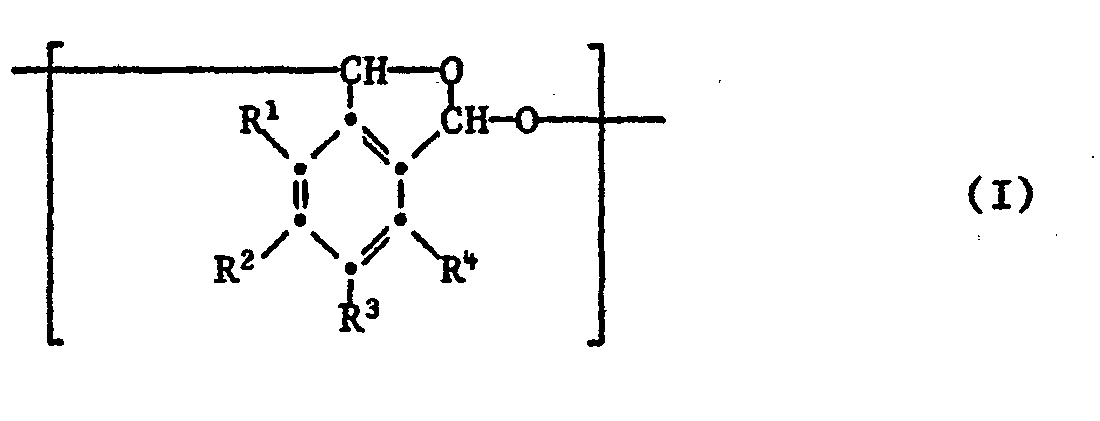
- Die Erfindung betrifft organometallhaltige endverkappte Polyphthalaldehyde mit der wiederkehrenden Einheit der Formel 1

- Als C1-C4-Alkoxy sind diese Reste z.B. Methoxy, Ethoxy, n-Propoxy oder n-Butoxy, bevorzugt Methoxy.
- Sind R1-R4 Alkylthio, so sind Methylthio, Ethylthio, n-Propylthio oder n-Butylthio, insbesondere Methylthio zu erwähnen.
- Als Alkoxycarbonyl handelt es sich z.B. um Methoxycarbonyl, Ethoxycarbonyl, n-Propoxycarbonyl oder n-Butoxycarbonyl.
- Mindestens einer, bevorzugt einer oder zwei und insbesondere zwei der Reste R1-R4 bedeuten eine Gruppe -Q(R5)3 oder -Q(R6)3. Bevorzugt sind dabei siliziumhaltige Reste.
- R5 bedeutet C1-C12-, bevorzugt C1-C4-Alkyl und ist insbesondere Methyl oder Ethyl. Im übrigen kann es sich um Isopropyl, n-Propyl, n-Butyl, n-Hexyl, n-Octyl, n-Decyl oder n-Dodecyl handeln.
- R6 ist als C6-Clo-Aryl, insbesondere Phenyl oder Naphtyl.
- In bevorzugten Verbindungen sind alle am Metall gebundenen Reste R5 bzw. R6 identisch.
- Besonders hervorzuheben sind Verbindungen, in welchen R2 und R3 eine Gruppe -Q(R5)3 oder -Si(R6)3 sind, und die übrigen Reste R1 und R4 Wasserstoff bedeuten.
- Zur Stabilisierung der Polymeren der Formel I, werden diese in bekannter Weise endverkappt. Als Verkappungsgruppen eignen sich Amine oder Acyle, wie sie z.B. von Hiroshi Ito und C.G. Willson, Polym. Eng. Sci. 23, 1012 ff (1983) beschrieben worden sind (s. auch Macromolecules 2(4), 414 (1969)).
- Die Polymeren mit der wiederkehrenden Einheit der Formel I besitzen vorzugsweise ein mittleres Molekulargewicht von 10'000 bis 1'000'000 und insbesondere von 50'000-400'000.
- Bei den neuen Polymeren der vorliegenden Erfindung handelt es sich vorzugsweise um Homopolymere. Als strahlungssensitive, trockenentwickelbare Zusammensetzung eignen sich aber auch Copolymere, so z.B. Copolymere, welche aus zwei oder mehr Bausteinen der Formel I verschiedener Struktur aufgebaut sind oder um Copolymere, welche neben Struktureinheiten der Formel I, andere Bausteine enthalten, welche sich von copolymerisierbaren Monomeren ableiten. Die vorliegende Erfindung betrifft daher auch Copolymere organometallhaltiger Phthalaldehyde enthaltend das wiederkehrende Strukturelement der Formel I


- Sind R7 und R8 Cl-C4-Alkyl, so handelt es sich beispielsweise um Methyl, Ethyl, Isopropyl, n-Propyl oder n-Butyl, bevorzugt um Methyl. Diese Alkylgruppen enthalten falls substituiert, vorzugsweise eine Gruppe -Q(R5)3 oder -Si(R6)3. Zur Bedeutung von Q, R5 und R6 verweisen wir auf die Beschreibung oben.
- Als substituiertes Phenyl für R7 und R8 kommt Phenyl in Frage, welches durch zwei und vorzugsweise durch eine Gruppe -Q(R5)3 oder -Si(R6)3 substituiert ist. Zur Bedeutung von Q, R5 und R6 verweisen wir erneut auf die Beschreibung oben.
- Im Rahmen der angegebenen Bedeutungen, gilt für die Reste R9, R10, R11 und R12 die im Zusammenhang mit der Formel I angegebene Erklärung.
- Typische Vertreter von Monomeren, von welchen sich die Strukturelemente der Formeln II, III oder IV ableiten, sind:
- OCH-CHzCHz-Si(CH3)3, OCH-C6H4-(p)Si(CH3)3, Phthalaldehyd, oder o-Formylphenylacetaldehyd.
- Besonders geeignet sind Monomere, von welchen sich Strukturelemente der Formel III ableiten.
- Die Herstellung der erfindungsgemässen Homo- und Copolymere erfolgt auf an sich bekannte Weise durch Polymerisation eines Phthalaldehyds der Formel V

- Ausserdem kann die Polymerisation auch durch Röntgenstrahlen initiiert werden.
- Die Reaktion dauert etwa 1 bis 10 Stunden und das so erhaltene Polymer kann in bekannter Weise endverkappt werden. Als Verkappungsmittel eignet sich z.B. Amine für die kationische Reaktionsführung oder Säurechloride oder Anhydride für die anionische Reaktionsführung.
- Die Herstellung der erfindungsgemässen Polymeren erfolgt z.B. nach den im US 3,940,507 beschriebenen Verfahren oder gemäss C. Aso und S. Tagami, Macromolecules 2, 414 ff (1969).
- Die zur vorliegenden Erfindung gehörenden Copolymeren können grundsätzlich nach dem gleichen Prinzip hergestellt werden, wobei ein Phthalaldehyd der Formel V mit mindestens einem Monomeren der Formeln II*, III* oder IV*
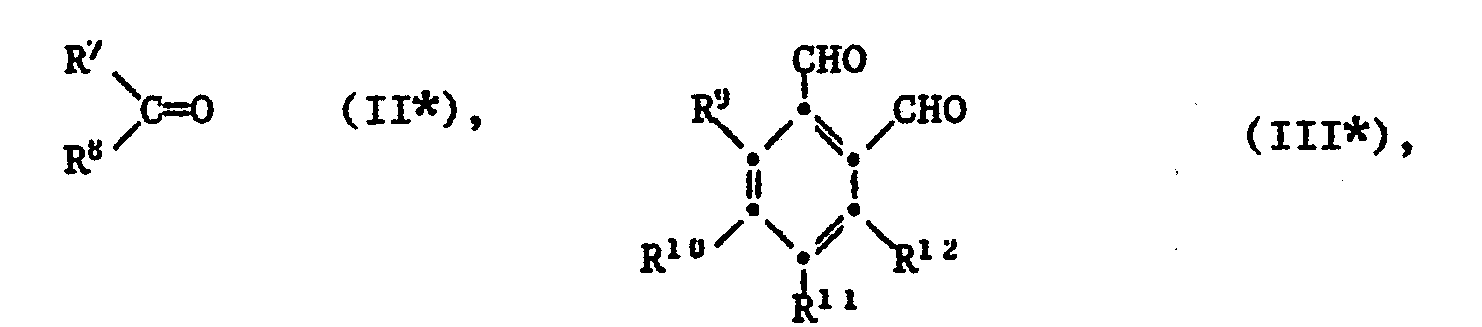

- Die Monomeren der Formeln II*, III* und IV* sind bekannte Verbindungen und können, falls sie teilweise noch neu sind, in Analogie zu bekannten hergestellt werden.
- Die Monomeren der Formel V sind neu und können in an sich bekannter Weise aus den entsprechenden Halogeniden der Formeln VI oder VII

- Die Ueberführung der Verbindungen der Formel VI in die Phthalaldehyde der Formel V erfolgt oxidativ zum Beispiel mittels Dimethylsulfoxid oder Hexamethylentetramin. Verfahren dieser Art sind detailliert beschrieben, z.B. in J.Chem.Soc. 692 (1940); J.Org.Chem. 24, 1792 ff (1959) oder J.Am.Chem.Soc. 81, 4113 ff (1959).
- Zur Herstellung der Phthalaldehyde der Formel V aus den entsprechenden Tetrahalogenverbindungen der Formel VII durch Hydrolyse mit einem Metall- oder Ammoniumsalz einer organischen Säure in wässrigem Medium in Gegenwart eines Phasentransferkatalysators und einer anorganischen Base kann auf die Methode der EP-A 03 230 verwiesen werden. Die Oxidation mittels Kaliumoxalat ist ausserdem in "Organic Synthesis", Coll.Vol. IV, 807 ff (1963) beschrieben.
- Die Verbindungen der Formeln VI und VII können analog dem in J.Chem.Soc., 79, Seite 6540 ff (1957) offenbarten Verfahren hergestellt werden, indem man Verbindungen der Formel VIII

- Die Verbindungen der Formel VIII sind bekannt und können wie beispielsweise in J.Chem.Soc. 3640 (1959) und J.Organomet.chem. 84(2) (1975) 165-175, J.Organomet.chem. 289(2-3) (1985) 331-9 beschrieben oder in analoger Weise hergestellt werden.
- Die erfindungsgemässen Polymeren eignen sich vortrefflich als strahlungssensitives, trocken entwickelbares Aufzeichnungsmaterial. Wie bereits erwähnt, lassen sich die Verbindungen mit der wiederkehrenden Struktureinheit (I) zur Herstellung von positiv arbeitenden Photoresistsystemen verwenden.
- Die Erfindung betrifft daher auch strahlungssensitive, trocken entwickelbare Zusammensetzungen enthaltend ein organometallhaltiges, endverkapptes Polyphthalaldehyd mit der wiederkehrenden Einheit der Formel I; sowie Copolymere, welche durch Copolymerisation von Phthalaldehyden der Formel V mit bis zu 50 Mol-% von Monomeren der Formel II, III oder IV erhalten werden und eine unter Einwirkung von aktinischer Strahlung eine Säure abspaltende Verbindung.
- Als strahlungsempfindliche Komponenten, die bei Lichteinwirkung Säure bilden bzw. abspalten, sind eine grosse Anzahl von Verbindungen bekannt. Dazu zählen beispielsweise Diazoniumsalze, wie sie in der Diazotypie verwendet werden, o-Chinondiazide, wie sie in bekannten positiv arbeitenden Kopiermassen verwendet werden, oder auch Halogenverbindungen, die bei Bestrahlung Halogenwasserstoffsäure bilden. Verbindungen dieses Typs sind beispielsweise in den US-PS 3,515,552, 3,536,489 oder 3,779,778, sowie in den DE-OS 2,718,259, 2,243,621 oder 2,610,842 beschrieben.
- Als strahlungsempfindliche Komponenten der erfindungsgemässen Zusammensetzungen eignen sich aber auch kationische Photoinitiatoren aus der Gruppe der Iodonium- oder Sulfoniumsalze. Solche Verbindungen sind beispielsweise in "UV-Curing, Science and Technology" (Editor: S.P. Pappas, Technology Marketing Corp., 642 Westover Road, Stanford, Conneticut, USA) beschrieben.
- Insbesondere sind auch Diaryliodosyl-Salze einsetzbar. Solche Verbindungen sind beispielsweise in der EP-A 106,797 beschrieben.
- Ferner können Sulfoxoniumsalze als strahlungsempfindliche Verbindungen verwendet werden. Solche Salze sind beispielsweise in der EP-PS 35,969 oder in den EP-A 44,274 bzw. 54,509 beschrieben. Insbesondere zu erwähnen sind aliphatische Sulfoxoniumsalze, die im tiefen UV-Bereich absorbieren.
- Insbesondere lassen sich auch Verbindungen einsetzen, die bei Bestrahlung mit aktinischem Licht Sulfonsäuren freisetzen. Solche Verbindungen sind an sich bekannt und beispielsweise in der GB-A 2,120,263, den EP-A 84,515, 37,512 oder 58,638 bzw. in den US-PS 4,258,121 oder 4,371,605 beschrieben.
- Werden als strahlungsempfindliche säureabspaltende Komponenten Salze eingesetzt, so sind diese vorzugsweise in organischen Lösungsmitteln löslich. Besonders bevorzugt handelt es sich bei diesen Salzen um Abscheidungsprodukte mit komplexen Säuren, beispielsweise von Borfluorwasserstoffsäure oder Hexafluorphosphorsäure.
- Die Menge der strahlungsempfindlichen Komponente der erfindungsgemässen Zusammensetzungen kann je nach Natur und Zusammensetzung des strahlungsempfindlichen Gemisches in weiten Grenzen variiert werden. Günstige Ergebnisse werden erzielt, wenn etwa 0,05 bis 5 Gew.-% an Komponente, bezogen auf das Polyphthalaldehyd, eingesetzt werden. Vorzugsweise setzt man 0,2 bis 1 Gew.-% Säurespender, bezogen auf das Polyphthalaldehyd ein. Da die strahlungsempfindliche Komponente (Initiator) nach der Trockenentwicklung im System zurückbleibt, wird vorzugsweise möglichst wenig dieser Substanzen eingesetzt, um negative Beeinflussungen in nachfolgenden Prozesschritten zu verhindern. Bei der hohen Empfindlichkeit des vorliegenden Systems ist dies möglich, was als grosser Vorteil gegenüber dem Stand der Technik zu werten ist und nicht erwartet werden konnte.
- Die erfindungsgemässe Zusammensetzung kann weitere übliche Zusatzstoffe enthalten, wie z.B. Stabilisatoren, Sensibilisatoren, gebräuchliche Polymere, wie Polystyrol oder Polymethylmethacrylat, Pigmente, Farbstoffe, Füllstoffe, Haftvermittler, Verlaufmittel, Netzmittel und Weichmacher. Ferner können die Zusammensetzungen zur Applikation in geeigneten Lösungsmitteln gelöst werden.
- Die erfindungsgemässen Zusammensetzungen eignen sich hervorragend als Beschichtungsmittel für Substrate aller Art, z.B. Holz, Textilien, Papier, Keramik, Glas, Kunststoffe, wie Polyester, Polyethylenterephthalat, Polyolefine oder Celluloseacetat, insbesondere in Form von Filmen, sowie von Metallen, wie Al, Cu, Ni, Fe, Zn, Mg oder Co, und von Halbleitermaterialien wie Si, Si3N4, Si02, GaAs, Ge, etc. bei denen durch bildmässiges Belichten eine Abbildung aufgebracht werden soll. Ein weiterer Gegenstand vorliegender Erfindung sind die beschichteten Substrate.
- Die Herstellung der beschichteten Substrate kann z.B. erfolgen, indem man eine Lösung oder Suspension der Zusammensetzung herstellt. Als Lösungsmittel eignen sich alle nicht allzu polaren und nicht zu niedrig siedenden Lösungsmittel, z.B. Ether, Ketone oder Aromaten, wie Tetrahydrofuran, Dioxan, Cyclohexanon, Benzol oder Toluol. Bevorzugt sind 1-20%-ige Polymerlösungen. Die Lösung wird mittels bekannten Beschichtungsverfahren auf ein Substrat gleichförmig aufgebracht, z.B. durch Schleudern, Tauchen, Rakelbeschichtung, Vorhanggiessverfahren, Aufpinseln, Sprühen und Reverse Rollbeschichtung. Es ist auch möglich, die lichtempfindliche Schicht auf einen temporären, flexiblen Träger zu bringen, und dann durch Schichtübertragung via Lamination das endgültige Substrat, z.B. eine Silizium- Wafer, zu beschichten.
- Die Auftragsmenge (Schichtdicke) und Art des Substrates (Schichtträger) sind abhängig vom gewünschten Applikationsgebiet. Besonders vorteilhaft ist es, dass die erfindungsgemässen Zusammensetzungen in sehr dünnen Schichten eingesetzt werden können, und sich durch eine hervorragende Auflösung auszeichnen. Sie eignen sich bei entsprechend gewählter Strahlungsquelle und strahlungsempfindlicher Komponente für ein breites Spektrum von Anwendungsgebieten, wo die Erzeugung von strukturierten Bildern erwünscht ist. Besonders vorteilhaft ist ihr Einsatz jedoch in der Submikronlithographie sowie der Mehrschichtenlithographie, wo heute die Anforderungen der Mikroelektronik an ein Resistsystem besonders hoch sind. Daher sind bevorzugte Filmschichtdicken 0,3-2,0 pm.
- Nach dem Beschichten wird das Lösungsmittel üblicherweise durch Trocknen entfernt und es resultiert eine amorphe Schicht des Resists auf dem Träger.
- Zwischen Träger und Resist kann, falls erwünscht, eine weitere Schicht aufgetragen werden. Dieses sogenannte Planarisierharz ermöglicht das Auftragen besonders dünner Resistschichten. Grundsätzlich eignen sich alle organischen Polymere und Oligomere, welche als Polymerlösung auf einen Träger aufgebracht werden können. Beispiele solcher sind Polyimide, Polyamidsäuren, Polymethylmethacrylat, Novolake oder auch andere Resistsysteme.
- Die strahlungssensitive Schicht wird in üblicher Weise bildmässig einer geeigneten Strahlung ausgesetzt. Die belichteten Stellen dieser Schicht depolymerisieren und die entstandenen Monomere verdampfen, wodurch die darunterliegende Schicht, bzw. der Träger freigelegt wird. Es ist ein Vorteil des erfindungsgemässen Systems, dass zu dieser Freilegung kein Lösungsmittel verwendet werden muss und die saubere und rückstandsfreie Selbstentwicklung sehr scharfe Positivbilder liefert. Je nach Art des entstehenden Monomers kann die Freilegung stark beschleunigt werden, durch Erwärmen und/oder Anlegen von Vakuum.
- Bevorzugt sind Erwärmungen zwischen 20 und 120°C während 1-60 Minuten.
- Belichtungen mit aktinischer Strahlung werden durch eine Quartzmaske, die ein vorbestimmtes Muster enthält oder durch einen Laserstrahl, der beispielsweise computergesteuert über die Oberfläche des beschichteten Substrates bewegt wird, durchgeführt.
- Bevorzugt werden zur Belichtung UV-Strahlen (200-450 nm), Elektronenstrahlen, Röntgenstrahlen oder Ionenstrahlen verwendet.
- Was das erfindungsgemässe System gegenüber dem Stand der Technik ausserdem auszeichnet, ist dessen unerwartet hohe Empfindlichkeit bei gleicher Schichtdicke. Obwohl bedeutend geringere Mengen an strahlungsempfindlichem Initiator nötig sind, ist die benötigte Strahlungsintensität bedeutend geringer. So kommt man mit beispielsweise 0,1-0,3 mJ/cm2 aus, um zum gewünschten Resultat zu kommen.
- Das erfindungsgemässe Aufzeichnungsmaterial ist ferner als Plasma- ätzresist geeignet. So sind die unbelichteten Stellen des strukturierten Bildes z.B. gegen Sauerstoffplasma-Aetzbedingungen resistent.
- In einem mit Kühler und Rührer ausgerüsteten 1,5-Liter Sulfierkolben werden unter Stickstoff 100 g (562 mmol) 4-Trimethylsilyl-o-xylol, 400 g (2250 mmol) N-Bromsuccinimid, 1 g Dibenzoylperoxid und 750 ml Tetrachlorkohlenstoff vorgelegt. Man erwärmt das Reaktionsgemisch auf Siedehitze, bis die Reaktion exotherm wird. Das Heizbad wird jetzt entfernt, bis das spontane Sieden abklingt. Danach wird noch etwa eine Stunde bei Siedehitze gerührt. Die gaschromatographische Analyse zeigt, dass kein 4-Trimethylsilyl-o-xylol mehr vorhanden ist. Das Gemisch wird auf 0°C gekühlt und das Succinimid abgetrennt. Das Filtrat wird nun mit 200 ml kalter 5%-iger Natronlauge zweimal extrahiert und einmal mit Wasser gewaschen. Die CClu-Phase wird mit Magnesiumsulfat getrocknet und das CC14 am Rotationsverdampfer vertrieben.
- Man erhält 250 g eines Festkörpers (90 % der Theorie), der bei 94°C schmilzt. Durch zweimaliges Umkristallisieren in wenig n-Hexan erhält man weisse Kristalle mit einem Schmelzpunkt von 97°C (Siedepunkt der Verbindung: 138°C/0,13 mbar).
- Elementaranalyse:

- IH-NMR-Spektrum (Aceton-d6): CH3-Si 9H(s) : 0.4 ppm BrzCH 2H(s) : 7.95 ppm und 7.5 ppm H-aromat. 3H(m) : 7.6-7.85 ppm
- 175 g (355 mMol) 4-Trimethyl-α,α,α',α-tetrabrom-o-xylol, 119 g Natriumformiat, 72 g Calciumcarbonat, 26 g Tetrabutylammoniumbromid und 150 ml Wasser werden in einem 750 ml Sulfierkolben mit Rührer vorgelegt. Unter Stickstoff wird das Gemisch auf etwa 100°C erwärmt, wobei das 4-Trimethyl-α,α,α',α'-tetrabrom-o-xylol aufschmilzt. Dann wird kräftig gerührt, so dass die verschiedenen Phasen gut vermischt werden. Nach etwa 12 Stunden wird auf 0°C abgekühlt und die Mischung mit 400 ml Diethylether extrahiert. Die getrocknete organische Phase wird eingeengt. Der Rückstand wird anschliessend über eine Kieselgel-Kolonne mit Toluol chromatographiert. Nach dem Einengen der Toluolfraktionen erhält man 54 g (61 % der Theorie) des reinen 4-Yrimethylsilyl-o-phthaldialdehyds.
- Dieser wird in etwa dem gleichen Volumen n-Hexan gelöst. Im Kühlschrank bilden sich gelbliche Kristalle, die einen Schmelzpunkt von 38°C haben. Siedepunkt der Verbindung: 98°C/0,13 mbar.
- Elementaranalyse:
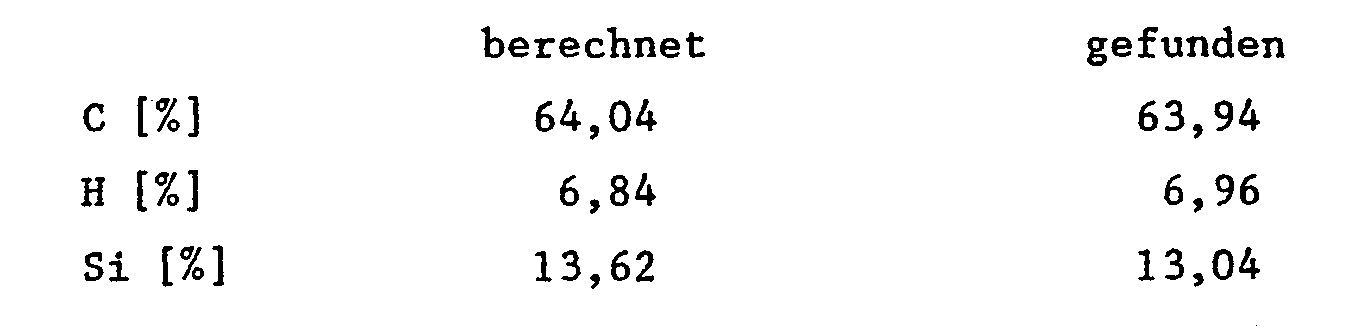
- 1H-NMR-Spektrum (Aceton-d6): CH3-Si (9H): 0.36 ppm (s) H-aromat. (3H): 8.0 ppm (m) H-aromat. (1H): 8.1 ppm (s) CHO (2H): 10.6 ppm (s)
- In einem 1,5 1 Sulfierkolben, der mit einem Rührer und einem Kühler versehen ist, werden unter Stickstoff 70 g (280 mmol) 4,5-Bis(trimethylsilyl)-o-xylol, 224 g (1260 mmol) N-Bromsuccinimid, 5 g Dibenzoylperoxid und 800 ml Tetrachlorkohlenstoff vorgelegt. Man erwärmt die Suspension bis zum selbständigen Sieden. Nach der Exothermie wird noch für etwa drei Stunden am Rückfluss gekocht. Die Suspension wird abgekühlt, vom Succinimid abgetrennt und das Filtrat zweimal mit 10%iger kalter Natronlauge gewaschen. Die getrocknete organische Phase wird vom Lösungsmittel befreit. der gewonnene Festkörper wird in n-Hexan umkristallisiert.
- Man erhält 120 g (75 %) Festkörper, der bei 157°C schmilzt.
- Elementaranalyse:

- 1H-NMR (Aceton-d6): CH3-Si (18H): 0.44 ppm (s) Br2CH (2H): 7.65 ppm (s) H-aromat. (2H): 8.1 ppm (s)
- 85 g (150 mmol) 4,5-Bis(trimethylsilyl)-a,a,a',a'-tetrabrom-o-xylol, 71,5 g Natriumformiat, 35 g Calciumcarbonat, 113 g Tetrabutylammoniumbromid, 175 ml Wasser und 200 ml Toluol werden in einem 750 ml Sulfierkolben eingebracht und unter Stickstoff wird bei 120°C stark gerührt. Nach 2 Tagen wird auf Raumtemperatur abgekühlt und mit Toluol verdünnt. Die organische Phase wird mit Wasser gewaschen und getrocknet. Das Lösungsmittel wird am Rotationsverdampfer entfernt und der Festkörper in n-Hexan bis zum konstanten Schmelzpunkt umkristallisiert.
- Man erhält 17 g (40 %) einer gelblichen, kristallinen Substanz, die bei 103°C schmilzt.
- Elementaranalyse:

- lH-NMR (Aceton-d6): CH3-Si (18H): 0.4 ppm (s) H-aromat. (2H): 8.3 ppm (s) CHO (2H): 10.5 ppm (s)
- Unter Stickstoff werden 24 g (116 mMol) 4-Trimethylsilyl-o-phthaldialdehyd und 100 ml trockenes Methylenchlorid vorgelegt, in flüssigem Stickstoff abgekühlt und 2 Mol-% BF3-diethylether als Initiator zugesetzt. Danach wird die Lösung im Hochvakuum vom Sauerstoff befreit.
- In einem Kältebad lässt man unter Stickstoff bei -78°C polymerisieren. Nach wenigen Stunden gibt man bei -78°C zur hochviskosen Lösung 2 ml -78°C kaltes Pyridin/Essigsäureanhydridgemisch (Verhältnis 1:1) hinzu.
- Man rührt noch 0,5 Stunden bei -78°C, erwärmt auf Raumtemperatur und giesst die Lösung in 1000 ml Methanol, wobei das Polymer sofort ausfällt. Dieses wird abgetrennt und getrocknet. Ausbeute: 23,5 g.
- Zur Reinigung wird das Polymer nochmals in 300 ml Methylenchlorid gelöst, filtriert und erneut in 1000 ml Methanol ausgefällt. Das Polymer wird abgetrennt und bei Raumtemperatur am Hochvakuum getrocknet.
- Ausbeute: 19.3 g (80 % der Theorie).
- Das Polymer hat einen Zersetzungspunkt von 156°C.
- Gelpermeationschromatoraphische Messungen in Tetrahydrofuran zeigen ein M von 290'000 und ein M von 80'000.
- 4 g (14,4 mmol) 4,5-Bis(trimethylsilyl)-o-phthaldialdehyd werden in einer Ampulle mit 12 ml trockenem Methylenchlorid gelöst. Durch Gefrieren/Auftauen wird am Hochvakuum von Sauerstoff befreit. Ueber eine Spritze gibt man 2 Mol % (bezüglich Monomer) einer BF3-Diethyl- etheratlösung in Methylenchlorid zur gefrorenen Lösung und lässt dann bei -78°C unter Stickstoff polymerisieren. Nach wenigen Stunden gibt man zur hochviskosen Lösung 1 ml Pyridin, das vorgekühlt war. Dann lässt man die Lösung auf Raumtemperatur erwärmen und fällt das Polymer in Methanol aus. Das weisse Pulver wird getrocknet, erneut in Methylenchlorid gelöst und nochmals in Methanol ausgefällt.
- Das weisse Polymerpulver wird am Hochvakuum bei 50°C getrocknet. Man erhält 3,1 g (77 %) Polymer.
- Das Polymer hat einen Zersetzungspunkt von 170°C. GPC-Messungen in THF zeigen ein 9w von 420'000 und ein
M n von 180'000. - 1H-NMR (CDCl3): CH3-Si (18H): 0.4 ppm (s) ar-H (2H): 8.2 ppm (s)

- Zu einer 10%-igen Lösung des Polymers gemäss Beispiel 3 in Cyclohexanon werden 1 Gew.% Diphenyliodoniumhexafluoroarsenat, bezogen auf das Polymer, gegeben. Die filtrierte Lösung wird bei 2500 rpm durch Schleuderbeschichtung auf einen Silizium-Wafer gebracht. Der Polymerfilm wird während 25 min. bei 95°G getrocknet. Die Schichtdicke des amorphen Films beträgt 0,9 pm.
- Dieser Resistfilm wird bei 254 nm während 0,2 sec. durch eine Quarzmaske belichtet (Intensität der Hg-Xe-Lampe bei 254 nm :
- 1 mw/cm2). Das belichtete Material wird anschliessend während 4 min. auf 110°C erhitzt.
- Dabei entstehen auffallend sauber aufgelöste Strukturen im Submikronbereich.
- Auf einen Silizium-Wafer wird eine 0.6 um dicke Schicht eines löslichen Polyimids (Probimide® 285, Ciba-Geigy AG) aufgetragen. Diese wird bei 300°C thermisch vernetzt. Darauf gibt man wie in Beispiel 7 beschrieben die Resistlösung. Nach dem Trocknen beträgt die Resist-Schichtdicke 0.7 pm.
- Die Belichtung erfolgt wie in Beispiel 7 beschrieben, die Trockenentwicklung wird bei 110°C während 3 min. durchgeführt. Anschliessend werden die freigelegten Stellen des Polyimids im Sauerstoffplasma (40 W, 10 sccm 02, 5·10-3 mbar) während 15 min. vollständig weggeätzt, während die nichtbelichteten Stellen des Photoresistmaterials nicht angegriffen werden.
- Auf diese Weise kann eine trockenentwickelte Submikronstruktur im Resist anisotrop in das darunterliegende Planarisierharz transferiert werden.
- Ciba-Geigy AG) aufgetragen. Durch thermische Vernetzung bei 300°C wird das Polyimid unlöslich gemacht.
- Zu einer 10%igen Lösung des Polymers gemäss Beispiel 8 in Cyclohexanon gibt man 1,5 Gew.% Diphenyliodoniumhexafluoroarsenat (bezogen auf das Polymer). Die Lösung wird durch einen Filter mit 0,5 um Porendurchmesser gereinigt und auf das unlösliche Polyimid aufgetragen. Durch Schleuderbeschichten bei 4500 rpm erzeugt man einen 0,4 um dicken, homogenen Resistfilm. Dieser wird bei 90°C während 20 Minuten getrocknet. Der trockene Resistfilm belichtet man mit 1 mJ/cm2 bei 254 nm durch eine Quarzmaske im sogenannten contact printing Verfahren. Der belichtete Resistfilm wird anschliessend bei 90°C während 20 Minuten trocken entwickelt.
- Die Resiststrukturen werden danach ins darunterliegende Polyimid mittels anisotropem Sauerstoffplasmaätzen transferiert. Bei 35 Watt, 4.10-2 mbar, 20 sccm dauert das Aetzen etwa 23 Minuten. Danach ist das Polyimid an den resistfreien Stellen bis zum Siliziumwafer abgeätzt, während das vom Resist bedeckte Polyimid vollständig intakt bleibt.
- Mit diesem Verfahren gelingt es, Strukturen von 0,5 um Breite und 2,5 um Tiefe zu erzeugen. Auf dem freigeätzten Siliziummaterial sind keine messbaren Rückstände mehr vorhanden.
Claims (13)




Applications Claiming Priority (2)
| Application Number | Priority Date | Filing Date | Title |
|---|---|---|---|
| CH14786 | 1986-01-16 | ||
| CH147/86 | 1986-01-16 |
Publications (3)
| Publication Number | Publication Date |
|---|---|
| EP0236261A2 true EP0236261A2 (de) | 1987-09-09 |
| EP0236261A3 EP0236261A3 (en) | 1988-09-21 |
| EP0236261B1 EP0236261B1 (de) | 1992-04-08 |
Family
ID=4180319
Family Applications (1)
| Application Number | Title | Priority Date | Filing Date |
|---|---|---|---|
| EP87810014A Expired - Lifetime EP0236261B1 (de) | 1986-01-16 | 1987-01-12 | Neue organometallhaltige Polymere |
Country Status (7)
| Country | Link |
|---|---|
| US (1) | US4734481A (de) |
| EP (1) | EP0236261B1 (de) |
| JP (1) | JPH0798852B2 (de) |
| KR (1) | KR910004040B1 (de) |
| AT (1) | ATE74612T1 (de) |
| CA (1) | CA1271878A (de) |
| DE (1) | DE3778055D1 (de) |
Cited By (1)
| Publication number | Priority date | Publication date | Assignee | Title |
|---|---|---|---|---|
| WO2000011520A1 (en) * | 1998-08-18 | 2000-03-02 | 3M Innovative Properties Company | Polymers having silicon-containing acetal or ketal functional groups |
Families Citing this family (11)
| Publication number | Priority date | Publication date | Assignee | Title |
|---|---|---|---|---|
| US4820829A (en) * | 1986-01-16 | 1989-04-11 | Ciba-Geigy Corporation | Substituted o-phthalaldehydes |
| JPH0775789B2 (ja) * | 1990-06-14 | 1995-08-16 | インターナショナル・ビジネス・マシーンズ・コーポレイション | 化学ハンダおよびそれを用いる結合方法 |
| US5338818A (en) * | 1992-09-10 | 1994-08-16 | International Business Machines Corporation | Silicon containing positive resist for DUV lithography |
| AU2001280157B2 (en) | 2000-08-29 | 2005-08-11 | Jsr Corporation | Composition having refractive index sensitively changeable by radiation and method for forming refractive index pattern |
| AU2258302A (en) | 2000-12-11 | 2002-06-24 | Jsr Corp | Radiation-sensitive composition changing in refractive index and method of changing refractive index |
| EP1369459A4 (de) | 2001-02-19 | 2008-05-21 | Jsr Corp | Strahlungsempfindliche zusammensetzung mit brechungsindexverteilung |
| CA2408217A1 (en) | 2001-03-13 | 2002-11-12 | Jsr Corporation | Radiation sensitive refractive index changing composition and use thereof |
| JP2003043682A (ja) | 2001-08-01 | 2003-02-13 | Jsr Corp | 感放射線性誘電率変化性組成物、誘電率変化法 |
| US7279362B2 (en) * | 2005-03-31 | 2007-10-09 | Intel Corporation | Semiconductor wafer coat layers and methods therefor |
| US8871893B2 (en) | 2010-05-10 | 2014-10-28 | The Penn State Research Foundation | Signal-responsive plastics |
| WO2022209816A1 (ja) * | 2021-04-01 | 2022-10-06 | Jsr株式会社 | 半導体基板の製造方法及びレジスト下層膜形成用組成物 |
Family Cites Families (7)
| Publication number | Priority date | Publication date | Assignee | Title |
|---|---|---|---|---|
| FR1601091A (de) * | 1968-03-21 | 1970-08-10 | ||
| US3867142A (en) * | 1973-04-16 | 1975-02-18 | Krause Offset System Kg | Photosensitive materials for producing printing plates |
| US3940507A (en) * | 1974-05-03 | 1976-02-24 | Rca Corporation | Electron beam recording media and method of recording |
| US4108839A (en) * | 1977-01-21 | 1978-08-22 | E. I. Du Pont De Nemours And Company | Photosensitive polyaldehydes and use in photoimaging |
| US4075175A (en) * | 1977-01-21 | 1978-02-21 | E. I. Du Pont De Nemours And Company | Preparation of photosensitive polyaldehydes |
| JPS5988737A (ja) * | 1982-11-15 | 1984-05-22 | Hitachi Ltd | 放射線感応性有機高分子材料 |
| JPS59216142A (ja) * | 1983-05-16 | 1984-12-06 | インタ−ナシヨナル ビジネス マシ−ンズ コ−ポレ−シヨン | リソグラフイ用マスクの製造方法 |
-
1987
- 1987-01-08 US US07/001,312 patent/US4734481A/en not_active Expired - Fee Related
- 1987-01-12 EP EP87810014A patent/EP0236261B1/de not_active Expired - Lifetime
- 1987-01-12 AT AT87810014T patent/ATE74612T1/de not_active IP Right Cessation
- 1987-01-12 DE DE8787810014T patent/DE3778055D1/de not_active Expired - Lifetime
- 1987-01-14 CA CA000527283A patent/CA1271878A/en not_active Expired - Lifetime
- 1987-01-16 KR KR1019870000323A patent/KR910004040B1/ko not_active Expired
- 1987-01-16 JP JP62008871A patent/JPH0798852B2/ja not_active Expired - Lifetime
Cited By (3)
| Publication number | Priority date | Publication date | Assignee | Title |
|---|---|---|---|---|
| WO2000011520A1 (en) * | 1998-08-18 | 2000-03-02 | 3M Innovative Properties Company | Polymers having silicon-containing acetal or ketal functional groups |
| US6359078B1 (en) | 1998-08-18 | 2002-03-19 | 3M Innovative Properties Company | Polymers having silicon-containing acetal or ketal functional groups |
| US6479219B2 (en) | 1998-08-18 | 2002-11-12 | 3M Innovative Properties Company | Polymers having silicon-containing acetal or ketal functional groups |
Also Published As
| Publication number | Publication date |
|---|---|
| JPH0798852B2 (ja) | 1995-10-25 |
| JPS62190211A (ja) | 1987-08-20 |
| KR870007447A (ko) | 1987-08-19 |
| CA1271878A (en) | 1990-07-17 |
| EP0236261A3 (en) | 1988-09-21 |
| KR910004040B1 (ko) | 1991-06-22 |
| US4734481A (en) | 1988-03-29 |
| ATE74612T1 (de) | 1992-04-15 |
| EP0236261B1 (de) | 1992-04-08 |
| DE3778055D1 (de) | 1992-05-14 |
Similar Documents
| Publication | Publication Date | Title |
|---|---|---|
| EP0342498B1 (de) | Positiv und negativ arbeitende strahlungsempfindliche Gemische sowie Verfahren zur Herstellung von Reliefmustern | |
| DE69718974T2 (de) | Neue Polymere und Photoresistzusammensetzungen | |
| EP0297443B1 (de) | Strahlungsempfindliches Gemisch für lichtempfindliche Beschichtungsmaterialien | |
| DE19758244B4 (de) | Photoresist-Copolymer auf der Basis von Bicycloalkenen, Verfahren zu dessen Herstellung und dessen Verwendung | |
| DE19964382B4 (de) | Verwendung einer Beschichtungszusammensetzung zur Herstellung einer nicht reflektierenden Beschichtung und Verfahren zur Herstellung der Beschichtungszusammensetzung | |
| EP0447868B1 (de) | Strahlungsempfindliches Gemisch | |
| DE69929879T2 (de) | Herstellung von acetal-derivatisierten hydroxylaromatischen polymeren und ihre verwendung in strahlungsempfindlichen formulierungen | |
| EP0473547A1 (de) | Olefinisch ungesättigte Oniumsalze | |
| EP0236261B1 (de) | Neue organometallhaltige Polymere | |
| DE19919794A1 (de) | Polymer und dessen Verwendung in einem Verfahren zur Bildung eines Mikromusters | |
| EP0291994A2 (de) | Photoresistgemisch und hiermit hergestelltes Photoresistmaterial enthaltend ein Polymer blockkierten Imidgruppen, sowie hierfür geeignetes Maleinsäureimidmonomer | |
| DE4120172A1 (de) | Strahlungsempfindliches gemisch, das als bindemittel neue polymere mit einheiten aus amiden von (alpha),(beta)-ungesaettigten carbonsaeuren enthaelt | |
| DE2641624C3 (de) | Verfahren zur Herstellung eines positiven Resistbildes unter Anwendung von Elektronenstrahlen | |
| DE10040963A1 (de) | Vernetzermonomer, umfassend eine Doppelbindung, und ein dieses enthaltendes Photoresist-Copolymer | |
| DE69024661T2 (de) | Anionisch polymerisierbare monomere, daraus hergestellte polymere und die verwendung der polymere in photowiderständen | |
| DE3810247C2 (de) | ||
| EP0510443B1 (de) | Negativ arbeitendes strahlungsempfindliches Gemisch und damit hergestelltes strahlungsempfindliches Aufzeichnungsmaterial | |
| DE19940515A1 (de) | Neue Monomere für Photoresiste, deren Polymere und Photoresist-Zusammensetzungen, die diese verwenden | |
| EP0337258B1 (de) | Strahlungsempfindliches Gemisch für lichtempfindliche Beschichtungsmaterialien und Verfahren zur Herstellung von Reliefmustern und Reliefbildern | |
| DE69228584T2 (de) | Positiv-arbeitendes Resistmaterial | |
| EP0307353A2 (de) | Organometallhaltige Polymere und deren Verwendung | |
| DE3935875A1 (de) | Strahlungsempfindliches gemisch und verfahren zur herstellung von reliefmustern | |
| EP0528203B1 (de) | Strahlungsempfindliches Gemisch mit einem polymeren Bindemittel mit Einheiten aus alpha,beta-ungesättigten Carbonsäureamiden | |
| EP0206983A2 (de) | Verfahren und Polymere zur Bilderzeugung | |
| EP0277555B1 (de) | Copolymerisate mit o-Nitrocarbinolestergruppierungen und Verfahren zur Herstellung von Zweilagenresisten sowie von Halbleiterbauelementen |
Legal Events
| Date | Code | Title | Description |
|---|---|---|---|
| PUAI | Public reference made under article 153(3) epc to a published international application that has entered the european phase |
Free format text: ORIGINAL CODE: 0009012 |
|
| 17P | Request for examination filed |
Effective date: 19870115 |
|
| AK | Designated contracting states |
Kind code of ref document: A2 Designated state(s): AT CH DE FR GB IT LI NL SE |
|
| PUAL | Search report despatched |
Free format text: ORIGINAL CODE: 0009013 |
|
| AK | Designated contracting states |
Kind code of ref document: A3 Designated state(s): AT CH DE FR GB IT LI NL SE |
|
| 17Q | First examination report despatched |
Effective date: 19910308 |
|
| GRAA | (expected) grant |
Free format text: ORIGINAL CODE: 0009210 |
|
| AK | Designated contracting states |
Kind code of ref document: B1 Designated state(s): AT CH DE FR GB IT LI NL SE |
|
| REF | Corresponds to: |
Ref document number: 74612 Country of ref document: AT Date of ref document: 19920415 Kind code of ref document: T |
|
| ITF | It: translation for a ep patent filed | ||
| REF | Corresponds to: |
Ref document number: 3778055 Country of ref document: DE Date of ref document: 19920514 |
|
| GBT | Gb: translation of ep patent filed (gb section 77(6)(a)/1977) | ||
| ET | Fr: translation filed | ||
| PLBE | No opposition filed within time limit |
Free format text: ORIGINAL CODE: 0009261 |
|
| STAA | Information on the status of an ep patent application or granted ep patent |
Free format text: STATUS: NO OPPOSITION FILED WITHIN TIME LIMIT |
|
| 26N | No opposition filed | ||
| EAL | Se: european patent in force in sweden |
Ref document number: 87810014.8 |
|
| PGFP | Annual fee paid to national office [announced via postgrant information from national office to epo] |
Ref country code: FR Payment date: 19951127 Year of fee payment: 10 |
|
| PGFP | Annual fee paid to national office [announced via postgrant information from national office to epo] |
Ref country code: NL Payment date: 19951128 Year of fee payment: 10 |
|
| PGFP | Annual fee paid to national office [announced via postgrant information from national office to epo] |
Ref country code: DE Payment date: 19951129 Year of fee payment: 10 |
|
| PGFP | Annual fee paid to national office [announced via postgrant information from national office to epo] |
Ref country code: GB Payment date: 19951207 Year of fee payment: 10 |
|
| PGFP | Annual fee paid to national office [announced via postgrant information from national office to epo] |
Ref country code: CH Payment date: 19951212 Year of fee payment: 10 |
|
| PGFP | Annual fee paid to national office [announced via postgrant information from national office to epo] |
Ref country code: AT Payment date: 19951213 Year of fee payment: 10 |
|
| PGFP | Annual fee paid to national office [announced via postgrant information from national office to epo] |
Ref country code: SE Payment date: 19960131 Year of fee payment: 10 |
|
| PG25 | Lapsed in a contracting state [announced via postgrant information from national office to epo] |
Ref country code: GB Effective date: 19970112 Ref country code: AT Effective date: 19970112 |
|
| PG25 | Lapsed in a contracting state [announced via postgrant information from national office to epo] |
Ref country code: SE Effective date: 19970113 |
|
| PG25 | Lapsed in a contracting state [announced via postgrant information from national office to epo] |
Ref country code: LI Effective date: 19970131 Ref country code: CH Effective date: 19970131 |
|
| PG25 | Lapsed in a contracting state [announced via postgrant information from national office to epo] |
Ref country code: NL Effective date: 19970801 |
|
| GBPC | Gb: european patent ceased through non-payment of renewal fee |
Effective date: 19970112 |
|
| REG | Reference to a national code |
Ref country code: CH Ref legal event code: PL |
|
| PG25 | Lapsed in a contracting state [announced via postgrant information from national office to epo] |
Ref country code: FR Effective date: 19970930 |
|
| NLV4 | Nl: lapsed or anulled due to non-payment of the annual fee |
Effective date: 19970801 |
|
| PG25 | Lapsed in a contracting state [announced via postgrant information from national office to epo] |
Ref country code: DE Effective date: 19971001 |
|
| EUG | Se: european patent has lapsed |
Ref document number: 87810014.8 |
|
| REG | Reference to a national code |
Ref country code: FR Ref legal event code: ST |
|
| PG25 | Lapsed in a contracting state [announced via postgrant information from national office to epo] |
Ref country code: IT Free format text: LAPSE BECAUSE OF NON-PAYMENT OF DUE FEES;WARNING: LAPSES OF ITALIAN PATENTS WITH EFFECTIVE DATE BEFORE 2007 MAY HAVE OCCURRED AT ANY TIME BEFORE 2007. THE CORRECT EFFECTIVE DATE MAY BE DIFFERENT FROM THE ONE RECORDED. Effective date: 20050112 |