EP0245074A2 - Article absorbant - Google Patents
Article absorbant Download PDFInfo
- Publication number
- EP0245074A2 EP0245074A2 EP87303994A EP87303994A EP0245074A2 EP 0245074 A2 EP0245074 A2 EP 0245074A2 EP 87303994 A EP87303994 A EP 87303994A EP 87303994 A EP87303994 A EP 87303994A EP 0245074 A2 EP0245074 A2 EP 0245074A2
- Authority
- EP
- European Patent Office
- Prior art keywords
- fibers
- hydrophilic
- woven fabrics
- layer
- weight
- Prior art date
- Legal status (The legal status is an assumption and is not a legal conclusion. Google has not performed a legal analysis and makes no representation as to the accuracy of the status listed.)
- Granted
Links
- 230000002745 absorbent Effects 0.000 title claims description 18
- 239000002250 absorbent Substances 0.000 title claims description 18
- 239000000835 fiber Substances 0.000 claims abstract description 144
- 239000010410 layer Substances 0.000 claims abstract description 25
- 230000002209 hydrophobic effect Effects 0.000 claims abstract description 21
- 239000002344 surface layer Substances 0.000 claims abstract description 19
- 230000005660 hydrophilic surface Effects 0.000 claims abstract description 7
- 239000004745 nonwoven fabric Substances 0.000 claims description 62
- 239000000463 material Substances 0.000 claims description 13
- 238000009877 rendering Methods 0.000 claims description 6
- XLYOFNOQVPJJNP-UHFFFAOYSA-N water Substances O XLYOFNOQVPJJNP-UHFFFAOYSA-N 0.000 description 38
- 239000007788 liquid Substances 0.000 description 36
- 238000000034 method Methods 0.000 description 13
- 238000009736 wetting Methods 0.000 description 13
- 238000010521 absorption reaction Methods 0.000 description 11
- 230000000052 comparative effect Effects 0.000 description 11
- 238000004519 manufacturing process Methods 0.000 description 8
- 239000003795 chemical substances by application Substances 0.000 description 7
- 239000000126 substance Substances 0.000 description 7
- 239000004094 surface-active agent Substances 0.000 description 7
- -1 polyethylene Polymers 0.000 description 6
- 229920000728 polyester Polymers 0.000 description 5
- 239000012085 test solution Substances 0.000 description 5
- 239000000243 solution Substances 0.000 description 4
- 229920002994 synthetic fiber Polymers 0.000 description 4
- 239000012209 synthetic fiber Substances 0.000 description 4
- 238000010998 test method Methods 0.000 description 4
- 239000004698 Polyethylene Substances 0.000 description 3
- 239000004743 Polypropylene Substances 0.000 description 3
- 239000008280 blood Substances 0.000 description 3
- 210000004369 blood Anatomy 0.000 description 3
- 239000002131 composite material Substances 0.000 description 3
- 230000003247 decreasing effect Effects 0.000 description 3
- 230000000694 effects Effects 0.000 description 3
- 239000011521 glass Substances 0.000 description 3
- 230000002175 menstrual effect Effects 0.000 description 3
- 239000000203 mixture Substances 0.000 description 3
- 238000012986 modification Methods 0.000 description 3
- 230000004048 modification Effects 0.000 description 3
- 229920000573 polyethylene Polymers 0.000 description 3
- 229920001155 polypropylene Polymers 0.000 description 3
- 238000012545 processing Methods 0.000 description 3
- 230000009467 reduction Effects 0.000 description 3
- 210000002700 urine Anatomy 0.000 description 3
- 229920000297 Rayon Polymers 0.000 description 2
- 239000011230 binding agent Substances 0.000 description 2
- 239000004744 fabric Substances 0.000 description 2
- 230000004927 fusion Effects 0.000 description 2
- 238000010438 heat treatment Methods 0.000 description 2
- 230000006872 improvement Effects 0.000 description 2
- 238000005259 measurement Methods 0.000 description 2
- 229920000642 polymer Polymers 0.000 description 2
- 239000002964 rayon Substances 0.000 description 2
- 230000002940 repellent Effects 0.000 description 2
- 239000005871 repellent Substances 0.000 description 2
- 239000002904 solvent Substances 0.000 description 2
- 210000004243 sweat Anatomy 0.000 description 2
- HFGHRUCCKVYFKL-UHFFFAOYSA-N 4-ethoxy-2-piperazin-1-yl-7-pyridin-4-yl-5h-pyrimido[5,4-b]indole Chemical compound C1=C2NC=3C(OCC)=NC(N4CCNCC4)=NC=3C2=CC=C1C1=CC=NC=C1 HFGHRUCCKVYFKL-UHFFFAOYSA-N 0.000 description 1
- 208000010201 Exanthema Diseases 0.000 description 1
- 239000004952 Polyamide Substances 0.000 description 1
- 241000287531 Psittacidae Species 0.000 description 1
- 230000002159 abnormal effect Effects 0.000 description 1
- 239000011358 absorbing material Substances 0.000 description 1
- 239000007864 aqueous solution Substances 0.000 description 1
- 230000008901 benefit Effects 0.000 description 1
- 210000001124 body fluid Anatomy 0.000 description 1
- 239000010839 body fluid Substances 0.000 description 1
- 230000008859 change Effects 0.000 description 1
- 239000000470 constituent Substances 0.000 description 1
- 238000002788 crimping Methods 0.000 description 1
- 230000000593 degrading effect Effects 0.000 description 1
- 201000005884 exanthem Diseases 0.000 description 1
- 239000002657 fibrous material Substances 0.000 description 1
- 238000005111 flow chemistry technique Methods 0.000 description 1
- 239000012510 hollow fiber Substances 0.000 description 1
- 238000010348 incorporation Methods 0.000 description 1
- 238000004898 kneading Methods 0.000 description 1
- 208000037805 labour Diseases 0.000 description 1
- 238000002844 melting Methods 0.000 description 1
- 230000008018 melting Effects 0.000 description 1
- 239000000178 monomer Substances 0.000 description 1
- 239000012466 permeate Substances 0.000 description 1
- 230000000704 physical effect Effects 0.000 description 1
- 229920002239 polyacrylonitrile Polymers 0.000 description 1
- 229920002647 polyamide Polymers 0.000 description 1
- 229920000098 polyolefin Polymers 0.000 description 1
- 206010037844 rash Diseases 0.000 description 1
- 239000002356 single layer Substances 0.000 description 1
- 231100000046 skin rash Toxicity 0.000 description 1
- 239000007921 spray Substances 0.000 description 1
- 238000004381 surface treatment Methods 0.000 description 1
Images
Classifications
-
- A—HUMAN NECESSITIES
- A61—MEDICAL OR VETERINARY SCIENCE; HYGIENE
- A61F—FILTERS IMPLANTABLE INTO BLOOD VESSELS; PROSTHESES; DEVICES PROVIDING PATENCY TO, OR PREVENTING COLLAPSING OF, TUBULAR STRUCTURES OF THE BODY, e.g. STENTS; ORTHOPAEDIC, NURSING OR CONTRACEPTIVE DEVICES; FOMENTATION; TREATMENT OR PROTECTION OF EYES OR EARS; BANDAGES, DRESSINGS OR ABSORBENT PADS; FIRST-AID KITS
- A61F13/00—Bandages or dressings; Absorbent pads
- A61F13/15—Absorbent pads, e.g. sanitary towels, swabs or tampons for external or internal application to the body; Supporting or fastening means therefor; Tampon applicators
- A61F13/51—Absorbent pads, e.g. sanitary towels, swabs or tampons for external or internal application to the body; Supporting or fastening means therefor; Tampon applicators characterised by the outer layers of the pads
- A61F13/511—Topsheet, i.e. the permeable cover or layer facing the skin
- A61F13/513—Topsheet, i.e. the permeable cover or layer facing the skin characterised by its function or properties, e.g. stretchability, breathability, rewet, visual effect; having areas of different permeability
- A61F13/51305—Topsheet, i.e. the permeable cover or layer facing the skin characterised by its function or properties, e.g. stretchability, breathability, rewet, visual effect; having areas of different permeability having areas of different permeability
-
- A—HUMAN NECESSITIES
- A61—MEDICAL OR VETERINARY SCIENCE; HYGIENE
- A61F—FILTERS IMPLANTABLE INTO BLOOD VESSELS; PROSTHESES; DEVICES PROVIDING PATENCY TO, OR PREVENTING COLLAPSING OF, TUBULAR STRUCTURES OF THE BODY, e.g. STENTS; ORTHOPAEDIC, NURSING OR CONTRACEPTIVE DEVICES; FOMENTATION; TREATMENT OR PROTECTION OF EYES OR EARS; BANDAGES, DRESSINGS OR ABSORBENT PADS; FIRST-AID KITS
- A61F13/00—Bandages or dressings; Absorbent pads
- A61F13/15—Absorbent pads, e.g. sanitary towels, swabs or tampons for external or internal application to the body; Supporting or fastening means therefor; Tampon applicators
- A61F13/51—Absorbent pads, e.g. sanitary towels, swabs or tampons for external or internal application to the body; Supporting or fastening means therefor; Tampon applicators characterised by the outer layers of the pads
- A61F13/511—Topsheet, i.e. the permeable cover or layer facing the skin
- A61F13/51121—Topsheet, i.e. the permeable cover or layer facing the skin characterised by the material
-
- A—HUMAN NECESSITIES
- A61—MEDICAL OR VETERINARY SCIENCE; HYGIENE
- A61F—FILTERS IMPLANTABLE INTO BLOOD VESSELS; PROSTHESES; DEVICES PROVIDING PATENCY TO, OR PREVENTING COLLAPSING OF, TUBULAR STRUCTURES OF THE BODY, e.g. STENTS; ORTHOPAEDIC, NURSING OR CONTRACEPTIVE DEVICES; FOMENTATION; TREATMENT OR PROTECTION OF EYES OR EARS; BANDAGES, DRESSINGS OR ABSORBENT PADS; FIRST-AID KITS
- A61F13/00—Bandages or dressings; Absorbent pads
- A61F13/15—Absorbent pads, e.g. sanitary towels, swabs or tampons for external or internal application to the body; Supporting or fastening means therefor; Tampon applicators
- A61F13/51—Absorbent pads, e.g. sanitary towels, swabs or tampons for external or internal application to the body; Supporting or fastening means therefor; Tampon applicators characterised by the outer layers of the pads
- A61F2013/51002—Absorbent pads, e.g. sanitary towels, swabs or tampons for external or internal application to the body; Supporting or fastening means therefor; Tampon applicators characterised by the outer layers of the pads with special fibres
- A61F2013/51038—Absorbent pads, e.g. sanitary towels, swabs or tampons for external or internal application to the body; Supporting or fastening means therefor; Tampon applicators characterised by the outer layers of the pads with special fibres being a mixture of fibres
- A61F2013/51042—Absorbent pads, e.g. sanitary towels, swabs or tampons for external or internal application to the body; Supporting or fastening means therefor; Tampon applicators characterised by the outer layers of the pads with special fibres being a mixture of fibres with hydrophobic and hydrophilic fibres
-
- A—HUMAN NECESSITIES
- A61—MEDICAL OR VETERINARY SCIENCE; HYGIENE
- A61F—FILTERS IMPLANTABLE INTO BLOOD VESSELS; PROSTHESES; DEVICES PROVIDING PATENCY TO, OR PREVENTING COLLAPSING OF, TUBULAR STRUCTURES OF THE BODY, e.g. STENTS; ORTHOPAEDIC, NURSING OR CONTRACEPTIVE DEVICES; FOMENTATION; TREATMENT OR PROTECTION OF EYES OR EARS; BANDAGES, DRESSINGS OR ABSORBENT PADS; FIRST-AID KITS
- A61F13/00—Bandages or dressings; Absorbent pads
- A61F13/15—Absorbent pads, e.g. sanitary towels, swabs or tampons for external or internal application to the body; Supporting or fastening means therefor; Tampon applicators
- A61F13/51—Absorbent pads, e.g. sanitary towels, swabs or tampons for external or internal application to the body; Supporting or fastening means therefor; Tampon applicators characterised by the outer layers of the pads
- A61F13/514—Backsheet, i.e. the impermeable cover or layer furthest from the skin
- A61F13/51401—Backsheet, i.e. the impermeable cover or layer furthest from the skin characterised by the material
- A61F2013/51409—Backsheet, i.e. the impermeable cover or layer furthest from the skin characterised by the material being a film
-
- A—HUMAN NECESSITIES
- A61—MEDICAL OR VETERINARY SCIENCE; HYGIENE
- A61F—FILTERS IMPLANTABLE INTO BLOOD VESSELS; PROSTHESES; DEVICES PROVIDING PATENCY TO, OR PREVENTING COLLAPSING OF, TUBULAR STRUCTURES OF THE BODY, e.g. STENTS; ORTHOPAEDIC, NURSING OR CONTRACEPTIVE DEVICES; FOMENTATION; TREATMENT OR PROTECTION OF EYES OR EARS; BANDAGES, DRESSINGS OR ABSORBENT PADS; FIRST-AID KITS
- A61F13/00—Bandages or dressings; Absorbent pads
- A61F13/15—Absorbent pads, e.g. sanitary towels, swabs or tampons for external or internal application to the body; Supporting or fastening means therefor; Tampon applicators
- A61F13/53—Absorbent pads, e.g. sanitary towels, swabs or tampons for external or internal application to the body; Supporting or fastening means therefor; Tampon applicators characterised by the absorbing medium
- A61F2013/530131—Absorbent pads, e.g. sanitary towels, swabs or tampons for external or internal application to the body; Supporting or fastening means therefor; Tampon applicators characterised by the absorbing medium being made in fibre but being not pulp
- A61F2013/53016—Absorbent pads, e.g. sanitary towels, swabs or tampons for external or internal application to the body; Supporting or fastening means therefor; Tampon applicators characterised by the absorbing medium being made in fibre but being not pulp having special shape
-
- A—HUMAN NECESSITIES
- A61—MEDICAL OR VETERINARY SCIENCE; HYGIENE
- A61F—FILTERS IMPLANTABLE INTO BLOOD VESSELS; PROSTHESES; DEVICES PROVIDING PATENCY TO, OR PREVENTING COLLAPSING OF, TUBULAR STRUCTURES OF THE BODY, e.g. STENTS; ORTHOPAEDIC, NURSING OR CONTRACEPTIVE DEVICES; FOMENTATION; TREATMENT OR PROTECTION OF EYES OR EARS; BANDAGES, DRESSINGS OR ABSORBENT PADS; FIRST-AID KITS
- A61F13/00—Bandages or dressings; Absorbent pads
- A61F13/15—Absorbent pads, e.g. sanitary towels, swabs or tampons for external or internal application to the body; Supporting or fastening means therefor; Tampon applicators
- A61F13/53—Absorbent pads, e.g. sanitary towels, swabs or tampons for external or internal application to the body; Supporting or fastening means therefor; Tampon applicators characterised by the absorbing medium
- A61F2013/530481—Absorbent pads, e.g. sanitary towels, swabs or tampons for external or internal application to the body; Supporting or fastening means therefor; Tampon applicators characterised by the absorbing medium having superabsorbent materials, i.e. highly absorbent polymer gel materials
Definitions
- the invention relates to an absorbent article such as a sanitary towel or napkin and a disposable nappy or diaper having an excellent absorption property.
- the invention relates to an improvement of a nonwoven fabric to use in an absorbent article.
- the invention applies to an absorbent article comprising a nonwoven fabric and an absorbent material such as fluff pulp, also called cotton-like pulp, an absorbent paper and an absorbent polymer. It may further comprise a leak-proof layer on the back.
- the disposable diaper or nappy is also called a paper diaper.
- regenerated hydrophilic fibers represented typically by rayons.
- regenerated hydrophilic fibers are mixed solely or together with hydrophilic fibers uniformly into non-woven fabrics in the conventional materials and, since the surface of the hydrophilic fibers is water repellent, the proportion of regenerated hydrophilic fibers employed has to be very high in order that the surface of the non-woven fabric is sufficiently hydrophilic.
- the water absorption rate at the surface of the non- woven fabric can indeed be increased, thereby decreasing liquid flow at the surface, but, since the regenerated hydrophilic fibers themselves absorb water which penetrates inside them, they have an intense water retaining power and show a great decrease in bulk upon wetting, the surface in contact with the skin becomes very sticky and the liquid return from the absorbing layer to the skin is increased to result in problems such as discomfort and the occurrence of skin rashes.
- an absorbent article having as surface material, a non-woven fabric comprising a surface layer containing from 60 to 100% by weight of first fibers having a hydrophilic surface and a hydrophobic core and from 40 to 0% by weight of second fibers which are hydrophilic at least at their surface, and a rear face formed of at least by one or more layers containing from 0 to 50% by weight of said first fibers and from 100 to 50% by weight of said second fibers, in which after wetting the second fibers are more hydrophilic than the first fibers at the surface.
- the surface layer consists entirely of the first fibers and the back layer consists entirely of the second fibers. It is preferred that said first fibers have been formed by rendering the surface of inherently hydrophobic fibers hydrophilic and that the second fibers are hydrophilic fibers or have been formed by rendering the surfaces of inherently hydrophobic fibers hydrophilic.
- first fibers of the surface layer when wetted, have a surface hydrophilic property of 0.5 ml or less and the second fibers of the back layer, when wetted, have such a property of 1 to 2 ml.
- the absorbent article of the invention may comprise said nonwoven fabric, an absorbent and a leak-proof material and may be a sanitary napkin or towel or a disposable diaper or nappy.
- the first fibers referred to herein may comprise a mixture of two or more different kinds of hydrophobic fibers having a similarly low hydrophilic property after wetting.
- the second fibers referred to herein may comprise a mixture of two or more kinds of different hydrophobic fibers having, after wetting, a similar hydrophilic property which is higher than that of the first fibers.
- the non-woven fabrics can allow liquids such as body fluids to,permeate rapidly to the absorbing layer, it is necessary that the surface of the fibers constituting the non-woven fabric is sufficiently hydrophilic at least in the situation where the absorbing article is constituted with the non-woven fabrics.
- the hydrophilic property of the surfaces of the fibers is excessively high, it is necessary that at least the surface layer of the non-woven fabric to be in contact with the skin has a surface hydrophilic property that is somewhat reduced by the passage of water.
- the weight ratio of the first fibers that is, the fibers having a hydrophilic surface and a hydrophobic core, and also low water retention in which the hydrophilic property after wetting is reduced as compared with that before wetting, comprises over 60% by weight and, most preferably, 100% of the surface layer.
- the hydrophilic property of the first fibers after wetting.(Hw) is preferably less than 0.5 ml, more preferably less than 0.3 ml according to the test method for water absorption amount as described herein.
- the liquid absorbing rate at the surface of the non-woven fabric is not reduced even if the surface hydrophilic property is lowered due to the passage of water.
- a rearface layer comprising at least one layer having hydrophilic property at least at its surface which is not reduced so much after wetting, with the weight ratio of the second fibers having a surface hydrophilic property after wetting higher than that of the first fibers, being greater than that in the surface layer.
- the weight ratio of the second fibers constituting the rearface layer is at least more than 50 % and it may be 100 % so long as the fiber constituting the surface layer lies within the range described above.
- the hydrophilic property of the second fibers after wetting corresponds to more than 1 ml by the test method for the water absorption amount described later in the examples.
- the second fibers also have a hydrophilic surface and a hydrophobic inside and the water retainabi- lity of the fibers per se is lower and, most desirably, all of the second fibers are made of such fibers.
- the hydrophilic property of the second fibers after wetting corresponds to less than 2 ml according to the the test method for the water absorption amount as described later in the examples.
- the rear face layer may be sufficient for the rear face layer to be a single layer but it may alternatively be a multi-layer structure in cases where a greater thickness is required.
- the first fibers and the second fibers may be different from each other with respect to the surface layer and the rearface layer and it is desirable that the degree of the difference in the hydrophilic property between the first fibers and the second fibers is high because it reduces the amount of liquid returned.
- the first fibers and the second fibers as described above can be prepared by applying a hydrophilic treatment to the surface of hydrophobic fibers and further controlling the durability of the hydrophilic treatment to the water content. Further, it is only necessary for the second fibers that they have hydrophilic property at least at the surface and those having hydrophilic property till the inside such as rayon fibers may also be used.
- the method of applying the surface hydrophilic treatment to the hydrophobic fibers can include, for example, a method of rendering hydrophilic property to the surface of hydrophobic synthetic fibers such as polyolefinic fibers, for example, of polyethylene and polypropylene, polyester fibers, polyamide fibers and polyacrylonitrile fibers using a surface active agent.
- the surface may be rendered hydrophilic by applying a surface chemical treatment such as chemically bonding those chemical materials having hydrophilic groups such as monomers having hydrophilic groups or polymers having hydrophilic groups, or a physical surface modification such as plasma fabrication and incorporation of chemical material having hydrophilic groups by kneading.
- those chemical materials having hydrophilic groups may be chemically bonded with the fiber surface, or chemical materials having hydrophilic groups may be bonded and crosslinked to each other to cover the surface of the fibers. Further, it is also possible to improve the water absorbing property by making the shape of the hydrophobic fibers into a profile configuration, or applying a hydrophilic treatment to the surface of them.
- the method of surface hydrophilic treatment can control the durability to the water content by adequately selecting the processing conditions with the agent for giving surface hydrophilic property or fabrication conditions for the fibers, they may be applied to the first fibers and the second fibers.
- hydrophilic treatment using a surface active agent can provide easy control for the durability against water content and an economical advantage in view of the cost as well.
- a method of giving hydrophilic property in the production step of the fibers is customary but, as another example, non-woven fabrics may be prepared by using the hydrophobic synthetic fibers described above, and the hydrophilic property may be given to the surface of the hydrophobic fibers by applying chemical and physical surface modifications or the treatment with a solution of a surface active agent as the after fabrication.
- polyesters which can be applied with various kinds of surface treatment and are less expensive in view of the cost are suitable to both the first fibers and the second fibers.
- polyolefinic fibers which can be easily applied with the hydrophilic treatment with low durability by a surface active agent and which are effective also as the thermo-fusible binder are also suitable.
- the non-woven fabrics can provide those performances of rapidly absorbing the liquid into the absorbing layer and restricting the return of liquid from the absorbing layer that conflict to each other can be obtained simultaneously.
- the thickness of non-woven fabrics constitutes one of the major factors for the return of liquid from the absorbing layer to the outside of the non-woven fabrics. That is, if the thickness of the non-woven fabrics is decreased excessively, distance between the skin and the absorbing layer is extremely reduced when the absorbing article is put on under wet state to increase the liquids return and significantly worsen the feeling upon use. On the other hand, if the thickness of the non-woven fabrics is increased, the liquid return is surely decreased. However, if the thickness is excessively large, the entire absorbing article becomes thick, to bring about abnormal feeling to users and also result in a problems of increased manufacturing cost.
- the thickness of the surface layer is excessively large, the thickness is increased at a portion where the hydrophobic property is increased than that under dry state once after the permeation of the water content through the non-woven fabrics, and it is difficult for the water content dropped in the next time to intrude to the inside of the non-woven fabrics.
- the thickness of the non-woven fabrics lies within a most adequate range in view of the liquid-returning property, feeling upon use and production cost.
- the range of the adequate thickness varies depending on the application uses.and the entire thickness is desirablly from 0.3 mm to 0.8 mm under the load of 2.5 g/cm 2 when using the non-woven fabrics for the application uses of sanitary napkin and from 0.6 to 2.5 mm in the case of using them for the paper diapers.
- the non-woven fabrics have the thickness as described above, it is necessary to adequately select the fibers for constituting the non-woven fabrics and provide the non-woven fabrics with an appropriate weight per unit area.
- hydrophobic synthetic fibers having a surface rendered hydrophilic which show no remarkable reduction in the bulkiness upon wetting as has been described above.
- the size of the fibers may be within a range from 1.5 to 6 denier, because it is difficult to increase the bulkiness of the entire non-woven fabrics if the size is less than 1.5 denier, whereas the entire non-woven fabrics become rigid to worsen the feelings if the size exceeds 6 denier.
- the fibers has elasticity as high as possible, which can be attained, for example, by a method of avoiding the use of extremely fine fibers as described above or selecting hollow fibers or those fibers applied with sterical crimping.
- polyester and polyolefin type fibers are most suitable as the fibers for non-woven fabrics.
- the weight is desirably within the range from 10 to 30 g/m 2 as a whole and from 5 to 10 g/m 2 for the surface layer in the case of using them as sanitary napkins, whereas from 20 to 50 g/m as a whole and from 7 to 15 g/m 2 for the surface layer in the case of using them as paper diapers.
- any of .the methods can optionally be selected provided that they have such a nature that the surface hydrophilic property of the constituent fibers is greater in the second fibers than in the first fibers in the situation where the non- woven fabrics are finally formed.
- the hydrophilic property has to be provided by the after-treatment as described above, which requires much labors and brings about an extreme difficulty. Accordingly, for forming the non-woven fabrics without degrading the hydrophilic property of the starting fiber material, it is desirable to set the fibers to each other by the thermal fusion of the fibers.
- the method of forming the non-woven fabrics stabilized by the fusion of the fibers is excellent as compared with other methods also in that the fabrics have sterically stabilized skeltons and can attain the physical property (thickness, feelings) of the non-woven fabrics as described above efficiency (with no remarkable increase in the weight per unit area).
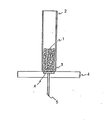
- Figure 1 is a cross sectional view of a device used for the measurement of water absorption amount.
- non-woven fabrics were manufactured by way of heat bonding method (passing a hot blow at 140 * C to a card web and setting ES fibers to other fibers through fusing by using polyethylene - polypropylene composite fibers)(ES fibers) or low melting polyester - polyester composite fibers (Melty) as binder fibers.
- fibers of the web were entangled under a high pressure water flow (spray pressure at 55 kg/cm , average amount of water stream supplied in the lateral direction : 250 cc/cm.min) to form non-woven fabrics.
- sanitary napkins (trade name; Lorie, manufactured by Kao Co) and disposable paper diapers (trade name Merries, manufactured by Kao Co.) were used while removing non-woven fabrics therefrom and, instead, placing non-woven fabrics shown in Tables 2 and 3 thereover respectively as the specimens to be measured as absorbing articles assuming the sanitary napkins and disposable paper diapers.
- Test solution was dropped from above 1 cm of the surface of the specimen inclined by 45 0 and the flowing distance along the surface of the non-woven fabrics from the point of dropping to the point where the solution was absorbed to the inside of the specimen was measured, which was defined as the surface liquid flow for the first time. Then, one minute after the dropping of the test solution, the test solution was again dropped to a portion where the solution had been dropped previously and the flowing distance along the surface of the non-woven fabrics from the point of dropping to the point where the solution was absorbed to the inside of the specimen was measured, which was defined as the surface liquid flow for the second time. Those showing short surface liquid flow for the first time and the surface liquid flow for the second time showing no considerable change indicate that there was no remarkable lateral leak.
- the dropping condition was 0.1 g/sec for the specimen assuming the sanitary napkins and 0.5 g/cm for the specimen assuming the paper diapers.
- test solution was caused to be absorbed by 10 cc in the specimens assuming the sanitary napkin and by 150 cc in the specimens assuming the paper diaper, pressure was applied after a predetermined of time and the amount of the test solution returned from the inside through the non-woven fabrics was measured. As the returning amount is smaller, surface stickiness is reduced, the feeling upon use is better and wiping effect is more excellent.
- ion exchanged water 5 was caused to be absorbed through a glass filter 4 into the fiber webs under a constant hydraulic pressure (atmospheric pressure) in a head portion 3 and the water absorption amount (ml) after one minutes was measured.
- the water absorption amount in the dry state is defined as Hd
- Hw water absorption amount after passing 600 cc of the ion exchanged water through the fiber webs and then dried was defined as Hw.
- Greater Hw means higher surface hydrophilic property after wetting.
- the surface liquid flow in the absorbing articles according to this invention is low both at the first and the second times and the liquid return from the inside to the surface is also low.
- Comparative Examples 1 - 7 absorbing articles were manufactured and the surface liquid flow and the liquid return thereof were measured by using the non- woven fabrics out of the range according to this invention and by the same procedures as in Examples. Since fibers having no substantial hydrophilic property were used for the surface layers in Comparative Example 1, 3 and 4, the surface liquid flow is high and leakage is liable to be caused. In Comparative Example 2 is constituted up to 100 with fibers which are hydrophilic at the surface and the inside and the returning amount is remarkable and stickiness is liable to occur although the surface liquid flow is preferable.
- Example 2 - 17 and Comparative Examples 5 and 6 the fabrics are constituted with fibers having a hydrophilic surface and a hydrophobic inside and show lower returning amount as compared with Example 1 comprising fibers having hydrophilic surface and inside.
- Comparative Example 5 among them, has a lower mixing ratio of the second fibers in the rearface layer than that defined in this invention and the surface liquid flow at the second time is increased.
- Comparative Example 6 the mixing ratio of the second fibers in the surface layer is greater than the range as defined in this invention and, accordingly, the returning amount is increased.
Landscapes
- Health & Medical Sciences (AREA)
- Epidemiology (AREA)
- Engineering & Computer Science (AREA)
- Biomedical Technology (AREA)
- Heart & Thoracic Surgery (AREA)
- Vascular Medicine (AREA)
- Life Sciences & Earth Sciences (AREA)
- Animal Behavior & Ethology (AREA)
- General Health & Medical Sciences (AREA)
- Public Health (AREA)
- Veterinary Medicine (AREA)
- Absorbent Articles And Supports Therefor (AREA)
- Treatments For Attaching Organic Compounds To Fibrous Goods (AREA)
Applications Claiming Priority (2)
| Application Number | Priority Date | Filing Date | Title |
|---|---|---|---|
| JP61104015A JPH0687874B2 (ja) | 1986-05-07 | 1986-05-07 | 吸収性物品 |
| JP104015/86 | 1986-05-07 |
Publications (3)
| Publication Number | Publication Date |
|---|---|
| EP0245074A2 true EP0245074A2 (fr) | 1987-11-11 |
| EP0245074A3 EP0245074A3 (en) | 1989-02-08 |
| EP0245074B1 EP0245074B1 (fr) | 1991-09-25 |
Family
ID=14369436
Family Applications (1)
| Application Number | Title | Priority Date | Filing Date |
|---|---|---|---|
| EP87303994A Expired - Lifetime EP0245074B1 (fr) | 1986-05-07 | 1987-05-05 | Article absorbant |
Country Status (10)
| Country | Link |
|---|---|
| US (1) | US4804378A (fr) |
| EP (1) | EP0245074B1 (fr) |
| JP (1) | JPH0687874B2 (fr) |
| CA (1) | CA1297638C (fr) |
| DE (1) | DE3773254D1 (fr) |
| ES (1) | ES2025160B3 (fr) |
| HK (1) | HK32693A (fr) |
| MY (1) | MY100847A (fr) |
| PH (1) | PH22590A (fr) |
| SG (1) | SG124992G (fr) |
Cited By (7)
| Publication number | Priority date | Publication date | Assignee | Title |
|---|---|---|---|---|
| US5130073A (en) * | 1990-01-16 | 1992-07-14 | Kimberly-Clark Corporation | Method of providing a polyester article with a hydrophilic surface |
| US5175050A (en) * | 1990-01-16 | 1992-12-29 | Kimberly-Clark Corporation | Polyester articles |
| US5200130A (en) * | 1990-12-17 | 1993-04-06 | Kimberly-Clark Corporation | Method of making polyolefin articles |
| US5258221A (en) * | 1990-12-17 | 1993-11-02 | Kimberly-Clark Corporation | Polyolefin article |
| USH1575H (en) * | 1994-09-19 | 1996-08-06 | Daugherty; Thomas H. | Apertured hydrophilic polymer film topsheet with improved absorbency and comfort properties |
| FR2762781A1 (fr) * | 1997-05-05 | 1998-11-06 | Gerald Greffe | Coussin absorbant pour produits d'hygiene bebe, adulte feminine |
| KR101148537B1 (ko) * | 2004-04-15 | 2012-05-23 | 가오 가부시키가이샤 | 흡수성 물품의 표면 시트 |
Families Citing this family (26)
| Publication number | Priority date | Publication date | Assignee | Title |
|---|---|---|---|---|
| US5009651A (en) * | 1988-09-06 | 1991-04-23 | Kao Corporation | Surface material for sanitary articles and its preparing method |
| ZA92308B (en) | 1991-09-11 | 1992-10-28 | Kimberly Clark Co | Thin absorbent article having rapid uptake of liquid |
| US5629005A (en) * | 1992-05-01 | 1997-05-13 | British United Shoe Machinery Limited | Absorbent material and a method of making same |
| MX9300424A (es) * | 1992-11-06 | 1994-05-31 | Kimberly Clark Co | Tela laminada fibrosa y metodo y aparato para la fabricacion de la misma. |
| US5370764A (en) * | 1992-11-06 | 1994-12-06 | Kimberly-Clark Corporation | Apparatus for making film laminated material |
| US5464687A (en) * | 1992-12-07 | 1995-11-07 | Lyondell Petrochemical Company | Wettable polyolefin fiber compositions and method |
| ATE215344T1 (de) * | 1993-08-17 | 2002-04-15 | Procter & Gamble | Wegwerfbarer absorbierender artikel mit der kapazität niederviskose fäkalien zu lagern |
| US5941864A (en) * | 1993-08-17 | 1999-08-24 | The Procter & Gamble Company | Disposable absorbent article having improved fecal storage |
| US5817394A (en) * | 1993-11-08 | 1998-10-06 | Kimberly-Clark Corporation | Fibrous laminated web and method and apparatus for making the same and absorbent articles incorporating the same |
| US5562650A (en) * | 1994-03-04 | 1996-10-08 | Kimberly-Clark Corporation | Absorbent article having an improved surge management |
| HU222768B1 (hu) * | 1994-06-30 | 2003-10-28 | The Procter & Gamble Company | Folyadékszállító szövedék felületi energiagradienssel, eljárás előállítására és ezt tartalmazó abszorbens cikk |
| US5614574A (en) * | 1994-07-12 | 1997-03-25 | Lyondell Petrochemical Company | Wettable polyolefin fiber compositions and method |
| US5676660A (en) * | 1995-02-08 | 1997-10-14 | Sanyo Chemical Industries, Ltd. | Absorbent product including absorbent layer treated with surface active agent |
| US6703537B1 (en) * | 1997-11-15 | 2004-03-09 | The Procter & Gamble Company | Absorbent article having improved fecal storage structure |
| US7625829B1 (en) * | 1999-08-30 | 2009-12-01 | Tredegar Film Products Corporation | Tear resistant elastic laminate and method of forming |
| JP2001327534A (ja) * | 2000-05-25 | 2001-11-27 | Uni Charm Corp | 使い捨て着用物品 |
| WO2002027088A2 (fr) * | 2000-09-29 | 2002-04-04 | Cotton Incorporated | Substrats cellulosiques a pouvoir d'absorption reduit pouvant drainer des liquides |
| EP1405949B1 (fr) * | 2002-10-02 | 2007-01-24 | Fort James Corporation | Produits papetiers contenant des fibres thermoliantes traitées en surface, et procédés de préparation |
| US7018976B2 (en) * | 2003-04-25 | 2006-03-28 | Unilever Home & Personal Care Usa, Divison Of Conopco, Inc. | Fabric treatment article and method |
| US7297226B2 (en) * | 2004-02-11 | 2007-11-20 | Georgia-Pacific Consumer Products Lp | Apparatus and method for degrading a web in the machine direction while preserving cross-machine direction strength |
| JP4566051B2 (ja) * | 2004-04-15 | 2010-10-20 | 花王株式会社 | 吸収性物品の表面シート |
| JP4566059B2 (ja) * | 2005-04-28 | 2010-10-20 | 花王株式会社 | 吸収性物品の表面シート |
| PL1931397T3 (pl) | 2005-10-05 | 2009-08-31 | Essity Hygiene & Health Ab | Wyrób absorpcyjny zawierający obszary hydrofilowe i hydrofobowe |
| BRPI0520626A2 (pt) | 2005-10-05 | 2009-05-19 | Sca Hygiene Prod Ab | artigo absorvente compreendendo um polìmero contrafìlico |
| WO2019075688A1 (fr) * | 2017-10-19 | 2019-04-25 | The Procter & Gamble Company | Feuille supérieure comprenant des fibres naturelles |
| WO2019075689A1 (fr) | 2017-10-19 | 2019-04-25 | The Procter & Gamble Company | Feuille supérieure comprenant des fibres naturelles ayant une bonne résistance mécanique |
Family Cites Families (16)
| Publication number | Priority date | Publication date | Assignee | Title |
|---|---|---|---|---|
| JPS5187398A (fr) * | 1975-01-25 | 1976-07-30 | Kimberly Clark Co | |
| US4077410A (en) * | 1976-07-06 | 1978-03-07 | Johnson & Johnson | Disposable absorbent pad with non-woven facing |
| JPS5746974Y2 (fr) * | 1977-06-17 | 1982-10-15 | ||
| DE2744466C2 (de) * | 1977-10-03 | 1985-03-07 | Henkel KGaA, 4000 Düsseldorf | Menstruationstampon |
| JPS54107191A (en) * | 1978-02-08 | 1979-08-22 | Kao Corp | Absorptive article |
| JPS5810508B2 (ja) * | 1978-04-18 | 1983-02-25 | 日本エクスラン工業株式会社 | 高度の水膨潤性及び高物性を有する新規な水膨潤性繊維並びにその製造方法 |
| JPS5756562A (en) * | 1980-09-20 | 1982-04-05 | Uni Charm Corp | Nonwoven fabric and production thereof |
| AU553889B2 (en) * | 1981-07-10 | 1986-07-31 | Chicopee | Nonwoven fabric composed of polyester/polyethylene conjugate fibres |
| US4372310A (en) * | 1981-07-30 | 1983-02-08 | The Kendall Company | Diaper with blended yarns |
| JPS59159415U (ja) * | 1983-04-11 | 1984-10-25 | 大王製紙株式会社 | 生理用ナプキン |
| JPS60198151A (ja) * | 1984-03-21 | 1985-10-07 | ユニ・チヤ−ム株式会社 | 衛生物品の外装材およびその製造方法 |
| JPS60172792U (ja) * | 1984-04-23 | 1985-11-15 | ハニ−フアイバ−株式会社 | 二層構造不織布 |
| US4578066A (en) * | 1984-05-29 | 1986-03-25 | Kimberly-Clark Corporation | Incontinent garment, catamenial device or wound dressing |
| JPS612854A (ja) * | 1984-06-15 | 1986-01-08 | ユニ・チヤ−ム株式会社 | 吸収性物品の表面材 |
| JPS6131155A (ja) * | 1984-07-25 | 1986-02-13 | 花王株式会社 | 吸収性物品 |
| GB8424950D0 (en) * | 1984-10-03 | 1984-11-07 | Ici Plc | Non-woven fibrous materials |
-
1986
- 1986-05-07 JP JP61104015A patent/JPH0687874B2/ja not_active Expired - Lifetime
-
1987
- 1987-04-24 US US07/042,216 patent/US4804378A/en not_active Expired - Lifetime
- 1987-05-02 MY MYPI87000568A patent/MY100847A/en unknown
- 1987-05-05 PH PH35226A patent/PH22590A/en unknown
- 1987-05-05 EP EP87303994A patent/EP0245074B1/fr not_active Expired - Lifetime
- 1987-05-05 DE DE8787303994T patent/DE3773254D1/de not_active Revoked
- 1987-05-05 ES ES87303994T patent/ES2025160B3/es not_active Expired - Lifetime
- 1987-05-06 CA CA000536460A patent/CA1297638C/fr not_active Expired - Fee Related
-
1992
- 1992-12-09 SG SG1249/92A patent/SG124992G/en unknown
-
1993
- 1993-04-01 HK HK326/93A patent/HK32693A/en not_active IP Right Cessation
Cited By (7)
| Publication number | Priority date | Publication date | Assignee | Title |
|---|---|---|---|---|
| US5130073A (en) * | 1990-01-16 | 1992-07-14 | Kimberly-Clark Corporation | Method of providing a polyester article with a hydrophilic surface |
| US5175050A (en) * | 1990-01-16 | 1992-12-29 | Kimberly-Clark Corporation | Polyester articles |
| US5200130A (en) * | 1990-12-17 | 1993-04-06 | Kimberly-Clark Corporation | Method of making polyolefin articles |
| US5258221A (en) * | 1990-12-17 | 1993-11-02 | Kimberly-Clark Corporation | Polyolefin article |
| USH1575H (en) * | 1994-09-19 | 1996-08-06 | Daugherty; Thomas H. | Apertured hydrophilic polymer film topsheet with improved absorbency and comfort properties |
| FR2762781A1 (fr) * | 1997-05-05 | 1998-11-06 | Gerald Greffe | Coussin absorbant pour produits d'hygiene bebe, adulte feminine |
| KR101148537B1 (ko) * | 2004-04-15 | 2012-05-23 | 가오 가부시키가이샤 | 흡수성 물품의 표면 시트 |
Also Published As
| Publication number | Publication date |
|---|---|
| ES2025160B3 (es) | 1992-03-16 |
| MY100847A (en) | 1991-03-15 |
| DE3773254D1 (de) | 1991-10-31 |
| JPS62261363A (ja) | 1987-11-13 |
| SG124992G (en) | 1993-02-19 |
| US4804378A (en) | 1989-02-14 |
| CA1297638C (fr) | 1992-03-24 |
| HK32693A (en) | 1993-04-08 |
| JPH0687874B2 (ja) | 1994-11-09 |
| EP0245074B1 (fr) | 1991-09-25 |
| PH22590A (en) | 1988-10-17 |
| EP0245074A3 (en) | 1989-02-08 |
Similar Documents
| Publication | Publication Date | Title |
|---|---|---|
| EP0245074B1 (fr) | Article absorbant | |
| US5653702A (en) | Absorbent body in an absorbent article, such as a sanitary napkin, a panty protector, incontinence guard, diaper and the like | |
| KR100630508B1 (ko) | 일회용 흡수제품, 이의 커버소재 및 커버소재의 제조방법 | |
| KR100236743B1 (ko) | 액체를 차폐 및 분포시키기 위한 흡수 구조체 | |
| US4755179A (en) | Absorbent article | |
| MX2013002740A (es) | Capa de tratamiento de liquidos en articulos absorbentes para el cuidado personal. | |
| TW508234B (en) | Absorbent structure in an absorbent article and a method of producing it | |
| EP0547498B1 (fr) | Structure absorbante pour couvrir et distribuer un liquide | |
| JP3032304B2 (ja) | 吸収性物品の表面材 | |
| JP3375153B2 (ja) | シート状吸収体 | |
| CZ223892A3 (en) | Composite liquid-absorbing pad and process for producing thereof | |
| HU223588B1 (hu) | Nemszövött kelme és abszorbens cikk | |
| JPH0436703B2 (fr) | ||
| US20030028164A1 (en) | Absorbent article with fluid treatment agent | |
| EP0776189A1 (fr) | Transport de liquide au moyen d'une structure fibreuse capillaire | |
| JP3940099B2 (ja) | 吸収性物品 | |
| JP4519091B2 (ja) | 吸収性物品 | |
| JPS6227161B2 (fr) | ||
| JP3644702B2 (ja) | 吸収性物品 | |
| JPH09322911A (ja) | 吸収性物品 | |
| JP4573705B2 (ja) | 吸収性物品 | |
| JPH1142251A (ja) | 吸収性物品 | |
| JPS6132671Y2 (fr) | ||
| JPH03234255A (ja) | 吸液拡散シート | |
| JP2006340841A (ja) | 吸収性物品 |
Legal Events
| Date | Code | Title | Description |
|---|---|---|---|
| PUAI | Public reference made under article 153(3) epc to a published international application that has entered the european phase |
Free format text: ORIGINAL CODE: 0009012 |
|
| AK | Designated contracting states |
Kind code of ref document: A2 Designated state(s): DE ES FR GB SE |
|
| PUAL | Search report despatched |
Free format text: ORIGINAL CODE: 0009013 |
|
| AK | Designated contracting states |
Kind code of ref document: A3 Designated state(s): DE ES FR GB SE |
|
| 17P | Request for examination filed |
Effective date: 19890123 |
|
| 17Q | First examination report despatched |
Effective date: 19900727 |
|
| GRAA | (expected) grant |
Free format text: ORIGINAL CODE: 0009210 |
|
| AK | Designated contracting states |
Kind code of ref document: B1 Designated state(s): DE ES FR GB SE |
|
| REF | Corresponds to: |
Ref document number: 3773254 Country of ref document: DE Date of ref document: 19911031 |
|
| ET | Fr: translation filed | ||
| REG | Reference to a national code |
Ref country code: ES Ref legal event code: FG2A Ref document number: 2025160 Country of ref document: ES Kind code of ref document: B3 |
|
| PLBI | Opposition filed |
Free format text: ORIGINAL CODE: 0009260 |
|
| 26 | Opposition filed |
Opponent name: MOELNLYCKE AB Effective date: 19920624 |
|
| PLAB | Opposition data, opponent's data or that of the opponent's representative modified |
Free format text: ORIGINAL CODE: 0009299OPPO |
|
| R26 | Opposition filed (corrected) |
Opponent name: MOELNLYCKE AB Effective date: 19920624 |
|
| PLAB | Opposition data, opponent's data or that of the opponent's representative modified |
Free format text: ORIGINAL CODE: 0009299OPPO |
|
| R26 | Opposition filed (corrected) |
Opponent name: MOELNLYCKE AB Effective date: 19920624 |
|
| EAL | Se: european patent in force in sweden |
Ref document number: 87303994.5 |
|
| PGFP | Annual fee paid to national office [announced via postgrant information from national office to epo] |
Ref country code: GB Payment date: 19970428 Year of fee payment: 11 |
|
| PGFP | Annual fee paid to national office [announced via postgrant information from national office to epo] |
Ref country code: DE Payment date: 19970509 Year of fee payment: 11 |
|
| PGFP | Annual fee paid to national office [announced via postgrant information from national office to epo] |
Ref country code: FR Payment date: 19970513 Year of fee payment: 11 |
|
| PGFP | Annual fee paid to national office [announced via postgrant information from national office to epo] |
Ref country code: SE Payment date: 19970516 Year of fee payment: 11 |
|
| PGFP | Annual fee paid to national office [announced via postgrant information from national office to epo] |
Ref country code: ES Payment date: 19970528 Year of fee payment: 11 |
|
| APAC | Appeal dossier modified |
Free format text: ORIGINAL CODE: EPIDOS NOAPO |
|
| RDAH | Patent revoked |
Free format text: ORIGINAL CODE: EPIDOS REVO |
|
| RDAG | Patent revoked |
Free format text: ORIGINAL CODE: 0009271 |
|
| STAA | Information on the status of an ep patent application or granted ep patent |
Free format text: STATUS: PATENT REVOKED |
|
| 27W | Patent revoked |
Effective date: 19971203 |
|
| GBPR | Gb: patent revoked under art. 102 of the ep convention designating the uk as contracting state |
Free format text: 971203 |
|
| APAH | Appeal reference modified |
Free format text: ORIGINAL CODE: EPIDOSCREFNO |