EP0245217A2 - Séquence de nucléotides capable d'induire des niveaux élevés de translation d'un gène hétérologue dans Bacillus subtilis et Escherichia coli - Google Patents
Séquence de nucléotides capable d'induire des niveaux élevés de translation d'un gène hétérologue dans Bacillus subtilis et Escherichia coli Download PDFInfo
- Publication number
- EP0245217A2 EP0245217A2 EP87830141A EP87830141A EP0245217A2 EP 0245217 A2 EP0245217 A2 EP 0245217A2 EP 87830141 A EP87830141 A EP 87830141A EP 87830141 A EP87830141 A EP 87830141A EP 0245217 A2 EP0245217 A2 EP 0245217A2
- Authority
- EP
- European Patent Office
- Prior art keywords
- escherichia coli
- bacillus subtilis
- nucleotide sequence
- gene
- translation
- Prior art date
- Legal status (The legal status is an assumption and is not a legal conclusion. Google has not performed a legal analysis and makes no representation as to the accuracy of the status listed.)
- Granted
Links
Images


Classifications
-
- C—CHEMISTRY; METALLURGY
- C12—BIOCHEMISTRY; BEER; SPIRITS; WINE; VINEGAR; MICROBIOLOGY; ENZYMOLOGY; MUTATION OR GENETIC ENGINEERING
- C12N—MICROORGANISMS OR ENZYMES; COMPOSITIONS THEREOF; PROPAGATING, PRESERVING, OR MAINTAINING MICROORGANISMS; MUTATION OR GENETIC ENGINEERING; CULTURE MEDIA
- C12N9/00—Enzymes; Proenzymes; Compositions thereof; Processes for preparing, activating, inhibiting, separating or purifying enzymes
- C12N9/14—Hydrolases (3)
- C12N9/78—Hydrolases (3) acting on carbon to nitrogen bonds other than peptide bonds (3.5)
- C12N9/86—Hydrolases (3) acting on carbon to nitrogen bonds other than peptide bonds (3.5) acting on amide bonds in cyclic amides, e.g. penicillinase (3.5.2)
-
- C—CHEMISTRY; METALLURGY
- C12—BIOCHEMISTRY; BEER; SPIRITS; WINE; VINEGAR; MICROBIOLOGY; ENZYMOLOGY; MUTATION OR GENETIC ENGINEERING
- C12N—MICROORGANISMS OR ENZYMES; COMPOSITIONS THEREOF; PROPAGATING, PRESERVING, OR MAINTAINING MICROORGANISMS; MUTATION OR GENETIC ENGINEERING; CULTURE MEDIA
- C12N15/00—Mutation or genetic engineering; DNA or RNA concerning genetic engineering, vectors, e.g. plasmids, or their isolation, preparation or purification; Use of hosts therefor
- C12N15/09—Recombinant DNA-technology
- C12N15/63—Introduction of foreign genetic material using vectors; Vectors; Use of hosts therefor; Regulation of expression
- C12N15/67—General methods for enhancing the expression
-
- C—CHEMISTRY; METALLURGY
- C12—BIOCHEMISTRY; BEER; SPIRITS; WINE; VINEGAR; MICROBIOLOGY; ENZYMOLOGY; MUTATION OR GENETIC ENGINEERING
- C12N—MICROORGANISMS OR ENZYMES; COMPOSITIONS THEREOF; PROPAGATING, PRESERVING, OR MAINTAINING MICROORGANISMS; MUTATION OR GENETIC ENGINEERING; CULTURE MEDIA
- C12N15/00—Mutation or genetic engineering; DNA or RNA concerning genetic engineering, vectors, e.g. plasmids, or their isolation, preparation or purification; Use of hosts therefor
- C12N15/09—Recombinant DNA-technology
- C12N15/63—Introduction of foreign genetic material using vectors; Vectors; Use of hosts therefor; Regulation of expression
- C12N15/70—Vectors or expression systems specially adapted for E. coli
-
- C—CHEMISTRY; METALLURGY
- C12—BIOCHEMISTRY; BEER; SPIRITS; WINE; VINEGAR; MICROBIOLOGY; ENZYMOLOGY; MUTATION OR GENETIC ENGINEERING
- C12N—MICROORGANISMS OR ENZYMES; COMPOSITIONS THEREOF; PROPAGATING, PRESERVING, OR MAINTAINING MICROORGANISMS; MUTATION OR GENETIC ENGINEERING; CULTURE MEDIA
- C12N15/00—Mutation or genetic engineering; DNA or RNA concerning genetic engineering, vectors, e.g. plasmids, or their isolation, preparation or purification; Use of hosts therefor
- C12N15/09—Recombinant DNA-technology
- C12N15/63—Introduction of foreign genetic material using vectors; Vectors; Use of hosts therefor; Regulation of expression
- C12N15/74—Vectors or expression systems specially adapted for prokaryotic hosts other than E. coli, e.g. Lactobacillus, Micromonospora
- C12N15/75—Vectors or expression systems specially adapted for prokaryotic hosts other than E. coli, e.g. Lactobacillus, Micromonospora for Bacillus
Definitions
- the invention relates to a nucleotide sequence capable of inducing high levels of translation of a heterologous gene in Bacillus subtilis and Escherichia coli and a method of preparing heterologous proteins comprising cultivation, in a suitable culture medium, of cells of Bacillus subtilis and Escherichia coli transformed by hybrid plasmids in which the nucleotide sequence is situated between the ribosome recognition site and the starting triplet (ATG) of the coding structural gene for the desired protein.
- ATG starting triplet
- procaryotes the expression of a gene (i.e. the process of transcription and translation whereby genetic information is used for synthesizing proteins) is controlled by regulating regions.
- regions which are represented at DNA level by certain sequences of nucleotide bases, comprise: the promotor, the terminator, the ribosome recognition site (RBS) and the triplets for starting (ATG) and stopping the translation.
- transcription means the transfer of genetic information from DNA to messenger RNA (mRNA).
- This process which is brought about by a specific- enzyme (DNA-dependent RNA-polymerase); initiates in the promotor a region which is located upstream of the coding structural gene for a given protein and which contains a recognition site and an attachment site for the RNA-polymerase.
- DNA-dependent RNA-polymerase DNA-dependent RNA-polymerase
- the transcription terminates in a region situated at the end of the structural gene.
- the terminator ensures that the RNA-polymerase is detached from the DNA.
- the genetic information has been transcribed in the m-RNA, it is used for synthetizing proteins or, more generally, is translated into protein.
- translation denotes transfer of genetic information from mRNA to the protein in accordance with the rules of the genetic code.
- the translation begins via the bond between the ribosomes and the ribosome recognition site of mRNA, whose nucleotide sequence on the DNA is situated behind the promotor.
- the triplets for starting (ATG) and stopping the translation show the associated ribosomes and enzymes where the genetic message starts and stops respectively.
- the primary sequence of a protein is determined by codons, which are present between the ATG and the stop triplet.
- RNA-polymerase As is known, the greater the affinity between RNA-polymerase and the promotor and the ribosome and RBS, the more efficient is the transcription and translation of a given gene.
- the technical literature gives nucleotide sequences, in the case both of the promotor and of the RBS, which can guarantee good affinity between the aforementioned structures.
- the optimum sequence given is AAAGGAGG, complementary with the third terminal of ribosomal 16S RNA.
- the expression of a gene also attaches to the composition and number of bases in the spacing sequence interposed between the RBS and the starting ATG of the gene.
- Recent develop ments in genetic'engineering have made it possible to prepare a protein by the cloning technique, in which the coding gene for the protein is joined to a suitable cloning vector, the resulting hybrid vector is inserted into a host microorganism, and finally the transformed microorganism is cultivated so as to produce the desired protein. More particularly, the technique can be used to improve the preparation of a protein by cloning the coding gene for the protein, under the control of optimum regulating regions.
- a nucleotide sequence has now been found for obtaining high translation levels of heterologous genes in Bacillus subtilis and in Escherichia coli.
- one aim of the invention is a nucleotide sequence capable of inducing high translation levels of a heterologous gene in Bacillus subtilis. and Escherichia coli.
- Another aim of the invention is a method of preparing heterologous proteins comprising cultivation in a suitable culture medium of cells of Bacillus subtilis and Escherichia coli transformed by hybrid plasmids in which the nucleotide sequence is situated between the ribosome recognition site and the starting triplet ATG of the structural gene which codes the protein.
- nucleotide sequence is:
- This sequence which occurs between the ribosome recognition site and the starting ATG of a heterologous gene, ensures a high rate of translation of the gene.
- Beta-lactamase, methylase and the human growth hormone are examples of heterologous genes which can be cloned.
- the nucleotide sequence (I) was inserted between the RBS and the ATG of the coding gene for beta-lactamase and the resulting hybrid plasmid was used to transform cells of Bacillus subtilis and Escherichia coli. Surprisingly, it has been found that the production of beta-lactamase shows a notable improvement in both microorganisms.
- nucleotide sequence (I) was inserted into plasmid pSM143 ATCC 53038, whose restriction map is shown in Fig. 2, where the coding gene for beta-lactamase is under the control of regulating, promotor and RBS sequences recognized by B. subtilis and E. coli and where the spacing sequence is AATTCT.
- Plasmid pSM143 was digested with the restriction enzyme EcoRI, which cuts the DNA immediately after RBS and leaves ends with a single helix.
- the digestion mixture was then mixed with the polymerase enzyme and kept at a temperature between 10 and 20 °C until the polymerisation reaction was complete.
- reaction mixture was again digested with the restriction enzyme XbaI, in a buffer solution at a temperature between 30 and 40 °C.
- the mixture was placed on 6% acrylamide gel and treated at 110 V for 3 hours.
- the 6600 base-pair fragment containing the beta-lactamase gene was then electro-eluted and bonded to the approximately 750 base-pair fragment XbaI-HpaI containing the promotor and RBS of the plasmid of Bacillus subtilis pEl94 (BGSG lE7).
- the last-mentioned fragment was obtained by digestion of plasmid pSM26, whose restriction map is shown in Fig. 3 and whose construction has recently been described by Grandi et al in Plasmid 1986 (in course of publication).
- the ligase reaction between the two fragments was brought about in the presence of T4 DNA ligase at a temperature of 10° to 20 °C.
- the ligase mixture was used to transform suitable cells of E. coli and the transforming substances were selected for ampicillin resistance (Amp R ).
- the hybrid plasmid pSM164 which was isolated from one of the A mp R clones, has a nucleotide sequence, determined by the method of Maxam and Gilbert (Methods in Enzymology, Vol. 65, 1980), which shows the presence of the spacing sequence (I) between the RBS region and the ATG of the beta-lactamase gene.
- the hybrid plasmid pSM164 was used to transform cells of Bacillus subtilis and Escherichia coli.
- the transformed cells were cultivated in VY liquid medium (DIFCO) mixed respectively with 5 ⁇ g/ml and 50 ⁇ g/ml of kanamycin at a temperature of 30 to 40 °C.
- DIFCO VY liquid medium
- beta-lactamase was measured by analysis of the beta-lactamase activity by the method described by O'Callaghan et al (Antimicrob. Ag. Chemother. I (1972) 283-288).
- the spacing sequence (I) was compared with other spacing sequences, more particularly pSM143 and pSM162 (AATAATTCT), a plasmid constructed from pSM154 and having the restriction map shown in Fig. 3 and the construction described in example 2.
- Cells of B. subtilis SMSl18 and E. coli HB101 transformed by these plasmids were cultivated under the conditions used for microorganisms transformed with pSM164.
- the results, expressed as beta-lactamase activity show five times the activity obtained for the other transformed strains, in the case both of B. subtilis SMSl18 (pSM1d64) and E. coli HB101 (pSM164).
- promotor sequence is the same in plasmids pSM143, pSM162 and pSM164, the difference in activity can be attributed only to a different efficiency of translation.
- the spacing sequence (I) is optimum for the translation process for either B. subtilis or E. coli.
- strain B. subtilis SMS118(pSM164) was filed at the American Type Culture Centre on 18 April, 1986, No. ATCC-67098.
- reaction mixture After inactivation of the enzyme at 65°C for 10 minutes, 5 ⁇ l of the reaction mixture were added to 45 ⁇ l of a solution containing 50 mM Tris-HCl (pH 7.5), 5 mM MgCl, 100 ⁇ m dATP, 100 ⁇ m dTTP and 4 U of polymerase (Klenow fragment, Boehringer).
- the polymerisation reaction was carried out at 14 °C for 2 hours. At the end of the reaction, the enzyme was inactivated at 65 °C for 10 minutes.
- reaction mixture 50 ⁇ l of reaction mixture were mixed with NaCl to a final concentration of 50 mM and with 1 U of XbaI (Boehringer) enzyme, and the resulting mixture was incubated at 37 °C for 1 hour.
- the plasmid DNA was placed on 6% agarose gel and treated at 110 V for 3 hours.
- the band containing the 6600 bp fragment of pSMl43 carrying the beta-lactamase gene was eluted as described by Maniatis et al (Molecular Cloning: A Laboratory Manual. Cold Spring Harbor p. 170 (1982)).
- the plasmid DNA was then precipitated by adding 0.3 M sodium acetate and 2.5 volumes of 95% ethanol to the eluate.
- the resulting suspension was centrifuged in a modified Epperdorf centrifuge for 10 minutes at revolutions per minute (rpm).
- the DNA was separated and re-suspended in a buffer solution at a final concentration of 0.5 ⁇ g/ml.
- 10 ⁇ g of pSM 26 were digested at 37 °C for 1 hour in 50 ⁇ l of solution containing 50 mM Tris-HCl (pH 7.5), 5mM MgCl, 50 mM NaCl, 10 U of XbaI and 10 U of HpaI.
- the DNA was separated on acrylamide gel and the approximately 750 bp fragment containing the promotor and RBS of pE194 was electro-eluted as described by Maxam and Gilbert (Methods in Enzymology, Vol. 80 (1980)).
- the DNA was precipitated from the eluate, separated and re-suspended in buffer solution at a concentration of 0.5 ⁇ g/ml.
- 0.1 ⁇ g of the 6600 bp DNA fragment were bonded to 30 ng of the 750 bp XbaI-HpaI fragment in a solution containing 66 mM Tris-HCL (pH 7.5), 10 mM MgCl, 10 mM dithiothreitol, 1 mM ATP and 1 U of T4 DNA ligase (Boehringer) at 14 °C for 18 hours. After inactivation of the enzyme, 5 ⁇ l of the ligase mixture were used to transform cells of E. coli HB101 and the transforming substances were selected for resistance to ampicillin on LB Agar plates (DIFCO) mixed with 50 ⁇ g/ml ampicillin.
- DIFCO ampicillin on LB Agar plates
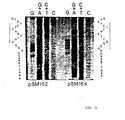
- Plasmid pSM164 the restriction map of which is shown in Fig. 3, was isolated from an ampicillin- resistant colony. Analysis of the nucleotide sequence of pSM164 showed the presence of the desired spacing sequence (Fig. 4) between the RBS region and the starting ATG of the beta-lactamase gene.
- 1 ⁇ g of pSMl43 was digested as described in Example 1 and, after inactivation of the enzyme, were added to 48 ⁇ l of a solution containing 50 mM Tris-HC1 (pH 7.5), 5 mM MgCl, 100 ⁇ m of ATP, 100 ⁇ m of dTTP and 2 U of polymerase.
- the polymerisation reaction was carried out at 14 °C for 1 hour, after which the enzyme was inactivated by mixing the reaction mixture with an equal volume of phenol saturated with TE (10 mM Tris-HCL (pH 7.5) and 1 mM EDTA).
- the phenol dissolved in the aqueous phase was subsequently extracted with ether and the DNA was precipitated at -80°C by adding 5 ⁇ l of a 3M solution of sodium acetate and 250 ml of 95% ethanol.
- the precipitate was separated by centrifuging, dried in vacuo and resuspended in 50 ⁇ l of a solution of 66 mM Tris-HC1 (pH 7.5), 6 mM MgCl, 10 mM dithiothreitol, 1 mM dATP and 1 U of T4 DNA ligase.
- the mixture was incubated at 14 °C for 18 hours, after which.10 ⁇ l were used to transform suitable cells of E. coli HB101 selected for ampicillin resistance as described in Example 1.
- Plasmid pSM162 the restriction map of which is shown in Fig. 3, was isolated from one of the resulting positive clones.
- nucleotide sequence of the region nearest to the beginning of the beta-lactamase gene shows the following spacing, as expected:
- Transformed cells of B . subtilis pSM118 and E. coli HB101 were cultivated in lactose broth (DIFCO) in the presence respectively of 15 ⁇ g/ml and 5 ⁇ g/ml kanamycin at 37 °C until the optical density measured at 660 nm was about 2.5 - 3.1.
- DIFCO lactose broth
- beta-lactamase was measured in the case of E. coli in the periplasmatic preparations obtained as described by A. Nicolaids (J. Bacteriol. 135, 178 (1978) whereas in the case of B. subtilis, production was determined in the cellular sonicated substances.
- the sonicates were prepared by suspending the B. subtilis cells, separated from the broth culture by centrifuging, in 5 ml of solution containing 30 mM Tris-HCl (pH 7.2) and 50 mM NaCl. The cellular suspension was re-centrifuged at 5 000 rpm for 10 minutes and the cells were resuspended in phosphate buffer (pH 7.0) and lysed in a Soniprep 150 model MSE sonicator operating at the maximum velocity.
- beta-lactamase activity was measured as described by O'Callaghan et al. Antimicrob.Ag.Chemother. I,283-288 (1972) and expressed as units per ml, i.e. as the quantity of enzyme necessary to hydrolyze 1 nanomol of substrate per minute.
- Table I gives the beta-lactamase activity values measured for the various cultures.
Landscapes
- Health & Medical Sciences (AREA)
- Genetics & Genomics (AREA)
- Life Sciences & Earth Sciences (AREA)
- Engineering & Computer Science (AREA)
- Chemical & Material Sciences (AREA)
- Organic Chemistry (AREA)
- Zoology (AREA)
- Wood Science & Technology (AREA)
- Bioinformatics & Cheminformatics (AREA)
- Biomedical Technology (AREA)
- Biotechnology (AREA)
- General Engineering & Computer Science (AREA)
- Microbiology (AREA)
- Molecular Biology (AREA)
- Biochemistry (AREA)
- General Health & Medical Sciences (AREA)
- Plant Pathology (AREA)
- Biophysics (AREA)
- Physics & Mathematics (AREA)
- Medicinal Chemistry (AREA)
- Micro-Organisms Or Cultivation Processes Thereof (AREA)
- Preparation Of Compounds By Using Micro-Organisms (AREA)
- Enzymes And Modification Thereof (AREA)
- Saccharide Compounds (AREA)
Priority Applications (1)
| Application Number | Priority Date | Filing Date | Title |
|---|---|---|---|
| AT87830141T ATE73496T1 (de) | 1986-05-07 | 1987-04-13 | Nukleotidsequenz, die in der lage ist, hohe translationsniveaus eines heterologen gens in bacillus subtilis und escherichia coli zu induzieren. |
Applications Claiming Priority (2)
| Application Number | Priority Date | Filing Date | Title |
|---|---|---|---|
| IT2034486 | 1986-05-07 | ||
| IT20344/86A IT1221765B (it) | 1986-05-07 | 1986-05-07 | Sequenza nucleotidica capace di indurre alti livelli di traduzione di un gene eterologo in bacillus subtilis ed escherichia coli |
Publications (3)
| Publication Number | Publication Date |
|---|---|
| EP0245217A2 true EP0245217A2 (fr) | 1987-11-11 |
| EP0245217A3 EP0245217A3 (en) | 1988-11-09 |
| EP0245217B1 EP0245217B1 (fr) | 1992-03-11 |
Family
ID=11165894
Family Applications (1)
| Application Number | Title | Priority Date | Filing Date |
|---|---|---|---|
| EP87830141A Expired - Lifetime EP0245217B1 (fr) | 1986-05-07 | 1987-04-13 | Séquence de nucléotides capable d'induire des niveaux élevés de translation d'un gène hétérologue dans Bacillus subtilis et Escherichia coli |
Country Status (8)
| Country | Link |
|---|---|
| US (1) | US4987069A (fr) |
| EP (1) | EP0245217B1 (fr) |
| JP (1) | JP2588402B2 (fr) |
| AT (1) | ATE73496T1 (fr) |
| DE (1) | DE3777238D1 (fr) |
| ES (1) | ES2032862T3 (fr) |
| GR (1) | GR3004560T3 (fr) |
| IT (1) | IT1221765B (fr) |
Cited By (2)
| Publication number | Priority date | Publication date | Assignee | Title |
|---|---|---|---|---|
| FR2636644A1 (fr) * | 1988-08-24 | 1990-03-23 | Sanofi Sa | Sequence d'adn participant a la regulation de l'expression d'une sequence d'adn codant pour un precurseur d'un polypeptide, vecteurs d'expression et procede de production periplasmique du polypeptide |
| US5279947A (en) * | 1988-08-24 | 1994-01-18 | Sanofi | DNA sequence participating in the regulation of the expression of a DNA sequence coding for a precursor of a polypeptide, expression vectors and process for the periplasmic production of the polypeptide |
Family Cites Families (3)
| Publication number | Priority date | Publication date | Assignee | Title |
|---|---|---|---|---|
| US4529695A (en) * | 1981-06-18 | 1985-07-16 | Wisconsin Alumni Research Foundation | Recombinant cloning vector, host for the vector, and method for using same |
| IT1156317B (it) * | 1982-09-08 | 1987-02-04 | Anic Spa | Vettori plasmidici ad espressione in bacillus subtilis e procedimento per la loro preparazione |
| JPS60188077A (ja) * | 1984-03-09 | 1985-09-25 | Teruhiko Beppu | 仔牛プロキモシンcDΝAの全配列を有する新規な発現プラスミド |
-
1986
- 1986-05-07 IT IT20344/86A patent/IT1221765B/it active
-
1987
- 1987-04-13 EP EP87830141A patent/EP0245217B1/fr not_active Expired - Lifetime
- 1987-04-13 DE DE8787830141T patent/DE3777238D1/de not_active Expired - Lifetime
- 1987-04-13 AT AT87830141T patent/ATE73496T1/de not_active IP Right Cessation
- 1987-04-13 ES ES198787830141T patent/ES2032862T3/es not_active Expired - Lifetime
- 1987-04-21 US US07/040,612 patent/US4987069A/en not_active Expired - Fee Related
- 1987-05-07 JP JP62109915A patent/JP2588402B2/ja not_active Expired - Lifetime
-
1992
- 1992-05-12 GR GR920400908T patent/GR3004560T3/el unknown
Cited By (3)
| Publication number | Priority date | Publication date | Assignee | Title |
|---|---|---|---|---|
| FR2636644A1 (fr) * | 1988-08-24 | 1990-03-23 | Sanofi Sa | Sequence d'adn participant a la regulation de l'expression d'une sequence d'adn codant pour un precurseur d'un polypeptide, vecteurs d'expression et procede de production periplasmique du polypeptide |
| EP0360641A1 (fr) * | 1988-08-24 | 1990-03-28 | Sanofi | Séquence d'ADN participant à la régulation de l'expression d'une séquence d'ADN codant pour un précurseur d'un polypeptide, vecteurs d'expression et procédé de production périplasmique du polypeptide |
| US5279947A (en) * | 1988-08-24 | 1994-01-18 | Sanofi | DNA sequence participating in the regulation of the expression of a DNA sequence coding for a precursor of a polypeptide, expression vectors and process for the periplasmic production of the polypeptide |
Also Published As
| Publication number | Publication date |
|---|---|
| EP0245217A3 (en) | 1988-11-09 |
| IT1221765B (it) | 1990-07-12 |
| ES2032862T3 (es) | 1993-03-01 |
| IT8620344A0 (it) | 1986-05-07 |
| ATE73496T1 (de) | 1992-03-15 |
| DE3777238D1 (de) | 1992-04-16 |
| US4987069A (en) | 1991-01-22 |
| JPS63219383A (ja) | 1988-09-13 |
| GR3004560T3 (fr) | 1993-04-28 |
| JP2588402B2 (ja) | 1997-03-05 |
| EP0245217B1 (fr) | 1992-03-11 |
Similar Documents
| Publication | Publication Date | Title |
|---|---|---|
| US4868111A (en) | Gram-positive expression control sequences | |
| EP0121386B1 (fr) | Vecteurs d'ADN et leur utilisation en technologie d'ADN recombinant | |
| Jones et al. | Recombination between short direct repeats in a rec A host | |
| US4666848A (en) | Polypeptide expression using a portable temperature sensitive control cassette with a positive retroregulatory element | |
| JP2004194588A (ja) | 新規なニトリルヒドラターゼ | |
| US4987078A (en) | Plasmid vectors for expression in Escherichia coli and/or Bacillus subtilis | |
| Murotsu et al. | Identification of the minimal essential region for the replication origin of miniF plasmid | |
| EP0245217B1 (fr) | Séquence de nucléotides capable d'induire des niveaux élevés de translation d'un gène hétérologue dans Bacillus subtilis et Escherichia coli | |
| JP2010284174A (ja) | プラスミド、それらの構築およびそれらのインターロイキン−4およびインターロイキン−4ムテインの製造における使用 | |
| AU614988B2 (en) | Recombinant dna expression vectors and dna compounds that encode isopenicillin n synthetase from aspergillus nidulans | |
| JP2551746B2 (ja) | 改良プラスミドベクタ−およびその利用 | |
| EP0302838B1 (fr) | Clonage du gène codant pour l'enzyme isoamylase et son utilisation pour la production de cette enzyme | |
| EP0186069B1 (fr) | Séquence de contrôle d'expression | |
| JP7061018B2 (ja) | 新規プロモーター、および同プロモーターを用いたタンパク質の製造方法 | |
| IE59562B1 (en) | Method for preparing proteins using transformed lactic acid bacteria | |
| US5721137A (en) | Plasmid vector and its use for the production of heterologous proteins | |
| EP0124076A2 (fr) | Méthode de production de plasmides recombinants, micro-organismes transformés par ces plasmides et alpha-amylase thermostabile | |
| US4585739A (en) | Plasmid for foreign gene expression in B. subtilis | |
| US5830720A (en) | Recombinant DNA and expression vector for the repressible and inducible expression of foreign genes | |
| EP0288325B1 (fr) | ADN encodant la synthétase N d'isopénicilline de A.nidulans, son utilisation et vecteurs encodant celle-ci | |
| EP0174785A1 (fr) | Elément rétrorégulateur positif, plasmide et cellules contenant ledit élément et leur production, méthode pour le renforcement de l'expression génétique utilisant ledit élément et méthode pour le renforcement de la demi-vie de l'ARN utilisant ledit élément | |
| JP2567199B2 (ja) | 枯草菌およびその形成方法 | |
| JPH08103278A (ja) | 活性型ヒトaltの製造方法 | |
| CN118086157A (zh) | 生产阿卡波糖的工程菌及其构建方法和应用 | |
| JPH0761267B2 (ja) | 組換えベクタ−及びそれを有する細菌 |
Legal Events
| Date | Code | Title | Description |
|---|---|---|---|
| PUAI | Public reference made under article 153(3) epc to a published international application that has entered the european phase |
Free format text: ORIGINAL CODE: 0009012 |
|
| AK | Designated contracting states |
Kind code of ref document: A2 Designated state(s): AT BE CH DE ES FR GB GR LI LU NL SE |
|
| PUAL | Search report despatched |
Free format text: ORIGINAL CODE: 0009013 |
|
| AK | Designated contracting states |
Kind code of ref document: A3 Designated state(s): AT BE CH DE ES FR GB GR LI LU NL SE |
|
| 17P | Request for examination filed |
Effective date: 19881109 |
|
| 17Q | First examination report despatched |
Effective date: 19910117 |
|
| GRAA | (expected) grant |
Free format text: ORIGINAL CODE: 0009210 |
|
| AK | Designated contracting states |
Kind code of ref document: B1 Designated state(s): AT BE CH DE ES FR GB GR LI LU NL SE |
|
| REF | Corresponds to: |
Ref document number: 73496 Country of ref document: AT Date of ref document: 19920315 Kind code of ref document: T |
|
| REF | Corresponds to: |
Ref document number: 3777238 Country of ref document: DE Date of ref document: 19920416 |
|
| ET | Fr: translation filed | ||
| PLBE | No opposition filed within time limit |
Free format text: ORIGINAL CODE: 0009261 |
|
| STAA | Information on the status of an ep patent application or granted ep patent |
Free format text: STATUS: NO OPPOSITION FILED WITHIN TIME LIMIT |
|
| REG | Reference to a national code |
Ref country code: GR Ref legal event code: FG4A Free format text: 3004560 |
|
| REG | Reference to a national code |
Ref country code: ES Ref legal event code: FG2A Ref document number: 2032862 Country of ref document: ES Kind code of ref document: T3 |
|
| 26N | No opposition filed | ||
| EPTA | Lu: last paid annual fee | ||
| EAL | Se: european patent in force in sweden |
Ref document number: 87830141.5 |
|
| PGFP | Annual fee paid to national office [announced via postgrant information from national office to epo] |
Ref country code: GB Payment date: 19970404 Year of fee payment: 11 |
|
| PGFP | Annual fee paid to national office [announced via postgrant information from national office to epo] |
Ref country code: FR Payment date: 19970409 Year of fee payment: 11 |
|
| PGFP | Annual fee paid to national office [announced via postgrant information from national office to epo] |
Ref country code: AT Payment date: 19970414 Year of fee payment: 11 |
|
| PGFP | Annual fee paid to national office [announced via postgrant information from national office to epo] |
Ref country code: SE Payment date: 19970418 Year of fee payment: 11 Ref country code: DE Payment date: 19970418 Year of fee payment: 11 |
|
| PGFP | Annual fee paid to national office [announced via postgrant information from national office to epo] |
Ref country code: GR Payment date: 19970422 Year of fee payment: 11 Ref country code: CH Payment date: 19970422 Year of fee payment: 11 |
|
| PGFP | Annual fee paid to national office [announced via postgrant information from national office to epo] |
Ref country code: NL Payment date: 19970428 Year of fee payment: 11 Ref country code: LU Payment date: 19970428 Year of fee payment: 11 Ref country code: ES Payment date: 19970428 Year of fee payment: 11 |
|
| PGFP | Annual fee paid to national office [announced via postgrant information from national office to epo] |
Ref country code: BE Payment date: 19970529 Year of fee payment: 11 |
|
| PG25 | Lapsed in a contracting state [announced via postgrant information from national office to epo] |
Ref country code: LU Free format text: LAPSE BECAUSE OF NON-PAYMENT OF DUE FEES Effective date: 19980413 Ref country code: GB Free format text: LAPSE BECAUSE OF NON-PAYMENT OF DUE FEES Effective date: 19980413 Ref country code: AT Free format text: LAPSE BECAUSE OF NON-PAYMENT OF DUE FEES Effective date: 19980413 |
|
| PG25 | Lapsed in a contracting state [announced via postgrant information from national office to epo] |
Ref country code: SE Free format text: LAPSE BECAUSE OF NON-PAYMENT OF DUE FEES Effective date: 19980414 Ref country code: ES Free format text: LAPSE BECAUSE OF NON-PAYMENT OF DUE FEES Effective date: 19980414 |
|
| PG25 | Lapsed in a contracting state [announced via postgrant information from national office to epo] |
Ref country code: LI Free format text: LAPSE BECAUSE OF NON-PAYMENT OF DUE FEES Effective date: 19980430 Ref country code: GR Free format text: LAPSE BECAUSE OF NON-PAYMENT OF DUE FEES Effective date: 19980430 Ref country code: FR Free format text: THE PATENT HAS BEEN ANNULLED BY A DECISION OF A NATIONAL AUTHORITY Effective date: 19980430 Ref country code: CH Free format text: LAPSE BECAUSE OF NON-PAYMENT OF DUE FEES Effective date: 19980430 Ref country code: BE Free format text: LAPSE BECAUSE OF NON-PAYMENT OF DUE FEES Effective date: 19980430 |
|
| BERE | Be: lapsed |
Owner name: ENIRICERCHE S.P.A. Effective date: 19980430 |
|
| PG25 | Lapsed in a contracting state [announced via postgrant information from national office to epo] |
Ref country code: NL Free format text: LAPSE BECAUSE OF NON-PAYMENT OF DUE FEES Effective date: 19981101 |
|
| GBPC | Gb: european patent ceased through non-payment of renewal fee |
Effective date: 19980413 |
|
| REG | Reference to a national code |
Ref country code: CH Ref legal event code: PL |
|
| NLV4 | Nl: lapsed or anulled due to non-payment of the annual fee |
Effective date: 19981101 |
|
| EUG | Se: european patent has lapsed |
Ref document number: 87830141.5 |
|
| PG25 | Lapsed in a contracting state [announced via postgrant information from national office to epo] |
Ref country code: DE Free format text: LAPSE BECAUSE OF NON-PAYMENT OF DUE FEES Effective date: 19990202 |
|
| REG | Reference to a national code |
Ref country code: FR Ref legal event code: ST |
|
| REG | Reference to a national code |
Ref country code: ES Ref legal event code: FD2A Effective date: 20010503 |