EP0247342A2 - Dispositif broyeur pour la fabrication de masse pâteuse - Google Patents
Dispositif broyeur pour la fabrication de masse pâteuse Download PDFInfo
- Publication number
- EP0247342A2 EP0247342A2 EP87105354A EP87105354A EP0247342A2 EP 0247342 A2 EP0247342 A2 EP 0247342A2 EP 87105354 A EP87105354 A EP 87105354A EP 87105354 A EP87105354 A EP 87105354A EP 0247342 A2 EP0247342 A2 EP 0247342A2
- Authority
- EP
- European Patent Office
- Prior art keywords
- container
- machine
- shredder
- comminution
- conveying
- Prior art date
- Legal status (The legal status is an assumption and is not a legal conclusion. Google has not performed a legal analysis and makes no representation as to the accuracy of the status listed.)
- Granted
Links
Images


Classifications
-
- B—PERFORMING OPERATIONS; TRANSPORTING
- B02—CRUSHING, PULVERISING, OR DISINTEGRATING; PREPARATORY TREATMENT OF GRAIN FOR MILLING
- B02C—CRUSHING, PULVERISING, OR DISINTEGRATING IN GENERAL; MILLING GRAIN
- B02C18/00—Disintegrating by knives or other cutting or tearing members which chop material into fragments
- B02C18/06—Disintegrating by knives or other cutting or tearing members which chop material into fragments with rotating knives
- B02C18/08—Disintegrating by knives or other cutting or tearing members which chop material into fragments with rotating knives within vertical containers
Definitions
- the invention relates to a comminution device for producing a pasty mass, in particular sausage meat.
- crushing machines have become known, in the filling container of which the various components for the pasty mass are introduced by hand. These machines work in batches, ie the filling container is at least partially filled and then the filling material is crushed to the desired degree of fineness. Then it can be removed and the cycle starts again.
- This type of loading can a uniform quality of the pasty mass to be produced cannot be guaranteed. This is mainly due to the fact that the various components have to be weighed individually and experience has shown that this does not happen with the required accuracy due to the frequency of the process, for example in the production of sausages. The reason for this is often the small amount of time that is spent on weighing.
- the object of the invention is therefore to create a comminution device for the production of a pasty mass, in particular sausage meat, with which a more uniform and thus qualitatively better mass can be produced, the production preferably also being accelerated.
- the shredding device is designed in accordance with the preamble of claim 1 in accordance with the characterizing part of this claim.
- the shredding machine known per se in its basic features is ver with a shredding device via a first conveyor with a first conveyor bound, which supplies a portion of the ingredients to be processed into a pasty mass, in particular the Haput components.
- these are meat, fat and the like.
- this first conveying device must be able to actually convey the introduced goods, ie, in the case of mismatched pieces, the conveying device must be able to convey solid substances.
- the different components for the pasty mass are introduced into this first conveying device in the correct ratio to one another, and this ensures that this proportion of the mass, in the correct composition, reaches the comminution machine.
- a so-called large mixer considerable quantities of these components are mixed beforehand and this then only requires one weighing process per component. Due to the large amount and the rarity of the weighing process, one can count on a far higher accuracy of each component and thus with a more uniform result with regard to the mixture emerging from this large mixer.
- the remaining components of the mass to be produced are fed to the comminution machine by means of a second conveyor device via a second conveyor device.
- a second conveyor device In the case of sausage meat production, it is, for example, blood plasma, water, spices, milk powder, protein and the like. Like., ie an essentially rather liquid component.
- the latter can also be composed in terms of their composition before being forwarded to the Zer Mix the shrinking machine well and, in addition to the other or main component, dose precisely based on the individual components.
- the finished pasty mass for example the sausage meat, emerges from the finest shredder and can be processed further in a known manner.
- a sausage filling machine where the mass is filled into a tubular casing, which can be subdivided into individual sausages - in the broadest sense - by dividing them evenly in particular.
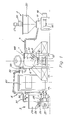
- the first conveying device 2 is connected to the comminuting machine 1 via a first conveying device 4 and the second conveying device 3 connected to the shredder 1 via a second conveyor 5.
- the comminution machine 1 is equipped with a container 6, which is preferably cylindrical in its upper part and conical or frustoconical in its lower part.
- a lid 48 is placed on the cylindrical part 7 of the container 6. It can be closed airtight. Two pre-shredders 8 and 8 protrude into the interior of the container 9 in.
- FIG. 1 For the sake of clarity, only one of the two pre-shredders 8 and 9 is shown in FIG. 1.
- sausage meat For the sake of simplicity, only the production of sausage meat is explained below, without this being intended to be restrictive.
- the pieces of meat and the like. are cut into relatively small parts by the rapidly rotating cutting knives 10 and 11 of the pre-shredder, the feed material already being pre-cut.
- the particles formed in the process now enter the finest shredder 15 and are further shredded there. However, they do not get into the finest shredder alone, rather the remaining components are fed to it via the second conveyor device 5, which, as said, are essentially liquid.
- the sausage meat emerging from the finest chopper 15 is a more or less spreadable mass, depending on the design of the chopper and also depending on the individual components. For example, in the production of salami, this mass is coarser than in the production of spread sausage.
- the container 7 is placed directly on the inlet connector 16 of the finest shredder on.
- the first delivery device 2 has a first delivery pump 17, which is in particular provided with an electric drive motor 18.
- a transmission 19 can also be located in between.
- this pump 17 there is also a first filling container 20, the shape of which preferably corresponds to that of the container 6 of the comminution machine 1.
- this first filling container 20 there is a stirring and conveying tool, not shown, which is driven by a motor 21.
- a gear 22 is connected between this electric motor 21 and the stirring and conveying tool.
- the task of this tool is to feed the material introduced into the first filling container 20 into the pump, because the pump is not self-priming, or at least not to a sufficient extent.
- there can also be a device of known type inside the first filling container 20 which prevents the mass from rotating in the container.
- the pump 17 is of a known type. It is preferably a gear pump with a driven externally toothed pinion and an engaged internally toothed gear, within which the pinion is located.
- the second feed device 3 also has a feed pump, namely the second feed pump 23. It is driven by an electric motor 24, a cutting tool 25 for fine grinding being located on the drive shaft. A Pre-shredder 26 pre-shreds the solid components and it is driven by means of an electric motor 27. The pre-shredding tool is designated 28. Roughly speaking, the second conveyor device can be compared with the comminution machine 1. The portion of the sausage meat leaving the second conveyor 3 is essentially liquid and comparable to a suspension. The pump 23 conveys it to the comminuting machine 1 via the second conveying device 5.
- this portion together with the other portion of the sausage meat fed in via the first conveying means 4 and pre-comminuted by the pre-comminutor 8 or 9, reaches the inlet connection 16 of the finest comminutor 15 in the manner already described
- the very fine comminution essentially relates to the portion supplied and pre-comminuted via the first conveying device 1.
- Both conveyors 4 and 5 are, as mentioned, pipelines.
- the shape of the second filling container, in which the second component for the sausage meat is filled, is comparable to that of the other containers 6 and 20. It is labeled 29.
- a three-way valve 30 is installed in the second conveyor device 5, which is designed as a pipeline. Two of the three connections of this valve are connected to the interrupted line 5, while an auxiliary line 31 is connected to the third, preferably middle connection. A circulation of the pre-comminuted material in the sense of arrow 32 is possible via this.
- a shut-off valve 32 is installed in the section of the second conveying device 5 which is located downstream of the three-way valve. In a manner not shown, the first conveying device 4 can also be shut off by such a valve, if necessary. This is important in that the container 6 of the shredding machine 1 can be evacuated.
- a vacuum separator 58 is provided for this purpose. Evacuation prevents air pockets in the meat, which would prevent portioning to the gram.
- a pressure relief valve 33 is arranged.
- valves 34 and 35 At the lower end of the container 6 of the comminution machine 1 there are two valves 34 and 35, preferably offset by 180 °, wherein steam can be let into the container 6 via at least one of these valves.
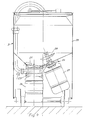
- a temperature sensor 36 and optionally controlled (Fig. 2). 2 is shown in somewhat more detail. It has rotating cutting knives 37 and 38 which work in a known manner with perforated plates 39 and 40, respectively. Pre-cutters 41 can be connected upstream of the cutting set 37, 39.
- This machine can be adjusted in a known manner by means of a handwheel 42.
- the drive motor for the cutting knives 37 and 38 is designated 43.
- An intermediate gear with 44 In addition, an automatic adjusting device 59 for the knives 37, 38 is provided opposite the perforated plates 39, 40.
- This setting device is controlled by the current of the drive motor 43 and the basic setting is made by the setting disk 60.
- a conveyor screw 45 which is preferably assigned to the funnel-shaped outlet end, is rotatably mounted. It ensures that the pre-shredded material supplied via the lines 4 and 5 is fed to the very fine shredder 15 without gaps, ie without the formation of cavities. It is located at the lower end of a drive shaft 46, the upper end of which has the gear 55. Furthermore, a stirring arm 49 is rotatably mounted in the container 6 via a gear 56, which closely conforms to the contour of the container 6, including its lower cover part. It ensures that no comminution material can accumulate there and in a way it promotes also the mixing. The drive takes place in each case via the electric motor 57.
- the screw conveyor 45 and 46 can be driven in opposite directions. If you turn it in the direction of arrow 50, the screw 45 conveys the material upwards, i.e. it is fed to the two pre-shredders 8 and 9 or fed again. Turning in the opposite direction causes conveyance to the finest shredder 15 and thus the very fine comminution and, if no further material is topped up, the emptying of the container 6.
- the container 6 is provided with a double wall 52, the space between which has an inlet 53 for hot or cold water. In this way, the entire container can be heated or cooled as required.
- a drain is provided for the condensate at 54.
- the raw material is supplied via the connection 62, which is provided with a pneumatically operated flap valve 63. The spices, however, are entered at port 64.
- a bowl 48 On the upper part of the container 6, a bowl 48 is arranged, which is releasably connected to it by a pneumatic lock 65.
- the lid 70 of this bowl 48 also has a lock 66, which can be closed pneumatically when vaporized.
- 48 cleaning balls 61 are provided in the lid 70 of the bowl, which are not in shown are connected to a cleaning liquid inlet, the cleaning agent being sprayed through the balls.
- the comminution device is provided with oil circulation lubrication, the oil being supplied from the oil tank 67 via lines 68.
- cartilage can collect between the perforated plates 39 and 40 in the finest shredder 15, a cartilage emptying 69, which can also be operated pneumatically, is arranged.
- the entire shredding device is equipped with an electrical or electronic control device 51. These can be used to specify all switch-on times of the rotary drives for comminution, mixing and conveying as well as evacuation and ventilation in a predetermined order, as well as the respective switch-on time. In particular, this controls the timing of the switching on of the various devices and machines in the manner desired and adapted to the material to be comminuted. This means that the metering of the amount of meat and also the amount of seasoning with liquid can be precisely determined by the corresponding running times of the feed pumps and, as said, can also be easily adapted to the individual components. This applies to both weight and volume. This also allows the mixing times and the duration to be defined and the time of evacuation and venting, the pre-shredding and the very fine shredding. Ultimately, of course, the monitoring of temperature and possibly pressure or negative pressure.
Landscapes
- Engineering & Computer Science (AREA)
- Food Science & Technology (AREA)
- Meat, Egg Or Seafood Products (AREA)
- Application Of Or Painting With Fluid Materials (AREA)
- Crushing And Pulverization Processes (AREA)
- Disintegrating Or Milling (AREA)
- Noodles (AREA)
- Debugging And Monitoring (AREA)
- Percussion Or Vibration Massage (AREA)
- Fittings On The Vehicle Exterior For Carrying Loads, And Devices For Holding Or Mounting Articles (AREA)
- Bakery Products And Manufacturing Methods Therefor (AREA)
Priority Applications (1)
| Application Number | Priority Date | Filing Date | Title |
|---|---|---|---|
| AT87105354T ATE68107T1 (de) | 1986-05-24 | 1987-04-10 | Zerkleinerungsvorrichtung zur herstellung einer pastoesen masse. |
Applications Claiming Priority (2)
| Application Number | Priority Date | Filing Date | Title |
|---|---|---|---|
| DE8613902U | 1986-05-24 | ||
| DE8613902U DE8613902U1 (de) | 1986-05-24 | 1986-05-24 | Zerkleinerungsvorrichtung zur Herstellung einer pastösen Masse |
Publications (3)
| Publication Number | Publication Date |
|---|---|
| EP0247342A2 true EP0247342A2 (fr) | 1987-12-02 |
| EP0247342A3 EP0247342A3 (en) | 1989-10-11 |
| EP0247342B1 EP0247342B1 (fr) | 1991-10-09 |
Family
ID=6794852
Family Applications (1)
| Application Number | Title | Priority Date | Filing Date |
|---|---|---|---|
| EP87105354A Expired - Lifetime EP0247342B1 (fr) | 1986-05-24 | 1987-04-10 | Dispositif broyeur pour la fabrication de masse pâteuse |
Country Status (7)
| Country | Link |
|---|---|
| EP (1) | EP0247342B1 (fr) |
| AT (1) | ATE68107T1 (fr) |
| DE (2) | DE8613902U1 (fr) |
| DK (1) | DK167244B1 (fr) |
| ES (1) | ES2025571T3 (fr) |
| FI (1) | FI872282L (fr) |
| NO (1) | NO170795C (fr) |
Cited By (3)
| Publication number | Priority date | Publication date | Assignee | Title |
|---|---|---|---|---|
| US4902412A (en) * | 1988-06-27 | 1990-02-20 | Wizzz-Rd Corp. | Swimming pool water recirculation system |
| EP0835608A1 (fr) * | 1996-10-12 | 1998-04-15 | Inofex Fleisch-, Lebensmitteltechnik und -technologie GmbH | Appareil automatique de coupe et d'émulsification |
| CN102217666A (zh) * | 2010-04-13 | 2011-10-19 | 艾伯特·汉德特曼机器制造有限责任两合公司 | 制造和灌注细粒香肠肉特别是乳状液的装置和方法 |
Family Cites Families (2)
| Publication number | Priority date | Publication date | Assignee | Title |
|---|---|---|---|---|
| US2970532A (en) * | 1954-02-08 | 1961-02-07 | Belle City Mfg Company | Apparatus for automatic proportioned mixing and grinding |
| US3580315A (en) * | 1965-03-11 | 1971-05-25 | Griffith Laboratories | Comminuting machine |
-
1986
- 1986-05-24 DE DE8613902U patent/DE8613902U1/de not_active Expired
-
1987
- 1987-04-10 ES ES198787105354T patent/ES2025571T3/es not_active Expired - Lifetime
- 1987-04-10 AT AT87105354T patent/ATE68107T1/de not_active IP Right Cessation
- 1987-04-10 DE DE8787105354T patent/DE3773537D1/de not_active Expired - Lifetime
- 1987-04-10 EP EP87105354A patent/EP0247342B1/fr not_active Expired - Lifetime
- 1987-05-22 DK DK260387A patent/DK167244B1/da not_active IP Right Cessation
- 1987-05-22 NO NO872160A patent/NO170795C/no unknown
- 1987-05-22 FI FI872282A patent/FI872282L/fi not_active Application Discontinuation
Cited By (5)
| Publication number | Priority date | Publication date | Assignee | Title |
|---|---|---|---|---|
| US4902412A (en) * | 1988-06-27 | 1990-02-20 | Wizzz-Rd Corp. | Swimming pool water recirculation system |
| EP0835608A1 (fr) * | 1996-10-12 | 1998-04-15 | Inofex Fleisch-, Lebensmitteltechnik und -technologie GmbH | Appareil automatique de coupe et d'émulsification |
| CN102217666A (zh) * | 2010-04-13 | 2011-10-19 | 艾伯特·汉德特曼机器制造有限责任两合公司 | 制造和灌注细粒香肠肉特别是乳状液的装置和方法 |
| CN102217666B (zh) * | 2010-04-13 | 2015-06-03 | 艾伯特·汉德特曼机器制造有限责任两合公司 | 制造和灌注细粒香肠肉特别是乳状液的装置和方法 |
| US9095148B2 (en) | 2010-04-13 | 2015-08-04 | Albert Handtmann Maschinenfabrik Gmbh & Co. Kg | Device and method of manufacturing and filling up fine sausage meat, in particular an emulsion |
Also Published As
| Publication number | Publication date |
|---|---|
| FI872282A7 (fi) | 1987-11-25 |
| DK260387A (da) | 1987-11-25 |
| NO170795C (no) | 1992-12-09 |
| FI872282L (fi) | 1987-11-25 |
| DE3773537D1 (de) | 1991-11-14 |
| ES2025571T3 (es) | 1992-04-01 |
| FI872282A0 (fi) | 1987-05-22 |
| DE8613902U1 (de) | 1986-07-17 |
| ATE68107T1 (de) | 1991-10-15 |
| EP0247342B1 (fr) | 1991-10-09 |
| NO872160L (no) | 1987-11-25 |
| DK167244B1 (da) | 1993-09-27 |
| EP0247342A3 (en) | 1989-10-11 |
| NO170795B (no) | 1992-08-31 |
| DK260387D0 (da) | 1987-05-22 |
| NO872160D0 (no) | 1987-05-22 |
Similar Documents
| Publication | Publication Date | Title |
|---|---|---|
| EP0123771B1 (fr) | Dispositif pour préparer un mélange de matière thermoplastique | |
| DE19642232C2 (de) | Zerkleinerungs- und Emulgierautomat | |
| EP0329662B1 (fr) | Dispositif de traitement de matieres plastiques | |
| EP1628812B1 (fr) | Dispositif de traitement d'un materiau plastique en vue de son recyclage | |
| EP0588160B1 (fr) | Procédé et dispositif de traitement des déchets en particulier des déchets alimentaires | |
| DE1808969A1 (de) | Mischmaschine | |
| EP0377161B1 (fr) | Méthode et appareil pour le travail de déchet de pâte pour la production de pâte neuve | |
| DE3049915A1 (en) | Apparatus for disintegrating and mixing foodstuffs | |
| EP3953029B1 (fr) | Procédé permettent de vider un dispositif de fabrication de granulats ou de produits extrudés | |
| DE2432860A1 (de) | Ruehrwerksmuehle zum kontinuierlichen dispergieren und feinmahlen von stoffen in einem fluessigen bzw. verfluessigbaren dispersionsmittel | |
| EP0247342B1 (fr) | Dispositif broyeur pour la fabrication de masse pâteuse | |
| WO2008011995A1 (fr) | Système de collecte de matière brute, de vis de pression et de transport pour des machines de broyage d'aliments | |
| EP0004935B1 (fr) | Mélangeur pour concasser et compacter des matières thermoplastiques et procédé de fonctionnement d'un tel mélangeur | |
| DE10058377A1 (de) | Verfahren und Vorrichtung zum Herstellen von Wurstbrät | |
| WO2021116111A1 (fr) | Broyeur à corps broyants entraînable en rotation, permettant l'obtention de polyisoprène et/ou d'autres matériaux apolaires | |
| DE102019205148A1 (de) | Vorrichtung zur Herstellung von Granulaten oder Extrudaten | |
| DE19830242C2 (de) | Zerkleinerungsmaschine, insbesondere für Lebensmittel | |
| DE2843866C2 (fr) | ||
| DE2152438C2 (de) | Maschine zum Zerkleinern und Mischen von Materialien, insbesondere Wurstfüllungen | |
| EP0029477A1 (fr) | Machine à hacher | |
| DE3322180C2 (de) | Vorrichtung zum Vermischen von körnigem oder stückigem Material mit einer Flüssigkeit | |
| DE3205323C2 (fr) | ||
| DE2554244A1 (de) | Vorrichtung zum herstellen und zerkleinern von mischungen | |
| DE2033788C3 (de) | Nahrungsmittefverarbeftungsvorrichtung | |
| DE3915803A1 (de) | Mischwolf |
Legal Events
| Date | Code | Title | Description |
|---|---|---|---|
| PUAI | Public reference made under article 153(3) epc to a published international application that has entered the european phase |
Free format text: ORIGINAL CODE: 0009012 |
|
| AK | Designated contracting states |
Kind code of ref document: A2 Designated state(s): AT BE CH DE ES FR GB IT LI NL SE |
|
| PUAL | Search report despatched |
Free format text: ORIGINAL CODE: 0009013 |
|
| AK | Designated contracting states |
Kind code of ref document: A3 Designated state(s): AT BE CH DE ES FR GB IT LI NL SE |
|
| 17P | Request for examination filed |
Effective date: 19890928 |
|
| 17Q | First examination report despatched |
Effective date: 19900912 |
|
| GRAA | (expected) grant |
Free format text: ORIGINAL CODE: 0009210 |
|
| AK | Designated contracting states |
Kind code of ref document: B1 Designated state(s): AT BE CH DE ES FR GB IT LI NL SE |
|
| REF | Corresponds to: |
Ref document number: 68107 Country of ref document: AT Date of ref document: 19911015 Kind code of ref document: T |
|
| GBT | Gb: translation of ep patent filed (gb section 77(6)(a)/1977) | ||
| REF | Corresponds to: |
Ref document number: 3773537 Country of ref document: DE Date of ref document: 19911114 |
|
| ITF | It: translation for a ep patent filed | ||
| ET | Fr: translation filed | ||
| REG | Reference to a national code |
Ref country code: ES Ref legal event code: FG2A Ref document number: 2025571 Country of ref document: ES Kind code of ref document: T3 |
|
| PLBE | No opposition filed within time limit |
Free format text: ORIGINAL CODE: 0009261 |
|
| STAA | Information on the status of an ep patent application or granted ep patent |
Free format text: STATUS: NO OPPOSITION FILED WITHIN TIME LIMIT |
|
| 26N | No opposition filed | ||
| EAL | Se: european patent in force in sweden |
Ref document number: 87105354.2 |
|
| PGFP | Annual fee paid to national office [announced via postgrant information from national office to epo] |
Ref country code: FR Payment date: 19950322 Year of fee payment: 9 |
|
| PGFP | Annual fee paid to national office [announced via postgrant information from national office to epo] |
Ref country code: CH Payment date: 19950324 Year of fee payment: 9 |
|
| PGFP | Annual fee paid to national office [announced via postgrant information from national office to epo] |
Ref country code: GB Payment date: 19950327 Year of fee payment: 9 |
|
| PGFP | Annual fee paid to national office [announced via postgrant information from national office to epo] |
Ref country code: AT Payment date: 19950328 Year of fee payment: 9 |
|
| PGFP | Annual fee paid to national office [announced via postgrant information from national office to epo] |
Ref country code: BE Payment date: 19950410 Year of fee payment: 9 |
|
| PGFP | Annual fee paid to national office [announced via postgrant information from national office to epo] |
Ref country code: ES Payment date: 19950419 Year of fee payment: 9 |
|
| PGFP | Annual fee paid to national office [announced via postgrant information from national office to epo] |
Ref country code: SE Payment date: 19950421 Year of fee payment: 9 |
|
| PGFP | Annual fee paid to national office [announced via postgrant information from national office to epo] |
Ref country code: NL Payment date: 19950430 Year of fee payment: 9 |
|
| PGFP | Annual fee paid to national office [announced via postgrant information from national office to epo] |
Ref country code: DE Payment date: 19950626 Year of fee payment: 9 |
|
| PG25 | Lapsed in a contracting state [announced via postgrant information from national office to epo] |
Ref country code: GB Effective date: 19960410 Ref country code: AT Effective date: 19960410 |
|
| PG25 | Lapsed in a contracting state [announced via postgrant information from national office to epo] |
Ref country code: SE Effective date: 19960411 Ref country code: ES Free format text: LAPSE BECAUSE OF NON-PAYMENT OF DUE FEES Effective date: 19960411 |
|
| PG25 | Lapsed in a contracting state [announced via postgrant information from national office to epo] |
Ref country code: LI Effective date: 19960430 Ref country code: CH Effective date: 19960430 Ref country code: BE Effective date: 19960430 |
|
| BERE | Be: lapsed |
Owner name: KARL SCHNELL G.M.B.H. & CO. MASCHINENFABRIK Effective date: 19960430 |
|
| PG25 | Lapsed in a contracting state [announced via postgrant information from national office to epo] |
Ref country code: NL Effective date: 19961101 |
|
| GBPC | Gb: european patent ceased through non-payment of renewal fee |
Effective date: 19960410 |
|
| REG | Reference to a national code |
Ref country code: CH Ref legal event code: PL |
|
| PG25 | Lapsed in a contracting state [announced via postgrant information from national office to epo] |
Ref country code: FR Effective date: 19961227 |
|
| PG25 | Lapsed in a contracting state [announced via postgrant information from national office to epo] |
Ref country code: DE Effective date: 19970101 |
|
| NLV4 | Nl: lapsed or anulled due to non-payment of the annual fee |
Effective date: 19961101 |
|
| EUG | Se: european patent has lapsed |
Ref document number: 87105354.2 |
|
| REG | Reference to a national code |
Ref country code: FR Ref legal event code: ST |
|
| REG | Reference to a national code |
Ref country code: ES Ref legal event code: FD2A Effective date: 19990201 |
|
| PG25 | Lapsed in a contracting state [announced via postgrant information from national office to epo] |
Ref country code: IT Free format text: LAPSE BECAUSE OF NON-PAYMENT OF DUE FEES Effective date: 20050410 |