EP0248557A2 - Vorrichtung und Verfahren zur Steuerung der Löschung eines Speicherbereichs - Google Patents
Vorrichtung und Verfahren zur Steuerung der Löschung eines Speicherbereichs Download PDFInfo
- Publication number
- EP0248557A2 EP0248557A2 EP87304319A EP87304319A EP0248557A2 EP 0248557 A2 EP0248557 A2 EP 0248557A2 EP 87304319 A EP87304319 A EP 87304319A EP 87304319 A EP87304319 A EP 87304319A EP 0248557 A2 EP0248557 A2 EP 0248557A2
- Authority
- EP
- European Patent Office
- Prior art keywords
- token
- space
- cleared
- subspace
- clear
- Prior art date
- Legal status (The legal status is an assumption and is not a legal conclusion. Google has not performed a legal analysis and makes no representation as to the accuracy of the status listed.)
- Granted
Links
Images







Classifications
-
- G—PHYSICS
- G06—COMPUTING OR CALCULATING; COUNTING
- G06F—ELECTRIC DIGITAL DATA PROCESSING
- G06F12/00—Accessing, addressing or allocating within memory systems or architectures
- G06F12/02—Addressing or allocation; Relocation
- G06F12/0223—User address space allocation, e.g. contiguous or non contiguous base addressing
- G06F12/023—Free address space management
Definitions
- the present invention relates to a method and device for controlling the clearing of a memory space, and in particular to a method and device for clearing the contents of a memory of an electronic computer.
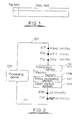
- Figure 2 illustrates the relationship between a processing device and a memory device in a computing device.
- the computing device comprises a memory device l00, including a distribution (allocation) section l00a, a memory section l00b, a delay (defer) processing section l00c, and a clear control section l00d.
- Channels l0l and l02 provide for the communication of data from a processing device l03 to the memory device l00, and from the memory device l00 to the processing device l03.
- the communication of all data between the processing device l03 and the memory device l00 is achieved by sending data packets (these packets are hereinafter referred to as tokens).
- the distribution section l00a of the memory device l00 receives a memory space request (SRQ) token l04, depending on the size of the space requested it sends a start address (A) in a token (PNT) l05.
- the memory section l00b receives a write (WRT) token l06 or a read (READ) token l07 it responds to the write token by entering its parameter V into address A, and responds to the read token by reading the contents V of the address A and transmitting the read data to the processing device l03 as a data (DT) token l08.
- WRT write
- READ read
- the delay processing section l00c and the clear control section l00d do not engage directly in the sending or receiving of tokens.
- the delay processing section l00c handles read tokens which relate to data not yet stored in arrived at the memory section l00b, which tokens must therefore be delayed, and the clear control section l00d performs the function of returning the content of a memory space to its original condition when that memory space is no longer in use.
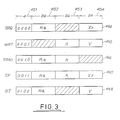
- each token comprises four fields, namely a first code field 45l, a second field 452, a third field 453, and a fourth field 454.
- the first code filed 45l is used to distinguish between the different kinds of tokens, and in the example in Fig. 3 it is assigned 4 bits which enables the identification of sixteen different kinds of token.
- each of fields 452 to 454 comprises in total twenty four bits but this number may be selected as appropriate to suit the system.
- the shaded areas in the diagrams represent fields which are not in use.
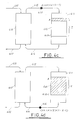
- Figures 4a to 4e serve to explain a prior art method for clearing the contents of each address in a memory section.
- numerals 6l0 and 6ll identify a clear control section and a memory section respectively.
- Channels 60l and 602 are provided for carrying tokens to and from a distribution section (not shown) corresponding to section l00a in Fig. 2.
- Channels 6l5 and 6l6 are provided for carrying tokens between the clear control section 6l0 and the memory section 6ll.
- the start address of the memory space 640 is designated A, and the size of that memory space, namely the number of addresses included in the memory space, is designated Z.
- the clear control section 6l0 when the memory space 640 is no longer in use, the clear control section 6l0 generates a clear token (CLR) 620 which it sends to the memory section 6ll.
- the token (CLR) 620 has three parameters, that is a space start address A, the size Z of the space, and the number of addresses C which have been cleared.
- CAK clearance acknowledged token
- the clear control section 6l0 When the clear control section 6l0 receives the acknowledgement token (CAK) 622, it takes the parameters Z (the size of the space) and C (the number of cleared words). Depending on the values of the received parameters it performs one or other of the actions (a) and (b) described below.
- CAK acknowledgement token
- the memory is divided into only two units 7ll and 7l2.
- the memory unit 7ll contains even number addresses and unit 7l2 contains odd number addresses.
- Numerals 70l to 7l6 in Figs. 5a to 5e correspond to numerals 60l to 6l6 respectively in Figs. 4a to 4e.
- a memory space of size Z and start address A is divided into a first space 740 which includes Z/2 even number addresses, and a space 74l which includes Z/2 odd number addresses.
- the memory unit 7ll receives the token CLR 730, and the memory unit 7l2 receives token CLR 73l.
- each memory unit decides the address to be cleared from the received parameters and clears that address.
- the units 740 and 74l generate the tokens clearance acknowledge (CAK) 732 and 733 respectively which have the same parameters.
- CAK tokens clearance acknowledge
- the clear control section 7l0 When the clear control section 7l0 receives tokens (CAK) 732 and 733, it reviews the space parameter Z, and parameter C representing the number of cleared words. Depending on the results of this, it carries out process (a) or process (b) as described below.
- CAK token is stored in the token stack, as is information related to acknowledge token 736 (see Fig. 5d).
- CAK token is taken from the token stack 750 and associated with the received CAK token 737, and as shown in Fig. 5e, a space liberate token (LIB) 738 is generated.
- LIB space liberate token
- Fig. 6 illustrates examples of the form of tokens CLR, CAK and LIB which are used in the above process.
- the above-described space clearance method does present problems.
- the memory is divided into two or more units by interleaving, and these units are processed in parallel, so that access is much quicker, but the known space clearing method exhibits the following disadvantages:-
- a memory space clearing control method for clearing a memory space in a memory device wherein the space to be cleared is divided into a series of subspaces each defined by a consecutive series of addresses, clear space tokens in respect of each subspace are sent to the memory device in parallel from a clear control device to clear individual addresses in the respective subspaces one at a time in address order and, when all the addresses in a subspace are cleared, a liberate space token is generated to indicate that the cleared subspace is free for use even if another subspace has not yet been cleared.
- the invention also provides a memory space clearing control device comprising means for dividing a memory space to be cleared into a series of subspaces each defined by a consecutive series of addresses, means for generating clear space tokens in respect of each subspace in parallel so as to clear individual addresses in the respective subspaces one at a time in address order, means for detecting clearance of all the addresses in a subspace, and means responsive to the detecting means for generating a liberate space token to indicate that the cleared subspace is free for use even if another subspace has not yet been cleared.
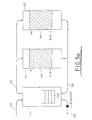
- Fig. 7 is a block diagram representing a memory space clear control device in accordance with an embodiment of the present invention.
- numeral l identifies a processing device which corresponds to the processing device l03 in Fig. 2.
- a clear control section 2 and a memory section 3 correspond to the clear control section l00d and the memory section l00b in Fig. 2 respectively.
- Communications channels 4 and 5 transfer tokens between the processing device l, the distribution section 2, and the memory section 3, and correspond to the lines l0l and l02 in Fig. 2.
- a buffer 2a temporarily houses tokens which are received from the channel 4.
- a control section 2b distinguishes the type of token which is received and makes up an output token according to its type.
- a buffer 2d sends tokens from the control section 2b to the channel 5.
- a buffer 3a temporarily houses tokens which have been received from the channel 4.
- a control section 3b distinguishes tokens received according to their type, and depending on their type their parameters are stored in memory 3c or the contents of the memory 3c are read.
- a buffer 3d sends tokens from the control device 3b to the channel device 5.
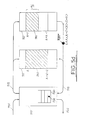
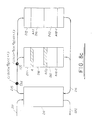
- Numeral 2l0 identifies a clear control section corresponding to section 2 of Fig. 7 and numerals 2ll and 2l2 identify divisions of the memory 3c of Fig. 7.
- Numerals 20l to 2l6 identify components corresponding to components 70l to 7l6 of Figs. 5a to 5e.
- the memory section in Figs. 8a to 8e is divided into two units 2ll and 2l2.
- the memory unit 2ll includes even number addresses
- the memory unit 2l2 includes odd number addresses.
- the clear control section 2l0 first creates clear tokens (CLR) 230 and 23l.
- the parameters of these tokens are the advance address, the size of the space, and the number of cleared addresses.
- the clear control section 2l0 creates these clear tokens, it divides the space to be cleared into a series of subspaces made up by consecutive addresses. Referring to Fig. 8a, in the described example the start address parameter is A for CLR 230 and (A+Z/2) for CLR 23l. At the start the number of cleared addresses is 0.
- the memory units 2ll and 2l2 When the memory units 2ll and 2l2 receive the CLR tokens 230 and 23l, they decide upon the addresses to be cleared on the basis of the received parameters.
- the memory units 2ll and 2l2 clear the contents of the indicated addresses, and for each of the entry tokens (CLR) generate a clear acknowledge token (CAK), as shown in Fig. 8b.
- CAK 232 and 233 have the same parameters as the corresponding clear tokens CLR 230 and 23l.
- the clear control section 2l0 When the clear control section 2l0 receives tokens CAK 232 or CAK 233, it reviews the two parameters, that is the size of the space and the number of cleared addresses. Then it proceeds as explained below depending on the result of this review.
- the present invention can be applied just as it is even if the memory section is divided by interleaving it four ways into four units or by interleaving it eight ways into eight units for example.
- the first parameter of the CLR token prefferably be the start address of each of the subdivided spaces, and for the last parameter to be the size which represents the same spaces.
Landscapes
- Engineering & Computer Science (AREA)
- Theoretical Computer Science (AREA)
- Physics & Mathematics (AREA)
- General Engineering & Computer Science (AREA)
- General Physics & Mathematics (AREA)
- Multi Processors (AREA)
- Memory System (AREA)
Applications Claiming Priority (2)
| Application Number | Priority Date | Filing Date | Title |
|---|---|---|---|
| GB868613070A GB8613070D0 (en) | 1986-05-29 | 1986-05-29 | Memory space clearing control |
| GB8613070 | 1986-05-29 |
Publications (3)
| Publication Number | Publication Date |
|---|---|
| EP0248557A2 true EP0248557A2 (de) | 1987-12-09 |
| EP0248557A3 EP0248557A3 (en) | 1989-10-18 |
| EP0248557B1 EP0248557B1 (de) | 1993-02-17 |
Family
ID=10598629
Family Applications (1)
| Application Number | Title | Priority Date | Filing Date |
|---|---|---|---|
| EP19870304319 Expired - Lifetime EP0248557B1 (de) | 1986-05-29 | 1987-05-15 | Vorrichtung und Verfahren zur Steuerung der Löschung eines Speicherbereichs |
Country Status (4)
| Country | Link |
|---|---|
| EP (1) | EP0248557B1 (de) |
| JP (1) | JPS63271549A (de) |
| DE (1) | DE3784189T2 (de) |
| GB (1) | GB8613070D0 (de) |
Cited By (2)
| Publication number | Priority date | Publication date | Assignee | Title |
|---|---|---|---|---|
| WO1992006436A3 (en) * | 1990-10-03 | 1992-10-15 | Thinking Machines Corp | Parallel computer system |
| US8615760B2 (en) | 2009-09-29 | 2013-12-24 | International Business Machines Corporation | Facilitating memory analysis |
-
1986
- 1986-05-29 GB GB868613070A patent/GB8613070D0/en active Pending
-
1987
- 1987-05-15 DE DE8787304319T patent/DE3784189T2/de not_active Expired - Fee Related
- 1987-05-15 EP EP19870304319 patent/EP0248557B1/de not_active Expired - Lifetime
- 1987-05-28 JP JP62132565A patent/JPS63271549A/ja active Pending
Non-Patent Citations (2)
| Title |
|---|
| COMMUNICATIONS OF THE ASSOCIATION OF COMPUTING MACHINERY, vol. 28, no. 1, January 1985, pages 34-52, ACM, New York, US; J.R. GURD et al.: "The Manchester prototype dataflow computer" * |
| PROCEEDINGS OF THE 1978 INTERNATIONAL CONFERENCE ON PARALLEL PROCESSING, Bellaire, MI, 22nd-25th August 1978, pages 166-172, IEEE, New York, US; W.B. ACKERMAN: "A structure processing facility for data flow computers" * |
Cited By (2)
| Publication number | Priority date | Publication date | Assignee | Title |
|---|---|---|---|---|
| WO1992006436A3 (en) * | 1990-10-03 | 1992-10-15 | Thinking Machines Corp | Parallel computer system |
| US8615760B2 (en) | 2009-09-29 | 2013-12-24 | International Business Machines Corporation | Facilitating memory analysis |
Also Published As
| Publication number | Publication date |
|---|---|
| DE3784189D1 (de) | 1993-03-25 |
| EP0248557B1 (de) | 1993-02-17 |
| DE3784189T2 (de) | 1993-06-03 |
| EP0248557A3 (en) | 1989-10-18 |
| JPS63271549A (ja) | 1988-11-09 |
| GB8613070D0 (en) | 1986-07-02 |
Similar Documents
| Publication | Publication Date | Title |
|---|---|---|
| US5025367A (en) | Storage allocation and garbage collection using liberate space tokens | |
| US5237567A (en) | Processor communication bus | |
| US4551842A (en) | Error-protected data transmission device and communication network | |
| EP0228629A2 (de) | Zeitmultiplexübertragungssystem | |
| EP0253940B1 (de) | Verfahren und System zur Leitweglenkung von Datenblöcken in Datenübertragungsnetzwerken | |
| EP0361176A3 (de) | Verfahren und Vorrichtung für die Datenübertragung zwischen mehreren Aufgaben in Datenverarbeitungssystemen | |
| JPH08508592A (ja) | 通信ネットワークのデータステーション内のデータバッファ方法および装置 | |
| US5003506A (en) | Memory capacity detection apparatus and electronic applied measuring device employing the same | |
| EP0036150A2 (de) | System zur Mustererkennung nach dem Mehrfach-Ähnlichkeitsverfahren | |
| JPS61500581A (ja) | 非同期ディジタル時分割多重処理方式 | |
| CA1057408A (en) | Subchannel memory access control | |
| EP0248557A2 (de) | Vorrichtung und Verfahren zur Steuerung der Löschung eines Speicherbereichs | |
| EP0057096B1 (de) | Informationsverarbeitungsanlage | |
| EP0429055A2 (de) | Datenformat für Informationspakete | |
| US6519655B1 (en) | Message preprocessing operations indicated by an associated descriptor read and descriptors belonging to a category of preprocessing descriptors and a category of instruction descriptors | |
| WO1981002798A1 (en) | Computer system and interface therefor | |
| EP0114390B1 (de) | Bitmuster-Prüfschaltung | |
| CN111639129B (zh) | 交易处理方法、装置、电子设备及计算机可读存储介质 | |
| CN87106178A (zh) | 数据通信方法和设备 | |
| US5428650A (en) | Method and device for selecting information usable by a local unit connected to a digital transmission system | |
| EP0431588B1 (de) | Verschachtelungsebeneentscheidungseinrichtung mit nur wenigen Hardwareteilen | |
| AU635157B2 (en) | Method of assigning slots in a ucol-type star network | |
| CS602090A3 (en) | Method of packet communication in information system | |
| EP0249345B1 (de) | Datenpaketverkürzungsverfahren und -vorrichtung | |
| US4484309A (en) | Magnetic bubble memory device |
Legal Events
| Date | Code | Title | Description |
|---|---|---|---|
| PUAI | Public reference made under article 153(3) epc to a published international application that has entered the european phase |
Free format text: ORIGINAL CODE: 0009012 |
|
| AK | Designated contracting states |
Kind code of ref document: A2 Designated state(s): DE FR GB |
|
| PUAL | Search report despatched |
Free format text: ORIGINAL CODE: 0009013 |
|
| AK | Designated contracting states |
Kind code of ref document: A3 Designated state(s): DE FR GB |
|
| 17P | Request for examination filed |
Effective date: 19900417 |
|
| 17Q | First examination report despatched |
Effective date: 19920626 |
|
| GRAA | (expected) grant |
Free format text: ORIGINAL CODE: 0009210 |
|
| AK | Designated contracting states |
Kind code of ref document: B1 Designated state(s): DE FR GB |
|
| REF | Corresponds to: |
Ref document number: 3784189 Country of ref document: DE Date of ref document: 19930325 |
|
| ET | Fr: translation filed | ||
| PGFP | Annual fee paid to national office [announced via postgrant information from national office to epo] |
Ref country code: GB Payment date: 19930504 Year of fee payment: 7 |
|
| PGFP | Annual fee paid to national office [announced via postgrant information from national office to epo] |
Ref country code: FR Payment date: 19930510 Year of fee payment: 7 |
|
| PGFP | Annual fee paid to national office [announced via postgrant information from national office to epo] |
Ref country code: DE Payment date: 19930524 Year of fee payment: 7 |
|
| PLBE | No opposition filed within time limit |
Free format text: ORIGINAL CODE: 0009261 |
|
| STAA | Information on the status of an ep patent application or granted ep patent |
Free format text: STATUS: NO OPPOSITION FILED WITHIN TIME LIMIT |
|
| 26N | No opposition filed | ||
| PG25 | Lapsed in a contracting state [announced via postgrant information from national office to epo] |
Ref country code: GB Effective date: 19940515 |
|
| GBPC | Gb: european patent ceased through non-payment of renewal fee |
Effective date: 19940515 |
|
| PG25 | Lapsed in a contracting state [announced via postgrant information from national office to epo] |
Ref country code: FR Effective date: 19950131 |
|
| PG25 | Lapsed in a contracting state [announced via postgrant information from national office to epo] |
Ref country code: DE Effective date: 19950201 |
|
| REG | Reference to a national code |
Ref country code: FR Ref legal event code: ST |