EP0249877B1 - Procédé pour la préparation d'un support immunoréactif pour l'analyse immunologique hétérogène - Google Patents
Procédé pour la préparation d'un support immunoréactif pour l'analyse immunologique hétérogène Download PDFInfo
- Publication number
- EP0249877B1 EP0249877B1 EP87108408A EP87108408A EP0249877B1 EP 0249877 B1 EP0249877 B1 EP 0249877B1 EP 87108408 A EP87108408 A EP 87108408A EP 87108408 A EP87108408 A EP 87108408A EP 0249877 B1 EP0249877 B1 EP 0249877B1
- Authority
- EP
- European Patent Office
- Prior art keywords
- receptor
- partner
- support material
- carrier material
- protein
- Prior art date
- Legal status (The legal status is an assumption and is not a legal conclusion. Google has not performed a legal analysis and makes no representation as to the accuracy of the status listed.)
- Expired - Lifetime
Links
Images

Classifications
-
- G—PHYSICS
- G01—MEASURING; TESTING
- G01N—INVESTIGATING OR ANALYSING MATERIALS BY DETERMINING THEIR CHEMICAL OR PHYSICAL PROPERTIES
- G01N33/00—Investigating or analysing materials by specific methods not covered by groups G01N1/00 - G01N31/00
- G01N33/48—Biological material, e.g. blood, urine; Haemocytometers
- G01N33/50—Chemical analysis of biological material, e.g. blood, urine; Testing involving biospecific ligand binding methods; Immunological testing
- G01N33/53—Immunoassay; Biospecific binding assay; Materials therefor
- G01N33/543—Immunoassay; Biospecific binding assay; Materials therefor with an insoluble carrier for immobilising immunochemicals
-
- Y—GENERAL TAGGING OF NEW TECHNOLOGICAL DEVELOPMENTS; GENERAL TAGGING OF CROSS-SECTIONAL TECHNOLOGIES SPANNING OVER SEVERAL SECTIONS OF THE IPC; TECHNICAL SUBJECTS COVERED BY FORMER USPC CROSS-REFERENCE ART COLLECTIONS [XRACs] AND DIGESTS
- Y10—TECHNICAL SUBJECTS COVERED BY FORMER USPC
- Y10S—TECHNICAL SUBJECTS COVERED BY FORMER USPC CROSS-REFERENCE ART COLLECTIONS [XRACs] AND DIGESTS
- Y10S435/00—Chemistry: molecular biology and microbiology
- Y10S435/969—Multiple layering of reactants
Definitions
- the invention relates to a carrier material for heterogeneous immunological analysis, a method for its production and its use.
- Heterogeneous immunological analysis can immunologically active receptors such.
- Such methods are known to the person skilled in the art, for example under the names competitive test, JEMA test or sandwich test.
- a common feature of these processes is that one of the reactants is immobilized on an insoluble carrier material so that it cannot be washed off.
- a receptor can be fixed to an insoluble carrier material by covalent or adsorptive binding (Methods in Enzymology, 73b , pp. 203-244 (1981) and BET Maggio “Enzyme Immunoassay” CAC Press, Florida 1980, in particular pages 175-178) .
- Both covalent and adsorptive binding of receptors to the solid phase have serious disadvantages.
- the chemical change at the receptor required for covalent binding also causes a change in the biological activity of the receptor.
- a disadvantage of the adsorptive binding is that the loading density is very low and the desorption of the receptor cannot be completely prevented when the carrier material is washed.
- Another method of fixation of receptors on a carrier material is the immunoprecipitate formation (see, for example, PCT-WO 82/02601 and US-A-3,888,629).
- the receptor to be immobilized is brought together with a precipitating partner on a carrier material and an immunoprecipitation is carried out.
- a network is formed between the receptor and its immunological partner, which network leads to the inside and / or the Surface of the carrier material is embedded and can no longer be removed by washing. This achieves a high loading density without chemical modification of the receptor to be immobilized.
- DE-A-3446636 describes a method for producing an immunoreactive porous carrier material, by applying a solution from a first partner of an immune reaction and a partner that precipitates with an immune reaction, incubating the carrier material soaked with the solutions for immunoprecipitation, if necessary washing and then drying the impregnated carrier material, characterized in that a solution of both partners of the immune reaction is prepared which contains an inhibitor for immunoprecipitation, the carrier material is impregnated with this solution and then the immunoprecipitation is triggered by removing the inhibitor or removing the inhibitory effect .
- the object of the present invention is therefore an improved carrier material which has an immobilized receptor in the immunoprecipitate, with which improved precision and a higher linearity of the calibration curve can be achieved in heterogeneous immunological tests.
- This object is achieved according to the invention by a method for producing an immunoreactive porous carrier material for heterogeneous immunological analysis by applying a solution of a receptor and a partner immunologically precipitating it to a carrier material, incubating the carrier material soaked with these solutions for immunoprecipitation, washing if necessary and then drying the impregnated carrier material, which is characterized in that the concentrations of the receptor and of the partner are selected such that their molar ratio during the impregnation is greater than the ratio defined by the Heidelberg maximum.
- the ratio of receptor and immunoprecipitating partner has a significant influence on the precision and the linearity of the calibration curve. It is particularly surprising that with the concentration ratios favorable for immunoprecipitation, as z. B. present in the Heidelberg maximum, the optimal precision and linearity of the calibration curve can not be achieved.
- the molar concentrations of the receptor and the immunoreactive partner are chosen so that their ratio is greater than the ratio defined by the Heidelberg maximum.
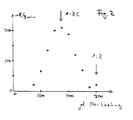
- the ratio of the Heidelberg maximum can easily be determined beforehand using turbidity tests.
- a corresponding turbidity curve can be found, for example, in "Methods in Immunology and Immunochemistry", Volume III, Academic Press 1971 , Chapter 13, page 10.
- the turbidity is plotted, which, with a constant amount, increases with increasing amounts of one of the two reactants of the other reactant is obtained.
- the turbidity maximum is the Heidelberg maximum.
- the Heidelberg maximum for the molar ratio of receptor to precipitating partner for purified feedstocks is usually around 1: 3.5.
- the advantageous effect according to the invention is achieved when this ratio is greater. It is preferred to use a ratio of greater than or equal to 1: 3. It is particularly preferred to choose the ratio greater than 1: 2.5 and less than 1: 1.
- Receptor and precipitating partner can be applied to the carrier material either sequentially or simultaneously.
- the carrier material is first impregnated with either the receptor or the precipitating partner and then the corresponding other partner is added as a solution.
- the impregnation of the carrier material is preferably carried out simultaneously.
- the impregnation is particularly preferably carried out in the presence of an inhibitor, as described in DE-A-3446636. Both the "one-step process" and the "two-step process” are preferred.
- an immunoprecipitate can be formed between two bivalent antibodies or antibody fragments, or an antibody and a haptenized protein.
- At least bivalent substances are immunologically suitable as receptors, such as. B. antibodies and their bivalent fragments, which can be both monoclonal and polyclonal and other proteins. Antigens or haptenized proteins are also suitable. If an immobilized hapten is to be used for an immunological determination, a polyhapten is preferably used as the receptor. For example, several hapten molecules, which in this case can also be monovalent, are attached to a bi- or multivalent carrier protein, such as. B. an antibody or serum albumin. This means that immunoprecipitation can also be achieved for monovalent haptens.
- the immunoprecipitating partner of the reaction must be selected according to the receptor.
- an antibody is preferably used which is bivalent and is directed against the receptor.
- An antibody is particularly preferably used which has the highest possible affinity for the receptor, so that the fixation of the immunoprecipitate on the carrier material is as firm as possible.
- the usual solid supports for immunoreactive substances come into consideration as the support material.
- a carrier material which is often also referred to as a matrix, can consist, for example, of glass, plastic, paper, porous metal or the like, provided that the carrier material is sufficiently penetrated by coherent liquid-permeable cavities. Natural, artificial, organic or inorganic polymers are also suitable. Fibrous, sponge-like or sintered substances are also suitable.
- the reagent carriers can be used flat, particulate or in another form. Flat, porous supports such as, for. B. paper, foam sheets, glass mats or the like.
- an immunoreactive carrier material produced according to the invention in the context of the heterogeneous enzyme immunoassay can, for. B. done so that hapten (H) or protein (P), which in a sample such as buffer solution, serum, plasma, urine, culture supernatant, etc. a. is included with a marked binder (B).
- hapten H
- P protein
- a binder come u. a.
- As a marker for the binder z.
- an enzyme fluorescent label or radioisotope can be used, in the following examples the ß-galactosidase was chosen.
- the amount of binder added can be molar, both in excess and in excess of the hapten or protein present in the sample.
- This mixture is incubated for a constant time, during which the complexes H-B and P-B form. After this period, three species are present in the reaction mixture, namely the complex consisting of hapten / protein and binder (H-B, P-B), residual free hapten / protein (H / P) and residual free binder (B).
- the immunoreactive support material produced according to the invention can be used in such a way that the analyte (hapten or protein) contained in the sample is mixed with a constant amount of labeled analyte.
- the marking can e.g. B. an enzyme, a fluorescent label, radioisotope and others. This mixture is placed on the matrix. An antibody which is directed against the analyte is immobilized on the matrix. The mixture is incubated on the matrix for a certain time. During this time, both unchanged analyte and labeled analyte compete for the binding sites on the matrix.
- the liquid is removed from the porous matrix, e.g. B. by centrifugation.
- the amount of the labeled analyte is then determined either in the free phase or the amount of the labeled analyte bound to the matrix.
- a further application of the carrier materials produced according to the invention can be such that the analyte (hapten or protein) is mixed with a constant amount of labeled antibody which is directed against the analyte. Possible ways of labeling the antibody have been described above. This mixture is either incubated for a certain time and then added to the porous support material or alternatively applied to the porous support material immediately after mixing. If the analyte is a hapten, the carrier material contains the hapten to be detected or a derivative thereof in fixed form, if the analyte is a protein, the carrier material contains the protein to be detected or a derivative thereof also in fixed form.
- labeled antibodies bind to the porous carrier material with binding sites that are still free. If the mixture was immediately added to the support material, the analyte from the sample and the analyte fixed to the support material compete for the binding sites of the labeled antibody. At the end of the incubation phase, the liquid is removed from the porous support material and the amount of the labeled antibody is determined either in the liquid phase or on the porous support material.
- the "affinity adsorbent, glutardialdehyde activated" from Boehringer Mannheim was used as the carrier.
- the antigen purification was carried out according to the manufacturer's instructions a sheep antibody against rabbit IgG or a spec. Antibodies against the hapten and for antibody purification rabbit IgG bound to the carrier. The immunosorption was carried out as described in the working instructions for the affinity adsorbent.
- Antiserum directed against theophylline, was purified via ammonium sulfate precipitation and passage through DEAE cellulose to the IgG fraction.
- the papain cleavage was carried out according to R.R. Porter, Biochem. J. 73, 119-126 (1959).
- the antigen was purified using ion exchange chromatography.
- the antibody was immunosorptively purified on a rabbit IgG column.
- the porous carrier material (fleece) used was: mixed fleece made of cellulose and polyester (Kalff, Eusmün, Germany), or made of linters, cellulose, polyamide (Binzer, Hatzfeld, Eder, Germany).
- Diphenylhydantoin immunoprecipitate nonwovens are produced analogously to Example 1.
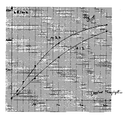
- the linearization of the calibration curve achieved is shown in FIG. 3.
Landscapes
- Health & Medical Sciences (AREA)
- Immunology (AREA)
- Life Sciences & Earth Sciences (AREA)
- Engineering & Computer Science (AREA)
- Molecular Biology (AREA)
- Biomedical Technology (AREA)
- Chemical & Material Sciences (AREA)
- Hematology (AREA)
- Urology & Nephrology (AREA)
- Food Science & Technology (AREA)
- Biochemistry (AREA)
- Cell Biology (AREA)
- Biotechnology (AREA)
- Medicinal Chemistry (AREA)
- Physics & Mathematics (AREA)
- Analytical Chemistry (AREA)
- Microbiology (AREA)
- General Health & Medical Sciences (AREA)
- General Physics & Mathematics (AREA)
- Pathology (AREA)
- Peptides Or Proteins (AREA)
- Medicines Containing Antibodies Or Antigens For Use As Internal Diagnostic Agents (AREA)
- Steroid Compounds (AREA)
- Investigating Or Analysing Biological Materials (AREA)
Claims (11)
- Procédé pour la préparation d'un matériau de support poreux immunoréactif pour l'analyse immunologique hétérogène, consistant à déposer, sur un matériau de support, un récepteur et son partenaire de précipitation immunologique, chacun à partir d'une solution, à incuber le matériau de support imprégné des solutions pour réaliser l'immunoprécipitation, éventuellement à laver et ensuite, à sécher le matériau de support imprégné, caractérisé en ce que la concentration du récepteur et la concentration de son partenaire sont choisies de façon que lors de l'imprégnation, leur rapport molaire soit supérieur au rapport défini par le maxima de Heidelberger.
- Procédé selon la revendication 1, caractérisé en ce que le récepteur et son partenaire sont utilisés dans un rapport molaire supérieur ou égal à 1 : 3.
- Procédé selon les revendications 1 - 2, caractérisé en ce que le récepteur et son partenaire sont utilisés dans un rapport molaire de 1 : 2,5 à 1 : 1.
- Procédé selon les revendications 1 - 3, caractérisé en ce que l'on utilise une solution d'un récepteur et une solution de son partenaire, l'une au moins de ces solutions contenant un inhibiteur de l'immunoprécipitation, on imprègne le matériau de support avec cette solution et ensuite, on déclenche l'immunoprécipitation par élimination de l'inhibiteur ou par suppression de l'action inhibitrice.
- Procédé selon les revendications 1 - 4, caractérisé en ce que comme récepteur, on utilise une protéine et comme partenaire, un anticorps ou un fragment d'anticorps dirigé contre cette protéine.
- Procédé selon la revendication 5, caractérisé en ce que comme récepteur, on utilise une protéine à laquelle est couplé au moins un haptène ou antigène.
- Procédé selon la revendication 6, caractérisé en ce que comme protéine, on utilise un anticorps ou un fragment d'anticorps auquel est couplé au moins un haptène ou une molécule d'antigène.
- Matériau de support pour l'analyse immunologique hétérogène, caractérisé en ce qu'il contient un récepteur et un partenaire de précipitation immunologique dans un rapport molaire qui est supérieur au rapport défini par le maxima de Heidelberger.
- Matériau de support selon la revendication 8, caractérisé en ce que, le rapport du récepteur au partenaire est supérieur ou égal à 1 : 3.
- Matériau de support selon la revendication 9, caractérisé en ce que le rapport molaire du récepteur au partenaire est compris entre 1 : 2,5 et 1 : 1.
- Utilisation d'un matériau de support selon les revendications 8 à 10, pour l'analyse immunologique hétérogène.
Priority Applications (1)
| Application Number | Priority Date | Filing Date | Title |
|---|---|---|---|
| AT87108408T ATE80738T1 (de) | 1986-06-20 | 1987-06-11 | Verfahren zur herstellung eines immunreaktiven traegermaterials fuer die heterogene immunologische analyse. |
Applications Claiming Priority (2)
| Application Number | Priority Date | Filing Date | Title |
|---|---|---|---|
| DE19863620653 DE3620653A1 (de) | 1986-06-20 | 1986-06-20 | Verfahren zur herstellung eines immunreaktiven traegermaterials fuer die heterogene immunologische analyse |
| DE3620653 | 1986-06-20 |
Publications (3)
| Publication Number | Publication Date |
|---|---|
| EP0249877A2 EP0249877A2 (fr) | 1987-12-23 |
| EP0249877A3 EP0249877A3 (en) | 1989-02-01 |
| EP0249877B1 true EP0249877B1 (fr) | 1992-09-16 |
Family
ID=6303306
Family Applications (1)
| Application Number | Title | Priority Date | Filing Date |
|---|---|---|---|
| EP87108408A Expired - Lifetime EP0249877B1 (fr) | 1986-06-20 | 1987-06-11 | Procédé pour la préparation d'un support immunoréactif pour l'analyse immunologique hétérogène |
Country Status (5)
| Country | Link |
|---|---|
| US (1) | US4820633A (fr) |
| EP (1) | EP0249877B1 (fr) |
| JP (1) | JPH063446B2 (fr) |
| AT (1) | ATE80738T1 (fr) |
| DE (2) | DE3620653A1 (fr) |
Families Citing this family (7)
| Publication number | Priority date | Publication date | Assignee | Title |
|---|---|---|---|---|
| JPS5787645A (en) * | 1980-11-20 | 1982-06-01 | Ricoh Co Ltd | Priority control system |
| DE3735684A1 (de) * | 1987-10-22 | 1989-05-03 | Boehringer Mannheim Gmbh | Immunreaktives traegermaterial und verfahren zu seiner herstellung |
| DE3802366A1 (de) * | 1988-01-27 | 1989-08-10 | Boehringer Mannheim Gmbh | Traegervlies fuer abloesbar impraegnierte reagenzien |
| FR2638234B1 (fr) * | 1988-10-21 | 1992-11-27 | Rhone Poulenc Chimie | Support pour molecules biologiquement actives ou lui-meme biologiquement actif, son procede de preparation et son application en biologie |
| JP2782695B2 (ja) * | 1992-09-11 | 1998-08-06 | ダムビノヴァ,スヴェトラーナ・アレクサンドロフナ | 神経症および精神病の診断用免疫吸着剤およびその実際的用途 |
| DE4343261C2 (de) * | 1993-12-17 | 1995-11-02 | Susanne Holzer | Verfahren zur präparativen Herstellung von Ausgangsstoffen für Immunoassays und Bioassays |
| JP4545869B2 (ja) * | 2000-02-23 | 2010-09-15 | 日本ケミファ株式会社 | 多孔性フィルタを用いる生理活性試料物質の測定方法 |
Family Cites Families (12)
| Publication number | Priority date | Publication date | Assignee | Title |
|---|---|---|---|---|
| GB1420916A (en) * | 1971-09-08 | 1976-01-14 | Bagshawe K D | Performance of chemical or biological reactions |
| CA983358A (en) * | 1971-09-08 | 1976-02-10 | Kenneth D. Bagshawe | Performance of chemical or biological reactions |
| DE2258822A1 (de) * | 1972-12-01 | 1974-06-06 | Merck Patent Gmbh | Verfahren und mittel zur analyse von isoenzymmustern |
| US4156081A (en) * | 1977-04-15 | 1979-05-22 | Syva Company | Theophylline antigens and antibodies |
| DE2901218A1 (de) * | 1979-01-13 | 1980-07-17 | Byk Gulden Lomberg Chem Fab | Ung von theophyllin |
| JPS5799598A (en) * | 1980-12-12 | 1982-06-21 | Chugai Pharmaceut Co Ltd | Hapten antigen and its synthetic intermediate |
| US4517288A (en) * | 1981-01-23 | 1985-05-14 | American Hospital Supply Corp. | Solid phase system for ligand assay |
| US4604365A (en) * | 1981-06-02 | 1986-08-05 | Electro-Nucleonics, Inc. | Immunoprecipitation assay |
| US4533493A (en) * | 1981-08-27 | 1985-08-06 | Miles Laboratories, Inc. | Theophylline immunogens, antibodies, labeled conjugates, and related derivatives |
| US4524025A (en) * | 1982-06-30 | 1985-06-18 | E. I. Du Pont De Nemours And Company | Hybridoma cell lines and monoclonal antibodies to theophylline |
| DE3225027A1 (de) * | 1982-07-05 | 1984-01-05 | Boehringer Mannheim Gmbh, 6800 Mannheim | Immunchemisches messverfahren |
| DE3446636A1 (de) * | 1984-12-20 | 1986-06-26 | Boehringer Mannheim Gmbh, 6800 Mannheim | Verfahren zur herstellung eines immunreaktiven poroesen traegermaterials |
-
1986
- 1986-06-20 DE DE19863620653 patent/DE3620653A1/de not_active Withdrawn
-
1987
- 1987-06-08 US US07/059,066 patent/US4820633A/en not_active Expired - Lifetime
- 1987-06-11 EP EP87108408A patent/EP0249877B1/fr not_active Expired - Lifetime
- 1987-06-11 DE DE8787108408T patent/DE3781721D1/de not_active Expired - Lifetime
- 1987-06-11 AT AT87108408T patent/ATE80738T1/de not_active IP Right Cessation
- 1987-06-18 JP JP62150362A patent/JPH063446B2/ja not_active Expired - Lifetime
Non-Patent Citations (1)
| Title |
|---|
| ESSENTIAL IMMUNOLOGY, I.M. ROITT, 5. Aufl., 1984, Blackwell Scientific Publications, Oxford; S.4-6; Fig. 1 und 3, S. 5< * |
Also Published As
| Publication number | Publication date |
|---|---|
| EP0249877A2 (fr) | 1987-12-23 |
| US4820633A (en) | 1989-04-11 |
| JPH063446B2 (ja) | 1994-01-12 |
| JPS6366462A (ja) | 1988-03-25 |
| EP0249877A3 (en) | 1989-02-01 |
| ATE80738T1 (de) | 1992-10-15 |
| DE3781721D1 (de) | 1992-10-22 |
| DE3620653A1 (de) | 1987-12-23 |
Similar Documents
| Publication | Publication Date | Title |
|---|---|---|
| DE3650513T2 (de) | Verzögerter immunologischer Test in fester Phase | |
| EP1143248B1 (fr) | Méthode pour l'immobilisation de conjugates dans des épreuves diagnostiques | |
| DE69121021T2 (de) | Bindungsnachweisverfahren mit Konjugatrückgewinnung | |
| EP0098590B1 (fr) | Procédé d'essai immunologique | |
| DE3834766A1 (de) | Verfahren zur bestimmung einer spezifisch bindefaehigen substanz | |
| EP0174652B1 (fr) | Procédé de mesure immunochimique pour haftènes et protéines | |
| DE2206103A1 (de) | Verfahren zum Nachweisen und Bestimmen einer Komponente der Reaktion zwischen spezifisch bindenden Proteinen und den Substanzen, die von diesen Proteinen spezifisch gebunden werden | |
| DE2951678A1 (de) | Immunologische bestimmung mit hilfe von lectin | |
| DE3905505A1 (de) | Polymere igg-derivate zur kompensation von stoerfaktoren in immunoassays | |
| DE2164768B2 (de) | Verfahren zum nachweis und zur bestimmung einer komponente der reaktion zwischen spezifischen bindeproteinen und bindefaehigen substanzen | |
| DE3138489A1 (de) | Verfahren zur durchfuehrung einer immunologischen bestimmung | |
| EP0782585B1 (fr) | ELIMINATION D'INTERFERENCES DUES AU FACTEUR RHUMATOIDE AU MOYEN D'ANTICORPS ANTI-Fd | |
| EP0544869B2 (fr) | Procede immunologique de depistage d'anticorps dans des liquides biologiques et kit de mise en oeuvre du procede | |
| DE69012552T2 (de) | Avidin-biotin assistiertes immunassayverfahren. | |
| DE69131811T2 (de) | Antikörpern gegen Ligand-Analogen und ihre Verwendung in Ligand-Rezeptor Bestimmungen | |
| EP0407904A2 (fr) | Procédé pour la détermination d'une analyte | |
| EP0185372B1 (fr) | Procédé pour la préparation d'une matière immunoréactive et poreuse pour supports | |
| EP0703452A2 (fr) | Méthode qualitative et/ou quantitative pour déterminer une substance | |
| EP0349988B1 (fr) | Méthode pour déterminer une substance spécifique capable de lier | |
| DE4328070C1 (de) | Verfahren zur Bestimmung eines Analyten in einem Volumen einer flüssigen Probe sowie seine Anwendung zur Bestimmung von anti-TSH-Rezeptor-Autoantikörpern in einem Patientenserum | |
| DE3543749A1 (de) | Verfahren zur herstellung eines reagenzpapieres fuer die immunologische analyse | |
| DE69418501T2 (de) | Immunologische Bestimmung eines Antigens oder eines Haptens | |
| EP0243655B1 (fr) | Procédé et réactif pour la détermination d'un partenaire réactionnel d'une réaction immunologique | |
| DE69304528T3 (de) | Verfahren zur bestimmung der menge eines schilddrüsenhormon-liganden in einer biologischen flüssigkeit und satz zur durchführung dieses verfahrens | |
| EP0249877A2 (fr) | Procédé pour la préparation d'un support immunoréactif pour l'analyse immunologique hétérogène |
Legal Events
| Date | Code | Title | Description |
|---|---|---|---|
| PUAI | Public reference made under article 153(3) epc to a published international application that has entered the european phase |
Free format text: ORIGINAL CODE: 0009012 |
|
| 17P | Request for examination filed |
Effective date: 19870611 |
|
| AK | Designated contracting states |
Kind code of ref document: A2 Designated state(s): AT BE CH DE ES FR GB GR IT LI LU NL SE |
|
| PUAL | Search report despatched |
Free format text: ORIGINAL CODE: 0009013 |
|
| AK | Designated contracting states |
Kind code of ref document: A3 Designated state(s): AT BE CH DE ES FR GB GR IT LI LU NL SE |
|
| 17Q | First examination report despatched |
Effective date: 19900824 |
|
| GRAA | (expected) grant |
Free format text: ORIGINAL CODE: 0009210 |
|
| AK | Designated contracting states |
Kind code of ref document: B1 Designated state(s): AT BE CH DE ES FR GB GR IT LI LU NL SE |
|
| PG25 | Lapsed in a contracting state [announced via postgrant information from national office to epo] |
Ref country code: SE Effective date: 19920916 Ref country code: NL Effective date: 19920916 Ref country code: GR Free format text: LAPSE BECAUSE OF FAILURE TO SUBMIT A TRANSLATION OF THE DESCRIPTION OR TO PAY THE FEE WITHIN THE PRESCRIBED TIME-LIMIT Effective date: 19920916 Ref country code: BE Effective date: 19920916 |
|
| REF | Corresponds to: |
Ref document number: 80738 Country of ref document: AT Date of ref document: 19921015 Kind code of ref document: T |
|
| REF | Corresponds to: |
Ref document number: 3781721 Country of ref document: DE Date of ref document: 19921022 |
|
| ITF | It: translation for a ep patent filed | ||
| ET | Fr: translation filed | ||
| PG25 | Lapsed in a contracting state [announced via postgrant information from national office to epo] |
Ref country code: ES Free format text: LAPSE BECAUSE OF FAILURE TO SUBMIT A TRANSLATION OF THE DESCRIPTION OR TO PAY THE FEE WITHIN THE PRESCRIBED TIME-LIMIT Effective date: 19921227 |
|
| GBT | Gb: translation of ep patent filed (gb section 77(6)(a)/1977) |
Effective date: 19921204 |
|
| NLV1 | Nl: lapsed or annulled due to failure to fulfill the requirements of art. 29p and 29m of the patents act | ||
| PG25 | Lapsed in a contracting state [announced via postgrant information from national office to epo] |
Ref country code: AT Effective date: 19930611 |
|
| PG25 | Lapsed in a contracting state [announced via postgrant information from national office to epo] |
Ref country code: LU Free format text: LAPSE BECAUSE OF NON-PAYMENT OF DUE FEES Effective date: 19930630 Ref country code: LI Effective date: 19930630 Ref country code: CH Effective date: 19930630 |
|
| PLBE | No opposition filed within time limit |
Free format text: ORIGINAL CODE: 0009261 |
|
| STAA | Information on the status of an ep patent application or granted ep patent |
Free format text: STATUS: NO OPPOSITION FILED WITHIN TIME LIMIT |
|
| 26N | No opposition filed | ||
| REG | Reference to a national code |
Ref country code: CH Ref legal event code: PL |
|
| PGFP | Annual fee paid to national office [announced via postgrant information from national office to epo] |
Ref country code: GB Payment date: 20000607 Year of fee payment: 14 |
|
| PGFP | Annual fee paid to national office [announced via postgrant information from national office to epo] |
Ref country code: FR Payment date: 20000612 Year of fee payment: 14 |
|
| PGFP | Annual fee paid to national office [announced via postgrant information from national office to epo] |
Ref country code: DE Payment date: 20000614 Year of fee payment: 14 |
|
| PG25 | Lapsed in a contracting state [announced via postgrant information from national office to epo] |
Ref country code: GB Free format text: LAPSE BECAUSE OF NON-PAYMENT OF DUE FEES Effective date: 20010611 |
|
| GBPC | Gb: european patent ceased through non-payment of renewal fee |
Effective date: 20010611 |
|
| PG25 | Lapsed in a contracting state [announced via postgrant information from national office to epo] |
Ref country code: FR Free format text: LAPSE BECAUSE OF NON-PAYMENT OF DUE FEES Effective date: 20020228 |
|
| PG25 | Lapsed in a contracting state [announced via postgrant information from national office to epo] |
Ref country code: DE Free format text: LAPSE BECAUSE OF NON-PAYMENT OF DUE FEES Effective date: 20020403 |
|
| PG25 | Lapsed in a contracting state [announced via postgrant information from national office to epo] |
Ref country code: IT Free format text: LAPSE BECAUSE OF NON-PAYMENT OF DUE FEES;WARNING: LAPSES OF ITALIAN PATENTS WITH EFFECTIVE DATE BEFORE 2007 MAY HAVE OCCURRED AT ANY TIME BEFORE 2007. THE CORRECT EFFECTIVE DATE MAY BE DIFFERENT FROM THE ONE RECORDED. Effective date: 20050611 |