EP0252668B1 - Céramiques diélectriques - Google Patents
Céramiques diélectriques Download PDFInfo
- Publication number
- EP0252668B1 EP0252668B1 EP19870305786 EP87305786A EP0252668B1 EP 0252668 B1 EP0252668 B1 EP 0252668B1 EP 19870305786 EP19870305786 EP 19870305786 EP 87305786 A EP87305786 A EP 87305786A EP 0252668 B1 EP0252668 B1 EP 0252668B1
- Authority
- EP
- European Patent Office
- Prior art keywords
- unloaded
- dielectric
- present
- general formula
- neutralized
- Prior art date
- Legal status (The legal status is an assumption and is not a legal conclusion. Google has not performed a legal analysis and makes no representation as to the accuracy of the status listed.)
- Expired
Links
Images
Classifications
-
- C—CHEMISTRY; METALLURGY
- C04—CEMENTS; CONCRETE; ARTIFICIAL STONE; CERAMICS; REFRACTORIES
- C04B—LIME, MAGNESIA; SLAG; CEMENTS; COMPOSITIONS THEREOF, e.g. MORTARS, CONCRETE OR LIKE BUILDING MATERIALS; ARTIFICIAL STONE; CERAMICS; REFRACTORIES; TREATMENT OF NATURAL STONE
- C04B35/00—Shaped ceramic products characterised by their composition; Ceramics compositions; Processing powders of inorganic compounds preparatory to the manufacturing of ceramic products
- C04B35/01—Shaped ceramic products characterised by their composition; Ceramics compositions; Processing powders of inorganic compounds preparatory to the manufacturing of ceramic products based on oxide ceramics
- C04B35/495—Shaped ceramic products characterised by their composition; Ceramics compositions; Processing powders of inorganic compounds preparatory to the manufacturing of ceramic products based on oxide ceramics based on vanadium, niobium, tantalum, molybdenum or tungsten oxides or solid solutions thereof with other oxides, e.g. vanadates, niobates, tantalates, molybdates or tungstates
Definitions
- the present invention relates to a dielectric ceramic and, more particularly, to a dielectric ceramic which has a high unloaded Q in a high-frequency range, thereby being suitable as a dielectric applicance for high frequencies.
- a dielectric resonator and a dielectric substrate which are used for a signal circuit in a high-frequency range such as microwaves and milli waves are generally required to use a dielectric ceramic which has a high dielectric constant, a high unloaded Q, and a small absolute value of the temperature coeffieient of the resonant frequency.
- TiO2 materials have conventionally been used.
- BaO-TiO2 and ZrO2-SnO2-TiO2 materials, and recently, Ba(Zn, Ta)O3 and Ba(Mg, Ta)O3 materials have been utilized as disclosed in GB-A-2166431.
- Dielectric ceramics made of these materials have an unloaded Q of 3,000 to 7,000, the dielectric constant is 20 to 40, and the temperature coefficient of the resonant frequency is as small as approximately 0 ppm/°C at a high frequency of about 10 GHz.
- An object of the present invention to provide a dielectric ceramic made of a novel material in order to exhibit a higher unloaded Q.
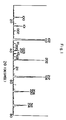
- Fig. 1 is an X-ray diffraction chart of a dielectric ceramic.
- x, y, z, u and w which represent the composition ratio of each cation are important in order to enhance the unloaded Q in a high-frequency range, which is one of the objects of the present invention, and the respective ranges of x, y, z, u and w are so determined as to achieve this object.
- the general formula (I) becomes Ba ⁇ (Mg 1-y Ni y ) 1-u Ta u ⁇ O p .
- the ranges of y and u are restricted to the following ranges: 0.001 ⁇ y ⁇ 0.088 and 0.66 ⁇ u ⁇ 0.72. if y exceeds 0.088, the unloaded Q is lowered, while if it is less than 0.001, the raw material is difficult to sinter. On the other hand, if u is less than 0.66, the raw material is difficult to sinter, while if it is 0.72 or more, the unloaded Q is unfavorably lowered and the temperature coefficient of the resonant frequency rapidly increases in the positive direction. It is preferable that 0.66 ⁇ u ⁇ 0.68.
- the general formula (I) becomes Ba ⁇ (Mg 1-y-w Ni y Co w ) 1-u Ta u ⁇ O p .
- the ranges of y and w are restricted to the following ranges: 0.001 ⁇ y ⁇ 0.40 and 0.001 ⁇ w ⁇ 0.40. If y or w is less than 0.001, the raw material is difficult to sinter or the unloaded Q is lowered. If y or w exceeds 0.40, the unloaded Q is lowered.
- the range of y + w is 0.002 ⁇ y + w ⁇ 0.40, preferably 0.002 ⁇ y + w ⁇ 0.35.
- y + w is less than 0.002
- the raw material is difficult to sinter, while if it exceeds 0.40, the unloaded Q is unfavourably lowered and the temperature coefficient of the resonant frequency suddenly increases in the negative direction.
- y + w is in the range of 0.002 to 0,40
- y + w is in the range of 0.002 to 0.15, it is possible to adjust the temperature coefficient to 0 to 10 ppm/°C
- y + w is in the range of 0.15 to 0.40, it is possible to adjust the temperature coefficient to a given value ranging from 0 to -13 ppm/°C.
- the range of u is 0.61 ⁇ u ⁇ 0.72, preferably 0.66 ⁇ u ⁇ 0.68. If u is less than 0.61, the raw material is difficult to sinter, while if it exceeds 0.72, the unloaded Q is unfavorably lowered and the temperature coefficient of the resonant frequency suddenly increases in the positive direction.
- the general formula (I) becomes Ba(Mg 1-y Ni y ) 1-u (Ta 1-z Nb z ) u O p .
- the ranges of y and u are restricted to the following ranges: 0.04 ⁇ y ⁇ 0.90 and 0.61 ⁇ u ⁇ 0.72, preferably 0.66 ⁇ u ⁇ 0.68. If y exceeds 0.90, the unloaded Q is lowered, while if y is less than 0.04 or u exceeds 0.72, the unloaded Q is unfavorably lowered and the temperature coefficient of the resonant frequency increases too much in the positive direction. If u is less than 0.61, the raw material is difficult to sinter.
- the general formula (I) becomes (Ba 1-x Sr x ) (Mg 1-y Ni y ) 1-u (Ta 1-z Nb z ) u O p .
- the ranges of x,y, z and u are restricted to the following ranges: 0 ⁇ x ⁇ 0.25, 0 ⁇ y ⁇ 0.5, 0 ⁇ z ⁇ 0.8, and 0.61 ⁇ u ⁇ 0.72. If x is 0, namely, no Sr is contained, the raw material is difficult to sinter, while if x exceeds 0.25, the temperature coefficient of the resonant frequency unfavorably rapidly increases in the positive direction.
- the value of y may be zero, in other words, no Ni may be contained in the raw material, while if y exceeds 0.5, the unloaded Q is lowered.
- the value of z may be zero, in other words, no Nb may be contained in the raw material, while if z exceeds 0.8, the unloaded Q is unfavorably lowered and the temperature coefficient of the resonant frequency increases too much in the positive direction.
- the symbol p may be any number with which the charges of the cations of the elements constituting the compositions represented by the general formula (I) are neutralized, whereby the entire composition is electrically neutralized.
- a dielectric ceramic according to the present invention has a substantially perovskite crystal structure. That is, a phase of a perovskite crystal structure is observed in the dielectric ceramics and hardly any other phase is observed by X-ray diffraction.
- a dielectric ceramic according to the present invention is produced not by a specified method but an ordinary method.
- powders of barium carbonate, strontium carbonate, magnesium oxide, nickel oxide, tantalum oxide and niobium oxide are weighed as materials for Ba, Sr, Mg, Ni, Ta and Nb components, respectively, so that a ceramic of the desired composition may be obtained. These powders are thoroughly mixed. The mixture is calcined, pulverized and press molded. The molded body obtained is sintered at a temperature of about 1,500 to 1,650°C to obtain a dielectric ceramic of the present invention.
- powders of barium carbonate, magnesium oxide, nickel oxide and tantalum oxide, each having the purity of 99.9 wt% were prepared. These powders were weighed so as to prepare 8 kinds of samples shown in Table 1 (the samples marked with * are comparative examples, and the others are embodiments of the present invention) which have the respective values shown in Table 1 as the values of y and u in the general formula (I): Ba ⁇ (Mg 1-y Ni y ) 1-u Ta u ⁇ O p . The powders were charged into a pot of a ball mill together with pure water and wet blended for 16 hours. The mixture was taken out of the pot and dried at 150°C for 5 hours.
- the mixture was calcined at 1,000°C for 2 hours in the air. After calcination, it was pulverized and screened through a sieve of 350 ⁇ m (42 mesh).
- the thus-obtained powder was molded into a disk 10 mm in diameter and 5 mm in thickness at a pressure of 50MPa (500 kg/cm2) by using a die, and was thereafter pressed at a pressure of 200MPa (2,000 kg/cm2) by a rubber press to obtain a formed body.
- the formed body was sintered at 1,650°C for 4 hours in a stream of oxygen, thereby obtaining ceramics.
- the dielectric constant ( ⁇ r) and the unloaded Q (Qu) of the thus-obtained ceramics were measured at a frequency of about 10 GHz by the dielectric resonator method.
- the resonance frequencies in the temperature range of -10 to 80°C were measured so as to calculate the temperature coefficient ( ⁇ f) of the resonant frequency at 20°C.
- the results obtained are shown in Table 1.
- the dielectric ceramics of sample Nos. 1 to 6, 10, 11, 13 to 17, 19 and 21 to 30, which are embodiments of the present invention have efficient characteristics in the dielectric constant, unloaded Q and the temperature coefficient of the resonant frequency, and that, in particular, the unloaded Q have large values exceeding 7,000, sometimes exceeding 10,000 depending upon the composition.
- the ceramics of sample Nos. 8, 18, 20, 31 and 32 which have the composition out of the range of the present invention, have small unloaded Q and the temperature dependency of the resonant frequency is not always good.
- Fig. 1 is an X-ray diffraction chart of the ceramics of the sample No. 19. The indexed diffraction lines derive from a hexagonal perovskite structure, and hardly any other diffraction line is observed.
- the dielectric ceramic of the present invention has efficient characteristics in the dielectric constant, the unloaded Q and the temperature coefficient of the resonant frequency in a high-frequency range in the vicinity of 10 GHz.
- the unloaded Q is a large value exceeding 7,000, and can be more than 10,000 in the case where the composition is Ba ⁇ (Mg 1-y-w Ni y Co w ) 1-u Ta u ⁇ O p or Ba ⁇ (Mg 1-y Ni y ) 1-u Ta u ⁇ O p , it can meet the recent demand for the use of higher frequencies.
- the dielectric ceramic of the present invention is very useful as a dielectric ceramic used for various dielectric resonators and dielectric substrates for high frequencies.
Landscapes
- Engineering & Computer Science (AREA)
- Chemical & Material Sciences (AREA)
- Ceramic Engineering (AREA)
- Manufacturing & Machinery (AREA)
- Materials Engineering (AREA)
- Structural Engineering (AREA)
- Organic Chemistry (AREA)
- Inorganic Insulating Materials (AREA)
- Compositions Of Oxide Ceramics (AREA)
Claims (8)
- Céramique diélectrique caractérisée en ce qu'elle présente une composition représentée par la formule générale (I) suivante :
(Ba1-xSrx)(Mg1-y-wNiyCow)1-u(Ta1-zNbz)uOp (I)
dans laquelle x = 0 ; w = 0 ; Z = 0 , 0,001 ≦ y ≦ 0,088 , 0,66 ≦ u ≦ 0,72, et p représente un nombre pour lequel les charges des cations de Ba, Mg, Ni et Ta sont neutralisées, de sorte que toute la composition est électriquement neutralisée. - Céramique selon la revendication 1, caractérisée en ce que 0,66 ≦ u ≦ 0,68.
- Céramique diélectrique caractérisée en ce qu'elle présente une composition représentée par la formule générale (I) suivante :
(Ba1-xSrx)(Mg1-y-wNiyCow)1-u(Ta1-zNbz)uOp (I)
dans laquelle x = 0 , z = 0 , 0,001 ≦ y ≦ 0,40 , 0,001 ≦ w ≦ 0,40 , 0,61 ≦ u ≦ 0,72 , 0,002 ≦ y + w ≦ 0 40, et p représente un nombre pour lequel les charges des cations de Ba, Mg, Ni, Co et Ta sont neutralisées, de sorte que toute la composition est électriquement neutralisée. - Céramique selon la revendication 3, caractérisée en ce que 0,002 ≦ y + w ≦ 0,35.
- Céramique selon la revendication 1, caractérisée en ce que 0,066 ≦ u ≦ 0,68.
- Céramique diélectrique caractérisée en ce qu'elle présente une composition représentée par la formule générale (I) suivante :
(Ba1-xSrx)Mg1-y-wNiyCow)1-u(Ta1-zNbz)uOp (I)
dans laquelle x = o ; w = o , 0,04 ≦ y ≦ 0,90 , 0,10 ≦ z ≦ 0,96 , 0 61 ≦ u ≦ 0,72, et p représente un nombre pour lequel les charges des cations de Ba, Mg, Ni, Nb et Ta sont neutralisées, de sorte que toute la composition est électriquement neutralisée. - Céramique selon la revendication 6, caractérisée en ce que 0,66 ≦ u ≦ 0,68.
- Céramique diélectrique caractérisée en ce qu'elle présente une composition représentée par la formule générale (I) suivante :
(Ba1-xSrx)(Mg1-y-wNiyCow)1-u (Ta1-zNbz)uOp (I)
dans laquelle w = o , 0 < x ≦ 0,25 , 0 ≦ Y ≦ 0,5 , o ≦ z ≦ 0,8 , 0,61 ≦ u ≦ 0,72, et p représente un nombre pour lequel les charges des cations de Ba, Sr, Mg, Ni, Ta et Nb sont neutralisées, de sorte que toute la composition est électriquement neutralisée.
Applications Claiming Priority (10)
| Application Number | Priority Date | Filing Date | Title |
|---|---|---|---|
| JP61035306A JPS62195895A (ja) | 1986-02-21 | 1986-02-21 | エレクトロルミネツセンス素子 |
| JP16153986 | 1986-07-09 | ||
| JP61161538A JPS6319706A (ja) | 1986-07-09 | 1986-07-09 | 誘電体磁器 |
| JP161539/86 | 1986-07-09 | ||
| JP161538/86 | 1986-07-09 | ||
| JP178823/86 | 1986-07-31 | ||
| JP61178824A JPH0644407B2 (ja) | 1986-07-31 | 1986-07-31 | 誘電体磁器 |
| JP61178823A JPS6337507A (ja) | 1986-07-31 | 1986-07-31 | 誘電体磁器 |
| JP178824/86 | 1986-07-31 | ||
| JP35306/86 | 1987-02-18 |
Publications (3)
| Publication Number | Publication Date |
|---|---|
| EP0252668A2 EP0252668A2 (fr) | 1988-01-13 |
| EP0252668A3 EP0252668A3 (en) | 1988-12-14 |
| EP0252668B1 true EP0252668B1 (fr) | 1992-01-29 |
Family
ID=27521685
Family Applications (1)
| Application Number | Title | Priority Date | Filing Date |
|---|---|---|---|
| EP19870305786 Expired EP0252668B1 (fr) | 1986-02-21 | 1987-06-30 | Céramiques diélectriques |
Country Status (1)
| Country | Link |
|---|---|
| EP (1) | EP0252668B1 (fr) |
Families Citing this family (5)
| Publication number | Priority date | Publication date | Assignee | Title |
|---|---|---|---|---|
| JPH0719485B2 (ja) * | 1987-12-16 | 1995-03-06 | 住友金属鉱山株式会社 | 誘電体磁器及びその製造方法 |
| JPH0617263B2 (ja) * | 1988-09-30 | 1994-03-09 | 住友金属鉱山株式会社 | 誘電体磁器組成物 |
| JPH0732323B2 (ja) * | 1989-05-30 | 1995-04-10 | 住友金属鉱山株式会社 | 共振周波数の温度係数を調整可能な共振器 |
| DE10226295A1 (de) * | 2002-06-13 | 2004-01-08 | Forschungszentrum Jülich GmbH | Wärmedämmschicht aus einem komplexen Perowskit |
| US7732361B2 (en) * | 2005-08-11 | 2010-06-08 | Hitachi Metals, Ltd. | Dielectric porcelain composition for use in electronic devices |
Family Cites Families (2)
| Publication number | Priority date | Publication date | Assignee | Title |
|---|---|---|---|---|
| JPS60130003A (ja) * | 1983-12-16 | 1985-07-11 | 日本特殊陶業株式会社 | 高周波用誘電体磁器組成物 |
| JPS61107609A (ja) * | 1984-10-30 | 1986-05-26 | 住友金属鉱山株式会社 | 高周波用誘電体磁器の製造方法 |
-
1987
- 1987-06-30 EP EP19870305786 patent/EP0252668B1/fr not_active Expired
Also Published As
| Publication number | Publication date |
|---|---|
| EP0252668A3 (en) | 1988-12-14 |
| EP0252668A2 (fr) | 1988-01-13 |
Similar Documents
| Publication | Publication Date | Title |
|---|---|---|
| US4665041A (en) | Dielectric ceramic composition for high frequencies | |
| EP0587140A2 (fr) | Compositions céramiques diélectriques et résonateurs diélectriques | |
| EP0664276A1 (fr) | Composé céramique diélectrique | |
| US20050230884A1 (en) | Alumina ceramic and mehtod for its manufacture | |
| US5256639A (en) | Dielectric ceramic composition | |
| EP0252668A2 (fr) | Céramiques diélectriques | |
| EP0589441A1 (fr) | Composition de céramiques diélectriques | |
| US4830995A (en) | Dielectric ceramics | |
| US5272122A (en) | BaO-xTiO2 dielectric ceramic composition | |
| US4717694A (en) | Dielectric ceramic composition for high frequencies | |
| EP0729928A1 (fr) | Compositions céramiques diélectriques | |
| EP0540029A1 (fr) | Composition céramique diélectrique pour utilisation en fréquence haut, et matériau diélectrique | |
| EP0882688B1 (fr) | Composition de porcellain diélectrique à micro-onde | |
| EP0395389B1 (fr) | Composition diélectrique en céramique pour dispositifs électroniques | |
| EP0211371B1 (fr) | Porcelaine diélectrique | |
| US5939344A (en) | Microwave dielectric porcelain composition | |
| EP0454172B1 (fr) | Composition céramique diélectrique | |
| JPH0580764B2 (fr) | ||
| US4692421A (en) | Dielectric ceramics | |
| JP3235410B2 (ja) | 誘電体磁器組成物 | |
| JPH0644407B2 (ja) | 誘電体磁器 | |
| JP3278520B2 (ja) | 誘電体磁器組成物 | |
| JP3330024B2 (ja) | 高周波用誘電体磁器組成物 | |
| JP2950672B2 (ja) | 誘電体磁器組成物 | |
| JP3239708B2 (ja) | 誘電体磁器組成物 |
Legal Events
| Date | Code | Title | Description |
|---|---|---|---|
| PUAI | Public reference made under article 153(3) epc to a published international application that has entered the european phase |
Free format text: ORIGINAL CODE: 0009012 |
|
| AK | Designated contracting states |
Kind code of ref document: A2 Designated state(s): DE FR GB |
|
| 17P | Request for examination filed |
Effective date: 19880714 |
|
| PUAL | Search report despatched |
Free format text: ORIGINAL CODE: 0009013 |
|
| AK | Designated contracting states |
Kind code of ref document: A3 Designated state(s): DE FR GB |
|
| 17Q | First examination report despatched |
Effective date: 19900706 |
|
| GRAA | (expected) grant |
Free format text: ORIGINAL CODE: 0009210 |
|
| AK | Designated contracting states |
Kind code of ref document: B1 Designated state(s): DE FR GB |
|
| REF | Corresponds to: |
Ref document number: 3776437 Country of ref document: DE Date of ref document: 19920312 |
|
| ET | Fr: translation filed | ||
| PLBE | No opposition filed within time limit |
Free format text: ORIGINAL CODE: 0009261 |
|
| STAA | Information on the status of an ep patent application or granted ep patent |
Free format text: STATUS: NO OPPOSITION FILED WITHIN TIME LIMIT |
|
| 26N | No opposition filed | ||
| PGFP | Annual fee paid to national office [announced via postgrant information from national office to epo] |
Ref country code: FR Payment date: 19960611 Year of fee payment: 10 |
|
| PGFP | Annual fee paid to national office [announced via postgrant information from national office to epo] |
Ref country code: GB Payment date: 19960621 Year of fee payment: 10 |
|
| PGFP | Annual fee paid to national office [announced via postgrant information from national office to epo] |
Ref country code: DE Payment date: 19960627 Year of fee payment: 10 |
|
| PG25 | Lapsed in a contracting state [announced via postgrant information from national office to epo] |
Ref country code: GB Free format text: LAPSE BECAUSE OF NON-PAYMENT OF DUE FEES Effective date: 19970630 |
|
| GBPC | Gb: european patent ceased through non-payment of renewal fee |
Effective date: 19970630 |
|
| PG25 | Lapsed in a contracting state [announced via postgrant information from national office to epo] |
Ref country code: FR Free format text: LAPSE BECAUSE OF NON-PAYMENT OF DUE FEES Effective date: 19980227 |
|
| PG25 | Lapsed in a contracting state [announced via postgrant information from national office to epo] |
Ref country code: DE Free format text: LAPSE BECAUSE OF NON-PAYMENT OF DUE FEES Effective date: 19980303 |
|
| REG | Reference to a national code |
Ref country code: FR Ref legal event code: ST |
|
| REG | Reference to a national code |
Ref country code: FR Ref legal event code: ST |