EP0254022A2 - Mischpolymerisate des Ethylens, Verfahren zu ihrer Herstellung und ihre Verwendung - Google Patents
Mischpolymerisate des Ethylens, Verfahren zu ihrer Herstellung und ihre Verwendung Download PDFInfo
- Publication number
- EP0254022A2 EP0254022A2 EP87108560A EP87108560A EP0254022A2 EP 0254022 A2 EP0254022 A2 EP 0254022A2 EP 87108560 A EP87108560 A EP 87108560A EP 87108560 A EP87108560 A EP 87108560A EP 0254022 A2 EP0254022 A2 EP 0254022A2
- Authority
- EP
- European Patent Office
- Prior art keywords
- weight
- parts
- trimethylpentene
- ethylene
- copolymers
- Prior art date
- Legal status (The legal status is an assumption and is not a legal conclusion. Google has not performed a legal analysis and makes no representation as to the accuracy of the status listed.)
- Withdrawn
Links
Classifications
-
- C—CHEMISTRY; METALLURGY
- C08—ORGANIC MACROMOLECULAR COMPOUNDS; THEIR PREPARATION OR CHEMICAL WORKING-UP; COMPOSITIONS BASED THEREON
- C08F—MACROMOLECULAR COMPOUNDS OBTAINED BY REACTIONS ONLY INVOLVING CARBON-TO-CARBON UNSATURATED BONDS
- C08F210/00—Copolymers of unsaturated aliphatic hydrocarbons having only one carbon-to-carbon double bond
- C08F210/16—Copolymers of ethene with alpha-alkenes, e.g. EP rubbers
-
- Y—GENERAL TAGGING OF NEW TECHNOLOGICAL DEVELOPMENTS; GENERAL TAGGING OF CROSS-SECTIONAL TECHNOLOGIES SPANNING OVER SEVERAL SECTIONS OF THE IPC; TECHNICAL SUBJECTS COVERED BY FORMER USPC CROSS-REFERENCE ART COLLECTIONS [XRACs] AND DIGESTS
- Y10—TECHNICAL SUBJECTS COVERED BY FORMER USPC
- Y10S—TECHNICAL SUBJECTS COVERED BY FORMER USPC CROSS-REFERENCE ART COLLECTIONS [XRACs] AND DIGESTS
- Y10S526/00—Synthetic resins or natural rubbers -- part of the class 520 series
- Y10S526/913—Vapor phase polymerization in absence of transition metal containing catalyst
Definitions
- the present invention relates to binary and ternary copolymers of ethylene.
- the binary copolymers consist of ethylene and 2,4,4-trimethylpentene (1), the ternary ones additionally contain a vinyl ester, a vinyl ether or an ester of acrylic acid or methacrylic acid.
- the copolymers have a melt index MFI (l90 / 2, l6) of 0.4 to 20 g / l0 min, a density of 0.9l5 to 0.960 g / cm3 and an impact strength of 850 to 2,600 mJ / mm2.
- the present invention further relates to a process for the preparation of the copolymers according to the invention by reacting the monomers together under the conditions of the free-radically initiated high-pressure polymerization.
- the new copolymers are particularly suitable for the production of films.
- DE-AS 20 l8 7l8 describes a process for the production of modified high-pressure polyethylenes, in which the polymerization of ethylene and optionally other compounds which can be copolymerized with ethylene are carried out in the presence of oligomers of isobutylene which are composed of 4 to 100 isobutylene units.
- the polymers obtained by the process of DE-AS 20 l8 7l8 are suitable for the production of films.
- the addition of oligomers of isobutylene has the effect that the surface stickiness of the films, referred to as blocking, is avoided.
- films that serve as packaging material for goods stored in particular at low temperatures They should have high transparency, rigidity, gloss and good impact strength. These properties must be maintained even at low temperatures.
- the present invention has for its object to provide copolymers of ethylene, which provide films with these desired properties, and a method for producing the copolymers.
- copolymers of ethylene which contain 0.2 to 5.0 parts by weight of 2,4,4-trimethylpentene (l) and optionally 2.0 to 20.0 parts by weight of 100 parts by weight of ethylene.
- Parts contain vinyl esters or vinyl ethers or esters of acrylic acid or methacrylic acid with aliphatic C1 to C8 alcohols, a melt index MFI (l90 / 2, l6) of 0.4 to 20 g / l0 min, a density of 0.9l5 to 0.960 g / cm3 and an impact strength of 850 to 2,600 mJ / mm2.
- the binary copolymers each contain 100 parts by weight of ethylene 0.2 to 5.0, in particular 0.3 to 4.0, preferably 0.35 to 3.5 parts by weight of 2,4,4-trimethylpentene (l ).
- the ternary copolymers consist of ethylene, 2,4,4-trimethylpentene (1) and another monomer from the following group of substances: vinyl ester, vinyl ether, acrylic acid ester or methacrylic acid ester. Vinyl esters and the esters of acrylic acid or methacrylic acid are particularly suitable as monomers; acrylic acid esters and in particular vinyl esters are preferred.
- vinyl esters those are particularly suitable whose carboxylic acid residues contain 2 to 4 carbon atoms, preferably vinyl acetate.
- the preferred vinyl ethers contain 4 to 8 carbon atoms.
- An example of these compounds is vinyl ethyl ether.
- the acrylic acid esters and methacrylic acid esters are derived from aliphatic alcohols with 1 to 8 carbon atoms in the molecule. The alcohols can be straight-chain or branched and carry the OH group on a primary secondary or tertiary carbon atom. Methyl, ethyl and tert-butyl acrylate and methacrylate have proven to be particularly suitable.
- the ternary polymers each contain 100 parts by weight of ethylene 0.2 to 5.0, preferably 0.3 to 4.0 and in particular 0.35 to 3.5 parts by weight of 2,4,4-trimethylpentene (1 ) and 2.0 to 20, preferably 2.2 to 15 and in particular 2.5 to 10 parts by weight of the above monomers.
- the copolymers according to the invention are characterized by a melt index MFI (l90 / 2, l6) of 0.4 to 20.0, preferably 0.5 to 10.0 and in particular 0.6 to 4.0 g / l0 min.
- MFI melt index
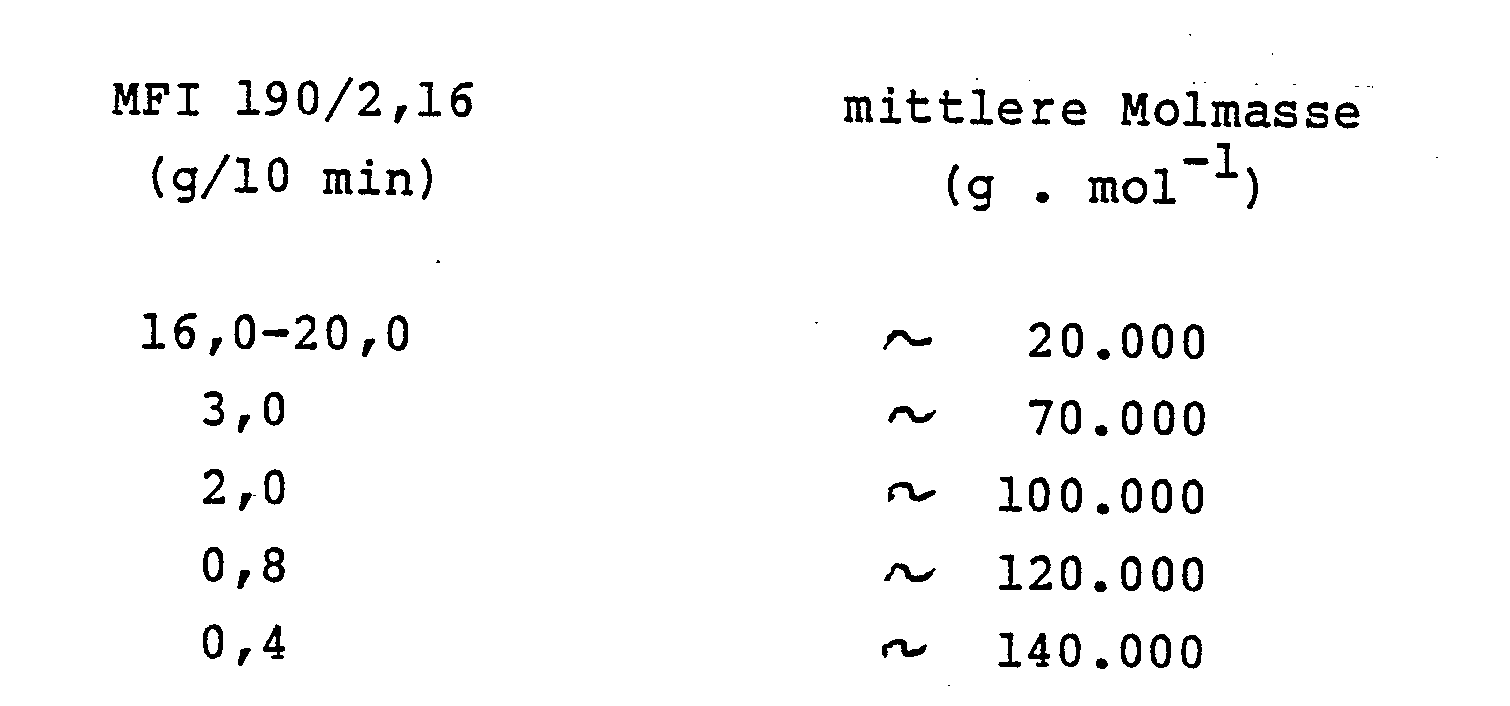
- the above-mentioned melt indexes are determined according to the German standard DIN 53735. Empirically, each melt index measured can be assigned an average molar mass determined by the gel permeation chromatography method. The corresponding values can be seen in the comparison below.
- the density of the copolymers is 0.915 to 0.960, preferably 0.920 to 0.945 and in particular 0.925 to 0.940 g / cm3.
- the new products are further described by their impact strength, which is in the range from 850 to 2,600, preferably 870 to 2,500 and in particular 900 to 2,200 mJ / mm2.
- the impact strength is determined in accordance with the German standard DIN 53448.
- the claimed binary and ternary copolymers of ethylene can be prepared by copolymerizing the monomers at 50 to 350 MPa and 100 to 350 ° C. in the presence of oxygen or radical-forming compounds.
- mixtures of 100 parts by weight of ethylene, 0.4 to 10.0 parts by weight of 2,4,4-trimethylpentene (1) and optionally 1.5 to 25.0 parts by weight of vinyl ester or vinyl ether or ester are used polymerized from acrylic acid or methacrylic acid and an aliphatic C1 to C8 alcohol.
- the composition of the polymer often differs from the composition of the monomer mixture.
- the polymerization is carried out under a pressure of 50 to 350, preferably 100 to 300, in particular of 125 to 275 MPa.
- the polymerization temperature is 100 to 300, preferably 120 to 325 and in particular 130 to 300 ° C.
- Oxygen or radical-forming compounds are used as polymerization initiators.
- Compounds which form free radicals include organic peroxides, hydroperoxides or azo compounds.
- organic peroxides tert-butyl perbenzoate, tert-butyl peroxipivalate and dilauryl peroxide have proven successful.
- Azo-bis (isobutyronitrile) is successfully used as the azo compound.
- Tert-butyl peroxipivalate has proven particularly useful.
- the compounds can be used alone or in a mixture.
- the polymerization initiators are used in a concentration of 3 to 50, preferably 5 to 40, in particular 10 to 25, ppm by weight, based on ethylene. They are fed to the polymerization directly or as a solution in an organic solvent. Hydrocarbons such as isooctane, benzene, toluene or gasoline fractions are used as solvents.
- molecular mass regulators are compounds which are added to the monomers in different concentrations in order to influence the growth of the polymeric molecule and thus the molar mass of the polymer.
- the molecular weight regulators include representatives from a wide variety of substance classes. Examples include: hydrogen, alkanes, unbranched alpha-olefins, alcohols, aldehydes and ketones (cf. Progr. Hochpolym.-Forschg. 7 (3), 386-448).
- diisobutylene i.e. a mixture consisting mainly of 2,4,4-trimethylpentene (1) and - (2) itself acts as a molecular weight regulator (cf. Progr. Hochpolym.-Forschung 7 (3), 4l7). Accordingly, monomer mixtures with a higher content of 2,4,4-trimethylpentene (l) polymers with a lower molar mass than monomer mixtures in which the 2,4,4-trimethylpentene (l) concentration is lower.
- the monomer mixture reacted by the process according to the invention always contains 2,4,4-trimethylpentene (1). Its proportion is 0.4 to 10.0, in particular 0.6 to 8.0, preferably 0.7 to 7.0 parts by weight per 100 parts by weight of ethylene used.
- 2,4,4-Trimethylpenten- (l) can also be fed to the polymerization reaction in the form of a mixture with other C8-olefins.
- Diisobutylene is particularly suitable as the mixture containing 2,4,4-trimethylpentene (1).
- This essentially means the best of 2,4,4-trimethylpentene (1) and 2,4,4-trimethylpentene (2) mixture which is formed in the dimerization of 2-methylpropene (i-butylene) with acidic catalysts (eg ion exchangers).
- it contains 50 to 90, preferably 55 to 80 and in particular 60 to 75 parts by weight of 2,4,4-trimethylpentene (I), in each case based on 100 parts by weight of diisobutylene.
- the monomer mixture polymerized by the process according to the invention may also contain further monomers.
- these include vinyl esters, vinyl ethers, acrylic acid esters and methacrylic acid esters.
- Their proportion in the monomer mixture is 1.5 to 25.0, preferably 2.0 to 20.0 and in particular 3.0 to 15.0 parts by weight, in each case based on 100 parts by weight of ethylene used.
- the residence time of the monomer mixture in the polymerization stage is 30 to 180, preferably 50 to 160 and in particular 60 to 140 seconds.
- the process according to the invention can be carried out in the high-pressure reactors known for the polymerization of ethylene and ethylene-containing monomer mixtures. These include stirred autoclaves and tubular reactors (cf. Ullmann's Encyclopedia of Technical Chemistry, 4th edition, Verlag Chemie Weinheim-Basel l980, volume l9, pages l69, l72 to l75).
- a tubular reactor When using a tubular reactor, the entire monomer mixture already containing initiators can be fed to the reactor in one stream.
- a partial stream is fed to the reactor inlet, and further partial streams are fed along the reactor, usually in the region of a peak temperature, to the reaction zone.
- Films made from the new copolymers have high strength (measured as impact strength) and remarkable transparency. These properties remain even at low temperatures, e.g. occur when storing frozen foods.
- the material is characterized by its high pull-out capacity (measured as the smallest film thickness that can be produced when pulling out without tearing or holes); it is 5 to 30, preferably 8 to 25 and in particular 10 to 20 ⁇ m.
- Examples A - F below explain the new polymers and the process for their preparation in more detail.
- Examples 1-4 relate to comparative tests which show that compliance with the claimed features (material properties and process parameters) are necessary in order to achieve the object on which the invention is based.
- 2,4,4-trimethylpentene (l) is always used in the form of the mixture of various C8-hydrocarbons called diisobutylene. It has the following composition:
- the 2,4,4-trimethylpentene (l) content in the polymers is determined from the (gas chromatographically determined) difference in the 2,4,4-trimethylpentene (l) content of the monomer mixture at the reactor inlet and outlet.
- the vinyl acetate content in the polymers is determined by pyrolysis and measurement of the released acetic acid using an aqueous iodide / iodate solution.
- the copolymers are produced in a continuously operated high-pressure reactor (stirred autoclave), which is followed by a high-pressure gas separator and a low-pressure gas separator.
- the monomer mixture intended for the polymerization is brought to the desired pressure and introduced into the high-pressure reactor.
- the amount of polymerization initiator required for maintaining the polymerization is added (tert-butyl peroxipivalate, dissolved in gasoline).
- the residence time of the reaction mixture in the high-pressure reactor is about 90 seconds.
- Examples 1 to 5 are carried out analogously to Examples AF, but in deviation from these, the monomer mixture separately contains a molecular weight regulator (moderator). The details of the test procedure can be found in Table 1.
- composition and properties of the copolymers obtained according to Examples 1 to 5 are listed in Table 2.
- copolymers according to the invention of Examples A-F have, compared to the copolymers of Examples 1-6 produced for comparison, a considerably increased impact strength, a significantly increased extractability and a significant improvement in transparency. They are therefore particularly suitable for the production of films.
Landscapes
- Chemical & Material Sciences (AREA)
- Health & Medical Sciences (AREA)
- Chemical Kinetics & Catalysis (AREA)
- Medicinal Chemistry (AREA)
- Polymers & Plastics (AREA)
- Organic Chemistry (AREA)
- Addition Polymer Or Copolymer, Post-Treatments, Or Chemical Modifications (AREA)
Abstract
Description
- Die vorliegende Erfindung betrifft binäre und ternäre Mischpolymerisate des Ethylens. Die binären Mischpolymerisate bestehen aus Ethylen und 2,4,4-Trimethylpenten-(l), die ternären enthalten zusätzlich einen Vinylester, einen Vinylether oder einen Ester der Acrylsäure oder der Methacrylsäure. Die Mischpolymerisate haben einen Schmelzindex MFI (l90/2,l6) von 0,4 bis 20 g/l0 min, eine Dichte von 0,9l5 bis 0,960 g/cm³ und eine Schlagzugzähigkeit von 850 bis 2.600 mJ/mm².
- Ferner betrifft die vorliegende Erfindung ein Verfahren zur Herstellung der erfindungsgemäßen Mischpolymerisate durch gemeinsame Umsetzung der Monomeren unter den Bedingungen der radikalisch initiierten Hochdruckpolymerisation.
- Die neuen Mischpolymerisate eignen sich aufgrund ihrer vorzüglichen Eigenschaften besonders zur Herstellung von Folien.
- Die DE-AS 20 l8 7l8 beschreibt ein Verfahren zur Herstellung von modifizierten Hochdruckpolyethylenen, bei dem die Polymerisation des Ethylens sowie gegebenenfalls andere, mit Ethylen copolymerisierbare Verbindungen, in Gegenwart von Oligomeren des Isobutylens, die aus 4 bis l00 Isobutyleneinheiten aufgebaut sind, durchgefuhrt wird.
- Die nach dem Verfahren der DE-AS 20 l8 7l8 gewonnenen Polymerisate eignen sich zur Herstellung von Folien. Der Zusatz von Oligomeren des Isobutylens bewirkt, daß die als Blocken bezeichnete Oberflächenklebrigkeit der Folien vermieden wird.
- Verwendet man dagegen Diisobutylen, so erhält man inhomogene Polymerisate. Die daraus hergestellten Folien sind trübe und weisen Stippen auf (vgl. DE-AS 20 l8 7l8, Spalte 2, Zeilen 32 bis 38 und Spalte 6, Vergleichsbeispiel 2). Sie sind daher für Verpackungszwecke ungeeignet.
- An Folien, die als Verpackungsmaterial für insbesondere bei tiefen Temperaturen gelagerte Waren dienen, werden bestimmte Anforderungen gestellt. Sie sollen hohe Transparenz, Steifigkeit, Glanz und gute Schlagzugzähigkeit besitzen. Diese Eigenschaften müssen auch bei tiefen Temperaturen erhalten bleiben.
- Der vorliegenden Erfindung liegt die Aufgabe zugrunde, Mischpolymerisate des Ethylens, die Folien mit diesen gewünschten Eigenschaften liefern, und ein Verfahren zur Herstellung der Mischpolymerisate bereitzustellen.
- Gelöst wird diese Aufgabe durch Mischpolymerisate des Ethylens, die je l00 Gew.-Teile Ethylen 0,2 bis 5,0 Gew.-Teile 2,4,4-Trimethylpenten-(l) und gegebenenfalls 2,0 bis 20,0 Gew.-Teile Vinylester oder Vinylether oder Ester der Acrylsäure oder der Methacrylsäure mit aliphatischen C₁- bis C₈-Alkoholen enthalten, einen Schmelzindex MFI (l90/2,l6) von 0,4 bis 20 g/l0 min, eine Dichte von 0,9l5 bis 0,960 g/cm³ und eine Schlagzugzähigkeit von 850 bis 2.600 mJ/mm² besitzen.
- Die binären Mischpolymerisate enthalten je l00 Gew.-Teile Ethylen 0,2 bis 5,0, insbesondere 0,3 bis 4,0, bevorzugt 0,35 bis 3,5 Gew.-Teile 2,4,4-Trimethylpenten-(l).
- Die ternären Mischpolymerisate bestehen aus Ethylen, 2,4,4-Trimethylpenten-(l) und einem weiteren Monomeren der folgenden Stoffgruppe: Vinylester, Vinylether, Acrylsäureester oder Methacrylsäureester. Besonders geeignet als Monomere sind Vinylester und die Ester der Acrylsäure oder der Methacrylsäure, bevorzugt werden Acrylsäureester und insbesondere Vinylester.
- Unter den Vinylestern kommen insbesondere solche in Betracht, deren Carbonsäurereste 2 bis 4 Kohlenstoffatome enthalten, vorzugsweise Vinylacetat. Die bevorzugten Vinylether enthalten 4 bis 8 Kohlenstoffatome. Ein Beispiel für diese Verbindungen ist der Vinylethylether. Die Acrylsäureester und Methacrylsäureester leiten sich von aliphatischen Alkoholen mit l bis 8 Kohlenstoffatomen im Molekül ab. Die Alkohole können geradkettig oder verzweigt sein und die OH-Gruppe an einem primären sekundären oder tertiärem Kohlenstoffatom tragen. Als besonders geeignet haben sich Methyl-, Ethyl- und tert.-Butylacrylat sowie -Methacrylat erwiesen.
- Die ternären Polymerisate enthalten je l00 Gew.-Teile Ethylen 0,2 bis 5,0, vorzugsweise 0,3 bis 4,0 und insbesondere 0,35 bis 3,5 Gew.-Teile 2,4,4-Trimethylpenten-(l) und 2,0 bis 20, vorzugsweise 2,2 bis l5 und insbesondere 2,5 bis l0 Gew.-Teile der vorstehend genannten Monomeren.
- Die erfindungsgemäßen Mischpolymerisate sind durch einen Schmelzindex MFI (l90/2,l6) von 0,4 bis 20,0, vorzugsweise 0,5 bis l0,0 und insbesondere von 0,6 bis 4,0 g/l0 min charakterisiert. Die Bestimmung der vorstehend genannten Schmelzindices erfolgt nach der deutschen Norm DIN 53735. Empirisch läßt sich jedem gemessenen Schmelzindex eine nach dem Verfahren der Gelpermeationschromatographie bestimmte mittlere Molmasse zuordnen. Die entsprechenden Werte können der nachfolgenden Gegenüberstellung entnommen werden.
- Die Dichte der Mischpolymerisate beträgt 0,9l5 bis 0,960, vorzugsweise 0,920 bis 0,945 und insbesondere 0,925 bis 0,940 g/cm³.
- Die neuen Produkte werden weiterhin durch ihre Schlagzugzähigkeit beschrieben, die im Bereich von 850 bis 2.600, vorzugsweise 870 bis 2.500 und insbesondere 900 bis 2.200 mJ/mm² liegt. Die Bestimmung der Schlagzugzähigkeit erfolgt nach der deutschen Norm DIN 53448.
- Die beanspruchten binären und ternären Mischpolymerisate des Ethylens lassen sich durch Mischpolymerisation der Monomeren bei 50 bis 350 MPa und l00 bis 350°C in Gegenwart von Sauerstoff oder Radikale bildenden Verbindungen herstellen. Hierzu werden Mischungen aus l00 Gew.-Teilen Ethylen, 0,4 bis l0,0 Gew.-Teilen 2,4,4-Trimethylpenten(l) und gegebenenfalls l,5 bis 25,0 Gew.-Teile Vinylester oder Vinylether oder Ester aus Acrylsäure oder Methacrylsäure und einem aliphatischen C₁- bis C₈-Alkohol polymerisiert.
- Da sich im allgemeinen die Polymerisationsgeschwindigkeit der Monomeren unterscheidet, weicht die Zusammensetzung des Polymerisats häufig von der Zusammensetzung des Monomerengemisches ab.
- Die Polymerisation erfolgt unter einem Druck von 50 bis 350, vorzugsweise l00 bis 300, insbesondere von l25 bis 275 MPa. Die Polymerisationstemperatur beträgt l00 bis 300, vorzugsweise l20 bis 325 und insbesondere l30 bis 300°C.
- Als Polymerisationsinitiatoren werden Sauerstoff oder Radikale bildende Verbindungen eingesetzt. Zu den Radikale bildenden Verbindungen gehören organische Peroxide, Hydroperoxide oder Azoverbindungen. Von den organischen Peroxiden haben sich tert.-Butylperbenzoat, tert.-Butylperoxipivalat und Dilaurylperoxid bewährt. Als Azoverbindung gelangt mit Erfolg Azo-bis(isobutyronitril) zum Einsatz. Besonders bewährt hat sich tert.Butylperoxipivalat. Die Verbindungen können allein oder im Gemisch verwendet werden. Die Polymerisationsinitiatoren werden in einer Konzentration von 3 bis 50, vorzugsweise 5 bis 40, insbesondere l0 bis 25 Gew.-ppm, bezogen auf Ethylen, eingesetzt. Man führt sie der Polymerisation direkt oder als Lösung in einem organischen Lösungsmittel zu. Als Lösungsmittel dienen Kohlenwasserstoffe wie Isooctan, Benzol, Toluol oder Benzinfraktionen.
- Ein wesentliches Merkmal des erfindungsgemäßen Herstellungsverfahrens der neuen Polymerisate ist die Abwesenheit gesonderter Molekularmassenregler (Moderatoren) während der Polymerisation. Molekularmassenregler sind Verbindungen, die den Monomeren in unterschiedlicher Konzentration zugesetzt werden, um das Wachstum des polymeren Moleküls und damit die Molmasse des Polymerisats zu beeinflussen. Zu den Molmassenreglern gehören Vertreter der unterschiedlichsten Stoffklassen. Als Beispiele seien genannt: Wasserstoff, Alkane, unverzweigte alpha-Olefine, Alkohole, Aldehyde und Ketone (vgl. Fortschr. Hochpolym.-Forschg. 7(3), 386-448).
- In diesem Zusammenhang muß darauf hingewiesen werden, daß Diisobutylen, d.h. ein Gemisch, das hauptsächlich aus 2,4,4-Trimethylpenten-(l) und -(2) besteht, selbst als Molmassenregler wirkt (vgl. Fortschr. Hochpolym.-Forschung 7(3), 4l7). Dementsprechend ergeben Monomerengemische mit einem höheren Gehalt an 2,4,4-Trimethylpenten-(l) Polymerisate mit einer niedrigeren Molmasse als Monomerengemische in denen die 2,4,4-Trimethylpenten(l)-Konzentration geringer ist.
- Erfolgt die Polymerisation außer in Gegenwart von 2,4,4-Trimethylpenten-(l) in Anwesenheit weiterer Molmassenregler, so erhält man Polymerisate, die zur Herstellung von Folien nicht geeignet sind. Insbesondere die Ausziehfähigkeit ist unbefriedigend. Daruber hinaus weisen die Folien Stippen auf und sind wegen fehlender Transparenz als Verpackungsmittel unbrauchbar. Es war nicht vorauszusehen, daß der Verzicht auf die getrennte Zugabe eines Moderators neben dem gleichzeitig als Molekularmassenregler wirkenden Comonomeren 2,4,4-Trimethylpenten-(l) zu Polymerisaten führt, die sich hervorragend zu Folien mit ausgezeichneten Eigenschaften verarbeiten lassen.
- Das nach dem erfindungsgemäßen Verfahren umgesetzte Monomerengemisch enthält stets 2,4,4-Trimethylpenten-(l). Sein Anteil beträgt 0,4 bis l0,0 insbesondere 0,6 bis 8,0, vorzugsweise 0,7 bis 7,0 Gew.-Teile je l00 Gew.-Teile eingesetztes Ethylen.
- 2,4,4-Trimethylpenten-(l) kann auch in Form einer Mischung mit anderen C₈-Olefinen der Polymerisationsreaktion zugeführt werden. Als 2,4,4-Trimethylpenten-(l) enthaltende Mischung besonders geeignet ist Diisobutylen. Hierunter versteht man das im wesentlichen aus 2,4,4-Trimethylpenten-(l) und 2,4,4-Trimethylpenten-(2) beste hende Gemisch, das bei der Dimerisierung von 2-Methylpropen(i-Butylen) mit sauren Katalysatoren (z.B. Ionenaustauschern) gebildet wird. Es enthält je nach Herstellung 50 bis 90, vorzugsweise 55 bis 80 und insbesondere 60 bis 75 Gew.-Teile 2,4,4-Trimethylpenten-(l), jeweils bezogen auf l00 Gew.-Teile Diisobutylen.
- Neben Ethylen und 2,4,4-Trimethylpenten-(l) kann das nach dem erfindungsgemäßen Verfahren polymerisierte Monomerengemisch noch weitere Monomere enthalten. Hierzu gehören Vinylester, Vinylether, Acrylsäureester und Methacrylsäureester. Ihr Anteil im Monomerengemisch beträgt l,5 bis 25,0, vorzugsweise 2,0 bis 20,0 und insbesondere 3,0 bis l5,0 Gew.Teile, jeweils bezogen auf l00 Gew.-Teile eingesetztes Ethylen. Die Verweilzeit des Monomerengemisches in der Polymerisationsstufe beträgt 30 bis l80, vorzugsweise 50 bis l60 und insbesondere 60 bis l40 sek.
- Das erfindungsgemäße Verfahren kann in den für die Polymerisation von Ethylen und Ethylen enthaltenden Monomerengemischen bekannten Hochdruckreaktoren durchgeführt werden. Hierzu gehören Rührautoklaven und Rohrreaktoren (vgl. Ullmanns Encyclopädie der Technischen Chemie, 4. Auflage, Verlag Chemie Weinheim-Basel l980, Band l9, Seite l69, l72 bis l75). Bei Verwendung eines Rohrreaktors kann das gesamte, bereits Initiatoren enthaltende Monomerengemisch in einem Strom dem Reaktor zugeführt werden. Besonders vorteilhaft ist es jedoch, einen Rohrreaktor mit Kaltgas- und Initiatornachdosierung zu verwenden und das Monomerengemisch in mindestens zwei Teilströme aufzuteilen. Hierbei wird ein Teilstrom dem Reaktoreingang zugeführt, weitere Teilströme werden längs des Reaktors, meist im Bereich einer Spitzentemperatur, der Reaktionszone zugeführt.
- Aus den neuen Mischpolymerisaten hergestellte Folien besitzen hohe Festigkeit (gemessen als Schlagzugzähigkeit) und bemerkenswerte Transparenz. Diese Eigenschaften bleiben auch bei niedrigen Temperaturen, wie sie z.B. bei der Lagerung von Tiefkühlkost auftreten, erhalten. Darüber hinaus zeichnet sich das Material durch hohe Ausziehfähigkeit (gemessen als geringste Foliendicke, die beim Ausziehen ohne Reißen oder Auftreten von Löchern hergestellt werden kann) aus; sie beträgt 5 bis 30, vorzugsweise 8 bis 25 und insbesondere l0 bis 20 µm.
- In den nachfolgenden Beispielen A - F werden die neuen Polymerisate und das Verfahren zu ihrer Herstellung näher erläutert. die Beispiele l - l4 betreffen Vergleichsversuche, die zeigen, daß die Einhaltung der beanspruchten Merkmale (Stoffeigenschaften und Verfahrensparameter) erforderlich sind, um die Aufgabe zu lösen, die der Erfindung zugrundeliegt.
- In den Beispielen wird 2,4,4-Trimethylpenten-(l) stets in Form des als Diisobutylen bezeichneten Gemisches verschiedener C₈-Kohlenwasserstoffe eingesetzt. Es hat folgende Zusammensetzung:

- Es siedet bei l0l°C, seine Dichte dist 0,7ll g/cm³.

- Zur Bestimmung der Stoffeigenschaften wurden folgende Verfahren herangezogen:
Schmelzindex MFI (l90/2,l6) g/l0 min: gemessen nach DIN 53735; Schlagzugzähigkeit gemessen nach DIN 53448; Ausziehfähigkeit bestimmt durch Verarbeitung des Mischpolymerisats auf einer Blasfolienanlage. Der Durchsatz beträgt 7 kg/h, der Düsenspalt hat einen Durchmesser von l mm, das Aufblasverhältnis ist 2,5 : l; Transparenz: visuelle Bewertung der Folien. - Der 2,4,4-Trimethylpenten-(l)-Anteil in den Polymerisaten wird aus der (gaschromatographisch bestimmten) Differenz des 2,4,4-Trimethylpenten-(l)-Gehaltes des Monomerengemisches an Reaktoreingang und Reaktorausgang ermittelt.
- Der Vinylacetat-Anteil in den Polymerisaten wird durch Pyrolyse und Messung der freigesetzten Essigsäure mittels wäßriger Jodid/Jodat-Lösung bestimmt.
- Die Mischpolymerisate werden in einem kontinuierlich betriebenen Hochdruckreaktor (Rührautoklav), dem ein Hochdruckgasabscheider und ein Niederdruckgasabscheider nachgeschaltet sind, hergestellt. Das für die Polymerisation bestimmte Monomerengemisch wird auf den gewünschten Druck gebracht und in den Hochdruckreaktor eingeleitet. Gleichzeitig setzt man die für die Aufrechterhaltung der Polymerisation benötigte Menge Polymerisationsinitiator zu (tert.-Butylperoxipivalat, gelöst in Benzin). Die Verweilzeit des Reaktionsgemisches im Hochdruckreaktor beträgt etwa 90 Sekunden.
- Reaktionsbedingungen, Initiatorkonzentration (bezogen auf eingesetztes Ethylen) und Zusammensetzung des Monomerengemisches sind der Tabelle l, die Eigenschaften der Mischpolymerisate der Tabelle 2 zu entnehmen.
- Die Beispiele l bis 5 werden analog den Beispielen A - F durchgeführt, abweichend von diesen enthält das Monomerengemisch jedoch gesondert einen Molmassenregler(Moderator). Die Einzelheiten der Versuchsdurchführung sind Tabelle l zu entnehmen.
- Zusammensetzung und Eigenschaften der nach den Beispielen l bis 5 erhaltenen Mischpolymerisate sind in Tabelle 2 aufgeführt.
- Die erfindungsgemäßen Mischpolymerisate der Beispiele A - F weisen gegenüber den zum Vergleich hergestellten Mischpolymerisaten der Beispiele l - 6 eine beträchtlich gesteigerte Schlagzugzähigkeit, eine deutlich erhöhte Ausziehfähigkeit, sowie eine signifikante Verbesserung der Transparenz auf. Sie sind daher zur Herstellung von Folien besonders geeignet.
- Verzichtet man auf die Zugabe von Diisobutylen und ersetzt es durch übliche Molekulargewichtsregler, so erhält man Produkte, die sich ebenfalls nicht zur Herstellung von Folien eignen. Die zu den Beispielen 6 bis l4 gehörenden Reaktionsbedingungen sind wiederum Tabelle l, die Eigenschaften der resultierenden Mischpolymerisate Tabelle 2 zu entnehmen.


Claims (8)
- l.) Mischpolymerisate des Ethylens, die je l00 Gew.-Teile Ethylen 0,2 bis 5,0 Gew.-Teile 2,4,4-Trimethylpenten-(l) und gegebenenfalls 2,0 bis 20,0 Gew.-Teile Vinylester oder Vinylether oder Ester der Acrylsäure oder der Methacrylsäure mit aliphatischen C₁- bis C₈-Alkoholen enthalten mit einem Schmelzindex MFI (l90/2,l6) von 0,4 bis 20 g/l0 min, einer Dichte von 0,9l5 bis 0,960 g/cm³ und einer Schlagzugzähigkeit von 850 bis 2.600 mJ/mm².
- 2.) Verfahren zur Herstellung von Mischpolymerisaten nach Anspruch l bei 50 bis 350 MPa und l00 bis 350°C in Gegenwart von Sauerstoff oder Radikale bildenden Verbindungen als Polymerisationsinitiatoren, dadurch gekennzeichnet, daß man Mischungen aus l00 Gew.-Teilen Ethylen, 0,4 bis l0 Gew.-Teilen 2,4,4-Trimethylpenten-(l) und gegebenenfalls l,5 bis 25 Gew.-Teilen Vinylester oder Vinylether oder Ester aus Acrylsäure oder Methacrylsäure und einem aliphatischen C₁- bis C₈-Alkohol polymerisiert.
- 3.) Verfahren nach Anspruch 2, dadurch gekennzeichnet, daß 2,4,4-Trimethylpenten-(l) in Form einer Mischung aus 2,4,4-Trimethylpenten-(l) mit anderen, acht Kohlenstoffatome enthaltenden Olefinen eingesetzt wird.
- 4.) Verfahren nach Anspruch 3, dadurch gekennzeichnet, daß als 2,4,4-Trimethylpenten-(l) enthaltende Mischung Diisobutylen eingesetzt wird.
- 5.) Verfahren nach einem oder mehreren der Ansprüche 2 bis 4, dadurch gekennzeichnet, daß die Verweilzeit in der Polymerisationsstufe 30 bis l80 Sekunden beträgt.
- 6.) Verfahren nach einem oder mehreren der Ansprüche 2 bis 5, dadurch gekennzeichnet, daß als Polymerisationsinitiator organische Peroxide oder Azoverbindungen verwendet werden.
- 7.) Verfahren nach einem oder mehreren der Ansprüche 2 bis 6, dadurch gekennzeichnet, daß als organische Peroxide tert.-Butylperbenzoat, tert.-Butylperoxipivalat und/oder Dilaurylperoxid und als Azoverbindung Azobis(isobutyronitril eingesetzt werden.
- 8.) Verwendung der Mischpolymerisate nach Anspruch l zur Herstellung von Folien.
Applications Claiming Priority (2)
| Application Number | Priority Date | Filing Date | Title |
|---|---|---|---|
| DE3621394 | 1986-06-26 | ||
| DE19863621394 DE3621394A1 (de) | 1986-06-26 | 1986-06-26 | Mischpolymerisate des ethylens, verfahren zu ihrer herstellung und ihre verwendung |
Publications (2)
| Publication Number | Publication Date |
|---|---|
| EP0254022A2 true EP0254022A2 (de) | 1988-01-27 |
| EP0254022A3 EP0254022A3 (de) | 1990-07-11 |
Family
ID=6303740
Family Applications (1)
| Application Number | Title | Priority Date | Filing Date |
|---|---|---|---|
| EP87108560A Withdrawn EP0254022A3 (de) | 1986-06-26 | 1987-06-13 | Mischpolymerisate des Ethylens, Verfahren zu ihrer Herstellung und ihre Verwendung |
Country Status (4)
| Country | Link |
|---|---|
| US (1) | US4883853A (de) |
| EP (1) | EP0254022A3 (de) |
| CA (1) | CA1280850C (de) |
| DE (1) | DE3621394A1 (de) |
Cited By (1)
| Publication number | Priority date | Publication date | Assignee | Title |
|---|---|---|---|---|
| WO1993021242A1 (en) * | 1992-04-20 | 1993-10-28 | Exxon Chemical Patents Inc. | Ethylene/branched olefin copolymers |
Families Citing this family (12)
| Publication number | Priority date | Publication date | Assignee | Title |
|---|---|---|---|---|
| US6025448A (en) | 1989-08-31 | 2000-02-15 | The Dow Chemical Company | Gas phase polymerization of olefins |
| US6538080B1 (en) | 1990-07-03 | 2003-03-25 | Bp Chemicals Limited | Gas phase polymerization of olefins |
| US5582923A (en) | 1991-10-15 | 1996-12-10 | The Dow Chemical Company | Extrusion compositions having high drawdown and substantially reduced neck-in |
| US5525695A (en) | 1991-10-15 | 1996-06-11 | The Dow Chemical Company | Elastic linear interpolymers |
| US5278272A (en) | 1991-10-15 | 1994-01-11 | The Dow Chemical Company | Elastic substantialy linear olefin polymers |
| US5395471A (en) | 1991-10-15 | 1995-03-07 | The Dow Chemical Company | High drawdown extrusion process with greater resistance to draw resonance |
| US5674342A (en) | 1991-10-15 | 1997-10-07 | The Dow Chemical Company | High drawdown extrusion composition and process |
| US5783638A (en) | 1991-10-15 | 1998-07-21 | The Dow Chemical Company | Elastic substantially linear ethylene polymers |
| US5792534A (en) | 1994-10-21 | 1998-08-11 | The Dow Chemical Company | Polyolefin film exhibiting heat resistivity, low hexane extractives and controlled modulus |
| US5763556A (en) * | 1996-05-21 | 1998-06-09 | Exxon Chemical Patents Inc. | Copolymers of ethylene and geminally disubstituted olefins |
| US7037989B2 (en) * | 2003-05-27 | 2006-05-02 | Exxonmobil Chemical Patents Inc. | Copolymers of ethylene and/or α-olefins and vicinally disubstituted olefins |
| DE102004035542A1 (de) * | 2004-07-22 | 2006-02-09 | Henkel Kgaa | Zwei-Komponenten-Bindemittel |
Family Cites Families (10)
| Publication number | Priority date | Publication date | Assignee | Title |
|---|---|---|---|---|
| US2856394A (en) * | 1955-10-06 | 1958-10-14 | Exxon Research Engineering Co | Polyisobutylene polymerization process having coarse and fine molecular weight control |
| US4076698A (en) * | 1956-03-01 | 1978-02-28 | E. I. Du Pont De Nemours And Company | Hydrocarbon interpolymer compositions |
| FR1527740A (fr) * | 1966-09-14 | 1968-06-07 | Inst Francais Du Petrole | Nouveau procédé de polymérisation d'oléfines |
| US3796696A (en) * | 1964-04-20 | 1974-03-12 | Gulf Oil Corp | Skin-packaging polymer and process |
| GB1077397A (en) * | 1965-06-21 | 1967-07-26 | Internat Synthetic Rubber Comp | Ethylene copolymerisation catalyst |
| US3481908A (en) * | 1965-08-02 | 1969-12-02 | Monsanto Co | Terpolymers of ethylene,a mono-olefin,and an unsaturated amide |
| US3847888A (en) * | 1972-12-01 | 1974-11-12 | Allied Chem | Ultra-high molecular weight polyethylene molding powder and molding process |
| JPS5952643B2 (ja) * | 1977-01-27 | 1984-12-20 | 三井化学株式会社 | エチレン共重合体 |
| JPS57105411A (en) * | 1980-12-23 | 1982-06-30 | Mitsubishi Petrochem Co Ltd | Ethylenic copolymer |
| FI68632C (fi) * | 1983-06-22 | 1985-10-10 | Neste Oy | Foerfarande foer framstaellning av sampolymerer av eten och langkedjade alfa-olefiner |
-
1986
- 1986-06-26 DE DE19863621394 patent/DE3621394A1/de not_active Withdrawn
-
1987
- 1987-05-29 US US07/055,722 patent/US4883853A/en not_active Expired - Fee Related
- 1987-06-05 CA CA000538964A patent/CA1280850C/en not_active Expired - Lifetime
- 1987-06-13 EP EP87108560A patent/EP0254022A3/de not_active Withdrawn
Cited By (2)
| Publication number | Priority date | Publication date | Assignee | Title |
|---|---|---|---|---|
| WO1993021242A1 (en) * | 1992-04-20 | 1993-10-28 | Exxon Chemical Patents Inc. | Ethylene/branched olefin copolymers |
| US5444145A (en) * | 1992-04-20 | 1995-08-22 | Exxon Chemical Patents Inc. | Ethylene/branched olefin copolymers |
Also Published As
| Publication number | Publication date |
|---|---|
| CA1280850C (en) | 1991-02-26 |
| DE3621394A1 (de) | 1988-01-14 |
| US4883853A (en) | 1989-11-28 |
| EP0254022A3 (de) | 1990-07-11 |
Similar Documents
| Publication | Publication Date | Title |
|---|---|---|
| EP0245773B1 (de) | Verfahren zur Herstellung von Copolymerisaten des Ethylens mit Acrylsäureestern in einem Röhrenreaktor bei Drücken oberhalb 500 bar | |
| EP0244855B1 (de) | Verfahren zur Herstellung von Copolymerisaten des Ethylens mit Vinylestern in einem Röhrenreaktor bei Drücken oberhalb 500 bar | |
| EP1263812A2 (de) | Verfahren zur herstellung von polyethylen | |
| EP0254022A2 (de) | Mischpolymerisate des Ethylens, Verfahren zu ihrer Herstellung und ihre Verwendung | |
| DE2557653C2 (de) | ||
| DE1217608B (de) | Formmassen aus Polyaethylen und AEthylen-Mischpolymerisaten | |
| DE3141507C2 (de) | ||
| EP0584651A2 (de) | Mischpolymerisate des Ethylens | |
| EP0121755B1 (de) | Verfahren zur Herstellung von Ethylenpolymerisaten bei Drücken oberhalb von 500 bar in einem Zweizonen-Rohrreaktor | |
| EP0374660B1 (de) | Verfahren zur Herstellung von Ethylen/Vinylacetat-Copolymerisaten mit erhöhter Festigkeit, neue Ethylen/Vinylacetat-Copolymerisate und ihre Verwendung | |
| EP0106999B1 (de) | Copolymerisate des Ethylens mit (Meth)acrylsäurealkylestern | |
| EP0098488B1 (de) | Verfahren zur Herstellung von Ethylen-Acrylsäureester-Copolymerisaten in einem Zweizonen-Reaktor bei Drücken oberhalb 500 bar | |
| EP0575873A1 (de) | Verfahren zur Herstellung von Copolymerisaten des Ethylens mit Acrylsäureestern oder Acrylsäure | |
| DE1720335C3 (de) | Verfahren zur Herstellung von Mischpolymerisaten des Äthylens | |
| DE2524274B2 (de) | Verfahren zur Herstellung von Mischpolymerisaten des Äthylens | |
| EP0534237A1 (de) | Ethylenhomopolymerisate und -copolymerisate sowie ein Verfahren zu ihrer Herstellung | |
| EP0175316A2 (de) | Verfahren zur Herstellung von Ethylencopolymerisaten | |
| EP0379724B1 (de) | Verfahren zur Herstellung von Copolymerisate aus Ethylen mit Alkencarbonsäuren oder Gemisch dieser Monomeren | |
| DE1908964C3 (de) | Verfahren zum kontinuierlichen Herstellen von Äthylenhomopolymerisaten | |
| DE2657475C3 (de) | Verfahren zur Herstellung von Hochdruckpolyäthylen | |
| DE2119047C3 (de) | Verfahren zur Herstellung von Mischpolymerisaten des Äthylens | |
| EP0121756B1 (de) | Verfahren zur Herstellung von Ethylenpolymerisaten bei Drücken oberhalb von 500 bar in einem Einzonen-Rohrreaktor | |
| EP0477749A1 (de) | Pfropfmischpolymer auf Basis eines ultrahochmolecularen Polyethylens und eines Ethylen-Copolymers | |
| EP0648785B1 (de) | Verfahren zur Herstellung von carboxylgruppenhaltigen Copolymerisaten des Ethylens | |
| DE3744214A1 (de) | Ethylen-vinylacetat-zusammensetzung |
Legal Events
| Date | Code | Title | Description |
|---|---|---|---|
| PUAI | Public reference made under article 153(3) epc to a published international application that has entered the european phase |
Free format text: ORIGINAL CODE: 0009012 |
|
| AK | Designated contracting states |
Kind code of ref document: A2 Designated state(s): AT BE CH DE ES FR GB IT LI LU NL SE |
|
| RAP1 | Party data changed (applicant data changed or rights of an application transferred) |
Owner name: HOECHST AKTIENGESELLSCHAFT |
|
| PUAL | Search report despatched |
Free format text: ORIGINAL CODE: 0009013 |
|
| AK | Designated contracting states |
Kind code of ref document: A3 Designated state(s): AT BE CH DE ES FR GB IT LI LU NL SE |
|
| 17P | Request for examination filed |
Effective date: 19900724 |
|
| 17Q | First examination report despatched |
Effective date: 19920602 |
|
| STAA | Information on the status of an ep patent application or granted ep patent |
Free format text: STATUS: THE APPLICATION IS DEEMED TO BE WITHDRAWN |
|
| 18D | Application deemed to be withdrawn |
Effective date: 19921013 |
|
| RIN1 | Information on inventor provided before grant (corrected) |
Inventor name: BEXTEN, LUDGER, DR.-DIPL.-CHEM. Inventor name: PAYER, WOLFGANG, DR.-DIPL.-CHEM. Inventor name: HOBES, JOHN, DR.DIPL.-CHEM. |