EP0254047A2 - Paketlängenverkehrsregelung in einem lokalen Netz - Google Patents
Paketlängenverkehrsregelung in einem lokalen Netz Download PDFInfo
- Publication number
- EP0254047A2 EP0254047A2 EP87108927A EP87108927A EP0254047A2 EP 0254047 A2 EP0254047 A2 EP 0254047A2 EP 87108927 A EP87108927 A EP 87108927A EP 87108927 A EP87108927 A EP 87108927A EP 0254047 A2 EP0254047 A2 EP 0254047A2
- Authority
- EP
- European Patent Office
- Prior art keywords
- medium
- network
- node
- information
- packet length
- Prior art date
- Legal status (The legal status is an assumption and is not a legal conclusion. Google has not performed a legal analysis and makes no representation as to the accuracy of the status listed.)
- Granted
Links
Images



Classifications
-
- H—ELECTRICITY
- H04—ELECTRIC COMMUNICATION TECHNIQUE
- H04L—TRANSMISSION OF DIGITAL INFORMATION, e.g. TELEGRAPHIC COMMUNICATION
- H04L47/00—Traffic control in data switching networks
- H04L47/10—Flow control; Congestion control
- H04L47/36—Flow control; Congestion control by determining packet size, e.g. maximum transfer unit [MTU]
-
- H—ELECTRICITY
- H04—ELECTRIC COMMUNICATION TECHNIQUE
- H04L—TRANSMISSION OF DIGITAL INFORMATION, e.g. TELEGRAPHIC COMMUNICATION
- H04L47/00—Traffic control in data switching networks
- H04L47/10—Flow control; Congestion control
-
- H—ELECTRICITY
- H04—ELECTRIC COMMUNICATION TECHNIQUE
- H04L—TRANSMISSION OF DIGITAL INFORMATION, e.g. TELEGRAPHIC COMMUNICATION
- H04L47/00—Traffic control in data switching networks
- H04L47/10—Flow control; Congestion control
- H04L47/11—Identifying congestion
-
- H—ELECTRICITY
- H04—ELECTRIC COMMUNICATION TECHNIQUE
- H04L—TRANSMISSION OF DIGITAL INFORMATION, e.g. TELEGRAPHIC COMMUNICATION
- H04L47/00—Traffic control in data switching networks
- H04L47/10—Flow control; Congestion control
- H04L47/13—Flow control; Congestion control in a LAN segment, e.g. ring or bus
Definitions
- the invention disclosed broadly relates to data processing and data communications and more particular strictlyly relates to techniques for maintaining data throughput in a packet switching local area network under changing traffic load.
- Local area networks are communications systems for transferring data among a plurality of workstation terminals, peripheral devices, cluster controllers, or host systems within the bounds of a single office building or building complex.
- a node refers to any machine or combination of machines which attaches to and uses the local area network.
- Local area network architectures allow for the attachment of many nodes to a common physical link.
- the shared access link permits any node to communicate directly with any other node attached to the link, through the propagation of electrical signals and the logical connections established by link protocols.
- Data is transferred as packets consisting of a variable-length information field preceded by appropriate addressing fields.
- Two general types of physical link topologies are used for shared access links, the ring and the bus.
- a ring consists of a series of nodes which are connected by unidirectional transmission links to form a single closed path. Information signals on the ring pass from node to node and are regenerated as they pass through each node.
- the bus type of link provides a bidirectional transmission facility to which all nodes are attached. Information signals propagate away from the originating node in both directions to the terminated ends of the bus.
- Time division multiplexing separates the energy of the two signals into different periods of time.
- the time division multiplexing (TDM) of digital information can be synchronous TDM or asynchronous TDM. Synchronous TDM allows each node to use a portion of the bandwidth for the medium at periodic intervals. Asynchronous TDM allows each node to transmit for a variable length of time. The data is blocked into packets that contain appropriate addressing information for routing the data.
- a logical control mechanism must be employed in conjunction with asynchronous TDM to regulate each node's access to the link for transmission.
- CSMA/CD carrier sense multiple access with collision detection
- This access method is described in the IEEE Standard 802.3, CSMA/CD Access Method and Physical Layer Specifications .
- a node senses whether a carrier signal is present, since this indicates that another node is transmitting. The origination of a new transmission will be delayed by the node until the carrier signal is removed.
- the node's transmission is started, it continues to monitor the transmission for a collision, that is the destruction of the transmitted electrical signals, indicating the presence of another transmitting node. In the event of a collision, transmission is halted and the node either waits a random period of time before attempting to retransmit, or waits for a predetermined time interval.
- An example access method for transmission of packets on a ring topology is the token ring multiple access (TRMA) method.
- TRMA token ring multiple access
- a unique sequence called a token
- the receipt by a node of the token gives it permission to initiate a transmission.
- the token is passed to another node.
- this token is passed implicitly, that is without addressing information, to the next node on the ring.
- an explicit token which contains specific node address information, is employed.
- the explicit token approach creates an ordering of the nodes which can be described as a logical ring.
- Token ring characteristics are specified in IEEE Project 802 Local Area Network Standards, Draft IEEE Standard 802.5, Token Ring Access Method and Physical Layer Specifications , working draft (February 1984). Additional references providing a background on token ring local area networks include an article by N. C. Strole entitled “A Local Communications Network Based on Interconnected Token Access Rings: A tutorial,” IBM Journal of Research and Development , Vol. 27, No. 5, September 1983, pp. 481-496, an article by R. C. Dixon, et al. entitled “A Token Ring Network for Local Data Communications,” IBM Systems Journal , Vol. 22, Nos. 1-2, 1983, pp. 47-62.
- a problem shared by all multiple access packet switching local area networks is that the time which must be devoted to resolving the contentions for access by the nodes, becomes an increasing function of the network loading.
- the network loading can be characterized by the duty factor, otherwise known as the bandwidth utilization efficiency which is the ratio of the present information flow rate R (in bits per second) divided by the maximum capacity information flow rate Ro (in bits per second).
- the packet delay time T which is the average waiting time for a node to obtain access to the communications medium and to successfully transmit the packet, increases.
- the relationship between the reduction in performance and the increase in network loading varies among the various types of access methods, all access methods for packet transmission on a multiple access communications link suffer this degraded operating characteristic. If the overloading condition continues to increase, the network becomes unstable, with many nodes being unable to obtain any access to the communications medium, for long periods of time.
- the adaptive packet length traffic control method and apparatus finds application in a local area communications network having a plurality of nodes connected to a multiple access communications medium. Each node will execute an access method to obtain exclusive access to the medium, after which the node gaining access will transmit a packet of information over the medium.
- the invention is an adaptive packet length apparatus and its method of operation, which can be distributed in each of the nodes or alternately which can be a centralized control. The adaptive packet length apparatus and method minimizes the average delay for each node gaining access to the medium.
- the adaptive packet length apparatus includes a storage means in the form of a writable random access memory and/or a read only memory, for storing program instructions representing the functional relationship between the packet length for the packets and the information flow rate in the medium.
- the form of the functional relationship stored in the storage means can be either an arithmetic expression relating the packet length and the information flow rate or alternately it can be a table of corresponding values relating the packet length to the information flow rate.
- the functional relationship relates those packet lengths and corresponding information flow rates which correspond to the minimum value of the average delay for a node to gain access to the medium.
- the adaptive packet length apparatus further includes a measurement means which is coupled to the communications medium, for measuring the average information flow rate in the medium.
- a buffer means is included at each node, coupled to a source of information to be transmitted and also coupled to the communications medium. The buffer means temporarily stores a block of the information from the source prior to the transmission over the medium.
- the adaptive packet length apparatus further includes a computing means which is connected to the storage means, to the measurement means and to the buffer means.
- the computing means receives the measured value of the average information flow rate from the measurement means.
- the computing means executes the program instructions from the storage means to operate on the measured value and to compute a resultant package length value.
- the computing means accesses a sub-block of the block of information in the buffer means, having a length approximately equal to the resultant packet length value calculated by the computing means.
- the buffer means then outputs the accessed sub-block of information for transmission over the medium.
- the resultant length of the packet of information transmitted is adaptively controlled by the invention in response to the measured present information flow rate in the medium.
- the operation of the invention results in increasing the packet length in response to measured increases in the information flow rate in the medium, in order to minimize the average delay for a node to gain access to the medium.
- the increased length in the packets of information produced by the invention enables greater attention to be focused on actual transmission of information by a node and correspondingly less attention to be dissipated on the contention resolution process for gaining access by the node to the medium.
- the operation of the invention results in an increased throughput and a maintenance of network stability. Increasing the length of the packets does not substantially reduce the overall information throughput for the network.
- the operation of the invention is independent of the local area network protocol.
- the method of operation of the invention is to impose the relationship that the average length of the packets on the network is to be a function of the measured information flow rate on the network, those packet lengths corresponding to the minimum value of the average delay for a node gaining access to the network.
- the method of operation of the invention includes the steps of storing the relationship between the packet length and the flow rate prior to the communications session. Then, during the communications session, the present average flow rate is measured for the medium.
- a buffer at the node stores a block of the information to be transmitted.
- the functional relationship between the packet length and the flow rate is used to compute the present packet length, by operating on the measured value of the flow rate.
- a sub-block of information of the computed packet length is accessed from the buffered block of information and is transmitted over the medium from the node.
- the operations of accessing additional sub-blocks and transmitting those sub-blocks is repeated until all of the information desired to be transmitted by the node, has been so transmitted.
- This method can be carried out in a distributed manner at each of the respective nodes in the local area network, or alternately it may be carried out at a centralized location, with control signals being transmitted to the respective nodes to carry out the respective transmitting operations.
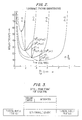
- Fig. 2 is a graph which relates the packet length (Lp) to the flow rate (R) for minimum access delay times T, over a range of network loading values.
- the ordinate for the graph of Fig. 2 is the ratio of the access delay time or packet delay T divided by the propagation delay over the total length of the ring or cable.
- each node on the ring 20 of Fig. 1 comprises a ring adapter 22, a performance adaptive control 24 and a utilization device such as a host 26 or a workstation 28.
- the invention disclosed herein resides in the performance adaptive control 24, the architecture of which is shown in greater detail in Fig. 4.
- the performance adaptive control 24 will adaptively control the size of the packets of information transmitted by its node through the ring adapter 22 onto the ring 20, in response to the measured information flow rate R on the ring 20.
- the performance adaptive control 24 will employ a functional relationship based upon the curves shown in Fig. 2, so that packet lengths Lp are chosen by the performance adaptive control 24 so as to have a minimum value for the average access delay time T, corresponding to the measured information flow rate R.
- the flow diagram of Fig. 5 illustrates the operation of the performance adaptive control 24.
- the performance adaptive control 24 is connected to the ring 20 by means of the ring adapter 22, as is shown in Fig. 4.
- the ring attachment function 30 has a serial input 32 connected to the ring 20 and a serial output 34 connected to the ring 20.
- the ring attachment function 30 is connected to the ring protocol management 36.
- the control processor 52 is connected to the ring protocol management 36 and to the RAM 44. Control processor 52 is connected by line 76 to the serial bit rate register 74 in the performance adaptive control 24.
- the RAM 44 of the ring adapter 22 is connected by line 62 to the PAC bus 60 of the performance adaptive control 24.
- the ring adapter 22 is described in USP 4,507,777 to Tucker, et al., assigned to the IBM Corporation.
- the ring adapter allows a node to accept and dispatch data on the ring 20 using the token ring multiple access protocol.
- the ring attachment function 30 performs electrical signal conversion on data including modulation and demodulation, and it extracts the timing signal from the serial ring data and uses the timing signal for synchronizing the data onto the serial ring output line 34.
- the ring attachment function 30 includes the transmitters and receivers which transmit and receive information from the ring 20.
- the ring protocol management 36 performs bit and byte level functions which include encoding and decoding data, handling token protocols, generating and detecting delimiters, generating and checking cyclic redundancy check decoding addresses, etc.
- the ring protocol management 36 repeats the serial receive data input on line 32 as serial transmit data output on line 34 to the ring 20.
- the ring protocol management 36 monitors the ring 20 for proper token sequence indicating that it has the permission to transmit. After transmission of a data frame, the ring protocol management 36 will then receive the transmitted packet after it has made its circuit around the ring, and it will strip the frame from the ring and replace the token back onto the ring 20.
- the control processor 52 in the ring adapter 22 can be programmed to provide the present, measured serial bit rate (R) for the information traffic flowing on the ring 20 and it can periodically provide the value R over the line 76 to the serial bit rate register 74 in the performance adaptive control 24.
- R measured serial bit rate
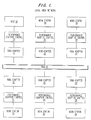
- the format for token ring multiple access protocol is shown in Fig. 3, wherein it is seen that the overall frame format includes a physical header of 15 bytes, followed by the data field which has a variable length, which in turn is followed by the physical trailer of six bytes.
- the variable length data field can include data link control information for higher level control functions, in addition to the information data traffic.
- the control processor 52 in the ring adaptor 22 constructs the message frames represented by Fig.
- the RAM 44 in the ring adaptor 22 will receive variable length data from the performance adaptive control 24 over the line 62 which is connected to the performance adaptive control (PAC) bus 60. This will be information which is destined for transmission out from the node onto the ring 20 over the serial out line 34. Information that is received from the ring 20 over the serial in line 32 will be passed through the RAM 44 and over the line 62 to the PAC bus 60 in the performance adaptive control 24.
- PAC performance adaptive control
- the performance adaptive control 24 is connected between the ring adaptor 22 and the workstation 28, as is shown in Fig. 4.
- the performance adaptive control 24 will adaptively control the packet length Lp by controlling the size of data sub-blocks passed over the line 62 to the ring adapter 22, which will form the variable length data field in the overall frame format of Fig. 3.
- the performance adaptive control 24 includes the control storage 72 which can be either a writable random access memory (RAM) and/or a read only memory. In the preferred embodiment, both a RAM and a ROM comprise the control storage 72 and they share the same address space.
- the control storage 72 stores program instructions which represent the functional relationship between the packet length Lp for the packets and the information flow rate R in the ring 20, corresponding to the minimum value of the average delay T for a node to gain access to the ring 20.
- This functional relationship is represented by the characteristic curves of Fig. 2.
- the form of the functional relationship stored in the control storage 72 can be an arithmetic expression which relates the packet length to the information flow rate. Alternately, the form of the functional relationship stored in the control storage 72 can be a table of corresponding values relating the packet length to the information flow rate.
- the control storage 72 is connected to the PAC bus 60 as shown in Fig. 4.
- the performance adaptive control 24 also includes the serial bit rate (R) register 74 which receives the value for R over line 76 from the ring adapter 22 and buffers it for access over the PAC bus 60.
- the performance adaptive control 24 also includes the RAM data buffer 68 which is connected through the PAC bus 60 to the line 62 from the ring adapter 22.
- the RAM data buffer 68 is also connected over the PAC bus 60 to the interface logic 66 which, in turn, is connected by line 64 to the input/output (I/O) bus 80 of the workstation 28.
- the RAM data buffer 68 temporarily stores blocks of information from the workstation 28 prior to providing sub-blocks of the buffered block of information, to the RAM 44 in the ring adapter 22, for transmission on the ring 20.
- the performance adaptive control 24 further includes the PAC processor 70 which is connected to the PAC bus 60.
- the processor 70 can be a stored program microprocessor such as a Motorola 68000 microprocessor. It sequentially accesses and executes instructions stored in the control storage 72 to carry out the various operations described herein for the performance adaptive control 24.
- the processor 70 will access the present measured information flow rate R from the register 74 and it will execute the program instructions stored in the control storage 72 so as to operate on the measured value R to compute a resultant packet length Lp. Further in response to the execution of instructions from the control storage 72, the processor 70 will access a sub-block of the block of information in the RAM data buffer 68, having a length equal to the computed length Lp.
- This sub-block of length Lp will be transferred over line 62 to the RAM 44 and it will form the variable length data field for the overall frame format shown in Fig. 3. Then, the control processor 52 in the ring adapter 22 will add to the sub-block of length Lp, the 15 byte physical header and the six byte physical trailer, and the completed frame will be output by the ring adapter 22 onto the ring 20 over the serial outline 34.
- the workstation 28 can be a standalone data processor such as an IBM Personal Computer.
- the workstation 28 includes the I/O bus to which is connected the RAM 82, ROM 84, the central processing unit (CPU) 86, the keyboard 88, the display 90 and other I/O devices 92.
- the performance adaptive control 24 and the ring adapter 22 can be physically embodied on an adapter card which physically plugs into one of the adapter slots on the I/O bus 80 of the IBM Personal Computer.
- the interface logic 66 can output interrupt signals to the workstation 28 and can operate in the manner described in the copending U. S. patent application by D. J. Bradley, et al. entitled "System for Managing a Plurality of Shared Interrupt Handlers in a Linked-List Data Structure," Serial No. 770,541, filed August 29, 1985, assigned to the IBM Corporation.
- Step 100 is a starting point followed by step 102 where the functional relationship F between the packet length Lp and the flow rate R is stored in the control storage 72. This can occur at the time of manufacture of the ROM portion of the control storage 72. Alter technicallynately, this can occur by loading the RAM portion of the control storage 72 at initial program load time.
- step 104 the performance adaptive control 24 will await data from the workstation 28 to be transmitted over the ring 20.
- step 106 follows where the ring adapter 22 provides the measured value R over the line 76, representing the present average flow rate of information in the ring 20.
- Step 108 follows, where a block of the information to be transmitted by the node is received from the workstation 28 and is temporarily stored in the buffer 68.
- Step 110 follows, where the PAC processor 70 computes the present packet length Lp from the measured flow rate R using the function F.
- Step 112 follows, where the processor 70 accesses a sub-block of data having a length Lp from the buffered block of information in the RAM data buffer 68.
- Step 114 follows, where the sub-block of information is transferred over the line 62 to the ring adapter 22 for transmission over the ring 20.
- Step 116 follows, which questions whether there are any more sub-blocks of data in the buffer 68 which must be transmitted.
- Fig. 6 shows an example of the subdivision of a data block in the RAM 68 into sub-blocks whose length Lp is a function of the present, measured information flow rate R.
- the RAM 68 stores 1024 byte block.
- the processor 70 in accordance with the invention, will divide the data block in the RAM 68 into four sub-blocks of 256 bytes each.
- part B of Fig. 6, as a second example in response to a measured medium network loading having a duty factor of 0.6, the processor 70 will divide the data block in the RAM 68 into three sub-blocks of approximately 342 bytes each.
- part C of Fig. 6, in a third example in response to a measured high network loading having a duty factor of 0.7, the processor 70 will divide the data block in the RAM 68 into two sub-blocks of 512 bytes each.
- the operation of the invention can best be described by referring to the generic performance characteristic shown in Fig. 2 and the flow chart in Fig. 7.
- the invention is based upon the optimal performance characteristics shown in Fig. 2 which were discovered by the inventor.
- These functions characterize local area network (LAN) media access protocols such as carrier sense multiple access/collision detection (CSMA/CD), token ring multiple access (TRMA), virtual token multiple access (VTMA) and many others.
- LAN local area network
- CSMA/CD carrier sense multiple access/collision detection
- TRMA token ring multiple access
- VTMA virtual token multiple access
- the performance characteristic N ( ⁇ , ⁇ ) is the packet delay metric T ( ⁇ , ⁇ ) normalized with respect to the electrical cable length, ⁇ as shown in Fig. 2.
- the parameter ⁇ is the well-known bandwidth utilization efficiency which is the ratio of cable traffic R (BPS) and cable capacity Ro (BPS) while the parameter ⁇ is the ratio of cable length ⁇ and packet length Lp/Ro where Lp is the packet size in bits. Since the cable length ⁇ depends on network geometry we can assume that it is fixed. Hence, N ( ⁇ , ⁇ ) in Fig. 2 is directly proportional to the packet delay T ( ⁇ , ⁇ ). Also note that as the network utilization increases the system design parameter ⁇ must be decreased (i.e., packet size increased) for the network operating point to move to the optimum stable region shown.
- the invention although applicable to all values of ⁇ , could be of particular interest in the high utilization region (i.e.
- a LAN is a packet switched network and in a packet switched network, the objective is to transmit as high a packet rate as the current state of the network will permit. The only reason for decreasing the packet rate as the network load increases is to prevent the network from overloading which is the object of the invention.
- Fig. 2 show how the invention enables the network to adapt to changes in load.
- the traffic on the network ⁇ * is monitored continuously by the invention as is the metric T( ⁇ *, ⁇ i ).
- Each node in the LAN uses the same adaptive control method and hence transitions to the same stable state, resulting in distributed monitoring and control.
- the parameter ⁇ is related to the packet size Lp by the following equation:
- the network packet rates in the initial state ( ⁇ * i , ⁇ i ) and in the final state ( ⁇ * i+1 , ⁇ i+1 ) are, from Eq. (1),
- a 22% decrease in packet rate is necessary to allow the network to transition from a near unstable operating point to a stable one.
- the packet rate In the transition process the packet rate must be reduced to 57% of its previous value. Of course, the packet rate increases when the network transition is downward.
- Fig. 7 is the flow chart which we will use to describe the adaptive process of the invention in more detail.
- the measured state ⁇ * is shown in steps 200, 202 and 204 to the right and the transitioning process from one state to the next is shown in steps 206, 208 and 210 to the left.
- the processor 70 calculates the packet delay T( ⁇ *, ⁇ i ) in step 204 and then the differential metric ⁇ T i as shown in step 212.
- T( ⁇ * i , ⁇ i ) is provided by the computer function that calculates the current stable state (step 204 at the left in the flow chart of Fig. 7).
- the absolute value of the differential metric ( ⁇ T i ) is compared in step 216 to a threshold value ⁇ Toi whose value in step 214 is a function of the current stable state ( ⁇ * i , ⁇ i ). If
- ⁇ Toi, the network must adapt in step 218 to a new transition state ( ⁇ * i+1 , ⁇ ) where ⁇ * ⁇ * i+1 . Otherwise, no changes to the network are made and the measurement process ⁇ * continues in step 220.
- the threshold parameter ⁇ Toi is a function of the current stable state, and will change as the process transition to a new state.
- the invention is applicable to the important case where the traffic on a LAN is not homogenous, that is when a change in traffic can be caused by a file transfer.
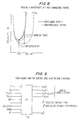
- the performance characteristics for homogenous traffic will provide an upper bound for the non-homogenous traffic case for any value of network utilization ⁇ , as shown in Fig. 8.
- the adaptive algorithm which assumes homogenous traffic, will always function properly for the non-homogenous case and will still be very close to the optimum.
- the apparent "track” shown in Fig. 8 is computed using the same method as before (see Fig. 7). However, the true operating point for non-homogenous traffic will be somewhat below that shown but for all practical purposes at the true minimum value of ⁇ .
- a terminal ready to transfer a file lets the network manager know of this, and also specifies the file size and transfer rate.
- the network manager uses the method shown in Fig. 7 to find the value ⁇ which minimizes T( ⁇ * i , ⁇ i ) and then sends the packet size control parameter ⁇ i to each node.
- the network manage onlyment function uses the invention to monitor T( ⁇ * i , ⁇ i ) in order to ensure that the network now functions as required.
- the advantage of centralized over adaptive control is that new traffic is not allowed on the network without permission until the network parameter ⁇ is adjusted to handle the load.
- the network manager uses the method in Fig. 7 to monitor traffic and sense when the load on the network decreases.
- the network manager then transmits a larger control value of ⁇ which will reduce the packet size to a smaller value and in turn permit the packet rate transmitted by each node to increase, Eq. (1).
- distriaded adaptive control has the advantage that a centralized monitor and control function is not needed, which leads to a much more reliable network.
- a combination of adaptive and centralized control can also be implemented with centralized control used only to allow for the very rapid transfer of extremely large files.
- the network manager could use a priority control algorithm which allows high priority users to remain active during the file transfer.
- the invention can also be used in the design of a LAN which will not overload as long as ⁇ * ⁇ ⁇ o i.e., a worst case design.
- the pair ( ⁇ o, ⁇ o) also define the maximum value of packet rate. At all values of utilization ⁇ * ⁇ o, the packet rate, will be less than,
- Eq. (11), (12), and (13) all have the same functional form shown in Fig. 2 although the actual numerical values are different.
- the equations are for three important media access protocols; CSMA/CD, TRMA, and VTMA.
- the first two protocols have been recommended by the IEEE 802.3 and IEEE 802.5 committee as LAN standards.
- Fig. 9 shows the input and output parameters and functions, as well as the measured load variable R* and the controlled packet size variable Lp* for the alternate embodiment PAC 24 ⁇ .
- the parameters and functions shown in Fig. 9 are defined in Table I.
- the architecture for the alternate embodiment of the invention is shown in Fig. 10.
- the performance adaptive control (PAC) 24 ⁇ shown represents the invention.
- PAC 24 ⁇ can be implemented with the OSI/RM communication protocols shown.
- PAC 24 ⁇ measures R* and controls the packet size Lp*, and therefore functions as a network monitor and control function resident in the co-processor.
- the conventional workstation function is performed in the main CPU 86 where the higher level communication protocols and the application reside.
- the other functions include a keyboard 88 for entering the PAC parameters and a display system 90 where the PAC time variant functions can be displayed on a screen, on request.
- the main functions of the keyboard and display are for using the workstation.
- OSI Open system Interconnect
- the resultant adaptive packet length traffic control apparatus and method maintains network stability in a packet switching local area network under changing traffic load, in an optimal manner by controlling the packet size transmitted.
- the traffic level is therefore maintained at all nodes even when the network traffic increases.
- the operation of the invention is independent of the nature of the traffic, that is it can be digitized voice, interactive data, the transfer of data files, or other diverse types of data communications applications.
- the invention is also independent of the local area network protocol employed and can be applied to CSMA/CD, token ring, token bus, virtual token, and other protocols.
- the invention offers a traffic control mechanism for providing network flow control without forcing the data terminals connected to the nodes to either slow down or speed up their operations.
Landscapes
- Engineering & Computer Science (AREA)
- Computer Networks & Wireless Communication (AREA)
- Signal Processing (AREA)
- Small-Scale Networks (AREA)
Applications Claiming Priority (2)
| Application Number | Priority Date | Filing Date | Title |
|---|---|---|---|
| US06/887,477 US4771391A (en) | 1986-07-21 | 1986-07-21 | Adaptive packet length traffic control in a local area network |
| US887477 | 1986-07-21 |
Publications (3)
| Publication Number | Publication Date |
|---|---|
| EP0254047A2 true EP0254047A2 (de) | 1988-01-27 |
| EP0254047A3 EP0254047A3 (en) | 1990-03-14 |
| EP0254047B1 EP0254047B1 (de) | 1994-03-23 |
Family
ID=25391230
Family Applications (1)
| Application Number | Title | Priority Date | Filing Date |
|---|---|---|---|
| EP87108927A Expired - Lifetime EP0254047B1 (de) | 1986-07-21 | 1987-06-23 | Paketlängenverkehrsregelung in einem lokalen Netz |
Country Status (4)
| Country | Link |
|---|---|
| US (1) | US4771391A (de) |
| EP (1) | EP0254047B1 (de) |
| JP (1) | JPH0630498B2 (de) |
| DE (1) | DE3789407T2 (de) |
Cited By (16)
| Publication number | Priority date | Publication date | Assignee | Title |
|---|---|---|---|---|
| GB2208261A (en) * | 1987-07-14 | 1989-03-15 | Standard Microsyst Smc | Distributed intelligence information processing systems and interface packages therefor |
| EP0452223A3 (en) * | 1990-04-13 | 1994-06-08 | Digital Equipment Corp | Telecommunications network with plesiochronous transfer mode |
| EP0528370A3 (en) * | 1991-08-15 | 1994-11-09 | Fujitsu Ltd | Frame length control in data transmission using atm network |
| WO1994022091A3 (en) * | 1993-03-16 | 1994-11-10 | Apple Computer | Method and apparatus for a dynamic, multi-speed bus architecture having a scalable interface |
| EP0647047A3 (de) * | 1993-09-14 | 1995-09-13 | Ibm | Benutzer/Anbieter Rechneranordnung. |
| WO2002030064A1 (en) | 2000-10-03 | 2002-04-11 | U4Ea Technologies Limited | Information flow control in a packet network based on variable conceptual packet lengths |
| EP1116122A4 (de) * | 1998-08-28 | 2003-05-21 | Intel Corp | Verfahren und gerät zum übermitteln und empfangen von netzwerkkonformen protokollsignalpaketen über einen plattformbus |
| WO2006063349A3 (en) * | 2004-12-07 | 2006-08-10 | Intel Corp | Methods and media access controller for broadband wireless communications with variable data unit size and delayed data unit construction |
| WO2006112966A1 (en) * | 2005-04-18 | 2006-10-26 | Hewlett-Packard Development Company, L.P. | Systems and methods for dynamic burst length transfers |
| EP1901495A1 (de) | 2006-09-13 | 2008-03-19 | Broadcom Corporation | Anpassbare Paketgrößenmodifikation für Paketnetzwerke zur Sprachübertragung |
| US7535835B2 (en) | 2000-10-03 | 2009-05-19 | U4Ea Technologies Limited | Prioritizing data with flow control |
| US7573817B2 (en) | 2000-10-03 | 2009-08-11 | U4Ea Technologies Limited | Policing data based on data load profile |
| US7970888B2 (en) | 2000-10-03 | 2011-06-28 | U4Ea Technologies Limited | Allocating priority levels in a data flow |
| EP2424159A1 (de) * | 2010-08-31 | 2012-02-29 | Kabushiki Kaisha Toshiba | Informationsübertragungsvorrichtung, Informationsübertragungsverfahren und computerlesbares Medium |
| US8174985B2 (en) | 2000-10-03 | 2012-05-08 | Gos Networks Ltd | Data flow control |
| US8743687B2 (en) | 2000-10-03 | 2014-06-03 | U4Ea Technologies Limited | Filtering data flows |
Families Citing this family (141)
| Publication number | Priority date | Publication date | Assignee | Title |
|---|---|---|---|---|
| US4870699A (en) * | 1986-03-26 | 1989-09-26 | General Electric Company | Method and apparatus for controlling the frequency of operation and at least one further variable operating parameter of a radio communications device |
| EP0283295B1 (de) * | 1987-03-20 | 1993-09-08 | Canon Kabushiki Kaisha | Datenübertragungssystem |
| US4989139A (en) * | 1987-07-17 | 1991-01-29 | International Business Machines Corporation | Map case network virtual connection interface system |
| JPS6489737A (en) * | 1987-09-30 | 1989-04-04 | Toshiba Corp | Multiple address communication data transmission system |
| US4985890A (en) * | 1987-10-20 | 1991-01-15 | Sharp Kabushiki Kaisha | Data transmission unit |
| JP2587434B2 (ja) * | 1987-11-13 | 1997-03-05 | 株式会社日立製作所 | データの入出力処理方法 |
| US4888763A (en) * | 1988-03-11 | 1989-12-19 | Codenoll Technology Corporation | Method and apparatus for detecting the collision of data packets utilizing a preassigned transceiver code in the preamble |
| US5377327A (en) * | 1988-04-22 | 1994-12-27 | Digital Equipment Corporation | Congestion avoidance scheme for computer networks |
| US5101402A (en) * | 1988-05-24 | 1992-03-31 | Digital Equipment Corporation | Apparatus and method for realtime monitoring of network sessions in a local area network |
| JP2525869B2 (ja) * | 1988-06-17 | 1996-08-21 | 株式会社フジクラ | 車載用デ―タ伝送ネットワ―ク |
| WO1990000841A1 (en) * | 1988-07-15 | 1990-01-25 | Luminis Pty. Ltd. | Access protection and priority control in distributed queueing |
| US5031124A (en) * | 1988-09-07 | 1991-07-09 | International Business Machines Corporation | Method for selecting computer storage devices for computer applications |
| DE3839675C2 (de) * | 1988-11-24 | 1996-02-15 | Lawrenz Wolfhard | Optimierer für ein parameterabhängiges Steuerungssystem |
| US5041963A (en) * | 1988-12-29 | 1991-08-20 | Intel Corporation | Local area network with an active star topology comprising ring controllers having ring monitor logic function |
| US5253252A (en) * | 1989-01-10 | 1993-10-12 | The Foxboro Company | Token device for distributed time scheduling in a data processing system |
| US4954965A (en) * | 1989-02-09 | 1990-09-04 | International Business Machines Corporation | Enhanced frame utilization for CSMA/CD communication protocol |
| US5179708A (en) * | 1989-04-07 | 1993-01-12 | At&T Bell Laboratories | System inhibiting message delivery to destination process until priority of process excuting on distination processor is no higher than priority of sending process |
| US5237659A (en) * | 1989-07-27 | 1993-08-17 | Bull S.A. | Gateway device for connecting a computer bus to a ring network |
| US5193151A (en) * | 1989-08-30 | 1993-03-09 | Digital Equipment Corporation | Delay-based congestion avoidance in computer networks |
| US5214644A (en) * | 1989-10-17 | 1993-05-25 | Matsushita Electric Industrial Co., Ltd. | Electronic device with data transmission function |
| US5095444A (en) * | 1989-12-21 | 1992-03-10 | Legent Corporation | System and method for measuring inter-nodal transmission delays in a communications network |
| US5267238A (en) * | 1989-12-29 | 1993-11-30 | Ricoh Company, Ltd. | Network interface units and communication system using network interface unit |
| US5115429A (en) * | 1990-08-02 | 1992-05-19 | Codex Corporation | Dynamic encoding rate control minimizes traffic congestion in a packet network |
| JPH077975B2 (ja) * | 1990-08-20 | 1995-01-30 | インターナショナル・ビジネス・マシーンズ・コーポレイション | データ伝送を制御するためのシステムおよび方法 |
| US5231593A (en) * | 1991-01-11 | 1993-07-27 | Hewlett-Packard Company | Maintaining historical lan traffic statistics |
| US5341374A (en) * | 1991-03-01 | 1994-08-23 | Trilan Systems Corporation | Communication network integrating voice data and video with distributed call processing |
| US5262964A (en) * | 1991-04-10 | 1993-11-16 | International Business Machines Corporation | Method and apparatus for variable playback speed of multimedia data interchange within a data processing system |
| US5268846A (en) * | 1991-04-10 | 1993-12-07 | International Business Machines Corporation | Method and apparatus for nonsequential multimedia data interchange in a data processing system |
| JPH0522345A (ja) * | 1991-07-12 | 1993-01-29 | Hitachi Ltd | 最大転送単位の最適値管理決定方式 |
| US5307351A (en) * | 1991-08-26 | 1994-04-26 | Universal Data Systems, Inc. | Data communication apparatus for adjusting frame length and method of operating same |
| US5351242A (en) * | 1992-04-14 | 1994-09-27 | Marian Kramarczyk | Method and apparatus for configuring and maintaining token ring networks |
| US5539727A (en) * | 1992-04-14 | 1996-07-23 | Kramarczyk; Marian | Method and apparatus for configuring and maintaining token ring networks |
| CA2095755C (en) * | 1992-08-17 | 1999-01-26 | Mark J. Baugher | Network priority management |
| US5434976A (en) * | 1992-09-28 | 1995-07-18 | Standard Microsystems Corporation | Communications controller utilizing an external buffer memory with plural channels between a host and network interface operating independently for transferring packets between protocol layers |
| US5414841A (en) * | 1992-10-19 | 1995-05-09 | International Business Machines Corporation | Computerized system for representing data items using token identifiers |
| US5379296A (en) * | 1992-12-31 | 1995-01-03 | Unisys Corporation | Method and apparatus for interfacing a workstation to a plurality of computer platforms |
| US5559967A (en) * | 1993-03-18 | 1996-09-24 | Apple Computer, Inc. | Method and apparatus for a dynamic, multi-speed bus architecture in which an exchange of speed messages occurs independent of the data signal transfers |
| KR100228320B1 (ko) * | 1993-05-25 | 1999-11-01 | 가나이 쓰도무 | 분산제어시스템 및 이를 구성하는 방법 |
| JPH087730B2 (ja) * | 1993-06-24 | 1996-01-29 | 日本電気株式会社 | 計算機システム |
| US5598581A (en) * | 1993-08-06 | 1997-01-28 | Cisco Sytems, Inc. | Variable latency cut through bridge for forwarding packets in response to user's manual adjustment of variable latency threshold point while the bridge is operating |
| US5761438A (en) * | 1993-08-31 | 1998-06-02 | Canon Kabushiki Kaisha | Apparatus for measuring the amount of traffic of a network at a predetermined timing and compressing data in the packet without changing the size of the packet |
| US6336143B1 (en) | 1993-09-27 | 2002-01-01 | International Business Machines Corporation | Method and apparatus for multimedia data interchange with pacing capability in a distributed data processing system |
| GB9402210D0 (en) * | 1994-02-04 | 1994-03-30 | British Telecomm | A method of communicating between nodes in a communications network |
| US5434978A (en) * | 1994-02-18 | 1995-07-18 | International Business Machines Corporation | Communications interface employing unique tags which enable a destination to decode a received message structure |
| US5541852A (en) * | 1994-04-14 | 1996-07-30 | Motorola, Inc. | Device, method and system for variable bit-rate packet video communications |
| JPH07336375A (ja) * | 1994-06-14 | 1995-12-22 | Hitachi Ltd | データ転送システム |
| US5524227A (en) * | 1994-07-29 | 1996-06-04 | U S West Technologies, Inc. | Method and system for formatting address strings into recognizable token sequences |
| US5623644A (en) * | 1994-08-25 | 1997-04-22 | Intel Corporation | Point-to-point phase-tolerant communication |
| US5659796A (en) * | 1995-04-13 | 1997-08-19 | Cray Research, Inc. | System for randomly modifying virtual channel allocation and accepting the random modification based on the cost function |
| US5701416A (en) * | 1995-04-13 | 1997-12-23 | Cray Research, Inc. | Adaptive routing mechanism for torus interconnection network |
| US20010002851A1 (en) * | 1995-04-14 | 2001-06-07 | Takao Shimada | Multimedia data processing system in network |
| ES2211725T3 (es) * | 1995-04-28 | 2004-07-16 | Matsushita Electric Industrial Co., Ltd. | Metodo de transmision de datos. |
| US6922416B2 (en) * | 1995-04-28 | 2005-07-26 | Matsushita Electric Industrial Co., Ltd. | Data transmitting apparatus, data receiving apparatus and data transmission control apparatus |
| US5878420A (en) * | 1995-08-31 | 1999-03-02 | Compuware Corporation | Network monitoring and management system |
| US5666348A (en) * | 1995-09-18 | 1997-09-09 | Telefonaktiebolaget L M Ericsson (Publ.) | Packet switched radio channel admission control in a cellular telecommunications system |
| US5966163A (en) | 1995-10-20 | 1999-10-12 | Scientific-Atlanta, Inc. | Providing constant bit rate upstream data transport in a two way cable system by scheduling preemptive grants for upstream data slots using selected fields of a plurality of grant fields |
| US6230203B1 (en) | 1995-10-20 | 2001-05-08 | Scientific-Atlanta, Inc. | System and method for providing statistics for flexible billing in a cable environment |
| JPH09116572A (ja) * | 1995-10-23 | 1997-05-02 | Nec Corp | パケットデータ制御方式 |
| US6055618A (en) * | 1995-10-31 | 2000-04-25 | Cray Research, Inc. | Virtual maintenance network in multiprocessing system having a non-flow controlled virtual maintenance channel |
| US5815667A (en) * | 1995-11-28 | 1998-09-29 | Ncr Corporation | Circuits and methods for intelligent acknowledgement based flow control in a processing system network |
| US5819045A (en) * | 1995-12-29 | 1998-10-06 | Intel Corporation | Method for determining a networking capability index for each of a plurality of networked computers and load balancing the computer network using the networking capability indices |
| US5805823A (en) * | 1996-01-30 | 1998-09-08 | Wayfarer Communications, Inc. | System and method for optimal multiplexed message aggregation between client applications in client-server networks |
| US5835925A (en) * | 1996-03-13 | 1998-11-10 | Cray Research, Inc. | Using external registers to extend memory reference capabilities of a microprocessor |
| US5864738A (en) * | 1996-03-13 | 1999-01-26 | Cray Research, Inc. | Massively parallel processing system using two data paths: one connecting router circuit to the interconnect network and the other connecting router circuit to I/O controller |
| US7028088B1 (en) | 1996-04-03 | 2006-04-11 | Scientific-Atlanta, Inc. | System and method for providing statistics for flexible billing in a cable environment |
| US5982778A (en) * | 1996-08-30 | 1999-11-09 | Advanced Micro Devices, Inc. | Arrangement for regulating packet flow rate in shared-medium, point-to-point, and switched networks |
| US5892753A (en) * | 1996-12-02 | 1999-04-06 | International Business Machines Corporation | System and method for dynamically refining PMTU estimates in a multimedia datastream internet system |
| US6065059A (en) * | 1996-12-10 | 2000-05-16 | International Business Machines Corporation | Filtered utilization of internet data transfers to reduce delay and increase user control |
| US6018465A (en) * | 1996-12-31 | 2000-01-25 | Intel Corporation | Apparatus for mounting a chip package to a chassis of a computer |
| US6137688A (en) | 1996-12-31 | 2000-10-24 | Intel Corporation | Apparatus for retrofit mounting a VLSI chip to a computer chassis for current supply |
| US6272150B1 (en) | 1997-01-17 | 2001-08-07 | Scientific-Atlanta, Inc. | Cable modem map display for network management of a cable data delivery system |
| US6324267B1 (en) | 1997-01-17 | 2001-11-27 | Scientific-Atlanta, Inc. | Two-tiered authorization and authentication for a cable data delivery system |
| US6003089A (en) * | 1997-03-31 | 1999-12-14 | Siemens Information And Communication Networks, Inc. | Method for constructing adaptive packet lengths in a congested network |
| US6009077A (en) * | 1997-04-08 | 1999-12-28 | University Of Massachusetts | Flow admission control for a router |
| US6286058B1 (en) | 1997-04-14 | 2001-09-04 | Scientific-Atlanta, Inc. | Apparatus and methods for automatically rerouting packets in the event of a link failure |
| US6073181A (en) * | 1997-06-03 | 2000-06-06 | International Business Machines Corporation | Multi-buffer error detection for an open data-link interface LAN adapter |
| US6000053A (en) * | 1997-06-13 | 1999-12-07 | Microsoft Corporation | Error correction and loss recovery of packets over a computer network |
| US6304911B1 (en) * | 1997-06-25 | 2001-10-16 | Advanced Micro Devices, Inc. | Information packet reception indicator for reducing the utilization of a host system processor unit |
| US6141690A (en) * | 1997-07-31 | 2000-10-31 | Hewlett-Packard Company | Computer network address mapping |
| US6108306A (en) * | 1997-08-08 | 2000-08-22 | Advanced Micro Devices, Inc. | Apparatus and method in a network switch for dynamically allocating bandwidth in ethernet workgroup switches |
| EP0903894A1 (de) * | 1997-09-18 | 1999-03-24 | Alcatel | Verfahren und Vorrichtung zur Charakterisierung von Zellenverkehr |
| JP3437070B2 (ja) * | 1997-10-20 | 2003-08-18 | 富士通株式会社 | 加入者無線アクセスシステム |
| WO1999023538A1 (en) * | 1997-10-28 | 1999-05-14 | Georgia Tech Research Corporation | Adaptive data security system and method |
| US6230252B1 (en) | 1997-11-17 | 2001-05-08 | Silicon Graphics, Inc. | Hybrid hypercube/torus architecture |
| US6101181A (en) * | 1997-11-17 | 2000-08-08 | Cray Research Inc. | Virtual channel assignment in large torus systems |
| US6085303A (en) * | 1997-11-17 | 2000-07-04 | Cray Research, Inc. | Seralized race-free virtual barrier network |
| US5970232A (en) * | 1997-11-17 | 1999-10-19 | Cray Research, Inc. | Router table lookup mechanism |
| US5841778A (en) * | 1997-11-21 | 1998-11-24 | Siemens Business Communication Systems, Inc. | System for adaptive backoff mechanisms in CSMA/CD networks |
| US6118761A (en) * | 1997-12-18 | 2000-09-12 | Advanced Micro Devices, Inc. | Apparatus and method for generating rate control frames in a workgroup switch based on traffic contribution from a network switch port |
| US6252855B1 (en) * | 1997-12-22 | 2001-06-26 | Cisco Technology, Inc. | Method and apparatus for identifying a maximum frame size to maintain delay at or below an acceptable level |
| US6370163B1 (en) | 1998-03-11 | 2002-04-09 | Siemens Information And Communications Network, Inc. | Apparatus and method for speech transport with adaptive packet size |
| FI108824B (fi) * | 1998-06-03 | 2002-03-28 | Nokia Corp | Datasiirtomenetelmiä tietoliikennejärjestelmässä |
| US6757548B1 (en) * | 1998-08-31 | 2004-06-29 | Motorola, Inc. | Method and apparatus in a wireless messaging system for estimating and using required delivery parameters to meet a target transmission reliability |
| US6216174B1 (en) | 1998-09-29 | 2001-04-10 | Silicon Graphics, Inc. | System and method for fast barrier synchronization |
| US6421720B2 (en) * | 1998-10-28 | 2002-07-16 | Cisco Technology, Inc. | Codec-independent technique for modulating bandwidth in packet network |
| US7142506B1 (en) * | 1999-02-02 | 2006-11-28 | Vocaltec Communications Ltd. | Method and apparatus for transmitting packets |
| US6996059B1 (en) * | 1999-05-19 | 2006-02-07 | Shoretel, Inc | Increasing duration of information in a packet to reduce processing requirements |
| JP4105341B2 (ja) * | 1999-08-13 | 2008-06-25 | 富士通株式会社 | フラグメントサイズ変更方法及びルータ装置 |
| US6751698B1 (en) | 1999-09-29 | 2004-06-15 | Silicon Graphics, Inc. | Multiprocessor node controller circuit and method |
| US6674720B1 (en) | 1999-09-29 | 2004-01-06 | Silicon Graphics, Inc. | Age-based network arbitration system and method |
| US6570849B1 (en) | 1999-10-15 | 2003-05-27 | Tropic Networks Inc. | TDM-quality voice over packet |
| US6980569B1 (en) | 1999-10-18 | 2005-12-27 | Siemens Communications, Inc. | Apparatus and method for optimizing packet length in ToL networks |
| US6889257B1 (en) * | 1999-12-03 | 2005-05-03 | Realnetworks, Inc. | System and method of transmitting data packets |
| US6856613B1 (en) * | 1999-12-30 | 2005-02-15 | Cisco Technology, Inc. | Method and apparatus for throttling audio packets according to gateway processing capacity |
| US20020009098A1 (en) * | 2000-07-14 | 2002-01-24 | International Business Machines Corporation | Communication control method and device |
| US7292598B2 (en) * | 2000-12-18 | 2007-11-06 | Texas Instruments Incorporated | Adaptive algorithms for optimal control of contention access |
| US7292530B2 (en) * | 2000-12-29 | 2007-11-06 | Intel Corporation | Method and apparatus to manage packet fragmentation |
| US7542419B2 (en) * | 2001-04-02 | 2009-06-02 | International Business Machines Corporation | Method and apparatus for managing aggregate bandwidth at a server |
| WO2002093401A1 (en) * | 2001-05-16 | 2002-11-21 | Pitts William M | Auto-sizing channel |
| US7480707B2 (en) * | 2001-05-16 | 2009-01-20 | International Business Machines Corporation | Network communications management system and method |
| US7688863B2 (en) * | 2001-10-19 | 2010-03-30 | Renesas Technology America, Inc. | Methods and apparatus for sharing network bandwidth |
| GB2382945B (en) * | 2001-12-04 | 2003-11-05 | Lucent Technologies Inc | A method of scheduling data packets for transmission over a shared channel, and terminal of a data packet transmission network |
| US7031254B2 (en) * | 2002-01-25 | 2006-04-18 | Lucent Technologies Inc. | Rate control system and method for a link within a wireless communications system |
| US7539756B2 (en) * | 2002-01-31 | 2009-05-26 | Darby & Mohaine, L.L.C. | Method and system of data packet transmission timing for controlling bandwidth |
| US20040158622A1 (en) * | 2002-05-16 | 2004-08-12 | Pitts William M. | Auto-sizing channel |
| US20040015602A1 (en) * | 2002-07-19 | 2004-01-22 | Roving Planet, Inc. | Network bandwidth allocation and access method and apparatus |
| US7428243B2 (en) * | 2002-10-18 | 2008-09-23 | Darby & Mohaine, Llc | Method and system for varying data packet size for controlling bandwidth |
| US20040199618A1 (en) * | 2003-02-06 | 2004-10-07 | Knight Gregory John | Data replication solution |
| US7474672B2 (en) * | 2003-02-11 | 2009-01-06 | International Business Machines Corporation | Frame alteration logic for network processors |
| JP2004260658A (ja) * | 2003-02-27 | 2004-09-16 | Matsushita Electric Ind Co Ltd | 無線lan装置 |
| US7178055B2 (en) * | 2003-06-06 | 2007-02-13 | Hewlett-Packard Development Company, L.P. | Method and system for ensuring data consistency after a failover event in a redundant data storage system |
| US7165187B2 (en) * | 2003-06-06 | 2007-01-16 | Hewlett-Packard Development Company, L.P. | Batch based distributed data redundancy |
| US7120825B2 (en) * | 2003-06-06 | 2006-10-10 | Hewlett-Packard Development Company, L.P. | Adaptive batch sizing for asynchronous data redundancy |
| US7735088B1 (en) | 2003-08-18 | 2010-06-08 | Cray Inc. | Scheduling synchronization of programs running as streams on multiple processors |
| US7421565B1 (en) * | 2003-08-18 | 2008-09-02 | Cray Inc. | Method and apparatus for indirectly addressed vector load-add -store across multi-processors |
| US7519771B1 (en) | 2003-08-18 | 2009-04-14 | Cray Inc. | System and method for processing memory instructions using a forced order queue |
| US7503048B1 (en) | 2003-08-18 | 2009-03-10 | Cray Incorporated | Scheduling synchronization of programs running as streams on multiple processors |
| US7379424B1 (en) | 2003-08-18 | 2008-05-27 | Cray Inc. | Systems and methods for routing packets in multiprocessor computer systems |
| US7543133B1 (en) | 2003-08-18 | 2009-06-02 | Cray Inc. | Latency tolerant distributed shared memory multiprocessor computer |
| US7366873B1 (en) | 2003-08-18 | 2008-04-29 | Cray, Inc. | Indirectly addressed vector load-operate-store method and apparatus |
| US7437521B1 (en) | 2003-08-18 | 2008-10-14 | Cray Inc. | Multistream processing memory-and barrier-synchronization method and apparatus |
| US7334110B1 (en) | 2003-08-18 | 2008-02-19 | Cray Inc. | Decoupled scalar/vector computer architecture system and method |
| US8307194B1 (en) | 2003-08-18 | 2012-11-06 | Cray Inc. | Relaxed memory consistency model |
| FR2867932A1 (fr) * | 2004-03-18 | 2005-09-23 | France Telecom | Mesure de debit en reception pour un terminal |
| US7436829B2 (en) * | 2004-03-30 | 2008-10-14 | Intel Corporation | Methods and apparatus for reconfiguring packets to have varying sizes and latencies |
| US7478769B1 (en) | 2005-03-09 | 2009-01-20 | Cray Inc. | Method and apparatus for cooling electronic components |
| US20080159249A1 (en) * | 2006-12-21 | 2008-07-03 | Ntt Docomo, Inc. | Radio communication apparatus and radio communication method |
| US20090010169A1 (en) * | 2007-07-03 | 2009-01-08 | Kazuyuki Tamura | Packet transfer apparatus and method for transmitting copy packet |
| KR100819726B1 (ko) * | 2007-10-31 | 2008-04-08 | 주식회사 제일정공 | 엔진오일의 낭비와 환경오염을 방지한 친환경 스터핑박스 |
| US7793001B2 (en) | 2008-05-09 | 2010-09-07 | Microsoft Corporation | Packet compression for network packet traffic analysis |
| CN103873376B (zh) * | 2012-12-18 | 2017-03-01 | 中国银联股份有限公司 | 基于流速控制的通信装置及方法 |
Family Cites Families (19)
| Publication number | Priority date | Publication date | Assignee | Title |
|---|---|---|---|---|
| IT944478B (it) * | 1971-12-29 | 1973-04-20 | Italiana Telecominicazioni Sie | Sistema di interpolazione della voce per multiplex a divisione di tempo |
| US3811014A (en) * | 1973-03-12 | 1974-05-14 | Logicon Inc | Adaptive pulse code modulation system |
| US3876838A (en) * | 1973-10-26 | 1975-04-08 | Vidar Corp | Carrier concentrator system and method |
| US4100377A (en) * | 1977-04-28 | 1978-07-11 | Bell Telephone Laboratories, Incorporated | Packet transmission of speech |
| US4251880A (en) * | 1979-07-31 | 1981-02-17 | Bell Telephone Laboratories, Incorporated | Digital loop switch for controlling data information having differing transmission characteristics |
| NL189062C (nl) * | 1980-02-15 | 1992-12-16 | Philips Nv | Werkwijze en stelsel voor overdracht van datapakketten. |
| JPS57159192A (en) * | 1981-03-27 | 1982-10-01 | Hitachi Ltd | Audio packet exchange system |
| JPS57158248U (de) * | 1981-03-30 | 1982-10-05 | ||
| US4441162A (en) * | 1981-04-22 | 1984-04-03 | Pitney Bowes Inc. | Local network interface with control processor & DMA controller for coupling data processing stations to common serial communications medium |
| US4412326A (en) * | 1981-10-23 | 1983-10-25 | Bell Telephone Laboratories, Inc. | Collision avoiding system, apparatus and protocol for a multiple access digital communications system including variable length packets |
| US4454508A (en) * | 1982-03-05 | 1984-06-12 | Burroughs Corporation | Timed token ring |
| US4516239A (en) * | 1982-03-15 | 1985-05-07 | At&T Bell Laboratories | System, apparatus and method for controlling a multiple access data communications system including variable length data packets and fixed length collision-free voice packets |
| EP0096097B1 (de) * | 1982-06-15 | 1985-12-27 | International Business Machines Corporation | Verfahren und Einrichtung zum Kontrollieren des Zugriffs auf ein Nachrichtennetzwerk |
| JPS5985159A (ja) * | 1982-11-05 | 1984-05-17 | Nec Corp | 装置間デ−タフロ−制御方式 |
| US4623886A (en) * | 1983-01-21 | 1986-11-18 | E-Systems, Inc. | Prioritized data packet communication |
| GB8304950D0 (en) * | 1983-02-22 | 1983-03-23 | Int Computers Ltd | Data communication systems |
| US4491947A (en) * | 1983-05-31 | 1985-01-01 | At&T Bell Laboratories | Technique for dynamic scheduling of integrated circuit- and packet-switching in a multi-beam SS/TDMA system |
| JPS60136442A (ja) * | 1983-12-26 | 1985-07-19 | Hitachi Ltd | パケツト交換デ−タ伝送システム |
| US4581734A (en) * | 1984-02-14 | 1986-04-08 | Rosemount Inc. | Multipriority communication system |
-
1986
- 1986-07-21 US US06/887,477 patent/US4771391A/en not_active Expired - Lifetime
-
1987
- 1987-06-18 JP JP62150367A patent/JPH0630498B2/ja not_active Expired - Lifetime
- 1987-06-23 EP EP87108927A patent/EP0254047B1/de not_active Expired - Lifetime
- 1987-06-23 DE DE3789407T patent/DE3789407T2/de not_active Expired - Fee Related
Cited By (25)
| Publication number | Priority date | Publication date | Assignee | Title |
|---|---|---|---|---|
| GB2208261A (en) * | 1987-07-14 | 1989-03-15 | Standard Microsyst Smc | Distributed intelligence information processing systems and interface packages therefor |
| EP0452223A3 (en) * | 1990-04-13 | 1994-06-08 | Digital Equipment Corp | Telecommunications network with plesiochronous transfer mode |
| EP0528370A3 (en) * | 1991-08-15 | 1994-11-09 | Fujitsu Ltd | Frame length control in data transmission using atm network |
| US5535221A (en) * | 1991-08-15 | 1996-07-09 | Fujitsu Limited | Frame length control in data transmission using ATM network |
| WO1994022091A3 (en) * | 1993-03-16 | 1994-11-10 | Apple Computer | Method and apparatus for a dynamic, multi-speed bus architecture having a scalable interface |
| US5509126A (en) * | 1993-03-16 | 1996-04-16 | Apple Computer, Inc. | Method and apparatus for a dynamic, multi-speed bus architecture having a scalable interface |
| EP0647047A3 (de) * | 1993-09-14 | 1995-09-13 | Ibm | Benutzer/Anbieter Rechneranordnung. |
| US5568616A (en) * | 1993-09-14 | 1996-10-22 | International Business Machines Corporation | System and method for dynamic scheduling of 3D graphics rendering using virtual packet length reduction |
| EP1116122A4 (de) * | 1998-08-28 | 2003-05-21 | Intel Corp | Verfahren und gerät zum übermitteln und empfangen von netzwerkkonformen protokollsignalpaketen über einen plattformbus |
| US7970888B2 (en) | 2000-10-03 | 2011-06-28 | U4Ea Technologies Limited | Allocating priority levels in a data flow |
| WO2002030064A1 (en) | 2000-10-03 | 2002-04-11 | U4Ea Technologies Limited | Information flow control in a packet network based on variable conceptual packet lengths |
| US8861362B2 (en) | 2000-10-03 | 2014-10-14 | Gos Holdings Limited | Data flow control |
| US8743687B2 (en) | 2000-10-03 | 2014-06-03 | U4Ea Technologies Limited | Filtering data flows |
| US8174985B2 (en) | 2000-10-03 | 2012-05-08 | Gos Networks Ltd | Data flow control |
| US7499400B2 (en) | 2000-10-03 | 2009-03-03 | U4Ea Technologies Limited | Information flow control in a packet network based on variable conceptual packet lengths |
| US7535835B2 (en) | 2000-10-03 | 2009-05-19 | U4Ea Technologies Limited | Prioritizing data with flow control |
| US7573817B2 (en) | 2000-10-03 | 2009-08-11 | U4Ea Technologies Limited | Policing data based on data load profile |
| US7489629B2 (en) | 2004-12-07 | 2009-02-10 | Intel Corporation | Methods and media access controller for broadband wireless communications with variable data unit size and delayed data unit construction |
| CN101099325B (zh) * | 2004-12-07 | 2011-01-26 | 英特尔公司 | 用可变数据单元大小和延迟的数据单元构造进行宽带无线通信的方法和媒体访问控制器 |
| WO2006063349A3 (en) * | 2004-12-07 | 2006-08-10 | Intel Corp | Methods and media access controller for broadband wireless communications with variable data unit size and delayed data unit construction |
| WO2006112966A1 (en) * | 2005-04-18 | 2006-10-26 | Hewlett-Packard Development Company, L.P. | Systems and methods for dynamic burst length transfers |
| US8391166B2 (en) | 2006-09-13 | 2013-03-05 | Broadcom Corporation | Adaptive packet size modification for voice over packet networks |
| EP1901495A1 (de) | 2006-09-13 | 2008-03-19 | Broadcom Corporation | Anpassbare Paketgrößenmodifikation für Paketnetzwerke zur Sprachübertragung |
| US8830865B2 (en) | 2006-09-13 | 2014-09-09 | Broadcom Corporation | Adaptive packet size modification for packet networks |
| EP2424159A1 (de) * | 2010-08-31 | 2012-02-29 | Kabushiki Kaisha Toshiba | Informationsübertragungsvorrichtung, Informationsübertragungsverfahren und computerlesbares Medium |
Also Published As
| Publication number | Publication date |
|---|---|
| EP0254047A3 (en) | 1990-03-14 |
| JPS6331245A (ja) | 1988-02-09 |
| US4771391A (en) | 1988-09-13 |
| DE3789407T2 (de) | 1994-10-27 |
| EP0254047B1 (de) | 1994-03-23 |
| DE3789407D1 (de) | 1994-04-28 |
| JPH0630498B2 (ja) | 1994-04-20 |
Similar Documents
| Publication | Publication Date | Title |
|---|---|---|
| US4771391A (en) | Adaptive packet length traffic control in a local area network | |
| US4926415A (en) | Local area network system for efficiently transferring messages of different sizes | |
| US6026075A (en) | Flow control mechanism | |
| US6170022B1 (en) | Method and system for monitoring and controlling data flow in a network congestion state by changing each calculated pause time by a random amount | |
| US5982778A (en) | Arrangement for regulating packet flow rate in shared-medium, point-to-point, and switched networks | |
| USRE38309E1 (en) | Full duplex flow control for Ethernet networks | |
| US5631905A (en) | Communications network control method | |
| US6035333A (en) | Method and system for providing congestion control in a data communications network | |
| EP0221708B1 (de) | Kommunikationssystem zur Übertragung kleiner digitaler Nachrichtenblöcke und grosser digitaler Nachrichtenblöcke | |
| KR100280642B1 (ko) | 이더넷 컨트롤러의 메모리 관리 장치 및 그 제어방법 | |
| US6928055B2 (en) | Network interface unit | |
| US7130271B1 (en) | Relaying apparatus | |
| US5812554A (en) | Efficiency of a network having a minimum data transmission time | |
| US6473801B1 (en) | System and method for arbitrating bandwidth on segmented network topologies | |
| JPH1056470A (ja) | ネットワーク通信制御装置 | |
| US20050117541A1 (en) | System and method for dynamically determining reservation parameters in a wireless network | |
| JPH09116572A (ja) | パケットデータ制御方式 | |
| CN115514685A (zh) | Arinc664终端基于传输表模式的延迟分析方法 | |
| JP2615441B2 (ja) | リング型ネットワークの分散アクセス方法 | |
| Martini et al. | Real-time communication in the demand-priority LAN-the effects on normal priority traffic | |
| Kwok et al. | On transparent bridging of CSMA/CD networks | |
| JPS62252238A (ja) | スロツトアクセス方式 | |
| Wong et al. | Rate controlled window protocol in networks with large bandwidth delay product | |
| JPH04179332A (ja) | データ伝送方式 | |
| Limb | Multiple-Access Protocols for High-Speed Networks |
Legal Events
| Date | Code | Title | Description |
|---|---|---|---|
| PUAI | Public reference made under article 153(3) epc to a published international application that has entered the european phase |
Free format text: ORIGINAL CODE: 0009012 |
|
| AK | Designated contracting states |
Kind code of ref document: A2 Designated state(s): DE FR GB IT |
|
| 17P | Request for examination filed |
Effective date: 19880530 |
|
| PUAL | Search report despatched |
Free format text: ORIGINAL CODE: 0009013 |
|
| AK | Designated contracting states |
Kind code of ref document: A3 Designated state(s): DE FR GB IT |
|
| 17Q | First examination report despatched |
Effective date: 19920127 |
|
| GRAA | (expected) grant |
Free format text: ORIGINAL CODE: 0009210 |
|
| AK | Designated contracting states |
Kind code of ref document: B1 Designated state(s): DE FR GB IT |
|
| PG25 | Lapsed in a contracting state [announced via postgrant information from national office to epo] |
Ref country code: IT Free format text: LAPSE BECAUSE OF FAILURE TO SUBMIT A TRANSLATION OF THE DESCRIPTION OR TO PAY THE FEE WITHIN THE PRE;WARNING: LAPSES OF ITALIAN PATENTS WITH EFFECTIVE DATE BEFORE 2007 MAY HAVE OCCURRED AT ANY TIME BEFORE 2007. THE CORRECT EFFECTIVE DATE MAY BE DIFFERENT FROM THE ONE RECORDED.SCRIBED TIME-LIMIT Effective date: 19940323 |
|
| REF | Corresponds to: |
Ref document number: 3789407 Country of ref document: DE Date of ref document: 19940428 |
|
| ET | Fr: translation filed | ||
| PLBE | No opposition filed within time limit |
Free format text: ORIGINAL CODE: 0009261 |
|
| STAA | Information on the status of an ep patent application or granted ep patent |
Free format text: STATUS: NO OPPOSITION FILED WITHIN TIME LIMIT |
|
| 26N | No opposition filed | ||
| PGFP | Annual fee paid to national office [announced via postgrant information from national office to epo] |
Ref country code: FR Payment date: 19960607 Year of fee payment: 10 |
|
| PGFP | Annual fee paid to national office [announced via postgrant information from national office to epo] |
Ref country code: DE Payment date: 19960628 Year of fee payment: 10 |
|
| PG25 | Lapsed in a contracting state [announced via postgrant information from national office to epo] |
Ref country code: FR Free format text: LAPSE BECAUSE OF NON-PAYMENT OF DUE FEES Effective date: 19980227 |
|
| PG25 | Lapsed in a contracting state [announced via postgrant information from national office to epo] |
Ref country code: DE Free format text: LAPSE BECAUSE OF NON-PAYMENT OF DUE FEES Effective date: 19980303 |
|
| REG | Reference to a national code |
Ref country code: FR Ref legal event code: ST |
|
| REG | Reference to a national code |
Ref country code: FR Ref legal event code: ST |
|
| PGFP | Annual fee paid to national office [announced via postgrant information from national office to epo] |
Ref country code: GB Payment date: 19990527 Year of fee payment: 13 |
|
| PG25 | Lapsed in a contracting state [announced via postgrant information from national office to epo] |
Ref country code: GB Free format text: LAPSE BECAUSE OF NON-PAYMENT OF DUE FEES Effective date: 20000623 |
|
| GBPC | Gb: european patent ceased through non-payment of renewal fee |
Effective date: 20000623 |