EP0254224A2 - 1-substituierte 3-Aryl-7-chlor-3,4-dihydro(2H)-acridon-N-oxide, ein Verfahren zu ihrer Herstelllung und ihre Verwendung als Arzneimittel und Futtermittelzusatz - Google Patents
1-substituierte 3-Aryl-7-chlor-3,4-dihydro(2H)-acridon-N-oxide, ein Verfahren zu ihrer Herstelllung und ihre Verwendung als Arzneimittel und Futtermittelzusatz Download PDFInfo
- Publication number
- EP0254224A2 EP0254224A2 EP87110365A EP87110365A EP0254224A2 EP 0254224 A2 EP0254224 A2 EP 0254224A2 EP 87110365 A EP87110365 A EP 87110365A EP 87110365 A EP87110365 A EP 87110365A EP 0254224 A2 EP0254224 A2 EP 0254224A2
- Authority
- EP
- European Patent Office
- Prior art keywords
- formula
- dihydro
- chloro
- alkyl
- compound
- Prior art date
- Legal status (The legal status is an assumption and is not a legal conclusion. Google has not performed a legal analysis and makes no representation as to the accuracy of the status listed.)
- Withdrawn
Links
Classifications
-
- C—CHEMISTRY; METALLURGY
- C07—ORGANIC CHEMISTRY
- C07D—HETEROCYCLIC COMPOUNDS
- C07D219/00—Heterocyclic compounds containing acridine or hydrogenated acridine ring systems
- C07D219/04—Heterocyclic compounds containing acridine or hydrogenated acridine ring systems with hetero atoms or with carbon atoms having three bonds to hetero atoms with at the most one bond to halogen, e.g. ester or nitrile radicals, directly attached to carbon atoms of the ring system
- C07D219/06—Oxygen atoms
-
- C—CHEMISTRY; METALLURGY
- C07—ORGANIC CHEMISTRY
- C07D—HETEROCYCLIC COMPOUNDS
- C07D219/00—Heterocyclic compounds containing acridine or hydrogenated acridine ring systems
- C07D219/04—Heterocyclic compounds containing acridine or hydrogenated acridine ring systems with hetero atoms or with carbon atoms having three bonds to hetero atoms with at the most one bond to halogen, e.g. ester or nitrile radicals, directly attached to carbon atoms of the ring system
- C07D219/08—Nitrogen atoms
-
- A—HUMAN NECESSITIES
- A61—MEDICAL OR VETERINARY SCIENCE; HYGIENE
- A61P—SPECIFIC THERAPEUTIC ACTIVITY OF CHEMICAL COMPOUNDS OR MEDICINAL PREPARATIONS
- A61P33/00—Antiparasitic agents
- A61P33/02—Antiprotozoals, e.g. for leishmaniasis, trichomoniasis, toxoplasmosis
Definitions
- the present invention relates to new, 1-substituted 3-aryl-7-chloro-3,4-dihydro- (2H) -acridone-N-oxides, a process for their preparation, pharmaceutical compositions containing them and their use as chemotherapeutic agents, especially as antimalarials and coccidiostats.
- Some of the acridones described have a chemotherapeutic effect against protozoan infections.
- the compounds of the invention have so far not been described in the literature. They differ in their constitution from the compounds known from the prior art in that they represent N-oxides of the acridone molecule and carry alkoxy or substituted amino substituents in the 1-position.
- the compounds according to the invention are extremely active against malaria and coccidia parasites.
- the present invention is a result of efforts to develop new compounds with high efficacy against malaria without undesirable side effects.
- the present invention therefore relates to 1-substituted 3-aryl-7-chloro-3,4-dihydro-2 (H) -acridone N-oxides of the formula I.
- R1 and R3 are the same or different and represent hydrogen, C1-C4-alkyl or a C2-C5-carbalkoxy or aryl group
- R2 is halogen or trifluoromethyl
- the substituents, if n is a number 2 or 3 are the same or can be different, n for a number from 0 to 3
- X for oxygen or nitrogen and R4, if X is oxygen, for a straight-chain or branched C1-C4-alkyl group, or if X is nitrogen
- XR4 for a di-C1 -C4-alkylamino group or a five- or six-membered heterocycle which may contain a further heteroatom and optionally one or more times with C1-C4-alkyl, substituted C
- R1 or R4 represent a C1-C4 alkyl group, it is a methyl, ethyl, propyl, isopropyl or butyl group.
- R2 is halogen, it means chlorine, bromine, fluorine or iodine.
- R1 and R3 as C2-C5 carbalkoxy group are preferably carbomethoxy or carboethoxy.
- dialkylamino group XR4 is preferably a dimethylamino or diethylamino group.
- C1-C4 alkoxy is preferably to be understood as the methoxy or ethoxy group.
- XR4 represents a five- or six-membered heterocycle, these are preferably heterocycles such as pyrrolidino, piperidino, morpholino or piperazino, which are optionally substituted with C1-C4-alkyl or an aryl group, which can be substituted one or more times, optionally with C1-C4-alkyl, halogen, C1-C4-alkoxy or trifluoromethyl.
- Alkyl, halogen and alkoxy have the same meaning as given above.
- Aryl is preferably phenyl.
- Particularly preferred compounds according to the invention are: 7-chloro-3,4-dihydro-1-methoxy-3- (4-trifluoromethylphenyl) -2 (H) -acridone-N-oxide monohydrate, 7-chloro-3,4-dihydro-1-ethoxy-3- (4-trifluoromethylphenyl) -2 (H) -acridone-N-oxide sesquihydrate, 7-chloro-3,4-dihydro-1-isopropoxy-3- (4-trifluoromethylphenyl) -2 (H) -acridone-N-oxide, 7-chloro-3,4-dihydro-1-ethoxy-2-methyl-3- (4-trifluoromethylphenyl) -2 (H) -acridone-N-oxide dihydrate, 7-chloro-3,4-dihydro-2-methyl-1- (N-methylpiperazino) -3- (4-trifluoromethylphenyl)
- the present invention furthermore relates to a process for the preparation of the compounds of the formula I, which is characterized in that an appropriately substituted acridinedione of the general formula II in a suitable anhydrous alcohol with corresponding alkoxides of the formula III or generally in an anhydrous polar or non-polar solvents such as methanol, ethanol, t-butanol, benzene or N, N-dimethylformamide with a corresponding amine of the formula IV, advantageously at a temperature from room temperature to 100 ° C. and advantageously over a period of 1 to 24 hours, such as given below: wherein R1 to R4 and n have the meanings given above. Under preferred conditions, alcoholic solvents and room temperature are used.
- the starting acridones of the formula (II) can be prepared in an analogous manner to that described in German Patent 2,337,474 and in Arzneistoffforschung, Drug Research 30 (II), No. 7, pp. 363-370 (1980) and by the following reaction scheme I explained. wherein R1, R2, R3 have the meanings given above.
- the compounds (I) can be recrystallized from organic solvents such as chloroform, methanol or acetone or purified by rubbing them into them.
- the compounds according to the invention have valuable chemotherapeutic properties which are suitable for controlling protozoan infections. For example, they are highly effective against plasmodia, the malaria pathogen. Efficacy against the chloroquine-resistant strain of Plasmodium berghei was also demonstrated on suitable models. When administered to Plasmodium berghei infected mice in a dose in the range of 10-25 mg / kg x 5 e.g. the parasite is completely cured.
- the compounds of formula I can be administered orally or parenterally in doses in the range from 2.5 to 100 mg / kg of body weight.
- Dosage unit forms such as dragées or capsules for oral administration or solutions or suspensions for injections each with 100 to 400 mg of active ingredient are preferred as anti-malaria agents.
- Such dosage units are administered one to three times a day, depending on the patient's condition.
- the present invention furthermore relates to pharmaceutical preparations which contain a compound according to the invention in a mixture or together with a pharmaceutically suitable carrier.
- the preparations can be in a form suitable for oral or parenteral administration and preferably in unit dosage forms.
- tablets, dragees, capsules, powder or granules are suitable, which contain the active ingredient in a mixture or together with, for example, starch, cellulose powder, talc, magnesium stearate, sugar, Contain gelatin, calcium carbonate, finely divided silica or carboxymethyl cellulose.
- sterile suspensions for example oily suspensions produced using sesame oil, castor oil or synthetic triglycerides, optionally with the simultaneous use of surfactants, for example sorbitan fatty acid esters, are suitable.
- aqueous suspensions can also be prepared, for example, using ethoxylated sorbitan fatty acid esters, optionally with the addition of thickeners, for example polyethylene glycol or carboxymethyl cellulose.
- the compounds according to the invention are also active against coccidiosis, for example poultry, turkey, rabbit, cattle and pork coccidiosis.
- coccidiosis for example poultry, turkey, rabbit, cattle and pork coccidiosis.
- the coccidiase is a serious problem during the rearing and fattening period as it can cause significant economic losses. Accordingly, there is great interest in the availability of highly active, well-tolerated coccidiostatics.
- the compounds of formula I are administered in a mixture with suitable feed.
- the invention accordingly also relates to a feed additive which contains a compound of the formula I.
Landscapes
- Organic Chemistry (AREA)
- Chemical & Material Sciences (AREA)
- Health & Medical Sciences (AREA)
- Veterinary Medicine (AREA)
- Chemical Kinetics & Catalysis (AREA)
- Animal Behavior & Ethology (AREA)
- Medicinal Chemistry (AREA)
- Nuclear Medicine, Radiotherapy & Molecular Imaging (AREA)
- Tropical Medicine & Parasitology (AREA)
- Pharmacology & Pharmacy (AREA)
- Life Sciences & Earth Sciences (AREA)
- General Chemical & Material Sciences (AREA)
- General Health & Medical Sciences (AREA)
- Public Health (AREA)
- Pharmaceuticals Containing Other Organic And Inorganic Compounds (AREA)
- Fodder In General (AREA)
- Other In-Based Heterocyclic Compounds (AREA)
- Plural Heterocyclic Compounds (AREA)
Abstract
Description
- Die vorliegende Erfindung betrifft neue, 1-substituierte 3-Aryl-7-chlor-3,4-dihydro-(2H)-acridon-N-oxide, ein Verfahren zu deren Herstellung, diese enthaltende pharmazeutische Zusammensetzungen sowie ihre Verwendung als chemotherapeutische Mittel, insbesondere als Malariamittel und Coccidiostatika.
- Die folgenden Patente und Veröffentlichungen betreffen 3-Aryl-7-chlor-3,4-dihydro-10-hydroxy-1,9(2H,1OH)-acridindion und dessen Derivate:
Deutsche Patentschrift 23 37 474
Deutsche Offenlegungsschrift 27 48 333
Arzneimittelforschung, Drug Research 30(11), Nr. 7, S. 1041-46 (1980)
Eur. J. Med. Chem., CHIM. THER. 20 Nr. 4, S. 363-370 (1985). - Einige der beschriebenen Acridone besitzen eine chemotherapeutische Wirkung gegen Protozoeninfektionen.
- Die erfindungsgemäßen Verbindungen, sind bisher nicht in der Literatur beschrieben. Sie unterscheiden sich in ihrer Konstitution von den aus dem Stand der Technik bekannten Verbindungen dadurch, daß sie N-Oxide des Acridonmoleküls darstellen und in 1-Stellung Alkoxy- bzw. substituierte Aminosubstituenten tragen. Die erfindungsgemäßen Verbindungen sind äußerst wirksam gegen Malaria- und Coccidienparasiten.
- Da Malariaparasiten rasch eine Resistenz gegen die üblicherweise verwendeten Arzneimittel ausbilden, besteht ein Bedarf an neuen sicheren und wirksamen Malariamitteln.
- Die vorliegende Erfindung ist ein Ergebnis der Bemühungen neue Verbindungen mit hoher Wirksamkeit gegen Malaria ohne unerwünschte Nebenwirkungen zu entwickeln.
- Gegenstand der vorliegenden Erfindung sind daher 1-substituierte 3-Aryl-7-chlor-3,4-dihydro-2(H)-acridon-N-oxide der Formel I

- Wenn R₁ bzw R₄ eine C₁-C₄-Alkylgruppe bedeuten, so handelt es sich um eine Methyl-, Äthyl-, Propyl-, Isopropyl- oder Butylgruppe.
- Steht R₂ für Halogen, so bedeutet es Chlor, Brom, Fluor oder Jod.
- R₁ und R₃ als C₂-C₅-Carbalkoxygruppe bedeuten bevorzugt Carbomethoxy oder Carboäthoxy.
- Bei einere Dialkylaminogruppe XR₄ handelt es sich bevorzugt um eine Dimethylamino- oder Diäthylaminogruppe.
- Unter C₁-C₄-Alkoxy ist bevorzugt die Methoxy- oder Äthoxygruppe zu verstehen.
- Steht XR₄ für einen fünf- oder sechs-gliedrigen Heterocyclus, so sind dies bevorzugt Heterocyclen wie Pyrrolidino, Piperidino, Morpholino oder Piperazino, die gegebenenfalls substituiert sind mit C₁-C₄-Alkyl- oder eine Arylgruppe, welche ein- oder mehrfach substituiert sein kann, gegebenenfalls mit C₁-C₄-Alkyl, Halogen, C₁-C₄-Alkoxy oder Trifluormethyl. Alkyl, Halogen und Alkoxy haben dabei dieselbe Bedeutung wie oben angegeben.
Unter Aryl ist bevorzugt Phenyl zu verstehen. - Verbindungen der Formel I, in denen R₁ für Wasserstoff, R₃ für Wasserstoff oder Methyl, R₂ für Chlor oder eine Trifluormethylgruppe, X für Sauerstoff oder Stickstoff und R₄ für Methyl, Äthyl oder Isopropyl bzw. XR₄ für einen gegebenenfalls substituierten Piperazino-, Pioeridino- oder Pyrrolidinorest stehen, und n = 1 ist, sind bevorzugt.
- Besonders bevorzugte erfindungsgemäße Verbindungen sind:
7-Chlor-3,4-dihydro-1-methoxy-3-(4-trifluormethylphenyl)-2(H)-acridon-N-oxid-monohydrat,
7-Chlor-3,4-dihydro-1-äthoxy-3-(4-trifluormethylphenyl)-2(H)-acridon-N-oxid-sesquihydrat,
7-Chlor-3,4-dihydro-1-isopropoxy-3-(4-trifluormethylphenyl)-2(H)-acridon-N-oxid,
7-Chlor-3,4-dihydro-1-äthoxy-2-methyl-3-(4-trifluormethylphenyl)-2(H)-acridon-N-oxid-dihydrat,
7-Chlor-3,4-dihydro-2-methyl-1-(N-methylpiperazino)-3-(4-trifluormethylphenyl)-2(H)-acridon-N-oxid-monohydrat,
7-Chlor-3,4-dihydro-1-pyrrolidino-3-(4-trifluormethylphenyl)-2(H)-acridon-N-oxid-monohydrat,
7-Chlor-3,4-dihydro-1-(N-2,6-dimethylphenylpiperazino)-3-(4-trifluormethylphenyl)-2(H)-acridon-N-oxid-monohydrat,
7-Chlor-3,4-dihydro-1-(N-4-methoxyphenylpiperazino)-3-(4-trifluormethylphenyl)-2(H)-acridon-N-oxid-monohydrat,
7-Chlor-3,4-dihydro-1-[N-(Nʹ-benzylpiperazino)]-3-(4-trifluormethylphenyl)-2(H)-acridon-N-oxid-monohydrat,
7-Chlor-3,4-dihydro-1-(N-phenylpiperazino)-3-(4-trifluormethylphenyl)-2(H)-acridon-N-oxid-monohydrat,
7-Chlor-3,4-dihydro-1-(N-3-trifluormethylphenylpiperazino)-3-(4-trifluormethylphenyl)2(H)-acridon-N-oxid-monohydrat,
7-Chlor-3,4-dihydro-1-morpholino-3-(4-trifluormethylphenyl)-2(H)-acridon-N-oxid-monohydrat,
7-Chlor-3,4-dihydro-1-[N-2-methoxyphenylpiperazino]-3-(4-chlorphenyl)-2(H)-acridon-N-oxid,
7-Chlor-3,4-dihydro-1-(N-methylpiperazin)-3-(4-trifluormethylphenyl)2(H)-acridon-N-oxid-monohydrat,
7-Chlor-3,4-dihydro-1-[N-(2-methyl-Nʹ-phenylpiperazino)]-3-(4-trifluormethylphenyl)-2(H)-acridon-N-oxid-monohydrat,
7-Chlor-3,4-dihydro-1-[N-(Nʹ-2-methylphenylpiperazino)]-3-(4-trifluormethylphenyl)-2(H)-acridon-N-oxid-monohydrat und 7-Chlor-3,4-dihydro-1-[(N-4-(p-chlorphenyl)-3-
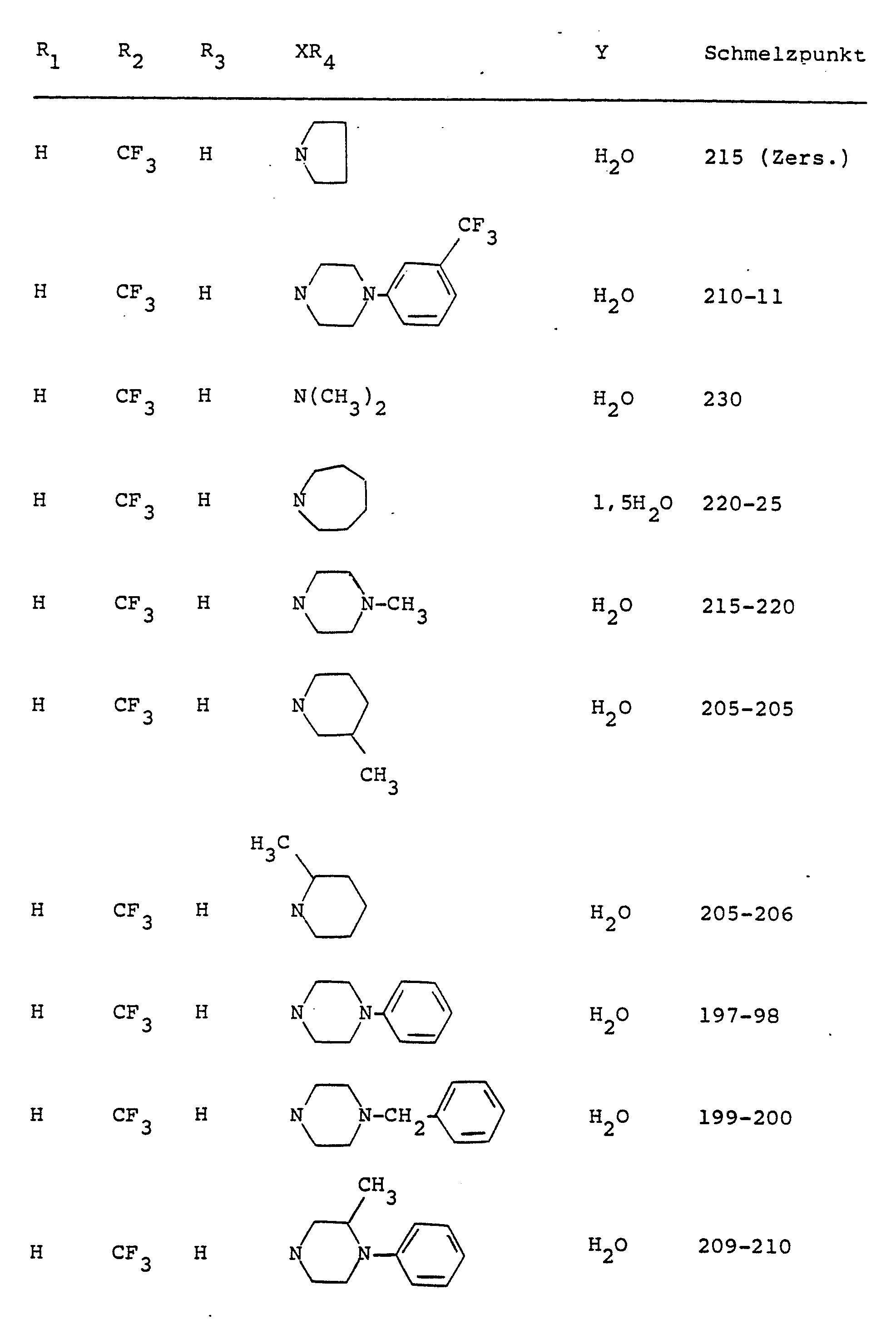
methylpiperazino]-3-(4-trifluormethylphenyl)-(H2)-acridon-N-oxid-monohydrat. - Einige der neuen, erfindungsgemäßen N-Oxide sind in der nachfolgenden Tabelle I aufgeführt.



- Gegenstand der vorliegenden Erfindung ist ferner ein Verfahren zur Herstellung der Verbindungen der Formel I, welches dadurch gekennzeichnet ist, daß man ein entsprechend substiutiertes Acridindion der allgemeinen Formel II in einem geeigneten wasserfreien Alkohol mit entsprechenden Alkoxiden der Formel III bzw. allgemein in einem wasserfreien polaren oder unpolaren Lösungsmittel wie Methanol, Äthanol, t-Butanol, Benzol oder N,N-Dimethylformamid mit einem entsprechenden Amin der Formel IV, zweckmäßig bei einer Temperatur von Raumtemperatur bis 100°C und vorteilhaft über einen Zeitraum von 1 bis 24 Stunden zur Reaktion bringt, wie beispielsweise unten angegeben:

- Die Ausgangsacridone der Formel (II) sind auf analoge Weise herstellbar wie in der Deutschen Patentschrift 2 337 474 und in Arzneimittelforschung, Drug Research 30 (II), Nr. 7, S. 363 - 370 (1980) beschrieben und durch das folgende Reaktionsschema I erläutert.

- Die erfindungsgemäßen Verbindungen besitzen wertvolle chemotherapeutische, zur Bekämpfung von Protozoeninfektionen geeignete Eigenschaften. Beispielsweise zeichnen sie sich durch eine hohe Wirksamkeit gegen Plasmodien, die Malariaerreger, aus. An geeigneten Modellen konnte auch eine Wirksamkeit gegen den Chloroquin-resistenten Stamm von Plasmodium berghei gezeigt werden. Bei Verabreichung an mit Plasmodium berghei infizierte Mäuse in einer Dosis im Bereich von 10 - 25 mg/kg × 5 z.B. wird die Parasitaemie vollständig geheilt.
- Die Verbindungen der Formel I kann man peroral oder parenteral in Dosierungen im Bereich von 2,5 bis 100 mg/kg Körpergewicht verabreichen. Als Anti-Malaria-Mittel werden Dosiereinheitsformen wie Dragees oder Kapseln zur oralen Verabreichung bzw. Lösungen oder Suspensionen für Injektionen mit je 100 bis 400 mg Wirkstoff bevorzugt. Solche Dosiereinheiten werden je nach dem Befinden des Patienten ein- bis dreimal täglich verabreicht.
- Gegenstand vorliegender Erfindung sind ferner pharmazeutische Präparate, die eine erfindungsgemäße Verbindung im Gemisch oder zusammen mit einem pharmazeutisch geeigneten Träger enthalten. Die Präparate können in zur oralen oder parenteralen Verabreichung geeigneter Form und vorzugsweise in Dosiereinheitsformen vorliegen.
- Zur oralen Verabreichung kommen Tabletten, Dragees, Kapseln, Pulver oder Granulat in Frage, welche den Wirkstoff im Gemisch oder zusammen mit beispielsweise Stärke, Cellulosepulver, Talkum, Magnesiumstearat, Zucker, Gelatine, Calciumcarbonat, feinverteilter Kieselsäure oder Carboxymethylcellulose enthalten.
- Zur parenteralen Verabreichung, insbesondere für intramuskuläre Injektionen, kommen sterile Suspensionen, zum Beispiel unter Verwendung von Sesamöl, Rizinusöl oder synthetischen Triglyceriden hergestellte ölige Suspensionen, gegebenenfalls unter gleichzeitiger Anwendung von Tensiden, beispielsweise Sorbitan-Fettsäureester, in Betracht. Zudem kann man auch wäßrige Suspensionen beispielsweise unter Verwendung äthoxylierter Sorbitan-Fettsäureester, gegebenenfalls unter Zusatz von Verdickungsmitteln, beispielsweise Polyäthylenglykol oder Carboxymethylcellulose, herstellen.
- Darüber hinaus sind die erfindungsgemäßen Verbindungen auch gegen Coccidioserreger wirksam, beispielsweise Geflügel-, Puten-, Kaninchen-, Rinder- und Schweinecoccidiose. Bei modernen Schlachttierzuchtmethoden stellt die Coccidiase während der Aufzuchts- und Mästzeit ein ernsthaftes Problem dar, da sie erhebliche wirtschaftliche Verluste verursachen kann. Dementsprechend besteht ein großes Interesse an der Verfügbarkeit hochaktiver, gut tolerierter Coccidiostatika.
- Dazu werden die Verbindungen der Formel I im Gemisch mit geeigneten Futtermitteln verabreicht. Gegenstand der Erfindung ist demnach auch ein Futtermittelzusatz, welcher eine Verbindung der Formel I enthält.
- Die nachfolgenden Beispiele erläutern die Erfindung.
-
- Man rührt eine Suspension von 7-Chlor-3,4-dihydro-10-hydroxy-3-(4-trifluormethylphenyl)-1,9(2H,1OH)-acridon (1,02 g, 0,0025 Mol) in Methanol (10 ml) bei Raumtemperatur und tropft Pyrrolidin (0,22 ml, 0,0032 Mol) dazu, wobei sich eine klare Lösung bildet. Bei weiterem Rühren erscheint ein gelber Niederschlag im Reaktionsgemisch, das noch eine halbe Stunde weitergeführt und dann filtriert wird. Das dabei erhaltene Produkt wird mit Aceton gewaschen und im Vakuum getrocknet, wobei man 7-Chlor-3,4-dihydro-1-pyrrolidino-3-(4-trifluormethylohenyl)-acridon-N-oxidmonohydrat vom Schmelzpunkt 215°C in 78 % Ausbeute (0,9 g) erhält.
- Unter den oben beschriebenen Bedingungen und unter Einsatz eines entsprechend substituierten Acridindions und des entsprechenden Amins anstelle von Pyrrolidin werden folgende Verbindungen hergestellt:
7-Chlor-3,4-dihydro-1-(N-2,6-dimethylohenylpiperazino)-3-(4-trifluormethylphenyl)-2(H)-acridon-N-oxid-monohydrat, Schmelzpunkt 221-22°C;
7-Chlor-3,4-dihydro-1-(N-4-methoxyphenylpiperazino)-3-(4-trifluormethylphenyl)-2(H)-acridon-N-oxid-monohydrat, Schmelzpunkt 204-5°C;
7-Chlor-3,4-dihydro-1-[N-(N-benzylpiperazino)]-3-(4-trifluormethylphenyl)-2(H)-acridon-N-oxid-monohydrat; 7-Chlor-3,4-dihydro-1-(N-phenylpiperazino)-3-(4-trifluormethylphenyl)-2(H)-acridon-N-oxid-monohydrat, Schmelzpunkt 197-98°C;
7-Chlor-3,4-dihydro-1-(N-3-trifluormethylphenylpiperazino)-3-(4-trifluormethylphenyl)-2(H)-acridon-N-oxid-monohydrat, Schmelzpunkt 210-11°C;
7-Chlor-3,4-dihydro-1-(morpholino)-3-(4-trifluormethylphenyl)-2(H)-acridon-N-oxid-monohydrat, Schmelzpunkt 250°C (Zers.);
7-Chlor-3,4-dihydro-1-[N-2-methoxyphenylpiperazino]-3-(4-chlorphenyl)-2(H)-acridon-N-oxid, Schmelzpunkt 188-89°C;
7-Chlor-3,4-dihydro-1-(N-methylpiperazino)-3-(4-trifluormethylphenyl)-2(H)-acridon-N-oxid-monohydrat, Schmelzpunkt 215-20°C;
7-Chlor-3,4-dihydro-1-[N-2-methyl-Nʹ-phenylpiperazino]-3-(4-trifluormethylphenyl)-2(H)-acridon-N-oxid-monohydrat, Schmelzpunkt 209-210°C;
7-Chlor-3,4-dihydro-1-[N-4-(p-chlorphenyl)-3-methylpiperazino]-3-(4-trifluormethylphenyl)-2(H)-acridon-N-oxid-monohydrat, Schmelzpunkt 207-208°C;
7-Chlor-3,4-dihydro-2-methyl-1-(N-methylpiperazino)-3-(4-trifluormethylphenyl)-2(H)-acridon-N-oxid-monohydrat, Schmelzpunkt 290-92°C. - Unter gutem Rühren versetzt man eine durch Auflösen von Natrium (1,2 g) in wasserfreiem Methanol (100 ml) hergestellte Natriummethylatlösung mit 7-Chlor-3,4-dihydro-10-hydroxy-3-(4-trifluormethylphenyl)-1,9(2H,1OH)-acridindion (10,0 g), rührt dann noch eine Stunde bei Raumtemperatur weiter und filtriert die Lösung zur Abtrennung des Niederschlags. Dieser wird gründlich mit Methanol gewaschen und im Vakuum getrocknet, wobei man 7-Chlor-3,4-dihydro-1-methoxy-3-(4-trifluormethylphenyl)-2(H)-acridon-N-oxid-monohydrat vom Schmelzpunkt 292-94°C erhält.
- Unter den oben beschriebenen Bedingungen und ausgehend von einem entsprechend substituierten Acridindion und einem geeigneten, durch Auflösen von Natrium im entsprechenden Alkohol hergestellten Natriumalkoholat werden die folgenden Verbindungen hergestellt:
7-Chlor-3,4-dihydro-1-äthoxy-3-(4-trifluormethylphenyl)-2(H)-acridon-N-oxid-sesquihydrat, Schmelzpunkt > 300°C;
7-Chlor-3,4-dihydro-1-isopropoxy-3-(4-trifluormethylphenyl)-2(H)-acridon-N-oxid-monohydrat, Schmelzpunkt > 300°C;
7-Chlor-3,4-dihydro-1-äthoxy-2-methyl-3-(4-trifluormethylphenyl)-2(H)-acridon-N-oxid, Schmelzpunkt 296°C und
7-Chlor-3,4-dihydro-1-äthoxy-2-phenyl-3-(4-trifluormethylphenyl)-2(H)-acridon-N-oxid, Schmelzpunkt > 300°C.
Claims (8)

R₁ und R₃, die gleich oder verschieden sein können, Wasserstoff, C₁-C₄-Alkyl, C₂-C₅-Carbalkoxy oder Phenyl, welches ein- oder mehrfach mit C₁-C₄-Alkyl, Halogen oder Amino substituiert sein kann,
R₂ Halogen oder Trifluormethyl, wobei die Substituenten falls n eine Zahl von 2 oder 3 bedeutet, gleich oder verschieden sein können,
n eine ganze Zahl von 0 bis 3,
X Sauerstoff oder Stickstoff
R₄ falls X Sauerstoff bedeutet, eine C₁-C₄-Alkylgruppe oder falls X Stickstoff bedeutet,
XR₄ eine Di-C₁-C₄-alkylaminogruppe oder einen 5- oder 6-gliedrigen Heterocyclus, der ein weiteres Heteroatom enthalten kann und unsubstituiert ist oder ein- oder mehrfach substituiert ist mit C₁-C₄-Alkyl, substituiertem C₁-C₄-Alkyl, oder Phenyl, das seinerseits ein- oder mehrfach mit C₁-C₄-Alkyl, C₁-C₄-Alkoxy oder Halogen substituiert sein kann.
R₁ Wasserstoff
R₂ ein Chloratom oder die Trifluormethylgruppe
n die Zahl
R₃ Wasserstoff oder Methyl
X ein Sauerstoff- oder ein Stickstoffatom,
R₄ falls X Sauerstoff ist, die Methyl-, Äthyl- oder Isopropylgruppe, oder falls X Stickstoff ist,
XR₄ einen unsubstituierten oder substituierten Piperazino-, Piperidino- oder Pyrrolidino-Rest.

NaOR₄ III
worin R₄ C₁-C₄-Alkyl bedeutet, zu einer Verbindung der Formel I umsetzt, worin X Sauerstoff darstellt, oder mit einer Verbindung der Formel IV
HNR₄ IV
worin NR₄ eine Dialkylaminogruppe oder einen 5- oder 6-gliedrigen Heterocyclus darstellt, zu einer Verbindung der Formel I umsetzt, worin X Stickstoff bedeutet und XR₄ die genannte Bedeutung hat.
Applications Claiming Priority (2)
| Application Number | Priority Date | Filing Date | Title |
|---|---|---|---|
| DE19863624702 DE3624702A1 (de) | 1986-07-22 | 1986-07-22 | Neue, 1-substituierte 3-aryl-7-chlor-3,4-dihydro(2h)-acridon-n-oxide, ein verfahren zu ihrer herstellung und ihre verwendung als arzneitmittel und futtermittelzusatz |
| DE3624702 | 1986-07-22 |
Publications (2)
| Publication Number | Publication Date |
|---|---|
| EP0254224A2 true EP0254224A2 (de) | 1988-01-27 |
| EP0254224A3 EP0254224A3 (de) | 1989-04-19 |
Family
ID=6305675
Family Applications (1)
| Application Number | Title | Priority Date | Filing Date |
|---|---|---|---|
| EP87110365A Withdrawn EP0254224A3 (de) | 1986-07-22 | 1987-07-17 | 1-substituierte 3-Aryl-7-chlor-3,4-dihydro(2H)-acridon-N-oxide, ein Verfahren zu ihrer Herstelllung und ihre Verwendung als Arzneimittel und Futtermittelzusatz |
Country Status (11)
| Country | Link |
|---|---|
| US (1) | US4803204A (de) |
| EP (1) | EP0254224A3 (de) |
| JP (1) | JPS6333365A (de) |
| KR (1) | KR880001604A (de) |
| AT (1) | AT388553B (de) |
| DE (1) | DE3624702A1 (de) |
| DK (1) | DK380287A (de) |
| HU (1) | HUT44516A (de) |
| IN (1) | IN164921B (de) |
| PT (1) | PT85371B (de) |
| ZA (1) | ZA875297B (de) |
Cited By (2)
| Publication number | Priority date | Publication date | Assignee | Title |
|---|---|---|---|---|
| US5447950A (en) * | 1991-04-12 | 1995-09-05 | British Technology Group Limited | Anthra[1,9-c,d]pyrazol-6-(2H)-ones useful for treating anaerobic bacterial infections |
| US5461078A (en) * | 1991-04-12 | 1995-10-24 | British Technology Group Limited | Anti-cancer compounds |
Families Citing this family (3)
| Publication number | Priority date | Publication date | Assignee | Title |
|---|---|---|---|---|
| KR100220538B1 (ko) * | 1991-01-11 | 1999-09-15 | 뮈쉘 쥐르밀 | 아크리딘 유도체 |
| EP1644347A1 (de) * | 2003-06-20 | 2006-04-12 | Arena Pharmaceuticals, Inc. | N-phenylpiperazinderivate und verfahren zur prophylaxe bzw. behandlung von mit dem 5ht[2c]-rezeptor assoziierten krankheiten |
| TW200633721A (en) * | 2004-12-14 | 2006-10-01 | Shionogi & Co | A pharmaceutical composition for treating constipation |
Family Cites Families (6)
| Publication number | Priority date | Publication date | Assignee | Title |
|---|---|---|---|---|
| DE2337474C2 (de) * | 1973-07-24 | 1982-01-21 | Hoechst Ag, 6000 Frankfurt | Chemotherapeutisch wirksame Tetrahydroacridone, Verfahren zu ihrer Herstellung und sie enthaltende Mittel |
| DE2748333A1 (de) * | 1977-10-28 | 1979-05-03 | Hoechst Ag | Mittel gegen malaria |
| US4291034A (en) * | 1980-03-20 | 1981-09-22 | Warner Lambert Company | 7-Chloro-3-substituted aryl-3,4-dihydro-1,9(2H,10H) and 10 hydroxy acridinedioneimines having antimalarial activity |
| DE3372094D1 (en) * | 1982-10-11 | 1987-07-23 | Hoechst Ag | 3-aryl-7-chloro-3,4-dihydro-acridine-1,9-(2h,10h)-dione-1-oximes and 1-hydrazones, their salts, process for their preparation and pharmaceutical preparations containing them, and their application |
| DE3237649A1 (de) * | 1982-10-11 | 1984-04-12 | Hoechst Ag, 6230 Frankfurt | 3-aryl-7-chlor-10-hydroxy-3,4-dihydro-acridin-1,9-(2h, 10h)-dion-1-oxime und -1-hydrazonderivate, deren salze, verfahren zu ihrer herstellung, sie enthaltende mittel und ihre verwendung |
| DE3410517A1 (de) * | 1984-03-22 | 1985-09-26 | Hoechst Ag, 6230 Frankfurt | 1-amino-, 1hydrazino- und 1-n-hydroxylamino-3-aryl-7-chlor-1,2,3,4-tetrahydro-9(10)-acridone, ihre salze, verfahren zu ihrer herstellung, sie enthaltende mittel und ihre verwendung |
-
1986
- 1986-05-15 IN IN149/BOM/86A patent/IN164921B/en unknown
- 1986-07-22 DE DE19863624702 patent/DE3624702A1/de not_active Withdrawn
-
1987
- 1987-07-17 EP EP87110365A patent/EP0254224A3/de not_active Withdrawn
- 1987-07-20 US US07/075,643 patent/US4803204A/en not_active Expired - Fee Related
- 1987-07-20 ZA ZA875297A patent/ZA875297B/xx unknown
- 1987-07-21 HU HU873360A patent/HUT44516A/hu unknown
- 1987-07-21 PT PT85371A patent/PT85371B/de unknown
- 1987-07-21 JP JP62180207A patent/JPS6333365A/ja active Pending
- 1987-07-21 DK DK380287A patent/DK380287A/da not_active Application Discontinuation
- 1987-07-22 KR KR1019870007932A patent/KR880001604A/ko not_active Withdrawn
- 1987-10-08 AT AT0260987A patent/AT388553B/de not_active IP Right Cessation
Cited By (2)
| Publication number | Priority date | Publication date | Assignee | Title |
|---|---|---|---|---|
| US5447950A (en) * | 1991-04-12 | 1995-09-05 | British Technology Group Limited | Anthra[1,9-c,d]pyrazol-6-(2H)-ones useful for treating anaerobic bacterial infections |
| US5461078A (en) * | 1991-04-12 | 1995-10-24 | British Technology Group Limited | Anti-cancer compounds |
Also Published As
| Publication number | Publication date |
|---|---|
| ZA875297B (en) | 1988-03-30 |
| EP0254224A3 (de) | 1989-04-19 |
| KR880001604A (ko) | 1988-04-25 |
| ATA260987A (de) | 1988-12-15 |
| DE3624702A1 (de) | 1988-02-04 |
| DK380287D0 (da) | 1987-07-21 |
| JPS6333365A (ja) | 1988-02-13 |
| PT85371B (de) | 1989-10-24 |
| HUT44516A (en) | 1988-03-28 |
| IN164921B (de) | 1989-07-08 |
| PT85371A (de) | 1987-08-01 |
| US4803204A (en) | 1989-02-07 |
| AT388553B (de) | 1989-07-25 |
| DK380287A (da) | 1988-01-23 |
Similar Documents
| Publication | Publication Date | Title |
|---|---|---|
| DE3814549A1 (de) | N-substituierte derivate von 1-desoxynojirimycin und 1-desoxymannonojirimycin, verfahren zu deren herstellung und deren verwendung in arzneimitteln | |
| DE2915318A1 (de) | Cycloalkyltriazole, verfahren zu ihrer herstellung und diese enthaltende arzneimittel | |
| DD292909A5 (de) | Verfahren zur herstellung neuer 2-(1-piperazinyl)-4-phenylcycloalkanopyridinderivate | |
| EP0422485B1 (de) | Chinoloncarbonsäurederivate, Verfahren zu ihrer Herstellung sowie ihre Verwendung als antivirale Mittel | |
| EP0049355A1 (de) | 7-Amino-1-cyclopropyl-4-oxo-1,4-dihydro-(naphthyridin oder chinolin)-3-carbonsäuren, Verfahren zu ihrer Herstellung und sie enthaltende Arzneimittel | |
| DE4430639A1 (de) | Verwendung von 5-substituierten Pyridin- und Hexahydrochinolin-3-carbonsäurederivaten | |
| CH642964A5 (de) | 1-substituierte 4-(chinolinylaminobenzoyl)-piperazine sowie diese verbindungen enthaltende arzneimittel. | |
| EP0215354B1 (de) | Substituierte 2-Phenyl-hexahydro-1,2,4-triazin-3,5-dione, Verfahren zu ihrer Herstellung, sie enthaltende Mittel und ihre Verwendung | |
| DE2914511A1 (de) | 4-chinolinylaminobenzoylpiperidine, verfahren zu ihrer herstellung und diese enthaltende arzneimittel | |
| EP0528164B1 (de) | Verwendung von Xanthinderivaten zur Herstellung eines Arzneimittels zur Behandlung von sekundären Nervenzellschäden und Funktionsstörungen nach Schädel-Hirn-Traumen | |
| EP0431371B1 (de) | 3-Aminopyrrole, Verfahren zu ihrer Herstellung und ihre Verwendung als Antikonvulsiva | |
| DE3617976C2 (de) | ||
| EP0104423A1 (de) | 2-Nitro-1,1-ethendiamine, Verfahren zu ihrer Herstellung sowie ihre Verwendung als Arzneimittel | |
| EP0254224A2 (de) | 1-substituierte 3-Aryl-7-chlor-3,4-dihydro(2H)-acridon-N-oxide, ein Verfahren zu ihrer Herstelllung und ihre Verwendung als Arzneimittel und Futtermittelzusatz | |
| DE4425650A1 (de) | Substituierte Triazolylmethylphenylnaphthyridone | |
| EP0061056A1 (de) | 5,6-Dimethyl-pyrrolo(2,3-b)pyridine, Verfahren zu ihrer Herstellung und ihre Verwendung als Arzneimittel | |
| DE3216843A1 (de) | Thiomethylpyridin-derivate, verfahren zu ihrer herstellung und diese verbindungen enthaltende arzneimittel | |
| EP0218068A1 (de) | Dihydropyridin-2-hydroxyamine, Verfahren zur Herstellung und ihre Verwendung in Arzneimitteln | |
| DE2749584A1 (de) | Ueberbrueckte geminale diphenylpiperidine, verfahren zu ihrer herstellung und sie enthaltende arzneimittel | |
| DE2817924A1 (de) | 3-(1-piperazinyl)-1,2,4-benzotriazine und ihre n-oxide | |
| DE69617001T2 (de) | (2-morpholinylmethyl)benzamid-derivate | |
| EP0007525A1 (de) | 2-(4-Aminopiperidino)-3,4-dihydrochinoline, Verfahren zu ihrer Herstellung, pharmazeutische Präparate auf Basis dieser Verbindungen sowie ihre Verwendung | |
| DE3142559A1 (de) | "pyrimidin-derivate" | |
| DE3743749A1 (de) | Arzneimittel enthaltend in kombination interferon und 1-desoxy-piperidinosen, verfahren zu deren herstellung und deren verwendung | |
| EP0004904B1 (de) | 2-Amino-3a,4,5,6-tetrahydro-perimidin-Derivate, diese enthaltende Arzneimittel und Verfahren zu ihrer Herstellung |
Legal Events
| Date | Code | Title | Description |
|---|---|---|---|
| PUAI | Public reference made under article 153(3) epc to a published international application that has entered the european phase |
Free format text: ORIGINAL CODE: 0009012 |
|
| AK | Designated contracting states |
Kind code of ref document: A2 Designated state(s): AT BE CH DE ES FR GB GR IT LI LU NL SE |
|
| PUAL | Search report despatched |
Free format text: ORIGINAL CODE: 0009013 |
|
| AK | Designated contracting states |
Kind code of ref document: A3 Designated state(s): AT BE CH DE ES FR GB GR IT LI LU NL SE |
|
| STAA | Information on the status of an ep patent application or granted ep patent |
Free format text: STATUS: THE APPLICATION HAS BEEN WITHDRAWN |
|
| 18W | Application withdrawn |
Withdrawal date: 19890706 |
|
| RIN1 | Information on inventor provided before grant (corrected) |
Inventor name: DHAR, RAJKUMAR, DR. Inventor name: RUPP, RICHARD HELMUT, DR. Inventor name: DE SOUZA, NOEL JOHN, DR. Inventor name: VENUGOPALAN, BINDUMADHAVAN, DR. Inventor name: CHATTERJEE, DIPAK KUMAR, DR. |