EP0254438A2 - Système pour animer l'opération de programme et pour afficher des relations basées sur le temps - Google Patents
Système pour animer l'opération de programme et pour afficher des relations basées sur le temps Download PDFInfo
- Publication number
- EP0254438A2 EP0254438A2 EP87305807A EP87305807A EP0254438A2 EP 0254438 A2 EP0254438 A2 EP 0254438A2 EP 87305807 A EP87305807 A EP 87305807A EP 87305807 A EP87305807 A EP 87305807A EP 0254438 A2 EP0254438 A2 EP 0254438A2
- Authority
- EP
- European Patent Office
- Prior art keywords
- time
- model
- message
- response
- event
- Prior art date
- Legal status (The legal status is an assumption and is not a legal conclusion. Google has not performed a legal analysis and makes no representation as to the accuracy of the status listed.)
- Withdrawn
Links
Images




Classifications
-
- G—PHYSICS
- G06—COMPUTING OR CALCULATING; COUNTING
- G06F—ELECTRIC DIGITAL DATA PROCESSING
- G06F30/00—Computer-aided design [CAD]
- G06F30/20—Design optimisation, verification or simulation
- G06F30/23—Design optimisation, verification or simulation using finite element methods [FEM] or finite difference methods [FDM]
-
- G—PHYSICS
- G06—COMPUTING OR CALCULATING; COUNTING
- G06F—ELECTRIC DIGITAL DATA PROCESSING
- G06F3/00—Input arrangements for transferring data to be processed into a form capable of being handled by the computer; Output arrangements for transferring data from processing unit to output unit, e.g. interface arrangements
- G06F3/01—Input arrangements or combined input and output arrangements for interaction between user and computer
- G06F3/048—Interaction techniques based on graphical user interfaces [GUI]
- G06F3/0487—Interaction techniques based on graphical user interfaces [GUI] using specific features provided by the input device, e.g. functions controlled by the rotation of a mouse with dual sensing arrangements, or of the nature of the input device, e.g. tap gestures based on pressure sensed by a digitiser
- G06F3/0489—Interaction techniques based on graphical user interfaces [GUI] using specific features provided by the input device, e.g. functions controlled by the rotation of a mouse with dual sensing arrangements, or of the nature of the input device, e.g. tap gestures based on pressure sensed by a digitiser using dedicated keyboard keys or combinations thereof
- G06F3/04895—Guidance during keyboard input operation, e.g. prompting
-
- G—PHYSICS
- G06—COMPUTING OR CALCULATING; COUNTING
- G06F—ELECTRIC DIGITAL DATA PROCESSING
- G06F30/00—Computer-aided design [CAD]
- G06F30/20—Design optimisation, verification or simulation
-
- G—PHYSICS
- G06—COMPUTING OR CALCULATING; COUNTING
- G06F—ELECTRIC DIGITAL DATA PROCESSING
- G06F2111/00—Details relating to CAD techniques
- G06F2111/04—Constraint-based CAD
Definitions
- This invention relates in general to computer-based simulation systems and in particular to a system employing constraint satisfaction for temporizing a simulation.
- Computer programs have long been used for simulating the behavior of a "real world" apparatus or process ' and an "animation” is a simulation which includes a graphical display representing the behavior of the apparatus or process.
- animation is a powerful means for representing the inner workings of a process which in itself does not have a visual aspect.
- data structures are often represented by two dimensional diagrams because they are most easily apprehended in spatial, visual form rather than as a textual description or bits in a memory bank.
- understanding obscure algorithms operating on data structures could be assisted through simulation of dynamic motion in such diagrams and images.
- Animation difficulties are further magnified if one insists an animation must be more than pictures on a screen, and that the pictures should create the illusion of things they represent for allowing a user to interact with them.
- an animated spring desirably acts like a real one in that a user should be able to "push” it or “pull” it and observe the response. This means the animation must be designed as a fully interactive interface and the user should be able to gain access to the code which drives the animation.
- Constraint languages allow the programmer to declare relations that a system of objects must satisfy; it is the job of constraint satisfaction algorithms to automatically find a way to satisfy those relationships.
- the de- clarative character is attractive since it tends to reduce the creation of an animation to the writing of an executable specification, which one may expect to be simpler than writing out detailed graphics instructions in an imperative language.
- ThingLab One existing constraint oriented computer pfo- gramming system, "ThingLab”, is described in "ThingLab -A Constraint-Oriented Simulation Laboratory", by A. H. Borning, published July, 1979 by Xerox Corporation, in Xerox Palo Alto Research Center ReportSSL-79-3, and in an article entitled “The Programming Language Aspects of ThingLab, A Constraint-Oriented Simulation Laboratory”, also by A.H. Borning, published in ACM Transactions on Programming Languages and Systems, October, 1981.. Constraints in ThingLab are implemented as objects that represent some relation as a predicate and contain a variety of methods as code fragments which can be used to establish the relation under different circumstances, depending on what is known.
- the goal of constraint satisfaction techniques is to choose and order appropriate methods so that relations throughout a network of constraints are reestablished following a change.
- the act of programming in a constraint oriented system consists of specifying, preferably in a graphical way, the interconnections among objects containing code fragments embodying the functionality of the part.
- the job of the constraint system then is to sort out and order those code fragments so that the composite shows the desired behavior of a coherent whole.
- One of the most attractive features of constraint languages is that they are fundamentally descriptive as opposed to imperative.
- the drudgery of hand-coding animations is in having to give explicitly imperative commands for everything that is to happen and appear on the screen. It is easier to merely describe in general terms how things should appear and let the system generate the code that would make it so.
- ThingLab The animated, dynamic responses of a system like ThingLab are user driven in response only to a command to "satisfy all constraints with these values now". Constraints in ThingLab are "static” rather than “temporal” in that they are satisfied in the same way for all time and are independent of time. There can be no history-dependent specifications because there is no history.
- a constraint system models time in order to provide meaningful and realistic animation.
- Time requires special treatment and cannot simply be inserted as another variable in a constraint relation.
- a group of interactive elements is simulated by utilizing a model embodied within an object oriented computer programming system and the temporal behavior of the model is controlled by a further time management object.
- the time management object is adapted to execute a procedure for incrementing a simulation "time” by adjusting the value of a variable representing time, and maintains an "event queue” for storing events, wherein an event comprises a representation of a message and a "time stamp” indicating a time at which the message is to be sent to the model.
- the time management object is further adapted to transmit any message represented by an event in the event queue to the model when time represented by the time variable surpasses the time indicated by the time stamp associated with the message. Each such message sent to the model causes the model to carry out some procedure.
- the model is made to respond to a triggering message in a temporal fashion by storing one or more events in the event queue in response to the triggering message.
- Each event stored in the event queue includes a time stamp indicating a future time at which a response message is to be sent to effect a particular response.
- the time management object increments the time variable, the response messages described by the enqueued events are sent in the order that the events are time stamped.
- the model can carry out an action or a sequence of actions in the future in response to a current triggering event.
- the behavior of the model is described according to a set of temporal constraints on the future behavior of the model (e.g., on the assignment of values to variables it controls) which are invoked in response to a triggering messee.
- a triggering message is sent to the modal q fer which no procedure has been compiled for satisfying temporal constraints
- a response procedure ? compiled for execution by the time management object which causes one or more events to be stored in the event queue.
- Each of these events includes a time stamp indicating a future time and a representation of a temporal constraint satisfaction message to the model for causing the model to satisfy the requirements of the temporal constraints triggered by the triggering message.
- the time management object increments the simulation time, it transmits to the model a message described by an event in the event queue whenever the simulation time surpasses the time indicated by the time stamp of the event, thereby causing the model to carry out an action in satisfaction of its temporal constraints.
- the present invention not only temporizes the behavior of the model by providing the time management object for controlling the actions of the model to be performed at a specified future time, it also automatically determines what those actions will be in order to satisfy a set of temporal constraints on the behavior of the model.
- FIGS. 1-17 depict displays on a computer graphics terminal illustrating the operation of the present invention.
- the preferred embodiment of the present invention is implemented as an improvement to the ThingLab constraint satisfaction programming system, which in turn is based on the Smalltalk programming language. Accordingly, the basic prin ciples of Smalltalk and ThingLab will be briefly discussed in order to provide a foundation for the detailed description of the present invention.
- Smalltalk is an object oriented computer programming language wherein computer software is organized into "objects" each comprising a block of program instructions describing various computer operations ("methods") to be performed in response to "messages" sent to the object. Such operations include, for example, the manipulation of variables and the transmission of messages to other objects.
- the "state" of an object is defined in terms of the values of variables that it controls and the methods associated with each object define its "behavior" in response to the messages it receives. Thus one may "program” in the Smalltalk language by writing individual blocks of code each of which defines (or creates) an object.
- the Smalltalk programming language can be used to facilitate the modeling of interactive systems in that each component of the system can be modeled with an object, the behavior of each component being simulated by the methods of the corresponding object and the interactions between components being simulated by the messages transmitted between objects.
- a user may also communicate with an object through its image on a computer terminal screen, utilizing a mouse to control a cursor on the screen to point to the object and buttons on the mouse or a keyboard to transmit messages to the object.
- An object may also provide information to the user through its image on the screen, using data readouts or graphical changes to the object image.
- ThingLab is a "higher level" programming language based on Smalltalk wherein a user may specify the behavior of a system of interrelated objects by indicating “constraints" that the state of each object must satisfy, rather than by directly encoding the methods which define or control each object's behavior. Once the constraints are specified, ThingLab generates the necessary code for methods which cause the network to satisfy the constraints.
- the associated constraint object would contain the expressions a - b + c, b - a - c, and c - a - b, any one of which may be used to satisfy the constraint. But depending upon which values are known or have just been changed, only one of the three methods for satisfying 'fPt'è constraint may be appropriate.
- ThingLab chooses and orders appropriate methods for each object so that relations throughout the network of constraints are reestablished after a change to the constraint network.
- ThingLab the state of such a system of objects changes only when a constraint is changed or when the value of a variable is changed by some stimulus event.
- an object cannot be "constrained” to behave in a temporal fashion by changing state at some future time in response to some event which happens now, but rather can only be constrained to fully respond "now” to an event that happens now. Therefore ThingLab is not suitable, for example, for modeling an RC network since the behavior of a capacitor in such a network is necessarily temporal.
- I C * dV/dt.
- ThingLab is utilized as the basis of a programming system, hereinafter referred to as "Animus".
- Animus A Smalltalk listing implementing Animus within the ThingLab environment is included as Appendix to this application.
- Animus permits a user to describe systems of Smalltalk objects according to the static constraints that they must satisfy, but in addition thereto Animus also permits systems to be described in terms of "temporal constraints” wherein objects are constrained to carry out one or more actions in the future in response to a stimulus event occurring in the present.
- the Animus system is well suited to creating animated simulations of physical systems. Continuous physical processes may be described by differential equations, as for example the equations of motion for a mechanical system. Animus provides the Smalltalk class TimeDifferentialConstraint which allows the user to specify such differential equations as constraints on the system's behavior. (Standard Smalltalk typographical conventions are used throughout this application. Class names are capitalized and may be shown in bold face while instance variable names begin in lower case.) The mechanism contained in TimeDifferentialConstraint satisfies a constraint by automatically generating and executing a finite difference approximation to the behavior specified.
- v dx/dt. That is, the prototypical instance of MechanicalNode has an instance variable representing a position whose value is constrained, as time advances, to be derived from the value of the instance variable for velocity.
- These constraints are "simple" because the response to satisfy them consists of a single event to adjust the object's state in the next instant, as contrasted with a more complex.
- animation response such as sending an icon out on a trajectory of many step-wise time sequenced moves.
- FIG. 1 showing an "Animus Browser window” 10 displayed on the screen of a computer terminal, we would begin by defining a new prototype class, selecting "define new thing" from a menu that pops up with a mouse button click in a first pane 12 of window 10. A dialog window then appears and asks for the name of the new prototype class, to which we respond by using a keyboard to type in "RC”. The line "RC" will then appear in the first pane 12 as part of a list of prototypes.
- Prototype constraint classes for electronic components are advantageously provided in a "kit” of such classes provided within Animus and includes such things as capacitors, inductors, oscilloscopes, and signal generators, with time dependent behavior built in.
- a resistor prototype kit component for example, includes the necessary Smalltalk code for controlling the display of a representation of a resistor on the screen as well as code for maintaining variables describing the state of the resistor (such as its resistance, terminal voltages and current through the resistor) and code describing the behavior of a resistor in terms of constraints its variables must satisfy (e.g. Ohm's law).
- the prior art ThingLab system includes kit components such as resistors which have non-temporal constraints.
- constraints defining a capacitor have a temporal aspect because a capacitor behaves in a temporal fashion.
- the relationships between voltage, current, and charge variables which describe the state of a capacitor are modeled by differential equations involving time and therefore a change in any of these variables must cause a time dependent change in one or more of the other variables in order to satisfy the constraints which define the behavior of the capacitor.
- a prototype kit component such as a capacitor desirably also includes code describing the temporal constraints on the behavior of the capacitor.
- FIG. 2 shows a latter stage in the construction of the RC prototype.
- Animus compiles a new method to respond to this message which, in addition to incrementing time, enqueues an "event" in an “event queue” (discussed in detail hereinbelow).
- An event is a description of a message to be sent upon the next increment of time ("tick" of the clock) to adjust the charge on the capacitor 20. This change to the charge in turn triggers other constraints which define the behavior of the RC network. Animus plans and compiles the necessary methods to implement this behavior based on the constraints triggered.
- the resulting exponential decay seen on the oscilloscope 26 is not the result of any analytical calculation of exponentials, but occurs naturally as a result of finite-difference approximations embodied in the methods generated by the system to satisfy a specified TimeDifferentialConstraint associated with each time dependent element of the RC network.
- the capacitor 20 is suitably provided in the "kit” with an initial charge.
- the user can edit the capacitor directly and simply assign a new value to the charge, whereupon the animation may proceed.
- To perform the edit we select "edit” in the third pane 16, and in the fourth pane 18 we select the kind of object we want to edit, in this case "Capacitor.”
- Animus shows us the selection by displaying a box 30 around the selected element, it illustrated in FIG. 3. Clicking a mouse button on the selection now brings up a standard Smalltalk Inspector window 31 as shown in FIG.
- the new initial charge on the capacitor changes the initial voltage across the capacitor so that the exponential decay of that voltage, viewed by the oscilloscope 26 as capacitor 20 discharges through resistor 24 following the "go" command, begins at a voltage level which may be higher or lower than the previous initial charge.
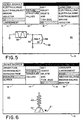
- the "gain” and “sweep” of the scope 34 may be adjusted by editing the instance variables for the scope in the same way that the capacitor's initial charge was changed. Numbers printed beside the components are suitably constrained with each "tick” (i.e., increment of time) to indicate the charge on the capacitor 32 and the current through the inductor 33 in arbitrary units.
- L inductance
- V the voltage across the inductor
- i the current through the inductor
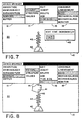
- FIG. 6 shows an animation of a mechanical analog to the electrical oscillator of FIG. 5, comprising a mass 40 on a spring 42.
- a spring prototype containing a constraint modeling Hooke's Law F -k/x (where F indicates a vector force and X indicates a distance vector) is provided in the kit. Hooke's Law is expressed as a static constraint between the spring's extension and the force it contributes.
- a "hand" object 41 from the kit (pane 18) may be inserted in the prototype which is constrained to drive the spring/weight system by moving the upper end 45 of the spring up and down at a fixed sinusoidal frequency.
- the hand 41 introduces into the system a "scripting" TimeFunctionConstraint in which the value of a variable is determined by evaluating some function of time. That is, the hand prototype definition has an instance variable, "verticalOffset,” defined by a sine function, A * sine-(wt).
- constraint satisfaction enqueues a message that assigns the value of the function at the current time into the constrained variable, the vertical offset of the hand 41 from its initial position. Since the driving hand 41 is steadily adding "energy" to the system, the oscillation amplitude would increase without bound in the absence of damping such as that due to friction, air resistance or spring inelasticity. Such damping is conveniently modeled in the mass 40 itself as a slight modification to the constraint determining the acceleration.
- a term f * v is simply subtracted from the value of acceleration, where v is a vector velocity, scaled by a damping coefficient f, yielding a force component proportional to velocity and opposing the direction of motion.
- TriggerConstraints A discrete process is described by its "trace", the stream of events comprising it, and a TriggerConstraint allows the animator to specify certain graphical responses to the occurrence of particular events.
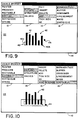
- FIG. 9 shows an Animus Browser window 10 displaying an animation ("sorting") created to test an algorithm for sorting numbers by magnitude.
- the animation consists of representing each number by a bar of height proportional to the magnitude of the number, bars being placed a graphical queue in the order that the numbers are arranged before the sort.
- the animation graphically swaps the positions of the bars in the queue to show how the sorting algorithm sorts.
- a SortQueue which causes a queue symbol 40 including a small rectangle 40a, indicating the start of the queue, and a dot 40b, indicating the end of the queue, to be placed in the display area 22 of window 10.
- each bar 41 in a queue 42 of such bars each bar being inserted between the queue start symbol 40a and the queue end symbol 40b.
- the height of each bar may be changed utilizing cursor 44, the magnitude represented by each bar being constrained to be proportional to the bar's height.
- the bar width remains constant.
- the algorithm to be animated may be invoked, as shown in FIG. 10, by selecting "send message” in the third pane 16 and "SortQueue” in the fourth pane 18 of window 10, and by pointing with the cursor 44 to the queue to receive the message.
- the system ascertains what messages the queue can understand and presents the user with a menu 46 (as shown in FIG. 11) from which to choose a sorting algorithm.
- selectionSort a sorting algorithm
- the bars flash (alternate between black and white fill) as seen in stop-action in FIG. 12.
- the sorting algorithm decides that positions of two bars 41 a, 41 b are to be swapped, the bars are graphically moved past one another to exchange positions as shown in mid-swap in FIG. 13.
- the bars could be swapped instantaneously but it is more difficult for a viewer to comprehend the procedure than when the bars move smoothly past one another over a period of time.
- the movement is simulated by "stepping" each bar across the screen using steps small enough so that the viewer perceives continuous movement.
- the movement of the bars in the sorting animation is an example of converting a discrete process (such as a swap) into a stream of events (display steps) which happen over a period of time. This capability is provided by the TriggerConstraints mechanism.
- the producer produces goods and transmits them to a distributor (monitor) which stores them in a warehouse (buffer) until purchased by the consumer.
- a distributor monitor
- the monitor sends a "full” signal to the producer which then stops production until the monitor sends a "not full” signal, indicating the buffer can accept more goods.
- the Animus "kit” provides prototypes for the consumer, the producer, and the monitor processes as well as for the buffer. Referring to FIG.
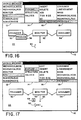
- FIG. 14 depicting an Animus Browser window 10 showing a producer/consumer animation under development in area 22, the producer is represented by a block 50, the monitor is represented by a block 52, the consumer is represented by a block 54, and the buffer is represented as a queue 60 similar to the queue of the previously discussed sorting example.
- An output lead 49 of the producer 50 is connected to an input lead 51 of the monitor 52 and an output lead 53 of the monitor is connected to an input lead 55 of the consumer 54.
- An input/output lead 62 of the monitor 52 is connected to the buffer 60.
- the lead connections define the paths of goods through the system and each lead is an instance variable such as "dataLead”, similar to instances of NumberLead in ThingLab, which enables a user to indicate that the output of a producer 50 is to be sent to a monitor 52 by graphically interconnecting leads.
- the monitor must handle the signaling embodied in the algorithm, so it will need protocols and variables for handling the signals, such as notEmptySignal notEmptyCondition - true notFullSignal notFullCondition - true Likewise the buffer will need to signal the monitor when it is full or not.
- MPC Monitor-Producer-Consumer
- Releasing the mouse button on the selected Producer causes the system to recompile all the methods for which responses are specified to be triggered, and then presents us, as shown in FIG. 16, with a menu 58 of messages which may be sent to the selected producer. In this case only the message "Produce" may be sent.
- the monitor 56 signals the producer 50 to wait.
- a graphical constraint is provided in the producer such that when its "blockingcondition" is set, the producer displays itself video inverted. Then if the consumer consumes an element, the monitor 52 receives a "notFuIISignal" message from the buffer 60 and in turn wakes the producer 50 which then resends its datum.
- An operator utilizes Animus to create a model which simulates the behavior of a collection of interactive elements such as a process or an apparatus.
- the model is assembled from Smalltalk objects instantiated from preexisting prototypes in the Animus kit wherein each prototype simulates a part of the process or apparatus. Once the model is created, it may itself be used as a prototype in the kit for an element of a more complicated model.
- the temporal behavior of the model is controlled by a time management object (hereinafter referred to as the "anima"), an instance of a subclass of a new Smalltalk class Anima.
- the anima is adapted to execute a procedure for incrementing a simulation "time” by incrementing the value of a variable representing time. The anima.
- an "event queue” for storing "events", wherein an "event” is a representation of a message, and a "time stamp” indicating a time at which the message is to be sent to the model.
- the anima is further adapted to transmit any message represented by an event in the event queue to objects of the model when the time represented by the time variable surpasses the time indicated by the time stamp associated with the message.
- Each such message sent to the model causes the model to carry out some procedure which satisfies constraints on its behavior.
- one or more events are stored in the event queue in response to the triggering message wherein each event includes a time stamp indicating a future time at which its message is to be sent to the model in order to effect a particular response.
- the time management object increments the time variable, the messages described by the events in the event queue are sent in the order that the events are time stamped.
- the model carries out an action or a sequence of actions in the future in response to a current triggering event.
- temporal behavior of the model is described by temporal constraints on the behavior of its parts, the temporal constraints being described by instances of temporal constraint classes which are instantiated when the kit prototypes are instantiated and inserted into the model.
- the temporal constraint classes include descriptions of triggering messages which invoke constraints.
- a triggering message is sent to the model for which no procedure has been compiled for satisfying temporal constraints triggered by the message
- Animus compiles a response procedure for execution by the time management object (the anima) which causes one or more events to be stored in the event queue.
- Each of these events includes a time stamp indicating a future time and a representation of a temporal constraint satisfaction message to the model for causing the model to satisfy the requirements of the temporal constraints triggered by the triggering message.
- Animus not only temporizes the behavior of the model by providing the anima for controlling the actions of the model to be performed at a specified future times, it also automatically determines what those actions will be in order to satisfy a set of temporal constraints on the behavior of the model and embodies those actions in the form of time stamped events in an event queue.
- Compile Time The time at which a message is sent to some node in the constrained structure which is not defined in the MethodDictionary for that object, but which is recognized as a method for which a response can be generated given the constraints. At this time a new method is compiled by the Animus system to respond to that message such that all constraints are satisfied.
- Run Time The time at which the new method (compiled at compile time) is executed. In the case of a temporal constraint this execution results in the creation of a response which can only occur in the future.
- Future Time The time at which a temporal response (created at run time) unfolds.
- a static constraint is not concerned with the future behavior of the system; it is concerned only with the current state of the system and says nothing about what states the system must assume in the future.
- a temporal constraint is satisfied by the future behavior of a system and has no effect on its current state.
- An “event” is an instance of class Event and is a representation of a Smalltalk message along with a time stamp specifying a time at which that message will be sent.
- a message in Smalltalk semantics consists of a reference to an object designated the receiver, a symbol serving as a message "selector", and an array of arguments.
- the receiver determines from the selector what method it is to execute and makes use of information contained in the arguments of the message when executing the method.
- the time stamp of an event serves to defer transmission of the message until time has a value greater than the time stamp.
- the "event queue” is a variable (“eventQueue") comprising a linked list of events in which insertions and removals of events may be done efficiently.
- Responses are represented as prototypes which, upon the occurrence of a designated trigger event, are realized as a stream of events, which are placed in the event queue. Any instance of Anima responds to the message "tick: dt,” by first checking to find all events in the event queue with time-stamps less than the current value of time, sends off the messages represented by the events, and finally increments the value of time by the value of dt.
- a temporal constraint is a relation that is required to hold between the existence of a stimuJ M s event and a response in the form of a stream of one or more new events.
- the statement of a tw- poral constraint must include a description of the stimulus event and some representation of the abstract response prototype from which the response stream of events can be instantiated at a particular time.
- the stimulus event may simply be a tick of the clock or it may be the receipt of some specified message by a particular object in the model.
- Temporal constraints are expressed locally in the components which are to exhibit the specified behavior, and these components are then combined (for instance by "merging" leads in the RC network example) so that the constraints interact in a network.
- ThingLab where static constraints are satisfied more locally (in the least common ancestor of the affected parts)
- Animus time is considered global and time as well as the single eventQueue variable are managed by the single instance of Anima which is contained in the ancestor to all parts of the animated structure. Therefore at the time of prototype initialization the animated structure must be traversed and all temporal constraints caused to migrate up to the anima, since the anima is the owner of the constrained variable, time. This process is detailed hereinbelow. Any message that would increment time thus must consider the constraints on time and a new method must be compiled to respond to that message which in addition to incrementing time guarantees that the constraints are satisfied.
- the strings provided in the array of "methods:” are code fragments that the constraint might utilize to reestablish the rule in the event of a change.
- the constraint is given the option to adjust the voltage at either lead, or to change the current through the resistor.
- the string 'resistance reference' indicates that the instance variable "resistance" is reference only, that is the constraint should not change the value of resistance to satisfy itself. However an outside reference to the resistance, for example if the user were to edit its value, would nonetheless cause the constraint to fire.
- the "owner:rule:methods" message is sent to an instance of class Constraint which responds by sending messages to an instance of Compiler which in turn parses the rule and method strings in the definition.
- the compiler returns an instance of a class MethodNode from which a parse tree representing each message string can be extracted.
- the intermediate representation used by the Smalltalk compiler is a tree of ParseNodes (of which MethodNode is a subclass) which (recursively) know how to emit byte- codes.
- the parse trees are then stored as initial values of instance variables in a new Constraint instance. Finally, the class sees that this new Constraint instance is inserted into the class definition of the prototype Resistor.
- the goal of temporal constraint satisfaction in the case of a TimeDifferentialConstraint, is to generate a set of methods that embody a finite difference approximation for a stated differential equation.
- this "owner:timeDerivativeOf:equals:” message calls on a compiler to return a parse tree, but the string to be parsed is only implicit in the definition. Additional string elements are added to the information given in the definition so that the compiler returns a parse tree standing for the code fragment:
- the value of the time increment t1 is not known until run time and so is expected as a parameter.
- This code fragment is incorporated into a new method created at compile time, as described hereinbelow.
- the local temporary variable "delta" is passed as an argument in another message to increment the charge.
- This parse tree is inserted as a field in the new constraint instance in the new prototype class definition, but not directly as before, but rather packaged inside an object called a Response.
- An instance of class Response is an abstract representation of some possibly complex behavior to occur in the future, and becomes realized at run time as a sequence of events to be stored in the event queue.
- the first step taken by the planner is to expand the message recursively to all parts of the receiver, so that a message affecting the whole structure, such as moving the entire object, may be implemented by messages to the parts, ultimately moving each point comprising the object by the same amount. For example, if a quadrilateral object consisting of four line segment objects were to receive the message "moveby:delta" it would expand this into four "moveby:” messages, one to each line segment. Each of the four messages to line segments would in turn be expanded to two messages, one for each of the endpoint objects of the segment.
- the path to the receiver is checked for any constraints that might no longer be satisfied, and these constraints are told to add their methods to the planner. For example, if two resistors were connected to the same electrical node whose voltage is to change, then the methods for each resistors Ohm's Law constraint must be added to the planner.
- a constraint is told to add its messages to the planner queue it checks to see whether it has already done so via a different access path to a merged object. The constraint also checks whether it "overlaps" the receiver of the message being planned for, that is, whether any of the constrained parts are going to be affected by the planned changes.
- the messages in the planner's queue are then processed to delete duplicates (arising because of merged parts being accesses via more than one path in the recursive expansion) and, if possible, to find a one-pass ordering for sending the messages in the queue so that changes can propagate through the system leaving all constraints satisfied. Finally, a new method is compiled into the receiver's class definition whose statements are the messages of the planner's queue in the appropriate order.
- the receiver of the initial message is the global entity "time”, located in the anima, which is an implicit variable in all simulation objects.
- time located in the anima
- the anima upon receipt of a message to time by "incrementby: dt," the anima must first gather together all the temporal constraints that are defined in parts of the prototype object since time and the constraints on time are going to be globally managed by the anima. The anima then sends itself a message to "compileResponseFor" the temporal constraints it has just gathered. This means that the code fragment contained in the response of each temporal constraint becomes augmented and placed in context.
- time primativelncrement t1 thingEvents enqueue: (Array with: (Event new atTime: time value + t1 receiver: self selector: #delta.thing.capacitor3.charge: arguments: (Array with: t1))).
- the future is represented by the event queue maintained by the anima.
- the eventQueue is an instance variable of anima comprising a linked list of time-stamped messages which will be sent when time catches up to the time-stamp.
- the systems being simulated and animated are continuous processes and the problem for the system in satisfying the constraints is to generate a discrete approximation of the continuous specification.
- the simulated process may be discrete, in which case the constraints and their satisfaction must conform to an event-driven, cause-and-effect model.
- evolution that is explicitly discrete with as much visual smoothness and continuity as possible, as for example in the previously discussed sort animation wherein discrete swaps of bar position in a queue were represented by apparently continuous movement of bars from one queue position to another.
- intermediate graphical states for a thing being animated must be interpolated which in fact have nothing to do with any actual state of the thing itself.
- TimeFunctionConstraint owner Hand prototype timeVariable: 't' timeFunction: '(t * frequency) sin * amplitude' constrains: 'verticaiOffset *.
- variable 't' is actually just a place holding dummy variable, since there is no instance variable referring to time in the Hand prototype itself. Later, at compile time this dummy variable is replaced by "time" which is an instance variable of the automatically generated subclass of Anima for the animation prototype into which the Hand is inserted.
- time is an instance variable of the automatically generated subclass of Anima for the animation prototype into which the Hand is inserted.
- TimeDifferentialConstraints effectively achieves this behavior.
- the constraint is triggered initially by any message that would increment the value of time in the global clock. That is, a message to increment time is reinterpretted in view of the constraint, and a new method is compiled that increments time as well as enques an event embodying the constraint's response.
- This event is the incrementing of the value of the differential (i.e., dx) by the specified amount (i.e., V * dt). But the event is enqueued to occur in the following instant, thereby generating the standard approximation by considering the old value of the derivative as valid throughout the time interval.
- a temporal constraint creates a run-time method which itself enqueues another method to be executed at a later time, and this latter method can only refer to its receiver and arguments, not expressions.
- the specification of responses to discrete events is implemented by the class Trigger_-Constraint .
- the trigger event is a message with the specified selector sent to the owner of the constraint.
- the constraint owner's behavior upon receiving the trigger message takes the constraint into account by first enqueuing the specified ré- sponse events and then performing the primitive method associated with the message. This technique allows particular instances of a class to have individualized responses to a given message, unlike the usual situation in Smalltalk where all instances of a class have the same behavior.
- Each temporal constraint possesses a Response by which it satisfies itself.
- the response is relatively simple, involving the sending of a single message to perform an assignment.
- the response triggered by a TriggerConstraint is often more involved, entailing the enqueuing of many events, or starting up a procedure implementing an algorithm being animated.
- a response that is an instance of class Flasher enqueues a series of events which alternately paint a region of the screen black and then white. Flashing may be used, for example, to highlight some object the user should notice, like the elements of an array as they are being compared in a sort.
- This code fragment in the trigger constraint causes the following method to be compiled into the anima class for the sorting animation:
- This method is executed instead of the original "compare: with:” method since all messages to the constrained object to invoke the original method have been recompiled, and rerouted to the anima with the new extended selector substituted. Notice that in the recompilation, the message “selftick: 1" has also been inserted by the compiler so that the events that are enqueued for the response are immediately executed. This is necessary since, when control is given over to an executing algorithm, the browser no longer sends tick messages to the prototype, as was the case when we selected "go" in the spring/weight simulation. Conceivably this problem could be solved by "animating the program counter," and using advances in the counter to send off tick messages. But object oriented languages such as Smalltalk typically do not have a program counter in the usual sense. Messages are simply passed around. The explicit insertion of tick messages by the system into the recompiled messages forces the animated responses to occur as they are needed in a temporal fashion.
- a script may be a stream of events, that is, time stamped messages.
- a script is accessed as a Stream that is opened onto a file.
- Instances of a script respond quite simply by placing their own sequence of events into the event queue at run time. In order to accomplish this the events are represented as SmallTalk parse trees at definition time in the same way that constraint methods and response methods are represented. Then when the structure is built and the anima is initialized, the event messages are relocated to reflect the context.
- TriggerConstraint allows for even more elaborate responses including initiation of an algorithm.
- a TriggerConstraint definition could contain code for the algorithm in the "causes:" field.
- selection sort algorithmic code appears in the definition of the SortQueue prototype as:
- the Buffer prototype contains the methods:
- the Producer prototype contains the following method: produce
- the receiver of the producer's production is intended to be the monitor itself, but graphically, we are only able to merge part of these objects, their dataLeads, to indicate this.
- Access to parts in ThingLab is strictly top-down via name paths, for example "MPC producerl dataLead node value.”
- MPC producerl dataLead node value There are no back-pointers from parts to their ancestors in the hierarchical structure.
- the "ancestral:send:with:” message allows us to send a message indirectly, again via the root where global responses are compiled so that constraint satisfaction is guaranteed.
- This convention of access via root and paths is a very natural approach in Thinglab where user requests drive the changes in the constrained structure. Access by the user to the structure is through the browser having an instance variable pointing to the root object of the structure.
- the constraint satisfaction mechanism depends on the passage of the message down through the network, checking at each node whether the message pathway overlaps the path to some constrained part, and thus whether that constraint should be added to the list of those whose satisfaction must be assured.
- Trigger selectors are similarly treated upon relocation in that they are extended by the path names to the part where the trigger is defined. However, the path names are no longer executable per se, but rather are joined together into a single long selector without spaces in order to provide a unique selector in the anima for that trigger. The system then compiles a new method for that selector into the anima. For example, assume that one wishes to animate the swap of two elements in a list which is part of a larger structure. To do so one would state a trigger constraint in the list object, triggering on the selector "swap:with:", defined in the standard Smalltalk system in class Sequen- ceableCollection. Note that there may be other lists in the object which may be not animated to avoid screen clutter.
- Relocation functions are provided by adding protocols to the classes used by the Smalltalk compiler itself.
- the compiler scans a source method as a string and creates a graph of parse tree nodes representing that method.
- the compiler uses classes such as AssignmentNode, Bloc- kNode, MessageNode , and VariableNode, all subclasses of ParseNode .
- Each of these classes are provided with methods as needed to respond to protocols such as "relocatePaths: aPathPrefix" which typically will perform a local. change to create a new selector by concatenating "aPathPrefix" onto the original selector.
- the relocation message and path extension are then recursively passed down to descendant nodes in the parse tree, such as to arguments or subexpressions.
- the processing is thus distributed among objects which perform relatively simple local transformations, and complexity is dealt with in the recursive calls.
- Each node in this recursive calling sequence returns a new structure with the alterations in place, and these returned structures are assembled into the new transformed MethodNode.
- TriggerConstraints require special treatment. Without any special treatment, a message such as "listswap: t1 with: t2,” would relocate into something like “thing simKernel1 readyListl list swap: t1 with: t2". In other words, the reference to the variable "list” is relocated but nothing is done to the selector. But since this selector is to trigger a response, that response has recompiled into the anima under a new selector, such as "thingsimkernel1 readyListl list.swap:with:” which does the swap as well as enqueuing the required responses.
- the method is redirected to the anima (i.e., the receiver is assigned to be "self") and the selector is extended by concatenating the path to the defining part to the selector. Then the "compressTrigger:” message is recursively sent to the arguments to the method (which may be expressions). If the MethodNode's selector is not among the triggers, then the selector is left as is, and the "compressTrigger:” message is simply passed to both the receiver expression and the arguments.
- SortQueue component defines two trigger constraints.
- TriggerConstraint owner SortQueue prototype to: 'list 'trigger: #compare: with: causes: '(Flasher with: (list at: a1)) enqueueEvents. (Flasher with: (list at: a2)) enqueueEvents' TriggerConstraint owner: SortQueue prototype to: 'list ⁇ trigger: #swap: with: causes: '(Trajectory with: (list at: a1) destination: (list at:a 2)). enqueueEvents) (Trajectory with: (list at: a2) destination: (list at: a1)) enqueueEvents)'
- the local variables t1, t2, etc. are generated in the decom- pilation of the compiled method. There are three significant differences to notice between this method and the kit component method. The first is the path extension to all references to local instance variables, as indicated for the variable "list” in this example. Next, the designated trigger selectors have been extended by concatenating the path extension to the original selector in the same way that the "selectionSort" selector itself was changed. Finally-an explicit tick message has been inserted to insure that enqueued events occur.
- temporal constraint involves the realization of a response.
- Responses in Animus are implemented by classes that are subclasses of the abstract superclass Response.
- TimeDifferentialConstraints which model continuum processes cause instantiation of I mmediateResponses which are the closest thing to the instantaneous reactions of the continua being modeled.
- TriggerConstraints often cause more elaborate responses such as instances of Flasher, or Trajectory, detailed hereinbelow.
- An instance of class Response is an object that represents an abstraction of the event sequence.
- the particular sequence is generated when the Response is realized by sending it the message "enqueueEvents,” or more generally “enqueueEventsAt: aShift with: aStretch,” where the parameters are temporal translation and scaling respectively. All instances of response classes understand these messages and react by generating an event stream and placing it time-ordered into the eventqueue.
- the parameters "aShift” and “aStretch” are defaulted to zero and one respectively in the simpler message “enqueueEvents,” that is the event stream is to start immediately and to be of the standard duration.
- Responses can also be realized which are given other parameters such as the object whose image is to be moved. Maintaining descriptions of responses in relatively abstract terms in these classes, rather than concretely instantiated, allows greater flexibility. For example a simple parameter may determine whether an icon is to move along a trajectory in constant time, or at a constant velocity.
- TriggerConstraint may be created without using the convenience of abstract Responses at all, but rather a "causes:" field may be filled with a string of arbitrary Smalltalk expressions. This is the means by which an arbitrary algorithm may be specified, as in the sorting examples.
- Any animation system should be able to perform a sequence of actions according to some predefined script.
- a response of class Script is initialized with a pointer to a file containing an array of strings which can be compiled into messages to create new events.
- Monitored Producer-Consumer animation one might like the producer and consumer to autonomously produce and consume at certain times according to scripts, rather than the user having to send individual messages to initiate each production and consumption.
- a Producer prototype contains the constraint:
- TriggerConstraint owner Producer prototype to: 'self' trigger: #produce causes:' (Trajectory with: (Lozenge form: (Form dotOfSize: 20) frame: (frame corner extent: 20@20) label: currentDatum) destination: dataLead node) enqueueEvents', has led to the compilation into class MPCAnima of the method, thingproducer3.produce (Trajectory with: (Lozenge form: (Form dotOfSize: 20) frame: (thing producer3 frame comer extent: 20@20) label: thing producer3 currentDatum) destination: thing producer3 dataLead node) enqueueEvents. self tick: 1. tthing producer3 produce.
- This method includes the desired graphical response. To have sent the "produce” message directly to the Producer would effectively subvert the temporal constraint mechanism.
- Sequences are used when the desired ⁇ 1i-mated effect cannot be simply achieved by maMng an icon move across the screen, but rather requires that the icon change shape, as for instance when an icon in the form of a human "walks" across the screen.
- a Sequence is initialized with a pointer to a file containing an array of bitmaps and at compile time these bit maps are stored into the constraint whose response is the sequence. Since the realization of a Sequence does not involve message passing like Scripts, but only display of the bitmaps, there is no need at compile time for methods to be relocated.
- class Trajectory The abstraction of the function of moving icons across the screen is implemented by the class Trajectory.
- An instance of class Trajectory is created by specifying at least the object whose image is to be moved, and where it is to move. Additional instance creation messages may also specify how it is to move, for example at constant velocity or along a curved path. But the default is that the icon will be moved in constant time, that is, in a constant number of steps along a straight line between its original position and the destination. Trajectories with as many as ten steps and as few as four have been tested. More steps create smoother movements, but typically four steps seem adequate to provide the illusion of smooth motion, the eye seeming to do the interpolation on its own, with only the barest suggestion of intervening positions.
- a non-trivial feature of the behavior required of trajectories is that they should not spoil the display as they move across it, but should create the illusion that an icon being moved slides over the display. This means that upon initialization, a trajectory must store a picture of the background of the region across which it will travel and then, at each step of the way it must restore the portion of background upon which the icon. had been sitting.
- Class Flashers provides another useful animation response.
- a Flasher is instantiated by simply specifying the region of the screen, a rectangle, that is to flash.
- An instance of Flasher then responds to the message "enqueueEvents" by creating and enqueuing a series of events that will flash the region on the screen. n the previously described sorting algorithm this response is used to point out the bars whose heights are being compared.
- the user interface to Animus is similar to the ThingLab interface with a few possible changes and additions.
- the classes AnimusBrowser and AnimusBrowserView are subclasses of Thin- glabBrowser and ThinglabBrowserView respectively.
- the principal desirable difference consists in the addition of a number of " Tools" which appear as items in the third pane of the browser. These tools, described hereinbelow, pertain to the management of simulation time, editing and message sending to parts, and the addition of elements to indexed parts, i.e. lists.
- the most fundamental addition to the set of browser tools is the class Driver which is activated by selecting the item "go" in the third pane of the browser.
- the basic function of the driver is to repeatedly send "tick:dt” messages to the anima of the selected prototype. It has proven useful to add to Driver capabilities to recognize when a tick,4of the clock entails no graphical change so that redrawing can be suppressed, significantly improving the response of some simulations. Also it is useful to have the driver check for user input requests at each tick.
- Driver is a subclass of the ThingLab class Tool and inherits from it the basic scheduling protocols. When the browser is started up, the selected Tool executes the method:
- This method allows the selected tool to define particular prelude, execution loop and postlude functions.
- a Driver sends the message "selection anima initialize.” This will not necessarily cause the anima to reinitialize and perform the involved method relocation for temporal constraints since the anima keeps an instance variable initialized which is set true upon initialization and reset false when any structural changes are made which would require recompilation of constraint methods. This is to avoid unnecessary recompilation every time the simulation is restarted when no structural changes have been made.
- the method "eachtime” defined in Driver sends the selection's anima the message “tick”: selection anima deltaT".
- the time increment is also stored as an instance variable in the anima so that the user may adjust the "granularity" of the animation.
- the input Sensor i.e., the Smalltalk object representing the mouse and its state
- the input Sensor is then checked to see if the appropriate mouse button is pressed, and if so a pop-up menu is presented for the user to send a message to the selection.
- a Driver keeps a Boolean variable "picturesChanged" set by any response event that moves components around on the screen so that a picture buffer update and redisplay is needed. Otherwise if nothing has happened to alter the picture since the last tick, redrawing is omitted. In some cases it is desirable to be able to directly set the absolute value of time, rather than to simply increment it. This is not generally possible for animations whose state is generated incrementally, but rather only for those whose state is strictly determined as a direct function of time.
- the system provides the class Setter, a subclass of class Tool which is activated when the user selects "settime" in the third pane of the browser.
- a Ticker tool is selected via the item "tick size" in the third pane of the browser and allows the user to adjust the granularity of the time increment that is sent with each new tick message to the anima. Like the Setter this tool prompts the user for a new value in a pop-up window, and whatever the user accepts in that window is assigned as the new value of the time increment used by the anima in "tick:" messages.
- Algorithm animation applications typically display data structures such as lists, or arrays, or in Smalltalk terminology, "indexed parts".
- Smalltalk makes a fundamental distinction between objects whose parts are named instance variables and those whose parts are unnamed and accessible by index. The difference implies that when a user builds an object in Animus, he can either insert a new part as a new named instance variable, or he may add elements to an already present indexed structure such as a list.
- a tool called a Kicker allows one to send a message to an object on the screen, such as to tell a particular array to sort itself.
- the choice of "send message" in the third pane like the ThingLab tool “move,” flashes an image of the prototype of the thing to receive the message.
- the prototype image sticks to an instance on the screen of that type, and the selected instance thereupon relocates into the anima the methods of any triggered selectors.
- These are the messages one is then allowed to send to that instance, and the user is offered a pop-up menu from which he may select one of the messages. This mechanism underlies the starting up of the previously described sorting example.
- Class Picker (detailed in Appendix I) provides the mode of interaction one expects from selecting "edit” in the third pane of the browser. Like the Kicker, Picker shows the user a flashing image of the prototype of the thing one wants to edit which sticks to an instance of that prototype. Thus having made the choice, Animus takes advantage of the general SmallTalk class Inspector, and simply opens up a system inspector on the instance chosen.
- the temporal behavior of a model embodied within an object oriented computer programming system is controlled by a time management object which increments a simulation time by adjusting the value of a variable representing time and which maintains an eventqueue for storing time stamped representations of messages to be sent to the model.
- the time management object is further adapted to transmit any message representation in the eventqueue to the model when the time represented by the time variable surpasses the time indicated by messages's time stamp and the model is made to respond to a triggering event in a temporal fashion by storing one or more time stamped message representations in the eventqueue so that as the time management object increments the time variable, the messages described by the events are sent in time stamped order.
- the temporal behavior of the model is described according to a set of temporal constraints invoked in response to triggering messages.
- a triggering message is sent to the model for which no procedure has been compiled for satisfying temporal constraints triggered by the message
- a response procedure is compiled and executed which stores the appropriate message representations in the eventqueue such that as the time management object increments the simulation time, it transmits the appropriate messages at the appropriate time to cause the model to carry out procedures in satisfaction of its temporal constraints. Therefore the present invention not only temporizes the behavior of the model through the use of the eventqueue, it also compiles methods for satisfying the temporal constraints on the behavior of the model.
Landscapes
- Engineering & Computer Science (AREA)
- Theoretical Computer Science (AREA)
- Physics & Mathematics (AREA)
- General Engineering & Computer Science (AREA)
- General Physics & Mathematics (AREA)
- Evolutionary Computation (AREA)
- Geometry (AREA)
- Computer Hardware Design (AREA)
- Human Computer Interaction (AREA)
- Management, Administration, Business Operations System, And Electronic Commerce (AREA)
- Processing Or Creating Images (AREA)
- Stored Programmes (AREA)
- Debugging And Monitoring (AREA)
Applications Claiming Priority (2)
| Application Number | Priority Date | Filing Date | Title |
|---|---|---|---|
| US891071 | 1986-07-25 | ||
| US06/891,071 US4821220A (en) | 1986-07-25 | 1986-07-25 | System for animating program operation and displaying time-based relationships |
Publications (2)
| Publication Number | Publication Date |
|---|---|
| EP0254438A2 true EP0254438A2 (fr) | 1988-01-27 |
| EP0254438A3 EP0254438A3 (fr) | 1989-10-25 |
Family
ID=25397562
Family Applications (1)
| Application Number | Title | Priority Date | Filing Date |
|---|---|---|---|
| EP87305807A Withdrawn EP0254438A3 (fr) | 1986-07-25 | 1987-06-30 | Système pour animer l'opération de programme et pour afficher des relations basées sur le temps |
Country Status (4)
| Country | Link |
|---|---|
| US (1) | US4821220A (fr) |
| EP (1) | EP0254438A3 (fr) |
| JP (1) | JPS6336354A (fr) |
| CA (1) | CA1274310A (fr) |
Cited By (4)
| Publication number | Priority date | Publication date | Assignee | Title |
|---|---|---|---|---|
| EP0415637A3 (en) * | 1989-08-30 | 1992-11-19 | Industrial Technology Institute | Method and apparatus for simulating a factory system |
| EP0509520A3 (en) * | 1991-04-18 | 1993-10-13 | X-Rite, Inc. | Apparatus and method for color measurement network message log structure |
| EP0567699A1 (fr) * | 1992-04-30 | 1993-11-03 | Hewlett-Packard Company | Système basé sur les objets |
| EP0490478A3 (fr) * | 1990-12-14 | 1994-02-09 | Tektronix Inc |
Families Citing this family (191)
| Publication number | Priority date | Publication date | Assignee | Title |
|---|---|---|---|---|
| JPS6441966A (en) * | 1987-08-07 | 1989-02-14 | Hitachi Ltd | Method for displaying routing |
| JPH01108681A (ja) * | 1987-10-20 | 1989-04-25 | Nec Corp | 動画仕様入力方式 |
| US4970664A (en) * | 1988-06-10 | 1990-11-13 | Kaiser Richard R | Critical path analyzer with path context window |
| JP2522541B2 (ja) * | 1989-03-24 | 1996-08-07 | 三菱電機株式会社 | シミュレ―ション装置及びシミュレ―ション方法 |
| US5125091A (en) * | 1989-06-08 | 1992-06-23 | Hazox Corporation | Object oriented control of real-time processing |
| US5043920A (en) * | 1989-09-20 | 1991-08-27 | International Business Machines Corporation | Multi-dimension visual analysis |
| US5161223A (en) * | 1989-10-23 | 1992-11-03 | International Business Machines Corporation | Resumeable batch query for processing time consuming queries in an object oriented database management system |
| JPH0833862B2 (ja) * | 1989-10-23 | 1996-03-29 | インターナシヨナル・ビジネス・マシーンズ・コーポレーシヨン | オブジエクト指向コンピユータ・システム |
| US5313629A (en) * | 1989-10-23 | 1994-05-17 | International Business Machines Corporation | Unit of work for preserving data integrity of a data-base by creating in memory a copy of all objects which are to be processed together |
| US5202981A (en) * | 1989-10-23 | 1993-04-13 | International Business Machines Corporation | Process and apparatus for manipulating a boundless data stream in an object oriented programming system |
| US5161225A (en) * | 1989-10-23 | 1992-11-03 | International Business Machines Corporation | Persistent stream for processing time consuming and reusable queries in an object oriented database management system |
| US5210700A (en) * | 1990-02-20 | 1993-05-11 | International Business Machines Corporation | Automatic delay adjustment for static timing analysis |
| US5133073A (en) * | 1990-05-29 | 1992-07-21 | Wavetracer, Inc. | Processor array of N-dimensions which is physically reconfigurable into N-1 |
| US5157785A (en) * | 1990-05-29 | 1992-10-20 | Wavetracer, Inc. | Process cell for an n-dimensional processor array having a single input element with 2n data inputs, memory, and full function arithmetic logic unit |
| US5239493A (en) * | 1990-06-26 | 1993-08-24 | Digital Equipment Corporation | Method and apparatus for interpreting and organizing timing specification information |
| EP0463732A3 (en) * | 1990-06-28 | 1992-10-14 | International Business Machines Corporation | Method and system for animating the execution of a computer program |
| AU659101B2 (en) * | 1990-09-17 | 1995-05-11 | Aprisma Management Technologies, Inc. | Network management system using model-based intelligence |
| US5265206A (en) * | 1990-10-23 | 1993-11-23 | International Business Machines Corporation | System and method for implementing a messenger and object manager in an object oriented programming environment |
| US5335339A (en) * | 1990-11-22 | 1994-08-02 | Hitachi, Ltd. | Equipment and method for interactive testing and simulating of a specification of a network system |
| US5459868A (en) * | 1990-11-30 | 1995-10-17 | St Computer Systems & Services | Interpretive object-oriented facility which can access pre-compiled classes |
| US5307499A (en) * | 1990-11-30 | 1994-04-26 | Singapore Computer Systems Limited | Interpretive object-oriented facility which can access pre-compiled classes |
| US5276885A (en) * | 1991-04-18 | 1994-01-04 | Carnegie Group | Single step mapping in topological order of the queued class and instance frames of a semantic network to a static working memory |
| US5574843A (en) * | 1991-04-26 | 1996-11-12 | Escom Ag | Methods and apparatus providing for a presentation system for multimedia applications |
| US6484189B1 (en) | 1991-04-26 | 2002-11-19 | Amiga Development Llc | Methods and apparatus for a multimedia authoring and presentation system |
| US5317732A (en) * | 1991-04-26 | 1994-05-31 | Commodore Electronics Limited | System for relocating a multimedia presentation on a different platform by extracting a resource map in order to remap and relocate resources |
| GB9110336D0 (en) * | 1991-05-13 | 1991-07-03 | Young Arthur P | Methods and computing equipment for real time application |
| JP2788820B2 (ja) * | 1991-08-30 | 1998-08-20 | 三菱電機株式会社 | シミュレーション装置 |
| US5852449A (en) * | 1992-01-27 | 1998-12-22 | Scientific And Engineering Software | Apparatus for and method of displaying running of modeled system designs |
| US5241675A (en) * | 1992-04-09 | 1993-08-31 | Bell Communications Research, Inc. | Method for enforcing the serialization of global multidatabase transactions through committing only on consistent subtransaction serialization by the local database managers |
| US5544295A (en) * | 1992-05-27 | 1996-08-06 | Apple Computer, Inc. | Method and apparatus for indicating a change in status of an object and its disposition using animation |
| US5528261A (en) * | 1992-06-09 | 1996-06-18 | Apple Computer, Inc. | Operating system software architecture and methods for supporting color processing |
| US5511196A (en) * | 1992-11-17 | 1996-04-23 | International Business Machines Corporation | Method and system in a data processing system for the enhancement of relationships between reference objects in an object oriented environment and a data object outside an object oriented environment |
| US5991538A (en) * | 1992-12-18 | 1999-11-23 | Inprise Corporation | System for generating and using programs in an object-oriented environment with a message dispatch architecture |
| US6259446B1 (en) | 1992-12-23 | 2001-07-10 | Object Technology Licensing Corporation | Menu state system |
| US5551055A (en) * | 1992-12-23 | 1996-08-27 | Taligent, Inc. | System for providing locale dependent user interface for presenting control graphic which has different contents or same contents displayed in a predetermined order |
| US5390325A (en) * | 1992-12-23 | 1995-02-14 | Taligent, Inc. | Automated testing system |
| US5315703A (en) * | 1992-12-23 | 1994-05-24 | Taligent, Inc. | Object-oriented notification framework system |
| US5434965A (en) * | 1992-12-23 | 1995-07-18 | Taligent, Inc. | Balloon help system |
| US5530864A (en) * | 1992-12-23 | 1996-06-25 | Taligent | Command object system for an object-oriented software platform |
| EP0664025B1 (fr) * | 1992-12-23 | 1997-04-23 | Otlc | Systeme a structure orientee objets |
| JP3793226B2 (ja) * | 1992-12-23 | 2006-07-05 | オブジェクト テクノロジー ライセンシング コーポレイション | アトミック・コマンド・システム |
| US5550563A (en) * | 1992-12-23 | 1996-08-27 | Taligent, Inc. | Interaction framework system |
| US5394523A (en) * | 1993-01-22 | 1995-02-28 | Taligent, Inc. | Polymorphic graphic device |
| WO1994017480A1 (fr) * | 1993-01-22 | 1994-08-04 | Taligent, Inc. | Systeme souple |
| JPH08506670A (ja) * | 1993-01-22 | 1996-07-16 | タリジェント インコーポレイテッド | フレキシブル・ネットワーク・システム |
| AU6019094A (en) * | 1993-01-22 | 1994-08-15 | Taligent, Inc. | Business card system |
| US5428718A (en) * | 1993-01-22 | 1995-06-27 | Taligent, Inc. | Tessellation system |
| AU6161594A (en) * | 1993-02-26 | 1994-09-14 | Taligent, Inc. | Collaborative work system |
| US5519862A (en) * | 1993-02-26 | 1996-05-21 | Taligent, Inc. | Concurrent processing apparatus with incremental command objects |
| US5369766A (en) * | 1993-03-25 | 1994-11-29 | Taligent, Inc. | Object-oriented loader system with support for different load formats |
| CA2135517A1 (fr) * | 1993-03-25 | 1994-09-29 | Patrick Delaney Ross | Systeme d'interruption multiniveau |
| US5485373A (en) * | 1993-03-25 | 1996-01-16 | Taligent, Inc. | Language-sensitive text searching system with modified Boyer-Moore process |
| EP0692114B1 (fr) * | 1993-03-31 | 2000-02-02 | Object Technology Licensing Corp. | Sequences de scripts basees sur le temps |
| CA2159467C (fr) * | 1993-03-31 | 2002-07-30 | Erik R. Neumann | Objets costumes |
| US5459865A (en) * | 1993-04-05 | 1995-10-17 | Taligent Inc. | Runtime loader |
| WO1994023379A1 (fr) * | 1993-04-05 | 1994-10-13 | Taligent, Inc. | Systeme de selection de police de caracteres |
| WO1994023380A1 (fr) * | 1993-04-05 | 1994-10-13 | Taligent, Inc. | Systeme de police pour l'entree de caracteres |
| WO1994025921A1 (fr) * | 1993-04-26 | 1994-11-10 | Taligent, Inc. | Systeme de translitteration de textes |
| US5432948A (en) * | 1993-04-26 | 1995-07-11 | Taligent, Inc. | Object-oriented rule-based text input transliteration system |
| WO1994029803A1 (fr) * | 1993-06-03 | 1994-12-22 | Taligent, Inc. | Systeme a objet representant un emplacement |
| US5544302A (en) * | 1993-06-03 | 1996-08-06 | Taligent, Inc. | Object-oriented framework for creating and using container objects with built-in properties |
| WO1994029791A1 (fr) * | 1993-06-03 | 1994-12-22 | Taligent, Inc. | Systeme de visualisation par objets 'emplacement' |
| US5524190A (en) * | 1993-06-04 | 1996-06-04 | Taligent, Inc. | Command object logging system for restoring documents |
| US5471568A (en) * | 1993-06-30 | 1995-11-28 | Taligent, Inc. | Object-oriented apparatus and method for scan line conversion of graphic edges |
| US5487145A (en) * | 1993-07-09 | 1996-01-23 | Taligent, Inc. | Method and apparatus for compositing display items which minimizes locked drawing areas |
| US5519867A (en) * | 1993-07-19 | 1996-05-21 | Taligent, Inc. | Object-oriented multitasking system |
| DE69400870T2 (de) * | 1993-07-19 | 1997-05-15 | Taligent Inc | Dynamisches verknüpfungssystem |
| US6684261B1 (en) | 1993-07-19 | 2004-01-27 | Object Technology Licensing Corporation | Object-oriented operating system |
| US5455951A (en) * | 1993-07-19 | 1995-10-03 | Taligent, Inc. | Method and apparatus for running an object-oriented program on a host computer with a procedural operating system |
| US5473777A (en) * | 1993-07-19 | 1995-12-05 | Moeller; Christopher P. | Wrapper for enabling an object otented application to maintain virtual memory using procedural function calls |
| US5379432A (en) * | 1993-07-19 | 1995-01-03 | Taligent, Inc. | Object-oriented interface for a procedural operating system |
| US5404529A (en) * | 1993-07-19 | 1995-04-04 | Taligent, Inc. | Object-oriented interprocess communication system interface for a procedural operating system |
| US5471675A (en) * | 1993-07-27 | 1995-11-28 | Taligent, Inc. | Object oriented video framework system |
| DE69406296T2 (de) * | 1993-07-27 | 1998-05-14 | Taligent, Inc., Cupertino, Calif. | Objekorientiertes anzeigesystem |
| US5396626A (en) * | 1993-08-04 | 1995-03-07 | Taligent, Inc. | Object-oriented locator system |
| US5379430A (en) * | 1993-08-04 | 1995-01-03 | Taligent, Inc. | Object-oriented system locator system |
| US5479589A (en) * | 1993-08-04 | 1995-12-26 | Taligent, Inc. | Object-oriented system for selecting a graphic image on a display |
| US5621434A (en) * | 1993-08-11 | 1997-04-15 | Object Technology Licensing Corp. | Cursor manipulation system and method |
| US5586236A (en) * | 1993-08-11 | 1996-12-17 | Object Technology Licensing Corp. | Universal color look up table and method of generation |
| US5566278A (en) * | 1993-08-24 | 1996-10-15 | Taligent, Inc. | Object oriented printing system |
| US5481666A (en) * | 1993-08-25 | 1996-01-02 | Taligent, Inc. | Object-oriented navigation system |
| US5500929A (en) * | 1993-08-30 | 1996-03-19 | Taligent, Inc. | System for browsing a network resource book with tabs attached to pages |
| US5428744A (en) * | 1993-08-30 | 1995-06-27 | Taligent, Inc. | Object-oriented system for building a graphic image on a display |
| US5388264A (en) * | 1993-09-13 | 1995-02-07 | Taligent, Inc. | Object oriented framework system for routing, editing, and synchronizing MIDI multimedia information using graphically represented connection object |
| US5390138A (en) * | 1993-09-13 | 1995-02-14 | Taligent, Inc. | Object-oriented audio system |
| AU5989194A (en) * | 1993-09-13 | 1995-04-03 | Taligent, Inc. | Object-oriented audio record/playback system |
| DE69403915T2 (de) | 1993-09-13 | 1998-01-15 | Taligent, Inc., Cupertino, Calif. | Objektorientiertes videosystem |
| WO1995008148A1 (fr) * | 1993-09-13 | 1995-03-23 | Taligent, Inc. | Systeme d'acheminement de donnees multimedia |
| US5511002A (en) * | 1993-09-13 | 1996-04-23 | Taligent, Inc. | Multimedia player component object system |
| US5583977A (en) * | 1993-10-21 | 1996-12-10 | Taligent, Inc. | Object-oriented curve manipulation system |
| US5522025A (en) * | 1993-10-25 | 1996-05-28 | Taligent, Inc. | Object-oriented window area display system |
| US5455854A (en) * | 1993-10-26 | 1995-10-03 | Taligent, Inc. | Object-oriented telephony system |
| EP0712513B1 (fr) * | 1993-10-29 | 1997-06-04 | Taligent, Inc. | Systeme de logiciel integre pour programme d'edition graphique |
| WO1995012866A1 (fr) * | 1993-11-02 | 1995-05-11 | Taligent, Inc. | Systeme graphique oriente objets |
| US5455952A (en) * | 1993-11-03 | 1995-10-03 | Cardinal Vision, Inc. | Method of computing based on networks of dependent objects |
| US5428722A (en) * | 1993-11-05 | 1995-06-27 | Taligent, Inc. | Object-oriented painter maker |
| US6040838A (en) * | 1993-11-05 | 2000-03-21 | Obejct Technology Licensing Corporation | Graphic state processing |
| US5537526A (en) * | 1993-11-12 | 1996-07-16 | Taugent, Inc. | Method and apparatus for processing a display document utilizing a system level document framework |
| AU6018294A (en) * | 1993-12-02 | 1995-06-19 | Taligent, Inc. | Method and apparatus for displaying hardware dependent graphics in an object-oriented operating system |
| US5515508A (en) * | 1993-12-17 | 1996-05-07 | Taligent, Inc. | Client server system and method of operation including a dynamically configurable protocol stack |
| AU6702594A (en) * | 1993-12-17 | 1995-07-03 | Taligent, Inc. | Object-oriented distributed communications directory service |
| US5594921A (en) * | 1993-12-17 | 1997-01-14 | Object Technology Licensing Corp. | Authentication of users with dynamically configurable protocol stack |
| US5499343A (en) * | 1993-12-17 | 1996-03-12 | Taligent, Inc. | Object-oriented networking system with dynamically configurable communication links |
| US5530799A (en) * | 1993-12-17 | 1996-06-25 | Taligent Inc. | Rendering cache in an object oriented system |
| US5548723A (en) * | 1993-12-17 | 1996-08-20 | Taligent, Inc. | Object-oriented network protocol configuration system utilizing a dynamically configurable protocol stack |
| US5548726A (en) * | 1993-12-17 | 1996-08-20 | Taligeni, Inc. | System for activating new service in client server network by reconfiguring the multilayer network protocol stack dynamically within the server node |
| US5491800A (en) * | 1993-12-20 | 1996-02-13 | Taligent, Inc. | Object-oriented remote procedure call networking system |
| US5548779A (en) * | 1993-12-21 | 1996-08-20 | Taligent | System for providing system services for a device to a client using stack definition and stack description of a stack having top, intermediate, and bottom service objects |
| US5546595A (en) * | 1993-12-21 | 1996-08-13 | Taligent, Inc. | Object-oriented system using objects representing hardware devices, physical connectors and connections between the physical connectors for configuring a computer |
| AU6814594A (en) * | 1993-12-21 | 1995-07-10 | Taligent, Inc. | Automatic hardware configuration |
| US5680624A (en) * | 1993-12-21 | 1997-10-21 | Object Licensing Corporation | Object oriented interrupt system |
| US5574915A (en) * | 1993-12-21 | 1996-11-12 | Taligent | Object-oriented booting framework |
| US5566346A (en) * | 1993-12-21 | 1996-10-15 | Taligent, Inc. | System for constructing hardware device interface software systems independent of operating systems including capability of installing and removing interrupt handlers |
| US5371884A (en) * | 1993-12-21 | 1994-12-06 | Taligent, Inc. | Processor fault recovery system |
| AU7511794A (en) * | 1993-12-22 | 1995-07-10 | Taligent, Inc. | Input methods framework |
| US5555368A (en) * | 1993-12-30 | 1996-09-10 | Taligent | Object-oriented multi-tasking view framework |
| US5465362A (en) * | 1993-12-30 | 1995-11-07 | Taligent, Inc. | Object-oriented view-system for displaying information in a windowing environment |
| US5544301A (en) * | 1993-12-30 | 1996-08-06 | Taligent, Inc. | Object-oriented view layout system |
| US5524199A (en) * | 1993-12-30 | 1996-06-04 | Taligent | Object-oriented view system with background processing of update request |
| US5615326A (en) * | 1993-12-30 | 1997-03-25 | Taligent, Inc. | Object-oriented viewing framework having view grouping |
| US5524200A (en) * | 1993-12-30 | 1996-06-04 | Taligent, Inc. | Object-oriented non-rectilinear viewing framework |
| AU7872494A (en) * | 1993-12-30 | 1995-07-17 | Taligent, Inc. | Object-oriented view coordinate space system |
| WO1995018413A1 (fr) * | 1993-12-30 | 1995-07-06 | Taligent, Inc. | Systeme de hierarchies de vues, oriente objets |
| US5832219A (en) | 1994-02-08 | 1998-11-03 | Object Technology Licensing Corp. | Distributed object networking service |
| US5475607A (en) * | 1994-04-12 | 1995-12-12 | International Business Machines Corporation | Method of target generation for multilevel hierarchical circuit designs |
| US5680563A (en) * | 1994-07-25 | 1997-10-21 | Object Technology Licensing Corporation | Object-oriented operating system enhancement for filtering items in a window |
| US5912666A (en) * | 1994-08-23 | 1999-06-15 | Object Technology Licensing Corp. | Object-oriented global cursor tool |
| US5504892A (en) * | 1994-09-08 | 1996-04-02 | Taligent, Inc. | Extensible object-oriented file system |
| DE69531994T2 (de) * | 1994-09-15 | 2004-07-22 | OEC Medical Systems, Inc., Boston | System zur positionserfassung mittels einer an einem patientenkopf angebrachten referenzeinheit zur anwendung im medizinischen gebiet |
| US5519818A (en) * | 1994-09-19 | 1996-05-21 | Taligent, Inc. | Object-oriented graphic picking system |
| US5592600A (en) * | 1994-09-27 | 1997-01-07 | International Business Machines Corporation | Animated display showing execution of object-oriented programs |
| CA2202614A1 (fr) * | 1994-10-25 | 1996-05-02 | Taligent, Inc. | Systeme oriente objets destine a gerer des fenetres |
| US5613122A (en) * | 1994-11-14 | 1997-03-18 | Object Technology Licensing Corp. | Object-oriented operating system |
| US5630131A (en) * | 1994-11-14 | 1997-05-13 | Object Technology Licensing Corp. | Method and apparatus for importing and exporting archive files for a graphical user interface |
| US5652884A (en) * | 1994-11-14 | 1997-07-29 | Object Technology Licensing Corp. | Method and apparatus for dynamic update of an existing object in an object editor |
| US5553282A (en) * | 1994-12-09 | 1996-09-03 | Taligent, Inc. | Software project history database and method of operation |
| US5752245A (en) * | 1994-12-09 | 1998-05-12 | Object Technology Licensing Corporation | Object-oriented system for configuration history management with a project workspace and project history database for draft identification |
| US5659735A (en) * | 1994-12-09 | 1997-08-19 | Object Technology Licensing Corp. | Object-oriented system for program version and history database management system for various program components |
| US5650946A (en) * | 1995-01-06 | 1997-07-22 | Xilinx, Inc. | Logic simulator which can maintain, store and use historical event records |
| US5713045A (en) * | 1995-06-29 | 1998-01-27 | Object Technology Licensing Corporation | System for processing user events with input device entity associated with event producer which further links communication from event consumer to the event producer |
| US5778230A (en) * | 1995-11-13 | 1998-07-07 | Object Technology Licensing Corp. | Goal directed object-oriented debugging system |
| US6158045A (en) * | 1995-11-13 | 2000-12-05 | Object Technology Licensing Corporation | Portable debugging services utilizing a client debugger object and a server debugger object with flexible addressing support |
| US5812850A (en) * | 1995-11-13 | 1998-09-22 | Object Technology Licensing Corp. | Object-oriented symbolic debugger using a compiler driven database and state modeling to control program execution |
| US5787245A (en) * | 1995-11-13 | 1998-07-28 | Object Technology Licensing Corporation | Portable debugging service utilizing a client debugger object and a server debugger object |
| US5956479A (en) * | 1995-11-13 | 1999-09-21 | Object Technology Licensing Corporation | Demand based generation of symbolic information |
| US5815653A (en) * | 1995-11-13 | 1998-09-29 | You; Lawrence L. | Debugging system with portable debug environment-independent client and non-portable platform-specific server |
| US6405263B1 (en) | 1995-12-04 | 2002-06-11 | International Business Machines Corporation | Method and apparatus for subclassing system object model classes in dynamic languages |
| US5729765A (en) * | 1995-12-07 | 1998-03-17 | Samsung Electronics Co., Ltd. | Method and apparatus for determining the status of a shared resource |
| US5790132A (en) * | 1995-12-07 | 1998-08-04 | Object Technology Licensing Corp. | Image rendering system with extensible mechanism for providing visual user feedback when an image graphic is selected |
| US5822580A (en) * | 1996-01-19 | 1998-10-13 | Object Technology Licensing Corp. | Object oriented programming based global registry system, method, and article of manufacture |
| CA2248909A1 (fr) | 1996-03-15 | 1997-09-25 | Zapa Digital Arts Ltd. | Objets graphiques informatiques programmables |
| US5875332A (en) * | 1996-05-31 | 1999-02-23 | International Business Machines Corporation | Generating a common gateway interface adapter customized for a stored procedure |
| US5819068A (en) * | 1996-05-31 | 1998-10-06 | United Defense, Lp | Temporally driven simulation engine |
| US5877768A (en) | 1996-06-19 | 1999-03-02 | Object Technology Licensing Corp. | Method and system using a sorting table to order 2D shapes and 2D projections of 3D shapes for rendering a composite drawing |
| GB9616184D0 (en) * | 1996-08-01 | 1996-09-11 | Philips Electronics Nv | Virtual environment navigation |
| US5857093A (en) * | 1996-09-20 | 1999-01-05 | Allen-Bradley Company, Llc | Cross-compiled simulation timing backannotation |
| GB9703016D0 (en) * | 1997-02-07 | 1997-04-02 | Cyberclass Limited | Animation system and mehod |
| US5923867A (en) * | 1997-07-31 | 1999-07-13 | Adaptec, Inc. | Object oriented simulation modeling |
| US6134594A (en) | 1997-10-28 | 2000-10-17 | Microsoft Corporation | Multi-user, multiple tier distributed application architecture with single-user access control of middle tier objects |
| US6026237A (en) * | 1997-11-03 | 2000-02-15 | International Business Machines Corporation | System and method for dynamic modification of class files |
| JPH11338680A (ja) | 1998-05-27 | 1999-12-10 | Mitsubishi Electric Corp | シミュレーション表示システム |
| US6442620B1 (en) | 1998-08-17 | 2002-08-27 | Microsoft Corporation | Environment extensibility and automatic services for component applications using contexts, policies and activators |
| US6425017B1 (en) | 1998-08-17 | 2002-07-23 | Microsoft Corporation | Queued method invocations on distributed component applications |
| US6829770B1 (en) | 1999-02-23 | 2004-12-07 | Microsoft Corporation | Object connectivity through loosely coupled publish and subscribe events |
| US6748455B1 (en) | 1999-02-23 | 2004-06-08 | Microsoft Corporation | Object connectivity through loosely coupled publish and subscribe events with filtering |
| US6920636B1 (en) * | 1999-12-15 | 2005-07-19 | Microsoft Corporation | Queued component interface passing for results outflow from queued method invocations |
| US7057612B2 (en) * | 2000-01-12 | 2006-06-06 | Balfour Technologies Llc | Method and system for a four-dimensional temporal visualization data browser |
| WO2001055917A1 (fr) * | 2000-01-27 | 2001-08-02 | Morphics Technology Inc. | Appareil et procede ameliores pour un traitement de signal a plusieurs voies logiques |
| US6658652B1 (en) | 2000-06-08 | 2003-12-02 | International Business Machines Corporation | Method and system for shadow heap memory leak detection and other heap analysis in an object-oriented environment during real-time trace processing |
| US6735758B1 (en) | 2000-07-06 | 2004-05-11 | International Business Machines Corporation | Method and system for SMP profiling using synchronized or nonsynchronized metric variables with support across multiple systems |
| US6904594B1 (en) | 2000-07-06 | 2005-06-07 | International Business Machines Corporation | Method and system for apportioning changes in metric variables in an symmetric multiprocessor (SMP) environment |
| US7389497B1 (en) | 2000-07-06 | 2008-06-17 | International Business Machines Corporation | Method and system for tracing profiling information using per thread metric variables with reused kernel threads |
| US6662359B1 (en) | 2000-07-20 | 2003-12-09 | International Business Machines Corporation | System and method for injecting hooks into Java classes to handle exception and finalization processing |
| US6742178B1 (en) | 2000-07-20 | 2004-05-25 | International Business Machines Corporation | System and method for instrumenting application class files with correlation information to the instrumentation |
| US6968540B2 (en) * | 2000-10-25 | 2005-11-22 | Opnet Technologies Inc. | Software instrumentation method and apparatus |
| US7062749B2 (en) * | 2000-12-15 | 2006-06-13 | Promenix, Inc. | Measuring, monitoring and tracking enterprise communications and processes |
| AU2002329611A1 (en) * | 2001-07-20 | 2003-03-03 | Altaworks Corporation | System and method for adaptive threshold determination for performance metrics |
| US7219034B2 (en) | 2001-09-13 | 2007-05-15 | Opnet Technologies, Inc. | System and methods for display of time-series data distribution |
| US7401057B2 (en) | 2002-12-10 | 2008-07-15 | Asset Trust, Inc. | Entity centric computer system |
| US7689994B2 (en) * | 2004-01-28 | 2010-03-30 | Microsoft Corporation | System and method for specifying and executing temporal order events |
| US6898475B1 (en) * | 2004-05-27 | 2005-05-24 | Palo Alto Research Center Inc. | System and method utilizing temporal constraints to coordinate multiple planning sessions |
| RU2280889C2 (ru) * | 2004-06-18 | 2006-07-27 | Корпорация "Самсунг Электроникс" | Способ индикации хода процесса |
| US8713025B2 (en) | 2005-03-31 | 2014-04-29 | Square Halt Solutions, Limited Liability Company | Complete context search system |
| US7457789B2 (en) * | 2005-08-17 | 2008-11-25 | Tacton Systems Ab | Configuration assistance for complex products |
| US20080154559A1 (en) * | 2006-10-12 | 2008-06-26 | Chethan Ram | Method and system for variable scale time management for simulation environments |
| US8438539B2 (en) * | 2008-04-11 | 2013-05-07 | International Business Machines Corporation | Using a menu slideshow framework for generating a custom menu-driven slideshow containing definable content |
| US20110185353A1 (en) * | 2010-01-27 | 2011-07-28 | Jack Matthew | Mitigating Problems Arising From Incompatible Software |
| US8719196B2 (en) | 2011-12-19 | 2014-05-06 | Go Daddy Operating Company, LLC | Methods for monitoring computer resources using a first and second matrix, and a feature relationship tree |
| US8600915B2 (en) | 2011-12-19 | 2013-12-03 | Go Daddy Operating Company, LLC | Systems for monitoring computer resources |
| US10657180B2 (en) * | 2015-11-04 | 2020-05-19 | International Business Machines Corporation | Building and reusing solution cache for constraint satisfaction problems |
| CN113468713B (zh) * | 2020-03-31 | 2024-10-01 | 顺丰科技有限公司 | 业务仿真方法、装置、计算机设备及存储介质 |
Family Cites Families (3)
| Publication number | Priority date | Publication date | Assignee | Title |
|---|---|---|---|---|
| US4604718A (en) * | 1983-04-25 | 1986-08-05 | Simulated Designs, Ltd. | Computer simulation system |
| US4656603A (en) * | 1984-03-01 | 1987-04-07 | The Cadware Group, Ltd. | Schematic diagram generating system using library of general purpose interactively selectable graphic primitives to create special applications icons |
| US4635208A (en) * | 1985-01-18 | 1987-01-06 | Hewlett-Packard Company | Computer-aided design of systems |
-
1986
- 1986-07-25 US US06/891,071 patent/US4821220A/en not_active Expired - Fee Related
-
1987
- 1987-06-03 CA CA000538545A patent/CA1274310A/fr not_active Expired - Fee Related
- 1987-06-30 EP EP87305807A patent/EP0254438A3/fr not_active Withdrawn
- 1987-07-24 JP JP62185301A patent/JPS6336354A/ja active Pending
Non-Patent Citations (3)
| Title |
|---|
| ACM TRANSACTIONS ON GRAPHICS, vol. 5, no. 4, October 1986, pages 345-374, US; A. BORNING et al.: "Constraint-based tools for building user interfaces" * |
| EXPERT DATABASE SYSTEMS, PROCEEDINGS FROM THE FIRST INTERNATIONAL WORKSHOP, Kiawab Island, S.C., 24th - 27th October 1984, pages 469-485, The Benjamin/Cummings Publishing Co., Inc., CA, US; M. NAKAZAWA et al.: "Milk: Multi level interactive logic simulator at Keio universitiy. Experience in using the Constraints language" * |
| PROC. OF THE ACM, CHI '86 CONFERENCE ON COMPUTER-HUMAN INTERACTION, Boston, Massachusetts, 13th - 17th April 1986, pages 131-136, ACM, New York, US; R.A. DUISBERG: "Animated graphical interfaces using temporal constraints" * |
Cited By (4)
| Publication number | Priority date | Publication date | Assignee | Title |
|---|---|---|---|---|
| EP0415637A3 (en) * | 1989-08-30 | 1992-11-19 | Industrial Technology Institute | Method and apparatus for simulating a factory system |
| EP0490478A3 (fr) * | 1990-12-14 | 1994-02-09 | Tektronix Inc | |
| EP0509520A3 (en) * | 1991-04-18 | 1993-10-13 | X-Rite, Inc. | Apparatus and method for color measurement network message log structure |
| EP0567699A1 (fr) * | 1992-04-30 | 1993-11-03 | Hewlett-Packard Company | Système basé sur les objets |
Also Published As
| Publication number | Publication date |
|---|---|
| EP0254438A3 (fr) | 1989-10-25 |
| US4821220A (en) | 1989-04-11 |
| JPS6336354A (ja) | 1988-02-17 |
| CA1274310A (fr) | 1990-09-18 |
Similar Documents
| Publication | Publication Date | Title |
|---|---|---|
| US4821220A (en) | System for animating program operation and displaying time-based relationships | |
| Borning et al. | Constraint-based tools for building user interfaces | |
| US5485600A (en) | Computer modelling system and method for specifying the behavior of graphical operator interfaces | |
| Schlungbaum | Model-based user interface software tools-current state of declarative models | |
| Szekely | Retrospective and challenges for model-based interface development | |
| Duisberg | Animated graphical interfaces using temporal constraints | |
| US7720662B1 (en) | Visual representation of model execution results contributing to a failure condition in a model | |
| Tanner et al. | Some issues in future user interface management system (UIMS) development | |
| Duisberg | Animation using temporal constraints: An overview of the Animus system | |
| Singh et al. | Automating the lexical and syntactic design of graphical user interfaces: The UofA* UIMS | |
| US7412366B1 (en) | Rate grouping during code generation for multi-rate models | |
| Narayanan et al. | An object-based architecture for developing interactive simulations using Java | |
| Courtney | Modeling user interfaces in a functional language | |
| Van Den Bos | Abstract interaction tools: a language for user interface management systems | |
| Myers et al. | Environment for rapidly creating interactive design tools | |
| Myers | Tools for creating user interfaces: An introduction and survey | |
| Rumbaugh | State trees as structured finite state machines for user interfaces | |
| EP0789894B1 (fr) | Dispositif et procede de commande d'une simulation | |
| Navarre et al. | An approach integrating two complementary model-based environments for the construction of multimodal interactive applications | |
| Golin et al. | Palette: an extensible visual editor | |
| Witten et al. | Jade: a distributed software prototyping environment | |
| Kang et al. | ASADAL/SIM: an incremental multi‐level simulation and analysis tool for real‐time software specifications | |
| Lee et al. | UML-based modeling and multi-threaded simulation for hybrid dynamic systems | |
| Harrouet et al. | Multiagent systems and virtual reality for interactive prototyping | |
| Barfield et al. | Objects, Invariants and Treacle: Animation in the Views System |
Legal Events
| Date | Code | Title | Description |
|---|---|---|---|
| PUAI | Public reference made under article 153(3) epc to a published international application that has entered the european phase |
Free format text: ORIGINAL CODE: 0009012 |
|
| AK | Designated contracting states |
Kind code of ref document: A2 Designated state(s): DE FR GB NL |
|
| PUAL | Search report despatched |
Free format text: ORIGINAL CODE: 0009013 |
|
| AK | Designated contracting states |
Kind code of ref document: A3 Designated state(s): DE FR GB NL |
|
| 17P | Request for examination filed |
Effective date: 19891124 |
|
| RAP1 | Party data changed (applicant data changed or rights of an application transferred) |
Owner name: TEKTRONIX, INC. |
|
| STAA | Information on the status of an ep patent application or granted ep patent |
Free format text: STATUS: THE APPLICATION HAS BEEN WITHDRAWN |
|
| 18W | Application withdrawn |
Withdrawal date: 19900917 |
|
| R18W | Application withdrawn (corrected) |
Effective date: 19900917 |
|
| RIN1 | Information on inventor provided before grant (corrected) |
Inventor name: DUISBERG, ROBERT A. |