EP0254960B1 - Multiprozessorsystem - Google Patents
Multiprozessorsystem Download PDFInfo
- Publication number
- EP0254960B1 EP0254960B1 EP87110224A EP87110224A EP0254960B1 EP 0254960 B1 EP0254960 B1 EP 0254960B1 EP 87110224 A EP87110224 A EP 87110224A EP 87110224 A EP87110224 A EP 87110224A EP 0254960 B1 EP0254960 B1 EP 0254960B1
- Authority
- EP
- European Patent Office
- Prior art keywords
- processor
- group
- memory
- sync
- lock
- Prior art date
- Legal status (The legal status is an assumption and is not a legal conclusion. Google has not performed a legal analysis and makes no representation as to the accuracy of the status listed.)
- Expired - Lifetime
Links
Images



Classifications
-
- G—PHYSICS
- G06—COMPUTING OR CALCULATING; COUNTING
- G06F—ELECTRIC DIGITAL DATA PROCESSING
- G06F9/00—Arrangements for program control, e.g. control units
- G06F9/06—Arrangements for program control, e.g. control units using stored programs, i.e. using an internal store of processing equipment to receive or retain programs
- G06F9/46—Multiprogramming arrangements
- G06F9/52—Program synchronisation; Mutual exclusion, e.g. by means of semaphores
-
- G—PHYSICS
- G06—COMPUTING OR CALCULATING; COUNTING
- G06F—ELECTRIC DIGITAL DATA PROCESSING
- G06F15/00—Digital computers in general; Data processing equipment in general
- G06F15/16—Combinations of two or more digital computers each having at least an arithmetic unit, a program unit and a register, e.g. for a simultaneous processing of several programs
- G06F15/163—Interprocessor communication
- G06F15/17—Interprocessor communication using an input/output type connection, e.g. channel, I/O port
-
- G—PHYSICS
- G06—COMPUTING OR CALCULATING; COUNTING
- G06F—ELECTRIC DIGITAL DATA PROCESSING
- G06F15/00—Digital computers in general; Data processing equipment in general
- G06F15/16—Combinations of two or more digital computers each having at least an arithmetic unit, a program unit and a register, e.g. for a simultaneous processing of several programs
- G06F15/163—Interprocessor communication
- G06F15/173—Interprocessor communication using an interconnection network, e.g. matrix, shuffle, pyramid, star, snowflake
- G06F15/17337—Direct connection machines, e.g. completely connected computers, point to point communication networks
Definitions
- This invention relates to a communication scheme between processors in a multiprocessor computer architecture. More particularly, this invention relates to an improvement of accessing a shared memory which is located in each processor group and is used for inter-processor data transmission.
- the present invention relates to the one having a shared memory located in each processor group exclusively for transferring the data as shown in FIG. 1.
- the processors in operation are required that a data transfer between the processors must be synchronized with a data processing therein.
- synchronize or "synchronization” is hereinafter used to mean an adjustment of timing to start and stop the tasks which competes with each other. Therefore, in the multiprocessor system, an easy means for fast operation of this synchronization has been necessarily requested.
- FIG. 2 A method of processor synchronization employed in the prior art system by a software control is shown in FIG. 2.
- a processor PA having its local memory LMA i.e. a memory which is directly accessed from its processor, and another processor PB having its local memory LMB are interconnected with each other by a communication network 3, as communication means, thus composing a multiprocessor system.
- the communication network 3 may be a bus or another network, such as a local-area network or a telephone line.
- the second processor PB For the second processor PB to read or write the memory LMA of the first processor PA, the second processor PB must check the status of the local memory LMA by the flags through the communication network 3 by the use of a predetermined protocol.
- FIG. 3 A second method of the processor synchronization employed in the prior art system achieved by a hardware control is shown in FIG. 3.
- processors PA and PB each having the local memory have a control line 4 between two processors, and has a communication means 5 and 5′ directly connected from a processor to the other processor's local memory.
- Each of the communication means 5 and 5′ includes a data bus 52 and a control line 51 for the access control.
- the line 4 is used exclusively for synchronization control. In this system, the load of the software as well as the overhead operation of the system is light. However, the line 4 for synchronization must be installed between all the processors to form a complete graph as shown in FIG. 4, where, as an example, five processors P1 through P5 are included.
- the required quantity of the control lines 4 for the system is n(n-1), where n indicates number of the processors. Therefore, the problem is that the hardware structure of the system becomes too much complicated to be applied to a large scale multiprocessor system.
- a third method of the processor synchronization is carried out by a hardware or a combination of a hardware and a sofware, as reported in "Multiprocessor Cache Synchronization" by Philip Bitar et al on IEEE International Symposium on Computer Architecture l986.
- Multiprocessor Cache Synchronization by Philip Bitar et al on IEEE International Symposium on Computer Architecture l986.
- a set of flag bits i.e. a LOCK bit and SYNC bit
- a control circuit for controlling accesses to a local memory are provided to each processor group.
- the LOCK bit is in a SET state
- a reading-out of the local memory in the first processor group from the second processor is inhibitted while the first processor is writing into the local memory.
- the SYNC bit in a RESET state accepts a read request to the local memory from the second processor after the first processor finishes writing into the local memory, as well as inhibits writing into the local memory from the first processor.
- the setting of the LOCK bit as well as the resetting of the SYNC bit can be carried out within each group without using the network communication.
- the setting of the SYNC bit is carried out implicitly by the memory access, in other words, it does not require a network communication.
- the software is free from the job for synchronization, and the network for the synchronization control is replaced by the access control lines.
- a reduced network traffic or a less sophisticated network is accomplished owing to the deletion of the synchronization control via the network, resulting in a high speed processor operation as well as a high performance capability of the network.
- FIG. 1 shows a general concept of a multiprocessor system using a memory for data transfer.
- FIG. 2 shows schematic configuration of a prior art multiprocessor system where the synchronization is controlled by software.
- FIG. 3 shows schematic configuration of a prior art multiprocessor system where the synchronization is controlled by hardware with an additional software for synchronization control.
- FIG. 4 shows required networks in the configuration of FIG. 3.
- FIG. 5 shows schematic configuration of a multiprocessor system according to the present invention.
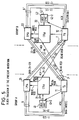
- FIG. 6 shows the control circuit in detail used for the present invention.
- FIG. 7 shows a truth table of the flags of the present invention.
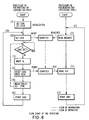
- FIG. 8 shows flow charts for explaining the operation of the present invention.
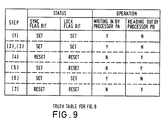
- FIG. 9 shows a truth table corresponding the flow shown in FIG. 8.
- FIG. 5 An embodiment of the present invention is hereinafter described referring to a principle block diagram of FIG. 5, where the multiprocessor system is composed of two processors 11 (PA) and 12 (PB) shown as representatives of a plurality of processors.
- Each processor PA and PB has own local memory LMA and LMB respectively.
- the term “own” is used to mean “belonging to the same group", i.e. in other words “accessable without using a network”.
- a term “other” is hereinafter used to mean the contrary meaning of the "own”.
- the memory LMA of the group A is accessed from the own processor PA and also from the processor PB of the other group B, thus the memory is shared by the two processors.
- a control circuit 31 having a set (41) of flag bits, one named a LOCK bit another one named a SYNC bit, are provided in the group A, for controlling the transfer of an access request from the processor PA or PB to the memory LMA.
- CTLA control circuit 31
- a second control circuit 32 having a set of flag bits (42) is provided in the group B, for controlling the transfer of an access request from the processor PA or PB to the memory LMB. Function of the control circuits and the flag bits shall be described in detail later on.
- Communication means 6 between the processors PA (or PB) and each own local memory LMA (or LMB) are composed of: data buses 11-21D, 12-22D, for each processor PA, PB to write a data into each own memory LMA, LMB; and access control lines 21-11C, 22-12C, each for delivering an acknowledge signal ACK to each request source PA, PB.
- Communication means 7 between the processor PA (or PB) and the memories LMB (or LMA) of their respectively opposite groups are composed of: data buses 21-12D, 22-11D, for each processor PB, PA to read a data out of their respectively opposite group's memory LMA, LMB; access control lines 21-12C, 22-11C, each for delivering an acknowledge signal ACK to each request source PB, PA; and access control lines 11-32C, 12-31C, each for delivering a read request signal "Read REQ" from each other processor PB, PA to each own control circuit CTLA, CTLB.
- control circuit 31 or 32 CTLA or CTLB
- flag bits 41 or 42
- FIG. 6 A typical structure of the control circuit 31 or 32 (CTLA or CTLB) and the flag bits 41 (or 42) are shown in FIG. 6, and its truth table is shown in FIG. 7, where a positive logic is employed.
- the control circuit CTLA 31 (or CTLB 32) is composed of AND gates 3a, 3b, 3c and a delay circuit 3d.
- the flag bit 41 is composed of widely used memory devices, such as flip-flops, one, 41-1, for the LOCK bit and one, 41-2, for the SYNC bit.
- the AND gate 3a is gated by the LOCK bit as well as the SYNC bit.
- One of the input terminals of the AND gate 3c is gated by the read request signal "Read REQ” from other processor 12 (PB), because the data transfer is from the own processor 11 (PA) to the other processor 12 (PB).
- One of the input terminals of the AND gate 3b is gated by the write request signal "Write REQ” from the own processor 11 (PA).
- the delay circuit 3d formed of widely used delay device to produce a predetermined delay time, which is equivalent to the time required for finishing reading a data to be transferred by a single operation. Accordingly, the SYNC bit 41-2 is automatically set as soon as the reading is finished.
- the control circuit CTLA and the flag bits operate as shown in the truth table of FIG. 7, where "Y" indicates that the request is permitted and "N" indicates that the request is inhibitted.
- the A group includes the processors 11 (PA), the memory 21 (LMA), the circuit control and 31 (CTLA) and its flag bits 41
- the B group includes the processors 12 (PB), the memory 22 (LMB), the control circuit 32 (CTLB) and its flag bits 42, as described below and shown in FIG. 8.
- the numerals for the procedure steps are also cited in the flow charts of FIG. 8. Dotted lines in FIG. 8 show "flows" of the flag information.
- the local memory LMA is written in exclusively by the own processor PA as well as readed out exclusively by the processor PB of the other group B, it is apparently possible for the reverse case where the local memory LMB is readed out by the own processor PA as well as written in by the processor PB of its own group B.
- each group may be provided with a plurality of the sets of flag bits, wherein each set communicates with a corresponding one of a plurality of the processors.
- control circuit 31 of FIG. 6 is referred to as a typical sample, any other circuit configuration which achieves the above-described function can be used in place of the circuit shown in FIG. 6.
- the software can be perfectly free from the job for synchronization, because the processor can be waited by inhibitting the access request signal, resulting in a reduced network traffic, that is, a high-speed operation, and
Landscapes
- Engineering & Computer Science (AREA)
- Theoretical Computer Science (AREA)
- Computer Hardware Design (AREA)
- Physics & Mathematics (AREA)
- Software Systems (AREA)
- General Engineering & Computer Science (AREA)
- General Physics & Mathematics (AREA)
- Mathematical Physics (AREA)
- Multi Processors (AREA)
Claims (5)
- Multiprozessor-System mit wenigstens zwei Gruppen (A:B), die über ein Netz zur Ausführung einer Datenkommunikation zwischen den Gruppen verbunden sind, wobei jede Gruppe umfaßt:- einen Prozessor (11; 12);- einen Speicher (LMA, 21; LMB, 22) auf den zugegriffen werden soll, d.h. aus dem oder in den durch den Prozessor (11; 12) der Gruppe (A; B) oder durch den Prozessor (12; 11) der anderen Gruppe (B; A) gelesen oder geschrieben wird;- eine erste Speichereinrichtung (SPERR, 41-1; SPERR, 42-1) zum Sperren des Zugriffs von dem Prozessor (12; 11) der anderen Gruppe (B; A), während der Prozessor (11; 12) der Gruppe (A; B) gerade auf den Speicher (LMA, 21; LMB, 22) der Gruppe (A; B) zugreift;- eine zweite Speichereinrichtung (SYNC, 41-2; SYNC, 42-2) zum Annehmen einer Zugriffsanfrage von dem Prozessor (12; 11) der anderen Gruppe (B; A) und zum Sperren eines Zugriffs von dem Prozessor (11; 12) der Gruppe (A; B); und- eine Steuerschaltung (CTLA, 31; CTLB, 32) zum Steuern des Zugriffs auf den Speicher (LMA, 21; LMB, 22) durch die Verwendung der ersten und zweiten Speichereinrichtungen (SPERR, 41-1, SYNC, 41-2; SPERR, 42-1, SYNC, 42-2) der Gruppe (A; B) und nur eines Zugriffs-Anfragesignals des Prozessors (12; 11) der anderen Gruppe (B; A),wobei die Datenkommunikation durch die Verwendung des Speichers (LMA, 21; LMB, 22) der Gruppe (A; B) durchgeführt wird.
- Mikroprozessorsystem nach Anspruch 1, dadurch gekennzeichnet, daß- die erste Speichereinrichtung (SPERR, 41-1; SPERR, 42-1) gesetzt wird, wenn der Prozessor (11; 12) der Gruppe (A; B) gerade auf den Speicher (LMA, 21; LMB, 22) der Gruppe (A; B) zugreift;- die erste Speichereinrichtung (SPERR, 41-1; SPERR, 42-1) und die zweite Speichereinrichtung (SYNC, 41-2; SYNC, 42-2) zurückgesetzt werden, wenn der Zugriff beendet ist; und- die zweite Speichereinrichtung (SYNC, 41-2; SYNC, 41-2) gesetzt wird, wenn ein Zugriff des Prozessors (12; 11) der anderen Gruppe (B; A) auf den Speicher (LMA, 21; LMB, 22) der Gruppe (A; B) beendet ist, wobei der Zugriff durch die Steuerschaltung (CTLA, 31; CTLB, 32) angenommen worden ist, da die ersten und zweiten Speichereinrichtungen (SPERR, 41-1, SYNC, 41-2; SPERR, 42-1, SYNC, 42-2) zurückgesetzt worden sind.
- Mikroprozessorsystem nach Anspruch 2, dadurch gekennzeichnet, daß die zweite Speichereinrichtung (SYNC, 41-2; SYNC, 42-2) bei einer vorgegebenen Verzögerungszeit nach dem Zugriff des Prozessors (12; 11) der anderen Gruppe (B; A) auf den Speicher (LMA, 21; LMB, 22) der Gruppe (A; B) beendet ist, gesetzt wird.
- Mikroprozessorsystem nach einem der vorangehenden Ansprüche, dadurch gekennzeichnet, daß der Speicher (LMA, 21; LMB, 22) der Gruppe (A; B) nur von dem Prozessor (11; 12) der Gruppe (A; B) beschrieben wird und nur von dem Prozessor (12; 11) der anderen Gruppe (B; A) ausgelesen wird.
- Mikroprozessorsystem nach Anspruch 4, dadurch gekennzeichnet, daß der Prozessor (12; 11) der anderen Gruppe (B; A) den Speicher (LMA, 21; LMB, 22) der Gruppe (A; B) durch eine Leseanfrage (LESE-RQ) über das Netz liest.
Applications Claiming Priority (2)
| Application Number | Priority Date | Filing Date | Title |
|---|---|---|---|
| JP165731/86 | 1986-07-15 | ||
| JP61165731A JPH0731662B2 (ja) | 1986-07-15 | 1986-07-15 | マルチプロセッサシステム |
Publications (3)
| Publication Number | Publication Date |
|---|---|
| EP0254960A2 EP0254960A2 (de) | 1988-02-03 |
| EP0254960A3 EP0254960A3 (de) | 1991-06-05 |
| EP0254960B1 true EP0254960B1 (de) | 1995-01-04 |
Family
ID=15818000
Family Applications (1)
| Application Number | Title | Priority Date | Filing Date |
|---|---|---|---|
| EP87110224A Expired - Lifetime EP0254960B1 (de) | 1986-07-15 | 1987-07-15 | Multiprozessorsystem |
Country Status (5)
| Country | Link |
|---|---|
| US (1) | US4975833A (de) |
| EP (1) | EP0254960B1 (de) |
| JP (1) | JPH0731662B2 (de) |
| CA (1) | CA1291827C (de) |
| DE (1) | DE3750938T2 (de) |
Families Citing this family (39)
| Publication number | Priority date | Publication date | Assignee | Title |
|---|---|---|---|---|
| JPS6481066A (en) * | 1987-09-24 | 1989-03-27 | Nec Corp | Connection system for multi-processor |
| US5050072A (en) * | 1988-06-17 | 1991-09-17 | Modular Computer Systems, Inc. | Semaphore memory to reduce common bus contention to global memory with localized semaphores in a multiprocessor system |
| JPH02105252A (ja) * | 1988-10-14 | 1990-04-17 | Nec Corp | ロック処理方式 |
| JP2519798B2 (ja) * | 1989-05-30 | 1996-07-31 | 富士通株式会社 | 多重プロセッサシステムにおけるシリアライズ機能の検証方式 |
| US5331538A (en) * | 1989-10-23 | 1994-07-19 | Pitney Bowes Inc. | Mail processing system controller |
| JP3222125B2 (ja) * | 1990-01-29 | 2001-10-22 | 株式会社日立製作所 | システム間データベース共用方式 |
| US5276847A (en) * | 1990-02-14 | 1994-01-04 | Intel Corporation | Method for locking and unlocking a computer address |
| JP2511588B2 (ja) * | 1990-09-03 | 1996-06-26 | インターナショナル・ビジネス・マシーンズ・コーポレイション | デ―タ処理ネットワ―ク、ロックを獲得させる方法及び直列化装置 |
| US5339397A (en) * | 1990-10-12 | 1994-08-16 | International Business Machines Corporation | Hardware primary directory lock |
| JPH05274273A (ja) * | 1991-06-28 | 1993-10-22 | Digital Equip Corp <Dec> | コンピュータ・システムに於ける素子のインターロック・スキーム |
| US5430860A (en) * | 1991-09-17 | 1995-07-04 | International Business Machines Inc. | Mechanism for efficiently releasing memory lock, after allowing completion of current atomic sequence |
| US5283870A (en) * | 1991-10-04 | 1994-02-01 | Bull Hn Information Systems Inc. | Method and apparatus for avoiding processor deadly embrace in a multiprocessor system |
| US5386525A (en) * | 1991-10-29 | 1995-01-31 | Pacific Bell | System for providing application programs with direct addressability into a shared dataspace |
| US5261106A (en) * | 1991-12-13 | 1993-11-09 | S-Mos Systems, Inc. | Semaphore bypass |
| US5392433A (en) * | 1992-09-25 | 1995-02-21 | International Business Machines Corporation | Method and apparatus for intraprocess locking of a shared resource in a computer system |
| US5317749A (en) * | 1992-09-25 | 1994-05-31 | International Business Machines Corporation | Method and apparatus for controlling access by a plurality of processors to a shared resource |
| US5440746A (en) * | 1992-11-06 | 1995-08-08 | Seiko Epson Corporation | System and method for synchronizing processors in a parallel processing environment |
| US5522029A (en) * | 1993-04-23 | 1996-05-28 | International Business Machines Corporation | Fault tolerant rendezvous and semaphore for multiple parallel processors |
| US5535116A (en) * | 1993-05-18 | 1996-07-09 | Stanford University | Flat cache-only multi-processor architectures |
| US5450595A (en) * | 1994-02-15 | 1995-09-12 | International Business Machines Corporation | Multiple hash tables based on access frequency |
| US5675743A (en) * | 1995-02-22 | 1997-10-07 | Callisto Media Systems Inc. | Multi-media server |
| US5893160A (en) * | 1996-04-08 | 1999-04-06 | Sun Microsystems, Inc. | Deterministic distributed multi-cache coherence method and system |
| US5983326A (en) * | 1996-07-01 | 1999-11-09 | Sun Microsystems, Inc. | Multiprocessing system including an enhanced blocking mechanism for read-to-share-transactions in a NUMA mode |
| JPH10134008A (ja) * | 1996-11-05 | 1998-05-22 | Mitsubishi Electric Corp | 半導体装置およびコンピュータシステム |
| US6381657B2 (en) * | 1997-01-31 | 2002-04-30 | Hewlett-Packard Company | Sharing list for multi-node DMA write operations |
| US6574720B1 (en) | 1997-05-30 | 2003-06-03 | Oracle International Corporation | System for maintaining a buffer pool |
| US6324623B1 (en) | 1997-05-30 | 2001-11-27 | Oracle Corporation | Computing system for implementing a shared cache |
| US6078994A (en) * | 1997-05-30 | 2000-06-20 | Oracle Corporation | System for maintaining a shared cache in a multi-threaded computer environment |
| US5946711A (en) * | 1997-05-30 | 1999-08-31 | Oracle Corporation | System for locking data in a shared cache |
| US6134636A (en) * | 1997-12-31 | 2000-10-17 | Intel Corporation | Method and apparatus for storing data in a memory array |
| US6501480B1 (en) * | 1998-11-09 | 2002-12-31 | Broadcom Corporation | Graphics accelerator |
| US6823511B1 (en) * | 2000-01-10 | 2004-11-23 | International Business Machines Corporation | Reader-writer lock for multiprocessor systems |
| US7500036B2 (en) * | 2000-12-28 | 2009-03-03 | International Business Machines Corporation | Quad aware locking primitive |
| US6657632B2 (en) * | 2001-01-24 | 2003-12-02 | Hewlett-Packard Development Company, L.P. | Unified memory distributed across multiple nodes in a computer graphics system |
| FR2842744B1 (fr) * | 2002-07-24 | 2006-06-30 | Michel Desroses | Dispositif de detection de la nature d'un coup et de mesure de sa force, procede pour ca mise en oeuvre et son application a l'arbitrage d'un sport |
| US7629979B2 (en) * | 2003-08-20 | 2009-12-08 | Hewlett-Packard Development Company, L.P. | System and method for communicating information from a single-threaded application over multiple I/O busses |
| US7428619B2 (en) * | 2005-01-18 | 2008-09-23 | Sony Computer Entertainment Inc. | Methods and apparatus for providing synchronization of shared data |
| US10055477B2 (en) * | 2012-06-26 | 2018-08-21 | Toshiba Mitsubishi-Electric Industrial Systems Corporation | Data collection apparatus and data collection program |
| US9990131B2 (en) * | 2014-09-22 | 2018-06-05 | Xilinx, Inc. | Managing memory in a multiprocessor system |
Family Cites Families (19)
| Publication number | Priority date | Publication date | Assignee | Title |
|---|---|---|---|---|
| JPS49114845A (de) * | 1973-02-28 | 1974-11-01 | ||
| JPS5036041A (de) * | 1973-07-11 | 1975-04-04 | ||
| US4121285A (en) * | 1977-04-01 | 1978-10-17 | Ultronic Systems Corporation | Automatic alternator for priority circuit |
| DE2911909C2 (de) * | 1978-03-29 | 1984-03-15 | British Broadcasting Corp., London | Digitales Datenverarbeitungsgerät |
| FR2431733A1 (fr) * | 1978-07-21 | 1980-02-15 | Sfena | Systeme de communication par memoire commune dans un calculateur comprenant plusieurs processeurs |
| JPS5839360A (ja) * | 1981-09-01 | 1983-03-08 | Toshiba Corp | メモリ−アクセス方式 |
| US4453214A (en) * | 1981-09-08 | 1984-06-05 | Sperry Corporation | Bus arbitrating circuit |
| JPS5887645A (ja) * | 1981-11-20 | 1983-05-25 | Hitachi Ltd | 計算機間交信方式 |
| JPS58129567A (ja) * | 1982-01-27 | 1983-08-02 | Nec Corp | マルチシステム制御装置 |
| JPS58140862A (ja) * | 1982-02-16 | 1983-08-20 | Toshiba Corp | 相互排他方式 |
| US4574350A (en) * | 1982-05-19 | 1986-03-04 | At&T Bell Laboratories | Shared resource locking apparatus |
| US4764865A (en) * | 1982-06-21 | 1988-08-16 | International Business Machines Corp. | Circuit for allocating memory cycles to two processors that share memory |
| JPS5991563A (ja) * | 1982-11-18 | 1984-05-26 | Nec Corp | 共通メモリ装置 |
| US4724517A (en) * | 1982-11-26 | 1988-02-09 | Inmos Limited | Microcomputer with prefixing functions |
| FR2536883A1 (fr) * | 1982-11-26 | 1984-06-01 | Thomson Csf | Procede et dispositif de coordination des transferts d'informations numeriques entre des unites de traitement de donnees emettrice et receptrice interconnectees par un canal de transmission asynchrone |
| JPS59229662A (ja) * | 1983-06-10 | 1984-12-24 | Hitachi Micro Comput Eng Ltd | 共有メモリ制御回路 |
| US4620278A (en) * | 1983-08-29 | 1986-10-28 | Sperry Corporation | Distributed bus arbitration according each bus user the ability to inhibit all new requests to arbitrate the bus, or to cancel its own pending request, and according the highest priority user the ability to stop the bus |
| JPS60246470A (ja) * | 1984-05-21 | 1985-12-06 | Anritsu Corp | コンピユ−タシステム |
| JPS60245063A (ja) * | 1984-05-21 | 1985-12-04 | Fujitsu Ltd | 共用メモリアクセス方式 |
-
1986
- 1986-07-15 JP JP61165731A patent/JPH0731662B2/ja not_active Expired - Lifetime
-
1987
- 1987-07-14 CA CA000542012A patent/CA1291827C/en not_active Expired - Lifetime
- 1987-07-15 DE DE3750938T patent/DE3750938T2/de not_active Expired - Fee Related
- 1987-07-15 EP EP87110224A patent/EP0254960B1/de not_active Expired - Lifetime
-
1989
- 1989-11-08 US US07/433,433 patent/US4975833A/en not_active Expired - Lifetime
Also Published As
| Publication number | Publication date |
|---|---|
| EP0254960A3 (de) | 1991-06-05 |
| JPH0731662B2 (ja) | 1995-04-10 |
| DE3750938T2 (de) | 1995-06-14 |
| US4975833A (en) | 1990-12-04 |
| JPS6320652A (ja) | 1988-01-28 |
| CA1291827C (en) | 1991-11-05 |
| EP0254960A2 (de) | 1988-02-03 |
| DE3750938D1 (de) | 1995-02-16 |
Similar Documents
| Publication | Publication Date | Title |
|---|---|---|
| EP0254960B1 (de) | Multiprozessorsystem | |
| US5301279A (en) | Apparatus for conditioning priority arbitration | |
| US4001790A (en) | Modularly addressable units coupled in a data processing system over a common bus | |
| US4991079A (en) | Real-time data processing system | |
| US3993981A (en) | Apparatus for processing data transfer requests in a data processing system | |
| US3997896A (en) | Data processing system providing split bus cycle operation | |
| US4000485A (en) | Data processing system providing locked operation of shared resources | |
| US4030075A (en) | Data processing system having distributed priority network | |
| US5941964A (en) | Bridge buffer management by bridge interception of synchronization events | |
| CA2062909C (en) | Multiprocessor system and data transmission apparatus thereof | |
| US6115761A (en) | First-In-First-Out (FIFO) memories having dual descriptors and credit passing for efficient access in a multi-processor system environment | |
| US5666515A (en) | Information processing system having multiple modules and a memory on a bus, where any module can lock an addressable portion of the memory by sending retry signals to other modules that try to read at the locked address | |
| US5032985A (en) | Multiprocessor system with memory fetch buffer invoked during cross-interrogation | |
| US6175888B1 (en) | Dual host bridge with peer to peer support | |
| US5682551A (en) | System for checking the acceptance of I/O request to an interface using software visible instruction which provides a status signal and performs operations in response thereto | |
| KR970029014A (ko) | 데이타 프로세싱 시스템 및 방법 | |
| US6944684B1 (en) | System for selectively using different communication paths to transfer data between controllers in a disk array in accordance with data transfer size | |
| US5835714A (en) | Method and apparatus for reservation of data buses between multiple storage control elements | |
| US5155807A (en) | Multi-processor communications channel utilizing random access/sequential access memories | |
| US20010047439A1 (en) | Efficient implementation of first-in-first-out memories for multi-processor systems | |
| US5581732A (en) | Multiprocessor system with reflective memory data transfer device | |
| GB1595471A (en) | Computer system | |
| US4494186A (en) | Automatic data steering and data formatting mechanism | |
| JPS602710B2 (ja) | 複合計算機システム | |
| JP3162459B2 (ja) | データ処理装置 |
Legal Events
| Date | Code | Title | Description |
|---|---|---|---|
| PUAI | Public reference made under article 153(3) epc to a published international application that has entered the european phase |
Free format text: ORIGINAL CODE: 0009012 |
|
| AK | Designated contracting states |
Kind code of ref document: A2 Designated state(s): DE FR GB |
|
| PUAL | Search report despatched |
Free format text: ORIGINAL CODE: 0009013 |
|
| AK | Designated contracting states |
Kind code of ref document: A3 Designated state(s): DE FR GB |
|
| 17P | Request for examination filed |
Effective date: 19910729 |
|
| 17Q | First examination report despatched |
Effective date: 19920306 |
|
| GRAA | (expected) grant |
Free format text: ORIGINAL CODE: 0009210 |
|
| AK | Designated contracting states |
Kind code of ref document: B1 Designated state(s): DE FR GB |
|
| REF | Corresponds to: |
Ref document number: 3750938 Country of ref document: DE Date of ref document: 19950216 |
|
| ET | Fr: translation filed | ||
| PLBE | No opposition filed within time limit |
Free format text: ORIGINAL CODE: 0009261 |
|
| STAA | Information on the status of an ep patent application or granted ep patent |
Free format text: STATUS: NO OPPOSITION FILED WITHIN TIME LIMIT |
|
| 26N | No opposition filed | ||
| REG | Reference to a national code |
Ref country code: GB Ref legal event code: IF02 |
|
| PGFP | Annual fee paid to national office [announced via postgrant information from national office to epo] |
Ref country code: FR Payment date: 20020709 Year of fee payment: 16 |
|
| PGFP | Annual fee paid to national office [announced via postgrant information from national office to epo] |
Ref country code: GB Payment date: 20020710 Year of fee payment: 16 |
|
| PGFP | Annual fee paid to national office [announced via postgrant information from national office to epo] |
Ref country code: DE Payment date: 20020724 Year of fee payment: 16 |
|
| PG25 | Lapsed in a contracting state [announced via postgrant information from national office to epo] |
Ref country code: GB Free format text: LAPSE BECAUSE OF NON-PAYMENT OF DUE FEES Effective date: 20030715 |
|
| PG25 | Lapsed in a contracting state [announced via postgrant information from national office to epo] |
Ref country code: DE Free format text: LAPSE BECAUSE OF NON-PAYMENT OF DUE FEES Effective date: 20040203 |
|
| GBPC | Gb: european patent ceased through non-payment of renewal fee |
Effective date: 20030715 |
|
| PG25 | Lapsed in a contracting state [announced via postgrant information from national office to epo] |
Ref country code: FR Free format text: LAPSE BECAUSE OF NON-PAYMENT OF DUE FEES Effective date: 20040331 |
|
| REG | Reference to a national code |
Ref country code: FR Ref legal event code: ST |