EP0255202A2 - Umhüllte Garne mit Bindegarnen mit niedrigem Verschmelzpunkt, damit versehene Florgewebe und Fabrikationsverfahren - Google Patents
Umhüllte Garne mit Bindegarnen mit niedrigem Verschmelzpunkt, damit versehene Florgewebe und Fabrikationsverfahren Download PDFInfo
- Publication number
- EP0255202A2 EP0255202A2 EP19870304099 EP87304099A EP0255202A2 EP 0255202 A2 EP0255202 A2 EP 0255202A2 EP 19870304099 EP19870304099 EP 19870304099 EP 87304099 A EP87304099 A EP 87304099A EP 0255202 A2 EP0255202 A2 EP 0255202A2
- Authority
- EP
- European Patent Office
- Prior art keywords
- strand
- binder
- pile
- fabric
- yarns
- Prior art date
- Legal status (The legal status is an assumption and is not a legal conclusion. Google has not performed a legal analysis and makes no representation as to the accuracy of the status listed.)
- Withdrawn
Links
- 239000004744 fabric Substances 0.000 title claims abstract description 165
- 239000011230 binding agent Substances 0.000 title claims abstract description 117
- 238000000034 method Methods 0.000 title claims description 18
- 239000000835 fiber Substances 0.000 claims abstract description 49
- 238000002844 melting Methods 0.000 claims abstract description 29
- 230000008018 melting Effects 0.000 claims abstract description 29
- 239000000463 material Substances 0.000 claims abstract description 26
- 229920001169 thermoplastic Polymers 0.000 claims abstract description 11
- 238000004519 manufacturing process Methods 0.000 claims description 12
- 238000005520 cutting process Methods 0.000 claims description 8
- 229920001577 copolymer Polymers 0.000 claims description 7
- 230000001680 brushing effect Effects 0.000 claims description 4
- 238000010008 shearing Methods 0.000 claims description 4
- 229920002972 Acrylic fiber Polymers 0.000 claims description 3
- 229920001634 Copolyester Polymers 0.000 claims description 3
- 239000004952 Polyamide Substances 0.000 claims description 3
- 239000004743 Polypropylene Substances 0.000 claims description 3
- 239000000155 melt Substances 0.000 claims description 3
- 229920002647 polyamide Polymers 0.000 claims description 3
- 229920000728 polyester Polymers 0.000 claims description 3
- -1 polypropylene Polymers 0.000 claims description 3
- 229920001155 polypropylene Polymers 0.000 claims description 3
- 239000004831 Hot glue Substances 0.000 claims 6
- 239000012815 thermoplastic material Substances 0.000 claims 3
- 230000002040 relaxant effect Effects 0.000 claims 1
- 239000004416 thermosoftening plastic Substances 0.000 abstract description 2
- 235000004879 dioscorea Nutrition 0.000 abstract 3
- 229920000642 polymer Polymers 0.000 abstract 1
- 238000009941 weaving Methods 0.000 description 6
- 238000011282 treatment Methods 0.000 description 4
- 230000000694 effects Effects 0.000 description 3
- 229920000742 Cotton Polymers 0.000 description 2
- 238000010586 diagram Methods 0.000 description 2
- 230000004927 fusion Effects 0.000 description 2
- 238000010438 heat treatment Methods 0.000 description 2
- 235000002566 Capsicum Nutrition 0.000 description 1
- 239000006002 Pepper Substances 0.000 description 1
- 235000016761 Piper aduncum Nutrition 0.000 description 1
- 235000017804 Piper guineense Nutrition 0.000 description 1
- 244000203593 Piper nigrum Species 0.000 description 1
- 235000008184 Piper nigrum Nutrition 0.000 description 1
- 239000000853 adhesive Substances 0.000 description 1
- 230000001070 adhesive effect Effects 0.000 description 1
- 239000002998 adhesive polymer Substances 0.000 description 1
- 238000010276 construction Methods 0.000 description 1
- 238000002788 crimping Methods 0.000 description 1
- 230000006866 deterioration Effects 0.000 description 1
- 230000002708 enhancing effect Effects 0.000 description 1
- 239000000675 fabric finishing Substances 0.000 description 1
- 230000002349 favourable effect Effects 0.000 description 1
- 239000012467 final product Substances 0.000 description 1
- 238000009962 finishing (textile) Methods 0.000 description 1
- 238000007730 finishing process Methods 0.000 description 1
- 239000002861 polymer material Substances 0.000 description 1
- 150000003839 salts Chemical class 0.000 description 1
- 229920002994 synthetic fiber Polymers 0.000 description 1
- 239000012209 synthetic fiber Substances 0.000 description 1
- 239000004753 textile Substances 0.000 description 1
- 210000002268 wool Anatomy 0.000 description 1
Images

Classifications
-
- D—TEXTILES; PAPER
- D03—WEAVING
- D03D—WOVEN FABRICS; METHODS OF WEAVING; LOOMS
- D03D27/00—Woven pile fabrics
-
- D—TEXTILES; PAPER
- D02—YARNS; MECHANICAL FINISHING OF YARNS OR ROPES; WARPING OR BEAMING
- D02G—CRIMPING OR CURLING FIBRES, FILAMENTS, THREADS, OR YARNS; YARNS OR THREADS
- D02G3/00—Yarns or threads, e.g. fancy yarns; Processes or apparatus for the production thereof, not otherwise provided for
- D02G3/22—Yarns or threads characterised by constructional features, e.g. blending, filament/fibre
- D02G3/38—Threads in which fibres, filaments, or yarns are wound with other yarns or filaments, e.g. wrap yarns, i.e. strands of filaments or staple fibres are wrapped by a helically wound binder yarn
-
- D—TEXTILES; PAPER
- D03—WEAVING
- D03D—WOVEN FABRICS; METHODS OF WEAVING; LOOMS
- D03D27/00—Woven pile fabrics
- D03D27/02—Woven pile fabrics wherein the pile is formed by warp or weft
- D03D27/10—Fabrics woven face-to-face, e.g. double velvet
-
- Y—GENERAL TAGGING OF NEW TECHNOLOGICAL DEVELOPMENTS; GENERAL TAGGING OF CROSS-SECTIONAL TECHNOLOGIES SPANNING OVER SEVERAL SECTIONS OF THE IPC; TECHNICAL SUBJECTS COVERED BY FORMER USPC CROSS-REFERENCE ART COLLECTIONS [XRACs] AND DIGESTS
- Y10—TECHNICAL SUBJECTS COVERED BY FORMER USPC
- Y10T—TECHNICAL SUBJECTS COVERED BY FORMER US CLASSIFICATION
- Y10T428/00—Stock material or miscellaneous articles
- Y10T428/23907—Pile or nap type surface or component
- Y10T428/23957—Particular shape or structure of pile
-
- Y—GENERAL TAGGING OF NEW TECHNOLOGICAL DEVELOPMENTS; GENERAL TAGGING OF CROSS-SECTIONAL TECHNOLOGIES SPANNING OVER SEVERAL SECTIONS OF THE IPC; TECHNICAL SUBJECTS COVERED BY FORMER USPC CROSS-REFERENCE ART COLLECTIONS [XRACs] AND DIGESTS
- Y10—TECHNICAL SUBJECTS COVERED BY FORMER USPC
- Y10T—TECHNICAL SUBJECTS COVERED BY FORMER US CLASSIFICATION
- Y10T428/00—Stock material or miscellaneous articles
- Y10T428/23907—Pile or nap type surface or component
- Y10T428/23957—Particular shape or structure of pile
- Y10T428/23964—U-, V-, or W-shaped or continuous strand, filamentary material
-
- Y—GENERAL TAGGING OF NEW TECHNOLOGICAL DEVELOPMENTS; GENERAL TAGGING OF CROSS-SECTIONAL TECHNOLOGIES SPANNING OVER SEVERAL SECTIONS OF THE IPC; TECHNICAL SUBJECTS COVERED BY FORMER USPC CROSS-REFERENCE ART COLLECTIONS [XRACs] AND DIGESTS
- Y10—TECHNICAL SUBJECTS COVERED BY FORMER USPC
- Y10T—TECHNICAL SUBJECTS COVERED BY FORMER US CLASSIFICATION
- Y10T428/00—Stock material or miscellaneous articles
- Y10T428/23907—Pile or nap type surface or component
- Y10T428/23957—Particular shape or structure of pile
- Y10T428/23964—U-, V-, or W-shaped or continuous strand, filamentary material
- Y10T428/23971—Continuous strand with adhesive bond to backing
-
- Y—GENERAL TAGGING OF NEW TECHNOLOGICAL DEVELOPMENTS; GENERAL TAGGING OF CROSS-SECTIONAL TECHNOLOGIES SPANNING OVER SEVERAL SECTIONS OF THE IPC; TECHNICAL SUBJECTS COVERED BY FORMER USPC CROSS-REFERENCE ART COLLECTIONS [XRACs] AND DIGESTS
- Y10—TECHNICAL SUBJECTS COVERED BY FORMER USPC
- Y10T—TECHNICAL SUBJECTS COVERED BY FORMER US CLASSIFICATION
- Y10T428/00—Stock material or miscellaneous articles
- Y10T428/23907—Pile or nap type surface or component
- Y10T428/23986—With coating, impregnation, or bond
-
- Y—GENERAL TAGGING OF NEW TECHNOLOGICAL DEVELOPMENTS; GENERAL TAGGING OF CROSS-SECTIONAL TECHNOLOGIES SPANNING OVER SEVERAL SECTIONS OF THE IPC; TECHNICAL SUBJECTS COVERED BY FORMER USPC CROSS-REFERENCE ART COLLECTIONS [XRACs] AND DIGESTS
- Y10—TECHNICAL SUBJECTS COVERED BY FORMER USPC
- Y10T—TECHNICAL SUBJECTS COVERED BY FORMER US CLASSIFICATION
- Y10T428/00—Stock material or miscellaneous articles
- Y10T428/23907—Pile or nap type surface or component
- Y10T428/23993—Composition of pile or adhesive
-
- Y—GENERAL TAGGING OF NEW TECHNOLOGICAL DEVELOPMENTS; GENERAL TAGGING OF CROSS-SECTIONAL TECHNOLOGIES SPANNING OVER SEVERAL SECTIONS OF THE IPC; TECHNICAL SUBJECTS COVERED BY FORMER USPC CROSS-REFERENCE ART COLLECTIONS [XRACs] AND DIGESTS
- Y10—TECHNICAL SUBJECTS COVERED BY FORMER USPC
- Y10T—TECHNICAL SUBJECTS COVERED BY FORMER US CLASSIFICATION
- Y10T428/00—Stock material or miscellaneous articles
- Y10T428/29—Coated or structually defined flake, particle, cell, strand, strand portion, rod, filament, macroscopic fiber or mass thereof
-
- Y—GENERAL TAGGING OF NEW TECHNOLOGICAL DEVELOPMENTS; GENERAL TAGGING OF CROSS-SECTIONAL TECHNOLOGIES SPANNING OVER SEVERAL SECTIONS OF THE IPC; TECHNICAL SUBJECTS COVERED BY FORMER USPC CROSS-REFERENCE ART COLLECTIONS [XRACs] AND DIGESTS
- Y10—TECHNICAL SUBJECTS COVERED BY FORMER USPC
- Y10T—TECHNICAL SUBJECTS COVERED BY FORMER US CLASSIFICATION
- Y10T428/00—Stock material or miscellaneous articles
- Y10T428/29—Coated or structually defined flake, particle, cell, strand, strand portion, rod, filament, macroscopic fiber or mass thereof
- Y10T428/2913—Rod, strand, filament or fiber
- Y10T428/2933—Coated or with bond, impregnation or core
- Y10T428/2936—Wound or wrapped core or coating [i.e., spiral or helical]
Definitions
- the present invention relates to the structure and manufacture of cut pile fabrics and to yarns used to make such fabrics.
- Cut pile fabrics have a variety of applications for which they are particularly suitable.
- the term "cut pile fabric” refers to a fabric which comprises a ground fabric into which are positioned upwardly facing cut pile tufts.
- a number of methods for producing such fabrics are well known and include cutting loop pile tufts to thereby produce cut pile or by plush weaving techniques wherein upper and lower ground fabrics are woven and are interconnected by pile yarns extending therebetween. By cutting the pile yarns between the two fabrics, a resulting cut pile face can be produced on each fabric.
- wrap yarns are formed by wrapping a binder strand, usually made up of one or more continuous synthetic filaments, around an untwisted body strand produced from staple fibers. Because the binder strand imparts structural integrity to the entire wrap yarn, no twist is necessary in the body strand. When used to form the upstanding pile portions of a cut pile fabric, wrap yarns provide good surface coverage and appearance. The untwisted characteristics of the body strands allows the cut faces of the staple fibers to blossom or spread apart to a greater degree and enhance their surface coverage.
- cut pile fabrics made from such wrap yarns also suffer from particular disadvantages characteristic of their nature and construction.
- One serious problem arises from the differences between the fiber characteristics of the body strand and those of the binder strand.
- the body strand is formed from staple fibers of particular individual or blended character and the binder strand is typically formed of continuous filaments of a different fiber having a different character. Accordingly, obtaining a consistent, identical color for the binder and body strands is almost impossible even where the wrap yarn or fabric made from it is piece dyed.
- a second problem characteristic of such fabrics is that the low twist characteristics of the body strand which are so favorable in the final product can cause handling problems during the process or finishing steps in forming the fabric.
- the staple fibers of the body strand essentially have no twist, they are characteristically held together by binder strands which, as stated above, are typically present less than 10 percent by weight.
- binder strands which, as stated above, are typically present less than 10 percent by weight.
- the body strand tufts of the wrap yarns tend to become detached from the ground yarns of the fabric when the wrap yarns are cut to form the piles of a fabric.
- the result is a troublesome loss of the cut pile tufts. If enough of the pile tufts become dislodged from the fabric, the resulting deterioration of the integrity and appearance of the fabric can relegate the fabric to second quality.
- the present invention comprises a cut pile fabric formed of interengaging ground yarns and cut pile tufts formed of wrap yarns extending from the ground yarns to form the face of the fabric.
- Each of the wrap yarns comprises a body strand of untwisted staple fibers and a binder strand helically wrapped around the body strand.
- the binder strand is formed of a thermoplastic polymer having heat-shrinkable and fusible properties and a relatively low melting point of less than about 300° F, at which temperature the staple fibers and ground yarns remain unaffected.
- the binder strands are shrunken and retractably positioned inwardly away from the face of the pile fabric so as to be hidden among the pile tufts and not visible.
- the fabric is heated to the melting point of the binder strand material, which causes the binder strand to be retracted and repositioned inwardly away from the cut face of the pile fabric and to be melted and thereafter resolidified into randomly arranged discrete portions of binder strand material which have no resemblance to a strand.
- Some-of these discrete portions of binder strand material fusibly interconnect some of the staple fibers of the body strands with one another and with the ground yarns.
- the present invention comprises a wrap yarn adapted to be used for forming pile in cut pile fabrics and particular cut pile fabrics formed therefrom.
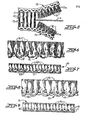
- a cut pile fabric is illustrated in perspective view in Figure 1 and is broadly designated at 10.
- the cut pile tufts which form the face of the fabric are formed of wrap yarns extending from inter-engaging ground yarns to form the face of the fabric.
- each of the wrap yarns comprises a body strand 11 formed of untwisted staple fibers and a textured binder strand 12 helically wrapped around the body strand to form a wrap yarn broadly designated at 13.
- the low-melt binder strand 12 is a crimped textured strand, has extensible and retractable properties, and is formed of a thermoplastic polymer having heat shrinkable and fusible properties and a predetermined relatively low melting point temperature; less than about 300° F. in preferred embodiments.
- the term "low-melt" describes the polymeric materials from which such binder strands can be formed.
- the staple fibers and ground yarns of the pile fabric are formed of materials which remain unaffected at the relatively low melting point of the binder strand.
- the binder strand 12 is wrapped around the body strand 11 in a tensioned condition so as to be axially extended and reduced in bulk compared to the condition the binder strand 12 would assume when relaxed.
- the wrap yarn comprises a crimped textured multifilament binder strand which is preferably formed by false twist crimp texturing to produce its extensible and retractable properties.
- Other methods of producing crimped textured binder strands are also acceptable, such as stuffer box processes, edge-crimping and knit-deknit techniques.
- Appropriate materials for forming the low melt binder strand include commercially available adhesive copolymers of which copolyamides and copolyesters are preferred and which melt and fuse at temperatures of less than about 300° F.
- a binder strand formed from such materials shrinks when subjected to temperatures less than the melting point of the material and melts into randomly arranged discrete portions of binder strand material when subjected to temperatures at or above the relatively low melting point.
- the body strand Various materials for forming the body strand are preferably synthetic fibers such as polyamide, polyester, polypropylene and acrylic fibers.
- the staple fibers may be natural fibers such as wool or cotton, for example.
- the synthetic staple fibers are about two inches in length.
- the wrap yarn will be characterized by binder strands of a size of approximately 40 denier multifilament with 13 filaments each of about 3 denier, and staple fiber body strands of about a 10's count according to the cotton system.
- the binder strands generally comprise between about 3 to 10 percent by weight of the wrap yarn and in preferred embodiments comprise between about 5 to 8 percent by weight of the wrap yarn.
- the invention is not limited, however, to the production of plush pile fabrics, but is useful in many other types of pile fabrics. It will be understood that in other pile fabrics, the yarn sizes of both binder and body strand, and their proportional relationship to one another, can vary widely.
- preferred embodiments of the cut pile fabrics of the present invention can be made by forming a cut pile fabric by plush fabric weaving techniques wherein interengaging ground yarns are woven into upper and lower fabrics with inter-engaging pile yarns extending therebetween.
- the cut pile fabric utilizes the wrap yarns of the present invention for the piles thereof and these piles are cut during the weaving process to form the cut pile fabric.
- the resulting fabric also undergoes backcoating and finishing treatments.
- the finishing of the fabric comprises heating the fabric to a temperature of about 230° F or higher, thereafter brushing the heat softened fabric to orient the fibers more uniformly after which a shearing step levels any fibers of excess height which would otherwise give an uneven appearance to the fabric.
- the fabric is typically backcoated prior to finishing to provide structural integrity during further handling and use.
- the weaving step is designated 20, the loom cutting step 30, the entire finishing step broadly as 40, the backcoating step as 50. Within the broad finishing step 40 are the individual steps of heating 43, then brushing 44, and shearing 45.
- plush pile fabric also preferably includes backcoating.
- backcoating adds necessary structural integrity to the plush fabric.
- Typical backcoating materials found to be appropriate include low melt thermoplastic adhesive polymers. It will be understood that in the production of other types of cut pile fabrics according to the present invention, other finishing techniques may be preferred which may or may not include certain of the specific steps found most suitable for plush fabrics.
- one preferred method of making such pile fabrics comprises forming upper and lower woven ground fabrics, 14 and 15 respectively, by plush fabric weaving techniques.
- the pile yarns extending between the upper and lower fabrics are wrap yarns of this invention.
- each of the wrap yarns which make up the piles comprises a body strand of untwisted staple fibers and a low-melt crimped textured binder strand having extensible and retractable properties and formed from a fusible thermoplastic polymer having a relatively low melting point of less than about 300° F.
- the binder strand 12 of the wrap yarn 13 is helically wrapped around the body strand 11 in a tensioned condition so as to be axially extended and reduced in bulk compared to the condition the crimped textured binder strand 12 would assume when relaxed.
- the upper and lower ground fabrics 14 and 15 are separated from one another by cutting the interconnecting pile yarns therebetween using a cutter C so as to form pile tufts 16 on the face of each of the separated pile fabrics 14 and 15.
- cutting the pile yarns 13 relaxes the tensioned condition of the crimp textured binder strands 12 and causes the binder strands to mechanically retract to a position inwardly from the cut face of the pile fabric. This initial inwardly retracted position is best illustrated in Figure 5 in which the relaxed binder strands are designated at 12a.
- each resulting fabric comprises interengaging ground yarns and cut pile tufts extending therefrom to form the face of the fabric.
- the binder yarns are retractably positioned inwardly away from the face of the pile fabric and are hidden among the pile tufts and are not visible.
- the resulting fabrics can be further treated with heat at relatively low temperatures to enhance the characteristics of the fabric while leaving the staple fibers of the body strand and the ground yarns unaffected.
- the method of the present invention further comprises additional treatments for improving a cut pile fabric which includes the wrap yarns of the present invention, regardless of the particular manner in which the cut pile fabric is formed.
- the method further comprises applying heat to the pile fabric so as to cause the binder strands to shrink and retract inwardly in a direction further away from the face of the pile fabric and to be hidden deeper among the pile tufts. With the binder strands so retracted away from the face of the fabric, the upper portions of the body strands can expand and enhance the uniformity of the face of the pile fabric.
- the resulting effect of heat on the fabric is designated in Figures 6 and 7 in which the heat- shrunk binder strands are designated 12b.
- Figure 7 illustrates a backcoating 17 added to the fabric in a typical manner.
- the method of the invention further comprises applying heat to the pile fabric so as to heat the fabric to the low melting point temperature of the binder strand material and to melt the binder strand into randomly arranged discrete portions of binder strand material.
- These discrete portions are schematically designated at 18 in Figures 8 and 9 and are positioned inwardly away from the cut face of the pile fabric and no longer have any resemblance to a strand.
- the discrete portions When the randomly arranged discrete portions of binder strand material are thereafter permitted to resolidify, the discrete portions will fusibly interconnect staple fibers forming some of the lower portions of the body strands with one another and will likewise permit some of the randomly arranged resolidified discrete portions of binder strand material to connect some of the staple fibers with the ground yarns.
- FIGs 8 and 9 The fabric resulting from such treatment is best illustrated in Figures 8 and 9 in which the melted binder strand material is shown as stippling 18 present in lower portions of the body strands, of which upper portions form the pile tufts 16 of the face of the fabric.
- Figure 9 shows the fabric with a backcoating 17.
- wrap yarn of the present invention and the resulting fabrics formed therefrom are especially suitable where plush fabrics are required having a dense pile face and pile heights of between about 3/16" and 1/4". These fabrics have outstanding aesthetic qualities regardless of color, a high quality hand and an improved structural integrity.
Landscapes
- Engineering & Computer Science (AREA)
- Textile Engineering (AREA)
- Mechanical Engineering (AREA)
- Knitting Of Fabric (AREA)
- Woven Fabrics (AREA)
- Yarns And Mechanical Finishing Of Yarns Or Ropes (AREA)
- Automatic Embroidering For Embroidered Or Tufted Products (AREA)
Applications Claiming Priority (2)
| Application Number | Priority Date | Filing Date | Title |
|---|---|---|---|
| US06/891,198 US4668552A (en) | 1986-07-28 | 1986-07-28 | Wrap yarns having low-melt binder strands and pile fabrics formed therefrom and attendant processes |
| US891198 | 1986-07-28 |
Publications (1)
| Publication Number | Publication Date |
|---|---|
| EP0255202A2 true EP0255202A2 (de) | 1988-02-03 |
Family
ID=25397776
Family Applications (1)
| Application Number | Title | Priority Date | Filing Date |
|---|---|---|---|
| EP19870304099 Withdrawn EP0255202A2 (de) | 1986-07-28 | 1987-05-08 | Umhüllte Garne mit Bindegarnen mit niedrigem Verschmelzpunkt, damit versehene Florgewebe und Fabrikationsverfahren |
Country Status (3)
| Country | Link |
|---|---|
| US (1) | US4668552A (de) |
| EP (1) | EP0255202A2 (de) |
| JP (1) | JPS6335868A (de) |
Cited By (5)
| Publication number | Priority date | Publication date | Assignee | Title |
|---|---|---|---|---|
| DE4240335A1 (de) * | 1992-12-01 | 1994-06-09 | Spindor N V | Bondiertes Fasermischgarn sowie daraus herstellbare gewebte oder gewirkte textile Flächengebilde |
| US5858515A (en) * | 1995-12-29 | 1999-01-12 | Kimberly-Clark Worldwide, Inc. | Pattern-unbonded nonwoven web and process for making the same |
| US5931823A (en) | 1997-03-31 | 1999-08-03 | Kimberly-Clark Worldwide, Inc. | High permeability liner with improved intake and distribution |
| DE10085242B4 (de) * | 1999-12-15 | 2009-07-09 | Hempage Ag | Bewehrungsmaterial und Verfahren zu seiner Herstellung |
| KR20240009134A (ko) * | 2022-07-13 | 2024-01-22 | 김진우 | 털끈 제조방법 및 이에 의해 제조된 털끈 |
Families Citing this family (30)
| Publication number | Priority date | Publication date | Assignee | Title |
|---|---|---|---|---|
| US6682618B1 (en) | 1986-11-24 | 2004-01-27 | Alliedsignal Inc. | Yarn with heat-activated binder material and process of making |
| US6969437B1 (en) * | 1997-01-30 | 2005-11-29 | Alliedsignal Inc. | Yarn with heat-activated binder material and process of making |
| IE890122L (en) * | 1988-02-23 | 1989-08-23 | Minnesota Mining & Mfg | Sheet material used to form portions of fasteners |
| US5525393A (en) * | 1988-06-29 | 1996-06-11 | Raab; Hans | Method for the manufacture of a plush-type cleaning cloth and cleaning cloth or cleaning glove thereby obtained |
| JPH02227348A (ja) * | 1989-03-01 | 1990-09-10 | Nippon Seiko Kk | 車両乗員保護装置用マグネット組込部品 |
| JPH038045U (de) * | 1989-06-12 | 1991-01-25 | ||
| US5616200A (en) * | 1992-10-23 | 1997-04-01 | Interface, Inc. | I-bond method for making fusion-bonded carpet |
| US5556684A (en) * | 1994-02-04 | 1996-09-17 | Forero; Miguel | Manufacturing process for synthetic fiber carpets fixed by fusion at regular intervals with crest or tufts, without using glues or using small amounts of glues, where threads do not loosen and thus obtaining the carpets |
| US5536551A (en) * | 1994-07-18 | 1996-07-16 | Jps Automotive | Method for binding tufts |
| US5698480A (en) * | 1994-08-09 | 1997-12-16 | Hercules Incorporated | Textile structures containing linear low density polyethylene binder fibers |
| US5567256A (en) * | 1994-12-21 | 1996-10-22 | Burlington Industries, Inc. | Process of making cotton room-size rugs |
| US5651168A (en) * | 1995-06-01 | 1997-07-29 | Quaker Fabric Corporation Of Fall River | Abrasion resistant chenille yarn and fabric and method for its manufacture |
| US6117546A (en) * | 1996-03-03 | 2000-09-12 | Hercules Incorporated | Yarns containing linear low density polyethylene fibers |
| US20050042412A1 (en) | 1996-12-31 | 2005-02-24 | Bruner Jeffrey W. | Composite elastomeric yarns and fabric |
| WO1999014408A1 (en) * | 1997-09-18 | 1999-03-25 | Alliedsignal Inc. | Yarn with heat-activated binder material and process of making |
| US6079744A (en) * | 1998-04-24 | 2000-06-27 | Breed Automotive Technology, Inc. | Device to detect seat belt buckle status |
| US6588192B1 (en) | 1998-05-11 | 2003-07-08 | Chatham, Inc. | Methods of making new chenille yarns for high speed weaving applications and improved product wear performance |
| US6107218A (en) * | 1998-05-11 | 2000-08-22 | Chatham Incorporated | Chenille yarn for high speed weaving applications and improved product wear performance |
| JP3434479B2 (ja) * | 1999-05-24 | 2003-08-11 | 小松 照明 | 刺繍模様形成方法およびその刺繍模様 |
| US6658835B1 (en) | 2000-11-28 | 2003-12-09 | Honeywell International Inc. | Untwisted wrapped singles yarns and carpets manufactured therefrom |
| US6837278B2 (en) | 2002-03-13 | 2005-01-04 | Kim William B | Method for making a blanket having a high pile density and a blanket made therefrom |
| US6647601B2 (en) * | 2002-03-13 | 2003-11-18 | William B. Kim | Method for making a blanket having a high pile density and a blanket made therefrom |
| JP3895212B2 (ja) * | 2002-04-12 | 2007-03-22 | エヌアイ帝人商事株式会社 | 清掃用立毛布帛およびモップ |
| US20040121115A1 (en) * | 2002-12-23 | 2004-06-24 | Bridges James C. | Enhanced surface coverings, yarns and methods |
| NL1026245C2 (nl) * | 2004-05-21 | 2005-11-22 | Klieverik Heli Bv | Werkwijze voor het vervaardigen van tapijt. |
| DE102006050704A1 (de) * | 2006-10-24 | 2008-04-30 | Maltzahn Carpets Gmbh | Verfahren zum Herstellen eines Teppichs und nach dem Verfahren hergestellter Teppich |
| ES2325852B1 (es) * | 2008-03-19 | 2010-06-29 | Hispanocatalana De Textiles, S.L | Tejido de hilos compuestos con masa de algodon sin torcer. |
| EA023898B1 (ru) * | 2009-11-09 | 2016-07-29 | Канека Корпорейшн | Ворсовый материал и способ его изготовления |
| TWI630296B (zh) * | 2017-01-26 | 2018-07-21 | 興采實業股份有限公司 | Woven bristle elastic fabric and manufacturing method thereof |
| US20190061330A1 (en) * | 2017-08-29 | 2019-02-28 | Engineered Floors LLC | Adhesive propagation control using layers of variable melt index |
Family Cites Families (7)
| Publication number | Priority date | Publication date | Assignee | Title |
|---|---|---|---|---|
| DE2428483B2 (de) * | 1974-06-12 | 1977-03-03 | Hoechst Ag, 6000 Frankfurt | Garn bestehend aus einem ungedrehten spinnfaserbaendchen und mindestens einem dieses spinnfaserbaendchen umwindenden filamentgarn |
| DE2447715C3 (de) * | 1974-10-07 | 1978-09-07 | Hoechst Ag, 6000 Frankfurt | Vorgarn und Verfahren zu dessen Herstellung |
| JPS51127265A (en) * | 1975-04-30 | 1976-11-05 | Toray Industries | Cut pile carpet |
| JPS5246179A (en) * | 1975-10-09 | 1977-04-12 | Toray Industries | Cut pile carpet |
| AU529092B2 (en) * | 1978-03-24 | 1983-05-26 | Toray Industries, Inc. | Fasciated yarn |
| US4267864A (en) * | 1979-05-29 | 1981-05-19 | Monsanto Company | Fabric suitable for making sandbags and method for making the same |
| DE3148940A1 (de) * | 1981-12-10 | 1983-06-23 | Fritz 7347 Bad Überkingen Stahlecker | Verfahren zum herstellen eines umwindegarnes, das umwindegarn und eine vorrichtung zum durchfuehren des verfahrens |
-
1986
- 1986-07-28 US US06/891,198 patent/US4668552A/en not_active Expired - Fee Related
-
1987
- 1987-03-27 JP JP62073967A patent/JPS6335868A/ja active Pending
- 1987-05-08 EP EP19870304099 patent/EP0255202A2/de not_active Withdrawn
Cited By (6)
| Publication number | Priority date | Publication date | Assignee | Title |
|---|---|---|---|---|
| DE4240335A1 (de) * | 1992-12-01 | 1994-06-09 | Spindor N V | Bondiertes Fasermischgarn sowie daraus herstellbare gewebte oder gewirkte textile Flächengebilde |
| US5858515A (en) * | 1995-12-29 | 1999-01-12 | Kimberly-Clark Worldwide, Inc. | Pattern-unbonded nonwoven web and process for making the same |
| US5931823A (en) | 1997-03-31 | 1999-08-03 | Kimberly-Clark Worldwide, Inc. | High permeability liner with improved intake and distribution |
| DE10085242B4 (de) * | 1999-12-15 | 2009-07-09 | Hempage Ag | Bewehrungsmaterial und Verfahren zu seiner Herstellung |
| KR20240009134A (ko) * | 2022-07-13 | 2024-01-22 | 김진우 | 털끈 제조방법 및 이에 의해 제조된 털끈 |
| KR102760877B1 (ko) | 2022-07-13 | 2025-02-03 | 김진우 | 털끈 제조방법 및 이에 의해 제조된 털끈 |
Also Published As
| Publication number | Publication date |
|---|---|
| US4668552A (en) | 1987-05-26 |
| JPS6335868A (ja) | 1988-02-16 |
Similar Documents
| Publication | Publication Date | Title |
|---|---|---|
| US4668552A (en) | Wrap yarns having low-melt binder strands and pile fabrics formed therefrom and attendant processes | |
| US4668553A (en) | Wrap yarns having crimped textured binder strands and pile fabrics formed therefrom and attendant processes | |
| US5874372A (en) | Highly stretchable fabrics and process for producing same | |
| US4366199A (en) | Decorative textile element | |
| JP3593641B2 (ja) | 複合捲縮糸、その製造方法および編織物 | |
| JPH08246282A (ja) | 長短複合糸およびその製造方法 | |
| JP3021679B2 (ja) | モールヤーンの製法 | |
| JP2004218163A (ja) | 芯地用複合糸及び芯地用布帛 | |
| JP2004218162A (ja) | 芯地用複合糸及び芯地用布帛 | |
| JP3021680B2 (ja) | モールヤーン及びその製造方法 | |
| US20050000070A1 (en) | Method of making pile fabric | |
| JPH0711531A (ja) | スパン複合嵩高糸 | |
| JP3394039B2 (ja) | 伸縮性複合加工糸及び該加工糸からなる伸縮性布帛 | |
| JP2696945B2 (ja) | カツトパイル経編地およびその製造方法 | |
| JP3425668B2 (ja) | 凹凸柄パイル布帛 | |
| JP2540125B2 (ja) | ポリエステル芯鞘型捲縮加工糸 | |
| JPH01310689A (ja) | キルティング生地 | |
| KR930000364B1 (ko) | 의견사(擬絹絲) 및 그 제조방법 | |
| JPH10195725A (ja) | 複合仮撚糸およびその製造方法 | |
| JP3418953B2 (ja) | 繊維構造物 | |
| JP3900323B2 (ja) | 意匠性パイル布帛 | |
| JP2519438Y2 (ja) | 成形用伸縮性布帛製造用タスラン加工糸 | |
| JPS5953929B2 (ja) | 特殊なレベルカツトアンドル−プカ−ペツト及びその製造方法 | |
| JPH04333631A (ja) | モールヤーンの製造方法 | |
| JPH07324243A (ja) | 仮撚複合融着糸とその製造方法 |
Legal Events
| Date | Code | Title | Description |
|---|---|---|---|
| PUAI | Public reference made under article 153(3) epc to a published international application that has entered the european phase |
Free format text: ORIGINAL CODE: 0009012 |
|
| AK | Designated contracting states |
Kind code of ref document: A2 Designated state(s): AT BE CH DE ES FR GB GR IT LI LU NL SE |
|
| STAA | Information on the status of an ep patent application or granted ep patent |
Free format text: STATUS: THE APPLICATION HAS BEEN WITHDRAWN |
|
| 18W | Application withdrawn |
Withdrawal date: 19890419 |
|
| R18W | Application withdrawn (corrected) |
Effective date: 19890419 |
|
| RIN1 | Information on inventor provided before grant (corrected) |
Inventor name: SCOTT, EDDIE WAYNE |