EP0255328A2 - Selektive Elektrode für Natrium-Ionen und Verfahren für deren Anwendung - Google Patents
Selektive Elektrode für Natrium-Ionen und Verfahren für deren Anwendung Download PDFInfo
- Publication number
- EP0255328A2 EP0255328A2 EP87306633A EP87306633A EP0255328A2 EP 0255328 A2 EP0255328 A2 EP 0255328A2 EP 87306633 A EP87306633 A EP 87306633A EP 87306633 A EP87306633 A EP 87306633A EP 0255328 A2 EP0255328 A2 EP 0255328A2
- Authority
- EP
- European Patent Office
- Prior art keywords
- electrode
- sodium
- ion
- binder material
- electrodes
- Prior art date
- Legal status (The legal status is an assumption and is not a legal conclusion. Google has not performed a legal analysis and makes no representation as to the accuracy of the status listed.)
- Granted
Links
Images
Classifications
-
- G—PHYSICS
- G01—MEASURING; TESTING
- G01N—INVESTIGATING OR ANALYSING MATERIALS BY DETERMINING THEIR CHEMICAL OR PHYSICAL PROPERTIES
- G01N27/00—Investigating or analysing materials by the use of electric, electrochemical, or magnetic means
- G01N27/26—Investigating or analysing materials by the use of electric, electrochemical, or magnetic means by investigating electrochemical variables; by using electrolysis or electrophoresis
- G01N27/28—Electrolytic cell components
- G01N27/30—Electrodes, e.g. test electrodes; Half-cells
- G01N27/333—Ion-selective electrodes or membranes
- G01N27/3335—Ion-selective electrodes or membranes the membrane containing at least one organic component
Definitions
- This invention relates to clinical chemistry and particularly to improved dry-operative sodium ion-selective electrodes and a method of use for the determination of sodium ions in aqueous fluids, for example, biological fluids.
- One type of electrode useful for determining the concentration of sodium ions in a fluid is generally composed of a reference electrode of some type and an ion-selective membrane.
- the reference electrode is a half-cell which contributes to providing a detectable potential during an assay.
- the ion-selective membrane can be made of glass or a polymeric binder material and is impregnated with an ion-sensitive carrier and a solvent for the carrier.
- the ion-sensitive carrier is also known as an ionophore and is a compound which is capable of sequentially complexing the desired ion (for example, sodium), and transporting it across the membrane interface.
- This invention also provides a method for potentiometrically determining sodium ions in an aqueous liquid comprising the steps of:
- the present invention provides a dry-operative electrode useful for the determination of sodium ions which can be manufactured more efficiently and reproducibly, thereby eliminating considerable waste. More particularly, the nonuniformity between individual strips of web used to prepare potentiometric slides is substantially reduced with this invention.
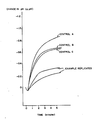
- the FIGURE contains graphical plots of the change in pH over time for compared reference layers as described in Example 2 below.
- the electrodes of the present invention are prepared using components and methods described in detail in U.S. Patent 4,214,968. Since most of the details are disclosed in that patent, the present disclosure will be directed to general summaries of the electrode components. As used herein, the terms “dry-operative” and “dried” have the meanings defined in U.S. Patent 4,214,968.
- the term “dried” when used in reference to layers of electrodes described herein refers to a physical state of such layers brought about by subjecting, in manufacture, the layer to drying conditions, i.e. conditions for temperature, reduced vapor pressure or whatever, adequate to accomplish removal of sufficient solvent or dispersing medium as to render the layer non-tacky, as this term is commonly interpreted in the coating arts, prior to the application of any overlying layer(s).
- This drying to drive off solvent or dispersing medium is a major factor imparting the "dry-operative" capability to the electrodes of the present invention.
- dry-operative describes an ion-selective electrode which provides reproducible potentiometric determination of ionic activity which can be related to the ion concentration of aqueous test solution with no requirement for "wet" storage (i.e., keeping in an aqueous solution) or precondition (i.e., soaking in a salt solution) prior to use.
- a "dry-operative" electrode produces accurate and reproducible determinations of potential which can be calibrated and thereby related via ionic activity to ionic concentration in an aqueous test solution without having first to be substantially hydrated or brought to an equilibrium state. Many of the electrodes described herein perform in this manner even when used immediately after storage at 20% relative humidity.
- the electrodes can also be constructed according to the teachings of Japanese Patent Publications 57(1982)-017851 and 57(1982)-017852.
- the electrodes and devices of this invention can be used to determine the concentration of sodium ions in any aqueous liquid, including wastewater, cooling water, groundwater or food and brewery processing fluids. They are particularly useful for the assay of biological fluids, for example, blood sera and urine.
- the electrode of the present invention comprises an internal reference electrode which exhibits a reproducible reference potential against which the potential occurring at the interface between the ion-selective electrode and the solution under test is measured.
- the reference electrode comprises a conductive metal layer of a suitable conductive metal (for example, silver, mercury, platinum or nickel).
- the conductive layer is in contact with a metal salt layer which may comprise substantially any insoluble salt of the metal in the conductive layer which establishes a fixed interfacial potential with the metal of the conductive layer.
- the metal salt layer comprises a salt of the metal which is a product of oxidation of the metal, for example, a silver halide or mercury halide.
- Useful metal/metal salt electrodes include silver/silver halide and mercury/mercury chloride electrodes. Other useful reference electrodes are known in the art. A silver/silver halide reference electrode is preferred in the practice of this invention.
- the sodium ion-selective electrodes of this invention also comprise a dried electrolyte or reference layer in contact with the reference electrode.
- the dried reference layer contains the dried residue of a salt and a buffer (described below) and any optional addenda, but is binderless (for example, according to U.S. Patent 4,571,293).
- the reference layer is a dried hydrophilic layer comprising one or more dried hydrophilic binder materials, a suitable buffer (described below) and a salt uniformly distributed in the binder materials.
- the anion of the salt is common to the salt of the metal salt layer of the reference electrode, and at least a portion of the cation of the salt is sodium.
- the dried reference layer is the dried residue of a solution of the salt, the buffer and a suitable hydrophilic binder material (either natural or synthetic) in a solvent for the binder material and salt.
- the hydrophilic binder material in the reference layer is acidic.
- Preferred binder materials are polymers having pendant acid groups e.g.
- the reference layer also comprise one or more water-soluble, organic dicarboxylic acids which buffer the layer to a pH of from 4 to 8.
- the layer is buffered to a pH of from 4.5 to 6.5.
- organic diacids comprise two carboxyl groups attached to an organic backbone which can be saturated or unsaturated.
- the acidic groups can be attached to aliphatic, alicyclic, aromatic and heterocyclic groups as long as the resulting compound is water-soluble.
- the compound has from 3 to 8 carbon atoms and suitable pKa to provide the desired buffering effect.
- dicarboxylic acids include maleic acid, malic acid, malonic acid, glutaric acid, dimethylglutaric acid, glutaconic acid, succinic acid, suberic acid, phthalic acid and others known to one skilled in the art.
- the buffering compounds can be used as free acids or as salts thereof (e.g. alkali metal or ammonium).
- Preferred dicarboxylic acids are saturated or unsaturated and have from 3 to 6 carbon atoms. Succinic acid is most preferred in practicing this invention.
- the dicarboxylic acid is present in an amount of at least 0.2 g/m2, and preferably from 0.5 to 3 g/m2 in the dried reference layer.
- the dried reference layer is in contact with a sodium-ion selective membrane composition.
- This composition is laminated, coated or otherwise applied directly over the reference layer.
- the composition comprises an ionophore for sodium ions, a compound capable of solvating the ionophore and a supporting matrix comprised of one or more binder materials.
- the matrix can be any material which is capable of forming a thin film of sufficient permeability to produce, in combination with the ionophore and solvent, sodium ion mobility thereacross.
- Useful materials include porous glass, pressed fibers, and synthetic and natural polymeric materials, such as poly(vinyl chloride), carboxylated poly(vinyl chloride), poly(styrene- co -styrene sulfonic acid), poly(vinyl chloride- co -styrene sulfonic acid) or poly(vinyl chloride- co -styrene carboxylic acid).
- Poly(vinyl chloride) is a preferred binder material in the practice of this invention.
- Useful ionophores include hemispherands, such as those described in European Patent Application 111,817, U.S. Patents 4,476,007 and 4,505,800, crown ethers, such as those described in U.S. Patent 4,504,368, monensin and esters thereof (for example, methyl monensin), and others known in the art as described in U.S. Patent 4,214,968.
- Preferred ionophores are hemispherands, crown ethers and esters of monensin, with esters of monensin being more preferred and methyl monensin most preferred.
- the ionophore is solvated by one or more organic solvents which are capable of at least partially solvating the ionophore and providing sodium ion mobility. If a hydrophobic binder is used as the supporting matrix, the solvent must be compatible with the binder.
- the solvent is sometimes identified in the art as a carrier solvent.
- Useful solvents include phthalates, sebacates, aromatic and aliphatic ethers, phosphates, mixed aromatic aliphatic phosphonates, adipates, nitrated ethers or esters or mixtures thereof, and others known in the art.
- Membranes including hydrophobic binder materials, an ionophore and solvating solvents are prepared using known film-coating or casting techniques. The amounts of each membrane component, including optional addenda, are readily determined from the disclosures of the references noted above.
- the electrodes of this invention can be self-supporting, meaning that one or more layers of the electrode have sufficient mechanical strength to support the remaining portions of the electrode.
- they further include a support which may be comprised of any material capable of bearing, either directly or by virtue of some intervening adhesion-improving layer, the other necessary portions of the electrode described herein.
- the support may be porous or nonporous and be composed of wood, cellulose, ceramic, metal, glass, filter paper, polymeric or glass fibers, or polymeric films.
- the support is prepared from a nonporous polymeric film.
- Sodium ion activity can be measured with the electrode of the present invention by measuring the steady-state difference in electrical potential between the fluid to be tested (test fluid) and a reference fluid in a cell arrangement schematically represented by the following: Reference electrode 1/test fluid/membrane //reference fluid/reference electrode 2.
- Reference electrode 1/test fluid/membrane //reference fluid/reference electrode 2.
- the calculations required to determine the ionic activity of the test fluid are derived from the well-known Nernst equation and are known to a skilled worker in the art.
- the electrode of this invention incorporates within its structure substantially all of the components needed for making a potentiometric determination with the exception of a second reference electrode, a potential-indicating device (for example, an electrometer or potentiometer) and associated wiring.
- a potential-indicating device for example, an electrometer or potentiometer
- the user merely contacts the membrane of the electrode with a sample of the test fluid (for example, less than 200 ⁇ l) and connects the electrodes to a potential-indicating device. Contacting the fluid with the membrane can be done in any suitable manner, but preferably, a sample of the test fluid is applied to the membrane with a suitable dispensing means.
- Second reference electrodes for use in the assay such as standard calomel electrodes, are well known.
- electrometers are well known.
- two or more electrodes of the present invention are incorporated or mounted into a frame to form a single device, slide or test chip as it is sometimes known in the art.
- One of the electrodes is used to contact the test fluid while another is used as the second reference electrode to which the reference solution is contacted.
- Such a device is described in more detail in U.S. Patent 4,171,246.
- Such devices generally comprise a means for providing a liquid junction between the electrodes, including a capillary bridge formed of a strip of paper, a standard chromatographic strip, a strip of a porous polymeric film, natural or synthetic threads or fibers, and so forth.
- Reference fluids useful in practicing the present invention are known in the art and commercially available.
- a dry-operative sodium ion-selective electrode comprises a nonporous support having thereon:
- Example 1 Dry-Operative Sodium Ion-Selective Electrode and Sodium Assay
- a dry-operative sodium-ion selective electrode of the present invention was prepared having the following format and components according to the procedures described in U.S. Patent 4,214,968:
- Control A contained no succinic acid in the Reference Layer
- Control B contained citric acid (pH 5.5) in place of the succinic acid
- Control C contained phosphoric acid (pH 5.5) in place of the succinic acid.
- the pH of the reference layer in each electrode was adjusted to the desired value using sodium hydroxide.
- Electrodes are prepared from individual continuous webs in manufacturing operations which were up to about 30 cm in width. Each of the webs from which the electrodes were prepared were tested for uniformity in performance across its full width. This was done by randomly selecting individual electrodes prepared from two different locations in the webs and spotting them with 10 ⁇ l samples of a reconstituted bovine serum albumin based lyophilate containing various amounts of sodium ions (90-210 milliequivalents/liter) onto the membranes of the electrodes. Some electrodes were tested immediately after manufacture (fresh). All of the electrodes were tested after 2 weeks of storage at 21°C and 50% relative humidity (aged).
- the pH measurements used to determine acid release were made by placing a flat combination pH electrode into the drop of fluid.
- the Controls are the same as those identified in that example.
- the FIGURE shows the amount of acid released from the compared electrodes having reference layers containing the different buffers over several minutes. Two replicates were made for each electrode reference layer, but the replicates of each Control layer were indistinguishable. It can be seen that the electrode of the present invention released significantly less acid than the Control electrodes. While the mechanism for the improvements obtained with this invention are unknown, it is believed that the acid released from an electrode which is not neutralized in some manner may contribute to the nonuniformity observed in manufactured electrodes of the art.
Landscapes
- Chemical & Material Sciences (AREA)
- Life Sciences & Earth Sciences (AREA)
- Health & Medical Sciences (AREA)
- Biochemistry (AREA)
- Chemical Kinetics & Catalysis (AREA)
- Electrochemistry (AREA)
- Physics & Mathematics (AREA)
- Analytical Chemistry (AREA)
- Molecular Biology (AREA)
- General Health & Medical Sciences (AREA)
- General Physics & Mathematics (AREA)
- Immunology (AREA)
- Pathology (AREA)
- Investigating Or Analysing Biological Materials (AREA)
- Secondary Cells (AREA)
- Conductive Materials (AREA)
Applications Claiming Priority (2)
| Application Number | Priority Date | Filing Date | Title |
|---|---|---|---|
| US06/890,060 US4708776A (en) | 1986-07-28 | 1986-07-28 | Sodium ion selective electrode and method of use |
| US890060 | 1986-07-28 |
Publications (3)
| Publication Number | Publication Date |
|---|---|
| EP0255328A2 true EP0255328A2 (de) | 1988-02-03 |
| EP0255328A3 EP0255328A3 (en) | 1989-09-27 |
| EP0255328B1 EP0255328B1 (de) | 1992-05-13 |
Family
ID=25396194
Family Applications (1)
| Application Number | Title | Priority Date | Filing Date |
|---|---|---|---|
| EP87306633A Expired EP0255328B1 (de) | 1986-07-28 | 1987-07-28 | Selektive Elektrode für Natrium-Ionen und Verfahren für deren Anwendung |
Country Status (5)
| Country | Link |
|---|---|
| US (1) | US4708776A (de) |
| EP (1) | EP0255328B1 (de) |
| JP (1) | JPH068797B2 (de) |
| CA (1) | CA1275443C (de) |
| DE (1) | DE3778998D1 (de) |
Cited By (3)
| Publication number | Priority date | Publication date | Assignee | Title |
|---|---|---|---|---|
| EP0539912A3 (en) * | 1991-10-31 | 1995-12-06 | Kyoto Daiichi Kagaku Kk | Method for producing dry-operative ion-selective electrode |
| EP0654664A3 (de) * | 1993-11-18 | 1996-06-12 | Du Pont | Monensinamide für natriumselektive Elektroden. |
| CN101750444B (zh) * | 2008-11-28 | 2013-04-17 | 中国科学院烟台海岸带研究所 | 一种聚合物膜银离子选择性电极的制备方法 |
Families Citing this family (9)
| Publication number | Priority date | Publication date | Assignee | Title |
|---|---|---|---|---|
| US5177221A (en) * | 1987-04-15 | 1993-01-05 | Miles Inc. | Chromogenic hemispherands and their preparation |
| US4992381A (en) * | 1987-04-15 | 1991-02-12 | Technicon Instruments Corporation | Method of detecting electrolytes in an aqueous test sample using chromogenic hemispherands and test device therefor |
| US5132001A (en) * | 1990-05-21 | 1992-07-21 | Bakos Vincent W | Hemispherand ionophores having increased lipophilicity |
| JP2927364B2 (ja) * | 1990-06-11 | 1999-07-28 | キヤノン株式会社 | 記録装置 |
| US5354449A (en) * | 1991-01-10 | 1994-10-11 | Band David M | pH electrode |
| US7344627B2 (en) | 1999-06-08 | 2008-03-18 | Broadley-James Corporation | Reference electrode having a flowing liquid junction and filter members |
| JP2003501656A (ja) * | 1999-06-08 | 2003-01-14 | ブロードレイ テクノロジーズ コーポレイション | 微小流体の液絡部を有する基準電極 |
| US6432296B1 (en) * | 1999-09-24 | 2002-08-13 | Daniel S. Daniel | Polymeric compositions for ion-selective electrodes |
| CN108002654B (zh) * | 2017-03-03 | 2020-11-13 | 北京中科众联新能源技术服务有限公司 | 一种悬浮法聚氯乙烯聚合工段废水处理方法 |
Family Cites Families (10)
| Publication number | Priority date | Publication date | Assignee | Title |
|---|---|---|---|---|
| US4171246A (en) * | 1976-05-19 | 1979-10-16 | Eastman Kodak Company | Method for determining ionic activity of components of liquid drops |
| US4214968A (en) * | 1978-04-05 | 1980-07-29 | Eastman Kodak Company | Ion-selective electrode |
| US4263343A (en) * | 1979-08-13 | 1981-04-21 | Eastman Kodak Company | Reference elements for ion-selective membrane electrodes |
| US4259164A (en) * | 1979-08-13 | 1981-03-31 | Eastman Kodak Company | Silver/silver halide electrodes comprising chromium or nickel |
| US4282079A (en) * | 1980-02-13 | 1981-08-04 | Eastman Kodak Company | Planar glass ion-selective electrode |
| JPS58102146A (ja) * | 1981-12-14 | 1983-06-17 | Fuji Photo Film Co Ltd | 銀/ハロゲン化銀電極の製造方法 |
| US4476007A (en) * | 1983-05-20 | 1984-10-09 | Eastman Kodak Company | Hemispherands and sodium-selective compositions and electrodes containing same |
| US4505800A (en) * | 1983-05-20 | 1985-03-19 | Eastman Kodak Company | Sodium-selective compositions and electrodes containing same |
| US4608149A (en) * | 1983-06-20 | 1986-08-26 | Eastman Kodak Company | Potassium ion-selective compositions and electrodes containing same |
| EP0160997B1 (de) * | 1984-05-10 | 1991-08-07 | Fuji Photo Film Co., Ltd. | Ionenselektivelektrode |
-
1986
- 1986-07-28 US US06/890,060 patent/US4708776A/en not_active Expired - Lifetime
- 1986-09-26 CA CA000519238A patent/CA1275443C/en not_active Expired - Fee Related
-
1987
- 1987-07-27 JP JP62185633A patent/JPH068797B2/ja not_active Expired - Lifetime
- 1987-07-28 EP EP87306633A patent/EP0255328B1/de not_active Expired
- 1987-07-28 DE DE8787306633T patent/DE3778998D1/de not_active Expired - Lifetime
Cited By (3)
| Publication number | Priority date | Publication date | Assignee | Title |
|---|---|---|---|---|
| EP0539912A3 (en) * | 1991-10-31 | 1995-12-06 | Kyoto Daiichi Kagaku Kk | Method for producing dry-operative ion-selective electrode |
| EP0654664A3 (de) * | 1993-11-18 | 1996-06-12 | Du Pont | Monensinamide für natriumselektive Elektroden. |
| CN101750444B (zh) * | 2008-11-28 | 2013-04-17 | 中国科学院烟台海岸带研究所 | 一种聚合物膜银离子选择性电极的制备方法 |
Also Published As
| Publication number | Publication date |
|---|---|
| JPS6337252A (ja) | 1988-02-17 |
| US4708776A (en) | 1987-11-24 |
| EP0255328B1 (de) | 1992-05-13 |
| EP0255328A3 (en) | 1989-09-27 |
| CA1275443C (en) | 1990-10-23 |
| DE3778998D1 (de) | 1992-06-17 |
| JPH068797B2 (ja) | 1994-02-02 |
Similar Documents
| Publication | Publication Date | Title |
|---|---|---|
| US5271815A (en) | Method for measuring glucose | |
| EP1164372B1 (de) | Auf einem Mikrochip basierender Differenz-Kohlendioxidsensor | |
| EP0255328B1 (de) | Selektive Elektrode für Natrium-Ionen und Verfahren für deren Anwendung | |
| JPH0633063U (ja) | 黒鉛をベースとする固態ポリマー膜イオン選択性電極 | |
| US20150177183A1 (en) | Reversible detection of ions with permselective membranes | |
| US20250258124A1 (en) | Single-use disposable reference sensor | |
| US5106752A (en) | Method and reagent for determining the ionic strength or specific gravity of aqueous liquids | |
| US6114170A (en) | Reagent for determining the ionic strength and/or the specific weight of aqueous liquids and method | |
| Ha et al. | A polymeric junction membrane for solid-state reference electrodes | |
| WO1994028405A1 (en) | Electrochemical metal analysis | |
| EP0155638B1 (de) | Kaliionenselektive Elektrode | |
| US4230601A (en) | Calibrator composition based upon dialyzed blood serum | |
| JPH11514750A (ja) | 延長された使用寿命を有するナトリウムイオン選択性電極膜 | |
| EP0215446A2 (de) | Vorrichtung und Verfahren zur Messung der Ionenaktivität | |
| US4608149A (en) | Potassium ion-selective compositions and electrodes containing same | |
| USH745H (en) | Ion-selective electrode for measuring carbonate concentration | |
| US6350524B1 (en) | Hydrophilic polyurethane-coated chloride-selective electrodes | |
| JP4662615B2 (ja) | 乾式操作型イオン選択性電極及び液体中のイオンの存在又は量の決定法 | |
| JPS6031257B2 (ja) | 陰イオン選択性電極 | |
| EP0129233B1 (de) | Kalium-ionenselektive Membrane | |
| KR0185781B1 (ko) | 염화이온센서의 전극에 구비되는 이온 선택성 막을 형성하기 위한 조성물 및 이것을 사용하여 이온 선택성 막을 형성하는 방법 | |
| JPH0469335B2 (de) | ||
| JPH09196883A (ja) | イオンセンサ | |
| JPH0575069B2 (de) | ||
| DD150508B1 (de) | Verfahren und enzymelektrode zur konzentrationsbestimmung von stoffwechselprodukten |
Legal Events
| Date | Code | Title | Description |
|---|---|---|---|
| PUAI | Public reference made under article 153(3) epc to a published international application that has entered the european phase |
Free format text: ORIGINAL CODE: 0009012 |
|
| AK | Designated contracting states |
Kind code of ref document: A2 Designated state(s): CH DE FR GB LI |
|
| PUAL | Search report despatched |
Free format text: ORIGINAL CODE: 0009013 |
|
| AK | Designated contracting states |
Kind code of ref document: A3 Designated state(s): CH DE FR GB LI |
|
| 17P | Request for examination filed |
Effective date: 19900313 |
|
| 17Q | First examination report despatched |
Effective date: 19910927 |
|
| GRAA | (expected) grant |
Free format text: ORIGINAL CODE: 0009210 |
|
| AK | Designated contracting states |
Kind code of ref document: B1 Designated state(s): CH DE FR GB LI |
|
| REF | Corresponds to: |
Ref document number: 3778998 Country of ref document: DE Date of ref document: 19920617 |
|
| PGFP | Annual fee paid to national office [announced via postgrant information from national office to epo] |
Ref country code: GB Payment date: 19920625 Year of fee payment: 6 |
|
| PGFP | Annual fee paid to national office [announced via postgrant information from national office to epo] |
Ref country code: CH Payment date: 19920727 Year of fee payment: 6 |
|
| ET | Fr: translation filed | ||
| PLBE | No opposition filed within time limit |
Free format text: ORIGINAL CODE: 0009261 |
|
| STAA | Information on the status of an ep patent application or granted ep patent |
Free format text: STATUS: NO OPPOSITION FILED WITHIN TIME LIMIT |
|
| 26N | No opposition filed | ||
| PG25 | Lapsed in a contracting state [announced via postgrant information from national office to epo] |
Ref country code: GB Effective date: 19930728 |
|
| PG25 | Lapsed in a contracting state [announced via postgrant information from national office to epo] |
Ref country code: LI Effective date: 19930731 Ref country code: CH Effective date: 19930731 |
|
| GBPC | Gb: european patent ceased through non-payment of renewal fee |
Effective date: 19930728 |
|
| REG | Reference to a national code |
Ref country code: CH Ref legal event code: PL |
|
| PGFP | Annual fee paid to national office [announced via postgrant information from national office to epo] |
Ref country code: FR Payment date: 20060719 Year of fee payment: 20 |
|
| PGFP | Annual fee paid to national office [announced via postgrant information from national office to epo] |
Ref country code: DE Payment date: 20060720 Year of fee payment: 20 |