EP0255773A2 - Kontinuierliches Verfahren zur Herstellung des Methacrylsäureesters eines C1-4 aliphatischen Alkohols - Google Patents
Kontinuierliches Verfahren zur Herstellung des Methacrylsäureesters eines C1-4 aliphatischen Alkohols Download PDFInfo
- Publication number
- EP0255773A2 EP0255773A2 EP87306576A EP87306576A EP0255773A2 EP 0255773 A2 EP0255773 A2 EP 0255773A2 EP 87306576 A EP87306576 A EP 87306576A EP 87306576 A EP87306576 A EP 87306576A EP 0255773 A2 EP0255773 A2 EP 0255773A2
- Authority
- EP
- European Patent Office
- Prior art keywords
- methacrylic acid
- plug
- flow reactor
- feed stream
- stream
- Prior art date
- Legal status (The legal status is an assumption and is not a legal conclusion. Google has not performed a legal analysis and makes no representation as to the accuracy of the status listed.)
- Ceased
Links
Images
Classifications
-
- C—CHEMISTRY; METALLURGY
- C07—ORGANIC CHEMISTRY
- C07C—ACYCLIC OR CARBOCYCLIC COMPOUNDS
- C07C67/00—Preparation of carboxylic acid esters
- C07C67/08—Preparation of carboxylic acid esters by reacting carboxylic acids or symmetrical anhydrides with the hydroxy or O-metal group of organic compounds
-
- C—CHEMISTRY; METALLURGY
- C07—ORGANIC CHEMISTRY
- C07C—ACYCLIC OR CARBOCYCLIC COMPOUNDS
- C07C67/00—Preparation of carboxylic acid esters
- C07C67/48—Separation; Purification; Stabilisation; Use of additives
- C07C67/52—Separation; Purification; Stabilisation; Use of additives by change in the physical state, e.g. crystallisation
- C07C67/54—Separation; Purification; Stabilisation; Use of additives by change in the physical state, e.g. crystallisation by distillation
-
- Y—GENERAL TAGGING OF NEW TECHNOLOGICAL DEVELOPMENTS; GENERAL TAGGING OF CROSS-SECTIONAL TECHNOLOGIES SPANNING OVER SEVERAL SECTIONS OF THE IPC; TECHNICAL SUBJECTS COVERED BY FORMER USPC CROSS-REFERENCE ART COLLECTIONS [XRACs] AND DIGESTS
- Y02—TECHNOLOGIES OR APPLICATIONS FOR MITIGATION OR ADAPTATION AGAINST CLIMATE CHANGE
- Y02P—CLIMATE CHANGE MITIGATION TECHNOLOGIES IN THE PRODUCTION OR PROCESSING OF GOODS
- Y02P20/00—Technologies relating to chemical industry
- Y02P20/50—Improvements relating to the production of bulk chemicals
- Y02P20/584—Recycling of catalysts
Definitions
- the present invention relates to esterification of methacrylic acid. More particularly, the present invention is directed to a process that provides continuous esterification of methacrylic acid in a process stream that includes appreciable amounts of relatively high boiling impurities as well.
- Methacrylic acid esters of saturated aliphatic alcohols e.g. methyl methacrylate (MMA)
- MMA methyl methacrylate
- Such polymers exhibit good transparency, weatherability and physical strength properties, and thus are eminently well suited for a wide variety of applications.
- Typical end uses for MMA-derived polymers include acrylic sheet that can be fabricated into signs, advertising displays, lighting fixtures, glazing materials, structural panels and the like, molding resins for automobile tail-light lenses, plumbing fixtures and the like, as well as constituents of a variety of surface coatings, adhesives, inks, floor polishes and the like.
- esterification of methacrylic acid with a saturated aliphatic alcohol such as methanol is, of course, well known in the art.
- a saturated aliphatic alcohol such as methanol
- One such esterification process is described in U.S. Patent No. 3,639,460 to Wenzel et al. In that particular process the esterification reaction is carried out in what is substantially a continuous flow stirred tank reactor (CSTR) and in the presence of an excess of methacrylic acid (MA) in the reactor.
- CSTR continuous flow stirred tank reactor
- the process of the present invention allows for low-cost, continuous-flow, catalytically induced, relatively high-conversion esterification of a crude methacrylic acid feed stream.
- the methacrylic acid-containing feed stream can contain not only the unreacted alcohol and methacrylic acid, but also appreciable amounts of by-product impurities as well.
- One further advantage of the present invention is that high-boiling impurities that are present can be advantageously utilized as part of the esterification medium. That is, the impurities need not be separated from the crude methacrylic acid prior to the esterification step but can be used advantageously to dilute the reactants with attendant better process control.
- the methacrylic acid esterification process contemplated by the present invention utilizes an excess of the esterifying alcohol and a plug-flow type of reactor.
- a feed stream containing methacrylic acid, a C1 to C4 aliphatic alcohol in stoichiometric excess relative to the methacrylic acid present, an esterification catalyst, and a liquid organic substance having a volatility no greater than that of methacrylic acid are fed to the reactor.
- This feed stream is maintained in the reactor at substantially atmospheric pressure, at an esterification temperature, and for a time period sufficient to esterify at least a portion of the introduced methacrylic acid.
- An admixture produced within the reactor contains the methacrylic acid ester, unreacted methacrylic acid, unreacted C1 to C4 aliphatic alcohol, the esterification catalyst, water, and sundry other reaction products.
- the produced admixture is continuously fractionated, preferably within a distillation zone or column, into a distillate stream and a bottoms stream.
- the distillate stream has a relatively greater methacrylic acid ester content than the bottoms stream.
- the bottoms stream contains relatively non-volatile liquid organic substances, some methacrylic acid ester, some methacrylic acid, some alcohol, the catalyst, and water. A portion of the bottoms stream is recycled to the reactor, and the remainder is purged.
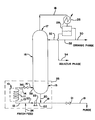
- FIGURE is a process flow diagram illustrating a system embodying the principles of the continuous-flow methacrylic acid esterification process of the present invention.
- a reactor feed stream is introduced into a plug-flow reactor 10 via a reactor-supply or reactor-feed pipe 12.
- a plug-flow type of reactor would normally not be selected. It has been found in the present process, however, that the utilization of a plug-flow type of reactor affords certain advantages that will be described hereinbelow in greater detail.
- the reactor feed stream contains crude methacrylic acid and a C1 to C4 aliphatic alcohol as reactants, an esterification catalyst such as sulfuric acid, and at least one liquid organic substance having a volatility no greater than that of methacrylic acid.
- the reactor feed stream contains a variety of liquid organic substances, such as those that are by-products of an upstream methacrylic acid production process.
- Illustrative of suitable C1 to C4 saturated aliphatic alcohols that can be used for esterification purposes in accordance with the principles of the present invention are methanol, ethanol, n -propanol and n -butanol. Methanol is preferred.
- Suitable esterification catalysts are well known. Sulfuric acid is illustrative and is preferred.
- the feed stream to reactor 10 is maintained at substantially atmospheric pressure, and is maintained at an esterification temperature for a time period sufficient to esterify at least a portion of the methacrylic acid introduced into reactor 10.
- Typical esterification temperatures are in the range of about 100°C. (about 212°F.) to about 160°C. (about 320°F.).
- the reactor effluent is constituted by an admixture that contains the methacrylic acid and the aliphatic alcohol reactants, the desired ester, as well as any by-products that may have been formed during esterification or that may have been introduced as part of the feed stream.
- Reactor 10 can include a spiral, or coiled, tubular reaction zone 11 surrounded by a heat exchanger 13 for supplying heat to the reaction zone 11, as shown in the FIGURE.
- the plug-flow reactor can have any appropriate heat-exchanger configuration, so long as plug-flow can be maintained through the reactor.
- the reactor effluent is conveyed away from reactor 10, via a conduit 14, to a suitable fractionation zone, such as into a sump portion 15 of a distillation column 16.
- the reactor effluent is continuously fractionated, preferably at a subatmospheric pressure, within distillation column 16, into a relatively volatile distillate or overhead stream and a relatively nonvolatile bottoms stream.
- the vaporized distillate stream rises through distillation column 16 and exits from the upper or head portion 17 thereof via an overhead vapor pipeline 18.
- the liquid bottoms stream exits from the sump portion 15 of distillation column 16 via a bottom discharge pipeline 20.
- the distillate, i.e. the overhead vapor stream, from distillation column 16 has a relatively greater methacrylic acid ester content than the bottoms stream and is condensed in an overhead condenser 26.
- the resulting condensate is fed to a suitable separator 28, such as the decanter shown in the accompanying FIGURE, for further liquid-liquid separation as will be discussed in greater detail below.
- a portion of the bottoms stream is returned, as recycle, to the plug-flow reactor 10.
- the remainder of the bottoms stream can be readily purged from the system, in a continuous or semicontinuous manner, via a purge line 19 as shown.
- the purge line 19 can include a valve 21, which can be remotely operated.
- a bottoms return conduit 22 supplies the returned bottoms stream portion to plug-flow reactor 10 via reactor feed pipe 12, as is shown.
- conduit 22 preferably includes a suitable pump 23, such as a rotary, positive-displacement pump or the like.
- the feed stream to plug-flow reactor 10 is constituted by the returned bottoms stream portion, recycled via conduit 22, and a fresh feed stream that is fed to reactor 10 via a fresh-feed pipeline 24.
- the fresh feed may include crude methacrylic acid, the C1 to C4 aliphatic alcohol that is to be esterified therewith, and the ester ification catalyst, as well as upstream methacrylic acid synthesis by-products and other impurities.
- bottoms return conduit 22 and fresh-feed pipeline 24 are combined before entry into the reactor so as to continuously feed to reactor 10 via reactor supply pipe 12 a substantially uniform reaction admixture over a preselected period of time.
- the C1 to C4 alcohol is present in the reactor feed stream in stoichiometric excess relative to the methacrylic acid present.
- the contemplated alcohol is methanol
- such methanol is present in the plug-flow reactor feed stream in an excess of up to about 70 mole percent, based on the amount of methacrylic acid that is present in reactor supply pipe 12.
- the bottoms stream discharged from distillation column 16 via bottoms discharge pipeline 20 contains a major portion of the liquid organic substance, and the esterification catalyst, initially supplied to the system via fresh-feed pipeline 24.
- the bottoms stream contains substantially all, and the overhead vapor stream contains substantially none, of the aforementioned liquid organic substance or substances and the esterification catalyst supplied to the system via fresh-feed pipeline 24.
- the volumetric ratio of the returned bottoms stream portion to the fresh feed in the total feed supplied to plug-flow reactor 10 can be in the range of about 5 to about 200. Preferably, this volumetric ratio is about 5 to about 20.
- the volumetric ratio of the recycled distillation column bottoms stream to the reactor feed stream is preferably about 0.8 to about 0.995, and more preferably is about 0.8 to about 0.95.
- a recirculation loop 25 for the distillation column 16 comprises the bottom or sump portion 15 of distillation column 16, the plug-flow reactor 10, and the various conduits 12, 14, 20 and 22, as shown in the FIGURE.
- the heat exchanger 13 in addition to providing heat to the reaction zone 11, as mentioned above, also provides the necessary heat input for the distillation column 16.
- the produced methacrylic acid ester is readily recovered in distillation column 16 employing well-known azeotropic distillation methods.
- the overhead vapor that passes out of distillation column 16 via overhead pipeline 18 is passed through the overhead condenser 26 and is thus liquefied.
- the resultant condensate which typically comprises an aqueous phase and an organic phase, is then passed to separator 28 for separation of these two phases.
- a preferred separator is a decanter.
- the aqueous phase is withdrawn from separator 28 via a conduit 34.
- a portion of the organic phase is passed from separator 28 via a conduit 30 to storage or further processing, as desired.
- the remainder of the organic phase is returned from separator 28 to distillation column 16, as reflux, via a liquid reflux pipeline 32.
- the liquid organic substance that is recirculated in the recirculation loop 25, also sometimes referred to herein as a relatively high-boiling impurity or as "heavies", is primarily a by-product of an upstream methacrylic acid synthesis step, which by-product need not be separated from the crude methacrylic acid feed stream before this acid is esterified.
- This liquid organic substance usually is constituted by 2,5-dimethylcyclopentenone, 3,5,5-trimethylbutyrolactone, and heavier substances, in various relative amounts. Typically, a mixture of these reaction by-products is present in varying amounts in plug-flow reactor supply pipe 12, feeding plug-flow reactor 10.
- the liquid organic substance serves as a diluent for the reactants. For instance, the concentration of the alcohol in the reaction admixture is reduced, thereby permitting the use of excess alcohol without the formation of undesirable ethers. Inasmuch as methacrylic acid concentration is also diluted, the undesired conversion of methacrylic acid to acetone and CO is also minimized.
- the mole ratio of the C1 to C4 aliphatic alcohol-to-methacrylic acid reactants present in the feed stream to plug-flow reactor 10 is preferably about 1.1 to about 1.7. More preferably, the mole ratio of the alcohol-to-methacrylic acid in the plug-flow reactor feed stream is about 1.2 to about 1.5.
- the sulfuric acid concentration in the distillation column feed stream may be about 5 to about 50 wt.%, and preferably is about 15 to about 30 wt.%, based on the weight of the distillation column feed stream.
- the organic phase portion that is returned to distillation column 16 as reflux is primarily methyl methacrylate with relatively minor amounts of methanol and water also present.
- the aqueous phase is mostly water, but can include minor amounts of methanol and methyl methacrylate.
- the fresh feed to plug-flow reactor 10 comprises methanol, crude methacrylic acid, the relatively heavy by-products, and the esterification catalyst.
- the process purge stream of mostly by-product and catalyst, can include relatively minor amounts of unreacted methacrylic acid and methanol, as well as some methyl methacrylate and water.
- That portion of the bottoms stream that is returned to plug-flow reactor 10 via bottoms return conduit 22 usually includes less than about 10 wt.% of the methyl methacrylate esterification reactants and products, with the remainder thereof being the relatively heavy by-products, and the esterification catalyst.
- bottoms stream in bottoms discharge conduit 20 is purged from recirculation loop 25 via purge line 19 to modulate the amount of bottoms from distillation column 16 that is returned as recycle to plug-flow reactor 10 via conduit 22.
- the relatively heavy by-product concentration in plug-flow reactor 10 is maintained at about 55 to about 75 percent by weight.
- the esterification temperature of the feed stream introduced into plug-flow reactor 10 is preferably about 100°C. (about 212°F.) to about 135°C. (about 275°F.) and the reactor residence time, i.e. that time period during which the introduced feed stream is held within plug-flow reactor 10, is preferably about 5 seconds to about 5 minutes. More preferably, the esterification temperature is about 120°C. (about 248°F.) to about 135°C. (about 275°F.), and the reactor residence time is about 30 seconds to about 2 minutes.
- the pressure within distillation column 16 is preferivelyably subatmospheric, more preferably about 250 millimeters of mercury.
- the pressure within the plug-flow reactor 10 is preferably maintained at least about 10 pounds per square inch in excess of the internal pressure of distillation column 16.
- valve 36 Pressure within the tubular reaction zone 11 can be maintained by a suitable back-pressure or throttle valve 36, which can be incorporated into conduit 22 as is shown in the accompanying FIGURE.
- Valve 36 can be remotely operated.
- valve 36 is spaced relatively close to a distillation column feed inlet 38, so that the distillation column feed stream flashes into the bottom or sump portion 15 of distillation column 16 after being reduced in pressure.
Landscapes
- Chemical & Material Sciences (AREA)
- Organic Chemistry (AREA)
- Crystallography & Structural Chemistry (AREA)
- Organic Low-Molecular-Weight Compounds And Preparation Thereof (AREA)
- Low-Molecular Organic Synthesis Reactions Using Catalysts (AREA)
Applications Claiming Priority (2)
| Application Number | Priority Date | Filing Date | Title |
|---|---|---|---|
| US06/891,760 US4748268A (en) | 1986-07-31 | 1986-07-31 | Continuous process for production of methacrylic acid ester of C1 to C4 aliphatic alcohol |
| US891760 | 1997-07-14 |
Publications (2)
| Publication Number | Publication Date |
|---|---|
| EP0255773A2 true EP0255773A2 (de) | 1988-02-10 |
| EP0255773A3 EP0255773A3 (de) | 1989-02-22 |
Family
ID=25398778
Family Applications (1)
| Application Number | Title | Priority Date | Filing Date |
|---|---|---|---|
| EP87306576A Ceased EP0255773A3 (de) | 1986-07-31 | 1987-07-24 | Kontinuierliches Verfahren zur Herstellung des Methacrylsäureesters eines C1-4 aliphatischen Alkohols |
Country Status (3)
| Country | Link |
|---|---|
| US (1) | US4748268A (de) |
| EP (1) | EP0255773A3 (de) |
| JP (1) | JPS6357551A (de) |
Cited By (3)
| Publication number | Priority date | Publication date | Assignee | Title |
|---|---|---|---|---|
| US5386052A (en) * | 1993-03-31 | 1995-01-31 | Mitsubishi Petrochemical Company Limited | Process for producing acrylic or methacrylic esters |
| FR2839070A1 (fr) * | 2002-04-30 | 2003-10-31 | Atofina | Procede de fabrication en continu de l'acrylate de dimethylaminoethyle |
| DE102020119237B3 (de) | 2020-07-21 | 2021-12-02 | Weber-Hydraulik Gmbh | Lenkzylinder für eine hydraulische Hinterachslenkung |
Families Citing this family (11)
| Publication number | Priority date | Publication date | Assignee | Title |
|---|---|---|---|---|
| DE3728242A1 (de) * | 1987-08-25 | 1989-03-09 | Basf Ag | Verfahren zur herstellung von carbonsaeureestern |
| DE19638093A1 (de) † | 1996-09-18 | 1998-03-19 | Basf Ag | Verfahren zur Vermeidung, Entfernung oder Verminderung von Ablagerungen an Apparateteilen bei der Veresterung von Acryl- oder Methacrylsäure |
| US5877345A (en) | 1997-02-07 | 1999-03-02 | Rohm And Haas Company | Process for producing butyl acrylate |
| ATE220657T1 (de) | 1998-11-04 | 2002-08-15 | Rohm & Haas | Verfahren zum herstellen mit grosser ausbeute von methylmethacrylat oder methacrylsäure |
| US6482976B1 (en) * | 1999-06-17 | 2002-11-19 | Union Carbide Chemicals & Plastics Technology Corporation | Processes for conducting equilibrium-limited reactions |
| US8192695B2 (en) * | 2005-05-04 | 2012-06-05 | Fina Technology, Inc. | Reactor apparatus having reduced back mixing |
| US7511101B2 (en) * | 2005-05-13 | 2009-03-31 | Fina Technology, Inc. | Plug flow reactor and polymers prepared therewith |
| JP2016516732A (ja) | 2013-03-18 | 2016-06-09 | エボニック レーム ゲゼルシャフト ミット ベシュレンクテル ハフツングEvonik Roehm GmbH | メタクリル酸及びメタクリル酸エステルの製造方法 |
| FR3024143B1 (fr) * | 2014-07-28 | 2016-07-15 | Arkema France | Procede perfectionne de fabrication de (meth)acrylates d'alkyle |
| US20230399286A1 (en) | 2020-10-23 | 2023-12-14 | Röhm Gmbh | Improved process for preparing methyl methacrylate and/or methacrylic acid by reduced back mixing during conversion |
| ES2935290T3 (es) | 2020-10-23 | 2023-03-03 | Roehm Gmbh | Procedimiento optimizado para la preparación de metacrilato de alquilo mediante reducción de productos secundarios perturbadores |
Family Cites Families (5)
| Publication number | Priority date | Publication date | Assignee | Title |
|---|---|---|---|---|
| US3821286A (en) * | 1971-10-05 | 1974-06-28 | American Cyanamid Co | Process for the production of methyl methacrylate |
| JPS563338B2 (de) * | 1972-05-23 | 1981-01-24 | ||
| JPS5914018B2 (ja) * | 1976-08-10 | 1984-04-02 | ジェイエスアール株式会社 | メタクリル酸エステルの製造方法 |
| JPS5562047A (en) * | 1978-10-31 | 1980-05-10 | Mitsubishi Rayon Co Ltd | Preparation of methacrylic acid ester |
| JPS5826843A (ja) * | 1981-08-11 | 1983-02-17 | Sumitomo Chem Co Ltd | アクリル酸エステルまたはメタクリル酸エステルの製造方法 |
-
1986
- 1986-07-31 US US06/891,760 patent/US4748268A/en not_active Expired - Fee Related
-
1987
- 1987-07-24 EP EP87306576A patent/EP0255773A3/de not_active Ceased
- 1987-07-31 JP JP62192491A patent/JPS6357551A/ja active Pending
Cited By (4)
| Publication number | Priority date | Publication date | Assignee | Title |
|---|---|---|---|---|
| US5386052A (en) * | 1993-03-31 | 1995-01-31 | Mitsubishi Petrochemical Company Limited | Process for producing acrylic or methacrylic esters |
| FR2839070A1 (fr) * | 2002-04-30 | 2003-10-31 | Atofina | Procede de fabrication en continu de l'acrylate de dimethylaminoethyle |
| WO2003093218A1 (fr) * | 2002-04-30 | 2003-11-13 | Atofina | Procede de fabrication en continu de l'acrylate de dimethylaminoethyle |
| DE102020119237B3 (de) | 2020-07-21 | 2021-12-02 | Weber-Hydraulik Gmbh | Lenkzylinder für eine hydraulische Hinterachslenkung |
Also Published As
| Publication number | Publication date |
|---|---|
| JPS6357551A (ja) | 1988-03-12 |
| US4748268A (en) | 1988-05-31 |
| EP0255773A3 (de) | 1989-02-22 |
Similar Documents
| Publication | Publication Date | Title |
|---|---|---|
| EP0255773A2 (de) | Kontinuierliches Verfahren zur Herstellung des Methacrylsäureesters eines C1-4 aliphatischen Alkohols | |
| CN1084324C (zh) | (甲基)丙烯酸的烷基酯的连续制备方法和所使用的设备 | |
| US4280010A (en) | Continuous production of alkyl acrylates free from ether | |
| KR100663853B1 (ko) | 에틸아세테이트의 제조 방법 및 이 방법을 실행하기 위한장치 | |
| CA2274182C (en) | Process for the preparation of vinyl acetate | |
| JP3934163B2 (ja) | アクリル酸ブチルの精製方法 | |
| US3404175A (en) | Process for forming and separating ethers or esters by plural stage distillation with removal of water as an azeotrope | |
| KR20010075475A (ko) | 방법 | |
| JPS6399039A (ja) | マイレン酸ジアルキルの製造方法 | |
| CN110997619B (zh) | 连续制备丙烯酸正丁酯或丙烯酸异丁酯的方法 | |
| JP4335925B2 (ja) | C1〜c4アルキルアクリレートを連続的に回収する方法 | |
| JPH101455A (ja) | (メタ)アクリル酸のアルキルエステルを連続的に製造する方法及び装置 | |
| JPH11508266A (ja) | 3−(メチルチオ)プロパナールの製造法 | |
| CN103193640A (zh) | 生产甲基丙烯酸甲酯的反应精馏方法 | |
| KR101891680B1 (ko) | 아크릴레이트 제조 방법 | |
| US4464229A (en) | Process for producing acrylic or methacrylic esters | |
| US5821384A (en) | Process for generating vinyl carboxylate esters | |
| US4474981A (en) | Process for preparing an acrylic or methacrylic acid ester | |
| US20080161596A1 (en) | Method for Preparing (Meth) Acrylic Esters or Anhydrides | |
| CN115850064B (zh) | 一种甲基丙烯酸丁酯的制备工艺 | |
| CN212335079U (zh) | 一种醋酸甲酯和甲醛合成甲基丙烯酸甲酯的生产工艺装置 | |
| US20240010604A1 (en) | Optimized process for synthesizing methacrylic acid (maa) and/or alkyl methacrylate by reducing unwanted byproducts | |
| US20230416184A1 (en) | Optimized process for synthesizing alkyl methacrylate by reducing unwanted byproducts | |
| US3839414A (en) | Dimethyl terephthalate manufacturing process | |
| JP3345985B2 (ja) | メタクリル酸メチルの製造方法 |
Legal Events
| Date | Code | Title | Description |
|---|---|---|---|
| PUAI | Public reference made under article 153(3) epc to a published international application that has entered the european phase |
Free format text: ORIGINAL CODE: 0009012 |
|
| AK | Designated contracting states |
Kind code of ref document: A2 Designated state(s): AT BE CH DE ES FR GB IT LI LU NL SE |
|
| PUAL | Search report despatched |
Free format text: ORIGINAL CODE: 0009013 |
|
| AK | Designated contracting states |
Kind code of ref document: A3 Designated state(s): AT BE CH DE ES FR GB IT LI LU NL SE |
|
| 17P | Request for examination filed |
Effective date: 19890811 |
|
| 17Q | First examination report despatched |
Effective date: 19910121 |
|
| STAA | Information on the status of an ep patent application or granted ep patent |
Free format text: STATUS: THE APPLICATION HAS BEEN REFUSED |
|
| 18R | Application refused |
Effective date: 19920213 |
|
| RIN1 | Information on inventor provided before grant (corrected) |
Inventor name: NAIM, HOUSSAM MAHMOUD Inventor name: PIETSCH, STEPHEN JAMES |