EP0256036B1 - Herstellung und verwendung von purpurinen, chlorinen und purpurin und chlorin enthaltenden zubereitungen - Google Patents
Herstellung und verwendung von purpurinen, chlorinen und purpurin und chlorin enthaltenden zubereitungen Download PDFInfo
- Publication number
- EP0256036B1 EP0256036B1 EP87900613A EP87900613A EP0256036B1 EP 0256036 B1 EP0256036 B1 EP 0256036B1 EP 87900613 A EP87900613 A EP 87900613A EP 87900613 A EP87900613 A EP 87900613A EP 0256036 B1 EP0256036 B1 EP 0256036B1
- Authority
- EP
- European Patent Office
- Prior art keywords
- purpurin
- chlorin
- carbon atoms
- carbon
- metal complex
- Prior art date
- Legal status (The legal status is an assumption and is not a legal conclusion. Google has not performed a legal analysis and makes no representation as to the accuracy of the status listed.)
- Expired - Lifetime
Links
Images
Classifications
-
- C—CHEMISTRY; METALLURGY
- C07—ORGANIC CHEMISTRY
- C07D—HETEROCYCLIC COMPOUNDS
- C07D487/00—Heterocyclic compounds containing nitrogen atoms as the only ring hetero atoms in the condensed system, not provided for by groups C07D451/00 - C07D477/00
- C07D487/22—Heterocyclic compounds containing nitrogen atoms as the only ring hetero atoms in the condensed system, not provided for by groups C07D451/00 - C07D477/00 in which the condensed system contains four or more hetero rings
-
- A—HUMAN NECESSITIES
- A61—MEDICAL OR VETERINARY SCIENCE; HYGIENE
- A61K—PREPARATIONS FOR MEDICAL, DENTAL OR TOILETRY PURPOSES
- A61K31/00—Medicinal preparations containing organic active ingredients
- A61K31/33—Heterocyclic compounds
- A61K31/395—Heterocyclic compounds having nitrogen as a ring hetero atom, e.g. guanethidine or rifamycins
- A61K31/40—Heterocyclic compounds having nitrogen as a ring hetero atom, e.g. guanethidine or rifamycins having five-membered rings with one nitrogen as the only ring hetero atom, e.g. sulpiride, succinimide, tolmetin, buflomedil
-
- C—CHEMISTRY; METALLURGY
- C07—ORGANIC CHEMISTRY
- C07D—HETEROCYCLIC COMPOUNDS
- C07D519/00—Heterocyclic compounds containing more than one system of two or more relevant hetero rings condensed among themselves or condensed with a common carbocyclic ring system not provided for in groups C07D453/00 or C07D455/00
Definitions
- This invention relates to the production and use of a family of purpurins, a family of chlorins and metal complexes of the purpurins and chlorins, and to purpurin- and chlorin-containing compositions.
- the purpurins have an unsaturated isocyclic ring fused to a reduced pyrrole ring; the unsaturated isocyclic ring of the purpurins corresponds with a saturated ring in the chlorins.
- the chlorins are useful as green dyes.
- the chlorins and the purpurins are useful in the detection and treatment of tumors; after they have been administered systemically, e.g., intravenously, they localize preferentially in a tumor.
- the chlorins and purpurins of the invention can also be used to treat tumors; after they have been administered and have localized, irradiation with light of a wave length at which they show an absorbance peak causes a reaction which damages or destroys the tumor where they have localized.
- the purpurin- and chlorin-containing compositions are solutions thereof in an organic liquid that is physiologically acceptable for intravenous administration and emulsions thereof in saline solutions.
- EP142,732 is said (C.A. 103: 123271S) to disclose certain chlorins of a different family and that they accumulate preferentially in the cancer cells of hamsters infected with pancreatic cancer.
- HpD hematoporphyrin derivative
- the chlorins and purpurins of the instant invention are preferred over HpD for this use because they are single, known compounds.
- the chlorins and purpurins have absorbance peaks at longer wavelengths and show greater absorbances, by comparison with HpD; the longer wavelength peaks are advantageous because light of the longer wavelengths is capable of greater penetration of tissue, while the greater absorbances are desirable because less light energy is required to cause a given degree of reaction.
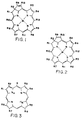
- Fig. 1 is a structural formula for metal complexes of the family of purpurins according to the invention where an unsaturated isocyclic ring is fused to a reduced pyrrole ring.
- Fig. 2 is a structural formula for metal complexes of the family of chlorins according to the invention where the isocyclic ring which corresponds with the unsaturated isocyclic ring of the purpurins is saturated.
- Fig. 3 is a structural formula for a family of porphyrins which can be used to produce purpurins according to the invention.
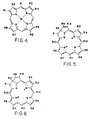
- Fig. 4 is a structural formula for metal complexes of porphyrins having the formula of Fig. 3.
- Fig. 5 is a structural formula for the family of purpurins according to the invention.
- Fig. 6 is a structural formula for the family of chlorins according to the invention.
- the instant invention in one aspect, is a solution in an organic/solvent of a purpurin having the structure of Fig. 1 or 5 or of a chlorin having the structure of Fig. 2 or 6 of the attached drawings, where M is a metal, for example, Ag, Al, Ce, Co, Cr, Cu, Dy, Er, Eu, Fe, Ga, Gd, Hf, Ho, In, La, Lu, Mn, Mo, Nd, Ni, Pb, Pd, Pr, Pt, Rh, Sb, Sc, Sm, Sn, Tb, Th, Ti, Tl, Tm, U, V, Y, Yb, Zn or Zr, and each of R1 to R13 is: H or CHO, a primary or secondary alkyl group having from 1 to 4 carbon atoms, an alkylene group having from 2 to 4 carbon atoms, a group having the formula R2N(R3)2 where R2 is a bivalent aliphatic hydrocarbon radical having from 1 to 4 carbon atoms, wherein any
- R1 can be a bivalent aliphatic hydrocarbon radical having from 2 to 4 carbon atoms wherein both of the valences of the radical are attached to the same carbon atom thereof and to a carbon atom of the purpurin, chlorin, or metal complex.
- the organic liquid is one in which the purpurin is soluble and which is physiologically acceptable for intravenous or topical administration.
- the invention is a chlorin having the structure of Fig. 2 or 6 of the attached drawings where R1 through R13 and M have the meanings set forth above.
- the invention is a family of purpurins having the structure of rig. 1 or 5 of the attached drawings where R1 through R13 and M have the meanings set forth above, except that R' is hydrogen or a primary or secondary alkyl group Raving from 2 to 4 carbon atoms.
- a method for detecting and treating tumors comprises administering an effective amount of a purpurin or chlorin to a human or animal patient, and irradiating the relevant region of the patient with ultra violet or visible light of a wavelength at which the purpurin or chlorin has an absorbance peak.
- the purpurin is one having the structure of Fig. 1 or Fig. 5 while the chlorin is one having the structure of Fig. 2 or Fig.
- R1 to R13 is H or CHO, a primary or secondary alkyl group having from 1 to 4 carbon atoms, an alkylene group having from 2 to 4 carbon atoms, a group having the formula R2N(R3 )2 where R2 is a bivalent aliphatic hydrocarbon radical having from 1 to 4 carbon atoms, wherein any carbon to carbon bond is either a single or a double bond, and not more than one is a double bond; R3 is hydrogen or an alkyl radical having from 1 to 2 carbon atoms and the two R3 groups can be the same or different, a group having the formula R2N(R4)3+ where R2 is a bivalent aliphatic hydrocarbon radical having from 1 to 4 carbon atoms, wherein any carbon to carbon bond is either a single or a double bond, and not more than one is a double bond; and R4 is an alkyl group having from 1 to 2 carbon atoms and the three R4 groups can be the
- R1 can be a bivalent aliphatic hydrocarbon radical having from 2 to 4 carbon atoms wherein both of the valences of the radical are attached to the same carbon atom thereof and to a carbon atom of the purpurin, chlorin, or metal complex.
- Examples 1 through 8 hereof set forth the best mode presently contemplated by the inventors, insofar as this invention is directed to purpurins and chlorins and their production.
- the in vivo test procedures describe the best mode insofar as this invention is directed to solutions of the purpurins and chlorins in an organic liquid and to the production of such solutions, and the in vitro and in vivo test procedures describe the best mode insofar as purpurins and chlorins are used for the detection and treatment of tumors.
- Patent NT2 a novel purpurin according to the invention
- Purpurin NT2 nickel meso -formyl octaethyl porphyrin
- the production of nickel meso -formyl octaethyl porphyrin is described in a journal article by R. Grigg et al., J. Chem.Soc. Perkin Trans I, 1972, pp. 1789,1798; it has the formula of Fig. 4 of the attached drawings where R1 through R8 are ethyl, R is CHO, and M is Ni.
- the product was identified by nuclear magnetic resonance as nickel meso -( ⁇ -ethoxycarbonylvinyl)octaethyl porphyrin; it showed visible spectrum absorbance peaks at 405, 530 and 565 nm ( ⁇ 94 180, 18 604, 27 790).
- a solution was prepared by dissolving 621 mg nickel meso -( ⁇ -ethoxycarbonylvinyl)octaethyl porphyrin in 10 ml concentrated (96.7 percent w/w) sulfuric acid; after the solution stood for 2 hours at room temperature of about 22°, an addition of 100 ml dichloromethane was made thereto, followed by saturated aqueous sodium bicarbonate to neutralize the sulfuric acid. The organic layer was collected, washed and dried; the solvent was then vaporized.
- a solution was prepared by dissolving 20 mg Purpurin NT2 in a mixed solvent composed of 15 ml dichloromethane and 5 ml methanol and 100 mg zinc acetate was added to the solution; the mixture which resulted was refluxed for about 4 minutes until the electronic spectrum of the reaction mixture indicated that chelation was complete.
- the reaction mixture was then concentrated to 7 ml and allowed to cool to room temperature of about 22°.
- Product which precipitated was recovered by filtration, dissolved in a mixed solvent composed of 5 ml dichloromethane and 2 ml methanol, and recrystallized, yielding 18 mg Zn Purpurin NT2 in the form of microcrystals.
- the Zn Purpurin NT2, a metal complex has the formula of Fig.
- R1 to R8 are ethyl
- R9 is CO2CH2CH3
- R10 to R13 are hydrogen and M is Zn
- the compound has visible spectrum absorbance peaks at 413, 435, 535, 578, 618 and 663 nm ( ⁇ 195 270, 219 498, 14 052, 18 886, 28 588, 86 733).
- a solution was prepared by dissolving 100 mg Purpurin NT2 in 20 mg tetrahydrofuran and adding 2 drops of triethylamine; with stirring, an addition of 20 mg palladium on charcoal was made and the mixture which resulted was hydrogenated at room temperature of about 22° for 5 hours in a sloping manifold hydrogenator in which a slight positive pressure of hydrogen was maintained.
- the palladium on charcoal that was used was composed of 10% w/w of palladium and 90% w/w of charcoal. The palladium on charcoal was filtered from the colorless reaction mixture, and the filtrate was stirred vigorously while exposed to air until the solution turned brown, about 21 ⁇ 2 hours.
- Chlorin NT2H2 was found to have absorbance peaks in the visible spectrum at 403, 500, 535, 558, 610 and 660 nm ( ⁇ 114 650, 23 532, 5 662, 4 246, 8 493, 39 455).
- the Chlorin NT2H2 zinc complex was prepared by the method described in Example 2; it was found to have absorbance peaks in the visible spectrum at 408, 515, 545, 590 and 633 nm ( ⁇ 145 474, 9 858, 5 377, 15 832, 59 444).
- the nickel complex of Chlorin NT2H2 was also prepared by the method described in Example 2, except that nickel acetate was substituted for the zinc acetate.
- the nickel complex of Chlorin NT2H2 was found to have absorbance peaks in the visible spectrum at 405, 498, 533, 588 and 630 nm ( ⁇ 145 779, 11 034, 8 693, 19 392, 64 146).
- the zinc and nickel complexes have the formula of Fig. 2 of the drawings where R1 to R8 are ethyl, R9 is CO2CH2CH3 and R10 to R13 are hydrogen. M is Zn for the zinc complex and Ni for the nickel complex.
- Purpurin NT1 was identified by nuclear magnetic resonance; it has absorbance peaks in the visible spectrum at wavelengths of 438, 510, 540, 583, 653, and 715 nm ( ⁇ 104 158, 9 450, 11 130, 15 540, 9 020, 42 629).
- Purpurin NT1 was hydrogenated by a procedure similar to that described above in Example 3, yielding, after work-up and chromatographic purification as there described, 65 mg Chlorin NT2H2.
- Example 1 The procedure described in Example 1 has been used to produce other purpurins. Typical ones of the starting materials used and the intermediates and purpurins produced are set forth tabularly in Examples 5, 6, 7 and 8.
- R9 is CO2CH2CH3 and R10 to R13 are hydrogen.
- the production of nickel meso -formyletio porphyrin I is disclosed in a Journal article by Johnson et al., J.Chem.Soc. (c) 1966, p.794.
- the nickel meso -formyl coproporphyrin I tetramethyl ester starting material used in the procedure of Example 6 was produced from a commercially available material, coproporphyrin I tetramethyl ester (formula of Fig. 3 of the attached drawings); nickel coproporphyrin I tetramethyl ester was produced therefrom (formula of Fig. 4 where M is Zn).
- R1, R3, R5 and R7 are CH3 and R2, R4, R6 and R8 are CH2CH2CO2CH3.
- Ni Coproporphyrin I Tetramethyl ester was prepared from a solution of 100 mg coproporphyrin I tetramethyl ester in a mixed solvent composed of 50 ml dichloromethane and 5 ml methanol and 100 mg nickel acetate. A mixture which was prepared by adding the nickel acetate to the solution was refluxed for about 12 hours until the electronic spectrum of the reaction mixture indicated that chelation was complete. The reaction mixture was then concentrated to 7 ml and allowed to cool to room temperature of about 22°.
- the Nickel- meso -formyl coproporphyrin I tetramethyl ester was prepared from the following materials: 2.8 ml freshly distilled phosphorus oxychloride, 2 ml dry dimethyl formamide, a solution of 100 mg nickel-coproporphyrin I tetramethyl ester in 75 ml dry 1,2-dichloroethane and 75 ml saturated aqueous sodium acetate.
- the dimethyl formamide was cooled on an ice bath, and the phosphorus oxychloride was added thereto dropwise. The solution which resulted was allowed to stand at room temperature for 30 minutes, and was then warmed to 50°.
- the nickelcoproporphyrin I tetramethyl ester solution was then added dropwise, with stirring, to the phosphorus oxychloride solution; the addition was made over a period of 30 minutes.
- the reaction mixture was maintained at about 50°, with stirring, for an additional 2 hours, during which time a change in color from red to green was observed.
- the sodium acetate solution was then added to the reaction mixture, and stirring was continued for an additional 2 hours.
- the organic and the aqueous phases were then separated, and the aqueous phase was extracted with dichloromethane. The organic phase and the dichloromethane extract were then combined, and evaporated to dryness.
- Example 3 The procedure of Example 3 has been used to hydrogenate Purpurin ET2 and Purpurin JP1, producing Chlorin ET2H2 and Chlorin JP1H2, respectively, where the isocyclic ring (to which the R9 substitutent is attached) is saturated.
- the chlorins had the same substitutents as the starting purpurins, but the structure of Fig. 6 instead of that of Fig. 5.
- Example 4 The procedure of Example 4 has been used to produce other zinc and nickel complexes.
- the purpurin and chlorin starting materials, the zinc or nickel compound used, and the complexes produced are set forth below: Starting Purpurin o r Chlorin Zinc or nickel Compound Complex Produced Purpurin ET2 Zinc acetate Zn Purpurin ET2 Nickel acetate Ni Purpurin GG2 Zinc acetate Zn Purpurin GG2 Nickel acetate Ni Chlorin ET2H2 Zinc acetate Zn Chlorin ET2H2 Nickel acetate Ni Chlorin NT2H2 Silver acetate Ag Purpurin NT1 Zinc acetate Zn Purpurin JP1 Zinc acetate Zn Chlorin NT2H2 Tin [2] chloride Sn Purpurin ET2 Tin [2] chloride Sn More visible spectrum peak absorbance data follow.
- the uptake test involved incubating the FANFT® induced rat bladder tumor cells with a solution of a purpurin or with a solution of a chlorin at a concentration of 0.010 mg per ml for one hour, temperature 37°, followed by removal of the incubation media, three washes of the cells with phosphate buffered saline, and extracting and quantitating of the purpurin or chlorin retained by the cells.
- the procedure as used in investigating the use of HpD in rat tumor cells is described in detail in a journal article by Garbo et al., Analytical Biochemistry, Vol. 151 (No. 1), pp. 70-81, 1985.
- the toxicity test involved the incubation and washing steps of the uptake test, followed by illumination of the cells with red light of a wavelength greater than 590 nanometers. Cell survival was then determined by Trypan Blue exclusion, a technique described in a journal article by Schneck, R., Arch. Path. (Lab. Med.) 35, p. 857, 1943.
- the uptake test was positive for Purpurin NT2 and for Chlorin NT2H2.
- the results of the toxicity test are given in the following table, together with the results of toxicity testing of HpD, of phosphate buffer saline and of the solvent system in which the purpurin or chlorin was dissolved.
- the in vivo testing was conducted on male Fisher 344 rate weighing 135 to 150 g in whom the transplantable FANFT® (N-[4-(5-nitro-2-furyl)-2-thiazolyl]formamide tumor system had been implanted.
- FANFT® N-[4-(5-nitro-2-furyl)-2-thiazolyl]formamide tumor system had been implanted.
- Two tumors were implanted into the subcutaneous tissue of the abdominal wall of each test animal; when the testing was carried out, each tumor was about 1 cm in diameter.
- the purpurins and chlorins tested were dissolved in a commercially available non-ionic solubilizer and emulsifier obtained by reacting ethylene oxide with castor oil in a ratio of 35 moles of ethylene oxide per mole of castor oil, diluting the resulting solution with 1,2-propanediol, and producing an emulsion with the resulting solution and 0.9% w/w aqueous sodium chloride solution.
- the specific non-ionic solubilizer used is available from BASF under the designation CREMOPHOR EL®; it is composed of fatty acid esters of polyglycols, glycerol polyglycols, polyethylene glycols and ethoxylated glycerol.
- test solutions were prepared from 50 mg purpurin or chlorin, 1 or 2 ml warm solubilizer (enough to dissolve the test compound), enough 1,2-propanediol to make a solution of the purpurin or chlorin in a mixed diol/solubilizer solvent containing 32.9% w/w solubilizer; finally, enough 0.9% w/w aqueous sodium chloride was added to make 10 ml test solution so that the final concentration of the purpurin or chlorin in the test solution was 5 mg per ml.
- test solution was made, with mechanical shaking and stirring, by dissolving the purpurin or chlorin in the solubilizer, diluting the resulting solution with the indicated amount of 1,2-propanediol, and adding the sodium chloride solution to the diluted solution.
- a control solution was also prepared for use with each test solution. The control was identical with the test solution except that it contained no purpurin or chlorin.
- the test solutions were prepared in air, but it is believed that a nitrogen atmosphere would be advantageous because it would minimize the chance of a reaction with oxygen.
- the testing involved injecting each rat with a solution of the purpurin or chlorin under test, dosage 4 mg purpurin or chlorin per kg of body weight or 10 mg purpurin or chlorin per kg of body weight or with the same volume of the appropriate control, irradiating one of the two tumors with light for 30 minutes, sacrificing the animals, and examining the tumors.
- the injections were made via the dorsal tail vein.
- the irradiation of one of the tumors occurred twenty four hours after each rat was injected while the other of the two tumors was shielded by an opaque box.
- Tumor temperature and body core temperature were monitored, using thermistors, one placed into the tumor and one placed intrarectally. Tumor temperature was kept within 2°C of body core temperature by directing a jet of cool air over the tumor.
- the light source was a slide projector that had a 500 watt bulb fitted with a red filter which is available from Corning Glass Works under the designation 2418.
- the light was reflected 90°C by a silvered mirror, and was focused onto the tumor with a secondary condensing lens.
- the light intensity on the tumor was monitored, using a photometer /radiometer that is available from United Detector Technology under the designation "UDT #351", and was maintained at 200 mw per cm2.
- the tumors were then excised, placed in 10% w/w phosphate-buffered formalin and cut into three sections perpendicular to their long axis.
- the tumors were then embedded in paraffin and cut into sections five microns in width.
- the sections were stained with hematoxylin and eosin.
- Tumor necrosis was complete in specimens removed from animals that had been injected with purpurin NT1 both four hours after irradiation and twenty four hours after irradiation. However, the irradiation was found to have caused extensive liver damage to some of the animals. The liver damage is believed to have occurred because of the high absorbance peak of Purpurin NT1 at 715 nm and the relative transparency of tissue to light of such wavelength. There was residual Purpurin NT1 in the liver which caused the damage when irradiated. This means, however, that Purpurin NT1 is highly effective when properly used.
- SnET2 0.25 40% of the test animals were free of tumors twelve days after irradiation. ET2 1.0 50% of the test animals were free of tumors twelve days after irradiation. NT2 1.0 The tumors on all of the test animals were smaller twelve days after than they were before irradiation. NT1 1.0 20% of the test animals were free of tumors twelve days after irradiation.
- Purpurin NT2 The production of Purpurin NT2, of Purpurin ET2, of Purpurin JP1, of Purpurin GG2, and of Purpurin CC1 is described in Examples 1, 5, 6, 7 and 8 hereof, respectively.
- R9 was CO2CH2CH3 or CO2CH3 in the foregoing purpurins.
- the other porphyrins which are required for substitution in the procedure of Example 1 for nickel meso -formyl octaethyl porphyrin to produce the purpurins having the structure of Fig. 5 of the drawings where R10 to R13 are hydrogen are either disclosed in the literature or can be produced by methods that are disclosed in the literature.
- porphyrins are produced by condensing two pyrroles, and by then condensing two of the condensation products.
- the two condensation products can be the same or different, and each can be made by condensing two pyrroles that are the same or different.
- the pyrroles necessary to produce porphyrins having the structure of Fig. 3 of the attached drawings (without the alkoxycarbonylvinyl substituent, R) where each of R1 to R8 is H or CHO, a primary or secondary alkyl group having from 1 to 4 carbon atoms, an alkylene group having from 2 to 4 carbon atoms, a group having the formula R2N(R3)2 where R2 is a bivalent aliphatic hydrocarbon radical having from 1 to 4 carbon atoms, wherein any carbon to carbon bond is either a single or a double bond, and not more than one is a double bond; R3 is hydrogen or an alkyl radical having from 1 to 2 carbon atoms and the two R3 groups can be the same or different, a group having the formula R2N(R4)3+ where R2 is a bivalent aliphatic hydrocarbon
- the alkoxycarbonylvinyl group can then be introduced in the known way disclosed in Example 1 hereof.
- These porphyrins produce, when used in the procedure of Example 1, purpurins having the structure of Fig. 5 of the attached drawings where R10 to R13 are hydrogen.
- Such purpurins can be reacted with the Vilsmier reagent to introduce a formyl group as R10 and R13, or chlorins can be produced therefrom by the method of Example 3 and the Vilsmier reagent can be used to introduce a formyl group as R10 in the chlorin.
- the formyl group after separation of the isomers, if necessary, can be reduced to CH3, or can be reduced to CH2OH or converted to an oxime group, which can then be converted to a cyano group, which, in turn, can be converted to an amide.
- the formyl group can also be reacted with Wittig reagents to give alkyl, alkenyl or carboxy side chains or to introduce the previously identified substituents which have an amine or an alcoholic OH function in the R10 or in the R13 position.
- the purpurin or chlorin can be reacted in the same way to introduce a desired group as R11.
- the chemistry can be used to introduce a desired group as R12.
- the corresponding chlorins can be produced from the purpurins by the method described in Example 3; the corresponding purpurins can be produced from the chlorins by oxidation; and the metal complexes can be produced by the method of Example 2 or by modifications thereof which are subsequently discussed herein.
- the method of Example 4 i.e., cyclizing the porphyrin in air, can be used to produce other purpurins having an R1 substituent connected thereto by a carbon to carbon double bond; specifically, the method can be used to produce purpurins where R1 is a bivalent aliphatic hydrocarbon radical having from 2 to 4 carbon atoms wherein both of the valences of the radical are attached to the same carbon atom thereof and to a carbon atom of the purpurin, chlorin, or metal complex. Hydrogenation to convert these purpurins to chlorins, however, also saturates the R1 double bond.
- the R1 double bond forms in the Example 4 procedure because a hydroxyl group is introduced into the molecule and, at the temperature of reflux, the elements of water are eliminated to form the double bond. Reaction of the hydroxyl group with hydrogen can be prevented by cyclizing at a lower temperature; the resulting purpurin can then be hydrogenated to the corresponding chlorin and the double bond with R1 can be formed by heating. It will be appreciated, however, that purpurins which are connected to the R1 substituent through a double bond are preferred over the corresponding chlorins because of the greater ease of synthesis.
- purpurins and chlorins according to the invention where R10 through R13 are hydrogen are preferred, other factors being equal, because the production of the compounds with other groups in these positions is complicated, time consuming and expensive.
- Purpurins and chlorins according to the invention where R9 is CO2R' and R' is a primary or secondary alkyl group having from 1 to 4 carbon atoms are also preferred, other factors being equal, because these groups are present at the end of the ring closure reaction which produces the purpurins (see Example 1).
- the esters of these R9 sustituents can be reduced to formyl groups and reacted as discussed above to introduce any of the other R1 to R8 or R10 to R13 substituents.
- Example 2 can be used to produce metal complexes of other purpurins and of various chlorins. Specifically, an equivalent amount of another purpurin or of a chlorin can be substituted for the Purpurin NT2, or copper acetate, nickel acetate, cobalt acetate, silver acetate, palladium acetate, or platinum acetate can be substituted for the zinc acetate, or both substitutions can be made.
- purpurin metal complexes having the formula of Fig. 1 where M is one of the metals named above in this paragraph can be produced from purpurins having the formula of Fig. 5; chlorin metal complexes having the formula of Fig.
- Example 2 where M has the same meaning can be produced from chlorins having the formula of Fig. 6.
- Other complexes can be produced by the method of Example 2 from salts containing cations other than acetate, and producing complexes which have the structures or Figs. 2 and 5, but where M does not represent merely a metal anion. Examples of salts that can be substituted for zinc acetate in the Example 2 procedure are identified below, together with the identity of M in Figs.
- Example 2 can also be modified by substituting phenol for glacial acetic acid and metal chelates of pentane, 2,4-dione for zinc acetate to produce complexes of any of the purpurins and chlorins.
- Metals that can be so reacted (as pentane, 2,4-dione chelates) and the identity of M in the complex that is produced are set forth in the following table: Metal Identity of M Metal Identity of M Al Al(acac) * Th Th(acac)2 Sc Sc(acac) U U(acac)2 Ga Ga(acac) La La(acac2 In In(acac) Ce Ce(acac) Mo Mo(acac) Nd Nd(acac) Ti Ti(acac)2 Sm Sm(acac) Zr Zr(acac)2 Gd Gd(acac) Hf Hf(acac)2 Tb Tb(acac) Eu Eu(acac) Dy Dy
- complexes of the foregoing purpurins and chlorins can be produced by the procedure of Example 2, substituting pyridine for glacial acetic acid and PbCl2 for zinc acetate. M in the complexes is Pb.
- reaction products of ethylene oxide and castor oil can be so used, as can reaction products of ethylene, propylene and other similar oxides with other fatty acids and the reaction products of propylene and other similar oxides with castor oil.
- glycols other than 1,2-propanediol can be used in producing the emulsions for intravenous administration, or the glycol can be omitted, particularly if the solubilizer is prepared to have a lower viscosity and greater compatibility with water, by comparison with the solubilizer that is available under the designation CREMOPHOR EL.
- the solution or emulsion be one which is physiologically acceptable and of a suitable concentration, or dilutable to a suitable concentration, for intravenous administration or for local administration, should that be desirable.
- An indefinitely large number of such solutions and emulsions will be apparent to those skilled in the relevant art from the foregoing specific disclosure.
- the aqueous phase need not be 0.9% w/w or any other concentration of sodium chloride.
- Such saline is presently favored for intravenous administration, but other aqueous phases can also be used, so long as the entire composition is physiologically acceptable for intravenous administration and, in fact, other aqueous phases may subsequently be favored. Indeed, other aqueous phases or organic phases may also be favored for local administration.
- Dosages ranging from 0.25 to 10 mg per kg of body weight were used in the in vivo procedures described above. It has been determined only that the biological consequences described above were caused by the dosages administered, not that any dosage reported is either a minimum or a maximum. It will be appreciated, therefore, that it is necessary only to use an effective amount of a purpurin or chlorin according to the invention in the detection and treatment of tumors, preferably as small a dosage as possible, and that the exact dosage can be determined by routine experimentation. While systemic administration has been described above, specifically intravenous, it will also be appreciated that local administration will be suitable, at least in some instances.
- Illumination of tumors containing a purpurin, a chlorin or a metal complex in accordance with the instant invention can be a surface illumination with a conventional light source, as described above, or can be a surface illumination with a laser.
- the illumination can also be into the the body or a tumor, for example through optical fibers inserted thereinto.
Landscapes
- Chemical & Material Sciences (AREA)
- Organic Chemistry (AREA)
- Health & Medical Sciences (AREA)
- Medicinal Chemistry (AREA)
- Pharmacology & Pharmacy (AREA)
- Epidemiology (AREA)
- Life Sciences & Earth Sciences (AREA)
- Animal Behavior & Ethology (AREA)
- General Health & Medical Sciences (AREA)
- Public Health (AREA)
- Veterinary Medicine (AREA)
- Pharmaceuticals Containing Other Organic And Inorganic Compounds (AREA)
- Cosmetics (AREA)
- Medicines Containing Antibodies Or Antigens For Use As Internal Diagnostic Agents (AREA)
Claims (18)
- Eine Lösung, bestehend aus einem organischen Lösungsmittel und einer gelösten Substanz, die ein Purpurin mit der Strukturformel der Abb. 5, ein Metallkomplex eines Purpurins mit der Strukturformel der Abb. 1, ein Chlorin mit der Strukturformel der Abb. 6 oder ein Metallkomplex eines Chlorins mit der Strukturformel der Abb. 2 sein kann (Abb. 1, 2, 5 und 6 siehe unten):
(Anm.d.Ü: Es folgen die Abbildungen 5, 1, 6, 2 der Vorlage)
H oder CHO,
einen Alkylrest mit 1 bis 4 C-Atomen, mit Ausnahme des t-Butylrestes,
einen Alkylenrest mit 2 bis 4 C-Atomen,
einen zweiwertigen aliphatischen Kohlenwasserstoffrest mit 2 bis 4 C-Atomen,
dessen beide Valenzen, von einem seiner C-Atome ausgehend, mit einem C-Atom des Purpurins, Chlorins oder von deren Metallkomplexen verbunden sind,
einen Rest mit der Formel R₂N(R₃)₂, in der R₂ für einen zweiwertigen aliphatischen Rest mit 1 bis 4 C-Atomen steht, dessen C-C-Bindungen Einfach- oder Doppelbindungen sind und der nicht mehr als eine Doppelbindung enthält und R₃ für ein H-Atom oder einen Alkylrest mit 1 bis 2 C-Atomen steht, wobei die beiden R₃-Reste identisch oder verschieden sein können,
einen Rest mit der Formel R₂N(R₄)₃A, in dem R₂ für einen zweiwertigen aliphatischen Rest mit 1 bis 4 C-Atomen steht, dessen C-C-Bindungen Einfach- oder Doppelbindungen sind und der nicht mehr als eine Doppelbindung enthält, A für ein physiologisch verträgliches Anion, R₄ für einen Alkylrest mit 1 bis 2 C-Atomen steht und dessen drei R₄-Reste identisch oder verschieden sein können,
einen Rest mit der Formel R₂OH, in dem R₂ für einen zweiwertigen aliphatischen Kohlenwasserstoffrest steht, der 1 bis 4 C-Atome enthält, dessen C-C-Bindungen Einfach- oder Doppelbindungen sind und der nicht mehr als eine Doppelbindung enthält oder
CO₂R', CH₂CO₂R' oder CH₂CH₂CO₂R', wobei R' für ein H-Atom oder einen Alkylrest mit 1 bis 4 C-Atomen steht, mit Ausnahme des t-Butylrestes, mit der Bedingung, daß höchstens einer der R1 bis R13 ein CHO-Rest, ein Rest mit der Formel R₂N(R₃)₂ oder ein Rest mit der Formel R₂N(R₄)₃A und mit der weiteren Bedingung, daß nur R1 ein zweiwertiger Kohlenwasserstoffrest mit 2 bis 4 C-Atomen sein kann, dessen beide Valenzen, von einem seiner C-Atome ausgehend, mit einem C-Atom des Purpurins, Chlorins oder von deren Metallkomplexen verbunden sind, wobei das Lösungsmittel ein organisches Lösungsmittel ist, die physiologisch verträglich sind, zur intravenösen Anwendung durch Verdünnen auf die physiologische Konzentration einstellbar sind oder bereits in dieser Konzentration vorliegen, um als pharmakologisch wirksame Substanz eingesetzt werden zu können. - Eine Lösung in einem Lösungsmittel, wie unter 1 beansprucht, als Mittel zum Nachweis und zur Behandlung von Tumoren.
- Eine wässrige Emulsion oder Suspension einer Lösung eines Purpurins wie unter Anspruch 1 beschrieben, mit der Strukturformel der Abb. 5.
- Eine wässrige Emulsion oder Suspension einer Lösung eines Metallkomplexes eines Purpurins wie unter Anspruch 1 beschrieben, mit der Strukturformel der Abb. 1.
- Eine wässrige Emulsion oder Suspension einer Lösung eines Chlorins wie unter Anspruch 1 beschrieben, mit der Strukturformel der Abb. 6.
- Eine wässrige Emulsion oder Suspension einer Lösung eines Metallkomplexes eines Chlorins wie unter Anspruch 1 beschrieben, mit der Strukturformel der Abb. 2.
- Ein Purpurin oder ein Chlorin mit der Strukturformel der Abb. 5 oder 6 oder ein Metallkomplex eines Purpurins oder eines Chlorins mit der Struktur der Abb. 1 oder 2 (Abb. 1, 2, 5 und 6 siehe unten)
(Anm.d.Ü: Es folgen die Abbildungen 5, 1, 6, 2 der Vorlage)
H oder CHO,
einen Alkylrest mit 1 bis 4 C-Atomen, mit Ausnahme des t-Butylrestes,
einen Alkylenrest mit 2 bis 4 C-Atomen,
einen zweiwertigen aliphatischen Kohlenwasserstoffrest mit 2 bis 4 C-Atomen, dessen beide Valenzen, von einem seiner C-Atome ausgehend, mit einem C-Atom des Purpurins, Chlorins oder von deren Metallkomplexen verbunden sind,
einen Rest mit der Formel R₂N(R₃)₂, in der R₂ für einen zweiwertigen aliphatischen Rest mit 1 bis 4 C-Atomen steht, dessen C-C-Bindungen Einfach- oder Doppelbindungen sind und der nicht mehr als eine Doppelbindung enthält und R₃ für ein H-Atom oder einen Alkylrest mit 1 bis 2 C-Atomen steht, wobei die beiden R₃-Reste identisch oder verschieden sein können,
einen Rest mit der Formel R₂N(R₄)₃A, in dem R₂ für einen zweiwertigen aliphatischen Rest mit 1 bis 4 C-Atomen steht, dessen C-C-Bindungen Einfach- oder Doppelbindungen sind und der nicht mehr als eine Doppelbindung enthält, A für ein physiologisch verträgliches Anion, R₄ für einen Alkylrest mit 1 bis 2 C-Atomen steht und dessen drei R₄ -Reste identisch oder verschieden sein können,
einen Rest mit der Formel R₂OH, in dem R₂ für einen zweiwertigen aliphatischen Kohlenwasserstoffrest steht, der 1 bis 4 C-Atome enthält, dessen C-C-Bindungen Einfach- oder Doppelbindungen sind und der nicht mehr als eine Doppelbindung enthält oder
CO₂R', CH₂CO₂R' oder CH₂CH₂CO₂R', wobei R' für ein H-Atom oder einen Alkylrest mit 1 bis 4 C-Atomen steht, mit Ausnahme des t-Butylrestes, mit der Bedingung, daß höchstens einer der R1 bis R13 ein CHO-Rest, ein Rest mit der Formel R₂N(R₃)₂ oder ein Rest mit der Formel R₂N(R₄)₃A und mit der weiteren Bedingung, daß nur R1 ein zweiwertiger Kohlenwasserstoffrest mit 2 bis 4 C-Atomen sein kann, dessen beide Valenzen, von einem seiner C-Atome ausgehend, mit einem C-Atom des Purpurins, Chlorins oder deren Metallkomplexen verbunden sind, und mit einer letzten Bedingung, daß vier Purpurine mit der Strukturformel der Abb. 5 von den Ansprüchen ausgeschlossen sind, nämlich zwei, bei denen R1 bis R8 für Ethylreste, R9 für einen CHO- oder einen CO₂CH₃-Rest und R10 bis R13 für H-Atome, und zwei, bei denen R1, R4, R6 und R8 für CH₃, R2 für CH₂CH₂CO₂CH₃, R3 und R9 für CO₂CH₃, R5 für CH₃CH₃, R7 entweder für -CH=CH₃ oder für - CH₂CH₂NHAc und R10 bis R13 für H-Atome stehen. - Ein Purpurin, ein Chlorin, ein PurpurinMetallkomplex oder ein Chlorin-Metallkomplex, wie unter 6 beansprucht, in dem R10 bis R13 durch H-Atome belegt sind.
- Ein Purpurin oder ein Purpurin-Metallkomplex, wie unter 7 beansprucht.
- Ein Chlorin oder ein Chlorin-Metallkomplex, wie unter 7 beansprucht.
- Ein Purpurin wie unter 8 beansprucht, in dem die R1, R3, R5 und R7 jeweils Methylreste sind, die R2, R4, R6 und R8 jeweils Ethylreste und R9 ein CH₃CH₂O₂C-Rest sind.
- Ein Chlorin, wie unter 8 beansprucht, in dem R1, R3, R5 und R7 Methylreste, R2, R4, R6 und R8 Ethylreste und R9 ein CH₃CH₂O₂C-Rest sind.
- Ein Purpurin, wie unter 8 beansprucht, in dem R1, R3, R5 und R7 Methylreste, R2, R4, R6 und R8 Ethylreste und R9 ein CH₃CH₂O₂C-Rest sind.
- Ein Chlorin-Metallkomplex, wie unter 8 beansprucht, in dem R1, R3, R5 und R7 Methylreste, R2, R4, R6 und R8 Ethylreste und R9 ein CH₃CH₂O₂C-Rest sind.
- Ein Chlorin, ein Chlorin-Metallkomplex oder ein Purpurin-Metallkomplex, wie unter 7 beansprucht, in dem die R1 bis R8 für Alkylreste mit 1 bis 4 C-Atomen, mit Ausnahme des t-Butylrestes, in dem R9 für CO₂R', CH₂CO₂R' oder CH₂CH₂CO₂R' stehen, wobei R' ein H-Atom oder ein Alkylrest mit 1 bis 4 C-Atomen ist, mit Ausnahme des t-Butylrestes, und M für Sn oder Zn steht.
- Ein Purpurin, wie unter 7 beansprucht, in dem die R1 bis R8 für Alkylreste mit 1 bis 4 C-Atomen, mit Ausnahme des t-Butylrestes, und in dem R9 für CO₂R', CH₂CO₂R' oder CH₂CH₂CO₂R'stehen, wobei R' ein H-Atom oder ein Alkylrest mit 2 bis 4 C-Atomen ist, mit Ausnahme des t-Butylrestes.
- Ein Purpurin-Metallkomplex, wie unter 12 beansprucht, in dem M für Sn oder Zn steht.
- Ein Chlorin-Metallkomplex, wie unter 13 beansprucht, in dem M für Sn oder Zn steht.
Priority Applications (1)
| Application Number | Priority Date | Filing Date | Title |
|---|---|---|---|
| AT87900613T ATE87826T1 (de) | 1986-01-02 | 1986-12-31 | Herstellung und verwendung von purpurinen, chlorinen und purpurin und chlorin enthaltenden zubereitungen. |
Applications Claiming Priority (4)
| Application Number | Priority Date | Filing Date | Title |
|---|---|---|---|
| US81571486A | 1986-01-02 | 1986-01-02 | |
| US815714 | 1986-01-02 | ||
| US84212586A | 1986-03-18 | 1986-03-18 | |
| US842125 | 2001-04-26 |
Publications (3)
| Publication Number | Publication Date |
|---|---|
| EP0256036A1 EP0256036A1 (de) | 1988-02-24 |
| EP0256036A4 EP0256036A4 (de) | 1989-11-30 |
| EP0256036B1 true EP0256036B1 (de) | 1993-04-07 |
Family
ID=27123989
Family Applications (1)
| Application Number | Title | Priority Date | Filing Date |
|---|---|---|---|
| EP87900613A Expired - Lifetime EP0256036B1 (de) | 1986-01-02 | 1986-12-31 | Herstellung und verwendung von purpurinen, chlorinen und purpurin und chlorin enthaltenden zubereitungen |
Country Status (5)
| Country | Link |
|---|---|
| EP (1) | EP0256036B1 (de) |
| AT (1) | ATE87826T1 (de) |
| CA (1) | CA1340951C (de) |
| DE (1) | DE3688253T2 (de) |
| WO (1) | WO1987004071A1 (de) |
Cited By (1)
| Publication number | Priority date | Publication date | Assignee | Title |
|---|---|---|---|---|
| US6605606B1 (en) | 2000-08-04 | 2003-08-12 | Miravant Pharmaceuticals, Inc. | Solid forms of tin ethyl etiopurpurin and processes for producing such forms |
Families Citing this family (11)
| Publication number | Priority date | Publication date | Assignee | Title |
|---|---|---|---|---|
| US5216012A (en) * | 1986-01-02 | 1993-06-01 | University Of Toledo | Production and use of purpurins, chlorins and purpurin- and chlorin-containing compositions |
| US5051415A (en) * | 1986-01-02 | 1991-09-24 | The University Of Toledo | Production and use of purpurins, chlorins and purpurin- and chlorin-containing compositions |
| US5534506A (en) * | 1986-01-02 | 1996-07-09 | University Of Toledo | Use of purpurins, chlorins and purpurin- and chlorin-containing compositions |
| US5250668A (en) * | 1988-01-11 | 1993-10-05 | Morgan Alan R | Production and use of porphyrin derivatives and of compositions containing such derivatives |
| US5109129A (en) * | 1989-09-29 | 1992-04-28 | The University Of Toledo, Medical College Of Ohio | Porphyrin derivatives |
| US4916711A (en) * | 1988-09-29 | 1990-04-10 | Boyer Joseph H | Lasing compositions and methods for using the same |
| US5446157A (en) * | 1990-04-23 | 1995-08-29 | Morgan; Lee R. | Boron difluoride compounds useful in photodynamic therapy and production of laser light |
| US6245758B1 (en) | 1994-05-13 | 2001-06-12 | Michael K. Stern | Methods of use for peroxynitrite decomposition catalysts, pharmaceutical compositions therefor |
| NZ285648A (en) * | 1994-05-13 | 1999-08-30 | Monsanto Co | Use of a metal complex as a metal peroxynitrite decomposition catalyst to treat diseases which are affected by accelerated decomposition of peroxynitrite |
| CN1090633C (zh) * | 1999-10-28 | 2002-09-11 | 许德余 | 叶绿素a降解产物金属络合物、其制备方法及抗胃溃疡药物 |
| RU2183956C1 (ru) * | 2001-03-30 | 2002-06-27 | Общество с ограниченной ответственностью "РАДА-ФАРМА" | Фотосенсибилизатор и способ его получения |
Family Cites Families (3)
| Publication number | Priority date | Publication date | Assignee | Title |
|---|---|---|---|---|
| JPS60500132A (ja) * | 1982-09-27 | 1985-01-31 | ヘルス・リサーチ・インコーポレーテッド | 腫瘍の診断および治療のための精製されたヘマトポルフイリン誘導体ならびにその方法 |
| JPS6092287A (ja) * | 1983-10-24 | 1985-05-23 | Toyo Hatsuka Kogyo Kk | 9−デスオキソ−9−ハイドロオキシ−フエオホ−バイド誘導体およびそれらのアルカリ塩類 |
| DE142732T1 (de) * | 1983-10-24 | 1985-11-21 | Toyo Hakka Kogyo K.K., Okayama | Pheophorbidderivate und diese enthaltende pharmazeutische mittel. |
-
1986
- 1986-12-31 EP EP87900613A patent/EP0256036B1/de not_active Expired - Lifetime
- 1986-12-31 DE DE8787900613T patent/DE3688253T2/de not_active Expired - Lifetime
- 1986-12-31 WO PCT/US1986/002824 patent/WO1987004071A1/en not_active Ceased
- 1986-12-31 AT AT87900613T patent/ATE87826T1/de not_active IP Right Cessation
- 1986-12-31 CA CA000526575A patent/CA1340951C/en not_active Expired - Fee Related
Cited By (2)
| Publication number | Priority date | Publication date | Assignee | Title |
|---|---|---|---|---|
| US6605606B1 (en) | 2000-08-04 | 2003-08-12 | Miravant Pharmaceuticals, Inc. | Solid forms of tin ethyl etiopurpurin and processes for producing such forms |
| WO2002011670A3 (en) * | 2000-08-04 | 2003-09-25 | Miravant Pharm Inc | Solid forms of tin ethyl etiopurpurin and processes for producing such forms |
Also Published As
| Publication number | Publication date |
|---|---|
| WO1987004071A1 (en) | 1987-07-16 |
| EP0256036A4 (de) | 1989-11-30 |
| DE3688253T2 (de) | 1993-09-02 |
| DE3688253D1 (de) | 1993-05-13 |
| EP0256036A1 (de) | 1988-02-24 |
| CA1340951C (en) | 2000-04-11 |
| ATE87826T1 (de) | 1993-04-15 |
Similar Documents
| Publication | Publication Date | Title |
|---|---|---|
| US4877872A (en) | Production and use of dimers of hematoporophyrin, purpurins, chlorines and purpurin- and chlorin-complexes | |
| US5051415A (en) | Production and use of purpurins, chlorins and purpurin- and chlorin-containing compositions | |
| EP0591355B1 (de) | Porphycenverbindungen zur photodynamischen therapie | |
| AU682149B2 (en) | Production and use of imines of porphyrins | |
| US5262401A (en) | Porphycene compounds for photodynamic therapy | |
| US5534506A (en) | Use of purpurins, chlorins and purpurin- and chlorin-containing compositions | |
| CA1341460C (en) | Production and use of porphyrin derivatives and of compositions containing such derivates | |
| US5216012A (en) | Production and use of purpurins, chlorins and purpurin- and chlorin-containing compositions | |
| CA1340951C (en) | Production and use of purpurins, chlorins and purpurin-and chlorin-containing compositions | |
| US5744598A (en) | Imines of porphyrins, of porphyrin derivatives, and of related compounds, and pharmaceutical compositions containing such imines | |
| CA1291710C (en) | Tetrapyrrole therapeutic agents | |
| EP0350948B1 (de) | Porphyrinderivate | |
| US5552134A (en) | Uses of benzochlorins, verdins and porphyrin derivatives and of compositions containing such benzochlorins, verdins and porphyrin derivatives | |
| US5693632A (en) | Method of use of diels alder adducts of vinyl porphyrin metal complexes | |
| US5354858A (en) | Production and use of Diels Alder adducts of vinyl porphyrins and of compositions containing such adducts | |
| US5250668A (en) | Production and use of porphyrin derivatives and of compositions containing such derivatives | |
| US5438051A (en) | Compositions of porphyrin derivatives | |
| US5109129A (en) | Porphyrin derivatives | |
| EP1781170B1 (de) | Addukt eines fluoreszierenden farbstoffs und tumor-avidem tetrapyrrol | |
| US5563262A (en) | Diels alder adducts of vinyl porphyrins | |
| JPH0615545B2 (ja) | 金属フェオホーバイド誘導体および金属ポルフィリン誘導体 | |
| JPH085888B2 (ja) | プルプリン、クロリン、並びにプルプリン―及びクロリン―含有組成物 | |
| JPH05504123A (ja) | ポルフィリン誘導体及びこのような誘導体を含む組成物の製造及び使用 |
Legal Events
| Date | Code | Title | Description |
|---|---|---|---|
| PUAI | Public reference made under article 153(3) epc to a published international application that has entered the european phase |
Free format text: ORIGINAL CODE: 0009012 |
|
| 17P | Request for examination filed |
Effective date: 19870831 |
|
| AK | Designated contracting states |
Kind code of ref document: A1 Designated state(s): AT BE CH DE FR GB IT LI LU NL SE |
|
| A4 | Supplementary search report drawn up and despatched |
Effective date: 19891130 |
|
| 17Q | First examination report despatched |
Effective date: 19910215 |
|
| GRAA | (expected) grant |
Free format text: ORIGINAL CODE: 0009210 |
|
| AK | Designated contracting states |
Kind code of ref document: B1 Designated state(s): AT BE CH DE FR GB IT LI LU NL SE |
|
| REF | Corresponds to: |
Ref document number: 87826 Country of ref document: AT Date of ref document: 19930415 Kind code of ref document: T |
|
| REF | Corresponds to: |
Ref document number: 3688253 Country of ref document: DE Date of ref document: 19930513 |
|
| ITF | It: translation for a ep patent filed | ||
| REG | Reference to a national code |
Ref country code: CH Ref legal event code: PL |
|
| ET | Fr: translation filed | ||
| REG | Reference to a national code |
Ref country code: CH Ref legal event code: AEN |
|
| EPTA | Lu: last paid annual fee | ||
| PLBE | No opposition filed within time limit |
Free format text: ORIGINAL CODE: 0009261 |
|
| STAA | Information on the status of an ep patent application or granted ep patent |
Free format text: STATUS: NO OPPOSITION FILED WITHIN TIME LIMIT |
|
| 26N | No opposition filed | ||
| PGFP | Annual fee paid to national office [announced via postgrant information from national office to epo] |
Ref country code: LU Payment date: 19941201 Year of fee payment: 9 |
|
| EAL | Se: european patent in force in sweden |
Ref document number: 87900613.8 |
|
| PG25 | Lapsed in a contracting state [announced via postgrant information from national office to epo] |
Ref country code: LU Free format text: LAPSE BECAUSE OF NON-PAYMENT OF DUE FEES Effective date: 19951231 |
|
| REG | Reference to a national code |
Ref country code: GB Ref legal event code: IF02 |
|
| PGFP | Annual fee paid to national office [announced via postgrant information from national office to epo] |
Ref country code: IT Payment date: 20050114 Year of fee payment: 20 |
|
| PGFP | Annual fee paid to national office [announced via postgrant information from national office to epo] |
Ref country code: SE Payment date: 20051227 Year of fee payment: 20 Ref country code: CH Payment date: 20051227 Year of fee payment: 20 |
|
| PGFP | Annual fee paid to national office [announced via postgrant information from national office to epo] |
Ref country code: GB Payment date: 20051229 Year of fee payment: 20 Ref country code: NL Payment date: 20051229 Year of fee payment: 20 |
|
| PGFP | Annual fee paid to national office [announced via postgrant information from national office to epo] |
Ref country code: FR Payment date: 20051230 Year of fee payment: 20 |
|
| PGFP | Annual fee paid to national office [announced via postgrant information from national office to epo] |
Ref country code: AT Payment date: 20060103 Year of fee payment: 20 |
|
| PGFP | Annual fee paid to national office [announced via postgrant information from national office to epo] |
Ref country code: DE Payment date: 20060131 Year of fee payment: 20 |
|
| PGFP | Annual fee paid to national office [announced via postgrant information from national office to epo] |
Ref country code: BE Payment date: 20060202 Year of fee payment: 20 |
|
| PG25 | Lapsed in a contracting state [announced via postgrant information from national office to epo] |
Ref country code: GB Free format text: LAPSE BECAUSE OF EXPIRATION OF PROTECTION Effective date: 20061230 |
|
| PG25 | Lapsed in a contracting state [announced via postgrant information from national office to epo] |
Ref country code: NL Free format text: LAPSE BECAUSE OF EXPIRATION OF PROTECTION Effective date: 20061231 |
|
| REG | Reference to a national code |
Ref country code: GB Ref legal event code: PE20 |
|
| NLV7 | Nl: ceased due to reaching the maximum lifetime of a patent |
Effective date: 20061231 |
|
| EUG | Se: european patent has lapsed | ||
| BE20 | Be: patent expired |
Owner name: THE *UNIVERSITY OF TOLEDO Effective date: 20061231 Owner name: *SAINT VINCENT MEDICAL CENTER Effective date: 20061231 Owner name: THE *MEDICAL COLLEGE OF OHIO Effective date: 20061231 |