EP0256183B1 - Mesure de la valeur efficace par échantillonnage du taux de variation du courant - Google Patents
Mesure de la valeur efficace par échantillonnage du taux de variation du courant Download PDFInfo
- Publication number
- EP0256183B1 EP0256183B1 EP19860306314 EP86306314A EP0256183B1 EP 0256183 B1 EP0256183 B1 EP 0256183B1 EP 19860306314 EP19860306314 EP 19860306314 EP 86306314 A EP86306314 A EP 86306314A EP 0256183 B1 EP0256183 B1 EP 0256183B1
- Authority
- EP
- European Patent Office
- Prior art keywords
- value
- signal
- power line
- current
- pulsatile
- Prior art date
- Legal status (The legal status is an assumption and is not a legal conclusion. Google has not performed a legal analysis and makes no representation as to the accuracy of the status listed.)
- Expired - Lifetime
Links
- 238000005070 sampling Methods 0.000 title claims description 31
- 238000000034 method Methods 0.000 claims description 24
- 230000000541 pulsatile effect Effects 0.000 claims description 24
- 238000003466 welding Methods 0.000 claims description 12
- 238000005259 measurement Methods 0.000 description 26
- 238000010586 diagram Methods 0.000 description 11
- 230000008569 process Effects 0.000 description 10
- 238000006243 chemical reaction Methods 0.000 description 8
- 230000006870 function Effects 0.000 description 6
- 230000001360 synchronised effect Effects 0.000 description 6
- 230000010354 integration Effects 0.000 description 4
- 238000012986 modification Methods 0.000 description 4
- 230000004048 modification Effects 0.000 description 4
- 230000000737 periodic effect Effects 0.000 description 4
- 238000012935 Averaging Methods 0.000 description 2
- 230000005355 Hall effect Effects 0.000 description 2
- 238000013459 approach Methods 0.000 description 2
- 238000010438 heat treatment Methods 0.000 description 2
- 238000012545 processing Methods 0.000 description 2
- XUIMIQQOPSSXEZ-UHFFFAOYSA-N Silicon Chemical compound [Si] XUIMIQQOPSSXEZ-UHFFFAOYSA-N 0.000 description 1
- 230000009471 action Effects 0.000 description 1
- 230000008859 change Effects 0.000 description 1
- 230000007812 deficiency Effects 0.000 description 1
- 230000001419 dependent effect Effects 0.000 description 1
- 238000001514 detection method Methods 0.000 description 1
- 238000011161 development Methods 0.000 description 1
- 230000000694 effects Effects 0.000 description 1
- 230000008030 elimination Effects 0.000 description 1
- 238000003379 elimination reaction Methods 0.000 description 1
- 238000011156 evaluation Methods 0.000 description 1
- 238000002307 isotope ratio mass spectrometry Methods 0.000 description 1
- 238000012544 monitoring process Methods 0.000 description 1
- 230000010355 oscillation Effects 0.000 description 1
- 229910052710 silicon Inorganic materials 0.000 description 1
- 239000010703 silicon Substances 0.000 description 1
Images


Classifications
-
- G—PHYSICS
- G01—MEASURING; TESTING
- G01R—MEASURING ELECTRIC VARIABLES; MEASURING MAGNETIC VARIABLES
- G01R19/00—Arrangements for measuring currents or voltages or for indicating presence or sign thereof
- G01R19/02—Measuring effective values, i.e. root-mean-square values
-
- B—PERFORMING OPERATIONS; TRANSPORTING
- B23—MACHINE TOOLS; METAL-WORKING NOT OTHERWISE PROVIDED FOR
- B23K—SOLDERING OR UNSOLDERING; WELDING; CLADDING OR PLATING BY SOLDERING OR WELDING; CUTTING BY APPLYING HEAT LOCALLY, e.g. FLAME CUTTING; WORKING BY LASER BEAM
- B23K11/00—Resistance welding; Severing by resistance heating
- B23K11/24—Electric supply or control circuits therefor
- B23K11/25—Monitoring devices
-
- G—PHYSICS
- G01—MEASURING; TESTING
- G01R—MEASURING ELECTRIC VARIABLES; MEASURING MAGNETIC VARIABLES
- G01R19/00—Arrangements for measuring currents or voltages or for indicating presence or sign thereof
- G01R19/25—Arrangements for measuring currents or voltages or for indicating presence or sign thereof using digital measurement techniques
Definitions
- the invention relates to root-mean-square (RMS) measurements and, more particularly, to one step RMS measurements of first differential waveforms.
- RMS root-mean-square
- RMS root-mean-squared
- the measurement of RMS values of current in high current heating and welding circuits requires special consideration.
- the signal may typically be measured by using a high current shunt, a Hall effect transducer, a current transformer, or an air core toroid coil (or Rogowski coil or belt).
- U.S. Patent No. 3034057 discloses an analog system for measuring the RMS value of AC welding current.
- This system relies on measuring the welding current using a toroidal pickoff coil, then integrating a voltage produced by the coil to yield a voltage proportional to the current. This latter voltage is then successively squared, amplified and integrated to produce a result.
- this system is limited to measuring welding current that only contains periodic current pulses. This system is simply unable to limit its measurements to encompass any one single pulse of welding current. As such, this system is of essentially no use in modern high current welders where only a small number of such pulses is used to form a weld.
- U.S. Reissue Patent No. 31,774 discloses a system for measuring a value of time integral of a function of a variable. This system relies on sampling the function at a periodic, though asynchronous, frequency that is not a harmonic or sub-harmonic of the frequency of the sampled function. All the resulting sampled values are then summed during a period of the sampled function to yield a time integral value.
- any resulting integrated value is likely to be in error, perhaps grossly so, for non-periodic, particularly pulsatile functions, such as half-cycles of AC current as are commonly used in AC welders. This error will arise due to the likely inclusion of an excessive number of samples, such as after a half-cycle pulse has terminated, in determining the value of the integral.
- the invention system advantageously eliminates this error.
- the high current shunt disturbs the circuit by increasing the physical size of the system.
- the Hall effect transducer is position sensitive, temperature sensitive and has a limited linear range.
- the high current transformer is expensive, bulky, has a limited linear range, and disturbs the circuit.
- the air core toroid coil is economical, small in size, easy to locate in the circuit, disturbs the circuit very little, is linear over a very large range but, however, provides an output proportional to the first differential with respect to time of the current in the monitored circuit. Therefore, in using air core toroid coils, it is usually necessary to integrate the first differential waveform generated by the air core toroid coil in order to obtain the current waveform before the RMS value is determined.
- Passive integrators are very stable but have very low output.
- Active integrators have high output, some DC drift, limited frequency range, and, when used for integration of signals with very low frequencies, often have an output that has low frequency oscillation resulting in a "rocking" output.
- active integrators are primarily used followed by some form of dedicated RMS integrated circuit.
- the current level is controlled by using a high current silicon controlled rectifier (SCR) switch to turn the current system on a short time after each half cycle of power line voltage has begun.
- SCR silicon controlled rectifier
- This system yields a current output for less than a full half cycle for each half power line voltage cycle. Since the measured RMS current value is used in controlling the current to the circuit, a device that generates RMS current values must be accurate. In order to obtain accurate RMS current values, the current must be measured for the whole half cycle, not merely that portion of the cycle when the current is not equal to zero. If the RMS current is determined during a half cycle only when the current is non-zero, the resultant RMS current value is greater than the true RMS current value, and accurate control of the current through the circuit cannot be achieved.
- an air core toroid coil is used to measure the first differential with respect to time of a current signal waveform. Since the output from the air core toroid coil (or Rogowski coil or belt) is the first differential with respect to time of the current waveform, it is necessary to integrate this signal to obtain the current waveform.
- the current waveform is not electrically but mathematically integrated, thus eliminating all the deficiencies associated with the use of active and passive electrical integrators, including the limitation of operating frequency range.
- the use of the air core toroid coil provides all the advantages associated with the use of this particular transducer.
- the RMS system of the present invention provides a simple and inexpensive system to obtain the RMS value of analog current waveforms which can have low frequencies, few perturbances, high amplitude, or a short time duration. Additionally, the present invention provides an RMS value of a waveform in one step directly from the first differential of the waveform without employing the second step of electrically integrating the first differential waveform. Furthermore, the RMS values obtained are independent of the time base of the measured waveform.
- the RMS value of a waveform or part thereof is determined by converting the signal into digital form and by sampling the first differential of the waveform generated by the air core toroid coil. The sampling and conversion is done N times per piece of waveform or time period being analyzed. As each sampling and conversion is completed, the digital number, representing the instantaneous value of the amplitude of the differential waveform, is used to determine the instantaneous value of the current at that time. This current value is squared and added to the sum of the prior squared values. Each squared value is summed until N samplings and conversions have been made. At this point, the final total is divided by N, and the square root is then taken to obtain the RMS value. Using this procedure, there is no limitation placed on N, which may range from one to a very large number. Additionally, the waveform may have any configuration or frequency.
- the high current flow of a single phase resistance welding machine is measured by an air core toroid coil.
- the output of the coil is applied directly to the input of an Analog-to-Digital (A/D) converter contained within a microcontroller large scale integrated circuit.
- the microcontroller is a complete microprocessor system including an internal timer and input/output (I/O) ports.
- the internal timer of the microcontroller causes the A/D converter to operate at predetermined time intervals.
- the digital word is stored in random access memory (RAM). The value is then used to determine the instantaneous value of the current.
- the squared value is added to the prior stored sum of squared values and stored in RAM.
- N the last sum of squared values is divided by N, and the square root of the result is taken thus resulting in the RMS current.
- the N count is synchronized to the line voltage used to operate the welder. Since during a weld pulse the current generally flows during only part of each half cycle, some of the instantaneous current values for each half cycle will be zero. However, since N is chosen to encompass the entire half cycle, the RMS value calculated will be based on the whole half cycle time period not merely a part of the half cycle time period. By using the entire half cycle time period, measurements made on only a small fraction of a half cycle will correspond to measurements made on longer weld pulses of more than one half cycle.
- N and the time between samplings of the differential signal can be independent of the particular waveform.
- the choice of N determines the resolution of the calculated values. As N is increased and the time between samplings is reduced, the RMS value approaches the amplitude of the current waveform for the short evaluation period. The choice of the time period between each of the N samplings determines the period over which the RMS value is obtained. Thus, the RMS value for any part of a waveform comprised of pulses of long duration may be determined.
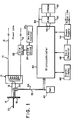
- Fig. 1 depicts a schematic diagram of an embodiment of the one step RMS system of the present invention used with a single phase resistance welder, an air core toroid coil, and a microcontroller which embodies the teachings of the present invention.
- the present invention can also be used to measure RMS current values of other systems such as, for example, electrical heating systems and power lines.
- a single phase resistance welder 10 is provided with electric power by a pair of power lines 12.
- a transformer 14 steps down the power line voltage and increases the electrode current which is provided to secondary circuit 16 and electrodes 18 which heat workpieces 20. Since the electrode current passing through secondary circuit 16 is the current that is to be measured and controlled, the RMS value of this current must be determined.
- the power line voltage provided to transformer 14 is controlled by SCR switch 22, drive 24, and welder control 26.
- Power lines 12, transformer 14 and SCR switch 22 comprise a primary circuit.
- An air core toroid coil 30 also known as a Rogowski coil or belt) surrounds a portion of secondary circuit 16 and may be located at any point in secondary circuit 16.
- the electrode current typically has a fixed current frequency and a fixed current period.
- EMF electro-magnetic force
- This EMF causes a differential current signal to be generated by the coil of air core toroid coil 30 which is proportional to the rate of change of the magnetic field induced by the electrode current flowing in secondary circuit 16.
- the differential current passing through the coil of air core toroid coil 30 is proportional to the first differential with respect to time of the electrode current passing through secondary circuit 16.
- other devices which produce a first differential current signal can be used instead of an air core toroid coil.
- microcontroller 40 is an MCS®-96 (8096) microcontroller or an MCS®-97 (8097) microcontroller manufactured by the Intel Corporation of Santa Clara, California although other microcontrollers or other similarly functioning devices can be used.
- Microcontroller 40 typically has an input signal range of about 0 to about 5 volts. Accordingly, reference system 42 is set at about 2.5 volts so that signals of equal positive and negative amplitude may be measured by microcontroller 40.
- the input signal on lines 32 and 34 can alternatively be rectified to a single polarity thus eliminating the need for reference system 42. This alternative would, however, increase the analog to digital conversion range by one bit and may add some inaccuracy and introduce some DC drift into the system.
- Zero crossing detector 46 provides a pulse of length equal to the time length of one half cycle of the power line frequency. This signal is used to initiate the correct time base for calculating the RMS current of secondary circuit 16.
- Digital data display 48 is used to display the RMS current value calculated by microcontroller 40. There are many types of digital displays suitable for operation from the microcontroller port; however, the resolution of the digital display 48 is to be chosen to adequately resolve the data gathered by microcontroller 40.
- RAM 50 and EPROM 52 provide the necessary memory for the operation of microcontroller 40.
- the software system which controls microcontroller 40 and which is depicted in flow diagram form in Figs. 2 and 3 and described in detail below is preferably stored in EPROM 52.
- RAM 50 is preferably used to store the running values of the different parameters measured and calculated as explained in detail below.
- RAM 50 and EPROM 52 are connected to microcontroller 40 via control lines 54 and data address bus 56.
- Microcontroller 40 contains, among other elements, an analog to digital (A/D) converter, a high speed input to output (I/O) port, and a timer.
- the A/D converter samples the input signal received on lines 32 and 34 at preselected time intervals, as discussed in detail below, and converts the input analog signal into a digital signal. This digital signal is then fed to the other elements of microcontroller 40.
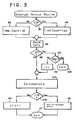
- FIGs. 2 and 3 depict a software system which implements the one step RMS system of the present invention and is capable of measuring an RMS current.
- a hardware system as shown in Fig. 1 can be used to implement the software system shown in Figs. 2 and 3.
- the hardware system must have the capability to convert an analog signal to digital form, measure a pulse width, execute a time based interrupt, and perform the various mathematical calculations within the given time constraints.
- an Intel MCS® 97 has these capabilities and has been disclosed as a typical hardware system.
- waveform 60 is an example of a current waveform plotted as a function of time. Although waveform 60 has a fixed known current frequency and a fixed known current period, other waveforms with unknown current frequencies and unknown current periods can be measured.
- the waveform produced by air core toroid coil 30 is shown as waveform 62. Waveform 62 is thus the first differential with respect to time of waveform 60.
- the software will calculate the RMS value of waveform 60 at predetermined intervals each of which is illustratively equal to one half current period or one pulse period which, as discussed below, is equal to (N x dt) + t rem .
- the system described here samples waveform 62 at fixed time intervals dt. Every time waveform 62 is sampled, the software system calculates the current value at that time (CURRENT j ) and adds the square of the current to a running sum (TOTAL j ). The number N of samples taken determines the accuracy of the system.
- the specific calculations used to determine the RMS current are described in detail with reference to the flow diagrams of Figs. 2 and 3.
- Block 70 measures the width of one half cycle of the power line base frequency. This can be done easily using the high speed I/O port of microcontroller 40 coupled to zero detector 46 which outputs a pulse of time width equal to one half cycle. The time of a pulse period or one half current cycle allows microprocessor 40 to determine the base frequency of the power signal on power lines 12 (and therefore that of the current in secondary circuit 16) to be measured.
- Block 72 it is determined whether the current frequency is 60 Hz or 50 Hz. Other frequencies can be accommodated with suitable changes in the software which would be obvious to those skilled in the art. In addition, the software can be modified so that the measurement of current in secondary circuit 16 is independent of the frequency or shape of the current waveform as discussed in greater detail below.
- Block 74 initializes the time base dependent variables for 60 Hz operation, while analogously block 76 does the same for 50 Hz operation. In particular, these variables are: the number of samples N to be taken per pulse period or one half cycle, and an associated remainder time (t rem ) for the particular operation frequency. N is determined based on a fixed sampling time interval dt of 100 microseconds.
- N is set equal to 99 and t rem is set equal to 100 us.
- N 82
- this time constraint is loosened, and the processor is given more than 100 us to complete all necessary calculations.
- the appropriate values of N and t rem are then preferably stored in RAM 50 for later use by microcontroller 40. For other operating frequencies, other values of N and t rem can be chosen.
- variable initialization block 78 the variables used in the main program are initialized by setting their values equal to zero and preferably storing these values in RAM 50. These variables are: TOTAL0, the running sum of the squares of the current; CURRENT0, the value of the current waveform at time zero; j, the counter used to keep track of the number of samples already taken of the waveform during a one half cycle; and di/dt0, the value of the first differential waveform 62 at time zero.
- Block 80 represents enabling the time based interrupt for the first time. This interrupt is determined by the timer and the I/O port of microcontroller 40.
- the timer is a counter that is always running in microcontroller 40.
- the software sets up an interrupt based on the count in the timer. When the timer reaches the specified count, an interrupt occurs. By reading the count in the timer and then adding some offset to that count, a relative time based interrupt is generated.
- the interrupt enabled in block 80 will be generated 100 us from the time it was enabled.
- the initialization routine is complete once the timer interrupt is enabled.
- the interrupt service routine for the timer interrupt enables the next timer interrupt and handles all calculations involved in determining the RMS current. Because this system is interrupt controlled, a foreground task such as keeping statistics on the values of RMS current, or display of data can be implemented.
- the offpage reference block 82 in Fig. 2 represents entry into such a foreground task.
- the flow diagram shown in Fig. 3 represents the interrupt service routine for the time based interrupt. Every time the interrupt is generated, data is sampled from air core toroid coil 30 and possibly used in calculations as explained in detail below.
- the first step in the interrupt service routine as shown in Fig. 3 is to enable the next interrupt.
- Block 94 represents this action.
- Block 92 is for the case when j is not equal to N.
- Block 96 represents the process of sampling the data from air core toroid coil 30. This process is accomplished by converting the analog value from coil 30 into digital form using the A/D converter of microcontroller 40. Once the conversion is complete, the data is read from the A/D converter into system RAM 50.
- Blocks 98, 100, 102 and 104 of Fig. 3 implement the startup of the measuring system.
- the program waits until a significant, non-zero, value is read from air core toroid coil 30 to start the measuring process. By doing this, the one half cycle measurement process is synchronized to the beginning of the current pulse.
- di/dt j DATA This is the value of the differential waveform 62 at time j x dt and is preferably stored in RAM 50 for later processing.
- the area SUB-AREA j as shown in Fig.
- TOTAL j TOTAL j-1 + [CURRENT j ]2
- the value of TOTAL j is then preferably stored in RAM 50.
- Decision 108 determines whether all N values for the waveform being measured have been processed which has occurred when j is equal to N. If j is not equal to N, then as block 110 shows, j is incremented by one and control of the processor is returned to the foreground routine.
- the processing of the foreground routine is interrupted at an interrupt time as set in blocks 92 or 94. When the foreground routine is interrupted, the interrupt service routine is processed beginning at block 90.
- j is equal to N, then all measurements for the waveform have been processed.
- the variables are also reset and reinitialized to zero for measurements in the next one half cycle.
- j, TOTAL, CURRENT, and di/dt are all set equal to zero and these values are stored in RAM 50.
- control of the processor is returned to the foreground routine as discussed above, the RMS current is displayed on digital display 48, and the next measurements on the next one half cycle will commence once the next non-zero data value is read from air core coil 30.
- the software program used to implement the RMS system of the present invention can also be easily modified to obtain RMS values of current waveforms with only a single pulse, or waveforms comprised of several different pulses with different durations.
- the current waveform can comprise three pulses, (which may or may not be repeated periodically), where the first pulse has a positive polarity and a duration of 0.5 seconds, the second pulse has a negative polarity and a duration of 1.0 seconds, and the third pulse has a positive polarity and a durtion of 0.5 seconds.
- this current waveform is a balanced waveform of several pulses, it is not symmetrically periodic like waveform 60 shown in Fig. 4.
- the initialization software described in the flow diagram of Figure 2 can be modified so that the measurement of the current in secondary circuit 16 is independent of the frequency or shape of the current waveform.
- This modification is useful, for example, when the current waveform to be measured is comprised of pulses which are equal to or greater than one half cycle of the power line frequency. If the waveform to be measured were comprised of pulses of several seconds in duration, it would be desirable to determine the RMS current more frequently than once for every pulse since more frequent monitoring of the RMS current may be desired. In such a case, the software in effect breaks the long pulses into segments and determines the RMS current for each segment. This can be accomplished by choosing particular values for N and t rem which do not necessarily depend upon the shape or frequency of the current waveform.
- interrupt service routine described in the flow diagram of Figure 3 can then optionally be modified so that the RMS values determined for all of the segments of the long pulses are averaged to obtain the average RMS value for the each long pulse.
- Such a modification of the software permits the measurement of RMS current values for waveforms commonly found in frequency converters and "DC" welders. Since these machines have current pulses with durations that are longer than those of single phase welders, the above described modification of the software to measure segments of the pulses permits the measurement of RMS current values of these pulses even though the pulse duration may be arbitrary and may vary from one pulse to another.
Landscapes
- Physics & Mathematics (AREA)
- General Physics & Mathematics (AREA)
- Engineering & Computer Science (AREA)
- Mechanical Engineering (AREA)
- Measurement Of Current Or Voltage (AREA)
Claims (14)
- Appareil permettant de déterminer la valeur de moyenne quadratique d'un signal impulsionnel généré à partir d'un signal de ligne d'alimentation, ledit signal de ligne d'alimentation présentant une période sensiblement fixe connue, et dans lequel la valeur absolue dudit signal impulsionnel présente une période sensiblement égale à la moitié de la période dudit signal de ligne d'alimentation et une durée temporelle égale à moins que ladite demi-période, ledit appareil étant caractérisé par :
un moyen (96) pour produire des échantillons du signal impulsionnel selon des intervalles d'échantillonnage sensiblement égaux prédéfinis commençant sensiblement lors de l'attaque d'une impulsion dudit signal impulsionnel et se poursuivant après pendant sensiblement la totalité de la durée de ladite demi-période dudit signal de ligne d'alimentation pour générer des valeurs échantillonnées correspondantes ;
un moyen (106) sensible audit moyen de production d'échantillons pour élever au carré chacune desdites valeurs échantillonnées pour générer des valeurs élevées au carré correspondantes ;
un moyen (106) sensible en réponse audit moyen d'élévation au carré pour accumuler chacune desdites valeurs élevées au carré pour produire une valeur totalisée ;
un moyen (106) sensible audit moyen d'élévation au carré pour diviser ladite valeur totalisée par un nombre, dans lequel ledit nombre est égal au nombre total d'échantillons séparés pris et accumulés pendant ladite demi-période pour obtenir une valeur intermédiaire ; et
un moyen (106) sensible audit moyen de division pour déterminer la racine carrée de ladite valeur intermédiaire pour obtenir ladite valeur de moyenne quadratique dudit signal impulsionnel. - Appareil selon la revendication 1, caractérisé en outre par :
un moyen (70) pour évaluer la période dudit signal de ligne d'alimentation ; et
un moyen (72) pour choisir une durée dudit intervalle d'échantillonnage pour produire une résolution souhaitée de ladite valeur de moyenne quadratique. - Appareil selon la revendication 2, caractérisé en ce que ledit moyen d'élévation au carré génère chaque valeur élevée au carré avant la survenue de chaque valeur échantillonnée se produisant successivement correspondante et ledit moyen d'accumulation additionne chaque valeur élevée au carré à la valeur totalisée avant la survenue de ladite valeur échantillonnée se produisant successivement ensuite.
- Appareil selon la revendication 3, caractérisé en ce que ledit appareil comprend en outre une bobine exploratrice sans noyau (30) pour produire ledit signal impulsionnel, dans lequel ledit signal impulsionnel est proportionnel à une première dérivée d'un courant mesuré ; ledit moyen de production d'échantillons comprend en outre :
un moyen pour échantillonner ledit signal impulsionnel selon des intervalles d'échantillonnage sensiblement égaux prédéfinis commençant sensiblement lors de l'attaque d'une impulsion dudit signal impulsionnel et se poursuivant ensuite pendant sensiblement la totalité de la durée de ladite demi-période dudit signal de ligne d'alimentation pour obtenir des valeurs numériques correspondantes ; et
un moyen pour intégrer chacune desdites valeurs numériques pour obtenir chacune desdites valeurs échantillonnées, dans lequel chacune desdites valeurs échantillonnées est proportionnelle à une valeur instantanée dudit courant mesuré. - Appareil selon la revendication 4, caractérisé en ce que ledit intervalle d'échantillonnage présente une durée d'approximativement 100 microsecondes et ledit nombre est égal à la valeur 82 dans l'éventualité où ledit signal de ligne d'alimentation présente une fréquence d'approximativement 60 hertz.
- Appareil selon la revendication 4, caractérisé en ce que ledit intervalle d'échantillonnage présente une durée d'approximativement 100 microsecondes et ledit nombre est égal à la valeur 99 dans l'éventualité où ledit signal de ligne d'alimentation présente une fréquence d'approximativement 50 hertz.
- Appareil selon la revendication 1, caractérisé en ce que l'appareil inclut en outre une bobine exploratrice sans noyau (30) pour produire lesdits échantillons dudit signal impulsionnel, ledit signal impulsionnel étant proportionnel à une première dérivée d'un courant de soudage mesuré, ledit appareil déterminant la moyenne quadratique dudit courant de soudage mesuré.
- Procédé de détermination de la valeur de moyenne quadratique d'un signal impulsionnel généré à partir d'un signal de ligne d'alimentation, ledit signal de ligne d'alimentation présentant une période sensiblement fixe connue, et dans lequel ledit signal impulsionnel présente une valeur absolue et la valeur absolue présente une période sensiblement égale à la moitié de la période dudit signal de ligne d'alimentation et une durée temporelle égale à moins que ladite demi-période, ledit procédé étant caractérisé par les étapes de :
production d'échantillons du signal impulsionnel selon des intervalles d'échantillonnage sensiblement égaux prédéfinis commençant sensiblement lors de l'attaque d'une impulsion dudit signal impulsionnel et se poursuivant après pendant sensiblement la totalité de la durée de ladite demi-période dudit signal de ligne d'alimentation pour générer des valeurs échantillonnées correspondantes ;
élévation au carré de chacune desdites valeurs échantillonnées pour générer des valeurs élevées au carré correspondantes ;
accumulation de chacune desdites valeurs élevées au carré pour produire une valeur totalisée ;
division de ladite valeur totalisée par un nombre, dans lequel ledit nombre est égal au nombre total d'échantillons séparés saisis et accumulés pendant ladite demi-période pour obtenir une valeur intermédiaire ; et
détermination de la racine carrée de ladite valeur intermédiaire pour obtenir ladite valeur de moyenne quadratique dudit signal impulsionnel. - Procédé selon la revendication 8, caractérisé en outre par les étapes de :
évaluation de la période dudit signal de ligne d'alimentation ; et
choix d'une durée dudit intervalle d'échantillonnage pour produire une résolution souhaitée de ladite valeur de moyenne quadratique. - Procédé selon la revendication 9, caractérisé en ce que ladite étape d'élévation au carré comprend en outre l'étape de génération de chaque valeur élevée au carré avant la survenue de chaque valeur échantillonnée se produisant successivement correspondante ; et ladite étape d'accumulation comprend en outre l'étape d'addition de chaque valeur élevée au carré à la valeur totalisée avant la survenue de ladite valeur échantillonnée se produisant successivement ensuite.
- Procédé selon la revendication 10, caractérisé en outre par l'étape de génération dudit signal impulsionnel en utilisant une bobine exploratrice sans noyau, dans lequel ledit signal impulsionnel généré par ladite bobine est proportionnel à une première dérivée d'un courant mesuré ; et ledit l'étape de génération d'échantillons comprend en outre :
l'échantillonnage dudit signal impulsionnel selon des intervalles d'échantillonnage sensiblement égaux prédéfinis commençant sensiblement lors de l'attaque d'une impulsion dudit signal impulsionnel et se poursuivant ensuite pendant la totalité de la durée de ladite demi-période dudit signal de ligne d'alimentation pour obtenir des valeurs numériques correspondantes ; et
intégration de chacune desdites valeurs numériques pour obtenir chacune desdites valeurs échantillonnées, dans lequel chacune desdites valeurs échantillonnées est proportionnelle à une valeur instantanée dudit courant mesuré. - Procédé selon la revendication 11, caractérisé en ce que ledit intervalle d'échantillonnage présente une durée d'approximativement 100 microsecondes et ledit nombre est égal à la valeur 82 dans l'éventualité où ledit signal de ligne d'alimentation présente une fréquence d'approximativement 60 hertz.
- Procédé selon la revendication 11, caractérisé en ce que ledit intervalle d'échantillonnage présente une durée d'approximativement 100 microsecondes et ledit nombre est égal à la valeur 99 dans l'éventualité où ledit signal de ligne d'alimentation présente une fréquence d'approximativement 50 hertz.
- Procédé selon la revendication 11, caractérisé en ce que ledit procédé inclut l'étape de génération dudit signal impulsionnel en utilisant une bobine exploratrice sans noyau, ledit signal impulsionnel généré étant proportionnel à une première dérivée d'un courant de soudage impulsionnel et ainsi, le procédé détermine la moyenne quadratique dudit courant de soudage.
Priority Applications (2)
| Application Number | Priority Date | Filing Date | Title |
|---|---|---|---|
| DE19863689956 DE3689956T2 (de) | 1986-08-15 | 1986-08-15 | Bestimmung des Effektivwertes des Stromes durch Abtastung des differentiellen Stromes. |
| EP19860306314 EP0256183B1 (fr) | 1986-08-15 | 1986-08-15 | Mesure de la valeur efficace par échantillonnage du taux de variation du courant |
Applications Claiming Priority (1)
| Application Number | Priority Date | Filing Date | Title |
|---|---|---|---|
| EP19860306314 EP0256183B1 (fr) | 1986-08-15 | 1986-08-15 | Mesure de la valeur efficace par échantillonnage du taux de variation du courant |
Publications (2)
| Publication Number | Publication Date |
|---|---|
| EP0256183A1 EP0256183A1 (fr) | 1988-02-24 |
| EP0256183B1 true EP0256183B1 (fr) | 1994-07-06 |
Family
ID=8196098
Family Applications (1)
| Application Number | Title | Priority Date | Filing Date |
|---|---|---|---|
| EP19860306314 Expired - Lifetime EP0256183B1 (fr) | 1986-08-15 | 1986-08-15 | Mesure de la valeur efficace par échantillonnage du taux de variation du courant |
Country Status (2)
| Country | Link |
|---|---|
| EP (1) | EP0256183B1 (fr) |
| DE (1) | DE3689956T2 (fr) |
Cited By (1)
| Publication number | Priority date | Publication date | Assignee | Title |
|---|---|---|---|---|
| WO2014137837A1 (fr) * | 2013-03-04 | 2014-09-12 | Neilsen-Kuljian, Inc. | Procédé et appareil de mesure de valeurs quadratiques moyennes (rms) de courants à déclenchement en salve |
Families Citing this family (8)
| Publication number | Priority date | Publication date | Assignee | Title |
|---|---|---|---|---|
| JP2573302B2 (ja) * | 1988-04-25 | 1997-01-22 | 株式会社東芝 | 抵抗溶接機の制御装置 |
| EP0438637A1 (fr) * | 1990-01-24 | 1991-07-31 | Landis & Gyr Business Support AG | Procédé et dispositif pour la détection de la valeur effective Ieff d'un courant à mesurer utilisant un élément Hall et un circuit d'amplification |
| DE69305972T2 (de) * | 1993-03-04 | 1997-06-12 | Serra Soldadura | System und Verfahren zur elektronischen Steuerung eines Schweissverfahrens in einer Widerstandsschweissanlage |
| US6064193A (en) * | 1997-07-17 | 2000-05-16 | Tektronix, Inc. | Method and apparatus for measuring the mean square value of an electrical signal |
| CA2247572A1 (fr) * | 1997-11-10 | 1999-05-10 | Fluke Corporation | Convertisseur de valeur efficace pour obtenir des mesures rapides de valeurs efficaces |
| EP3382406A1 (fr) * | 2017-03-30 | 2018-10-03 | NorthQ ApS | Système et procédé d'estimation du courant transporté dans un câble |
| CN110927613A (zh) * | 2019-11-29 | 2020-03-27 | 南京航空航天大学 | 一种航空宽变频电源信号有效值同步采样方法 |
| CN113634863A (zh) * | 2021-08-16 | 2021-11-12 | 南京米利嘉电子科技有限公司 | 一种基于次级电流检测的电阻焊质量监控方法 |
Family Cites Families (5)
| Publication number | Priority date | Publication date | Assignee | Title |
|---|---|---|---|---|
| FR978684A (fr) * | 1948-01-05 | 1951-04-17 | Napier & Son Ltd | Perfectionnements à la mesure des courants électriques |
| DE1011065B (de) * | 1954-09-18 | 1957-06-27 | Siemens Ag | Einrichtung zum Messen nicht sinusfoermiger Wechselstroeme, insbesondere der kurzzeitigen Stroeme von mittels Entladungsgefaessen leistungsgesteuerten Schweissmaschinen |
| US3034057A (en) * | 1959-01-16 | 1962-05-08 | Gen Motors Corp | Universal weld current analyzer |
| US3289079A (en) * | 1963-03-04 | 1966-11-29 | Duffers Ass | R. m. s. measuring system having an integrating circuit including a transistorized capacitor discharge means controlled by the measured signal |
| USRE31774E (en) * | 1979-02-16 | 1984-12-18 | Leeds & Northrup Company | Measuring system |
-
1986
- 1986-08-15 EP EP19860306314 patent/EP0256183B1/fr not_active Expired - Lifetime
- 1986-08-15 DE DE19863689956 patent/DE3689956T2/de not_active Expired - Fee Related
Cited By (1)
| Publication number | Priority date | Publication date | Assignee | Title |
|---|---|---|---|---|
| WO2014137837A1 (fr) * | 2013-03-04 | 2014-09-12 | Neilsen-Kuljian, Inc. | Procédé et appareil de mesure de valeurs quadratiques moyennes (rms) de courants à déclenchement en salve |
Also Published As
| Publication number | Publication date |
|---|---|
| DE3689956T2 (de) | 1995-02-23 |
| EP0256183A1 (fr) | 1988-02-24 |
| DE3689956D1 (de) | 1994-08-11 |
Similar Documents
| Publication | Publication Date | Title |
|---|---|---|
| US5548197A (en) | Method and apparatus for determining motor speed using zero crossing times | |
| CA1269713A (fr) | Compteurs electroniques de consommation d'electricite | |
| US4721906A (en) | One step RMS system | |
| US4459546A (en) | Electronic kilowatthour meter | |
| KR100232437B1 (ko) | 솔리드 스테이트 모우터제어기의 전류측정장치 | |
| EP0660120B1 (fr) | Méthode pour la mesure électronique digitale de quantités électriques périodiques et instrument pour réaliser ladite méthode | |
| US10534026B2 (en) | Multiple phase measurement device | |
| EP0256183B1 (fr) | Mesure de la valeur efficace par échantillonnage du taux de variation du courant | |
| US5473241A (en) | Method and apparatus for RMS measurements in induction motor without sampling | |
| US5257864A (en) | Temperature detector | |
| EP0058050A1 (fr) | Procédé de mesure de fréquence | |
| KR19990044983A (ko) | 실효값의 빠른 계측을 얻을 수 있는 실효값 변환기 | |
| EP0339551B1 (fr) | Appareil de commande de soudeuses par résistance et méthode de commande associée | |
| GB2093292A (en) | Apparatus and methods for analogue-to-digital conversion and for deriving in-phase and quadrature components of voltage and current in an impedance | |
| JPH0619409B2 (ja) | 直流送電系の故障点標定装置 | |
| JP3015597B2 (ja) | オシロスコープの水平軸電子目盛りを校正する方法及び装置 | |
| JP2589817Y2 (ja) | Lcrテスタ | |
| RU2037835C1 (ru) | Прибор для измерения тока разрыва при контроле интенсивности искрения щеток электрических машин | |
| JPS5847425Y2 (ja) | 交流電気機器特性試験装置 | |
| JPS59152028A (ja) | 放電加工用比抵抗制御装置 | |
| SU1758614A1 (ru) | Способ определени пространственных составл ющих амплитуды вектора напр женности магнитного пол вблизи массивных проводников | |
| RU2068567C1 (ru) | Устройство для бесконтактного измерения мгновенных значений импульсов тока разрыва в коммутируемых секциях коллекторных электрических машин | |
| SU1642408A1 (ru) | Способ определени тока в разр дном контуре конденсатора | |
| SU1026064A1 (ru) | Устройство дл измерени напр жени прикосновени и шага и сопротивлени заземлени | |
| JPH057548Y2 (fr) |
Legal Events
| Date | Code | Title | Description |
|---|---|---|---|
| PUAI | Public reference made under article 153(3) epc to a published international application that has entered the european phase |
Free format text: ORIGINAL CODE: 0009012 |
|
| AK | Designated contracting states |
Kind code of ref document: A1 Designated state(s): DE FR GB IT |
|
| 17P | Request for examination filed |
Effective date: 19880816 |
|
| 17Q | First examination report despatched |
Effective date: 19901119 |
|
| RAP1 | Party data changed (applicant data changed or rights of an application transferred) |
Owner name: DYNAMIC SYSTEMS INC. |
|
| GRAA | (expected) grant |
Free format text: ORIGINAL CODE: 0009210 |
|
| AK | Designated contracting states |
Kind code of ref document: B1 Designated state(s): DE FR GB IT |
|
| REF | Corresponds to: |
Ref document number: 3689956 Country of ref document: DE Date of ref document: 19940811 |
|
| ITTA | It: last paid annual fee | ||
| ITF | It: translation for a ep patent filed | ||
| ET | Fr: translation filed | ||
| PLBE | No opposition filed within time limit |
Free format text: ORIGINAL CODE: 0009261 |
|
| STAA | Information on the status of an ep patent application or granted ep patent |
Free format text: STATUS: NO OPPOSITION FILED WITHIN TIME LIMIT |
|
| 26N | No opposition filed | ||
| REG | Reference to a national code |
Ref country code: FR Ref legal event code: TP |
|
| REG | Reference to a national code |
Ref country code: GB Ref legal event code: 732E |
|
| REG | Reference to a national code |
Ref country code: GB Ref legal event code: IF02 |
|
| PGFP | Annual fee paid to national office [announced via postgrant information from national office to epo] |
Ref country code: FR Payment date: 20030625 Year of fee payment: 18 |
|
| PGFP | Annual fee paid to national office [announced via postgrant information from national office to epo] |
Ref country code: DE Payment date: 20030901 Year of fee payment: 18 |
|
| PGFP | Annual fee paid to national office [announced via postgrant information from national office to epo] |
Ref country code: GB Payment date: 20040804 Year of fee payment: 19 |
|
| PG25 | Lapsed in a contracting state [announced via postgrant information from national office to epo] |
Ref country code: DE Free format text: LAPSE BECAUSE OF NON-PAYMENT OF DUE FEES Effective date: 20050301 |
|
| PG25 | Lapsed in a contracting state [announced via postgrant information from national office to epo] |
Ref country code: FR Free format text: LAPSE BECAUSE OF NON-PAYMENT OF DUE FEES Effective date: 20050429 |
|
| REG | Reference to a national code |
Ref country code: FR Ref legal event code: ST |
|
| PG25 | Lapsed in a contracting state [announced via postgrant information from national office to epo] |
Ref country code: IT Free format text: LAPSE BECAUSE OF NON-PAYMENT OF DUE FEES;WARNING: LAPSES OF ITALIAN PATENTS WITH EFFECTIVE DATE BEFORE 2007 MAY HAVE OCCURRED AT ANY TIME BEFORE 2007. THE CORRECT EFFECTIVE DATE MAY BE DIFFERENT FROM THE ONE RECORDED. Effective date: 20050815 Ref country code: GB Free format text: LAPSE BECAUSE OF NON-PAYMENT OF DUE FEES Effective date: 20050815 |
|
| GBPC | Gb: european patent ceased through non-payment of renewal fee |
Effective date: 20050815 |