EP0256706A2 - Verfahren und Vorrichtung zum Ausgleichen der Ausgangsleistung eines Laser-Markierungssystems - Google Patents
Verfahren und Vorrichtung zum Ausgleichen der Ausgangsleistung eines Laser-Markierungssystems Download PDFInfo
- Publication number
- EP0256706A2 EP0256706A2 EP87306687A EP87306687A EP0256706A2 EP 0256706 A2 EP0256706 A2 EP 0256706A2 EP 87306687 A EP87306687 A EP 87306687A EP 87306687 A EP87306687 A EP 87306687A EP 0256706 A2 EP0256706 A2 EP 0256706A2
- Authority
- EP
- European Patent Office
- Prior art keywords
- lasers
- stroke
- marking
- laser
- time period
- Prior art date
- Legal status (The legal status is an assumption and is not a legal conclusion. Google has not performed a legal analysis and makes no representation as to the accuracy of the status listed.)
- Granted
Links
Images


Classifications
-
- B—PERFORMING OPERATIONS; TRANSPORTING
- B23—MACHINE TOOLS; METAL-WORKING NOT OTHERWISE PROVIDED FOR
- B23K—SOLDERING OR UNSOLDERING; WELDING; CLADDING OR PLATING BY SOLDERING OR WELDING; CUTTING BY APPLYING HEAT LOCALLY, e.g. FLAME CUTTING; WORKING BY LASER BEAM
- B23K26/00—Working by laser beam, e.g. welding, cutting or boring
- B23K26/02—Positioning or observing the workpiece, e.g. with respect to the point of impact; Aligning, aiming or focusing the laser beam
- B23K26/06—Shaping the laser beam, e.g. by masks or multi-focusing
- B23K26/062—Shaping the laser beam, e.g. by masks or multi-focusing by direct control of the laser beam
- B23K26/0626—Energy control of the laser beam
-
- B—PERFORMING OPERATIONS; TRANSPORTING
- B23—MACHINE TOOLS; METAL-WORKING NOT OTHERWISE PROVIDED FOR
- B23K—SOLDERING OR UNSOLDERING; WELDING; CLADDING OR PLATING BY SOLDERING OR WELDING; CUTTING BY APPLYING HEAT LOCALLY, e.g. FLAME CUTTING; WORKING BY LASER BEAM
- B23K26/00—Working by laser beam, e.g. welding, cutting or boring
- B23K26/02—Positioning or observing the workpiece, e.g. with respect to the point of impact; Aligning, aiming or focusing the laser beam
- B23K26/06—Shaping the laser beam, e.g. by masks or multi-focusing
-
- B—PERFORMING OPERATIONS; TRANSPORTING
- B23—MACHINE TOOLS; METAL-WORKING NOT OTHERWISE PROVIDED FOR
- B23K—SOLDERING OR UNSOLDERING; WELDING; CLADDING OR PLATING BY SOLDERING OR WELDING; CUTTING BY APPLYING HEAT LOCALLY, e.g. FLAME CUTTING; WORKING BY LASER BEAM
- B23K26/00—Working by laser beam, e.g. welding, cutting or boring
- B23K26/02—Positioning or observing the workpiece, e.g. with respect to the point of impact; Aligning, aiming or focusing the laser beam
- B23K26/06—Shaping the laser beam, e.g. by masks or multi-focusing
- B23K26/0604—Shaping the laser beam, e.g. by masks or multi-focusing by a combination of beams
-
- B—PERFORMING OPERATIONS; TRANSPORTING
- B23—MACHINE TOOLS; METAL-WORKING NOT OTHERWISE PROVIDED FOR
- B23K—SOLDERING OR UNSOLDERING; WELDING; CLADDING OR PLATING BY SOLDERING OR WELDING; CUTTING BY APPLYING HEAT LOCALLY, e.g. FLAME CUTTING; WORKING BY LASER BEAM
- B23K26/00—Working by laser beam, e.g. welding, cutting or boring
- B23K26/02—Positioning or observing the workpiece, e.g. with respect to the point of impact; Aligning, aiming or focusing the laser beam
- B23K26/06—Shaping the laser beam, e.g. by masks or multi-focusing
- B23K26/0604—Shaping the laser beam, e.g. by masks or multi-focusing by a combination of beams
- B23K26/0613—Shaping the laser beam, e.g. by masks or multi-focusing by a combination of beams having a common axis
-
- G—PHYSICS
- G06—COMPUTING OR CALCULATING; COUNTING
- G06K—GRAPHICAL DATA READING; PRESENTATION OF DATA; RECORD CARRIERS; HANDLING RECORD CARRIERS
- G06K1/00—Methods or arrangements for marking the record carrier in digital fashion
- G06K1/12—Methods or arrangements for marking the record carrier in digital fashion otherwise than by punching
- G06K1/126—Methods or arrangements for marking the record carrier in digital fashion otherwise than by punching by photographic or thermographic registration
-
- B—PERFORMING OPERATIONS; TRANSPORTING
- B23—MACHINE TOOLS; METAL-WORKING NOT OTHERWISE PROVIDED FOR
- B23K—SOLDERING OR UNSOLDERING; WELDING; CLADDING OR PLATING BY SOLDERING OR WELDING; CUTTING BY APPLYING HEAT LOCALLY, e.g. FLAME CUTTING; WORKING BY LASER BEAM
- B23K2101/00—Articles made by soldering, welding or cutting
- B23K2101/007—Marks, e.g. trade marks
Definitions
- This invention relates to the field of marking devices for placing codes and the like on a substrate. More specifically, it relates to marking devices capable of placing alphanumeric codes, bar codes and other useful indicia on the surface of a product which moves relative to the marking device as, for example, on a conveyor. That device marks on objects moved past the laser beams.
- the present invention can be employed with a system which scans the beams across a stationary substrate, for example, using moving mirrors. Usually the marking is accomplished using a plurality of lasers having sufficient energy to permanently alter the surface of the product to be marked.
- One device with which the present invention may be employed is disclosed in U.S. patent application Serial No. 596,898 assigned to the present assignee which application is hereby incorporated by reference.
- Such a laser marking device employs a plurality of lasers, for example, seven.
- the output beam from each laser is sent through a beam delivery tube and a focusing lens onto the marking location.
- the seven beams are arranged by means of the lens to form a vertical column of seven beams, each capable of marking a dot onto the passing product.
- a dot matrix arrangement for printing alphanumeric characters is obtained in a manner well known in this art.
- By selectively turning on the lasers corresponding to the correct positions for a desired alphanumeric character such symbols may be marked onto the product.
- a 5 ⁇ 7 dot matrix is employed and thus, for each character to be printed, the seven lasers must be turned on and off five times in a sequence which will place dots where required to form the character.
- Each character is formed by turning on selected lasers simultaneously five separate times (each time being referred to as a stroke) as the substrate of the article to be marked moves past the laser lens.
- variations in laser energy output cause degradation of the print quality. Some dots are only partially formed or are missing entirely. Others are too large.
- This variation in laser output energy can result from: (l) variation in nominal laser output power, (2) turn on delay, (3) turn on and turn off time constants, (4) energy density and beam shape variation. Indeed efforts to match seven lasers so that their effective output power is essentially equal would be prohibitively expensive and perhaps impossible as power output can change over time.
- the present invention discloses a method and apparatus for equalizing laser output by controlling the electrical drive signals for each laser.
- the result substantially reduces the effect of laser performance variation on print quality.
- the control takes several forms. First, the relative energy output of each laser is determined and its on time is adjusted by appropriately weighting the on time of each laser relative to the weakest laser beam. Alternatively, the beam weighting can be relative to other references, such as average beam energy or even an independent reference value.
- the use of variable width "on" time pulses for the lasers can, however, introduce nonlinearity in the formed characters. To avoid or minimize this problem, all of the "on" pulses are centred about a selected time axis. Thus, the combination of weighted "on” pulses coupled with pulse centering provides a significant improvement in overall print quality.
- a further object of the invention is to provide a method and apparatus for varying the "on" pulse width of each laser in such a marking system to substantially equalize the energy outputs thereof.
- Another object of the invention is to provide a method and apparatus for centering the "on" pulses used to trigger the lasers to insure vertical linearity of the energy dots produced therefrom for marking a moving substrate.
- a further object of the invention is to provide a method and means whereby high stroke rates may be obtained by pre-ionizing the lasers to reduce turn on delay.
- the invention is suitable for use in a laser marking system.
- the system includes a laser head l0 containing a number of lasers, preferably CO2 lasers, which are excited by RF energy at approximately 27MHz to a nominal power of about 20 watts.
- the laser head typically will contain seven lasers, the outputs of which are directed through a beam delivery tube l2, via mirrors, onto a lens l4 which focuses the beams onto a marking area.
- the marking area is on the surface l6 of a conveyor system on which products to be marked are carried.
- the outputs of the lasers are focused by the lens to form a vertical column of beams, in the case of seven lasers a seven high vertical column. Because the products to be marked move transversely with respect to the vertical column it is possible to create a 7 ⁇ n dot matrix from which alphanumeric characters may be generated by selectively controlling the beam energy of each laser. For purposes of this application it will be assumed that a 7 ⁇ 5 dot matrix is desired and thus each matrix is composed of five vertical strokes from the seven lasers as the substrate to be marked moves past the marking point (see Figure 2).
- the RF exitation for the lasers is generated by amplifiers l8 located in a control console, one amplifier for each laser.
- the amplifiers are controlled by digital signals from a computer system 20 via a laser interface circuit 22 according to the present invention.
- Each laser is separately controllable by a signal which turns the laser on or off depending on the particular character to be printed.
- a keyboard and CRT unit 24 permit the operator to communicate with the computer to enter data and alter the operation of the laser interface 22 as will be described.
- many computer systems can be employed as, for example, an Intel 80/24 single board computer system.
- each matrix which for exemplary purposes is 7 ⁇ 5, contains 35 dots.
- a 7 ⁇ 5 dot matrix there are five "strokes", each stroke being one of the vertical columns.
- To create the letter E for example, all lasers are turned on during the first stroke. During strokes 2 and 3 only lasers l, 4 and 7 are turned on, while on strokes 4 and 5 only lasers l and 7 are on.
- a significant problem with laser marking is the between laser variation in output power. Matching seven or more lasers so that they have virtually identical output power is not easily accomplished. Even were this possible on a commercial scale, changes in operating characteristics over time would soon produce the same problem.
- One way to overcome the variation in output power is to determine the minimum amount of on time the weakest laser requires to make an acceptable dot and to then turn on all of the lasers for that amount of time.
- Such an approach results in the more powerful lasers having output energy which is more than required and causes the dots printed therefrom to be too large, resulting in unacceptable print quality.
- Another approach is to equalize laser output by varying the amplitude of the RF signal used to fire the laser. Under this scheme a weaker laser could be excited with a higher amplitude signal producing a higher output. This method, however, involves the use of more costly RF amplifiers and the need for circuitry to adjust the amplifiers as a function of the beam output.
- a low cost but highly effective method and apparatus are disclosed for equalizing laser output power.
- the invention obtains the desired result by independently controlling the "on" time of each laser. This reduces the effect of turn on delays and variations in laser power between units.
- This method is advantageous because it may be easily implemented at low cost. Specifically, only two states, on and off, need be provided and a simple RF amplifier may be utilized.
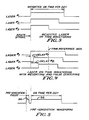
- FIG. 3 illustrates the turn on pulses for three of the seven lasers in a typical marking system.
- Laser No. l has been determined (arbitrarily) to be the laser with the lowest power output while laser No. 2 has an intermediate output and laser No. 3 the greatest output.
- At the beginning of a stroke (indicated by the vertical dashed line) all three lasers are turned on but remain on for different times, the on time corresponding inversely to their power output.
- laser No. 3 is on for the shortest period of time while laser No. l is on for the longest period of time. This will be referred to herein as weighting the on time pulse since it is typically obtained by calculating a weighting factor based on the laser having the lowest power output.
- the weighting factors which are provided to the computer, are used to turn on the more powerful lasers for a shorter time. This permits the energy output per laser to be equalized to a desired energy level.
- the operator selects a nominal on time pulse which is satisfactory for the weakest laser. He then determines the weighting factors for the remaining lasers (for example, a percentage of the weakest laser's on time).
- the computer then computes the actual on time for each other laser by multiplying the nominal on time by the weighting factor. This value is provided to the laser interface 22 as will be described.
- the appropriate delays may be empirically determined and provided to the computer system or they can be calculated by the computer from the weighting factors.
- weighting and pulse centering techniques provides a highly satisfactory result at relatively high energy levels (e.g., on time pulses greater than one millisecond). Additional techniques are necessary at low energy levels as may occur at high stroke rates (on time pulse widths less than 300 microseconds). This is because the on time pulse width at low energy levels is only two or three times longer than the turn on delays of the lasers. In fact, the slower lasers (those that have the greatest turn on delay) may have their output energy severely reduced at high stroke rates resulting in significantly less output power.
- the present invention it is possible to decrease turn on delay so that its effects become relatively insignificant. This is accomplished by applying RF energy to the laser for a short time at the beginning of each stroke pulse followed by a variable delay (which may be zero) before the beginning of the actual on time pulse for generating the dot. This permits the laser to respond much faster when it is turned on to print a dot.
- the use of a short pre-ionization pulse significantly decreases turn on delay without causing significant laser output prior to the on pulse used for marking. Such pre-ionization pulses are required only for a stroke on which a particular laser is designated to print a dot.
- the concept of pre-ionizing a laser is illustrated in Figure 5.
- the vertical dashed line indicates the beginning of a stroke.
- a short pre-ionization pulse 30 is generated to prepare the laser to fire as soon as the on time pulse 32 is received.
- the pulse 30 may be followed by a short delay 34 before the on time pulse is received or, in fact, the delay 34 may be zero in which case the pre-ionization pulse is immediately followed by the on time pulse.
- Either pre-ionization technique works satisfactorily under the present circumstances.
- Whether or not to use a delay between the pulses is a consideration determined primarily by the stroke rate at which the system is operating and whether or not a modification to the ionization technique is employed, such modification being described hereafter under the heading "No Dot/Every Dot Pre-ionization".
- the pre-ionization pulses 30 are of a duration controlled by a single timer. If desired, a separate timer can be provided for each laser. This would permit separate adjustment of each pre-ionization timer for the turn on delay associated with a particular laser. Although separate timers for each laser provide best matching, a single timer provides adequate performance and reduces circuit complexity.
- pre-ionization pulse is effective only if it occurs relatively close (within a few milliseconds) to the leading edge of the laser turn on pulse.
- high stroke rate printing a millisecond or less between strokes, for example
- each on pulse will itself provide pre-ionization for the next dot.
- high stroke rate, consecutive dots the use of a separate pre-ionization pulse interferes with proper printing by starting the laser too early thus contributing to, rather than decreasing differences in laser energy output.
- laser energy is better equalized by not providing a separate pre-ionization pulse but instead relying on the pre-ionizing effect of the on pulse for the dot printed during the previous stroke.
- the top waveform shows every dot pre-ionization as would occur at stroke rates below a threshold value.
- a pre-ionization pulse occurs before the on time pulse. Note, however, that in the case of a blank (no dot) there are no pre-ionization or on time pulses.
- a pre-ionization pulse is generated if and only if the laser had not been turned on during the previous stroke.
- a preionization pulse is present at 40, 42 and 44 but not provided prior to turn on pulse 46 because the pre-ionization is accomplished by the prior on pulse 48 from the previous stroke.
- the logic determines whether the previous stroke was a dot or a blank and, if a dot, blocks the pre-ionization pulse to the RF amplifier.
- the computer 20 previously described, in addition to operator inputs via the keyboard, also receives signals from the conveyor system. These signals are indicated as the product detect and the shaft encoder signals.
- the first signal indicates that a product to be marked has reached the appropriate point for marking to commence.
- the shaft encoder signal indicates that it is time to initiate a stroke. This signal is derived from a rotating shaft associated with the conveyor system. Alternatively, a timer or oscillator may be employed to initiate stroke pulses a selected time after the product detect signal has been received.
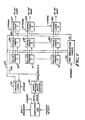
- the computer 20 communicates with the various timing devices and logic associated with the invention through an address decode/write control device 70.
- the particular form of device is not critical but, for example, it may be a programmable array logic device included in an MMI PAL l4L8.
- the device 70 receives address data from the processor and responsive thereto directs associated data to selected devices connected to its output.
- the devices are a trigger latch 72, delay timers 74-76, pre-ionization timer 78, and pulse timers 80-82.
- the data from the computer is simply buffered by device 70 and sent to the device selected by the address decoder.
- the trigger latch 72 is loaded with the dot pattern data for each stroke and, when the stroke signal is received, activates the delay timers 74 through 76 and the pre-ionization timer 78 via bus 84.
- Delay timers 74 through 76 which provide the pulse centering function, communicate both with the trigger latch 72 and the address decode device 70.
- the appropriate delay value for a given laser is loaded in from the address decode 70 via the bus 86 while the trigger signal for the delay timers is received from the trigger latch 72 via bus 84. Only the delay timers for lasers which are to create a dot (rather than a blank) receive a signal from the trigger latch to initiate operation.
- each delay timer triggers the corresponding on pulse timer 80 through 82.
- These timers have also been previously loaded with a value to accomplish pulse weighting.
- the outputs of the pulse timers are provided to corresponding gating logic 88 through 90 which, as described subsequently in connection with Figure 8, provides the pre-ionization features of the invention.
- the number of timers and logic circuits provided is equal to the number of lasers utilized.
- there is but a single pre-ionization timer for all the lasers because of the small variation in turn on delay between laser devices although, if desired, a separate pre-ionization timer could be provided for each laser.
- the timers are preferably re-triggerable, one shot timers and, for example, Intel 8253 devices are suitable for this purpose.
- the timers are shown as discrete devices and this, in fact, is the preferred embodiment, it is possible to implement the timing function through a computer software routine where speed is not critical. In such case it would not be necessary to provide discrete timer devices to perform the functions specified.
- the logic circuit consists of a pre-ionization control section l00 ORed with the output signal, from the pulse timers 80 through 82.
- the pre-ionization control l00 includes a stroke rate timer l02, an inhibit latch l04 and a NAND gate l06.
- the stroke rate timer l02 receives the stroke signals from the computer 20 and determines the rate at which the strokes are generated. If the timer times out before another stroke is received, it indicates a sufficiently slow stroke rate that pre-ionization on every stroke is preferred.
- the stroke rate is low enough so that there is no concern that a previous on pulse has pre-ionized the laser making it undesirable to permit additional pre-ionization.
- the stroke rate timer does not time out, it indicates that the system is operating at a stroke rate fast enough so that it is necessary to selectively inhibit pre-ionization pulses.
- Inhibit latch l04 is reset by the stroke rate timer l02 if the latter times out thereby permitting a pre-ionization pulse to occur (unless inhibited by the other inputs to gate l06). In the absence of a reset signal, the operation of the inhibit latch is as follows.
- the pre-ionization timer 78 generates a signal at the beginning of each stroke. This signal, if not blocked by latch l04, generates a pre-ionization pulse of a duration determined by the pre-ionization timer setting.
- the data for a particular laser stroke (either a logic zero or a logic one from the trigger latch) is loaded into the inhibit latch by the trailing edge of the pre-ionization timer signal, . If the data is a logic one and the stroke rate is fast enough to avoid a reset from timer l02, the inhibit condition exists because the laser has been pre-ionized by the preceding stroke on pulse.
- the output of the latch l04 is a logical one but is inverted at l08 thereby blocking the ionization signal at gate l06. Conversely, if the data is a logic zero, a low output results from the latch which, in turn, enables gate l06 (assuming no other gate input is low).
- inhibit latch functions to monitor the data from the preceding stroke and inhibits the ionization pulse when necessary (assuming the stroke rate is fast enough).
- the other inputs to gate l06 are the pre-ionization pulse itself from the timer 78 via line ll0, a manual disable switch via line ll2, and a data signal from the trigger latch 72 via line ll4.
- the input to gate l06 on line ll4 is the data for the current stroke. Obviously if the laser is not to be turned on for that stroke (a blank is selected) there is no need for a pre-ionization pulse. It is, therefore, blocked by gate l06 when a logic zero is present on line ll4.
- the sequence of printing an alphanumeric character begins when a product is detected.
- the computer then waits until a stroke is required (either generated internally by a programmable timer or externally generated from the shaft encoder signal). For every stroke the computer sends a seven bit pattern (for a seven laser system) to the trigger latch 72 via the address encode circuit 70. A logic one is sent if a dot is desired and a logic zero is sent if a blank or no dot is desired.
- the stroke signal is received by the trigger latch, it triggers the appropriate delay timers which begin counting to properly center the on pulses about a selected time reference.
- the outputs of the delay timers are connected to trigger the corresponding pulse timer when each delay timer times out.
- the pulse timers if triggered, generate the weighted on pulses corresponding to the relative power output of the particular laser with which it is associated.
- the outputs from the on pulse timers are gated with the pre-ionization pulse from the pre-ionization timer as shown in Figure 8. After triggering, the trigger latch 72 is cleared in preparation for the next stroke. When the next stroke signal is received the entire sequence repeats.
- the pre-ionization timer is triggered simultaneously with the trigger latch by the stroke signal.
- the pre-ionization timer output common to all lasers, is processed by the control logic of Figure 8.
- the pre-ionization pulse is allowed to pass through to the corresponding RF amplifier only under the following conditions:
- an improved laser marking device has been disclosed by virtue of a method and apparatus capable of equalizing the output performance of a plurality of lasers used to generate a dot matrix on a moving substrate.
Landscapes
- Physics & Mathematics (AREA)
- Optics & Photonics (AREA)
- Engineering & Computer Science (AREA)
- Plasma & Fusion (AREA)
- Mechanical Engineering (AREA)
- General Physics & Mathematics (AREA)
- Theoretical Computer Science (AREA)
- Lasers (AREA)
- Laser Beam Printer (AREA)
- Laser Beam Processing (AREA)
- Dot-Matrix Printers And Others (AREA)
- Exposure Or Original Feeding In Electrophotography (AREA)
Applications Claiming Priority (2)
| Application Number | Priority Date | Filing Date | Title |
|---|---|---|---|
| US06/894,366 US4720618A (en) | 1986-08-07 | 1986-08-07 | Method and apparatus for equalizing power output in a laser marking system |
| US894366 | 1992-06-04 |
Publications (3)
| Publication Number | Publication Date |
|---|---|
| EP0256706A2 true EP0256706A2 (de) | 1988-02-24 |
| EP0256706A3 EP0256706A3 (en) | 1989-08-09 |
| EP0256706B1 EP0256706B1 (de) | 1994-10-12 |
Family
ID=25402978
Family Applications (1)
| Application Number | Title | Priority Date | Filing Date |
|---|---|---|---|
| EP87306687A Expired - Lifetime EP0256706B1 (de) | 1986-08-07 | 1987-07-29 | Verfahren und Vorrichtung zum Ausgleichen der Ausgangsleistung eines Laser-Markierungssystems |
Country Status (6)
| Country | Link |
|---|---|
| US (1) | US4720618A (de) |
| EP (1) | EP0256706B1 (de) |
| JP (1) | JP2509236B2 (de) |
| AT (1) | ATE112873T1 (de) |
| CA (1) | CA1292286C (de) |
| DE (1) | DE3750649D1 (de) |
Families Citing this family (44)
| Publication number | Priority date | Publication date | Assignee | Title |
|---|---|---|---|---|
| US4780607A (en) * | 1987-08-24 | 1988-10-25 | United Technologies Corporation | Laser beam power monitoring arrangement |
| US4997994A (en) * | 1989-09-01 | 1991-03-05 | At&T Bell Laboratories | Article having marking thereon and methods of making |
| US5474627A (en) * | 1990-10-11 | 1995-12-12 | Aerospatiale Societe Nationale Industrielle | Method for marking an electric cable |
| US5247154A (en) * | 1991-01-17 | 1993-09-21 | Westinghouse Electric Corp. | Method and apparatus for monitoring the laser marking of a bar code label |
| ES2102455T3 (es) * | 1991-01-17 | 1997-08-01 | United Distillers Plc | Marcacion dinamica con laser. |
| AU3235393A (en) * | 1991-12-04 | 1993-06-28 | Colorado Laser Marking, Inc. | Apparatus and method for marking thin walled tubes |
| US5294770A (en) * | 1992-01-14 | 1994-03-15 | Alza Corporation | Laser tablet treatment system with dual access to tablet |
| US5341157A (en) * | 1992-08-14 | 1994-08-23 | Bumb & Associates | Laser-driven silk screen mask device |
| US5508080A (en) * | 1994-02-17 | 1996-04-16 | Takashimaya Nippatsu Kogyo Co. Ltd. | Flexible laminated surface material and method of producing the same |
| US5658474A (en) * | 1994-12-16 | 1997-08-19 | Alza Corporation | Method and apparatus for forming dispenser delivery ports |
| US6027195A (en) * | 1996-11-12 | 2000-02-22 | Varis Corporation | System and method for synchronizing the piezoelectric clock sources of a plurality of ink jet printheads |
| US6791592B2 (en) * | 2000-04-18 | 2004-09-14 | Laserink | Printing a code on a product |
| CA2406085C (en) * | 2000-04-18 | 2009-10-27 | Laserink | Printing a code on a product |
| US20030047538A1 (en) * | 2001-09-12 | 2003-03-13 | Paul Trpkovski | Laser etching indicia apparatus |
| DE10224372A1 (de) * | 2002-05-24 | 2003-12-11 | Jenoptik Automatisierungstech | Verfahren zum Aufbringen und Auslesen von Informationen mittels Laser |
| US20050088510A1 (en) * | 2003-10-24 | 2005-04-28 | Shlomo Assa | Low angle optics and reversed optics |
| US7046267B2 (en) * | 2003-12-19 | 2006-05-16 | Markem Corporation | Striping and clipping correction |
| US20050271096A1 (en) * | 2004-04-12 | 2005-12-08 | Rolland Zeleny | Laser output temperature compensation |
| US20060012821A1 (en) * | 2004-07-12 | 2006-01-19 | Kevin Franklin | Laser marking user interface |
| US7394479B2 (en) | 2005-03-02 | 2008-07-01 | Marken Corporation | Pulsed laser printing |
| US8657098B2 (en) * | 2010-01-20 | 2014-02-25 | Ten Media, Llc | Systems and methods for processing eggs |
| US8499718B2 (en) * | 2010-01-20 | 2013-08-06 | Ten Media, Llc | Systems and methods for processing eggs |
| US20110177208A1 (en) * | 2010-01-20 | 2011-07-21 | Newmarket Impressions, Llc | Systems and methods for processing eggs |
| JP5913134B2 (ja) | 2010-01-20 | 2016-04-27 | テン メディア,エルエルシー | 卵および他の物体を処理するシステムおよび方法 |
| US8455030B2 (en) * | 2010-01-20 | 2013-06-04 | Ten Media, Llc | Systems and methods for processing eggs |
| US8823758B2 (en) | 2010-01-20 | 2014-09-02 | Ten Media, Llc | Systems and methods for processing eggs |
| US8715757B2 (en) * | 2010-01-20 | 2014-05-06 | Ten Media, Llc | Systems and methods for processing eggs |
| US8455026B2 (en) | 2010-01-20 | 2013-06-04 | Ten Media, Llc | Systems and methods for processing eggs |
| EP2564973B1 (de) | 2011-09-05 | 2014-12-10 | ALLTEC Angewandte Laserlicht Technologie Gesellschaft mit beschränkter Haftung | Markierungsvorrichtung mit mehreren Lasern und einem Mischungsdeflektorsmittel |
| EP2565998A1 (de) | 2011-09-05 | 2013-03-06 | ALLTEC Angewandte Laserlicht Technologie Gesellschaft mit beschränkter Haftung | Gasringlaservorrichtung |
| EP2565673B1 (de) | 2011-09-05 | 2013-11-13 | ALLTEC Angewandte Laserlicht Technologie Gesellschaft mit beschränkter Haftung | Vorrichtung und Verfahren zum Markieren eines Objekts mit Hilfe eines Laserstrahls |
| EP2565996B1 (de) | 2011-09-05 | 2013-12-11 | ALLTEC Angewandte Laserlicht Technologie Gesellschaft mit beschränkter Haftung | Lasergerät mit Lasereinheit und Flüssigkeitsbehälter für eine Kühlvorrichtung dieser Lasereinheit |
| EP2564975B1 (de) | 2011-09-05 | 2014-12-10 | ALLTEC Angewandte Laserlicht Technologie Gesellschaft mit beschränkter Haftung | Markierungsvorrichtung mit mehreren Lasern und individuell justierbaren Deflektionsmitteln |
| EP2564976B1 (de) | 2011-09-05 | 2015-06-10 | ALLTEC Angewandte Laserlicht Technologie Gesellschaft mit beschränkter Haftung | Markierungsvorrichtung mit mindestens einem Gaslaser und einer Kühleinrichtung |
| DK2565994T3 (en) | 2011-09-05 | 2014-03-10 | Alltec Angewandte Laserlicht Technologie Gmbh | Laser device and method for marking an object |
| EP2564972B1 (de) | 2011-09-05 | 2015-08-26 | ALLTEC Angewandte Laserlicht Technologie Gesellschaft mit beschränkter Haftung | Markierungsvorrichtung mith mehreren Lasern, Deflektionmitteln und Telescopikmitteln für jeden Laserstrahl |
| ES2450467T3 (es) | 2011-09-05 | 2014-03-24 | ALLTEC Angewandte Laserlicht Technologie Gesellschaft mit beschränkter Haftung | Dispositivo láser y procedimiento de generación de luz láser |
| EP2564970B1 (de) | 2011-09-05 | 2015-08-26 | ALLTEC Angewandte Laserlicht Technologie Gesellschaft mit beschränkter Haftung | Markierungsvorrichtung zum Markieren eines Gegenstands mit einem Markierungslicht mit verschiedenen Licht-Modulen von unterschiedlichen Technologien |
| ES2544269T3 (es) | 2011-09-05 | 2015-08-28 | ALLTEC Angewandte Laserlicht Technologie Gesellschaft mit beschränkter Haftung | Aparato de marcado con una pluralidad de láseres de gas con tubos de resonancia y medios de deflexión ajustables individualmente |
| EP2564971B1 (de) | 2011-09-05 | 2015-08-26 | ALLTEC Angewandte Laserlicht Technologie Gesellschaft mit beschränkter Haftung | Markierungsvorrichtung mit mehreren Lasern und einem Satz von Reflektoren |
| ES2446364T3 (es) | 2011-09-05 | 2014-03-07 | ALLTEC Angewandte Laserlicht Technologie Gesellschaft mit beschränkter Haftung | Dispositivo de láser de gas con depósito de gas |
| US9315317B2 (en) | 2012-02-21 | 2016-04-19 | Ten Media, Llc | Container for eggs |
| US20140336029A1 (en) * | 2013-05-07 | 2014-11-13 | The Procter & Gamble Company | Process for laser puncturing holes into water-soluble films |
| US10583668B2 (en) | 2018-08-07 | 2020-03-10 | Markem-Imaje Corporation | Symbol grouping and striping for wide field matrix laser marking |
Family Cites Families (9)
| Publication number | Priority date | Publication date | Assignee | Title |
|---|---|---|---|---|
| DE2726454B2 (de) * | 1977-06-11 | 1979-08-23 | Hoesch Werke Ag, 4600 Dortmund | Verfahren zum Kennzeichnen von bewegten Tafeln und Bändern |
| DE2853258A1 (de) * | 1978-12-09 | 1980-06-12 | Hoesch Werke Ag | Verfahren und anordnung zum aufbringen einer kennzeichnung auf der oberflaeche von bewegten tafeln und baendern |
| US4287483A (en) * | 1979-09-04 | 1981-09-01 | Raytheon Company | Transverse excitation laser |
| JPS56152373A (en) * | 1980-04-24 | 1981-11-25 | Fuji Photo Film Co Ltd | Laser recording device |
| US4546995A (en) * | 1982-11-02 | 1985-10-15 | Kassai Kabushikikaisha | Collapsible luggage carrier |
| US4652722A (en) * | 1984-04-05 | 1987-03-24 | Videojet Systems International, Inc. | Laser marking apparatus |
| JPH0614610B2 (ja) * | 1984-12-17 | 1994-02-23 | 沖電気工業株式会社 | パルス幅制御回路 |
| NL8403926A (nl) * | 1984-12-24 | 1986-07-16 | Oce Nederland Bv | Werkwijze voor het belichten van een lichtgevoelige laag en belichtingsinrichting. |
| JP2503202B2 (ja) * | 1985-01-30 | 1996-06-05 | 株式会社リコー | 半導体レ−ザの出力制御装置 |
-
1986
- 1986-08-07 US US06/894,366 patent/US4720618A/en not_active Expired - Fee Related
-
1987
- 1987-07-28 CA CA000543181A patent/CA1292286C/en not_active Expired - Fee Related
- 1987-07-29 EP EP87306687A patent/EP0256706B1/de not_active Expired - Lifetime
- 1987-07-29 DE DE3750649T patent/DE3750649D1/de not_active Expired - Lifetime
- 1987-07-29 AT AT87306687T patent/ATE112873T1/de active
- 1987-08-07 JP JP62196500A patent/JP2509236B2/ja not_active Expired - Lifetime
Also Published As
| Publication number | Publication date |
|---|---|
| DE3750649D1 (de) | 1994-11-17 |
| CA1292286C (en) | 1991-11-19 |
| JP2509236B2 (ja) | 1996-06-19 |
| EP0256706A3 (en) | 1989-08-09 |
| JPS6342191A (ja) | 1988-02-23 |
| EP0256706B1 (de) | 1994-10-12 |
| US4720618A (en) | 1988-01-19 |
| ATE112873T1 (de) | 1994-10-15 |
Similar Documents
| Publication | Publication Date | Title |
|---|---|---|
| US4727235A (en) | Method and apparatus for equalizing power output in a laser marking system | |
| US4720618A (en) | Method and apparatus for equalizing power output in a laser marking system | |
| US3866533A (en) | Electrical print impression control | |
| US4503444A (en) | Method and apparatus for generating a gray scale with a high speed thermal ink jet printer | |
| CA1138803A (en) | Print hammer drive circuit with compensation for voltage variation | |
| DE69827464T2 (de) | Tintenstrahldrucker und -Druckverfahren zur Verbesserung der Genauigkeit der Tintentropfenplazierung | |
| ATE161481T1 (de) | Farbstrahlaufzeichnungsgerät und verfahren | |
| EP0518670A3 (en) | Ink jet recording apparatus | |
| EP1332876A3 (de) | Tintenstrahldrucker und Druckverfahren | |
| JPH05507185A (ja) | 印刷胴エングレービング | |
| CA1114445A (en) | Control system for inductively controlled multiphase motor | |
| WO1994026525A1 (en) | Spot size modulatable ink jet printhead | |
| CA1186782A (en) | Control system for timing hammers of impact printers | |
| US5198833A (en) | Variable density ink-jet dot printer | |
| US4513300A (en) | Apparatus for driving a semiconductor laser for use in a laser-beam printer | |
| US6037963A (en) | Laser printer having variable beam spacing | |
| US3834306A (en) | Print density control | |
| US5263994A (en) | Printer having a plurality of printing modes | |
| US4990942A (en) | Printer RF line control | |
| EP0173952A1 (de) | Punktmatrix-Schlagdrucker | |
| US5171093A (en) | Control system for a dot matrix printer | |
| JP3292125B2 (ja) | ガスレーザ加工機 | |
| JPS63188055A (ja) | インクジエツト記録装置 | |
| JP3175916B2 (ja) | インクジェット記録装置 | |
| US9630401B2 (en) | Printhead calibration and printing |
Legal Events
| Date | Code | Title | Description |
|---|---|---|---|
| PUAI | Public reference made under article 153(3) epc to a published international application that has entered the european phase |
Free format text: ORIGINAL CODE: 0009012 |
|
| AK | Designated contracting states |
Kind code of ref document: A2 Designated state(s): AT BE CH DE ES FR GB GR IT LI LU NL SE |
|
| PUAL | Search report despatched |
Free format text: ORIGINAL CODE: 0009013 |
|
| AK | Designated contracting states |
Kind code of ref document: A3 Designated state(s): AT BE CH DE ES FR GB GR IT LI LU NL SE |
|
| 17P | Request for examination filed |
Effective date: 19891108 |
|
| 17Q | First examination report despatched |
Effective date: 19910409 |
|
| RAP1 | Party data changed (applicant data changed or rights of an application transferred) |
Owner name: VIDEOJET SYSTEMS INTERNATIONAL, INC. |
|
| GRAA | (expected) grant |
Free format text: ORIGINAL CODE: 0009210 |
|
| AK | Designated contracting states |
Kind code of ref document: B1 Designated state(s): AT BE CH DE ES FR GB GR IT LI LU NL SE |
|
| PG25 | Lapsed in a contracting state [announced via postgrant information from national office to epo] |
Ref country code: IT Free format text: LAPSE BECAUSE OF FAILURE TO SUBMIT A TRANSLATION OF THE DESCRIPTION OR TO PAY THE FEE WITHIN THE PRE;WARNING: LAPSES OF ITALIAN PATENTS WITH EFFECTIVE DATE BEFORE 2007 MAY HAVE OCCURRED AT ANY TIME BEFORE 2007. THE CORRECT EFFECTIVE DATE MAY BE DIFFERENT FROM THE ONE RECORDED.SCRIBED TIME-LIMIT Effective date: 19941012 Ref country code: AT Effective date: 19941012 Ref country code: LI Effective date: 19941012 Ref country code: GR Free format text: LAPSE BECAUSE OF FAILURE TO SUBMIT A TRANSLATION OF THE DESCRIPTION OR TO PAY THE FEE WITHIN THE PRESCRIBED TIME-LIMIT Effective date: 19941012 Ref country code: CH Effective date: 19941012 Ref country code: FR Effective date: 19941012 Ref country code: NL Effective date: 19941012 Ref country code: BE Effective date: 19941012 |
|
| REF | Corresponds to: |
Ref document number: 112873 Country of ref document: AT Date of ref document: 19941015 Kind code of ref document: T |
|
| REF | Corresponds to: |
Ref document number: 3750649 Country of ref document: DE Date of ref document: 19941117 |
|
| PG25 | Lapsed in a contracting state [announced via postgrant information from national office to epo] |
Ref country code: SE Effective date: 19950112 |
|
| PG25 | Lapsed in a contracting state [announced via postgrant information from national office to epo] |
Ref country code: DE Effective date: 19950113 |
|
| REG | Reference to a national code |
Ref country code: CH Ref legal event code: PL |
|
| PG25 | Lapsed in a contracting state [announced via postgrant information from national office to epo] |
Ref country code: ES Free format text: LAPSE BECAUSE OF FAILURE TO SUBMIT A TRANSLATION OF THE DESCRIPTION OR TO PAY THE FEE WITHIN THE PRESCRIBED TIME-LIMIT Effective date: 19950123 |
|
| EN | Fr: translation not filed | ||
| NLV1 | Nl: lapsed or annulled due to failure to fulfill the requirements of art. 29p and 29m of the patents act | ||
| PG25 | Lapsed in a contracting state [announced via postgrant information from national office to epo] |
Ref country code: LU Free format text: LAPSE BECAUSE OF NON-PAYMENT OF DUE FEES Effective date: 19950731 |
|
| PLBE | No opposition filed within time limit |
Free format text: ORIGINAL CODE: 0009261 |
|
| 26N | No opposition filed | ||
| PGFP | Annual fee paid to national office [announced via postgrant information from national office to epo] |
Ref country code: GB Payment date: 19970716 Year of fee payment: 11 |
|
| PG25 | Lapsed in a contracting state [announced via postgrant information from national office to epo] |
Ref country code: GB Free format text: LAPSE BECAUSE OF NON-PAYMENT OF DUE FEES Effective date: 19980729 |
|
| GBPC | Gb: european patent ceased through non-payment of renewal fee |
Effective date: 19980729 |