EP0256772B1 - Verfahren und Apparat zur Formung eines Filterelementes - Google Patents
Verfahren und Apparat zur Formung eines Filterelementes Download PDFInfo
- Publication number
- EP0256772B1 EP0256772B1 EP87306937A EP87306937A EP0256772B1 EP 0256772 B1 EP0256772 B1 EP 0256772B1 EP 87306937 A EP87306937 A EP 87306937A EP 87306937 A EP87306937 A EP 87306937A EP 0256772 B1 EP0256772 B1 EP 0256772B1
- Authority
- EP
- European Patent Office
- Prior art keywords
- mold
- projections
- grooves
- blank
- filter element
- Prior art date
- Legal status (The legal status is an assumption and is not a legal conclusion. Google has not performed a legal analysis and makes no representation as to the accuracy of the status listed.)
- Expired - Lifetime
Links
Images






Classifications
-
- B—PERFORMING OPERATIONS; TRANSPORTING
- B01—PHYSICAL OR CHEMICAL PROCESSES OR APPARATUS IN GENERAL
- B01D—SEPARATION
- B01D39/00—Filtering material for liquid or gaseous fluids
-
- B—PERFORMING OPERATIONS; TRANSPORTING
- B31—MAKING ARTICLES OF PAPER, CARDBOARD OR MATERIAL WORKED IN A MANNER ANALOGOUS TO PAPER; WORKING PAPER, CARDBOARD OR MATERIAL WORKED IN A MANNER ANALOGOUS TO PAPER
- B31D—MAKING ARTICLES OF PAPER, CARDBOARD OR MATERIAL WORKED IN A MANNER ANALOGOUS TO PAPER, NOT PROVIDED FOR IN SUBCLASSES B31B OR B31C
- B31D5/00—Multiple-step processes for making three-dimensional [3D] articles
- B31D5/0082—Making filter elements, e.g. pleated
-
- B—PERFORMING OPERATIONS; TRANSPORTING
- B01—PHYSICAL OR CHEMICAL PROCESSES OR APPARATUS IN GENERAL
- B01D—SEPARATION
- B01D29/00—Filters with filtering elements stationary during filtration, e.g. pressure or suction filters, not covered by groups B01D24/00 - B01D27/00; Filtering elements therefor
- B01D29/01—Filters with filtering elements stationary during filtration, e.g. pressure or suction filters, not covered by groups B01D24/00 - B01D27/00; Filtering elements therefor with flat filtering elements
- B01D29/012—Making filtering elements
-
- B—PERFORMING OPERATIONS; TRANSPORTING
- B01—PHYSICAL OR CHEMICAL PROCESSES OR APPARATUS IN GENERAL
- B01D—SEPARATION
- B01D29/00—Filters with filtering elements stationary during filtration, e.g. pressure or suction filters, not covered by groups B01D24/00 - B01D27/00; Filtering elements therefor
- B01D29/01—Filters with filtering elements stationary during filtration, e.g. pressure or suction filters, not covered by groups B01D24/00 - B01D27/00; Filtering elements therefor with flat filtering elements
- B01D29/05—Filters with filtering elements stationary during filtration, e.g. pressure or suction filters, not covered by groups B01D24/00 - B01D27/00; Filtering elements therefor with flat filtering elements supported
- B01D29/07—Filters with filtering elements stationary during filtration, e.g. pressure or suction filters, not covered by groups B01D24/00 - B01D27/00; Filtering elements therefor with flat filtering elements supported with corrugated, folded or wound filtering sheets
- B01D29/072—Filters with filtering elements stationary during filtration, e.g. pressure or suction filters, not covered by groups B01D24/00 - B01D27/00; Filtering elements therefor with flat filtering elements supported with corrugated, folded or wound filtering sheets ring shaped
-
- B—PERFORMING OPERATIONS; TRANSPORTING
- B01—PHYSICAL OR CHEMICAL PROCESSES OR APPARATUS IN GENERAL
- B01D—SEPARATION
- B01D2201/00—Details relating to filtering apparatus
- B01D2201/12—Pleated filters
-
- Y—GENERAL TAGGING OF NEW TECHNOLOGICAL DEVELOPMENTS; GENERAL TAGGING OF CROSS-SECTIONAL TECHNOLOGIES SPANNING OVER SEVERAL SECTIONS OF THE IPC; TECHNICAL SUBJECTS COVERED BY FORMER USPC CROSS-REFERENCE ART COLLECTIONS [XRACs] AND DIGESTS
- Y10—TECHNICAL SUBJECTS COVERED BY FORMER USPC
- Y10S—TECHNICAL SUBJECTS COVERED BY FORMER USPC CROSS-REFERENCE ART COLLECTIONS [XRACs] AND DIGESTS
- Y10S493/00—Manufacturing container or tube from paper; or other manufacturing from a sheet or web
- Y10S493/941—Filter
Definitions
- the present invention relates to the formation of a filter element, and more particularly to a method of and an apparatus for forming a filter element by pressing heated molds against the peak and valley folds of a ring-shaped corrugated blank and then cooling the blank to shape the same to true circular concentric configuration.
- Filter elements are manufactured by cutting off a sheet of filter element material to a sector-shaped blank, folding the blank into a corrugated structure having alternate peak and valley folds creased along arcuate lines, and forcibly bringing the opposite edges of the corrugated sectorial blank into abutment against each other to form a ring-shaped filter element.
- the filter element material is usually composed of a stack of a dense layer, an intermediate layer, and a coarse layer which are bonded together.
- the dense layer is made of material fibers closely massed and intertwined together which are highly resistant to becoming loose under tension and not stretchable enough to absorb strains produced when the filter blank is folded. Therefore, when the blank is forcibly brought into the ring shape, the peak and valley fold tend to produce angular edges, rather than being trued into concentric relation.
- the filter element blank with such angular edges on the folds or creases presents difficulty in automatic production of filter elements. More specifically, a filter element blank may not smoothly and stably be set on molds when it is to be shaped by the molds while being impregnated with resin, and a filter element blank may be ruptured when the molds are pressed against each other.
- a curved body is placed on a heat set jig having crest portions of concentric circular form and this is placed into a high temperature chamber kept at about 120°C for about 30 minutes to be heated.
- the curved body thus adapts to the shape of the jig and is ready for the ends of the curved body to be joined together to form a complete ring.
- the curved body settles onto the crest portions of the jig under the softening action of the heat and the action of gravity.
- the disclosed arrangement does not however lend itself to mass production of filter elements since it requires many jigs and heating devices, and a long period of time is required to heat filter element blanks.
- Another object of the present invention is to provide an apparatus for carrying out the above filter element forming method.
- a method of forming a filter element comprising the steps of; providing a corrugated filter element blank (10) which is at least partly curved and has radially alternate peak (12) and valley (14) folds; placing the curved blank (10) on a first mold (16) having as many concentric projections (18) as the number of the peak folds (12) of the curved blank (10) and as many curved grooves (20) as the number of the valley folds (14) of said curved blank (10), with the peak folds (12) fitted respectively over the projections (18) and the valley folds (14) fitted respectively in the grooves (20); preheating a second mold (28), the second mold (28) having projections (46) lying along concentric lines for fitting respectively in the grooves (20) of the first mold (16) with the valley folds (14) received therein, and concentric grooves (42) for receiving respectively the projections (18) of the first mold (16) with the peak folds (12) fitted thereover; pressing the curved blank (10) between the first (16) and second (28)
- an apparatus for forming a filter element comprising: a first mold (16) having concentric projections (18) and concentric grooves (20), the projections (18) and grooves (20) being alternately arranged; a second mold (28) having projections (46) lying along concentric lines and positioned in alignment with grooves (20) of the first mold, respectively, and concentric grooves (42) positioned in alignment with projections (18) of the first mold, respectively, the projections (46) and grooves (42) of the second mold (28) being alternately arranged; means (26) for moving the first (16) and second (28) molds relatively to each other to bring the projections (18) of the first mold (16) into and out of grooves (42) of the second mold (28) and also to bring the projections (46) of the second mold (28) into and out of the grooves (20) of the first mold (16); heater means (34,36) for heating one of the first (16) and second (28) molds, and an ejector mechanism (56,58) operable to separate from the heated mold
- a flat filter element blank 101 of a sectorial shape is cut off from a filter element material sheet (not shown).
- the sector-shaped blank 101 is then creased or corrugated along spaced arcuate lines b -b ⁇ , c - c ⁇ , ... j - j ⁇ of the sectorial shape to form alternate peak and valley folds successively arranged from one end a - a ⁇ to the other end k - k ⁇ as shown in FIG. 9.
- the blank 101 is thereafter curved in its entirety with the end a - a ⁇ located inside and the end k - k ⁇ outside until opposite ends 102, 103 are brought together thereby to form a ring shape, as illustrated in FIG. 10.
- the ring-shaped blank denoted at 10 has peak folds 12 and valley folds 14 which are angularly bent at 12 ⁇ , 14 ⁇ in several circumferentially spaced locations.
- FIG. 1 shows successive steps of shaping the ring-shaped filter element blank 10 into a filter element.
- the opposite ends 102, 102 of the filter element blank 10 are omitted from illustration in FIG. 1.
- the ring-shaped blank 10 is shaped by a mold assembly comprising a lower mold 16 and an upper mold 28.
- the lower mold 16 is of a circular shape having a plurality of as many concentric projections or fins 18 as the number of the peak folds 12 of the ring-shaped blank 10, and a plurality of valleys or grooves 20 defined between the fins 18.
- the lower mold 16 is carried by a pallet 22 placed on a conveyor 24.
- the ring-shaped blank 10 is mounted on the lower mold 16 in a position (A) in FIG. 1.
- the ring-shaped blank 10 mounted on the lower mold 16 is fed by the conveyor 24 from the position (A) to a shaping station in a position (B).
- a lifter cylinder 26 is disposed in the shaping station for elevating the lower mold 16.
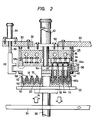
- the upper mold 28 is located in the shaping station above the lower mold 16. The lower mold 16 lifted by the lifter cylinder 26 is pressed against the upper mold 28.
- the upper mold 28 includes a heat-insulating support plate 32 fixed to a stationary base 30, and a heating plate 34 attached to the support plate 32 and accommodating heaters 36 therein.
- a disc suspension ring 38 is also attached to the support plate 32 with the heating plate 34 therebetween, and a circular plate or disc 40 is fixed to the lower end of the disc suspension ring 38.
- the disc 40 has a plurality of as many concentric grooves 42 as the number of the fins 18 of the lower mold 16, the grooves 42 being defined in a lower surface of the disc 40 in vertical alignment with the fins 18 of the lower mold 16.
- the grooves 42 can receive the respective fins 18 on which the peak folds 12 of the ring-shaped blank 10 are mounted, when the lower mold 16 is pressed upwardly against the disc 40.
- the disc 40 also has a plurality of arcuate slits 44 defined along concentric circular lines in the disc 40 between the grooves 42. Each circular slit group has seven circumferentially spaced arcuate slits 44 in the illustrated embodiment.
- a plurality of arcuate (as viewed from below the upper mold 28) projections or fins 46 are slidably inserted respectively in the slits 44 in vertical alignment with the grooves 20 of the lower mold 16.
- the fins 46 have upper ends 46a fixed to a fin height adjustment plate 48 disposed within the ring 38 and below the heating plate 34.
- there are seven arcuate fins 46 in each circular fin group which are circumferentially spaced along a concentric circular line and disposed in corresponding slits 44.
- the fin height adjustment plate 48 is normally urged to move downwardly by springs 50 disposed between the fin height adjustment plate 48 and the heating plate 34.
- the fin height adjustment plate 48 is centrally secured to the lower threaded end of a piston rod 54 of a height adjustment cylinder 52 fixedly mounted on the upper surface of the support plate 32.
- An ejector or knockout ring 56 is loosely fitted over the disc 40 and has a plurality of integral ejectors or knockouts 58 disposed in circumferentially spaced positions and extending radially toward the center of the disc 40.
- each knockout 58 is of a narrow member having a plurality of fins 60 which are identical in cross section to the fins 46 and a plurality of grooves 62 which are positioned between the fins 60 and identical in shape to the grooves 42 of the disc 40.
- the knockout 58 has an upper end 58a held against the fin height adjustment plate 48.
- the fins 60 of the knockouts 58 are arcuate in shape and are slidably inserted respectively in slits defined circumferentially between the fins 46. In the illustrated embodiment, there are seven knockouts 58 which are integrally coupled by the ring 56. The fins 60 are omitted from illustration in FIGS. 3A and 3B.
- the knockout ring 56 is coupled to a coupling 68 on the distal end of a piston rod 66 of a knockout cylinder 64 mounted on the upper surface of the base 30.
- FIG. 3A shows the knockouts 58 retracted upwardly into the disc 40.
- FIG. 3B illustrates the knockouts 58 lowered out of the disc 40 to eject the shaped filter element when the lower mold 16 is moved downwardly away from the upper mold 28.
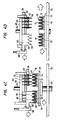
- FIGS. 4A through 4D A process of successively shaping the ring-shaped blank 10 in the shaping station with the upper and lower molds 28, 16 will hereinafter be described with reference to FIGS. 4A through 4D.
- the ring-shaped blank 10 is mounted on the lower mold 16 carried on the pallet 22, and then delivered by the conveyor 24 to a position directly below the upper mold 28, as shown in FIG. 4A.
- the fins 46 of the upper mold 28 are adjusted in height by the height adjustment cylinder 52 to match the height of the folds of the ring-shaped blank 10.
- the upper surfaces 58a of the knockouts 58 are held in contact with the lower surface of the fin height adjustment plate 48.
- the grooves 42 of the disc 40 and the grooves 62 of the knockouts 58 are registered with each other, and the tip ends 46 of the fins 46 and the tip ends of the fins 60 of the knockouts 58 are aligned with each other.
- the disc 40, the fins 46, and the knockouts 58 are bodily heated by the heating plate 34 up to a temperature for heat-setting the ring-shaped blank 10.
- the lifter cylinder 26 is elevated to press the lower mold 16 against the upper mold 28 as shown in FIG. 4B.
- the tip ends of the fins 18 of the lower mold 16 on which the peak folds 12 of the blank 10 are fitted respectively into the concentic grooves 42 of the disc 40, and the fins 46 of the upper mold 28 are inserted respectively into the valleys or grooves 14 of the blank 10, with the tip ends of the fins 46 pressing the bottoms of the valleys 14.
- the peak folds 12 of the blank 10 are forced respectively into the grooves 62 of the knockouts 58 by the fins 18, and the fins 60 of the knockouts 58 are pressed against the bottoms of the valleys 14 of the blank 10. A shown in FIG.
- the filter element blank 10 is composed of a laminated structure comprising an upper dense layer 76, an intermediate layer 78, and a lower coarse layer 80.
- the dense layer 76 has a fiber structure which is most closely massed and intertwined, and hence is most resistant to deformation. Therefore, the filter element blank 10 has a density gradient in its axial direction. Since the dense layer 76 is positioned in direct contact with the heated disc 40, the fins 46, and the fins 60, it is well heated to shape or heat-set the peak folds 12 and the valley folds 14 to true concentric configuration while rectifying the angularly bent edges 12 ⁇ , 14 ⁇ to smooth round surfaces.
- the lifter cylinder 26 is lowered to displace the lower mold 16 away from the upper mold 28, as illustrated in FIG. 4C.
- the knockout cylinder 64 is operated to lower the knockouts 58 in unison with the lower mold 16.
- the shaped filter element 10A on the lower mold 16 is thus ejected by the knockouts 58 and separated from the upper mold 28 without sticking thereto.
- filter element blanks of different types that are to be shaped into filter elements. They can roughly be classified into those having different numbers of folds, and those having different heights of folds.
- Filter element blanks of different numbers of folds can be shaped by one set of upper and lower molds insofar as the upper and lower molds have a maximum number of fins.
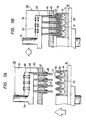
- ring-shaped filter element blanks 10a, 10b of different fold heights Ha, Hb between peak and valley folds 12a, 12b and 14a, 14b have the same fold-to-fold pitch P. Therefore, the upper mold 28 can process such blanks of different fold heights by adjusting the projection of the fins 46 with the height adjustment cylinder 52.
- the fins 46 of the upper mold 28 are also automatically adjustable in height to accommodate a certain range of fold heights. More specifically, as shown in FIG. 7A, the fins 46 are previously adjusted in height to match the fold height of a ring-shaped filter element blank. After the blank has been shaped, another ring-shaped blank 10 of a smaller fold height is mounted on the lower mold 16. The lower mold 16 is lifted and pressed against the upper mold 28 with the blank 10 interposed therebetween. The fin height adjustment plate 48 is normally biased by the spring 50 to move downwardly.
- the fins 46 are displaced upwardly by the blank 10 while compressing the springs 50, so that the peak folds 12 and the valley folds 14 of the blank 10 can neatly be shaped with heat by the fins 18, 46, as shown in FIG. 7B.
- the knockouts 58 (not shown in FIGS. 7A and 7B) are also moved upwardly by the blank 10, displacing the grooves 62 of the knockouts 58 out of contact with the peak folds 12 of the blank 10. Therefore, those areas of the peak folds 12 which are out of contact with the knockouts 58 are not shaped under pressure.
- the mold assembly can shape ring-shaped filter element blanks of different fold heights without operating the height adjustment cylinder 52 (FIG. 2) as long as such different fold heights are within the range in which the fin height adjustment plate 48 is vertically slidable against the resiliency of the springs 50.
- the shaped filter element 10A is delivered from the shaping station at (B) in FIG. 1 to the cooling station at (C) in FIG. 1.
- the cooling station has an air supply duct 72 with an air blower 70 disposed in its upper end, and a discharge duct 74 located below the air supply duct 72 with the conveyor 24 therebetween.
- the filter element 10A that has been heat-set in the shaping station is cooled in the cooling station by cooling air supplied downwardly from the air blower 70 through the air supply duct 72 into the air discharge duct 74.
- the filter element blank may be of a single layer rather than a multiple-layer structure.
Landscapes
- Chemical & Material Sciences (AREA)
- Chemical Kinetics & Catalysis (AREA)
- Filtering Materials (AREA)
- Filtering Of Dispersed Particles In Gases (AREA)
- Electrical Discharge Machining, Electrochemical Machining, And Combined Machining (AREA)
- Piezo-Electric Or Mechanical Vibrators, Or Delay Or Filter Circuits (AREA)
- Moulds For Moulding Plastics Or The Like (AREA)
- Filtration Of Liquid (AREA)
Claims (17)
- Verfahren zum Formen eines Filterelements, das die Schritte aufweist: Bereitstellen eines gewellten Filterelementschnitteils (10), das zumindest teilweise gebogen ist und radial abwechselnde Spitzen- (12) und Tal-(14)-Falten aufweist; Anordnen des gebogenen Schnitteils (10) an einer ersten Form (16), die anzahlmäßig so viele konzentrische Vorsprünge (18) aufweist wie das gebogene Schnitteil (10) Spitzenfalten (12), und anzahlmäßig so viele gebogene Nuten (20) wie das gewellte Schnitteil (10) Talfalten (14), wobei die Spitzenfalten (12) jeweils über den Vorsprüngen (18) eingepaßt werden, und die Talfalten (14) jeweils in den Nuten (20) eingepaßt werden; Vorheizen einer zweiten Form (28), wobei die zweite Form (28) Vorsprünge (46) aufweist, die entlang konzentrischer Linien zum jeweiligen Einpassen in die Nuten (20) der ersten Form (16) liegen, wobei die Talfalten (14) darin aufgenommen werden, und konzentrische Nuten (42) zum jeweiligen Aufnehmen der Vorsprünge (18) der ersten Form (16), wobei die Spitzenfalten (12) darüber eingepaßt werden; Pressen des gebogenen Schnitteils (10) zwischen der ersten (16) und der zweiten Form (28); Erhitzen des gebogenen Schnitteils (10), während es zwischen der ersten (16) und der zweiten Form (28) formgepreßt wird, um dadurch ein Filterelement zu formen, das zumindest teilweise gebogen ist und konzentrische Spitzen- und Talfalten aufweist; Trennen des gebogenen Filterelements von der zweiten Form; und Kühlen des gebogenen Filterelements.
- Verfahren nach Anspruch 1, wobei das gewellte Filterelementschnitteil (10) ringförmig ist.
- Verfahren nach Anspruch 1 oder 2, wobei die erste (16) und die zweite Form (28) jeweils eine untere und eine obere Form aufweist, wobei die untere Form beweglich zu und preßar gegen die obere Form ist zum Pressen des ringförmigen Schnitteils (10) zwischen der oberen und der unteren Form.
- Verfahren nach Anspruch 3, wobei die erste Form (16), nachdem sie von der zweiten Form (28) getrennt worden ist, mit dem kreisförmigen Filterelement darauf zum Kühlen geliefert wird.
- Verfahren nach einem der vorangehenden Ansprüche, wobei die Talfalten (12) des gewellten Schnitteils (10) während des Pressens des Schnitteils durch die Vorsprünge (46) der zweiten Form (28) in den Nuten (20) der ersten Form gepreßt werden, und die Spitzenfalten (12) des gewellten Schnitteils (10) durch die Vorsprünge (18) der ersten Form (16) innerhalb der Nuten (42) der zweiten Form (28) gepreßt werden.
- Verfahren nach einem der vorangehenden Ansprüche, wobei das gewellte Schnitteil (10) einen Dichtegradienten in seiner axialen Richtung aufweist.
- Verfahren nach einem der vorangehenden Ansprüche, wobei das gewellte Schnitteil aus einem Filterelementschnitteil (10) einer sektormäßigen Form ausgebildet ist, wobei die Spitzen- (12) und die Tal-(14)-Falten sich entlang gebogener Linien der sektormäßigen Form erstrecken.
- Gerät zum Formen eines Filterelements, das aufweist: eine erste Form (16) mit konzentrischen Vorsprüngen (18) und konzentrischen Nuten (20), wobei die Vorsprünge (18) und die Nuten (20) abwechselnd angeordnet sind; eine zweite Form (28) mit Vorsprüngen (46), die entlang konzentrischer Linien liegen bzw. in Ausrichtung mit den Nuten (20) der ersten Form positioniert sind, und mit konzentrischen Nuten (42), die jeweils in Ausrichtung mit den Vorsprüngen (18) der ersten Form positioniert sind, wobei die Vorsprünge (46) und die Nuten (42) der zweiten Form (28) abwechselnd angeordnet sind; eine Einrichtung (26) zum Bewegen der ersten (16) und der zweiten Form (28) relativ zueinander, um die Vorsprünge (18) der ersten Form (16) in die und aus den Nuten (42) der zweiten Form (28) zu bringen, und auch, um die Vorsprünge (46) der zweiten Form (28) in die und aus den Nuten (20) der ersten Form (16) zu bringen; eine Heizeinrichtung (34, 36) zum Erhitzen entweder der ersten (16) oder der zweiten Form (28), und eine Ausstoßvorrichtung (56, 58), die betrieben werden kann, um ein Filterelement, das durch Wärmepressen eines Schnitteils (10) zwischen den zwei Formen ausgebildet ist, von der erhitzten Form zu trennen.
- Gerät nach Anspruch 8, wobei die erste (16) und die zweite Form (28) jeweils eine untere und eine obere Form aufweist, wobei die obere Form oberhalb der unteren Form positioniert ist.
- Gerät nach Anspruch 8, wobei die Heizvorrichtung einen elektrischen Heizer (36) aufweist, der in der zweiten Form (28) angeordnet ist, zum Erhitzen der Vorsprünge (46) und der Nuten (42) der zweiten Form.
- Gerät nach Anspruch 8, wobei die zweite Form (28) die Ausstoßvorrichtung (56, 58) enthält, die zu den Vorsprüngen (18) und den Nuten (20) der ersten Form (16) beweglich ist, wenn die erste (16) und die zweite Form (28) durch die Bewegungseinrichtung (26) weg voneinander bewegt werden, um die Vorsprünge (18) der ersten Form (16) aus den Nuten (42) der zweiten Form (28) zu bringen, und auch, um die Vorsprünge (42) der zweiten Form (28) aus den Nuten (20) der ersten Form (16) zu bringen.
- Gerät nach Anspruch 11, wobei die Vorsprünge (42) der zweiten Form (28) jeweils gebogene Formen aufweisen, die umfangsmäßig entlang jeder der konzentrischen Linien beabstandet sind, wobei die Ausstoßvorrichtung (56, 58) zwischen den beabstandeten gebogenen Vorsprüngen (46) der zweiten Form (28) entlang den konzentrischen Linien angeordnet ist.
- Gerät nach Anspruch 12, wobei die Ausstoßvorrichtung (56, 58) Nuten (62) aufweist, die in ihrem einem Ende definiert sind, zum jeweiligen Aufnehmen der Vorsprünge (18) der ersten Form (16) darin, und Vorsprünge (60) an dem einen Ende, um jeweils mit den Nuten (20) der ersten Form in Eingriff zu gelangen.
- Gerät nach Anspruch 13, wobei die Vorsprünge (18) der ersten Form, die Vorsprünge (46) der zweiten Form, und die Vorsprünge (60) der Ausstoßvorrichtung (56, 58) in der Form von Rippen sind.
- Gerät nach Anspruch 8, wobei die zweite Form (28) eine erste und eine zweite Platte (32) aufweist, wobei die erste Platte die Nuten (42) der zweiten Form (28) aufweist, und Schlitze, die jeweils mit den zweiten Vorsprüngen ausgerichtet sind und entlang konzentrischer Linien liegen, wobei die Vorsprünge (42) der zweiten Form jeweils in den Schlitzen (44) angeordnet sind, wobei die einen Enden der Vorsprünge der zweiten Form von der ersten Platte zu der ersten Form vorstehen, und gegenüberliegende Enden von der ersten Platte weg von der ersten Form (16) vorstehen und an der zweiten Platte befestigt sind.
- Gerät nach Anspruch 15, wobei die Vorsprünge (42) der zweiten Form in den Schlitzen (44) jeweils beweglich angeordnet sind, das weiterhin eine Einstelleinrichtung (52, 54) aufweist, die mit der zweiten Platte (32) gekoppelt ist, zum Bewegen der Vorsprünge (42) der zweiten Form durch die Schlitze (44), um das Ausmaß einzustellen, zu dem die einen Enden der Vorsprünge (46) der zweiten Form von der ersten Platte zu der ersten Form (16) vorstehen.
- Gerät nach Anspruch 8, das weiterhin eine Einstelleinrichtung zum Einstellen des Ausmaßes aufweist, zu dem die Vorsprünge (46) der zweiten Form (28) zu der ersten Form (16) vorstehen.
Priority Applications (1)
| Application Number | Priority Date | Filing Date | Title |
|---|---|---|---|
| AT87306937T ATE96686T1 (de) | 1986-08-20 | 1987-08-05 | Verfahren und apparat zur formung eines filterelementes. |
Applications Claiming Priority (2)
| Application Number | Priority Date | Filing Date | Title |
|---|---|---|---|
| JP194489/86 | 1986-08-20 | ||
| JP61194489A JPH0785769B2 (ja) | 1986-08-20 | 1986-08-20 | ▲ろ▼過エレメントの加熱成形方法 |
Publications (2)
| Publication Number | Publication Date |
|---|---|
| EP0256772A1 EP0256772A1 (de) | 1988-02-24 |
| EP0256772B1 true EP0256772B1 (de) | 1993-11-03 |
Family
ID=16325374
Family Applications (1)
| Application Number | Title | Priority Date | Filing Date |
|---|---|---|---|
| EP87306937A Expired - Lifetime EP0256772B1 (de) | 1986-08-20 | 1987-08-05 | Verfahren und Apparat zur Formung eines Filterelementes |
Country Status (13)
| Country | Link |
|---|---|
| US (1) | US4834700A (de) |
| EP (1) | EP0256772B1 (de) |
| JP (1) | JPH0785769B2 (de) |
| KR (1) | KR900005521B1 (de) |
| CN (1) | CN1009161B (de) |
| AT (1) | ATE96686T1 (de) |
| AU (1) | AU575751B2 (de) |
| CA (1) | CA1262515A (de) |
| DE (1) | DE3788021T2 (de) |
| ES (1) | ES2044938T3 (de) |
| MY (1) | MY101330A (de) |
| PH (1) | PH24809A (de) |
| PT (1) | PT85554B (de) |
Families Citing this family (20)
| Publication number | Priority date | Publication date | Assignee | Title |
|---|---|---|---|---|
| EP0523986A1 (de) * | 1991-07-17 | 1993-01-20 | Universal Filtration (Proprietary) Limited | Vorrichtung zur Herstellung eines Filterelements |
| US5630940A (en) * | 1993-04-01 | 1997-05-20 | Minnesota Mining And Manufacturing Company | Filter device for the filtration of fluids |
| DE69625021T2 (de) * | 1995-04-27 | 2003-08-21 | Avecor Cardiovascular Inc., Plymouth | Methode zur herstellung eines filters für fluiden |
| DE19700433C2 (de) * | 1997-01-10 | 2002-11-28 | Preh Elektro Feinmechanik | Gassack sowie ein Verfahren und eine Vorrichtung zum Falten des Gassackes für ein Insassenrückhaltesystem |
| JP3918358B2 (ja) * | 1999-04-22 | 2007-05-23 | 株式会社デンソー | フィルタエレメントの製造方法 |
| NL1011915C2 (nl) | 1999-04-28 | 2000-10-31 | Wiltoe Innovatie B V | IJsblokjesapparaat en inzetelement voor een ijsblokbakje daarvan. |
| US20030024140A1 (en) * | 2001-07-07 | 2003-02-06 | Thompson Owen R. | Filter pleating machine |
| US20070151920A1 (en) * | 2005-12-06 | 2007-07-05 | Kay Ronald J | System and method of micromolded filtration microstructure and devices |
| JP4699340B2 (ja) * | 2006-11-16 | 2011-06-08 | 日東電工株式会社 | フィルタユニット |
| EP2829310A1 (de) * | 2007-06-26 | 2015-01-28 | Donaldson Company, Inc. | Filtermedienpack |
| JP5055140B2 (ja) * | 2008-01-10 | 2012-10-24 | ユニ・チャーム株式会社 | シートの賦形方法 |
| KR20100086753A (ko) * | 2009-01-23 | 2010-08-02 | 삼성전자주식회사 | 오븐 레인지 |
| NL2002676C2 (nl) * | 2009-03-26 | 2010-09-28 | Vmi Holland Bv | Vouwinrichting en samenstel voor het in een vouwbaar pakmateriaal of in te pakken materiaal maken van een vouw. |
| CN104567336A (zh) * | 2015-01-15 | 2015-04-29 | 中国建筑材料科学研究总院 | 压滤干燥模具 |
| CN106626533A (zh) * | 2016-12-13 | 2017-05-10 | 柳州通为机械有限公司 | 汽车滤芯模具 |
| US11433332B2 (en) * | 2018-11-05 | 2022-09-06 | Hollingsworth & Vose Company | Filter media with irregular structure |
| US11420143B2 (en) | 2018-11-05 | 2022-08-23 | Hollingsworth & Vose Company | Filter media with irregular structure and/or reversibly stretchable layers |
| CN109720011B (zh) * | 2018-12-18 | 2020-10-30 | 天长市天翔集团有限公司 | 一种瓦楞纸板成型加工装置 |
| CN111038002A (zh) * | 2019-12-27 | 2020-04-21 | 江苏元泰智能科技股份有限公司 | 一种滤纸波浪成型装置及成型方法 |
| CN117245993A (zh) * | 2023-11-07 | 2023-12-19 | 广东耀泰过滤器科技有限公司 | 一种滤芯生产用折纸机 |
Family Cites Families (14)
| Publication number | Priority date | Publication date | Assignee | Title |
|---|---|---|---|---|
| US1989015A (en) * | 1932-06-10 | 1935-01-22 | Philadelphia Storage Battery | Method of making sound reproducing diaphragms |
| US2531555A (en) * | 1946-05-03 | 1950-11-28 | United Shoe Machinery Corp | Article-forming system |
| FR2158667A5 (de) * | 1971-10-28 | 1973-06-15 | Maillan Bernard | |
| US4098177A (en) * | 1976-05-13 | 1978-07-04 | Brown Company | Filter paper cup for a percolator and process for making the same |
| US4246223A (en) * | 1978-11-20 | 1981-01-20 | Peerless Machine And Tool Corporation | Method and apparatus of making a compartment tray |
| SU1022765A1 (ru) * | 1980-12-10 | 1983-06-15 | Предприятие П/Я А-1697 | Устройство дл изготовлени ленты с гофрами,расположенными в шахматном пор дке |
| US4430223A (en) * | 1981-02-25 | 1984-02-07 | Nippondenso Co., Ltd. | Filter element for filtering fluid and method of producing same |
| AU540096B2 (en) * | 1982-08-04 | 1984-11-01 | Nippondenso Co. Ltd. | Filter device and manufacturing method |
| JPS5936515A (ja) * | 1982-08-20 | 1984-02-28 | Nippon Denso Co Ltd | 「ろ」過エレメントの製造方法 |
| EP0200798B1 (de) * | 1985-05-07 | 1989-01-25 | Nippondenso Co., Ltd. | Verfahren und Vorrichtung zum Herstellen von gebogenen, wellenförmigen Artikeln |
| JPS60174218A (ja) * | 1984-02-20 | 1985-09-07 | Nippon Denso Co Ltd | リング状濾過エレメントの製造方法及び装置 |
| JPS60225615A (ja) * | 1984-04-24 | 1985-11-09 | Nippon Denso Co Ltd | リング状エレメントの丸め成形方法及び装置 |
| JPS61161113A (ja) * | 1985-01-07 | 1986-07-21 | Nippon Denso Co Ltd | 流体用濾過体 |
| JPS6237143A (ja) * | 1985-08-12 | 1987-02-18 | 株式会社デンソー | フイルタエレメントの成形方法及び装置 |
-
1986
- 1986-08-20 JP JP61194489A patent/JPH0785769B2/ja not_active Expired - Lifetime
-
1987
- 1987-07-30 CA CA000543477A patent/CA1262515A/en not_active Expired
- 1987-07-31 US US07/080,009 patent/US4834700A/en not_active Expired - Lifetime
- 1987-08-05 ES ES87306937T patent/ES2044938T3/es not_active Expired - Lifetime
- 1987-08-05 DE DE87306937T patent/DE3788021T2/de not_active Expired - Fee Related
- 1987-08-05 EP EP87306937A patent/EP0256772B1/de not_active Expired - Lifetime
- 1987-08-05 AT AT87306937T patent/ATE96686T1/de not_active IP Right Cessation
- 1987-08-10 MY MYPI87001278A patent/MY101330A/en unknown
- 1987-08-11 PH PH35655A patent/PH24809A/en unknown
- 1987-08-13 AU AU76846/87A patent/AU575751B2/en not_active Ceased
- 1987-08-17 KR KR1019870008984A patent/KR900005521B1/ko not_active Expired
- 1987-08-18 CN CN87105639A patent/CN1009161B/zh not_active Expired
- 1987-08-19 PT PT85554A patent/PT85554B/pt not_active IP Right Cessation
Also Published As
| Publication number | Publication date |
|---|---|
| CN87105639A (zh) | 1988-03-16 |
| AU7684687A (en) | 1988-02-25 |
| JPS6349219A (ja) | 1988-03-02 |
| DE3788021D1 (de) | 1993-12-09 |
| ES2044938T3 (es) | 1994-01-16 |
| PH24809A (en) | 1990-10-30 |
| AU575751B2 (en) | 1988-08-04 |
| KR880002562A (ko) | 1988-05-09 |
| PT85554A (pt) | 1988-08-17 |
| CN1009161B (zh) | 1990-08-15 |
| KR900005521B1 (ko) | 1990-07-31 |
| EP0256772A1 (de) | 1988-02-24 |
| DE3788021T2 (de) | 1994-03-03 |
| CA1262515A (en) | 1989-10-31 |
| PT85554B (pt) | 1994-03-31 |
| JPH0785769B2 (ja) | 1995-09-20 |
| ATE96686T1 (de) | 1993-11-15 |
| US4834700A (en) | 1989-05-30 |
| MY101330A (en) | 1991-09-05 |
Similar Documents
| Publication | Publication Date | Title |
|---|---|---|
| US4834700A (en) | Method of and apparatus for forming filter element | |
| KR20220165950A (ko) | 가열 접착식 적층 코어 제조 장치 및 제조 방법 | |
| US4304621A (en) | Apparatus for the manufacture of a jacket for a flexible disk for data recording | |
| US3183291A (en) | Rim shaping apparatus for plastic containers and method | |
| JPS58185240A (ja) | 紙ロ−ルから紙製品を作るシステム | |
| JPH02290700A (ja) | デイスクパツドの熱成形プレス装置 | |
| KR960004240A (ko) | 가요성 프레스 | |
| US4713046A (en) | Circular machine for automatic manufacturing of display boxes | |
| US20240266929A1 (en) | Apparatus for manufacturing laminated core capable of adjusting height of back pressure unit automatically | |
| EP0073416A2 (de) | Verfahren und Vorrichtungen zum Herstellen von Behältern aus wärmeschrumpfbaren orientierten Schaumkunststoffolien | |
| JPH0681453B2 (ja) | コイル成形装置 | |
| KR950009967B1 (ko) | 종이컵 제조방법 | |
| TH7793A (th) | วิธีการและอุปกรณ์สำหรับการขึ้นรูปไส้กรอง | |
| TH2376B (th) | วิธีการและอุปกรณ์สำหรับการขึ้นรูปไส้กรอง | |
| CN116833742A (zh) | 一种钢丝轮生产用快速成型装置 | |
| CN215242826U (zh) | 一种注塑产品加工成型装置 | |
| EP0200798A1 (de) | Verfahren und Vorrichtung zum Herstellen von gebogenen, wellenförmigen Artikeln | |
| KR900006638B1 (ko) | 디스크용 자킷 케이스의 제조장치 | |
| TW200400344A (en) | Press-forming apparatus | |
| CN120228836B (zh) | 一种橡胶生产用硫化机 | |
| CN115742280B (zh) | 一种自动预热机 | |
| KR100412315B1 (ko) | 제과용 주름용기 성형장치 | |
| CN118682004A (zh) | 一种易脱模的冲压模具 | |
| US2936485A (en) | Apparatus for making ring closures | |
| WO2005032741A1 (en) | Tolerance ring manufacturing process and apparatus |
Legal Events
| Date | Code | Title | Description |
|---|---|---|---|
| PUAI | Public reference made under article 153(3) epc to a published international application that has entered the european phase |
Free format text: ORIGINAL CODE: 0009012 |
|
| AK | Designated contracting states |
Kind code of ref document: A1 Designated state(s): AT DE ES FR GB IT |
|
| 17P | Request for examination filed |
Effective date: 19880317 |
|
| 17Q | First examination report despatched |
Effective date: 19900116 |
|
| GRAA | (expected) grant |
Free format text: ORIGINAL CODE: 0009210 |
|
| AK | Designated contracting states |
Kind code of ref document: B1 Designated state(s): AT DE ES FR GB IT |
|
| REF | Corresponds to: |
Ref document number: 96686 Country of ref document: AT Date of ref document: 19931115 Kind code of ref document: T |
|
| RIN1 | Information on inventor provided before grant (corrected) |
Inventor name: IWASE, TAKATOSHI Inventor name: ITO, YUJI Inventor name: MOCHIZUKI, IKUO Inventor name: MIYAGAWA, YOSHIAKI Inventor name: HANAI, MINEO Inventor name: KONDO, NAOHIKO |
|
| REF | Corresponds to: |
Ref document number: 3788021 Country of ref document: DE Date of ref document: 19931209 |
|
| REG | Reference to a national code |
Ref country code: ES Ref legal event code: FG2A Ref document number: 2044938 Country of ref document: ES Kind code of ref document: T3 |
|
| ITF | It: translation for a ep patent filed | ||
| ET | Fr: translation filed | ||
| REG | Reference to a national code |
Ref country code: GB Ref legal event code: 746 Effective date: 19940616 |
|
| PLBE | No opposition filed within time limit |
Free format text: ORIGINAL CODE: 0009261 |
|
| STAA | Information on the status of an ep patent application or granted ep patent |
Free format text: STATUS: NO OPPOSITION FILED WITHIN TIME LIMIT |
|
| REG | Reference to a national code |
Ref country code: FR Ref legal event code: DL |
|
| 26N | No opposition filed | ||
| REG | Reference to a national code |
Ref country code: GB Ref legal event code: IF02 |
|
| PGFP | Annual fee paid to national office [announced via postgrant information from national office to epo] |
Ref country code: GB Payment date: 20030730 Year of fee payment: 17 |
|
| PGFP | Annual fee paid to national office [announced via postgrant information from national office to epo] |
Ref country code: FR Payment date: 20030808 Year of fee payment: 17 |
|
| PGFP | Annual fee paid to national office [announced via postgrant information from national office to epo] |
Ref country code: AT Payment date: 20030813 Year of fee payment: 17 |
|
| PGFP | Annual fee paid to national office [announced via postgrant information from national office to epo] |
Ref country code: DE Payment date: 20030814 Year of fee payment: 17 |
|
| PGFP | Annual fee paid to national office [announced via postgrant information from national office to epo] |
Ref country code: ES Payment date: 20030926 Year of fee payment: 17 |
|
| PG25 | Lapsed in a contracting state [announced via postgrant information from national office to epo] |
Ref country code: GB Free format text: LAPSE BECAUSE OF NON-PAYMENT OF DUE FEES Effective date: 20040805 Ref country code: AT Free format text: LAPSE BECAUSE OF NON-PAYMENT OF DUE FEES Effective date: 20040805 |
|
| PG25 | Lapsed in a contracting state [announced via postgrant information from national office to epo] |
Ref country code: ES Free format text: LAPSE BECAUSE OF NON-PAYMENT OF DUE FEES Effective date: 20040806 |
|
| PG25 | Lapsed in a contracting state [announced via postgrant information from national office to epo] |
Ref country code: DE Free format text: LAPSE BECAUSE OF NON-PAYMENT OF DUE FEES Effective date: 20050301 |
|
| GBPC | Gb: european patent ceased through non-payment of renewal fee |
Effective date: 20040805 |
|
| PG25 | Lapsed in a contracting state [announced via postgrant information from national office to epo] |
Ref country code: FR Free format text: LAPSE BECAUSE OF NON-PAYMENT OF DUE FEES Effective date: 20050429 |
|
| REG | Reference to a national code |
Ref country code: FR Ref legal event code: ST |
|
| PG25 | Lapsed in a contracting state [announced via postgrant information from national office to epo] |
Ref country code: IT Free format text: LAPSE BECAUSE OF NON-PAYMENT OF DUE FEES;WARNING: LAPSES OF ITALIAN PATENTS WITH EFFECTIVE DATE BEFORE 2007 MAY HAVE OCCURRED AT ANY TIME BEFORE 2007. THE CORRECT EFFECTIVE DATE MAY BE DIFFERENT FROM THE ONE RECORDED. Effective date: 20050805 |
|
| REG | Reference to a national code |
Ref country code: ES Ref legal event code: FD2A Effective date: 20040806 |