EP0260022A2 - Rostfreier Stahl mit guter Korrosionsbeständigkeit und guter Beständigkeit gegen Korrosion durch Seewasser und Verfahren zu seiner Herstellung - Google Patents
Rostfreier Stahl mit guter Korrosionsbeständigkeit und guter Beständigkeit gegen Korrosion durch Seewasser und Verfahren zu seiner Herstellung Download PDFInfo
- Publication number
- EP0260022A2 EP0260022A2 EP87307546A EP87307546A EP0260022A2 EP 0260022 A2 EP0260022 A2 EP 0260022A2 EP 87307546 A EP87307546 A EP 87307546A EP 87307546 A EP87307546 A EP 87307546A EP 0260022 A2 EP0260022 A2 EP 0260022A2
- Authority
- EP
- European Patent Office
- Prior art keywords
- steel
- group
- members selected
- corrosion
- weight
- Prior art date
- Legal status (The legal status is an assumption and is not a legal conclusion. Google has not performed a legal analysis and makes no representation as to the accuracy of the status listed.)
- Granted
Links
Images

Classifications
-
- C—CHEMISTRY; METALLURGY
- C22—METALLURGY; FERROUS OR NON-FERROUS ALLOYS; TREATMENT OF ALLOYS OR NON-FERROUS METALS
- C22C—ALLOYS
- C22C38/00—Ferrous alloys, e.g. steel alloys
- C22C38/18—Ferrous alloys, e.g. steel alloys containing chromium
- C22C38/40—Ferrous alloys, e.g. steel alloys containing chromium with nickel
- C22C38/48—Ferrous alloys, e.g. steel alloys containing chromium with nickel with niobium or tantalum
-
- C—CHEMISTRY; METALLURGY
- C21—METALLURGY OF IRON
- C21D—MODIFYING THE PHYSICAL STRUCTURE OF FERROUS METALS; GENERAL DEVICES FOR HEAT TREATMENT OF FERROUS OR NON-FERROUS METALS OR ALLOYS; MAKING METAL MALLEABLE, e.g. BY DECARBURISATION OR TEMPERING
- C21D8/00—Modifying the physical properties of ferrous metals or ferrous alloys by deformation combined with, or followed by, heat treatment
-
- C—CHEMISTRY; METALLURGY
- C22—METALLURGY; FERROUS OR NON-FERROUS ALLOYS; TREATMENT OF ALLOYS OR NON-FERROUS METALS
- C22C—ALLOYS
- C22C38/00—Ferrous alloys, e.g. steel alloys
- C22C38/18—Ferrous alloys, e.g. steel alloys containing chromium
- C22C38/40—Ferrous alloys, e.g. steel alloys containing chromium with nickel
- C22C38/58—Ferrous alloys, e.g. steel alloys containing chromium with nickel with more than 1.5% by weight of manganese
Definitions
- This invention relates to austenitic stainless steels which are useful in propeller shatfs, pump shafts, motor shafts all for ships and shafts for agitators and which have a high corrosion fatigue strength, loading endurance, corrosion resistance in seawater, and ductility.
- the present invention also relates to a method for producing such steels.
- SUS 304 Known steels used for the propeller shafts, pump shafts and motor shafts for ships are SUS 304, SUS 316, SUS 630, and SUS 329 stainless steels (Japanese Industrial Standard).
- SUS 304 has a corrosion fatigue strength of about 18 kgf/mm2, a pitting potential of about 280 mV and an endurance of about 27 kgf/mm2, which are low in all characteristics.
- SUS 329 JI which is an austenite-ferrite two-phase stainless steel composed of 25Cr-4Ni-1Mo, has a high pitting potential of about 550 mV and thus, exhibits a good resistance to corrosion in seawater, but has a low corrosion fatigue strength of about 28 kgf/mm2 and a low endurance of about 48 kgf/mm2.
- the conventional stainless steels are not satisfactory with respect to all the characteristics including the corrosion fatigue strength, corrosion resistance in seawater and endurance.
- the present inventors found that austenitic stainless steels could be improved in resistances to corrosion fatigue and resistance in seawater and an endurance when the content of C was reduced while adding suitable amounts of N and Nb therein.
- This specific process comprises heating the steel to a predetermined temperature, subjecting it to rough rolling, cooling the just rolled steel at a predetermined cooling rate to form a fine recrystallized structure by static recrystallization, further subjecting to finish rolling, and cooling the thus rolled steel at a predetermined cooling rate to give a "recrystallized and worked double structure".
- recrystallized and worked double structure used herein is intended to mean a structure whose optical microscopic structure is the same as a recrystallized structure of fine crystal grains after solid solution treatment, but whose electron microscopic structure has dislocations of a high density and shows worked structures of several microns in size which are divided with sub-boundary structures.
- the steel according to the present invention comprises, by weight, not more than 0.03% of C, not more than 2.0% of Si, not more than 5.0% of Mn, from 6 to 13% of Ni, from 16 to 21% of Cr, from 0.10 to 0.30% of N, and from 0.02 to 0.25% of Nb with the balance being Fe and inevitable impurity elements.
- the steel of the present invention may further comprise at least one of the following elements in defined amounts: not more than 4.0% of Mo, not more than 4.0% of Cu, not more than 0.08% of S, not more than 0.08% of Se, not more than 0.08% of Te, not more than 0.10% of P, not more than 0.30% of Bi, not more than 0.30% of Pb, not more than 0.01% of B, not more than 0.30% of V, not more than 0.30% of Ti, not more than 0.30% of W, not more than 0.30% of Ta, not more than 0.30% of Hf, not more than 0.30% of Zr, not more than 0.30% of Al, not more than 0.01% of Ca, not more than 0.01% of Mg and not more than 0.01% of rare-earth elements.
- the lower limits of these elements are a trace, respectively, when incorporated in a steel.
- the present invention relates to stainless steels having a good corrosion resistance and a good resistance to corrosion in seawater and also to a method for producing such steels.
- the steel according to the present invention fundamentally contains, by weight, not more than 0.03% of C, not more than 2.0% of Si, not more than 5.0% of Mn, from 6 to 13% of Ni, from 16 to 21% of Cr, from 0.10 to 0.30% of N and from 0.02 to 0.25% of Nb with the balance being Fe and inevitable impurity elements.
- This steel will be hereinafter referred to simply as "first steel”.
- the corrosion resistance of the first steel can be further improved when either at least one of not more than 4% of Mo and not more than 4% of Cu, or not more than 0.002% of S is added to the first steel.
- This steel will be hereinafter referred to as "second steel".
- the machinability of the first steel can be improved without deterioration of the hot workability.
- This steel will be hereinafter referred to as "fourth steel”.
- the hot workability of the first steel can be further improved.
- This steel will be hereinafter referred to as "sixth steel”.
- the second steel according to the present invention can be further improved with respect to the strength, machinability and hot workability by adding to the second steel one or more of not more than 0.30% of V, not more than 0.30% of Ti, not more than 0.30% of W, not more than 0.30% of Ta, not more than 0.30% of Hf, not more than 0.30% of Zr and not more than 0.30% of Al, one or more of not more than 0.080% of Se, not more than 0.080% of Te, not more than 0.080% of S and not more than 0.100% of P, one or more of not more than 0.30% of Bi and not more than 0.30% of Pb, and one or more of from 0.0020 to 0.0100% of B, from 0.0020 to 0.0100% of Ca, from 0.0020 to 0.0100% of Mg and from 0.0020 to 0.0100% of rare earth elements.
- This steel will be hereinafter referred to as "seventh steel".
- the controlled rolling process comprises heating the steel to 1100 to 1300°C, subjecting the heated steel to rough rolling at a rough rolling temperature of 1000 to 1200°C and a working rate of not less than 50%, cooling it at a cooling rate of not less than 4°C/min after said rough rolling, subjecting further the rough rolled steel to finish rolling at a finish rolling temperature of 800 to 1000°C and a working rate of not less than 20% and cooling the resultant steel at a cooling rate of not less than 4°C/min after said finish rolling.
- the first and second steels which have been worked by the above process will be hereinafter referred to as "eighth steel” and "ninth steel", respectively.
- the "recrystallized and worked double structure” can be developed when the steels of the compositions within the scope of the present invention are subjected to said controlled rolling.
- the structure of austenitic stainless steels is constituted of a micro structure with a size of 100 micrometers observed through an optical microscope and a substructure with a size of 1 micrometer observed through an electron microscope.
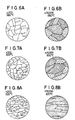
- Figs. 4A and 4B The structure of 200 magnifications and 20,000 magnifications of the steel that has been subjected only to solid solution treatment are shown in Figs. 4A and 4B, respectively.
- Figs. 5A and 5B there are shown the structures of 200 magnifications and 20,000 magnifications of the steel which have been subjected to said controlled rolling at a finish rolling temperature of 900°C after the solid solution treatment.
- the microstructure of the steel after the controlled rolling is a worked structure of a mixed grain size with the substructure being also a worked structure.
- the structures of 200 magnifications and 20,000 magnifications of the steel subjected to controlled rolling according to the present invention include, as particularly shown in Figs. 6A, 6B, 7A, 7B, 8A and 8B, a microstructure composed of a recrystallized structure of several tens micrometers in size and a substructure composed of a recrystallized structure of several microns in size.
- the crystal grains of the substructure are a recrystallized and worked double or duplex structure which is a worked structure having dislocations of a high density.
- the finish rolling temperature is 1050°C
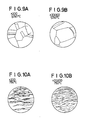
- little dislocations are observed in the substructure as is shown in Figs. 9A and 9B.
- the optical microscopic structure has crystal grains same as those of a fine recrystallized structure of a steel after the solid solution treatment
- the structure observed through an electron microscope is a structure having worked and recrystallized crystal of several microns in size which are divided with sub-grains and have little dislocation.
- This type of steel has only a slight improvement in strength.
- the finish rolling temperature is 770°C
- any recrystallized substructure is not formed as is shown in Figs. 10A and 10B, with the toughness being improved only slightly.
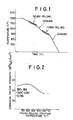
- Fig. 2 shows an influence of the finish rolling starting temperature on the corrosion fatigue strength.
- the steel subjected to a finish rolling temperature of 800 to 1000°C and having a recystallized and worked double structure has an improved corrosion fatigue strength of 32 kgf/mm2.
- Fig. 3 shows the relation between the corrosion fatigue strength and the content of N, revealing that when the content of N is more than 0.10%, the corrosion fatigue strength is improved as being more than 32 kgf/mm2.
- C is an element which considerably impede the corrosion resistance after controlled rolling and its content should be suitably controlled. Accordingly, its upper limit is defined as 0.03%. The lower limit of C is determined as 0.001%.
- Si is an element which is added as a deoxidizer and can improve strength.
- Si gives an adverse influence on the ⁇ / ⁇ balance at high temperature and lowers the hot workability.
- it impairs a corrosion resistance and reduces an amount of N as the solid solution at the time of solidification of the steel.
- the upper limit of Si is determined as 2%.
- the lower limit of Si is determined as 0.05%.
- Mn is an element which is added as a deoxidizer and can increase an amount of N as a solid solution and for a gamma phase. If, however, the content increases, the hot workability and corrosion resistance are impaired. Thus, the upper limit is determined as 5.0%. The lower limit of Mn is determined as 0.20%.
- Ni is a fundamental element of austenitic stainless steels and should be added in an amount of not less then 6% in order to impart good corrosion resistance and corrosion fatigue strength and to obtain an austenitic structure.
- the lower limit is determined as 6.0%.
- the upper limit is determined as 13%.
- Cr is a fundamental element of stainless steels. In order to impart good corrosion resistance and corrosion fatigue strength, not less than 16% of Cr should be contained. Thus, the lower limit is determined as 16%. However, when the content of Cr increases too great, the ⁇ / ⁇ balance at high temperature is impaired and the hot workability lowers, so that the upper limit is determined as 21%.
- N is an austenite-forming element and permits the action of facilitating the solid solution, the formation of finer crystal grains and the improvement of corrosion fatigue strength.
- its content should be not less than 0.10% and the lower limit is determined as 0.10%.
- the upper limit is determined as 0.30%.
- Nb is an element which can improve the corrosion resistance by fixation of C and also improve the corrosion fatigue strength. It is necessary to contain Nb in the steel at least 0.02% or more. However, when the content of Nb is too great, the hot workability is impaired and thus, the upper limit is determined as 0.25%.
- Mo and Cu are both elements of further improving the corrosion resistance and the corrosion fatigue strength.
- Mo and Cu are expensive elements and when they are, respectively, contained in amounts exceeding 4.0%, the hot workability deteriorates.
- the upper limit is determined as 4.0% for the respective elements.
- S is an element which can improve the corrosion resistance by reducing the content substantially and which can also improve the ductility and toughness. Accordingly, a small content is desirable, therefore, the upper limit is determined as 0.002%.
- Se, Te, S and P are elements which can improve the machinability of the steels of the present invention.
- Se, Te and S are used in amounts exceeding 0.80%, respectively, and P is used in amounts exceeding 0.100%, the hot workability and corrosion resistance lowers.
- the upper limit for each of Se, Te and S is determined as 0.08% and the upper limit for P is determined as 0.100%.
- V, Ti, W, Ta, Hf, Zr and Al are elements for improving the strength of a steel rolled by the controlled rolling process.
- the improving effect is not so significant but the hot workability lowers.
- the upper limit of the respective elements is determined as 0.30%.
- Bi and Pb are elements of improving the machinability of the steels of the present invention. If the contents of Bi and Pb are too great, the hot workability lowers and thus, the upper limit for each element is determined as 0.30%.
- B, Ca, Mg and rare earth elements are elements which are used to improve the hot workability of the steel in accordance with the present invention. At least 0.0020% of the respective elements should be contained, if required. However, adding of greater amounts than as required results in a lowering of the hot workability, therefore, the upper limit for each element determined as 0.0100%.
- the heating temperature defined from 1100 to 1300°C is for the reason that the deformation resistance during the rolling is suppressed and Nb is sufficiently converted into solid solution.
- the Nb precipitation cannot be completely dissolved as a solid solution and the deformation resistance cannot be made small.
- heating temperature exceeds 1300°C a part of the grains dissolves, leading to formation of coarse crystal grains to make the rolling dificult.
- the rough rolling temperature is determined from 1000 to 1200°C so as to obtain a fine recrystallized structure. If the temperature is less than 1000°C, the fine recrystallized structure cannot be obtained. On the other hand, when the temperature exceeds 1200°C, the crystal grains are made rough by recrystallization.
- the reason why the working rate is defined at 50% or higher in the course of the rough rolling is due to the fact that at a working rate less than 50% the energy for lattice defects is so small that a fine structure cannot be obtained.
- the steel After the rough rolling, the steel is cooled at a cooling rate of not less than 4°C/min, by which a fine recrystallized structure is obtained by static recrystallization.
- finish rolling temperature is defined to be in the range of from 800 to 1000°C is as follows: At temperatures lower than 800°C, the deformation resistance increases, making the controlled rolling process difficult, so that only a worked structure is formed, thus a "recrystallized and worked double structure" can not be obtained. If the finish rolling temperature exceeds 1000°C, a recrystallized structure alone is obtained by recrystallization and a "recystallized and worked double structure" can not be obtained.
- the working rate for the finish rolling is determined as not less than 20%. At a working rate less than 20%, the working strain is so small that a recrystallized and working double structure having satisfactory strength cannot be obtained.
- the cooling rate after the finish rolling is determined as not less than 4°C/min. This is because at a cooling rate less than 4°C/min, intergranular carbide appears, thus lowering the corrosion resistance.
- Tables 1 to 5 indicate chemical composition of tested steels. More particularly, Table 1 indicates the chemical composition of the first and second steels Nos.1-10 of the present invention, Table 2 indicates the chemical composition of the third and fourth steels Nos.11-18, Table 3 indicates the chemical composition of the fifth steel Nos.19-27, Table 4 indicates the chemical composition of the sixth and seventh steels Nos.28-35, and Table 5 indicates the chemical composition of conventional steels Nos.36-40 and comparative steels Nos.41-45
- the corrosion fatigue strength was evaluated by subjecting a test piece which is soaked in seawater to a rotary bending fatigue test and expressing it by 108 kgf/mm2.
- the endurance and elongation were measured using a No.4 test piece which is defined by Japanese Industrial Standard.
- the corrosion resistance in seawater was determined by measuring a pitting potential in an aqueous 35% NaCl solution at a temperature of 30°C.
- the machinability was determined by a drill life test in which a 20mm long test piece was machined with a drill made of a high speed tool steel (JIS) of 9.5mm in diameter and under condition of at a revolution rate of 527 rpm and at a feeding rate of 0.06mm/rev.
- JIS high speed tool steel
- the hot workability was determined by subjecting a test piece to a high speed and high temperature tensile test using the Gleeble (tradename) apparatus under conditions of a temperature of 1100°C and a pulling speed of 50mm/sec to measure a drawing rate (%).
- the second steels Nos. 6-10 to which at least one of Mo, Cu and S is added have a better corrosion resistance and the third steels Nos. 11-15 in which at least one of S, Te, P and Se is incorporated have better machinability.
- the fourth steels Nos. 16-18 to which B and at least one of Bi and Pb are added have improved machinability without lowering of the hot workability.
- the fifth steels Nos. 19-27 in which at least one of V, Ti, W, Ta, Hf, Zr and Al is incorporated have an improved endurance.
- the sixth steels Nos. 28-32 in which at least one of B, Ca, Mg, and rare earth elements is incorporated have an improved hot workability and the seventh steels Nos. 33-35 to which the above elements are added have improved corrosion resistance, machinability, strength and hot workability.
- the steel No.36 among the conventional steels Nos. 36-40 which were subjected to the thermal solid solution treatment is poor in characteristics and exhibits a corrosion fatigue strength of 18 kgf/mm2, an endurance of 24 kgf/mm2, and a pitting potential of 280 mV.
- the steels Nos. 37 and 38 although the pitting potential is as high as 300 mV, the corrosion fatigue strength and endurance are poor.
- the steel No.39 has a good corrosion fatigue resistance, but exhibits a pitting potential as low as 170 mV.
- the steel No.40 and a good pitting potential of 680 mV but is low in corrosion fatigue strength and endurance.
- the steel No.44 which was treated under the same conditions as in the controlled rolling process according to the present invention exhibits low pitting potential since its content of C is so high.
- the steel No.45 exhibits low pitting potential since its content of Cr is low.
- the austenitic stainless steels of the present invention have suitable amounts of N and Nb and a reduced amount of C and are subjected to controlled rolling process, thereby obtaining a "recrystallized and worked double structure".
- the austenitic stainless steels of the present invention have a high corrosion fatigue characteristic, corrosion resistance in seawater and endurance, i.e. a corrosion fatigue strength of not less than 32 kgf/mm2, an endurance of not less than 62 kgf/mm2, and a pitting potential of not less than 310 mV.
- the steels of the present invention are suitable for use in propeller shafts and pump shafts for ships and contribute highly to the industries.
Landscapes
- Chemical & Material Sciences (AREA)
- Engineering & Computer Science (AREA)
- Mechanical Engineering (AREA)
- Materials Engineering (AREA)
- Metallurgy (AREA)
- Organic Chemistry (AREA)
- Physics & Mathematics (AREA)
- Thermal Sciences (AREA)
- Crystallography & Structural Chemistry (AREA)
- Heat Treatment Of Steel (AREA)
Applications Claiming Priority (2)
| Application Number | Priority Date | Filing Date | Title |
|---|---|---|---|
| JP204763/86 | 1986-08-30 | ||
| JP61204763A JP2602015B2 (ja) | 1986-08-30 | 1986-08-30 | 耐腐食疲労性、耐海水性に優れたステンレス鋼およびその製造方法 |
Publications (3)
| Publication Number | Publication Date |
|---|---|
| EP0260022A2 true EP0260022A2 (de) | 1988-03-16 |
| EP0260022A3 EP0260022A3 (en) | 1989-03-01 |
| EP0260022B1 EP0260022B1 (de) | 1991-10-23 |
Family
ID=16495941
Family Applications (1)
| Application Number | Title | Priority Date | Filing Date |
|---|---|---|---|
| EP87307546A Expired - Lifetime EP0260022B1 (de) | 1986-08-30 | 1987-08-26 | Rostfreier Stahl mit guter Korrosionsbeständigkeit und guter Beständigkeit gegen Korrosion durch Seewasser und Verfahren zu seiner Herstellung |
Country Status (4)
| Country | Link |
|---|---|
| US (2) | US5000801A (de) |
| EP (1) | EP0260022B1 (de) |
| JP (1) | JP2602015B2 (de) |
| DE (1) | DE3774050D1 (de) |
Cited By (7)
| Publication number | Priority date | Publication date | Assignee | Title |
|---|---|---|---|---|
| WO2011053460A1 (en) * | 2009-11-02 | 2011-05-05 | Ati Properties, Inc. | Lean austenitic stainless steel |
| US8313691B2 (en) | 2007-11-29 | 2012-11-20 | Ati Properties, Inc. | Lean austenitic stainless steel |
| US8337748B2 (en) | 2007-12-20 | 2012-12-25 | Ati Properties, Inc. | Lean austenitic stainless steel containing stabilizing elements |
| US8877121B2 (en) | 2007-12-20 | 2014-11-04 | Ati Properties, Inc. | Corrosion resistant lean austenitic stainless steel |
| CN105002422A (zh) * | 2015-07-13 | 2015-10-28 | 苏州金业船用机械厂 | 一种高硬度抗压型螺旋桨叶片 |
| CN109286022A (zh) * | 2018-09-27 | 2019-01-29 | 中国华能集团清洁能源技术研究院有限公司 | 一种耐腐蚀的熔融碳酸盐燃料电池双极板材料及制造工艺 |
| CN111961991A (zh) * | 2020-09-02 | 2020-11-20 | 燕山大学 | 一种超高强塑积trip型双相不锈钢及其制备方法 |
Families Citing this family (14)
| Publication number | Priority date | Publication date | Assignee | Title |
|---|---|---|---|---|
| JPH0611902B2 (ja) * | 1989-07-12 | 1994-02-16 | 住友金属工業株式会社 | ステンレス形鋼およびその製造方法 |
| US5340534A (en) * | 1992-08-24 | 1994-08-23 | Crs Holdings, Inc. | Corrosion resistant austenitic stainless steel with improved galling resistance |
| TW290592B (de) * | 1993-07-08 | 1996-11-11 | Asahi Seiko Co Ltd | |
| US5824264A (en) * | 1994-10-25 | 1998-10-20 | Sumitomo Metal Industries, Ltd. | High-temperature stainless steel and method for its production |
| FR2780735B1 (fr) * | 1998-07-02 | 2001-06-22 | Usinor | Acier inoxydable austenitique comportant une basse teneur en nickel et resistant a la corrosion |
| JP2004124173A (ja) * | 2002-10-02 | 2004-04-22 | Nippon Chuzo Kk | 非磁性オーステナイトステンレス鋳鋼およびその製造方法 |
| RU2295439C2 (ru) * | 2005-02-21 | 2007-03-20 | Общество с ограниченной ответственностью "ПРОМПЛАСТ 14" | Способ получения гранул вспенивающегося стирольного полимера |
| EP2103705A1 (de) * | 2008-03-21 | 2009-09-23 | ArcelorMittal-Stainless France | Herstellungsverfahren von rostfreien austenitischen Stahlblechen mit hohen mechanischen Eigenschaften |
| US8387282B2 (en) | 2010-04-26 | 2013-03-05 | Nike, Inc. | Cable tightening system for an article of footwear |
| WO2011139481A1 (en) | 2010-05-04 | 2011-11-10 | International Paper Company | Coated printed substrates resistant to acidic highlighters and printing solutions |
| WO2012012724A1 (en) | 2010-07-23 | 2012-01-26 | International Paper Company | Coated printable substrates providing higher print quality and resolution at lower ink usage |
| WO2018103087A1 (zh) * | 2016-12-09 | 2018-06-14 | 孙瑞涛 | 一种制造高氮奥氏体不锈钢船舰用螺旋桨铸件的方法 |
| KR102292016B1 (ko) | 2019-11-18 | 2021-08-23 | 한국과학기술원 | 균일하게 분포하는 나노 크기의 석출물을 다량 함유한 오스테나이트계 스테인리스강 및 이의 제조방법 |
| JP7513867B2 (ja) * | 2020-03-06 | 2024-07-10 | 日本製鉄株式会社 | オーステナイト系ステンレス鋼及びオーステナイト系ステンレス鋼の製造方法 |
Family Cites Families (15)
| Publication number | Priority date | Publication date | Assignee | Title |
|---|---|---|---|---|
| US3306736A (en) * | 1963-08-30 | 1967-02-28 | Crucible Steel Co America | Austenitic stainless steel |
| US3284250A (en) * | 1964-01-09 | 1966-11-08 | Int Nickel Co | Austenitic stainless steel and process therefor |
| DE1483037C3 (de) * | 1965-02-03 | 1974-03-14 | Stahlwerke Suedwestfalen Ag, 5930 Huettental-Geisweid | Anwendung des Warm-Kalt-oder Kalrverformens oder der Kombination beider Verfahren auf Bauteile aus hochwarmfesten Stählen |
| DE1558656B2 (de) * | 1967-04-19 | 1976-10-21 | Stahlwerke Bochum Ag, 4630 Bochum | Rost- und korrosionsbestaendiger stahlguss |
| JPS5456018A (en) * | 1977-10-12 | 1979-05-04 | Sumitomo Metal Ind Ltd | Austenitic steel with superior oxidation resistance for high temperature use |
| JPS5562151A (en) * | 1978-10-30 | 1980-05-10 | Daido Steel Co Ltd | Stainless cast steel for marine propeller |
| JPS5946287B2 (ja) * | 1979-02-13 | 1984-11-12 | 住友金属工業株式会社 | オ−ステナイト系ステンレス鋼の固溶化処理法 |
| CA1196555A (en) * | 1981-12-28 | 1985-11-12 | Ruzica Petkovic-Luton | Thermal mechanical treatment for enhancing high temperature properties of cast austenitic steel structures |
| JPS58117862A (ja) * | 1982-01-05 | 1983-07-13 | Kawasaki Steel Corp | 耐塩化物応力腐食割れ性と耐隙間腐食性のすぐれたオ−ステナイト系ステンレス鋼 |
| JPS59129731A (ja) * | 1983-01-14 | 1984-07-26 | Nippon Steel Corp | オ−ステナイト系ステンレス鋼板又は鋼帯の製造方法 |
| JPS59185763A (ja) * | 1983-04-04 | 1984-10-22 | Nippon Stainless Steel Co Ltd | 中性塩環境における耐食性に優れたオ−ステナイトステンレス鋼 |
| JPS60177128A (ja) * | 1984-02-24 | 1985-09-11 | Nippon Kokan Kk <Nkk> | 耐腐食疲労特性の優れた海洋構造物用50キロ級鋼の製造法 |
| DE3407307A1 (de) * | 1984-02-24 | 1985-08-29 | Mannesmann AG, 4000 Düsseldorf | Verwendung einer korrosionsbestaendigen austenitischen eisen-chrom-nickel-stickstoff-legierung fuer mechanisch hoch beanspruchte bauteile |
| JPH0615692B2 (ja) * | 1985-07-01 | 1994-03-02 | 川崎製鉄株式会社 | オ−ステナイト系ステンレス厚鋼板の製造方法 |
| DE3586247T2 (de) * | 1985-10-15 | 1993-02-25 | Aichi Steel Works Ltd | Hochfester rostfreistahl und dessen herstellung. |
-
1986
- 1986-08-30 JP JP61204763A patent/JP2602015B2/ja not_active Expired - Lifetime
-
1987
- 1987-08-26 DE DE8787307546T patent/DE3774050D1/de not_active Expired - Fee Related
- 1987-08-26 EP EP87307546A patent/EP0260022B1/de not_active Expired - Lifetime
-
1988
- 1988-10-03 US US07/253,338 patent/US5000801A/en not_active Expired - Fee Related
-
1990
- 1990-06-06 US US07/533,851 patent/US5000797A/en not_active Expired - Fee Related
Cited By (19)
| Publication number | Priority date | Publication date | Assignee | Title |
|---|---|---|---|---|
| US8858872B2 (en) | 2007-11-29 | 2014-10-14 | Ati Properties, Inc. | Lean austenitic stainless steel |
| US8313691B2 (en) | 2007-11-29 | 2012-11-20 | Ati Properties, Inc. | Lean austenitic stainless steel |
| US10370748B2 (en) | 2007-11-29 | 2019-08-06 | Ati Properties Llc | Lean austenitic stainless steel |
| US9617628B2 (en) | 2007-11-29 | 2017-04-11 | Ati Properties Llc | Lean austenitic stainless steel |
| US9133538B2 (en) | 2007-12-20 | 2015-09-15 | Ati Properties, Inc. | Lean austenitic stainless steel containing stabilizing elements |
| US9873932B2 (en) | 2007-12-20 | 2018-01-23 | Ati Properties Llc | Lean austenitic stainless steel containing stabilizing elements |
| KR101535695B1 (ko) * | 2007-12-20 | 2015-07-09 | 에이티아이 프로퍼티즈, 인코퍼레이티드 | 안정화 원소를 함유하고 저 함량 니켈의 오스테나이트계 스테인리스 강 |
| US9121089B2 (en) | 2007-12-20 | 2015-09-01 | Ati Properties, Inc. | Lean austenitic stainless steel |
| US8337749B2 (en) | 2007-12-20 | 2012-12-25 | Ati Properties, Inc. | Lean austenitic stainless steel |
| US10323308B2 (en) | 2007-12-20 | 2019-06-18 | Ati Properties Llc | Corrosion resistant lean austenitic stainless steel |
| US8877121B2 (en) | 2007-12-20 | 2014-11-04 | Ati Properties, Inc. | Corrosion resistant lean austenitic stainless steel |
| US8337748B2 (en) | 2007-12-20 | 2012-12-25 | Ati Properties, Inc. | Lean austenitic stainless steel containing stabilizing elements |
| US9624564B2 (en) | 2007-12-20 | 2017-04-18 | Ati Properties Llc | Corrosion resistant lean austenitic stainless steel |
| US9822435B2 (en) | 2007-12-20 | 2017-11-21 | Ati Properties Llc | Lean austenitic stainless steel |
| RU2586366C2 (ru) * | 2009-11-02 | 2016-06-10 | ЭйТиАй ПРОПЕРТИЗ, ИНК. | Аустенитная нержавеющая сталь |
| WO2011053460A1 (en) * | 2009-11-02 | 2011-05-05 | Ati Properties, Inc. | Lean austenitic stainless steel |
| CN105002422A (zh) * | 2015-07-13 | 2015-10-28 | 苏州金业船用机械厂 | 一种高硬度抗压型螺旋桨叶片 |
| CN109286022A (zh) * | 2018-09-27 | 2019-01-29 | 中国华能集团清洁能源技术研究院有限公司 | 一种耐腐蚀的熔融碳酸盐燃料电池双极板材料及制造工艺 |
| CN111961991A (zh) * | 2020-09-02 | 2020-11-20 | 燕山大学 | 一种超高强塑积trip型双相不锈钢及其制备方法 |
Also Published As
| Publication number | Publication date |
|---|---|
| US5000801A (en) | 1991-03-19 |
| EP0260022A3 (en) | 1989-03-01 |
| EP0260022B1 (de) | 1991-10-23 |
| DE3774050D1 (de) | 1991-11-28 |
| JP2602015B2 (ja) | 1997-04-23 |
| JPS63199851A (ja) | 1988-08-18 |
| US5000797A (en) | 1991-03-19 |
Similar Documents
| Publication | Publication Date | Title |
|---|---|---|
| US5000797A (en) | Method for producing a stainless steel having a good corrosion resistance and a good resistance to corrosion in seawater | |
| JP6766887B2 (ja) | 油井用高強度ステンレス継目無鋼管およびその製造方法 | |
| JP6399259B1 (ja) | 油井用高強度ステンレス継目無鋼管およびその製造方法 | |
| EP2199420B1 (de) | Austenitischer edelstahl | |
| EP1357198B1 (de) | Wärme- und korrosionsbeständige austenitische Legierung, wärme- und druckbeständige Bauteile und Verfahren zu deren Herstellung | |
| JP6156609B1 (ja) | 油井用高強度ステンレス継目無鋼管およびその製造方法 | |
| JP6369662B1 (ja) | 二相ステンレス鋼およびその製造方法 | |
| JPWO2018043214A1 (ja) | 二相ステンレス鋼およびその製造方法 | |
| CA2105199A1 (en) | Low nickel, copper containing chromium-nickel-manganese-copper-nitrogen austenitic stainless steel | |
| JPH10503809A (ja) | 熱間加工性に優れた耐硫化物応力割れ性を有するマルテンサイト系ステンレス鋼 | |
| WO2024009564A1 (ja) | ステンレス継目無鋼管およびその製造方法 | |
| JP4754362B2 (ja) | 耐食性、耐力、低温靱性が良好なオーステナイト系ステンレス熱間圧延鋼材およびその製造方法 | |
| JP2005290554A (ja) | 被削性と靭性および溶接性に優れた鋼板およびその製造方法 | |
| PL195084B1 (pl) | Utwardzalny wydzieleniowo stop martenzytycznej stali nierdzewnej | |
| JP7164032B2 (ja) | ボルト、及びボルト用鋼材 | |
| CN115917028A (zh) | 不锈钢无缝钢管及其制造方法 | |
| SE431660B (sv) | Smidbar austenitisk nickellegering | |
| JP7347714B1 (ja) | 油井用高強度ステンレス継目無鋼管 | |
| CN114450428A (zh) | 不锈钢无缝钢管及其制造方法 | |
| JP2946992B2 (ja) | 強度、靭性および耐食性に優れた2相ステンレス鋼材の製造方法 | |
| JP7845035B2 (ja) | 非磁性オーステナイト系ステンレス鋼材及びその製造方法 | |
| JP4059156B2 (ja) | 原子力用ステンレス鋼 | |
| JPS6137953A (ja) | 非磁性鋼線材の製造方法 | |
| WO2023153185A1 (ja) | オーステナイト系ステンレス鋼およびオーステナイト系ステンレス鋼の製造方法 | |
| JP7131332B2 (ja) | オーステナイト系耐熱合金及びオーステナイト系耐熱合金部品 |
Legal Events
| Date | Code | Title | Description |
|---|---|---|---|
| PUAI | Public reference made under article 153(3) epc to a published international application that has entered the european phase |
Free format text: ORIGINAL CODE: 0009012 |
|
| AK | Designated contracting states |
Kind code of ref document: A2 Designated state(s): DE FR GB SE |
|
| PUAL | Search report despatched |
Free format text: ORIGINAL CODE: 0009013 |
|
| AK | Designated contracting states |
Kind code of ref document: A3 Designated state(s): DE FR GB SE |
|
| 17P | Request for examination filed |
Effective date: 19890505 |
|
| 17Q | First examination report despatched |
Effective date: 19890712 |
|
| GRAA | (expected) grant |
Free format text: ORIGINAL CODE: 0009210 |
|
| AK | Designated contracting states |
Kind code of ref document: B1 Designated state(s): DE FR GB SE |
|
| PG25 | Lapsed in a contracting state [announced via postgrant information from national office to epo] |
Ref country code: SE Effective date: 19911023 Ref country code: FR Effective date: 19911023 |
|
| REF | Corresponds to: |
Ref document number: 3774050 Country of ref document: DE Date of ref document: 19911128 |
|
| EN | Fr: translation not filed | ||
| PLBE | No opposition filed within time limit |
Free format text: ORIGINAL CODE: 0009261 |
|
| STAA | Information on the status of an ep patent application or granted ep patent |
Free format text: STATUS: NO OPPOSITION FILED WITHIN TIME LIMIT |
|
| 26N | No opposition filed | ||
| PGFP | Annual fee paid to national office [announced via postgrant information from national office to epo] |
Ref country code: GB Payment date: 19950815 Year of fee payment: 9 |
|
| PGFP | Annual fee paid to national office [announced via postgrant information from national office to epo] |
Ref country code: DE Payment date: 19950828 Year of fee payment: 9 |
|
| PG25 | Lapsed in a contracting state [announced via postgrant information from national office to epo] |
Ref country code: GB Effective date: 19960826 |
|
| GBPC | Gb: european patent ceased through non-payment of renewal fee |
Effective date: 19960826 |
|
| PG25 | Lapsed in a contracting state [announced via postgrant information from national office to epo] |
Ref country code: DE Effective date: 19970501 |