EP0260415A2 - Synthèse et utilisation de polyanhydrides à haut poids moléculaire - Google Patents
Synthèse et utilisation de polyanhydrides à haut poids moléculaire Download PDFInfo
- Publication number
- EP0260415A2 EP0260415A2 EP87110971A EP87110971A EP0260415A2 EP 0260415 A2 EP0260415 A2 EP 0260415A2 EP 87110971 A EP87110971 A EP 87110971A EP 87110971 A EP87110971 A EP 87110971A EP 0260415 A2 EP0260415 A2 EP 0260415A2
- Authority
- EP
- European Patent Office
- Prior art keywords
- dicarboxylic acids
- molecular weight
- aromatic
- polyanhydride
- aliphatic
- Prior art date
- Legal status (The legal status is an assumption and is not a legal conclusion. Google has not performed a legal analysis and makes no representation as to the accuracy of the status listed.)
- Granted
Links
Images





Classifications
-
- C—CHEMISTRY; METALLURGY
- C08—ORGANIC MACROMOLECULAR COMPOUNDS; THEIR PREPARATION OR CHEMICAL WORKING-UP; COMPOSITIONS BASED THEREON
- C08G—MACROMOLECULAR COMPOUNDS OBTAINED OTHERWISE THAN BY REACTIONS ONLY INVOLVING UNSATURATED CARBON-TO-CARBON BONDS
- C08G67/00—Macromolecular compounds obtained by reactions forming in the main chain of the macromolecule a linkage containing oxygen or oxygen and carbon, not provided for in groups C08G2/00 - C08G65/00
- C08G67/04—Polyanhydrides
Definitions
- This invention is in the area of organic synthesis and is in particular a method for synthesis of high molecular weight polyanhydride.
- High molecular weight polyanhydrides are essential for biomedical applications where superior physico-mechanical properties including film forming, high tensile strength, yield of break and impact are required. Although synthesis of polyanhydrides is well documented, polyanhydrides having a molecular weight average in excess of 15,000 to 20,000 and an intrinsic viscosity in organic solvents of greater than 0.3 dl/g are not synthesized using any of the known methods. Previous reports of polyanhydrides having higher molecular weights were based on estimated molecular weights. Controlled studies using instrumentation not available when these reports were made have shown that the polyanhydrides produced by solution polymerization and melt polymerization have a molecular weight average of a few thousand up to at most 20,000.
- the low molecular weight polyanhydride polymers are limited by their low molecular weight (generally 12,500 mw) and corresponding low intrinsic viscosity in solution (approximately 0.1 to 0.3 dl/g in organic solvents at room temperature).
- polyanhydrides are useful in controlled release drug delivery systems due to their hydrolytic instability and the fact that they degrade into monomeric diacids which are highly biocompatible, as shown by tissue response and toxicological studies, the rate of degradation is too rapid for many applications.
- controlled release devices is limited since the devices incorporating the low molecular weight polyanhydrides can only be manufactured in two ways: by mixing the powdered polyanhydride with the bioactive substances and then pressing the mixture into devices or by melting the polyanhydrides and bioactive substances at a relatively high temperature. The first method frequently results in a non-homogeneous mixture or poor release kinetics and the second causes degradation of the incorporated drugs or a reaction between the drugs and the polyanhydrides.
- a polymer to be useful as a matrix for controlled release of a biologically active substance surface erosion of the polymer should be the determining factor for release of the entrapped substance.
- the polymeric matrix composition must degrade into low molecular weight, non-toxic products. Ideally, the polymeric matrix erodes at a preselected, constant rate and the biologically active substance is released at a zero-order rate, without regard to the concentration of any other chemical component. To obtain a zero-order release reaction of active substances from the matrix, it is necessary to utilize a matrix geometry which does not change substantially in surface area as a function of time.
- the composition must also not undergo bulk erosion which often occurs in addition to, or in place of, surface erosion, rendering the entire polymer composition sponge-like and causing breakup of the matrix.
- the polymer should be hydrophobic yet contain water labile linkages. Bulk erosion is directly due to the hydrophilic nature of most bioerodible polymeric compositions. Hydrophilic bioerodible polymers incorporate water which is drawn into the center of the matrix. Polymers which undergo bulk erosion include polylactic acid, polyglutamic acid, polycaprolactone and lactic/glycolic acid copolymers.
- One hydrophobic composition which is useful for delivery of biologically active substances is polyorthoesters.
- An advantage to their use is that hydrolysis of orthoester is pH sensitive and pH may therefore be used for regulation of the release of the active substance.
- all polyorthoesters synthesized to date are often too hydrolytically stable for use in controlled release systems without acid catalysts included within the matrix to promote bioerosion.
- the polyorthoester polymers-additive system swell substantially when attempts are made to suppress degradation in the interior of the matrix, the rate of swelling often dominating and affecting the rate of release for the active substances more than the rate of erosion itself.
- compositions which are useful as hydrophobic polymeric matrices for the controlled release of biologically active substances after implantation are polyanhydride polymers prepared by a modification of the melt polycondensation synthesis method of Conix, described in Macro Synth. 2, 95-98 (1966), in which the prepolymer is recrystallized initially to provide a more pure, higher molecular weight unit for polymerization. Selected polyanhydrides completely degrade to their monomers under physiological conditions at rates useful for drug delivery.
- Degradation rates are high in polymers or copolymers of sebacic acid. Erosion rates are highly dependent on the number of methylene groups. As with the other reported polyanhydrides, these polymers also have low molecular weight (up to 15,000) and intrinsic viscosities (up to 0.3 dl/g). As a result, their physico-mechanical properties and release kinetics are less than is desired.
- the present invention is a method for synthesizing high molecular weight polyanhydrides wherein a high molecular weight polyanhydride is defined as having a molecular weight average in excess of 20,000 and is characterized by an intrinsic viscosity of greater than 0.3 dl/g in organic solvent at room temperature.
- the formulas are to be construed to include substitutions on the aromatic groups of the dicarboxylic acid.
- the high molecular weight polyanhydrides are synthesized by melt polycondensation of highly pure dicarboxylic acid monomers converted to the mixed anhydride by reflux in acetic anhydride for 15 to 30 minutes; isolation and purification of the isolated prepolymers by recrystallization; and melt polymerization under low pressure (10 ⁇ 4mm) with a dry ice/acetone trap at a temperature between 140°C and 250°C, more preferably 180°C, for between 10 and 300 minutes, more preferably 90 minutes.
- Higher molecular weight are obtained by inclusion of a catalyst which increases the rate of anhydride interchain exchange.
- Catalysts which are useful include any catalysts active in transesterification, ring opening polymerization and related polymerizations.
- the preferred catalysts are heterogenic coordination catalysts, such as Cd(CH3COO)2, earth metal oxides such as CaO, BaO, and CaCo3, and complexes of ZnEt2 and hydroxylated molecules.
- higher molecular weight polyanhydrides are produced from monomers such as sebacic acid (SA), bis (p-carboxy-phenoxy) propane (CPP), isophthalic acid (Iph), and dodecanedioic acid (DD). Examples are also included of controlled release in vivo and in vitro from devices formed of high molecular weight polymers.
- SA sebacic acid
- CPP bis (p-carboxy-phenoxy) propane
- Iph isophthalic acid
- DD dodecanedioic acid
- the present invention is a method for synthesizing high molecular weight polyanhydrides wherein high molecular weights polyanhydrides (HMW PA) are defined as polyanhydrides having a molecular weight in excess of 20,000 or as having a high intrinsic viscosity in excess of 0.3 dl/g in organic solvents at room temperature.
- HMW PA high molecular weights polyanhydrides
- the HMW PA are particularly useful in biomedical applications, such as in controlled release drug delivery systems.
- the method for synthesizing the HMW PA consists of: selecting highly pure prepolymers consisting of mixed anhydrides prepared from highly pure dicarboxylic acids wherein the anhydrides are formed by refluxing the diacids in acetic anhydride, propionic anhydride, or other short aliphatic anhydrides or by reacting the diacids with acetyl chloride or other short aliphatic acid chlorides in the presence of an organic base such as triethylamine; polymerizing the highly pure prepolymers at a temperature and for a time such that a high molecular weight polyanhydride is formed, generally in the range of 140°C to 250°C, for a period of 10 to 300 minutes for the preferred monomers; removing the condensation product formed by the polymerization, preferably by means of a chilled trap under vacuum; and stopping the reaction at the point before the HMW PA begin to degrade or forming an insoluble gel.
- the time and temperature of the polymerization act in cooperation to yield a HMW compound.
- the polymer composition is also important. In the following examples, polymerizing the prepolymers for between 60 and 120 minutes, most preferrably 90 minutes, at a temperature of between 150°C and 220°C, most preferrably 180°C, was found to yield the highest molecular weights for polymers composed of sebacic acid, bis(p-carboxyphenoxy)propane, i sophthalic acid and dodecanedioic acid.
- the formulas are to be construed to include substitutions on the aromatic groups of the dicarboxylic acid.
- the following monomers are preferred for use in synthesizing copolymers for biomedical applications: bis(p-carboxyphenoxy)alkanes; Hydroquinone-O,O ⁇ diacetic acid; 1,4-bis-carboxymethyl benzene; 2,2-bis(4-hydroxyphenyl)propane-O,O ⁇ -diacetic acid; 2,2-bis(4-carboxyphenyl)propane; terephthalic acid; bis(4-carboxyphenyl)alkanes; 1,4 phenylene dipropionic acid; and cyclohexane dicarboxylic acids.
- the molecular weight of the polymers can be significantly increased by including a catalyst with the prepolymers in the melt polymerization.
- a catalyst Any catalysts used for transterification, ring opening polymerization and related polymerizations are useful
- acid, base and coordination catalysts such as Cd(CH3COO)2, earth metal oxides including CaO, BaO, and CaCO3 and Z n Et2-H2O are used.
- Heterogenic coordination catalysts are preferred since the catalyst can be easily removed from the polymer for biomedical use.
- High molecular weight polyanhydrides are synthesized by melt polycondensation with two important modifications: pure isolated prepolymers are used in the polymerization reaction and the reaction conditions are carefully controlled.
- the dicarboxylic acid monomers are converted to the mixed anhydride by total reflux in acetic anhydride. Caution must be taken to avoid excessive reaction.
- SA sebacic acid
- CPP bis(p-carboxyphenoxy)propane
- IPh isophthalic acid
- DD dodecanedioic acid
- the following catalysts calcium oxide, calcium carbonate, diethyl zinc (15 wt % solution in toluene), cadmium acetate hydrate (Aldrich), barium oxide (EM Sciences, New Jersey), were reduced to less than 50 micron particle size before use.
- the polymers and prepolymers were characterized by infrared spectroscopy, thermal analysis, melting point, viscosity, stress-strain and GPC.
- Infrared spectroscopy was performed on a Perkin-Elmer Spectrophotometer Model 1430. Polymeric samples were film cast onto NaCl plates from solutions of the polymer in chloroform. Prepolymer samples were either pressed into KBr pellets or dispersed in nujol onto NaCl plates.
- Thermal analysis of polymers was determined on a Perkin-Elmer DSC-2 differential Scanning Calorimeter employing a heating rate of 20°/min.
- the melting point of prepolymers was determined on a Fisher Johns melting point apparatus .
- the molecular weight of the polymers and prepolymers were estimated on a Perkin-Elmer GPC system consisting of the series 10 pump, the 3600 Data Station and the LKB 214 - rapid spectral detector at 254 nm. Samples were eluted in chloroform through two PL Gel columns (Polymer Laboratories; 100 Angstroms and 1000 Angstroms pore sizes) in series at a flow rate of 1.5 ml/min. Polystyrene (Polyscience PA) was used as the calibration standard.
- the viscosity of the polymers was measured in an Ubbelohde Viscometer (cannon 75) at 23°C using 1, 0.5 and 0.25 % w/v polymer in chloroform solution. ⁇ H-NMR spectra were run on a Bruker AM-250 spectrometer in CDC13.
- the mechanical properties of films composed of CPP:SA copolymers were determined on an Instron Instrument Model 1122 stress-strain tester at an initial strain rate of 0.05 mm/min following the ASTM designation D882-81 for tensile properties characterization of thin plastic sheeting.
- Polymer films of 0.8 mm thickness were prepared by a solvent casting method as follows. Solutions of CPP:SA copolymers (20% w/v) in dichloromethane were cast on glass petri dishes. The dishes were placed on dry ice or stored at -20°C for solvent evaporation. Strong and flexible films (0.8 mm thick) were obtained. The films were stored under vacuum in a CaCl2 desiccator.
- the degree of oligomerization of the prepolymers was determined from the integration of a representative peak of the repeating unit and the methyl terminals peak of the acetic mixed anhydride end group.
- Polyanhydrides were synthesized by melt polycondensation, modifying to the method described by Hill and Carothers in J. Am. Chem. Soc. , 54, 1569 (1932) and 55, 5023 (1933) by using highly pure isolated prepolymers and optimizing the reaction conditions (temperature, time, removal of condensation product).
- Aliphatic prepolymers were prepared by refluxing the dicarboxylic acid monomers (40 g) in acetic anhydride (500 ml) for 20 minutes. The excess acetic anhydride was removed to dryness under vacuum at 50°C. The crude prepolymer was recrystallized from dry toluene. The crystals were then immersed in a 1:1 mixture of dry petrol ether and ethyl ether overnight to extract traces of acetic anhydride and toluene. The pure crystals were dried under vacuum over calcium chloride (75-88% yield). Aromatic monomers were refluxed for 15 minutes, then the unreacted diacid (10-20%) was removed by filtration.
- the crude polymer was purified by precipitation in dry petroleum ether from dichloromethane solution. The precipitate was then extracted with anhydrous ether for several hours at room temperature.
- the molecular weight average, viscosity, and melting point of polyanhydrides synthesized using the method of the present invention are shown in Table 1.
- the molecular weight average of these polymers ranged from 87,900 up to 122,800.
- the number average molecular weight that was obtained was in the range of 20,000 to 35,000.
- Fig. 1a shows the Mw distribution of CPP:SA(20:80) polymers as a function of time of polymerization using the method of the present invention. Two periods can be defined in the polymerization process, the first up to 45 minutes and the second up to 90 minutes. In the second period, the molecular weight increases without any shift of the main fraction. This can be explained by the formation of a relatively homogenic molecular weight distribution, which then couples, partially yielding a high molecular weight fraction.
- Fig. 1b shows the Mw of CPP:SA(20:80) as a function of time of polymerization.
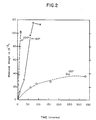
- Fig. 2 is a graph of the molecular weight average of CPP:SA(20:80) at various temperatures: 150°C, 180°C and 220°C, as a function of time of polymerization (minutes). It is clear from this graph that the time and temperature can be optimized for each polymer composition to maximize molecular weight.
- the molecular weight average of the high molecular weight polyanhydrides can be significantly increased by mixing a catalyst into the prepolymers and then melt polymerizing under optimum conditions. Catalysts were found to have a minor effect on the number average molecular weight.
- Table 2 compares the viscosity and molecular weight average for CPP:SA (20:80) polymers melt-polymerized at 180°C using 2 moles % coordination catalysts. Significantly higher molecular weight in shorter times were achieved with Cd(CH3COO)2, earth metal oxides, calcium carbonate and ZnEt2-H2O.
- the Mw of CPP:SA(20:80) increased up to 240,133 with catalyst, in comparison to a Mw of 116,800 without catalysts. These catalysts are preferred since the reaction type is heterogenic, resulting in easy separation of the catalyst, a requirement for use of the polymer in vivo or in other medical applications.
- the molecular weights of CPP:SA(20:80) polymerized with 2 mole % catalyst are depicted in Fig. 3 as a function of time of polymerization (min). Calcium oxide, barium oxide, calcium carbonate, and cadmium acetate were used as the catalysts.
- the Mw and polymerization time for the polymerization of polyanhydride at 180°C with the catalyst cadmium acetate (2 mole% cadmium acetate: 10 m mole prepolymer) are listed in Table 3.
- the polymers formed using these methods including polymers formed from sebacic acid, dodecaredioic acid, bis(p-carboxyphenoxy) propane, isophthalic acid, and combinations thereof, having molecular weights up to 240,133 and intrinsic viscosi ty of up to 1.18 dl/g.
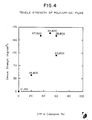
- Fig. 4 is a graph of the tensile strength of films made of CPP copolymers as a function of percent CPP and as a function of molecular weight increasing either the percent CPP or the molecular weight increases tensile strength.
- These polymers have many useful applications, particularly in the biomedical area. For example, they may be used to form a bioerodible matrix for controlled release of a bioactive compound such as nutrients, drugs, and compounds having agricultural applications. They are also useful in the manufacture of sutures, protective coverings, for example, to replace skin on burn patients; to secure wounds; as patches following surgery: and as absorbable bone replacements.
- Example 1 In vitro release of colchicine from a polyCPP:SA(30:70) film of 5% colchicine loading
- the in vitro release rate for a representative drug, colchicine (400 mw), from a polyCPP:SA(30:70) film is shown in Fig. 5 as the percent release over time (hr) at 37°C in buffered solutions having a pH of 2.0 and 7.4.
- the one mm thick film was formed by solvent casting the 5% colchicine - polyCPP:SA(30:70) solution mixture.
- Example 2 In vivo release of insulin from 300 micron polyCPP:SA(20:80) microcapsules
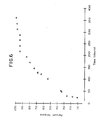
- the in vivo release rate of insulin a polypeptide hormone of approximately 6000 molecular weight, from 300 micron polyCPP:SA(20:80) microspheres is shown in Fig. 6.
- the percent release of insulin into 0.1 M phosphate buffer pH 7.4 at 37°C clearly establishes that zero order release is occurring over a period of approximately two weeks.
- the polyCPP:SA(20:80) has a molecular weight average of 92,000.
- Example 3 In vivo release of insulin in rats from 300 micron polyCPP:SA(20:80) microcapsules
- Fig. 7a is a graph of glucose (mg/dl) in urine over eight days.
- Fig. 7b is a graph of glucose (mg/dl) in blood over eight days.
- the insulin is released over a period of several days, with an effectiveness of four to five days at this loading in microspheres of this size and composition. The microspheres totally disappear after seven days.
- the polyCPP:SA(20:80) polymers forming injectible microspheres of 300 microns have a molecular weight of 92,000.
- PolyCPP:SA(20:80) polymers formed using the prior art methods have a molecular weight of 12,000.
- larger non-injectible size microspheres formed of the low molecular weight polyCPP:SA(20:80) of approximately 800 microns in diameter, of 5% insulin loading are required to obtain an effective release over a period of three days.
- Example 4 In vivo release of insulin in rats from a 0.5 mm thick polyCPP:SA(20:80) film
- Fig. 8 shows the effectiveness of in vivo insulin release in rats over a period of several days from a polyCPP:SA(20-80) film of 5% insulin loading.
- the 0.5 mm thick film is prepared by suspending the insulin in the polymer dissolved in chloroform and casting. After removal of the solvent, the 200 mg film is surgically implanted under the skin of the rats (20 0 g average).
Landscapes
- Chemical & Material Sciences (AREA)
- Chemical Kinetics & Catalysis (AREA)
- Medicinal Chemistry (AREA)
- Polymers & Plastics (AREA)
- Organic Chemistry (AREA)
- Health & Medical Sciences (AREA)
- Polyesters Or Polycarbonates (AREA)
- Polyethers (AREA)
- Medicinal Preparation (AREA)
- Pharmaceuticals Containing Other Organic And Inorganic Compounds (AREA)
- Organic Low-Molecular-Weight Compounds And Preparation Thereof (AREA)
- Acyclic And Carbocyclic Compounds In Medicinal Compositions (AREA)
- Polyamides (AREA)
Applications Claiming Priority (2)
| Application Number | Priority Date | Filing Date | Title |
|---|---|---|---|
| US06/892,809 US4757128A (en) | 1986-08-01 | 1986-08-01 | High molecular weight polyanhydride and preparation thereof |
| US892809 | 1986-08-01 |
Related Child Applications (2)
| Application Number | Title | Priority Date | Filing Date |
|---|---|---|---|
| EP95200186 Division | 1987-07-29 | ||
| EP95200186.5 Division-Into | 1987-07-29 |
Publications (3)
| Publication Number | Publication Date |
|---|---|
| EP0260415A2 true EP0260415A2 (fr) | 1988-03-23 |
| EP0260415A3 EP0260415A3 (fr) | 1988-05-18 |
| EP0260415B1 EP0260415B1 (fr) | 1996-11-27 |
Family
ID=25400529
Family Applications (1)
| Application Number | Title | Priority Date | Filing Date |
|---|---|---|---|
| EP87110971A Expired - Lifetime EP0260415B1 (fr) | 1986-08-01 | 1987-07-29 | Synthèse et utilisation de polyanhydrides à haut poids moléculaire |
Country Status (11)
| Country | Link |
|---|---|
| US (1) | US4757128A (fr) |
| EP (1) | EP0260415B1 (fr) |
| JP (1) | JP2700646B2 (fr) |
| KR (1) | KR880002904A (fr) |
| AT (1) | ATE145657T1 (fr) |
| CA (1) | CA1274339A (fr) |
| DE (2) | DE260415T1 (fr) |
| ES (1) | ES2006417T3 (fr) |
| GR (2) | GR880300163T1 (fr) |
| LU (1) | LU90462I2 (fr) |
| NL (1) | NL990036I2 (fr) |
Cited By (6)
| Publication number | Priority date | Publication date | Assignee | Title |
|---|---|---|---|---|
| EP0368912A4 (en) * | 1987-07-31 | 1990-12-19 | Massachusetts Institute Of Technology | Polyanhydrides with improved hydrolytic degradation properties |
| EP0414416A3 (en) * | 1989-08-25 | 1991-07-03 | Nova Pharmaceutical Corporation | Aromatic polyanhydride compositions |
| ES2038072A1 (es) * | 1991-07-12 | 1993-07-01 | Univ Valladolid | Procedimiento para la obtencion de polianhidridos a base de acidos dicarboxilicos y anhidrido acetico. |
| EP0580386A1 (fr) * | 1992-07-20 | 1994-01-26 | Ethicon, Inc. | Polyanhydrides aromatiques |
| EP0692510A1 (fr) * | 1986-10-17 | 1996-01-17 | Massachusetts Institute Of Technology | Préparation de copolyanhydrides |
| EP2062586A2 (fr) | 2005-05-05 | 2009-05-27 | Antisense Pharma GmbH | Utilisation de faibles doses d'oligonucleotides antisens aux genes de tgf-beta, vegf, interleukine-10, c-jun, c-fos ou prostaglandine e2 dans le traitement de tumeurs |
Families Citing this family (164)
| Publication number | Priority date | Publication date | Assignee | Title |
|---|---|---|---|---|
| US5969079A (en) | 1985-09-05 | 1999-10-19 | The Boeing Company | Oligomers with multiple chemically functional end caps |
| US5714566A (en) | 1981-11-13 | 1998-02-03 | The Boeing Company | Method for making multiple chemically functional oligomers |
| US5693741A (en) | 1988-03-15 | 1997-12-02 | The Boeing Company | Liquid molding compounds |
| US5516876A (en) | 1983-09-27 | 1996-05-14 | The Boeing Company | Polyimide oligomers and blends |
| US5210213A (en) | 1983-06-17 | 1993-05-11 | The Boeing Company | Dimensional, crosslinkable oligomers |
| US5705598A (en) | 1985-04-23 | 1998-01-06 | The Boeing Company | Polyester sulfone oligomers and blends |
| US5512676A (en) | 1987-09-03 | 1996-04-30 | The Boeing Company | Extended amideimide hub for multidimensional oligomers |
| US5328695A (en) * | 1983-03-22 | 1994-07-12 | Massachusetts Institute Of Technology | Muscle morphogenic protein and use thereof |
| US4880635B1 (en) * | 1984-08-08 | 1996-07-02 | Liposome Company | Dehydrated liposomes |
| US5618907A (en) | 1985-04-23 | 1997-04-08 | The Boeing Company | Thallium catalyzed multidimensional ester oligomers |
| US6309635B1 (en) | 1986-11-20 | 2001-10-30 | Children's Medical Center Corp. | Seeding parenchymal cells into compression resistant porous scaffold after vascularizing in vivo |
| US5804178A (en) * | 1986-11-20 | 1998-09-08 | Massachusetts Institute Of Technology | Implantation of cell-matrix structure adjacent mesentery, omentum or peritoneum tissue |
| US5567612A (en) * | 1986-11-20 | 1996-10-22 | Massachusetts Institute Of Technology | Genitourinary cell-matrix structure for implantation into a human and a method of making |
| US4933431A (en) * | 1987-07-31 | 1990-06-12 | Massachusetts Institute Of Technology | One step preparation of poly(amide-anhydride) |
| US5817744A (en) | 1988-03-14 | 1998-10-06 | The Boeing Company | Phenylethynyl capped imides |
| US4990336A (en) * | 1989-02-08 | 1991-02-05 | Biosearch, Inc. | Sustained release dosage form |
| US5356630A (en) * | 1989-02-22 | 1994-10-18 | Massachusetts Institute Of Technology | Delivery system for controlled release of bioactive factors |
| US4999417A (en) * | 1989-03-30 | 1991-03-12 | Nova Pharmaceutical Corporation | Biodegradable polymer compositions |
| US5001215A (en) * | 1989-11-02 | 1991-03-19 | Hoechst Celanese Corp. | Aromatic polyester from 1,3-bis(p-carboxyphenoxy)propane |
| AU655762B2 (en) * | 1989-12-26 | 1995-01-12 | Nova Pharmaceutical Corporation | Prodrug anhydrides of asprin, indomethacin and ibuprofen, their preparation, compositions, and anti-inflammatory method of use |
| US5240963A (en) * | 1990-01-19 | 1993-08-31 | Nova Pharmaceutical Corporation | Branched polyanhydrides |
| US5317079A (en) * | 1990-01-19 | 1994-05-31 | Nova Pharmaceutical Corporation | Fatty acid terminated polyanhydride |
| US5179189A (en) * | 1990-01-19 | 1993-01-12 | Nova Pharmaceutical Corporation | Fatty acid terminated polyanhydrides |
| US5171812A (en) * | 1990-01-19 | 1992-12-15 | Nova Pharmaceutical Corporation | Polyanhydrides of oligomerized unsaturated aliphatic acids |
| US5175235A (en) * | 1990-06-04 | 1992-12-29 | Nova Pharmaceutical Corporation | Branched polyanhydrides |
| US5270419A (en) * | 1990-01-19 | 1993-12-14 | Nova Pharmaceutical Corporation | Polyanhydrides of oligomerized unsaturated aliphatic acids |
| US5126147A (en) * | 1990-02-08 | 1992-06-30 | Biosearch, Inc. | Sustained release dosage form |
| DK0568651T3 (da) * | 1991-02-01 | 2002-08-05 | Massachusetts Inst Technology | Bionedbrydelige polymerblandinger til afgivelse af lægemidler |
| US5330768A (en) * | 1991-07-05 | 1994-07-19 | Massachusetts Institute Of Technology | Controlled drug delivery using polymer/pluronic blends |
| WO1993007913A1 (fr) * | 1991-10-24 | 1993-04-29 | Children's Medical Center Corporation | Neomorphogenese in vivo de structures urologiques a partir de cultures de cellules |
| CA2091265C (fr) * | 1991-11-26 | 1997-12-30 | Osamu Isozaki | Agent de reticulation et composition reticulable |
| US5518730A (en) | 1992-06-03 | 1996-05-21 | Fuisz Technologies Ltd. | Biodegradable controlled release flash flow melt-spun delivery system |
| US5700485A (en) | 1992-09-10 | 1997-12-23 | Children's Medical Center Corporation | Prolonged nerve blockade by the combination of local anesthetic and glucocorticoid |
| US5922340A (en) | 1992-09-10 | 1999-07-13 | Children's Medical Center Corporation | High load formulations and methods for providing prolonged local anesthesia |
| DK0659073T3 (da) * | 1992-09-10 | 2002-03-11 | Childrens Medical Center | Bionedbrydelige polymermatrixer med vedvarerende afgivelse af lokalanæstetika |
| US5709854A (en) * | 1993-04-30 | 1998-01-20 | Massachusetts Institute Of Technology | Tissue formation by injecting a cell-polymeric solution that gels in vivo |
| US5321113A (en) * | 1993-05-14 | 1994-06-14 | Ethicon, Inc. | Copolymers of an aromatic anhydride and aliphatic ester |
| US5543158A (en) * | 1993-07-23 | 1996-08-06 | Massachusetts Institute Of Technology | Biodegradable injectable nanoparticles |
| US5473103A (en) * | 1993-12-16 | 1995-12-05 | Yissum Research Development Co. Of The Hebrew University Of Jerusalem | Biopolymers derived from hydrolyzable diacid fats |
| US6007845A (en) * | 1994-07-22 | 1999-12-28 | Massachusetts Institute Of Technology | Nanoparticles and microparticles of non-linear hydrophilic-hydrophobic multiblock copolymers |
| US5626862A (en) | 1994-08-02 | 1997-05-06 | Massachusetts Institute Of Technology | Controlled local delivery of chemotherapeutic agents for treating solid tumors |
| US5716404A (en) * | 1994-12-16 | 1998-02-10 | Massachusetts Institute Of Technology | Breast tissue engineering |
| US6123727A (en) * | 1995-05-01 | 2000-09-26 | Massachusetts Institute Of Technology | Tissue engineered tendons and ligaments |
| US5855610A (en) | 1995-05-19 | 1999-01-05 | Children's Medical Center Corporation | Engineering of strong, pliable tissues |
| US6129761A (en) * | 1995-06-07 | 2000-10-10 | Reprogenesis, Inc. | Injectable hydrogel compositions |
| US5741685A (en) * | 1995-06-07 | 1998-04-21 | Children's Medical Center Corporation | Parenchymal cells packaged in immunoprotective tissue for implantation |
| MX9700850A (es) | 1995-06-09 | 1997-09-30 | Euro Celtique Sa | Formulaciones y metodos para proporcionar anestesia local prolongada. |
| US6143211A (en) * | 1995-07-21 | 2000-11-07 | Brown University Foundation | Process for preparing microparticles through phase inversion phenomena |
| WO1997005185A2 (fr) | 1995-07-28 | 1997-02-13 | Focal, Inc. | Hydrogels multiblocs biodegradables destines a etre utilises comme agents de liberation regulee pour l'administration de medicaments et le traitement de tissus |
| US5968543A (en) * | 1996-01-05 | 1999-10-19 | Advanced Polymer Systems, Inc. | Polymers with controlled physical state and bioerodibility |
| US5756652A (en) * | 1996-02-29 | 1998-05-26 | Depuy Orthopaedics, Inc. | Poly (ester-anhydrides) and intermediates therefor |
| US5611344A (en) * | 1996-03-05 | 1997-03-18 | Acusphere, Inc. | Microencapsulated fluorinated gases for use as imaging agents |
| BR9707936B1 (pt) * | 1996-03-05 | 2010-12-14 | composiÇço formadora de imagem atravÉs de ultra-som. | |
| US5747060A (en) * | 1996-03-26 | 1998-05-05 | Euro-Celtique, S.A. | Prolonged local anesthesia with colchicine |
| US5668288A (en) * | 1996-04-16 | 1997-09-16 | Depuy Orthopaedics, Inc. | Polyester ionomers for implant fabrication |
| US6299905B1 (en) | 1996-04-16 | 2001-10-09 | Depuy Orthopaedics, Inc. | Bioerodable polymeric adhesives for tissue repair |
| US5905134A (en) * | 1996-04-17 | 1999-05-18 | Abbott Laboratories | Process for the preparation of polyanhydrides |
| CA2260750C (fr) | 1996-06-24 | 2004-11-09 | Euro-Celtique, S.A. | Methodes sures d'anesthesie locale |
| US5955096A (en) * | 1996-06-25 | 1999-09-21 | Brown University Research Foundation | Methods and compositions for enhancing the bioadhesive properties of polymers using organic excipients |
| US20030077317A1 (en) * | 1996-06-25 | 2003-04-24 | Brown University Research Foundation | Methods and compositions for enhancing the bioadhesive properties of polymers using organic excipients |
| US5837221A (en) * | 1996-07-29 | 1998-11-17 | Acusphere, Inc. | Polymer-lipid microencapsulated gases for use as imaging agents |
| US6046187A (en) * | 1996-09-16 | 2000-04-04 | Children's Medical Center Corporation | Formulations and methods for providing prolonged local anesthesia |
| BR9809064A (pt) | 1997-04-03 | 2002-01-02 | Guilford Pharm Inc | Polìmeros biodegradáveis de poliéster de tereftalato-polifosfato, composições, artigos e métodos para fazer e usar os mesmos |
| EP1009390A4 (fr) * | 1997-07-02 | 2004-05-06 | Euro Celtique Sa | Anesthesie a effet prolonge injectee dans les interlignes articulaires et corporelles |
| US6123956A (en) * | 1997-07-10 | 2000-09-26 | Keith Baker | Methods for universally distributing therapeutic agents to the brain |
| US6635642B1 (en) | 1997-09-03 | 2003-10-21 | Guilford Pharmaceuticals Inc. | PARP inhibitors, pharmaceutical compositions comprising same, and methods of using same |
| US6291425B1 (en) | 1999-09-01 | 2001-09-18 | Guilford Pharmaceuticals Inc. | Compounds, methods and pharmaceutical compositions for treating cellular damage, such as neural or cardiovascular tissue damage |
| US6426415B1 (en) | 1997-09-03 | 2002-07-30 | Guilford Pharmaceuticals Inc. | Alkoxy-substituted compounds, methods and compositions for inhibiting parp activity |
| US6197785B1 (en) | 1997-09-03 | 2001-03-06 | Guilford Pharmaceuticals Inc. | Alkoxy-substituted compounds, methods, and compositions for inhibiting PARP activity |
| US6346536B1 (en) | 1997-09-03 | 2002-02-12 | Guilford Pharmaceuticals Inc. | Poly(ADP-ribose) polymerase inhibitors and method for treating neural or cardiovascular tissue damage using the same |
| US6514983B1 (en) | 1997-09-03 | 2003-02-04 | Guilford Pharmaceuticals Inc. | Compounds, methods and pharmaceutical compositions for treating neural or cardiovascular tissue damage |
| WO1999012990A1 (fr) * | 1997-09-10 | 1999-03-18 | Rutgers, The State University | Polyanhydres avec produits de degradation utilises therapeutiquement |
| US6486214B1 (en) * | 1997-09-10 | 2002-11-26 | Rutgers, The State University Of New Jersey | Polyanhydride linkers for production of drug polymers and drug polymer compositions produced thereby |
| US7122615B1 (en) * | 1998-09-10 | 2006-10-17 | Rutgers, The State University Of New Jersey | Polyanhydrides with therapeutically useful degradation products |
| US6468519B1 (en) | 1997-09-10 | 2002-10-22 | Rutgers, The State University Of New Jersey | Polyanhydrides with biologically active degradation products |
| US6395749B1 (en) | 1998-05-15 | 2002-05-28 | Guilford Pharmaceuticals Inc. | Carboxamide compounds, methods, and compositions for inhibiting PARP activity |
| US6153212A (en) * | 1998-10-02 | 2000-11-28 | Guilford Pharmaceuticals Inc. | Biodegradable terephthalate polyester-poly (phosphonate) compositions, articles, and methods of using the same |
| US6419709B1 (en) | 1998-10-02 | 2002-07-16 | Guilford Pharmaceuticals, Inc. | Biodegradable terephthalate polyester-poly(Phosphite) compositions, articles, and methods of using the same |
| US6387902B1 (en) | 1998-12-31 | 2002-05-14 | Guilford Pharmaceuticals, Inc. | Phenazine compounds, methods and pharmaceutical compositions for inhibiting PARP |
| US6350464B1 (en) | 1999-01-11 | 2002-02-26 | Guilford Pharmaceuticals, Inc. | Methods for treating ovarian cancer, poly (phosphoester) compositions, and biodegradable articles for same |
| US6537585B1 (en) | 1999-03-26 | 2003-03-25 | Guilford Pharmaceuticals, Inc. | Methods and compositions for treating solid tumors |
| US6294643B1 (en) | 1999-04-20 | 2001-09-25 | Sumitomo Chemical Co., Ltd. | Aromatic polyester and molded article using the same |
| US6503528B1 (en) | 1999-11-19 | 2003-01-07 | Abbott Laboratories | Polymeric compositions and a method of making the same |
| EP2095817A1 (fr) | 1999-12-07 | 2009-09-02 | Rutgers, The State University Of New Jersey | Compositions et procédés thérapeutiques |
| US20040038948A1 (en) * | 1999-12-07 | 2004-02-26 | Uhrich Kathryn E. | Therapeutic compositions and methods |
| US6685928B2 (en) | 1999-12-07 | 2004-02-03 | Rutgers, The State University Of New Jersey | Therapeutic compositions and methods |
| US7029700B2 (en) * | 2000-01-14 | 2006-04-18 | Brown University Research Foundation | Micronized freeze-dried particles |
| WO2001090077A1 (fr) | 2000-05-19 | 2001-11-29 | Guilford Pharmaceuticals, Inc. | Derives de sulfonamide et de carbamide de 6(5h) phenanthridinones et utilisations de ceux-ci |
| WO2001091796A2 (fr) | 2000-06-01 | 2001-12-06 | Guilford Pharmaceuticals Inc. | Methodes, composes et compositions permettant de traiter la goutte |
| EP1309354A2 (fr) * | 2000-07-27 | 2003-05-14 | Rutgers, The State University | Polyesters et polyamides therapeutiques |
| AU2001279064A1 (en) * | 2000-07-27 | 2002-02-13 | Rutgers, The State University | Therapeutic azo-compounds for drug delivery |
| US20030152637A1 (en) * | 2001-01-25 | 2003-08-14 | Mark Chasin | Local anesthetic, and method of use |
| US20020142304A1 (en) * | 2001-03-09 | 2002-10-03 | Anderson Daniel G. | Uses and methods of making microarrays of polymeric biomaterials |
| DE60221009T2 (de) * | 2001-05-07 | 2008-03-13 | Cornell Research Foundation, Inc. | Biologisch abbaubare copolymere, die an ein segment mit mehreren funktionellen gruppen gebunden sind |
| ATE478656T1 (de) * | 2001-06-22 | 2010-09-15 | Univ Johns Hopkins Med | Biologisch abbaubare polymerzusammensetzungen, zusammensetzungen und damit in beziehung stehende verwendungen |
| CA2456806C (fr) | 2001-08-08 | 2011-10-18 | Brown University Research Foundation | Procedes de micronisation de medicaments hydrophobes |
| DE60231555D1 (de) | 2001-11-23 | 2009-04-23 | Theodore James Anastasiou | Verbesserte synthese von polyanhydriden |
| US6993846B2 (en) * | 2002-05-08 | 2006-02-07 | Eveready Battery Company, Inc. | Lubricating strip |
| WO2004006863A2 (fr) * | 2002-07-17 | 2004-01-22 | Rutgers, The State University | Dispositifs therapeutiques pour croissance cellulaire structuree |
| CN100366249C (zh) * | 2002-09-29 | 2008-02-06 | 天津帝士力投资控股集团有限公司 | 一种替莫唑胺控释给药系统 |
| WO2004098570A1 (fr) * | 2002-10-30 | 2004-11-18 | Spherics, Inc. | Agents bioactifs nanoparticulaires |
| EP1585500B8 (fr) * | 2002-12-20 | 2017-07-26 | Auritec Pharmaceuticals | Particules enrobees destinees a l'administration prolongee d'ingredients pharmaceutiques |
| US20040197301A1 (en) * | 2003-02-18 | 2004-10-07 | Zhong Zhao | Hybrid polymers and methods of making the same |
| US7662864B2 (en) * | 2003-06-04 | 2010-02-16 | Rutgers, The State University Of New Jersey | Solution polymerization processes to prepare a polymer that degrades to release a physiologically active agent |
| CA2549195A1 (fr) * | 2003-12-09 | 2005-06-23 | Spherics, Inc. | Polymeres bioadhesifs a fonction catechol |
| EP1713514B1 (fr) * | 2004-01-28 | 2021-11-24 | Johns Hopkins University | Medicaments et particules de transport de genes se depla ant rapidement a travers les barrieres muqueuses |
| US8012457B2 (en) | 2004-06-04 | 2011-09-06 | Acusphere, Inc. | Ultrasound contrast agent dosage formulation |
| US20060045865A1 (en) * | 2004-08-27 | 2006-03-02 | Spherics, Inc. | Controlled regional oral delivery |
| WO2006026504A2 (fr) * | 2004-08-27 | 2006-03-09 | Spherics, Inc. | Formulations orales mucoadhesives de medicaments a permeabilite et solubilite elevees |
| US20090317376A1 (en) | 2005-06-06 | 2009-12-24 | Georgetown University Medical School | Compositions And Methods For Lipo Modeling |
| US20070225472A1 (en) * | 2006-03-23 | 2007-09-27 | Varshney Sunil K | Polyanhydride polymers and their uses in biomedical devices |
| EP2032614A2 (fr) * | 2006-06-06 | 2009-03-11 | Rutgers, The State University Of New Jersey | Polymères iodés |
| EP2051752A4 (fr) * | 2006-07-27 | 2011-10-19 | Univ Virginia Patent Found | Système et procédé d'implantation intracrânienne d'agents thérapeutiques ou de diagnostic |
| WO2008027557A2 (fr) * | 2006-08-31 | 2008-03-06 | Spherics, Inc. | Compositions à base de topiramate et méthodes permettant d'en augmenter la biodisponibilité |
| EP2061433B1 (fr) * | 2006-09-08 | 2011-02-16 | Johns Hopkins University | Compositions destinées à améliorer le transport à travers le mucus |
| WO2008034019A2 (fr) | 2006-09-13 | 2008-03-20 | Polymerix Corporation | Agents actifs et oligomères et polymères de ceux-ci |
| WO2008051565A2 (fr) * | 2006-10-23 | 2008-05-02 | Bioabsorbable Therapeutics, Inc. | Composition pour libération de médicament présentant un support thérapeutique |
| US8298576B2 (en) | 2006-11-17 | 2012-10-30 | Supernus Pharmaceuticals, Inc. | Sustained-release formulations of topiramate |
| US10092524B2 (en) | 2008-06-11 | 2018-10-09 | Edge Therapeutics, Inc. | Compositions and their use to treat complications of aneurysmal subarachnoid hemorrhage |
| EP2631256B1 (fr) | 2008-01-09 | 2020-03-11 | Hitachi Chemical Co., Ltd. | Composition de résine thermodurcissable, matériau de moulage en résine époxy et condensat d'acide carboxylique polyvalent |
| US8637593B2 (en) | 2008-01-09 | 2014-01-28 | Hitachi Chemical Company, Ltd. | Thermosetting resin composition, epoxy resin molding material, and polyvalent carboxylic acid condensate |
| JP6205133B2 (ja) | 2009-07-10 | 2017-09-27 | プレジデント アンド フェローズ オブ ハーバード カレッジ | 抗炎症剤としての恒久的に荷電したナトリウムおよびカルシウムチャンネルブロッカー |
| WO2011025893A1 (fr) | 2009-08-28 | 2011-03-03 | The Trustees Of Columbia University In The City Of New York | Systèmes, procédés, et dispositifs de production de microbulles remplies de gaz |
| WO2011075557A1 (fr) | 2009-12-16 | 2011-06-23 | The Trustees Of Columbia University In The City Of New York | Procédés, dispositifs, et systèmes de délivrance de médicament à la demande déclenchée par ultrasons |
| EP2538956A4 (fr) * | 2010-02-22 | 2015-04-22 | Edge Therapeutics Inc | Procédés et compositions pour traiter des affections hémorragiques du cerveau |
| US8673359B2 (en) | 2010-07-08 | 2014-03-18 | Brown University | Nanoparticle compositions and methods for improved oral delivery of active agents |
| US8741317B2 (en) | 2010-08-19 | 2014-06-03 | Rutgers, The State University Of New Jersey | Slow-degrading polymers comprising salicylic acid for undelayed and sustained drug delivery |
| KR20140063513A (ko) | 2011-02-11 | 2014-05-27 | 에쥐 세라피틱스, 인코포레이티드 | 거미막밑 출혈을 갖는 인간의 예후를 개선시키기 위한 조성물 및 방법 |
| RU2606169C2 (ru) | 2011-04-05 | 2017-01-10 | Эдж Терапьютикс | Система интравентрикулярной доставки лекарственного средства для улучшения исхода после повреждения головного мозга, нарушающего мозговое кровообращение |
| JP6138904B2 (ja) | 2012-03-16 | 2017-05-31 | ザ・ジョンズ・ホプキンス・ユニバーシティー | 活性剤の送達のための非線状マルチブロックコポリマー薬物コンジュゲート |
| US8962577B2 (en) | 2012-03-16 | 2015-02-24 | The Johns Hopkins University | Controlled release formulations for the delivery of HIF-1 inhibitors |
| JP6360039B2 (ja) | 2012-05-03 | 2018-07-18 | カラ ファーマシューティカルズ インコーポレイテッド | 複数の被覆された粒子を含む組成物、医薬組成物、医薬製剤、及び当該粒子の形成方法 |
| US9827191B2 (en) | 2012-05-03 | 2017-11-28 | The Johns Hopkins University | Compositions and methods for ophthalmic and/or other applications |
| ES3055223T3 (en) | 2012-05-03 | 2026-02-10 | Alcon Inc | Pharmaceutical nanoparticles showing improved mucosal transport |
| US11596599B2 (en) | 2012-05-03 | 2023-03-07 | The Johns Hopkins University | Compositions and methods for ophthalmic and/or other applications |
| US9399019B2 (en) | 2012-05-09 | 2016-07-26 | Evonik Corporation | Polymorph compositions, methods of making, and uses thereof |
| US9144579B2 (en) | 2012-08-17 | 2015-09-29 | Rutgers, The State University Of New Jersey | Polyesters and methods of use thereof |
| US20140120057A1 (en) | 2012-10-25 | 2014-05-01 | Rutgers, The State University Of New Jersey | Polymers and methods thereof for wound healing |
| US9387250B2 (en) | 2013-03-15 | 2016-07-12 | Rutgers, The State University Of New Jersey | Therapeutic compositions for bone repair |
| BR112015024234B1 (pt) | 2013-03-21 | 2022-11-16 | Eupraxia Pharmaceuticals USA LLC | Composição farmacêutica de liberação sustentada injetável, uso da mesma para diminuir inflamação ou controlar dor e método para formar micropartículas revestidas |
| WO2014194055A1 (fr) | 2013-05-29 | 2014-12-04 | Rutgers, The State University Of New Jersey | Poly(anhydride-esters) à base d'antioxydants |
| WO2015058868A1 (fr) | 2013-10-25 | 2015-04-30 | Pangaea Biotech, S.L. | Compositions et procédés pour le traitement du cancer |
| US10023521B2 (en) | 2014-06-13 | 2018-07-17 | Rutgers, The State University Of New Jersey | Process and intermediates for preparing poly(anhydride-esters) |
| CA2957764C (fr) | 2014-08-13 | 2019-07-02 | The Johns Hopkins University | Nanoparticules chargees de glucocorticoides utilisables en vue de la prevention du rejet d'une allogreffe de cornee et de la neovascularisation corneenne |
| US20180008718A1 (en) | 2015-01-20 | 2018-01-11 | The Johns Hopkins University | Compositions for the sustained release of anti-glaucoma agents to control intraocular pressure |
| WO2016164898A1 (fr) | 2015-04-10 | 2016-10-13 | Rutgers, The State University Of New Jersey | Polymères d'acide kojique |
| KR20180069782A (ko) | 2015-08-03 | 2018-06-25 | 프레지던트 앤드 펠로우즈 오브 하바드 칼리지 | 하전 이온 채널 블록커 및 이용 방법 |
| CA2997668C (fr) | 2015-09-09 | 2021-06-01 | Micell Technologies, Inc. | Systeme d'administration de medicaments comprenant un support biodegradable avec des particules de petite taille et un medicament sousforme de poudre seche |
| DK3206672T3 (en) | 2015-10-27 | 2018-06-18 | Eupraxia Pharmaceuticals Inc | Formulations for sustained release of local anesthetics |
| CN108883308A (zh) | 2016-01-26 | 2018-11-23 | 利维申制药有限公司 | α-肾上腺素能药剂的组合物和用途 |
| EP3246050A1 (fr) | 2016-05-17 | 2017-11-22 | BSN medical GmbH | Timbre transdermique ou pansement |
| US10449269B2 (en) | 2016-08-29 | 2019-10-22 | Yale University | Particle conjugated prosthetic patches and methods of making and using thereof |
| US20210162013A1 (en) | 2018-08-03 | 2021-06-03 | Brown University | Compositions and methods for improving the bioavailability of glp1 and analogues thereof |
| AU2020235888A1 (en) | 2019-03-11 | 2021-09-30 | Nocion Therapeutics, Inc. | Charged ION channel blockers and methods for use |
| MX2021010869A (es) | 2019-03-11 | 2022-01-19 | Nocion Therapeutics Inc | Bloqueadores de canales iónicos sustituidos por éster y métodos para su uso. |
| US10828287B2 (en) | 2019-03-11 | 2020-11-10 | Nocion Therapeutics, Inc. | Charged ion channel blockers and methods for use |
| US10780083B1 (en) | 2019-03-11 | 2020-09-22 | Nocion Therapeutics, Inc. | Charged ion channel blockers and methods for use |
| US10934263B2 (en) | 2019-03-11 | 2021-03-02 | Nocion Therapeutics, Inc. | Charged ion channel blockers and methods for use |
| US12496279B2 (en) | 2019-04-11 | 2025-12-16 | The Johns Hopkins University | Nanoparticles for drug delivery to brain |
| CN114828845A (zh) | 2019-11-06 | 2022-07-29 | 诺西恩医疗公司 | 带电的离子通道阻滞剂及其使用方法 |
| US10933055B1 (en) | 2019-11-06 | 2021-03-02 | Nocion Therapeutics, Inc. | Charged ion channel blockers and methods for use |
| CN119118953A (zh) | 2020-03-11 | 2024-12-13 | 诺西恩医疗公司 | 带电的离子通道阻滞剂及其使用方法 |
| US12162851B2 (en) | 2020-03-11 | 2024-12-10 | Nocion Therapeutics, Inc. | Charged ion channel blockers and methods for use |
| WO2024011218A1 (fr) | 2022-07-08 | 2024-01-11 | Brown University | Nanoparticules polymères pour l'administration à action prolongée d'un peptide et leurs procédés de fabrication et d'utilisation |
Family Cites Families (10)
| Publication number | Priority date | Publication date | Assignee | Title |
|---|---|---|---|---|
| US2071250A (en) * | 1931-07-03 | 1937-02-16 | Du Pont | Linear condensation polymers |
| US2071251A (en) * | 1931-07-03 | 1937-02-16 | Du Pont | Fiber and method of producing it |
| GB968715A (en) * | 1961-10-12 | 1964-09-02 | Ici Ltd | Polymeric anhydrides |
| US3526612A (en) * | 1969-04-16 | 1970-09-01 | Marathon Oil Co | Polyanhydrides,and processes for their production |
| US3960150A (en) * | 1971-09-09 | 1976-06-01 | Alza Corporation | Bioerodible ocular device |
| US3981303A (en) * | 1971-09-09 | 1976-09-21 | Alza Corporation | Bioerodible ocular device |
| US3986510A (en) | 1971-09-09 | 1976-10-19 | Alza Corporation | Bioerodible ocular device |
| US3993071A (en) * | 1971-09-09 | 1976-11-23 | Alza Corporation | Bioerodible ocular device |
| JPS60141725A (ja) * | 1983-12-29 | 1985-07-26 | Okamura Seiyu Kk | ポリ酸ポリ無水物粉体 |
| CH671402A5 (fr) * | 1985-10-02 | 1989-08-31 | Sandoz Ag |
-
1986
- 1986-08-01 US US06/892,809 patent/US4757128A/en not_active Expired - Lifetime
-
1987
- 1987-07-21 CA CA000542618A patent/CA1274339A/fr not_active Expired - Lifetime
- 1987-07-29 DE DE198787110971T patent/DE260415T1/de active Pending
- 1987-07-29 EP EP87110971A patent/EP0260415B1/fr not_active Expired - Lifetime
- 1987-07-29 ES ES87110971T patent/ES2006417T3/es not_active Expired - Lifetime
- 1987-07-29 AT AT87110971T patent/ATE145657T1/de not_active IP Right Cessation
- 1987-07-29 DE DE3751964T patent/DE3751964T2/de not_active Expired - Lifetime
- 1987-07-31 JP JP62192542A patent/JP2700646B2/ja not_active Expired - Lifetime
- 1987-08-01 KR KR1019870008485A patent/KR880002904A/ko not_active Ceased
-
1989
- 1989-01-31 GR GR88300163T patent/GR880300163T1/el unknown
-
1997
- 1997-02-19 GR GR960403393T patent/GR3022577T3/el unknown
-
1999
- 1999-10-18 NL NL990036C patent/NL990036I2/nl unknown
- 1999-10-20 LU LU90462C patent/LU90462I2/fr unknown
Cited By (6)
| Publication number | Priority date | Publication date | Assignee | Title |
|---|---|---|---|---|
| EP0692510A1 (fr) * | 1986-10-17 | 1996-01-17 | Massachusetts Institute Of Technology | Préparation de copolyanhydrides |
| EP0368912A4 (en) * | 1987-07-31 | 1990-12-19 | Massachusetts Institute Of Technology | Polyanhydrides with improved hydrolytic degradation properties |
| EP0414416A3 (en) * | 1989-08-25 | 1991-07-03 | Nova Pharmaceutical Corporation | Aromatic polyanhydride compositions |
| ES2038072A1 (es) * | 1991-07-12 | 1993-07-01 | Univ Valladolid | Procedimiento para la obtencion de polianhidridos a base de acidos dicarboxilicos y anhidrido acetico. |
| EP0580386A1 (fr) * | 1992-07-20 | 1994-01-26 | Ethicon, Inc. | Polyanhydrides aromatiques |
| EP2062586A2 (fr) | 2005-05-05 | 2009-05-27 | Antisense Pharma GmbH | Utilisation de faibles doses d'oligonucleotides antisens aux genes de tgf-beta, vegf, interleukine-10, c-jun, c-fos ou prostaglandine e2 dans le traitement de tumeurs |
Also Published As
| Publication number | Publication date |
|---|---|
| DE3751964T2 (de) | 1997-06-05 |
| ES2006417A4 (es) | 1989-05-01 |
| GR880300163T1 (en) | 1989-01-31 |
| ES2006417T3 (es) | 1997-07-01 |
| DE3751964D1 (de) | 1997-01-09 |
| KR880002904A (ko) | 1988-05-12 |
| NL990036I1 (nl) | 1999-12-01 |
| ATE145657T1 (de) | 1996-12-15 |
| JPS63258924A (ja) | 1988-10-26 |
| NL990036I2 (nl) | 2001-01-02 |
| EP0260415B1 (fr) | 1996-11-27 |
| US4757128A (en) | 1988-07-12 |
| JP2700646B2 (ja) | 1998-01-21 |
| EP0260415A3 (fr) | 1988-05-18 |
| GR3022577T3 (en) | 1997-05-31 |
| LU90462I2 (fr) | 2000-01-03 |
| CA1274339A (fr) | 1990-09-18 |
| DE260415T1 (de) | 1989-02-16 |
Similar Documents
| Publication | Publication Date | Title |
|---|---|---|
| US4757128A (en) | High molecular weight polyanhydride and preparation thereof | |
| US4888176A (en) | Controlled drug delivery high molecular weight polyanhydrides | |
| US5175235A (en) | Branched polyanhydrides | |
| US4882168A (en) | Polyesters containing alkylene oxide blocks as drug delivery systems | |
| US5240963A (en) | Branched polyanhydrides | |
| US4118470A (en) | Normally-solid, bioabsorbable, hydrolyzable, polymeric reaction product | |
| Kricheldorf et al. | Polylactides‐synthesis, characterization and medical application | |
| JP4410857B2 (ja) | ヒドロキシ酸から誘導されたモノマー及びそれから調製されたポリマー | |
| CA1246265A (fr) | Compositions a liberation lente continue | |
| US5321113A (en) | Copolymers of an aromatic anhydride and aliphatic ester | |
| US4048256A (en) | Normally-solid, bioabsorbable, hydrolyzable, polymeric reaction product | |
| US4095600A (en) | Normally-solid, bioabsorbable, hydrolyzable, polymeric reaction product | |
| US4997904A (en) | Aromatic polyanhydride compositions | |
| EP0258780B1 (fr) | Polyesters contenant des séquences d'oxyde d'alkylène et leur utilisation comme systèmes de libération de médicaments | |
| CA2309278C (fr) | Polymeres anioniques biodegradables derives de l-tyrosine aminoacide | |
| US4122129A (en) | Normally-solid, bioabsorbable, hydrolyzable, polymeric reaction product | |
| US4857311A (en) | Polyanhydrides with improved hydrolytic degradation properties | |
| US4906474A (en) | Bioerodible polyanhydrides for controlled drug delivery | |
| US6048521A (en) | Copolymers of tyrosine-based polyarlates and poly(alkylene oxides) | |
| AU637883B2 (en) | Polyanhydrides of the oligomerized unsaturated aliphatic acids | |
| US5270419A (en) | Polyanhydrides of oligomerized unsaturated aliphatic acids | |
| US6805876B2 (en) | Phosphate based biodegradable polymers | |
| JP3054451B2 (ja) | 加水分解性樹脂組成物 | |
| GB1592830A (en) | Absorbable pharmaceutical compositions based on isomorphic copolyoxalates | |
| WO2008005371A2 (fr) | Polymères de poly(orthoester) et leurs procédés de préparation et d'utilisation |
Legal Events
| Date | Code | Title | Description |
|---|---|---|---|
| PUAI | Public reference made under article 153(3) epc to a published international application that has entered the european phase |
Free format text: ORIGINAL CODE: 0009012 |
|
| AK | Designated contracting states |
Kind code of ref document: A2 Designated state(s): AT BE CH DE ES FR GB GR IT LI LU NL SE |
|
| PUAL | Search report despatched |
Free format text: ORIGINAL CODE: 0009013 |
|
| AK | Designated contracting states |
Kind code of ref document: A3 Designated state(s): AT BE CH DE ES FR GB GR IT LI LU NL SE |
|
| RAP1 | Party data changed (applicant data changed or rights of an application transferred) |
Owner name: MASSACHUSETTS INSTITUTE OF TECHNOLOGY |
|
| ITCL | It: translation for ep claims filed |
Representative=s name: STEFANO RUFFINI |
|
| TCNL | Nl: translation of patent claims filed | ||
| 17P | Request for examination filed |
Effective date: 19881026 |
|
| TCAT | At: translation of patent claims filed | ||
| DET | De: translation of patent claims | ||
| EL | Fr: translation of claims filed | ||
| 17Q | First examination report despatched |
Effective date: 19910523 |
|
| GRAH | Despatch of communication of intention to grant a patent |
Free format text: ORIGINAL CODE: EPIDOS IGRA |
|
| GRAH | Despatch of communication of intention to grant a patent |
Free format text: ORIGINAL CODE: EPIDOS IGRA |
|
| GRAA | (expected) grant |
Free format text: ORIGINAL CODE: 0009210 |
|
| AK | Designated contracting states |
Kind code of ref document: B1 Designated state(s): AT BE CH DE ES FR GB GR IT LI LU NL SE |
|
| REF | Corresponds to: |
Ref document number: 145657 Country of ref document: AT Date of ref document: 19961215 Kind code of ref document: T |
|
| XX | Miscellaneous (additional remarks) |
Free format text: TEILANMELDUNG 95200186.5 EINGEREICHT AM 29/07/87. |
|
| REG | Reference to a national code |
Ref country code: CH Ref legal event code: NV Representative=s name: KIRKER & CIE SA |
|
| REF | Corresponds to: |
Ref document number: 3751964 Country of ref document: DE Date of ref document: 19970109 |
|
| ET | Fr: translation filed | ||
| ITF | It: translation for a ep patent filed | ||
| REG | Reference to a national code |
Ref country code: GR Ref legal event code: FG4A Free format text: 3022577 |
|
| REG | Reference to a national code |
Ref country code: ES Ref legal event code: FG2A Ref document number: 2006417 Country of ref document: ES Kind code of ref document: T3 |
|
| PLBE | No opposition filed within time limit |
Free format text: ORIGINAL CODE: 0009261 |
|
| STAA | Information on the status of an ep patent application or granted ep patent |
Free format text: STATUS: NO OPPOSITION FILED WITHIN TIME LIMIT |
|
| 26N | No opposition filed | ||
| PGFP | Annual fee paid to national office [announced via postgrant information from national office to epo] |
Ref country code: GR Payment date: 19980731 Year of fee payment: 12 |
|
| REG | Reference to a national code |
Ref country code: FR Ref legal event code: CP Free format text: PRODUCT NAME: CARMUSTINE; NAT. REGISTRATION NO/DATE: NL 23 791 19981210; FIRST REGISTRATION: FR - NL 23 791 19981210 Spc suppl protection certif: 99C0017 Filing date: 19990517 |
|
| REG | Reference to a national code |
Ref country code: FR Ref legal event code: CR Free format text: FRCR 99C0017, 990517 |
|
| REG | Reference to a national code |
Ref country code: FR Ref legal event code: CP |
|
| REG | Reference to a national code |
Ref country code: NL Ref legal event code: AC1 Free format text: NLAC1 990036, 19991018 |
|
| REG | Reference to a national code |
Ref country code: LU Ref legal event code: CCP Free format text: LUCCP 90462, EXPIRES: 20120729 |
|
| PG25 | Lapsed in a contracting state [announced via postgrant information from national office to epo] |
Ref country code: GR Free format text: LAPSE BECAUSE OF NON-PAYMENT OF DUE FEES Effective date: 20000207 |
|
| REG | Reference to a national code |
Ref country code: FR Ref legal event code: CY Free format text: FRCY 99C0017, 19990517, EXPIRES: 20120728 |
|
| REG | Reference to a national code |
Ref country code: NL Ref legal event code: KC1 Free format text: NLKC1 990036, 20070729, EXPIRES: 20120728 |
|
| REG | Reference to a national code |
Ref country code: GB Ref legal event code: CTFF Free format text: GBCTFFSPC/GB2001/013: 20010323 |
|
| REG | Reference to a national code |
Ref country code: GB Ref legal event code: IF02 |
|
| REG | Reference to a national code |
Ref country code: GB Ref legal event code: CTFG Spc suppl protection certif: SPC/GB01/013 Filing date: 20030116 Expiry date: 20120728 |
|
| PGFP | Annual fee paid to national office [announced via postgrant information from national office to epo] |
Ref country code: AT Payment date: 20060705 Year of fee payment: 20 |
|
| PGFP | Annual fee paid to national office [announced via postgrant information from national office to epo] |
Ref country code: FR Payment date: 20060717 Year of fee payment: 20 |
|
| PGFP | Annual fee paid to national office [announced via postgrant information from national office to epo] |
Ref country code: NL Payment date: 20060724 Year of fee payment: 20 |
|
| PGFP | Annual fee paid to national office [announced via postgrant information from national office to epo] |
Ref country code: ES Payment date: 20060726 Year of fee payment: 20 Ref country code: GB Payment date: 20060726 Year of fee payment: 20 |
|
| PGFP | Annual fee paid to national office [announced via postgrant information from national office to epo] |
Ref country code: CH Payment date: 20060727 Year of fee payment: 20 |
|
| PGFP | Annual fee paid to national office [announced via postgrant information from national office to epo] |
Ref country code: IT Payment date: 20060731 Year of fee payment: 20 |
|
| PGFP | Annual fee paid to national office [announced via postgrant information from national office to epo] |
Ref country code: LU Payment date: 20060804 Year of fee payment: 20 |
|
| PGFP | Annual fee paid to national office [announced via postgrant information from national office to epo] |
Ref country code: BE Payment date: 20060828 Year of fee payment: 20 |
|
| PGFP | Annual fee paid to national office [announced via postgrant information from national office to epo] |
Ref country code: DE Payment date: 20060831 Year of fee payment: 20 |
|
| PG25 | Lapsed in a contracting state [announced via postgrant information from national office to epo] |
Ref country code: NL Free format text: LAPSE BECAUSE OF EXPIRATION OF PROTECTION Effective date: 20070729 |
|
| REG | Reference to a national code |
Ref country code: GB Ref legal event code: PE20 |
|
| REG | Reference to a national code |
Ref country code: CH Ref legal event code: PL |
|
| EUG | Se: european patent has lapsed | ||
| NLV7 | Nl: ceased due to reaching the maximum lifetime of a patent |
Effective date: 20070729 |
|
| REG | Reference to a national code |
Ref country code: ES Ref legal event code: FD2A Effective date: 20070730 |
|
| PG25 | Lapsed in a contracting state [announced via postgrant information from national office to epo] |
Ref country code: GB Free format text: LAPSE BECAUSE OF EXPIRATION OF PROTECTION Effective date: 20070728 |
|
| BE20 | Be: patent expired |
Owner name: MASSACHUSETTS *INSTITUTE OF TECHNOLOGY Effective date: 20070729 |
|
| PG25 | Lapsed in a contracting state [announced via postgrant information from national office to epo] |
Ref country code: ES Free format text: LAPSE BECAUSE OF EXPIRATION OF PROTECTION Effective date: 20070730 |
|
| PGFP | Annual fee paid to national office [announced via postgrant information from national office to epo] |
Ref country code: SE Payment date: 20060727 Year of fee payment: 20 |
|
| REG | Reference to a national code |
Ref country code: GB Ref legal event code: SPCI Free format text: PRODUCT NAME: N,N'-BIS(2-CHLOROETHYL)-N-NITROSO-UREA (CARMUSTINE) COMBINED WITH A POLYANHYDRIDE HAVING A WEIGHT AVERAGE MOLECULAR WEIGHT OF GREATER THAN 20,000 PREPARED BY THE POLYCONDENSATION OF: (I) 4,4'-(TRIMETHYLENEDIOXY)-DIBENZOIC ACID; AND (II) SEBACIC ACID (POLI; REGISTERED: FR 561 907-5 19990105; UK PL 00012/0337 20000928 Spc suppl protection certif: SPC/GB01/013 Filing date: 20010323 Effective date: 20090220 |
|
| REG | Reference to a national code |
Ref country code: NL Ref legal event code: SPCX Free format text: PRODUCT NAME: CARMUSTINE; NAT. REGISTRATION NO/DATE: RVG 24056 19990809; FIRST REGISTRATION: FR 561 907-5 19981210 Spc suppl protection certif: C990036 Filing date: 19991018 Expiry date: 20070729 Extension date: 20120728 |