EP0260607B1 - Fibres composées thermocollantes et leur méthode de fabrication - Google Patents
Fibres composées thermocollantes et leur méthode de fabrication Download PDFInfo
- Publication number
- EP0260607B1 EP0260607B1 EP87113267A EP87113267A EP0260607B1 EP 0260607 B1 EP0260607 B1 EP 0260607B1 EP 87113267 A EP87113267 A EP 87113267A EP 87113267 A EP87113267 A EP 87113267A EP 0260607 B1 EP0260607 B1 EP 0260607B1
- Authority
- EP
- European Patent Office
- Prior art keywords
- composite
- core
- base polymer
- sheath
- sheath component
- Prior art date
- Legal status (The legal status is an assumption and is not a legal conclusion. Google has not performed a legal analysis and makes no representation as to the accuracy of the status listed.)
- Expired - Lifetime
Links
- 239000002131 composite material Substances 0.000 title claims description 108
- 239000000835 fiber Substances 0.000 title claims description 79
- 239000000853 adhesive Substances 0.000 title claims description 37
- 238000000034 method Methods 0.000 title claims description 29
- -1 polyethylene Polymers 0.000 claims description 107
- 229920005601 base polymer Polymers 0.000 claims description 67
- 239000000306 component Substances 0.000 claims description 64
- 239000004743 Polypropylene Substances 0.000 claims description 63
- 229920001155 polypropylene Polymers 0.000 claims description 63
- 239000008358 core component Substances 0.000 claims description 50
- 238000002844 melting Methods 0.000 claims description 50
- 230000008018 melting Effects 0.000 claims description 50
- 229920000642 polymer Polymers 0.000 claims description 37
- 239000004698 Polyethylene Substances 0.000 claims description 35
- 229920000573 polyethylene Polymers 0.000 claims description 35
- 238000010438 heat treatment Methods 0.000 claims description 29
- 238000009987 spinning Methods 0.000 claims description 24
- 229920001296 polysiloxane Polymers 0.000 claims description 9
- VGGSQFUCUMXWEO-UHFFFAOYSA-N Ethene Chemical compound C=C VGGSQFUCUMXWEO-UHFFFAOYSA-N 0.000 claims description 7
- 239000005977 Ethylene Substances 0.000 claims description 7
- 239000000155 melt Substances 0.000 claims description 7
- 238000001816 cooling Methods 0.000 claims description 4
- 150000002222 fluorine compounds Chemical class 0.000 claims description 3
- 229920005606 polypropylene copolymer Polymers 0.000 claims description 3
- QQONPFPTGQHPMA-UHFFFAOYSA-N propylene Natural products CC=C QQONPFPTGQHPMA-UHFFFAOYSA-N 0.000 claims description 3
- 125000004805 propylene group Chemical group [H]C([H])([H])C([H])([*:1])C([H])([H])[*:2] 0.000 claims description 3
- 239000004711 α-olefin Substances 0.000 claims description 3
- 239000005038 ethylene vinyl acetate Substances 0.000 claims description 2
- 229920001200 poly(ethylene-vinyl acetate) Polymers 0.000 claims description 2
- 239000004745 nonwoven fabric Substances 0.000 description 44
- 230000000052 comparative effect Effects 0.000 description 11
- 238000012360 testing method Methods 0.000 description 7
- 239000003638 chemical reducing agent Substances 0.000 description 6
- 229920000297 Rayon Polymers 0.000 description 5
- 239000002964 rayon Substances 0.000 description 5
- 238000011282 treatment Methods 0.000 description 5
- 238000011161 development Methods 0.000 description 4
- 238000001125 extrusion Methods 0.000 description 4
- 229920001903 high density polyethylene Polymers 0.000 description 4
- 239000004700 high-density polyethylene Substances 0.000 description 4
- 230000015572 biosynthetic process Effects 0.000 description 3
- 238000002788 crimping Methods 0.000 description 3
- 230000007423 decrease Effects 0.000 description 3
- 238000005469 granulation Methods 0.000 description 3
- 230000003179 granulation Effects 0.000 description 3
- 238000004519 manufacturing process Methods 0.000 description 3
- 239000000203 mixture Substances 0.000 description 3
- VXNZUUAINFGPBY-UHFFFAOYSA-N 1-Butene Chemical compound CCC=C VXNZUUAINFGPBY-UHFFFAOYSA-N 0.000 description 2
- 238000009960 carding Methods 0.000 description 2
- 229920001577 copolymer Polymers 0.000 description 2
- 230000003247 decreasing effect Effects 0.000 description 2
- 239000004205 dimethyl polysiloxane Substances 0.000 description 2
- 235000013870 dimethyl polysiloxane Nutrition 0.000 description 2
- 230000000694 effects Effects 0.000 description 2
- 239000000123 paper Substances 0.000 description 2
- 229920000435 poly(dimethylsiloxane) Polymers 0.000 description 2
- 238000012545 processing Methods 0.000 description 2
- XLYOFNOQVPJJNP-UHFFFAOYSA-N water Substances O XLYOFNOQVPJJNP-UHFFFAOYSA-N 0.000 description 2
- JGBAASVQPMTVHO-UHFFFAOYSA-N 2,5-dihydroperoxy-2,5-dimethylhexane Chemical compound OOC(C)(C)CCC(C)(C)OO JGBAASVQPMTVHO-UHFFFAOYSA-N 0.000 description 1
- TZUHRPKXUADVEM-UHFFFAOYSA-N 2,5-dimethyl-2,5-bis[(2-methylpropan-2-yl)oxy]hexane Chemical compound CC(C)(C)OC(C)(C)CCC(C)(C)OC(C)(C)C TZUHRPKXUADVEM-UHFFFAOYSA-N 0.000 description 1
- FRIBMENBGGCKPD-UHFFFAOYSA-N 3-(2,3-dimethoxyphenyl)prop-2-enal Chemical compound COC1=CC=CC(C=CC=O)=C1OC FRIBMENBGGCKPD-UHFFFAOYSA-N 0.000 description 1
- XTXRWKRVRITETP-UHFFFAOYSA-N Vinyl acetate Chemical compound CC(=O)OC=C XTXRWKRVRITETP-UHFFFAOYSA-N 0.000 description 1
- QVGXLLKOCUKJST-UHFFFAOYSA-N atomic oxygen Chemical compound [O] QVGXLLKOCUKJST-UHFFFAOYSA-N 0.000 description 1
- 239000013043 chemical agent Substances 0.000 description 1
- 239000003795 chemical substances by application Substances 0.000 description 1
- 238000010276 construction Methods 0.000 description 1
- 239000000498 cooling water Substances 0.000 description 1
- 238000002425 crystallisation Methods 0.000 description 1
- 230000008025 crystallization Effects 0.000 description 1
- 238000009826 distribution Methods 0.000 description 1
- 239000000463 material Substances 0.000 description 1
- 238000005259 measurement Methods 0.000 description 1
- 238000002074 melt spinning Methods 0.000 description 1
- 238000002156 mixing Methods 0.000 description 1
- 230000003287 optical effect Effects 0.000 description 1
- 229910052760 oxygen Inorganic materials 0.000 description 1
- 239000001301 oxygen Substances 0.000 description 1
- YWAKXRMUMFPDSH-UHFFFAOYSA-N pentene Chemical compound CCCC=C YWAKXRMUMFPDSH-UHFFFAOYSA-N 0.000 description 1
- 125000006551 perfluoro alkylene group Chemical group 0.000 description 1
- 230000002093 peripheral effect Effects 0.000 description 1
- 229920000098 polyolefin Polymers 0.000 description 1
- 238000002360 preparation method Methods 0.000 description 1
- 230000001737 promoting effect Effects 0.000 description 1
- 239000002994 raw material Substances 0.000 description 1
- 230000001105 regulatory effect Effects 0.000 description 1
- 230000002040 relaxant effect Effects 0.000 description 1
- 239000007858 starting material Substances 0.000 description 1
- CIHOLLKRGTVIJN-UHFFFAOYSA-N tert‐butyl hydroperoxide Chemical compound CC(C)(C)OO CIHOLLKRGTVIJN-UHFFFAOYSA-N 0.000 description 1
- 238000012956 testing procedure Methods 0.000 description 1
- 230000000007 visual effect Effects 0.000 description 1
- 210000002268 wool Anatomy 0.000 description 1
Images
Classifications
-
- D—TEXTILES; PAPER
- D01—NATURAL OR MAN-MADE THREADS OR FIBRES; SPINNING
- D01F—CHEMICAL FEATURES IN THE MANUFACTURE OF ARTIFICIAL FILAMENTS, THREADS, FIBRES, BRISTLES OR RIBBONS; APPARATUS SPECIALLY ADAPTED FOR THE MANUFACTURE OF CARBON FILAMENTS
- D01F8/00—Conjugated, i.e. bi- or multicomponent, artificial filaments or the like; Manufacture thereof
- D01F8/04—Conjugated, i.e. bi- or multicomponent, artificial filaments or the like; Manufacture thereof from synthetic polymers
- D01F8/06—Conjugated, i.e. bi- or multicomponent, artificial filaments or the like; Manufacture thereof from synthetic polymers with at least one polyolefin as constituent
-
- Y—GENERAL TAGGING OF NEW TECHNOLOGICAL DEVELOPMENTS; GENERAL TAGGING OF CROSS-SECTIONAL TECHNOLOGIES SPANNING OVER SEVERAL SECTIONS OF THE IPC; TECHNICAL SUBJECTS COVERED BY FORMER USPC CROSS-REFERENCE ART COLLECTIONS [XRACs] AND DIGESTS
- Y10—TECHNICAL SUBJECTS COVERED BY FORMER USPC
- Y10T—TECHNICAL SUBJECTS COVERED BY FORMER US CLASSIFICATION
- Y10T428/00—Stock material or miscellaneous articles
- Y10T428/29—Coated or structually defined flake, particle, cell, strand, strand portion, rod, filament, macroscopic fiber or mass thereof
- Y10T428/2913—Rod, strand, filament or fiber
- Y10T428/2922—Nonlinear [e.g., crimped, coiled, etc.]
- Y10T428/2924—Composite
-
- Y—GENERAL TAGGING OF NEW TECHNOLOGICAL DEVELOPMENTS; GENERAL TAGGING OF CROSS-SECTIONAL TECHNOLOGIES SPANNING OVER SEVERAL SECTIONS OF THE IPC; TECHNICAL SUBJECTS COVERED BY FORMER USPC CROSS-REFERENCE ART COLLECTIONS [XRACs] AND DIGESTS
- Y10—TECHNICAL SUBJECTS COVERED BY FORMER USPC
- Y10T—TECHNICAL SUBJECTS COVERED BY FORMER US CLASSIFICATION
- Y10T428/00—Stock material or miscellaneous articles
- Y10T428/29—Coated or structually defined flake, particle, cell, strand, strand portion, rod, filament, macroscopic fiber or mass thereof
- Y10T428/2913—Rod, strand, filament or fiber
- Y10T428/2922—Nonlinear [e.g., crimped, coiled, etc.]
- Y10T428/2925—Helical or coiled
-
- Y—GENERAL TAGGING OF NEW TECHNOLOGICAL DEVELOPMENTS; GENERAL TAGGING OF CROSS-SECTIONAL TECHNOLOGIES SPANNING OVER SEVERAL SECTIONS OF THE IPC; TECHNICAL SUBJECTS COVERED BY FORMER USPC CROSS-REFERENCE ART COLLECTIONS [XRACs] AND DIGESTS
- Y10—TECHNICAL SUBJECTS COVERED BY FORMER USPC
- Y10T—TECHNICAL SUBJECTS COVERED BY FORMER US CLASSIFICATION
- Y10T428/00—Stock material or miscellaneous articles
- Y10T428/29—Coated or structually defined flake, particle, cell, strand, strand portion, rod, filament, macroscopic fiber or mass thereof
- Y10T428/2913—Rod, strand, filament or fiber
- Y10T428/2929—Bicomponent, conjugate, composite or collateral fibers or filaments [i.e., coextruded sheath-core or side-by-side type]
-
- Y—GENERAL TAGGING OF NEW TECHNOLOGICAL DEVELOPMENTS; GENERAL TAGGING OF CROSS-SECTIONAL TECHNOLOGIES SPANNING OVER SEVERAL SECTIONS OF THE IPC; TECHNICAL SUBJECTS COVERED BY FORMER USPC CROSS-REFERENCE ART COLLECTIONS [XRACs] AND DIGESTS
- Y10—TECHNICAL SUBJECTS COVERED BY FORMER USPC
- Y10T—TECHNICAL SUBJECTS COVERED BY FORMER US CLASSIFICATION
- Y10T428/00—Stock material or miscellaneous articles
- Y10T428/29—Coated or structually defined flake, particle, cell, strand, strand portion, rod, filament, macroscopic fiber or mass thereof
- Y10T428/2913—Rod, strand, filament or fiber
- Y10T428/2929—Bicomponent, conjugate, composite or collateral fibers or filaments [i.e., coextruded sheath-core or side-by-side type]
- Y10T428/2931—Fibers or filaments nonconcentric [e.g., side-by-side or eccentric, etc.]
-
- Y—GENERAL TAGGING OF NEW TECHNOLOGICAL DEVELOPMENTS; GENERAL TAGGING OF CROSS-SECTIONAL TECHNOLOGIES SPANNING OVER SEVERAL SECTIONS OF THE IPC; TECHNICAL SUBJECTS COVERED BY FORMER USPC CROSS-REFERENCE ART COLLECTIONS [XRACs] AND DIGESTS
- Y10—TECHNICAL SUBJECTS COVERED BY FORMER USPC
- Y10T—TECHNICAL SUBJECTS COVERED BY FORMER US CLASSIFICATION
- Y10T428/00—Stock material or miscellaneous articles
- Y10T428/29—Coated or structually defined flake, particle, cell, strand, strand portion, rod, filament, macroscopic fiber or mass thereof
- Y10T428/2913—Rod, strand, filament or fiber
- Y10T428/2973—Particular cross section
-
- Y—GENERAL TAGGING OF NEW TECHNOLOGICAL DEVELOPMENTS; GENERAL TAGGING OF CROSS-SECTIONAL TECHNOLOGIES SPANNING OVER SEVERAL SECTIONS OF THE IPC; TECHNICAL SUBJECTS COVERED BY FORMER USPC CROSS-REFERENCE ART COLLECTIONS [XRACs] AND DIGESTS
- Y10—TECHNICAL SUBJECTS COVERED BY FORMER USPC
- Y10T—TECHNICAL SUBJECTS COVERED BY FORMER US CLASSIFICATION
- Y10T428/00—Stock material or miscellaneous articles
- Y10T428/29—Coated or structually defined flake, particle, cell, strand, strand portion, rod, filament, macroscopic fiber or mass thereof
- Y10T428/2913—Rod, strand, filament or fiber
- Y10T428/2973—Particular cross section
- Y10T428/2976—Longitudinally varying
Definitions
- the present invention relates to heat-adhesive composite fibers which may be processed by heating into a nonwoven fabric or the like to provide a bulky product with a soft touch or feeling, and a method for making the same fibers.
- a heat-adhesive composite fiber comprising a core portion and a sheath portion, said core portion being of the side-by-side type composite structure comprising two core components of different polymers in a composite ratio of 1:2 to 2:1 and said sheath portion comprising a sheath component of a polyethylene base polymer having a melting point lower by at least 20°C than the lower one of the melting points of said two core components, and covering said core portion entirely in a proportion of 25 to 55 % by Weight based on the total weight of it and said core portion, and to a method for making the above heat-adhesive composite fibers by separately subjecting to composite-spinning a polypropylene base polymer for a core component and a polyethylene base polymer for a she
- Heat-adhesive composite fibers comprising a core portion and a sheath portion are already known from DE-A-35 44 523 and EP-A-132 110.
- DE-A-3 544 523 discloses a bicomponent fibre of which the core consists of polypropylene (PP) and the outer fibre regions have a high concentration of the polyethylene (PE)-phase, and the process of extruding a mixture of PP and PE following a special stretching treatment together with conventional process. It also discloses that the fibre has thermo-adhesive properties, and exhibits three-demensional crimping, and can be used to make soft, bulky products such as non-wovens.
- PP polypropylene
- PE polyethylene
- EP-A-0 132 110 discloses a process for producing a heat-adhesive composite monofilament consisting of a low melting polyolefin component containing polyethylene on the sheath side and a high melting polypropylene component on the core side.
- a specific melting point and melt flow index ratios being in a specific relation are used, and the composite ratio is 30 : 70 to 60 : 40, and magnification of stretching is 6 - 9.
- any appreciable outcome has not been attained in terms of not only the bulkiness but also the touch or feeling of nonwoven fabrics obtained from the polypropylene base heat-adhesive composite fibers by heating. Improvements in touch or feeling have been attempted as by using fine deniers or increasing the proportion of other fibers to be mixed with the composite fibers, such as rayon or wool, but have not still resulted in any product excelling in softness and bulkiness. The situation being like this, a strong demand for further improvements in the bulkiness and softness of nonwoven fabrics intended for purposes such as paper diapers or sanitary materials is not satisfied. Thus, it is strongly desired to meet such a demand.
- a main object of the present invention is to provide heat-adhesive composite fibers which can solve the aforesaid problems, and can easily be processed by heating into a nonwoven fabric with their heat adhesiveness, said nonwoven fabric being not only bulky but also having a highly soft touch or feeling.
- the nonwoven fabric structure is extremely stabilized and sufficiently bulked and have soft touch or feeling when the composite fibers processed into the nonwoven fabrics are constructed by a core portion which imparts bulkiness to the nonwoven fabrics and a sheath portion which imparts heat adhesiveness to the fiber, and furthermore, in addition to the above-mentioned construction, when a number of nodular aggregates consisting of the sheath component are formed on the surfaces of the fibers except for the portions of the fibers bonded together, the soft touch or feeling is further elevated.
- a heat-adhesive composite fiber comprising a core portion and a sheath portion, said core portion being of the side-by-side type composite structure comprising two core components of different polymers in a composite ratio of 1:2 to 2:1 and said sheath portion comprising a sheath component of a polyethylene base polymer having a melting point lower by at least 20°C than the lower one of the melting points of said two core components, and covering said core portion entirely in a proportion of 25 to 55 % by weight based on the total weight of it and said core portion, which is characterized in that said different polymers of the core portion consist of different polypropylene base polymers, one of them having a Q value, expressed in terms of the weight-average molecular weight/the number-average molecular weight, equal to or higher than 6 and the other one having a Q value equal to or lower than 5, and said sheath portion has a number of aggregatable portions, at least latently relea
- the heat-adhesive composite fibers according to the present invention further improve the bulkiness and touch or feeling of nonwoven fabrics obtained therefrom, which have been problems in the prior art.
- said polypropylene base polymer of at least one of said two core components is polypropylene.
- said polypropylene base polymer of at least one of said two core components is a copolymer of propylene with a small amount of an ⁇ -olefin except for propylene.
- said polyethylene base polymer of the sheath component is polyethylene.
- said polyethylene base polymer of the sheath component is an ethylene-vinyl acetate copolymer having an ethylene content of 98 to 60 % by weight.
- said composite unstretched yarn is stretched at a stretching temperature of 15°C to 130°C inclusive and at an overall draw ratio of 1.3 to 9.
- a polypropylene base polymer having a melt flow ratio of 4 to 40 is used as said polypropylene base polymer for said core component having a Q value of 6 or more.
- a polypropylene base polymer having a melt flow rate of 4 to 60 is used as said polypropylene base polymer for said core component having a Q value of 5 or less.
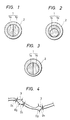
- reference numeral 1 is a core portion (hereinafter simply referred to as the core) of the side-by-side type composite structure comprising core-dividing zones 1a and 1b each consisting of a core component of a different polypropylene base polymer.
- the side-by-side type composite structure of the core 1 may take on various forms.
- the, core 1 may be of the sectional structure which is diametrically divided into two identical semi-circles, as illustrated in Figure 1.
- the core 1 may be of the sectional structure in which one core-dividing zone 1a is mostly surrounded with the other core-dividing zone 1b, except for its slight peripheral portion, as illustrated in Figure 2.
- the core actually assumes a structure lying between the aforesaid extreme structures.
- the core 1 may be located off the center in section of the fiber, as illustrated in Figure 3.
- Polypropylene base polymers which are represented by crystalline polypropylene, may include copolymers of propylene with a small amount of other alpha-olefins save propylene, such as ethylene, butene-1 or pentene-1. In this case, it is preferred that the comonomer component content is up to 40 % by weight.
- the core component of one core-dividing zone 1a (which may hereinafter be simply referred to as the component 1a) has a Q value of at least 6, and to the component 1a the general-purpose polypropylene is applied, while the core component of the other core-dividing zone 1b (which may hereinafter be referred to as the component 1b) has a Q value of up to 5, preferably 3 to 5.
- the composite ratio of the core components 1a and 1b forming the core 1 is in a range of 1:2 to 2:1.
- the side-by-side type composite structure of the core 1 comprising the components 1a and 1b having different Q values imparts to the composite fibers the crimps revealed after fiber-manufacturing process and in addition the crimps developed in processing from latent crimps by heating, resulting in an increase in bulkiness.
- Reference numeral 2 is a sheath portion (hereinafter simply called the sheath) which is formed of a sheath component of a polyethylene base polymer, the melting point of which is lower by at least 20°C than the lower one of the melting points of the two core components of the core 1, viz., the components 1a and 1b (or the melting point common to the components 1a and 1b, if there is no difference in the melting point therebetween).
- a polyethylene, base polymer may include polyethylene or a copolymer of ethylene/vinyl acetate, having an ethylene content of 98 to 60 % by weight. That polyethylene is exemplified by a low-, intermediate- or high-density polyethylene.
- the sheath-core type composite fibers of the present invention are constituted by covering the core 1 with the sheath 2 in such a manner that the proportion of the sheath 2 is in a range of 25 to 55 % by weight based on the total weight of it and the core 1.
- the proportion of the sheath 2 is below 25 % by weight, the strength of the resulting nonwoven fabric decreases to such a low level that some problems arise practically.
- the development of crimps due to the core 1 is inhibited so that the composite fibers are insufficiently crimped and the resulting nonwoven fabrics are inferior in bulkiness.
- the sheath 2 is of polyethylene base polymer of a low melting point, thus the adhesion portion between fibers can be formed by heat treatment as in the case of the conventional heat-adhesive composite fiber.
- a nonwoven fabric product obtained from the heat-adhesive composite fibers constituted by it together with the core 1 may have a sufficient bulkiness and show an excellent touch or feeling.
- the following structure which is obtained by the method described later may impart a much softer touch or feeling to the nonwoven fabric product.
- the structure is that there are many portions on the sheath 2 which form a number of nodular aggregates 3 consisting of the sheath component by a heat treatment at a temperature between the melting point of the sheath component and the lower one of the melting points of the two core components 1a and 1b (the portions may hereinafter be called the aggregatable portions).
- the sheath 2 is released from the core 1, or is latently released from the core 1 due to their feeble interface affinity.
- the aggregatable portions are distinguishable from the other portion, depending upon whether or not the nodular aggregates 3 consisting of the sheath component are formed by the heat treatment at the aforesaid temperature, as illustrated in Figure 4.
- a diameter (D2) of the greatest portion of the nodular aggregate 3 is about two times the diameter (D1) of the thinnest portion adjacent thereto. Per one centimeter of the actual length of fiber, there are formed 0.1 to 0.5 nodular aggregates 3 having such a diameter (D2).
- D2 the proportion of the sheath 2 exceeds 55 % by weight of the total weight of it and the core 1, the formation of the aggregates 3 is not sufficient and, hence, makes no contribution to improvements in the touch or feeling of nonwoven fabrics.
- the heat-adhesive composite fibers according to the present invention are constructed as mentioned above.
- the polypropylene base polymer for the component 1a having a Q value of at least 6 should preferably show a melt flow rate (hereinafter sometimes abbreviated as MFR and measured according to Table 1, Condition 14 provided by JIS K 7210) of 4 to 40, and the polypropylene base polymer for the component 1b having a Q value of 5 or less should preferably show a melt flow rate of 4 to 60.
- Polypropylene base polymers having a Q value of 5 or less may be prepared by the following methods, using polypropylene base polymers having a Q value of more than 5 as the starting material.
- added to and mixed with the starting polymer is an organic peroxide compound in an amount of 0.01 to 1.0 % by weight based on the starting polymer, said organic peroxide compound releases oxygen by heating at a temperature equal to or higher than the melting point of the starting polymer, such as t-butyl hydroperoxide, cumene hydroperoxide or 2,5-dimethylhexane-2,5-dihydroperoxide etc., and the resulting mixture is subjected to melting extrusion from an extruder for granulation.
- the starting polymer may be subjected to melting extrusion several times at elevated temperatures, with no addition of the aforesaid organic peroxide compound, for repeated granulation. Since the Q value is decreased a little by melting extrusion, the polymer for the component 1a before melt spinning should preferably have a Q value of slightly higher than 6, while the polymer for the component 1b may have a Q value of slightly higher than 5.
- the polyethylene base polymer should preferably have a melt index (hereinafter sometimes abbrebiated as MI and measured according to Table 1, Condition 4 provided by JIS K 7210) of 2 to 50.
- the aforesaid three polymers After the aforesaid three polymers have been provided, they are separately supplied to the respective three extruders for melting extrusion, and the obtained molten polymers are guided to a known appropriate composite spinning nozzle by way of the respective gear pumps.
- a spinning nozzle as disclosed in Japanese Patent Publication No. 44-29522 may be used as the known composite spinning nozzle capable of spinning out three polymer components into a sectional structure similar to that of the heat-adhesive composite fiber according to the present invention.
- the outputs of the respective gear pumps are regulated in such a manner that the ratio of the amounts of the polymers for the core components 1a and 1b is a given composite ratio within the range of 2:1 to 1:2, and the amount of the polymer for the sheath component is a given one within the range of 25 to 55 % by weight based on the total amount of it and the core components.
- nonstretched composite yarns of the given sectional shape are stretched in a single or multi-stage manner.
- the multi-stage stretching be carried out under the condition that the first-stage stretching temperature is lower than the second-stage stretching temperature, and that the single-stage stretching be effected at normal temperature (15 to 40°C) or a relatively low temperature close thereto. Since stretching is usually accompanied by the generation of heat, the single-stage stretching or the first-stage stretching of the multi-stage stretching is preferably carried out while passing the yarns through the water maintained at normal temperature, or in a room maintained at normal temperature by cooling water.
- the stretching has to be effected by somewhat complicated steps as mentioned below.
- the composite nonstretched yarns Prior to stretching, the composite nonstretched yarns are firstly heat-treated under no tension at a temperature ranging from 80°C to below the melting point of the sheath component for 10 seconds or longer, preferably for 12 to 180 seconds. This heat treatment promotes the crystallization of the two core components 1a and 1b, and decreases the interface affinity of the sheath 2 with respect to the core 1.
- the yarns may be continuously passed through a dry heat oven or hot water, or batchwise treated in a large dryer.
- the heat-treated nonstretched yarns are cooled down to normal temperature (15 to 40°C), and the first-stage stretching is then carried out at that normal temperature in a draw ratio of 1.3 to 2, preferably 1.5 to 1.8.
- the first-stage stretching promotes a reduction in the interface affinity between the sheath 2 and the core 1. In consequence, the sheath 2 is actually or latently released from the core 1 at their interface to produce a number of the aggregatable proportions.
- a draw ratio exceeding 2 at the first-stretching stage offers problems such as fuzzing, a drop in fiber strength and an increase in the degree of shrinkage of the resulting nonwoven fabric, whilst a draw ratio of less than 1.3 renders it difficult to obtain the effect as contemplated in the present invention.
- the second-stage streching is carried out, without relaxing the yarn between the first-stage and second-stage stretching, at a temperature of 80°C or higher and below the melting point of the sheath component.
- the draw ratio should be equal to or higher than 90 % of the maximum draw ratio (at which the yarn drawn in the first-stage stretching begins to snap off by increasing the draw ratio gradually in the second-stage stretching).
- the second-stage stretching carried out at the temperature and draw ratio gives rise to three-dimensional crimping, by which the fiber strength is increased, the degree of shrinkage and bulkiness of the resulting nonwoven fabric are decreased and increased, respectively, and the formation of the aforesaid aggregatable portions is further promoted.
- the nonstretched yarns prepared in the following manner are used. That is, when composite spinning is carried out with three polymers, a chemical agent for reducing the interface affinity (which may hereinafter be called the affinity-reducing agent) is added to these polymers. More exactly, the affinity-reducing agent is added to both polypropylene base polymers for the two core components, or to the polyethylene base polymer for the sheath component, or to both polymers for two core components and the sheath component.
- the affinity-reducing agent is added to both polypropylene base polymers for the two core components, or to the polyethylene base polymer for the sheath component, or to both polymers for two core components and the sheath component.
- affinity-reducing agents effective use is made of polysiloxanes such as polydimethylsiloxane, phenyl-modified polysiloxane, amino-modified polysiloxane, olefin-modified polysiloxane, hydroxide-modified polysiloxane and epoxy-modified polysiloxane, and fluorine compounds such as perfluroloalkyl group-containing polymers, perfluoroalkylene group-containing polymers and modified products of these polymers.
- the affinity-reducing agent is added to each pertinent polymer in an amount of 0.05 to 1.0 % by weight based thereon.
- the heat-adhesive composite fibers can then be made, while further promoting the formation of the aggregatable portions.
- the stretched yarns are dried, as the occasion may be, and may immediately be used, or may be cut to a given length for the purpose intended.
- the treatments of nonstretched yarns such as heating, cooling and stretching after spinning should preferably be carried out usually with nonstretched yarn bundles formed into a tow of several ten thousand to several million deniers. It is also preferred that such a tow is subjected to the given treatments such as heating, cooling and stretching, while passing it continuously therethrough or moving it therethrough at a low speed in an assembled state, without cutting-off of said tow to short fibers, if possible.
- the treatments such as heating may be carried out in a batchwise manner, as already mentioned.
- the heat-adhesive composite fibers according to the present invention are obtained by carrying out the second aspect of the present invention, as mentioned above.
- the heat-adhesive composite fibers according to the present invention are of the composite structure wherein the core of the side-by-side type composite structure, for which two polypropylene base polymer having different Q values are used, is covered with the, sheath of the polyethylene base polymer having a melting point lower than those of the polymers forming the core components. Accordingly, although the heat-adhesive composite fibers according to the prersent invention are of the sheath-core structure which is generally recognized to show a reduced or limited development of crimps, the revealed crimps and latent crimps developed by heating are very large and take on a moderate three-dimensional shape, due to the core being of side-by-side structure.
- the composite fiber possesses sufficient heat adhesiveness of the sheath which makes it easy to prepare bulky nonwoven fabrics of large bulk and stabilized structure by heating.
- the sheath additionally includes many aggregatable portions, such portions are molten and aggregated by heating on the fiber surfaces, and are then solidified to give a number of nodular aggregates 3 consisting of the sheath component, which imparts high softness to the touch or feeling of nonwoven fabrics. The reasons appear to be that the area of contact of the fiber surfaces is reduced to a remarkable degree, since the nodular aggregate 3 come into point contact with the surface of the adjacent fibers.
- the heat-adhesive composite fibers according to the present invention further improve the bulkiness and touch or feeling of nonwoven fabrics obtained therefrom, which have been problems in the prior art.
- Example 2 however, 0.10 % by weight of dimethylpolysiloxane was mixed with high-density polyethylene i.
- the spinning nozzle used had 120 holes each of 1.0 mm in diameter.
- the components 1a and 1b forming the core were used in a composite ratio of 1:1, whilst the proportion of the sheath to the total amount of the core plus sheath was varied in a range of 33.3 to 66.7 % by weight.
- the spinning temperature the Polymer temperature just prior to spinning out from the spinning nozzle
- the polypropylenes for both components 1a and 1b and the polyethylene base polymer were spinned at 260°C and 220°C, respectively.
- composite nonstretched yarns of 12.1 dtex/f (11 d/f (deniers per filament)] were obtained.
- the composite nonstretched yarns were bundled into a tow of about 99 000 dtex (90,000 deniers), which was successively treated in the following manner.
- the tow was heated by passing it under no tension through a dry heat chamber of 105°C for 30 seconds. (However, any heat treatment was not applied in Comparative Examples 1, 2, 3, 10 and 12.). Thereafter, the tow was allowed to stand in a tow can to completely cool it down to room temperature (22°C). Then, the tow was passed through a bath of 21°C containing 0.2 % of a surface finishing agent, and was subjected to a double-stage stretching. For stretching, three-stage rolls were used.
- a single-stage stretching is carried out by passing the tow through the first and second stretching rolls if it is done, whilst the double-stage stretching was done by passing the tow through the third stretching roll following the same first-stage stretching as the above-mentioned single stage stretching.
- the first-stage stretching temperature (identical with the stretching temperature in the case of the single-stage stretching) is defined as being identical with the temperature of the first stretching roll
- the second-stage stretching temperature is defined as being identical with the temperature of the second stretching roll.
- Each starting polypropylene was modified by adding thereto 2,5-dimethyl-2,5-di(tertiary-butyloxy)hexane and extruding the product out of an extruder for granulation.
- the starting polypropylenes c, d, e, f and h had MFRs of 6, 4, 6, 18 and 4, respectively.
- the above mentioned tow was subjected to the first-stage stretching between a pair of cold stretching rolls of 26°C (but of 60°C in Comparative Example 7 and of 90°C in Comparative Examples 9 and 10) at a draw ratio of 1.6.
- the tow stretched at first-stage was transferred successively to the subsequent second-stage stretching process without letting it loose, and the tow was stretched between a pair of stretching rolls heated at 90°C (but at different temperatures in Comparative Examples 5, 6 and 7) at the draw ratios corresponing to various per cents of various maximum draw ratios in the second-stage stretching, as specified in Table 2, and was thereafter cooled down to room temperature.
- each heat-adhesive composite fiber was used in the amount of 100 % and heated into a nonwoven fabric, the bulkiness and touch or feeling of which were then tested.
- a group of fibers are passed twice through a carding machine to make a web of 100 g/m2, from which five 25 cm ⁇ 25 cm square web pieces were cut. Each web piece was put between craft paper sheets, and the assembly was placed in a hot-air circulation type dryer of 145°C for 5 minutes to make a nonwoven fabric, which was in turn cooled at room temperature.
- Each nonwoven fabric was cut into 20 cm ⁇ 20 cm pieces. Such five pieces were formed into a stack on which a cardboard was placed, and the thickness of one nonwoven fabric was calculated from the overall thickness of the stack to find the value in mm for bulkiness.
- Example 7 and 8 From the comparison of Example 7 and 8 with Comparative Example 12 in particular, it is found that, the composite fibers obtained by applying the heat treatment to be effected prior to stretching of the composite nonstretched yarns are more excellent in the aggregatability and then in the touch or feeling of the resulting nonwoven fabrics, than ones obtained without said heat treatment. Accordingly, it is found that the heat treatment of the composite nonstretched yarns takes great part in the aggregatability.
- the heat-adhesive composite fiber obtained in Example 4 was cut to a length of 64 mm, and was mixed with rayon of 2,2 dtex x 51 (2d x 51) mm in the proportions set forth in Table 3.
- Nonwoven fabrics of about 100 g/m 2 were made substantially according to the procedures for testing the aforesaid "Bulkiness of Nonwoven Fabric", and were then tested in respect of the bulkiness and touch or feeling and measured in terms of the strength and elongation.
- the reference nonwoven fabric for the estimation of touch or feeling was obtained from 30 % by weight of the composite fibers obtained in Comparison Example 10 and 70 % by weight of rayon in a similar manner.
- test pieces of 20 cm ⁇ 5 cm are cut out of the nonwoven fabric in such a manner that their sides of 20 cm lie along the flow direction on a carding machine.
- the breaking strength and elongation of the five test pieces are found with a tensile strength tester at a grab space of 100 mm and a drawing speed of 100 mm/min., and the measurements were averaged.
Landscapes
- Chemical & Material Sciences (AREA)
- Chemical Kinetics & Catalysis (AREA)
- General Chemical & Material Sciences (AREA)
- Engineering & Computer Science (AREA)
- Textile Engineering (AREA)
- Multicomponent Fibers (AREA)
- Nonwoven Fabrics (AREA)
- Spinning Methods And Devices For Manufacturing Artificial Fibers (AREA)
Claims (9)
- Fibre composite thermocollante, comprenant une partie formant noyau et une partie formant gaine,
ladite partie formant noyau étant formée par une structure composite du type côte-à-côte, comprenant deux constituants du noyau formés de polymères différents dans un rapport de composition compris entre 1:2 et 2:1, et
ladite partie formant gaine comprenant un constituant formé d'un polymère à base de polyéthylène et possédant un point de fusion inférieur d'au moins 20°C au plus faible des deux points de fusion desdits deux constituants du noyau, et recouvrant entièrement ladite partie du noyau, dans une proportion de 25 à 55 % en poids sur la base du poids total de cette partie formant gaine et de ladite partie formant noyau,
caractérisée en ce que
lesdits polymères différents de la partie formant noyau sont constitués par différents polymères à base de polypropylène, dont l'un possède une valeur Q, exprimée en termes de poids moléculaire moyen en poids/poids moléculaire en moyenne numérique, égal ou supérieur à 6, tandis que l'autre possède une valeur Q égale ou inférieure à 5, et ladite partie formant gaine possède un nombre de parties pouvant être agrégées, en étant libérables au moins de façon latente et qui forment de nombreux agrégats modulaires sous l'effet d'un traitement thermique à une température supérieure au point de fusion dudit constituant de la gaine, mais inférieure au plus bas des points de fusion desdits deux constituants du noyau,
les parties susceptibles d'être agrégées pouvant être obtenues par le fait qu'on les soumet séparément à un filage composite desdits deux polymères à base de polypropylène pour les deux constituants du noyau et ledit polymère à base de polyéthylène pour un constituant de la gaine, ce qui permet d'obtenir un fil composite non étiré de ladite structure dans laquelle une partie du noyau de la structure composite du type côte-à-côte est recouverte entièrement par une partie formant gaine, puis de chauffer ledit fil composite non étiré en l'absence de traction à une température comprise entre 80°C et une valeur inférieure au point de fusion dudit constituant de la gaine pendant 10 secondes ou plus longtemps et de la refroidir jusqu'à 15 à 40°C, puis
soumettre le fil composite refroidi non étiré à une première étape d'étirage à une température comprise entre 15 et 40°C avec un rapport d'étirage compris entre 1,3 et 2, et ensuite, sans laisser le fil devenir lâche, le soumettre à la seconde étape d'étirage à une température comprise entre 80°C et une valeur inférieure au point de fusion dudit constituant de la gaine et avec un rapport d'étirage d'au moins 90 % du rapport d'étirage maximum (avec lequel le fil est tiré lors de la première étape d'étirage commence à se détendre sous l'effet d'un accroissement graduel du rapport d'étirage lors de la seconde étape d'étirage). - Fibre composite thermocollante selon la revendication 1, caractérisée en ce que ledit polymère à base de polypropylène d'au moins l'un desdits deux constituants du noyau est du propylène.
- Fibre composite thermocollante selon la revendication 1, caractérisée en ce que ledit polymère à base de polypropylène d'au moins l'un desdits deux constituants du noyau est un copolymère de polypropylène avec une faible quantité d'une α-oléfine, hormis le propylène.
- Fibre composite thermocollante selon l'une quelconque des revendications 1 à 3, caractérisée en ce que ledit polymère à base de polyéthylène du second constituant de la gaine est du polyéthylène.
- Fibre composite thermocollante selon l'une quelconque des revendications 1 à 3, caractérisée en ce que ledit polymère à base de polyéthylène du constituant de la gaine est un copolymère éthylène-acétate de vinyle possédant une teneur en éthylène comprise entre 98 et 60 % en poids.
- Fibre composite thermocollante selon l'une quelconque des revendications 1 à 5, selon lequel on soumet séparément à un filage composite, un polymère à base de polypropylène pour un constituant du noyau et un polymère à base de polyéthyléne pour un constituant de la gaine, qui possède un point de fusion inférieur d'au moins 20°C au point de fusion dudit polymère à base de polypropylène, de manière à obtenir un fil composite non étiré, dans lequel une partie formant noyau est recouverte entièrement par une partie formant gaine, ledit constituant de la gaine étant présent en un pourcentage de 25 à 55 % en poids sur la base du poids de ladite partie formant gaine et de ladite partie formant noyau, et on étire ledit fil composite non étiré au moyen d'un processus d'étirage en deux étapes,
caractérisée en ce
qu'on soumet les deux polymères à base de polypropylène à un filage composite pour deux constituants du noyau afin de former ladite partie formant noyau sous la forme d'une structure composite du type côte-à-côte, constituée par lesdits deux constituants du noyau dans un rapport composite compris entre 1:2 et 2:1, l'un desdits constituants possédant une valeur Q exprimée sous la forme du poids moléculaire moyen en poids/poids moléculaire en moyenne numérique égale ou supérieure à 6 et l'autre desdits constituants possédant une valeur Q égale ou inférieure à 5, et ledit point de fusion dudit polymère à base de polyéthylène pour le constituant de la gaine est inférieur, de ladite température, au plus bas des points de fusion desdits deux polymères à base de polypropylène, et, lors de ladite étape de filage composite, au moins un élément choisi parmi des polysiloxanes et des composés du fluor est ajouté aux deux polymères à base de polypropylène pour les deux constituants du noyau ou au polymère à base de polyéthylène pour le constituant de la gaine, ou aux deux polymères pour les deux constituants du noyau et le constituant de la gaine, chacun en une quantité comprise entre 0,05 et 1,0 % en poids sur la base dudit polymère concerné,
ceci étant suivi par un filage composite, tandis qu'avant l'étirage dudit fil composite non étiré, on chauffe ledit fil composite non étiré, sans l'application d'aucune traction, à une température comprise entre 80°C et une valeur inférieure au point de fusion dudit constituant de la gaine pendant 10 secondes ou plus et on le refroidit à une température comprise entre 15 et 40°C, puis on le soumet à la première étape d'étirage à une température comprise entre 15 et 40°C et avec un rapport d'étirage compris entre 1,3 et 2, et, sans laisser le fil prendre un état lâche, on le soumet ensuite à la seconde étape d'étirage à une température comprise entre 80°C et une valeur inférieure au point de fusion du type constituant la gaine et avec un rapport d'étirage égal au moins à 90 % du rapport d'étirage maximum de la seconde étape d'étirage (rapport d'étirage maximum pour lequel le fil tiré lors de la première étape d'étirage commence à se détendre sous l'effet de l'accroissement graduel du rapport d'étirage dans la seconde étape d'étirage). - Procédé selon la revendication 6, selon lequel on étire ledit fil composite non étiré, à une température d'étirage comprise entre 15° et 130°C inclusivement et avec un rapport d'étirage global compris entre 1,3 et 9.
- Procédé selon l'une quelconque des revendications 6 et 7, caractérisé en ce qu'on utilise un polymère à base de polypropylène ayant un indice de fluidité compris entre 4 et 40, en tant que polymère à base de polypropylène pour ledit constituant du noyau possédant une valeur Q égale à 6 ou plus.
- Procédé selon l'une quelconque des revendications 6 à 8, selon lequel on utilise un polymère à base de polypropylène possédant un indice de fluidité compris entre 4 et 60, en tant que polymère à base de polypropylène pour ledit constituant du noyau possédant une valeur Q égale à 5 ou moins.
Applications Claiming Priority (2)
| Application Number | Priority Date | Filing Date | Title |
|---|---|---|---|
| JP214145/86 | 1986-09-12 | ||
| JP61214145A JPH0819570B2 (ja) | 1986-09-12 | 1986-09-12 | 熱接着性複合繊維及びその製造方法 |
Publications (3)
| Publication Number | Publication Date |
|---|---|
| EP0260607A2 EP0260607A2 (fr) | 1988-03-23 |
| EP0260607A3 EP0260607A3 (en) | 1989-11-23 |
| EP0260607B1 true EP0260607B1 (fr) | 1993-11-10 |
Family
ID=16650972
Family Applications (1)
| Application Number | Title | Priority Date | Filing Date |
|---|---|---|---|
| EP87113267A Expired - Lifetime EP0260607B1 (fr) | 1986-09-12 | 1987-09-10 | Fibres composées thermocollantes et leur méthode de fabrication |
Country Status (6)
| Country | Link |
|---|---|
| US (1) | US4840846A (fr) |
| EP (1) | EP0260607B1 (fr) |
| JP (1) | JPH0819570B2 (fr) |
| KR (1) | KR940008076B1 (fr) |
| DE (1) | DE3788098T2 (fr) |
| DK (2) | DK161603C (fr) |
Families Citing this family (40)
| Publication number | Priority date | Publication date | Assignee | Title |
|---|---|---|---|---|
| DK245488D0 (da) * | 1988-05-05 | 1988-05-05 | Danaklon As | Syntetisk fiber samt fremgangsmaade til fremstilling deraf |
| IN171869B (fr) * | 1988-10-24 | 1993-01-30 | Du Pont | |
| FI112252B (fi) * | 1990-02-05 | 2003-11-14 | Fibervisions L P | Korkealämpötilasietoisia kuitusidoksia |
| ATE178666T1 (de) * | 1992-01-13 | 1999-04-15 | Hercules Inc | Wärmeverbindbare fasern für wiederstandsfähige vliesstoffe |
| US5556677A (en) * | 1994-01-07 | 1996-09-17 | Composite Development Corporation | Composite shaft structure and manufacture |
| US5549947A (en) * | 1994-01-07 | 1996-08-27 | Composite Development Corporation | Composite shaft structure and manufacture |
| US5437899A (en) * | 1992-07-14 | 1995-08-01 | Composite Development Corporation | Structural element formed of a fiber reinforced thermoplastic material and method of manufacture |
| US5382400A (en) | 1992-08-21 | 1995-01-17 | Kimberly-Clark Corporation | Nonwoven multicomponent polymeric fabric and method for making same |
| US5405682A (en) * | 1992-08-26 | 1995-04-11 | Kimberly Clark Corporation | Nonwoven fabric made with multicomponent polymeric strands including a blend of polyolefin and elastomeric thermoplastic material |
| US5336552A (en) | 1992-08-26 | 1994-08-09 | Kimberly-Clark Corporation | Nonwoven fabric made with multicomponent polymeric strands including a blend of polyolefin and ethylene alkyl acrylate copolymer |
| CA2092604A1 (fr) | 1992-11-12 | 1994-05-13 | Richard Swee-Chye Yeo | Fils polymeres hydrophiles composites; non-tisses obtenus avec ces fils |
| US5482772A (en) | 1992-12-28 | 1996-01-09 | Kimberly-Clark Corporation | Polymeric strands including a propylene polymer composition and nonwoven fabric and articles made therewith |
| SG50447A1 (en) * | 1993-06-24 | 1998-07-20 | Hercules Inc | Skin-core high thermal bond strength fiber on melt spin system |
| DE4330725A1 (de) | 1993-09-10 | 1995-03-16 | Bayer Ag | Verfahren zur Herstellung von Elastanfasern durch Einspinnen einer Kombination von PDMS und ethoxyliertem PDMS |
| US5888601A (en) * | 1994-01-07 | 1999-03-30 | Composite Development Corporation | Composite tubular member having consistent strength |
| WO1995030532A1 (fr) * | 1994-05-04 | 1995-11-16 | Composite Development Corporation | Structure et procede de fabrication d'un element composite courbe, tres resistant et tres rigide |
| JPH0874128A (ja) * | 1994-07-04 | 1996-03-19 | Chisso Corp | 熱融着性複合繊維およびその繊維を用いた不織布 |
| US5798305A (en) * | 1994-07-04 | 1998-08-25 | Chisso Corporation | Hot-melt-adhesive conjugate fibers and a non-woven fabric using the fibers |
| DK0719879T3 (da) * | 1994-12-19 | 2000-09-18 | Fibervisions L P | Fremgangsmåde til fremstilling af fibre til ikke-vævede materialer af høj styrke og de resulterende fibre og ikke-vævede ma |
| US6352948B1 (en) | 1995-06-07 | 2002-03-05 | Kimberly-Clark Worldwide, Inc. | Fine fiber composite web laminates |
| US5985193A (en) * | 1996-03-29 | 1999-11-16 | Fiberco., Inc. | Process of making polypropylene fibers |
| BR9708409A (pt) | 1996-03-29 | 1999-08-03 | Hercules Inc | Fibras de polipropileno e intens fabricados a partir das mesmas |
| US6410138B2 (en) | 1997-09-30 | 2002-06-25 | Kimberly-Clark Worldwide, Inc. | Crimped multicomponent filaments and spunbond webs made therefrom |
| US5876840A (en) * | 1997-09-30 | 1999-03-02 | Kimberly-Clark Worldwide, Inc. | Crimp enhancement additive for multicomponent filaments |
| IL133593A0 (en) * | 1999-12-19 | 2001-07-24 | A P S Advanced Pneumatic Struc | Combined structural element |
| AU774541B2 (en) | 1999-12-21 | 2004-07-01 | Kimberly-Clark Worldwide, Inc. | Fine denier multicomponent fibers |
| US6465094B1 (en) | 2000-09-21 | 2002-10-15 | Fiber Innovation Technology, Inc. | Composite fiber construction |
| EP1519664A1 (fr) * | 2002-06-27 | 2005-04-06 | Koninklijke Philips Electronics N.V. | Filament indicateur d'usure |
| HU2762U (en) * | 2002-12-20 | 2004-06-28 | Procter & Gamble | Disposable absorbent article |
| TW200934897A (en) * | 2007-12-14 | 2009-08-16 | Es Fiber Visions Co Ltd | Conjugate fiber having low-temperature processability, nonwoven fabric and formed article using the conjugate fiber |
| WO2009079315A2 (fr) | 2007-12-14 | 2009-06-25 | 3M Innovative Properties Company | Agrégat de fibres |
| WO2009079233A2 (fr) | 2007-12-14 | 2009-06-25 | 3M Innovative Properties Company | Matières solides et utilisations |
| CA2708220C (fr) | 2007-12-14 | 2016-04-12 | 3M Innovative Properties Company | Procedes de traitement de puits souterrains a l'aide d'additifs modifiables |
| CN104451926B (zh) * | 2014-12-23 | 2016-11-30 | 浙江依爱夫游戏装文化产业有限公司 | 复合抗菌纤维 |
| CN106283221B (zh) * | 2016-11-15 | 2018-12-14 | 上海理工大学 | 一种一鞘双芯微流体控制喷头、纺丝装置及纺丝方法 |
| CN106757417B (zh) * | 2016-12-08 | 2018-12-14 | 上海理工大学 | 一种同芯并列异鞘微流体控制喷头、纺丝装置及纺丝方法 |
| US20190104790A1 (en) * | 2017-10-11 | 2019-04-11 | Kai-Hsi Tseng | Reinforcement fiber for protection products |
| CN108004603B (zh) * | 2018-01-16 | 2019-11-26 | 东华大学 | 防切割聚乙烯复合纤维及其制备方法 |
| CN108893789B (zh) * | 2018-08-31 | 2024-04-30 | 宁波建嵘科技有限公司 | 一种纤维状锂离子电池的喷丝装置 |
| KR102486793B1 (ko) * | 2021-04-15 | 2023-01-10 | 에쓰대시오일 주식회사 | 고온 인장 시험기의 다단 연신을 이용한 폴리올레핀계 모노필라멘트 원사의 제조방법, 이에 의해 제조된 폴리올레핀계 모노필라멘트 원사 및 상기 폴리올레핀계 모노필라멘트 원사의 물성 예측방법 |
Family Cites Families (10)
| Publication number | Priority date | Publication date | Assignee | Title |
|---|---|---|---|---|
| GB1121314A (en) * | 1965-04-21 | 1968-07-24 | Mitsubishi Rayon Co | Polypropylene composite filaments and method for producing the same |
| US3900678A (en) * | 1965-10-23 | 1975-08-19 | Asahi Chemical Ind | Composite filaments and process for the production thereof |
| GB1173817A (en) * | 1966-05-28 | 1969-12-10 | Asahi Chemical Ind | Manufacture of Conjugated Sheath-Core Type Composite Fibres |
| US3509013A (en) * | 1966-09-26 | 1970-04-28 | Hercules Inc | Composite polypropylene filament |
| US4189338A (en) * | 1972-11-25 | 1980-02-19 | Chisso Corporation | Method of forming autogenously bonded non-woven fabric comprising bi-component fibers |
| NZ185412A (en) * | 1976-10-20 | 1980-03-05 | Chisso Corp | Heat-adhesive compsite fibres based on propylene |
| JPS53147816A (en) * | 1977-05-24 | 1978-12-22 | Chisso Corp | Hot-melt fiber of polypropylene |
| JPS5823951A (ja) * | 1981-07-31 | 1983-02-12 | チッソ株式会社 | 嵩高不織布の製造方法 |
| JPS6021908A (ja) * | 1983-07-14 | 1985-02-04 | Chisso Corp | 複合モノフイラメントの製造法 |
| DE3544523A1 (de) * | 1984-12-21 | 1986-06-26 | Barmag Barmer Maschinenfabrik Ag, 5630 Remscheid | Verfahren zur herstellung von bikomponentenfasern, daraus hergestellte fasern und deren verwendung |
-
1986
- 1986-09-12 JP JP61214145A patent/JPH0819570B2/ja not_active Expired - Lifetime
-
1987
- 1987-09-10 US US07/094,891 patent/US4840846A/en not_active Expired - Lifetime
- 1987-09-10 DE DE87113267T patent/DE3788098T2/de not_active Expired - Fee Related
- 1987-09-10 EP EP87113267A patent/EP0260607B1/fr not_active Expired - Lifetime
- 1987-09-11 KR KR1019870010107A patent/KR940008076B1/ko not_active Expired - Fee Related
- 1987-09-11 DK DK474287A patent/DK161603C/da not_active IP Right Cessation
-
1991
- 1991-03-25 DK DK053491A patent/DK170381B1/da not_active IP Right Cessation
Also Published As
| Publication number | Publication date |
|---|---|
| DK474287D0 (da) | 1987-09-11 |
| EP0260607A3 (en) | 1989-11-23 |
| JPS6375115A (ja) | 1988-04-05 |
| DK161603B (da) | 1991-07-22 |
| KR880004157A (ko) | 1988-06-02 |
| DK170381B1 (da) | 1995-08-14 |
| EP0260607A2 (fr) | 1988-03-23 |
| US4840846A (en) | 1989-06-20 |
| DK161603C (da) | 1992-01-06 |
| DK53491A (da) | 1991-03-25 |
| DK474287A (da) | 1988-03-13 |
| KR940008076B1 (ko) | 1994-09-01 |
| DE3788098T2 (de) | 1994-03-03 |
| DK53491D0 (da) | 1991-03-25 |
| DE3788098D1 (de) | 1993-12-16 |
| JPH0819570B2 (ja) | 1996-02-28 |
Similar Documents
| Publication | Publication Date | Title |
|---|---|---|
| EP0260607B1 (fr) | Fibres composées thermocollantes et leur méthode de fabrication | |
| US4818587A (en) | Nonwoven fabrics and method for producing them | |
| EP0264112B1 (fr) | Etoffes non tissées et procédé pour les fabriquer | |
| US5993714A (en) | Method of making low density microfiber nonwoven fabric | |
| EP1727926B1 (fr) | Fibres et bandes conjuguees extensibles et elastiques non collantes au toucher | |
| DE3315360C2 (de) | Schmelzklebende Fasern aus Polyethylen und deren Verwendung in Verbundfasern | |
| DE69935912T2 (de) | Artikel mit elastizität bei hoher temperatur hergestellt aus bestrahlten und vernetzten ethylenpolymeren und verfahren zu ihrer herstellung | |
| CN1331766A (zh) | 卷曲多组分纤维及其制造方法 | |
| DE60100458T2 (de) | Polypropylenfasern | |
| EP0685579A2 (fr) | Fibres conjuguées avec haute capacité de frisage et tissus non-tissés produits à partir de celles-ci | |
| EP1041180A1 (fr) | Fibres de polypropylène | |
| JP6587568B2 (ja) | 潜在捲縮性複合繊維とその製造方法、および繊維集合物、ならびに不織布 | |
| EP1126054A1 (fr) | Fibres de polypropylène | |
| EP0758027A1 (fr) | Fil continu en polyester, son procede de production, articles tisses et tricotes a partir dudit fil continu, et procede de production desdits articles | |
| JP4379127B2 (ja) | 熱接着性複合繊維、その製造方法及び該複合繊維を用いた繊維成形体 | |
| KR20130008477A (ko) | 신축성 부직포 및 그 제조 방법 | |
| JP4081338B2 (ja) | ポリプロピレン系流体撹乱加工繊維及びその製造方法 | |
| JPH0160577B2 (fr) | ||
| JPH07216653A (ja) | ポリプロピレン系高捲縮性フィラメント糸及びその製造法 | |
| JPH026850B2 (fr) | ||
| JP2936304B2 (ja) | ポリプロピレン系異収縮混繊糸及びその製造方法 | |
| JP2916985B2 (ja) | ポリプロピレン系嵩高性複合糸及びその製造方法 |
Legal Events
| Date | Code | Title | Description |
|---|---|---|---|
| PUAI | Public reference made under article 153(3) epc to a published international application that has entered the european phase |
Free format text: ORIGINAL CODE: 0009012 |
|
| AK | Designated contracting states |
Kind code of ref document: A2 Designated state(s): DE FR GB IT |
|
| PUAL | Search report despatched |
Free format text: ORIGINAL CODE: 0009013 |
|
| RHK1 | Main classification (correction) |
Ipc: D01F 8/04 |
|
| AK | Designated contracting states |
Kind code of ref document: A3 Designated state(s): DE FR GB IT |
|
| 17P | Request for examination filed |
Effective date: 19900306 |
|
| 17Q | First examination report despatched |
Effective date: 19911022 |
|
| GRAA | (expected) grant |
Free format text: ORIGINAL CODE: 0009210 |
|
| AK | Designated contracting states |
Kind code of ref document: B1 Designated state(s): DE FR GB IT |
|
| REF | Corresponds to: |
Ref document number: 3788098 Country of ref document: DE Date of ref document: 19931216 |
|
| ITF | It: translation for a ep patent filed | ||
| ET | Fr: translation filed | ||
| PLBE | No opposition filed within time limit |
Free format text: ORIGINAL CODE: 0009261 |
|
| STAA | Information on the status of an ep patent application or granted ep patent |
Free format text: STATUS: NO OPPOSITION FILED WITHIN TIME LIMIT |
|
| 26N | No opposition filed | ||
| REG | Reference to a national code |
Ref country code: GB Ref legal event code: IF02 |
|
| PGFP | Annual fee paid to national office [announced via postgrant information from national office to epo] |
Ref country code: FR Payment date: 20030909 Year of fee payment: 17 |
|
| PGFP | Annual fee paid to national office [announced via postgrant information from national office to epo] |
Ref country code: GB Payment date: 20030910 Year of fee payment: 17 |
|
| PGFP | Annual fee paid to national office [announced via postgrant information from national office to epo] |
Ref country code: DE Payment date: 20030918 Year of fee payment: 17 |
|
| PG25 | Lapsed in a contracting state [announced via postgrant information from national office to epo] |
Ref country code: GB Free format text: LAPSE BECAUSE OF NON-PAYMENT OF DUE FEES Effective date: 20040910 |
|
| PG25 | Lapsed in a contracting state [announced via postgrant information from national office to epo] |
Ref country code: DE Free format text: LAPSE BECAUSE OF NON-PAYMENT OF DUE FEES Effective date: 20050401 |
|
| GBPC | Gb: european patent ceased through non-payment of renewal fee |
Effective date: 20040910 |
|
| PG25 | Lapsed in a contracting state [announced via postgrant information from national office to epo] |
Ref country code: FR Free format text: LAPSE BECAUSE OF NON-PAYMENT OF DUE FEES Effective date: 20050531 |
|
| REG | Reference to a national code |
Ref country code: FR Ref legal event code: ST |
|
| PG25 | Lapsed in a contracting state [announced via postgrant information from national office to epo] |
Ref country code: IT Free format text: LAPSE BECAUSE OF NON-PAYMENT OF DUE FEES;WARNING: LAPSES OF ITALIAN PATENTS WITH EFFECTIVE DATE BEFORE 2007 MAY HAVE OCCURRED AT ANY TIME BEFORE 2007. THE CORRECT EFFECTIVE DATE MAY BE DIFFERENT FROM THE ONE RECORDED. Effective date: 20050910 |