EP0262520B1 - Mit Fasern reaktive Monoazoverbindung der bifuktionellen Vinylsulfonreihe - Google Patents
Mit Fasern reaktive Monoazoverbindung der bifuktionellen Vinylsulfonreihe Download PDFInfo
- Publication number
- EP0262520B1 EP0262520B1 EP87113621A EP87113621A EP0262520B1 EP 0262520 B1 EP0262520 B1 EP 0262520B1 EP 87113621 A EP87113621 A EP 87113621A EP 87113621 A EP87113621 A EP 87113621A EP 0262520 B1 EP0262520 B1 EP 0262520B1
- Authority
- EP
- European Patent Office
- Prior art keywords
- independently
- another
- following formula
- hydrogen
- dyeing
- Prior art date
- Legal status (The legal status is an assumption and is not a legal conclusion. Google has not performed a legal analysis and makes no representation as to the accuracy of the status listed.)
- Expired - Lifetime
Links
- 0 Cc1c2c(O)c(*=C)c(*)cc2cc(O)c1 Chemical compound Cc1c2c(O)c(*=C)c(*)cc2cc(O)c1 0.000 description 12
- OEBNFJKEIOZMLE-UHFFFAOYSA-N CC(C)(C1)C(OC)=CC(N)=C1C=O Chemical compound CC(C)(C1)C(OC)=CC(N)=C1C=O OEBNFJKEIOZMLE-UHFFFAOYSA-N 0.000 description 1
- LTQGNFJBUXBZSS-UHFFFAOYSA-N CC1C(N=O)=CC=C(C)CC1 Chemical compound CC1C(N=O)=CC=C(C)CC1 LTQGNFJBUXBZSS-UHFFFAOYSA-N 0.000 description 1
- IXHQGEWCUKGEQY-UHFFFAOYSA-N CC1C=CC=CC1N=O Chemical compound CC1C=CC=CC1N=O IXHQGEWCUKGEQY-UHFFFAOYSA-N 0.000 description 1
- UTYPDIZEMVOOJA-UHFFFAOYSA-N Cc1cccc(N=O)c1 Chemical compound Cc1cccc(N=O)c1 UTYPDIZEMVOOJA-UHFFFAOYSA-N 0.000 description 1
Classifications
-
- C—CHEMISTRY; METALLURGY
- C09—DYES; PAINTS; POLISHES; NATURAL RESINS; ADHESIVES; COMPOSITIONS NOT OTHERWISE PROVIDED FOR; APPLICATIONS OF MATERIALS NOT OTHERWISE PROVIDED FOR
- C09B—ORGANIC DYES OR CLOSELY-RELATED COMPOUNDS FOR PRODUCING DYES, e.g. PIGMENTS; MORDANTS; LAKES
- C09B62/00—Reactive dyes, i.e. dyes which form covalent bonds with the substrates or which polymerise with themselves
- C09B62/44—Reactive dyes, i.e. dyes which form covalent bonds with the substrates or which polymerise with themselves with the reactive group not directly attached to a heterocyclic ring
- C09B62/503—Reactive dyes, i.e. dyes which form covalent bonds with the substrates or which polymerise with themselves with the reactive group not directly attached to a heterocyclic ring the reactive group being an esterified or non-esterified hydroxyalkyl sulfonyl or mercaptoalkyl sulfonyl group, a quaternised or non-quaternised aminoalkyl sulfonyl group, a heterylmercapto alkyl sulfonyl group, a vinyl sulfonyl or a substituted vinyl sulfonyl group, or a thiophene-dioxide group
- C09B62/507—Azo dyes
- C09B62/51—Monoazo dyes
-
- D—TEXTILES; PAPER
- D06—TREATMENT OF TEXTILES OR THE LIKE; LAUNDERING; FLEXIBLE MATERIALS NOT OTHERWISE PROVIDED FOR
- D06P—DYEING OR PRINTING TEXTILES; DYEING LEATHER, FURS OR SOLID MACROMOLECULAR SUBSTANCES IN ANY FORM
- D06P1/00—General processes of dyeing or printing textiles, or general processes of dyeing leather, furs, or solid macromolecular substances in any form, classified according to the dyes, pigments, or auxiliary substances employed
- D06P1/38—General processes of dyeing or printing textiles, or general processes of dyeing leather, furs, or solid macromolecular substances in any form, classified according to the dyes, pigments, or auxiliary substances employed using reactive dyes
Definitions
- the present invention relates to a monoazo compound, a process for producing the same and a process for dyeing or printing fiber materials using the same. More specifically, the present invention relates to a monoazo compound having two vinylsulfone type fiber reactive groups in the molecule, which is particularly useful for dyeing or printing fiber materials in a red color.
- EP-A-218 131 which is comprised in the state of the art according to Art. 54(3) EPC, discloses water-soluble azo compounds with fiber reactive dye properties according to the formula in which D, R 1 , R 2 , R, A, B, M, m, n, p and y are defined as in the above reference.
- solubility is a significant property required for the reactive dye on carrying out the dyeing or printing of fiber materials without any difficulty, as already known, for example, from the dictionary of dyes and dyeing, edited by K.G. Ponting, page 159 (1980).
- dyeing and printing systems in a dye house have been actively mechanized and automated in many aspects for saving energy and labor, and therefore the reactive dyes have been eagerly required to be formed into an aqueous liquid composition for automatic weighing and dispensing systems. Also for this reason, the solubility of the reactive dye is significant.
- a reactive dye having a high solubility decreases its affinity to fibers, and is easy to hydrolyze its fiber reactive group, resulting in decrease of its build-up property. Therefore, it is considered that the solubility of the reactive dye can be improved with detriment to the build-up property and vice versa.
- the reactive dyes have been required to be improved in the solubility and build-up property at, the same time and in a high degree.
- the object underlying the present invention is to provide new reactive dyes of a red color meeting various needs of high level including those described above.
- the present invention provides a monoazo compound represented by the following formula (I) in the free acid form, wherein A 1 and A 2 independently of one another are a phenylene group represented by the following formula, wherein B 1 and B 2 independently of one another are hydrogen, methyl, ethyl, methoxy, ethoxy, halogeno (e.g.
- the present invention also provides a process for dyeing or printing fiber materials, which comprises using the monoazo compound of the formula (I).
- the asterisked linkage is bonded to the group of -NR 1 - or -NR 2 -.
- Y in -S0 2 CH 2 CH 2 Y which is represented by Z 1 and Z 2 denotes a group capable of being split by the action of an alkali and includes different groups known per se such as sulfuric acid ester group, thiosulfuric acid ester group, phosphoric acid ester group, acetic acid ester group and halogen atoms (e.g. chlorine).
- the most preferred is a case where both Z 1 and Z 2 denote the ,8-sulfatoethylsulfonyl group.
- the alkyl group represented by R 1 and R 2 is preferably the one having 1 to 4 carbon atoms, which is unsubstituted or substituted with hydroxy, cyano, alkoxy, halogeno, carboxy, carbamoyl, alkoxycarbonyl, alkylcarbonyloxy, sulfo, sulfamoyl and the like.
- alkyl group are methyl, ethyl, n-propyl, iso-propyl, n-butyl, iso-butyl, sec-butyl, 2-hydroxyethyl, 2-hydroxypropyl, 3-hydroxypropyl, 2-hydroxybutyl, 3-hydroxybutyl, 4-hydroxybutyl, 2,3-dihydroxypropyl, 3,4-dihydroxybutyl, cyanomethyl, 2-cyanoethyl, 3-cyanopropyl, methoxymethyl, ethoxymethyl, 2-methoxyethyl, 2-ethoxyethyl, 3-methoxypropyl, 3-ethoxypropyl, 2-hydroxy-3-methoxypropyl, chloromethyl, bromomethyl, 2-chloroethyl, 2-bromoethyl, 3-chloropropyl, 3-bromopropyl, 4-chlorobutyl, 4-bromobutyl, carboxymethyl, 2-carboxyeth
- monoazo compounds represented by the formula (I) particularly preferred are those represented by the following formulas (1-1), (1-2) and (1-3) in each free acid form, wherein Z 1 and Z 2 are as defined above, where in Z 1 and Z 2 are as defined above, and R 5 is an alkyl group having 1 to 4 carbon atoms (examples thereof are the same as those illustrated for R 1 and R 2 , and preferred are methyl, ethyl, hydroxyethyl, cyanoethyl, carboxyethyl and the like), and wherein R 1 is as defined above.
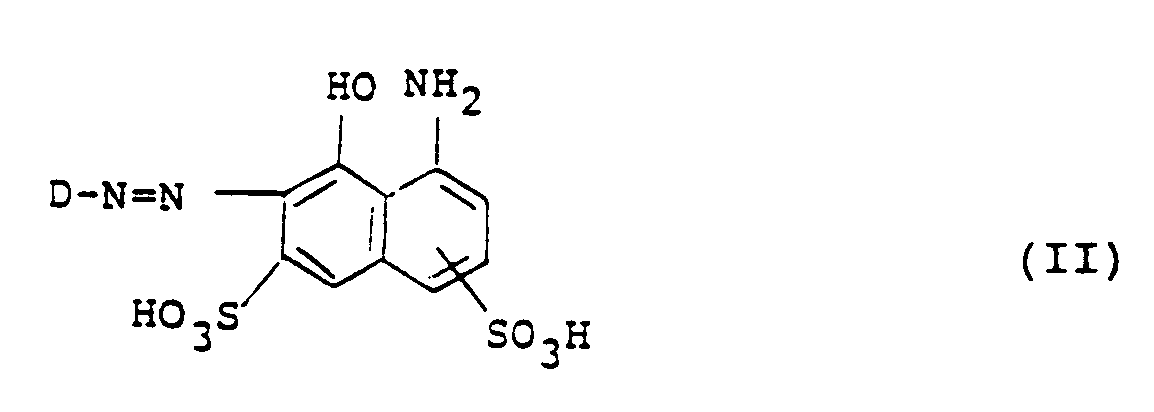
- the monoazo compound (I) of the present invention can be produced in a manner known per se, for example, by subjecting the monoazo intermediate compound of the formula (II), the amine compound of the formula (III) and another amine compound of the formula (IV) to condensation in an optional order with a cyanuric halide such as cyanuric chloride and cyanuric fluoride.
- a cyanuric halide such as cyanuric chloride and cyanuric fluoride.
- the order of condensation is not particularly limited. Considering, however, the yield and quality of the monoazo compound (I) obtained, it is preferred to use any one of (II), (III) and (IV) having the lowest reactivity to the cyanuric halide first of all for the condensation with the cyanuric halide.
- a first condensation of any one of (II), (III) and (IV) with the cyanuric halide can be carried out in an aqueous medium at a temperature of -10 ° to 50 ° C, preferably 0 ° to 30 ° C, while controlling the pH within 1 to 10, preferably 2 to 7.
- a second condensation of any one of remaining two with the first condensate can be carried out in an aqueous medium at a temperature of 10 ° to 80 ° C, preferably 20 ° to 50 ° C, while controlling the pH within 2 to 9, preferably 3 to 6, and a third condensation of the last one with the second condensate in an aqueous medium at a temperature of 40 to 100°C, preferably 40 to 80°C, while controlling the pH within 2 to 9, preferably 3 to 6.
- the monoazo intermediate compound (II) can be prepared by diazotizing an aromatic amine represented by the following formula (V), wherein D is as defined above, followed by coupling with a naphthalenedisulfonic acid represented by the following formula (V) in the free acid form, the diazotizing and coupling being carried out in a conventional manner known per se.
- the aromatic amine (V) usable in the present invention includes an aniline compound and a naphthylamine compound, each being represented by the following formulas (VII) and (VIII), in each free acid form respectively. wherein R 3 and R 4 are as defined above.
- aniline compound (VII) examples are:
- 2-aminobenzenesulfonic acid 2-amino-5-methylbenzenesulfonic acid, 2-amino-5-ethylbenzenesulfonic acid, 2-amino-5-methoxybenzenesulfonic acid, 2-amino-5-ethoxyben- zenesulfonic acid, 2-amino-5-chlorobenzenesulfonic acid, 2-aminobenzene-1,5-disulfonic acid, 2-aminobenzene-1 ,4-disulfonic acid and the like.
- 2-aminonaphthlene-1-sulfonic acid 2-aminonaphthalene-1,5-disulfonic acid
- 2-aminonaphthalene-1 ,7-disulfonic acid 2-aminonaphthalene-1 ,7-trisulfonic acid and the like.
- the naphthalenedisulfonic acid (VI) includes 1-amino-8-hydroxynaphthalene-3,6-disulfonic acid, 1-amino-8-hydroxynaphthalene-4,6-disulfonic acid and the like.
- All the starting compounds described above may be used in the form of a free acid or a salt such as alkali metal and alkaline earth metal salts.
- the monoazo compound of the formula (I) may be in the form of a free acid, preferably in the form of an alkali metal or alkaline earth metal salt such as sodium salt, potassium salt, lithium salt and the like.
- the desired monoazo compound (I) containing reaction mixture may be subjected to salting-out in a conventional manner using an electrolyte, demineralization using a semipermeable membrane, evaporation such as spray-drying and the like to provide the monoazo compound (I) in the form of a powdery or liquid commercial product.
- the monoazo compound (I) of the present invention is fiber-reactive and useful for dyeing or printing hydroxyl group-containing and amide group-containing materials in a fibrous form including unmixed or mixed fiber spinning.
- the hydroxyl group-containing materials include natural or synthetic hydroxyl group-containing materials such as cellulose fiber materials, cellulose-containing fiber materials, regenerated products thereof and polyvinyl alcohol.
- cellulose fiber materials are cotton and other vegetable fibers such as linen, hemp, jute and ramie fibers.
- regenerated cellulose fibers are viscose staple and filament viscose,
- cellulose-containing fiber materials are mixed fiber materials such as cellulose/polyester, cellulose/wool, cellulose/acryl and the like.
- the amide group-containing materials include synthetic or natural polyamide and polyurethane.
- Examples of the materials, particularly in the fibrous forms, are wool and other animal furs, silk, leather, polyamide-6,6, polyamide-6, polyamide-11 and polyamide-4.
- the dyeing may be carried out in a suitable manner, which can be selected from conventional manners depending on the physical and chemical properties of said fiber materials.
- cellulose fiber materials can be dyed using the present compound by an exhaustion dyeing, padding including cold batch-up dyeing or printing method.
- the exhaustion dyeing can be carried out at a relatively low temperature in the presence of an acid binding agent such as sodium carbonate, trisodium phosphate, sodium hydroxide and the like, if desired, using a neutral salt such as sodium sulfate, sodium chloride and the like, together with a hydrotropic agent, a penetrant or a level dyeing agent.
- an acid binding agent such as sodium carbonate, trisodium phosphate, sodium hydroxide and the like
- a neutral salt such as sodium sulfate, sodium chloride and the like
- the neutral salt usable for promoting the exhaustion may be added to a dye bath before or after temperature reaching a desired level for the dyeing, if desired, dividedly.
- the padding can be carried out by padding the fiber materials at ambient temperature or an elevated temperature, and after drying , steaming or dry-heating the materials to perform the dye-fixation.
- the printing can be carried out in a one-phase or two-phase manner.
- the one-phase printing may be conducted by printing the fiber materials with a printing paste containing an acid binding agent such as sodium hydrogencarbonate and the like, followed by steaming at a temperature of 100 ° to 160°C.
- the two-phase printing may be conducted by printing the fiber materials with a neutral or weakly acidic printing paste, and passing the materials through a hot alkaline bath containing an electrolyte or over-padding the materials with an alkaline padding liquor containing an electrolyte, followed by a steaming or dry-heating treatment.
- a paste or emulsifier such as sodium alginate, starch ether and the like may be used, if desired, together with a conventional auxiliary agent such as urea and/or dispersing agent.
- the acid binding agent useful for fixing the compound of the present invention on the cellulose fiber materials includes water-soluble basic salts consisting of alkali or alkaline earth metals and inorganic or organic acids or compounds capable of liberating alkalis under heating conditions.
- alkali metal hydroxides and alkali metal salts of inorganic or organic acids having a weak or medium strength are particularly preferred.
- sodium salts and potassium salts are particularly preferred. Examples thereof are sodium hydroxide, potassium hydroxide, sodium hydrogencarbonate, sodium carbonate, sodium formate, potassium carbonate, sodium dihydrogenphosphate, disodium hydrogenphosphate, trisodium phosphate, sodium silicate, sodium trichloroacetate and the like.
- the dyeing of neutral or synthetic polyamide and polyurethane fiber materials can be carried out by performing exhaustion in an acid or weak acid bath, while controlling the pH value, and then making the bath neutral, or in some cases alkaline to perform the fixation.
- the dyeing temperature ranges usually from 60 to 120°C.
- a conventional level dyeing agent such as condensation product between cyanuric chloride and 3 times by mole of aminobenzene-sulfonic acid or aminonaphthalenesulfonic acid, or an addition product between stearylamine and ethylene oxide, and the like.
- the present monoazo compount (I) can be characterized by excellent dye performances in the dyeing and printing of fiber materials, particularly cellulose fiber materials.
- the compound can give a dyed product excellent in light fastness, perspiration-light fastness, formalin fastness, wet fastness such as washing resistance, peroxide-washing resistance, chlorine resistance, chloride bleaching resistance, perspiration resistance and acid-hydrolysis resistance, and alkali fastness, abrasion fastness and iron fastness.
- the monoazo compound (I) can also exhibit extremely excellent build-up, level-dyeing and washing-off properties and high solubility as well as high exhaustion and fixation percentages, Moreover, when used for the dyeing or printing, the monoazo compount (I) can hardly be affected by changes in a dyeing temperature, an alkali agent, an amount of inorganic salts and bath ratio, so that a dyed or printed product with a constant quality can be obtained with superior reproducibility.
- the monoazo compound (I) can exhibit excellent build-up property and alkali stability (almost no hydrolysis by the action of the alkali agent) and almost no difference in the depth and shade appears between the dyed products obtained by fixing at 25 ° C and at a lower temperature than that.
- a monoazo intermediate compound of the following formula (50.4 parts), was dissolved in water (1000 parts), and cyanuric chloride (18.5 parts) was added thereto. The mixture was stirred at 0 to 5°C, while controlling the pH within 2.5 to 3.5 using a 20% aqueous sodium carbonate solution, to perform a first condensation.
- Example 1 was repeated, provided that a monoazo intermediate compound of the formula (II) shown in a second column of the following table, an amine compound of the formula (III) in a third column and another amine compound of the formula (IV) in a fourth column were used in place of the monoazo intermediate compound, 1-aminobenzene-4- ⁇ -sulfatoethylsulfone and 1-aminobenzene-3- ⁇ -sulfatoethylsul- fone used in Example 1, respectively, to obtain the corresponding monoazo compounds 2 to 19.
- Cyanuric chloride (18.5 parts) was dispersed in water (1000 parts), and 1-N-ethylaminobenzene-3- ⁇ -sulfatoethylsulfone (30.9 parts) was added thereto. The mixture was stirred at 0 ° to 5 ° C, while controlling the pH within 2 to 3 using a 20% aqueous sodium carbonate solution, to perform a first condensation.
- a monoazo intermediate compound of the following formula (50.4 parts), was added to the above second condensation reaction mixture, and the mixture was heated upto 60° to 70 C, while controlling the pH within 4 to 5, and stirred at that temperature within that pH to perform a third condensation.
- Example 20 was repeated, provided that a monoazo intermediate compound of the formula (II) shown in a second column of the following table, an amine compound of the formula (III) in a third column and another amine compound of the formula (IV) in a fourth column were used in place of the monoazo intermediate compound, 1-N-ethylaminobenzene-3- ⁇ -sulfatoethylsulfone and 1-aminobenzene-3- ⁇ -sul- fatoethylsulfone used in Example 20, respectively, to obtain the corresponding monoazo compounds 21 to 42.
- a monoazo intermediate compound of the following formula (63.4 parts), was dissolved in water (500 parts), and cyanuric chloride (18.5 parts) was added thereto. The mixture was stirred at 0 to 5 ° C, while controlling the pH within 2.5 to 3.5 using a 20% aqueous sodium carbonate solution, performing a first condensation.
- the monoazo compound (1) obtained in Example 1 was dissolved in water (200 parts), and sodium sulfate (20 parts) and cotton (10 parts) were added thereto. The bath was heated to 50 ° C, and 30 minutes thereafter sodium carbonate (4 parts) was added thereto. Dyeing was continued for 1 hour at that temperature. Thereafter, the cotton was washed with water and soaped to obtain a dyed product of a deep red color.
- the dyed product was excellent in fastness properties, particularly acid-hydrolysis fastness, chlorine fastness, light fastness and perspiration-light fastness, and the monoazo compound was found to have excellent build-up property.
- Example 20 The monoazo compound obtained in Example 20 (0.3 part) was dissolved in water (150 parts), and sodium sulfate (30 parts) and cotton (10 parts) were added thereto. The bath was heated to 60 °C. 20 Minutes thereafter, sodium carbonate (4 parts) was added thereto. Dyeing was continued for 1 hour at that temperature. The cotton was washed with water and soaped to obtain a dyed product of a deep red color excellent in fastness properties, particularly acid-hydrolysis fastness, chlorine fastness, light fastness and perspiration-light fastness, with excellent build-up property.
- the monoazo compounds obtained in Examples 1 to 19 each (0.3 part) was dissolved in water (300 parts), and sodium sulfate (30 parts) and cotton (10 parts) were added thereto. The bath was heated to 60 ° C. 20 Minutes thereafter, sodium carbonate (5 parts) was added thereto, and dyeing was continued for 1 hour at that temperature. The cotton was washed with water and soaped to obtain each dyed product of a deep red color excellent in fastness properties, perticularly acid-hydrolysis fastness, chlorine fastness, light fastness and perspiration-light fastness with excellent build-up property.
- the monoazo compounds obtained in Examples 20 to 32 each (0.3 part) was dissolved in water (200 parts), and sodium sulfate (30 parts) and cotton (10 parts) were added ther eto. The bath was heated to 50 ° C. 30 Minutes thereafter, trisodium phosphate (4 parts) was added thereto, and dyeing was continued for 1 hour at that temperature. Thereafter, the cotton was washed with water and soaped to obtain each dyed product of a deep red color excellent in fastness properties, particularly acid-hydrolysis fastness, chlorine fastness, light fastness and perspiration-light fastness with excellent build-up property.
- Mercerized cotton broad cloth was printed with the color paste having the composition described above, and then pre-dried, subjected to steaming at 100°C for 5 minutes, rinsed with hot water, soaped, again rinsed with hot water, and then dried.
- each printed product of a deep red color excellent in fastness properties particularly acid-hydrolysis fastness, chlorine fastness, light fastness and perspiration-light fastness with a high fixing percent and excellent build-up property.
- the monoazo compounds obtained in Examples 1 to 19 and 32 to 67 each (25 parts) was dissolved in hot water, and the solution was cooled to 25 ° C. 32.5% Aqueous sodium hydroxide solution (5.5 parts) and 50 Be' water glass (150 parts) were added thereto, and water was added to make the whole 1000 parts at 25 ° C to obtain a padding liquor. Immediately thereafter, cotton cloth was padded with the padding liquor and batched up, and the cloth wrapped tightly with a polyethylene film was allowed to stand in a room kept at 20 ° C.
- each monoazo compound was found to have excellent build-up property.
- the monoazo compounds obtained in Examples 1 to 19 each (25 parts) was dissolved in hot water, and the solution was cooled to 25 ° C. To this solution were added 32.5% aqueous sodium hydroxide solution (10 parts) and anhydrous sodium sulfate (30 parts), and then water was added thereto to make the whole 1000 parts at 25 ° C. Immediately thereafter, viscose rayon woven fabric was padded with the obtained padding liquor. The fabric padded was batched-up, wrapped tightly with a polyethylene film, and allowed to stand in a room kept at 20 ° C.
- Dyeing Example 3 Using the monoazo compounds obtained in Examples 1 to 19, Dyeing Example 3 was repeated, provided that sodium carbonate was used in an amount of 3 parts in place of 5 parts, thereby obtaining results similar to those in Dyeing Example 3.
- Dyeing Example 3 was repeated, provided that the dyeing was continued at 50 ° C in place of 60 C, thereby obtaining results similar to those in Dyeing Example 3.
- Dyeing Example 3 Using the monoazo compounds obtained in Examples 1 to 19, Dyeing Example 3 was repeated, provided that sodium sulfate was used in an amount of 15 parts in place of 30 parts, thereby obtaining results similar to those in Dyeing Example 3.
- Dyeing Example 4 was repeataed, provided that water and sodium sulfate were used in each amount of 150 parts and 23 parts in place of 200 parts and 30 parts, respectively, thereby obtaining results similar to those in Dyeing Example 4.
- Dyeing Example 1 Using the monoazo compounds obtained in Examples 33 to 67, Dyeing Example 1 was repeated, provided that sodium sulfate was used in an amount of 10 parts in place of 20 parts, sodium carbonate was added 20 minutes after the heating in place of 30 minutes thereafter, and the dyeing was continued at 60 ° C in place of 50 C, thereby obtaining results similar to those in Dyeing Example 1.
Landscapes
- Chemical & Material Sciences (AREA)
- Organic Chemistry (AREA)
- Engineering & Computer Science (AREA)
- Textile Engineering (AREA)
- Coloring (AREA)
Claims (11)




Applications Claiming Priority (4)
| Application Number | Priority Date | Filing Date | Title |
|---|---|---|---|
| JP22345386 | 1986-09-19 | ||
| JP223453/86 | 1986-09-19 | ||
| JP61274868A JPH0791483B2 (ja) | 1986-11-18 | 1986-11-18 | モノアゾ化合物及びそれを用いる繊維材料の染色又は捺染方法 |
| JP274868/86 | 1986-11-18 |
Publications (2)
| Publication Number | Publication Date |
|---|---|
| EP0262520A1 EP0262520A1 (de) | 1988-04-06 |
| EP0262520B1 true EP0262520B1 (de) | 1992-12-09 |
Family
ID=26525484
Family Applications (1)
| Application Number | Title | Priority Date | Filing Date |
|---|---|---|---|
| EP87113621A Expired - Lifetime EP0262520B1 (de) | 1986-09-19 | 1987-09-17 | Mit Fasern reaktive Monoazoverbindung der bifuktionellen Vinylsulfonreihe |
Country Status (5)
| Country | Link |
|---|---|
| US (1) | US4841032A (de) |
| EP (1) | EP0262520B1 (de) |
| KR (1) | KR960000171B1 (de) |
| DE (1) | DE3783001T2 (de) |
| ES (1) | ES2052532T3 (de) |
Families Citing this family (6)
| Publication number | Priority date | Publication date | Assignee | Title |
|---|---|---|---|---|
| US4904766A (en) * | 1986-10-17 | 1990-02-27 | Sumitomo Chemical Company, Limited | Monoazo compound having two vinylsulfone type fiber reactive groups through triazinyl bridging group |
| AU642047B2 (en) * | 1990-11-26 | 1993-10-07 | Sumitomo Chemical Company, Limited | Triazine compounds and method for dyeing or printing fiber materials using the same |
| US6153365A (en) * | 1999-12-16 | 2000-11-28 | Eastman Kodak Company | Photographic processing compositions containing stain reducing agent |
| CN100404628C (zh) * | 2002-12-27 | 2008-07-23 | 上海染料化工八厂 | 大红色染料组合物及其制备与应用 |
| JP5682947B2 (ja) * | 2009-05-28 | 2015-03-11 | 日本化薬株式会社 | 反応染料組成物及びそれを用いる染色法 |
| CN113150576B (zh) * | 2021-03-02 | 2022-11-25 | 泰兴锦云染料有限公司 | 一种喷墨印花活性红色染料及其制备方法和应用 |
Family Cites Families (9)
| Publication number | Priority date | Publication date | Assignee | Title |
|---|---|---|---|---|
| DE1265698C2 (de) * | 1961-05-06 | 1968-11-07 | Hoechst Ag | Verfahren zur Erzeugung von nassechten Faerbungen und Drucken |
| FR1350612A (fr) * | 1961-07-22 | 1964-01-31 | Hoechst Ag | Colorants azoïques et leur préparation |
| JPS46824Y1 (de) * | 1966-12-30 | 1971-01-13 | ||
| US4341699A (en) * | 1979-07-13 | 1982-07-27 | Sumitomo Chemical Company, Limited | Reactive red dye having both monochlorotriazinyl- and vinylsulfone-type reactive groups |
| EP0076782B1 (de) * | 1981-10-02 | 1986-03-05 | Ciba-Geigy Ag | Reaktivfarbstoffe, deren Herstellung und Verwendung |
| JPH07116375B2 (ja) * | 1984-02-20 | 1995-12-13 | 住友化学工業株式会社 | トリアジン化合物およびそれを用いる繊維材料の染色または捺染法 |
| CH663215A5 (de) * | 1984-04-09 | 1987-11-30 | Mitsubishi Chem Ind | Reaktive azofarbstoffe. |
| JPS612762A (ja) * | 1984-06-14 | 1986-01-08 | Sumitomo Chem Co Ltd | ジスアゾ化合物およびそれを用いる染色または捺染法 |
| DE3624136A1 (de) * | 1985-09-30 | 1987-04-09 | Hoechst Ag | Wasserloesliche azoverbindungen, verfahren zu deren herstellung und ihre verwendung als farbstoffe |
-
1987
- 1987-08-28 US US07/090,508 patent/US4841032A/en not_active Expired - Fee Related
- 1987-09-17 DE DE8787113621T patent/DE3783001T2/de not_active Expired - Fee Related
- 1987-09-17 ES ES87113621T patent/ES2052532T3/es not_active Expired - Lifetime
- 1987-09-17 EP EP87113621A patent/EP0262520B1/de not_active Expired - Lifetime
- 1987-09-19 KR KR1019870010408A patent/KR960000171B1/ko not_active Expired - Fee Related
Also Published As
| Publication number | Publication date |
|---|---|
| EP0262520A1 (de) | 1988-04-06 |
| DE3783001D1 (de) | 1993-01-21 |
| KR880004046A (ko) | 1988-06-01 |
| KR960000171B1 (ko) | 1996-01-03 |
| US4841032A (en) | 1989-06-20 |
| ES2052532T3 (es) | 1994-07-16 |
| DE3783001T2 (de) | 1993-06-03 |
Similar Documents
| Publication | Publication Date | Title |
|---|---|---|
| KR920002681B1 (ko) | 모노아조 화합물의 제조방법 | |
| EP0241104B1 (de) | Faserreaktive Monoazoverbindung mit 7-Amino-1-naphtholsulfonsäure als Kupplungskomponente | |
| US5037965A (en) | Monoazo red dye compound having vinylsulfone type fiber reactive groups | |
| EP0167858A1 (de) | Faserreaktive Disazoverbindung | |
| EP0172283B1 (de) | Monoazopyridon-Verbindung | |
| EP0538872B1 (de) | Monoazoverbindungen und Verfahren zum Färben oder Bedrucken von Fasermaterialien mittels derselben | |
| EP0239847B1 (de) | Monoazoverbindung mit einer faserreaktiven Gruppe des Vinylsulfon-Typs, getragen von einem substituierten Triazinbrückenglied | |
| EP0262520A1 (de) | Mit Fasern reaktive Monoazoverbindung der bifuktionellen Vinylsulfonreihe | |
| EP0184071B1 (de) | Monoazoverbindungen, Verfahren zu ihrer Herstellung und Färbverfahren unter deren Verwendung | |
| EP0400648B1 (de) | Polyazofarbstoffe mit mehreren faserreaktiven Vinylsulfongruppen in einem Molekül | |
| EP0264137B1 (de) | Zwei mit Fasern reaktive Gruppen der Vinylsulfonreihe enthaltende Scharlach-Monoazoverbindung | |
| EP0265928B1 (de) | Rote Monoazoverbindung mit zwei faserreaktiven Gruppen der Vinylsulfonreihe | |
| EP0372543B1 (de) | Roter Monoazoreaktivfarbstoff der Vinylsulfonreihe | |
| EP0235325B1 (de) | Faserreaktive Phthalocyaninverbindung mit Gruppen des Vinylsulfons, sowie des Dihalogenotriazinyltyps | |
| EP0554561B1 (de) | Bisazoverbindungen und Verfahren zum Färben und Bedrucken von Fasermaterialien unter Verwendung derselben | |
| JPH0372572A (ja) | モノアゾ化合物及びそれを用いて繊維材料を染色又は捺染する方法 | |
| JPH0558034B2 (de) | ||
| JPH0388860A (ja) | モノアゾ化合物およびそれを用いて繊維材料を染色または捺染する方法 | |
| JPH0826238B2 (ja) | 水溶性モノアゾ化合物及びそれを用いて繊維材料を染色又は捺染する方法 | |
| JP2712419B2 (ja) | モノアゾ化合物及びそれを用いて繊維材料を染色又は捺染する方法 | |
| JPH0826239B2 (ja) | 水溶性モノアゾ化合物及びそれを用いて繊維材料を染色又は捺染する方法 | |
| JPH0717856B2 (ja) | モノアゾ化合物およびそれを用いて繊維材料を染色または捺染する方法 | |
| JPH0446303B2 (de) | ||
| JPS61155469A (ja) | モノアゾ化合物およびそれを用いる染色または捺染法 | |
| EP0593016A2 (de) | Asymetrische Dioxazinverbindungen und deren Verwendung als faserreaktive Farbstoffe |
Legal Events
| Date | Code | Title | Description |
|---|---|---|---|
| PUAI | Public reference made under article 153(3) epc to a published international application that has entered the european phase |
Free format text: ORIGINAL CODE: 0009012 |
|
| AK | Designated contracting states |
Kind code of ref document: A1 Designated state(s): BE CH DE ES FR GB IT LI NL SE |
|
| 17P | Request for examination filed |
Effective date: 19880829 |
|
| RAP3 | Party data changed (applicant data changed or rights of an application transferred) |
Owner name: SUMITOMO CHEMICAL COMPANY, LIMITED |
|
| 17Q | First examination report despatched |
Effective date: 19890816 |
|
| ITF | It: translation for a ep patent filed | ||
| ITTA | It: last paid annual fee | ||
| GRAA | (expected) grant |
Free format text: ORIGINAL CODE: 0009210 |
|
| AK | Designated contracting states |
Kind code of ref document: B1 Designated state(s): BE CH DE ES FR GB IT LI NL SE |
|
| ET | Fr: translation filed | ||
| REF | Corresponds to: |
Ref document number: 3783001 Country of ref document: DE Date of ref document: 19930121 |
|
| PLBE | No opposition filed within time limit |
Free format text: ORIGINAL CODE: 0009261 |
|
| STAA | Information on the status of an ep patent application or granted ep patent |
Free format text: STATUS: NO OPPOSITION FILED WITHIN TIME LIMIT |
|
| 26N | No opposition filed | ||
| REG | Reference to a national code |
Ref country code: ES Ref legal event code: FG2A Ref document number: 2052532 Country of ref document: ES Kind code of ref document: T3 |
|
| EAL | Se: european patent in force in sweden |
Ref document number: 87113621.4 |
|
| PGFP | Annual fee paid to national office [announced via postgrant information from national office to epo] |
Ref country code: SE Payment date: 19960711 Year of fee payment: 10 |
|
| PGFP | Annual fee paid to national office [announced via postgrant information from national office to epo] |
Ref country code: ES Payment date: 19960912 Year of fee payment: 10 |
|
| PGFP | Annual fee paid to national office [announced via postgrant information from national office to epo] |
Ref country code: NL Payment date: 19960930 Year of fee payment: 10 Ref country code: FR Payment date: 19960930 Year of fee payment: 10 |
|
| PGFP | Annual fee paid to national office [announced via postgrant information from national office to epo] |
Ref country code: BE Payment date: 19961029 Year of fee payment: 10 |
|
| PG25 | Lapsed in a contracting state [announced via postgrant information from national office to epo] |
Ref country code: SE Free format text: LAPSE BECAUSE OF NON-PAYMENT OF DUE FEES Effective date: 19970918 Ref country code: ES Free format text: THE PATENT HAS BEEN ANNULLED BY A DECISION OF A NATIONAL AUTHORITY Effective date: 19970918 |
|
| PG25 | Lapsed in a contracting state [announced via postgrant information from national office to epo] |
Ref country code: FR Free format text: THE PATENT HAS BEEN ANNULLED BY A DECISION OF A NATIONAL AUTHORITY Effective date: 19970930 Ref country code: BE Free format text: LAPSE BECAUSE OF NON-PAYMENT OF DUE FEES Effective date: 19970930 |
|
| BERE | Be: lapsed |
Owner name: SUMITOMO CHEMICAL CY LTD Effective date: 19970930 |
|
| PG25 | Lapsed in a contracting state [announced via postgrant information from national office to epo] |
Ref country code: NL Free format text: LAPSE BECAUSE OF NON-PAYMENT OF DUE FEES Effective date: 19980401 |
|
| NLV4 | Nl: lapsed or anulled due to non-payment of the annual fee |
Effective date: 19980401 |
|
| EUG | Se: european patent has lapsed |
Ref document number: 87113621.4 |
|
| REG | Reference to a national code |
Ref country code: FR Ref legal event code: ST |
|
| PGFP | Annual fee paid to national office [announced via postgrant information from national office to epo] |
Ref country code: CH Payment date: 20000823 Year of fee payment: 14 |
|
| PGFP | Annual fee paid to national office [announced via postgrant information from national office to epo] |
Ref country code: GB Payment date: 20000913 Year of fee payment: 14 |
|
| PGFP | Annual fee paid to national office [announced via postgrant information from national office to epo] |
Ref country code: DE Payment date: 20001129 Year of fee payment: 14 |
|
| REG | Reference to a national code |
Ref country code: ES Ref legal event code: FD2A Effective date: 20001204 |
|
| PG25 | Lapsed in a contracting state [announced via postgrant information from national office to epo] |
Ref country code: GB Free format text: LAPSE BECAUSE OF NON-PAYMENT OF DUE FEES Effective date: 20010917 |
|
| PG25 | Lapsed in a contracting state [announced via postgrant information from national office to epo] |
Ref country code: LI Free format text: LAPSE BECAUSE OF NON-PAYMENT OF DUE FEES Effective date: 20010930 Ref country code: CH Free format text: LAPSE BECAUSE OF NON-PAYMENT OF DUE FEES Effective date: 20010930 |
|
| REG | Reference to a national code |
Ref country code: GB Ref legal event code: IF02 |
|
| PG25 | Lapsed in a contracting state [announced via postgrant information from national office to epo] |
Ref country code: DE Free format text: LAPSE BECAUSE OF NON-PAYMENT OF DUE FEES Effective date: 20020501 |
|
| GBPC | Gb: european patent ceased through non-payment of renewal fee |
Effective date: 20010917 |
|
| REG | Reference to a national code |
Ref country code: CH Ref legal event code: PL |
|
| PG25 | Lapsed in a contracting state [announced via postgrant information from national office to epo] |
Ref country code: IT Free format text: LAPSE BECAUSE OF NON-PAYMENT OF DUE FEES;WARNING: LAPSES OF ITALIAN PATENTS WITH EFFECTIVE DATE BEFORE 2007 MAY HAVE OCCURRED AT ANY TIME BEFORE 2007. THE CORRECT EFFECTIVE DATE MAY BE DIFFERENT FROM THE ONE RECORDED. Effective date: 20050917 |