EP0264884B2 - Dispositif d'entrée à touches - Google Patents
Dispositif d'entrée à touches Download PDFInfo
- Publication number
- EP0264884B2 EP0264884B2 EP87115277A EP87115277A EP0264884B2 EP 0264884 B2 EP0264884 B2 EP 0264884B2 EP 87115277 A EP87115277 A EP 87115277A EP 87115277 A EP87115277 A EP 87115277A EP 0264884 B2 EP0264884 B2 EP 0264884B2
- Authority
- EP
- European Patent Office
- Prior art keywords
- contact
- sheet
- microcomputer
- key
- groups
- Prior art date
- Legal status (The legal status is an assumption and is not a legal conclusion. Google has not performed a legal analysis and makes no representation as to the accuracy of the status listed.)
- Expired - Lifetime
Links
Images





Classifications
-
- H—ELECTRICITY
- H03—ELECTRONIC CIRCUITRY
- H03M—CODING; DECODING; CODE CONVERSION IN GENERAL
- H03M11/00—Coding in connection with keyboards or like devices, i.e. coding of the position of operated keys
- H03M11/22—Static coding
- H03M11/24—Static coding using analogue means, e.g. by coding the states of multiple switches into a single multi-level analogue signal or by indicating the type of a device using the voltage level at a specific tap of a resistive divider
Definitions
- the present invention relates to a key input device so designed that the kind of a key depressed is determined by the combined use of an analog-type signal and a digital-type signal.
- This type of system includes a plurality of output ports and a plurality of ordinary input terminals so that scan pulses of a controlled timing are generated from the output ports and the corresponding pulse is applied to the input terminal connected to the depressed key, thereby discriminating the key.
- this system is also not a method which drastically decreases the number of the required input and output terminals and therefore it is limited by the number of the input and output terminals of the microcomputer.
- these input and output terminals are used only for operating key inputting purposes, there is a shortage of the input and output terminals for the other essential control purposes.
- it leads to a pressure for the capacity of the ROM of the microcomputer used with this system for scan output control purposes. etc.
- this system is of an analog-to-digital conversion (AID conversion) type in which voltages generated by the depression of the respective keys differ from one another in accordance with their kinds and each key is discriminated by converting the corresponding analog voltage to digital form.
- AID conversion analog-to-digital conversion
- US-A-4,015,254 essentially discloses key input devices as shown in present Fig. 1A and 1B, respectively.
- DE-A-33 38 749 discloses a key input device, in which according to Fig. 3 thereof a microcomputer receives both, digital and analog signals at respective input terminals. There are provided first keys for applying said digital signals to the microcomputer and second keys for applying said analog signals to said microcomputer. The discrimination of the keys for applying said analog signals is performed on the basis of both, the analog and the digital signals. The digital signals serve for providing a second function for each of said keys for applying said analog signals.
- Figs. 1A and 1B are diagrams showing conventional key input systems.
- Fig. 2 is an extemal view of a high-frequency heating apparatus incorporating an embodiment of the invention.
- Fig. 3 is a circuit diagram of the apparatus of Fig. 2.
- Fig. 4 is a diagram showing a detailed construction of one key input portion in the embodiment of Fig. 2.
- Fig. 5 is a sectional view for explaining the operation of one key input portion in the embodiment of Fig. 2.
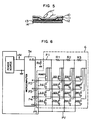
- Fig. 6 is a diagram showing the construction of the key input section in the embodiment of Fig. 2.
- Fig. 7 is a diagram for explaining the control of the embodiment of Fig. 2.
- Fig. 8 is a diagram showing the construction of a key input section in a modification of the embodiment of Fig. 2.
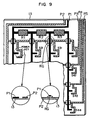
- Fig. 9 is a pattern diagram of the key input section in the embodiment of Fig. 2.
- Fig. 10 is a pattern diagram of a key input section in another modification of the embodiment of Fig. 2.
- Numeral 1 designates the body of a high-frequency heating apparatus.
- a heating chamber 2 is formed inside the body 1.
- Numeral 3 designates a hinged door fitted in the opening of the heating chamber 2, and 4 a control panel arranged on the front part of the body 1 to allow the user to set a cooking sequence such as cooking power and time.
- the control panel 4 contains a control circuit unit 5 including a microcomputer and a keyboard 6 for feeding the intention of the user into the microcomputer.
- the microcomputer 5a shown in Fig. 3 performs and controls the cooking sequence in accordance with the preprogrammed contents.
- Fig. 3 shows a circuit diagram for the apparatus of Fig. 2.
- the apparatus includes a magnetron 7 serving as a high-frequency oscillator, a transformer 8 for supplying power to the magnetron 7, and switches 9a and 9b for switching on and off the power supplied to the transformer 8 to switch on and off the high-frequency output of the magnetron 7.
- the microcomputer 5a includes ordinary input terminals K 1 to K 4 and an A/D conversion input terminal A/D 1 and the terminals are wired in correspondence to the respective keys of the keyboard 6. Also connected to the keyboard 6 is a + voltage (+ 5 V) which serves as a power supply for the microcomputer 5a and as an A/D conversion input power supply.
- the keyboard 6 includes a plurality of keys such as cooking power keys, cooking time keys and a start key and each of the keys has a separate switch function. These switch functions serve to open and close the circuits of the input terminals (K 1 ⁇ K 4 , A/D 1 ) of the microcomputer 5a.
- Numeral 10 designates a panel showing the positions of the keys and providing an external appearance.
- the panel 10 is designed so that it can be recognized easily by the user.
- Numeral 11 designates a conductive sheet forming contacts for the switch functions, 12a spacer providing contact gaps, arranged to ensure the insulation for those portions other than the contact portions of the keys and also formed with an opening at its portions corresponding to each contact portion to cause the conductive sheet 11 to directly face the openings, and 13 a pattem sheet having a plurality of contact patterns formed thereon to touch the conductive sheet 11 through the spacer 12 in response to the depression of the respective keys.
- a reinforcing sheet 14 is provided to reinforce the whole assembly.
- the conductive sheet 11 is connected to the metal portion of the high-frequency heating apparatus body with small screws or the like and the control circuit unit 5 is similarly connected electrically to the heating apparatus body, thereby connecting the 5-volt power supply of the microcomputer 5a to the conductive sheet 11 of the keyboard 6 through the metal portion of the heating apparatus body.
- Fig. 6 showing a connection diagram for the patterns on the pattern sheet 13 of the keyboard 6 and the microcomputer 5a.
- the keys include 16 different ones so that if, for example, the POWER key is depressed, the voltage of 5 V is applied to the ordinary input terminal K 1 of the microcomputer 5a by the pattern P2 of Fig. 6 and also the divided voltage by ladder resister R 1 , R 2 , R 3 and R x is applied to the A/D conversion input terminal A/D 1 through the pattern P 1 .
- the keys include 16 different ones so that if, for example, the POWER key is depressed, the voltage of 5 V is applied to the ordinary input terminal K 1 of the microcomputer 5a by the pattern P2 of Fig. 6 and also the divided voltage by ladder resister R 1 , R 2 , R 3 and R x is applied to the A/D conversion input terminal A/D 1 through the pattern P 1 .
- the keys include 16 different ones so that if, for example, the POWER key is depressed, the voltage of 5 V is
- the resolution of this ladder circuit is selectively set to four levels and therefore the voltage applied to the microcomputer 5a through the input terminal A/D 1 changes in response to the depression of the respective keys as follows.
- A/D 1 5 V (designated as a level 1)
- A/D 1 5 x R x R x + R 1 (designated as a level 2)
- A/D 1 5 x R x R x + R 1 + R 2 (designated as a level 3)
- A/D 1 5 x R x R x + R 1 + R 2 + R 3 (designated as a level 4)
- the keys are also connected in groups of four keys each to the ordinary input terminals K 1 , K 2 , K 3 and K 4 , respectively, and the matrix table of Fig. 7 is prepared in accordance with the various combinations of two input signals.
- the microcomputer 5a discriminates each key in accordance with the corresponding combination of two different input signals.
- the POWER key corresponds to the level 1 and the associated input is a K 1 input.
- the key S 33 corresponds to the level 3 and the associated input is a K 3 input.
- the microcomputer 5a determines first the kind of the ordinary input (K 1 ⁇ K 4 ) and it then determines the level of the A/D conversion input, thereby determining the kind of the depressed key.
- the POWER, S 12 , S 13 and S 14 keys, connected to the voltage of the level 1 are each placed in the preferential position in the corresponding row. For instance, when the POWER and S 21 keys are depressed simultaneously, the voltage of the level 1 is generated at the A/D 1 terminal and the smaller the level number the higher the priority level is. Therefore, the preferential keys can be attained by simply determining the corresponding matrix positions and there is no need to increase the ROM capacity and the RAM capacity for any program.
- the key scanning input terminals of the microcomputer 5a can be reduced as compared with the conventional key matrix system and also any increased number of the keys on the keyboard can be easily met with by increasing the AID resolution levels for AID conversion inputs.
- the output terminals of the microcomputer 5a are ensured amply and therefore the degree of freedom of designing is increased from the program designing standpoint of the microcomputer 5a with the resulting effect of causing some superfluous portion in the ROM capacity of the microcomputer 5a and allowing additional utilization thereof.
- the application of voltage to the patterns is effected only when any key is depressed and therefore the invention is advantageous with respect to the problem of interpattern migration which is encountered in the construction of the actual membrane.
- the embodiment only the reduced resolution levels are required for the A/D conversion resolution and this is a great advantage from the accuracy standpoint of forming a resistor pattern on the actual membrane.
- FIG. 8 a second embodiment of the invention will be described.
- This embodiment shows a case in which the number of keys is increased by two times by simply adding a single A/D conversion input terminal.
- the number of keys can be doubled by combining the similar matrix with the additional AID conversion input terminal and using the same ordinary input terminals K 1 and K 2 without any addition.
- the corresponding key discrimination table is as shown in Fig. 8. Also, the same dividing resistors R 1 , R 2 , R 3 and R x for A/D conversion may be used for the terminals A/D 1 and A/D 2 or the dividing resistors for the two may be different from each other, and the provision of these dividing resistors can be realized easily.
- the pattern P 1 and the patterns P 2 , P 3 , P 4 , and P 5 are respectively arranged in comb form.
- the group of ladder resistors R 1 , R 2 and R 3 prepared by, for example, forming carbon to the desired thickness, width, etc., to provide a high resistance value can be formed on a part of the pattern P 1 by the same operation as the other patterns. Since the present invention requires no increase in the resolution of the ladder resistors, the precision attained by this carbon resistor method can be considered sufficient for the ladder resistors.
- these resistors can be easily attained by the operation of printing and baking carbon on the pattern sheet 13.
- the resistance value can be increased by decreasing the width of the carbon pattern and conversely the resistance value can be reduced by increasing the width of the carbon pattern.
- the patterns other than the resistors R 1 , R 2 and R 3 may be formed with carbon mixed with such material as silver, thereby producing pattems having a very small resistance value.
- a resist RG is placed at each of the points where the patterns overlap one another to prevent the patterns from contacting with one another.
- the provision of the ladder resistor group of R 1 , R 2 and R 3 of a high resistance value and the pattems P 1 , P 2 , P 3 , P 4 , and P 5 of a low resistance value and the provision of the resist portions RG at the pattern intersections can be easily effected.
- the construction of this invention has the effect of greatly improving the quality in that excepting when any key is depressed so that the conductive sheet 11 supplied with 5 V is brought into contact with the pattem sheet 13 through the spacer sheet 12, no voltage is applied to the patterns on the pattern sheet 13 and the A/D conversion pattern P 1 and the ordinary input patterns P 2 , P 3 , P 4 and P 5 are all at the same potential, thereby preventing the occurrence of migration caused in the silver material which has been used frequently for such patterns.
- a pattem PV connected to the 5-volt power supply is formed as a third contact pattern on the pattem sheet 13, and the conductive sheet 11 simply forms a conductive film which is supplied with no voltage.
Landscapes
- Engineering & Computer Science (AREA)
- Theoretical Computer Science (AREA)
- Input From Keyboards Or The Like (AREA)
- Push-Button Switches (AREA)
Claims (6)
- Dispositif d'entrée à touches, comprenantdes moyens de commande à circuits (5) contenant un micro-ordinateur (5a) qui présente une borne d'entrée de conversion analogique-numérique (A/D1) et une pluralité de bornes d'entrée directe (K1, K2, K3, K4) et qui a des fonctions de programmation; etun clavier (6) pour appliquer des signaux d'entrée audit micro-ordinateur (5a),ledit clavier (6) comportant une pluralité de motifs distincts de contact pour touche (P1, P2, P3, P4, P5), un premier groupe de ces motifs de contact étant connecté, par l'intermédiaire de l'une parmi une pluralité de résistances prédéterminées, à ladite borne d'entrée de conversion analogique-numérique (A/D1) et un second groupe étant connecté directement auxdites bornes d'entrée directe (K1, K2, K3, K4), etune pluralité de touches (POWER, S12-S14, S21-S24, S31-S34, S41-S44), chacune de ces touches correspondant à un motif sélectionné parmi lesdits motifs de contact dans chacun desdits groupes, pour appliquer simultanément, lorsqu'elle est enfoncée, la même tension à ladite borne de conversion analogique-numérique (A/D1), directement ou par l'intermédiaire d'une ou de plusieurs résistances (R1, R2, R3, Rx) constituant lesdites résistances prédéterminées, et, directement, à l'une desdites bornes d'entrée directe (K1 à K4),d'où il résulte que ledit micro-ordinateur identifie ladite touche enfoncée par analyse de la présence de ladite tension auxdites bornes d'entrée directe (K1 à K4) et par analyse de la valeur de tension résultante sur ladite borne d'entrée de conversion analogique-numérique (A/D1),
- Dispositif selon la revendication 1, dans lequel ledit clavier (6) est un clavier du type à membrane,ledit clavier (6) contenant une feuille de caractères (10) indiquant des positions de ladite pluralité de touches (POWER, S12-S14, S21-S24, S31-S34, S41-S44), une feuille conductrice (11) présentant une surface inférieure conductrice et disposée au-dessous de ladite feuille de caractères (10), une feuille d'écartement (10), qui est disposée au-dessous de ladite feuille conductrice (11) et dans laquelle est formée une pluralité d'ouvertures correspondant chacune à l'une desdites touches, et une feuille de contacts (13) qui est disposée au-dessous de ladite feuille d'écartement (12) et dans laquelle sont formés des premier et second groupes de contacts, un contact de chacun de ces groupes étant associé à chacune desdites touches,chaque contact dudit premier groupe étant connecté à une borne correspondante parmi lesdites bornes d'entrée directe (K1-K4) dudit micro-ordinateur (5a) par l'intermédiaire d'un motif ayant une faible résistance (P2, P3, P4, P5) et chaque contact dudit second groupe étant connecté à ladite borne d'entrée de conversion analogique-numérique (A/D1) dudit micro-ordinateur (5a) directement ou par l'intermédiaire d'une ou de plusieurs résistances (R1, R2, R3, R4) imprimées sur ladite feuille de contacts (13),ladite feuille conductrice (11) étant connectée à une source de courant dudit micro-ordinateur (5a),d'où il résulte que, quand ladite feuille de caractères (10) est pressée au niveau de l'une quelconque des positions de touche, ladite feuille conductrice (11) entre simultanément en contact avec un contact de chacun desdits premier et second groupes de contacts à travers l'une desdites ouvertures formées dans ladite feuille d'écartement, ce qui établit, par l'intermédiaire de ladite feuille conductrice, la connexion entre ladite source de courant et lesdits contacts desdits premier et second groupes.
- Dispositif selon la revendication 1 ou 2, dans lequel lesdites résistances (R1, R2, R3, R4) sont des motifs de résistance imprimés dans un espace libre parmi lesdits groupes de motifs de contact sur ladite feuille de contacts (13), de façon à produire une pluralité de valeurs de résistance différentes.
- Dispositif selon la revendication 2 ou 3, dans lequel la tension de ladite source de courant n'est appliquée auxdits premier et second groupes de contacts que lorsqu'une pression est exercée sur ladite feuille de contacts, d'où il résulte que lesdits groupes sont maintenus à un potentiel égal en l'absence de pression.
- Dispositif selon l'une quelconque des revendications 2 à 4, dans lequel ladite feuille conductrice (11) est connectée à la source de courant dudit micro-ordinateur (5a) et à une masse de l'appareil (1) qui est équipé dudit clavier (6).
- Dispositif selon l'une quelconque des revendications 2 à 5, dans lequel des premier, second et troisième groupes de contacts sont formés sur ladite feuille de contacts (13), un contact de chacun de ces groupes étant associé à chacune desdites touches, chaque contact dudit premier groupe étant connecté à une borne correspondante parmi lesdites bornes d'entrée directe (K1-K4) dudit micro-ordinateur (5a) par l'intermédiaire d'un motif ayant une faible résistance (P2, P3, P4, P5), chaque contact dudit second groupe étant connecté à ladite borne d'entrée de conversion analogique-numérique (A/D1) dudit micro-ordinateur (5a) par l'intermédiaire d'une résistance parmi une pluralité de résistances imprimées sur ladite feuille de contacts (13), et lesdits contacts dudit troisième groupe de contacts étant connectés à une source de courant dudit micro-ordinateur, d'où il résulte que, lorsqu'une pression est exercée sur ladite feuille de caractères (10) au niveau de l'une quelconque des positions de touche, ladite feuille conductrice (11) entre simultanément en contact avec un contact de chacun desdits premier, second et troisième groupes, à travers l'une desdites ouvertures formées dans ladite feuille d'écartement (12).
Applications Claiming Priority (6)
| Application Number | Priority Date | Filing Date | Title |
|---|---|---|---|
| JP248614/86 | 1986-10-20 | ||
| JP61248614A JPH0625959B2 (ja) | 1986-10-20 | 1986-10-20 | 入力装置 |
| JP62132474A JPH0673254B2 (ja) | 1987-05-28 | 1987-05-28 | キ−入力装置 |
| JP62132475A JPH0673255B2 (ja) | 1987-05-28 | 1987-05-28 | キ−入力装置 |
| JP132474/87 | 1987-05-28 | ||
| JP132475/87 | 1987-05-28 |
Publications (4)
| Publication Number | Publication Date |
|---|---|
| EP0264884A2 EP0264884A2 (fr) | 1988-04-27 |
| EP0264884A3 EP0264884A3 (en) | 1990-10-10 |
| EP0264884B1 EP0264884B1 (fr) | 1993-03-17 |
| EP0264884B2 true EP0264884B2 (fr) | 1996-12-18 |
Family
ID=27316507
Family Applications (1)
| Application Number | Title | Priority Date | Filing Date |
|---|---|---|---|
| EP87115277A Expired - Lifetime EP0264884B2 (fr) | 1986-10-20 | 1987-10-19 | Dispositif d'entrée à touches |
Country Status (3)
| Country | Link |
|---|---|
| US (1) | US4872008A (fr) |
| EP (1) | EP0264884B2 (fr) |
| DE (1) | DE3784829T3 (fr) |
Families Citing this family (16)
| Publication number | Priority date | Publication date | Assignee | Title |
|---|---|---|---|---|
| JPH0628020B2 (ja) * | 1988-01-22 | 1994-04-13 | 株式会社東芝 | キー入力装置 |
| JPH0314075A (ja) * | 1989-06-13 | 1991-01-22 | Ricoh Co Ltd | 文書検索装置 |
| US5036320A (en) * | 1989-07-31 | 1991-07-30 | Chrysler Corporation | Smart multiple switch scanner, single wire bus multiplex system therefor |
| DE4104230A1 (de) * | 1991-02-12 | 1992-08-13 | Siemens Ag | Bussystem |
| KR930008505Y1 (ko) * | 1991-05-04 | 1993-12-22 | 주식회사 금성사 | 마이크로 컴퓨터의 키이신호 입력회로 |
| US5329377A (en) * | 1992-09-14 | 1994-07-12 | Ethix Corporation | Facsimile communicating aid |
| US5521986A (en) * | 1994-11-30 | 1996-05-28 | American Tel-A-Systems, Inc. | Compact data input device |
| KR100203745B1 (ko) * | 1996-05-27 | 1999-06-15 | 윤종용 | 에이디씨-키 패드 장치 및 그의 제어방법 |
| EP0917293A1 (fr) * | 1997-11-13 | 1999-05-19 | Koninklijke Philips Electronics N.V. | Appareil comportant un clavier et clavier permettant de détecter l'appui simultané de deux touches |
| DE10044087A1 (de) * | 2000-09-07 | 2002-04-04 | Bosch Gmbh Robert | Vorrichtung zur Aktivierung eines Steuergeräts |
| KR20040067641A (ko) * | 2003-01-24 | 2004-07-30 | 삼성전자주식회사 | 전자렌지 |
| EP1946696B1 (fr) * | 2005-09-21 | 2012-08-15 | Chang-Ming Yang | Dispositif electrique |
| US7688230B2 (en) * | 2006-07-13 | 2010-03-30 | Emerson Electric Co. | Switching device with critical switch detection |
| US8866642B2 (en) * | 2007-11-23 | 2014-10-21 | Google Inc. | Uniquely identifiable keys for electronic keyboards |
| TW201511471A (zh) * | 2013-09-10 | 2015-03-16 | Wistron Corp | 開關電路及電子裝置 |
| GB2607548A (en) * | 2018-05-18 | 2022-12-07 | 1004335 Ontario Inc Carrying On Business As A D Metro | Optical touch sensor devices and systems |
Family Cites Families (8)
| Publication number | Priority date | Publication date | Assignee | Title |
|---|---|---|---|---|
| US4015254A (en) * | 1975-12-04 | 1977-03-29 | General Motors Corporation | Keyboard encoding circuit utilizing an A/D converter |
| US4429301A (en) * | 1981-10-26 | 1984-01-31 | Amp Incorporated | Means for decoding a switch array |
| JPS58213330A (ja) * | 1982-06-07 | 1983-12-12 | Victor Co Of Japan Ltd | キ−入力判別装置 |
| US4736190A (en) * | 1982-11-01 | 1988-04-05 | Texas Instruments Incorporated | Sheet membrane keyboard and electronic apparatus using same |
| US4544924A (en) * | 1982-12-22 | 1985-10-01 | Rca Corporation | On-off arrangement in a microprocessor controlled remote transmitter for a consumer instrument |
| US4581603A (en) * | 1983-03-11 | 1986-04-08 | The Maxi-Switch Company | Switch matrix key closure validation device and method |
| GB2151379A (en) * | 1983-12-13 | 1985-07-17 | Stephen Harold Alsop | Key pad |
| US4725816A (en) * | 1984-12-10 | 1988-02-16 | John Fluke Mfg. Co., Inc. | Matrix keyboard encoder circuit |
-
1987
- 1987-10-19 EP EP87115277A patent/EP0264884B2/fr not_active Expired - Lifetime
- 1987-10-19 DE DE3784829T patent/DE3784829T3/de not_active Expired - Lifetime
- 1987-10-20 US US07/110,327 patent/US4872008A/en not_active Expired - Lifetime
Also Published As
| Publication number | Publication date |
|---|---|
| EP0264884A3 (en) | 1990-10-10 |
| DE3784829T2 (de) | 1993-10-14 |
| US4872008A (en) | 1989-10-03 |
| EP0264884A2 (fr) | 1988-04-27 |
| DE3784829D1 (de) | 1993-04-22 |
| DE3784829T3 (de) | 1997-04-17 |
| EP0264884B1 (fr) | 1993-03-17 |
Similar Documents
| Publication | Publication Date | Title |
|---|---|---|
| EP0264884B1 (fr) | Dispositif d'entrée à touches | |
| US4561002A (en) | Capacitive touch switch arrangement | |
| US4495485A (en) | Touch control arrangement for data entry | |
| WO1984000430A1 (fr) | Systeme electrographique et procede | |
| US4494109A (en) | Noncontacting keyboard employing a transformer element | |
| US4555693A (en) | Multikey keyboard for inputting data into a computer | |
| GB2090979A (en) | Proximity control switching panels | |
| US4736190A (en) | Sheet membrane keyboard and electronic apparatus using same | |
| CA1155963A (fr) | Clavier commande par balayage | |
| US4178481A (en) | Electrical data entry devices | |
| CA1293065C (fr) | Dispositif de saisie a touches | |
| EP0150421B1 (fr) | Système à tableau sensible au toucher et aux variations de capacité | |
| EP0251670B1 (fr) | Dispositif de contrôle pour appareils de cuisson | |
| JPH0555222U (ja) | キーボードスイッチ方式 | |
| JPH0673254B2 (ja) | キ−入力装置 | |
| EP1100069A1 (fr) | Clavier à commutateurs de touches multi-bit | |
| JPH0351857Y2 (fr) | ||
| JPH0673255B2 (ja) | キ−入力装置 | |
| US4494110A (en) | Keyboard modules for use in data terminals | |
| KR100434057B1 (ko) | 버튼 배열 전이 자판 | |
| JPS6235131B2 (fr) | ||
| JPH044609B2 (fr) | ||
| JPS63101920A (ja) | 入力装置 | |
| CA1275705C (fr) | Dispositif de commande-regulation pour un appareil de cuisson a minuterieavec coupures intermittentes | |
| JPS5935226A (ja) | キ−ボ−ド入力回路 |
Legal Events
| Date | Code | Title | Description |
|---|---|---|---|
| PUAI | Public reference made under article 153(3) epc to a published international application that has entered the european phase |
Free format text: ORIGINAL CODE: 0009012 |
|
| AK | Designated contracting states |
Kind code of ref document: A2 Designated state(s): DE FR GB IT SE |
|
| PUAL | Search report despatched |
Free format text: ORIGINAL CODE: 0009013 |
|
| AK | Designated contracting states |
Kind code of ref document: A3 Designated state(s): DE FR GB IT SE |
|
| 17P | Request for examination filed |
Effective date: 19901128 |
|
| 17Q | First examination report despatched |
Effective date: 19910625 |
|
| GRAA | (expected) grant |
Free format text: ORIGINAL CODE: 0009210 |
|
| AK | Designated contracting states |
Kind code of ref document: B1 Designated state(s): DE FR GB IT SE |
|
| RIN1 | Information on inventor provided before grant (corrected) |
Inventor name: OHTSUKA, AKINORI Inventor name: KURITA, HITOSHI Inventor name: FUJII, YASUTERU |
|
| ITF | It: translation for a ep patent filed | ||
| REF | Corresponds to: |
Ref document number: 3784829 Country of ref document: DE Date of ref document: 19930422 |
|
| ET | Fr: translation filed | ||
| PLBI | Opposition filed |
Free format text: ORIGINAL CODE: 0009260 |
|
| 26 | Opposition filed |
Opponent name: INTERESSENGEMEINSCHAFT FUER RUNDFUNKSCHUTZRECHTE E Effective date: 19931216 |
|
| EAL | Se: european patent in force in sweden |
Ref document number: 87115277.3 |
|
| PLAB | Opposition data, opponent's data or that of the opponent's representative modified |
Free format text: ORIGINAL CODE: 0009299OPPO |
|
| ITPR | It: changes in ownership of a european patent |
Owner name: OFFERTA DI LICENZA AL PUBBLICO |
|
| R26 | Opposition filed (corrected) |
Opponent name: INTERESSENGEMEINSCHAFT FUER RUNDFUNKSCHUTZRECHTE E Effective date: 19931216 |
|
| REG | Reference to a national code |
Ref country code: GB Ref legal event code: 746 Effective date: 19950928 |
|
| PLAW | Interlocutory decision in opposition |
Free format text: ORIGINAL CODE: EPIDOS IDOP |
|
| REG | Reference to a national code |
Ref country code: FR Ref legal event code: D6 |
|
| PLAW | Interlocutory decision in opposition |
Free format text: ORIGINAL CODE: EPIDOS IDOP |
|
| ITF | It: translation for a ep patent filed | ||
| PUAH | Patent maintained in amended form |
Free format text: ORIGINAL CODE: 0009272 |
|
| STAA | Information on the status of an ep patent application or granted ep patent |
Free format text: STATUS: PATENT MAINTAINED AS AMENDED |
|
| 27A | Patent maintained in amended form |
Effective date: 19961218 |
|
| AK | Designated contracting states |
Kind code of ref document: B2 Designated state(s): DE FR GB IT SE |
|
| ET3 | Fr: translation filed ** decision concerning opposition | ||
| REG | Reference to a national code |
Ref country code: GB Ref legal event code: IF02 |
|
| PG25 | Lapsed in a contracting state [announced via postgrant information from national office to epo] |
Ref country code: IT Free format text: LAPSE BECAUSE OF NON-PAYMENT OF DUE FEES;WARNING: LAPSES OF ITALIAN PATENTS WITH EFFECTIVE DATE BEFORE 2007 MAY HAVE OCCURRED AT ANY TIME BEFORE 2007. THE CORRECT EFFECTIVE DATE MAY BE DIFFERENT FROM THE ONE RECORDED. Effective date: 20051019 |
|
| PGFP | Annual fee paid to national office [announced via postgrant information from national office to epo] |
Ref country code: SE Payment date: 20061004 Year of fee payment: 20 |
|
| PGFP | Annual fee paid to national office [announced via postgrant information from national office to epo] |
Ref country code: DE Payment date: 20061012 Year of fee payment: 20 |
|
| PGFP | Annual fee paid to national office [announced via postgrant information from national office to epo] |
Ref country code: GB Payment date: 20061018 Year of fee payment: 20 |
|
| REG | Reference to a national code |
Ref country code: GB Ref legal event code: PE20 |
|
| PG25 | Lapsed in a contracting state [announced via postgrant information from national office to epo] |
Ref country code: GB Free format text: LAPSE BECAUSE OF EXPIRATION OF PROTECTION Effective date: 20071018 |
|
| PGFP | Annual fee paid to national office [announced via postgrant information from national office to epo] |
Ref country code: FR Payment date: 20061010 Year of fee payment: 20 |