EP0265253A2 - Enzyme dispersé stabilisé - Google Patents
Enzyme dispersé stabilisé Download PDFInfo
- Publication number
- EP0265253A2 EP0265253A2 EP87309324A EP87309324A EP0265253A2 EP 0265253 A2 EP0265253 A2 EP 0265253A2 EP 87309324 A EP87309324 A EP 87309324A EP 87309324 A EP87309324 A EP 87309324A EP 0265253 A2 EP0265253 A2 EP 0265253A2
- Authority
- EP
- European Patent Office
- Prior art keywords
- enzyme
- pores
- water
- organic liquid
- composition
- Prior art date
- Legal status (The legal status is an assumption and is not a legal conclusion. Google has not performed a legal analysis and makes no representation as to the accuracy of the status listed.)
- Withdrawn
Links
- 102000004190 Enzymes Human genes 0.000 title claims abstract description 100
- 108090000790 Enzymes Proteins 0.000 title claims abstract description 100
- 239000007788 liquid Substances 0.000 claims abstract description 44
- 239000011148 porous material Substances 0.000 claims abstract description 42
- 239000007787 solid Substances 0.000 claims abstract description 9
- 239000012982 microporous membrane Substances 0.000 claims abstract description 4
- 239000012528 membrane Substances 0.000 claims description 49
- XLYOFNOQVPJJNP-UHFFFAOYSA-N water Substances O XLYOFNOQVPJJNP-UHFFFAOYSA-N 0.000 claims description 35
- 238000000034 method Methods 0.000 claims description 23
- HVYWMOMLDIMFJA-DPAQBDIFSA-N cholesterol Chemical compound C1C=C2C[C@@H](O)CC[C@]2(C)[C@@H]2[C@@H]1[C@@H]1CC[C@H]([C@H](C)CCCC(C)C)[C@@]1(C)CC2 HVYWMOMLDIMFJA-DPAQBDIFSA-N 0.000 claims description 18
- 239000000203 mixture Substances 0.000 claims description 10
- 239000000758 substrate Substances 0.000 claims description 10
- 235000012000 cholesterol Nutrition 0.000 claims description 9
- 230000002255 enzymatic effect Effects 0.000 claims description 7
- 239000000126 substance Substances 0.000 claims description 7
- 239000012736 aqueous medium Substances 0.000 claims description 6
- 238000004519 manufacturing process Methods 0.000 claims description 6
- 229920002239 polyacrylonitrile Polymers 0.000 claims description 5
- 108010089254 Cholesterol oxidase Proteins 0.000 claims description 4
- 238000006243 chemical reaction Methods 0.000 claims description 4
- 238000009835 boiling Methods 0.000 claims description 3
- 238000013270 controlled release Methods 0.000 claims description 3
- 229920000642 polymer Polymers 0.000 claims description 3
- 108010055297 Sterol Esterase Proteins 0.000 claims description 2
- 102000000019 Sterol Esterase Human genes 0.000 claims description 2
- 230000002459 sustained effect Effects 0.000 claims description 2
- 239000000047 product Substances 0.000 claims 4
- 150000001875 compounds Chemical class 0.000 claims 3
- 102000003992 Peroxidases Human genes 0.000 claims 1
- 239000007795 chemical reaction product Substances 0.000 claims 1
- 150000001840 cholesterol esters Chemical class 0.000 claims 1
- 239000012530 fluid Substances 0.000 claims 1
- 108040007629 peroxidase activity proteins Proteins 0.000 claims 1
- 239000000243 solution Substances 0.000 abstract description 30
- 239000007864 aqueous solution Substances 0.000 abstract description 8
- 230000000694 effects Effects 0.000 abstract description 6
- 150000002894 organic compounds Chemical class 0.000 abstract description 3
- 238000011049 filling Methods 0.000 abstract description 2
- 230000014759 maintenance of location Effects 0.000 abstract description 2
- 238000003556 assay Methods 0.000 abstract 1
- 229940088598 enzyme Drugs 0.000 description 80
- YXFVVABEGXRONW-UHFFFAOYSA-N Toluene Chemical compound CC1=CC=CC=C1 YXFVVABEGXRONW-UHFFFAOYSA-N 0.000 description 24
- 239000002904 solvent Substances 0.000 description 22
- CSCPPACGZOOCGX-UHFFFAOYSA-N Acetone Chemical compound CC(C)=O CSCPPACGZOOCGX-UHFFFAOYSA-N 0.000 description 12
- 230000002209 hydrophobic effect Effects 0.000 description 8
- 239000003960 organic solvent Substances 0.000 description 8
- IAZDPXIOMUYVGZ-UHFFFAOYSA-N Dimethylsulphoxide Chemical compound CS(C)=O IAZDPXIOMUYVGZ-UHFFFAOYSA-N 0.000 description 6
- SNRUBQQJIBEYMU-UHFFFAOYSA-N dodecane Chemical compound CCCCCCCCCCCC SNRUBQQJIBEYMU-UHFFFAOYSA-N 0.000 description 6
- 238000001035 drying Methods 0.000 description 6
- 239000008363 phosphate buffer Substances 0.000 description 6
- BBMCTIGTTCKYKF-UHFFFAOYSA-N 1-heptanol Chemical compound CCCCCCCO BBMCTIGTTCKYKF-UHFFFAOYSA-N 0.000 description 4
- 108010093096 Immobilized Enzymes Proteins 0.000 description 4
- 239000012190 activator Substances 0.000 description 4
- 239000011159 matrix material Substances 0.000 description 4
- 230000004044 response Effects 0.000 description 4
- 210000002966 serum Anatomy 0.000 description 4
- 239000011800 void material Substances 0.000 description 4
- UHOVQNZJYSORNB-UHFFFAOYSA-N Benzene Chemical compound C1=CC=CC=C1 UHOVQNZJYSORNB-UHFFFAOYSA-N 0.000 description 3
- 244000309466 calf Species 0.000 description 3
- 239000011521 glass Substances 0.000 description 3
- 229920001600 hydrophobic polymer Polymers 0.000 description 3
- 230000002779 inactivation Effects 0.000 description 3
- 230000008569 process Effects 0.000 description 3
- 230000006641 stabilisation Effects 0.000 description 3
- 238000011105 stabilization Methods 0.000 description 3
- RLFWWDJHLFCNIJ-UHFFFAOYSA-N 4-aminoantipyrine Chemical compound CN1C(C)=C(N)C(=O)N1C1=CC=CC=C1 RLFWWDJHLFCNIJ-UHFFFAOYSA-N 0.000 description 2
- LFQSCWFLJHTTHZ-UHFFFAOYSA-N Ethanol Chemical compound CCO LFQSCWFLJHTTHZ-UHFFFAOYSA-N 0.000 description 2
- 108010001336 Horseradish Peroxidase Proteins 0.000 description 2
- 108090001060 Lipase Proteins 0.000 description 2
- 239000004367 Lipase Substances 0.000 description 2
- 102000004882 Lipase Human genes 0.000 description 2
- ISWSIDIOOBJBQZ-UHFFFAOYSA-N Phenol Chemical compound OC1=CC=CC=C1 ISWSIDIOOBJBQZ-UHFFFAOYSA-N 0.000 description 2
- 239000012062 aqueous buffer Substances 0.000 description 2
- 239000011324 bead Substances 0.000 description 2
- 238000005266 casting Methods 0.000 description 2
- 238000010924 continuous production Methods 0.000 description 2
- 238000004132 cross linking Methods 0.000 description 2
- 238000009792 diffusion process Methods 0.000 description 2
- 239000012634 fragment Substances 0.000 description 2
- 239000012510 hollow fiber Substances 0.000 description 2
- 229940040461 lipase Drugs 0.000 description 2
- 235000019421 lipase Nutrition 0.000 description 2
- 239000000843 powder Substances 0.000 description 2
- 239000002002 slurry Substances 0.000 description 2
- 159000000000 sodium salts Chemical class 0.000 description 2
- 229910001220 stainless steel Inorganic materials 0.000 description 2
- 238000003860 storage Methods 0.000 description 2
- 230000002194 synthesizing effect Effects 0.000 description 2
- 238000000108 ultra-filtration Methods 0.000 description 2
- 102000008186 Collagen Human genes 0.000 description 1
- 108010035532 Collagen Proteins 0.000 description 1
- 229920002307 Dextran Polymers 0.000 description 1
- 238000009007 Diagnostic Kit Methods 0.000 description 1
- 238000012695 Interfacial polymerization Methods 0.000 description 1
- CTQNGGLPUBDAKN-UHFFFAOYSA-N O-Xylene Chemical compound CC1=CC=CC=C1C CTQNGGLPUBDAKN-UHFFFAOYSA-N 0.000 description 1
- 102000019280 Pancreatic lipases Human genes 0.000 description 1
- 108050006759 Pancreatic lipases Proteins 0.000 description 1
- 239000004372 Polyvinyl alcohol Substances 0.000 description 1
- 240000004808 Saccharomyces cerevisiae Species 0.000 description 1
- WBWWGRHZICKQGZ-UHFFFAOYSA-N Taurocholic acid Natural products OC1CC2CC(O)CCC2(C)C2C1C1CCC(C(CCC(=O)NCCS(O)(=O)=O)C)C1(C)C(O)C2 WBWWGRHZICKQGZ-UHFFFAOYSA-N 0.000 description 1
- 239000002253 acid Substances 0.000 description 1
- 150000001298 alcohols Chemical class 0.000 description 1
- 230000004075 alteration Effects 0.000 description 1
- 239000008346 aqueous phase Substances 0.000 description 1
- 230000015572 biosynthetic process Effects 0.000 description 1
- 239000007853 buffer solution Substances 0.000 description 1
- 239000008366 buffered solution Substances 0.000 description 1
- 239000000969 carrier Substances 0.000 description 1
- 238000006555 catalytic reaction Methods 0.000 description 1
- 229920002678 cellulose Polymers 0.000 description 1
- 238000010382 chemical cross-linking Methods 0.000 description 1
- 238000001311 chemical methods and process Methods 0.000 description 1
- 239000003153 chemical reaction reagent Substances 0.000 description 1
- 229920001436 collagen Polymers 0.000 description 1
- 239000003086 colorant Substances 0.000 description 1
- 229920000891 common polymer Polymers 0.000 description 1
- 238000011109 contamination Methods 0.000 description 1
- 229920001577 copolymer Polymers 0.000 description 1
- 239000008367 deionised water Substances 0.000 description 1
- 238000004807 desolvation Methods 0.000 description 1
- 238000010586 diagram Methods 0.000 description 1
- 238000010790 dilution Methods 0.000 description 1
- 239000012895 dilution Substances 0.000 description 1
- 239000006185 dispersion Substances 0.000 description 1
- 230000007613 environmental effect Effects 0.000 description 1
- 238000006911 enzymatic reaction Methods 0.000 description 1
- 238000011067 equilibration Methods 0.000 description 1
- 238000001704 evaporation Methods 0.000 description 1
- 230000008020 evaporation Effects 0.000 description 1
- 238000010438 heat treatment Methods 0.000 description 1
- 229930195733 hydrocarbon Natural products 0.000 description 1
- 150000002430 hydrocarbons Chemical class 0.000 description 1
- 229920001477 hydrophilic polymer Polymers 0.000 description 1
- 238000011065 in-situ storage Methods 0.000 description 1
- 230000003993 interaction Effects 0.000 description 1
- 239000002502 liposome Substances 0.000 description 1
- 238000012423 maintenance Methods 0.000 description 1
- 239000002609 medium Substances 0.000 description 1
- 230000000813 microbial effect Effects 0.000 description 1
- 239000003094 microcapsule Substances 0.000 description 1
- 239000012454 non-polar solvent Substances 0.000 description 1
- 229920001778 nylon Polymers 0.000 description 1
- 239000003921 oil Substances 0.000 description 1
- 229940116369 pancreatic lipase Drugs 0.000 description 1
- 238000005191 phase separation Methods 0.000 description 1
- 230000004962 physiological condition Effects 0.000 description 1
- 229920002492 poly(sulfone) Polymers 0.000 description 1
- 229920000515 polycarbonate Polymers 0.000 description 1
- 239000004417 polycarbonate Substances 0.000 description 1
- 229920000728 polyester Polymers 0.000 description 1
- 229920002338 polyhydroxyethylmethacrylate Polymers 0.000 description 1
- 229920002451 polyvinyl alcohol Polymers 0.000 description 1
- 229920000915 polyvinyl chloride Polymers 0.000 description 1
- 230000001376 precipitating effect Effects 0.000 description 1
- 238000001556 precipitation Methods 0.000 description 1
- 230000002035 prolonged effect Effects 0.000 description 1
- 239000012429 reaction media Substances 0.000 description 1
- 238000011084 recovery Methods 0.000 description 1
- 238000005057 refrigeration Methods 0.000 description 1
- 239000002689 soil Substances 0.000 description 1
- 238000001179 sorption measurement Methods 0.000 description 1
- 239000010935 stainless steel Substances 0.000 description 1
- 239000012086 standard solution Substances 0.000 description 1
- WBWWGRHZICKQGZ-GIHLXUJPSA-N taurocholic acid Chemical compound C([C@@H]1C[C@H]2O)[C@@H](O)CC[C@]1(C)[C@@H]1[C@@H]2[C@@H]2CC[C@@H]([C@@H](CCC(=O)NCCS(O)(=O)=O)C)[C@@]2(C)[C@H](O)C1 WBWWGRHZICKQGZ-GIHLXUJPSA-N 0.000 description 1
- 230000001225 therapeutic effect Effects 0.000 description 1
- 239000008096 xylene Substances 0.000 description 1
Images


Classifications
-
- C—CHEMISTRY; METALLURGY
- C12—BIOCHEMISTRY; BEER; SPIRITS; WINE; VINEGAR; MICROBIOLOGY; ENZYMOLOGY; MUTATION OR GENETIC ENGINEERING
- C12P—FERMENTATION OR ENZYME-USING PROCESSES TO SYNTHESISE A DESIRED CHEMICAL COMPOUND OR COMPOSITION OR TO SEPARATE OPTICAL ISOMERS FROM A RACEMIC MIXTURE
- C12P1/00—Preparation of compounds or compositions, not provided for in groups C12P3/00 - C12P39/00, by using microorganisms or enzymes
-
- C—CHEMISTRY; METALLURGY
- C12—BIOCHEMISTRY; BEER; SPIRITS; WINE; VINEGAR; MICROBIOLOGY; ENZYMOLOGY; MUTATION OR GENETIC ENGINEERING
- C12N—MICROORGANISMS OR ENZYMES; COMPOSITIONS THEREOF; PROPAGATING, PRESERVING, OR MAINTAINING MICROORGANISMS; MUTATION OR GENETIC ENGINEERING; CULTURE MEDIA
- C12N11/00—Carrier-bound or immobilised enzymes; Carrier-bound or immobilised microbial cells; Preparation thereof
- C12N11/02—Enzymes or microbial cells immobilised on or in an organic carrier
- C12N11/04—Enzymes or microbial cells immobilised on or in an organic carrier entrapped within the carrier, e.g. gel or hollow fibres
-
- C—CHEMISTRY; METALLURGY
- C12—BIOCHEMISTRY; BEER; SPIRITS; WINE; VINEGAR; MICROBIOLOGY; ENZYMOLOGY; MUTATION OR GENETIC ENGINEERING
- C12Q—MEASURING OR TESTING PROCESSES INVOLVING ENZYMES, NUCLEIC ACIDS OR MICROORGANISMS; COMPOSITIONS OR TEST PAPERS THEREFOR; PROCESSES OF PREPARING SUCH COMPOSITIONS; CONDITION-RESPONSIVE CONTROL IN MICROBIOLOGICAL OR ENZYMOLOGICAL PROCESSES
- C12Q1/00—Measuring or testing processes involving enzymes, nucleic acids or microorganisms; Compositions therefor; Processes of preparing such compositions
Definitions
- This invention relates to enzymatic processes, e.g., for assaying or synthesizing specific organic compounds.
- Enzymatic reactions are widely used in various biomedical and industrial applications such as assaying or synthesizing specific organic compounds.
- enzymes To facilitate enzyme handling and recovery, enzymes have been immobilized on insoluble supports, including membranes.
- Techniques for immobilization include chemical cross-linking, covalent binding to supports, physical entrapment or adsorption, or a combination of physical and chemical processes.
- enzymes must retain their naturally occuring folding pattern which establishes the configuration or structure necessary for enzymatic activity. Denaturization of the enzyme (alteration of its folding pattern accompanied by loss of activity) can result from prolonged storage, heat, and other environmental factors. Many immobilization methods, particularly covalent binding and cross-linking, have been proposed to preserve the native conformation of the enzymes, but such methods themseles may contribute to enzyme inactivation.
- Kazandjian et al ., Biotech. and Bioeng. XXVIII:417-421 (1986) disclose a method of precipitating two enzymes, horseradish peroxidase and cholesterol oxidase, onto a glass powder. First they form an aqueous slurry of enzyme and powder, and then they dry the slurry to obtain "visibly dry (free-flowing) beads.” They add the resulting beads to enzyme substrate ( p -amisidine) dissolved in various solvents, and conclude that the reaction proceeds fastest in "very hydrophobic, water immiscible solvents that evidently do not strip the essential water from the enzyme even if no exogenous water is added (on top of that brought in with H2O2) . . . .
- Klibanov Science 219 : 722-726 (1983) discloses various strategies for enzyme stabilization, including attaching the enzyme to a support by multiple links to avoid unfolding, and encapsulating the enzyme in membranes that are impermeable for enzymes, but permeable for low molecular weight substrates and products. Entrapment in microcapsules is accomplished by "interfacial polymerization, liquid drying or phase separation.” Entrapment in liposomes or in hollow fibers is also disclosed.
- enzymes can be stabilized and evenly dispersed without destroying their activity by sequestering the enzyme at least at the surface of a solid carrier structure having micropores and filling the pores with a water-immiscible organic liquid, inwhich the enzyme remains active.
- the preferred solid carrier is a microporous membrane.
- the organic liquid is characterized by a dipole moment less than 2.5 Debye units, a dielectric constant less than 20, and a boiling point at atmospheric pressure of at least about 40°C but preferably over about 75°C.
- the system is particularly useful for enzymes such as cholesterol oxidase, whose substrates are insoluble or sparingly soluble (less than about 10g/l) in water under physiological conditions.
- the liquid content of the carrier is at least 90 percent water-immiscible organic liquid.
- a second aspect of the invention generally features a method of making a stabilized, evenly dispersed enzyme system, by providing a solid carrier having a microporous structure whose pores contain an aqueous solution, allowing an aqueous solution of enzyme to equilibrate with the solution in the pores, and replacing the liquid in the pores with a water-immiscible organic liquid.
- the enzyme pores are subjected to controlled partial collapse.
- partial collapse I mean that the pores are not eliminated, but they are collapsed sufficiently to effectively trap the enzyme.
- the preferred method of effecting controlled partial collapse and replacement of the aqueous liquid is to dry the carrier surface to remove water, introduce a water miscible organic liquid into the pores, and then contact the carrier with the immiscible organic liquid, allowing replacement by diffusion.
- the largest membrane pores initially have a diameter in the range of 10 Angstroms to 100 microns. After controlled collapse, the pore size is reduced to sequester the enzyme (or cell debris containing the enzyme) to on the order of between 5 Angstroms and 10 microns.
- the invention offers improved enzyme stability, e.g., as manifested by shelf-life in a diagnostic kit; moreover it substantially improves heat tolerance of the enzyme, e.g. so that its catalytic reaction can be performed at temperatures well above ordinary physiological temperatures. Also, the invention provides an even dispersion of enzyme without formation of clums or precipitation, which limit surface area contact with the reaction medium.
- the system is produced under mild conditions so as to preserve enzymatic activity.
- the system can also be used for enzymes having water soluble substrates, by contacting the enzyme-containing membrane with substrate dissolved in an aqueous phase.
- the system can be used to react substances in aqueous media over a wide pH range, because the organic liquid insulates the membrane from the pH of the surrounding aqueous medium.
- the invention also can be used to provide sustained controlled release of active enzyme over time, as described more fully below.
- Enzymes used in the above-described system may be virtually any known enzyme, but preferred enzymes are those catalyzing reaction of a lipophilic substance, i.e., one that prefers non-polar, hydrophobic water-immiscible liquids over polar liquids such as water; i.e. the substance should be sparingly (if at all) soluble in water, but easily dissolved in the water-immiscible organic liquid chosen.
- a lipophilic substance i.e., one that prefers non-polar, hydrophobic water-immiscible liquids over polar liquids such as water; i.e. the substance should be sparingly (if at all) soluble in water, but easily dissolved in the water-immiscible organic liquid chosen.
- the organic liquid or solvent used could be any apolar organic solvent which is immiscible with water.
- the solubility of water in these organic solvents should be less than 10% and preferably less than 1% by weight.
- the dipole moment of these solvents in general will be between 0 and 2.5 and preferable under 1 Debye unit.
- the dieletric constants of these solvents in general will be under 20 and preferably under 10. It will be preferable to have solvents with relatively high boiling points specifically for applications involving higher temperatures. Examples of suitable solvents in this class include toluene, benzene, xylene, hydrocarbons, oils, higher alcohols etc.
- the organic liquid can be readily selected for a given enzyme as described herein.
- the final organic liquid content of the membrane should be over 90% of the total liquid in the membranes and preferable over 98% of the total liquid.
- the preferred carriers are membranes, although other forms of carrier could be used.
- the membrane can be in any convenient form such as flat sheet, hollow fibers, tubes, sponges or even porous rods or fabricated forms from basic membrane structures.
- Membranes with larger pores in the range of 10 Angstroms - 100 micron and/or initial void volumes between 20-97% of wet volume are suitable for these procedures, with pore sizes in 10 Angstroms - 5 micron and/or initial void volumes between 50-90% being the most preferred range.
- the two primary requirements of membranes for such a procedure are that: i) the initial pore sizes of the membranes are large enough to allow the enzymes of interest to enter the membrane matrix by diffusion (in the case of asymmetric membranes, at least the pores on the more open spongy side are large enough for the enzymes to diffuse into the membrane matrix); and ii) the water (or other non-solvent) in the pores is in its non-equilibrium state, such that the pores can be collapsed irreversibly upon drying.
- These requirements can be easily met by membranes synthesized from a wide variety of relatively hydrophobic polymers or their derivatives, as described below. Also the membrane should be resistant to the organic solvent of interest.
- the initial water (non-solvent) content should be such that, upon drying or evaporation of the non-solvent, the pores will collapse irreversibly.
- This requirement is easily met by membranes fabricated from a wide variety of relatively hydrophobic polymers, copolymers or their derivatives such as nylons, polyesters, polysulfones, polyacrylonitriles, polycarbonates, polyvinylchlorides, cellulose esters etc.
- the membranes When solutions of these membranes are cast, spun or extruded and allowed to coagulate in a non-solvent bath or in atmoshperic humidity, the membranes contain a high fraction of non-solvent, but upon drying the pore-structure generally collapses irreversibly such that they will not regain the original amount of water or non-solvent upon rewetting.
- the membrane could be hydrophilic such that the pores would collapse and the membranes would deswell when water or hydrophilic solvent is replaced by non-polar solvents.
- hydrophilic solvent such as water or hydrophilic solvent is replaced by non-polar solvents.
- common polymers such as poly-HEMA or their derivatives, cellulosic or their derivatives, hydrolyzed polyacrylonitrile or their derivatives, collagen, polyvinyl alcohol or their derivatives, etc.
- hydrophobic or hydrophilic polymer matrices depends upon the application.
- hydrophilic membranes the entrapment as described above will be due to the desolvation and consequent partial collapse of the membrane structure in presence of organic liquids.
- the membranes When such membranes are used in contact with aqueous liquids, e.g., as in diagnostic strips, the membranes would gradually reswell and water will preferentially displace the entrapped organic liquids and cause some of the immobilized enzymes to leach into the analate solution.
- Such loss of enzymes would be of little consequence in the case of disposable diagnostic strips but is not desirable for applications requiring continuous processes as for examle in bioreactors.
- hydrophobic membrane matrices which undergo permanent shrinkage of pores will be more desirable.
- the hydrophilic membrane matrices are preferred for controlled release of enzymes, because the enzymes would be stable for a long time but could be released slowly into external aqueous media when contacted by such media.
- Such systems are useful for example in therapeutic type of application or for example in enzymatic processes involving in situ clean up of soil or water contamination.
- Enzyme stabilization in hydrophilic matrices can also be used as a storage device to keep the enzymes active until needed. This would be particularly useful for in-field applications where it may not be practicable to have refrigeration.
- stabilized enzymes trapped in hydrophilic matrices can release the enzymes into outside aqueous solutions. Such stabilized enzymes therefore can also be used with applciations requiring hydrophilic substrates and/or cofactors, both of which are largely insoluble in the organic liquids.
- Fig. 1 One convenient way to manufacture these stabilized membranes under mild conditions (shown in Fig. 1) is to start with a suitable synthetic membrane containing water or aqueous buffer solution in its pores and with pore-sizes large enough to accommodate the enzyme molecules. The membrane is next placed in a buffered solution of enzyme at its optimum pH and the enzyme is allowed to diffuse into the membrane matrix. After the diffusional exchange, the membrane is partially dried either by gently squeezing the membrane between paper towels or by subjecting it to vacuum. The membrane is of such a type that this partial drying causes partial collapse of the pores, thereby effectively entrapping the enzyme molecules within the pores.
- the membrane is next placed in a water miscible organic solvent such as acetone, ethanol, etc., and the water in the membrane is exchanged via diffusional exchange. Once this exchange is complete, the enzyme-entrapped membrane is further placed into the desired organic liquid.
- the diffusional exchange causes the enzyme molecules to be surrounded by the appropriate organic liquids. Since the enzymes are effectively trapped within the pores or void spaces of the polymer matrix, they do remain well-dispersed during the diffusional exchange. The hydrophilicity of parts of the enzyme will result in a small amount of bound water enveloped around the enzyme molecules. Based on current theoretical understanding, it appears that the bound water around enzyme molecules ensures their normal functioning, and the hydrophobic medium surrounding them establishes hydrophobic interaction to prevent unfolding of the enzyme molecules.
- the present invention describes stabilization of enzymes which are isolated and not a part of living or dead cells, it is possible to prepare such membranes from cell fragments or even whole cells without isolating the enzymes from the cells.
- the use of the invention is not limited by whether the enzymes are in isolated and purified form or part of cell fragments and therefore in crude, unpurified forms.
- Microporous membranes were made by dissolving polyacrylonitrile (molecular weight 150,000) in DMSO at a concentration of 6% by weight, and the solution was filtered through 5 micron stainless steel wire-mesh. The filtered solution was cast on a glass plate to a 10 mil (250 micron) thickness with a casting knife, and allowed to coagulate at 70°F and between 70-75% humidity. The polymer solution coagulated in 2-3 hours, giving a microporous membrane with maximum pore-size of 0.8 microns as judged by bubble point. The water content of this membrane was 94% by weight.
- the membrane was washed with water for several days and punched into discs of 25 mm diameter. These discs were then equilibrated overnight with 0.1 M solution of phosphate buffer at pH 7 at 4°C in a refriagerator, and the next day they were equilibrated in a enzyme solution containing cholesterol esterase, cholesterol oxidase (microbial) and horseradish peroxidase at pH 7 in 0.1 M phosphate buffer at 4°C.
- the concentrations of the three enzymes in the buffer solution were 237.5 units/liter, 507.5 units/liter, and 72,250 units/liter respectively.
- the enzyme-entrapped membrane discs were partially dried by placing them between Kimwipes® (Kimberly-Clark Corp.) in stacks of two, and lightly squeezing them for 5 minutes. During this time, the water content dropped from 94% to between 50 and 70%, and the pores shrank sufficiently to retain even molecules under 10,000 daltons molecular weight.
- the films were placed in acetone for about 2 hours, during which time acetone was replaced with fresh acetone at least four times.
- the enzyme-containing discs were divided into 3 different lots: One lot was placed in dodecane, one lot in 1-heptanol, and one lot in toluene.
- a few films after partial drying step were saved as controls without subjecting them to acetone or solvent exchange.
- the solvents also contained chromophores and activator in the following concentration: 4-aminoantipyrine at 4.9 m mol/liter; phenol 106.3 m mol/liter and sodium salt of taurocholic acid at 150 mg/liter. (These reagents were not fully soluble in dodecane.)
- the films were allowed to stay in the solvents for 2 days at 4°C during which time fresh solvent was exchanged.
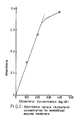
- the response to cholesterol concentration was obtained in the following manner: To an enzyme film in a vial, 1 ml of 6% TChA solution in 0.1 M phosphate buffer and .04 ml of cholesterol standard solution (between 100 - 400 mg/dl cholesterol) were added and the vial was incubated at 37°C for an hour. The resultant solution in the vial was diluted fourfold with DI water and resultant pinkish color observed against a blank at 500 nm in a visible spectrophotometer. The blank had identical composition except, instead of cholesterol, de-ionized water was added. The response was proportional to cholesterol concentration, with tolune films showing the strongest color. The response of toluene film is shown in Figure 2.
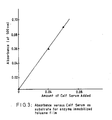
- Example 1 Two toluene films of Example 1 were taken in separate vials and to these 1 ml of 6 g% TChA solution in 0.1 M phosphate buffer was added followed by 0.04 and 0.08 ml of calf serum respectively. The vials were then incubated for 1 hour at 37°C and the solutions were diluted fourfold with DI water. The resultant pinkish colors were measured at 500 mm against a blank (treated identically but without the serum). The response is shown in Figure 3 is proportional to the amount of calf serum. The cholesterol in the calf serum was determined to be 55 mg/dl as judged from the results of Figure 2.
- Ultrafiltration membranes were made by dissolving polyacrylonitrile in DMSO at a concentration of 6% by weight and the solution filtered through 5 micron stainless steel wire mesh.
- the filtered solutions were cast on glass plates with a doctor knife, with a casting thickness of 10 mils and immediately coagulated in DI water at room temperature.
- the resultant membranes were of ultrafiltration type, with a shiny skin and porous substructure.
- the molecular weight cut-off was about 100,000 but the pores on the underside were large enough to allow blue dextran (mol. wt. 2,000,000 daltons) to penetrate through.
- the films of examples 1 and 3 were heated in vials at 60°C for 3 hours.
- the films containing immobilized enzyme in the aqueous buffer as well as free buffered enzyme solutions were also heated as controls.
- the free enzyme solutions were heated for only 1 hour at 60°C.
- the vials were allowed to cool to room temperature and 0.25 ml chromophore and 0.75 ml of 6% TChA activator solution in phosphate buffer were added to the films.
- 0.25 ml each of the chromophore and activator solutions were added to 0.5 ml of enzyme solution.
- 0.04 ml of 400 mg/dl cholesterol standard was added to each of these solutions and the solution was incubated at 37°C for 45 minutes.
- 0.25 ml chromophore and 0.75 ml of activator solution was heated in an identical manner followed by five fold dilution with DI water.
- the chromophore solution had 4.9 m mol/liter 4 aminoantiyrine and 106.3 m mol/liter of phenol in 0.1 M phosphate buffer.
- the trend is similar to that observed at 60°C.
- the aqueous enzyme solution is minimally active.
- the aqueous solution of enzymes 0.5 ml. volume
- the toluene film of Example 1 were at least 35 - 40 times as active as compared to free aqueous solution or aqueous immobilized films of Example 1.
- the toluene films of Example 3 were at least 15 times as active as compared to free native solutions.
- the other organic films with dodecane, and heptanol were also at least 15-20 times as active as the free enzyme solution.
Landscapes
- Chemical & Material Sciences (AREA)
- Organic Chemistry (AREA)
- Life Sciences & Earth Sciences (AREA)
- Zoology (AREA)
- Wood Science & Technology (AREA)
- Engineering & Computer Science (AREA)
- Health & Medical Sciences (AREA)
- Genetics & Genomics (AREA)
- Bioinformatics & Cheminformatics (AREA)
- Microbiology (AREA)
- Biochemistry (AREA)
- General Health & Medical Sciences (AREA)
- General Engineering & Computer Science (AREA)
- Biotechnology (AREA)
- Proteomics, Peptides & Aminoacids (AREA)
- Physics & Mathematics (AREA)
- Biophysics (AREA)
- Immunology (AREA)
- Analytical Chemistry (AREA)
- Molecular Biology (AREA)
- Dispersion Chemistry (AREA)
- Biomedical Technology (AREA)
- Mycology (AREA)
- Chemical Kinetics & Catalysis (AREA)
- General Chemical & Material Sciences (AREA)
- Immobilizing And Processing Of Enzymes And Microorganisms (AREA)
- Measuring Or Testing Involving Enzymes Or Micro-Organisms (AREA)
- Enzymes And Modification Thereof (AREA)
Applications Claiming Priority (2)
| Application Number | Priority Date | Filing Date | Title |
|---|---|---|---|
| US92251786A | 1986-10-24 | 1986-10-24 | |
| US922517 | 1986-10-24 |
Publications (2)
| Publication Number | Publication Date |
|---|---|
| EP0265253A2 true EP0265253A2 (fr) | 1988-04-27 |
| EP0265253A3 EP0265253A3 (fr) | 1990-01-10 |
Family
ID=25447148
Family Applications (1)
| Application Number | Title | Priority Date | Filing Date |
|---|---|---|---|
| EP87309324A Withdrawn EP0265253A3 (fr) | 1986-10-24 | 1987-10-21 | Enzyme dispersé stabilisé |
Country Status (3)
| Country | Link |
|---|---|
| EP (1) | EP0265253A3 (fr) |
| JP (1) | JPS63192389A (fr) |
| CA (1) | CA1291430C (fr) |
Cited By (7)
| Publication number | Priority date | Publication date | Assignee | Title |
|---|---|---|---|---|
| WO1990011786A1 (fr) * | 1989-04-10 | 1990-10-18 | Pharmacia Ab | Composition contenant une enzyme pour le nettoyage de verres de contact et methode pour un tel nettoyage |
| EP0331521A3 (fr) * | 1988-03-04 | 1991-01-23 | Kingston Technologies, Inc. | Compositions à base de polyacrylonitrile et procédé pour leur préparation |
| EP0430395A1 (fr) * | 1989-11-24 | 1991-06-05 | Kingston Diagnostics, L.P. | Enzymes stabilisées dispersées |
| WO1992022814A1 (fr) * | 1991-06-19 | 1992-12-23 | Hypoguard (Uk) Limited | Milieu de support |
| WO1992022815A1 (fr) * | 1991-06-19 | 1992-12-23 | Hypoguard (Uk) Limited | Milieu de support |
| WO1994025564A1 (fr) * | 1993-04-28 | 1994-11-10 | Zeneca Limited | Bacteries viables |
| CN110862150A (zh) * | 2019-12-10 | 2020-03-06 | 浙江永续环境工程有限公司 | 一种应用污水处理复合菌剂的污水处理方法 |
-
1987
- 1987-10-21 EP EP87309324A patent/EP0265253A3/fr not_active Withdrawn
- 1987-10-23 JP JP26800287A patent/JPS63192389A/ja active Pending
- 1987-10-23 CA CA000550164A patent/CA1291430C/fr not_active Expired - Lifetime
Cited By (7)
| Publication number | Priority date | Publication date | Assignee | Title |
|---|---|---|---|---|
| EP0331521A3 (fr) * | 1988-03-04 | 1991-01-23 | Kingston Technologies, Inc. | Compositions à base de polyacrylonitrile et procédé pour leur préparation |
| WO1990011786A1 (fr) * | 1989-04-10 | 1990-10-18 | Pharmacia Ab | Composition contenant une enzyme pour le nettoyage de verres de contact et methode pour un tel nettoyage |
| EP0430395A1 (fr) * | 1989-11-24 | 1991-06-05 | Kingston Diagnostics, L.P. | Enzymes stabilisées dispersées |
| WO1992022814A1 (fr) * | 1991-06-19 | 1992-12-23 | Hypoguard (Uk) Limited | Milieu de support |
| WO1992022815A1 (fr) * | 1991-06-19 | 1992-12-23 | Hypoguard (Uk) Limited | Milieu de support |
| WO1994025564A1 (fr) * | 1993-04-28 | 1994-11-10 | Zeneca Limited | Bacteries viables |
| CN110862150A (zh) * | 2019-12-10 | 2020-03-06 | 浙江永续环境工程有限公司 | 一种应用污水处理复合菌剂的污水处理方法 |
Also Published As
| Publication number | Publication date |
|---|---|
| JPS63192389A (ja) | 1988-08-09 |
| EP0265253A3 (fr) | 1990-01-10 |
| CA1291430C (fr) | 1991-10-29 |
Similar Documents
| Publication | Publication Date | Title |
|---|---|---|
| AU597120B2 (en) | Stabilized dispersed enzyme | |
| US6051389A (en) | Enzyme sensor | |
| Arica et al. | Immobilization of glucose oxidase in poly (2-hydroxyethyl methacrylate) membranes | |
| US4781890A (en) | Multilayer chemical analytical element | |
| PT88183B (pt) | Sensor do tipo electrodo de enzima e processo para realizar analises utilizando esse sensor | |
| US3972776A (en) | Preparation of protein membranes containing microbial cells | |
| EP0265253A2 (fr) | Enzyme dispersé stabilisé | |
| EP0194578B1 (fr) | Protéines immobilisées sur polyamides ou hydrate de cellulose et leur application à la préparation de biocatalyseurs, bandes d'essai ou matériaux pour chromatographie | |
| EP0430395A1 (fr) | Enzymes stabilisées dispersées | |
| Trusek-Holownia et al. | An integrated process: Ester synthesis in an enzymatic membrane reactor and water sorption | |
| CN103374562B (zh) | 一种酶固定化方法 | |
| Murtinho et al. | Cellulose derivatives membranes as supports for immobilisation of enzymes | |
| EP0244825B1 (fr) | Elément sec pour l'analyse du cholestérol | |
| CN102277348B (zh) | 一种用高碘酸钠氧化法固定化磷脂酶a1的方法 | |
| JPH08509124A (ja) | リポーター酵素放出技術:アスパラギン酸プロテアーゼ及びその他の加水分解酵素活性の存在についての検定方法 | |
| Elcin et al. | Polyester film strips coated with photographic gelatin containing immobilized glucose oxidase hardened by chromium (III) sulphate | |
| CA1290271C (fr) | Materiel et methode pour activer la croissance de bacteries anaerobiques | |
| JPH09318588A (ja) | バイオセンサおよびその製造方法 | |
| DD294729A5 (de) | Verfahren zur herstellung von immobilisaten mit biologisch aktiven, makromolekularen verbindungen | |
| US4184919A (en) | Method of gelling microbial mycelia | |
| Cantarella et al. | Preparation and properties of co-reticulated invertase supported by an ultrafiltration membrane | |
| JP2012095648A (ja) | 安定化されたタンパク質を含む生体活性組成物及びその製造方法 | |
| Kato et al. | Lipid-membrane characteristics of large lipid-vesicles prepared by two-step emulsification technique and enzymatic NAD+-recycling in the vesicles | |
| Ishimori et al. | Stress sensitive glucose oxidase-nylon membrane | |
| JPH02182192A (ja) | 酵素反応方法 |
Legal Events
| Date | Code | Title | Description |
|---|---|---|---|
| PUAI | Public reference made under article 153(3) epc to a published international application that has entered the european phase |
Free format text: ORIGINAL CODE: 0009012 |
|
| AK | Designated contracting states |
Kind code of ref document: A2 Designated state(s): AT BE CH DE ES FR GB GR IT LI LU NL SE |
|
| PUAL | Search report despatched |
Free format text: ORIGINAL CODE: 0009013 |
|
| AK | Designated contracting states |
Kind code of ref document: A3 Designated state(s): AT BE CH DE ES FR GB GR IT LI LU NL SE |
|
| 17P | Request for examination filed |
Effective date: 19900710 |
|
| RAP1 | Party data changed (applicant data changed or rights of an application transferred) |
Owner name: KINGSTON TECHNOLOGIES, INC. |
|
| 17Q | First examination report despatched |
Effective date: 19920204 |
|
| STAA | Information on the status of an ep patent application or granted ep patent |
Free format text: STATUS: THE APPLICATION IS DEEMED TO BE WITHDRAWN |
|
| 18D | Application deemed to be withdrawn |
Effective date: 19920616 |
|
| RIN1 | Information on inventor provided before grant (corrected) |
Inventor name: THAKORE, YATIN B. |