EP0265940A2 - Verfahren zum Rückgewinnen von Silber aus verbrauchten sauren Entwicklerlösungen - Google Patents
Verfahren zum Rückgewinnen von Silber aus verbrauchten sauren Entwicklerlösungen Download PDFInfo
- Publication number
- EP0265940A2 EP0265940A2 EP87115889A EP87115889A EP0265940A2 EP 0265940 A2 EP0265940 A2 EP 0265940A2 EP 87115889 A EP87115889 A EP 87115889A EP 87115889 A EP87115889 A EP 87115889A EP 0265940 A2 EP0265940 A2 EP 0265940A2
- Authority
- EP
- European Patent Office
- Prior art keywords
- vessel
- silver
- copper
- finely divided
- metal salt
- Prior art date
- Legal status (The legal status is an assumption and is not a legal conclusion. Google has not performed a legal analysis and makes no representation as to the accuracy of the status listed.)
- Withdrawn
Links
- 229910052709 silver Inorganic materials 0.000 title claims abstract description 78
- 239000004332 silver Substances 0.000 title claims abstract description 78
- 239000012530 fluid Substances 0.000 title claims abstract description 46
- 238000012545 processing Methods 0.000 title claims abstract description 38
- 238000000034 method Methods 0.000 title claims abstract description 24
- 239000002699 waste material Substances 0.000 title claims abstract description 19
- 238000011084 recovery Methods 0.000 title claims abstract description 16
- 230000002378 acidificating effect Effects 0.000 title claims abstract description 15
- BQCADISMDOOEFD-UHFFFAOYSA-N Silver Chemical compound [Ag] BQCADISMDOOEFD-UHFFFAOYSA-N 0.000 claims abstract description 64
- XEEYBQQBJWHFJM-UHFFFAOYSA-N Iron Chemical compound [Fe] XEEYBQQBJWHFJM-UHFFFAOYSA-N 0.000 claims abstract description 60
- 239000002184 metal Substances 0.000 claims abstract description 37
- 229910052751 metal Inorganic materials 0.000 claims abstract description 37
- 150000003839 salts Chemical class 0.000 claims abstract description 35
- 229910052742 iron Inorganic materials 0.000 claims abstract description 30
- 229910000831 Steel Inorganic materials 0.000 claims abstract description 24
- 239000010959 steel Substances 0.000 claims abstract description 24
- 210000002268 wool Anatomy 0.000 claims abstract description 22
- -1 silver halide Chemical class 0.000 claims abstract description 20
- RYGMFSIKBFXOCR-UHFFFAOYSA-N Copper Chemical compound [Cu] RYGMFSIKBFXOCR-UHFFFAOYSA-N 0.000 claims abstract description 11
- 229910052802 copper Inorganic materials 0.000 claims abstract description 11
- 239000010949 copper Substances 0.000 claims abstract description 11
- BDOSMKKIYDKNTQ-UHFFFAOYSA-N cadmium atom Chemical compound [Cd] BDOSMKKIYDKNTQ-UHFFFAOYSA-N 0.000 claims abstract description 9
- 229910052793 cadmium Inorganic materials 0.000 claims abstract description 7
- ARUVKPQLZAKDPS-UHFFFAOYSA-L copper(II) sulfate Chemical compound [Cu+2].[O-][S+2]([O-])([O-])[O-] ARUVKPQLZAKDPS-UHFFFAOYSA-L 0.000 claims abstract description 6
- MPTQRFCYZCXJFQ-UHFFFAOYSA-L copper(II) chloride dihydrate Chemical compound O.O.[Cl-].[Cl-].[Cu+2] MPTQRFCYZCXJFQ-UHFFFAOYSA-L 0.000 claims abstract description 5
- QCUOBSQYDGUHHT-UHFFFAOYSA-L cadmium sulfate Chemical compound [Cd+2].[O-]S([O-])(=O)=O QCUOBSQYDGUHHT-UHFFFAOYSA-L 0.000 claims abstract description 4
- 229910000331 cadmium sulfate Inorganic materials 0.000 claims abstract description 4
- 229910000366 copper(II) sulfate Inorganic materials 0.000 claims abstract 3
- 239000000463 material Substances 0.000 claims description 7
- QTBSBXVTEAMEQO-UHFFFAOYSA-N Acetic acid Chemical compound CC(O)=O QTBSBXVTEAMEQO-UHFFFAOYSA-N 0.000 description 12
- 239000000243 solution Substances 0.000 description 12
- 239000010802 sludge Substances 0.000 description 8
- 239000007787 solid Substances 0.000 description 7
- JZCCFEFSEZPSOG-UHFFFAOYSA-L copper(II) sulfate pentahydrate Chemical compound O.O.O.O.O.[Cu+2].[O-]S([O-])(=O)=O JZCCFEFSEZPSOG-UHFFFAOYSA-L 0.000 description 6
- 238000012360 testing method Methods 0.000 description 5
- 238000004458 analytical method Methods 0.000 description 4
- 235000012489 doughnuts Nutrition 0.000 description 4
- 238000007792 addition Methods 0.000 description 3
- 229910000365 copper sulfate Inorganic materials 0.000 description 3
- 239000000203 mixture Substances 0.000 description 3
- QAOWNCQODCNURD-UHFFFAOYSA-N Sulfuric acid Chemical compound OS(O)(=O)=O QAOWNCQODCNURD-UHFFFAOYSA-N 0.000 description 2
- 239000006227 byproduct Substances 0.000 description 2
- 150000001661 cadmium Chemical class 0.000 description 2
- 230000005465 channeling Effects 0.000 description 2
- 150000001879 copper Chemical class 0.000 description 2
- 230000002939 deleterious effect Effects 0.000 description 2
- 239000002244 precipitate Substances 0.000 description 2
- 239000000047 product Substances 0.000 description 2
- 239000000126 substance Substances 0.000 description 2
- DHCDFWKWKRSZHF-UHFFFAOYSA-L thiosulfate(2-) Chemical compound [O-]S([S-])(=O)=O DHCDFWKWKRSZHF-UHFFFAOYSA-L 0.000 description 2
- CPELXLSAUQHCOX-UHFFFAOYSA-M Bromide Chemical compound [Br-] CPELXLSAUQHCOX-UHFFFAOYSA-M 0.000 description 1
- JPVYNHNXODAKFH-UHFFFAOYSA-N Cu2+ Chemical compound [Cu+2] JPVYNHNXODAKFH-UHFFFAOYSA-N 0.000 description 1
- DGAQECJNVWCQMB-PUAWFVPOSA-M Ilexoside XXIX Chemical compound C[C@@H]1CC[C@@]2(CC[C@@]3(C(=CC[C@H]4[C@]3(CC[C@@H]5[C@@]4(CC[C@@H](C5(C)C)OS(=O)(=O)[O-])C)C)[C@@H]2[C@]1(C)O)C)C(=O)O[C@H]6[C@@H]([C@H]([C@@H]([C@H](O6)CO)O)O)O.[Na+] DGAQECJNVWCQMB-PUAWFVPOSA-M 0.000 description 1
- FOIXSVOLVBLSDH-UHFFFAOYSA-N Silver ion Chemical compound [Ag+] FOIXSVOLVBLSDH-UHFFFAOYSA-N 0.000 description 1
- LSNNMFCWUKXFEE-UHFFFAOYSA-N Sulfurous acid Chemical compound OS(O)=O LSNNMFCWUKXFEE-UHFFFAOYSA-N 0.000 description 1
- 238000010521 absorption reaction Methods 0.000 description 1
- 239000003929 acidic solution Substances 0.000 description 1
- 125000000129 anionic group Chemical group 0.000 description 1
- 150000001450 anions Chemical class 0.000 description 1
- 239000007864 aqueous solution Substances 0.000 description 1
- 238000001479 atomic absorption spectroscopy Methods 0.000 description 1
- 150000001768 cations Chemical class 0.000 description 1
- 238000006243 chemical reaction Methods 0.000 description 1
- 238000013461 design Methods 0.000 description 1
- 238000006073 displacement reaction Methods 0.000 description 1
- 230000005611 electricity Effects 0.000 description 1
- 238000002474 experimental method Methods 0.000 description 1
- 230000005484 gravity Effects 0.000 description 1
- 238000012544 monitoring process Methods 0.000 description 1
- 238000007747 plating Methods 0.000 description 1
- 238000005086 pumping Methods 0.000 description 1
- 230000000717 retained effect Effects 0.000 description 1
- 238000007086 side reaction Methods 0.000 description 1
- 150000003378 silver Chemical class 0.000 description 1
- 229910052708 sodium Inorganic materials 0.000 description 1
- 239000011734 sodium Substances 0.000 description 1
- 238000010561 standard procedure Methods 0.000 description 1
Images
Classifications
-
- C—CHEMISTRY; METALLURGY
- C22—METALLURGY; FERROUS OR NON-FERROUS ALLOYS; TREATMENT OF ALLOYS OR NON-FERROUS METALS
- C22B—PRODUCTION AND REFINING OF METALS; PRETREATMENT OF RAW MATERIALS
- C22B11/00—Obtaining noble metals
- C22B11/04—Obtaining noble metals by wet processes
- C22B11/042—Recovery of noble metals from waste materials
- C22B11/046—Recovery of noble metals from waste materials from manufactured products, e.g. from printed circuit boards, from photographic films, paper or baths
-
- Y—GENERAL TAGGING OF NEW TECHNOLOGICAL DEVELOPMENTS; GENERAL TAGGING OF CROSS-SECTIONAL TECHNOLOGIES SPANNING OVER SEVERAL SECTIONS OF THE IPC; TECHNICAL SUBJECTS COVERED BY FORMER USPC CROSS-REFERENCE ART COLLECTIONS [XRACs] AND DIGESTS
- Y02—TECHNOLOGIES OR APPLICATIONS FOR MITIGATION OR ADAPTATION AGAINST CLIMATE CHANGE
- Y02P—CLIMATE CHANGE MITIGATION TECHNOLOGIES IN THE PRODUCTION OR PROCESSING OF GOODS
- Y02P10/00—Technologies related to metal processing
- Y02P10/20—Recycling
Definitions
- This invention relates to an improved process for recovering silver from waste, acidic photographic processing fluids.
- This invention also relates to an apparatus for recovering silver from waste, acidic photographic processing fluids.
- Fixer solution is used to dissolve out the unexposed and thus undeveloped silver halide of a photographic element in order to "fix" the image.
- Fixer solutions are usually acidic, e.g., due to the presence of acetic acid. Since silver is an important resource, and is expensive, numerous methods of recovering silver have been developed. These methods include two basic systems, one depending on electrolytic methods and the second utilizing a chemical replacement by a baser and less expensive metal; i.e., a metal higher in the electromotive series than silver. Both systems have advantages and disadvantages.
- the electrolytic system consumes electricity and that too can be expensive and is inefficient, with the effluent solution containing 200 ppm or more of silver.
- the chemical replacement system is also not generally efficient. Both systems, in addition, tend to produce a black, finely divided solid precipitate known as "black sludge" that plugs and clogs the system, and the solution containing more silver thus bypasses the system and is lost. This lost silver is not only economically disadvantageous but also represents a pollution problem and thus is ecologically unsound.
- a process for the recovery of silver from spent, waste acidic silver halide photographic processing fluid which comprises passing the waste processing fluid through finely divided iron contained in a vessel and recovering the fluid containing substantially no dissolved silver, the improvement wherein the vessel contains a minor amount with respect to the amount of finely divided iron of a metal salt wherein the metal is taken from the group consisting of copper and cadmium.
- an apparatus for the recovery of silver from spent, waste acidic silver halide photographic processing fluid comprising
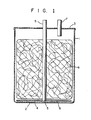
- FIG. 1 With reference to FIG. 1 there is shown a vertical cross-sectional view of a preferred mode of a silver recovery apparatus wherein the vessel 1 has a flat bottom 2 and a top 3 which can be removable. Alternatively, the top can be fixedly attached to vessel 1 so that it must be cut in order to be removed.
- a plate 4 Located in the bottom area of the vessel 1 is a plate 4 preferably containing perforations, the plate being capable of dispersing spent, waste acidic silver halide photographic processing fluid that enters the vessel 1 through inlet 5.
- the vessel Above the plate 4 the vessel is at least substantially filled with finely divided iron 6, e.g., in the form of steel wool.
- An outlet 7 is present in the vessel for removal of the substantially silver free processing fluid in the vessel 1.
- a copper or cadmium metal salt 8 which may be in dry form or present as a solution, e.g., aqueous solution; is present in the vessel 1, generally located in the area below plate 4.
- the design of the apparatus can vary but the spent, waste photographic processing fluid must be capable of entering the vessel and come in sufficient contact with the finely divided iron and metal salt prior to exiting from the vessel to remove at least a substantial amount of silver from the spent, waste photographic processing fluid.
- the apparatus can be used as part of an automatic processing unit. Several apparatus are utilized, e.g., up to five or more, if necessary.
- the processing fluid enters into one apparatus of the type described above and flows, e.g., by pumping means, by gravity forces, etc., consecutively through a series of similar apparatus. After leaving the last apparatus the processing fluid may pass through a silver detector device which measures the remaining silver in the processing fluid.
- one or more individual recovery apparatus may be replaced as sufficient silver is reclaimed.
- the vessel 1, plate 4, inlet tube 5 and outlet tube 7 are made of materials which are inert to the acidic silver halide photographic processing fluid. Inert plastic is a preferred type of material but other materials known to those skilled in the art can be used including metal.
- the finely divided iron 6 preferably is present in the form of steel wool. Woven steel screen wire and wound steel wire may also be used.
- the vessel is preferably essentially filled with the finely divided iron 6 above plate 4.
- the metal salt 8, whether solid or in solution is preferably present at the bottom of vessel 1 under plate 4 in minor amount relative to the finely divided iron 6.
- Metal salts that have been found to be useful in combination with the finely divided iron include: copper sulfate, copper(II)chloride dihydrate, cadmium sulfate, as well as other copper and cadmium salts. Copper salts, e.g., copper sulfate pentahydrate, are preferred primarily because they are less expensive. The anionic portion of the salt does not appear to be critical for practical useful results.
- the ratio of finely divided iron to metal salt ranges from 25 to 1 to 4 to 1 weight to weight. By way of illustration but not limitation, 500 g to 2,500 g of the metal salt are present in combination with 24 pounds ( ⁇ 10,886 g) of finely divided iron. A preferred amount of copper sulfate pentahydrate is 1,000 g per 24 pounds ( ⁇ 10,886 g) of steel wool.
- spent, waste silver halide photographic processing fluid which may be acidic due to the presence of acetic acid or sulfuric acid, acetic acid mixtures, is passed into the vessel 1 through inlet 5 whereby the processing fluid flows into the area of the vessel below plate 4 which, preferably being perforated, permits the processing fluid to be evenly dispersed first over the metal salt 8 and then up through the finely divided iron 6. Subsequently the processing fluid leaves the apparatus through outlet 7.
- the amount of time that the processing fluid takes as it passes through the apparatus depends on variables such as concentration of silver, geometry and size of the collecting apparatus, flow through rate, etc.
- the residual time is best defined by silver analysis of the effluent and can vary widely.
- the processing fluid will have substantially no dissolved silver therein and can be safely, economically and ecologically disposed.
- Previous silver recovery systems do not utilize a metal salt according to the present invention, and thus these systems are not as efficient.
- the dry contents of a prior art vessel may contain 30 to 70% silver and, in addition, much black sludge.
- a metal salt e.g., copper sulfate
- the use of metal salt preserves the initial structure of the finely divided iron, e.g., steel wool, thereby preventing plugging and channeling, inhibits side reactions and enhances the conversion of iron to silver.
- the instant invention due to the presence of the copper and cadmium metal salts provides an improved process for recovering silver from spent, waste, acidic silver halide photographic processing fluids, e.g., fixer solution as well as other acidic solutions containing dissolved silver.
- these fluids e.g., fixer solution as well as other acidic solutions containing dissolved silver.
- these fluids typically contain acetic acid, relatively large amounts of thiosulfate, sulfite, bromide, sodium and possibly some tetrathionate ions, etc.
- the presence of the relatively small amount of metal salt in the silver recovery apparatus surprisingly improves the utility of silver recovery by not only reducing the amount of black sludge formed as well as other deleterious by-products but has been found to increase the silver analysis to 90% by weight or more.
- the initial structure or form of the finely divided iron, e.g., steel wool, is also retained so that channeling and plugging is avoided.
- the process and apparatus are easily adaptable into an automatic processing unit.
- exposed, photographic elements are sent into these processors and carried along via rollers and the like through developer, wash, fixer, and wash solutions and the films then automatically dried.
- Conventionally fresh developer and fixer (replenishment) are added at rates determined by film throughput and some spent fluids are withdrawn simultaneously.
- the spent fixer which is acidic in nature, contains the highest amount of dissolved silver halide and it is this fluid to which this invention is primarily drawn.
- Completion of the displacement reaction and, hence, exhaustion of the available iron in the cannister was made by monitoring the amount of silver in the effluent stream by atomic absorption spectroscopy.
- the volume of the cannisters used is proportional to the throughput.
- Cannisters representing this invention e.g., containing 1000 grams of copper sulfate pentahydrate added to the cannisters as dry solid before the introduction of the spent fixer, provided the following results:
- the output silver from the improved process is pure enough to be refined for reclamation of silver values without the intermediate steps required for the control material.
- Copper(II)chloride dihydrate used at approximately equal copper(II) ion concentration to that supplied by copper(II)sulfate pentahydrate, was tested and found to yield substantially equivalent improvement in silver plating efficiency when added to steel wool as a dry solid and then flooded with spent photographic fixer as described in Example 1.
- the mixture was covered with 100 g of spent photographic fixer containing 3600 ppm of silver in the form of its thiosulfate anion complex.
- the mixture was allowed to remain in contact on a back-and-forth motion shaker for 1.5 hours.
- the fixer was then drained off and analyzed for silver using atomic absorption spectrophotometer and standard techniques.
- a second fixer charge was then added and the process repeated with no further addition of copper salt.
- a third fixer charge was added. Silver ion analysis of the effluent is shown below.
- Both salts caused approximately equivalent removal of silver.
- the liquor was clear and colorless, the steel wool was uniformly plated with bright silver and structurally intact, and there was only a small amount of black sludge, finely divided solid black precipitate formed.
- a control using only steel wool was effective in removing silver (e.g. 10.2 ppm mean) but contained black sludge, had a black effluent solution and the steel wool was structurally degraded.
- Example 2 A series of tests, similar to those described in Example 2, above, were made. 5.0 g of steel wool containing added solid salts of various cations were contacted with successive 100 g portions of spent photographic fixer containing 3600 ppm of complexed silver. The technique described in Example 2, above, was employed. Results of this series are given in Table 1 below.
Landscapes
- Chemical & Material Sciences (AREA)
- Engineering & Computer Science (AREA)
- Organic Chemistry (AREA)
- Materials Engineering (AREA)
- Mechanical Engineering (AREA)
- Metallurgy (AREA)
- Manufacturing & Machinery (AREA)
- Silver Salt Photography Or Processing Solution Therefor (AREA)
- Removal Of Specific Substances (AREA)
- Manufacture And Refinement Of Metals (AREA)
- Heat Treatment Of Water, Waste Water Or Sewage (AREA)
- Treatment Of Sludge (AREA)
- Water Treatment By Electricity Or Magnetism (AREA)
Applications Claiming Priority (2)
| Application Number | Priority Date | Filing Date | Title |
|---|---|---|---|
| US06/925,296 US4740244A (en) | 1986-10-31 | 1986-10-31 | Process for recovery of silver from spent, waste, acidic processing fluids |
| US925296 | 1986-10-31 |
Publications (2)
| Publication Number | Publication Date |
|---|---|
| EP0265940A2 true EP0265940A2 (de) | 1988-05-04 |
| EP0265940A3 EP0265940A3 (de) | 1990-01-17 |
Family
ID=25451522
Family Applications (1)
| Application Number | Title | Priority Date | Filing Date |
|---|---|---|---|
| EP19870115889 Withdrawn EP0265940A3 (de) | 1986-10-31 | 1987-10-29 | Verfahren zum Rückgewinnen von Silber aus verbrauchten sauren Entwicklerlösungen |
Country Status (7)
| Country | Link |
|---|---|
| US (1) | US4740244A (de) |
| EP (1) | EP0265940A3 (de) |
| JP (1) | JPS63128137A (de) |
| AU (1) | AU576705B2 (de) |
| CA (1) | CA1303859C (de) |
| IN (1) | IN169924B (de) |
| NO (1) | NO874522L (de) |
Cited By (2)
| Publication number | Priority date | Publication date | Assignee | Title |
|---|---|---|---|---|
| WO1991012565A1 (en) * | 1990-02-08 | 1991-08-22 | Eskofot A/S | Method and apparatus for removing silver in the form of silver salts from a liquid |
| WO1995033692A1 (en) * | 1994-06-07 | 1995-12-14 | Trebla Chemical Company | Apparatus and method for recovery of silver |
Families Citing this family (17)
| Publication number | Priority date | Publication date | Assignee | Title |
|---|---|---|---|---|
| US4874530A (en) * | 1986-12-05 | 1989-10-17 | Knica Corporation | Method for treating photographic processing waste solution |
| WO1989005866A1 (en) * | 1987-12-15 | 1989-06-29 | Systratec Services Pty. Ltd. | Metal recovery process |
| US4881973A (en) * | 1988-02-01 | 1989-11-21 | E. I. Du Pont De Nemours And Company | Life silver recovery system |
| US5004212A (en) * | 1990-01-29 | 1991-04-02 | E. I. Du Pont De Nemours And Company | Apparatus with improved flow-through characteristics for the recovery of silver from silver-containing waste fluids |
| US5445714A (en) * | 1990-06-27 | 1995-08-29 | Eco Stills, Inc. | Waste materials concentrator |
| WO1992000128A1 (en) * | 1990-06-27 | 1992-01-09 | Cal Glass Environmental Systems, Inc. | Waste materials concentrator |
| DE4100741A1 (de) * | 1991-01-12 | 1992-07-16 | Basf Ag | Verfahren zur abtrennung von edleren metallionen als eisen aus prozess- und abwaessern |
| US5133873A (en) * | 1991-02-22 | 1992-07-28 | Miles Inc. | Process for removal of copper ions from aqueous effluent |
| US5288728A (en) * | 1992-09-17 | 1994-02-22 | Eastman Kodak Company | Process for recovering silver from photographic solutions |
| US5431825A (en) * | 1992-10-29 | 1995-07-11 | Chemical Waste Management, Inc. | Method for the reduction and stabilization of metals |
| US5472176A (en) * | 1994-07-01 | 1995-12-05 | Fabrikan Company | Silver recovery device |
| US5641452A (en) * | 1995-11-15 | 1997-06-24 | United Resource Recovery Corporation | Device for recovering silver from fluids and process using same |
| GB9623337D0 (en) | 1996-11-08 | 1997-01-08 | Markessinis Andreas | Water treatment process |
| US6145468A (en) * | 1998-10-19 | 2000-11-14 | Woog; Manfred J. | Silver indicator methods and test kit |
| RU2165468C1 (ru) * | 1999-09-28 | 2001-04-20 | Акционерное общество открытого типа "Катализатор" | Способ извлечения серебра из отработанных фоторастворов, промывных и сточных вод |
| US6290897B1 (en) | 2000-01-24 | 2001-09-18 | Eker Y. Chen | Pumpless silver recovery system |
| CN100393898C (zh) * | 2003-09-24 | 2008-06-11 | 苏州大学 | 从含银废液中回收银的方法 |
Family Cites Families (13)
| Publication number | Priority date | Publication date | Assignee | Title |
|---|---|---|---|---|
| US2216765A (en) * | 1939-02-24 | 1940-10-08 | Nat Electric Prod Corp | Electrical lamp connection |
| US2905323A (en) * | 1956-02-28 | 1959-09-22 | Fairview Photo Service Inc | Apparatus for recovery of silver from spent photographic solutions |
| US3043432A (en) * | 1960-01-12 | 1962-07-10 | Fairco Reclaiming Service | Apparatus for recovery of silver from spent photographic solutions |
| US3369801A (en) * | 1965-11-10 | 1968-02-20 | Eastman Kodak Co | Silver recovery unit |
| AU428478B2 (en) * | 1968-07-29 | 1972-09-25 | Silver Recovery Equipment Pty. Limited | A package unit for removing metal froma solution ofthe metal |
| FR2106962A5 (en) * | 1970-09-30 | 1972-05-05 | Louyot Comptoir Lyon Alemand | Recovery of silver - from photographic solutions |
| US3705716A (en) * | 1971-07-09 | 1972-12-12 | Eastman Kodak Co | Monitoring silver recovery |
| AU453543B2 (en) * | 1971-08-04 | 1974-09-16 | Silver Recovery Equipment Pty Limited | A package unit for removing metal froma solution ofthe metal |
| GB1353805A (en) * | 1971-08-20 | 1974-05-22 | Kodak Ltd | Silver recovery |
| US3792845A (en) * | 1972-12-11 | 1974-02-19 | K Larson | Silver recovery unit |
| US4213600A (en) * | 1978-08-07 | 1980-07-22 | Thompson Roy R Jr | Silver reclamation apparatus |
| FR2467887A1 (fr) * | 1979-10-23 | 1981-04-30 | Kodak Pathe | Procede pour la recuperation d'un metal a partir de solutions aqueuses, par echange avec un second metal reducteur |
| US4441697A (en) * | 1982-01-29 | 1984-04-10 | William E. Tipton, Jr. | Silver recovery unit |
-
1986
- 1986-10-31 US US06/925,296 patent/US4740244A/en not_active Expired - Lifetime
-
1987
- 1987-10-27 IN IN840/CAL/87A patent/IN169924B/en unknown
- 1987-10-29 EP EP19870115889 patent/EP0265940A3/de not_active Withdrawn
- 1987-10-29 CA CA 550555 patent/CA1303859C/en not_active Expired - Lifetime
- 1987-10-30 JP JP62273633A patent/JPS63128137A/ja active Granted
- 1987-10-30 AU AU80518/87A patent/AU576705B2/en not_active Ceased
- 1987-10-30 NO NO874522A patent/NO874522L/no unknown
Cited By (3)
| Publication number | Priority date | Publication date | Assignee | Title |
|---|---|---|---|---|
| WO1991012565A1 (en) * | 1990-02-08 | 1991-08-22 | Eskofot A/S | Method and apparatus for removing silver in the form of silver salts from a liquid |
| US5672328A (en) * | 1990-02-08 | 1997-09-30 | Eskofot A/S | Method and apparatus for removing silver in the form of silver salts from a liquid |
| WO1995033692A1 (en) * | 1994-06-07 | 1995-12-14 | Trebla Chemical Company | Apparatus and method for recovery of silver |
Also Published As
| Publication number | Publication date |
|---|---|
| AU576705B2 (en) | 1988-09-01 |
| NO874522L (no) | 1988-05-02 |
| EP0265940A3 (de) | 1990-01-17 |
| US4740244A (en) | 1988-04-26 |
| CA1303859C (en) | 1992-06-23 |
| JPH024661B2 (de) | 1990-01-30 |
| AU8051887A (en) | 1988-05-05 |
| JPS63128137A (ja) | 1988-05-31 |
| NO874522D0 (no) | 1987-10-30 |
| IN169924B (de) | 1992-01-11 |
Similar Documents
| Publication | Publication Date | Title |
|---|---|---|
| US4740244A (en) | Process for recovery of silver from spent, waste, acidic processing fluids | |
| US4854552A (en) | Apparatus for recovery of silver from spent, waste, acidic processing fluids | |
| US5288728A (en) | Process for recovering silver from photographic solutions | |
| CA1232138A (en) | Removal of radium from aqueous liquids | |
| EP0655419A1 (de) | Verfahren zur Behandlung von photographischem Abwasser | |
| US3832453A (en) | Recovery of silver from photographic processing solutions | |
| US4457495A (en) | Apparatus for the automatic recovery of silver from argentiferous wash waters | |
| Aktas | Silver recovery from silver-rich photographic processing solutions by copper | |
| US6387243B1 (en) | Separation of metal ions absorbed on a resin and installation for recycling photographic effluents including an exchanger and an electrolytic vessel | |
| US6042775A (en) | Silver reclamation system | |
| Schreiber | Present Status of Silver Recovery in Motion-Picture Laboratories: A Tutorial Paper | |
| US6277290B1 (en) | Process for recovering silver from photographic solutions | |
| KR19980702743A (ko) | 암모니아성 금속용액 재순환 방법 | |
| JPH0947768A (ja) | 重金属イオンの除去方法及び重金属イオン除去装置 | |
| CA2105416A1 (en) | Method and apparatus for silver recovery from photographic processing solutions | |
| JP3144160B2 (ja) | 水中の放射性物質除去方法 | |
| AU3436402A (en) | Process to remove ferric iron impurities from an acidic aqueous solution used in the electro-winning of copper | |
| US2205792A (en) | Recovery of silver from spent photographic solutions | |
| EP0315374A1 (de) | Vorrichtung und Verfahren für die Entfernung von Abwasser aus Photoprozessen | |
| JP2706134B2 (ja) | 写真処理液の銀回収方法 | |
| EP0761276B1 (de) | Vorrichtung zur Trennung von Abwasser in fester und flüssiger Phase | |
| JPS5934437B2 (ja) | ジシクロヘキシル−24−クラウン−8による水銀分離除去法 | |
| EP0880726B1 (de) | Regenerierung einer erschöpften fixierlösung | |
| Mutter et al. | SMPTE Tutorial Paper: Silver Recovery Management for Motion-Picture Laboratories | |
| Meyers | Recovery of Metals Using Aluminum Displacement |
Legal Events
| Date | Code | Title | Description |
|---|---|---|---|
| PUAI | Public reference made under article 153(3) epc to a published international application that has entered the european phase |
Free format text: ORIGINAL CODE: 0009012 |
|
| AK | Designated contracting states |
Kind code of ref document: A2 Designated state(s): BE CH DE FR GB IT LI LU NL SE |
|
| PUAL | Search report despatched |
Free format text: ORIGINAL CODE: 0009013 |
|
| AK | Designated contracting states |
Kind code of ref document: A3 Designated state(s): BE CH DE FR GB IT LI LU NL SE |
|
| 17P | Request for examination filed |
Effective date: 19900228 |
|
| 17Q | First examination report despatched |
Effective date: 19910627 |
|
| STAA | Information on the status of an ep patent application or granted ep patent |
Free format text: STATUS: THE APPLICATION HAS BEEN WITHDRAWN |
|
| 18W | Application withdrawn |
Withdrawal date: 19910823 |
|
| R18W | Application withdrawn (corrected) |
Effective date: 19910823 |