EP0266313A2 - Prothèse dentaire en alliage fritté - Google Patents
Prothèse dentaire en alliage fritté Download PDFInfo
- Publication number
- EP0266313A2 EP0266313A2 EP87830110A EP87830110A EP0266313A2 EP 0266313 A2 EP0266313 A2 EP 0266313A2 EP 87830110 A EP87830110 A EP 87830110A EP 87830110 A EP87830110 A EP 87830110A EP 0266313 A2 EP0266313 A2 EP 0266313A2
- Authority
- EP
- European Patent Office
- Prior art keywords
- alloy
- die material
- die
- microns
- expansion
- Prior art date
- Legal status (The legal status is an assumption and is not a legal conclusion. Google has not performed a legal analysis and makes no representation as to the accuracy of the status listed.)
- Withdrawn
Links
Images

Classifications
-
- A—HUMAN NECESSITIES
- A61—MEDICAL OR VETERINARY SCIENCE; HYGIENE
- A61C—DENTISTRY; APPARATUS OR METHODS FOR ORAL OR DENTAL HYGIENE
- A61C13/00—Dental prostheses; Making same
- A61C13/08—Artificial teeth; Making same
-
- A—HUMAN NECESSITIES
- A61—MEDICAL OR VETERINARY SCIENCE; HYGIENE
- A61C—DENTISTRY; APPARATUS OR METHODS FOR ORAL OR DENTAL HYGIENE
- A61C13/00—Dental prostheses; Making same
- A61C13/0003—Making bridge-work, inlays, implants or the like
-
- A—HUMAN NECESSITIES
- A61—MEDICAL OR VETERINARY SCIENCE; HYGIENE
- A61K—PREPARATIONS FOR MEDICAL, DENTAL OR TOILETRY PURPOSES
- A61K6/00—Preparations for dentistry
- A61K6/80—Preparations for artificial teeth, for filling teeth or for capping teeth
- A61K6/84—Preparations for artificial teeth, for filling teeth or for capping teeth comprising metals or alloys
- A61K6/844—Noble metals
-
- B—PERFORMING OPERATIONS; TRANSPORTING
- B22—CASTING; POWDER METALLURGY
- B22F—WORKING METALLIC POWDER; MANUFACTURE OF ARTICLES FROM METALLIC POWDER; MAKING METALLIC POWDER; APPARATUS OR DEVICES SPECIALLY ADAPTED FOR METALLIC POWDER
- B22F3/00—Manufacture of workpieces or articles from metallic powder characterised by the manner of compacting or sintering; Apparatus specially adapted therefor ; Presses and furnaces
- B22F3/12—Both compacting and sintering
- B22F3/1208—Containers or coating used therefor
- B22F3/1258—Container manufacturing
- B22F3/1283—Container formed as an undeformable model eliminated after consolidation
-
- B—PERFORMING OPERATIONS; TRANSPORTING
- B22—CASTING; POWDER METALLURGY
- B22F—WORKING METALLIC POWDER; MANUFACTURE OF ARTICLES FROM METALLIC POWDER; MAKING METALLIC POWDER; APPARATUS OR DEVICES SPECIALLY ADAPTED FOR METALLIC POWDER
- B22F3/00—Manufacture of workpieces or articles from metallic powder characterised by the manner of compacting or sintering; Apparatus specially adapted therefor ; Presses and furnaces
- B22F3/10—Sintering only
- B22F2003/1042—Sintering only with support for articles to be sintered
Definitions
- This invention relates to fixed and removable dental prosthetic and similar biomechanical devices such as crowns, inlays, onlays, pontics, bridges and the like, made of sintered metal alloy.
- Other precise sintered alloy pieces may also be provided, such as bone pins, reconstructive bone parts, and other orthopedic devices.
- This invention relates to making and using sintered metal copings, bridges, onlays, inlays, cowns, and the like which have superior physical properties and which show superior dimensional fit, separation and alignment than the usual cast metal prosthetic devices.
- Other short run, biomechanical devices may also be constructed by these same techniques.
- Hitherto metallic dental prosthetic devices have been cast by processes such as investment casting, the "lost wax” process, to yield a homogeneous microstructure of one fine phase or multiphase fine grain microstructures with appreciable porosity.
- the microstructure of the porosity of cast metals is irregular and may even show channels. Often the porosity is spherical in the general range of one micron., The level of porosity is about one percent.
- the liquid phase sintered dental devices of the present invention exhibit under an optical microscope a composite structure.
- discontinuous grains are dispersed in a continuous matrix.
- the heterogeneous two-phase product may show higher melting grains of one composition in a lower melting matrix of another composition. This disparity in composition arises from the fact that the sintering is carried out at a temperature between that of the liquidus and solidus temperatures.
- abutment die material to make a preform for the copings or crowns and a base die material to join the various segments of the bridge, so that a fit of less than 50 microns results when multi- tooth dental devices are made from die materials with different physical and thermal expansions.
- the conventional method for making a dental preform relies on the "lost wax” technique, which involves casting molten metal into a hollow ceramic investment material shaped around an original wax model.
- the wax model is formed to fit precisely a die which is a replica of the prepared surface of the teeth made by the dentist from a dental impression. Therefore, to make a cast alloy or porcelain dental device, such as a full cast crown, veneer crown, coping, pontic, inlay, onlay, or bridge by the lost wax process involves six steps between seven entities: prepared tooth, impression, die, wax model, hollow investment, metal replica, dental device. Trying to accomplish this six-stage process with good dental "fit" leads to variable results ranging from +200 microns or more to a negative fit which cannot be seated upon the original die or prepared tooth.
- the essence of the present invention is a dental prosthetic device made from a liquid-phase, sintered alloy characterized by a multiphase, composite microstructure and low, isolated, spherical porosity.
- the porosity is about 0.5 percent in the form of isolated spherical pores less than ten micrometers.
- the grain structure comprises isolated grains of from about 20 microns to about 80 microns averaging 50 microns in diameter dispersed in a continuous matrix. The grains and matrix may have different elemental compositions even if they arise from the same alloy.
- Another aspect of the present invention is the use of two kinds of ceramic, siliceous, die material in the making of metallic dental prosthetic devices.
- One is an abutment die material having a thermal expansion between ambient and 600°C. of about 0.01 mm/mm (0.008 to 0.015 mm/mm) and a physical expansion of about zero to 0.03 mm/mm.
- the other siliceous base die material has a lower thermal expansion (0.004 to 0.015 mm/mm) and a physical expansion of about zero.
- biomechanical devices such as bone pins, reconstructive bone parts, and other orthopedic devices.
- a powdered, sinterable, alloy with a thermal expansion coefficient of about 0.008 mm/mm (0.004 to 0.015 mm/mm) between ambient and 600°C.
- the abutment die has a positive physical expansion.
- the abutment die material must have a positive physical expansion so that there is a proper fit of the dental device onto the prepared tooth.
- the abutment die has a larger thermal expansion than the alloy between ambient and 700°C. to give a good "separation" for the dental device.
- the multitooth devices show good "alignment" between the various segments of the metallic device, ensured by zero physical expansion and thermal expansion equal to the alloy between ambient and 700°C. of the base die material between the abutments.
- dental prosthetic devices for a single tooth such as a single crown or for several vicinal teeth such as a bridge may be made by the following method, which gives a "fit" between the prosthetic device and the prepared dental surface of less than 50 microns:
- a multitooth device such as a bridge
- two die materials, abutment and base, with tailored thermal and physical expansions are employed, the former for the coping sections and the latter for attaching the coping sections, so that the components of the bridge fit the prepared tooth within 50 microns positive without any cracks or strains, and the bridge has true "alignment” in order to allow proper seating by complete coverting of the margins of the prepared tooth.
- the preferred die materials are proper mixtures of alpha-quartz, alpha-cristobalite, zirconium silicate (zircon), magnesium oxide, monoammonium dihydrogen phosphate, and colloidal silica.
- the preferred alloy contains about 80% palladium.
- the present invention is broadly applicable to all types of dental devices including veneer crowns, full crowns, copings, pontics, inlays, onlays, or bridges.
- Instances which illustrate the invention are single copings with one abutment and three-tooth bridges with two abutments and one pontic, but these are merely illustrative, not limiting.
- the advantages to the dental profession and the patient of the present invention are: high degree of dimensional control for copings and other fixed prosthodontic devices, lower alloy consumption per unit, less labor per unit, shorter processing time, lower porosity parts, stronger parts, reduction in time for receiving the impression to returning the prosthodontic device, and a simpler manual technique.
- Physical expansion is an irreversible change based on change in structure, such as heating kyanite to form mullite, or causing magnesium oxide to react with monoammonium phosphate. Such structural change creates a one-time expansion at a definitive temperature or occurrence.
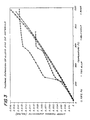
- Thermal expansion is reversible. When a material heats up, it expands. When that material cools, it contracts, as shown in Fig. 3.
- the essence of building a good "fit" into a siliceous die material/dental alloy combination is that the die material has enough one-time physical expansion, so that when the coping on the die model cools down, the coping is larger than the prepared tooth surface, as shown in Fig. 1.
- the coping will be at least 20 microns larger than the model of the prepared tooth. This 20-30 micron increase enables the dentist or technician to get the sintered coping onto the prepared tooth, and provides the proper room for an adhesive holding the coping on the prepared tooth, as shown in Table 1. Ideally this space is less than 50 microns.
- “Horizontal fit” is defined as half the difference between the inner diameter of a liquid-phase sintered alloy coping and the outer diameter of the prepared tooth and shown for idealized teeth of 3-6 mm. in Table 1.
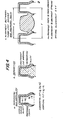
- the “vertical fit” is defined as the difference between the height of a sintered metal coping and that of an idealized tooth as shown in Fig. 4.
- Separatation relates to the ability to remove the sintered alloy coping from the ceramic replication without destroying the latter.
- the abutment die material must have a larger thermal expansion between treatment temperature and the ambient temperature than the sinterable alloy. As shown in Fig. 3, below 900°C the abutment die material has a larger thermal expansion than does a dental alloy. At about 900°C. the ceramic die material and the dental alloy have an equal thermal expansion. Above 900°C. the thermal expansion of a dental alloy continues to increase linearly, but the thermal expansion of the ceramic die material remains almost constant.
- the differential expansion vertical distance between the expansion curves below about 900°C., where the thermal expansion of the die material is greater than that of the dental alloy, must be greater than that above 900°C. where the thermal expansion of the dental alloy is greater.
- a multitooth dental device of the present invention two die materials are preferred, as shown in Fig. 2. These two materials have different thermal expansion, as shown in Fig. 3.
- the abutment die material must have a larger thermal expansion than that of the dental alloy so that there is good "separation” and a positive physical expansion so that there is good "fit”.
- the base die material must have about the same overall thermal expansion as that of the dental alloy in the processing range of temperature so that there is good "alignment!: and hence good "seating" of the finished dental device in the patient's mouth, as well as essentially zero physical expansion. It is an important aspect of the present invention that two different die materials with different thermal expansions be employed for the reason given. They have entirely separate functions, hence must have entirely different thermal expansions.
- the process of the present invention comprises the following steps:
- alpha-quartz which has a high thermal coefficient of expansion. It is essentially pure silica, over 99.5% with small amounts of alumina, iron oxide, and titania in that order plus trace amounts of calcium oxide and magnesium oxide. Preferably most of the quartz particles should pass through a screen of 200 mesh (74 microns); in fact about half of suitable commercial alpha-quartz is less than 20 microns.
- a suitable commercial source is Sil-Co-Sil 295 from the Ottawa Silica Co. of Ottawa, Illinois. In abutment die materials the usual amount of alpha-quartz ranges from 50% to 95%.
- base die material In base die material the usual amount is lower (about 30% to 75%) but compensated by a component with lower thermal expansion such as zircon.
- Alpha-quartz has a thermal expansion of about 1.4% above 600°C. At 573°C. it transforms to beta-quartz.
- alpha-cristobalite Another material, almost pure silica, which may be used interchangeably or in combination with alpha quartz, is alpha-cristobalite, which at about 200°C. is transformed to beta-crostobalite.
- the beta- form has a high thermal expansion rising steadily from about 1.2% at 200°C. to about 1.5% at 1000°C.
- abutment die material from about 5% up to 50% is preferred; in the base die material from about 5% up to about 40%.
- Alpha-cristobalite is commercially available from the CED Process Minerals Co. of Cuyahoga Falls, Ohio in the form of a minus 200 mesh (74 microns) powder, over half of which is less than 20 microns.
- Minus 325 mesh (44 microns) and minus 400 mesh (38 microns) are also suitable and commercially available.
- Fused silica (from about 10% up to about 40% of the total) may also be employed; it has a thermal expansion of about 0.1 percent between ambient and 1000°C.
- zircon in the form of a minus 200 mesh (74 microns) powder. This has a thermal expansion of only about 0.4% between ambient and 1000°C.
- Zircon, zirconium silicate is available from M & T Chemical Co., Rahway, New Jersey.
- the physical expansion of an abutment die material should be about zero to about 3% and its thermal expansion should be greater than that of the sinterable alloy used (good separation). Since the role of the base die material is to maintain a desirable distance between abutments (see Figure 2), it should have a physical expansion approximately zero and a thermal expansion approximately that of the sinterable alloy at about 600°C.-900°C. (0.004-0.015 mm/mm).
- the particle size of alpha-quartz employed is less than about 90 microns; that of alpha-cristobalite is less than about 90 microns.
- the colloidal silica suspensions have a particle size from about 50 to 250 angstroms.
- a siliceous refractory die material is set within a few minutes by mixing the silica with a binder.
- a preferred binder is a mixture of magnesium oxide (5-40% of the total), a suspension of colloidal silica (10-40%) and ammonium dihydrogen phosphate (5-40%).
- Other polyvalent oxides may be employed to react with the colloidal silica, which itself might be replaced by ethyl silicate or other siliceous liquids in amounts from about 10% to 50%.
- the ammonium phosphate acts both as a buffering agent and as a soluble reactant for the polyvalent cation.
- the chemical reaction of the setting reaction should take place within about five minutes. This reaction not only provides the necessary expansion for the finished die to be slightly larger than the original tooth but also gives the die material its "green" strength.
- the concentration of colloidal silica may vary from a about 5% to about 60%.
- the die material is allowed to remain in the impression mould to finish the setting reactions for about one-half to one hour before being removed from the moult and fired. While the die material is still soft one or more dowels or pins may be positioned in the refractory mould, depending on the number of teeth being modeled. Alumina is the preferred material for the dowels.
- a representative formulation for an abutment die material is 13.6 parts alpha-quartz, 2.4 parts alpha-cristobalite, 2.0 parts magnesium oxide, 2.0 parts monoammonium phosphate (all powders), plus about 5 parts aqueous undiluted 40% Ludox HS40 colloidal silica suspension (duPont Co., Wilmington, Delaware). Volumetrically, the desired ratio is 1.2 volumes Ludox suspension per five parts powders (24 ml/100 g). When cured for about 45 minutes and fired at about 1300°C. for 10 minutes, this formulation showed a physical expansion of about 2.5%, a thermal expansion at 600°C of 1.2%, a working time of about five minutes, and a flexural strength of about 16.5 MPa. Another embodiment may comprise up to 40% zircon.
- a representative formulation for a base die material is about 100 parts alpha-quartz, about 20 parts alpha-cristobalite, 15 parts magnesium oxide, 15 parts monoammonium phosphate, 50 parts zircon, and 50 parts 40% colloidal silica aqueous suspension (diluted HS40, duPont).
- the base die material When cured for about one hour and fired at 1300°C for 10 minutes, the base die material showed a thermal expansion of 0.01 mm/mm at 700°C. and a physical expansion of about zero.
- the flexural strength of the fired base die was about 11 MPa.
- the refractory die material may be fired at a temperature range of 900° to 1500°C.
- the preferred temperature is about 1300°C.
- the essence of the present invention is for there to be a positive differential thermal expansion, so that for the outer diameter of die material at room temperature in the range of 3-6 mm, the diameter of the corresponding sintered alloy coping would be about (** +0.006 mm/mm expansion) 3018, 4024, 5030, and 6036 mu respectively.
- As for horizontal fit at least 15-20 mu is preferable, so that there is room between the prepared tooth and the sintered alloy coping for a thin layer of cement of the conventional zinc phosphate or ionomer type.
- the sintering alloy liquid
- contact angle less than 90°
- Young's equation If the sintering alloy has a high contact angle, does not wet the refractory die material, rounded and inaccurate margins may be formed. Also it is more likely for the sintering metal to crack upon shrinking without wetting.
- metallize the refractory die replica with an extremely thin layer of metal about 25 microns (about 8 to about 40 mu) thick.
- One method of metallizing a palladium/silver alloy is to paint it on either fired or unfired refractory die material. Air firing a painted layer on unfired die material saves one step, since the firing performs two functions. Coprecipitated powders with a particulate size of about one micron are suitable. The powder may be dispersed in hydrocarbon thinner. It is preferred to fire the thin metallizing layer between the solidus and liquidus temperature of the alloy. For 60% palladium/40% silver alloys that is about 1350°C.
- High gold/pal- ladium alloys e.g. 80-85% gold can be fired for metallizing at about 1200-1300°C. After firing, the metallizing layer is from about 2 to about 8 microns thick.
- metallizing processes such as plating, vapor deposition, sputtering, flame spraying, and the like may also be used to ensure a low contact angle between the alloy to be sintered and the refractory die material.
- the product of the present invention being a liquid phase sintered dental prosthetic device has a totally different microstructure and hence different properties than the cast dental devices of the prior art.
- Dental alloys made up of more than one metal follow- . ing Gibbs' phase rule, will have a solidus temperature and a liquidus temperature based on the well-known "rabbit-ears" phase diagram of most alloys.
- the sintering process takes place for many of the dental alloys disclosed above in the temperature range of 1000°C-1300°C. because in this range two phases are found simultaneously; a liquidus phase, rich in the low-melting component of the alloy, and a solidus phase, rich in the high-melting component of the alloy.
- the microstructure in the form of a composite there are two components to the microstructure in the form of a composite.
- more than one alloy there may be a plurality of discontinuous granules.
- the composite microstructure of discontinuous rather large grains in a continuous matrix is less porous than the uniformly granular one-phase microstructure of a cast dental device of the prior art.
- Dental prosthetic devices of the present invention are characterized by two or more phases depending on the number of materials in the alloy. These are isolated grains, normally well-rounded and sized from about 20 to about 80 micrometers averaging about 50 microns.
- the continuous phase exhibits essentially no pores, less than 0.5 percent. The few pores are isolated and spherical in the range of less than about ten microns in size.
- Cast dental prosthetic devices of the prior art have a completely different microstructure and porosity than the liquid-phase, sintered devices of the present invention.
- the cast pieces (Amer.Dental Assoc. spec. 38) have a fine grained structure with grains less than 50 microns in one or more phases. There is essentially no continuous matrix and the fine grains are patterned in larger domains, not isolated.
- Furthemore, cast structures have porosity, generally irregular. There may even be visible channels. If there are spherical pores, they are usually very small - about one micron.
- Figure 1 illustrates the process for making a single coping.
- the dentist prepares the tooth mostly by removing unwanted material to form a supporting abutment.
- the second panel taking the impression of the prepared tooth is shown.
- the third panel shows a liquid-sintered alloy coping on the preformed abutment die material made from the impression.
- the fourth panel shows the alloy coping, separated from the abutment die material of panel three, on the prepared tooth with the distance of the fit illustrated. The space of the fit will later be infused with dental cement.
- Figure 2 illustrates the process for making a three-unit bridge.
- the first panel shows the prepared teeth. Two of them have abutment resulting from removed dental material.
- the second panel shows a preform comprising abutment die material, base die material between and under the abutments, and alumina dowels inserted in the abutments.
- the third panel shows a sintered alloy three-unit bridge consisting of alloy coping joined by an alloy pontic on the refractory die after sintering and before separation.
- Figure 3 gives data on the linear thermal expansion of two die materials and two alloys between ambient room temperature and, 1000°C.
- the two alloys have monotonically increasing linear thermal expansion with arcuate data.
- the abutment die material shows a marked increase in thermal expansion at about 250°C. and another at about 575°C., at which point the expansion becomes negligible with increasing temperature.
- the base die material has lesser increases of expansion at the two transition temperatures and a constant value above 600°C.
- the vertical difference between the alloy and abutment die material expansion provides separation.
- the match of the base die material and the alloy between approximately 700°C. and ambient ensures proper alignment of multispan units.
- Figure 4 provides the quantitative basis for defining fit, separation, and alignment.
- panel a horizontal and vertical fit are graphically illustrated. Separation between the abutment die material and a sintered alloy coping is shown in panel b.
- Panel c. shows the identity between tooth spacings in a properly aligned bridge.
- This Example illustrates the use of the present invention to make a single crown coping fitted to less than 50 microns on a prepared tooth and then layer it with dental porcelain.
- a prepared posterior tooth about 6 mm in diameter and 4 mm long in the shape of a truncated cone was prepared to accept a single crown.
- a replica of the prepared tooth was taken using conventional dental elastomer, and the impression was prepared to accept a ceramic die material.
- a powder was mixed consisting of 13.6g. alpha-quartz, 2.4g. alpha-cristobalite, 2g. magnesium oxide and 2g. monoammonium phosphate; 4.8 ml 40 percent Ludox HS 40 brand colloidal silica (duPont Co.) liquid was then stirred in to make an abutment die material of uniform consistency with a working time of about five minutes.
- the abutment die material was vibrated into the impression of the prepared tooth; an alumina holding pin was set into the viscous ceramic; and then it was allowed to set and cure.
- the cured abutment die material was taken out of the impression. It showed a physical expansion of 1.0 percent and a thermal expansion of 0.0135 mm/mm between ambient and 700°C.
- the model tooth was then fired at 135°C for ten minutes in air.
- the fired model was then coated with fine metallizing powder less than five microns of 60/40 palladium/silver alloy in Adsol thinner (Alloy Metals Inc., Troy, Mich.) to give a smooth, uniform coating about 20-30 mu thick.
- Adsol thinner Alloy Metals Inc., Troy, Mich.
- the coated model was then heated another ten minutes at 1350°C. in air to give an applied layer about 5 mu thick.
- a sinterable alloy mixture was then prepared from 79 percent palladium, 10 percent copper, 9 percent gallium, and 2 percent gold and 2 percent (Adsol cement 1260) diluted to a paintable consistency with Adsol thinner.
- a die model was coated to a thickness of about 0.3-0.5 mm and then allowed to air dry. After drying, the die model coated with sinterable alloy was placed in a vacuum furnace at 350°C., which was then evacuated to about 50 millitorr. The following sintering cycle under vacuum was then carried out: 1165°C (2 min.); 750°C (10 min.); then removed at 550°C.
- the thermal expansion from ambient to 700°C. of the sinterable alloy is 0.0095 mm/mm.
- the differential thermal expansion between the abutment die material and the sinterable alloy between ambient and 700°C. is 0.004 mm/mm.
- the coping was separated.
- the alloy coping was touched up with additional sintering alloy powder and refired in the same cycle as above. Prior to adding porcelain the alloy coping is heat treated to oxidize its surface in air at 980°C. for five minutes. The die continued to serve as a support, however, after separation.
- This coping exhibited the usual microstructure of a liquid sintered metal: isolated, rounded grains in a continuous matrix with a low porosity of about 0.5 percent. The individual pores were isolated and spherical less than ten microns in diameter.
- Example 2 illustrates the application of the present invention for making a single crown of an anterior tooth.
- the procedure of Example 1 was used.
- the prepared anterior tooth was 3 mm in diameter and 5 mm high.
- the abutment die material showed 2.0 percent physical expansion and 0.0135 mm/mm thermal expansion.
- This Example illustrates the use of palladium as a metallizing alloy.
- Example 2 The same procedure as in Example 1 was employed except that a 70/30 palladium/silver metallizing alloy powder was used. The firing temperature was increased to 1400°C., between the liquidus and solidus temperatures of this alloy.
- This Example illustrates the use of a lower melting sinterable alloy 92.7 percent Ni/2.8 B/4.5 Si, dental alloy 780, Alloy Metals Inc., Troy, Mich., to prepare a single crown. Because the lower melting alloy was used, the sintering temperature was decreased.
- Example 1 The procedure of Example 1 was used except that the firing step was accomplished at 1020°C. for ten minutes. No precoat metallization step was necessary.
- This Example illustrates the elimination of the heat treatment step at about 700°C.
- Example 1 The procedure of Example 1 was employed except that after sintering the vacuum oven assembly was allowed to cool slowly from the sintering temperature to about 550°C., whereupon the work was removed from the oven.
- This Example illustrates the use of the present invention to make a three-unit bridge.
- Two posterior teeth with a tooth missing between them were prepared in such a way that the three spaces would take a three-unit bridge consisting of two abutments and one pontic.
- the dimensions of the two abutment were similar to the prepared tooth of Example 1.
- the overall length of the bridge was about 25 mm.
- the high expanding abutment die material of the present invention and the merely compensating expansion die material for the base were employed.
- the abutment die material was made, poured, alumina pins inserted, and allowed to set and cure. This abutment die material showed a physical expansion of 1.0 percent and thermal expansion between ambient and 700°C. of 0.0135 mm/mm.
- the base die material was prepared, as above, and poured into the remaining parts of the dental impression to join the abutments, as shown in Fig. 2.
- the base die material showed a physical expansion of zero and a thermal expansion from ambient to 700°C. of 0.0095 mm/mm.
- Example 1 Employing a liquid-sinterable alloy powder (minus 120 mesh) of 79 percent palladium/10 percent copper/9 percent gallium/2 percent gold the two abutments were individually built up and fired, as described in Example 1. In the second stage the sinterable alloy was used to sculp a pontic as shown in Fig. 2. The complete assembly was fired, touched up, refired, and porcelainized as in Example 1.
Landscapes
- Health & Medical Sciences (AREA)
- Oral & Maxillofacial Surgery (AREA)
- Veterinary Medicine (AREA)
- Epidemiology (AREA)
- Life Sciences & Earth Sciences (AREA)
- Animal Behavior & Ethology (AREA)
- General Health & Medical Sciences (AREA)
- Public Health (AREA)
- Dentistry (AREA)
- Plastic & Reconstructive Surgery (AREA)
- Engineering & Computer Science (AREA)
- Manufacturing & Machinery (AREA)
- Mechanical Engineering (AREA)
- Dental Preparations (AREA)
- Dental Prosthetics (AREA)
- Dental Tools And Instruments Or Auxiliary Dental Instruments (AREA)
Applications Claiming Priority (2)
| Application Number | Priority Date | Filing Date | Title |
|---|---|---|---|
| US06/923,898 US4828495A (en) | 1984-04-03 | 1986-10-28 | Sintered alloy dental prosthetic devices and method |
| US923898 | 1986-10-28 |
Publications (2)
| Publication Number | Publication Date |
|---|---|
| EP0266313A2 true EP0266313A2 (fr) | 1988-05-04 |
| EP0266313A3 EP0266313A3 (fr) | 1989-12-06 |
Family
ID=25449438
Family Applications (1)
| Application Number | Title | Priority Date | Filing Date |
|---|---|---|---|
| EP87830110A Withdrawn EP0266313A3 (fr) | 1986-10-28 | 1987-03-20 | Prothèse dentaire en alliage fritté |
Country Status (7)
| Country | Link |
|---|---|
| US (1) | US4828495A (fr) |
| EP (1) | EP0266313A3 (fr) |
| JP (1) | JPS63111859A (fr) |
| KR (1) | KR880004788A (fr) |
| BR (1) | BR8703595A (fr) |
| IL (1) | IL81309A0 (fr) |
| ZA (1) | ZA87221B (fr) |
Cited By (9)
| Publication number | Priority date | Publication date | Assignee | Title |
|---|---|---|---|---|
| EP0633440A1 (fr) * | 1993-07-02 | 1995-01-11 | Abb Research Ltd. | Procédé pour la préparation d'un support de frittage |
| US8231387B2 (en) | 2008-07-02 | 2012-07-31 | Zimmer, Inc. | Porous implant with non-porous threads |
| US8562348B2 (en) | 2008-07-02 | 2013-10-22 | Zimmer Dental, Inc. | Modular implant with secured porous portion |
| US8851891B2 (en) | 2008-11-06 | 2014-10-07 | Zimmer Dental, Inc. | Expandable bone implant |
| US8899982B2 (en) | 2008-07-02 | 2014-12-02 | Zimmer Dental, Inc. | Implant with structure for securing a porous portion |
| US8899981B2 (en) | 2005-08-30 | 2014-12-02 | Zimmer Dental, Inc. | Dental implant for a jaw with reduced bone volume and improved osseointegration features |
| US9095396B2 (en) | 2008-07-02 | 2015-08-04 | Zimmer Dental, Inc. | Porous implant with non-porous threads |
| US9439738B2 (en) | 2009-11-24 | 2016-09-13 | Zimmer Dental, Inc. | Porous implant device with improved core |
| US9707058B2 (en) | 2009-07-10 | 2017-07-18 | Zimmer Dental, Inc. | Patient-specific implants with improved osseointegration |
Families Citing this family (28)
| Publication number | Priority date | Publication date | Assignee | Title |
|---|---|---|---|---|
| US5421831A (en) * | 1991-04-19 | 1995-06-06 | Giampapa; Vincent C. | Sub-malar facial implant |
| JPH05228161A (ja) * | 1992-02-19 | 1993-09-07 | Olympus Optical Co Ltd | 歯科補綴物 |
| US5373860A (en) * | 1992-08-25 | 1994-12-20 | Catone; Guy A. | Apparatus for and method of contouring plates for bone fixation |
| US5833464A (en) * | 1996-07-26 | 1998-11-10 | Ivoclar A.G. | Method for manufacturing a ceramic dental replacement |
| JPH10277061A (ja) * | 1997-04-04 | 1998-10-20 | Injietsukusu:Kk | 支台歯模型および歯冠修復物の製造方法 |
| SE512809C2 (sv) * | 1998-09-11 | 2000-05-15 | Nobel Biocare Ab | Metod, anordning och användning vid dental eller annan människokroppsrelaterad produkt |
| US6325839B1 (en) * | 1999-07-23 | 2001-12-04 | Jeneric/Pentron, Inc. | Method for manufacturing dental restorations |
| WO2001015620A1 (fr) | 1999-09-02 | 2001-03-08 | Jeneric/Pentron Incorporated | Procede de fabrication de restaurations dentaires |
| US6667112B2 (en) | 2000-01-10 | 2003-12-23 | Pentron Laboratory Technologies, Llc | Method for the manufacture of dental restorations |
| US20040109783A1 (en) * | 2000-01-10 | 2004-06-10 | Arun Prasad | Method for the manufacture of dental restorations |
| US6613273B2 (en) | 2000-01-10 | 2003-09-02 | Jeneric/Pentron Incorporated | Method for the manufacture of dental restorations |
| US6656420B2 (en) | 2000-01-26 | 2003-12-02 | Jeneric/Pentron Incorporated | Dental alloys |
| US6689202B2 (en) | 2000-07-21 | 2004-02-10 | Jeneric/Pentron Incorporated | Molds for the manufacture of a dental restoration and methods of making dental restorations |
| US6627248B1 (en) | 2000-11-10 | 2003-09-30 | Jeneric/Pentron Incorporated | Metallization of ceramic restorations |
| US7052581B2 (en) * | 2001-08-01 | 2006-05-30 | Philip Morris Usa Inc. | Process of producing magnesium ammonium phosphate in monohydrate form (dittmarite) |
| US8168208B1 (en) * | 2002-06-03 | 2012-05-01 | Ahmed El-Ghannam | Silica-calcium phosphate bioactive composite for improved synthetic graft resorbability and tissue regeneration |
| US20050279475A1 (en) * | 2004-01-30 | 2005-12-22 | Philip Morris Usa Inc. | Processes of making monohydrate form of magnesium ammonium phosphate and processes of making cigarette paper using same |
| US8814567B2 (en) | 2005-05-26 | 2014-08-26 | Zimmer Dental, Inc. | Dental implant prosthetic device with improved osseointegration and esthetic features |
| WO2007027794A1 (fr) | 2005-08-30 | 2007-03-08 | Zimmer Dental, Inc. | Implant dentaire aux caractéristiques d’osséointégration améliorées |
| US20070003908A1 (en) * | 2005-07-01 | 2007-01-04 | Sequoia Dental Studio, Llc | Dental crown composed of anodized titanium |
| US20090061389A1 (en) | 2007-08-30 | 2009-03-05 | Matthew Lomicka | Dental implant prosthetic device with improved osseointegration and shape for resisting rotation |
| US20110207079A1 (en) * | 2010-01-27 | 2011-08-25 | Rubin Jerry A | Coated surgical and dental implements and implants with superior heat dissipation and toughness |
| DE102011081847A1 (de) * | 2011-08-31 | 2013-02-28 | Siemens Aktiengesellschaft | Verfahren zum Herstellen von Feuerfestkeramiken für Gasturbinenanlagen |
| US9434651B2 (en) | 2012-05-26 | 2016-09-06 | James R. Glidewell Dental Ceramics, Inc. | Method of fabricating high light transmission zirconia blanks for milling into natural appearance dental appliances |
| RU2548798C1 (ru) * | 2014-03-13 | 2015-04-20 | Меликсет Литвинович Меликян | Непрямой атравматичный способ реставрации/реконструкции зубов, разрушенных ниже уровня десны, с применением армированного сеточно-металлокомпозитного (смк) зубного протеза по меликяну м.л. |
| US11731312B2 (en) | 2020-01-29 | 2023-08-22 | James R. Glidewell Dental Ceramics, Inc. | Casting apparatus, cast zirconia ceramic bodies and methods for making the same |
| KR102108464B1 (ko) | 2020-02-12 | 2020-05-07 | 대구보건대학교산학협력단 | 치아 보철물용 거치 트레이 장치 |
| EP4681844A1 (fr) * | 2024-07-18 | 2026-01-21 | Richemont International SA | Procédé de fabrication d'un élément en alliage de métal précieux d'une pièce de joaillerie ou d'horlogerie |
Family Cites Families (49)
| Publication number | Priority date | Publication date | Assignee | Title |
|---|---|---|---|---|
| US2106809A (en) * | 1934-12-15 | 1938-02-01 | Austenal Lab Inc | Swaged denture and method of making the same |
| US2206502A (en) * | 1938-09-29 | 1940-07-02 | Nobilium Products Inc | Shaped material for casting dentures |
| US2263586A (en) * | 1939-12-18 | 1941-11-25 | Edmund A Steinbock | Investment |
| GB1105111A (en) * | 1963-10-08 | 1968-03-06 | Nat Res Dev | Improvements in dental materials |
| US3450545A (en) * | 1966-05-31 | 1969-06-17 | Du Pont | Noble metal metalizing compositions |
| US3549393A (en) * | 1966-08-08 | 1970-12-22 | Ceram Corp | Precision tolerance ceramic and method of preparing same |
| US3920578A (en) * | 1968-06-12 | 1975-11-18 | Du Pont | Colloidal silica-based binder vehicles and gels |
| US3541688A (en) * | 1968-10-25 | 1970-11-24 | Nat Res Dev | Dental restorations |
| US3502466A (en) * | 1969-04-22 | 1970-03-24 | Ceramco Ind Products Corp | Manufacture of articles from powdered metals |
| US3647488A (en) * | 1969-11-04 | 1972-03-07 | Ceramco Inc | Dental prosthesis model base composition containing calcium fluoride |
| US3649733A (en) * | 1970-07-17 | 1972-03-14 | Max P Schlienger | Centrifugally cleaned arc furnace electrode wheel |
| US3761728A (en) * | 1970-08-07 | 1973-09-25 | Star Dental Labor | Method of forming dental restorations |
| US3758317A (en) * | 1971-05-20 | 1973-09-11 | Du Pont | Monolithic inorganic structures |
| US3786565A (en) * | 1972-03-06 | 1974-01-22 | Rech Pour Applic Ceramique Ser | Process for manufacturing false teeth |
| US3934348A (en) * | 1975-01-02 | 1976-01-27 | Bora Janjic | Method of forming a porcelain crown |
| JPS583998B2 (ja) * | 1975-02-15 | 1983-01-24 | ニホンルツボ カブシキガイシヤ | フテイケイタイカザイ |
| US3987545A (en) * | 1975-06-02 | 1976-10-26 | Ipco Hospital Supply Corporation (Whaledent International Division) | Method and apparatus for making a dental prosthesis in situ |
| CA1081506A (fr) * | 1975-07-21 | 1980-07-15 | Shigeo Takahashi | Couronne a surface de porcelaine |
| FR2326907A1 (fr) * | 1975-10-10 | 1977-05-06 | Mazeirat Jean | Amelioration de la liaison entre un subjectile et un recouvrement, notamment en prothese dentaire |
| SE414399B (sv) * | 1976-03-16 | 1980-07-28 | Hans Scheicher | Keramiskt material for anvendning inom medicinen, i synnerhet for framstellning av implantat, fremst odontologiska implantat samt sett for framstellning av materialet |
| US4114272A (en) * | 1976-05-05 | 1978-09-19 | Albert Saragossi | Process for the manufacture of dental prostheses |
| CA1107584A (fr) * | 1977-10-27 | 1981-08-25 | William V. Youdelis | Methode d'enduction superficielle d'alliages pour ameliorer leur resistance a la corrosion |
| US4172867A (en) * | 1978-08-31 | 1979-10-30 | Devault Zachary P | Index pin and die spacer combination for dental model |
| US4235630A (en) * | 1978-09-05 | 1980-11-25 | Caterpillar Tractor Co. | Wear-resistant molybdenum-iron boride alloy and method of making same |
| US4249943A (en) * | 1978-10-11 | 1981-02-10 | Williams Gold Refining Company Incorporated | Non-precious ceramic alloy |
| DE2851729C2 (de) * | 1978-11-30 | 1980-06-04 | W.C. Heraeus Gmbh, 6450 Hanau | Blendgold, Verfahren zum Verblenden gegossener oder gesinterter metallischer Zahnprothesen oder Zahnprothesenteile und Anwendung des Blendgoldes |
| US4299629A (en) * | 1979-06-01 | 1981-11-10 | Goetze Ag | Metal powder mixtures, sintered article produced therefrom and process for producing same |
| US4243412A (en) * | 1979-06-07 | 1981-01-06 | Sybron Corporation | Dental alloy |
| US4585417A (en) * | 1979-12-14 | 1986-04-29 | Coors Porcelain Company | Dental appliance and method of manufacture |
| US4265669A (en) * | 1979-12-14 | 1981-05-05 | Coors Porcelain Company | Shrink-free ceramic and method and raw batch for the manufacture thereof |
| DE3008605A1 (de) * | 1980-03-06 | 1981-09-10 | Heraeus Edelmetalle Gmbh, 6450 Hanau | Verfahren zur herstellung von mit keramik verblendeten zahnprothetischen teilen |
| DE3027473C2 (de) * | 1980-07-19 | 1985-12-05 | Degussa Ag, 6000 Frankfurt | Goldhaltiges Präparat zum Überziehen metallischer Teile (II) |
| US4386962A (en) * | 1980-09-12 | 1983-06-07 | Walker William F | Composition and method for producing ceramic articles |
| DE3046334A1 (de) * | 1980-12-09 | 1982-07-22 | Etablissement Dentaire Ivoclar, Schaan | Aufsinterbare grundmasse zur herstellung einer zwischenschicht zwischen einer hochschmelzenden dentalmetall-legierung und zahnporzellan |
| US4431451A (en) * | 1981-02-24 | 1984-02-14 | American Dental Association Health Foundation | Dental material |
| US4369068A (en) * | 1981-08-10 | 1983-01-18 | Degussa Aktiengesellschaft | Gold containing preparation for coating metallic parts |
| US4433958A (en) * | 1981-09-25 | 1984-02-28 | Rohm And Haas Company | Permanent dental restorative material |
| US4461618A (en) * | 1982-01-25 | 1984-07-24 | Johnson & Johnson Dental Products Company | Process for producing a dental restoration |
| SU1097330A1 (ru) * | 1982-05-05 | 1984-06-15 | Казанский Государственный Ордена Трудового Красного Знамени Медицинский Институт Им.С.В.Курашова | Состав дл изготовлени учебных моделей зубных р дов |
| US4501613A (en) * | 1982-07-22 | 1985-02-26 | Tokyo Shibaura Denki Kabushiki Kaisha | Wear resistant sintered body |
| DE3248357A1 (de) * | 1982-12-28 | 1984-07-05 | ESPE Fabrik pharmazeutischer Präparate GmbH, 8031 Seefeld | Pulverfoermiger dentalwerkstoff, verfahren zu seiner herstellung und seine verwendung |
| US4457709A (en) * | 1983-03-09 | 1984-07-03 | Moore Charles E | Holding device for a dental dowel pin |
| US4530722A (en) * | 1983-03-24 | 1985-07-23 | Harborchem, Inc. | Binder and refractory compositions and methods |
| US4508835A (en) * | 1983-06-08 | 1985-04-02 | Allied Corporation | Vibratable refractory mix and binder therefor |
| US4562882A (en) * | 1984-02-29 | 1986-01-07 | Alleluia Vincent V | Method of making a dental prosthesis |
| US4661071A (en) * | 1984-04-03 | 1987-04-28 | Denpac Corp. | Vacuum sintered powder alloy dental prosthetic device and oven to form same |
| US4608229A (en) * | 1984-09-12 | 1986-08-26 | Engelhard Corporation | Palladium metal base dental alloy |
| DE3438288C1 (de) * | 1984-10-19 | 1985-07-04 | Degussa Ag, 6000 Frankfurt | Verwendung von Silber-Palladium-Legierungen als Werkstoffe zum Aufbrennen von Dentalkeramiken |
| DE3532331A1 (de) * | 1985-09-11 | 1987-03-19 | Degussa | Verfahren zur herstellung eines metallischen zahnersatzes |
-
1986
- 1986-10-28 US US06/923,898 patent/US4828495A/en not_active Expired - Lifetime
-
1987
- 1987-01-13 ZA ZA87221A patent/ZA87221B/xx unknown
- 1987-01-20 IL IL81309A patent/IL81309A0/xx unknown
- 1987-03-06 JP JP62051834A patent/JPS63111859A/ja active Pending
- 1987-03-20 EP EP87830110A patent/EP0266313A3/fr not_active Withdrawn
- 1987-07-13 BR BR8703595A patent/BR8703595A/pt unknown
- 1987-10-26 KR KR870011943A patent/KR880004788A/ko not_active Withdrawn
Cited By (14)
| Publication number | Priority date | Publication date | Assignee | Title |
|---|---|---|---|---|
| EP0633440A1 (fr) * | 1993-07-02 | 1995-01-11 | Abb Research Ltd. | Procédé pour la préparation d'un support de frittage |
| US10070945B2 (en) | 2005-08-30 | 2018-09-11 | Zimmer Dental, Inc. | Dental implant for a jaw with reduced bone volume and improved osseointegration features |
| US8899981B2 (en) | 2005-08-30 | 2014-12-02 | Zimmer Dental, Inc. | Dental implant for a jaw with reduced bone volume and improved osseointegration features |
| US8231387B2 (en) | 2008-07-02 | 2012-07-31 | Zimmer, Inc. | Porous implant with non-porous threads |
| US8562348B2 (en) | 2008-07-02 | 2013-10-22 | Zimmer Dental, Inc. | Modular implant with secured porous portion |
| US8899982B2 (en) | 2008-07-02 | 2014-12-02 | Zimmer Dental, Inc. | Implant with structure for securing a porous portion |
| US9066771B2 (en) | 2008-07-02 | 2015-06-30 | Zimmer Dental, Inc. | Modular implant with secured porous portion |
| US9095396B2 (en) | 2008-07-02 | 2015-08-04 | Zimmer Dental, Inc. | Porous implant with non-porous threads |
| US8851891B2 (en) | 2008-11-06 | 2014-10-07 | Zimmer Dental, Inc. | Expandable bone implant |
| US9744007B2 (en) | 2008-11-06 | 2017-08-29 | Zimmer Dental, Inc. | Expandable bone implant |
| US9707058B2 (en) | 2009-07-10 | 2017-07-18 | Zimmer Dental, Inc. | Patient-specific implants with improved osseointegration |
| US9901424B2 (en) | 2009-11-24 | 2018-02-27 | Zimmer Dental, Inc. | Porous implant device with improved core |
| US9439738B2 (en) | 2009-11-24 | 2016-09-13 | Zimmer Dental, Inc. | Porous implant device with improved core |
| US10687919B2 (en) | 2009-11-24 | 2020-06-23 | Zimmer Dental, Inc. | Porous implant device with improved core |
Also Published As
| Publication number | Publication date |
|---|---|
| IL81309A0 (en) | 1987-08-31 |
| ZA87221B (en) | 1988-08-31 |
| BR8703595A (pt) | 1988-05-24 |
| US4828495A (en) | 1989-05-09 |
| JPS63111859A (ja) | 1988-05-17 |
| KR880004788A (ko) | 1988-06-27 |
| EP0266313A3 (fr) | 1989-12-06 |
Similar Documents
| Publication | Publication Date | Title |
|---|---|---|
| US4828495A (en) | Sintered alloy dental prosthetic devices and method | |
| US4671770A (en) | High strength porcelain dental prosthetic device | |
| US4661071A (en) | Vacuum sintered powder alloy dental prosthetic device and oven to form same | |
| CA1292608C (fr) | Production d'une prothese dentaire en metal | |
| US7943068B2 (en) | Method of making a dental restoration | |
| Liu | A panorama of dental CAD/CAM restorative systems | |
| US5775912A (en) | Method of producing a dental restoration using CAD/CAM | |
| McLaren et al. | Ceramics in dentistry—part I: classes of materials | |
| Pröbster et al. | Slip-casting alumina ceramics for crown and bridge restorations. | |
| Dickinson et al. | A comparative study of the strength of aluminous porcelain and all-ceramic crowns | |
| US20040113301A1 (en) | Method for producing two-membered or multi-membered all-ceramic dental shaped parts and corresponding device | |
| JPH0767891A (ja) | セラミックスを基材とする歯科補綴物の製造法およびそれに使用するための成形物 | |
| Sorensen et al. | In-Ceram all-ceramic bridge technology. | |
| US6398990B1 (en) | Dental restorations | |
| US4940676A (en) | Ceramic compositions and methods employing same | |
| US6626672B1 (en) | Dental prosthesis and method | |
| Sorensen et al. | Marginal fidelity of four methods of swaged metal matrix crown fabrication | |
| US4957440A (en) | Process for preparing nonshrinking porcelain opaque covering for dental appliances | |
| EP0358713B1 (fr) | Compositions ceramiques ameliorees et procedes d'utilisation de celles-ci | |
| Mattmüller et al. | Hydrothermal ceramic for porcelain-fused-to-metal crowns: An initial experience report from clinical practice. | |
| US20040214141A1 (en) | Dental crowns | |
| JP3218207B2 (ja) | 全セラミック性歯構造体の作成方法 | |
| JPH067840B2 (ja) | 焼結された金属義歯部材を製造する方法 | |
| Schweiger et al. | 3D Printing of Lithium Disilicate Ceramics: Fact, Fiction, or Future? | |
| JPH02218360A (ja) | 歯科技工用ピンとそれを用いた模型製作方法 |
Legal Events
| Date | Code | Title | Description |
|---|---|---|---|
| PUAI | Public reference made under article 153(3) epc to a published international application that has entered the european phase |
Free format text: ORIGINAL CODE: 0009012 |
|
| AK | Designated contracting states |
Kind code of ref document: A2 Designated state(s): AT BE CH DE ES FR GB GR IT LI LU NL SE |
|
| PUAL | Search report despatched |
Free format text: ORIGINAL CODE: 0009013 |
|
| AK | Designated contracting states |
Kind code of ref document: A3 Designated state(s): AT BE CH DE ES FR GB GR IT LI LU NL SE |
|
| STAA | Information on the status of an ep patent application or granted ep patent |
Free format text: STATUS: THE APPLICATION IS DEEMED TO BE WITHDRAWN |
|
| 18D | Application deemed to be withdrawn |
Effective date: 19900607 |
|
| RIN1 | Information on inventor provided before grant (corrected) |
Inventor name: BELL, A. MILTON Inventor name: KURZEJA, RONALD Inventor name: GAMBERG, MURRAY G. |