EP0267599A2 - Dispositif d'illumination type ceil de mouche - Google Patents
Dispositif d'illumination type ceil de mouche Download PDFInfo
- Publication number
- EP0267599A2 EP0267599A2 EP87116667A EP87116667A EP0267599A2 EP 0267599 A2 EP0267599 A2 EP 0267599A2 EP 87116667 A EP87116667 A EP 87116667A EP 87116667 A EP87116667 A EP 87116667A EP 0267599 A2 EP0267599 A2 EP 0267599A2
- Authority
- EP
- European Patent Office
- Prior art keywords
- element lenses
- illumination system
- eye lens
- fly eye
- lens unit
- Prior art date
- Legal status (The legal status is an assumption and is not a legal conclusion. Google has not performed a legal analysis and makes no representation as to the accuracy of the status listed.)
- Granted
Links
- 238000005286 illumination Methods 0.000 title claims abstract description 37
- 230000003287 optical effect Effects 0.000 claims abstract description 21
- 239000011159 matrix material Substances 0.000 claims abstract description 15
- 125000006850 spacer group Chemical group 0.000 claims description 15
- 239000000463 material Substances 0.000 claims description 9
- 229920000642 polymer Polymers 0.000 claims description 5
- 239000011347 resin Substances 0.000 claims description 2
- 229920005989 resin Polymers 0.000 claims description 2
- 230000000875 corresponding effect Effects 0.000 claims 4
- 210000001747 pupil Anatomy 0.000 description 5
- 229910000838 Al alloy Inorganic materials 0.000 description 4
- 230000005540 biological transmission Effects 0.000 description 3
- 229910052729 chemical element Inorganic materials 0.000 description 3
- 229910052751 metal Inorganic materials 0.000 description 3
- 239000002184 metal Substances 0.000 description 3
- 239000000853 adhesive Substances 0.000 description 2
- 230000005855 radiation Effects 0.000 description 2
- 230000001070 adhesive effect Effects 0.000 description 1
- 230000000712 assembly Effects 0.000 description 1
- 238000000429 assembly Methods 0.000 description 1
- 230000000903 blocking effect Effects 0.000 description 1
- 230000001419 dependent effect Effects 0.000 description 1
- 230000000694 effects Effects 0.000 description 1
- 238000003780 insertion Methods 0.000 description 1
- 230000037431 insertion Effects 0.000 description 1
- 238000012986 modification Methods 0.000 description 1
- 230000004048 modification Effects 0.000 description 1
- 230000002093 peripheral effect Effects 0.000 description 1
- 229920000136 polysorbate Polymers 0.000 description 1
- 230000000644 propagated effect Effects 0.000 description 1
Images




Classifications
-
- G—PHYSICS
- G02—OPTICS
- G02B—OPTICAL ELEMENTS, SYSTEMS OR APPARATUS
- G02B3/00—Simple or compound lenses
- G02B3/0006—Arrays
- G02B3/0037—Arrays characterized by the distribution or form of lenses
- G02B3/0056—Arrays characterized by the distribution or form of lenses arranged along two different directions in a plane, e.g. honeycomb arrangement of lenses
-
- G—PHYSICS
- G02—OPTICS
- G02B—OPTICAL ELEMENTS, SYSTEMS OR APPARATUS
- G02B19/00—Condensers, e.g. light collectors or similar non-imaging optics
- G02B19/0004—Condensers, e.g. light collectors or similar non-imaging optics characterised by the optical means employed
- G02B19/0028—Condensers, e.g. light collectors or similar non-imaging optics characterised by the optical means employed refractive and reflective surfaces, e.g. non-imaging catadioptric systems
-
- G—PHYSICS
- G02—OPTICS
- G02B—OPTICAL ELEMENTS, SYSTEMS OR APPARATUS
- G02B19/00—Condensers, e.g. light collectors or similar non-imaging optics
- G02B19/0033—Condensers, e.g. light collectors or similar non-imaging optics characterised by the use
- G02B19/0047—Condensers, e.g. light collectors or similar non-imaging optics characterised by the use for use with a light source
-
- G—PHYSICS
- G02—OPTICS
- G02B—OPTICAL ELEMENTS, SYSTEMS OR APPARATUS
- G02B3/00—Simple or compound lenses
-
- G—PHYSICS
- G02—OPTICS
- G02B—OPTICAL ELEMENTS, SYSTEMS OR APPARATUS
- G02B3/00—Simple or compound lenses
- G02B3/0006—Arrays
- G02B3/0037—Arrays characterized by the distribution or form of lenses
- G02B3/0062—Stacked lens arrays, i.e. refractive surfaces arranged in at least two planes, without structurally separate optical elements in-between
-
- G—PHYSICS
- G02—OPTICS
- G02B—OPTICAL ELEMENTS, SYSTEMS OR APPARATUS
- G02B3/00—Simple or compound lenses
- G02B3/0006—Arrays
- G02B3/0075—Arrays characterized by non-optical structures, e.g. having integrated holding or alignment means
-
- G—PHYSICS
- G03—PHOTOGRAPHY; CINEMATOGRAPHY; ANALOGOUS TECHNIQUES USING WAVES OTHER THAN OPTICAL WAVES; ELECTROGRAPHY; HOLOGRAPHY
- G03F—PHOTOMECHANICAL PRODUCTION OF TEXTURED OR PATTERNED SURFACES, e.g. FOR PRINTING, FOR PROCESSING OF SEMICONDUCTOR DEVICES; MATERIALS THEREFOR; ORIGINALS THEREFOR; APPARATUS SPECIALLY ADAPTED THEREFOR
- G03F7/00—Photomechanical, e.g. photolithographic, production of textured or patterned surfaces, e.g. printing surfaces; Materials therefor, e.g. comprising photoresists; Apparatus specially adapted therefor
- G03F7/20—Exposure; Apparatus therefor
- G03F7/2002—Exposure; Apparatus therefor with visible light or UV light, through an original having an opaque pattern on a transparent support, e.g. film printing, projection printing; by reflection of visible or UV light from an original such as a printed image
-
- G—PHYSICS
- G03—PHOTOGRAPHY; CINEMATOGRAPHY; ANALOGOUS TECHNIQUES USING WAVES OTHER THAN OPTICAL WAVES; ELECTROGRAPHY; HOLOGRAPHY
- G03F—PHOTOMECHANICAL PRODUCTION OF TEXTURED OR PATTERNED SURFACES, e.g. FOR PRINTING, FOR PROCESSING OF SEMICONDUCTOR DEVICES; MATERIALS THEREFOR; ORIGINALS THEREFOR; APPARATUS SPECIALLY ADAPTED THEREFOR
- G03F7/00—Photomechanical, e.g. photolithographic, production of textured or patterned surfaces, e.g. printing surfaces; Materials therefor, e.g. comprising photoresists; Apparatus specially adapted therefor
- G03F7/70—Microphotolithographic exposure; Apparatus therefor
- G03F7/70058—Mask illumination systems
- G03F7/702—Reflective illumination, i.e. reflective optical elements other than folding mirrors, e.g. extreme ultraviolet [EUV] illumination systems
Definitions
- the present invention relates generally to a fly eye lens unit for an illumination system, and more particularly to an assemblage of element lenses for constituting an efficient fly eye lens unit for use in yielding a uniform irradiance distribution on an object.
- a fly eye lens unit is used in an illumination system for use in a proximity or contact exposure of integrated circuit patterns, printed wiring circuit patterns or the like.
- One of such conventional illumination systems is shown in United States Patent 3,296,923 issued to Miles, in which the illumination system includes a light source, an ellipsoidal mirror disposed with respect to the light source, a collimating lens for collimating the light rays emitted from the light source, a cold mirror placed on the optical axis of the system for reflecting the thus collimated light rays, two lenticular lenses with a fly eye lens structure for a converging effect on the propagated light and an object lens for applying a uniform illumination on an object to be illuminated.
- fly eye lens unit refers to such a multiple structure of the matrix of element lenses as well as a single structure thereof.
- each element lens must be precisely disposed in two dimensions perpendicular to the optical axis, and furthermore each element lens of the matrices must precisely be disposed along the optical axis of the illumination system.
- Loss of light should also be considered, when assembling element lenses into a fly eye lens unit. That is, if the light beam from a light source is blocked by any elements constituting the fly eye lens unit, e.g. a lens holder for holding respective element lenses or adhesive agent for applying the adhesive effect to respective lenses, light intensity or quantity should be compensated, which will apparently be disadvantageous.
- a fly eye lens structure which includes a first frame for defining an incident aperture of the fly eye lens thereon, a second frame for defining an exit aperture of the fly eye lens unit thereon, a plurality of element lenses orderly aligned in two-dimensions, said element lenses forming a plurality of rows extending in a predetermined direction and being closely in contact with each other, side walls disposed between said first and second frames for housing said element lenses therein, and biasing means for applying a biasing force to the element lenses sideward with respect to the rows of the element lenses.
- the aforementioned fly eye lens structure is particularly adaptable for such an illumination system as comprising a light source, converging means disposed with respect to said light source for converging light emitted from the light source, a fly eye lens unit disposed approximately at a converging point of the converging means, collimation means for collimating light rays exited from the fly eye lens unit and an object disposed along the optical path of the illumination system.
- spacer means disposed closely between the respective side walls and element lenses.
- the spacer means has heat insulating characteristics and elasticity adaptable for absorbing the thermal expansion of elements of the fly eye lens unit.
- the spacer means comprises, for example, a resin plate made of fluorine-contained polymers.
- a plurality of bores are provided on at least one of the side walls, said bores being defined at positions corresponding to the res pective rows of the element lenses, and the biasing means is accomodated in the respective bores.
- the biasing means comprises a contact member for contacting with an element lenses aligned in a corresponding row of the element lenses, a biasing coil spring for applying a biasing force to a corresponding row of the element lenses and adjusting means for adjusting the biasing force.
- the contact member has, preferably, heat insulating characteristics and elasticity adaptable for absorbing the thermal expansion of elements of the fly eye lens unit.
- the element lenses are disposed in a matrix of rows, and the element lenses are formed in a plurality of matrices.
- both the incident aperture and the exit aperture defined on the first and second frames have enough inner diameter not to block light rays received by and passing through the fly eye lens unit.
- the problem of heat can efficiently be resolved, that is, if the fly eye lens is considerably heated, the heat transmission can efficiently be blocked, and, even if the thermal expansion may occur in the fly eye lens unit, such thermal expansion can efficiently be absorbed without affecting the optical characteristics of the fly eye lens.
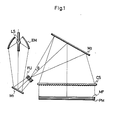
- the illumination system generally comprises a light source LS, an ellipsoidal mirror EM disposed with respect to the light source, a first folding mirror M1, a fly eye lens unit FU, a second folding mirror M2, a collimation system CS, a mask film MF bearing desired circuit patterns thereon and a photosensitive material PM, respectively disposed along the optical path in order.
- the light source LS is positioned at or adjacent to the first focal point of the ellipsoidal mirror EM, so that light emitted from the light source is condensed and directed to the fly eye lens unit FU through the folding mirror M1.
- the folding mirror M1 comprises so-called a cold mirror which allows most of infrared radiation to pass therethrough and reflects most of ultraviolet radiation.
- the fly eye lens unit FU is positioned at a point adjacent to the second focal point of the ellipsoidal mirror EM, which is preferred in order to form the secondary light source thereby, since light emitted from the light source is most condensed at this point. However, it is sufficient if the fly eye lens unit FU is disposed at a position optically nearer to the light source LS than that as mentioned above, as long as the light directed toward the fly eye lens unit FU is received within the effective area thereof. Light condensed by the ellipsoidal mirror EM enters the fly eye lens unit FU to impinge upon the incident surface of the collimation system CS.
- the fly eye lens structure is very useful for resolving the irradiance non-uniformity at the entrance pupil of such optical system, which enables the incident surface of the collimation system CS to be illuminated uniformly independent of the irradiance distribution at the entrance pupil.
- respective element lenses of the fly eye lens unit provides uniform irradiance through the entire area of the incident surface of the collimation system, thus the irradiance distribution on the incident surface of the collimation system will become uniform.
- the illumination system shown in Figure 1 is designed so that the entrance pupil of the fly eye lens unit FU is conjugated with the incident surface of the collimation system CS, accordingly light passing through a predetermined common point in the entrance pupil will impinge upon a predetermined common point on the incident surface of the collimation system, and consequently light emitted from the light source and received in the entrance pupil will illuminate the predetermined area of the incident surface of the collimation system, without any loss of light.
- the collimation system CM comprises a single Fresnel lens, which is advantageous to reduce the optical path between the light source LC and an object to be illuminated.
- the photosensitive material PM is positioned immediately under the mask film MF, and exposure of a desired circuit pattern is made accurately and effectively on the photosensitive material.
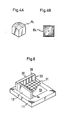
- the fly eye lens unit generally comprises a base frame 11 defining a square opening 12, side walls 13, 16, 22 and 27, spacer plates 14, 23 and 26, a multiple structure of element lenses 31 to 34, and a lid plate 24 defining a circular opening 25 thereon.
- the base frame 11 is made of aluminum alloy, and the square opening 12 defined thereon is adapted to pass light rays from a light source.
- the square opening 12 defines an exit aperture of the fly eye lens unit FU, which has a large inner diameter not to block the light beam exited from the fly eye lens unit.
- the respective side walls 13, 16, 22 and 27 is also made of aluminum alloy, and is secured upright on the respective peripheral edges of the base frame 11.
- Each of the bores 17 has a threaded section 17 s and a non-threaded cylindrical section 17 c therein.
- the threads provided in the threaded section 17 s is designed to be engageable with those of the screw.
- the non-threaded section 17 c has a larger diameter than that of the threaded section 17 s .
- the non-threaded section 17 c accomodates a biasing means comprising a first metal disk 18, a coil spring 19, a second metal disk 20 of the same shape as that of the first disk 18, and a contact element 21 made of fluorine-contained polymers, in order.
- the respective bores 17 on the side wall 16 are positioned at positions corresponding to respective rows of the element lenses aligned in respect of the corresponding screws 15.
- the respective spacer plates 14, 23 and 26 is made of fluorine-contained polymers, and is closely disposed between the respective side walls 13, 22 and 27 and the assembly of the element lenses 31 to 34, respectively. It is preferable to chose fluorine-contained polymers as the spacer plates because of its elasticity and heat insulating characteristics. However, it may be also applicable to use any materials having appropriate elasticity for absorbing the thermal expansion either of the element lenses or metallic base frame and side walls, and having appropriate heat insulating characteristics for blocking the heat transmission from the metallic base frame and side walls to the element lenses, or vice versa.
- a plurality of grooves 35 extending in the vertical direction. Positions of the grooves 35 are determined so as to correspond to respective adjacent element lenses on the matrices. Air existing between respective matrices of the element lenses can freely communicate with the outside thereof.
- Respective element lenses 31 e to 34 e constitute four units of matrices 31 to 34, and each of these matrices includes 5 ⁇ 5 pieces of element lenses EM.
- Each matrix of the element lenses is assembled only by the biasing forces of the coil springs 19, without any adhesive agent or the like.
- the biasing force to be applied to each row of element lenses in respect of the corresponding screw 15 is adjusted by the screw, and according to experimental demonstrations it was preferable to apply the biasing force in the range of 1.0 to 1.5 kg to respective rows of the element lenses.
- the element lenses in each of the matrices have substantially the same optical characteristics.
- Each of the element lenses EL has an incident surface and an exit surface having a predetermined curvature, respectively, and four plane side surfaces, as best shown in Figures 4-A and 4-B It is especially preferable to form a precise square by the side surfaces in the plane view.
- the adjacent element lenses in each matrix are closely in contact with each other, without any intermedium.
- the adjacent matrices disposed along the optical axis are spaced from each other by a predetermined distance, where respective optical axes of the element lenses EL in each matrix are precisely coincident with each other.
- the distance between the adjacent matrices is determined on the basis of the optical characteristics on an object to be illuminated.
- the lid plate 24 is also made of aluminum alloy, and defines an circular opening 25 thereon.
- the circular opening 25 defines an incident aperture of the fly eye lens unit FU, where the inner diameter of the opening 25 is designed so that the light beam converging on the fly eye lens unit should not be blocked by the lid plate.
- assemblage of the respective element lenses is accomplished only by the biasing forces of the biasing coil springs 19, which are applied to the rows aligned in respect of the screws from a longitudinal direction and are appropriately adjusted only by manipulating respective screws.
- a side wall 27 ⁇ is comprised substantially in the same manner as the side wall 16, and the spacer plate 26 in Figure 3 is replaced by assemblies of biasing means as those in Figure 3, each of which includes screw 15 ⁇ , a first disk plate 18 ⁇ , a coil spring 19 ⁇ , a second disk plate 20 ⁇ and a contact element 21 ⁇ .
- the biasing force applied to the respective rows in respect of the screws 15 ⁇ is adjusted to be smaller by approximately 500g than that applied to the respective rows of the screws 15.
- both the side walls 13 and 22 are fixed to the base frame 11, and the spacer plates 14 and 23 are mounted along these side walls. Then, an appropriate square plate 51 corresponding to the square opening 12 is placed within the opening.
- the fourth (i.e. lowermost) matrix 31 of element lenses are aligned, on the square plate 51, along the side walls 13 and 2.
- the side wall 16 is mounted to the base frame 11, where the respective bores 17 accomodates a biasing means comprising the contact element 21, the coil spring 19 and a pair of the metal disks 18 and 19.
- screws 15 are set to the bores 17, applying the biasing forces to the rows aligned in respect of the screws.
- the respective rows of the element lenses is fixedly held by the biasing forces.
- an adjusting plate 71 is placed on the fourth (i.e. lowermost) matrix 31 of the element lenses, where the adjusting plate 71 has a thickness precisely corresponding to the distance between the fourth matrix 31 of the element lenses and the third matrix 32 thereof.
- the element lenses of the third matrix 32 are aligned in the same manner as those of the fourth matrix.
- the spacer plate 26 and the side wall 27 are fixedly mounted on the base frame 11, in the case of the first embodiment shown in Figure 3, or the side wall 27 ⁇ having substantially the same structure as the side wall 16 is fixedly mounted on the base frame 11, in the case of the second embodiment shown in Figure 5.
- the lid plate 24 is mounted on the side walls, whereby assembling of the fly eye lens unit is accomplished.
- the fly eye lens unit FU since the fly eye lens unit FU is positioned at a point adjacent to the second focal point of the ellipsoidal mirror EM, the fly eye lens unit FU will be heated considerably, in spite of interposition of the cold mirror M1.
- the spacer plates having heat insulating characteristics are interposed between the element lenses and a housing comprising the base frame, side walls and lid plate of aluminum alloy, the thermal transmission from the housing to the element lenses, or vice virsa, is efficiently blocked. Even if the thermal expansion may occur in the fly eye lens unit, it is efficiently absorbed by the spacer plates 14, 23 and 26 and the biasing means, and accordingly the optical characteristics of the fly eye lens unit is kept substantially constant.
Landscapes
- Physics & Mathematics (AREA)
- General Physics & Mathematics (AREA)
- Optics & Photonics (AREA)
- Exposure Of Semiconductors, Excluding Electron Or Ion Beam Exposure (AREA)
- Exposure And Positioning Against Photoresist Photosensitive Materials (AREA)
- Projection Apparatus (AREA)
Applications Claiming Priority (2)
| Application Number | Priority Date | Filing Date | Title |
|---|---|---|---|
| JP61172952A JPS62204097A (ja) | 1986-03-04 | 1986-07-24 | 潤滑装置 |
| JP172952/86 | 1986-11-11 |
Publications (3)
| Publication Number | Publication Date |
|---|---|
| EP0267599A2 true EP0267599A2 (fr) | 1988-05-18 |
| EP0267599A3 EP0267599A3 (en) | 1988-08-17 |
| EP0267599B1 EP0267599B1 (fr) | 1992-04-15 |
Family
ID=15951401
Family Applications (1)
| Application Number | Title | Priority Date | Filing Date |
|---|---|---|---|
| EP19870116667 Expired EP0267599B1 (fr) | 1986-07-24 | 1987-11-11 | Dispositif d'illumination type ceil de mouche |
Country Status (1)
| Country | Link |
|---|---|
| EP (1) | EP0267599B1 (fr) |
Cited By (3)
| Publication number | Priority date | Publication date | Assignee | Title |
|---|---|---|---|---|
| US4998191A (en) * | 1988-10-28 | 1991-03-05 | Asahi Kogaku Kogyo Kabushiki Kaisha | Illuminating optical device |
| EP0401608A3 (fr) * | 1989-06-05 | 1991-09-25 | Firma Carl Zeiss | Arrangement de lentilles |
| EP1653271B1 (fr) * | 2004-10-29 | 2008-08-13 | Swarovski Optik KG | Réticule et son utilisation dans une lunette de visée |
Family Cites Families (4)
| Publication number | Priority date | Publication date | Assignee | Title |
|---|---|---|---|---|
| US3296923A (en) * | 1965-01-04 | 1967-01-10 | Gen Electric | Lenticulated collimating condensing system |
| DE2803277A1 (de) * | 1978-01-26 | 1979-08-02 | Bosch Gmbh Robert | Vorrichtung zur belichtung einer auf eine oberflaeche eines substrats aufgebrachten fotolackschicht |
| JPS6038681B2 (ja) * | 1978-09-27 | 1985-09-02 | キヤノン株式会社 | 紫外用多層膜 |
| FR2526962A1 (fr) * | 1982-05-13 | 1983-11-18 | Dme | Condenseur oeil de mouche a juxtaposition de spheres transparentes pour microphotolithographie |
-
1987
- 1987-11-11 EP EP19870116667 patent/EP0267599B1/fr not_active Expired
Cited By (4)
| Publication number | Priority date | Publication date | Assignee | Title |
|---|---|---|---|---|
| US4998191A (en) * | 1988-10-28 | 1991-03-05 | Asahi Kogaku Kogyo Kabushiki Kaisha | Illuminating optical device |
| EP0401608A3 (fr) * | 1989-06-05 | 1991-09-25 | Firma Carl Zeiss | Arrangement de lentilles |
| EP1653271B1 (fr) * | 2004-10-29 | 2008-08-13 | Swarovski Optik KG | Réticule et son utilisation dans une lunette de visée |
| US7804643B2 (en) | 2004-10-29 | 2010-09-28 | Swarovski Optik K.G. | Reticle and use thereof for an aiming telescope |
Also Published As
| Publication number | Publication date |
|---|---|
| EP0267599A3 (en) | 1988-08-17 |
| EP0267599B1 (fr) | 1992-04-15 |
Similar Documents
| Publication | Publication Date | Title |
|---|---|---|
| US4884869A (en) | Fly's eye lens unit for illumination system | |
| US4497015A (en) | Light illumination device | |
| US6285443B1 (en) | Illuminating arrangement for a projection microlithographic apparatus | |
| US5967653A (en) | Light projector with parabolic transition format coupler | |
| KR100450556B1 (ko) | 투사형-마이크로리소그래피장치용조명장치 | |
| US5636003A (en) | Illumination optical apparatus and scanning exposure apparatus | |
| KR100352732B1 (ko) | 후방투사스크린 | |
| EP1637909A2 (fr) | Instrument optique dýimagerie | |
| US7159986B2 (en) | Wide field collimator | |
| US5150138A (en) | Projection type image display apparatus | |
| KR987001098A (ko) | 영상 표시 장치(Picture Display Device) | |
| JP3608580B2 (ja) | 照明光学装置、露光装置、露光方法、及びフライアイレンズ | |
| EP0952490B1 (fr) | Tube de lentille et graveur à projection | |
| USRE34634E (en) | Light illumination device | |
| EP2253997A2 (fr) | Système d'éclairage pour contact micro-lithographique et appareil d'exposition de proximité | |
| US6024452A (en) | Prismatic light beam homogenizer for projection displays | |
| US5620814A (en) | Process and arrangement for producing dose profiles for the fabrication of structured surfaces | |
| CN100547489C (zh) | 一种用于微光刻的照明光学系统 | |
| EP0267599A2 (fr) | Dispositif d'illumination type ceil de mouche | |
| US7050247B2 (en) | Optical unit, exposure unit and optical devices | |
| US6469834B1 (en) | System and method for elimination of scattered side lobes created by integrator lenslet arrays | |
| US5613768A (en) | Apparatus for generating parallel light using two arrayed mirrors | |
| US5642149A (en) | Apparatus and method for printing with a non-refractive imaging system | |
| EP0250975B1 (fr) | Système d'illumination | |
| US6970289B1 (en) | Screen for rear projection display |
Legal Events
| Date | Code | Title | Description |
|---|---|---|---|
| PUAI | Public reference made under article 153(3) epc to a published international application that has entered the european phase |
Free format text: ORIGINAL CODE: 0009012 |
|
| AK | Designated contracting states |
Kind code of ref document: A2 Designated state(s): DE FR GB IT |
|
| PUAL | Search report despatched |
Free format text: ORIGINAL CODE: 0009013 |
|
| AK | Designated contracting states |
Kind code of ref document: A3 Designated state(s): DE FR GB IT |
|
| RHK1 | Main classification (correction) |
Ipc: G02B 3/00 |
|
| 17P | Request for examination filed |
Effective date: 19881019 |
|
| 17Q | First examination report despatched |
Effective date: 19900727 |
|
| GRAA | (expected) grant |
Free format text: ORIGINAL CODE: 0009210 |
|
| AK | Designated contracting states |
Kind code of ref document: B1 Designated state(s): DE FR GB IT |
|
| ITF | It: translation for a ep patent filed | ||
| ET | Fr: translation filed | ||
| REF | Corresponds to: |
Ref document number: 3778301 Country of ref document: DE Date of ref document: 19920521 |
|
| PLBE | No opposition filed within time limit |
Free format text: ORIGINAL CODE: 0009261 |
|
| STAA | Information on the status of an ep patent application or granted ep patent |
Free format text: STATUS: NO OPPOSITION FILED WITHIN TIME LIMIT |
|
| 26N | No opposition filed | ||
| PGFP | Annual fee paid to national office [announced via postgrant information from national office to epo] |
Ref country code: GB Payment date: 19971103 Year of fee payment: 11 |
|
| PGFP | Annual fee paid to national office [announced via postgrant information from national office to epo] |
Ref country code: FR Payment date: 19971112 Year of fee payment: 11 |
|
| PGFP | Annual fee paid to national office [announced via postgrant information from national office to epo] |
Ref country code: DE Payment date: 19971114 Year of fee payment: 11 |
|
| PG25 | Lapsed in a contracting state [announced via postgrant information from national office to epo] |
Ref country code: GB Free format text: LAPSE BECAUSE OF NON-PAYMENT OF DUE FEES Effective date: 19981111 |
|
| GBPC | Gb: european patent ceased through non-payment of renewal fee |
Effective date: 19981111 |
|
| PG25 | Lapsed in a contracting state [announced via postgrant information from national office to epo] |
Ref country code: FR Free format text: LAPSE BECAUSE OF NON-PAYMENT OF DUE FEES Effective date: 19990730 |
|
| REG | Reference to a national code |
Ref country code: FR Ref legal event code: ST |
|
| PG25 | Lapsed in a contracting state [announced via postgrant information from national office to epo] |
Ref country code: DE Free format text: LAPSE BECAUSE OF NON-PAYMENT OF DUE FEES Effective date: 19990901 |
|
| PG25 | Lapsed in a contracting state [announced via postgrant information from national office to epo] |
Ref country code: IT Free format text: LAPSE BECAUSE OF NON-PAYMENT OF DUE FEES;WARNING: LAPSES OF ITALIAN PATENTS WITH EFFECTIVE DATE BEFORE 2007 MAY HAVE OCCURRED AT ANY TIME BEFORE 2007. THE CORRECT EFFECTIVE DATE MAY BE DIFFERENT FROM THE ONE RECORDED. Effective date: 20051111 |