EP0269385A2 - Verfahren zur Herstellung von einem zusammengesetzten Oxid - Google Patents
Verfahren zur Herstellung von einem zusammengesetzten Oxid Download PDFInfo
- Publication number
- EP0269385A2 EP0269385A2 EP87310273A EP87310273A EP0269385A2 EP 0269385 A2 EP0269385 A2 EP 0269385A2 EP 87310273 A EP87310273 A EP 87310273A EP 87310273 A EP87310273 A EP 87310273A EP 0269385 A2 EP0269385 A2 EP 0269385A2
- Authority
- EP
- European Patent Office
- Prior art keywords
- organometallic compound
- process according
- metallic element
- composite oxide
- protic acid
- Prior art date
- Legal status (The legal status is an assumption and is not a legal conclusion. Google has not performed a legal analysis and makes no representation as to the accuracy of the status listed.)
- Granted
Links
Images




Classifications
-
- C—CHEMISTRY; METALLURGY
- C01—INORGANIC CHEMISTRY
- C01G—COMPOUNDS CONTAINING METALS NOT COVERED BY SUBCLASSES C01D OR C01F
- C01G1/00—Methods of preparing compounds of metals not covered by subclasses C01B, C01C, C01D, or C01F, in general
-
- C—CHEMISTRY; METALLURGY
- C01—INORGANIC CHEMISTRY
- C01B—NON-METALLIC ELEMENTS; COMPOUNDS THEREOF; METALLOIDS OR COMPOUNDS THEREOF NOT COVERED BY SUBCLASS C01C
- C01B13/00—Oxygen; Ozone; Oxides or hydroxides in general
- C01B13/14—Methods for preparing oxides or hydroxides in general
- C01B13/18—Methods for preparing oxides or hydroxides in general by thermal decomposition of compounds, e.g. of salts or hydroxides
- C01B13/185—Preparing mixtures of oxides
-
- C—CHEMISTRY; METALLURGY
- C01—INORGANIC CHEMISTRY
- C01B—NON-METALLIC ELEMENTS; COMPOUNDS THEREOF; METALLOIDS OR COMPOUNDS THEREOF NOT COVERED BY SUBCLASS C01C
- C01B13/00—Oxygen; Ozone; Oxides or hydroxides in general
- C01B13/14—Methods for preparing oxides or hydroxides in general
- C01B13/32—Methods for preparing oxides or hydroxides in general by oxidation or hydrolysis of elements or compounds in the liquid or solid state or in non-aqueous solution, e.g. sol-gel process
-
- C—CHEMISTRY; METALLURGY
- C01—INORGANIC CHEMISTRY
- C01B—NON-METALLIC ELEMENTS; COMPOUNDS THEREOF; METALLOIDS OR COMPOUNDS THEREOF NOT COVERED BY SUBCLASS C01C
- C01B19/00—Selenium; Tellurium; Compounds thereof
- C01B19/008—Salts of oxyacids of selenium or tellurium
-
- C—CHEMISTRY; METALLURGY
- C01—INORGANIC CHEMISTRY
- C01B—NON-METALLIC ELEMENTS; COMPOUNDS THEREOF; METALLOIDS OR COMPOUNDS THEREOF NOT COVERED BY SUBCLASS C01C
- C01B25/00—Phosphorus; Compounds thereof
- C01B25/16—Oxyacids of phosphorus; Salts thereof
- C01B25/26—Phosphates
- C01B25/265—General methods for obtaining phosphates
-
- C—CHEMISTRY; METALLURGY
- C01—INORGANIC CHEMISTRY
- C01B—NON-METALLIC ELEMENTS; COMPOUNDS THEREOF; METALLOIDS OR COMPOUNDS THEREOF NOT COVERED BY SUBCLASS C01C
- C01B25/00—Phosphorus; Compounds thereof
- C01B25/16—Oxyacids of phosphorus; Salts thereof
- C01B25/26—Phosphates
- C01B25/32—Phosphates of magnesium, calcium, strontium, or barium
-
- C—CHEMISTRY; METALLURGY
- C01—INORGANIC CHEMISTRY
- C01B—NON-METALLIC ELEMENTS; COMPOUNDS THEREOF; METALLOIDS OR COMPOUNDS THEREOF NOT COVERED BY SUBCLASS C01C
- C01B25/00—Phosphorus; Compounds thereof
- C01B25/16—Oxyacids of phosphorus; Salts thereof
- C01B25/26—Phosphates
- C01B25/36—Aluminium phosphates
-
- C—CHEMISTRY; METALLURGY
- C01—INORGANIC CHEMISTRY
- C01B—NON-METALLIC ELEMENTS; COMPOUNDS THEREOF; METALLOIDS OR COMPOUNDS THEREOF NOT COVERED BY SUBCLASS C01C
- C01B25/00—Phosphorus; Compounds thereof
- C01B25/16—Oxyacids of phosphorus; Salts thereof
- C01B25/26—Phosphates
- C01B25/37—Phosphates of heavy metals
- C01B25/372—Phosphates of heavy metals of titanium, vanadium, zirconium, niobium, hafnium or tantalum
-
- C—CHEMISTRY; METALLURGY
- C01—INORGANIC CHEMISTRY
- C01B—NON-METALLIC ELEMENTS; COMPOUNDS THEREOF; METALLOIDS OR COMPOUNDS THEREOF NOT COVERED BY SUBCLASS C01C
- C01B33/00—Silicon; Compounds thereof
- C01B33/20—Silicates
-
- C—CHEMISTRY; METALLURGY
- C01—INORGANIC CHEMISTRY
- C01B—NON-METALLIC ELEMENTS; COMPOUNDS THEREOF; METALLOIDS OR COMPOUNDS THEREOF NOT COVERED BY SUBCLASS C01C
- C01B35/00—Boron; Compounds thereof
- C01B35/08—Compounds containing boron and nitrogen, phosphorus, oxygen, sulfur, selenium or tellurium
- C01B35/10—Compounds containing boron and oxygen
- C01B35/12—Borates
- C01B35/127—Borates of heavy metals
-
- C—CHEMISTRY; METALLURGY
- C01—INORGANIC CHEMISTRY
- C01B—NON-METALLIC ELEMENTS; COMPOUNDS THEREOF; METALLOIDS OR COMPOUNDS THEREOF NOT COVERED BY SUBCLASS C01C
- C01B35/00—Boron; Compounds thereof
- C01B35/08—Compounds containing boron and nitrogen, phosphorus, oxygen, sulfur, selenium or tellurium
- C01B35/14—Compounds containing boron and nitrogen, phosphorus, sulfur, selenium or tellurium
- C01B35/143—Phosphates
-
- C—CHEMISTRY; METALLURGY
- C01—INORGANIC CHEMISTRY
- C01P—INDEXING SCHEME RELATING TO STRUCTURAL AND PHYSICAL ASPECTS OF SOLID INORGANIC COMPOUNDS
- C01P2002/00—Crystal-structural characteristics
- C01P2002/70—Crystal-structural characteristics defined by measured X-ray, neutron or electron diffraction data
- C01P2002/72—Crystal-structural characteristics defined by measured X-ray, neutron or electron diffraction data by d-values or two theta-values, e.g. as X-ray diagram
Definitions
- the present invention relates to a novel process for the manufacture of a composite oxide.
- a non-homogeneous coprecipitation method wherein the composite oxide is produced by hydrolyzing an aqueous solution of a mixture of metallic salts with aqueous ammonia; a homogeneous coprecipitation method wherein urea is employed instead of the aqueous ammonia in the above method; a method comprising kneading metallic hydroxides; a method wherein an oxide of a metal is dipped into an aqueous solution of a salt of a different metal; and a method wherein aqueous ammonia is further added to the aqueous solution of the metallic salt.
- the composite oxide is obtained by mixing a plurality of metallic alkoxides and then carrying out hydrolysis. More particularly, a plurality of alkoxides or alcoholic solutions of metallic compounds are mixed, water or steam is added to the mixture to adjust the pH thereof, and the whole is stirred at an appropriate temperature, whereby hydrolysis occurs to yield a gel or precipitate which is separated, dried and calcinated to obtain the composite oxide compound.
- the resulting compound can be purified to a high level by fractionating the starting materials.
- the object of the present invention is to provide a novel process for manufacturing the composite oxide with a high level of purity and without segregation.
- a novel process for the manufacture of a composite oxide characterized by carrying out, in a non-aqueous medium, a condensation reaction between an organometallic compound having a structure such that the metallic element present in the compound is bonded to the organic moiety therein via an oxygen atom, and a protic acid which is capable of carrying out the condensation reaction with the organometallic compound, and is a hydroxide containing an element different from the metallic element contained in said organometallic compound.
- the present invention provides the composite oxide prepared by the above process.
- any known organometallic compound may be employed, so long as it has a structure wherein the metallic element present in the compound is bonded to the organic moiety therein via an oxygen atom.
- the term "metallic element” used herein means an element capable of bonding to the organic moiety via the oxygen atom to form the organometallic compound. More particularly, the metallic element is, for example, beryllium (Be), magnesium (Mg), aluminium (Al), phosphorus (P), calcium (Ca), scandium (Sc), titanium (Ti), vanadium (V), chromium (Cr), manganese (Mn), iron (Fe), cobalt (Co), nickel (Ni), copper (Cu), zinc (Zn), gallium (Ga), arsenic (As), rubidium (Rb), strontium (Sr), yttrium (Y), zirconium (Zr), niobium (Nb), molybdenum (Mo), cadmium (Cd), indium (In), tin (Sn), barium (Ba), lanthanum (La), hafnium (Hf), tantalum (Ta), tungsten (W), mercury (Hg),
- the preferable metallic element is Be, Mg, Al, Ca, Ti, V, Fe, Zn, Ga, Sr, Y, Zr, Nb, Sn, Ba, La, Hf, Ta or Pb. More preferably, the metallic element is Ca, Ti, Zr, Fe, Pb, Ba, Sn, Cu or Ta.
- the organic moiety present in the organometallic compound is, for example, an aliphatic hydrocarbon group (i.e., alkyl, alkenyl, alkylene or alkenylene group having 1 to 6 carbon atoms).
- the typical organometallic compound which can be used in the present invention is a metal alkoxide compound of the formula M(OR) x wherein M represents the metallic element, R represents a hydrocarbon group, preferably lower alkyl or alkylene, and x is an integer of 2 to 6.
- M represents the metallic element
- R represents a hydrocarbon group, preferably lower alkyl or alkylene
- x is an integer of 2 to 6. Examples of the metal alkoxide compounds will be exemplified hereinafter.
- Alkoxides of the metallic element of two valencies are, for example, organomagnesium compounds, such as Mg(OCH3)2 , Mg(OC2H5)2 , Mg(OC3H7)2 , Mg(OC4H9)2 , Mg(OC5H11)2 or Mg(O2C2H5), or similar compounds wherein Ca, Zn, Sr, Ba, Pb, etc., is substituted for Mg in the compounds.
- organomagnesium compounds such as Mg(OCH3)2 , Mg(OC2H5)2 , Mg(OC3H7)2 , Mg(OC4H9)2 , Mg(OC5H11)2 or Mg(O2C2H5), or similar compounds wherein Ca, Zn, Sr, Ba, Pb, etc., is substituted for Mg in the compounds.
- Alkoxides of the metallic element of three valencies are, for example, organoaluminium compounds, such as Al(OC2H5)3 , Al(OC3H7)3 or Al(OC4H9)3 or similar compounds wherein Ga, etc., is substituted for Al in the compounds.
- organoaluminium compounds such as Al(OC2H5)3 , Al(OC3H7)3 or Al(OC4H9)3 or similar compounds wherein Ga, etc., is substituted for Al in the compounds.
- Alkoxides of the metallic element of four valencies are, for example, organotitanium compounds, such as Ti(OCH3)4 , Ti(OC2H5)4 , Ti(O-iso-C3H7)4 , Ti(O-n-C3H7)4 , Ti(O-n-C4H9)4 or similar compounds wherein Zr, Ge, Sn, Hf, etc., is substituted for Ti in the compounds.
- Alkoxides of the metallic element of five valencies are, for example, Nb(OCH3)5 , Nb (OC2H5)5 , Nb(O-n-C3H7)5 , Nb(O-n-C4H9)4 or Nb(O-t-C4H9)4 , or similar compounds wherein V, Ta or the like is substituted for Nb in the compounds.
- Alkoxides of the metallic element of six valencies are, for example, Mo(OC2H5)6 , Mo(O-iso-C3H7)6 , or Mo(O-n-C4H9)6.
- the protic acid used in the present invention is the compound known as Br ⁇ nsted acid.
- any known protic acid (Br ⁇ nsted acid) may be employed, so long as it can take part in the condensation reaction with the above organometallic compound, and is a hydroxide containing an element different from the metallic element contained in the organometallic compound with which it is to be reacted.
- the above protic acid is, for example, the hydroxide containing the element belonging to Groups III to VI of the Periodic Table, and it is preferable to use a protic acid having the formula M ⁇ (OH) y wherein M ⁇ is boron (B), silicon (Si), phosphorus (P), titanium (Ti), vanadium (V), chromium (Cr), arsenic (As), tellurium (Te) or lead (Pb), and y is an integer of 3 to 6.
- protic acid which may be used in the present invention, there may be mentioned, H3BO3 , H3PO4 , As(OH)3 , Te(OH)6 , H2CrO4 , H4SiO4 , H4TiO4 , Pb(OH)2 , or H3VO4.
- an alcohol such as methanol, ethanol, isopropanol, butanol, isoamyl alcohol, ethylene glycol, or propylene glycol.
- ethers such as dioxane or diethyl ether, esters such as ethyl acetate, a nonpolar solvent such as benzene, or a mixture thereof, may be used.
- the organometallic compound Prior to the condensation reaction, the organometallic compound is generally dissolved or dispersed in the non-aqueous medium to become a stock liquid.
- the protic acid is also dissolved or dispersed in the medium to form a separate stock liquid.
- it is not necessary to dilute the reactants with the medium and it is generally preferable to use lower concentrations of the reactants in the medium.
- concentration is too low, the amount of the medium to be used is increased.
- the concentration is too high, the reaction is difficult to control and the handling is awkward. Therefore, the appropriate concentration is determined by taking into account the above items.
- the concentration of the reactant is generally not more than 50% by weight, preferably 0.1 - 50% by weight, more preferably 0.1 - 5% by weight.
- anhydrous acid i.e., acetic acid, nitric acid or oxalic acid
- base i.e., pyridine, or amines such as diethyl amine or triethyl amine
- the resulting product can be utilized in the form of a liquid without separation, by applying the same to a substrate and drying, and if desired, calcinating. Further, the resulting product may be filtered off and dried, and if desired, calcinated at an appropriate temperature for an appropriate number of hours to obtain, for example, ceramics with a high level of purity.
- the organometallic compound such as the metal alkoxide acts as a protic base (Br ⁇ nsted base) and causes an acid-base reaction with the protic acid, such as a mineral acid having an OH group, in the non-aqueous medium to yield the composite oxide. More particularly, the protic acid liberates a proton to provide an anion in the non-aqueous medium.
- the anion nucleophilically attacks the metallic element of the organometallic compound, and causes the nucleophilic substitution reaction, to cause the bonding of the metallic element to the different element through the oxygen atom.
- the organometallic compounds used should not react with each other, and the protic acids should not react with each other, and therefore, the acid-base reaction should proceed exclusively, and thus the composite oxide having a uniform distribution of atoms can be produced.
- the reaction can be schematically shown as follows: wherein M ⁇ is the metallic element, M is the different element, and R is, for example, alkyl or carbonyl.
- the composite oxide formed in accordance with the present process contains i) the metallic element stemming from the organometallic compound, ii) the oxygen atom stemming from the protic acid, and iii) an element other than hydrogen and oxygen, and different from the metallic element, stemming from the protic acid.
- the composite oxide obtained in accordance with the present process comprises predominantly amorphous materials, or a mixture of a major part of amorphous materials and a minor part of crystalline materials.
- a small amount of heat can bring about a crystalline product, and further, an amorphous product can be produced by an appropriate selection of the starting materials.
- the distribution of the components in the composite oxide produced by the present process is uniform, and no difference in chemical composition can be observed throughout the whole product.
- the composite oxide obtained by the process in accordance with the present invention may be utilized for catalytic, electronic or bio-materials, or mechanical materials (as calcinated materials).
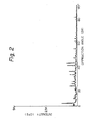
- the crystal structure of the products including composite oxides according to the present invention was confirmed by analyzing the structure by an X-ray diffraction method.
- An X-ray diffraction analyzer, RAD-IIB (Rigaku Denki K.K.) was employed to determine the diffraction intensity with Cu K ⁇ radiations at 40 kV and 20 mA, and to identify the crystal structure.
- homogeneity of the distribution of constituting components was evaluated on the basis of observation of a minute area (less than 100 ⁇ ) by an electron microscope, and on the basis of composition analyses of several points by a Electron probe Micro Analyzer (EPMA), etc.
- a transmission electron microscope, JEM-100SX (Nippon Denshi K,K.), and an energy dispersive X-ray spectroscope (EDX), Q-200J (Link Co., Ltd.) were employed for observation of the microstructures, and a composition analysis of minute areas.
- This example illustrates the production of apatite according to the present invention.
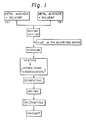
- Figure 3 is a flow sheet illustrating the above production
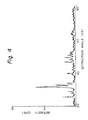
- Figure 4 is an X-ray diffraction pattern of the calcinated powder material obtained by calcination of the resulting powder material at 560°C for 1 hour.
- TCP tricalcium phosphate
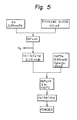
- Figure 5 is a flow sheet illustrating the above production
- Figure 6 is an X-ray diffraction pattern of the calcinated powder material obtained by calcination of the resulting powder material at 560°C for 1 hour.
- This example illustrates the production of apatite in accordance with the present invention.
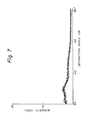
- Example 3 calcium glycoxide was prepared, and a solution of a mixture of phosphoric acid and ethanol was added dropwise thereto. A powder material was obtained after filtration and drying.
- Figure 7 is an X-ray diffraction pattern of the above powder material before calcination
- Figure 8 is an X-ray diffraction pattern of the calcinated material thereof (at 560°C for 1 hour).
- the patterns show that the material before calcination was amorphous, whereas the calcinated material was a crystalline phase of Ca5(PO4)3OH.
- This example illustrates the production of CaTeO4 in accordance with the present invention.
- Example 2 100 ml of solution of calcium glycoxide (0.01 mole/l) was prepared, and to this solution, 0.001 mole of telluric acid diluted with 50 ml of ethylene glycol was slowly added dropwise in such a manner that the reaction temperature was not lowered. After the addition was completed, the whole was aged by heating at 100°C under reflux for 1 hour and then cooled to room temperature. The precipitate formed was filtered and dried, and the product was further calcinated at 1,000°C for 1 hour to obtain CaTeO4.
- This example illustrates the production of Zn3TeO6 in accordance with the present invention.
- 0.001 mole of commercially available Zn(OC2H5)2 was added to 100 ml of ethanol, and the mixture was heated under reflux for several hours in a nitrogen stream, to ensure uniformity. Then, 0.001 mole of telluric acid was diluted with 50 ml of ethanol and added slowly dropwise to the solution of Zn(OC2H5)2. After the addition, refluxing was continued for 3 hours and the resulting product filtered, dried, and calcinated at 1,000°C for 1 hour to obtain Zn3TeO6.
- This example illustrates the production of AsBO4 in accordance with the present invention.
- This example illustrates the production of BPO4 in accordance with the present invention.
- This example illustrates the production of Zr2O(PO4)2 in accordance with the present invention.
Landscapes
- Chemical & Material Sciences (AREA)
- Organic Chemistry (AREA)
- Inorganic Chemistry (AREA)
- Oxygen, Ozone, And Oxides In General (AREA)
- Catalysts (AREA)
- Silicates, Zeolites, And Molecular Sieves (AREA)
- Inorganic Compounds Of Heavy Metals (AREA)
Applications Claiming Priority (2)
| Application Number | Priority Date | Filing Date | Title |
|---|---|---|---|
| JP277854/86 | 1986-11-22 | ||
| JP27785486A JPH0816004B2 (ja) | 1986-11-22 | 1986-11-22 | 複合酸化物の製造方法 |
Publications (3)
| Publication Number | Publication Date |
|---|---|
| EP0269385A2 true EP0269385A2 (de) | 1988-06-01 |
| EP0269385A3 EP0269385A3 (en) | 1989-02-08 |
| EP0269385B1 EP0269385B1 (de) | 1992-07-01 |
Family
ID=17589202
Family Applications (1)
| Application Number | Title | Priority Date | Filing Date |
|---|---|---|---|
| EP19870310273 Expired EP0269385B1 (de) | 1986-11-22 | 1987-11-20 | Verfahren zur Herstellung von einem zusammengesetzten Oxid |
Country Status (4)
| Country | Link |
|---|---|
| EP (1) | EP0269385B1 (de) |
| JP (1) | JPH0816004B2 (de) |
| CA (1) | CA1331833C (de) |
| DE (1) | DE3780128T2 (de) |
Cited By (2)
| Publication number | Priority date | Publication date | Assignee | Title |
|---|---|---|---|---|
| EP0540737A4 (en) * | 1987-12-28 | 1993-06-16 | Nippon Carbon Co., Ltd. | Heat- and corrosion-resistant composition |
| WO2007141324A1 (en) * | 2006-06-08 | 2007-12-13 | Colorobbia Italia S.P.A. | Nanometric hydroxyapatite and suspensions thereof, its preparation and use |
Family Cites Families (3)
| Publication number | Priority date | Publication date | Assignee | Title |
|---|---|---|---|---|
| GR66589B (de) * | 1978-06-22 | 1981-03-30 | Snam Progetti | |
| CA1217927A (en) * | 1983-04-15 | 1987-02-17 | Tsutomu Nanao | Inorganic composite material and process for preparing the same |
| JPS6183603A (ja) * | 1984-09-07 | 1986-04-28 | Agency Of Ind Science & Technol | 非晶質複合金属酸化物の製造方法 |
-
1986
- 1986-11-22 JP JP27785486A patent/JPH0816004B2/ja not_active Expired - Lifetime
-
1987
- 1987-11-20 EP EP19870310273 patent/EP0269385B1/de not_active Expired
- 1987-11-20 CA CA 552360 patent/CA1331833C/en not_active Expired - Fee Related
- 1987-11-20 DE DE19873780128 patent/DE3780128T2/de not_active Expired - Lifetime
Cited By (2)
| Publication number | Priority date | Publication date | Assignee | Title |
|---|---|---|---|---|
| EP0540737A4 (en) * | 1987-12-28 | 1993-06-16 | Nippon Carbon Co., Ltd. | Heat- and corrosion-resistant composition |
| WO2007141324A1 (en) * | 2006-06-08 | 2007-12-13 | Colorobbia Italia S.P.A. | Nanometric hydroxyapatite and suspensions thereof, its preparation and use |
Also Published As
| Publication number | Publication date |
|---|---|
| DE3780128D1 (de) | 1992-08-06 |
| JPH0816004B2 (ja) | 1996-02-21 |
| EP0269385B1 (de) | 1992-07-01 |
| EP0269385A3 (en) | 1989-02-08 |
| CA1331833C (en) | 1994-09-06 |
| JPS63134505A (ja) | 1988-06-07 |
| DE3780128T2 (de) | 1992-12-17 |
Similar Documents
| Publication | Publication Date | Title |
|---|---|---|
| Kessler | Molecular structure design and synthetic approaches to the heterometallic alkoxide complexes (soft chemistry approach to inorganic materials by the eyes of a crystallographer) | |
| EP1603924B1 (de) | Alkoholate der seltenerdmetalle als vorstufen für metalloxidschichten und -filme | |
| US7914762B2 (en) | Preparation method of chalcopyrite-type compounds with microwave irradiation | |
| Kessler | The Synthesis and Solution Stability | |
| EP0055459A1 (de) | Verfahren zur Herstellung von Oxiden durch chemische Dampf-Abscheidung (CVD) | |
| Goel et al. | New chemistry for the sol-gel process: Acetone as a new condensation reagent | |
| Gainsford et al. | Ethylene glycolate derivatives of aluminum: tetra-, penta-, and hexacoordination | |
| Mishra et al. | A convenient and quantitative route to Sn (IV)–M [M= Ti (IV), Nb (V), Ta (V)] heterobimetallic precursors for dense mixed-metal oxide ceramics | |
| US4298723A (en) | Layered or amorphous acyclic organometallic inorganic polymers | |
| EP0269385B1 (de) | Verfahren zur Herstellung von einem zusammengesetzten Oxid | |
| Gaskins et al. | Room temperature perovskite production from bimetallic alkoxides by ketone assisted oxo supplementation (KAOS) | |
| Kemmitt et al. | Titanium Amino Alcohol Complexes from α-Titanic Acid: X-Ray Crystal Structure of Titanium Bis [2, 2´-(methylimino) diethanolate] | |
| Veith et al. | Tuning metal stoichiometry in heterometal alkoxides: first structurally characterised molecular precursor to BaZrO3 | |
| JPH06287154A (ja) | 金属アルコキシド錯体の製造方法および複合酸化物の製造方法ならびに焼結体、板状体および膜 | |
| EP0869103A1 (de) | Vorläufer basierend auf einer einzigen organometallischen Verbindung für die Herstellung von anorganischen Filmüberzügen und von Pulvern | |
| Deng et al. | Heterobimetallic peroxo-titanium (IV) nitrilotriacetate complexes as single source precursors for preparation of MTiO3 (M= Co, Ni and Zn) | |
| Jones et al. | Dinuclear mixed alkyl phosphido and alkyl aryloxy complexes of manganese (II). Crystal structures of [Mn (CH2CMe3)(. mu.-tert-Bu2P)] 2 and [Mn (CH2CMe2Ph)(. mu.-O-2, 4, 6-(tert-Bu) 3C6H2)] 2 | |
| Della Pergola et al. | Chemistry of iridium carbonyl cluster complexes. Synthesis and x-ray crystal structure determination of the [NMe3 (CH2Ph)] 3 [Ir9 (. mu.-CO) 7 (CO) 13] complex containing a cofacial bioctahedral iridium cluster. Another example of different electron counting between isoskeletal rhodium and iridium carbonyl clusters | |
| Kessler | Sol–gel precursors | |
| Kumta et al. | Non-aqueous chemical synthesis of tetragonal (β-La2S3) lanthanum sulfide powders | |
| Archer et al. | Synthesis, characterization and reactivity of crown ether adducts of barium carboxylates: Ba (O2CCH3) 2 (18-crown-6)· 4H2O and Ba (O2C (CH2) 4CO2)(18-crown-6)· 8H2O | |
| JP2581653B2 (ja) | リン酸ジルコニウムの製造方法 | |
| JPH1087330A (ja) | チタン酸ジルコニウム析出物の製造方法 | |
| Khoudiakov | I. Mercury-mediated synthesis of intermetallic and oxide materials. II. Synthesis and characterization of precursors for chemical beam epitaxy of lithium niobate | |
| DE69812406T2 (de) | Verfahren zur herstellung eines heterometallischen oxidfilms des limo2 typs |
Legal Events
| Date | Code | Title | Description |
|---|---|---|---|
| PUAI | Public reference made under article 153(3) epc to a published international application that has entered the european phase |
Free format text: ORIGINAL CODE: 0009012 |
|
| AK | Designated contracting states |
Kind code of ref document: A2 Designated state(s): DE FR GB IT NL |
|
| PUAL | Search report despatched |
Free format text: ORIGINAL CODE: 0009013 |
|
| AK | Designated contracting states |
Kind code of ref document: A3 Designated state(s): DE FR GB IT NL |
|
| RHK1 | Main classification (correction) |
Ipc: C01B 13/32 |
|
| 17P | Request for examination filed |
Effective date: 19890616 |
|
| 17Q | First examination report despatched |
Effective date: 19910308 |
|
| GRAA | (expected) grant |
Free format text: ORIGINAL CODE: 0009210 |
|
| AK | Designated contracting states |
Kind code of ref document: B1 Designated state(s): DE FR GB IT NL |
|
| ITF | It: translation for a ep patent filed | ||
| REF | Corresponds to: |
Ref document number: 3780128 Country of ref document: DE Date of ref document: 19920806 |
|
| ET | Fr: translation filed | ||
| PLBE | No opposition filed within time limit |
Free format text: ORIGINAL CODE: 0009261 |
|
| STAA | Information on the status of an ep patent application or granted ep patent |
Free format text: STATUS: NO OPPOSITION FILED WITHIN TIME LIMIT |
|
| 26N | No opposition filed | ||
| PGFP | Annual fee paid to national office [announced via postgrant information from national office to epo] |
Ref country code: GB Payment date: 19931110 Year of fee payment: 7 |
|
| PGFP | Annual fee paid to national office [announced via postgrant information from national office to epo] |
Ref country code: NL Payment date: 19931130 Year of fee payment: 7 Ref country code: FR Payment date: 19931130 Year of fee payment: 7 |
|
| PGFP | Annual fee paid to national office [announced via postgrant information from national office to epo] |
Ref country code: DE Payment date: 19931229 Year of fee payment: 7 |
|
| PG25 | Lapsed in a contracting state [announced via postgrant information from national office to epo] |
Ref country code: GB Effective date: 19941120 |
|
| PG25 | Lapsed in a contracting state [announced via postgrant information from national office to epo] |
Ref country code: NL Effective date: 19950601 |
|
| NLV4 | Nl: lapsed or anulled due to non-payment of the annual fee | ||
| GBPC | Gb: european patent ceased through non-payment of renewal fee |
Effective date: 19941120 |
|
| PG25 | Lapsed in a contracting state [announced via postgrant information from national office to epo] |
Ref country code: FR Effective date: 19950731 |
|
| PG25 | Lapsed in a contracting state [announced via postgrant information from national office to epo] |
Ref country code: DE Effective date: 19950801 |
|
| REG | Reference to a national code |
Ref country code: FR Ref legal event code: ST |
|
| PG25 | Lapsed in a contracting state [announced via postgrant information from national office to epo] |
Ref country code: IT Free format text: LAPSE BECAUSE OF NON-PAYMENT OF DUE FEES;WARNING: LAPSES OF ITALIAN PATENTS WITH EFFECTIVE DATE BEFORE 2007 MAY HAVE OCCURRED AT ANY TIME BEFORE 2007. THE CORRECT EFFECTIVE DATE MAY BE DIFFERENT FROM THE ONE RECORDED. Effective date: 20051120 |