EP0271131A2 - Karrageenan enthaltendes wässriges Gel - Google Patents
Karrageenan enthaltendes wässriges Gel Download PDFInfo
- Publication number
- EP0271131A2 EP0271131A2 EP19870202223 EP87202223A EP0271131A2 EP 0271131 A2 EP0271131 A2 EP 0271131A2 EP 19870202223 EP19870202223 EP 19870202223 EP 87202223 A EP87202223 A EP 87202223A EP 0271131 A2 EP0271131 A2 EP 0271131A2
- Authority
- EP
- European Patent Office
- Prior art keywords
- carrageenan
- gel
- aqueous gel
- kappa
- weight
- Prior art date
- Legal status (The legal status is an assumption and is not a legal conclusion. Google has not performed a legal analysis and makes no representation as to the accuracy of the status listed.)
- Granted
Links
Images

Classifications
-
- A—HUMAN NECESSITIES
- A61—MEDICAL OR VETERINARY SCIENCE; HYGIENE
- A61Q—SPECIFIC USE OF COSMETICS OR SIMILAR TOILETRY PREPARATIONS
- A61Q19/00—Preparations for care of the skin
-
- A—HUMAN NECESSITIES
- A23—FOODS OR FOODSTUFFS; TREATMENT THEREOF, NOT COVERED BY OTHER CLASSES
- A23L—FOODS, FOODSTUFFS OR NON-ALCOHOLIC BEVERAGES, NOT OTHERWISE PROVIDED FOR; PREPARATION OR TREATMENT THEREOF
- A23L29/00—Foods or foodstuffs containing additives; Preparation or treatment thereof
- A23L29/20—Foods or foodstuffs containing additives; Preparation or treatment thereof containing gelling or thickening agents
- A23L29/206—Foods or foodstuffs containing additives; Preparation or treatment thereof containing gelling or thickening agents of vegetable origin
- A23L29/256—Foods or foodstuffs containing additives; Preparation or treatment thereof containing gelling or thickening agents of vegetable origin from seaweeds, e.g. alginates, agar or carrageenan
-
- A—HUMAN NECESSITIES
- A61—MEDICAL OR VETERINARY SCIENCE; HYGIENE
- A61K—PREPARATIONS FOR MEDICAL, DENTAL OR TOILETRY PURPOSES
- A61K8/00—Cosmetics or similar toiletry preparations
- A61K8/02—Cosmetics or similar toiletry preparations characterised by special physical form
- A61K8/04—Dispersions; Emulsions
- A61K8/042—Gels
-
- A—HUMAN NECESSITIES
- A61—MEDICAL OR VETERINARY SCIENCE; HYGIENE
- A61K—PREPARATIONS FOR MEDICAL, DENTAL OR TOILETRY PURPOSES
- A61K8/00—Cosmetics or similar toiletry preparations
- A61K8/18—Cosmetics or similar toiletry preparations characterised by the composition
- A61K8/72—Cosmetics or similar toiletry preparations characterised by the composition containing organic macromolecular compounds
- A61K8/73—Polysaccharides
-
- A—HUMAN NECESSITIES
- A61—MEDICAL OR VETERINARY SCIENCE; HYGIENE
- A61Q—SPECIFIC USE OF COSMETICS OR SIMILAR TOILETRY PREPARATIONS
- A61Q11/00—Preparations for care of the teeth, of the oral cavity or of dentures; Dentifrices, e.g. toothpastes; Mouth rinses
-
- A—HUMAN NECESSITIES
- A61—MEDICAL OR VETERINARY SCIENCE; HYGIENE
- A61Q—SPECIFIC USE OF COSMETICS OR SIMILAR TOILETRY PREPARATIONS
- A61Q19/00—Preparations for care of the skin
- A61Q19/10—Washing or bathing preparations
Definitions
- the present invention relates to an aqueous gel comprising carrageenan, to a gel-forming composition and a dry composition to constitute such aqueous gel, and to a composite containing same.
- aqueous gels that have a fairly high gel strength and a relatively low melting point.
- the gelling agent commonly used to meet these demands is gelatin.
- gelatin aqueous gels can be made that usually have a melting point of about 30-35°C.
- Gelatin can be used to prepare very weak gels; but, alternatively, rather firm gels can suitably be obtained with gelatin as well.
- the gel strength of aqueous gelatin gels as indicated by the yield stress at 5°C, may range from about 0.1 to above 200 kN/m2.
- gelatin is not without disadvantages.
- gelatin is a rather expensive gelling agent.
- the gelatin gel sets rather slowly, which can be undesirable.
- the use of gelatin in food-products can be undesirable for e.g. Jews and Moslems, because it is prepared from pigskin.
- a commercially acceptable gelling agent for the preparation of fairly strong low melting aqueous gels, that can be used instead of gelatin has never been found.
- the gel is firm at room temperature yet softens at or near body temperature to facilitate its cosmetic or pharmaceutical benefit.
- Kappa- and iota-carrageenan are commonly used polysaccharide gelling agents. With carrageenan gelling agent compositions as commonly available, fairly firm gels can conveniently be obtained. However, such gels have high melting points, e.g. from about 50°C to about 70°C or even higher.
- the gel melting point is the temperature at which the gel network structure disappears if the gel is heated slowly.
- Tm transition midpoint temperature
- ORD optical rotation dispersion
- Tm-value usually does not differ substantially from the gel melting point.
- the ordered state may also be the non-gelled double-helix state.
- the Tm-value of a carrageenan gel is often used interchangeably with the temperature at which the gel melts, which is correct for the majority of carrageenan gels, substantial differences between the temperature at which a gel comprising carrageenan melts and the Tm-value of that gel, may occur. If for example, in a carrageenan gel composition that has a Tm-value and a gel melting point of about 50°C, locust bean gum is incorporated, this can cause an increase of the temperature at which the gel melts to e.g. about 55°C or 60°C without changing the Tm-value of the order to disorder transition. For the large majority of carrageenan gels, however, the gel melting point does not differ substantially from the Tm-value.
- US 3,962,482 is directed to clear, elastic, water gels and gel-forming compositions that include a potassium salt and a potassium sensitive carrageenan.
- the gels and the gel-forming compositions are characterized by essentially complete freedom from polyvalent metal ions.
- US 4,307,124 describes the preparation of a carrageenan gel with the use of a composition that is swellable in cold tap water and gels at room temperature.
- the composition comprises kappa-carrageenan containing less than 5 wt.% of each of potassium and calcium cations, potassium bitartrate, cold soluble locust bean gum and a sodium salt of a sequestering agent.
- the sequestering agent is present in an amount sufficient to sequester substantially all of the polyvalent cations present when the composition is dissolved in cold tap water.
- Tm mid point temperature of the order to disorder transition
- US 4,276,320 discloses gels with relatively low melting points, e.g. at about body temperature.
- the gel-forming compositions comprise kappa-carrageenan, potassium in an ionizable form in an amount sufficient to provide the sol (after solution of the composition in an aqueous medium) with a potassium ion content of from about 200 to about 800 ppm, and a sodium salt of a sequestering agent in an amount sufficient to sequester substantially all of the polyvalent cations present in the sol.
- the gels disclosed in US 4,276,320 have Tm-values well below 45°C. However, the gels are extremely weak. At 1°C, the yield stress is below the measurement range of a conventional Instron® Tester. At refrigerator temperature, the gels do not retain their shape but are still pourable.
- Sequestering agents need not be used and ordinary tapwater can be employed to prepare the gel.
- the present invention provides an aqueous gel comprising carrageenan which gel contains a cation (A) of a type and in a concentration effective to cause the gel to have a transition midpoint temperature below 45°C, the carrageenan being kappa-carrageenan, iota-carrageenan or a mixture thereof, and having a concentration effective to cause the gel to have a yield stress of at least 0.5 kN/m2 at 5°C.
- the cation (A) is selected from the group consisting of potassium, ammonium, calcium, magnesium, aluminum, rubidium and mixtures of two or more thereof.
- aqueous gel in this specification by aqueous gel is meant that the liquid with which the gel has been made up is an aqueous liquid, i.e. containing water as solvent.
- carrageenan Throughout this specification by carrageenan is meant gelling carrageenan, i.e. kappa-carrageenan, iota-carrageenan or a mixture thereof.
- Non-gelling carrageenan such as lambda-carrageenan is explicitly indicated as such.
- the characteristics of the present aqueous carrageenan gel are governed by the following properties: -
- the presence of cation (A) is required to be able to obtain a sufficiently strong gel.
- cation (A) is required to be able to obtain a sufficiently strong gel.
- aluminum and especially potassium are effective to enhance the gel strength.
- iota-carrageenan suitably potassium and magnesium and especially calcium can be employed.
- Tm is determined by the ionic environment of the polymer and is, in principle, independent of the carrageenan concentration itself. At a particular ionic composition, the Tm-value is, generally, different for kappa- and iota-carrageenan.
- the Tm-value varies linearly with the fractions of kappa- and iota-carrageenan in the mixture, between the two extreme Tm-values observed for the pure carrageenan forms in that ionic environment.
- the gel strength at a given ionic composition is determined by the concentration of kappa- and iota-carrageenan.
- the incorporation of cation (B) is preferred, inter alia because it reduces the brittleness of the gels, thereby making them more elastic and thus more like gelatin gels.
- the presence of e.g. sodium chloride can further be beneficial, for example for taste reasons if the gel is to be used as or in a food-product.
- carrageenan preparations always contain cations. Consequently, changing the kind or amount of carrageenan or replacing, for example, one commercial sample of kappa-carrageenan with another one, will in general cause a change in the ionic composition of the aqueous gel, and thereby, inter alia in the Tm-value of the aqueous gel.
- cations contained in a carrageenan sample can be exchanged with other cations using methods known per sé.
- the ionic content of carrageenan samples can be analyzed accurately. Consequently, the ionic contribution of the carrageenan to the aqueous gel composition can, to some extent, be chosen freely and can be known accurately.
- the Tm-value of the gels is determined by the ionic content.
- the ionic content to be chosen to obtain an aqueous gel having a pre-determined Tm-value can be determined in the following manner. A series of kappa-carrageenan gels with various ionic contents is prepared and the Tm-values thereof are measured. Similarly the Tm-values of a series of iota-carrageenan gels with those same ionic contents are measured.
- Tm-values for kappa-carrageenan, iota-carrageenan and carrageenan mixtures for intermediate ionic compositions can be calculated from the obtained data using conventional interpolation techniques. In this manner, the Tm-value for a specific ionic composition at a given ratio of kappa- and iota-carrageenan can be predicted.
- a suitable way to carry out such an analysis of the experimental data is to derive expressions by which the concentrations of the various cations can be converted into equivalent concentrations of one particular cation.
- the ionic content of a composition can thus be characterized by a total equivalent concentration of one cation.
- An equation for the Tm-value can subsequently be derived, expressed as a function of that total equivalent cation concentration.
- the gel strength of particular compositions can be predicted. Alternatively, it can be calculated with which compositions a preselected gel strength can be obtained. In practice, however, the precise strength of the gel is usually not a critical parameter, and it is commonly sufficient to measure the gel strength of only a limited number of compositions and to choose an appropriate carrageenan concentration at a suitable ionic composition on the basis of such a limited set of data.
- the following procedure can be used to design a moderately strong carrageenan gel having a Tm-value of about 30°C and containing for taste reasons about 0.5 wt.% NaCl and to ensure microbiological stability 0.05 wt.% potassium sorbate.
- the available gelling agents are iota-carrageenan containing 6.30 wt.% Na+ and 1.60 wt.% K+ and kappa-carrageenan containing 4.82 wt.% Na+ and 2.48 wt.% K+.
- Deionized water is to be used to make up the gel.
- the table shows that when using more than 1.5 wt.% carrageenan, whether kappa-, iota- or the 1:1 mixture, the Tm-value will become too high.
- a Tm-value of 30 ⁇ 2°C When using, for example, the kappa-carrageenan in an amount of about 1-1.5 wt.%, in the presence of 0.5 wt.% NaCl and 0.05 wt.% potassium sorbate a Tm-value of 30 ⁇ 2°C will be obtained. If it is desirable to use less than 1% kappa-carrageenan, a Tm-value of about 30°C can be obtained by adding additional salt, e.g. some KCl. The influence of various, additional amounts of KCl on the Tm-values can be calculated in a similar way by using equations 2 and 3. When employing the 1:1 mixture, a Tm-value of about 30°C will also be obtained without adding extra cations, when using about 1-1.5 wt.% carrageenan polymer.
- the anions contained in the salts with cations (A) and (B) are not critical.
- the anion of the salts is the carrageenan polymer, chloride, sulphate or a mixture thereof.
- Other anions e.g. fluoride and/or nitrate, can however also be present.
- the salts employed are soluble in water.
- the aqueous gel may comprise additional ingredients, e.g. colouring matter and taste and flavour or fragrance compounds dependent upon the intended end use of the gel, provided that such additional ingredients do not adversely affect the gel properties. If, for example, that is considered desirable, some gelatin may also be incorporated in the aqueous gel without adverse effects.
- the gel may contain non-gelling thickening agent, provided it does not raise the Tm-value to above 45°C or reduce the yield stress to below 0.5 kN/m2.
- the gel may contain a non-gelling thickening agent like lambda-carrageenan.
- the Tm-value of the gel is 10-40°C, more preferably it is 20-35°C.
- the gel preferably has a yield stress of 1-100 kN/m2; more preferably the yield stress is 10-50 kN/m2.
- the concentration of kappa- and iota-carrageenan determines, at a given ionic composition, the strength of the gel.
- the content of carrageenan that can suitably be applied varies with the ionic environment of the polymer. Usually, however, a total carrageenan content of 0.3-10 parts by weight per 100 parts by weight of water, is adequate; a total carrageenan content of 0.5-5 parts by weight, in particular of 1-4 parts by weight, per 100 parts by weight of water being preferred.
- carrageenan are based on the water being effectively fully available to form the gel network structure. Less amounts of carrageenan, as low as 0.1 part by weight per 100 parts by weight of water, may be sufficient to obtain a gel network structure, if the effective water content of the carrageenan-containing aqueous phase composition is reduced e.g. by incorporating part of the water "phase-separated" from the carrageenan-containing water. This may be the case where the gel according to the present invention is part of a multi-phase system, such as e.g.
- a water-in-oil emulsion where part of the water is included as a dispersed non-gel-forming aqueous phase, and the remainder of the water is contained in a carrageenan-containing gel-forming composition according to the present invention dispersed in the continuous fat phase separate from the first non-gel-forming aqueous phase.
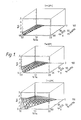
- the optimal amounts of cations (A) and (B) to be present in the gel depends on the desired gel strength and transition midpoint temperature as well as on the precise choice of the cations (A) and (B). In practice, however, it is preferred that the gel comprises cations (A) and (B), in dependence of the weight ratio of kappa- and iota-carrageenan present in the gel, in concentrations within the ranges corresponding to space ABCDEFGH of figure 3.
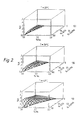
- concentrations of cations (A) and (B) to be present in the gel correspond to space ABCDEFGH of figure 4.
- the gel preferably contains 0.5-5 parts by weight of carrageenan per 100 parts by weight of water.
- carrageenan employed comprises from 50-100 wt.% kappa-carrageenan and 0-50 wt.% iota-carrageenan then it is preferred for the gel to contain 0.01-0.25 wt.% K+, 0.1-2 wt.% Na+ and/or 0.04-3 wt.% Ca2+.
- the carrageenan consists of 50-100 wt.% iota-carrageenan and 0-50 wt.% kappa-carrageenan then preferably the gel comprises 0.01-0.6 wt.% Ca2+, 0.01-0.7 wt.% Mg2+, 0.05-0.5 wt.% K+ and/or 0.05-1 wt.% Na+.
- the gel structure of the aqueous gels described hereinbefore disappears if the temperature is raised to above the gel melting point. Similarly, no gel network is formed if the ingredients are mixed together at a temperature above the gel melting point, or if the temperature is raised to above the melting point before the gel has set. It is to be understood that the present invention encompasses a gel-forming composition containing carrageenan, that constitutes an aqueous gel as hereinbefore described, when kept at a temperature of 5°C.
- the present invention provides a dry composition containing carrageenan, that constitutes an aqueous gel as hereinbefore described, when solubilized in an adequate amount of water and subsequently kept at 5°C.
- aqueous gels, gel-forming compositions and dry compositions suitable for the preparation thereof can beneficially be used for the preparation of a variety of products. Accordingly, in yet another aspect of the present invention there is provided a composite containing an aqueous gel, a gel-forming composition or a composition suitable for the preparation thereof, as hereinbefore described.
- Preferred composites are food products and toiletries.
- Examples of food products i.e. products intended for human or animal consumption, that can beneficially be prepared with the use of the present invention are meat products, such as paté's, sausages and canned ham in jelly, sauces, soups, in particular dry soups, such as low-calorie instant soups, confectionery gels and yoghurt-type products.
- carrageenan gels of the invention have desirable rheological properties as personal care products. Their melting characteristics also make them suitable vehicles for the incorporation and delivery of other ingredients which are intended to provide enhanced benefits. For example, moisturising, conditioning, cleansing and UV-absorbing agents can be added to skin, nail and hair care formulations. For dental care, agents can be incorporated to help clean teeth and prevent caries, plaque, tartar and gum disease. Colouring agents, preservatives and fragrances, and other ingredients conventionally employed in the manufacture of personal care products intended for topical application to the skin, mucosae and the teeth can also be incorporated in the aqueous carrageenan gels according to the invention.
- toiletry products for which the present invention can advantageously be employed include, but are not restricted to, skin and dentifrice creams or gels and shampoos.
- a particular advantage of skin care products containing the carrageenan gel according to the invention is their ability to match the sensory properties of conventional emulsions without the presence of any oil whatsoever. It is also possible to incorporate the aqueous gels of the invention in oil-in-water or water-in-oil emulsions without loss of the melting characteristics of the gel, provided that the amount of oil present in the emulsion does not exceed 10% by weight.
- the yield stress is determined by measuring the force at break at 5°C, using the procedure as described in J. Mol. Biol. (1980) 138 , 349-362, and dividing the measured force by the cross sectional area (i.e. 1.13 10 ⁇ 4 m2).
- the midpoint temperature (Tm) of the transition from the ordered to the disordered state is determined by means of optical rotation measurement as described in Faraday Discuss. Chem. Soc. (1974), 57 , 230-237.
- a series of gels was made with varying amounts of kappa- and/or iota-carrageenan and of added NaCl and KCl.
- the carrageenan and the salts were dissolved in water at 60°C.
- the mixture was then cooled down to refrigerator temperature, and the gel was allowed to set.
- the kappa-carrageenan employed contained 4.82 wt.% Na+ and 2.48 wt.% K+.
- the iota-carrageenan contained 6.30 wt.% Na+ and 1.60 wt.% K+.
- the transition midpoint temperature, the yield stress and, as indication for the elasticity, the deformation at rupture was determined for each of the gels. The results are given in table 2.
- An acid water dessert gel was made using the following ingredients: 5.36 g kappa-carrageenan (2.48 wt.% K+, 4.82 wt.% Na+) 1.79 g iota-carrageenan (1.60 wt.% K+, 6.30 wt.% Na+) 0.50 g potassium sorbate 0.96 g citric acid 90.2 g sucrose.
- the carrageenans were blended and dissolved in 300 g water at 60°C.
- the sucrose, potassium sorbate and citric acid were dissolved in 200 g water, also at 60°C.
- the two solutions were mixed together, then poured into moulds and cooled down to 10°C.
- the gelling temperature was 23°C.
- a suitable acid water dessert gel was obtained.
- the gel had a Tm-value of 34°C.
- the yield stress measured at 5°C, was 12 kN/m2 and the deformation at rupture was 74%.
- This example illustrates a clear gel which can be used to give the skin a silky smooth feel. It has the following formulation: This gel had a Tm-value of 30°C, and was prepared as described hereinbefore. The kappa- and iota-carrageenan had the same ion contents as described in example 2. Methylparaben was dissolved prior to dispersing the carrageenan, and perfume was added after the gel had cooled to around 30°C.
- This example illustrates a skin moisturising gel with a rich texture. It has the following composition: This gel had a Tm-value of 41°C. It was prepared by the method described in Example 3, the addition of glycerol being made to the hot carrageenan/salt solution.
- This example illustrates an all-purpose, mild skin cleanser gel, with the following formulation: This gel had a Tm-value of 41°C and was prepared by the method described in Example 4.
- This example illustrates a gentle dentifrice with mild abrasive action and protection against caries from monofluorophosphate. It has the following composition: This gel had a Tm-value of 35°C.
- This example illustrates a low-calorie instant soup composition suitable for the preparation of one cup of soup (about 200 ml): This formulation fully dissolved on addition of about 190 ml of hot tap water (over 80 °C). Subsequently, the mixture was allowed to cool down to below 45°C. No gelling occurred at temperatures of over 45 °C.
Landscapes
- Health & Medical Sciences (AREA)
- Life Sciences & Earth Sciences (AREA)
- Animal Behavior & Ethology (AREA)
- Veterinary Medicine (AREA)
- Chemical & Material Sciences (AREA)
- Public Health (AREA)
- General Health & Medical Sciences (AREA)
- Dispersion Chemistry (AREA)
- Birds (AREA)
- Epidemiology (AREA)
- Engineering & Computer Science (AREA)
- Polymers & Plastics (AREA)
- Food Science & Technology (AREA)
- Nutrition Science (AREA)
- Dermatology (AREA)
- Jellies, Jams, And Syrups (AREA)
- Cosmetics (AREA)
- Polysaccharides And Polysaccharide Derivatives (AREA)
- Medicinal Preparation (AREA)
- Seeds, Soups, And Other Foods (AREA)
- Meat, Egg Or Seafood Products (AREA)
- Dairy Products (AREA)
Priority Applications (1)
| Application Number | Priority Date | Filing Date | Title |
|---|---|---|---|
| AT87202223T ATE84681T1 (de) | 1986-11-24 | 1987-11-16 | Karrageenan enthaltendes waessriges gel. |
Applications Claiming Priority (2)
| Application Number | Priority Date | Filing Date | Title |
|---|---|---|---|
| GB868628068A GB8628068D0 (en) | 1986-11-24 | 1986-11-24 | Aqueous gel comprising carrageenan |
| GB8628068 | 1986-11-24 |
Publications (3)
| Publication Number | Publication Date |
|---|---|
| EP0271131A2 true EP0271131A2 (de) | 1988-06-15 |
| EP0271131A3 EP0271131A3 (en) | 1988-07-06 |
| EP0271131B1 EP0271131B1 (de) | 1993-01-20 |
Family
ID=10607841
Family Applications (1)
| Application Number | Title | Priority Date | Filing Date |
|---|---|---|---|
| EP87202223A Expired - Lifetime EP0271131B1 (de) | 1986-11-24 | 1987-11-16 | Karrageenan enthaltendes wässriges Gel |
Country Status (9)
| Country | Link |
|---|---|
| US (1) | US5002934A (de) |
| EP (1) | EP0271131B1 (de) |
| JP (1) | JPS63291545A (de) |
| AT (1) | ATE84681T1 (de) |
| AU (1) | AU604274B2 (de) |
| CA (1) | CA1320382C (de) |
| DE (1) | DE3783741T2 (de) |
| GB (1) | GB8628068D0 (de) |
| ZA (1) | ZA878770B (de) |
Cited By (12)
| Publication number | Priority date | Publication date | Assignee | Title |
|---|---|---|---|---|
| EP0495421A1 (de) * | 1991-01-15 | 1992-07-22 | Alcon Laboratories, Inc. | Verwendung von Karrageenan in topischen ophthalmologischen Zusammensetzungen |
| WO1999042548A1 (en) * | 1998-02-23 | 1999-08-26 | Unilever Plc | Detergent compositions |
| WO1999044571A1 (en) * | 1998-03-06 | 1999-09-10 | Fmc Corporation | High moisture toothpaste |
| US6063915A (en) * | 1998-07-30 | 2000-05-16 | Hercules Incorporated | Carrageenan compositions and methods for their production |
| US6329331B1 (en) | 1998-04-03 | 2001-12-11 | Unilever Home & Personal Care Usa, Division Of Conopco, Inc. | Detergent compositions |
| WO2002074100A1 (en) * | 2001-03-19 | 2002-09-26 | Taisho Pharmaceutical Co.,Ltd. | Gel composition |
| WO2002040056A3 (en) * | 2000-11-06 | 2003-05-01 | Alcon Inc | Carrageenan viscoelastics for ocular surgery |
| WO2009134657A1 (en) * | 2008-04-28 | 2009-11-05 | The Procter & Gamble Company | Oral care compositions |
| FR2968998A1 (fr) * | 2010-12-21 | 2012-06-22 | Lubmedlab | Gel universel d'aide a la prise de medicament par voie orale |
| WO2014067839A1 (en) * | 2012-11-05 | 2014-05-08 | Unilever N.V. | Food concentrate in the form of a gel |
| WO2020165773A1 (en) * | 2019-02-15 | 2020-08-20 | Johnson & Johnson Consumer Inc. | Moldable gel cleanser |
| WO2021213752A1 (de) * | 2020-04-22 | 2021-10-28 | Beiersdorf Ag | Transparentes kosmetisches gel |
Families Citing this family (49)
| Publication number | Priority date | Publication date | Assignee | Title |
|---|---|---|---|---|
| FR2578719B1 (fr) * | 1985-03-12 | 1990-02-09 | Christian Best | Composition alimentaire coloree a usage notamment de decor |
| US5120715A (en) * | 1988-12-12 | 1992-06-09 | Takeda Chemical Industries, Ltd. | Method for purifying fibroblast growth factor protein |
| US5344844A (en) * | 1990-01-09 | 1994-09-06 | Kabushiki Kaisya Advance | Salt excretion promoting composition |
| CH679670A5 (en) * | 1990-10-01 | 1992-03-31 | Applied Pharma Res | Commercial carrageenan purificn. - by treatment with hydrogen peroxide in hydrated, inert organic solvent |
| EP0480305A1 (de) * | 1990-10-11 | 1992-04-15 | Abbott Laboratories | Carrageen-Iota enthaltende flüssige Nahrungsmittel |
| US5250312A (en) * | 1991-12-02 | 1993-10-05 | Kraft General Foods, Inc. | Process for retaining moisture in meat, poultry and seafood |
| JP3027025U (ja) * | 1995-10-02 | 1996-07-30 | 正三 松本 | 膝関節炎症用のマグネット補助器 |
| WO1999044572A1 (en) * | 1998-03-06 | 1999-09-10 | Fmc Corporation | Non-stringy gel toothpaste comprising kappa carrageenan and cellulose as binders |
| DE69931857T2 (de) * | 1998-04-24 | 2007-02-15 | Unilever N.V. | Durchsichtige Salatsosse mit getrennten Öl- und Wasserschichten |
| US6033651A (en) * | 1998-06-10 | 2000-03-07 | Revlon Consumer Products Corporation | Gel cosmetic compositions |
| US6214376B1 (en) | 1998-08-25 | 2001-04-10 | Banner Pharmacaps, Inc. | Non-gelatin substitutes for oral delivery capsules, their composition and process of manufacture |
| JP4450450B2 (ja) * | 1998-09-02 | 2010-04-14 | 株式会社Adeka | 水中油型乳化組成物 |
| GB2342030A (en) * | 1998-10-01 | 2000-04-05 | Nestle Sa | Confectionery containing iota-carrageenan |
| FR2796248B1 (fr) * | 1999-07-12 | 2003-04-04 | Skw Biosystems | Article de confiserie gelifie, non aere, a base de carraghenane |
| DE19953336B4 (de) * | 1999-11-05 | 2004-08-12 | Schwan-Stabilo Cosmetics Gmbh & Co. Kg | Strukturierte Kosmetikmasse, Verfahren zu ihrer Herstellung sowie ihre Verwendung |
| US8178150B2 (en) | 2000-02-22 | 2012-05-15 | Suzanne Jaffe Stillman | Water containing soluble fiber |
| US7115297B2 (en) * | 2000-02-22 | 2006-10-03 | Suzanne Jaffe Stillman | Nutritionally fortified liquid composition with added value delivery systems/elements/additives |
| US7892586B2 (en) | 2001-02-22 | 2011-02-22 | Suzanne Jaffe Stillman | Water containing soluble fiber |
| US6387354B1 (en) * | 2000-03-06 | 2002-05-14 | Shemberg Marketing Corporation | Semi-refined carrageenan dentifrice binder |
| DE10051955A1 (de) * | 2000-10-20 | 2002-05-02 | Wella Ag | Haarbehandlungsmittel in Form eines festen und formstabilen Gels |
| KR20010112185A (ko) * | 2001-11-19 | 2001-12-20 | 방계룡 | 체중감량을 위한 겔 식품의 제조방법 |
| US6949256B2 (en) * | 2002-01-18 | 2005-09-27 | Banner Pharmacaps, Inc. | Non-gelatin capsule shell formulation |
| US7887838B2 (en) | 2002-01-18 | 2011-02-15 | Banner Pharmacaps, Inc. | Non-gelatin film and method and apparatus for producing same |
| JP5153045B2 (ja) * | 2002-07-29 | 2013-02-27 | 帝國製薬株式会社 | 漢方ゼリー医薬組成物 |
| US20040185066A1 (en) * | 2003-03-17 | 2004-09-23 | Yuh-Jye Uang | Antifreeze gel in a deformable container |
| JP4414670B2 (ja) * | 2003-04-10 | 2010-02-10 | 松谷化学工業株式会社 | イオン交換能力を有するグルコースポリマーの製造法及びそれを含有する組成物 |
| US20050019294A1 (en) * | 2003-04-14 | 2005-01-27 | Fmc Corporation | Homogeneous, thermoreversible alginate films and soft capsules made therefrom |
| US20050008677A1 (en) * | 2003-04-14 | 2005-01-13 | Fmc Corporation | Delivery system of homogeneous, thermoreversible gel film containing kappa-2 carrageenan |
| JP2007525451A (ja) * | 2003-04-14 | 2007-09-06 | エフ エム シー コーポレーション | 均一かつ熱可逆性アルギネートフィルムの伝達システム |
| US7816341B2 (en) | 2003-04-14 | 2010-10-19 | Fmc Corporation | Homogeneous, thermoreversible gel containing reduced viscosity carrageenan and products made therefrom |
| US20050013847A1 (en) * | 2003-04-14 | 2005-01-20 | Fmc Corporation | Delivery systems of homogeneous, thermoreversible alginate films |
| US20050019295A1 (en) * | 2003-04-14 | 2005-01-27 | Fmc Corporation | Homogeneous, thermoreversible low viscosity polymannan gum films and soft capsules made therefrom |
| US20060093560A1 (en) * | 2004-10-29 | 2006-05-04 | Jen-Chi Chen | Immediate release film coating |
| US20070281065A1 (en) * | 2006-06-06 | 2007-12-06 | Modliszewski James J | Kappa-2 carrageenan composition and products made therefrom |
| ES2987072T3 (es) | 2006-09-07 | 2024-11-13 | Scott & White Memorial Hospital | Métodos y composiciones basados en conjugados de toxina diftérica-interleucina-3 |
| US20080131454A1 (en) * | 2006-12-05 | 2008-06-05 | Marinomed Biotechnologie Gmbh | Methods and Compositions for the Treatment of Rhinovirus Infections with Carrageenan |
| EP2181116A4 (de) * | 2007-06-25 | 2013-02-27 | Cp Kelco Us Inc | Carrageenan |
| US8268808B2 (en) * | 2007-06-25 | 2012-09-18 | Cp Kelco U.S., Inc. | Carrageenan and carrageenan-containing products |
| US20080317790A1 (en) * | 2007-06-25 | 2008-12-25 | Cp Kelco U.S., Inc. | Process for Treatment of Kappa Carrageenan |
| US20080317789A1 (en) * | 2007-06-25 | 2008-12-25 | Cp Kelco U.S., Inc. | Carrageenan Process |
| US20080317926A1 (en) * | 2007-06-25 | 2008-12-25 | Cp Kelco U.S., Inc. | Carrageenan Process |
| US20080317791A1 (en) * | 2007-06-25 | 2008-12-25 | Cp Kelco U.S., Inc. | Kappa Carrageenan |
| US20080317927A1 (en) * | 2007-06-25 | 2008-12-25 | Cp Kelco U.S., Inc. | Process for Treatment of Kappa Carrageenan |
| US8293285B2 (en) * | 2008-03-14 | 2012-10-23 | Cp Kelco U.S., Inc. | Carrageenan modified by ion-exchange process |
| BR112012006339B1 (pt) * | 2009-09-21 | 2017-09-19 | Cargill, Incorporated | Hair styling gel comprising a mixture of carrageenan |
| JP2013103920A (ja) * | 2011-11-16 | 2013-05-30 | Sanei Gen Ffi Inc | 化粧品用基礎組成物 |
| EP2827839B1 (de) * | 2012-03-20 | 2019-02-27 | Particle Dynamics International, LLC | Dosierungsform auf basis eines gelierungsmittels |
| NL2010552C2 (en) * | 2013-04-02 | 2014-10-06 | Paxtree Ltd | Composition as auxiliary means for oral medication. |
| KR101305349B1 (ko) * | 2013-05-16 | 2013-09-06 | (주) 제이티 | 하이드로겔 비누 조성물, 하이드로겔 비누 및 이의 제조방법 |
Family Cites Families (16)
| Publication number | Priority date | Publication date | Assignee | Title |
|---|---|---|---|---|
| US2864706A (en) * | 1956-04-11 | 1958-12-16 | Seaplant Chemical Corp | Method and compositions for the preparation of carrageenin water gels |
| US3342612A (en) * | 1965-01-26 | 1967-09-19 | Marine Colloids Inc | Dessert gel |
| US3956173A (en) * | 1974-07-05 | 1976-05-11 | Hercules Incorporated | Preparation of gels based on carrageenan |
| CA1045936A (en) * | 1975-03-24 | 1979-01-09 | Uniroyal Ltd. | Clear, elastic, water gels based on carrageenan |
| JPS5411243A (en) * | 1977-06-24 | 1979-01-27 | Lion Dentifrice Co Ltd | Tooth paste composition |
| WO1980001142A1 (en) * | 1978-12-08 | 1980-06-12 | Fmc Corp | Compositions for making stable emulsions and dispersions |
| US4336145A (en) * | 1979-07-12 | 1982-06-22 | Halliburton Company | Liquid gel concentrates and methods of using the same |
| US4353890A (en) * | 1979-10-24 | 1982-10-12 | Colgate-Palmolive Company | Stabilization of carrageenan-containing toothpaste |
| JPS5673015A (en) * | 1979-11-15 | 1981-06-17 | Dentaru Kagaku Kk | Toothpaste composition |
| US4276320A (en) * | 1980-01-25 | 1981-06-30 | Fmc Corporation | Compositions and method for preparing dessert gels |
| US4307124A (en) * | 1980-03-17 | 1981-12-22 | Fmc Corporation | Composition and method for preparing dessert gel |
| JPS57185755A (en) * | 1981-05-11 | 1982-11-16 | Oki Electric Ind Co Ltd | Subscriber response detecting system |
| AU576475B2 (en) * | 1982-09-27 | 1988-09-01 | Halliburton Company | Method and composition for fracturing subterranean formations |
| JPS59179043A (ja) * | 1983-03-30 | 1984-10-11 | San Ei Chem Ind Ltd | 球状ゼリ−の製法 |
| US4543250A (en) * | 1983-04-11 | 1985-09-24 | Fmc Corporation | Toiletry formulations comprising low molecular weight carrageenan |
| JPH0627054B2 (ja) * | 1983-10-01 | 1994-04-13 | ライオン株式会社 | 歯磨組成物 |
-
1986
- 1986-11-24 GB GB868628068A patent/GB8628068D0/en active Pending
-
1987
- 1987-11-16 EP EP87202223A patent/EP0271131B1/de not_active Expired - Lifetime
- 1987-11-16 AT AT87202223T patent/ATE84681T1/de not_active IP Right Cessation
- 1987-11-16 DE DE8787202223T patent/DE3783741T2/de not_active Expired - Fee Related
- 1987-11-19 AU AU81382/87A patent/AU604274B2/en not_active Ceased
- 1987-11-20 US US07/123,100 patent/US5002934A/en not_active Expired - Lifetime
- 1987-11-23 CA CA000552487A patent/CA1320382C/en not_active Expired - Fee Related
- 1987-11-23 ZA ZA878770A patent/ZA878770B/xx unknown
- 1987-11-24 JP JP62295934A patent/JPS63291545A/ja active Granted
Cited By (15)
| Publication number | Priority date | Publication date | Assignee | Title |
|---|---|---|---|---|
| EP0495421A1 (de) * | 1991-01-15 | 1992-07-22 | Alcon Laboratories, Inc. | Verwendung von Karrageenan in topischen ophthalmologischen Zusammensetzungen |
| WO1999042548A1 (en) * | 1998-02-23 | 1999-08-26 | Unilever Plc | Detergent compositions |
| US6265368B1 (en) | 1998-02-23 | 2001-07-24 | Lever Brothers Company, Division Of Conopco, Inc. | Aqueous detergent compositions thickened using carrageenan |
| WO1999044571A1 (en) * | 1998-03-06 | 1999-09-10 | Fmc Corporation | High moisture toothpaste |
| US6329331B1 (en) | 1998-04-03 | 2001-12-11 | Unilever Home & Personal Care Usa, Division Of Conopco, Inc. | Detergent compositions |
| US6063915A (en) * | 1998-07-30 | 2000-05-16 | Hercules Incorporated | Carrageenan compositions and methods for their production |
| US7060297B2 (en) | 2000-11-06 | 2006-06-13 | Alcon, Inc. | Carrageenan viscoelastics for ocular surgery |
| WO2002040056A3 (en) * | 2000-11-06 | 2003-05-01 | Alcon Inc | Carrageenan viscoelastics for ocular surgery |
| WO2002074100A1 (en) * | 2001-03-19 | 2002-09-26 | Taisho Pharmaceutical Co.,Ltd. | Gel composition |
| WO2009134657A1 (en) * | 2008-04-28 | 2009-11-05 | The Procter & Gamble Company | Oral care compositions |
| FR2968998A1 (fr) * | 2010-12-21 | 2012-06-22 | Lubmedlab | Gel universel d'aide a la prise de medicament par voie orale |
| WO2014067839A1 (en) * | 2012-11-05 | 2014-05-08 | Unilever N.V. | Food concentrate in the form of a gel |
| WO2020165773A1 (en) * | 2019-02-15 | 2020-08-20 | Johnson & Johnson Consumer Inc. | Moldable gel cleanser |
| AU2020222315B2 (en) * | 2019-02-15 | 2025-08-21 | Kenvue Brands Llc | Moldable gel cleanser |
| WO2021213752A1 (de) * | 2020-04-22 | 2021-10-28 | Beiersdorf Ag | Transparentes kosmetisches gel |
Also Published As
| Publication number | Publication date |
|---|---|
| DE3783741T2 (de) | 1993-05-27 |
| JPS63291545A (ja) | 1988-11-29 |
| US5002934A (en) | 1991-03-26 |
| DE3783741D1 (de) | 1993-03-04 |
| CA1320382C (en) | 1993-07-20 |
| ATE84681T1 (de) | 1993-02-15 |
| ZA878770B (en) | 1989-07-26 |
| EP0271131A3 (en) | 1988-07-06 |
| GB8628068D0 (en) | 1986-12-31 |
| EP0271131B1 (de) | 1993-01-20 |
| JPH0511942B2 (de) | 1993-02-16 |
| AU8138287A (en) | 1988-05-26 |
| AU604274B2 (en) | 1990-12-13 |
Similar Documents
| Publication | Publication Date | Title |
|---|---|---|
| EP0271131B1 (de) | Karrageenan enthaltendes wässriges Gel | |
| EP0432835B1 (de) | Fliessfähige Zusammensetzung | |
| AU2009200773A1 (en) | Oral and personal care compositions and methods | |
| KR0169139B1 (ko) | 미각을 보존하는, 온화한 경구 위생용 조성물 | |
| JP2014162725A (ja) | 外用組成物 | |
| BR0317805B1 (pt) | Composição de cuidados oral ou pessoal | |
| JPS58180419A (ja) | デンタルクリ−ム | |
| JP3776139B2 (ja) | 皮膚外用剤 | |
| JPH08283145A (ja) | 低pH皮膚外用剤組成物 | |
| JPS61180705A (ja) | 皮膚外用組成物 | |
| WO1985004803A1 (en) | Hyaluronic acid/hyaluronate based fragrance products | |
| JP2592573B2 (ja) | シャンプー組成物 | |
| JP4632553B2 (ja) | 口腔用組成物 | |
| JPS62114905A (ja) | 香粧品 | |
| JPH0317006A (ja) | クレンジング料組成物 | |
| JPH1087441A (ja) | ヘアトリートメント | |
| JP7778337B2 (ja) | 水中油滴型乳化物 | |
| JPH0551311A (ja) | 保湿材および皮膚化粧料 | |
| JPS59186911A (ja) | 頭髪化粧料 | |
| JP3491027B2 (ja) | 口腔用組成物 | |
| JP7806385B2 (ja) | 有効成分の滞留剤 | |
| JP3127658B2 (ja) | 毛髪化粧料 | |
| JP7586474B2 (ja) | 毛髪洗浄剤組成物 | |
| JP2024095759A (ja) | 有効成分の滞留剤 | |
| JPH0474324B2 (de) |
Legal Events
| Date | Code | Title | Description |
|---|---|---|---|
| PUAI | Public reference made under article 153(3) epc to a published international application that has entered the european phase |
Free format text: ORIGINAL CODE: 0009012 |
|
| PUAL | Search report despatched |
Free format text: ORIGINAL CODE: 0009013 |
|
| AK | Designated contracting states |
Kind code of ref document: A2 Designated state(s): AT BE CH DE ES FR GB GR IT LI NL SE |
|
| AK | Designated contracting states |
Kind code of ref document: A3 Designated state(s): AT BE CH DE ES FR GB GR IT LI NL SE |
|
| 17P | Request for examination filed |
Effective date: 19880524 |
|
| 17Q | First examination report despatched |
Effective date: 19900312 |
|
| RAP3 | Party data changed (applicant data changed or rights of an application transferred) |
Owner name: UNILEVER PLC Owner name: UNILEVER N.V. |
|
| GRAA | (expected) grant |
Free format text: ORIGINAL CODE: 0009210 |
|
| AK | Designated contracting states |
Kind code of ref document: B1 Designated state(s): AT BE CH DE ES FR GB GR IT LI NL SE |
|
| PG25 | Lapsed in a contracting state [announced via postgrant information from national office to epo] |
Ref country code: GR Free format text: LAPSE BECAUSE OF FAILURE TO SUBMIT A TRANSLATION OF THE DESCRIPTION OR TO PAY THE FEE WITHIN THE PRESCRIBED TIME-LIMIT Effective date: 19930120 |
|
| REF | Corresponds to: |
Ref document number: 84681 Country of ref document: AT Date of ref document: 19930215 Kind code of ref document: T |
|
| REF | Corresponds to: |
Ref document number: 3783741 Country of ref document: DE Date of ref document: 19930304 |
|
| ET | Fr: translation filed | ||
| ITF | It: translation for a ep patent filed | ||
| PG25 | Lapsed in a contracting state [announced via postgrant information from national office to epo] |
Ref country code: ES Free format text: LAPSE BECAUSE OF FAILURE TO SUBMIT A TRANSLATION OF THE DESCRIPTION OR TO PAY THE FEE WITHIN THE PRESCRIBED TIME-LIMIT Effective date: 19930501 |
|
| PLBE | No opposition filed within time limit |
Free format text: ORIGINAL CODE: 0009261 |
|
| STAA | Information on the status of an ep patent application or granted ep patent |
Free format text: STATUS: NO OPPOSITION FILED WITHIN TIME LIMIT |
|
| 26N | No opposition filed | ||
| PG25 | Lapsed in a contracting state [announced via postgrant information from national office to epo] |
Ref country code: NL Effective date: 19940601 |
|
| NLV4 | Nl: lapsed or anulled due to non-payment of the annual fee | ||
| EAL | Se: european patent in force in sweden |
Ref document number: 87202223.1 |
|
| REG | Reference to a national code |
Ref country code: GB Ref legal event code: IF02 |
|
| PGFP | Annual fee paid to national office [announced via postgrant information from national office to epo] |
Ref country code: AT Payment date: 20031103 Year of fee payment: 17 |
|
| PGFP | Annual fee paid to national office [announced via postgrant information from national office to epo] |
Ref country code: GB Payment date: 20031112 Year of fee payment: 17 |
|
| PGFP | Annual fee paid to national office [announced via postgrant information from national office to epo] |
Ref country code: FR Payment date: 20031119 Year of fee payment: 17 |
|
| PGFP | Annual fee paid to national office [announced via postgrant information from national office to epo] |
Ref country code: SE Payment date: 20031121 Year of fee payment: 17 Ref country code: CH Payment date: 20031121 Year of fee payment: 17 |
|
| PGFP | Annual fee paid to national office [announced via postgrant information from national office to epo] |
Ref country code: DE Payment date: 20031231 Year of fee payment: 17 |
|
| PGFP | Annual fee paid to national office [announced via postgrant information from national office to epo] |
Ref country code: BE Payment date: 20040115 Year of fee payment: 17 |
|
| PG25 | Lapsed in a contracting state [announced via postgrant information from national office to epo] |
Ref country code: GB Free format text: LAPSE BECAUSE OF NON-PAYMENT OF DUE FEES Effective date: 20041116 Ref country code: AT Free format text: LAPSE BECAUSE OF NON-PAYMENT OF DUE FEES Effective date: 20041116 |
|
| PG25 | Lapsed in a contracting state [announced via postgrant information from national office to epo] |
Ref country code: SE Free format text: LAPSE BECAUSE OF NON-PAYMENT OF DUE FEES Effective date: 20041117 |
|
| PG25 | Lapsed in a contracting state [announced via postgrant information from national office to epo] |
Ref country code: LI Free format text: LAPSE BECAUSE OF NON-PAYMENT OF DUE FEES Effective date: 20041130 Ref country code: CH Free format text: LAPSE BECAUSE OF NON-PAYMENT OF DUE FEES Effective date: 20041130 Ref country code: BE Free format text: LAPSE BECAUSE OF NON-PAYMENT OF DUE FEES Effective date: 20041130 |
|
| BERE | Be: lapsed |
Owner name: *UNILEVER N.V. Effective date: 20041130 |
|
| PG25 | Lapsed in a contracting state [announced via postgrant information from national office to epo] |
Ref country code: DE Free format text: LAPSE BECAUSE OF NON-PAYMENT OF DUE FEES Effective date: 20050601 |
|
| EUG | Se: european patent has lapsed | ||
| GBPC | Gb: european patent ceased through non-payment of renewal fee |
Effective date: 20041116 |
|
| REG | Reference to a national code |
Ref country code: CH Ref legal event code: PL |
|
| PG25 | Lapsed in a contracting state [announced via postgrant information from national office to epo] |
Ref country code: FR Free format text: LAPSE BECAUSE OF NON-PAYMENT OF DUE FEES Effective date: 20050729 |
|
| REG | Reference to a national code |
Ref country code: FR Ref legal event code: ST |
|
| PG25 | Lapsed in a contracting state [announced via postgrant information from national office to epo] |
Ref country code: IT Free format text: LAPSE BECAUSE OF NON-PAYMENT OF DUE FEES Effective date: 20051116 |
|
| BERE | Be: lapsed |
Owner name: *UNILEVER N.V. Effective date: 20041130 |