EP0271833A2 - Verfahren zur Herstellung von Aminopyrimidinen - Google Patents
Verfahren zur Herstellung von Aminopyrimidinen Download PDFInfo
- Publication number
- EP0271833A2 EP0271833A2 EP87118369A EP87118369A EP0271833A2 EP 0271833 A2 EP0271833 A2 EP 0271833A2 EP 87118369 A EP87118369 A EP 87118369A EP 87118369 A EP87118369 A EP 87118369A EP 0271833 A2 EP0271833 A2 EP 0271833A2
- Authority
- EP
- European Patent Office
- Prior art keywords
- alkyl
- formula
- phenyl
- halo
- alkoxy
- Prior art date
- Legal status (The legal status is an assumption and is not a legal conclusion. Google has not performed a legal analysis and makes no representation as to the accuracy of the status listed.)
- Granted
Links
- 0 C**CC(C**)=N Chemical compound C**CC(C**)=N 0.000 description 1
Classifications
-
- C—CHEMISTRY; METALLURGY
- C07—ORGANIC CHEMISTRY
- C07D—HETEROCYCLIC COMPOUNDS
- C07D239/00—Heterocyclic compounds containing 1,3-diazine or hydrogenated 1,3-diazine rings
- C07D239/02—Heterocyclic compounds containing 1,3-diazine or hydrogenated 1,3-diazine rings not condensed with other rings
- C07D239/24—Heterocyclic compounds containing 1,3-diazine or hydrogenated 1,3-diazine rings not condensed with other rings having three or more double bonds between ring members or between ring members and non-ring members
- C07D239/28—Heterocyclic compounds containing 1,3-diazine or hydrogenated 1,3-diazine rings not condensed with other rings having three or more double bonds between ring members or between ring members and non-ring members with hetero atoms or with carbon atoms having three bonds to hetero atoms with at the most one bond to halogen, directly attached to ring carbon atoms
- C07D239/46—Two or more oxygen, sulphur or nitrogen atoms
- C07D239/56—One oxygen atom and one sulfur atom
-
- C—CHEMISTRY; METALLURGY
- C07—ORGANIC CHEMISTRY
- C07D—HETEROCYCLIC COMPOUNDS
- C07D239/00—Heterocyclic compounds containing 1,3-diazine or hydrogenated 1,3-diazine rings
- C07D239/02—Heterocyclic compounds containing 1,3-diazine or hydrogenated 1,3-diazine rings not condensed with other rings
- C07D239/24—Heterocyclic compounds containing 1,3-diazine or hydrogenated 1,3-diazine rings not condensed with other rings having three or more double bonds between ring members or between ring members and non-ring members
- C07D239/28—Heterocyclic compounds containing 1,3-diazine or hydrogenated 1,3-diazine rings not condensed with other rings having three or more double bonds between ring members or between ring members and non-ring members with hetero atoms or with carbon atoms having three bonds to hetero atoms with at the most one bond to halogen, directly attached to ring carbon atoms
- C07D239/46—Two or more oxygen, sulphur or nitrogen atoms
- C07D239/52—Two oxygen atoms
-
- C—CHEMISTRY; METALLURGY
- C07—ORGANIC CHEMISTRY
- C07D—HETEROCYCLIC COMPOUNDS
- C07D239/00—Heterocyclic compounds containing 1,3-diazine or hydrogenated 1,3-diazine rings
- C07D239/02—Heterocyclic compounds containing 1,3-diazine or hydrogenated 1,3-diazine rings not condensed with other rings
- C07D239/24—Heterocyclic compounds containing 1,3-diazine or hydrogenated 1,3-diazine rings not condensed with other rings having three or more double bonds between ring members or between ring members and non-ring members
- C07D239/28—Heterocyclic compounds containing 1,3-diazine or hydrogenated 1,3-diazine rings not condensed with other rings having three or more double bonds between ring members or between ring members and non-ring members with hetero atoms or with carbon atoms having three bonds to hetero atoms with at the most one bond to halogen, directly attached to ring carbon atoms
- C07D239/46—Two or more oxygen, sulphur or nitrogen atoms
- C07D239/58—Two sulfur atoms
Definitions
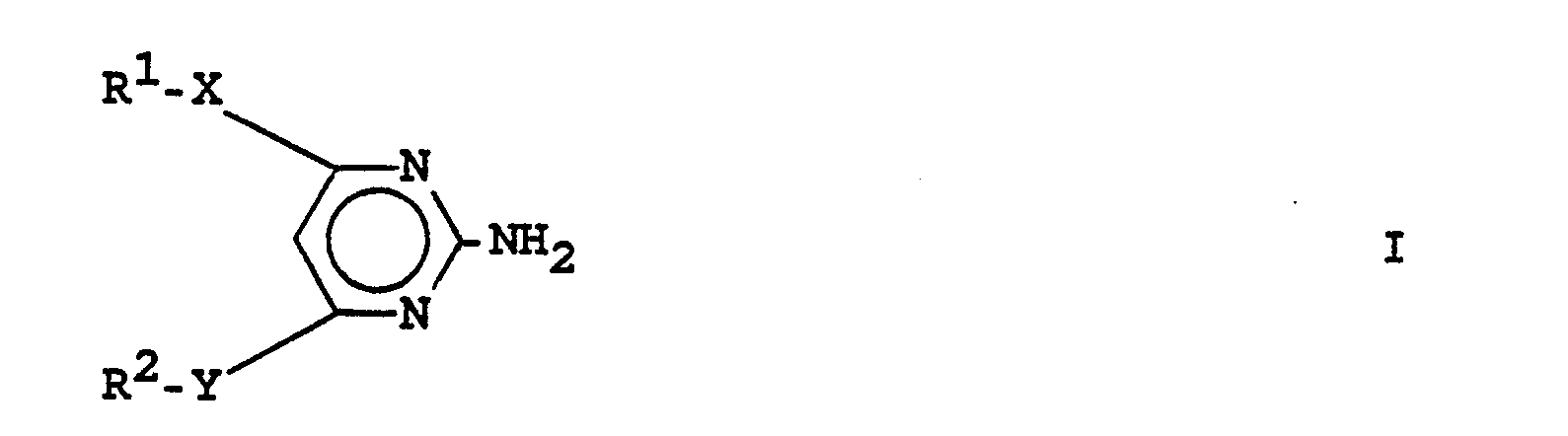
- the invention relates to a process for the preparation of pyrimidines of the formula I.
- X and Y independently of one another oxygen or sulfur and R1 and R2 independently of one another denote (C1-C4) alkyl, (C1-C4) alkoxy- (C1-C2) alkyl or halo (C1-C4) alkyl, characterized in that a propanediimidate of the formula II wherein R1 and R2 are as defined in Formula I, or one of its salts with a cyanate ester of the formula III R3-OC ⁇ N III, wherein R3 (C1-C4) alkyl, phenyl, phenyl which is substituted by 1, 2 or 3 radicals from the radicals halogen, (C1-C4) alkoxy and (C1-C4) alkyl, ⁇ - or ⁇ -naphthyl or halo ( C1-C4) alkyl means reacted in an inert organic solvent.
- pyrimidines of the formula I can be prepared by reacting propanediimidates with aqueous cyanamide solution or cyanogen chloride in a two- or three-stage process (EP-A-0 024 200), the formation and subsequent isolation of an N-cyanoimidate as an intermediate as characteristic process features are to be viewed.
- the yields available for the end product are unsatisfactory.
- Further disadvantages of the process mentioned are: the formation of not inconsiderable amounts of by-products, the need to carry out the reaction in a narrow pH range and the additional use of a base.
- a further disadvantage is that the inorganic salts formed during the reaction, especially when using aqueous cyanamide solution, get into the waste water in dissolved form, from which they have to be removed by additional measures.
- the process according to the invention surprisingly proceeds in a process-technically simple manner
- One-step process without isolable intermediates which allows a reaction to be carried out without pH control.
- By-products are only formed to a minor extent.
- the imide nitrogen attacks the cyanate ester without a cyanimidate passing through or being formed as an intermediate stage.
- the high selectivity in the formation of compounds of the formula I and the associated high yields were not to be expected.
- the process according to the invention is expediently carried out in such a way that the propanediimidate is isolated as the mono- or disalt or as the bisimidate, in solution or as a suspension with the cyanate ester of the formula III at reaction temperatures of 0-180 ° C., preferably 20-140 ° C. .
- Preferred salts of propanediimidate are those of hydrofluoric, hydrochloric or hydrobromic acid or sulfuric or phosphoric acid.
- Haloalkyl radicals for R1, R2, R3 are, for example, CH2Cl, CHCl2, CCl3, CH2CH2Cl or CH2CF3.
- X and Y are preferably oxygen.
- R1 and R2 are preferably (C1-C4) alkyl, especially methyl.
- R3 is preferably phenyl, which can have up to 3 substituents, in particular 1 or 2 substituents, from the radicals chlorine, methyl and methoxy, or ⁇ -naphthy
- Suitable inert organic solvents are those which are inert under the respective reaction conditions.
- alcohols such as methanol, ethanol and propanol
- ketones such as acetone and methyl isobutyl ketone
- ethers such as diethyl ether, dioxane and tetrahydrofuran
- esters such as methyl acetate, ethyl acetate and butyl acetate
- hydrocarbons such as toluene, xylene, hexane and cyclohexane
- nitroles such as acetonitrile
- halogenated hydrocarbons such as chloroform and methylene chloride or mixtures of the solvents listed.
- the compounds of formula II can be prepared by known methods (SM McElvain and ID Schroeder, JACS 71 , 40 (1949); B. Harstun, DE-OS 2426913).
- the mono salt and the bisimidate of these compounds can be prepared from the corresponding disalt by reaction with bases such as alkali and alkaline earth metal hydroxides, carbonates, bicarbonates or alcoholates in an inert solvent.
- bases such as alkali and alkaline earth metal hydroxides, carbonates, bicarbonates or alcoholates in an inert solvent.
Landscapes
- Chemical & Material Sciences (AREA)
- Organic Chemistry (AREA)
- Organic Low-Molecular-Weight Compounds And Preparation Thereof (AREA)
Abstract
R¹ - X -


oder deren Salze mit Cyansäureestern der Formel R³-O-CN, worin R³ C₁-C₄-Alkyl, Phenyl, Phenyl, das durch 1, 2 oder 3 Reste aus den Resten Halogen, C₁-C₄-Alkoxy und C₁-C₄-Alkyl substituiert ist, α- oder β-Naphthyl oder Halo-C₁-C₄-alkyl bedeutet, in einem unter den Reaktionsbedingungen inerten organischen Lösungsmittel erhalten. Das Einstufenverfahren gestattet eine effektive Herstellung der Verbindungen der Formel I, die als Zwischenprodukte zur Herstellung herbizider Sulfonylharnstoffe verwendet werden können.
Description
- Gegenstand der Erfindung ist ein Verfahren zur Herstellung von Pyrimidinen der Formel I

X und Y unabhängig voneinander Sauerstoff oder Schwefel und
R¹ und R² unabhängig voneinander (C₁-C₄)Alkyl, (C₁-C₄)Alkoxy-(C₁-C₂)alkyl oder Halo(C₁-C₄)alkyl bedeuten,
dadurch gekennzeichnet, daß man ein Propandiimidat der Formel II
mit einem Cyansäureester der Formel III
R³-O-C≡N III,
worin
R³ (C₁-C₄)Alkyl, Phenyl, Phenyl, das durch 1, 2 oder 3 Reste aus den Resten Halogen, (C₁-C₄)Alkoxy und (C₁-C₄)Alkyl substituiert ist, α- oder β-Naphthyl oder Halo(C₁-C₄)alkyl bedeutet,
in einem inerten organischen Lösungsmittel umsetzt. - Verbindungen der Formel I sind wertvolle Zwischenprodukte bei der Herstellung von Sulfonylharnstoffen mit herbizider Wirkung; siehe beispielsweise US-A-4,169,179 oder EP-A-071 958 (US-A-4,492,598).
- Bekannt ist die Umsetzung von Nucleophilen und Dinucleophilen mit Cyansäureestern (E. Grigat, Angew. Chem. 84, 1008 (1972); Angew. Chem. Int. Ed. Vol 11, 949 (1972)).
- Ferner ist bekannt, daß Pyrimidine der Formel I durch Umsetzung von Propandiimidaten mit wäßriger Cyanamidlösung oder Chlorcyan in einem Zwei- oder Dreistufenprozeß hergestellt werden können (EP-A-0 024 200), wobei die Bildung und anschließende Isolierung eines N-Cyanoimidates als Zwischenprodukt als charakteristische Verfahrensmerkmale anzusehen sind. Die hierbei erhältlichen Ausbeuten für das Endprodukt sind jedoch unbefriedigend. Weitere Nachteile des genannten Verfahrens sind: die Bildung nicht unerheblicher Mengen an Nebenprodukten, die Notwendigkeit der Reaktionsführung in einem engen pH-Bereich und die zusätzliche Verwendung einer Base. Außerdem ist von Nachteil, daß die während der Umsetzung gebildeten anorganischen Salze, speziell beim Einsatz von wäßriger Cyanamidlösung, in gelöster Form ins Abwasser gelangen, aus welchem sie durch zusätzliche Maßnahmen entfernt werden müssen.
- Überraschenderweise verläuft das erfindungsgemäße Verfahren demgegenüber in einem verfahrenstechnisch einfachen Einstufenprozeß ohne isolierbare Zwischenprodukte, der eine Reaktionsführung ohne pH-Kontrolle gestattet. Nebenprodukte werden nur in untergeordnetem Maß gebildet.
- Beim erfindungsgemäßen Verfahren greift der Imidstickstoff am Cyansäureester an, ohne daß dabei ein Cyanimidat als Zwischenstufe durchlaufen oder gebildet wird. Die hohe Selektivität bei der Bildung von Verbindungen der Formel I und die damit verbundenen hohen Ausbeuten waren nicht zu erwarten.
- Im Verlauf der Reaktion werden keine Salze gebildet, die zu einer Abwasserbelastung führen könnten. Neben den bereits beschriebenen verfahrenstechnischen und wirtschaftlichen Vorteilen, ist dieser Aspekt aus ökologischer Sicht als fortschrittlich anzusehen. Nach Beendigung der Reaktion, Extraktion des gebildeten Alkohols (R³OH) und Abdestillieren des Lösungsmittel, welches nahezu quantitativ zurückgewonnen wird, verbleibt des Endprodukt in hoher Reinheit.
- Das erfindungsgemäße Verfahren wird zweckmäßigerweise so durchgeführt, daß man das Propandiimidat alsk Mono- oder Disalz oder als Bisimidat isoliert, in Lösung oder als Suspension mit dem Cyansäureester der Formel III bei Reaktionstemperaturen von 0-180 °C, vorzugsweise 20-140 °C, umsetzt. Als Salze des Propandiimidates werden bevorzugt solche der Fluor-, Chlor- oder Bromwasserstoffsäure oder der Schwefel- oder Phosphorsäure eingesetzt. Haloalkylreste für R¹, R², R³ sind beispielsweise CH₂Cl, CHCl₂, CCl₃, CH₂CH₂Cl oder CH₂CF₃. Vorzugsweise bedeuten X und Y Sauerstoff. R¹ und R² bedeuten vorzugsweise (C₁-C₄)Alkyl, insbesondere Methyl. R³ bedeutet vorzugsweise Phenyl, das bis zu 3 Substituenten, insbesondere 1 oder 2 Substituenten, aus den Resten Chlor, Methyl und Methoxy aufweisen kann, oder β-Naphthyl.
- Als inerte organische Lösungsmittel sind solche geeignet, die unter den jeweiligen Reaktionsbedingungen inert sind. Beispielsweise können als inerte organische Lösungsmittel Alkohole wie Methanol, Ethanol, und Propanol, Ketone wie Aceton und Methylisobutylketon, Ether wie Diethylether, Dioxan und Tetrahydrofuran, Ester wie Methylacetat, Ethylacetat und Butylacetat, Kohlenwasserstoffe wie Toluol, Xylol, Hexan und Cyclohexan, Nitrole wie Acetonitril und halogenierte Kohlenwasserstoffe wie Chloroform und Methylenchlorid oder Mischungen der aufgeführten Lösungsmittel verwendet werden.
- Um störende Einflüsse von Sauerstoff auf die Reaktion zu vermeiden, ist es zweckmäßig, unter Inertgasatmosphäre, beispielsweise unter Stickstoff, zu arbeiten.
- Die Verbindungen der Formel II können nach bekannten Methoden hergestellt werden (S.M. McElvain and I.D. Schroeder, JACS 71, 40 (1949); B. Harstun, DE-OS 2426913).
- Das Monosalz und das Bisimidat dieser Verbindungen können aus dem entsprechenden Disalz durch Umsetzung mit Basen wie Alkali- und Erdalkalihydroxiden, -carbonaten, -hydrogencarbonaten oder -alkoholaten in einem inerten Lösungsmittel hergestellt werden.
- Nachfolgende Beispiele sollen das erfindungsgemäße Verfahren näher erläutern:
- Zu 800 ml Diethylether werden bei Raumtemperatur unter Stickstoffüberlagerung 52 g Dimethylpropandiimidat und 49 g Phenylcyanat gegeben. Nach 5 Stunden Erwärmen auf 36 °C wird das Phenol mit 10 %iger Natronlauge ausgewaschen und das Lösungsmittel abdestilliert.
- Es verbleiben 55 g Produkt, was einer Ausbeute von 89 % der Theorie entspricht.
Der Schmelzpunkt beträgt 93-94 °C. - Zu 800 ml Methylisobutylketon werden unter Stickstoffüberlagerung bei 50 °C 49 g Phenylcyanat und 52 g Dimethylpropandiimidat gegeben und für 5 Stunden reagieren gelassen. Das entstehende Phenol wird mit Natronlauge extrahiert und das Lösungsmittel abdestilliert. Es verbleiben 56,4 g Produkt, was einer Ausbeute von 91 % der Theorie entspricht. Der Schmelzpunkt beträgt 92-94 °C.
- In einer Lösung von 500 ml Aceton werden unter Stickstoffüberlagerung bei 40 °C 52 g Dimethylpropandiimidat und 75,2 g 2,4-Dichlorphenylcyanat gegeben und 5 Stunden bei 40 °C reagieren gelassen. Nach Extrahieren von 2,4-Dichlorphenol wird das Lösungsmittel abdestilliert.
Es verbleiben 54,5 g Produkt, was einer Ausbeute von 88 % der Theorie entspricht.
Der Schmelzpunkt ist 92-94 °C. - Zu 500 ml Essigsäuremethylester werden 59 g 2,4-Dimethylphenylcyanat und 67 g Dimethylpropandiimidatmonohydrochlorid gegeben und 5 Stunden bei 50 °C reagieren gelassen. Nach Extrahieren von 2,4-Dimethylphenol mit Natronlauge wird das Lösungsmittel abdestilliert.
Es verbleiben 53 g Produkt, was einer Ausbeute von 86 % der Theorie entspricht.
Der Schmelzpunkt beträgt 92-93 °C. - Zu 500 ml Toluol werden bei 70 °C 52 g Dimethylpropandiimidat und 63 g β-Naphthylcyanat gegeben und 5 Stunden bei 70 °C reagieren gelassen. Nach Entfernen des β-Naphthols wird das Lösungsmittel abdestilliert. Es verbleiben 55,8 g Produkt, was einer Ausbeute von 90 % der Theorie entspricht.
- Zu 800 ml Toluol werden unter Stickstoffüberlagerung bei 110 °C 52 g Dimethylpropandiimidat und 67,0g 2-Methyl-4-chlorphenylcyanat gegeben und 5 Stunden bei 110 °C reagieren gelassen. Nach Extraktion von 2-Methyl-4-chlorphenol wird das Lösungsmittel abdestilliert. Es verbleiben 55,2 g Produkt, was einer Ausbeute von 89,2 % der Theorie entspricht.
Der Schmelzpunkt des Produkts ist 92-94 °C. - Zu 800 ml Toluol werden unter Stickstoffüberlagerung bei 90 °C 52 g Dimethylpropandiimidat und 73,4g 4-Chlor-2-methoxyphenylcyanat gegeben und 6 Stunden bei 90 °C reagieren gelassen. Nach Extraktion von 4-Chlor-2-methoxyphenol wird das Lösungsmittel abdestilliert. Es verbleiben 53,2 g Produkt (Ausbeute 86 % d. Th.) mit einem Schmelzpunkt von 92-93 °C.
- Analog zu den in den Beispielen 1-7 beschriebenen Verfahrensweisen lassen sich beispielsweise folgende Verbindungen der Formel I herstellen:

Claims (8)

X und Y unabhängig Sauerstoff oder Schwefel und
R¹ und R² unabhängig voneinander (C₁-C₄)Alkyl, (C₁-C₄)Alkoxy-(C₁-C₂)alkyl oder Halo(C₁-C₄)alkyl bedeuten,
dadurch gekennzeichnet, daß man ein Propandiimidat der Formel II

mit einem Cyansäureester der Formel III
R³-O-C≡N III,
worin
R³ (C₁-C₄)Alkyl, Phenyl, Phenyl, das durch 1, 2, oder 3 Reste aus den Resten Halogen, (C₁-C₄)Alkoxy oder (C₁-C₄)Alkyl substituiert ist, α- oder β-Naphthyl oder Halo(C₁-C₄)alkyl bedeutet,
in einem inerten organischen Lösungsmittel umsetzt.
Applications Claiming Priority (2)
| Application Number | Priority Date | Filing Date | Title |
|---|---|---|---|
| DE3642832 | 1986-12-16 | ||
| DE19863642832 DE3642832A1 (de) | 1986-12-16 | 1986-12-16 | Verfahren zur herstellung von aminopyrimidinen |
Publications (3)
| Publication Number | Publication Date |
|---|---|
| EP0271833A2 true EP0271833A2 (de) | 1988-06-22 |
| EP0271833A3 EP0271833A3 (en) | 1990-02-28 |
| EP0271833B1 EP0271833B1 (de) | 1994-09-07 |
Family
ID=6316233
Family Applications (1)
| Application Number | Title | Priority Date | Filing Date |
|---|---|---|---|
| EP87118369A Expired - Lifetime EP0271833B1 (de) | 1986-12-16 | 1987-12-11 | Verfahren zur Herstellung von Aminopyrimidinen |
Country Status (4)
| Country | Link |
|---|---|
| US (1) | US4831138A (de) |
| EP (1) | EP0271833B1 (de) |
| JP (1) | JPS63162677A (de) |
| DE (2) | DE3642832A1 (de) |
Cited By (2)
| Publication number | Priority date | Publication date | Assignee | Title |
|---|---|---|---|---|
| EP0445642A1 (de) * | 1990-03-08 | 1991-09-11 | BASF Aktiengesellschaft | 2-Amino-(fluoralkoxy-pyrimidine) und Verfahren zu ihrer Herstellung |
| EP0547411A1 (de) * | 1991-11-26 | 1993-06-23 | Lonza A.G. | Verfahren zur Herstellung von 2-substituierten 4,6-Dialkoxypyrimidinen |
Families Citing this family (8)
| Publication number | Priority date | Publication date | Assignee | Title |
|---|---|---|---|---|
| DE4007683A1 (de) * | 1990-03-10 | 1991-09-12 | Basf Ag | Herbizide sulfonylharnstoffe, verfahren und zwischenprodukte zu ihrer herstellung |
| DE4024754A1 (de) * | 1990-08-03 | 1992-02-06 | Basf Ag | Herbizide sulfonylharnstoffe, verfahren und zwischenprodukte zu ihrer herstellung und ihre verwendung |
| DE4024761A1 (de) * | 1990-08-03 | 1992-02-06 | Basf Ag | 2-amino-(fluoralkoxy-1,3,5-triazine) und verfahren zu ihrer herstellung |
| CA2051338A1 (en) * | 1990-09-15 | 1992-03-16 | Stephen Lachhein | Process for the preparation of aminopyrimidines |
| EP0689238B1 (de) * | 1994-06-23 | 2002-02-20 | STMicroelectronics S.r.l. | Verfahren zur Herstellung eines Leistungsbauteils in MOS-Technik |
| ATE293608T1 (de) * | 1999-04-15 | 2005-05-15 | Basf Ag | Verfahren zur herstellung von substituierten pyrimidinen |
| US6281358B1 (en) | 1999-04-15 | 2001-08-28 | American Cyanamid Company | Process for the preparation of substituted pyrimidines |
| CN110818643B (zh) * | 2018-08-13 | 2021-04-16 | 新发药业有限公司 | 一种2-氨基-4,6-二甲氧基嘧啶的制备方法 |
Family Cites Families (6)
| Publication number | Priority date | Publication date | Assignee | Title |
|---|---|---|---|---|
| DE2426913A1 (de) * | 1974-06-04 | 1975-12-11 | Ferring Arzneimittel Gmbh | Malonsaeure- bzw. bernsteinsaeure-di- (imidoester),- verfahren zu ihrer herstellung und anwendung in der peptidchemie |
| CH603575A5 (de) * | 1974-08-19 | 1978-08-31 | Hoffmann La Roche | |
| US4032559A (en) * | 1975-07-28 | 1977-06-28 | The Upjohn Company | N,2-dicyanoacetimidates |
| US4169179A (en) * | 1977-10-07 | 1979-09-25 | Bussey Harry Jun | Spring-like loose fill packaging material |
| AR225772A1 (es) * | 1979-08-14 | 1982-04-30 | Du Pont | Nuevo 3-amino-3-alcoxi-n-ciano-2-propenimidato de alquilo y procedimientos para su preparacion y de pirimidinas partiendo de aquellos |
| DE3131489A1 (de) * | 1981-08-08 | 1983-02-24 | Hoechst Ag, 6000 Frankfurt | Heterocyclisch substituierte sulfonylharnstoffe, verfahren zu ihrer herstellung und ihre verwendung in der landwirtschaft |
-
1986
- 1986-12-16 DE DE19863642832 patent/DE3642832A1/de not_active Withdrawn
-
1987
- 1987-12-11 EP EP87118369A patent/EP0271833B1/de not_active Expired - Lifetime
- 1987-12-11 DE DE3750500T patent/DE3750500D1/de not_active Expired - Fee Related
- 1987-12-14 JP JP62314318A patent/JPS63162677A/ja active Pending
- 1987-12-14 US US07/132,484 patent/US4831138A/en not_active Expired - Fee Related
Cited By (4)
| Publication number | Priority date | Publication date | Assignee | Title |
|---|---|---|---|---|
| EP0445642A1 (de) * | 1990-03-08 | 1991-09-11 | BASF Aktiengesellschaft | 2-Amino-(fluoralkoxy-pyrimidine) und Verfahren zu ihrer Herstellung |
| US5283332A (en) * | 1990-03-08 | 1994-02-01 | Gerhard Hamprecht | 2-amino(fluoroalkoxy)pyrimidines and the preparation thereof |
| US6235904B1 (en) * | 1990-03-08 | 2001-05-22 | Basf Aktiengesellschaft | 2-amino (fluoroalkoxy) pyrimidines and the preparation thereof |
| EP0547411A1 (de) * | 1991-11-26 | 1993-06-23 | Lonza A.G. | Verfahren zur Herstellung von 2-substituierten 4,6-Dialkoxypyrimidinen |
Also Published As
| Publication number | Publication date |
|---|---|
| DE3642832A1 (de) | 1988-06-30 |
| EP0271833B1 (de) | 1994-09-07 |
| EP0271833A3 (en) | 1990-02-28 |
| JPS63162677A (ja) | 1988-07-06 |
| US4831138A (en) | 1989-05-16 |
| DE3750500D1 (de) | 1994-10-13 |
Similar Documents
| Publication | Publication Date | Title |
|---|---|---|
| DE69230278T2 (de) | Verfahren zur Herstellung von Omeprazol | |
| DE69623532T2 (de) | Verfahren zur Herstellung von 4-Trifluormethylnicotinsäure | |
| EP1012144B1 (de) | Verfahren zur herstellung (hetero)aromatischer hydroxylamine | |
| EP0271833B1 (de) | Verfahren zur Herstellung von Aminopyrimidinen | |
| EP0271834B1 (de) | Verfahren zur Herstellung von Pyrimidinen | |
| EP0280781B1 (de) | Verfahren zur Herstellung von N-Alkyl-N'-methyl-alkylenharnstoffen, insbesondere N,N'-Dimethylalkylenharnstoffen | |
| EP0025843B1 (de) | Herstellung von Monoalkylethern von Hydroxyphenolen und deren Umwandlung zu Hydroxycumaranen | |
| DE2436149C3 (de) | Verfahren zur Herstellung von 5-Fluorcytosin | |
| EP0463464A1 (de) | Verfahren zur Herstellung von 2-Chlor-5-methyl-pyridin | |
| EP0373464B1 (de) | Verfahren zur Herstellung von 2-Chlor-5-chlormethylpyridin | |
| EP0341693B1 (de) | Verfahren zur Herstellung von O-substituierten Hydroxylaminen | |
| EP0178611B1 (de) | Verfahren zur Herstellung von N,N',N"-Tris(2-hydroxypropyl)melamin | |
| EP0424849B1 (de) | Verfahren zur Herstellung von Aminopyrimidinen | |
| DE69707860T2 (de) | Verfahren zur herstellung von tetrahydroindolizinen | |
| DE69427827T2 (de) | Verfahren zur Herstellung von Sulfonylharnstoffderivaten und Zwischenprodukte für dieses Verfahren | |
| EP0547411A1 (de) | Verfahren zur Herstellung von 2-substituierten 4,6-Dialkoxypyrimidinen | |
| DE2803755A1 (de) | Verfahren zur herstellung von n-substituierten 3-amino-1.2-benzisothiazolen | |
| EP0279366B1 (de) | Verfahren zur Herstellung von Pyrimidinen | |
| EP0476554A1 (de) | Verfahren zur Herstellung von Aminopyridinen | |
| EP0373463B1 (de) | Verfahren zur Herstellung von 2-Chlor-5-chlormethylpyridin | |
| DE3906174A1 (de) | Verfahren zur herstellung von d-mannosaminderivaten | |
| EP0504873A1 (de) | Verfahren zur Herstellung von N-Alkylsulfonamiden | |
| EP0033885B1 (de) | Verfahren zur Herstellung von (2-Chlor-4-trifluormethyl-phenyl)-(3-methoxy-phenyl)-ether | |
| DE19535083C1 (de) | N-(4-Brom-2-fluorbenzyl)carbamate sowie ein Verfahren zu ihrer Herstellung | |
| EP0114289B1 (de) | Verfahren zur Herstellung von 2-Alkylthiomethyl-4-hydroxypyrimidinen |
Legal Events
| Date | Code | Title | Description |
|---|---|---|---|
| PUAI | Public reference made under article 153(3) epc to a published international application that has entered the european phase |
Free format text: ORIGINAL CODE: 0009012 |
|
| AK | Designated contracting states |
Kind code of ref document: A2 Designated state(s): CH DE FR GB IT LI NL |
|
| PUAL | Search report despatched |
Free format text: ORIGINAL CODE: 0009013 |
|
| AK | Designated contracting states |
Kind code of ref document: A3 Designated state(s): CH DE FR GB IT LI NL |
|
| 17P | Request for examination filed |
Effective date: 19900627 |
|
| 17Q | First examination report despatched |
Effective date: 19920409 |
|
| GRAA | (expected) grant |
Free format text: ORIGINAL CODE: 0009210 |
|
| RAP1 | Party data changed (applicant data changed or rights of an application transferred) |
Owner name: HOECHST SCHERING AGREVO GMBH |
|
| AK | Designated contracting states |
Kind code of ref document: B1 Designated state(s): CH DE FR GB IT LI NL |
|
| REF | Corresponds to: |
Ref document number: 3750500 Country of ref document: DE Date of ref document: 19941013 |
|
| ITF | It: translation for a ep patent filed | ||
| PG25 | Lapsed in a contracting state [announced via postgrant information from national office to epo] |
Ref country code: GB Effective date: 19941211 |
|
| GBT | Gb: translation of ep patent filed (gb section 77(6)(a)/1977) |
Effective date: 19941114 |
|
| PG25 | Lapsed in a contracting state [announced via postgrant information from national office to epo] |
Ref country code: LI Effective date: 19941231 Ref country code: CH Effective date: 19941231 |
|
| ET | Fr: translation filed | ||
| PG25 | Lapsed in a contracting state [announced via postgrant information from national office to epo] |
Ref country code: NL Effective date: 19950701 |
|
| PLBE | No opposition filed within time limit |
Free format text: ORIGINAL CODE: 0009261 |
|
| STAA | Information on the status of an ep patent application or granted ep patent |
Free format text: STATUS: NO OPPOSITION FILED WITHIN TIME LIMIT |
|
| GBPC | Gb: european patent ceased through non-payment of renewal fee |
Effective date: 19941211 |
|
| 26N | No opposition filed | ||
| PG25 | Lapsed in a contracting state [announced via postgrant information from national office to epo] |
Ref country code: FR Effective date: 19950831 |
|
| REG | Reference to a national code |
Ref country code: CH Ref legal event code: PL |
|
| NLV4 | Nl: lapsed or anulled due to non-payment of the annual fee |
Effective date: 19950701 |
|
| PG25 | Lapsed in a contracting state [announced via postgrant information from national office to epo] |
Ref country code: DE Effective date: 19950901 |
|
| REG | Reference to a national code |
Ref country code: FR Ref legal event code: ST |
|
| PG25 | Lapsed in a contracting state [announced via postgrant information from national office to epo] |
Ref country code: IT Free format text: LAPSE BECAUSE OF NON-PAYMENT OF DUE FEES;WARNING: LAPSES OF ITALIAN PATENTS WITH EFFECTIVE DATE BEFORE 2007 MAY HAVE OCCURRED AT ANY TIME BEFORE 2007. THE CORRECT EFFECTIVE DATE MAY BE DIFFERENT FROM THE ONE RECORDED. Effective date: 20051211 |