EP0272158A2 - Elektronisches Wörterbuch - Google Patents
Elektronisches Wörterbuch Download PDFInfo
- Publication number
- EP0272158A2 EP0272158A2 EP87311231A EP87311231A EP0272158A2 EP 0272158 A2 EP0272158 A2 EP 0272158A2 EP 87311231 A EP87311231 A EP 87311231A EP 87311231 A EP87311231 A EP 87311231A EP 0272158 A2 EP0272158 A2 EP 0272158A2
- Authority
- EP
- European Patent Office
- Prior art keywords
- word
- optical reader
- electronic dictionary
- words
- language
- Prior art date
- Legal status (The legal status is an assumption and is not a legal conclusion. Google has not performed a legal analysis and makes no representation as to the accuracy of the status listed.)
- Granted
Links
Images




Classifications
-
- G—PHYSICS
- G06—COMPUTING OR CALCULATING; COUNTING
- G06F—ELECTRIC DIGITAL DATA PROCESSING
- G06F17/00—Digital computing or data processing equipment or methods, specially adapted for specific functions
-
- G—PHYSICS
- G06—COMPUTING OR CALCULATING; COUNTING
- G06F—ELECTRIC DIGITAL DATA PROCESSING
- G06F3/00—Input arrangements for transferring data to be processed into a form capable of being handled by the computer; Output arrangements for transferring data from processing unit to output unit, e.g. interface arrangements
- G06F3/01—Input arrangements or combined input and output arrangements for interaction between user and computer
- G06F3/018—Input/output arrangements for oriental characters
-
- G—PHYSICS
- G06—COMPUTING OR CALCULATING; COUNTING
- G06F—ELECTRIC DIGITAL DATA PROCESSING
- G06F40/00—Handling natural language data
- G06F40/20—Natural language analysis
- G06F40/237—Lexical tools
- G06F40/242—Dictionaries
-
- G—PHYSICS
- G06—COMPUTING OR CALCULATING; COUNTING
- G06F—ELECTRIC DIGITAL DATA PROCESSING
- G06F40/00—Handling natural language data
- G06F40/40—Processing or translation of natural language
- G06F40/55—Rule-based translation
-
- G—PHYSICS
- G06—COMPUTING OR CALCULATING; COUNTING
- G06F—ELECTRIC DIGITAL DATA PROCESSING
- G06F40/00—Handling natural language data
- G06F40/40—Processing or translation of natural language
- G06F40/58—Use of machine translation, e.g. for multi-lingual retrieval, for server-side translation for client devices or for real-time translation
Definitions
- the invention relates to an electronic dictionary for the electronic translation of words or compound words from one language (source language) into words or compound words of another language (target language); in particular, it relates to the means of input into the electronic dictionary of the words or compound words to be translated.
- keyboard input of words or compounds in the source language and display corresponding words or compounds in the target language, possibly including other information such as the meanings of the translated words, their pronunciation, and their parts of speech.
- Keyboard input is liable to error, especially when the operator enters the words by looking at the source document and keyboard alternately. Each time an input error is made, the word must be reentered by correcting the error. Input may therefore be slow, requiring longer than it takes to consult an ordinary dictionary. Further, the operator normally has to write the target words found on the source document so as not to forget them.
- the word or compound word to be translated is in a variant form (for example, the past tense or progressive form of a verb)
- a variant form for example, the past tense or progressive form of a verb
- the user has to determine mentally the original or canonical form of the word, prior to inputting it on the keyboard.
- the procedure has thus been extremely cumbersome, and conventional electronic dictionaries have not been able to provide the full benefits to be expected from an electronic dictionary.
- the invention provides an electronic dictionary for the electronic translation of words or compound words in a source language to the corresponding words or compound words in a target language.
- the electronic dictionary of the invention is characterised in that it comprises an optical reader which optically reads the source language, and a translation unit which, based on the output information supplied by the optical reader, outputs the target language.
- a display unit can be additionally provided to display the target language produced by the translation unit.
- the optical reader, translation unit and display unit are provided in a unitary housing.
- the translation unit and display unit are provided in a unitary housing and the optical reader is provided in a scanner electrically connected to the unitary housing by a connector cord.
- the electronic dictionary configured as described above operates as follows:
- Input of the words to be translated, which are recorded on a source document, is effected using the optical reader.
- the optical reader may comprise, for example, a light source for illuminating the source document and a photoelectric sensor which converts the light reflected from the source document into electrical signals.
- the translation unit based on the result of reading by the optical reader, outputs the corresponding translated language information.
- the corresponding translated language information may include the meanings of the words, their pronunciation, and other information provided in an ordinary dictionary.
- the display unit displays the translated language information which is output from the translation unit.
- optical input of the source language by the optical reader eliminates the errors inherent in keyboard input of the words to be translated. The invention thus solves the existing problem.
- the electronic dictionary may be provided with a printer which prints at least a part of the translated language information produced by the translation unit.
- the optical reader and the printer are disposed at fixed position relative to each other, so that the said part of the translated language information will be printed at a fixed position relative to the input language. Printing of the translated language information by a printer saves the operator the trouble of writing down the words.
- the optical reader illuminates the medium containing the language to be translated with light from an external source.
- a condenser is provided to enable the optical reader to condense light from the external source.
- the condenser may be a lens or any other form of condenser, such as a solar collector.
- the translation unit identifies, based on output from the optical reader, variants of the language to be translated and, as a result of that identification makes predetermined changes at the word ending or ignores the word endings, and produces translated language information corresponding to the original or canonical form of the word.
- Corresponding target language information may, for example, include the meanings of the canonical form of the source words, their pronunciation, and other information necessary in a dictionary.
- the electronic dictionary is capable of producing translated language information consistent with the canonical form of the word, irrespective of its variation. This provides a function of an ordinary dictionary.
- the English word to be translated is entered in alphabetical characters from a keyboard 1 by a finger-pressing action of the operator.
- the alphabetical characters are fed to a retrieval controller 3.
- retrieval controller 3 retrieves the corresponding English word from a semantic dictionary 2, and the meaning and other items associated with the Japanese word corresponding to the English word are displayed on a display panel 4.
- an electronic dictionary for translating English words or compound words to the corresponding Japanese words or compound words.
- the electronic dictionary also provides other information normally found in a conventional dictionary, such as pronunciation, examples of usage, parts of speech and word origin.
- the electronic dictionary comprises an optical reader 5, an analog/digital converter (abbreviated as A/D converter) 6, a preprocessor 7, a recognition controller 8, a recognition dictionary 9, a semantic dictionary 10, a retrieval controller 11, and a display panel 12.
- the optical reader 5, more fully shown in Figure 4 comprises a light source 5a which illuminates a source document 14 on which the English words to be translated are printed, a lens 5b which condenses the light from the light source 5a on to the source document 14, a pickup sensor 5d and a lens 5c which forms an image of the reflected light from the source document 14 on the pickup sensor 5d.
- the pickup sensor 5d converts the light from the image into electrical signals indicating brightness and darkness.
- the pickup sensor 5d may be a CCD sensor, for example.
- the A/D converter 6 converts the analog signals from the pickup sensor 5d into digital signals, supplying the digital signals to the preprocessor 7.
- the recognition dictionary 9 contains standard alphabetic character patterns for the recognition of optically read alphabetic characters.
- Pattern matching consists of pre-storage of two-dimensional images of characters in the dictionary as they are, and a process of matching a given input pattern, comprised of binary signals that have been read, with a pattern in the dictionary.
- Structural analysis consists of extraction of partial profiles of characters from the characters; dictionary storage of descriptions of the extracted partial profiles, and their interrelationships; and a process of matching a given input pattern with the stored information.
- the identification of alphabetic characters that are read can be done either by pattern matching or by structural analysis. Since headings and the initial letter of an English sentence are capitalized, the recognition controller 9 ignores the difference between upper and lower case when identifying a character.
- the semantic dictionary 10 contains dictionary storage of Japanese language data corresponding to English words, including word meaning, pronunciation symbols, related grammar, sentence examples using a given word, synonyms and antonyms.
- the retrieval controller 11 retrieves from the semantic dictionary 10 the Japanese word corresponding to a given English word that has been read.
- the retrieval controller 11 includes: an input buffer 15 which is used for temporary storage of character codes for the storage of alphabetic characters corresponding to the single word which has been identified by the recognition controller 8; a word library 16 which contains the starting address in a dictionary memory 20 (further described hereinbelow) which contains English words to be translated and the meanings of the corresponding Japanese words; an address counter 17 for scanning the English words stored in the word library 16; a register 18 for temporary storage of the English words and their starting addresses as read from the word library 16; and a gate 19 which determines whether the English words obtained from the input buffer 15 and the register 18 match.
- the semantic dictionary 10 includes the dictionary memory 20 containing Japanese language information, such as the meanings of Japanese words and their pronunciation symbols, as discussed above; and a register 21 which specifies the address in the dictionary memory 20.
- the display panel 12 displays the translated Japanese language information which is retrieved by retrieval controller 11.
- the electronic dictionary described with reference to Figures 3 to 5 operates as follows: When the source document 14 containing the English words to be translated is illuminated by light source 5a, as shown in Figure 2, the reflected light is fed into the pickup sensor 5d through the lens 5c. The pickup sensor 5d converts the reflected light into electrical signals which are fed into the recognition controller 8 after undergoing binarization and related treatment in the preprocessor 7.
- the recognition controller 8 uses the aforementioned pattern matching or structural analysis method, and by referencing the alphabetical standard patterns stored in the recognition dictionary 9, identifies the individual alphabetic characters that have been read. It then sends English word character codes, consisting of a group of identified alphabetic characters, to the retrieval controller 11.
- Figure 6 shows examples of word storage in the word library 16 and the dictionary memory 20.
- the alphabetic writing in ⁇ ⁇ connected by chain lines to Japanese characters is not actually in the dictionary but is inserted in the Figure for explanation to English readers.
- the string of alphabetic codes equivalent to a single word that has been identified is stored in the input buffer 15 shown in Figure 5.
- the English word and its address code ("a" and "0001" as illustrated) are sent from the beginning of the word library 16 to the word buffer and address in the register 18.
- the gate 19 determines whether or not the character code (English word that has been read in) stored in the input buffer 15 matches the English word stored in register 18. If there is no match, "1" is added to address counter 17, which causes the next English word and address ("abandon" and "0002” as illustrated) in the word library 16 to be sent to the register 18. Then, as described above, the gate 19 determines whether or not the word in register 18 matches the English word that has been read in.
- Words in the word library 16 continue to be read until a match is found between the English word that has been read in and an English word read from the word library 16.
- the address contained in register 18 at that time is sent to the address register 21 of the semantic dictionary 10.
- the code for address "0051" is sent to the address register 21.
- the semantic dictionary 10 transfers the contents of the dictionary memory 20, using the address specified by the address register 21 as the starting addresses, one by one to a display buffer which is not shown in the figure (although in this embodiment the display buffer is provided in the retrieval controller 11, it can be in the semantic dictionary 10).
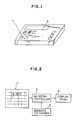
- Figure 7 is a schematic perspective external view of the electronic dictionary described with reference to Figures 3 to 6.
- a main unit 30, containing the elements shown in Figure 3, has an upper protrusion 30v integrally mounting the optical reader 5.
- the user With one hand lifts the main unit 30, brings the optical reader 5 to the beginning of the English word and, holding the optical reader 5 against the source document 14, scans the source document 14 to the right as shown in the Figure.
- the alphabetic characters on the source document 14 are thus optically read, are subsequently converted to Japanese language information by the above described operations, and are displayed on the display panel 12.
- Means are provided to keep constant the space between the surface of the source document 14 and the light receiving surface of the image sensor.
- Such means may comprise protrusions 3a as shown in Figure 3.
- the protrusions 3a should be slidable on the source document 14.
- Figure 8 shows an electronic dictionary similar to that of Figure 7, except that the optical reader 5 has been separated from the main unit, now reference 35, and located in a scanner 32.
- the scanner 32 and the main unit 30 are electrically connected by a connector cord 3.
- the scanner 32 is held against the source document 14, and as described with reference to Figure 7, the optical reader 5 in the scanner 32 is moved along the source document 14.
- the information picked up by the scanning process is transferred to the main unit 30 via the connector cord 33.
- the translated Japanese word information is displayed on the display unit 12 which is a part of the main unit 35.
- the hand-held electronic dictionaries described with reference to Figures 7 and 8 allow simple, easy document reading and input. Further, the electronic dictionary shown in Figure 8, requiring only scanning by the scanner 32, makes for extremely handy optical scanning of the source document 14.
- the electronic dictionaries allow optical input of the English words to be translated, reducing input errors stemming from keyboard operation in conventional methods, enhancing operational speed and offering electronic dictionary functions that are suited to practical applications.
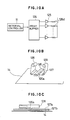
- FIG. 10A another embodiment of the invention is shown. This is generally similar to the embodiment of Figure 3, but is further provided with a printer 13 to print the Japanese language information displayed on the display panel 12. Further details of an exemplary printer 13 are shown in Figures 10A, 10B and 10C.
- the exemplary printer 13 is a thermal transfer printer using a thermal head.
- the printer 13 comprises a printer buffer 124 which receives as print data the Japanese language information from the dictionary memory 20 ( Figure 5), and drivers 125 provided to drive respective thermal elements 126d, serially connected to the said drivers 125.
- Figure 10B is a schematic perspective view showing a thermal head 126, which consists of an array of thermal elements 126d.
- a transfer ribbon 127 passes in front of the thermal head 126.
- This transfer ribbon 127 is drawn from a spool 128 and taken up on a reel 129.
- Figure 10C is a diagram, on an enlarged scale, showing the relationship between the thermal head 126 and the transfer ribbon 127.
- the latter is situated at a frontal part 126a of the thermal head 126 and comprises a base film 127a and an ink layer 127b.
- the principal constituent of the ink layer 127b is wax which melts when heat is applied.
- Ink 127b, heated and melted in part by thermal head 126 is transferred to the source document 14 which is placed in front of the head 126.
- the semantic dictionary 10 transfers the contents of the dictionary memory 20, using the address specified by the address register 21 as starting address, one by one to the display buffer, as described above with reference to Figure 5, it also transfers the dictionary memory contents to print buffer 124.
- Printer 13 stores the Japanese language information (print data) from dictionary memory 20 in the print buffer 124 via the retrieval controller 11. Subsequently, by appropriate timing provided by a timing generator (not shown), print data corresponding to one vertical dot line are read from buffer 124, causing the thermal dots 126d to be heated by the drivers 125. This melts the ink layer 127b on transfer ribbon 127, resulting in thermal transfer of one dot line of print data to the course document 14 which is placed in front of the ribbon. In this matter, printing of all the lines is performed according to the timing signals which are supplied sequentially.
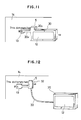
- FIG 11 is a schematic perspective external view of the electronic dictionary described with reference to Figures 9 and 10.
- the electronic dictionary differs from that shown in Figure 7 by the provision of a protrusion 30v, located below the optical reader 5 at a fixed distance from it.
- the printer 13 is integrally mounted in the protrusion 30v. During operation as described with reference to Figure 7, the printer is positioned between the English word being read and an English word in the following line on the source document 14.
- the alphabetic characters on the source document 14 are optically read, their Japanese language information is displayed on display panel 12 and at the same time is printed by print er 13 between the lines. It is also possible to print only the meaning of the word from the Japanese language information.
- the electronic dictionary shown in Figure 12 bears the same relationship to that shown in Figure 11 as the electronic dictionary shown in Figure 8 bears to that shown in Figure 7.
- the printer 13 has been removed from the main unit 35 and attached to the scanner 32 in a fixed position relative to the optical reader 5. Operation is as described with reference to Figure 8, and during such operation, the printer 13 prints between the lines on the source document 14 as described with reference to Figure 11.
- the embodiments of Figures 9 to 12 allow printing of the meanings of words or compounds words translated between print lines on the source document 14, saving the operator from the trouble of writing down translated words and freeing him from cumbersome operations.
- the invention provides an electronic dictionary with improved operational speed, suitable for practical use.
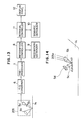
- the optical reader 205 comprises a lens 5b which condenses light from an external source 205e (light supplied from a light source external to the electronic dictionary) on to the source document 14.
- the optical reader 205 requires no internal light source for illuminating the source document 14. It lends itself to a simple configuration. As a result, the whole electronic dictionary can be made light and compact, and more suitable as a portable unit.
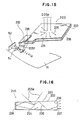
- Figures 15 and 16 show a further arrangement by which the source document 14 may be illuminated by light from an external source.
- an optical reader 205 comprises a condenser 231 which condenses light from external source 205e; a reflecting mirror 232 which reflects the light from the condenser 231; lenses 205f and 5b; and pickup sensor 5d.
- the condensor 231, as shown in Figure 16, is provided with a transparent plastics plate 233 in which is diffused a fluorescent dye 234. Light from the external source 205e, entering the interior of the plastics plate 233 from its surface, strikes the fluorescent dye 234; fluorescent light emitted from this location propagates forward while being totally reflected by the surface of the plastics plate 233.
- the reflected light then, as described in the first embodiment, is converted to electrical signals by the pickup sensor 5d through the lens 5b.
- the working principles of the condenser 231 peforming the above functions have been developed by BASF and an experimental version of it, named "Solar Collector”, can be obtained from Morishita Sangyo Kabushiki Kaisha.
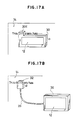
- Figures 17A and 17B show hand-held electronic dictionaries similar to those described with reference to Figures 7 and 8, but which incorporate the optical reader 205 in place of the optical reader 5.
- the optical reader 205 may in each case be in the form described with reference to Figure 14 or in the form described with reference to Figures 15 and 16. If the latter form of optical reader 205 is incorporated, the light condenser 231 may be formed to cover the entire surface of the main unit 30 (Figure 17A) or of the scanner 32 alone ( Figure 17B).
- the condensor 231 is transparent and does not interfere with the function of the display panel 123 in Figure 17A. Operation of the electronic dictionaries shown in Figures 17A and 17B is as described with reference to Figures 7 and 8.
- Figures 13 to 17A, 17B feature the use of external light for read-input of the words to be translated. They thereby eliminate the need for a light source for the optical reader. This relieves the operator of the burden of switching the power for the light source on and off and makes it possible to reduce the size and weight of the electronic dictionary, thus providing a portable, practical electronic dictionary.
- the retrieval controller 313 is provided with a gate 320 which checks the number of characters as counted from the beginning in which input buffer 15 and the word buffer 18a in register 18 match; a memory buffer 321a which stores the current number of matching characters; a memory buffer 321b which stores the number of matching characters obtained during the last work lookup operation (the contents of the buffer 321a are shifted to the buffer 321b each time a word lookup is performed); a gate 322 which determines which of the matching characters counts stored in buffers 321a and 321b is larger; a word ending register 323 which stores a library of word ending changes, such as "ed" and "ing"; a check gate 324 which checks for agreement between the word endings in the register 323 and the input buffer 15; and a modification gate 325 which modifies the word ending in the input buffer 15.
- a gate 320 which checks the number of characters as counted from the beginning in which input buffer 15 and the word buffer 18a in register 18 match
- a memory buffer 321a which
- Figure 19 is a flow chart illustrating the operation of the retrieval controller 313.
- the string of alphabetic codes equivalent to a single word that has been identified in the recognition controller 8 is stored in the input buffer 15, shown in Figure 18.
- the English word and its address code (“a" and "0001" in Figure 6) are sent from the beginning of the word library 16 to the word buffer 18a and the address 18b in the register 18.
- the gate 19 determines whether or not the character code (English word that has been read in) stored in the input buffer 15 matches the English word stored in the register 18 (Step 429 in Figure 19). If there is a match, the word lookup terminates (Step 442).
- the gate 322 determines whether the previous match character count (buffer 321b) or the current match character count (buffer 321a) is larger (Step 430). If the current match character count is greater than or equal to the previous one, the next word is looked up (Step 439).
- the output from the gate 322 is supplied to a controller which is not shown in the Figure.
- check gate 324 determines whether or not the word ending in input buffer 15 and word ending register 323 match (Step 431). If the word to be translated has a special form of variation, such as in the case of a present participle or gerund, with "ing" attached, (e.g.
- check gate 324 changes the variant word into its original form by ignoring the word ending (Steps 435 and 440).
- the word modification is done by word ending modification gate 325 on the word contained in the input buffer 15, according to an instruction from the controller which has received output from check gate 324. If the word ending variation in a given word fails the test at Step 431, and if it is determined that a variant of the word ending "ing" is “ying” (Step 432), the word ending “ying” is modified to "ie” by word ending modification gate 325 (Step 436 and 440). If a given word ending is either “ies” or “ied”, it is changed to "y” in both cases (Steps 437 and 440).
- a word ending is not a special variant, i.e. simple addition of "ed” for the past tense of a verb; addition of "ing” to transform a verb into a present particle or verb-noun; or addition of "s” to in the plural form of a noun; or a word having the ending "'s” indicating the possessive case; such word endings are all ignored by gate 325 (Steps 438 and 440). It is by these procedures that word ending variations are processed. If control is passed to Step 339 following the above processing steps, i.e. if the next word is to be looked up, "1" is added to address counter 317, which causes the next word and address (e.g.
- the gate 19 determines whether or not the word in the register 18 matches the English word that has been read in.
- the words in the word library 16 continue to be read until a match is found between the English word that has been read in and an English word read from the word library 16.
- Step 440 word lookup is performed again, this time on the variant word whose word ending has been modified (canonical word) (Step 429).
- Step 441 it means that the word being sought is not in the word library 16.
- the controller displays a message to that effect on the display panel 12, and terminates the operation.
- the above embodiment identifies variants of a given word to be translated and to obtain the translated language information corresponding to the canonical form of the word to be translated. This eliminates the need for correcting variant words into their original forms before entry into the dictionary, as is the case with conventional methods. Moreover, this feature combined with use of the optical reader offer practical electronic dictionaries with improved operability.
- word endings are shown to be taken care of, but it may be so arranged that other word endings are also taken care of.
- Such other examples include those of the comparatives of adjectives and adverbs (e.g. "er”, “ier”, “ger”) and those of the superlatives of adjectives and adverbs (e.g. "est”, "iest", "gest”).
- the retrieval starts with the first word of the dictionary. But it may be so arranged that the retrieval starts with the first word that begins with the first character of the word that has been input (i.e. optically read).
Landscapes
- Engineering & Computer Science (AREA)
- Theoretical Computer Science (AREA)
- General Engineering & Computer Science (AREA)
- Physics & Mathematics (AREA)
- General Physics & Mathematics (AREA)
- Computational Linguistics (AREA)
- General Health & Medical Sciences (AREA)
- Health & Medical Sciences (AREA)
- Audiology, Speech & Language Pathology (AREA)
- Artificial Intelligence (AREA)
- Human Computer Interaction (AREA)
- Data Mining & Analysis (AREA)
- Databases & Information Systems (AREA)
- Mathematical Physics (AREA)
- Software Systems (AREA)
- Machine Translation (AREA)
- Electrically Operated Instructional Devices (AREA)
Applications Claiming Priority (8)
| Application Number | Priority Date | Filing Date | Title |
|---|---|---|---|
| JP61301760A JPS63155361A (ja) | 1986-12-19 | 1986-12-19 | 電子辞書 |
| JP301760/86 | 1986-12-19 | ||
| JP62008069A JPH0668753B2 (ja) | 1987-01-19 | 1987-01-19 | 電子辞書 |
| JP8069/87 | 1987-01-19 | ||
| JP62008070A JPS63177264A (ja) | 1987-01-19 | 1987-01-19 | 電子辞書 |
| JP8070/87 | 1987-01-19 | ||
| JP29884/87 | 1987-02-13 | ||
| JP62029884A JPS63198161A (ja) | 1987-02-13 | 1987-02-13 | 電子辞書 |
Publications (3)
| Publication Number | Publication Date |
|---|---|
| EP0272158A2 true EP0272158A2 (de) | 1988-06-22 |
| EP0272158A3 EP0272158A3 (en) | 1990-06-13 |
| EP0272158B1 EP0272158B1 (de) | 1994-09-14 |
Family
ID=27454859
Family Applications (1)
| Application Number | Title | Priority Date | Filing Date |
|---|---|---|---|
| EP87311231A Expired - Lifetime EP0272158B1 (de) | 1986-12-19 | 1987-12-21 | Elektronisches Wörterbuch |
Country Status (4)
| Country | Link |
|---|---|
| US (1) | US4890230A (de) |
| EP (1) | EP0272158B1 (de) |
| KR (1) | KR920005854B1 (de) |
| DE (1) | DE3750543T2 (de) |
Cited By (9)
| Publication number | Priority date | Publication date | Assignee | Title |
|---|---|---|---|---|
| FR2659461A1 (fr) * | 1990-03-06 | 1991-09-13 | Kis France Sa | Dispositif de traduction automatique d'un document. |
| US5241671A (en) * | 1989-10-26 | 1993-08-31 | Encyclopaedia Britannica, Inc. | Multimedia search system using a plurality of entry path means which indicate interrelatedness of information |
| US5414644A (en) * | 1993-11-24 | 1995-05-09 | Ethnographics, Inc. | Repetitive event analysis system |
| US5513991A (en) * | 1994-12-02 | 1996-05-07 | Vamp, Inc. | Method of simulating personal individual art instruction |
| GB2328770A (en) * | 1997-08-30 | 1999-03-03 | E Lead Electronic Co Ltd | Camera type electronic language translation system |
| US6491525B1 (en) | 1996-03-27 | 2002-12-10 | Techmicro, Inc. | Application of multi-media technology to psychological and educational assessment tools |
| EP0926604A3 (de) * | 1997-12-24 | 2005-11-02 | International Business Machines Corporation | Übersetzungsverfahren und System |
| US6978277B2 (en) | 1989-10-26 | 2005-12-20 | Encyclopaedia Britannica, Inc. | Multimedia search system |
| US7207804B2 (en) | 1996-03-27 | 2007-04-24 | Michael Hersh | Application of multi-media technology to computer administered vocational personnel assessment |
Families Citing this family (63)
| Publication number | Priority date | Publication date | Assignee | Title |
|---|---|---|---|---|
| US5834753A (en) * | 1986-08-08 | 1998-11-10 | Norand Corporation | Laser scanner module having integral interface with hand-held data capture terminal proximity and label sensing, and enhanced sensitivity and power efficiency |
| US6149062A (en) * | 1988-01-14 | 2000-11-21 | Intermec Ip Corp. | Interface with hand-held data capture terminal, proximity and label sensing, and enhanced sensitivity and power efficiency |
| JPH01279368A (ja) * | 1988-04-30 | 1989-11-09 | Sharp Corp | キャラクタデータの転送方式 |
| JPH0833806B2 (ja) * | 1989-03-13 | 1996-03-29 | 富士通株式会社 | データ処理装置における多国語変換処理方式 |
| JPH02249064A (ja) * | 1989-03-22 | 1990-10-04 | Oki Electric Ind Co Ltd | 電子辞書 |
| US5065318A (en) * | 1989-04-24 | 1991-11-12 | Sharp Kabushiki Kaisha | Method of translating a sentence including a compound word formed by hyphenation using a translating apparatus |
| JP2758952B2 (ja) * | 1989-12-28 | 1998-05-28 | 富士通株式会社 | 日本語文書読取翻訳システムの修正時における表示方式 |
| US5544045A (en) * | 1991-10-30 | 1996-08-06 | Canon Inc. | Unified scanner computer printer |
| US8352400B2 (en) | 1991-12-23 | 2013-01-08 | Hoffberg Steven M | Adaptive pattern recognition based controller apparatus and method and human-factored interface therefore |
| US5523946A (en) * | 1992-02-11 | 1996-06-04 | Xerox Corporation | Compact encoding of multi-lingual translation dictionaries |
| US5517409A (en) * | 1992-03-24 | 1996-05-14 | Ricoh Company, Ltd. | Image forming apparatus and method having efficient translation function |
| JPH05314175A (ja) * | 1992-05-13 | 1993-11-26 | Ricoh Co Ltd | 対訳画像形成装置 |
| US5867812A (en) * | 1992-08-14 | 1999-02-02 | Fujitsu Limited | Registration apparatus for compound-word dictionary |
| USD354743S (en) | 1993-04-02 | 1995-01-24 | Vieira Osvaldo B | Microprocessor controlled road map |
| JPH0765012A (ja) * | 1993-08-27 | 1995-03-10 | Ricoh Co Ltd | 対訳画像形成装置 |
| US5905250A (en) * | 1993-12-27 | 1999-05-18 | Olympus Optical Co., Ltd. | Audio information recording/reproducing system |
| JP3565453B2 (ja) * | 1994-08-23 | 2004-09-15 | キヤノン株式会社 | 画像入出力装置 |
| DE19520432A1 (de) * | 1995-06-03 | 1996-12-12 | Kremser Peter Dipl Math | Handgehaltenes Übersetzungsgerät |
| IL114367A (en) * | 1995-06-27 | 1999-11-30 | Wizcom Technologies Ltd | Hand-holdable optical scanner particularly useful as electronic translator |
| DE29514054U1 (de) * | 1995-09-01 | 1996-02-29 | Eleftheriadis, Theofilos, 52064 Aachen | Elektronischer Pocketübersetzer natürlicher Sprachen mit Scannervorrichtung |
| DE69623636T2 (de) * | 1995-10-27 | 2003-07-31 | Ultravision Oy, Espoo | Gerät und verfahren zum abtasten und interpretieren für das lesen und interpretieren von zeichen und buchstaben |
| US5848386A (en) | 1996-05-28 | 1998-12-08 | Ricoh Company, Ltd. | Method and system for translating documents using different translation resources for different portions of the documents |
| US5913185A (en) * | 1996-08-19 | 1999-06-15 | International Business Machines Corporation | Determining a natural language shift in a computer document |
| US7966078B2 (en) | 1999-02-01 | 2011-06-21 | Steven Hoffberg | Network media appliance system and method |
| USD421605S (en) * | 1999-05-06 | 2000-03-14 | Alex Rozovsky | Time activated answering machine |
| US20030120478A1 (en) * | 2001-12-21 | 2003-06-26 | Robert Palmquist | Network-based translation system |
| JP3848181B2 (ja) * | 2002-03-07 | 2006-11-22 | キヤノン株式会社 | 音声合成装置及びその方法、プログラム |
| US7707039B2 (en) | 2004-02-15 | 2010-04-27 | Exbiblio B.V. | Automatic modification of web pages |
| US8442331B2 (en) | 2004-02-15 | 2013-05-14 | Google Inc. | Capturing text from rendered documents using supplemental information |
| US10635723B2 (en) | 2004-02-15 | 2020-04-28 | Google Llc | Search engines and systems with handheld document data capture devices |
| US7812860B2 (en) | 2004-04-01 | 2010-10-12 | Exbiblio B.V. | Handheld device for capturing text from both a document printed on paper and a document displayed on a dynamic display device |
| US20060081714A1 (en) | 2004-08-23 | 2006-04-20 | King Martin T | Portable scanning device |
| US8081849B2 (en) | 2004-12-03 | 2011-12-20 | Google Inc. | Portable scanning and memory device |
| US9143638B2 (en) | 2004-04-01 | 2015-09-22 | Google Inc. | Data capture from rendered documents using handheld device |
| US7894670B2 (en) | 2004-04-01 | 2011-02-22 | Exbiblio B.V. | Triggering actions in response to optically or acoustically capturing keywords from a rendered document |
| US8146156B2 (en) | 2004-04-01 | 2012-03-27 | Google Inc. | Archive of text captures from rendered documents |
| US20060098900A1 (en) | 2004-09-27 | 2006-05-11 | King Martin T | Secure data gathering from rendered documents |
| US9116890B2 (en) | 2004-04-01 | 2015-08-25 | Google Inc. | Triggering actions in response to optically or acoustically capturing keywords from a rendered document |
| US9008447B2 (en) | 2004-04-01 | 2015-04-14 | Google Inc. | Method and system for character recognition |
| US7990556B2 (en) | 2004-12-03 | 2011-08-02 | Google Inc. | Association of a portable scanner with input/output and storage devices |
| US8713418B2 (en) | 2004-04-12 | 2014-04-29 | Google Inc. | Adding value to a rendered document |
| US8489624B2 (en) | 2004-05-17 | 2013-07-16 | Google, Inc. | Processing techniques for text capture from a rendered document |
| US8620083B2 (en) | 2004-12-03 | 2013-12-31 | Google Inc. | Method and system for character recognition |
| US8874504B2 (en) | 2004-12-03 | 2014-10-28 | Google Inc. | Processing techniques for visual capture data from a rendered document |
| US8346620B2 (en) | 2004-07-19 | 2013-01-01 | Google Inc. | Automatic modification of web pages |
| US20070016420A1 (en) * | 2005-07-07 | 2007-01-18 | International Business Machines Corporation | Dictionary lookup for mobile devices using spelling recognition |
| EP2067119A2 (de) | 2006-09-08 | 2009-06-10 | Exbiblio B.V. | Optische scanner, zum beispiel tragbare optische scanner |
| US7860707B2 (en) * | 2006-12-13 | 2010-12-28 | Microsoft Corporation | Compound word splitting for directory assistance services |
| JP4349440B2 (ja) * | 2007-06-07 | 2009-10-21 | カシオ計算機株式会社 | 情報表示装置及び情報表示プログラム |
| US20090061401A1 (en) * | 2007-08-30 | 2009-03-05 | Debra Fleming | Apparatus to enhance enjoyment from reading printed subject matter |
| US20090182548A1 (en) * | 2008-01-16 | 2009-07-16 | Jan Scott Zwolinski | Handheld dictionary and translation apparatus |
| WO2010041249A1 (en) * | 2008-10-07 | 2010-04-15 | Ziruz Nihul Ltd. | High concentration "reverse bulb" solar photovoltaic module |
| US20100128994A1 (en) * | 2008-11-24 | 2010-05-27 | Jan Scott Zwolinski | Personal dictionary and translator device |
| WO2010096191A2 (en) | 2009-02-18 | 2010-08-26 | Exbiblio B.V. | Automatically capturing information, such as capturing information using a document-aware device |
| US8447066B2 (en) | 2009-03-12 | 2013-05-21 | Google Inc. | Performing actions based on capturing information from rendered documents, such as documents under copyright |
| EP2406767A4 (de) | 2009-03-12 | 2016-03-16 | Google Inc | Automatische bereitstellung von mit erfassten informationen, z. b. in echtzeit erfassten informationen, assoziierten inhalten |
| US9081799B2 (en) | 2009-12-04 | 2015-07-14 | Google Inc. | Using gestalt information to identify locations in printed information |
| US9323784B2 (en) | 2009-12-09 | 2016-04-26 | Google Inc. | Image search using text-based elements within the contents of images |
| KR101220709B1 (ko) * | 2010-02-03 | 2013-01-10 | 삼성전자주식회사 | 한글 및 한자가 혼용된 문서에 대한 전자 사전 검색 장치 및 방법 |
| US20140242557A1 (en) * | 2012-01-13 | 2014-08-28 | Aderonke Akinsanya | Audible dictionary device and method |
| US10013604B1 (en) * | 2016-06-24 | 2018-07-03 | X Development Llc | Flexible form factor overlay device |
| CN105976651A (zh) * | 2016-07-15 | 2016-09-28 | 苏州市玄天环保科技有限公司 | 智能词典服务系统 |
| CN109358901B (zh) * | 2018-12-06 | 2023-08-25 | 深圳高通半导体有限公司 | 一种可解码点阵字库的处理器芯片及实现方法 |
Family Cites Families (15)
| Publication number | Priority date | Publication date | Assignee | Title |
|---|---|---|---|---|
| US3114980A (en) * | 1959-08-18 | 1963-12-24 | Davis John Hancock | Means for audibly reproducing printed data |
| US4028537A (en) * | 1976-03-31 | 1977-06-07 | Champion International Corporation | Product processing system with price printer |
| JPS5918865B2 (ja) * | 1976-06-25 | 1984-05-01 | 株式会社東芝 | 電子部品のマウンテイング装置 |
| JPS5953590B2 (ja) * | 1979-09-14 | 1984-12-26 | シャープ株式会社 | 翻訳装置 |
| JPS59868B2 (ja) * | 1979-10-24 | 1984-01-09 | シャープ株式会社 | 単語の基本形認識装置およびこれを用いた翻訳装置 |
| US4393462A (en) * | 1979-10-24 | 1983-07-12 | Sharp Kabushiki Kaisha | Electronic translator with means for pronouncing input words and translated words |
| US4377741A (en) * | 1980-06-26 | 1983-03-22 | The Brekka Corporation | Apparatus for producing updated information on a tangible medium |
| US4392053A (en) * | 1981-08-25 | 1983-07-05 | Western Publishing Inc. | Optical probe |
| DE3233194C2 (de) * | 1981-09-08 | 1986-04-10 | Sharp K.K., Osaka | Elektronischer Taschenübersetzer |
| DE3215225C2 (de) * | 1982-04-23 | 1984-05-30 | Kienzle Apparate Gmbh, 7730 Villingen-Schwenningen | Kombinierte Druck- und Leseeinrichtung |
| US4724523A (en) * | 1985-07-01 | 1988-02-09 | Houghton Mifflin Company | Method and apparatus for the electronic storage and retrieval of expressions and linguistic information |
| US4574317A (en) * | 1983-12-12 | 1986-03-04 | Wayne Scheible | Hand scannable portable copier and method |
| JPS61105671A (ja) * | 1984-10-29 | 1986-05-23 | Hitachi Ltd | 自然言語処理装置 |
| JPS61255468A (ja) * | 1985-05-08 | 1986-11-13 | Toshiba Corp | 機械翻訳処理装置 |
| US4727245A (en) * | 1986-10-14 | 1988-02-23 | Mars, Inc. | Portable data scanner with removable modular printer |
-
1987
- 1987-12-17 US US07/135,525 patent/US4890230A/en not_active Expired - Lifetime
- 1987-12-19 KR KR1019870014573A patent/KR920005854B1/ko not_active Expired
- 1987-12-21 DE DE3750543T patent/DE3750543T2/de not_active Expired - Fee Related
- 1987-12-21 EP EP87311231A patent/EP0272158B1/de not_active Expired - Lifetime
Cited By (13)
| Publication number | Priority date | Publication date | Assignee | Title |
|---|---|---|---|---|
| US7051018B2 (en) | 1989-10-26 | 2006-05-23 | Encyclopaedia Britannica, Inc. | Multimedia search system |
| US5241671A (en) * | 1989-10-26 | 1993-08-31 | Encyclopaedia Britannica, Inc. | Multimedia search system using a plurality of entry path means which indicate interrelatedness of information |
| US7664775B2 (en) | 1989-10-26 | 2010-02-16 | Encyclopaedia Britannica, Inc. | Multimedia search system |
| US7085778B2 (en) | 1989-10-26 | 2006-08-01 | Encyclopaedia Britannica, Inc. | Multimedia search system |
| US7082437B2 (en) | 1989-10-26 | 2006-07-25 | Encyclopaedia Britannica, Inc. | Multimedia search system |
| US6978277B2 (en) | 1989-10-26 | 2005-12-20 | Encyclopaedia Britannica, Inc. | Multimedia search system |
| FR2659461A1 (fr) * | 1990-03-06 | 1991-09-13 | Kis France Sa | Dispositif de traduction automatique d'un document. |
| US5414644A (en) * | 1993-11-24 | 1995-05-09 | Ethnographics, Inc. | Repetitive event analysis system |
| US5513991A (en) * | 1994-12-02 | 1996-05-07 | Vamp, Inc. | Method of simulating personal individual art instruction |
| US6491525B1 (en) | 1996-03-27 | 2002-12-10 | Techmicro, Inc. | Application of multi-media technology to psychological and educational assessment tools |
| US7207804B2 (en) | 1996-03-27 | 2007-04-24 | Michael Hersh | Application of multi-media technology to computer administered vocational personnel assessment |
| GB2328770A (en) * | 1997-08-30 | 1999-03-03 | E Lead Electronic Co Ltd | Camera type electronic language translation system |
| EP0926604A3 (de) * | 1997-12-24 | 2005-11-02 | International Business Machines Corporation | Übersetzungsverfahren und System |
Also Published As
| Publication number | Publication date |
|---|---|
| EP0272158B1 (de) | 1994-09-14 |
| US4890230A (en) | 1989-12-26 |
| DE3750543T2 (de) | 1995-05-18 |
| EP0272158A3 (en) | 1990-06-13 |
| KR880008191A (ko) | 1988-08-30 |
| KR920005854B1 (ko) | 1992-07-23 |
| DE3750543D1 (de) | 1994-10-20 |
Similar Documents
| Publication | Publication Date | Title |
|---|---|---|
| EP0272158B1 (de) | Elektronisches Wörterbuch | |
| US5339412A (en) | Electronic filing system using a mark on each page of the document for building a database with respect to plurality of multi-page documents | |
| JP3641485B2 (ja) | 記録方法および装置 | |
| US4901364A (en) | Interactive optical scanner system | |
| US6937974B1 (en) | Translation system and a multifunction computer, particularly for treating texts and translation on paper | |
| EP0238067A2 (de) | Abtasteinrichtung für optische Daten | |
| US20040034835A1 (en) | Method and apparatus for generating a summary from a document image | |
| CN1190208A (zh) | 文字信息处理装置 | |
| US20090182548A1 (en) | Handheld dictionary and translation apparatus | |
| CN87108368A (zh) | 电子词典 | |
| JPH0668753B2 (ja) | 電子辞書 | |
| JP3523370B2 (ja) | データシンボル読み取り装置 | |
| JPH05274346A (ja) | 電子辞書 | |
| JP2913937B2 (ja) | バーコード印刷方法およびバーコードプリンター | |
| JPS63177264A (ja) | 電子辞書 | |
| JPS5856076A (ja) | 光学的文字読取装置 | |
| JPS6280781A (ja) | 読取り装置 | |
| JPH0546814A (ja) | 文字読み取り装置 | |
| JPH01265361A (ja) | 文字選択システム及び辞典検索システム | |
| GB2130772A (en) | Electronic typewriter and word processor | |
| CN1322628A (zh) | 一种印刷式读物、名片及显示装置 | |
| JPS61273064A (ja) | ペンリ−ダ・プリンタ | |
| JPS63155361A (ja) | 電子辞書 | |
| JPH0644298A (ja) | 電子辞書 | |
| JPS63273166A (ja) | 電子辞書 |
Legal Events
| Date | Code | Title | Description |
|---|---|---|---|
| PUAI | Public reference made under article 153(3) epc to a published international application that has entered the european phase |
Free format text: ORIGINAL CODE: 0009012 |
|
| AK | Designated contracting states |
Kind code of ref document: A2 Designated state(s): DE FR GB |
|
| PUAL | Search report despatched |
Free format text: ORIGINAL CODE: 0009013 |
|
| RHK1 | Main classification (correction) |
Ipc: G06F 15/38 |
|
| AK | Designated contracting states |
Kind code of ref document: A3 Designated state(s): DE FR GB |
|
| 17P | Request for examination filed |
Effective date: 19901008 |
|
| 17Q | First examination report despatched |
Effective date: 19920813 |
|
| GRAA | (expected) grant |
Free format text: ORIGINAL CODE: 0009210 |
|
| AK | Designated contracting states |
Kind code of ref document: B1 Designated state(s): DE FR GB |
|
| ET | Fr: translation filed | ||
| REF | Corresponds to: |
Ref document number: 3750543 Country of ref document: DE Date of ref document: 19941020 |
|
| PLBE | No opposition filed within time limit |
Free format text: ORIGINAL CODE: 0009261 |
|
| STAA | Information on the status of an ep patent application or granted ep patent |
Free format text: STATUS: NO OPPOSITION FILED WITHIN TIME LIMIT |
|
| 26N | No opposition filed | ||
| PGFP | Annual fee paid to national office [announced via postgrant information from national office to epo] |
Ref country code: FR Payment date: 19981209 Year of fee payment: 12 |
|
| PGFP | Annual fee paid to national office [announced via postgrant information from national office to epo] |
Ref country code: GB Payment date: 19981224 Year of fee payment: 12 |
|
| PGFP | Annual fee paid to national office [announced via postgrant information from national office to epo] |
Ref country code: DE Payment date: 19981229 Year of fee payment: 12 |
|
| PG25 | Lapsed in a contracting state [announced via postgrant information from national office to epo] |
Ref country code: GB Free format text: LAPSE BECAUSE OF NON-PAYMENT OF DUE FEES Effective date: 19991221 |
|
| GBPC | Gb: european patent ceased through non-payment of renewal fee |
Effective date: 19991221 |
|
| PG25 | Lapsed in a contracting state [announced via postgrant information from national office to epo] |
Ref country code: FR Free format text: LAPSE BECAUSE OF NON-PAYMENT OF DUE FEES Effective date: 20000831 |
|
| PG25 | Lapsed in a contracting state [announced via postgrant information from national office to epo] |
Ref country code: DE Free format text: LAPSE BECAUSE OF NON-PAYMENT OF DUE FEES Effective date: 20001003 |
|
| REG | Reference to a national code |
Ref country code: FR Ref legal event code: ST |