EP0272885A2 - Dispositif semi-conducteur comportant une diode de décalage de niveau - Google Patents
Dispositif semi-conducteur comportant une diode de décalage de niveau Download PDFInfo
- Publication number
- EP0272885A2 EP0272885A2 EP87311148A EP87311148A EP0272885A2 EP 0272885 A2 EP0272885 A2 EP 0272885A2 EP 87311148 A EP87311148 A EP 87311148A EP 87311148 A EP87311148 A EP 87311148A EP 0272885 A2 EP0272885 A2 EP 0272885A2
- Authority
- EP
- European Patent Office
- Prior art keywords
- level shift
- semiconductor device
- layer
- substrate
- diode
- Prior art date
- Legal status (The legal status is an assumption and is not a legal conclusion. Google has not performed a legal analysis and makes no representation as to the accuracy of the status listed.)
- Granted
Links
Images




Classifications
-
- H—ELECTRICITY
- H10—SEMICONDUCTOR DEVICES; ELECTRIC SOLID-STATE DEVICES NOT OTHERWISE PROVIDED FOR
- H10D—INORGANIC ELECTRIC SEMICONDUCTOR DEVICES
- H10D8/00—Diodes
- H10D8/825—Diodes having bulk potential barriers, e.g. Camel diodes, planar doped barrier diodes or graded bandgap diodes
-
- H—ELECTRICITY
- H10—SEMICONDUCTOR DEVICES; ELECTRIC SOLID-STATE DEVICES NOT OTHERWISE PROVIDED FOR
- H10D—INORGANIC ELECTRIC SEMICONDUCTOR DEVICES
- H10D84/00—Integrated devices formed in or on semiconductor substrates that comprise only semiconducting layers, e.g. on Si wafers or on GaAs-on-Si wafers
- H10D84/01—Manufacture or treatment
-
- H—ELECTRICITY
- H10—SEMICONDUCTOR DEVICES; ELECTRIC SOLID-STATE DEVICES NOT OTHERWISE PROVIDED FOR
- H10D—INORGANIC ELECTRIC SEMICONDUCTOR DEVICES
- H10D84/00—Integrated devices formed in or on semiconductor substrates that comprise only semiconducting layers, e.g. on Si wafers or on GaAs-on-Si wafers
- H10D84/01—Manufacture or treatment
- H10D84/02—Manufacture or treatment characterised by using material-based technologies
- H10D84/05—Manufacture or treatment characterised by using material-based technologies using Group III-V technology
Definitions
- the present invention generally relates to semiconductor devices having level shift diodes, and more particularly to a semiconductor device having at least one level shift diode with an arbitrary level shift quantity by utilizing a discontinuity in the energy band at a heterojunction between two semiconductors.
- a level shift diode is constructed by utilizing the fact that a forward voltage drop is approximately constant at a pn junction.
- the level shift diode is used to shift a voltage level by a predetermined value in a logic circuit and the like employing transistors.
- a voltage drop introduced by one pn junction is insufficient, a plurality of level shift diodes are connected in series according to the needs.
- a level shift quantity of a level shift diode utilizing a Schottky junction is a constant value which is approximately in a range of 0.6 V to 0.8 V per Schottky junction, because the Schottky barrier height is in the range of 0.6 V to 0.8 V regardless of the kind of metal formed on the GaAs layer.
- the Schottky junction is made by forming a metal layer on the GaAs substrate.
- the surface of the GaAs substrate is exposed to the air when forming the metal layer thereon.
- the surface of the GaAs substrate includes irregularities when compared to that of the silicon substrate, and for this reason, it is difficult to accurately control the level shift quantity of the Schottky diode because the Schottky diode is easily affected by a leakage current.
- a large area of the semiconductor device is occupied by the Schottky diodes for providing the desired level shift.
- Another and more specific object of the present invention is to provide a semiconductor device having a level shift diode which comprises on an anode side thereof a first compound semiconductor heterojunction forming layer and on a cathode side thereof a second compound semiconductor heterojunction forming layer having an electron affinity smaller than that of the first compound semiconductor heterojunction forming layer.
- the semiconductor device of the present invention it is possible to arbitrarily set the level shift quantity by stacking a plurality of heterojunctions and by appropriately changing the composition of the compound semiconductor heterojunction forming layer constituting the heterojunction which generates a discontinuity in the energy band.
- the area of the level shift diode on the semiconductor device is small compared to that of a Schottky diode.
- Still another object of the present invention is to provide a semiconductor device comprising a substrate, at least one field effect transistor provided on the substrate, and at least one level shift diode provided on the substrate, where the level shift diode comprises a first layer made of a first compound semiconductor and a second layer made of a second compound semiconductor having an electron affinity smaller than that of the first compound semiconductor.
- the first and second layers form a heterojunction therebetween.
- the first and second compound semiconductors are both made of either one of n-type and i-type (or either one of p-type and i-type) semiconductors, and the first layer is used in common with the field effect transistor as a layer of the field effect transistor.
- the first and second compound semiconductors are both made of either one of p-type and i-type semiconductors
- the first layer, as the anode is made of a first compound semiconductor having a bottom of valence band higher for the hole than that of a second compound semiconductor for the second layer as the cathode. According to the semiconductor device of the present invention, it is possible to accurately control the level shift quantity of the level shift diode.
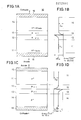
- FIG.1A shows an embodiment of the level shift diode which constitutes an essential part of the semiconductor device according to the present invention.
- a level shift diode 10 comprises an n+-type gallium arsenide (GaAs) anode contact layer 11, an n-type GaAs heterojunction forming layer 12, an n-type (or i-type) aluminum gallium arsenide (AlGaAs) heterojunction forming layer 13, an n+-type AlGaAs cathode contact layer 14, an anode electrode 15, and a cathode electrode 16.
- GaAs gallium arsenide
- AlGaAs aluminum gallium arsenide
- FIG.1B shows an energy band diagram of the level shift diode 10.
- E c denotes the bottom of the conduction band
- ⁇ E a denotes the barrier height at the energy band gap produced by the difference in the electron affinities of the n-type GaAs heterojunction forming layer 12 and the n-type AlGaAs heterojunction forming layer 13.
- a barrier height E B becomes small and a current starts to flow when a positive voltage is applied to the anode electrode 15, a negative voltage is applied to the cathode electrode 16 and the two voltages are increased.
- FIGS.2A through 2C show the energy band diagram of the level shift diode 10 for different anode voltages V a
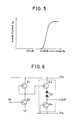
- FIG.3 shows the anode voltage V a versus anode current I a characteristic of the level shift diode 10.
- FIGS.2A through 2C and 3 those parts which are the same as those corresponding parts in FIGS.1A and 1B are designated by the same reference numerals and characters.
- the barrier height ⁇ E a is sufficiently high, and no anode current I a flows.
- FIG.2B shows the energy band diagram for the case where V a ⁇ ⁇ E a /e, where e denotes the electronic charge.
- the barrier height ⁇ E a decreases compared to the case shown in FIG.2A, and a slight anode current I a starts to flow.
- FIG.2C shows the energy band diagram for the case where V a ⁇ ⁇ E a /e.
- the barrier height ⁇ E a decreases even further from the case shown in FIG.2B, and a large anode current I a flows thereby reaching a saturation.
- the level (voltage) shift quantity changes depending on the barrier height ⁇ E a at the heterojunction interface.
- the barrier height ⁇ E a can be varied by changing the composition of the n-type AlGaAs heterojunction forming layer 13 which is one of the semiconductor layers for forming the heterojunction interface, that is, by varying Al content x of Al x Ga 1-x As which constitutes the n-type AlGaAs heterojunction forming layer 13.
- the level shift quantity of the level shift diode 10 can be changed continuously by appropriately varying the Al content x of Al x Ga 1-x As. Furthermore, it is possible to more accurately control the level shift quantity compared to the Schottky diode.
- FIG.1C shows a level shift diode with p-type semiconductors in which the carriers are holes.
- FIG.1D is an energy band diagram of the level shift diode in FIG.1C.
- E v denotes the bottom of the valence band
- E barrier denotes the barrier height at the energy band gap produced by the difference in the energy level of the valence band for the holes.
- the energy level of E v in the first layer 12 is higher than that of the second layer 13 at the heterojunction.
- FIG.2D shows the energy band diagram for the case where V a ⁇ ⁇ E barrier /e. In this case, holes are injected from the anode to the cathode.
- FIG.4A shows another embodiment of the level shift diode which constitutes an essential part of the semiconductor device according to the present invention.
- a level shift diode 20 essentially comprises two level shift diodes 10 which are connected in series.
- FIG.5 shows an anode voltage V a versus anode current I a characteristic of the level shift diode 20.
- FIGS.4A through 4C and 5 those parts which are the same as those corresponding parts in FIGS.1A and 1B are designated by the same reference numerals and characters.
- the two level shift diodes 10 constituting the level shift diode 20 are identical both in construction and characteristic.
- the two level shift diodes 10 may have the same construction but different barrier heights ⁇ E a .
- the Al content x of the Al x Ga 1-x As which constitutes the n-type AlGaAs heterojunction forming layer 13 of one of the two level shift diodes 10 may be different from that of the other of the two level shift diodes 10.
- the level (voltage) shift quantity of the level shift diode 20 it is easier to control the level (voltage) shift quantity of the level shift diode 20 to a desired value than simply controlling to the same value the Al content x of the Al x Ga 1-x As which constitutes the n-type AlGaAs heterojunction forming layer 13 of the two level shift diodes 10 having identical construction and characteristic.
- FIG.4D shows the level shift diode which has a Al x Ga 1-x As layer 17 with graded composition x in substitute of the layers 11 through 14 in FIG.4A.
- FIG.4E shows the energy band diagram of the level shift diode of FIG.4D in which the energy level of the conduction band in the layer 17 changes gradually.
- FIG.4F shows Al composition of FIGS.4D and 4E.
- FIG.6 is a circuit diagram of the first embodiment.
- the semiconductor device is a buffered field effect transistor logic (BFL) circuit comprising transistors Q1 through Q4 and a level shift diode D1.
- IN and OUT respectively denote input and output terminals, V DD denotes a positive power source voltage, and V SS denotes a negative power source voltage.
- FIG.7 shows an essential part of the first embodiment indicated by a phantom line in FIG.6.
- those parts which are the same as those corresponding parts in FIG.6 are designated by the same reference numerals and characters.
- the semiconductor device comprises a semiinsulating GaAs substrate 31, an undoped (intrinsic) GaAs active layer 32, an n+-type AlGaAs electron supplying layer 33, a level shift diode region 34, an element isolation region 35, alloyed regions 36, a two dimensional electron gas (2DEG) layer 37, source electrodes SQ3 and SQ4, drain electrodes DQ3 and DQ4, gate electrodes GQ3 and GQ4, and a cathode electrode CD of the level shift diode D1.
- High electron mobility transistors HEMTs are used for the transistors Q3 and Q4.
- FIG.8 shows on an enlarged scale the level shift diode region 34 shown in FIG.7 together with the n+-type AlGaAs electron supplying layer 33.
- the level shift diode region 34 comprises an n+-type GaAs layer 34A, an n-type GaAs layer 34B, an n-type AlGaAs layer 34C, an n+-type AlGaAs layer 34D, an n-type AlGaAs layer 34C, an n-type GaAs layer 34B, an n+-type GaAs layer 34A, an n-type GaAs layer 34B, an n-type AlGaAs layer 34C, and an n+-type AlGaAs layer 34D.
- the n+-type AlGaAs electron supplying layer 33 and the level shift diode region 34 constitute the level shift diode D1 which is essentially the same as the level shift diode 20 described before in conjunction with FIGS.4A through 4C and 5.
- the drain electrode DQ4 functions as the anode electrode of the level shift diode D1.
- the level shift diode region 34 comprises highly doped layers, the level shift diode region 34 can also function satisfactorily as an electrode contact layer.
- the level shift diode D1 is connected between the source electrode SQ3 of the transistor Q3 and the drain electrode DQ4 of the transistor Q4, and the semiconductor device shown in FIG.7 is identical to the essential part of the BFL circuit indicated by the phantom lines in FIG.6.
- FIG.9 shows an essential part of a modification of the first embodiment.
- those parts which are the same as those corresponding parts in FIGS.7 and 8 are designated by the same reference numerals, and a description thereof will be omitted.
- One n-type GaAs layer 34B and one n-type AlGaAs layer 34C respectively in the middle are omitted from the level shift diode region 34 shown in FIG.8.
- an alloyed region 39 is formed in the top n+-type AlGaAs layer 34D.
- these omitted layers 34B and 34C have little effect and are omitted in this modification for this reason.
- the illustration of the connection between the cathode electrode CD and the source electrode SQ3 is omitted in FIG.9.
- FIGS.7 through 9 and FIGS.11, 12, 14 and 15 which will be described later, the symbols of the diode and/or transistor are shown in the cross sectional view to facilitate the understanding thereof.
- FIG.10 is a circuit diagram of the second embodiment.
- the semiconductor device is a Schottky diode field effect transistor logic (SDFL) circuit comprising transistors Q11 through Q13 and a level shift diode D2.
- IN and OUT respectively denote input and output terminals, V DD denotes a positive power source voltage, and -V SS denotes a negative power source voltage.
- SDFL Schottky diode field effect transistor logic
- FIG.11 shows an essential part of the second embodiment.
- those parts which are the same as those corresponding parts in FIG.10 are designated by the same reference numerals and characters.
- the semiconductor device comprises semiinsulating GaAs substrate 51, an undoped (intrinsic) GaAs active layer 52, an n+-type AlGaAs electron supplying layer 53, a GaAs layer 54, an element isolation region 55, alloyed regions 56, a two dimensional electron gas (2DEG) layer 57, a level shift diode region 58, source electrodes SQ11, SQ12 and SQ13, drain electrodes DQ11, DQ12 and DQ13, gate electrodes GQ11, GQ12 and GQ13, and a cathode electrode CD of the level shift diode D2.
- 2DEG two dimensional electron gas
- the GaAs layer 54 is made up of an n+-type GaAs layer 54a and an n-type GaAs layer 54b.
- the level shift diode region 58 comprises an AlGaAs layer 61, an GaAs layer 62 and an AlGaAs layer 63.
- HEMTs are used for the transistors Q11 through Q13.
- the AlGaAs layer 61 comprises an n-type AlGaAs layer 61a, an n+-type AlGaAs layer 61b and an n-type AlGaAs layer 61c.
- the GaAs layer 62 comprises an n-type GaAs layer 62a, an n+-type GaAs layer 62b and an n-type GaAs layer 62c.
- the AlGaAs layer 63 comprises an n-type-AlGaAs layer 63a and an n+-type AlGaAs layer 63b.
- the level shift diode D2 is connected between the cathode electrode CD and the drain electrode DQ11 of the transistor Q11, and the semiconductor device shown in FIG.11 is identical to the SDFL circuit shown in FIG.10.
- FIG.13 is a circuit diagram of the third embodiment.
- the semiconductor device is a field effect transistor logic with Schottky diode and coupling capacitor (FLSC) circuit comprising transistors Q21 and Q22, level shift diodes D3 and D4 and a resistor R.
- IN and OUT respectively denote input and output terminals
- V DD denotes a positive power source voltage
- -V SS denotes a negative power source voltage.
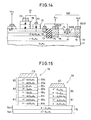
- FIG.14 shows an essential part of the third embodiment.
- those parts which are the same as those corresponding parts in FIG.13 are designated by the same reference numerals and characters.
- the semiconductor device comprises a semiinsulating GaAs substrate 71, an undoped GaAs active layer 72, an n+-type AlGaAs electron supplying layer 73, a GaAs layer 74, an element isolation region 75, alloyed regions 76, a two dimensional electron gas (2DEG) layer 77, level shift diode regions 78 and 79, a source electrode SQ22, a drain electrode DQ22, a gate electrode GQ22, an anode electrode AD of the level shift diode D4, and a cathode electrode CD of the level shift diode D3.
- 2DEG two dimensional electron gas
- the GaAs layer 74 is made up of an n+-type GaAs layer 74a and n-type GaAs layer 74b.
- the level shift diode region 78 comprises an AlGaAs layer 81, a GaAs layer 82 and an AlGaAs layer 83.
- the level shift diode region 79 comprises the AlGaAs layer 81 and the GaAs layer 82.
- HEMTs are used for the transistors Q21 and Q22.
- the AlGaAs layer 81 comprises an n-type AlGaAs layer 81a, an n+-type AlGaAs layer 81b and an n-type AlGaAs layer 81c.
- the GaAs layer 82 comprises an n-type GaAs layer 82a, an n+-type GaAs layer 82b and an n-type GaAs layer 82c.
- the AlGaAs layer 83 comprises an n-type AlGaAs layer 83a and an n+-type AlGaAs layer 83b.
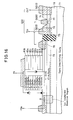
- FIG.16 shows another cross sectional view of the third embodiment.
- FIG.16 shows almost the same structure as FIGS.14 and 15. Only difference is that the level shift diode at the right hand side has the layers 82c, 83a and 83b. Therefore, in FIG.16, two level shift diodes have the same semiconductor layers construction but operate differently depending on the applied voltage.
- the level shift diodes D3 and D4 are connected in parallel, and the semiconductor device shown in FIG.13 is identical to the essential part of the FLSC circuit shown in FIG.14.
- the level shift quantity of the level shift diode in the semiconductor device is accurately controlled to a desired value because the level shift diode utilizes the heterojunction.
- the level shift diode only occupies a small area on the semiconductor device compared to the conventional semiconductor using a Schottky diode.
- the third embodiment it may be seen that after a plurality of the n+-type GaAs layer, the n-type GaAs layer, the n-type AlGaAs layer and the n+-type AlGaAs layer are stacked, it is possible to form a plurality of level shift diodes on the same substrate by isolating level shift diode regions and removing a predetermined number of layers from arbitrary ones of the level shift diode regions. In this manner, it is possible to form level shift diodes coupled in opposite directions on the same substrate, by simply making the number of layers of the level shift diode regions different from each other.
- the level shift diode at least comprises a first layer made of a first compound semiconductor and a second layer made of a second compound semiconductor having an electron affinity smaller than that of the first compound semiconductor, where the first and second compound semiconductors are both made of n-type semiconductors.
- the first and second compound semiconductors may both be made of either one of n-type and i-type semiconductors.
- the first and second compound semiconductors may both be made of either one of p-type and i-type semiconductors. It will be readily apparent to those skilled in the art that the described embodiments shown in FIG.7 and after may be modified to suit the case where the first and second compound semiconductors are both made of either one of p-type and i-type semiconductors, for example.
Landscapes
- Junction Field-Effect Transistors (AREA)
Applications Claiming Priority (2)
| Application Number | Priority Date | Filing Date | Title |
|---|---|---|---|
| JP61302866A JPS63156367A (ja) | 1986-12-20 | 1986-12-20 | レベル・シフト・ダイオ−ド |
| JP302866/86 | 1986-12-20 |
Publications (3)
| Publication Number | Publication Date |
|---|---|
| EP0272885A2 true EP0272885A2 (fr) | 1988-06-29 |
| EP0272885A3 EP0272885A3 (en) | 1990-08-01 |
| EP0272885B1 EP0272885B1 (fr) | 1994-09-07 |
Family
ID=17914040
Family Applications (1)
| Application Number | Title | Priority Date | Filing Date |
|---|---|---|---|
| EP87311148A Expired - Lifetime EP0272885B1 (fr) | 1986-12-20 | 1987-12-17 | Dispositif semi-conducteur comportant une diode de décalage de niveau |
Country Status (3)
| Country | Link |
|---|---|
| US (1) | US4963948A (fr) |
| EP (1) | EP0272885B1 (fr) |
| JP (1) | JPS63156367A (fr) |
Cited By (4)
| Publication number | Priority date | Publication date | Assignee | Title |
|---|---|---|---|---|
| EP0272985A3 (en) * | 1986-12-20 | 1989-06-14 | Fujitsu Limited | Constant current semiconductor device |
| EP0935294A1 (fr) * | 1998-02-06 | 1999-08-11 | Canare Electric Co., Ltd. | Dispositif à capacité variable comportant des couches à interference d'ondes quantiques |
| WO2010016445A1 (fr) | 2008-08-06 | 2010-02-11 | Canon Kabushiki Kaisha | Redresseur |
| EP2157613A1 (fr) * | 2008-08-20 | 2010-02-24 | Ommic | Procédé d'intégration monolithique de RITD pseudomorphique et de transistor à base de matériaux III-V |
Families Citing this family (13)
| Publication number | Priority date | Publication date | Assignee | Title |
|---|---|---|---|---|
| JP2513887B2 (ja) * | 1990-02-14 | 1996-07-03 | 株式会社東芝 | 半導体集積回路装置 |
| JPH0414314A (ja) * | 1990-05-08 | 1992-01-20 | Toshiba Corp | ソース電極結合形論理回路 |
| KR100356883B1 (ko) * | 1991-06-12 | 2003-01-08 | 텍사스 인스트루먼츠 인코포레이티드 | 프리차지트리거링방법,프리차지트리거드디지탈디바이스,프리차지트리거드펑션스테이지,및동기식파이프라인시스템 |
| US5398077A (en) * | 1992-05-19 | 1995-03-14 | Eastman Kodak Company | Method for adjusting the luminance of a color signal |
| US20030015708A1 (en) * | 2001-07-23 | 2003-01-23 | Primit Parikh | Gallium nitride based diodes with low forward voltage and low reverse current operation |
| US7183575B2 (en) | 2002-02-19 | 2007-02-27 | Nissan Motor Co., Ltd. | High reverse voltage silicon carbide diode and method of manufacturing the same high reverse voltage silicon carbide diode |
| US7534633B2 (en) | 2004-07-02 | 2009-05-19 | Cree, Inc. | LED with substrate modifications for enhanced light extraction and method of making same |
| US8519437B2 (en) * | 2007-09-14 | 2013-08-27 | Cree, Inc. | Polarization doping in nitride based diodes |
| US9012937B2 (en) | 2007-10-10 | 2015-04-21 | Cree, Inc. | Multiple conversion material light emitting diode package and method of fabricating same |
| US9287469B2 (en) * | 2008-05-02 | 2016-03-15 | Cree, Inc. | Encapsulation for phosphor-converted white light emitting diode |
| US8415692B2 (en) | 2009-07-06 | 2013-04-09 | Cree, Inc. | LED packages with scattering particle regions |
| US8536615B1 (en) | 2009-12-16 | 2013-09-17 | Cree, Inc. | Semiconductor device structures with modulated and delta doping and related methods |
| US8604461B2 (en) | 2009-12-16 | 2013-12-10 | Cree, Inc. | Semiconductor device structures with modulated doping and related methods |
Family Cites Families (7)
| Publication number | Priority date | Publication date | Assignee | Title |
|---|---|---|---|---|
| CA1145482A (fr) * | 1979-12-28 | 1983-04-26 | Takashi Mimura | Dispositif a semiconducteur a heterojonction unique a grande mobilite electronique |
| US4353081A (en) * | 1980-01-29 | 1982-10-05 | Bell Telephone Laboratories, Incorporated | Graded bandgap rectifying semiconductor devices |
| JPS58170054A (ja) * | 1982-03-31 | 1983-10-06 | Fujitsu Ltd | 光複合半導体装置 |
| JPS6095973A (ja) * | 1983-10-31 | 1985-05-29 | Fujitsu Ltd | 半導体装置 |
| US4575924A (en) * | 1984-07-02 | 1986-03-18 | Texas Instruments Incorporated | Process for fabricating quantum-well devices utilizing etch and refill techniques |
| JPS61274369A (ja) * | 1985-05-22 | 1986-12-04 | Fujitsu Ltd | 電界効果型半導体装置 |
| JPH0614536B2 (ja) * | 1985-09-17 | 1994-02-23 | 株式会社東芝 | バイポ−ラ集積回路 |
-
1986
- 1986-12-20 JP JP61302866A patent/JPS63156367A/ja active Granted
-
1987
- 1987-12-17 EP EP87311148A patent/EP0272885B1/fr not_active Expired - Lifetime
-
1989
- 1989-08-22 US US07/398,281 patent/US4963948A/en not_active Expired - Lifetime
Cited By (7)
| Publication number | Priority date | Publication date | Assignee | Title |
|---|---|---|---|---|
| EP0272985A3 (en) * | 1986-12-20 | 1989-06-14 | Fujitsu Limited | Constant current semiconductor device |
| US4914489A (en) * | 1986-12-20 | 1990-04-03 | Fujitsu Limited | Constant current semiconductor device |
| EP0935294A1 (fr) * | 1998-02-06 | 1999-08-11 | Canare Electric Co., Ltd. | Dispositif à capacité variable comportant des couches à interference d'ondes quantiques |
| US6331716B1 (en) | 1998-02-06 | 2001-12-18 | Canare Electric Co., Ltd. | Variable capacity device with quantum-wave interference layers |
| WO2010016445A1 (fr) | 2008-08-06 | 2010-02-11 | Canon Kabushiki Kaisha | Redresseur |
| US9087935B2 (en) | 2008-08-06 | 2015-07-21 | Canon Kabushiki Kaisha | Detector having a Schottky barrier portion and a barrier portion having a rectifying property |
| EP2157613A1 (fr) * | 2008-08-20 | 2010-02-24 | Ommic | Procédé d'intégration monolithique de RITD pseudomorphique et de transistor à base de matériaux III-V |
Also Published As
| Publication number | Publication date |
|---|---|
| EP0272885A3 (en) | 1990-08-01 |
| US4963948A (en) | 1990-10-16 |
| JPH0587153B2 (fr) | 1993-12-15 |
| JPS63156367A (ja) | 1988-06-29 |
| EP0272885B1 (fr) | 1994-09-07 |
Similar Documents
| Publication | Publication Date | Title |
|---|---|---|
| US4963948A (en) | Semiconductor device having level shift diode | |
| US5705827A (en) | Tunnel transistor and method of manufacturing same | |
| US3922565A (en) | Monolithically integrable digital basic circuit | |
| EP0049273B1 (fr) | Dispositif a circuit integre a transistor complementaire a effet de champ | |
| EP0144242A2 (fr) | Dispositif de circuit intégré à semi-conducteur composé | |
| CA1079819A (fr) | Circuits mtl ou i2l | |
| US4758870A (en) | Semiconductor device | |
| US20090026499A1 (en) | Semiconductor integrated circuit device and semiconductor switching device using thereof | |
| GB1572190A (en) | Integrated circuits | |
| US4649411A (en) | Gallium arsenide bipolar ECL circuit structure | |
| KR100283199B1 (ko) | 헤테로 접합 바이폴라 트랜지스터 및 그것을 사용한 반도체장치 | |
| KR860003666A (ko) | 반도체 집적회로장치 및 그 제조방법 | |
| US4264915A (en) | Charge-coupled component formed on gallium arsenide | |
| EP0208294B1 (fr) | Circuit intégré tridimensionnel | |
| US3638081A (en) | Integrated circuit having lightly doped expitaxial collector layer surrounding base and emitter elements and heavily doped buried collector larger in contact with the base element | |
| US5773873A (en) | Semiconductor device having multi-emitter structure | |
| US5293084A (en) | High speed logic circuit | |
| US5563087A (en) | Method of fabricating InAs/GaSb/AlSb material system SRAM | |
| US5140399A (en) | Heterojunction bipolar transistor and the manufacturing method thereof | |
| US5461245A (en) | Article comprising a bipolar transistor with floating base | |
| EP0289343B1 (fr) | Transistors bipolaires à hétérojonction | |
| EP0140369A1 (fr) | Circuit intégré semi-conducteur comportant des transistors connectés en série | |
| CN119789511B (zh) | 一种平面栅GaN垂直互补场效应晶体管反相器 | |
| US4642486A (en) | Decoder circuit using transistors or diodes of different characteristics | |
| EP0390593B1 (fr) | Circuit intégré de transistors bipolaires à hétérojonction |
Legal Events
| Date | Code | Title | Description |
|---|---|---|---|
| PUAI | Public reference made under article 153(3) epc to a published international application that has entered the european phase |
Free format text: ORIGINAL CODE: 0009012 |
|
| AK | Designated contracting states |
Kind code of ref document: A2 Designated state(s): DE FR GB |
|
| PUAL | Search report despatched |
Free format text: ORIGINAL CODE: 0009013 |
|
| AK | Designated contracting states |
Kind code of ref document: A3 Designated state(s): DE FR GB |
|
| 17P | Request for examination filed |
Effective date: 19901227 |
|
| 17Q | First examination report despatched |
Effective date: 19920129 |
|
| RBV | Designated contracting states (corrected) |
Designated state(s): FR GB |
|
| REG | Reference to a national code |
Ref country code: DE Ref legal event code: 8566 |
|
| GRAA | (expected) grant |
Free format text: ORIGINAL CODE: 0009210 |
|
| AK | Designated contracting states |
Kind code of ref document: B1 Designated state(s): FR GB |
|
| ET | Fr: translation filed | ||
| PLBE | No opposition filed within time limit |
Free format text: ORIGINAL CODE: 0009261 |
|
| STAA | Information on the status of an ep patent application or granted ep patent |
Free format text: STATUS: NO OPPOSITION FILED WITHIN TIME LIMIT |
|
| 26N | No opposition filed | ||
| REG | Reference to a national code |
Ref country code: GB Ref legal event code: IF02 |
|
| PGFP | Annual fee paid to national office [announced via postgrant information from national office to epo] |
Ref country code: FR Payment date: 20031210 Year of fee payment: 17 |
|
| PGFP | Annual fee paid to national office [announced via postgrant information from national office to epo] |
Ref country code: GB Payment date: 20031217 Year of fee payment: 17 |
|
| PG25 | Lapsed in a contracting state [announced via postgrant information from national office to epo] |
Ref country code: GB Free format text: LAPSE BECAUSE OF NON-PAYMENT OF DUE FEES Effective date: 20041217 |
|
| GBPC | Gb: european patent ceased through non-payment of renewal fee |
Effective date: 20041217 |
|
| PG25 | Lapsed in a contracting state [announced via postgrant information from national office to epo] |
Ref country code: FR Free format text: LAPSE BECAUSE OF NON-PAYMENT OF DUE FEES Effective date: 20050831 |
|
| REG | Reference to a national code |
Ref country code: FR Ref legal event code: ST |