EP0273014A2 - Pflanzenfungizide Mittel enthaltend als Wirstoffe Salze der pyrophosphorigen Säure und ihre Anwendung - Google Patents
Pflanzenfungizide Mittel enthaltend als Wirstoffe Salze der pyrophosphorigen Säure und ihre Anwendung Download PDFInfo
- Publication number
- EP0273014A2 EP0273014A2 EP87810768A EP87810768A EP0273014A2 EP 0273014 A2 EP0273014 A2 EP 0273014A2 EP 87810768 A EP87810768 A EP 87810768A EP 87810768 A EP87810768 A EP 87810768A EP 0273014 A2 EP0273014 A2 EP 0273014A2
- Authority
- EP
- European Patent Office
- Prior art keywords
- formula
- pyrophosphite
- salts
- pyrophosphorous acid
- aluminum
- Prior art date
- Legal status (The legal status is an assumption and is not a legal conclusion. Google has not performed a legal analysis and makes no representation as to the accuracy of the status listed.)
- Granted
Links
Classifications
-
- A—HUMAN NECESSITIES
- A01—AGRICULTURE; FORESTRY; ANIMAL HUSBANDRY; HUNTING; TRAPPING; FISHING
- A01N—PRESERVATION OF BODIES OF HUMANS OR ANIMALS OR PLANTS OR PARTS THEREOF; BIOCIDES, e.g. AS DISINFECTANTS, AS PESTICIDES OR AS HERBICIDES; PEST REPELLANTS OR ATTRACTANTS; PLANT GROWTH REGULATORS
- A01N57/00—Biocides, pest repellants or attractants, or plant growth regulators containing organic phosphorus compounds
-
- C—CHEMISTRY; METALLURGY
- C01—INORGANIC CHEMISTRY
- C01B—NON-METALLIC ELEMENTS; COMPOUNDS THEREOF; METALLOIDS OR COMPOUNDS THEREOF NOT COVERED BY SUBCLASS C01C
- C01B25/00—Phosphorus; Compounds thereof
- C01B25/16—Oxyacids of phosphorus; Salts thereof
- C01B25/168—Pyrophosphorous acid; Salts thereof
-
- A—HUMAN NECESSITIES
- A01—AGRICULTURE; FORESTRY; ANIMAL HUSBANDRY; HUNTING; TRAPPING; FISHING
- A01N—PRESERVATION OF BODIES OF HUMANS OR ANIMALS OR PLANTS OR PARTS THEREOF; BIOCIDES, e.g. AS DISINFECTANTS, AS PESTICIDES OR AS HERBICIDES; PEST REPELLANTS OR ATTRACTANTS; PLANT GROWTH REGULATORS
- A01N59/00—Biocides, pest repellants or attractants, or plant growth regulators containing elements or inorganic compounds
- A01N59/26—Phosphorus; Compounds thereof
Definitions
- the present invention relates to microbicidally active salts of pyrophosphorous acid, processes for their preparation, microbicidal agents and new salts of pyrophosphorous acid.
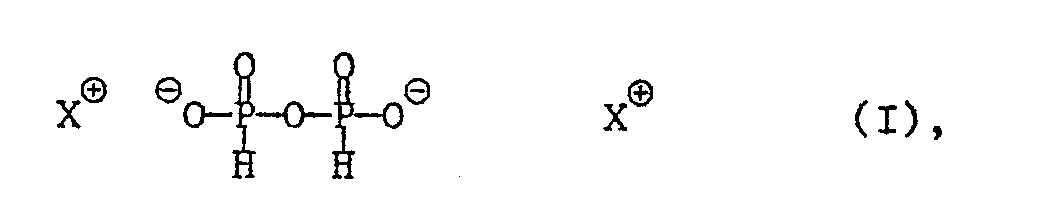
- the invention relates in particular to salts of the pyrophosphorous acid of the formula I.
- X ⁇ is a cation equivalent selected from the group sodium, potassium, lithium, beryllium, magnesium, aluminum, zinc, manganese, copper or NH4.
- Preferred plant microbicides are dilithium pyrophosphite and very particularly disodium pyrophosphite.
- L. Amat (Compt. Rend. 106 , (1888), 1400) describes that disodium pyrophosphite is formed when monosodium phosphite is heated to 160 ° C.
- An analogous behavior is reported by the potassium, rubidium and cesium salts (L. Amat; Compt. Rend. 108 (1889) 1056). These results are contradicted by Payne (J. Inorg. Nucl. Chem. 26 (1964), 2103).
- Rammelsberg Pogg. Ann. (1867) 131 , 263, 376; 132 , 488; Ber (1868) 1 , 186
- manganese, barium and calcium pyrophosphite cannot be produced by heating the corresponding phosphites.
- Kiehl et al. report the preparation of diammonium pyrophosphite by heating monoammonium phosphite at 100 to 120 ° C.
- Another subject of the invention are thus processes for the preparation of salts of pyrophosphorous acid.
- the above object is achieved by a process for the preparation of salts of the pyrophosphorous acid of the formula wherein X ⁇ is a cation equivalent selected from the group sodium, potassium, lithium, beryllium, magnesium, aluminum, zinc, manganese, copper or NH4, characterized in that a salt of the phosphorous acid of the formula II wherein X ⁇ is as previously defined, dehydrated in suspension at 80 to 280 ° C, and the water released in the course of the reaction is removed by means of suitable measures.
- the water released in the condensation can advantageously be removed from the reaction mixture by azeotropic distillation using a liquid which is immiscible or only miscible with water.
- the azeotropic distillation of water released in condensation reactions is a process which is generally known in preparative chemistry.
- the salts of the pyrophosphorous acid I can be obtained in almost quantitative yield and are now in sufficient purity almost 100 years after the first description of the disodium salt to disposal.
- the invention relates, as new compounds with a purity which is significantly improved over that known, to the compounds of the formula I which can be prepared by the process described above, in particular the disodium pyrophosphite.
- the disodium pyrophosphite relates to a disodium pyrophosphite, Na2H2P2O5, and a dilithium pyrophosphite, Li2H2P2O5, in at least 99.0% purity.
- the invention further relates to the new compounds of the formula I in which X represents lithium, beryllium, magnesium, calcium, barium, aluminum, manganese, zinc and copper (I) or copper (II).
- the liquid used as an azeotropic entrainer can be selected from a large number of known solvents or solvent mixtures which form azeotropes with water and boil in the specified temperature range.
- solvents or solvent mixtures which form azeotropes with water and boil in the specified temperature range.
- examples include high-boiling hydrocarbons such as dodecane, naphthalene, decalin, tetralin and halogenated hydrocarbons such as benzaldichloride, benzotrichloride, chlorobenzyl chloride, dibromobenzene, chlorobromobenzene and other high-boiling solvents such as esters with at least 9 carbon atoms, for example ethyl benzoate or formic acid octyl ester, mentioned (compilation of suitable solvents, for example, in CRC Handbook of Chemistry and Physics 52nd Ed., Cranwood Ohio 1971, Azeotropes, pp. D1-D44).
- reaction is advantageously carried out at temperatures between 80 and 140 ° C., while temperatures between 180 and 250 ° C. are preferred for the other salts of phosphorous acid.
- Suitable entraining agents in the case of diammonium pyrophosphite are those solvents which boil between 80 ° C and 140 ° C.
- Any solvents or solvent mixtures can be selected within the specified temperature ranges.
- 1,1,2-Trichloroethane or toluene is particularly suitable for the temperature range 80 - 140 ° C and 1,2,4-trichlorobenzene for the temperature range from 180 ° C to 250 ° C.
- the active compounds of the formula I according to the invention have very advantageous curative and preventive fungicidal properties for protecting crop plants.
- the present active ingredient mixtures on plants or on parts of plants (fruits, flowers, leaves, stems, tubers, roots) of different crops can be used to contain or destroy the microorganisms that occur.
- the active substances are active against the phytopathogenic fungi belonging to the following classes: Ascomycetes (e.g. Venturia, Podosphaera, Erysiphe, Monilinia, Uncinula); Basidiomycetes (e.g. the genera Hemileia, Rhizoctonia, Puccinia); Fungi imperfecti (e.g. Botrytis, Helminthosporium, Fusarium, Septoria, Cercospora, Alternaria and especially Pyricularia); then especially against the Oomycetes belonging to the class of the Phycomycetes such as Phytophthora, Peronospora, Pseudoperonospora, Pythium or Plasmopara.
- Ascomycetes e.g. Venturia, Podosphaera, Erysiphe, Monilinia, Uncinula
- Basidiomycetes e.g. the genera Hemileia, Rhizoctonia
- the active ingredients can also be used as dressings for the treatment of seeds (fruits, tubers, grains) and plant cuttings to protect against fungal infections and against phytopathogenic fungi occurring in the soil.
- the active compounds according to the invention are notable for particularly good plant tolerance and for their environmental friendliness. Pyrophosphorous acid and its salts are converted into soluble phosphates over time and accordingly later serve as fertilizers in soil applications. This is particularly true for disodium pyrophosphite, which is broken down into disodium phosphate.
- the active compounds of the formula I are applied to the area or plant to be treated, together with any other carriers, surfactants or other application-promoting additives which are customary in formulation technology.
- Suitable carriers and additives can be solid or liquid and correspond to the substances useful in formulation technology, e.g. natural or regenerated mineral substances, solvents, dispersants, wetting agents, adhesives, thickeners, binders or fertilizers.
- microbicides can also be added to broaden the spectrum, e.g. Dithiocarbamates such as Zineb, Maneb and in particular Mancozeb.
- a preferred method of applying the active ingredient is to apply it to the aerial parts of the plants, especially the foliage (foliar application).
- the number of applications and the application rate depend on the biological and climatic living conditions for the pathogen.
- the active ingredients can also via Get soil through the root system into the plant by soaking the location of the plant with a liquid preparation or by introducing the substances into the soil in solid form, for example in the form of granules (soil application).
- the compounds of the formula I can also be applied to seeds (coating) by either soaking the grains in succession in a liquid preparation of the active ingredient or coating them with an already combined preparation.
- other types of application to plants are possible in special cases, for example the targeted treatment of the buds or the fruit heads.
- the compounds of the formula I are used in unchanged form or preferably together with the auxiliaries customary in formulation technology and are therefore used, for example, to emulsion concentrates, spreadable pastes, directly sprayable or dilutable solutions, diluted emulsions, wettable powders, soluble powders, dusts, granules, by encapsulation in e.g. polymeric materials processed in a known manner.
- the methods of application such as spraying, atomizing, dusting, scattering, brushing or pouring are chosen in the same way as the type of agent, in accordance with the intended objectives and the prevailing conditions.
- Favorable application rates are generally 100 g to 6 kg ai / ha, in particular 100 g to 2000 g ai / ha.
- the formulations are prepared in a known manner, e.g. by intimately mixing and / or grinding the active ingredients with extenders, e.g. with solvents, solid carriers, and optionally surface-active compounds (surfactants).
- extenders e.g. with solvents, solid carriers, and optionally surface-active compounds (surfactants).
- Possible solvents are: aromatic hydrocarbons, preferably the fractions C8 to C12, such as xylene mixtures or substituted naphthalenes, phthalic acid esters such as dibutyl or dioctyl phthalate, aliphatic hydrocarbons such as cyclohexane or paraffins, alcohols and glycols and their ethers and esters such as ethanol, Ethylene glycol, ethylene glycol monomethyl or ethyl ether, ketones such as cyclohexanone, strongly polar solvents such as N-methyl-2- pyrrolidone, dimethyl sulfoxide or dimethylformamide, and optionally epoxidized vegetable oils such as epoxidized coconut oil or soybean oil; or water.
- aromatic hydrocarbons preferably the fractions C8 to C12, such as xylene mixtures or substituted naphthalenes, phthalic acid esters such as dibutyl or dioctyl phthalate,
- solid carriers e.g. natural dust, such as calcite, talc, kaolin, montmorillonite or attapulgite
- solid carriers e.g. natural dust, such as calcite, talc, kaolin, montmorillonite or attapulgite
- highly disperse silica or highly disperse absorbent polymers can also be added.
- adsorptive granulate carriers come porous types such as Pumice stone, broken brick, sepiolite or bentonite, as non-sorptive carrier materials e.g. Calcite or sand in question.
- a large number of pregranulated materials of inorganic or organic nature such as, in particular, dolomite or comminuted plant residues can be used.
- application-promoting additives that can lead to a reduction in the application rate are also natural (animal or vegetable) or synthetic phospholipids from the series of the cephalins and lecithins.
- Synthetic phospholipids are e.g. Dioctanoylphosphatidylcholine and dipalmitoylphosphatidylcholine.
- suitable surface-active compounds are nonionic, cationic and / or anionic surfactants with good emulsifying, dispersing and wetting properties.
- surfactants are also to be understood as mixtures of surfactants.
- the present invention includes methods for the treatment of plant diseases which are characterized by the application of the compounds of the formula I or the new agents to the site infected or at risk from infection.
- the active ingredient is mixed well with the additives and ground well in a suitable mill.
- Spray powder is obtained which can be diluted with water to form suspensions of any desired concentration.
- Emulsions of any desired concentration can be prepared from this concentrate by dilution with water.
- Ready-to-use dusts are obtained by mixing the active ingredient with the carrier and grinding it in a suitable mill.
- the active ingredient is mixed with the additives, ground and moistened with water. This mixture is extruded and then dried in an air stream.
- the finely ground active ingredient is applied evenly in a mixer to the kaolin moistened with polyethylene glycol. In this way, dust-free coating granules are obtained.
- the method according to the invention of dehydrating a phosphite in suspension allows the production of a high-purity pyrophosphite, as in the following examples, H-1.2, H-2, H-4.2. , H-5 is set out.
- Ammonium phosphite is left in boiling 1,1,2-trichloroethane in an apparatus provided with a water separator for 3 days.
- the following salts of pyrophosphorous acid can be obtained analogously to the examples above: Dipotassium pyrophosphite (K2H2P2O5) Calcium pyrophosphite (CaH2P2O5) Copper (II) pyrophosphite (CuH2P2O5) Zinc (II) pyrophosphite (Zn H2P2O5) Copper (I) pyrophosphite (Cu2H2P2O5) Barium pyrophosphite (BaH2P2O5) Manganese pyrophosphite (MnH2P2O5)
- Vine seedlings 5 weeks old are sprayed with a spray mixture (0.2% active substance) prepared from the formulated test substance and infected a day later with a sporangia suspension (20,000 sporangia / ml) from P. viticola .
- Incubation takes place at 20 ° C in a greenhouse cabin; a 14-hour incubation phase with 100% rel.
- tomato plants were sprayed with a spray mixture (0.2% active substance) prepared from wettable powder of the active compound, as described above. After 24 hours, the treated plants were infected with a sporangia suspension of the fungus. The fungal attack was assessed after incubation of the infected plants for 5 days at 90-100% atmospheric humidity and 20 ° C.
Landscapes
- Life Sciences & Earth Sciences (AREA)
- Chemical & Material Sciences (AREA)
- Organic Chemistry (AREA)
- Inorganic Chemistry (AREA)
- Health & Medical Sciences (AREA)
- Plant Pathology (AREA)
- Pest Control & Pesticides (AREA)
- Engineering & Computer Science (AREA)
- Dentistry (AREA)
- General Health & Medical Sciences (AREA)
- Wood Science & Technology (AREA)
- Zoology (AREA)
- Environmental Sciences (AREA)
- Agronomy & Crop Science (AREA)
- Agricultural Chemicals And Associated Chemicals (AREA)
Abstract
Description
- Die vorliegende Erfindung betrifft mikrobizid wirksame Salze der pyrophosphorigen Säure, Verfahren zu deren Herstellung, mikrobizide Mittel und neue Salze der pyrophosphorigen Säure.
- Aus der US-P 4,075,324 ist bekannt geworden, dass bestimmte Salze der phosphorigen Säure fungizid wirksam sind. Diese Salze befriedigen nicht immer im Hinblick auf Wirkungsstärke und Wirkungsdauer.
- Es wurde nun gefunden, dass Salze der pyrophosphorigen Säure eine verbesserte mikrobizide Wirkung aufweisen.
- Die Erfindung betrifft insbesondere Salze der pyrophosphorigen Säure der Formel I

- Als Pflanzenmikrobizide bevorzugt sind Dilithiumpyrophosphit und ganz besonders Dinatriumpyrophosphit.
- Aus der Literatur sind bisher nur wenige Salze der pyrophosphorigen Säure bekannt geworden.
- So beschreibt L. Amat (Compt. Rend. 106, (1888), 1400), dass sich Dinatriumpyrophosphit beim Erhitzen von Mononatriumphosphit auf 160°C bilde. Ein analoges Verhalten wird von den Kalium-, Rubidium- und Cäsiumsalzen berichtet (L. Amat; Compt. Rend. 108 (1889) 1056). Diesen Ergebnissen wird von Payne (J. Inorg. Nucl. Chem. 26 (1964), 2103) widersprochen. Nach Untersuchungen von Rammelsberg (Pogg. Ann. (1867) 131, 263, 376; 132, 488; Ber (1868) 1, 186) können Mangan-, Barium- und Calciumpyrophosphit nicht durch Erhitzen der entsprechenden Phosphite hergestellt werden.
- Kiehl et al. (J. Amer. Chem. Soc. 60 (1938) 47) berichten über die Herstellung von Diammoniumpyrophosphit durch Erhitzen von Monoammoniumphosphit auf 100 bis 120°C.
- Neuere Veröffentlichungen betreffen spektroskopische Untersuchungen von Dinatriumpyrophosphit (M. Baudler, Z. Naturf. 12b (1957), 347; W. Mc.Farlane J. Chem. Soc. A, 1968, 1715). Auch Mc. Farlane berichtet, dass das nach dem Verfahren von Amat. (s.o.) hergestellte Produkt noch beträchtliche Mengen an Ausgangsverbindungen enthält.
- Eigene Untersuchungen zeigen, dass mit den aus der o.a. Literatur bekannten Verfahren die Salze der pyrophosphorigen Säure nicht in hinreichender Reinheit herstellbar sind. So bildet sich nach zehnstündigem Erhitzen von Mononatriumphosphit auf 160°C (bei 0,02 Torr) nur eine 1:1 Mischung von Mononatriumphosphit und Dinatriumpyrophosphit (Verfahren analog zu Armat, Lit.s.o.). Ebenfalls wird bei mehr als dreitägigem Erhitzen (39 Stunden) von Monoammoniumphosphit auf 120°C entgegen den Angaben von Kiehl (Lit.s.o.) kein Diammoniumpyrophosphit gefunden. Beim Erhitzen im Vakuum (0.2 Torr) auf 110°C kann dagegen die Bildung eines neuen Hemi-Salzes gemäss nachstehender Gleichung beobachtet werden:

- Die Ergebnisse der eigenen Untersuchungen sowie Hinweise in der Literatur zeigen, dass bisher noch kein allgemein anwendbares Verfahren zur Herstellung von Salzen der pyrophosphorigen Säure zur Verfügung steht.
- Ein weiterer Erfindungsgegenstand sind somit Verfahren zur Herstellung von Salzen der pyrophosphorigen Säure. Die vorstehende Aufgabe wird gelöst durch ein Verfahren zur Herstellung von Salzen der pyrophosphorigen Säure der Formel


- Als vorteilhaft hat es sich erwiesen, das als Edukt eingesetzte Phosphit möglichst fein zu zerkleinern, so dass es in Suspension in einer in dem vorgenannten Temperaturbereich siedenden Flüssigkeit eingesetzt werden kann. Bei fortschreitender Reaktion kann der suspendierte Feststoff zusammbacken. Das zusammengeklumpte Material sollte dann fein verrieben werden.
- Das bei der Kondensation freiwerdende Wasser kann in vorteilhafter Weise durch azeotrope Destillation durch eine mit Wasser nicht oder nur begrenzt mischbare Flüssigkeit aus dem Reaktionsgemisch entfernt werden.
- Die azeotrope Destillation von bei Kondensationsreaktionen freiwerdendem Wasser ist ein in der präparativen Chemie allgemein bekanntes Verfahren. Ueberraschenderweise können durch Erhitzen von Salzen der phosphorigen Säure II in Flüssigkeiten, welche mit Wasser in der Dampfphase ein Azeotrop bilden, die Salze der pyrophosphorigen Säure I in nahezu quantitativer Ausbeute erhalten werden und stehen nunmehr fast 100 Jahre nach der ersten Beschreibung des Dinatriumsalzes in hinreichender Reinheit zur Verfügung.
- Die Erfindung betrifft darüber hinaus als neue Verbindungen mit einer gegenüber dem Bekannten deutlich verbesserten Reinheit die nach dem vorstehend beschrieben Verfahren herstellbaren Verbindungen der Formel I, insbesondere das Dinatriumpyrophosphit. Vor allem betrifft es ein Dinatriumpyrophosphit, Na₂H₂P₂O₅, und ein Dilithiumpyrophosphit, Li₂H₂P₂O₅, in mindestens 99,0%iger Reinheit.
- Des weiteren betrifft die Erfindung die neuen Verbindungen der Formel I, in denen X für Lithium, Beryllium, Magnesium, Calcium, Barium, Aluminium, Mangan, Zink und Kupfer(I) oder Kupfer(II) steht.
- Die als azeotropes Schleppmittel verwendete Flüssigkeit kann aus einer Vielzahl von bekannten, mit Wasser Azeotrope bildenden Lösungsmitteln oder Lösungsmittel-Gemischen, welche in dem angegebenen Temperaturbereich sieden, gewählt werden. Als Beispiele seien hochsiedende Kohlenwasserstoffe wie Dodecan, Naphthalin, Decalin, Tetralin und halogenierte Kohlenwasserstoffe wie Benzaldichlorid, Benzotrichlorid, Chlorbenzylchlorid, Dibrombenzol, Chlorbrombenzol sowie weitere hochsiedende Lösungsmittel wie Ester mit mindestens 9 Kohlenstoffatomen, z.B. Benzoesäureethylester oder Ameisensäure octylester, genannt (Zusammenstellung geeigneter Lösungsmittel etwa in CRC Handbook of Chemistry and Physics 52nd Ed., Cranwood Ohio 1971, Azeotropes, S. D1-D44).
- In vorteilhafter Weise wird die Umsetzung bei Verbindungen der Formel I bzw. II, in denen X für Ammonium steht, bei Temperaturen zwischen 80 und 140°C durchgeführt, während bei den übrigen Salzen der phosphorigen Säure Temperaturen zwischen 180 und 250°C bevorzugt sind.
- Als geeignete Schleppmittel im Falle des Diammoniumpyrophosphits sind solche Lösungsmittel zu nennen, welche zwischen 80°C und 140°C sieden.
- Bei den restlichen Verbindungen der Formel I, in denen X für ein Alkali-, Erdalkali-, Aluminium-, Mangan-, Zink- oder Kupferion steht sind Lösungsmittel mit einer Siedetemperatur zwischen 180°C und 250°C bevorzugt.
- Innerhalb der vorgegebenen Temperaturbereiche können beliebige Lösungsmittel oder Lösungsmittelgemische ausgewählt werden.
- Besonders geeignet für den Temperaturbereich 80 - 140°C ist 1,1,2-Trichlorethan oder Toluol und für den Temperaturbereich von 180°C bis 250°C 1,2,4-Trichlorbenzol.
- Wenn X für einwertiges Kation steht, sind die Pyrophosphite der Formel I in Wasser löslich, während in den Fällen, in denen X für ein Kationenäquivalent eines zwei- oder dreiwertigen Kations steht, die entsprechenden Salze in Wasser schwer löslich bzw. unlöslich sind.
- Während die in Wasser löslichen Verbindungen der Formel I sowohl in flüssiger als auch in fester Form formulierbar sind, ist bei den in Wasser schwer löslichen bzw. unlöslichen Verbindungen eine Formulierung als Feststoff, etwa als Staub, WP (= Spritzpulver) oder SC (= Suspensionskonzentrat) bevorzugt.
- Die erfindungsgemässen Wirkstoffe der Formel I besitzen sehr vorteilhafte kurative und präventive Fungizid-Eigenschaften zum Schutz von Kulturpflanzen. Mit den vorliegenden Wirkstoffmischungen können an Pflanzen oder an Pflanzenteilen (Früchte, Blüten, Laubwerk, Stengel, Knollen, Wurzeln) von unterschiedlichen Nutzkulturen die auftretenden Mikroorganismen eingedämmt oder vernichtet werden.
- Die Wirkstoffe sind gegen die den folgenden Klassen angehörenden phytopathogenen Pilze wirksam: Ascomyceten (z.B. Venturia, Podosphaera, Erysiphe, Monilinia, Uncinula); Basidiomyceten (z.B. die Gattungen Hemileia, Rhizoctonia, Puccinia); Fungi imperfecti (z.B. Botrytis, Helminthosporium, Fusarium, Septoria, Cercospora, Alternaria und insbesondere Pyricularia); dann aber besonders gegen die der Klasse der Phycomyceten angehörenden Oomyceten wie Phytophthora, Peronospora, Pseudoperonospora, Pythium oder Plasmopara. Die Wirkstoffe können auch als Beizmittel zur Behandlung von Saatgut (Früchte, Knollen, Körner) und Pflanzenstecklingen zum Schutz vor Pilzinfektionen sowie gegen im Erdboden auftretende Phytopathogene Pilze eingesetzt werden. Die erfindungsgemässen Wirkstoffe zeichnen sich durch besonders gute Pflanzenverträglichkeit und durch ihre Umweltfreundlichkeit aus. Pyrophosphorige Säure und ihre Salze werden im Laufe der Zeit in lösliche Phosphate umgewandelt und dienen dementsprechend bei Erdboden-Applikationen später als Düngemittel. Dies trifft in besonderem Masse für Dinatriumpyrophosphit zu, das in Dinatriumphosphat abgebaut wird.
- Als Zielkulturen für die hierin offenbarten Indikationsgebiete gelten im Rahmen dieser Erfindung z.B. folgende Pflanzenarten: Getreide: (Weizen, Gerste, Roggen, Hafer, Reis, Sorghum und Verwandte, wie z.B. Zierrasen (= Turf); Rüben: (Zucker- und Futterrüben); Kern-, Stein- und Beerenobst: (Aepfel, Birnen, Pflaumen, Pfirsiche, Mandeln, Kirschen, Erdbeeren, Himbeeren, Preiselbeeren, und Brombeeren); Hülsenfrüchte: (Bohnen, Linsen, Erbsen, Soja); Oelkulturen: (Raps, Senf, Mohn, Oliven, Sonnenblumen, Kokos, Rizinus, Kakao, Erdnüsse); Gurkengewächse: (Kürbis, Gurken, Melonen); Fasergewächse: (Baumwolle, Flachs, Hanf, Jute); Citrusfrüchte: (Orangen, Zitronen, Grapefruit, Mandarinen); Gemüsesorten: (Spinat, Kopfsalat, Spargel, Kohlarten, Möhren, Zwiebeln, Tomaten, Kartoffeln, Paprika); Lorbeergewächse: (Avocado, Cinnamonum, Kampfer) oder Pflanzen wie Mais, Tabak, Nüsse, Kaffee, Zuckerrohr, Ananas, Tee, Weinreben, Hopfen, Bananen- und Naturkautschukgewächse sowie Zierpflanzen (Blumen, Sträucher, Laubbäume und Nadelbäume wie Koniferen). Diese Aufzählung stellt keine Limitierung dar.
- Die Wirkstoffe der Formel I werden auf die zu behandelnde Fläche oder Pflanze gegeben, zusammen mit gegebenenfalls weiteren in der Formulierungstechnik üblichen Trägerstoffen, Tensiden oder anderen applikationsfördernden Zusätzen.
- Geeignete Träger und Zusätze können fest oder flüssig sein und entsprechen den in der Formulierungstechnik zweckdienlichen Stoffen, wie z.B. natürlichen oder regenerierten mineralischen Stoffen, Lösungs-, Dispergier-, Netz-, Haft-, Verdickungs-, Binde- oder Düngemitteln.
- Es können auch weitere Mikrobizide zur Spektrumsverbreiterung zugemischt werden, z.B. Dithiocarbamate wie Zineb, Maneb und insbesondere Mancozeb.
- Ein bevorzugtes Verfahen zum Aufbringen des Wirkstoffs ist das Aufbringen auf die oberirdischen Pflanzenteile, vor allem das Blattwerk (Blattapplikation). Anzahl der Applikationen und Aufwandmenge richten sich nach den biologischen und klimatischen Lebensbedingungen für den Erreger. Die Wirkstoffe können aber auch über den Erdboden durch das Wurzelwerk in die Pflanze gelangen, indem man den Standort der Pflanze mit einer flüssigen Zubereitung tränkt oder die Substanzen in fester Form in den Boden einbringt z.B. in Form von Granulat (Bodenapplikation). Die Verbindungen der Formel I können auch auf Samenkörner aufgebracht werden (Coating), indem man die Körner entweder nacheinander in einer flüssigen Zubereitung des Wirkstoffs tränkt oder sie mit einer bereits kombinierten Zubereitung beschichtet. Darüberhinaus sind in besonderen Fällen weitere Applikationsarten bei Pflanzen möglich, z.B. die gezielte Behandlung der Knospen oder der Fruchtstände.
- Die Verbindungen der Formel I werden dabei in unveränderter Form oder vorzugsweise zusammen mit den in den Formulierungstechnik üblichen Hilfsmittel eingesetzt und werden daher z.B. zu Emulsionskonzentraten, streichfähigen Pasten, direkt versprühbaren oder verdünnbaren Lösungen, verdünnten Emulsionen, Spritzpulvern, löslichen Pulvern, Stäubemitteln, Granulaten, durch Verkapselungen in z.B. polymeren Stoffen in bekannter Weise verarbeitet. Die Anwendungsverfahren die Versprühen, Vernebeln, Verstäuben, Verstreuen, Bestreichen oder Giessen werden gleich wie die Art der Mittel den angestrebten Zielen und den gegebenen Verhältnissen entsprechend gewählt. Günstige Aufwandmengen liegen im allgemeinen bei 100 g bis 6 kg AS/ha, insbesondere bei 100 g bis 2000 g AS/ha.
- Die Formulierungen werden in bekannter Weise hergestellt, z.B. durch inniges Vermischen und/oder Vermahlen der Wirkstoffe mit Streckmitteln, wie z.B. mit Lösungsmitteln, festen Trägerstoffen, und gegebenenfalls oberflächenaktiven Verbindungen (Tensiden).
- Als Lösungsmittel können in Frage kommen: Aromatische Kohlenwasserstoffe, bevorzugt die Fraktionen C₈ bis C₁₂, wie z.B. Xylolgemische oder substituierte Naphthaline, Phthalsäureester wie Dibutyl- oder Dioctylphthalat, aliphatische Kohlenwasserstoffe wie Cyclohexan oder Paraffine, Alkohole und Glykole sowie deren Ether und Ester, wie Ethanol, Ethylenglykol, Ethylenglykolmonomethyl- oder Ethylether, Ketone wie Cyclohexanon, stark polare Lösungsmittel wie N-Methyl-2- pyrrolidon, Dimethylsulfoxid oder Dimethylformamid, sowie gegebenenfalls epoxydierte Pflanzenöle wie epoxydiertes Kokosnussöl oder Sojaöl; oder Wasser.
- Als feste Trägerstoffe, z.B. für Stäubemittel und dispergierbare Pulver, werden in der Regel natürliche Gesteinsmehle verwendet, wie Calcit, Talkum, Kaolin, Montmorillonit oder Attapulgit. Zur Verbesserung der physikalischen Eigenschaften können auch hochdisperse Kieselsäure oder hochdisperse saugfähige Polymerisate zugesetzt werden. Als gekörnte, adsorptive Granulatträger kommen poröse Typen wie z.B. Bimsstein, Ziegelbruch, Sepiolit oder Bentonit, als nicht sorptive Trägermaterialien z.B. Calcit oder Sand in Frage. Darüberhinaus kann eine Vielzahl von vorgranulierten Materialien anorganischer oder organischer Natur wie insbesondere Dolomit oder zerkleinerte Pflanzenrückstände verwendet werden. Besonders vorteilhafte, applikationsfördernde Zuschlagstoffe, die zu einer Reduktion der Aufwandmenge führen können, sind ferner natürliche (tierische oder pflanzliche) oder synthetische Phospholipide aus der Reihe der Kephaline und Lecithine. Synthetische Phospholipide sind z.B. Dioctanoylphosphatidylcholin und Dipalmitoylphosphatidylcholin.
- Als oberflächenaktive Verbindungen kommen je nach Art der zu formulierenden Wirkstoffe der Formel I nichtionogene, kation- und/oder anionaktive Tenside mit guten Emulgier-, Dispergier- und Netzeigenschaften in Betracht. Unter Tensiden sind auch Tensidgemische zu verstehen.
- Darüber hinaus schliesst die vorliegende Erfindung nach Verfahren zur Behandlung von Pflanzenkrankheiten ein, die sich durch Applikation der Verbindungen der Formel I bzw. der neuen Mittel auf die durch Infektion befallene oder gefährdete Stelle auszeichnen.

- Der Wirkstoff wird mit den Zusatzstoffen gut vermischt und in einer geeigneten Mühle gut vermahlen. Man erhält Spritzpulver, die sich mit Wasser zu Suspensionen jeder gewünschten Konzentration verdünnen lassen.

- Aus diesem Konzentrat können durch Verdünnen mit Wasser Emulsionen jeder gewünschten Konzentration hergestellt werden.

- Man erhält anwendungsfertige Stäubemittel, indem der Wirkstoff mit den Träger vermischt und auf einer geeigneten Mühle vermahlen wird.

- Der Wirkstoff wird mit den Zusatzstoffen vermischt, vermahlen und mit Wasser angefeuchtet. Dieses Gemisch wird extrudiert und anschliessend im Luftstrom getrocknet.

- Der fein gemahlene Wirkstoff wird in einem Mischer auf das mit Polyethylenglykol angefeuchtete Kaolin gleichmässig aufgetragen. Auf diese Weise erhält man staubfreie Umhüllungs-Granulate.
- Die nachstehenden Beispiele erläutern die Erfindung.
- 15.8 g (0.152 Mol) NaH₂PO₃ werden im Vakuum 17 Stunden bei 200°C erhitzt. Die stark zusammenbackende Substanz wird zwischendurch mehrfach pulverisiert. Man isoliert danach 14.02 g (97.1 % d. Th. bezogen auf Pyrophosphit) eines weissen Produkts, welches gemäss dem ³¹P-NMR-Spektrum zu.
91 % aus der Titelverbindung der Formel
und
9 % aus der Ausgangsverbindung der Formel
- Gegenüber diesem aus der Literatur bekannten Verfahren, das zu einem sehr unreinen Endprodukt führt, erlaubt das erfindungsgemässe Verfahen der Dehydratisierung eines Phosphits in Suspension die Herstellung eines hochreinen Pyrophosphits, wie in den folgenden Beispielen, H-1.2, H-2, H-4.2., H-5 dargelegt wird.
- 221 g (2,125 Mol) NaH₂PO₃ werden mit 400 ml 1,2,4-Trichlorbenzol unter Rühren in einer mit einem Wasserabscheider versehenen Apparatur für 17 Stunden zum Sieden erhitzt, wobei die Masse zusammenbackt und zwischendurch entnommen und pulverisiert wird. Nach dem Erkalten wird abfiltriert.
- Man isoliert 201 g (99,6 %) der Titelverbindung der Formel

³¹P-NMR (D₂O) δ = 4,89 ppm, JPH = 666 Hz; ¹H-NMR (D₂O): δ = 7,1 ppm, JPH = 661 Hz
H₂P₂O₅Na₂ (189,95) Ber. P 32,61 % Na 24.21 %
Gef. P 32,4 % Na 24.5 % - Analog zu der in H 1.2 beschriebenen Verfahrensweise erhält man nach 7 stündigem Erhitzen von LiH₂PO₃ in 1,2,4-Trichlorbenzol die Titelverbindung der Formel

³¹P NMR (H₂O) δ = 4,9 ppm
¹H NMR (D₂O) δ = 6,94 ppm, JPH = 673 Hz - Analog zu dem in H 1.2 beschriebenen Verfahrensweise erhält man nach 22 stündigem Erhitzen von [Mg]0.5 H₂PO₃ in 1,2,4-Trichlorbenzol die Titelverbindung der Formel

- Zu einer Lösung von 30,3 g (0,369 Mol) phosphorige Säure in 100 ml Wasser werden 20 g (0,123 Mol) Aluminium-tri-ethanolat gegeben. Nach Abklingen der exothermen Reaktion wird für 14 Stunden bei Raumtemperatur belassen und danach zur Trockene eingedampft.
- Man isoliert 32,9 g (99 %) der Titelverbindung der Formel

- 8.0 g (0.03 Mol) Aluminiumphosphit werden 16 Stunden am Wasserabscheider in 1,2,4-Trichlorbenzol zum Sieden erhitzt. Danach wird das 1,2,4-Trichlorbenzol abdekantiert, der Rückstand in Dichlormethan aufgeschlämmt, abfiltriert und getrocknet.
- Man isoliert 5,63 g (75,3 %) der Titelverbindung der Formel

- Ammoniumphosphit wird in einer mit einem Wasserabscheider versehenen Apparatur für 3 Tage in siedendem 1,1,2-Trichlorethan belassen.
- Man isoliert die Titelverbindung der Formel

¹H-NMR (D₂O) δ = 7,4 ppm (PH, JPH = 676 Hz; δ = 5,8 ppm (NH₄) - Analog zu den vorstehenden Beispielen können die folgenden Salze der pyrophosphorigen Säure erhalten werden:
Dikaliumpyrophosphit (K₂H₂P₂O₅)
Calciumpyrophosphit (CaH₂P₂O₅)
Kupfer(II)pyrophosphit (CuH₂P₂O₅)
Zink(II)pyrophosphit (Zn H₂P₂O₅)
Kupfer(I)pyrophosphit (Cu₂H₂P₂O₅)
Bariumpyrophosphit (BaH₂P₂O₅)
Manganpyrophosphit (MnH₂P₂O₅) - 5 Wochen alte Rebensämlinge werden mit einer aus der formulierten Prüfsubstanz hergestellten Spritzbrühe (0,2 % Aktivsubstanz) besprüht und einen Tag später mit einer Sporangiensuspension (20ʹ000 Sporangien/ml) von P. viticola infiziert. Die Inkubation erfolgt bei 20°C in einer Gewächshauskabine; einer 14-stündigen Inkubationsphase mit 100 % rel. Luftfeuchtigkeit folgen 4 Tage mit 75 - 85 % und abschliessend zur Induktion der Pilzsporulation noch eine Nacht mit 100 %. Nach der 6-tägigen Inkubation wird der Pilzbefall ausgewertet (0 - 5 % = volle Wirkung).

- Tomatenpflanzen wurden nach 3-wöchiger Anzucht mit einer aus Spritzpulver des Wirkstoffes, wie oben beschriebenen hergestellten Spritzbrühe (0,2 % Aktivsubstanz) besprüht. Nach 24 Stunden wurden die behandelten Pflanzen mit einer Sporangiensuspension des Pilzes infiziert. Die Beurteilung des Pilzbefalls erfolgte nach einer Inkubation der infizierten Pflanzen während 5 Tagen bei 90 - 100 % Luftfeuchtigkeit und 20°C.

Claims (13)


Priority Applications (1)
| Application Number | Priority Date | Filing Date | Title |
|---|---|---|---|
| AT87810768T ATE100670T1 (de) | 1986-12-23 | 1987-12-18 | Pflanzenfungizide mittel enthaltend als wirstoffe salze der pyrophosphorigen saeure und ihre anwendung. |
Applications Claiming Priority (2)
| Application Number | Priority Date | Filing Date | Title |
|---|---|---|---|
| CH5202/86 | 1986-12-23 | ||
| CH520286 | 1986-12-23 |
Publications (3)
| Publication Number | Publication Date |
|---|---|
| EP0273014A2 true EP0273014A2 (de) | 1988-06-29 |
| EP0273014A3 EP0273014A3 (en) | 1990-01-31 |
| EP0273014B1 EP0273014B1 (de) | 1994-01-26 |
Family
ID=4289644
Family Applications (1)
| Application Number | Title | Priority Date | Filing Date |
|---|---|---|---|
| EP87810768A Expired - Lifetime EP0273014B1 (de) | 1986-12-23 | 1987-12-18 | Pflanzenfungizide Mittel enthaltend als Wirstoffe Salze der pyrophosphorigen Säure und ihre Anwendung |
Country Status (18)
| Country | Link |
|---|---|
| US (2) | US4859466A (de) |
| EP (1) | EP0273014B1 (de) |
| JP (1) | JPS63166813A (de) |
| KR (1) | KR880006987A (de) |
| AR (1) | AR246029A1 (de) |
| AT (1) | ATE100670T1 (de) |
| AU (1) | AU610844B2 (de) |
| BR (1) | BR8707031A (de) |
| CA (1) | CA1328979C (de) |
| DE (1) | DE3788948D1 (de) |
| DK (1) | DK168987B1 (de) |
| ES (1) | ES2061523T3 (de) |
| HU (1) | HU206028B (de) |
| IL (1) | IL84889A (de) |
| NZ (1) | NZ223006A (de) |
| PT (1) | PT86435B (de) |
| TR (1) | TR23828A (de) |
| ZA (1) | ZA879590B (de) |
Cited By (3)
| Publication number | Priority date | Publication date | Assignee | Title |
|---|---|---|---|---|
| FR2706736A1 (de) * | 1993-06-23 | 1994-12-30 | Rhone Poulenc Agrochimie | |
| FR2708415A1 (fr) * | 1993-06-23 | 1995-02-10 | Rhone Poulenc Agrochimie | Traitement de semences à l'aide d'acide phosphoreux ou un de ses sels, et semences ainsi traitées. |
| WO2020132095A1 (en) * | 2018-12-20 | 2020-06-25 | Lanxess Solutions Us Inc. | Method for preparing readily processable, thermally-stable, phosphorus-containing flame retardant material |
Families Citing this family (3)
| Publication number | Priority date | Publication date | Assignee | Title |
|---|---|---|---|---|
| US10035896B2 (en) | 2014-07-29 | 2018-07-31 | Lanxess Solutions Us Inc. | Salts of pyrophosphonic acid as flame retardants |
| US12305020B2 (en) | 2020-06-17 | 2025-05-20 | Lanxess Corporation | Flame retardant and stabilizer combined for use with thermoplastics |
| IT202300012561A1 (it) | 2023-06-19 | 2024-12-19 | Ndg Natural Dev Group S R L | Formulazioni antifungine per la concia delle sementi, semi trattati e metodi |
Family Cites Families (2)
| Publication number | Priority date | Publication date | Assignee | Title |
|---|---|---|---|---|
| US3415623A (en) * | 1965-04-19 | 1968-12-10 | Monsanto Co | Process for preparing condensed phosphorous acid |
| TR19072A (tr) * | 1973-11-26 | 1978-05-01 | Pepro | Fosforlu tuerevler ihtiva eden fungisid terkipler |
-
1987
- 1987-12-11 US US07/131,710 patent/US4859466A/en not_active Expired - Fee Related
- 1987-12-18 EP EP87810768A patent/EP0273014B1/de not_active Expired - Lifetime
- 1987-12-18 DE DE87810768T patent/DE3788948D1/de not_active Expired - Fee Related
- 1987-12-18 AT AT87810768T patent/ATE100670T1/de not_active IP Right Cessation
- 1987-12-18 ES ES87810768T patent/ES2061523T3/es not_active Expired - Lifetime
- 1987-12-21 NZ NZ223006A patent/NZ223006A/xx unknown
- 1987-12-21 CA CA000554940A patent/CA1328979C/en not_active Expired - Fee Related
- 1987-12-21 IL IL84889A patent/IL84889A/xx not_active IP Right Cessation
- 1987-12-21 AR AR87309666A patent/AR246029A1/es active
- 1987-12-22 PT PT86435A patent/PT86435B/pt not_active IP Right Cessation
- 1987-12-22 TR TR88/0003A patent/TR23828A/xx unknown
- 1987-12-22 DK DK677087A patent/DK168987B1/da not_active Application Discontinuation
- 1987-12-22 JP JP62325102A patent/JPS63166813A/ja active Pending
- 1987-12-22 AU AU82919/87A patent/AU610844B2/en not_active Ceased
- 1987-12-22 HU HU875951A patent/HU206028B/hu not_active IP Right Cessation
- 1987-12-22 ZA ZA879590A patent/ZA879590B/xx unknown
- 1987-12-23 BR BR87070312A patent/BR8707031A/pt not_active Application Discontinuation
- 1987-12-23 KR KR1019870015027A patent/KR880006987A/ko not_active Withdrawn
-
1989
- 1989-05-15 US US07/352,240 patent/US5013559A/en not_active Expired - Fee Related
Cited By (10)
| Publication number | Priority date | Publication date | Assignee | Title |
|---|---|---|---|---|
| FR2706736A1 (de) * | 1993-06-23 | 1994-12-30 | Rhone Poulenc Agrochimie | |
| FR2708415A1 (fr) * | 1993-06-23 | 1995-02-10 | Rhone Poulenc Agrochimie | Traitement de semences à l'aide d'acide phosphoreux ou un de ses sels, et semences ainsi traitées. |
| BE1008436A5 (fr) * | 1993-06-23 | 1996-05-07 | Rhone Poulenc Agrochimie | Traitement de semences a l'aide d'acide phosphoreux ou un de ses sels, et semences ainsi traitees. |
| WO2020132095A1 (en) * | 2018-12-20 | 2020-06-25 | Lanxess Solutions Us Inc. | Method for preparing readily processable, thermally-stable, phosphorus-containing flame retardant material |
| CN113166181A (zh) * | 2018-12-20 | 2021-07-23 | 朗盛公司 | 用于制备容易处理的热稳定性含磷阻燃材料的方法 |
| JP2022515185A (ja) * | 2018-12-20 | 2022-02-17 | ランクセス・コーポレーション | 容易に加工可能な熱安定性リン含有難燃性材料の調製方法 |
| IL284017B1 (en) * | 2018-12-20 | 2024-10-01 | Lanxess Corp | Method for preparing readily processable, thermally-stable, phosphorus-containing flame retardant material |
| CN113166181B (zh) * | 2018-12-20 | 2025-01-24 | 朗盛公司 | 用于制备容易处理的热稳定性含磷阻燃材料的方法 |
| IL284017B2 (en) * | 2018-12-20 | 2025-02-01 | Lanxess Corp | Method for preparing a thermally stable, easily processable, phosphorus-containing flame retardant |
| AU2019403247B2 (en) * | 2018-12-20 | 2025-03-13 | Lanxess Corporation | Method for preparing readily processable, thermally-stable, phosphorus-containing flame retardant material |
Also Published As
| Publication number | Publication date |
|---|---|
| BR8707031A (pt) | 1988-08-02 |
| ATE100670T1 (de) | 1994-02-15 |
| AU8291987A (en) | 1988-06-23 |
| US5013559A (en) | 1991-05-07 |
| DK677087A (da) | 1988-06-24 |
| DK677087D0 (da) | 1987-12-22 |
| ES2061523T3 (es) | 1994-12-16 |
| DE3788948D1 (de) | 1994-03-10 |
| PT86435A (en) | 1988-01-01 |
| JPS63166813A (ja) | 1988-07-11 |
| US4859466A (en) | 1989-08-22 |
| NZ223006A (en) | 1990-08-28 |
| TR23828A (tr) | 1990-09-25 |
| HU206028B (en) | 1992-08-28 |
| IL84889A (en) | 1992-05-25 |
| EP0273014A3 (en) | 1990-01-31 |
| EP0273014B1 (de) | 1994-01-26 |
| IL84889A0 (en) | 1988-06-30 |
| HUT46196A (en) | 1988-10-28 |
| DK168987B1 (da) | 1994-07-25 |
| ZA879590B (en) | 1988-08-31 |
| AR246029A1 (es) | 1994-03-30 |
| KR880006987A (ko) | 1988-08-26 |
| AU610844B2 (en) | 1991-05-30 |
| CA1328979C (en) | 1994-05-03 |
| PT86435B (pt) | 1990-11-20 |
Similar Documents
| Publication | Publication Date | Title |
|---|---|---|
| EP0230209A2 (de) | Mikrobizide | |
| DE2655910A1 (de) | Neue dioxolanderivate | |
| EP0182738A2 (de) | Verfahren zur Herstellung fungizid aktiver 4-Phenyl-pyrrol-Derivate | |
| DE1543805B1 (de) | Substituierte 3-Furylmethylester und Verfahren zu deren Herstellung sowie deren Verwendung als Insekticide | |
| EP0450355A1 (de) | Verbindungen zur Bekämpfung von Pflanzenkrankheiten | |
| EP0198797B1 (de) | Schädlingsbekämpfungsmittel | |
| EP0346841A2 (de) | 1-Aryl-naphthoesäureamide und diese enthaltende mikrobizide Mittel | |
| DE2804664A1 (de) | N- eckige klammer auf (phosphinyl) amino eckige klammer zu thio-methylcarbamate bzw. n- eckige klammer auf (phosphinothioyl) amino eckige klammer zu thio-methylcarbamate, deren verwendung in einem verfahren zur schaedlingsbekaempfung, pestizide mittel welche diese verbindungen enthalten, sowie verfahren zur herstellung dieser verbindungen und dafuer benoetigte ausgangsmaterialien | |
| EP0273014B1 (de) | Pflanzenfungizide Mittel enthaltend als Wirstoffe Salze der pyrophosphorigen Säure und ihre Anwendung | |
| EP0627164A1 (de) | Mikrobizide Mischungen die Prochloraz und Cyprodinil enthalten | |
| EP0183217B1 (de) | Mikrobizide Mittel | |
| EP0655441B1 (de) | Kristallmodifikation von (4-Cyclopropyl-6-methyl-pyrimidin-2-yl)- phenyl-amin, und Verfahren zu dessen Herstellung | |
| DE1567131A1 (de) | Herbizide Komposition und Verfahren zu ihrer Anwendung | |
| DE2732930C2 (de) | Neue 0-Äthyl-S-n-propyl-O-2,2,2- trihalogenäthylphosphorthiolate (oder -thionothiolate), Verfahren zu ihrer Herstellung und ihre Verwendung als Insektizide, Akarizide und Nematizide | |
| EP0065483B1 (de) | Mikrobizide Acylanilin- und Acylnaphthylamin-Derivate, Verfahren zu deren Herstellung und ihre Verwendung | |
| DE1914012A1 (de) | Neue s-Triazin-Derivate | |
| DE2655843A1 (de) | Neue dioxolanderivate | |
| DE2635967A1 (de) | 2-cyanacetamid-derivate und ihre herstellung und anwendung | |
| CH677664A5 (de) | ||
| DE2512556C2 (de) | Cyclische Diphosphorverbindungen, ihre Herstellung und diese enthaltende fungizide Zusammensetzungen | |
| EP0439426A1 (de) | Mikrobizide Mittel | |
| DE3038083A1 (de) | 5-(2'-chlor-4'-trifluormethylphenoxy)-2-nitrostyrolderivate, verfahren zu ihrer herstellung und diese verbindungen enthaltende herbizide mittel | |
| DE3014922C2 (de) | N-Alkoxymethyl-chloracetanilide und diese enthaltende herbizide Mittel | |
| CH652275A5 (en) | Fungicide | |
| DE2140743A1 (de) | Fungicide Chinoxahnverbindungen |
Legal Events
| Date | Code | Title | Description |
|---|---|---|---|
| PUAI | Public reference made under article 153(3) epc to a published international application that has entered the european phase |
Free format text: ORIGINAL CODE: 0009012 |
|
| 17P | Request for examination filed |
Effective date: 19871221 |
|
| AK | Designated contracting states |
Kind code of ref document: A2 Designated state(s): AT BE CH DE ES FR GB GR IT LI NL |
|
| PUAL | Search report despatched |
Free format text: ORIGINAL CODE: 0009013 |
|
| AK | Designated contracting states |
Kind code of ref document: A3 Designated state(s): AT BE CH DE ES FR GB GR IT LI NL |
|
| 17Q | First examination report despatched |
Effective date: 19911017 |
|
| GRAA | (expected) grant |
Free format text: ORIGINAL CODE: 0009210 |
|
| AK | Designated contracting states |
Kind code of ref document: B1 Designated state(s): AT BE CH DE ES FR GB GR IT LI NL |
|
| REF | Corresponds to: |
Ref document number: 100670 Country of ref document: AT Date of ref document: 19940215 Kind code of ref document: T |
|
| ITF | It: translation for a ep patent filed | ||
| REF | Corresponds to: |
Ref document number: 3788948 Country of ref document: DE Date of ref document: 19940310 |
|
| REG | Reference to a national code |
Ref country code: GR Ref legal event code: FG4A Free format text: 3010570 |
|
| ET | Fr: translation filed | ||
| GBT | Gb: translation of ep patent filed (gb section 77(6)(a)/1977) |
Effective date: 19940414 |
|
| PGFP | Annual fee paid to national office [announced via postgrant information from national office to epo] |
Ref country code: FR Payment date: 19941109 Year of fee payment: 8 |
|
| PGFP | Annual fee paid to national office [announced via postgrant information from national office to epo] |
Ref country code: AT Payment date: 19941115 Year of fee payment: 8 |
|
| PGFP | Annual fee paid to national office [announced via postgrant information from national office to epo] |
Ref country code: DE Payment date: 19941118 Year of fee payment: 8 |
|
| PGFP | Annual fee paid to national office [announced via postgrant information from national office to epo] |
Ref country code: GB Payment date: 19941124 Year of fee payment: 8 |
|
| PLBE | No opposition filed within time limit |
Free format text: ORIGINAL CODE: 0009261 |
|
| STAA | Information on the status of an ep patent application or granted ep patent |
Free format text: STATUS: NO OPPOSITION FILED WITHIN TIME LIMIT |
|
| PGFP | Annual fee paid to national office [announced via postgrant information from national office to epo] |
Ref country code: ES Payment date: 19941214 Year of fee payment: 8 |
|
| PGFP | Annual fee paid to national office [announced via postgrant information from national office to epo] |
Ref country code: GR Payment date: 19941216 Year of fee payment: 8 |
|
| REG | Reference to a national code |
Ref country code: ES Ref legal event code: FG2A Ref document number: 2061523 Country of ref document: ES Kind code of ref document: T3 |
|
| PGFP | Annual fee paid to national office [announced via postgrant information from national office to epo] |
Ref country code: NL Payment date: 19941231 Year of fee payment: 8 |
|
| PGFP | Annual fee paid to national office [announced via postgrant information from national office to epo] |
Ref country code: BE Payment date: 19950104 Year of fee payment: 8 |
|
| 26N | No opposition filed | ||
| PGFP | Annual fee paid to national office [announced via postgrant information from national office to epo] |
Ref country code: CH Payment date: 19950315 Year of fee payment: 8 |
|
| PG25 | Lapsed in a contracting state [announced via postgrant information from national office to epo] |
Ref country code: GB Effective date: 19951218 Ref country code: AT Effective date: 19951218 |
|
| PG25 | Lapsed in a contracting state [announced via postgrant information from national office to epo] |
Ref country code: LI Effective date: 19951231 Ref country code: CH Effective date: 19951231 Ref country code: BE Effective date: 19951231 |
|
| BERE | Be: lapsed |
Owner name: CIBA-GEIGY A.G. Effective date: 19951231 |
|
| PG25 | Lapsed in a contracting state [announced via postgrant information from national office to epo] |
Ref country code: GR Free format text: THE PATENT HAS BEEN ANNULLED BY A DECISION OF A NATIONAL AUTHORITY Effective date: 19960630 |
|
| PG25 | Lapsed in a contracting state [announced via postgrant information from national office to epo] |
Ref country code: NL Effective date: 19960701 |
|
| GBPC | Gb: european patent ceased through non-payment of renewal fee |
Effective date: 19951218 |
|
| REG | Reference to a national code |
Ref country code: CH Ref legal event code: PL |
|
| PG25 | Lapsed in a contracting state [announced via postgrant information from national office to epo] |
Ref country code: FR Effective date: 19960830 |
|
| REG | Reference to a national code |
Ref country code: GR Ref legal event code: MM2A Free format text: 3010570 |
|
| NLV4 | Nl: lapsed or anulled due to non-payment of the annual fee |
Effective date: 19960701 |
|
| PG25 | Lapsed in a contracting state [announced via postgrant information from national office to epo] |
Ref country code: DE Effective date: 19960903 |
|
| REG | Reference to a national code |
Ref country code: FR Ref legal event code: ST |
|
| PG25 | Lapsed in a contracting state [announced via postgrant information from national office to epo] |
Ref country code: ES Free format text: LAPSE BECAUSE OF NON-PAYMENT OF DUE FEES Effective date: 19961219 |
|
| REG | Reference to a national code |
Ref country code: ES Ref legal event code: FD2A Effective date: 19970113 |
|
| PG25 | Lapsed in a contracting state [announced via postgrant information from national office to epo] |
Ref country code: IT Free format text: LAPSE BECAUSE OF NON-PAYMENT OF DUE FEES;WARNING: LAPSES OF ITALIAN PATENTS WITH EFFECTIVE DATE BEFORE 2007 MAY HAVE OCCURRED AT ANY TIME BEFORE 2007. THE CORRECT EFFECTIVE DATE MAY BE DIFFERENT FROM THE ONE RECORDED. Effective date: 20051218 |